Browsed by
Category: History

The Real Meaning of the 1914 Christmas Truce – Article by Ron Paul

The Real Meaning of the 1914 Christmas Truce – Article by Ron Paul

The New Renaissance Hat
Ron Paul
December 28, 2014
******************************
One hundred years ago last week, on Christmas Eve, 1914, German and British soldiers emerged from the horrors of World War One trench warfare to greet each other, exchange food and gifts, and to wish each other a Merry Christmas. What we remember now as the “Christmas Truce” began with soldiers singing Christmas carols together from in the trenches. Eventually the two sides climbed out of the trenches and met in person. In the course of this two-day truce, which lasted until December 26, 1914, the two sides also exchanged prisoners, buried their dead, and even played soccer with each other.
***

How amazing to think that the celebration of the birth of the Prince of Peace could bring a brief pause in one of the most destructive wars in history. How sad that it was not to last.

The Christmas Truce showed that given the choice, people do not want to be out fighting and killing each other. It is incredibly damaging to most participants in war to face the task of killing their fellow man. That is one reason we see today an epidemic of PTSD and suicides among US soldiers sent overseas on multiple deployments.

The Christmas Truce in 1914 was joyous for the soldiers, but it was dangerous for the political leadership on both sides. Such fraternization with the “enemy” could not be tolerated by the war-makers. Never again was the Christmas Truce repeated on such a scale, as the governments of both sides explicitly prohibited any repeat of such a meeting. Those who had been greeting each other had to go back to killing each other on orders from those well out of harm’s way.

As much as national governments would like to stamp out such humanization of the “enemy,” it is still the case today that soldiers on the ground will meet and share thoughts with those they are meant to be killing. Earlier this month, soldiers from opposing sides of the Ukraine civil war met in eastern Ukraine to facilitate the transfer of supplies and the rotation of troops. They shook hands and wished that the war would be over. One army battalion commander was quoted as saying at the meeting, “I think it’s a war between brothers that nobody wants. The top brass should sort things out. And us? We are soldiers, we do what we’re told.”

I am sure these same sentiments exist in many of the ongoing conflicts that are pushed by the governments involved – and in many cases by third-party governments seeking to benefit from the conflict.

The encouraging message we should take from the Christmas Truce of 100 years ago is that given the opportunity, most humans do not wish to kill each other. As Nazi leader Hermann Goering said during the Nuremberg war crimes trials, “naturally, the common people don’t want war; neither in Russia nor in England nor in America, nor for that matter in Germany.” But, as he added, “the people can always be brought to the bidding of the leaders. That is easy. All you have to do is tell them they are being attacked and denounce the pacifists for lack of patriotism and exposing the country to danger. It works the same way in any country.”

This is where our efforts must be focused. To oppose all war propaganda perpetrated by governments against the will of the people.

Ron Paul, MD, is a former three-time Republican candidate for U. S. President and Congressman from Texas.

This article is reprinted with permission from the Ron Paul Institute for Peace and Prosperity.

Nathaniel Branden Remembered – Article by Edward Hudgins

Nathaniel Branden Remembered – Article by Edward Hudgins

The New Renaissance Hat
Edward Hudgins
December 7, 2014
******************************

I first met Nathaniel Branden, who passed away on the morning of December 3, 2014, in fall 1983. I had successfully passed my Ph.D. oral defense of dissertation that morning, so except for shuffling paperwork, I was now “Doctor Hudgins.” I don’t know how others would mark such a milestone, but I was eager that evening to hear Branden’s talk on “The Benefits and Hazards of the Philosophy of Ayn Rand [1].”

Discovering Ayn Rand [2] and Nathaniel Branden


I had discovered and loved the works of Rand a decade earlier. She presented a vision of a rational world of flourishing, self-actuated, self-confident, achievement-oriented individuals, in sharp contrast to the corrosive culture of whim-worshipping irrationality and self-abnegation of that time.

Nathaniel Branden, Edward Hudgins, and Barbara BrandenThe author with Nathaniel Branden (1930-2014) and Barbara Branden, 2007.
***

With Rand, of course, I encountered Nathaniel Branden. I knew he had been her philosophical heir-apparent, and that they had had an angry break. And I had heard rumors of their affair. But even though he was persona non grata in Objectivist circles, I eagerly read his post-Rand books, including The Psychology of Self-Esteem [3], Breaking Free, and The Disowned Self.

The latter two were especially important. The Objectivist world at the time had what some called cult-like qualities, which Branden himself later acknowledged he had helped create in his years with Rand. One simply was to assume that Ayn Rand [2] was right about everything, and as a “student of Objectivism [4]” your goal was simply to understand her philosophy. Ironically, independent thinking–a key Objectivist virtue–was frowned upon in practice.

Nathaniel Branden’s Breaking Free


While Branden in Breaking Free and The Disowned Self was not directly addressing the defects of the Objectivism [4] movement, he was dealing with self-alienation and other deep problems that held individuals back from being independent and flourishing. He was clearly drawing from the problems he had encountered in individuals who loved Rand’s vision but found the official Objectivist movement stifling.

So that evening in 1983 I listened to Branden address head-on the benefits and hazards of Rand’s philosophy. It was refreshing and liberating. Whether I agreed completely with his analysis or not, there was now a more open, adult conversation going on about the Rand and the philosophy.

Branden argued that Objectivism [4] indeed presented a radiant vision of, in Rand’s words, what the world can be and should be. But too many individuals who loved Rand’s vision saw themselves as so far removed from the heroes of her novels that they despaired. Too many would say “I’m no Roark or Galt, so I must be no good.”

Technology for Self-Esteem Pioneered by Nathaniel Branden


Branden defined his goal as creating the psychological technology to help individuals get from where they were to where they wanted to be.

Branden is often credited as being the father of the modern self-esteem movement. This is true, but misleading. Today, many see “self-esteem” as a lazy and vacuous glance in the mirror to say “I’m great!” Branden defined self-esteem as the recognition that one is worthy of happiness and capable of achieving it. But happiness and flourishing require effort.

In The Six Pillars of Self-Esteem [5] he identified the necessary practices to reach those goals as living consciously, self-acceptance, self-responsibility, self-assertiveness, living purposefully, and personal integrity. Branden was, in effect, operationalizing Rand’s dictum that “as man is a being of self-made wealth, so he is a being of self-made soul.”

Over the decades that followed “Benefits and Hazards” I had many opportunities to attend and to host conferences with Branden, to discuss with him his insights about psychology and about Objectivism [4], and to see the benefits that his own work brought to many in this world.

To his wife, Leigh, and all his friends I pass along my condolences. Keep in your hearts and minds the good memories of him. He would have wanted it that way.

Links:

[1] http://nathanielbranden.com/the-benefits-and-hazards-of-the-philosophy-of-ayn-rand-mp3
[2] http://www.atlassociety.org/ayn_rand
[3] http://nathanielbranden.com/on-self-esteem/the-psychology-of-self-esteem/
[4] http://www.atlassociety.org/objectivism
[5] http://nathanielbranden.com/on-self-esteem/the-six-pillars-of-self-esteem-the-definitive-work-on-self-esteem-by-the-leading-pioneer-in-the-field/

***

Dr. Edward Hudgins directs advocacy and is a senior scholar for The Atlas Society, the center for Objectivism in Washington, D.C.

Copyright, The Atlas Society. For more information, please visit www.atlassociety.org.

How Wilson and the Fed Extended the Great War – Article by Brendan Brown

How Wilson and the Fed Extended the Great War – Article by Brendan Brown

The New Renaissance Hat
Brendan Brown
November 9, 2014
******************************

As the world reflects on the incomprehensible horror of the Great War which erupted 100 years ago there is a question which goes unasked in the media coverage. How was there no peace deal between the belligerents in 1915 or at latest 1916 once it became clear to all — especially after the Battle of the Somme — that the conflict had developed into a stalemate and holocaust of youth?

While there had been some early hopes for peace in 1916, they quickly evaporated as it became clear that the British government would not agree to a compromise deal. The political success of those who opposed compromise was based to a considerable degree on the argument that soon the US would enter the conflict on the Entente’s (Britain and France) side.

Although the US had allowed the Entente (but not the Central Powers) to access Wall Street without restriction during the first two years of the war, the historical evidence shows that President Wilson had been inclined to threaten Britain with the ending of its access to vital US market financing for its war effort if it failed to negotiate seriously for peace. But Wilson was dissuaded from urging peace on the negotiators by his political adviser Colonel House.

A less well-known story is the role of the then-newly created Fed (which opened its doors in 1914) and its allies within the Wilson administration in facilitating Entente finance. Two prominent Fed members — Paul Warburg and Adolph Miller — had fought a rear-guard campaign seeking to restrict their new institution from discounting trade bills or buying acceptances (largely financing munitions) issued by the belligerents (in practice, the Entente Powers). But, they had been thwarted by the persistence of the New York Fed chief Benjamin Strong (closely allied to J.P. Morgan and others who were gaining tremendously from arranging loans to France and Britain) and the Treasury Secretary McAdoo, the son-in-law of President Wilson. (McAdoo, whose railroad company had been bailed out personally by J.P. Morgan, was also a voting member of the Federal Reserve Board).

Milton Friedman has argued that the creation of the Federal Reserve made no difference to the US monetary and economic outcomes during the period of neutrality (up until March 1917) or during the US participation in the war (to November 1918). The difference, Friedman contended, came afterward when the Fed allowed rapid monetary growth to continue for a further year. Under the pre-Fed regime, Friedman argues, the US would also have experienced huge inflows of gold during the period of neutrality and under existing procedures (for official US gold purchases), and these would have fueled rapid growth of high-powered money and hence inflation. In the period of war participation, the Treasury would have printed money with or without the Fed (as indeed had occurred during the Civil War).

There are two big caveats to consider about Friedman’s “the Fed made no difference” case. The first is that the administration and Wall Street’s ability to facilitate the flow of finance to the Entente would have been constricted in the absence of backdoor support (via trade acceptances and bills) by the new “creature of Jekyll Island” (the Fed). The second is that both camps within the Fed (Benjamin Strong on the one hand, and Paul Warburg and Adolph Miller on the other) were united in welcoming the accumulation of gold on their new institutions’ balance sheet. They saw this as strengthening the metallic base of the currency (both were concerned that the Fed’s creation should not be the start of a journey toward fiat money) and also as a key factor in their aims to make New York the number-one financial center in the world, displacing London in that role.

Without those hang-ups it is plausible that the US would have trodden the same path as Switzerland in dealing with the flood of gold from the belligerents and its inflationary potential. That path was the suspension of official gold purchases and effective temporary floating of the gold price. The latter might have slumped to say $10–14 per ounce from the then official level of $21 and correspondingly the dollar (like the Swiss franc) would have surged, while Sterling and the French franc come under intense downward pressure. In effect the Entente Powers would not have been able to finance their war expenditures by dumping gold in the US and having this monetized by the Fed and Treasury — a process which effectively levied an inflation tax on US citizens.

This suspension of gold purchases would have meant a better prospect of there being a gold-standard world being recreated in the ensuing peace. The exhaustion of British gold holdings during the war ruled out the resurrection of Sterling as gold money. Its so-called return to gold in 1925 was in fact a fixed exchange rate link to the US dollar. The US would have been spared much of the cumulative wartime inflation. The Fed would not have been so flush with gold that it could have tolerated the big monetary binge through 1919 before ultimately being forced by a decline in its free gold position to suddenly tighten policy sharply and induce the Great Recession of 1920–21. That episode led on to the Fed focusing during the 1920s on modern monetary management (counter-cyclical policy changes and price stabilization). The consequences of that focus, ultimately fatal to the gold order, were the Great Boom and the Great Depression.

Brendan Brown is an associated scholar of the Mises Institute and is author of Euro Crash: How Asset Price Inflation Destroys the Wealth of Nations and The Global Curse of the Federal Reserve: Manifesto for a Second Monetarist Revolution. See Brendan Brown’s article archives.

This article was published on Mises.org and may be freely distributed, subject to a Creative Commons Attribution United States License, which requires that credit be given to the author.

Once-Peaceful Canada Turns Militaristic; Blowback Follows – Article by Ron Paul

Once-Peaceful Canada Turns Militaristic; Blowback Follows – Article by Ron Paul

The New Renaissance Hat
Ron Paul
October 30, 2014
******************************
In 1968 the government of Canada decided to openly admit Americans seeking to avoid being drafted into the US war on Vietnam. Before, would-be immigrants were technically required to prove that they had been discharged from US military service. This move made it easier for Americans to escape President Johnson’s war machine by heading north.
***

Although a founding member of NATO, Canada did not join the United States in its war against Vietnam. The Canadian government did not see a conflict 7,000 miles away as vital to Canada’s national interest so Canada pursued its own foreign policy course, independent of the United States.

How the world has changed. Canada’s wise caution about military adventurism even at the height of the Cold War has given way to a Canada of the 21st century literally joined at Washington’s hip and eager to participate in any bombing mission initiated by the D.C. interventionists.

Considering Canada’s peaceful past, the interventionist Canada that has emerged at the end of the Cold War is a genuine disappointment. Who would doubt that today’s Canada would, should a draft be re-instated in the US, send each and every American resister back home to face prison and worse?

As Glenn Greenwald pointed out this past week:

Canada has spent the last 13 years proclaiming itself a nation at war. It actively participated in the invasion and occupation of Afghanistan and was an enthusiastic partner in some of the most extremist War on Terror abuses perpetrated by the U.S.

Canada has also enthusiastically joined President Obama’s latest war on Iraq and Syria, pledging to send fighter jets to participate in the bombing of ISIS (and likely many civilians in the process).

But Canada’s wars abroad came back home to Canada last week.

Though horrific, it should not be a complete surprise that Canada found itself hit by blowback last week, as two attacks on Canadian soil left two Canadian military members dead.

Greenwald again points out what few dare to say about the attacks:

Regardless of one’s views on the justifiability of Canada’s lengthy military actions, it’s not the slightest bit surprising or difficult to understand why people who identify with those on the other end of Canadian bombs and bullets would decide to attack the military responsible for that violence.

That is the danger of intervention in other people’s wars thousands of miles away. Those at the other end of foreign bombs – and their surviving family members or anyone who sympathizes with them – have great incentive to seek revenge. This feeling should not be that difficult to understand.

Seeking to understand the motivation of a criminal does not mean that the crime is justified, however. We can still condemn and be appalled by the attacks while realizing that we need to understand the causation and motivation. This is common sense in other criminal matters, but it seems to not apply to attacks such as we saw in Canada last week. Few dare to point out the obvious: Canada’s aggressive foreign policy is creating enemies abroad that are making the country more vulnerable to attack rather than safer.

Predictably, the Canadian government is using the attacks to restrict civil liberties and expand the surveillance state. Like the US PATRIOT Act, Canadian legislation that had been previously proposed to give the government more authority to spy on and aggressively interrogate its citizens has been given a shot in the arm by last week’s attacks.

Unfortunately Canada has unlearned the lesson of 1968: staying out of other people’s wars makes a country more safe; following the endless war policy of its southern neighbor opens Canada up to the ugly side of blowback.

Ron Paul, MD, is a former three-time Republican candidate for U. S. President and Congressman from Texas.

This article is reprinted with permission from the Ron Paul Institute for Peace and Prosperity.

The Great Fact: A Review of Deirdre McCloskey’s “Bourgeois Dignity” – Article by Bradley Doucet

The Great Fact: A Review of Deirdre McCloskey’s “Bourgeois Dignity” – Article by Bradley Doucet

The New Renaissance Hat
Bradley Doucet
September 20, 2014
******************************
We live in astonishing times. We take it for granted, of course, which is good in a way because, well, we have to get on with the business of living and can’t spend every waking moment going, “Oh my God! This is amazing!” But it’s a good idea to stop and take stock from time to time in order to appreciate just how far we’ve come in the past 200 years or so—to show gratitude for just how much richer the average person is today thanks to the Industrial Revolution.
***

“In 1800, the average human consumed and expected her children and grandchildren and great-grandchildren to go on consuming a mere $3 a day, give or take a dollar or two,” writes economist and historian Deirdre McCloskey in her excellent 2010 book, Bourgeois Dignity: Why Economics Can’t Explain the Modern World. That’s in modern-day, US prices, corrected for cost of living. Apart from a comparatively few wealthier lords, bishops, and the odd rich merchant, people were dirt poor, barely subsisting, unable to afford luxuries like elementary education for their kids—who had a 50% chance at birth of not making it past the age of 30. That’s the way it was, the way it had always been, and as far as anyone could tell, the way it always would be.

More Than 16 Times Richer

But thankfully, things turned out a little differently. There are seven times as many of us on the planet today, but we’re many times richer on average, despite pockets of enduring dire poverty here and there. According to McCloskey, “Real income per head nowadays exceeds that around 1700 or 1800 in, say, Britain and in other countries that have experienced modern economic growth by such a large factor as sixteen, at least.” And this is a very conservative estimate of material improvement, not taking into account such novelties as jet travel, penicillin, and smartphones.

This radical, positive change brought about by the Industrial Revolution is the “Great Fact” about the modern world. “No competent economist, regardless of her politics, denies the Great Fact,” writes McCloskey. But it does require explanation, and here there are many theories. What caused it? Why did it happen where and when it happened—starting in northern Europe around 1800—instead of in some other place, at some other time? And although modern economic growth has at least begun to reach most of the world, including now China and India, if we had a better understanding of its causes, perhaps we could do a better job of encouraging it to spread to the relatively few remaining holdouts.

What changed, argues McCloskey, is the way people thought about markets and innovation and the people who were engaged in the business of making new things and buying and selling them. “More or less suddenly the Dutch and British and then the Americans and the French began talking about the middle class, high or low—the “bourgeoisie”—as though it were dignified and free. The result was modern economic growth.” In other words, the material, economic fact has a non-material, rhetorical cause, which is why economics can’t explain the modern world. Our ideas changed, and we started innovating like never before, and an explosion of innovation drove the rapid economic growth of the past 200 years.

What Didn’t Cause the Industrial Revolution

Bourgeois Dignity is the second book of a trilogy. The first book, The Bourgeois Virtues (2006), which I have not read but now plan to, argued for the positive ethical status of a bourgeois life. The third book, Bourgeois Equality, due out in 2015, will present the positive case for the claim that it is a change in ideas and rhetoric that made the modern world—and that ideas and rhetoric could unmake it, too. As for this second book in the series, it presents the negative case by examining the materialist explanations for the Great Fact offered up by economists and historians from both the left and the right, and finding them all to be lacking.

Imperialism, for instance, did not bring about the modern world. The average European did not become spectacularly wealthy by historical standards simply by taking Africa’s and America’s wealth. Imperialism did happen, and it did make a few people rich and hurt a lot of people, especially in places like the Belgian Congo. But it did not raise the standard of living of average Europeans, who would have been better off if their leaders had allowed trade to flourish instead of supporting the subjugation of people in foreign lands. Besides which, empires had existed in other times and places without bringing about an Industrial Revolution. A unique effect cannot be the result of a routine cause. And it cannot either simply be the case that wealth was moved from one place to another, because there is much more wealth per person today than ever before, despite there being many more of us around.

International trade did not do it either, according to McCloskey. Trade is a good thing, as imperialism is a bad thing, but its effects are relatively small. And extensive trade, too, existed long before the 1800s, in places other than Europe and the United States, without launching the rapid material betterment of all. And for similar reasons, it wasn’t the case that people began saving more, or finally accumulated enough, or got greedier all of a sudden, or discovered a Protestant work ethic, or finally built extensive transportation infrastructure, or formed unions, or suddenly started respecting private property, or any of dozens of other explanations presented by economists and historians over the years.

Respect for Innovation and Making Money

Only innovation has the power to make people radically better off by radically increasing the output produced from given inputs, and only innovation was a truly novel cause, to the extent that it was taking place on an unprecedented scale two hundred years ago in northern Europe. And the reason that it began happening there and then like never before was a change in rhetoric—a newfound liberty, yes, but also a newfound dignity previously reserved for clergy and warriors. For the first time, in the 17th and 18th centuries, it became respectable, even honourable, to figure out new ways of doing things and to make money selling those innovations to other people, and so innovation and business were encouraged, and much of humanity was lifted out of dire poverty for the first time in history starting in the 19th century.

Ideas matter. Supported by bourgeois dignity, and despite the betrayal of a portion of the intellectual elite as of around 1848, we have continued to innovate and make money and lift more and more people out of poverty. There have been significant setbacks due to communism and fascism and two world wars, but almost everyone is much better off today than anyone dreamed was possible just a few short centuries ago. In order to continue spreading the wealth, and the opportunities for human flourishing that go with it, we need to defend the idea that business and innovation deserve to be free and respected, as Deirdre McCloskey herself has so admirably done in this fine volume.

Bradley Doucet is Le Québécois Libre‘s English Editor and the author of the blog Spark This: Musings on Reason, Liberty, and Joy. A writer living in Montreal, he has studied philosophy and economics, and is currently completing a novel on the pursuit of happiness. He also writes for The New Individualist, an Objectivist magazine published by The Atlas Society, and sings.
The Dawn of the Surveillance State – Article by Gary McGath

The Dawn of the Surveillance State – Article by Gary McGath

The New Renaissance Hat
Gary McGath
September 18, 2014
******************************

We think of mass surveillance as a product of modern technology—applying computing power to scoop up communications and metadata in bulk. But large-scale spying on Americans got its real start in 1917, when the United States entered World War I. The government wanted to build up an apparatus to crush all criticism.

In his 1917 Flag Day speech, President Wilson claimed that Germany had “filled our unsuspecting communities with vicious spies and conspirators and sought to corrupt the opinion of our people in their own behalf.” He warned, “Woe be to the man or group of men that seeks to stand in our way in this day of high resolution.” The next day, Congress gave teeth to his warning with the Espionage Act, which criminalized opposition to the war. In 1918, the Sedition Act made prohibitions on dissent even broader.

The apparatus for searching out people with supposedly disloyal tendencies was already in place. The Council of National Defense, created in 1916, had begun urging the states to create their own Councils of Defense. Some of them paid close attention to everything people were saying and promoted persecution of anything sounding disloyal or foreign. In Iowa, elderly women were jailed for speaking German over the telephone, and a pastor was imprisoned for giving part of a funeral service in Swedish.

In Oklahoma, Governor Robert L. Williams formed an extralegal state Council of Defense, which in turn created an Oklahoma Loyalty Bureau, employing secret service agents to find sedition in communities. The Tulsa County Council of Defense formed a secret organization to look for dissidents.

The Bureau of Investigation (later called the FBI) got into the act, creating the American Protective League (APL)—a private, quasi-official espionage organization. The APL boasted that it was “organized with approval and operating under the direction of the United States Department of Justice, Bureau of Investigation.” Because it was nominally private, the government didn’t have to take responsibility for its actions. Its 1,200 branches put local public schools under surveillance, checked on people who didn’t buy war bonds, and investigated Lutheran clergymen who didn’t express public support for the war. APL members detained over 40,000 people, opened mail, and raided factories, union halls, and private homes.

The federal government did its own share of outrageous searches and seizures. A 1918 pamphlet, “War-time Prosecutions and Mob Violence,” by the National Civil Liberties Bureau, cites numerous raids, with vast amounts of printed materials confiscated, from September 1917 onward. The International Workers of the World (IWW) and the International Bible Students’ Association—a branch of what’s now known as the Jehovah’s Witnesses—were targeted repeatedly.

The Feds also took control of all radio stations when the United States joined the war. Amateur radio was shut down, along with many commercial stations. In 1918 the federal government nationalized telephone and telegraph service, an act that Postmaster General Burleson declared necessary “to prevent communication by spies and other public enemies.”

Most of the surveillance apparatus was dismantled after the war was over, and communications returned to private hands. However, the Sedition Act, which made it all possible, still remains on the books, though in a more limited form. In 1971, it was used to indict Daniel Ellsberg for leaking the Pentagon Papers, which showed that the government had been systematically misleading the public about the Vietnam War. In 2013, it was the basis for bringing charges against Edward Snowden.

And even if most of the organizations created during this wave of hysteria are now defunct, as historian Lon Strauss has written, we can “see the foundation that influenced subsequent decisions…. There’s a direct connection with the type of surveillance state that produced the NSA; that foundation was created in the First World War.”

Mass surveillance might be grabbing headlines, but unfortunately, it’s nothing new.

Gary McGath is a freelance writer and a former editor of the Thomas Paine Review.

This article was originally published by The Foundation for Economic Education.
Review of Ilia Stambler’s “A History of Life-Extensionism in the Twentieth Century”: A Source of Perspective, Insight, and Hope for Life Extension – Article by G. Stolyarov II

Review of Ilia Stambler’s “A History of Life-Extensionism in the Twentieth Century”: A Source of Perspective, Insight, and Hope for Life Extension – Article by G. Stolyarov II

The New Renaissance Hat
G. Stolyarov II
September 13, 2014
******************************

A History of Life-Extensionism in the Twentieth Century by Ilia Stambler is the most thorough treatment to date of the ideas of famous thinkers and scientists who attempted to prolong human lifespans. In this detailed and impressively documented work – spanning 540 pages – Dr. Stambler explores the works of life-extensionist thinkers and practitioners from a vast variety of ideological, national, and methodological backgrounds. Dr. Stambler’s opus will enable today’s advocates of human life extension to understand the immensely rich and interesting historical legacy that they can draw upon.

In substance, I agree with Dr. Stambler’s central observation that life-extensionist thinkers tended to adapt to the political and ideological climates of the societies in which they lived. I do suspect that, in some regimes (e.g., communist and fascist ones), the adaptation was partly a form of protection from official persecution. Even then, Soviet life-extensionists were unable to avoid purges and denunciations if they fell out of favor with the dominant scientific establishment. My own thinking is that life-extensionism is a powerful enough human motive that it will attempt to thrive in any society and under any regime. However, some regimes are more dangerous for life-extensionism than others – especially if they explicitly persecute those who work on life extension. If, on the other hand, complete freedom of scientific inquiry exists (with no barriers to performing research that respects all human rights or getting such research published), then significant progress can occur in a variety of political/ideological environments.

Even so, I have been tremendously interested to delve into Dr. Stambler’s discussion of the deep roots of life-extensionist thought in Russian society, where ideas favoring life prolongation have taken hold despite a long history of authoritarianism and more general human suffering. I even remember my own very early years in Minsk, where I found it easy to adopt an anti-death attitude the moment I learned about death – and where, even in childhood, I found my support for human life extension to be largely uncontroversial from an ethical standpoint. When I moved to the United States, I encountered far more resistance to this idea than I ever did in Belarus. While most Americans are not opposed to advanced medicine and concerted efforts to fight specific diseases of old age, there does still seem to be a culturally ingrained perception of some “maximum lifespan” beyond which life extension is feared, even though it is considered acceptable up to that limit. I think, however, that the dynamics of a competitive economy with some degree of freedom of research will ultimately enable most Americans to accept longer lifespans in practice, even if there is no intellectual revolution in their minds. The key challenge in the United States is to remove inadvertent institutional obstacles to progress (e.g., the extremely time-consuming FDA approval process for treatments), and also to prevent new obstacles from being established. Once radical life extension does occur, most Americans will explicitly or tacitly embrace it.

Dr. Stambler portrays American life-extensionist thinking as aligned with a capitalist, free-market, libertarian outlook – and this is often true, but it may be an exception to the book’s thesis that life-extensionist thinkers adapt to the predominant ideological environments that surround them. My own observation regarding American life-extensionism is that it does seem to correspond with a type of free-market libertarianism that is far outside the current ideological mainstream (though it is growing in popularity). The views of Peter Thiel, Ray Kurzweil, Peter Diamandis, Reason (of FightAging.org), and Max More are far from the views of the political establishment in Washington, D.C., which tends to be much more in favor of a centralized welfare/security nation-state with elements of corporatism, but not a libertarian free market. The love of liberty is a strong part of American history and culture – and continues to feature strongly in the attitudes of many Americans (including some wealthy and prominent ones) – but I do not think the political establishment reflects this idea at all anymore.  An interesting thought on this matter is that it might have become easier in recent years for life-extensionists not to represent the dominant paradigm in their society or regime and still to prominently pursue life-extension endeavors. If this is so, then this would be an encouraging sign of a greater emerging diversity of approaches, and generally greater tolerance of such diversity on the part of regimes. After all, the American regime, for all of its flaws, has generally not been cracking down on the libertarian life-extensionists who disagree with it politically. At the same time, as Dr. Stambler points out, the United States remains the leading country in life-extension research – and this occurs in spite of the political disagreements between many life-extensionists and the regime.

A History of Life-Extensionism in the Twentieth Century offers tremendous value to readers in encapsulating a diversity of vantage points on and approaches toward human life extension throughout history. While many of the pioneers in this area failed to achieve their ultimate goal, they did advance human biological knowledge in important, incremental ways while doing so. Furthermore, they navigated political and ideological environments that were often far more hostile to unhampered technological progress than the environments in many Western countries today. This should enable readers to hold out hope that continued biomedical progress toward greater human lifespans could be made in our era and could accelerate with our support and advocacy.

By the Numbers: Is Private Gun Ownership Responsible for Police Militarization? – Article by Daniel J. Bier

By the Numbers: Is Private Gun Ownership Responsible for Police Militarization? – Article by Daniel J. Bier

The New Renaissance Hat
Daniel J. Bier
September 3, 2014
******************************

Are private guns to blame for police militarization and racial tensions with cops? That’s the conclusion of Adam Winkler, a Huffington Post blogger and law professor at UCLA. In the wake of a police officer shooting an unarmed black teenager in Ferguson, Missouri, Winkler argues that private gun ownership is a major culprit for the tensions between citizens and cops.

The problems of racial harassment and police militarization are exacerbated by the fact that America has a heavily-armed civilian population. … Whatever one’s personal views about guns, there is no denying their presence in every American city, from Philadelphia to Ferguson. Nor should we fail to recognize the profound impact this has on law enforcement.

Because there are so many guns out there, police officers are trained to live in fear of the very people they are supposed to protect and serve. … At training academies throughout the nation, new recruits are taught that cop-killers need two things: a will to kill and an opportunity to act. There’s little an officer can do about will … Officers can, however, limit the opportunities for a cop-killer to act by being prepared and quick to defend themselves.

He further contends that police militarization is actually in part the result of private gun ownership: “The Brown protests have also set off a debate about militarization of the police since 9/11. That militarization is partially a result of our heavily-armed civilian population. The armored vehicles that have become the symbol of militarization are being purchased by law enforcement agencies to protect officers against gunfire.”

There are many problems with this argument, but first let me note that the armored vehicles Winkler mentions, such as MRAPs, are designed to protect soldiers from landmines and IEDs in wartime, not to protect peace officers from gunfire. They are mine-resistant, not bullet-resistant, vehicles. If guns are really the concern, “overkill” just doesn’t even cut it here.

But the biggest issue with Winkler’s claim is that widespread private gun ownership far predated police militarization. Large numbers of private citizens have owned firearms throughout American history.

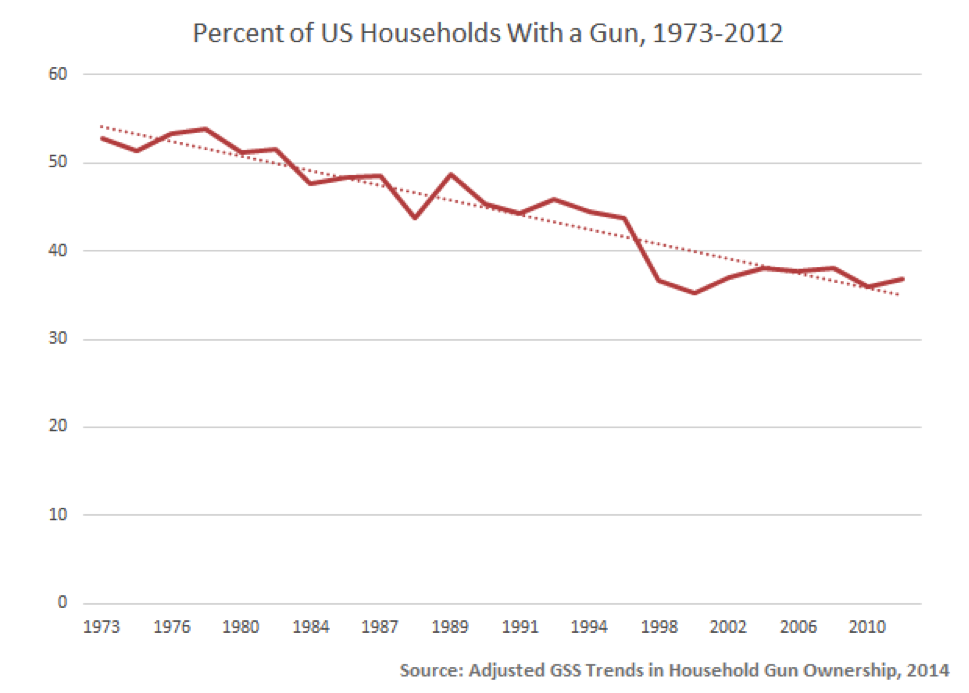
Moreover, gun ownership in the United States has been declining, both before and throughout the process of militarizing law enforcement. The 1980s saw early stirrings of it, with the spread of SWAT teams and Reagan-era “tough on crime” policies. It grew in the mid-1990s under the Clinton administration, which authorized the DoD’s 1033 program, expanding and formalizing the process for giving military gear to police. Finally, after 9/11, militarization took off in earnest, with two wars, paranoia about terrorism, a booming defense industry, and billions of dollars in Homeland Security money to drive it.

Meanwhile, rates of gun ownership through the U.S. dropped or stagnated. Winkler drops the oft-quoted and often misunderstood statistic that there are “320 million guns in the United States, approximately one per person,” but apparently doesn’t recognize that this stat doesn’t mean everyone gets a gun. (A good way to check: Look around you. Do you see any guns? No? Okay, myth busted.) Today, the actual rate of gun ownership is just 34 percent, down from an average of over 52 percent in the 1970s.

Not only is gun ownership down, so is crime—dramatically so. Starting in 1990, and continuing through recessions, terrorist attacks, and wars, crime has fallen. Murder, rape, robbery, assault—even property crimes—are all down. Cops toting .50 caliber machine guns and driving landmine-resistant vehicles cannot be responding to an epidemic of violence, because one simply doesn’t exist.

But even if far fewer people own guns and commit crimes than did so in the past, it’s still possible that police officers are uniquely under threat in recent years. Maybe killings, assaults, and injuries of police are on the rise. But they’re not.

In every way, this theory fails to align with the facts. Not only is gun ownership down, but so are crime and attacks on police. Private gun ownership is not responsible for militarization, racial profiling, or tensions with police.

But Winkler is right about one thing: Police officers are being taught to be paranoid about citizens and guns, and that fear is being channeled against minorities, from ATF stings targeted at poor blacks and Hispanics, to New York’s racist stop-and-frisk program, to New Jersey’s felony prosecution of a single mom who tried to do the right thing.

But the reason isn’t that there is more of a threat than there used to be. It’s that people are being systematically misinformed—by reporting like Winkler’s—about the risks they actually face. Telling poor minorities that hostilities with police are really partly their fault—and that if they would just give up their guns, everything would be okay—is not just absurd, it’s actively harmful.

Daniel Bier is the executive editor of The Skeptical Libertarian. He writes on issues relating to science, skepticism, and economic freedom, focusing on the role of evolution in social and economic development.

This article was originally published by The Foundation for Economic Education.
What Have We Accomplished in Iraq? – Article by Ron Paul

What Have We Accomplished in Iraq? – Article by Ron Paul

The New Renaissance Hat
Ron Paul
August 17, 2014
******************************
We have been at war with Iraq for 24 years, starting with Operations Desert Shield and Storm in 1990. Shortly after Iraq’s invasion of Kuwait that year, the propaganda machine began agitating for a US attack on Iraq. We all remember the appearance before Congress of a young Kuwaiti woman claiming that the Iraqis were ripping Kuwaiti babies from incubators. The woman turned out to be the daughter of the Kuwaiti ambassador to the US and the story was false, but it was enough to turn US opposition in favor of an attack.
***

This month, yet another US president – the fifth in a row – began bombing Iraq. He is also placing in US troops on the ground despite promising not to do so.

The second Iraq war in 2003 cost the US some two trillion dollars. According to estimates, more than one million deaths have occurred as a result of that war. Millions of tons of US bombs have fallen in Iraq almost steadily since 1991.

What have we accomplished? Where are we now, 24 years later? We are back where we started, at war in Iraq!

The US overthrew Saddam Hussein in the second Iraq war and put into place a puppet, Nouri al-Maliki. But after eight years, last week the US engineered a coup against Maliki to put in place yet another puppet. The US accused Maliki of misrule and divisiveness, but what really irritated the US government was his 2011 refusal to grant immunity to the thousands of US troops that Obama wanted to keep in the country.

Early this year, a radical Islamist group, ISIS, began taking over territory in Iraq, starting with Fallujah. The organization had been operating in Syria, strengthened by US support for the overthrow of the Syrian government. ISIS obtained a broad array of sophisticated US weapons in Syria, very often capturing them from other US-approved opposition groups. Some claim that lax screening criteria allowed some ISIS fighters to even participate in secret CIA training camps in Jordan and Turkey.

This month, ISIS became the target of a new US bombing campaign in Iraq. The pretext for the latest US attack was the plight of a religious minority in the Kurdish region currently under ISIS attack. The US government and media warned that up to 100,000 from this group, including some 40,000 stranded on a mountain, could be slaughtered if the US did not intervene at once. Americans unfortunately once again fell for this propaganda and US bombs began to fall. Last week, however, it was determined that only about 2,000 were on the mountain and many of them had been living there for years! They didn’t want to be rescued!

This is not to say that the plight of many of these people is not tragic, but why is it that the US government did not say a word when three out of four Christians were forced out of Iraq during the ten year US occupation? Why has the US said nothing about the Christians slaughtered by its allies in Syria? What about all the Palestinians killed in Gaza or the ethnic Russians killed in east Ukraine?

The humanitarian situation was cynically manipulated by the Obama administration —  and echoed by the US media — to provide a reason for the president to attack Iraq again. This time it was about yet another regime change, breaking Kurdistan away from Iraq and protection of the rich oil reserves there, and acceptance of a new US military presence on the ground in the country.

President Obama has started another war in Iraq and Congress is completely silent. No declaration, no authorization, not even a debate. After 24 years we are back where we started. Isn’t it about time to re-think this failed interventionist policy? Isn’t it time to stop trusting the US federal government and its war propaganda? Isn’t it time to leave Iraq alone?

Ron Paul, MD, is a former three-time Republican candidate for U. S. President and Congressman from Texas.

This article is reprinted with permission from the Ron Paul Institute for Peace and Prosperity.

Lessons on Dictatorship in Da Chen’s “Colors of the Mountain” (2003) – Essay by G. Stolyarov II

Lessons on Dictatorship in Da Chen’s “Colors of the Mountain” (2003) – Essay by G. Stolyarov II

The New Renaissance Hat
G. Stolyarov II
July 29, 2014
******************************
Note from the Author: This essay was originally written in 2003 and published in two parts on Associated Content (subsequently, Yahoo! Voices) in 2007.  The essay received over 500 views on Associated Content / Yahoo! Voices, and I seek to preserve it as a valuable resource for readers, subsequent to the imminent closure of Yahoo! Voices. Therefore, this essay is being published directly on The Rational Argumentator for the first time.  
***
~ G. Stolyarov II, July 29, 2014

**

A Glimpse into the Mindset of a Dictator


In Colors of the Mountain, the autobiography of Da Chen, the author relates an interesting episode from his life as a student in the Chinese schools. As Chinese schools rapidly convert from anti-intellectualism to centers of educational encouragement, the quotes of Chairman Mao are used to uphold the new shift. Yet Chen comments on Mao’s incompatibility with genuine intellectual progress.

“It was ironic to bring Mao into this drive for intellectual excellence. If Mao had known what his Little Red Guards were doing, he would have howled like a lonely wolf in his icy coffin and cried his smoke-ridden lungs out. Mao, the dictator, was the friend of the devils…” (256)

This passage directly and brilliantly unveils the essence of dictatorship and the means by which a dictatorial entity seeks to maintain its power. The philosophy of Mao the dictator had been to foster perpetual conflict among the Chinese and create the impression of an imminent crisis where none existed. In the words of the author, Mao “made fake smoke over fake fires.”

The mindset of the dictator suggests to him that his subjects will flock to his side at a time of urgency, while peace and prosperity will breed unrest, and, worse, an across-the-board desire for individual autonomy. Chen shows the consequences of this approach with a chillingly perceptual flair: “And strewn down his long path lay the bones of millions of angry ghosts.”

The soil in which autocracy springs its roots is chaos and suffering; this is required to drain resources from the general population for the alleviation of the imagined threat, as well as for the amassing of attitudinal support for the dictator’s initiatives. All the while, it is key to keep the masses ignorant and quell intelligent dissent, as Mao’s Red Guards had undertaken throughout China during the Cultural Revolution.

It is quite convenient for the dictator to brand as the source of the newest “crisis” those autonomous individuals with the greatest potential to establish social justice. This, in effect, kills two birds with one stone. Hence, extending Mao’s policy to its logical conclusion, it would come as no surprise that the man was categorically averse to any genuine, objective education.

Mao’s ruling style reminiscent of another masterful analysis of a totalitarian regime, George Orwell’s 1984, in which the collectivist ruling elites overtly claim that the purpose of their power is to inflict suffering and thereby secure their power, in brazen disregard for standard of living, while squandering the country’s resources on a perpetual world war.

Control from Beyond the Grave

***

In Colors of the Mountain, the young Da Chen is declined the opportunity to attend Chairman Mao’s funeral ceremony and laments this, as he has developed a vague cultist devotion to him. Da recalls,”As though the rift between the Red families and the landlords’ families were widened by the death of Mao, I was told by the school authorities not to attend the ceremony…” (138).

Despite the horrendous harm inflicted by Mao’s policies upon his family, Da Chen continues to harbor a mentality of unquestioned devotion to authority, whoever may hold such a position. His social upbringing has inculcated him with a mindset of never seeking to analyze Mao’s actions, for “he was wiser, no, the wisest.”

The submission of Da is Mao’s even beyond the grave, even though the physical control of the dictator over the lives of the Chinese people has already crumbled and been replaced with a more benign regime. The general Communist Chinese sociocultural milieu preaches that the people exist to serve the government and scorns the individualist philosophies of the Enlightenment.

Despite his striving for individual success and his recognition of the colossal obstacles placed in his way by Mao’s regime, Da cannot help but absorb this perception, almost subconsciously. There are numerous references to this: “I had been told…,” “I was to follow him…,” “I didn’t know any better,” “A cult mentality had already been forged in me…”

This is the consequence whenever an individual rejects the laws of objective reality in favor of the arbitrary edicts of other people. Because the laws of reality can be grasped by reason and authoritarian whims cannot, the individual’s rational sovereignty is discarded and he comes to worship that which possesses the greatest potential of harming him.

Simultaneously, this devotion to authority will never ingratiate the outcast individual with the elites of his society. Just as Da’s former record of academic excellence had failed to advance his prospects for a successful future, so does his reverence for Mao fail to convince the elites of his community to permit him to attend the funeral ceremony. The intent of authoritarianism is not to reward those who espouse love for it, but to punish invented “enemies” by deprivation or outright assault.

In Colors of the Mountain, Da Chen powerfully demonstrates that a cultic devotion to another human being, especially a powerful and brutal one, is always a self-defeating proposition. Dictators such as Mao are always thirsty for the blood of the innocent; the devotion of the latter will merely fuel the destroyers’ appetites.