Browsed by
Category: Philosophy

Individualism, Objective Reality, and Open-Ended Knowledge – Article by G. Stolyarov II

Individualism, Objective Reality, and Open-Ended Knowledge – Article by G. Stolyarov II

The New Renaissance Hat
G. Stolyarov II
September 11, 2013
******************************

I am an individualist, but not a relativist. While I have no dispute with individuals determining their own meaning and discovering their own significance (indeed, I embrace this), this self-determination needs to occur within an objective physical universe. This is not an optional condition for any of us. The very existence of the individual relies on absolute, immutable physical and biological laws that can be utilized to give shape to the individual’s desires, but that cannot be ignored or wished away. This is why we cannot simply choose to live indefinitely and have this outcome occur. We need to develop technologies that would use the laws of nature to bring indefinite longevity about.

In other words, I am an ontological absolutist who sees wisdom in Francis Bacon’s famous statement that “Nature, to be commanded, must be obeyed.” Individual choice, discovery, and often the construction of personal identity and meaning are projects that I embrace, but they rely on fundamental objective prerequisites of matter, space, time, and causality. Individuals who wish to shape their lives for the better would be wise to take these prerequisites into account (e.g., by developing technologies that overcome the limitations of unaided biology or un-transformed matter). My view is that a transhumanist ethics necessitates an objective metaphysics and a reason-and-evidence-driven epistemology.

This does not, however, preclude an open-endedness to human knowledge and scope of generalization about existence. Even though an absolute reality exists and truth can be objectively known, we humans are still so limited and ignorant that we scarcely know a small fraction of what there is to know. Moreover, each of us has a grasp of different aspects of truth, and therefore there is room for valid differences of perspective, as long as they do not explicitly contradict one another. In other words, it is not possible for both A and non-A to be true, but if there is a disagreement between a person who asserts A and a person who asserts B, it is possible for both A and B to be true, as long as A and B are logically reconcilable. A dogmatic paradigm would tend to erroneously classify too much of the realm of ideas as non-A, if A is true, and hence would falsely reject some valid insights.

These insights illustrate the compatibility of objective physical and biological laws (physicalism) with individual self-determination (volition or free will). There is a similar relationship between ontology and ethics. An objective ontology (based on immutable natural laws) is needed as a foundation for an individualistic ethics of open-ended self-improvement and ceaseless progress.

Paradoxes, Not Contradictions – Post by G. Stolyarov II

Paradoxes, Not Contradictions – Post by G. Stolyarov II

The New Renaissance Hat
G. Stolyarov II
September 10, 2013
******************************

I am personally fond of Ayn Rand’s identification of certain matters as “paradoxes, but not contradictions”. In my view, contradictions do not exist in reality, though there may be elements that are difficult to reconcile mentally because of incomplete information or preliminary errors in one’s perception of existence.

A paradox arises when a person’s initial intuitions do not appear to hold. This means that either the initial intuitions are wrong, or one’s information is incomplete. For instance, the famous “water-diamond paradox” of Classical economics was an inability to explain why the price of water, which is essential for life, was so much lower than the price of diamonds, which, at the time, only had uses in jewelry and decoration. The 1871 Marginalist Revolution (a development independently arrived at by Carl Menger, Leon Walras, and William Stanley Jevons) resolved the paradox by explaining a key fact about human valuation that the Classical economists had missed – namely, that a person does not evaluate the entire stock of a given good, but only considers particular quantities of goods at the margin. So the paradox was resolved in an entirely rational, non-contradictory manner, by demonstrating that the abundance of water has enabled its life-sustaining uses to be fulfilled for most individuals, while the relative scarcity of diamonds means that, for most consumers, any diamond they obtain would be put to the highest-valued purpose they would find for a diamond.
***

I see the progress of human civilization as, in part, consisting of the increasing resolution of paradoxes. While, of course, it is possible that new paradoxes would arise as the old ones are resolved, these paradoxes arise on the boundaries of the new intellectual territory that is yet to be fathomed and incorporated into the domain of human mastery. Paradoxes, mysteries, and unresolved questions occur on the outermost edges of human advancement at any given time. As the edges expand, old mysteries and paradoxes are solved and new ones may arise in territory that was previously completely unexplored. In this sense, encountering a paradox can be seen as a challenge – a call to resolve the quandary and thereby score gains for human progress. As a meliorist who sees no limits to the potential of human reason and technology, I think that all questions are ultimately answerable and all paradoxes are solvable, given enough time, effort, and proper means. Sometimes the resolution of a paradox requires highly creative, unorthodox, and unprecedented thinking – which must transcend conventional dichotomies and posited antagonisms in order to arrive at a new understanding.

War in the Middle East is Inherently Collectivist – Article by G. Stolyarov II

War in the Middle East is Inherently Collectivist – Article by G. Stolyarov II

The New Renaissance Hat
G. Stolyarov II
September 8, 2013
******************************

Especially in light of the looming threat of a wasteful, counterproductive US military intervention in Syria, it is necessary to offer a resounding refutation to the recommendations of those who consider themselves individualists to engage in any sort of mass military action – commonly known as war, declared or not – against large numbers of people in the Middle East. Some such persons, especially those affiliated with the Ayn Rand Institute (ARI), advocate a foreign policy more aggressive and, in its consequences, far more destructive than even the actual interventionist measures undertaken by the United States federal government during the Bush and Obama administrations. In a recent speech at the 2013 Steamboat Institute Freedom Conference, Yaron Brook, ARI’s executive director, put forth his recommendation for solving the persistent threat of politicized Islamist regimes and the terrorism that stems therefrom: completely destroy either Iran or Saudi Arabia and threaten the surviving country into submission. Brook also reaffirmed his consideration of General William Tecumseh Sherman, one of the first practitioners of modern “total war” and an instigator of untold damage to the lives and property of innocent civilians during the American Civil War, as his personal hero.  As an advocate of reason, a person of conscience, and a staunch individualist, I strongly, emphatically object to this course of action. As foreign policy goes, I cannot think of one less productive, other than perhaps indiscriminately launching nuclear weapons everywhere.

In March 2012 I made a video, “Refuting Ayn Rand on War”, where I specifically described my objections to Rand’s and Brook’s advocacy of warfare. I refer there to some of Brook’s previously stated views, including his admiration of William T. Sherman, which he again articulated during his Steamboat Institute speech. While most of Brook’s speech is sympathetic in its emphasis on individual freedom and a rolling-back of the economic burdens imposed by the federal government domestically, his foreign policy would clearly undermine this path. Indeed, if one wishes to reduce the scope of the federal government and its intrusiveness into individuals’ lives, deep cuts on both the domestic and foreign fronts are needed. US government debt is already spiraling out of control, and it would not be practically feasible to balance the budget (avoiding increased taxation, inflation, or borrowing) without cutting military spending and eliminating numerous wasteful and deleterious foreign occupations. As long as self-proclaimed individualists, libertarians, and fiscal conservatives resist an enormous reduction in US military budgets and overseas intervention, at least one, and probably all, of the three consequences of continued budget deficits will inevitably occur.

But there is a deeper, moral case to be made against war in general. Some might allege that this time it is different. But when was it ever not different? The regime of the Soviet Union posed a far greater danger to liberty in the 20th century than rag-tag groups of fundamentalist Islamist terrorists and the regimes backing them ever could. Yet war between the United States and the Soviet Union was fortunately averted, aside from some admittedly destructive proxy wars, and billions of innocent people can live in relative peace and comfort today due to the avoidance of nuclear Armageddon through a more restrained foreign policy than the “hawks” of the Cold War era advocated.  I do not oppose targeted strikes that specifically eliminate violent terrorists and only such individuals. A good example of this was the raid that killed Osama bin Laden in 2011. However, a state of war is completely unnecessary to carry out such limited actions.

War attacks not just an armed band of terrorists, not just a regime, but an entire country and its people. This is especially true since the shift in the 19th century away from limited battlefield engagements involving professional armed servants (and mercenaries) of powerful interests competing for natural resources and prestige, and toward “total war” fueled by nationalistic and ideological animosities – where all of a country’s population is considered “the enemy” or at least an asset to “the enemy”. Such warfare is inherently collectivistic in its premise. It fails to recognize that individuals ruled by hostile regimes or terrorized by armed criminals still have minds of their own, that they may disagree with and indeed be oppressed by those regimes and criminals. Targeted assassinations of dictators and terrorist leaders are one matter, but indiscriminate “collateral damage” against peaceful civilians is morally unacceptable for an individualist. Anyone claiming to follow the philosophy of Ayn Rand, including Ayn Rand herself, should know (or, in Rand’s case, should have known) better.

The current case of violent crime fueled by fundamentalist Islamist ideology is no exception. The world has over a billion Muslims, who are overwhelmingly peaceful (like most adherents of all major religious and ideological systems), even if one legitimately considers them mistaken in their theological beliefs. Many prominent Muslims have condemned the attacks of September 11, 2001, and other attacks on peaceful civilians in the West. Some Muslims are secular in their political outlook and, indeed, have made efforts to maintain secular governments in the face of threats by Islamist political parties to implement sharia law and religiously motivated restrictions on personal freedom. The revolutions in Egypt, Tunisia, and Libya, despite their sub-optimal outcomes and the eventual emergence of dominant factions advocating the politicization of religion, were initially driven by freedom-respecting, secular, yet largely Muslim individuals. These people set the spark for the overthrow of the long-standing authoritarian tyrannies of Mubarak, Ben Ali, and Gaddafi. They now contend against political Islam in their troubled countries, but it is essential for any individualist to respect them and their plight, and for any government that even pretends to respect freedom to leave them alive to have any positive influence of which they are capable. Often, the infighting within the turmoil-ridden Middle East results in tragedy on all sides; surely, this ought to be the glaring lesson of the current Syrian situation. However, American bombs, missiles, and drones are surely not the answer. These weapons kill indiscriminately. Even drone attacks allegedly “targeted” toward terror suspects (still often without due process or convincing evidence of their criminal intent) end up killing far more innocent bystanders, including children, than actual would-be terrorists. Are the relatives, friends, and acquaintances of the victims going to acknowledge the “moral legitimacy” of their deaths by the brutal calculus of Yaron Brook and those who think like him? Or, more realistically, are they going to experience a justified outrage and forever despise the government – and, if they are themselves collectivists in mindset – the entire country and people whom they blame for these terrible killings?

There is no quick, easy solution to the turmoil in the Middle East, nor to the violent threats that such turmoil sometimes poses to the lives of people in the Western world. However, there are some clear changes of direction that can gradually curtail the major risks.  First, it is essential for governments in the Western world to refrain from actions that curtail the liberties of their own citizens, allegedly to respond to this threat. In fact, the terrorists and political Islamist regimes have won a greater victory than they could ever have achieved by force of arms, as a result of the pervasive civil-liberties violations instigated by Western governments since September 11, 2001. The omnipresent surveillance, the bodily violations at airports, the increasing militarization of the police force surely have more in common with a totalitarian regime than with the freedom that the fundamentalist terrorists allegedly hate. The more aggressive American military interventions become, the more animosity and blowback they generate, the more inclined Western governments will be to crack down on their own citizens’ freedoms further. Thus, militarism abroad directly causes unfreedom at home – as it has during every major war in American History, from Lincoln’s imprisonment of dissident newspaper editors during the Civil War, to Woodrow Wilson’s World War I propaganda machine and imprisonment of opponents of the military draft, to Franklin Roosevelt’s internment of 110,000 Japanese-Americans during World War II. The present period of the never-ending “War on Terror” is no exception. There is no way for a government to respect individualism and the rights of its own citizens while it turns civilians abroad into fodder for bombs and drone strikes.

Second, it is essential to treat “acts of terror” no differently from “ordinary” crimes – attacks on human lives and property. The criminal-justice system has various ways of dealing with gangsters, murderers, street muggers, arsonists, and common vandals. Domestically, the same standards should apply toward the same acts, no matter whether or not they were motivated by Islamist ideology. A person who bombs a building or a public event is a criminal murderer and should be dealt with accordingly. It is time to dismantle the exceptional category of “terrorist acts” as distinct from ordinary crime. That category is the linchpin by which all of our Constitutional freedoms have been rendered moot. As regards armed military-style groups operating abroad, it is acceptable to use truly targeted strikes limited to neutralizing members of those groups (and not “signature strikes” that attack an entire area, irrespective of the known presence of militants). But this is not war against an entire people or even a government; it is more akin to a targeted action. As former Representative Ron Paul has recommended since the September 11 attacks, issuing Letters of Marque and Reprisal specifically against such militants is a desirable, Constitutionally authorized remedy quite distinct from war.

Finally, to end the threat of militant attacks on Westerners, it is essential for the Middle East itself to become transformed over time, both economically and culturally, into a place where individual rights and intellectual progress are fundamentally respected and appreciated. Bombs could never effectuate such transformation; they only breed hatred and backlash. Instead, individuals and companies in the West should entice the Middle East to join them on a more enlightened trajectory. Commerce and cultural diffusion can bring economic opportunity and prosperity to millions who are currently in dire poverty. Ayn Rand recognized and appreciated the power of free-market capitalism to bring not just peace and prosperity, but moral elevation, to vast numbers of people. This should be the path embraced by decision-makers in the West, echoing the sage advice of Thomas Jefferson: “peace, commerce, and honest friendship with all nations, entangling alliances with none”. Over the coming decades, a steady application of this approach will diminish the militant threat, though not overnight. Still, it is a far preferable alternative to the recommendations of those whose policy of mass destruction would only fuel the fires of militant attacks and reduce Western governments, militaries, and their supporters to the same level of inhuman barbarism against which they are allegedly defending us.  True individualism – indeed, true humanism – would demand no less than a complete rejection of the killing of innocent civilians as a solution to any problem.

Longevitize!: The Master Compendium for the Life-Extension Movement – Post by G. Stolyarov II

Longevitize!: The Master Compendium for the Life-Extension Movement – Post by G. Stolyarov II

The New Renaissance Hat
G. Stolyarov II
September 7, 2013
******************************

longevitize2013_med

Longevitize!: Essays on the Science, Philosophy & Politics of Longevity is a new and (literally) vital compilation, edited by Franco Cortese, which assembles perhaps the widest array of resources on radical life extension in one location. You can read a detailed description of the book here. Cortese’s ambitious projects have breathed new life into the transhumanist and immortalist movements, and Longevitize promises to be perhaps his most influential contribution to date, illustrating a thorough grasp of the current state of the efforts to defeat senescence and enable humankind to transcend its primordial limitations.

In addition to 164 articles representing diverse perspectives about the scientific, philosophical, and political aspects and implications of indefinite life extension, this compendium includes an immensity of links to external resources, including books, articles, and videos. I am proud that my Resources on Indefinite Life Extension (RILE) page formed the crux of the book’s Appendix II. Longevitize permits the reader to delve as deeply as can be desired into studying the feasibility, desirability, and possibilities for implementation of the defeat of senescence and involuntary death.

I am proud to have contributed 27 essays to this anthology, spanning 9 years of my thinking and writing on the prospect of indefinite longevity. In addition, the excellent cover was designed by my wife Wendy Stolyarov, incorporating Maxim Vorobiev’s 1842 painting, “Oak fractured by a lightning bolt. Allegory on wife’s death.” Death destroys our irreplaceable individual universes much like that lightning destroyed the tree. It is time to put an end to this travesty, and Longevitize offers an amazing toolkit and intellectual foundation for doing so. Buy this book, read it, and use it in your further intellectual explorations – including your writing, research, argumentation, and activism.

Right now, Longevitize! is available as an e-book for $9.99, both in PDF and MOBI formats, from Amazon. A hard-copy version is currently being prepared.

Transhumanism as the Logical Extrapolation of Humanism – Post by G. Stolyarov II

Transhumanism as the Logical Extrapolation of Humanism – Post by G. Stolyarov II

The New Renaissance Hat
G. Stolyarov II
September 6, 2013
******************************

When discussing the relationship between transhumanism and humanism, some would claim that transhumanism rejects humanism due to the latter’s limiting aspects, while others hold that transhumanism is the logical extrapolation of humanism. I firmly adhere to the latter view.

The Wikipedia definition of humanism is rather broad: “Humanism is a group of philosophies and ethical perspectives which emphasize the value and agency of human beings, individually and collectively, and generally prefers individual thought and evidence (rationalism, empiricism) over established doctrine or faith (fideism).” Historically, the advocacy of human agency and value has often led to humanists resisting static definitions of “human nature” (for instance, as advocated by various premodern religions) in favor of a melioristic view of progress and human potential. My own essay, “Human Nature is Tautological” (also available in video form) is an example of this position.

Indeed, I have often thought that humanism and transhumanism are separated only by the degree of emphasis on human improvability. Transhumanism takes the melioristic aspirations of humanism to a new level by emphasizing the power of technology to radically transform human lives by lifting age-old limitations. But nothing in humanism per se would resist such a radical transformation. Transhumanism, in my view, accepts the core values of humanism and takes them further in light of the recognition of technological possibilities, particularly as regards radical life extension and extension of human reach to both the mega-scale (space colonization and giant construction projects) and to the nano-scale (nanotechnology and its applications to manufacturing and medicine).

Responses to an Inquiry on Ethics, Human Purpose, and the Future of Humanity – Article by G. Stolyarov II

Responses to an Inquiry on Ethics, Human Purpose, and the Future of Humanity – Article by G. Stolyarov II

The New Renaissance Hat
G. Stolyarov II
September 5, 2013
******************************

A recent philosophical exchange with reader Elu Sive on TRA’s “About Mr. Stolyarov” page was sufficiently interesting and constructive that I have decided to post it here for a general audience. Elu Sive raised ten points of view and requested my feedback, which I subsequently provided. Here, I will cite each of the points and my response.

Elu Sive Point 1: “There is an objective reality.”

My Response: I agree in full.

Elu Sive Point 2: “The purpose of democracy is mainly a means of fighting corruption and promoting the interests of the people as opposed to those in power. It is not a valid method to select the correct answer among alternatives and should never be used as such.”

My Response: I agree. The will of the majority does not determine truth, nor does it necessarily coincide with good policy. Moreover, most decisions should be left up to individuals to implement, so long as such implementation can be done non-coercively. Democracy is only useful in the highly limited context where conflicts of preference are unavoidable and necessarily involve some people’s preferences being overridden. For instance, if only one person can be the neighborhood sheriff, then it makes sense to put the issue to a majority vote. However, even then, the powers of the neighborhood sheriff should be highly limited to the protection of individual rights, and not their violation.

Elu Sive Point 3: “Science is the best method we have for evaluating what is true and not.”

My Response: I agree, especially when science is defined broadly to include logic and mathematics. More generally, rational inquiry based on real-world observation and logical deduction therefrom is the best method we have for evaluating what is true and not.

Elu Sive Point 4: “Our human existence is only meaningful in our social contexts, to our selves and to future generations (our existence is not meaningful in universal or spiritual fashion).”

My Response: Here I disagree. Our existence is meaningful per se and as the antecedent to all meaning and value. My video series “Life as the Basis of Morality” (see Part 1 and Part 2) explains my reasoning. I agree with Ayn Rand’s statement: “I need no warrant for being, and no word of sanction upon my being. I am the warrant and the sanction.”

Elu Sive Point 5: “We should place a greater emphasis on our social context and future generations than on our selves. We should favor altruism over self-reliance.”

My Response: Here I also disagree. While I advocate considering the future and taking a longer-term view of one’s actions, as well as considering one’s impact on the world and on others, all of this should be done to promote one’s own enlightened, rational self-interest, particularly in the continuation of one’s own life and flourishing. Each individual is, by nature, best suited to promote his own well-being. In promoting his own well-being, the individual should be concerned about the well-being of others and should seek ways to exchange values with others to promote mutual flourishing. Complete autarky is impossible and undesirable; we can gain great values and improve our lives tremendously by interacting with others. However, each individual’s moral self-reliance – in the sense of thinking for oneself, acting out of one’s own initiative, and valuing one’s own productive work and independence from subjugation to the arbitrary dictates of others – is paramount for creating a world where human flourishing is maximized to the extent possible.

Elu Sive Point 6: “What classifies as common good depends on circumstances and must be continuously re-evaluated.”

My Response: What is good for people does depend on the specific context, but it is still rooted in objective requirements of human survival and flourishing. As a simple example, there are some items that can give our bodies energy if we consume them, while there are others that would poison us. The objective requirements of human survival and flourishing depend on the laws of nature, which are universally valid, though their applicability will differ based on the context. The correct answer in a given situation is like the correct choice of tool for constructing a building; it depends on what part you are working on, with what materials, in what setting, and for what goal (in terms of the values you are trying to realize). Multiple answers will be good enough for a particular problem, but some answers are clearly superior to others in achieving human survival and flourishing. That being said, it is important to continually use one’s rational faculty to evaluate the soundness of possible approaches on a case-by-case basis.

Elu Sive Point 7: “Our social context is only meaningful in the long-term context of supporting and improving human civilization, or a possible post-human civilization.”

My Response: I agree with the goal of improving human and possibly post-human civilization (though I prefer the term “transhuman”, since I think that technological transformations will amplify and supplement our humanity, enabling us to transcend existing limitations, rather than take our humanity away). I think that human societal interactions can serve multiple valuable purposes both in the immediate term and in the long term. In the immediate term, it is certainly good that grocery stores exist in one’s vicinity to enable one to obtain food and other conveniences. The shorter-term interactions, as long as they are compatible with long-term perspectives and values, can certainly be of value as well.

Elu Sive Point 8: “The defining character of our age as judged by future civilization will be: short-shortsightedness and extreme individualism.”

My Response: I agree that there is considerable short-sightedness in our era, though it is probably less than in previous eras, when the average human lifespan was several times shorter than today. The extreme individualism, though, is not a phenomenon that I observe. I see all too many people bound by thoughtless traditions and norms, while refusing to think about matters on principle (instead of being attached to the concrete institutions and thought patterns that are fed to them by “opinion leaders” and the surrounding culture). The true individualist, who takes charge of his own life and is willing to engage in innovative thinking which transforms the world, is quite rare still. If asked to characterize our era, I would describe it as a time when the knowledge to solve many of the world’s problems is already available and accessible, but the willpower to solve these problems and overcome the constraints of obsolete institutions is lacking. I also see our era as characterized by a race between accelerating technological progress and increasingly outrageous authoritarian intervention.

Elu Sive Point 9: “We should practice future-oriented altruism: just as we care for others in our immediate vicinity in order to create a better life for everyone, we should care for our [descendants] as predecessors have, or we wish them to have had.”

My Response: I agree that we should look forward into the future and consider how life would be then, and how our current actions would affect future living conditions. I do not think that our focus should solely be on future beings, though. I hope to personally see a better future, and to structure my actions to maximize my chances. I am, though, happy to have been born into a world where the many generations of humans before me have already created an infrastructure of knowledge and capital to enable a relatively comfortable way of life. The great challenge of our time is to secure our lives against the still-omnipresent forces of ruin, death, and decay.

Elu Sive Point 10: “We should aim to replace humanity with post-human beings, remedied from most of the flaws that plague the human psyche and physiology today and in the past.”

My Response: I agree with remedying existing human flaws and transcending human limitations, with the important caveat that I consider such actions to be consistent with and to amplify humanity. Importantly, I think that we ourselves should be the beneficiaries of these improvements, through new medical treatments and augmentations (especially radical life extension), as well as the eventual integration of biological and non-biological components.

Combatting the “Longer Life Will Slow Progress” Criticism – Article by Franco Cortese

Combatting the “Longer Life Will Slow Progress” Criticism – Article by Franco Cortese

The New Renaissance Hat
Franco Cortese
September 2, 2013
******************************

We are all still children. As far as the Centenarian is concerned, the only people to have ever lived have been children – and we have all died before our coming of age.

What if humans only lived to age 20? Consider how much less it would be possible to know, to experience, and to do. Most people would agree that a maximum lifespan of 20 years is extremely circumscribing and limiting – a travesty. However, it is only because we ourselves have lived past such an age that we feel intuitively as though a maximum lifespan of 20 years would be a worse state of affairs than a maximum lifespan of 100. And it is only because we ourselves have not lived past the age of 100 that we fail to have similar feelings regarding death at the age of 100. This doesn’t seem like such a tragedy to us – but it is a tragedy, and arguably one as extensive as death at age 20.

Another reason informing our concern with death at age 20 and our relative ease with death at 100 is the notion of living long enough to do enough. Death at age 20 for the most part seems to preclude such experiences as parenthood, to birth a child and watch him grow into personhood, whereas a 100-year-old will have had enough time to have children, to watch them grow, to work and to enjoy the fruits of his or her labor through leisure in retirement. Our ignorance regarding the real scope of possibility, of possible experience and possible modes of existence, also informs our relative unconcern with death at age 100. We feel that there is a limited number of things for one to do in life, or at least things that are qualitatively unique enough to be considered as being truly distinguishable from the rest.

But we couldn’t be more wrong. It’s hard to step outside culture sometimes, and easy to naively look upon a foreign culture as embodying but a very limited number of archetypes and stereotypical caricatures of their true depth and diversity. There are more contemporary cultural traditions and conditions that can be practiced and experienced than there are years to actually do so. Likewise, there is more history to learn about than time available. The current breadth and depth of the world and its past are far too gargantuan to be encompassed by a mere 100 years. If you really think that there are only so many things that can be done in a lifetime, you simply haven’t lived long enough or broadly enough. There is more to the wide whorl of the world than the confines and extents of our own particular cultural narrative and native milieu.

More than this, the startling diversity of the world and stark heterogeneity of history are only set to continue their upward growth into spaces unknown as we move into the plethora of futures before us. More information is being produced than can be kept up with. Culture has always been changing, but today the pace of that change is swifter than ever before. The thought that boredom would ever be an issue to longer-living people is simply laughable. Not only does the world currently contain more than it is possible to know in a single century, but it is accumulating ever more depth and diversity every day, and at an accelerating pace. You couldn’t catch up with history in the first place, and you’re sure to gain more ground to cover than you can possibly encompass, faster than you can get a hold of it, as life expectancy experiences further increases.

Another condition informing our concern with death at 20 and our relative unconcern with death at 100 is the decline of function as we age. Bodily suffering and functional decay increase as one grows with age, and often we look upon the elderly as beings more defined by their encumbrance, by what they have lost, than by what they still possess. What will life be like, we wonder, when bodily motion becomes a battle, and when the simple experience of motion in an embodied world is complimented at every turn and twist by heat, friction, and pain, when living as we once did when young becomes a labor, and leisure is really just that? Or perhaps worse, when our minds begin to fall out from under us, to fail, as we are left to look on in horror from the inside-out, looking in? Lucky for us, we’re wrong; and even if we weren’t, we are still lucky that it is a transient tragedy, a temporary and ultimately remediable one.
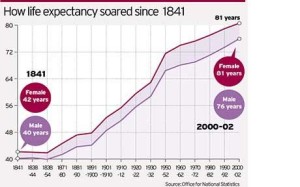
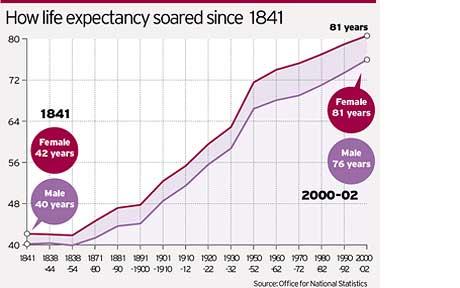
How Life Expectancy Soared Since 1841

These men and women are more than the sum of what they have lost. They are living, breathing, thinking and valuing beings. They are! It’s as simple and stunning as that: they exist! To think that they might be better off, happier, in the rest of death and quiet of last breath – to think that they are beings defined most fundamentally by suffering, and by a comparison of what they no longer are, is not only wrong but perverse. They are living, and life so long as it’s lived should never be defined by suffering, by a lack or comparison of what it isn’t, but rather by what it is and still is. There are exceptions, of course; rapidly debilitating disease, unremitting pain, incomprehensible horror at the slow decay of mind. But I would argue confidently that the elderly are not in constant woe of that which they can no longer do. Like living beings, they deal with it and continue on in the business of being. To consider the elderly as “waiting for the rest and peace of death” is a dangerous and ugly notion, and one very far from the truth.

Luckily, functional decline as a correlate of age is on the way out. We will live to 100 not in a period of decline upon hitting our mid-twenties, but in a continuing period of youthfulness. There are no longevity therapies on the table that offer to truly prolong life indefinitely without actually reversing aging. Death and aging are not separate things or processes; death is when aging has won the battle. Aging is slow death, and a truly-indefinite delaying of death ipso facto necessitates a reversal of aging, and a remediation of the physiological conditions that ultimately lead to death (i.e., what we colloquially call aging). To think that we will be prolonging our lives not as youthful beings of whatever physiological age we so desire but instead as elderly, age-ravaged beings patching new holes and bracing old crutches, is to some extent mistake the cause for the symptom. If we prolong life significantly, we will prolong the healthy portion of our lives first and foremost. The centenarians of next century will look as healthy as the 20-year-olds of last.

Thus, one of the impediments preventing us from seeing death at 100 as a tragedy, as dying before one’s time, will be put to rest as well. When we see a 100-year-old die in future, he or she will have the young face of someone who we feel today has died before their time. We won’t be intuitively inclined to look back upon the gradual loss of function and physiological-robustness as leading to and foretelling this point, thereby making it seem inevitable or somehow natural. We will see a terribly sad 20-year-old, wishing they had more time. We will be able to envision with vivid viscerality the bright and buoyant things they could be doing were they not bedridden and stricken with sickness unto death.

Moreover, that gradual decline into visually apprehensible old age also highlights another impediment to seeing the elderly as continually growing beings with a future to look forward to rather than fight against. The gradual decline of our mental faculties makes it seem that we would be accumulating experience and memory at a deficit, cumulatively losing the ability to think, judge, remember, and experience. Thus old age conjures to mind more senility than wisdom for many people.

This, too, is less true than delusive. Again, this type of thinking is engendered by comparing what they seem to be with what they aren’t or once were. In any case, it will be even less true in the future, when longevity therapies restore our mental health to its youthful glory. Then, the prospect of ever-continuing experience and personal growth, ever-accumulating wisdom and knowledge, ever sharper consideration and discernment, is not so intuitively improbable. The claim that we can in fact continue to grow in how smart, ethical, knowledgeable, and deliberative we are will not be so easily balkable when one’s physiological state ceases to be an indicator of one’s chronological age.

Another common criticism of indefinite longevity in regard to the downfalls of old age comes from Max Planck’s statement that science progresses one funeral at a time; that men and women of a given generation become so attached to their theories that they remain attached in the face of contrary evidence, and it takes their very death for new theories to be embraced by new generations unencumbered by the consideration that “after all this time I might actually be wrong after all”. From this sentiment follows the criticism that significantly extending the average human lifespan will slow progress in science by preventing the death those grafted unflinchingly to a given theory. I would argue that such a sentiment stems from the view of the elderly previously defined and defied, namely as beings more defined by what they have lost than by what they have, as beings fighting against the grain of growth. To view the elderly as continually growing beings forces one to see this criticism as somewhat naïve.

Along another line of argumentation, if we assume that this observation is correct and elderly academics refusing to let their own cherished theories die at the hands of the new is a real concern only aggravated by the coming of longevity therapies, then we still have reason to believe that longevity therapies can change the nature of the game by a large enough extent to negate these problematic concerns.

If some people refuse to consider in light of new evidence or perspective that their theory is wrong, refuse to allow the series of thought leading to the realization that all they have worked for is of lesser importance now, the most obvious cause of discontent would seem to be the notion of their own onrushing death. “If my theory is wrong, there isn’t time – or perhaps just youthful vigor – enough to do it all over again from scratch.” Someone worked his lifetime to achieve recognition in his field, and with his death so close around the corner, he faces the prospect of having all that work and worth be devalued by new developments. It is a scary thought, and the notion that people willingly or subconsciously refuse to consider facts that undermine their theory, and its perceived worth in their field, is least conceivable under such conditions. Thusly considered, Planck’s notion doesn’t appear as naïve as it first seemed.

But this is the very concern set to be alleviated by longevity therapies. If the concern with being wrong is most impacted by one’s impeding death, and the fact that one wouldn’t have the time or energy to create another groundbreaking paradigm upheaval in their chosen field should one’s namesake-theory prove to be mistaken, then the arrival of longevity therapies should not only fail to exasperate and aggravate this situation, but indeed may even ameliorate or negate it, allowing people to let their theories go under the comforting thought that they have all the time in the world to do it again.

My friend and peer Gennady Stolyarov II combats this criticism admirably, arguing that such instances occur due to the functional decline that comes with graceless old age, due to senility and a loss of mental flexibility. I think there is definitely some weight and worth to this consideration. And luckily, this, too, is a concern that is alleviated rather than aggravated by the introduction of longevity therapies. Longevity therapies will increase our healthy lifespans rather than stretch out the slow rot of our old age, as remarked earlier. Thus the longevity therapies that many critics argue could exasperate this progress-stalling state of affairs could, along yet another line of argumentation, constitute the very thing that jolts this state of affairs into reform. If senility and loss of mental flexibility contribute to Planck’s notion that life (or more properly the absence of timely death) forestalls scientific progress, then longevity therapies may constitute the source of senility’s demise and mental flexibility’s restoration.

In any case, even if we accept Plank’s notion as true, and conclude that indefinite longevity will aggravate rather than alleviate this state of affairs, faster progress in the sciences or the humanities is no justification for simply doing nothing to negate physically remediable sources of death and disease.

It seems to me a truism that we get smarter, more ethical, and more deliberative as we age. To think otherwise is in many cases derivative of the notion that physiology and experience alike are on the decline once we “peak” in our mid-twenties, downhill into old age – which does undoubtedly happen, and which inarguably does cause functional decline. But longevity therapies are nothing more nor less than the maintenance of normative functionality; longevity therapies would thus not only negate the functional decline that comes with old age, and with it the source of the problem arguably at the heart of the concern that longer life will slow progress even more, but might even constitute the only foreseeable fix to the problem by definition, because indefinite longevity is defined as (or more properly, synonymous with) the maintenance of normative functionality, a.k.a. the indefinite prevention of functional decline. There is no reason to expect that, in a time when we age without functional decline, the ethicality and experience of each human being wouldn’t increase as we age just as they arguably do as we age from two to twenty to thirty.

Increasing longevity will not bring with it prolonged old-age, a frozen decay and decrepit delay, but will instead prolong our youthful lives and make us continually growing beings, getting smarter and more ethical all the time. Indefinite longevity will not slow progress, it will accelerate it! Instead of having thinking, being beings die after ten decades, they can continue to think and be. They can build upon the edifice of their existence and experience continually, reaching heights unheralded in flighty fits and bounds. Moreover, increasingly more and more people may very well be a boon to the momentum of progress. It could be argued that the increasing rate of progress was aided by the increase in global population that preceded it, providing not only more people to have more thoughts, but more people to challenge existing thought and to provide feedback accordingly in forward fashion. Statistically speaking, more people should mean more ideas, and more ideas should mean more good ideas, all else being equal.

Thus indefinite longevity will better progress, not deter it, and will do so on the scale of both self and society. We will continue to grow, to learn, and to yearn. But more than that – we will continue to be – and that in itself is cause for good pause. In all our worry about stalled progress and boredom, we forget that even if indefinite longevity didn’t bring with it a host of advantages and boons to the boom of progress and exalted strife intrinsic to life, the ability to simply continue being is incommunicably better than the alternative, which does nothing but put an end to all other alternatives.

Franco Cortese is an editor for Transhumanity.net, as well as one of its most frequent contributors.  He has also published articles and essays on Immortal Life and The Rational Argumentator. He contributed 4 essays and 7 debate responses to the digital anthology Human Destiny is to Eliminate Death: Essays, Rants and Arguments About Immortality.


Franco is an Advisor for Lifeboat Foundation (on its Futurists Board and its Life Extension Board) and contributes regularly to its blog.

Labels and Ideological Bubbles – Article by Sanford Ikeda

Labels and Ideological Bubbles – Article by Sanford Ikeda

The New Renaissance Hat
Sanford Ikeda
August 30, 2013
******************************

Be mindful of how you label the people with whom you disagree.

***
When I engage in an ideological discussion I try to be sensitive to how I ideologically label the person with whom I’m talking and how she labels me. I’m not talking about dismissive or openly pejorative words (e.g. evil, stupid, silly), but proper terms of discourse. More than just good manners, how we habitually label our opponents in ideological dialogue could reveal something unpleasant about the ideological world we inhabit.
***

Getting the Label Right

***
Now, some people argue that “ideas matter, labels don’t.” When we’re talking about specific ideas, such as for example military intervention in the Middle East, then yes calling it liberal, libertarian, progressive, socialist, or whatever may add nothing to the discussion. But when referring to the worldview of a particular person or group of like-minded persons, especially in the context of a public debate, then how we label ourselves and others can matter a great deal. If the goal is to promote constructive dialogue then it’s important to get the labels right.
***
We prefer in such cases to be called by the label that we identify ourselves with. I don’t like being called a conservative or a liberal because those labels signify sets of ideas and policies, many of which I do not hold. I prefer to be called a libertarian. (Classical liberal might be better but no one in the mainstream knows what that is.)
***
Colleagues I’ve known for decades at my college assume that I’m a conservative because I’ve come out publicly against nationalized healthcare, from which they wrongly infer that I oppose same-sex marriage and that I “support our troops” in foreign wars. Readers of The Freeman have, I’m sure, had to defend themselves against the charge of being “pro-business” because of our skepticism of regulation and high taxes. We have to explain that upholding the free-market is not pro-business, pro-consumer, or pro-labor (although the free-market position is in a sense “pro” all those things and more). That kind of mislabeling, however annoying, can be the result of an honest mistake—one I know I make myself.
***
Mistakenly mislabeling someone is one thing: conservative for libertarian, marxist for progressive. Another is deliberately mislabeling your opponent, a trick that forces her to waste time defending herself against the false charge. But there’s a third kind of mislabeling that reflects a deeper sort of error, one that issues from exclusivity and insularity.
***

Who calls herself a Neoliberal or a Statist?

***
For example, I’m reviewing a book about cities whose author uses the word “neoliberal” a lot. It’s used mostly by Europeans on the political “left”—e.g., social democrats, progressives, socialists, greens—to refer to people or groups who hold some sort of “libertarian” views. I’ll explain in a moment why I’m using scare quotes here.
***
From what I’ve been able to gather from my European colleagues, however, no one actually identifies herself as a “neoliberal.” Neoliberal is apparently a term some attach to positions “on the (extreme) right,” which apparently includes people thought to have an anti-union or pro-business agenda. There are such people, of course, but there’s a reason no one self-identifies as a neoliberal.
***
As Stanley Fish explained a few years ago in The New York Times: “…neoliberalism is a pejorative way of referring to a set of economic/political policies based on a strong faith in the beneficent effects of free markets.” So “neoliberal” is pejorative.
***
And before libertarians get too indignant, let me point out that we sling words like “collectivist” and “statist” when describing our opponents, and to my knowledge no one self-identifies with those terms, either. To be sure, among our ideological comrades, they may have a fairly clear meaning and may spark a certain esprit de corps. But consistently using a word, over a wide range of venues, to describe others that no one ever uses to self-identify is a pretty good sign that you live in an ideological bubble.
***
Evidently, while the author of the book I’m reviewing says she’s writing for “an interdisciplinary readership,” she takes it for granted that it will be an ideologically sympathetic one.
***

Our Ideological Bubbles

***
An ideological bubble, as I’m using the term, is a social network with shared ideological understandings that closes its members off to others with opposing views. You can be a staunch market-anarchist, for example, but still be willing to have a serious, civil conversation with people with whom you strongly disagree. Put simply, you live in an ideological bubble if the only people whom you will talk to seriously about ideology are those you already agree with.
***
An ideological bubble insulates us from real-time criticisms of our principles and positions, retarding our intellectual growth. It gives us a false sense of security and breeds self-satisfaction, off-putting harshness, and intolerance—things destructive to civility. Also, keep in mind that it’s often the bystanders to a debate whom we want to persuade, and they will consider our language and conduct when judging our ideas.
***
One of the things I’ve learned from my great teacher Israel Kirzner is that we can’t realistically be aware of all of our current limitations because we simply don’t know all that we don’t know. We have blind spots, and that means intellectual bubbles of all sorts are inevitable.  But that doesn’t mean that they have to remain invisible to us. Kirzner also taught us that creative discovery is possible. The signs are there, and keeping an eye open to them will give us a chance to make them at least a little more permeable.
***
Sanford Ikeda is an associate professor of economics at Purchase College, SUNY, and the author of The Dynamics of the Mixed Economy: Toward a Theory of Interventionism.
***
This article was originally published by The Foundation for Economic Education.
Free Will and Self-Causation – Article by Leonid Fainberg

Free Will and Self-Causation – Article by Leonid Fainberg

The New Renaissance Hat
Leonid Fainberg
August 26, 2013
******************************

Homo liber nulla de re minus quam de morte cogitat; et ejus sapientia non mortis sed vitae meditatio est.

~ SPINOZA’S Ethics, Pt. IV, Prop. 67

(There is nothing over which a free man ponders less than death; his wisdom is, to meditate not on death but on life.)

Reductionism and its corollary, Determinism, are deeply enrooted in the fabric of the modern mainstream philosophy. These are leftovers of the Cartesian mind-body dichotomy. Instead of rejecting this notion altogether, Reductionists simply choose the other, bodily side of this loaded coin. Now they have reached a blind alley in their attempts to explain life in terms of lifelessness. As Hans Jonas observed:

“Vitalistic monism is replaced by mechanistic monism, in whose rules of evidence the standard of life is exchanged for that of death.” (The Phenomenon of Life, pg. 11).

Since Mind and Free Will are biological phenomena which cannot be explained in terms of non-life, Reductionists are necessarily Determinists. Hard Determinists reject the notion of Free Will (and therefore Mind) completely; soft Determinists and Compatibilists are still trying to find explanation of Free Will in the indeterminate realm of Quantum mechanics, in stochastic rules of Chaos theory, or in the mystical realm of Tao. I maintain that Free Will is a manifestation on the conceptual level of the very essential property of life itself, which is biological self-causation.

“Freedom must denote an objectively discernible mode of being, i.e., a manner of executing existence, distinctive of the organic per se.” (Ibid, pg. 3).

The Law of Causality is the Law of Identity applied to action (Ayn Rand). Since biological action is a self-generated, goal-orientated response (SIGOR) to environmental challenges, such an action cannot be predetermined by any antecedent cause. On the contrary, any antecedent or proximate action could be only detrimental to the healthy living process.

As Rosen put it:

“[I]t is perfectly respectable to talk about a category of final causation and to a component as the effect of its final cause… In this sense, then, a component is entailed by its function… a material system is an organism if and only if it is closed to efficient causation.” (Life Itself, pg. 135).

In other words the process of biological causation is a process in which a final cause (a goal), becomes its efficient cause.  Traditionally, the notion of the final cause associated with Aristotle’s primary mover, some divine, supernatural source.  However, this is not a case of mysticism, far from it.

Life emerged as a result of self-organization of abiotic elements. How that happened we don’t know yet. However, some researchers think that this is a thermodynamically inevitable event.

“Life is universally understood to require a source of free energy and mechanisms with which to harness it. Remarkably, the converse may also be true: the continuous generation of sources of free energy by abiotic processes may have forced life into existence as a means to alleviate the buildup of free energy stresses….” (Energy Flow and the Organization of Life. Harold Morowitz and Eric Smith, 2006).

But does this mean that life is a determined process? I don’t think so. Life is an emergent phenomenon, and as such it possesses new properties which its precursors don’t have. In their book Biological Self-organization Camazine et al. (2001: 8) define self-organization “as a process in which pattern at the global level of a system emerges solely from numerous interactions among the lower-level components of the system. The system has properties that are emergent, if they are not intrinsically found within any of the parts, and exist only at a higher level of description….’’

From this definition it follows that (1) a process of self-organization doesn’t have an antecedent cause; and (2) emergent properties of such a system are different from the properties of its components and therefore cannot be explained by means of reductionism. In other words, properties of such a system are not defined by antecedent cause. Life is a self-organizing, self-regulated material structure which is able to produce self-generated, goal-orientated action when the goal is preservation and betterment of itself. This new emergent identity which applied to biotic action defines new type of causation: self-causation.

Harry Binswanger observed that “All levels of living action, from a cell’s protein-synthesis to a scientist’s investigations, are goal-directed. In vegetative action, past instances of the ‘final cause’ act as ‘efficient cause.’” (1992).

This is the mechanism of self-causation. Now it is clear why any action imposed on the organism and driven by antecedent cause could be only detrimental: it inevitably would interfere with the self-generated action of the organism. Each and every organism is its own primary mover. In the low organisms the degree of freedom of action is limited by their genetic setup. However, even low organisms, like fungi for example, able to overcome this genetic determinism.

“During a critical period, variability is generated by the fact that a system becomes conditioned by all the factors influencing the spontaneous emergence of a symmetry-breaking event. In such a context variability does not reflect an environmental perturbation in expression of a pre-existing (genetic) program of development…It is expression of a process of individuation.” (Trewavas, 1999)

SIGOR is limited by an organism’s perceptual ability and capacity to process the sensory input. The process of evolution is a process of development of these qualities, since the organism’s survival depends on them. More freedom of action means better chances of survival. The end product of such a process is Free Will and self-awareness – that is, human mind. Free Will therefore is an expression of self-causation on conceptual level.

As Rodrigues observed: “Cerebral representations result from self-emergence of networks of interactions between modules of neurons stimulated by sensorial perception.” (Rodriguez at al., 1999)

The human abilities to choose goals consciously and to act rationally in order to achieve them lead us from biology to ethics. But the origin of these abilities lies in the very fundamental property of any living being. This property is self-generated, goal-orientated action driven by self-causation. Any attempt to reduce this property to the set of biochemical reactions or to undetermined behavior of subatomic particles is doomed to fail. Ayn Rand profoundly summarized the meaning of life in We, The Living: “I know what I want, and to know HOW TO WANT – isn’t it life itself?”

Leonid Fainberg is an Objectivist philosopher and contributor to The Rational Argumentator.

Longevity’s Bottleneck May Be Funding, But Funding’s Bottleneck is Advocacy – Article by Franco Cortese

Longevity’s Bottleneck May Be Funding, But Funding’s Bottleneck is Advocacy – Article by Franco Cortese

The New Renaissance Hat
Franco Cortese
August 21, 2013
******************************
When asked what the biggest bottleneck for Radical or Indefinite Longevity is, most thinkers say funding. Some say the biggest bottleneck is breakthroughs and others say it’s our way of approaching the problem (i.e., that many are seeking healthy life extension, a.k.a. “aging gracefully”, instead of more comprehensive methods of indefinite life extension), but the majority seem to feel that what is really needed is adequate funding to plug away at developing and experimentally verifying the various, sometimes mutually exclusive technologies and methodologies that have already been proposed. I claim that Radical Longevity’s biggest bottleneck is not funding, but advocacy.
***
This is because the final objective of increased funding for Radical Longevity and Life Extension research can be more effectively and efficiently achieved through public advocacy for Radical Life Extension than it can by direct funding or direct research, per unit of time or effort. Research and development obviously still need to be done, but an increase in researchers needs an increase in funding, and an increase in funding needs an increase in the public perception of RLE’s feasibility and desirability.
***

There is no definitive timespan that it will take to achieve indefinitely extended life. How long it takes to achieve Radical Longevity is determined by how hard we work at it and how much effort we put into it. More effort means that it will be achieved sooner. And by and large, an increase in effort can be best achieved by an increase in funding, and an increase in funding can be best achieved by an increase in public advocacy. You will likely accelerate the development of Indefinitely Extended Life, per unit of time or effort, by advocating the desirability, ethicality, and technical feasibility of longer life than you will by doing direct research, or by working towards the objective of directly contributing funds to RLE projects and research initiatives.

In order to get funding, we need to demonstrate with explicit clarity just how much we want it, and that we can do so while minimizing potentially negative societal repercussions like overpopulation. We must do our best to vehemently invalidate the Deathist clichés that promulgate the sentiment that Life Extension is dangerous or unethical. It needn’t be either, nor is it necessarily likely to be either.

Some think that spending one’s time deliberating the potential issues that could result from greatly increased lifespans and the ways in which we could mitigate or negate them won’t make a difference until greatly increased lifespans are actually achieved. I disagree. While any potentially negative repercussions of RLE (like overpopulation) aren’t going to happen until RLE is achieved, offering solution paradigms and ways in which we could negate or mitigate such negative repercussions decreases the time we have to wait for it by increasing the degree with which the wider public feels it to be desirable, and that it can very well be done safely and ethically. Those who are against radical life extension are against it either because they think it is infeasible (in which case being “against” it may be too strong a descriptor) or because they have qualms relating to its ethicality or its safety. More people openly advocating against it would mean a higher public perception of its undesirability. Whether RLE is eventually achieved via private industry or via government-subsidized research initiatives, we need to create the public perception that it is widely desired before either government or industry will take notice.

The sentiment that that the best thing we can do is simply live healthily and wait until progress is made seems to be fairly common as well. People have the feeling that researchers are working on it, that it will happen if it can happen, and that waiting until progress is made is the best course to take. Such lethargy will not help Radical Longevity in any way. How long we have to wait for RLE is a function of how much effort we put into it. And in this article I argue that how much funding and attention RLE receives is by and large a function of how widespread the public perception of its feasibility and desirability is.

This isn’t simply about our individual desire to live longer. It might be easier to hold the sentiment that we should just wait it out until it happens if we only consider its impact on the scale of our own individual lives. Such a sentiment may also be aided by the view that greatly longer lives would be a mere advantage, nice but unnecessary. I don’t think this is the case. I argue that the technological eradication of involuntary death is a moral imperative if there ever was one. If how long we have to wait until RLE is achieved depends on how vehemently we demand it and on how hard we work to create the public perception that longer life is widely longed-for, then to what extent are 100,000 lives lost potentially needlessly every day while we wait on our hands? One million people will die a wasteful and involuntary death in the next 10 days: one million real lives. This puts the Deathist charges of inethicality in a ghostly new light. If advocating the desirability, feasibility, and radical ethicality of RLE can hasten its implementation by even a mere 10 days, then one million lives that would have otherwise been lost will have been saved by the efforts of RLE advocates, researchers and fiscal supporters. Seen in this way, working toward RLE may very well be the most ethical and humanitarian way you could spend your time, in terms of the number of lives saved and/or the amount of suffering prevented.

This is a contemporary problem that we can have a direct impact on. People intuitively assume that we won’t achieve indefinitely extended life until far in the future. This makes them conflate any lives saved by indefinitely extended lifespans with lives yet to come into existence. This makes them see involuntary death as a problem of the future, rather than a problem of today. But more people than I’ve ever known will die tomorrow, from causes that are physically possible to obviate and ameliorate – indeed, from causes that we have potential and conceptual solutions for today.
***

I have attempted to show in this article that advocating RLE should be considered as “working toward it” to as great an extent as directly funding it or performing direct research on it is considered as “working toward it”. Advocacy has greater potential to increase its widespread desirability than direct work or funding does, and increasing both its desirability and the public perception of its desirability has more potential to generate increased funding and research-attention for RLE than direct funding or research does. Advocacy thus has the potential to contribute to the arrival of RLE and hasten its implementation just as much, if not more so (as I have attempted to argue in this article), than practical research or direct funding does. This should motivate people to help create the momentous momentum we need to really get the ball rolling. To be an RLE advocate is to be an RLE worker. Involuntary death from age-associated, physically remediable causes is the largest source of death, destruction, and suffering today.  Don’t you want to help prevent the most widespread source of death and of suffering in existence today?  Don’t you want to help mitigate the most pressing moral concern not only of today, but of the entirety of human history – namely physically remediable involuntary death?

Then advocate the technological eradication of involuntary death. Advocate the technical feasibility, extreme desirability, and blatant ethicality of indefinitely extending life. Death is a cataclysm. We need not sanctify the seemingly inevitable any longer. We need not tell ourselves that death is somehow a good thing, or something we can do nothing about, in order to live with the “fact” of it any longer. Soon it won’t be fact of life. Soon it will be artifact of history. Life may not be ipso facto valuable according to some philosophies of value – but life is a necessary precondition for any sort of value whatsoever. Death is dumb, dummy! An incontrovertible waste convertible into nothing! A negative-sum blight! So if you want to contribute to the problems of today, if you want to help your fellow man today, then stand proud and shout loud, “Doom to Arbitrary Duty and Death to  Arbitrary Death!” at every crowd cowed by the seeming necessity of death.

Franco Cortese is an editor for Transhumanity.net, as well as one of its most frequent contributors.  He has also published articles and essays on Immortal Life and The Rational Argumentator. He contributed 4 essays and 7 debate responses to the digital anthology Human Destiny is to Eliminate Death: Essays, Rants and Arguments About Immortality.
Franco is an Advisor for Lifeboat Foundation (on its Futurists Board and its Life Extension Board) and contributes regularly to its blog.