Browsed by
Category: Philosophy

Why I Wrote a Children’s Book on Indefinite Life Extension – Article by G. Stolyarov II

Why I Wrote a Children’s Book on Indefinite Life Extension – Article by G. Stolyarov II

The New Renaissance Hat
G. Stolyarov II
December 21, 2013
******************************

My greatest fear about the future is not of technology running out of control or posing existential risks to humankind. Rather, my greatest fear is that, in the year 2045, I will be 58 years old and already marked by notable signs of senescence, sitting at the kitchen table, drinking my morning coffee, and wondering, “What happened to that Singularity we were promised by now? Why did it not come to pass? Why does the world of 2045 look pretty much like the world of 2013, with only a few cosmetic differences?” My greatest fear is that, as I stare into that mug of coffee, I would recognize that it will all be downhill from there, especially as “kids these days” would pay no more attention to technological progress and life-extension possibilities than their predecessors did. My greatest fear is that they would consider me a quixotic old man, fantasizing about a future that never was, while they struggle to make ends meet in an ever-more hostile economy (which would look much like our own, except farther along in the sequence of gradual decay, because nobody cares), strangled by labyrinthine restrictions arising out of Luddism and change-aversion within the widespread society. In short, my greatest fear is that our present will be our future, except that I and the present generation of longevity activists will lose our youthful vitality and will ourselves be rapidly approaching the abyss of oblivion.

So I needed to do something. I am not a doctor or biologist, but I did vow at the age of five that I would devote my life to the struggle against senescence and death – so I needed to make good on that promise. My articles, videos, and occasional donations to life-extension endeavors are all well and good, but I also wanted to make a unique contribution that could turn the tide of cultural attitudes toward life extension and toward death itself. After years of brainstorming and months of concerted activity on the part of both me and my wife and illustrator Wendy Stolyarov, the result is Death is Wrong – an illustrated children’s book on life extension that is the first of its kind.

Death is Wrong - by Gennady Stolyarov II, Illustrated by Wendy Stolyarov

Death is Wrong – available in both paperback and Kindle editions – fills an important void. Virtually everyone learns about death as a child, and the initial reaction is the correct one: bewilderment, horror, and outrage. Yet there has been no resource to validate these completely correct first impressions. Almost immediately, the young ones are met with excuses and rationalizations, so that they might be consoled and return to a semblance of normalcy. Over millennia of facing indeed inevitable demises, humans have constructed elaborate edifices of rationalization, designed to keep thoughts of death from intruding upon their day-to-day lives. While understandable in eras when technological progress could not have been expected to attain radical life extension (see Benjamin Franklin’s famous lament that he was born too soon), today such evasions of the grave wrong of death are among the most counterproductive attitudes imaginable. Now that technological progress could bring us into the bright age of indefinite longevity within our lifetimes, every atavistic remnant of the old death acceptance poses a barrier that must be surmounted. The fewer barriers life-extension progress encounters, the faster indefinite lifespans will arrive for us; the more of us will be preserved from oblivion.

While transhumanists and life-extension advocates have made headway with conveying their aspirations for the future to some of the most technically educated and philosophically inclined adults, the mainstream of society remains pervaded by the old death-acceptance arguments – religious and secular: from the fear of “playing God” to the specter of overpopulation. Every mind held captive by these traditional and Malthusian pro-death prejudices is a mind that will at best not help life-extension progress and at worst hinder it greatly – a higher likelihood for the most intelligent purveyors of the death-acceptance mindset. People who embrace these notions and find them credible (despite the relative ease of debunking them using logic and evidence) largely do so because the fallacies were ingrained into them since childhood, with no counterarguments being presented or even posited as conceivable. So, if the antidote to these fallacies is to be most effective, it must be administered in childhood.

Death is Wrong will be easily understood by most eight-year-olds, though my aim is to encompass as young an audience as possible. The beautiful and detailed illustrations will help keep young minds engaged as they read about long-lived organisms found in nature, as well as the great advocates of life extension from the past and the present (featured in the book are Francis Bacon, Benjamin Franklin, Marquis de Condorcet, Friedrich Nietzsche, Alan Harrington, and Aubrey de Grey). The book discusses successes in animal life extension, along with providing a concise introduction to Dr. de Grey’s SENS program and the seven principal types of damage that must be addressed in order to reverse senescence. Parts of the book are autobiographical: they describe my own experiences as a child finding out about death and vowing to combat it. The book also focuses of refuting the common pro-death rationalizations and presenting young readers with all of the amazing opportunities and possibilities that can only exist if humans live much, much longer than is presently the case. At the end is a call to action and a list of further resources for young readers to find out more and to become involved with the life-extension movement.

Some may question my tactic of assailing death itself directly – an approach that strikes at the very attitudes enabling acceptance of the Dragon-Tyrant in the room (not the elephant, because elephants are largely innocuous). Yet this is not the time for prevarication or for dampening the rhetoric to the point where one only advocates greater “healthspans” or “compression of morbidity” or any incremental stopping place for progress. While the achievement of indefinite lifespans (and functional immortality, through improvements to the safety of humans’ environment and to the institutional incentives to avoid violence) will not come all at once, and incremental discoveries and lifespan extensions will certainly be the process leading to the goal, the goal itself – defeating death – should not be forgotten or dismissed. The grave wrong of death is worse than that of slavery – once a ubiquitous institution that every society took for granted. William Lloyd Garrison, the 19th-century abolitionist, recognized that the way to get slavery to disappear was to emphasize the feasibility and desirability of its complete eradication: “Urge immediate abolition as earnestly as we may, it will, alas! be gradual abolition in the end. We have never said that slavery would be overthrown by a single blow; that it ought to be, we shall always contend.” [1] Truer words were never spoken when it comes to the abolition of innocent human death. For those of us life-extension advocates who cannot participate in the research directly (other than donating money and other services to aid the researchers), the most promising path to follow is the example of William Lloyd Garrison. We should emphasize the urgency, the moral necessity, the undeniable justice of abolishing the death of innocent humans as soon as possible. We need to transform the culture so that it comes to reject death much as it was transformed to reject slavery after millennia of blithe acceptance. Then the research funding will flow, the votes and political rhetoric will follow, and even theologies and philosophies will be reinterpreted to view the fight against death on Earth to be the natural conclusion of every religious faith and secular ideology.

The spread of Death is Wrong to children is just one piece of the strategy of advocating for the abolition of the death of innocents. I would admire and embrace every activist project – including other children’s books – aimed toward this same cultural transformation. For those who have been wondering how they personally could contribute to the prospects of achieving indefinite longevity within our lifetimes, I hope that this book offers inspiration as well as some concrete possibilities for action. Even a single pro-longevity activist in a community could make a tremendous difference by donating copies of Death is Wrong to libraries, schools, bookstores, and children’s activity groups – or directly to children with whom the activist is acquainted.

Perhaps, if enough of today’s children read Death is Wrong, they would not view us life-extension advocates as hopeless oldsters lost in unattainable fantasy, thirty-two years into the future. Rather, they would be young alongside us, working to build a human civilization truly worthy of the name – one that is permeated by peace, prosperity, virtue, and a striving to ceaselessly progress as humankind comes to inhabit, develop, beautify, and ennoble the universe at large.

[1] Quoted in William H. Pease and Jane H. Pease, eds., The Antislavery Argument (Indianapolis: Bobbs-Merrill Co., 1965), p. xxxv.
“Death is Wrong”: Illustrated Children’s Book on Life Extension – Announcement and Short Excerpt – Video by G. Stolyarov II

“Death is Wrong”: Illustrated Children’s Book on Life Extension – Announcement and Short Excerpt – Video by G. Stolyarov II

Death is Wrong is the ambitious new book for children and for life-extension advocates of all ages.

If you have ever asked, “Why do people have to die?” then this book is for you. The answer is that no, death is not necessary, inevitable, or good. In fact, death is wrong. Death is the enemy of us all, to be fought with medicine, science, and technology. This book introduces you to the greatest, most challenging, most revolutionary movement to radically extend human lifespans so that you might not have to die at all.

You will learn about some amazingly long-lived plants and animals, recent scientific discoveries that point the way toward lengthening lifespans in humans, and simple, powerful arguments that can overcome the common excuses for death. If you have ever thought that death is unjust and should be defeated, you are not alone. Read this book, and become part of the most important quest in human history.

This book was written by the philosopher and futurist Gennady Stolyarov II and illustrated by the artist Wendy Stolyarov. It is here to show you that, no matter who you are and what you can do, there is always a way for you to help in humanity’s struggle against death.

The First Edition of Death is Wrong was published by the Rational Argumentator Press.

References

Paperback version on Amazon
Kindle version on Amazon
Paperback version on Createspace

Reviews

“Not too grammatically complex, and not too excruciatingly simplistic, Death is Wrong is a blunt dose of reality, quick to the punch and holding nothing back. This is the book I wish I’d have read as a young child.”

~ B. J. Murphy – The Proactionary Transhumanist. Read the full review.

“I thought the book was fun to read and important in what it tries to accomplish.”

~ Zoltan Istvan – Psychology Today. Read the full review.


Putting Randomness in Its Place – Video by G. Stolyarov II

Putting Randomness in Its Place – Video by G. Stolyarov II

A widespread misunderstanding of the meaning of the term “randomness” often results in false generalizations made regarding reality. In particular, the view of randomness as metaphysical, rather than epistemological, is responsible for numerous commonplace fallacies.

Reference
– “Putting Randomness in Its Place” – Essay by G. Stolyarov II

Individualism, Objective Reality, and Open-Ended Knowledge – Video by G. Stolyarov II

Individualism, Objective Reality, and Open-Ended Knowledge – Video by G. Stolyarov II

Mr. Stolyarov explains how an objective reality governed by physical laws is compatible with individual self-determination and indeed is required for individuals to meaningfully expand their lives and develop their unique identities.

Reference

– “Individualism, Objective Reality, and Open-Ended Knowledge” – Post by G. Stolyarov II

SENS or Cryonics?: My Answer to a Hypothetical Choice – Video by G. Stolyarov II

SENS or Cryonics?: My Answer to a Hypothetical Choice – Video by G. Stolyarov II

If Mr. Stolyarov had $1 billion to donate to life extension, would he donate it to SENS (Strategies for Engineered Negligible Senescence) or cryonics? Find out his answer.

References:
– “How Can I Live Forever?: What Does and Does Not Preserve the Self” – Essay by G. Stolyarov II
– “How Can I Live Forever?: What Does and Does Not Preserve the Self” – Video by G. Stolyarov II
SENS Research Foundation Website
– “Kim Suozzi Cryogenically Preserved After Battle With Brain Cancer” – Huffington Post – January 22, 2013

Transhumanism as the Logical Extrapolation of Humanism – Video by G. Stolyarov II

Transhumanism as the Logical Extrapolation of Humanism – Video by G. Stolyarov II

Mr. Stolyarov explains why transhumanism is humanism taken to its full logical extent by recognizing the possibilities unleashed by technology for improving human potential.

References
– “Transhumanism as the Logical Extrapolation of Humanism” – Post by G. Stolyarov II
– “Human Nature is Tautological” – Video by G. Stolyarov II
– “Human Nature is Tautological” – Essay by G. Stolyarov II
– “Humanism” – Wikipedia

Evolution Has No Moral Value; Life Extension Does – Video by G. Stolyarov II

Evolution Has No Moral Value; Life Extension Does – Video by G. Stolyarov II

Mr. Stolyarov responds to two statements by Michael Garfield and makes the case that evolution should not be pursued as a moral goal in itself; rather, the survival and increased longevity of every individual should be pursued, since our rationality, technology, and moral compass allow us to transcend the cruelty of primeval natural selection.

Mr. Stolyarov also refutes the allegation that older people somehow necessarily become resigned to or accepting of their own death. He presents counterexamples of individuals who lived past the age of 80 and who wished to continue living indefinitely.

See Benjamin Franklin’s thoughts on scientific progress and life extension: “The rapid progress true science now makes occasions my regretting sometimes that I was born too soon. It is impossible to imagine the height to which may be carried, in a thousand years, the power of man over matter. We may, perhaps, deprive large masses of their gravity, and give them absolute levity, for the sake of easy transport. Agriculture may diminish its labor and double its produce: all diseases may by sure means be prevented or cured (not excepting even that of old age,) and our lives lengthened at pleasure, even beyond the antediluvian standard. Oh that moral science were in as fair a way of improvement, that men would cease to be wolves to one another, and that human beings would at length learn what they now improperly call humanity.”

References
– “Life as the Origin and Basis of Morality” – Video Series by G. Stolyarov II – Part 1 and Part 2
– “Eliminating Death – Part 1 – Death as Waste” – Video by G. Stolyarov II
– “World’s Oldest Man Wants To Live Forever” – WayOdd
– “Robert Ettinger” – Wikipedia

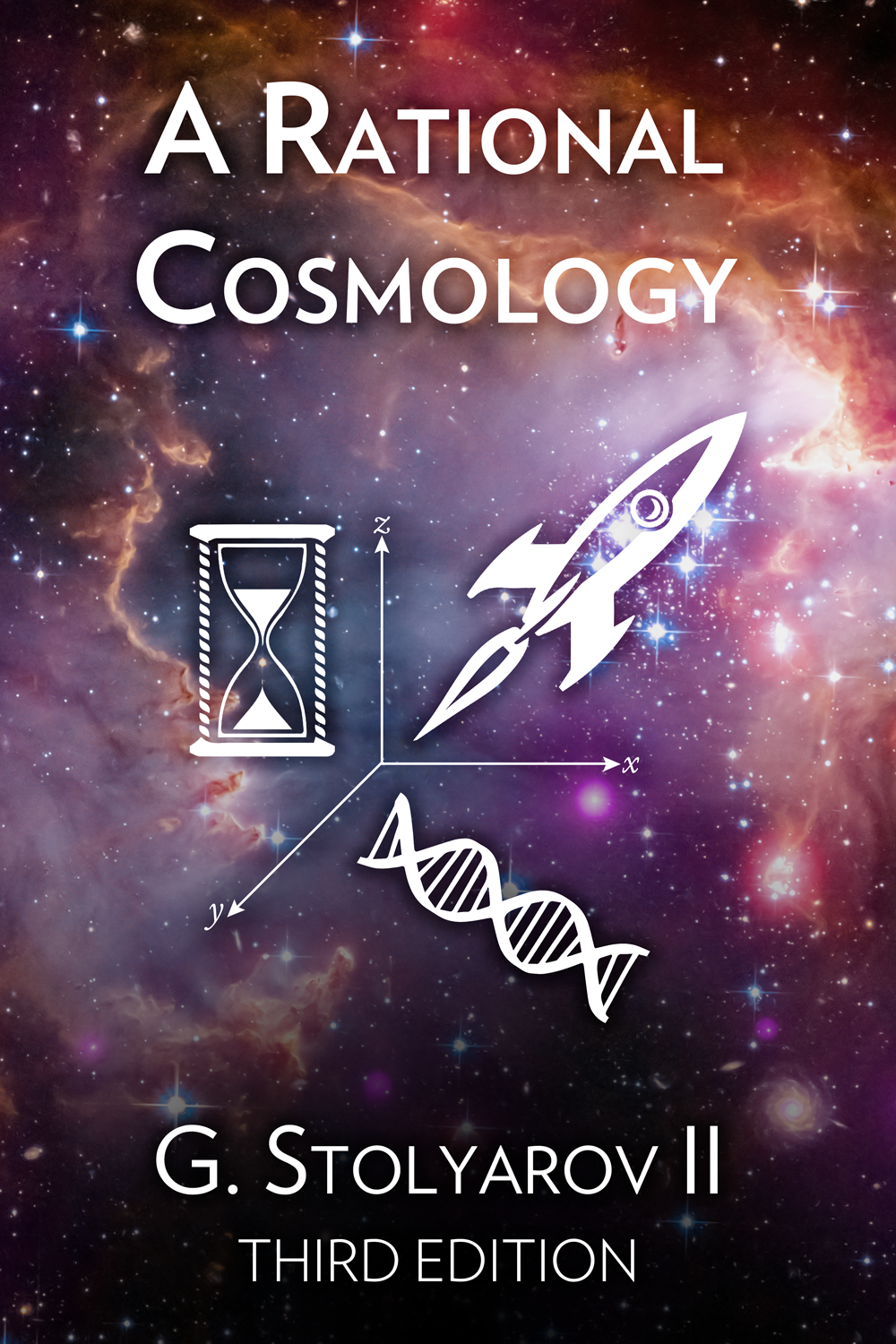
A Rational Cosmology – Treatise by G. Stolyarov II – Third Edition

A Rational Cosmology – Treatise by G. Stolyarov II – Third Edition

A Rational Cosmology - Third Edition - by G. Stolyarov II

A Rational Cosmology – Third Edition – by G. Stolyarov II

Contemporary science does not make as much progress as it could, due the fallacy of empiricism-positivism – the idea that no knowledge is certain beyond refutation and that every claim is contingent on highly narrow, particular, and expensive experiments. A Rational Cosmology, however, provides a thorough refutation of prevalent empiricist-positivist fallacies, both in content and in method. It shatters some of the erroneous philosophical interpretations of theories such as Relativity and Quantum Mechanics. Moreover, it refutes the ex nihilo origin of the universe – including its manifestation in popular views of the Big Bang and Big Crunch – the particle/wave view of light, and a host of other fallacious ideas, using the proper, axiomatic-deductive methodology of identifying those theories’ conceptual flaws and internal contradictions.

As constructive alternatives to these fallacies, A Rational Cosmology presents objective, absolute, rationally grounded views of terms such as universe, matter, volume, space, time, motion, sound, light, forces, fields, and even the higher-order concepts of life, consciousness, and volition. The result is a system verified by ubiquitous observation and common sense, the underpinnings of objective science which demonstrate a knowable, fathomable reality and set the stage for unfettered progress, confidence in reason, and full-scale logical investigation of just about everything existence has to offer.

The Third Edition of A Rational Cosmology has been enhanced and edited, with augmentations and revisions to several of the previous essays. There is a new, beautiful cover design by Wendy D. Stolyarov. Furthermore, there are two additional numbered essays and more recent writings within the Related Essays section.

For the first time, A Rational Cosmology is available for free download in the form of unified files. There are four options to choose from.

Download the PDF version.

Download the MOBI version.

Download the EPUB version.

Download the AZW3 version.

The Rational Argumentator welcomes your reviews of A Rational Cosmology. You can submit them to TRA by sending them to gennadystolyarovii@yahoo.com. You are also encouraged to spread the word by reprinting the information on this page or your own comments concerning the book on other media outlets.

Feedback Loops and Individual Self-Determination – Article by G. Stolyarov II

Feedback Loops and Individual Self-Determination – Article by G. Stolyarov II

The New Renaissance Hat
G. Stolyarov II
September 15, 2013
******************************

I have always been fond of the concept of feedback loops, and it is indeed the case that much of humankind’s progress, and the progress of a given individual, can be thought of as a positive feedback loop. In the technology/reason interaction, human reason leads to the creation of technology, which empowers human reason and raises rational thinking to new heights, which enables still further technology, and so on. This, I think, is a good way of understanding why technological progress is not just linear, but exponential; the rate of progress builds on itself using a positive feedback loop.

Positive Feedback LoopNegative feedback loops also exist, of course. For instance, one eats and feels sated, so one stops eating. One exercises and becomes tired, so one stops exercising. Thomas Malthus’s mistake was to view human economic and technological activity as a negative feedback loop (with the improved life opportunities that technology makes possible defeated in the end by overpopulation and resource scarcity). He did not realize that the population growth made possible by technology is a growth in human reasoning ability (more bright minds out there, including the extreme geniuses who can produce radical, paradigm-shifting breakthroughs), which in turn can result in further technological growth, far outpacing the growth in resource demands caused by increasing population.

***
I do also think that positive feedback loops play a role in the questions surrounding free will and determinism. For instance, the growth trajectory of an individual – the process of intellectual empowerment and skill acquisition – is a positive feedback loop. By learning a skill and doing it well, a person feels better about his situation and becomes more motivated to make further progress in the skill. How does it start? This, I think, is where the substance of the free-will/determinism debate has historically led people to be at odds. In my view, free will plays a crucial role, especially at the beginning of a chain of undertakings, in the individual’s choice to focus on a particular subset of reality – certain entities about which one would like to know more, or certain projects one would want to pursue further.
***
Generally, the choice to focus or not is always under an individual’s control under normal conditions of the brain and body (e.g., adequate rest, lack of physical pain, freedom from pressing demands on one’s time). A young child who chooses to focus on productive, mind-enhancing endeavors essentially sets himself up for a virtuous positive feedback loop that continues throughout life. The first instance of such focus could make a very subtle difference, compared to a child who chooses not to focus, and the other child could possibly catch up by choosing to focus later, but an accumulation of subtle differences in individual decisions could result in very different trajectories due to path-dependencies in history and in individual lives. The good news for all of us is that the decision to focus is always there; as one gets older and the set of possible opportunities expands, the harder decision becomes on what to focus out of a myriad of possibly worthwhile endeavors.
***
This understanding integrates well with the portrayal of free will as compatible with an underlying entirely physical nature of the mind. There is undeniably an aspect of the chemistry of the brain that results in human focus and enables the choice to focus. Yet this kind of physical determination is the same as self-determination or free will, if you will. My physical mind is the same as me, so if it is chemically configured to focus (by me), then this is equivalent to me making the choice to focus, which is how the virtuous cycle of skill acquisition leading to motivation leading to skill acquisition begins.
***
In general, in these kinds of recursive phenomena, it may be possible to legitimately answer the question of what came first if one considers not only the types of phenomena (A leading to B leading to A, etc.), but also qualitative and quantitative distinctions among each instance of the same type of phenomenon (e.g., a small amount of A leading to a little bit of B, leading to somewhat more of A with a slightly different flavor, leading to radically more of B, which opens up entirely new prospects for future feedback loops). We see this sort of development when it comes to the evolution of life forms, of technologies, and of entire human societies. If traced backward chronologically, each of these chains of development will be seen to contain many variations of similar types of phenomena, but also clear beginnings for each sequence of feedback loops (e.g., the philosophy of Aristotle paving the way for Aquinas paving the way for the Renaissance paving the way for the Enlightenment paving the way for transhumanism). History does repeat itself, though always with new and surprising variations upon past themes. In the midst of all this recursion, feedback, and path-dependency, we can chart unique, never-quite-previously-tried paths for ourselves.