Browsed by
Category: Politics

Canadians Confused by the Correct Use of the Term “Liberal” – Article by Jeffrey A. Tucker

Canadians Confused by the Correct Use of the Term “Liberal” – Article by Jeffrey A. Tucker

The New Renaissance Hat
Jeffrey Tucker
******************************

The Canadian Broadcasting Corporation has been following the political upheavals in the US with some curiosity. In light of this piece, they called me to discuss where the Republican ticket is representing capitalism well. In the course of the interview, I described myself as a fan of commercial society, free enterprise, deregulation, and therefore a classical liberal. I said later that I’m a radical liberal.

Much to the amazement of the producers, it was this section of the interview (which was heard by more than a million people) that caused the biggest response. They were flooded with comments of confusion. Why does this guy call himself a liberal?

The producers were intrigued enough to do an entire segment on the topic, the results of which were interesting and substantial. Of course the topic is complex because the meaning of the word has changed so much in the last 100 years. The corruption of the term became so intense following World War II that the leftover liberals had to change their name to libertarians.

And today matters are in flux. In Eastern Europe and large parts of Latin America, the term is used correctly. In Europe, it is a mix. In the UK, the word liberal is coming back as a description of people who celebrate commercial society, favor peace, support civil liberties, and reject big government. In the US, the term has been left on the table, but is still mostly associated with the opposite of its traditional meaning.

The result of the CBC’s investigative efforts are as follows.

On last week’s episode of The 180, we spoke with Jeffrey Tucker, a self-described ‘classical liberal.’ He argued Donald Trump is giving capitalism a bad name, by presenting himself as a titan of industry, when he’s really more of an entertainer.

After that interview, we received notes from people questioning Tucker’s bona-fides as a ‘liberal,’ since he spoke highly of individual liberties, free markets, and limited government. Some said Tucker was clearly a ‘neo-liberal,’ some said he was a ‘large R conservative,’ presumably meaning Republican, while others thought the term ‘classical liberal’ had plenty of negative connotations all on its own.

So what is a classical liberal?

First off, you should totally click the play button on this page to hear the audio explainer. It’s got all kinds of fun music and clips of people using the word ‘liberal’ in weird and hilarious ways. Like when Rush Limbaugh said the Soviet Union and Cuba and China were run by ‘liberals.’ Weird.

Part of the problem with the word ‘liberal’ is it’s used differently across time, and across countries. In Canada, the word mostly means a supporter of the Liberal Party, or someone in the political middle. In the United States, it means a strong social progressive, and in some circles can mean a socialist or a communist. In Europe it’s associated with internationalism and free migration. In Australia, in the words of Australian Liberal Party leader Malcolm Turnbull, it means the primacy of “freedom, the individual, and the market.” 

That last one, the Australian definition, is probably closest to what political scientists consider a classical liberal view.

John Locke

If you want to get what classical liberalism is, and where liberalism as an ideology comes from, you gotta know about this guy, John Locke. 

Locke was an English philosopher who lived in the 17th century, and one of the most important people in the development of liberalism, both classical and modern, according to Barbara Arneil, Professor of Political Science at the University of British Columbia.

“In essence what he introduced to the political lexicon was the idea of individual rights. He said individuals have rights by nature, and if the government does not serve those rights, then the people could get together and reject the government. So in essence, this idea of individuals and their rights begins the notion that the government is answerable to individual people.”

This was still a time of kings and emperors and lords and barons, so Locke’s ideas were rather significant. And these liberal ideas influenced a good deal of western society, including the founding documents of the United States of America.

“Thomas Jefferson drew a lot of his philosophy from John Locke. He saw him as the greatest political thinker. So there’s a lot of Locke in the American Declaration of Independence. On the economic side, Locke was also somebody who developed the idea of the right to private property. So we have both the political and economic repercussions and we see them right around the world. All the bills of rights, really originate with Locke’s original idea.” 

So if someone says they’re a classical liberal as opposed to modern liberal, they’re probably more in line with Locke’s original sentiments.

Times change, so do words, and so do ideas

At some point, liberalism shifted from its emphasis on individual liberties, to include regulating business, and using the government to support individuals, rather than simply leaving them alone. According to Lee Ward, Associate Professor of Politics and International Studies at the University of Regina, the shift is part of the industrial revolution throughout the 18th and 19th centuries.

“The term liberalism takes on a new kind of meaning, politically. Sometimes called ‘welfare liberalism. At that point, liberalism is accommodating the new demands produced by industrialization. So classical liberals in the 17th century were talking about an economy that was very rudimentary compared to what we have today. A bank in the 17th century doesn’t mean the same thing as a bank in the 20th century. So by the time you get to the 20th century, liberalism has changed.”

To Barbara Arneil at UBC, it’s not simply that the definition of liberalism changed, it’s that over time, some people changed their conception of ‘freedom’. Whereas classical liberals think of liberty as being free from interference, modern liberalism considers whether the government can support people in society to freely pursue their goals.

“I think the thread that remains throughout all liberal thought is the idea of the individual and their freedom. So initially, freedom is understood as being free of restraints. But now we have a different definition of freedom, and it’s about  having the necessary supports to have freedom that has any meaning.”

The concepts of liberalism, both classical and modern, are political philosophies and ideologies not specific political affiliations, and these concepts, among others, influence parties across the Canadian spectrum.

Labels and insults

In the United States, ‘liberal’ is often used as an epithet. To some degree, the terms ‘neo-liberal’ or ‘social conservative’ or ‘socialist’ are also used as negative descriptors in Canada. 

To Ward, it’s not particularly helpful to use philosophical terminology as a pejorative, or to try and sum up a person’s character or values with a snippy line about liberals, conservatives, socialists, or anarchists.

“I worry that sometimes we throw out terminology as weapons, as rhetorical jabs. Understand that behind all of the different perspectives and ideologies, there’s some claim to justice there. And even if I disagree in large measure with much of what’s being said, there’s is some truth that is being expressed. There’s something good in it. As good as it is to be engaged in politics and to really care about what’s happening, it’s also good to step back sometimes and to understand that when we use terms like conservative, liberal, progressive, socialist, they’re all reflecting a certain claim to justice, and there’s probably something in each of those that we can agree with.”

According to Ward, if we could understand that behind all the terms we throw around to describe people, there is a rich intellectual history, we could have more respectful and constructive political debate.

Jeffrey Tucker

Jeffrey Tucker

Jeffrey Tucker is Director of Content for the Foundation for Economic Education and CLO of the startup Liberty.me. Author of five books, and many thousands of articles, he speaks at FEE summer seminars and other events. His latest book is Bit by Bit: How P2P Is Freeing the World.  Follow on Twitter and Like on Facebook. Email. 

This article was originally published on FEE.org. Read the original article.
The Bad Economics Behind “Monopoly” – Article by Chris Calton

The Bad Economics Behind “Monopoly” – Article by Chris Calton

The New Renaissance Hat
Chris Calton
******************************

In 1868, a young Henry George wrote an editorial on the nearly completed Pacific Railroad that was soon to connect his state of California with the rest of the country. This editorial, “What the Railroad Will Bring Us,” acknowledged the progress that railroads would signify in the industrializing economy of the Gilded Age, but George saw this as a boon only for the privileged few. Like many thinkers of his time, he was concerned with the “labor question,” which he referred to as one of “the riddles of a Sphinx, which not to answer is death.” Why was there poverty in an age of economic expansion?

Henry George believed that he figured out the riddle after a horseback ride in Oakland Hills, California. While stopping to give his horse a drink of water, George engaged in polite conversation with a farmer, casually asking the value of the land around him. The farmer told him of some land for sale nearby for $1,000 per acre. With this thought in mind, George concluded that land values would inevitably rise as the population grew, and speculators — that economic specter historians love to fear — could own land unproductively to profit merely off its natural increase in value. This, George decided, was the reason why there was poverty in a progressing economy.

In 1879, George published the book Progress and Poverty, formally laying out this conundrum and his answer to it. In it, he detailed for the first time his “Single Tax Plan” that proposed to tax land in proportion to its increase in value, which he believed would lead to the end of property rights in land entirely.

Apparently, George’s idea hit home with a lot of people at the time. His book outsold every book the year it was published except for the Bible, and a movement to form “Single Tax Clubs” spread throughout the country and beyond. Henry George became a Gilded Age rockstar.monopoly1

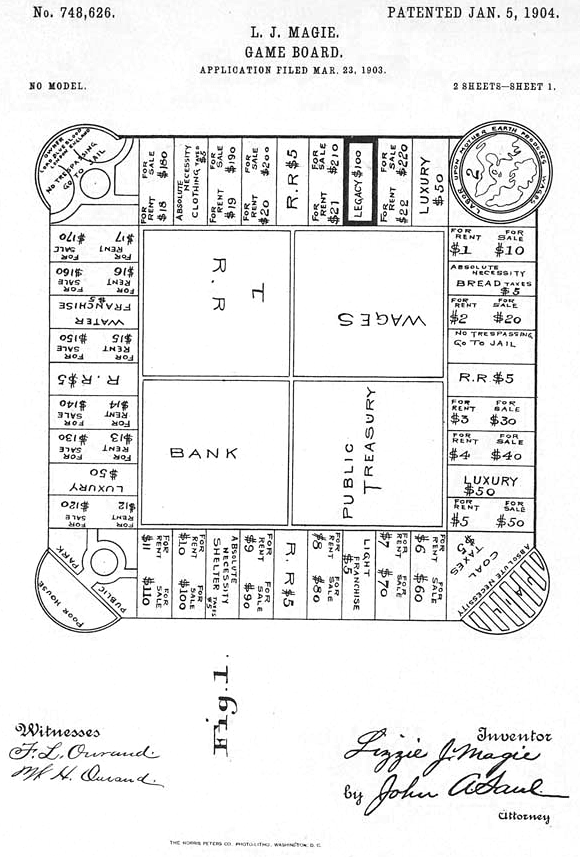
Among his followers was a woman named Elizabeth Magie. She believed that George’s land value tax plan was the solution to economic woes, and she wanted to bring this idea to as many people as she could. To do this, she developed The Landlord’s Game. This board game intended to demonstrate the horrors of land accumulation and rent, and to illustrate the benefit of George’s Single Tax Plan.

The original game, patented in 1904, closely resembles the modern game of Monopoly, that would later evolve out of it. Players started in a square that said “Labor Upon Mother Earth Produces Wages.” As the original rules state, “Each time a player goes around the board he is supposed to have performed so much labor upon Mother Earth, for which after passing the beginning-point he receives his wages, one hundred dollars, and is checked upon the tally-sheet as having been around once.”

Most of the squares look at least somewhat familiar. Many gave sale prices and rent costs, not unlike modern monopoly. This was explicitly meant to illustrate the belief that land rent transactions were involuntary, a notion that Benjamin Powell has already addressed. The railroads are also present, representing “transportation, and when a player stops upon one of these spaces he must pay five dollars to the ‘R.R.’” Less familiar squares demonstrated the horrors of private property rights by saying “No Trespassing. Go to Jail” from which the more ambiguous “Go Directly to Jail” corner would evolve in the modern game.

cal2

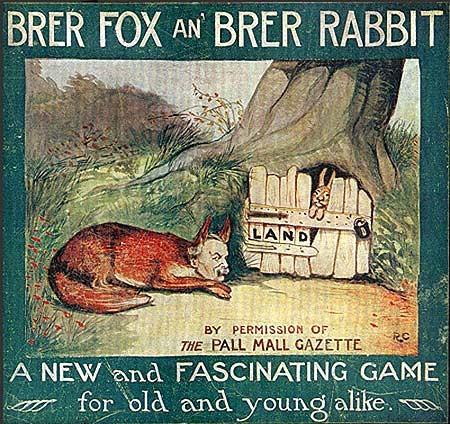
In 1913, a version of the game was picked up in Britain called Brer Fox an’ Brer Rabbit, taking the name from the African fables of Brother Fox and Brother Rabbit (the native language of African slaves lacked the diphthong syllable, so the word “brother” was pronounced “br’er” when told in English). In this, the clever Br’er Rabbit represented the wily landowner earning his immoral rents. The pesky Br’er Fox was meant to represent British reform leader David Lloyd George, who was of no relation to Henry George but was a strong supporter of his land value tax. In 1909, Lloyd George came up with the “People’s Budget” which instituted a version of Henry George’s land tax and planted the seeds for the British welfare state. His face is imposed on the figure of Br’er Fox on the original cover for the British game.

cal3

This version of the game was actually used to educate students about Henry George’s ideas in places like the University of Pennsylvania and Columbia. The Landlord’s Game and its British variant attempted to teach people the socialistic concepts that wages come from land, private property in land was immoral and destructive, and the economy is a zero-sum environment. The game evolved over time into the modern version Monopoly, whose invention is falsely credited to Charles Darrow.

Today, of course, the specifically Georgist elements have been removed from the game. There are no longer any “No Trespassing” squares, and what once was known as “The Poor House” where bankrupt players were forced to go upon running out of money is now the “Free Parking” square. The several “Absolute Necessity Taxes” across the board (perhaps the one aspect of the game’s educational commentary that libertarians could agree with) have been reduced to the Luxury and Income Tax squares. And of course, the unambiguously socialistic “Mother Earth” starting square became simply “Go.” Nonetheless, the modern variant retains the zero-sum myths of monopoly land accumulation, and in this, the legacy of Henry George is retained. If you’ve ever finished a game of monopoly with a frustrated player overturning the board and scattering the pieces, then it’s possible that Lizzie Magie accomplished her original goal.

Chris Calton is a Mises University alumnus and an economic historian. See his YouTube channel here.

This article was published on Mises.org and may be freely distributed, subject to a Creative Commons Attribution United States License, which requires that credit be given to the author.

Hurricane Matthew Has No Silver Lining – Article by Dan Sanchez

Hurricane Matthew Has No Silver Lining – Article by Dan Sanchez

The New Renaissance Hat
Dan Sanchez
******************************

Hurricane Matthew is barreling down on the southeast Atlantic coast. Sadly, the region is not only plagued by disastrous weather, but economic fallacies that compound the disaster. Like clockwork, outrage and policies against “price gouging” were the first to emerge.

For some intellectuals, common sense is for mere commoners.And now, just as predictably, the Broken Window Fallacy is emerging on the horizon. Discussion about the storm is playing out just like the famous parable of the broken window, created by Frederic Bastiat, and updated for modern audiences by Henry Hazlitt. In Hazlitt’s version of the parable, a youth throws a brick through the window of a bakery. Neighbors gather around to commiserate with the baker over his misfortune.

Similarly, decent people all over the country are sending their hearts out to the unfortunate people whose homes and businesses are in Hurricane Matthew’s path. The category 4 hurricane is sure to break a great many windows. In fact, in one video I saw, debris shattered a house’s window right behind an intrepid weather reporter as he was talking to the camera.

Of course, the damage will go far beyond broken windows. Entire houses and businesses will be flooded. Lives will be financially ruined. Some lives have already been lost entirely. It is only common sense to recognize such vast destruction as pure loss and misfortune.

But for some intellectuals, common sense is for mere commoners. They delight in using more sophisticated reasoning to arrive at contrarian conclusions, which they generously share with their ignorant, benighted brethren.

Taking Away Resources

In the parable, the clever ones among the crowd console the baker by pointing out the social good that will come from his private misfortune. As Hazlitt puts the argument:

How much does a new plate glass window cost? Three hundred dollars? That will be quite a sum. After all, if windows were never broken, what would happen to the glass business? Then, of course, the thing is endless. The glazier will have $300 more to spend with other merchants, and these in turn will have $300 more to spend with still other merchants, and so ad infinitum. The smashed window will go on providing money and employment in ever-widening circles. The logical conclusion from all this would be, if the crowd drew it, that the little hoodlum who threw the brick, far from being a public menace, was a public benefactor.

And now, this very morning, we have a USA Today writer playing this exact same role in the discussion of Hurricane Matthew. Paul Davidson consoles the storm’s victims as follows:

But hurricanes typically don’t harm a nation’s economic growth. And much of the losses in the region are later offset. Most damaged homes, businesses and infrastructure are repaired or rebuilt, generating economic activity. And at least some of the disruptions to retail and other businesses are made up in the following weeks and months as consumers release pent-up demand. (Emphasis added.)

The problem with Davidson’s analysis is the same problem that beset the 19th century writers whom Bastiat was lampooning when he wrote the broken window parable. Their clever contrarianism is more sophistical than sophisticated. As Bastiat put it, they only look at “the seen” and entirely neglect “the unseen.” The “unseen” is the opportunity cost of repairing damage. As is so often the case, sound economics vindicates common sense by giving the unseen its due regard. As Hazlitt wrote:

Now let us take another look. The crowd is at least right in its first conclusion. This little act of vandalism will in the first instance mean more business for some glazier. The glazier will be no more unhappy to learn of the incident than an undertaker is to learn of a death. But the shopkeeper will be out $300 that he was planning to spend for a new suit. Because he has had to replace a window, he will have to go without the suit (or some equivalent need or luxury). Instead of having a window and $300 he now has merely a window. Or, as he was planning to buy the suit that very afternoon, instead of having both a window and a suit he must be content with the window and no suit. If we think of him as part of the community, the community has lost a new suit that might otherwise have come into being, and is just that much poorer.

The glazier’s gain of business, in short, is merely the tailor’s loss of business. No new “employment” has been added. The people in the crowd were thinking only of two parties to the transaction, the baker and the glazier. They had forgotten the potential third party involved, the tailor. They forgot him precisely because he will not now enter the scene. They will see the new window in the next day or two. They will never see the extra suit, precisely because it will never be made. The see only what is immediately visible to the eye.

Indeed, we can consider even more “unseen” victims of the vandal. A new suit can be considered a consumption good. But what if the baker would have otherwise spent the $300 on a producer’s good? What if he would have used it to buy a new, more efficient oven? The need to repair the window would have prevented that investment: an investment that could have increased the amount of baked goods available to the community. All those consumers who would have benefited from that greater abundance would then have also suffered a loss.

Similarly, USA Today’s Davidson sees the “economic activity” generated by the repairing and rebuilding of homes, businesses, and infrastructure that will be damaged or destroyed by Hurricane Matthew. But he neglects the economic activity that would have created entirely new goods and services: activity now made impossible because the resources needed are tied up restoring old goods and services.

Hazlitt also deals handily with the counterargument that the replacements will be more modern and better than what was destroyed:

It is sometimes said that the Germans or the Japanese had a postwar advantage over the Americans because their old plants, having been destroyed completely by bombs during the war, could be replaced with the most modern plants and equipment and thus produce more efficiently and at lower costs than the Americans with their older and half-obsolete plants and equipment. But if this were really a clear net advantage, Americans could easily offset it by immediately wrecking their old plants, junking all the old equipment. In fact, all manufacturers in all countries could scrap all their old plants and equipment every year and erect new plants and install new equipment.

The simple truth is that there is an optimum rate of replacement, a best time for replacement. It would be an advantage for a manufacturer to have his factory and equipment destroyed by bombs only if the time had arrived when, through deterioration and obsolescence, his plant and equipment had already acquired a null or a negative value and the bombs fell just when he should have called in a wrecking crew or ordered new equipment anyway.

We do the victims of Hurricane Matthew no service by offering them false consolation. Sound economics, common sense, and common decency all arrive at the same conclusion: that natural disasters truly are disasters to those afflicted. And the victims deserve our unstinting sympathy and support.

dan-sanchez


Dan Sanchez

Dan Sanchez is Managing Editor of FEE.org. His writings are collected at DanSanchez.me.

This article was originally published on FEE.org. Read the original article.
Trump: The Moral Monster Beyond Hope – Post by G. Stolyarov II

Trump: The Moral Monster Beyond Hope – Post by G. Stolyarov II

The New Renaissance Hat
G. Stolyarov II
******************************

Two excellent recent editorials highlight the unprecedented danger that Donald Trump poses to liberty and basic human decency in America.

Nina Khrushcheva, great-granddaughter of Nikita Khrushchev, writes of how Donald Trump has brought Soviet-Style politics, particularly the sweeping use of the Big Lie, to the United States. (“Trump Through Russian Eyes”. Project Syndicate. September 27, 2016)

Khrushcheva observes,

Indeed, from my perspective, many of the nastiest and most perverse features of Russian politics now seem present in the United States as well. The Big Lie – invented in Nazi Germany, perfected in the Soviet Union, and wielded expertly by Russian President Vladimir Putin – is today a core component of Donald Trump’s presidential campaign.

***

So far, Trump has been allowed to get away with his lies. The news media have largely been what Lenin called ‘useful idiots,’ so eager to use Trump to boost their own ratings that they did not notice or care that they were also boosting his. No surprise, then, that an emboldened Trump now delivers lies of ever more breathtaking audacity.

Harvard political theorist Danielle Allen likens Donald Trump to Gilgamesh – and not in a flattering manner. (“Donald Trump is a walking, talking example of the tyrannical soul”. The Washington Post. October 8, 2016.) In the early “Epic of Gilgamesh”, the king Gilgamesh (before he journeys on his quest to obtain eternal life) is an arbitrary, capricious tyrant with no regard for any other individuals’ rights or for basic human dignity and decency. Only when Gilgamesh realizes that death is a fundamental problem affecting everyone (him, too), is he impelled away from tyranny and toward wisdom.

But it is too much to hope that Trump would all of a sudden turn from a populist demagogue and would-be tyrant into a life-extension supporter. Instead, Trump should be recognized as completely devoid of moral character, and a completely lost cause for anyone who thought that he might somehow magically transform himself into a reasonable person.

It is time to break free from the spell of the Big Lie and universally denounce Trump for the moral monster he is. All people of good moral character must stand against Trump. Support anyone else you wish (Libertarian, Democrat, Green, Transhumanist, McMullin, none of the above) – but express the conviction that a decent, humane society should not allow such an unseemly, tyrannical brute as Trump to have any degree of power.

This post may be freely reproduced using the Creative Commons Attribution Share-Alike International 4.0 License, which requires that credit be given to the author, G. Stolyarov II. Find out about Mr. Stolyarov here.

Fifteen Years Into the Afghan War, Do Americans Know the Truth? – Article by Ron Paul

Fifteen Years Into the Afghan War, Do Americans Know the Truth? – Article by Ron Paul

The New Renaissance HatRon Paul
******************************
Last week marked the fifteenth anniversary of the US invasion of Afghanistan, the longest war in US history. There weren’t any victory parades or photo-ops with Afghanistan’s post-liberation leaders. That is because the war is ongoing. In fact, 15 years after launching a war against Afghanistan’s Taliban government in retaliation for an attack by Saudi-backed al-Qaeda, the US-backed forces are steadily losing territory back to the Taliban.

What President Obama called “the good war” before took office in 2008, has become the “forgotten war” some eight years later. How many Americans know that we still have nearly 10,000 US troops in Afghanistan? Do any Americans know that the Taliban was never defeated, but now holds more ground in Afghanistan than at any point since 2001? Do they know the Taliban overran the provincial capital of Kunduz last week for a second time in a year and they threaten several other provincial capitals?

Do Americans know that we are still wasting billions on “reconstruction” and other projects in Afghanistan that are, at best, boondoggles? According to a recent audit by the independent US government body overseeing Afghan reconstruction, half a billion dollars was wasted on a contract for a US company to maintain Afghan military vehicles. The contractor “fail[ed] to meet program objectives,” the audit found. Of course they still got paid, like thousands of others getting rich off of this failed war.

Do Americans know that their government has spent at least $60 billion to train and equip Afghan security forces, yet these forces are still not capable of fighting on their own against the Taliban? We recently learned that an unknown but not insignificant number of those troops brought to the US for training have deserted and are living illegally somewhere in the US. In the recent Taliban attack on Kunduz, it was reported that thousands of Afghan security personnel fled without firing a shot.

According to a recent study by Brown University, the direct costs of the Iraq and Afghanistan wars thus far are nearly five trillion dollars. The indirect costs are virtually incalculable.

Perhaps Afghanistan is the “forgotten war” because to mention it would reveal how schizophrenic is US foreign policy. After all, we have been fighting for 15 years in Afghanistan in the name of defeating al-Qaeda, while we are directly and indirectly assisting a franchise of al-Qaeda to overthrow the Syrian government. How many Americans would applaud such a foreign policy? If they only knew, but thanks to a media only interested in promoting Washington’s propaganda, far too many Americans don’t know.

I have written several of these columns on the various anniversaries of the Afghan (and Iraq) wars, pointing out that the wars are ongoing and that the result of the wars has been less stable countries, a less stable region, a devastated local population, and an increasing probability of more blowback. I would be very happy to never have to write one of these again. We should just march home.

Ron Paul, MD, is a former three-time Republican candidate for U. S. President and Congressman from Texas.

This article is reprinted with permission from the Ron Paul Institute for Peace and Prosperity.

Trump’s Economic Plan Faces Well-Deserved Ridicule – Article by K. William Watson

Trump’s Economic Plan Faces Well-Deserved Ridicule – Article by K. William Watson

The New Renaissance HatK. William Watson
******************************

Earlier this week, the Trump campaign released a white paper written by senior policy adviser Peter Navarro to elaborate and quantify the candidate’s economic plan.  The goal of the paper is to explain how Donald Trump’s promises to renegotiate trade agreements and raise tariffs will promote economic growth and raise revenue for the government.

The plan betrays embarrassing ignorance of how trade negotiations work and a farcically simplistic and erroneous understanding of economics.  In essence, the plan justifies Trump’s policies by reimagining how the world works.

Trump’s entire view of trade and its impact on the U.S. economy is wrong.  He believes that trade is good for the United States only if we export more than we import and that trade relations are a contest between countries, which we are losing because they sell more stuff to us than we sell to them.  He claims to be the tough-guy who will the save the American economy from shrewd foreign cheaters and the inept government officials who let them beat us.

Since that’s not how things work in the real world, he has to rely on falsehoods and bad economics to justify disastrous policies.  This new white paper is just a continuation of that tactic.

But you don’t have to take my word for it.  If you think I’m being too harsh or would like to learn more about the “Trump Trade Doctrine” and what’s wrong with it, I recommend you read lengthier condemnations from experts who have called the plan’s analysis “truly disappointing,” “not only wrong, but foolish,” “magical thinking,” “a complete mess,” and the sort of thing “that would get you flunked out of an AP economics class.”

Bill Watson is a trade policy analyst with Cato’s Herbert A Stiefel Center for Trade Policy Studies. His research focuses on U.S. trade remedy policies, disguised protectionism, and the institutional aspects of global trade liberalization. He manages Free Trade, Free Markets: Rating the Congress, Cato’s online database that tracks votes by Congress and its individual members on bills and amendments affecting the freedom of Americans to trade and invest in the global economy. Watson received a BA in political science from Texas Christian University, a JD from Tulane University Law School, and an LLM in international and comparative law from the George Washington University Law School.

This work by Cato Institute is licensed under a Creative Commons Attribution-NonCommercial-ShareAlike 3.0 Unported License.

After Peres, Is Peace Possible in the Middle East? – Article by Ron Paul

After Peres, Is Peace Possible in the Middle East? – Article by Ron Paul

The New Renaissance HatRon Paul
******************************

The death of former Israeli president and prime minister Shimon Peres last week marks the last of the Zionist “old guard” who successfully fought for a UN mandate to establish the state of Israel in what was formerly British Palestine. Much has been written about Peres since his death. He was a peacemaker. He was a warrior. He was brutal. He was complex. It is possible for all of them to be accurate at the same time.

Was Peres a warrior? That is without question. Israel was established in bloodshed and Peres played an important role in that fight. Also, the brutal Israeli attack on a Palestinian refugee camp at Qana in 1996 took place under Peres’s command. In that attack more than 100 women and children were killed.

But history, and especially Middle East history, can be quite complex. Shimon Peres was above all in favor of trying to find a way for Israelis and Palestinians to live side-by-side. He was right there in spirit when Israeli Prime Minister Yitzhak Rabin had a famous 1993 handshake with Palestinian leader Yassir Arafat. Rabin paid for his efforts with his life, as a right-wing radical assassinated him in 1995.

Shimon Peres was in favor of real negotiations with the Palestinians and he several times inserted himself into the process to urge the hawkish Benjamin Netanyahu to start talking rather than saber rattling. In 2012, for example, Peres made it known again that he favored a two-state solution and that Palestinian leader Mahmoud Abbas was a suitable negotiating partner. He also urged Netanyahu to open up direct talks with Hamas if certain agreements could be made beforehand.

But perhaps his greatest move to avert war only came known with his passing. Former Jerusalem Post editor Steve Linde wrote a fascinating article last week in his old newspaper detailing a meeting he and the Post’s managing editor had with Shimon Peres in 2014. According to Linde, Peres was asked what he thought was his greatest legacy. He replied that he had personally intervened to stop Netanyahu from ordering a preemptive strike on Iran’s nuclear sites. Asked by the journalists when they could report this revelation, Peres responded, “when I’m dead.” So it came to pass last week.

How much for the worse things have become in Israeli-Palestinian relations with the passing on of anyone preferring negotiations to violence! There is little interest among current Israeli leadership to take steps toward negotiation or peace. Innocent Israelis and Palestinians will continue to be killed and injured as long as no compromises are considered. Sadly this position is reinforced in Washington, where the Obama administration just agreed to grant Israel the largest military aid package in US history.

There is much to admire in those who work for peace, even those with stains on their record. I remain convinced that Israeli-Palestinian peace efforts would be much closer to bearing fruit if the US government would stop inserting itself into the process and subsidizing either side. Left alone, both sides would likely produce more leaders interested in ending bloodshed and conflict.

Ron Paul, MD, is a former three-time Republican candidate for U. S. President and Congressman from Texas.

This article is reprinted with permission from the Ron Paul Institute for Peace and Prosperity.

George Washington’s Letter to the Jews – Article by Sarah Skwire

George Washington’s Letter to the Jews – Article by Sarah Skwire

The New Renaissance HatSarah Skwire
******************************

In August of 1790, George Washington wrote a brief letter to the Hebrew Congregation of Newport, Rhode Island. If anything, it is more timely than ever as we continue to struggle with questions of toleration and bigotry, and of the joys and dangers of insisting on freedom of conscience in our nation and in our lives.

Gentlemen:

While I received with much satisfaction your address replete with expressions of esteem, I rejoice in the opportunity of assuring you that I shall always retain grateful remembrance of the cordial welcome I experienced on my visit to Newport from all classes of citizens.

The reflection on the days of difficulty and danger which are past is rendered the more sweet from a consciousness that they are succeeded by days of uncommon prosperity and security.

If we have wisdom to make the best use of the advantages with which we are now favored, we cannot fail, under the just administration of a good government, to become a great and happy people.

The citizens of the United States of America have a right to applaud themselves for having given to mankind examples of an enlarged and liberal policy—a policy worthy of imitation. All possess alike liberty of conscience and immunities of citizenship.

It is now no more that toleration is spoken of as if it were the indulgence of one class of people that another enjoyed the exercise of their inherent natural rights, for, happily, the Government of the United States, which gives to bigotry no sanction, to persecution no assistance, requires only that they who live under its protection should demean themselves as good citizens in giving it on all occasions their effectual support.

It would be inconsistent with the frankness of my character not to avow that I am pleased with your favorable opinion of my administration and fervent wishes for my felicity.

May the children of the stock of Abraham who dwell in this land continue to merit and enjoy the good will of the other inhabitants—while every one shall sit in safety under his own vine and fig tree and there shall be none to make him afraid.

May the father of all mercies scatter light, and not darkness, upon our paths, and make us all in our several vocations useful here, and in His own due time and way everlastingly happy. ~ G. Washington

Washington came to Newport for a visit on August 17th, 1790  and was addressed by Moses Seixas, one of the officials of the long-established Jewish congregation of Newport. Seixas noted that, given the grim history of the Jews, America was a particularly important place, for:

Deprived as we heretofore have been of the invaluable rights of free Citizens, we now (with a deep sense of gratitude to the Almighty disposer of all events) behold a Government, erected by the Majesty of the People—a Government, which to bigotry gives no sanction, to persecution no assistance—but generously affording to All liberty of conscience, and immunities of Citizenship: deeming every one, of whatever Nation, tongue, or language, equal parts of the great governmental Machine…

While I suspect many reader will find, as I do, the notion of being a part of the “great governmental machine” far less appealing than Seixas did, his main point remains a vital one. For a people who had been chased from their homes by persecution, forced conversions, violence, and governmental theft of their property, the American promise of toleration was an almost incomprehensible blessing.

Toleration in Rhode Island

When I visited the Touro synagogue—home of the Jewish congregation Washington addressed—last week, my tour guide reminded me that Rhode Island’s version of religious toleration was particularly impressive, even within the wider American context.

Founded by the famously ornery Roger Williams, who was banished from the Massachusetts Bay Colony for spreading “new and dangerous opinions,” and established by a charter from King Charles II,  Rhode Island was based on principles of complete religious toleration from its very beginning. The 1663 founding charter notes that Rhode Island is meant to be:

a lively experiment, that a most flourishing civil state may stand and best be maintained…with a full liberty in religious concernments… our royal will and pleasure is, that no person within the said colony, at any time hereafter shall be any wise molested, punished, disquieted, or called in question, for any differences in opinion in matters of religion, and do not actually disturb the civil peace of our said colony; but that all and every person and persons may, from time to time, and at all times hereafter, freely and fully have and enjoy his and their own judgments and consciences, in matters of religious concernments, throughout the tract of land hereafter mentioned, they behaving themselves peaceably and quietly, and not using this liberty to licentiousness and profaneness, nor to the civil injury or outward disturbance of others, any law, statute, or clause therein contained, or to be contained, usage or custom of this realm, to the contrary hereof, in any wise notwithstanding.

Even the structure of Newport echoes the words of its royal charter. The city’s churches are not next to the statehouse, but clustered behind it, emphasizing their equality with one another and the separation between church and state.

It is hard for a modern reader to understand exactly how astonishing this promise of complete freedom of religious conscience was for the time. Perhaps the best way to think about it is that, when this royal charter was drawn up, Europe had suffered through more than 120 years of near-constant religious warfare. The death toll from that religiously motivated violence totaled somewhere between 5.6 and 18.5 million, depending on which historians you read and whether or not you count deaths caused by diseases and famine resulting from warfare.

Rhode Island must have seemed like a miracle to any 17th-century citizen. And for the Jews of Spain and Portugal, making their way to Newport via Amsterdam, the promise of such freedom must have been tantalizing and a little terrifying. Could they really trust that non-Christian religions would be included in these promises? Would they really be safe?

They would.

And the letter that Seixas read to George Washington makes that sense of security perfectly clear. Seixas did not speak of toleration and freedom as promises made in hopes of some much-desired future. He spoke of them as established truths that were in place then and there, as he was writing. “We now …behold a Government, erected by the Majesty of the People—a Government, which to bigotry gives no sanction, to persecution no assistance.”

Freedom Works

Washington’s response to Seixas and the other Jews of Newport is similarly focused on the success of the American experiment in toleration. He writes:

The citizens of the United States of America have a right to applaud themselves for having given to mankind examples of an enlarged and liberal policy—a policy worthy of imitation. All possess alike liberty of conscience and immunities of citizenship.

The Revolution is over. The Constitution is in place. The Republic has not fallen apart in its first years. There is reason to be proud, says Washington.

More importantly, he argues that toleration is not a question of an elite extending a favor to a lower and less worthy class. Toleration is about the equal treatment of all. The Jews of Newport are not “tolerated” the way that one learns to live with a leaky faucet or a small ding on your car bumper. Their differences are tolerated because their persons are equal.

It is now no more that toleration is spoken of as if it were the indulgence of one class of people that another enjoyed the exercise of their inherent natural rights, for, happily, the Government of the United States, which gives to bigotry no sanction, to persecution no assistance, requires only that they who live under its protection should demean themselves as good citizens in giving it on all occasions their effectual support.

Repeating Seixas’s phrasing back to him, in words that have become a crucial part of American thinking, Washington reassures him, and all the Jews of Newport, that he and they are of one mind on the subject of toleration.

We should think, today, about that phrase that Seixas originated and Washington repeated. It makes a fine model for how we should behave in the increasingly fraught religious tensions of the 21st century.

A civil society should give to bigotry no sanction, and to persecution no assistance. That means that those of us who are already here may not use our position to persecute newcomers, nor may we use their differences as an excuse for hatred and ill-treatment. But this is a covenant that must work in both directions. To enter into a civil society, one must make those promises as well.

Old hatreds, old prejudices, and old patterns of persecution must be left on the doormat of a civil society—discarded, like a pair of muddy boots, before you come in.

Only then can we regain the pride that Seixas and Washington had in a toleration that they felt was secured. Only then can we close our letters as Washington closed his, with the conviction that now, “every one shall sit in safety under his own vine and fig tree and there shall be none to make him afraid.”

Sarah Skwire is the poetry editor of the Freeman and a senior fellow at Liberty Fund, Inc. She is a poet and author of the writing textbook Writing with a Thesis. She is a member of the FEE Faculty Network.

This article was published by The Foundation for Economic Education and may be freely distributed, subject to a Creative Commons Attribution 4.0 International License, which requires that credit be given to the author.

For the Separation of Stadium and State – Article by David R. Henderson

For the Separation of Stadium and State – Article by David R. Henderson

The New Renaissance HatDavid R. Henderson
******************************

The title of this post is the same as the title of an article by Jonah Goldberg about the Colin Kaepernick incident. (If you haven’t been paying attention to the NFL lately, here’s the summary: Kaepernick is a San Francisco 49er who refused, and still refuses, to stand for the U.S. national anthem.)

I had been pondering writing a similar piece myself. And then I saw his title. Darn, I thought, Goldberg has beat me to it.

Except that he didn’t.

Goldberg’s article is all about his narrow way of keeping politics out of sports: players should stand for the national anthem. Some people would see this as a way of inserting politics into sports.

That means that people who don’t like what Kaepernick did are being forced to pay for the very property on which he did it.

But how would you keep politics out of sports in a fundamental way? It would be by not forcing people to pay for sports.

You don’t have to know a lot about the 49ers or the NFL to know that local governments tax their residents and others heavily to pay for luxurious stadiums.

That means that people who don’t like what Kaepernick did are being forced to pay for the very property on which he did it. On the other hand, it also means that people who don’t like the flag-waving that goes on at NFL games are also forced to pay for the property on which that occurs.

There’s a simple solution here: actually separate sports and state. That is, quit forcing taxpayers to pay for sports.

Now that’s a solution that I will salute.


david-r-henderson
David R. Henderson

David Henderson is a research fellow with the Hoover Institution and an economics professor at the Graduate School of Business and Public Policy, Naval Postgraduate School, Monterey, California. He is editor of The Concise Encyclopedia of Economics (Liberty Fund) and blogs at econlib.org.

This article was originally published on FEE.org. Read the original article.

Where Does the Term “Libertarian” Come From Anyway? – Article by Jeffrey A. Tucker

Where Does the Term “Libertarian” Come From Anyway? – Article by Jeffrey A. Tucker

The New Renaissance HatJeffrey A. Tucker
******************************

The word “libertarian” has gained new prominence due to the strange politics of our time. According to Google Trends, its use as a search term in the US is at a 10-year high.

It’s long. It’s awkward. It always needs explaining. In America, it’s a word for both a party and an ideology. And the wars over what it actually means never end.

What I haven’t seen is a serious investigation into the modern origins of the use of the term that might allow us to have a better understanding of what it means.

Thanks to FEE’s archiving project, we now have a better idea. As it turns out, libertarianism is not a strange new ideology with arcane rules and strictures, much less a canon of narrowly prescribed belief. It predates the Libertarian Party’s founding in 1972. The term came into use twenty years earlier to signal a broad embrace of an idea with ancient origins.

To be sure, if we go back a century, you will find a 1913 book Liberty and the Great Libertarians by Charles Sprading (reviewed here). It includes biographies of many classical liberals but also some radicals in general who didn’t seem to have much affection for modern commercial society. It’s a good book but, so far as I can tell, the use of the term in this book is an outlier.

Apart from a few isolated cases – H.L. Mencken had described himself as a libertarian in 1923 –  the term laid dormant on the American scene for the following 50 years.

The Liberty Diaspora

Toward the end of World War II, a small group of believers in liberty set out to fight and reverse the prevailing ideological trends in media, academia, and government. During the war, the government controlled prices, wages, speech, and industrial production. It was comprehensive planning – a system not unlike that practiced in countries the US was fighting.

A flurry of books appeared that urged a dramatic change. In 1943, there was Rose Wilder Lane’s Discovery of Freedom, Isabel Paterson’s The God of the Machine, and Ayn Rand’s Fountainhead. In 1944, there was F.A. Hayek’s Road to Serfdom, Ludwig von Mises’s Omnipotent Government, and John T. Flynn’s As We Go Marching.

These powerful works signaled that it was time to counter the prevailing trend toward the “planned society,” which is why Leonard Read established the Foundation for Economic Education in 1946. It was the first institute wholly dedicated to the cause of human freedom.

As of yet, no word was used to describe the ideological outlook of this group of thinkers. To understand why, you have to put yourself back in the confusing period in question. The war had entrenched the New Deal and dealt a serious blow to those who wanted the US to stay out of foreign entanglements. The political resistance to the New Deal was completely fractured. The attack on Pearl Harbor had driven the anti-war movement into hiding. The trauma of war had changed everything. The pro-liberty perspective had been so far driven from public life that it had no name.

Resisting Labels

Most of these dissident thinkers would have easily described themselves as liberals two decades earlier. But by the mid-1930s, that word had been completely hijacked to mean its opposite. And keep in mind that the word “conservative” – which had meaning in the UK (referring to the Tories, who were largely opposed to classical liberalism) but not in the US – had yet to emerge: Russell Kirk’s The Conservative Mind wasn’t published until 1953.

In addition, Leonard Read resisted labeling the pro-freedom ideology, and for good reason. An ideological system with a name seems also to indicate a plan for how society ought to be managed and what a nation ought to strive for in detail. What he and others favored was exactly the opposite: the freedom for each individual to discover the right way through an emergent process of social evolution that never stops. There was no end state. There was only a process. They rightly believed labels distract from that crucial point.

We Need a Word

And yet, people will necessarily call you something. The problem of what that would be vexed this first generation after the war, and the struggle was on to find the right term. Some people liked the term “individualist,” but that has the problem of de-emphasizing the thriving sense of community, and the vast and intricate social cooperation, that result from a free society.

Kirk’s book on “conservatism” appeared in 1953, but this term frustrated many people who believed strongly in free markets. Kirk had hardly mentioned economics at all, and the traditionalism he highlighted in the book seemed to exclude the classical liberal tradition of Hume, Smith, Jefferson, and Paine. The book also neglected the contributions of 20th century advocates of freedom, who had a new consciousness concerning the grave threats to liberty from both the right and left.

In 1953, Max Eastman wrote a beautiful piece in The Freeman that discussed the reversal of the terms left and right over the course of the century, and deeply regretted the loss of the term liberalism. Among other suggestions, Eastman proposed “New Liberalism” to distinguish them from the New Deal liberals. But in addition to being awkward in general, the phrase had a built-in obsolescence. He further toyed with other phrases such as “conservative liberal,” but that had its own problems.

We are Liberals but the Word Is Gone

They were all struggling with the same problem. These people were rightly called liberals. But the term liberalism was taken from them, and they were now homeless. They knew what they believed but had no memorable term or elevator pitch.

A solution was proposed by Dean Russell, a historian of thought and a colleague of Read’s who had translated many works of Frédéric Bastiat. In May 1955, he wrote the seminal piece that proposed that the term libertarian be revived:

Many of us call ourselves “liberals.” And it is true that the word “liberal” once described persons who respected the individual and feared the use of mass compulsions. But the leftists have now corrupted that once-proud term to identify themselves and their program of more government ownership of property and more controls over persons. As a result, those of us who believe in freedom must explain that when we call ourselves liberals, we mean liberals in the uncorrupted classical sense. At best, this is awkward and subject to misunderstanding.

Here is a suggestion: Let those of us who love liberty trade-mark and reserve for our own use the good and honorable word “libertarian.””

So there we have it: libertarian is a synonym for what was once called liberal. It meant no more and it meant no less. It is not a new system of thought, a new ideology, a new revelation of some highly rarified political outlook with detailed answers to all of life’s problems. It was proposed as nothing more than a term to describe a tradition of thought dating back hundreds of years in the West and with even ancient origins.

Liberalism = Libertarianism

Liberalism is a term that describes the general conviction that freedom is the best solution to the whole problem of social interaction. Put another way, liberalism celebrates the primacy of freedom and rejects power and central authority as both ineffective and morally corrupting.

Russell then goes into specifics. Libertarianism is “the opposite of an authoritarian. Strictly speaking, a libertarian is one who rejects the idea of using violence or the threat of violence—legal or illegal—to impose his will or viewpoint upon any peaceful person.”

A libertarian believes government should “leave people alone to work out their own problems and aspirations.”

A libertarian, continued Russell, “respects the right of every person to use and enjoy his honestly acquired property—to trade it, to sell it, or even to give it away—for he knows that human liberty cannot long endure when that fundamental right is rejected or even seriously impaired.” A libertarian “believes that the daily needs of the people can best be satisfied through the voluntary processes of a free and competitive market” and “has much faith in himself and other free persons to find maximum happiness and prosperity in a society wherein no person has the authority to force any other peaceful person to conform to his viewpoints or desires in any manner. In summary: “The libertarian’s goal is friendship and peace with his neighbors at home and abroad.”

Chodorov Weights In

He must have made a persuasive case. Frank Chodorov came on board, making exactly the same point in an essay in National Review, printed on June 20, 1956:

“The bottle is now labeled libertarianism. But its content is nothing new; it is what in the nineteenth century, and up to the time of Franklin Roosevelt, was called liberalism — the advocacy of limited government and a free economy. (If you think of it, you will see that there is a redundancy in this formula, for a government of limited powers would have little chance of interfering with the economy.) The liberals were robbed of their time-honored name by the unprincipled socialists and near socialists, whose avidity for prestige words knows no bounds. So, forced to look for another and distinctive label for their philosophy, they came up with libertarianism — good enough but somewhat difficult for the tongue.”

Read Comes Around

Even Leonard Read himself came around to using the term. He used it freely in his famous 1956 essay “Neither Left Nor Right.” Then in 1962, Read wrote The Elements of Libertarian Leadership. He again made the point that a libertarian is no more or less than a substitute for the term liberal:

“The term libertarian is used because nothing better has been found to replace liberal, a term that has been most successfully appropriated by contemporary authoritarians. As long as liberal meant liberation from the authoritarian state, it was a handy and useful generalization. It has come to mean little more than state liberality with other people’s money.”

A Big Tent

There you have it. The content is nothing new. It is a broad umbrella of people who put the principle of freedom first. In its inception, libertarianism included: constitutionalists, believers in limited government, objectivists, anarchists, localists, agorists, pacifists, brutalists, humanitarians, and maybe monarchists too. It included deontologists, consequentialists, and empiricists.

The term was designed to apply to everyone who was not a partisan of central planning. It did not refer to a narrow doctrine but to a general tendency, exactly the same as liberalism itself. And that liberal principle was that individuals matter and society needs no overarching managerial authority to work well.

Nor does it need to refer only to people who have a consistent and comprehensive worldview. Let’s say you want lower taxes, legal pot, and peace, and these are the issues that concern you. It strikes me that you can rightly call yourself a libertarian, regardless of what you might think on other issues once pressed.

For this reason, the endless fights over who is and who isn’t a libertarian are beside the point. There are better and worse renderings, better and worse arguments, better and worse implications, and it is up to all of us to do the hard work of discovering what those are. Whatever the results, no one can lay exclusive claim to the term. There are as many types of libertarians as there are believers in liberty itself.

To be sure, there are still plenty of problems with the term. It is still too long, and it is still too awkward. It will do for now, but notice something: the left-wing partisans of central planning don’t seem to embrace the word “liberalism” as they once did. They prefer the term “progressive” – a misnomer if there ever was one!

Does that leave the word liberal on the table for the taking? Maybe. That would be some beautiful poetry. I say again, let’s take back the word “liberal”.

Jeffrey Tucker

Jeffrey Tucker

Jeffrey Tucker is Director of Content for the Foundation for Economic Education and CLO of the startup Liberty.me. Author of five books, and many thousands of articles, he speaks at FEE summer seminars and other events. His latest book is Bit by Bit: How P2P Is Freeing the World.  Follow on Twitter and Like on Facebook. Email.