Browsed by
Category: Politics

Donald Trump Is the Nightmare Version of a Political Outsider – Article by Lucy Steigerwald

Donald Trump Is the Nightmare Version of a Political Outsider – Article by Lucy Steigerwald

The New Renaissance HatLucy Steigerwald
******************************

Trump Is Not an Alternative to Politics as Usual: He Is Its Purest Form

At a CNN-hosted town hall debate, Donald Trump said that the US government’s core focus should be on security (times three!), health care, and education. In spite of this vague, rambling answer, and much other blathering in support of big government, the real estate mogul has a large, intense following, which includes people on the right, the left, and even some paleoconservatives and libertarians.

In some ways, it’s understandable: if the normal process of politics revolts you in any way, the dream of anti-candidate Trump is sweet. The approval rating for the presidency in general is around 30 percent, according to Gallup. For Congress, it’s a stingy eight percent. People — or at least the people Gallup calls — do not seem terribly impressed by their elected officials.

Nor should they be. Powerful men and women spy, meddle, steal, and go to war, whether the people want them to or not, and then pat them on the head and coo euphemisms when people get upset with the results.

Into this travesty strolls Donald Trump, with a terrible, shallow campaign, brilliant in its bombastic vagueness. Populism, it’s been a while. You’re looking tanned, rested, but disturbingly familiar.

When Trump boasts about being against the Iraq war, or disses Dick Cheney, or says that being called a politician is insulting, it’s all too easy to like him. It would be so nice to believe he is not one of them, but one of us. Sure, he’s a billionaire on his third wife, with numerous failed business ventures, a love of eminent domain, and his own brand of “luxury” steaks, but he feels our loathing of the political class.

Yet it is infuriating that this is the year, and this is the man who has stolen the heart of the people fed up with DC. Not someone with principles (such as one against, oh, gleefully saying literally anything to be elected), not someone notably different from the elites he professes to loathe — merely a man who knows how to blab with the purest, most bald-faced confidence ever seen on a national stage.

In one way, Trump’s presidential run is about an outsider group revolting against the status quo, the way that fringey, quixotic campaigns like Pat Buchanan, Dennis Kucinich, or Ron Paul’s were. And some libertarians and paleocons have jumped on the Trump float, but it is clearly not their parade. The cause of Trump is not small government or social democracy or even Catholic populism.

It is Charlie Sheen-esque nationalism. It is strident whining confused for truth-telling. It is nonsense mercantilist ideas, bullying as public policy, and the worst anti-immigrant scapegoating in decades. However, there are no ideas here: it’s merely a billionaire playing that he’s angry about Mexicans and rallying swarms to his meaningless sort of “patriotism.”

Whether Trump was inevitable, or whether he simply speaks to the truly mediocre 2016 candidates is uncertain. But boy is it frustrating that the man who wants to raze DC is the one who wants to erect a statue of himself in its place. He tells it like it is, he knows politicians don’t work for the people! But he’s going to wave his hands and make a Mexico wall and 18th-century trade policy appear by incantation.

Back in September, the New Yorker wrote that “Trump … is playing the game of anti-politics.” We should be so lucky. Trump is merely politics distilled down to the size of one angry rich guy. On the campaign trail, would-be officials swear they can do anything and everything (and in the first 100 days, no less). Trump is bolder, brasher, and even more divorced from reality. But he’s still essentially that. The waking reality of the presumptive GOP nominee — who disses Dick Cheney, Hillary Clinton, and both party establishments — is that he is, heart and soul, a consummate politician.

His critique of the political class is not that they meddle too heavily in the lives of individuals, but that they haven’t done enough. If they had, wouldn’t we have a 50-foot wall on the southern border? Wouldn’t all those manufacturing jobs come back from China? For Trump and his supporters, the problem with Washington is not the inherent disaster of a massive bureaucracy with no consequences for failure and a surplus of corrupting power. No, it’s lack of strident, Trump-like spirit: a lack of will.

In spite of his twitches towards a less militaristic foreign policy — in between suggesting the United States rip up the Geneva Conventions, bomb the hell out of Syria, and seize Iraq’s oil — there is nothing really consistent about Trump. He may or may not be worse in practice than the status quo, but there is no reason to suspect that he is the savior of anything except his own ego. Indeed, his view that the government is incompetent due to bad managers sounds more like progressive technocracy than anything conservative. But somehow his screaming fans have gotten their signals crossed or, more grimly, they are as disinterested in small government as he is.

Hating DC is fun, but it doesn’t magically translate to supporting liberty. And populism is a not principle — it has no policies, feasible or otherwise. It is raw emotion. It is preaching. It is the flimflam, finger-pointing, and impossible promises of traditional assembly-line politics, just stripped down to bare parts. Trump is the schoolyard version of everything Marco Rubio or Bill Kristol advocates. He isn’t flattering anyone’s intelligence with his policy acumen. He doesn’t think we’re terribly smart, but he also thinks those fancy pants DC elites are not as smart as they pretend. He’s right about all of that. It’s not as if politics is noble or deserves better than Trump. It is Trump.

The Donald is not some demon summoned from another dimension to destroy America. He probably isn’t a new Hitler or Mussolini. He is a part of us, a glitzy, gilded reflection of the dark soul of politics: the lies, the self-promotion, and the delusion. Take a good, long look.

Lucy Steigerwald is a contributing editor to Antiwar.com and a contributor to Playboy; she previously worked as an Associate Editor for Reason magazine. Her articles have appeared at Playboy, Vice, Antiwar, Reason, Pittsburgh City Paper, the Pittsburgh Tribune-Review, and various libertarian blogs.

This article was originally published by The Foundation for Economic Education and may be freely distributed, subject to a Creative Commons Attribution 4.0 International License, which requires that credit be given to the author.

Vietnam War at 50: Have We Learned Nothing? – Article by Ron Paul

Vietnam War at 50: Have We Learned Nothing? – Article by Ron Paul

The New Renaissance HatRon Paul
******************************

Last week Defense Secretary Ashton Carter laid a wreath at the Vietnam Veterans Memorial in Washington in commemoration of the “50th anniversary” of that war. The date is confusing, as the war started earlier and ended far later than 1966. But the Vietnam War at 50 commemoration presents a good opportunity to reflect on the war and whether we have learned anything from it.

Some 60,000 Americans were killed fighting in that war more than 8,000 miles away. More than a million Vietnamese military and civilians also lost their lives. The US government did not accept that it had pursued a bad policy in Vietnam until the bitter end. But in the end the war was lost and we went home, leaving the destruction of the war behind. For the many who survived on both sides, the war would continue to haunt them.

It was thought at the time that we had learned something from this lost war. The War Powers Resolution was passed in 1973 to prevent future Vietnams by limiting the president’s ability to take the country to war without the Constitutionally mandated Congressional declaration of war. But the law failed in its purpose and was actually used by the war party in Washington to make it easier to go to war without Congress.

Such legislative tricks are doomed to failure when the people still refuse to demand that elected officials follow the Constitution.

When President George H. W. Bush invaded Iraq in 1991, the warhawks celebrated what they considered the end of that post-Vietnam period where Americans were hesitant about being the policeman of the world. President Bush said famously at the time, “By God, we’ve kicked the Vietnam Syndrome once and for all.”

They may have beat the Vietnam Syndrome, but they learned nothing from Vietnam.

Colonel Harry Summers  returned to Vietnam in 1974 and told his Vietnamese counterpart Colonel Tsu, “You know, you never beat us on the battlefield.” The Vietnamese officer responded, “That may be so, but it is also irrelevant.”

He is absolutely correct: tactical victories mean nothing when pursuing a strategic mistake.

Last month was another anniversary. March 20, 2003, was the beginning of the second US war on Iraq. It was the night of “shock and awe” as bombs rained down on Iraqis. Like Vietnam, it was a war brought on by the US federal government’s lies and propaganda, amplified by a compliant media that repeated the lies without hesitation.

Like Vietnam, the 2003 Iraq war was a disaster. More than 5,000 Americans were killed in the war and as many as a million or more Iraqis lost their lives. There is nothing to show for the war but destruction, trillions of dollars down the drain, and the emergence of al-Qaeda and ISIS.

Sadly, unlike after the Vietnam fiasco there has been almost no backlash against the US empire. In fact, President Obama has continued the same failed policy and Congress doesn’t even attempt to reign him in. On the very anniversary of that disastrous 2003 invasion, President Obama announced that he was sending US Marines back into Iraq! And not a word from Congress.

We’ve seemingly learned nothing.

There have been too many war anniversaries! We want an end to all these pointless wars. It’s time we learn from these horrible mistakes.

Ron Paul, MD, is a former three-time Republican candidate for U. S. President and Congressman from Texas.

This article is reprinted with permission from the Ron Paul Institute for Peace and Prosperity.

The Myth of Primitive Communism – Article by Mike Reid

The Myth of Primitive Communism – Article by Mike Reid

The New Renaissance HatMike Reid
******************************

Generosity Is an Investment in Human Capital

All my students starved to death. Again.

Here’s what they learned the hard way: generosity today can be a way of saving for tomorrow.

They were survivors of a plane crash on a desert island. They knew they’d be trapped there for months and that the only food would be the large but elusive fish in the sea.

When one of my students managed to catch a fish, he ate as much as he could, then stored the rest for himself under some rocks near the beach.

Other students, less successful as fishermen, starved to death promptly.

Soon, the initially successful fisherman found himself alone on the island. With no refrigeration, the food he’d stashed rotted away. And when he ventured out fishing again, he was unlucky and got stung by a deadly jellyfish.

With no one left to take care of him, he, too, perished.

Every year, I play this game with my students. We use a big square of desks to represent our island, pennies to represent fast-decaying fish fillets, and dice to randomize the fishers’ success or failure. (If a student decides not to fish, he has no chance to catch food but also no chance of encountering the dreaded jellyfish.)

“Primitive Communists”
We play this game while studying the famous Ju/’hoansi hunter-gatherers. Until the colonial encroachments of the 20th century, most Ju/’hoansi lived in small, nomadic groups in the Kalahari desert, the men hunting with bows and arrows and the women collecting nuts, berries, and roots with digging sticks and carrier sashes.

Every year, in the discussions that follow our brief reading on this culture, my students remark with amazement that whenever a Ju/’hoan man or woman finds food, he or she shares it widely with the community.

This behavior seems to be an important part of why Richard B. Lee, the most prominent anthropologist in the study of the Ju/’hoansi, describes them as “primitive communists” in the Marxian sense. And many of my students each year seem to get the idea that the Ju/’hoansi share their food so freely with each other because they are in some way more charitable, more natural, or otherwise more moral than us.

Sometimes, a student remarks, “That’s like socialism, right?”

So I like to play this little starvation game to disabuse my students of their romantic notions about communist noble savages in the African wilderness.

What, I ask, would happen if a bunch of greedy, selfish people like us found themselves in the same economic situation the Ju/’hoansi face?

The Economic Constraints of Foraging Life
Nomadic foragers like the Ju/’hoansi have unreliable “incomes” in terms of the food they find from day to day and week to week.

They are often masterful trackers and foragers. But, no matter how competent you are, when you pursue a giraffe on foot with a bow and arrow, sometimes the giraffe gets away.

Furthermore, it’s difficult for nomadic foragers to store food or other forms of material wealth. In fact, the Ju/’hoansi are even less inclined to store food than many other nomadic foragers. Perhaps this is because, while they can dry meat to last a couple of months, they also know a sudden rainstorm could ruin their savings. And because they travel repeatedly over the year to new water holes and food sources, as Lee says, “it would be sheer folly to amass more goods than can be carried along when the group moves.”

So if one were to ask a Ju/’hoan man in the morning what he’s going to eat that night, he could honestly respond, “I don’t know; I haven’t caught it yet.”

Cultural Heritage and Human Survival
Every year, in the game with my students, one of two things happens:

  1. Successful fishermen imitate the Ju/’hoansi. They give away their excess food freely, starting with their friends or closest neighbors at the game table.
  2. The students starve to death en masse.

My students tend to go into this game with an idealistic view of the Ju/’hoansi as selfless, altruistic people.

They tend to finish the game realizing that, even if you were the greediest, most selfish nomadic forager in the world, your best move would still be to share food with your neighbors.

Since nomadic foragers have a difficult time storing physical capital, especially food, their response all around the world, in culture after culture, is to promptly turn it into human capital by giving it to friends, relatives, and neighbors.

Like my students, Ju/’hoansi men and women are tempted to hoard their own wealth. Indeed, Ju/’hoansi elders often lament that they have given generously all their lives and would now like to keep just a little for themselves.

But the Ju/’hoansi also have a massive corpus of gift-exchange rituals, conversational habits, and even stock jokes that they use to bolster their own patience and to bring hoarders peacefully into line. These behaviors represent the heritage of thousands of years of spontaneous-order cultural development under economic conditions in which short-run greed is tantamount to stupidity.

What makes the Ju/’hoansi seem selfless, or communistic, or morally superior to us is their age-old cultural adaptation to the fact that, for each individual in their situation, the best strategy to save for the future is to share widely in the present.

Culture and Markets
In the very different economic and technological circumstances of the industrialized West, we have our own roundabout methods by which our selfish desires lead to social prosperity. In markets, each of us can still provide best for his or her own future by helping others — especially strangers — for the right price.

Would this same system work for hunter-gatherers?

If a group of 19th-century Ju/’hoansi equipped with digging sticks and bows and arrows had tried the ethics of the modern market for themselves, many might have starved to death before they recognized their error and began to recreate a culture more appropriate to their own ecology and technology.

But what works for the Ju/’hoansi would be devastating for us. If we today, in a market society made up largely of strangers, attempted to practice the ethics of profligate sharing and meek humility — or even worse, to enforce such ethics on noncompliant others through government policies — we would drive our whole society into chaos and penury.

The Ju/’hoansi’s strategy works only for people in the Ju/’hoansi’s situation.

Our own great wealth and our own social order are built on savings and investment — and on using our resources to benefit strangers through market exchange.

Mike Reid is a publishing consultant at InvisibleOrder.com and the publications impresario at Liberty.me. He also teaches anthropology at the University of Winnipeg. Mike lives in Manitoba with his wife and two children.

This article was originally published by The Foundation for Economic Education and may be freely distributed, subject to a Creative Commons Attribution 4.0 International License, which requires that credit be given to the author.

The US Two-Party System Made Donald Trump’s Fascist Campaign Possible – Video by G. Stolyarov II

The US Two-Party System Made Donald Trump’s Fascist Campaign Possible – Video by G. Stolyarov II

The New Renaissance Hat
G. Stolyarov II
******************************

Were it not for the deeply fallacious and self-defeating mindset of voting for the “lesser evil”, the rise of a demagogue such as Trump would have been impossible in the United States.

Though it may be alleged that economic fascism has characterized America’s “mixed economy” since at least the New Deal of the 1930s, the resurgence of cultural fascism would have been unthinkable even during the 2012 Presidential Election. Yet it is here in the form of Donald Trump’s campaign. Mr. Stolyarov considers what made possible this frightening resurgence of the worst tendencies in American politics. He concludes that the biggest underlying facilitator of Trump’s frightening rise is the very two-party political system in the United States and the “lesser evil” trap it engenders in the minds of many voters.

References

– “The US Two-Party System Made Donald Trump’s Fascist Campaign Possible” – Article by G. Stolyarov II
– “Why Republicans Deserved a Crushing Defeat in the 2012 Presidential Election” – Article by G. Stolyarov II –
– “Black students ‘outraged’ after being escorted from Trump rally” – Article by Lindsey Bever – The Washington Post and Chicago Tribune
– “Technically, it is illegal to protest inside of Trump rallies” – Article by Colin Daileda – Mashable –
– “Rejecting the Purveyors of Pull: The Lessons of Atlas Shrugged: Part II” – Article by G. Stolyarov II
– “Trump is Phony, a Fraud” – Speech by Mitt Romney – PBS NewsHour
– “Hating the Establishment Is Not the Same as Supporting Liberty” – Article by Jeffrey Tucker
– “On Moral Responsibility in General and in the Context of Voting” – Article by G. Stolyarov II
– “The Importance of Zoltan Istvan’s Transhumanist Presidential Campaign” – Article by G. Stolyarov II

Demagoguery vs. Data on Employment in America – Article by Tyler Watts

Demagoguery vs. Data on Employment in America – Article by Tyler Watts

The New Renaissance Hat
Tyler Watts
******************************

Demagogue politicians love to play on popular fears that low-wage foreigners are “stealing” good-paying American jobs by way of outsourcing and globalization. The claim is made by nativists and protectionists of all political stripes, whether leftists complaining of a “rigged economy” or rightists speaking of other countries “beating us” economically.

A sound economic analysis of the claim about job losses due to international trade should address two questions: First, is it true that the US has lost jobs due to trade (or other factors)? Second, is this phenomenon good or bad overall for the US and world economies?

On the first point, it can appear as though the US has lost jobs. For example, as Figure 1 shows, manufacturing employment in the US has declined by about 2 million from pre-Great Recession levels, and is down by over 7 million, or 37 percent, from the all-time high reached in 1979.

Figure 1: Total Manufacturing Employment, 1940–2016

watts1

The problem, though, is that by looking at manufacturing in terms of jobs, we’re missing the full picture of industrial production.

Nevertheless, the demagogues still argue that, even though high-paying service sector jobs have more than replaced lost factory jobs, “we don’t make things here anymore” and we should lament this. This oft-heard refrain is patently false. We don’t make certain things, such as garments, toys or electronics, because global free trade and technological advances tend to shift America’s output into those industries in which our comparative advantage is greatest. But Americans do indeed make things — quite valuable things.

This can be seen in Figure 2, which shows the US Industrial Production Index for the “de-industrialization” period. After the expected steep decline following the Great Recession of 2008–2009, US manufacturing has slowly bounced back and is now producing more products, in value-added terms, than ever before. Indeed, this index, which consists mainly of manufacturing, has grown by over 100 percent since the 1979 peak in manufacturing employment.

Figure 2: Industrial Production Index for the United States, 1979–2016

watts2

In other words, thanks to productivity gains, we need fewer workers to make more stuff.

From an economic perspective, nothing could be better news. US manufacturing creates 100 percent more value with 37 percent fewer workers. Creating more value with fewer workers means we’re more efficient than ever, or put another way, more productive than ever. These awesome productivity gains have many sources, especially in the form of technological advances in areas like software, robotics, and communications. Globalization and outsourcing have also played a role, as they allow American workers a greater degree of specialization in those sectors where our productivity edge is largest.

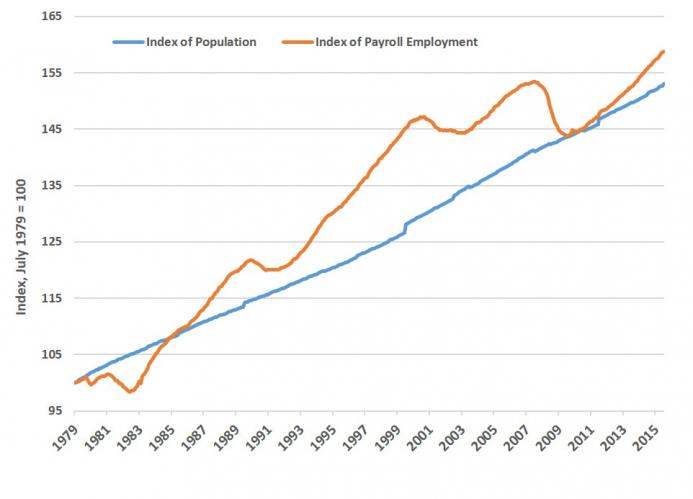
The good news gets better, though: not only have we gained jobs on net, but jobs have grown faster than the population over time. Since the 1979 peak in manufacturing employment, the US adult population grew by 53 percent, whereas employment grew by 59 percent, as shown in Figure 3.

Figure 3: Population Growth vs. Employment Growth Since 1979

watts3Source: Federal Reserve Economic Data

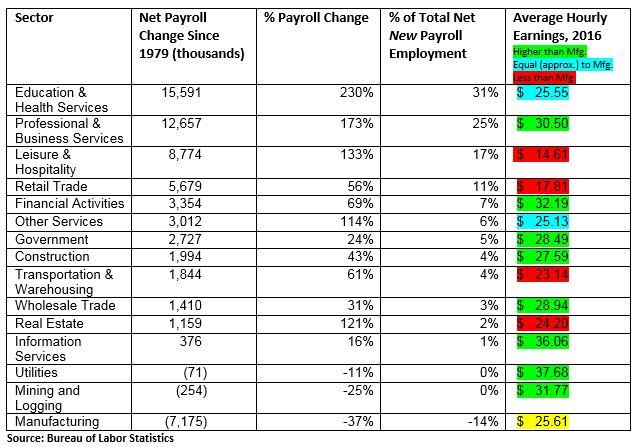
Despite these generally positive facts, some still contend that we’ve replaced “good” manufacturing jobs with lousy service sector jobs. Well, of course it must be true that, if we’ve lost manufacturing jobs, but gained jobs overall, then all of the job gains must have come from non-manufacturing sectors. And indeed the service sector, broadly defined, has seen employment growth of 90 percent since our 1979 benchmark. But beware of making hasty earnings assumptions about a sector that employs nearly 124 million people. To see whether the newly-created “service sector” jobs really don’t pay as well as the vaunted manufacturing jobs, we need to drill down into the employment and earnings data. What we’ll find is that a large majority of the new service sector jobs pay just as well or much better than manufacturing jobs.

Table 1 presents Bureau of Labor Statistics data on the 15 largest sectors and sub-sectors of the US economy, which together represent over 96 percent of the total net increase in payroll employment for the post-peak manufacturing jobs era (1979 to 2016). This might come as a surprise to the anti-globalization crowd: despite the loss of 7 million manufacturing jobs (and some mining, logging, and utilities sector jobs), we’ve seen a net increase of nearly 53 million total jobs. Of these net new jobs, fully 62 percent of them feature, as of January 2016, average hourly earnings equal to or greater than current average hourly manufacturing earnings. In other words, most of the 53 million new jobs pay the same or better wages than the demagogues’ benchmark “good” manufacturing jobs. So we lost 7 million good jobs, only to gain about 32 million equal or better-paying jobs, along with about 19 million lower-paying jobs (about 38 percent of net new jobs pay less than manufacturing).

Table 1: Employment Changes and Current Earnings by Sector

watts4Source: Bureau of Labor Statistics

We’ve established that, despite a major decrease in employment in the manufacturing sector, we’ve gained many more jobs than we’ve lost in the past 35 years or so, and that most of these new jobs pay better to boot. Economic changes, while painful in the short run, have brought gains in output and employment not only for the US, but for the rest of the world as well. Overall, this is good news for the US and world economies.

So, as the campaign season heats up, let’s not be misled by baseless arguments about America “losing jobs” or other countries “beating us” at trade. Trade is a positive sum game, and the benefits for both the US and world economies are, shall we say, “yuge.”

Tyler Watts earned his PhD in economics at George Mason University in 2010. He currently teaches economics at East Texas Baptist University and runs the Institute for Economic Education (see YouTube channel here), a public outreach focused on integrating economics with a Biblical worldview and providing unique teaching tools for high school and college economics students.

This article was published on Mises.org and may be freely distributed, subject to a Creative Commons Attribution United States License, which requires that credit be given to the author.

The US Two-Party System Made Donald Trump’s Fascist Campaign Possible – Article by G. Stolyarov II

The US Two-Party System Made Donald Trump’s Fascist Campaign Possible – Article by G. Stolyarov II

The New Renaissance Hat
G. Stolyarov II
******************************

                It is disconcerting to watch as the front-runner for the 2016 Republican Presidential nomination in the United States espouses a genuinely fascistic agenda – not just in terms of protectionism, economic nationalism, militarism, and the desire to centrally plan economic greatness – but also in terms of the overtly uglier sides of historical fascism: the xenophobia, racism, advocacy of torture and blood guilt, desire to silence political opponents, and incitements to violence against protesters and dissenters. Yet this is precisely what Donald Trump has done, unleashing the long-dormant worst tendencies of American politics. He has emboldened the crudest, least enlightened, most hide-bound enemies of tolerance, cosmopolitanism, and liberty to emerge from well-deserved disgrace to fuel the campaign of a cynical, unprincipled opportunist who thrives by pandering to their lowest impulses. Trump is vulgar, volatile, and unhinged. He has already turned his rallies into miniature versions of the police state he would create if elected – evicting even protesters who simply stand there with signs or clothing that express disagreement with Trump, or even individuals who attract the ire of the frenzied Trumpists for having the “wrong” color of skin or the “wrong” incidental expressions. Because of a bizarre law (H. R. 347, enacted in 2012), it is illegal to protest inside Trump rallies (or rallies of any candidate that receives Secret Service protection), so Trump is already utilizing coercive police powers to suppress dissent.

                Though it may be alleged that economic fascism has characterized America’s “mixed economy” since at least the New Deal of the 1930s, the resurgence of cultural fascism would have been unthinkable even during the 2012 Presidential Election. Mitt Romney, who seemed to me at the time to represent a paradigm of crony capitalism that inched toward overarching totalitarianism, now appears to be a gentleman and an intellectual – a voice of reason, class, and prudence in his eloquent denunciation of Donald Trump. Romney, as President, would have been unlikely to avert an incremental descent into fascism (although, in retrospect, he seems to be a decent human being), and his own candidacy was marred by manipulations at various State Republican Conventions, but, compared to Trump, Romney is a model of civility and good sense. Romney, if elected, would primarily have been the next status-quo President, overseeing a deeply flawed and deteriorating but endurable economic, political, and civil-liberties situation. Trump, however, would plunge the United States into an abyss where the remnants of personal liberty will suffocate.

                And yet the manipulations that occurred in 2012 to aid Romney paved the way for a Trump candidacy and its widely perceived “unstoppable” momentum. (Let us hope that this perception is premature!) I was a delegate to the Nevada State Republican Convention in 2012, where I helped elect a pro-Ron Paul delegation to the Republican National Convention. However, upon learning of the events at the National Convention, I became forever disillusioned with the ability of the Republican Party to become receptive to the advocacy of individual freedom. I wrote after Romney’s electoral defeat that

the rule change enacted by the party establishment at the National Convention, over the vociferous objections of the majority of delegates there, has permanently turned the Republican Party into an oligarchy where the delegates and decision-makers will henceforth be picked by the ‘front-runner’ in any future Presidential contest. Gone are the days when people like me could, through grass-roots activism and participation at successive levels of the party conventions, become delegates to a state convention and exert some modicum of influence over how the party is governed and intellectually inclined.

                The Republican Party establishment intended its rule change to prevent the ability of motivated grass-roots activists to elect delegates at State Conventions who would vote against the “presumptive nominee” and in favor of an upstart – presumably more libertarian – contender such as Ron Paul. Little did the establishment expect that this rule change would prevent its own favored candidates from effectively contesting Donald Trump’s nomination if Trump continues to win popular votes, especially in “winner-take-all” primaries, and approaches a majority of the total delegates. The most that the Republican Party elites can hope for now is that a candidate such as Ted Cruz eventually overtakes Trump, or that the remaining candidates – Cruz, Marco Rubio, and John Kasich – split enough of the delegates to deny Trump the majority and lead to a brokered convention. But as the narrative of inevitability continues to be spun in Trump’s favor and he amasses prominent endorsements and even promises from the other candidates that they would support him if he were the nominee, these damage-control plans seem quite vulnerable. Blind party loyalty, combined with a bandwagon mentality, appears to be driving the Republican establishment to a reluctant capitulation to Trump – which would be political suicide, but they are apt to do it anyway.

                If Trump trumps the old Republican Party establishment, however, this would be nothing to cheer. It would be a replacement of a defunct, cronyist, and backroom-dealing oligarchy – but one considerably tempered by satiation from its own decades of comfortable dominance and the remaining checks and balances of the political system – with a vicious, crass, completely unrestrained new oligarchy headed by Trump himself, and fueled by populistic pandering to masses about whom Trump personally could not care less. Trump asserts that he is incorruptible because he is funding his own campaign. However, the truth is that he does not need to pay anyone off for special political privileges, because he is the special interest that would be garnering the favors during “normal times”. If elected, he will simply do so without the intermediaries of the traditional political class. As Jeffrey Tucker eloquently explains,

many have fallen for Donald Trump’s claim that he deserves support solely because he owes nothing to anyone. Therefore, he is not part of the establishment. Why is that good for liberty? He has said nothing about dismantling power. […] He wants surveillance, controls on the internet, religious tests for migration, war-like tariffs, industrial planning, and autocratic foreign-policy power. He’s praised police power and toyed with ideas such as internment and killings of political enemies. His entire governing philosophy boils down to arbitrary, free-wheeling authoritarianism.

                Yet the biggest underlying facilitator of Trump’s frightening rise is the very two-party political system in the United States. Had the ballot-access laws not been rigged against “third” political parties and independent candidates, and had representation been determined on a proportional rather than a “winner-take-all” basis, there would have been genuine alternatives for voters to choose from. At present, however, every recent election season has degenerated into a spectacle of demonizing “the other side” – even if that side is just a different wing of the same political establishment. Far too many people vote for “the lesser evil” in their view, rather than the candidate with whom they agree most (who will most likely be a minor-party or independent candidate, since both the Republican and Democratic Parties are widely perceived as ineffectual and misguided once actually in power). Instead of evaluating specific candidates based on their stances on the issues as well as their personal record of integrity (or lack thereof), too many voters have learned to viscerally hate “the other” party’s brand and exhibit unconditional loyalty to their own. During the primary process, even voters who prefer the candidates who did not become the nominee will often capitulate and embrace a deeply flawed frontrunner. If too many Republican voters come to believe that Hillary Clinton or Bernie Sanders would be intolerable choices for President, then they may come to rally behind Trump even if they personally would have preferred Rubio, Cruz, or Kasich – and that is how a fascistic campaign could elicit the support of even the many non-fascists who simply cannot distance themselves from the “R” next to a candidate’s name.

                The only way in the long term to defeat Trump and those like him (because, in the wake of Trump’s bewildering popularity, others will emerge to imitate his tactics) is to renounce the two-party political system and judge each candidate solely on his or her policies, record, and personal merits or demerits. As I pointed out in 2012 in “On Moral Responsibility in General and in the Context of Voting”,

The most reliable way to avoid adverse moral responsibility in voting is to vote for a candidate whom one considers to be an improvement over the status quo in absolute, not relative, terms – and without regard for how others might vote. Morality is not based on consensus, but on objective truth. One’s own understanding of objective truth, and the continual pursuit of improving that understanding, is the best path to moral action and the habits of thought that facilitate it.

More recently, in 2015, I explained that

voters who are caught in the expectations trap will tend to vote for the “lesser evil” (in their view) from one party, because they tend to think that the consequences of the election of the candidate from the other party will be dire indeed, and they do not want to “take their vote away” from the slightly less objectionable candidate. This thinking rests on the false assumption that a single individual’s vote, especially in a national election, can actually sway the outcome. Given that the probabilities of this occurring are negligible, the better choice – the choice consistent with individual autonomy and the pursuit of principle – is to vote solely based on one’s preference, without any regard for how others will vote or how the election will turn out.

             Had Trump been one candidate among tens of independent contenders, he would have been rightly recognized as a demagogue whose base of support is a xenophobic, poorly educated fringe. Had numerous political parties been able to compete without major barriers to entry, today’s “moderate” establishment Republicans and movement conservatives would have had no need to fight with Trump over a particular party’s nomination, since they – having little in common – would have likely fielded multiple candidates of their own from multiple parties. As it stands now, however, the two-party system has destroyed the checks that would exist in a truly politically competitive system to prevent a fascistic demagogue’s meteoric rise. Only the consciences of voters stand between Trump and the Republican nomination, as well as the Presidency. Now, more than ever, it is imperative to vote solely on principle and escape the “lesser evil” trap, lest the greater evil of untrammeled illiberalism trap us forever.

This essay may be freely reproduced using the Creative Commons Attribution Share-Alike International 4.0 License, which requires that credit be given to the author, G. Stolyarov II. Find out about Mr. Stolyarov here.

A Transhumanist Manifesto for Calgary and Beyond – Article by Reed Nelson

A Transhumanist Manifesto for Calgary and Beyond – Article by Reed Nelson

Reed Nelson
******************************
What is Transhumanism?

Transhumanism is the idea, philosophy, movement, what have you, that human beings both can and should be enhanced by the use of technology. So while some people use glasses, cars, phones computers, airplanes, and so forth, well, we Transhumanists want to go further.

A lot further.

We want robotic hearts, we want to stay young, we want to be stronger, faster, smarter, and more loving than we are now.

And we don’t people to feel depression, or rage, or extreme loneliness, or to experience cancer, AIDS, or disability of any sort.

We want everyone to feel and function well, all of the time, and we want to grow as never before.

Now consider this.

For the entirety of our species we have only been changing the external – where we live, what clothes we wear, what religions we devote ourselves to and so forth.

And now, I and many others believe that it is time to change the inside.

It is time to evolve.

On Rational Devotion

It seems to me that within Christianity, as well as many other religions, there is the idea that one must devote to God, and God will respond – that is to say, God will heal you in his time.

His time? Does that mean, not even in this life, and yet still you are asked to devote?

(Oh, and why does he heal say, loneliness but not an amputee?)

If God is real, then at minimum, he should meet us halfway, and for each prayer, a little healing, and for each verse read, a little healing.

But of course it doesn’t work that way, and the believer is told to keep going and just, well, believe. That to me sounds like mental slavery.

And I will have none of it.

Technology heals. Nature heals. Animals heal. People heal each other.

And technology has the potential to be, and often already is, the greatest healer of all.

Why devote to anything else then?

P. S. In the movie Forrest Gump, what heals the legs of Lt. Dan? Oh right, technology.

Please, brothers and sisters, let us now turn away from the empty promises of holy books, and instead let us support Transhumanism, for it shall lead us to real healing.

So now we come to arguably our crystalline truth – if there is a biological problem, there is a biological solution.

Zoltan Istvan for American President 2016.

Spread the Good News.

Reed Nelson is the founder of The Transhumanist Party of Calgary in Alberta, Canada. See the Facebook page of The Transhumanist Party of Calgary here.

Will Trump Boycott Grocery Stores for Their Unfair Trade? – Article by Edward Hudgins

Will Trump Boycott Grocery Stores for Their Unfair Trade? – Article by Edward Hudgins

The New Renaissance HatEdward Hudgins
******************************

Donald Trump’s stump thump against Mexico is that it runs a $58 billion annual trade surplus with the United States. Trump somehow thinks this leaves America the poorer.

He claims that it is out of that money, presumably sitting in some giant vault in Tijuana, that Mexico will pay for the border fence he wants to build to keep immigrants from entering the United States illegally. Trump’s pronouncements only demonstrate how he keeps facts and reason from entering his thoughts and, how he would keep Americans from making their own free choices in a free market.

International free trade is win-win
Trump’s very language reveals a glaring error concerning trade. Mexico and America do not trade. Mexicans and Americans do. Mexicans have $58 billion more in cash (pieces of paper with George Washington’s picture on them or the equivalent credits on bank ledgers) and Americans have $58 billion more in goods (electrical equipment, Trump-themed apparel).

And Trump doesn’t bother to ask, what are those Mexicans supposed to do with those pieces of paper? If they don’t spend them in America, they’ve got nothing but useless paper. So the Mexican trade surplus also means that Mexicans are investing an equivalent amount in America, helping the U.S. economy grow.

Further, the fundamental nature of trade between individuals is a win-win situation. Someone who buys an orange Donald hat for $20 to show his support for the former host of “The Apprentice” values the hat more than the twenty. And the manufacturer in Mexico who has a warehouse full of said head gear prefers the $20.

If The Donald slaps a 30% tariff on all goods coming from Mexico, maybe his starry-eyed supporters would shell out $26, the higher cost of the hat. But a poor mother with five kids seeing the price of a pair of shoes jump from $20 to $26 might be hard-pressed to afford the extra $30 she’d need to cover the feet of all her five little ones. But Trump doesn’t care. He wants to get rid of that pesky trade imbalance and what better way than to discourage that mom from buying Mexican-made shoes for her family! On the other hand, maybe he will notice when Mexican investors pull out of his latest golf resort or skyscraper projects, because his policies have destroyed their profits.

Trump’s grocery store trade deficit
If Trump is so against trade deficits, he should have a serious problem in his own household. Trump no doubt runs a huge trade deficit with his grocery store. He gives them piles of money when he buys food—no doubt top-priced cuisine—but the store never buys anything from him. Maybe he should boycott it. Maybe we should all boycott our local grocery stores lest we be victims of a trade deficit. Maybe if elected president, Trump will slap a 30 percent “grocery tariff” on everything that those stores try to sell to us poor, exploited schleps until those stores start purchasing stuff from us.

Trumps versus liberty
Trump poses as a friend of the people, but he wants to use government to prohibit the Americans from purchasing goods from whomever they wish—including Mexicans. The Donald presumes to know better what individual Americans should buy with their own money and at what price than they do. He’s determined to drive up the prices for Americans buying from Mexicans to teach those Mexicans a lesson. So what if American consumers and businesspeople are collateral damage.

Trump’s policies would only add more instability to an already unstable world. Ayn Rand explained that “The essence of capitalism’s foreign policy is free trade—i.e., the abolition of trade barriers… the opening of the world’s trade routes to free international exchange and competition among the private citizens of all countries dealing directly with one another. During the nineteenth century, it was free trade that liberated the world, undercutting and wrecking the remnants of feudalism and the statist tyranny of absolute monarchies.”

When governments take away the liberty of individuals to pursue their self-interest by trading freely with other individuals—a win-win situation—they set the stage for conflicts and even wars between countries. Trump’s proposed trade war is really a war on the American people.

Dr. Edward Hudgins directs advocacy and is a senior scholar for The Atlas Society, the center for Objectivism in Washington, D.C.

Copyright The Atlas Society. For more information, please visit www.atlassociety.org.

Bernie Sanders’ Anti-Foreign Crankery – Article by Daniel Bier

Bernie Sanders’ Anti-Foreign Crankery – Article by Daniel Bier

The New Renaissance HatDaniel Bier
******************************

A Vesuvius of Tribalism and Economic Illiteracy

At Sunday’s Democratic presidential debate, Bernie Sanders attacked American trade with Mexicans, Chinese, Vietnamese, and presumably all other foreigners who might try to steal our jobs. Sanders harangued Hillary Clinton,

NAFTA, supported by the Secretary, cost us 800,000 jobs nationwide, tens of thousands of jobs in the Midwest. Permanent normal trade relations with China cost us millions of jobs.

Look, I was on a picket line in early 1990’s against NAFTA because you didn’t need a PhD in economics to understand that American workers should not be forced to compete against people in Mexico making 25 cents an hour.

… And the reason that I was one of the first, not one of the last to be in opposition to the TPP is that American workers … should not be forced to compete against people in Vietnam today making a minimum wage of $0.65 an hour.

Look, what we have got to do is tell corporate America that they cannot continue to shut down. We’ve lost 60,000 factories since 2001. They’re going to start having to, if I’m president, invest in this country — not in China, not in Mexico.

First, let’s note his dodgy job numbers. As Dan Griswold noted in 2011, in response to a similar claim about jobs “lost” from the “trade deficit” with Mexico,

In the first five years after NAFTA’s passage, 1994-98, when we could have expected it to have the most impact, the U.S. economy ADDED a net 15 million new jobs, including 700,000 manufacturing jobs.

Behold, the horror unleashed on US manufacturing jobs by trade with Mexico:nafta-manufacturing

In fact, since NAFTA went into effect in 1994, total US employment has increased by 28 million jobs. Even if we buy the dubious claim that NAFTA “cost us 800,000 jobs” over the last 22 years, this amounts just 36,000 jobs a year.

As Griswold noted, even in good times, 300,000 Americans file for unemployment each week. The US economy creates and destroys more than 15 million jobs every year. This alleged displacement amounts to less than one day’s worth of job losses.

It’s true that, in the long-run, manufacturing jobs have been in decline in the United States. But this is not because manufacturing is in decline. The myth (promoted by the other nationalist blowhard in the race) that United States “doesn’t make stuff anymore” is not just wrong — it couldn’t be further from the truth.

Real US manufacturing output is the highest it has ever been. Simply put, the US makes more stuff than ever.

manufacturing-indexHow can this be? Because manufacturing productivity — the amount of value added per hour worked — has gone up dramatically in recent decades. Manufacturing employment is declining because of automation; a US factory worker today can add a lot more value per hour than one in 1970.

manufacturing-employees-output-per-hour

It’s simply not true that trade devastated the US economy and wiped out millions of jobs. Employment has shifted within the US economy, out of industry into service jobs, and manufacturing has shifted around the globe, aligning production with the comparative advantages of each country’s labor and capital markets.

The resentment stoked by nationalists like Trump and Sanders is based on a nonsensical proposition, a mirage of high-paying blue collar jobs stolen by conniving foreigners, which we could reclaim if only we had the will to wage a trade war.

But the machines and global production chains are here to stay, and the jobs being done in Vietnam and China for fifty cents an hour are on the extreme low end of the value-added chain — which should be obvious, when you think about it, since they pay so little. (On the back of every iPhone is a short economics lesson on this point: “Designed by Apple in California. Assembled in China.”)

Do we really want to “bring those jobs back”? Do we envision a future where the American middle class is sewing textiles in sweatshops for a dollar an hour? Of course not. Americans today likely wouldn’t do those jobs at any wage, but especially not at the wages paid to low-skilled workers in developing Asian and Latin American countries. Those jobs only exist at those wages; at higher wages, they are scarcer, higher-skilled, and more capital intensive.

True, we could make t-shirts and Happy Meal toys in the United States, but we’d be doing it with far, far fewer workers and a lot more capital. Instead of 30 workers at fifty cents an hour, it’d be one person with a machine for $20 an hour.

The real difference would be that everyone would be poorer as a result: consumers paying higher prices, foreigners working in worse conditions and for less money, and American resources being diverted away from where they are most productive.

This is where economic ignorance stops being morally neutral and becomes a real threat to the life and well-being of the poor, especially in the developing world.

Not content to merely keep Mexicans from working in the United States (where, thanks to US capital and infrastructure, they could earn three or four times more than they make in Mexico), Bernie Sanders now objects to the right of Mexicans to work in Mexico, if they dare to sell goods and services to Americans — or, God forbid, try to compete with American firms.

For a champion of the poor like Sanders, there’s a double irony here, in that poor Americans are already much wealthier than poor Mexicans, and that tariffs also make goods more expensive for native consumers, disproportionately hurting the poorest Americans. Not only are poor Mexicans made worse off, by losing access to the US market and thus losing jobs, but poor Americans are also made worse off by having less disposable income, which is thus not spent elsewhere in the economy to sustain other American jobs.

And this is just the first order effects of closing off trade with Mexico. When the Mexican government inevitably retaliates, US exports to Mexico (which totaled $236 billion in 2015) will also be devastated and more jobs will be lost. And of course, simply multiply this orders of magnitude for China, Vietnam, and every other country on the nationalistic hit list.

Who gains from this? In the long run, nobody, which is why (after decades of gradual reform) we finally got relatively free trade with our closest neighbors, signed into law by a liberal Democrat. But in the short run, a few US corporations and labor unions would benefit from trade tariffs — at the expense of both poor foreigners and poor Americans as a whole.

(For those keeping score, this makes it an ironic hat trick for Sanders, whose tirades against free trade and open borders are laced with fear-mongering about “corporations.”)

Finally, let us ponder Sanders’ Alice-in-Wonderland solution to the imagined ills of free trade:

Look, what we have got to do is tell corporate America that they cannot continue to shut down. We’ve lost 60,000 factories since 2001. They’re going to start having to, if I’m president, invest in this country — not in China, not in Mexico.

Did I say Alice in Wonderland? I meant Atlas Shrugged. Ayn Rand was justly accused of having unbelievable, one-dimensional stereotypes, but sadly, American politics seems to have the same problem.

It’s anyone’s guess how Sanders imagines he could force factories not to close and order companies to stay in the United States, but the “you can’t shut down” solution is almost directly lifted from “Directive 10-289,” the order that Rand’s antagonists use to try to “stabilize” the economy:

All workers, wage earners and employees of any kind whatsoever shall henceforth be attached to their jobs and shall not leave nor be dismissed nor change employment… All industrial, commercial, manufacturing and business establishments of any nature whatsoever shall henceforth remain in operation…

Faced with economic decline, the government believed that the only option was to stop the decline, rather allowing people to go where they choose, buy what they choose, and make what they choose. “What it comes down to is that we can manage to exist as and where we are, but we can’t afford to move!” archvillain Wesley Mouch exclaims. “So we’ve got to stand still… We’ve got to make those bastards stand still!”

When Rand first published this in 1957, this was hyperbole about the fear of change, the reductio ad absurdum of the argument for keeping things as they are. Now, it’s an applause line for mainstream presidential candidates.

Daniel Bier is the site editor of FEE.org He writes on issues relating to science, civil liberties, and economic freedom.

This article was published by The Foundation for Economic Education and may be freely distributed, subject to a Creative Commons Attribution 4.0 International License, which requires that credit be given to the author.
One Bad Reason to Hate Trump – Article by Sarah Skwire

One Bad Reason to Hate Trump – Article by Sarah Skwire

The New Renaissance HatSarah Skwire
******************************

99 Reasons, But the Name Ain’t One

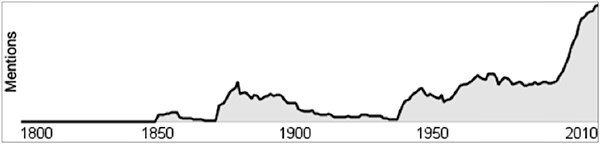
I have 99 (thousand) reasons to hate Donald Trump and to find his campaign stomach turning. I won’t list them here. The Google graph showing the rising use of the word “bloviate” in American political discourse should stand in place of any detailed accounting.

bloviategraph

But what’s grabbed most of the attention since John Oliver mentioned it recently on his show, Last Week Tonight, is Trump’s name. As Oliver notes, “Trump sounds like money.” But, he continues in tones of shock and dismay, “It turns out the name Trump was not always his family name.… An ancestor had changed it to Trump from Drumpf.”

My family name wasn’t originally Skwire. It was Skwirsky. My grandfather and his brothers changed it — right around when Trump’s ancestor changed the family name — because back in those days, it was hard to get jobs in the United States with an obviously foreign name. Trump’s ancestors, I’m sure, did the same thing.

There’s no shame in being from places that aren’t America. There’s no shame in having a last name that’s unusual. And I am bothered by the pleasure we are taking in mocking a name that sounds a little bit funny and a whole lot foreign. It sounds like the kind of rhetoric Trump uses. So I’m not going to indulge.

However.

(And this is a very big “however.”)

I do think there’s something to talk about here, and I don’t think it’s funny at all.

The focus on Trump’s original family name is not analogous to the focus on former Republican presidential candidate Chris Christie’s ample girth. Governor Christie’s poundage was immaterial to his campaign. He has not publically bloviated about the need for the obese to stop being lazy, to start exercising, and to start eating right. He has not signed on to regulatory agendas like former New York mayor Michael Bloomberg’s attempts to control what and how much people eat and drink. He hasn’t, in other words, turned his weight into a centerpiece of his campaign.

Trump, however, has made immigration one of his central issues. Even those of us who have tried desperately to avoid the whole political season have heard that he wants a bigger wall along the border with Mexico, that he wants Mexico to pay for it, and that he would deport 11 million illegal immigrants in short order. A little research turns up Trump’s repeated references to immigrants as criminals, drug dealers, and rapists. Birthright citizenship is dumb, he opines. And the barriers to immigration should be towering, because, Trump says over and over, the people born here should be our first concern.

It’s not funny that Trump’s family name used to be Drumpf. That’s just a standard American story that most of us probably share. To be an American, for most of us, means we’re not really from around here.

But the idea that we might have an American president who thinks it’s fine for the Drumpf family to come to America and achieve unimagined success in a few generations, but who will do everything possible to keep the Rodriguez family or the Habib family from doing the same?

That’s a tragedy.

Sarah Skwire is the poetry editor of the Freeman and a senior fellow at Liberty Fund, Inc. She is a poet and author of the writing textbook Writing with a Thesis. She is a member of the FEE Faculty Network.

This article was published by The Foundation for Economic Education and may be freely distributed, subject to a Creative Commons Attribution 4.0 International License, which requires that credit be given to the author.