Browsed by
Category: Politics

Free Trade Is the Path to Prosperity – Article by Georgi Vuldzhev

Free Trade Is the Path to Prosperity – Article by Georgi Vuldzhev

The New Renaissance HatGeorgi Vuldzhev
******************************

The political circus of the 2016 presidential election has revived and reinvigorated popular belief in age-old protectionist fallacies. Currently Donald Trump and Bernie Sanders are both in favor of expanding protectionist trade policy, with both of them arguing that free trade “destroys” jobs and hurts domestic workers and producers by exposing them to foreign competition. Both candidates espouse an utterly misguided zero-sum view of economics, in which one side to an exchange wins only when the other side loses. Both men are, of course, completely wrong.

Free Trade Does Not Destroy Jobs

It is true that greater competition between domestic and foreign workers can lead to a decline in wage rates and possibly unemployment in some sectors of the economy. But this is only a short-term effect. Free competition between foreign and domestic producers also naturally leads to lower prices for the goods and services which can now be freely imported from abroad. So, while nominal wage rates are pushed down in some sectors, real wage rates rise overall for everyone in the economy because of the decline in prices.

Thanks to free trade consumers spend less money on certain goods and services and this allows them to spend more money on others, which leads to rising demand and thus profits in the sectors providing the latter, and consequently leads also to more investment by entrepreneurs. This higher rate of investment naturally leads to the creation of more jobs in these sectors and thus offsets any original rise in unemployment that might have occurred.

Alternatively, the consumers may choose to save the extra disposable income that was freed up by the decline in prices. This rise in the savings rate will lead to a decline in interest rates, which makes profitable certain long-term capital-intensive projects which were not profitable beforehand. Seizing the opportunity presented by this increase in savings, entrepreneurs will start borrowing and investing in those long-term capital intensive projects, which on its own already creates more jobs, but it also leads to a rise in demand for capital goods, which raises profits in the capital goods industries and consequently leads to more investment and job openings in those sectors.

Free Trade Is Win-Win

Free trade not only doesn’t “destroy” jobs, but it also promotes specialization between nations, which improves the efficiency and productivity of workers, and leads to a rise in living standards for all. Trade is not some kind of a zero-sum game in which if one side wins, the other has to lose.

When two countries such as the United States and China, for example, trade freely with one another, their citizens are incentivized to specialize in those lines of production in which they have a comparative advantage. Due to the difference in factors of production endowments it is best for different countries to specialize in producing those types of goods and services which they can produce most efficiently in comparative terms. A higher level of specialization, through the effect of economies of scale, makes production more cost-efficient.

By specializing in a certain line of production and then exchanging the goods and services produced for those that others are specialized in producing, the people of a given country can substantially raise their living standards because the gains in productivity are naturally followed by an increasing supply of goods and services and thus rising real incomes. This way free trade allows for the flourishing of what can be called an “international” division of labor. Just like a greater degree of division of labor can lead to big gains in productivity and thus real incomes on an intra-national (i.e., internal for a given country) level it can also do so on an international level.

Protectionism Makes You Poor

When international trade is restricted, for example, by protectionist legislation which places tariffs on certain imports, this process of specialization is hindered and thus the gains in productive efficiency are diminished. By artificially raising the price of imports, tariffs allow otherwise uncompetitive and inefficient domestic businesses to remain in operation. Consumers are forced to pay higher prices for the goods the importation of which is penalized by tariffs, and this effectively constitutes a redistribution of resources from the consumers to the domestic producers.

More importantly, protectionism hinders the process of specialization described in the previous section and thus prevents living standards from rising in the long-term, or worse — it can even lead to their decline. By propping up the profits of comparatively inefficient domestic producers and keeping in business, tariffs prevent the labor shift from those inefficient sectors, to more comparatively efficient ones. Consequently, because this prevents a higher degree of specialization from taking place, or even reverses it, the benefits that specialization leads to cannot be obtained. Productivity does not increase (or at least not to the same degree as it could) and thus real incomes do not rise.

Contrary to the popular political rhetoric nowadays, free trade does not “destroy jobs.” It can only lead to a shift of resources (labor, capital, and other factors) from one comparatively inefficient sector or group of sectors in the domestic economy to another more comparatively efficient one. This process of specialization in the comparatively advantageous lines of production not only does not destroy jobs, but it also enables big gains in efficiency and productivity to take place, which leads to a rise in real incomes. This is how, far from somehow hurting the domestic workers, free trade actually does the opposite — it makes them richer. It is, in fact, protectionism which makes us all poorer, workers included, by artificially propping up inefficient businesses, leading to a misallocation of resources and a decline in standards of living for us all.

Georgi Vuldzhev is a student and an intern at the Institute for Market Economics in Sofia, Bulgaria. He has written articles on economics and politics for the European Students for Liberty blog, where he is a regular contributor, and various Bulgarian publications. His main interests are Austrian economics and libertarian political theory.

This article was published on Mises.org and may be freely distributed, subject to a Creative Commons Attribution United States License, which requires that credit be given to the author.

A Conversation with My Neighbor “Sam” – Article by Mark Brandly

A Conversation with My Neighbor “Sam” – Article by Mark Brandly

The New Renaissance HatMark Brandly
******************************

Lately, I’ve wondered how my neighbor, Sam, affords to buy so much stuff. He appears to have an unlimited budget. When I asked him about this, Sam asked, “Do you think I’m spending too much?”

“That depends,” I said, “How much money do you make?”

“I take home $100,000 a year.”

That surprised me. I would guess that he’s spending more than that. But I tried to be encouraging, “That sounds like plenty of income. With a little planning, you should be able to budget your spending and be financially stable.”

“But my finances are a mess,” Sam replied. “I spend more than I take home. Last year I had to borrow $12,000 just to cover my spending.”

“Well maybe things will be better this year,” I said, hoping that Sam’s spending issues was a one year problem.

“No,” Sam replied. “Actually, in the first three months of this year, I’ve already spent $19,000 more than I’ve made. It looks like my budget deficit this year will be much worse than it was last year.”

Now I was starting to worry. “Have you been borrowing money to cover your spending for a long time?”

“Oh yes. I have a lot of debt. Part of the problem is that I owe myself $150,000.”

I wondered if Sam misspoke, “Wait, wait, wait, you owe yourself $150,000? Why do you think that you’re in debt to yourself?”

“Well you see, over the years I promised myself that I was going to use my paychecks to pay for a fund for my children’s education, but instead of spending $150,000 on colleges, I spent the money on other expenses. So I figure that I owe myself this money so that I can pay for my children’s college tuitions.”

Obviously Sam doesn’t understand the definition of the word “debt.”

I tried to be polite in my response: “That doesn’t make any sense. It’s true that you’ve made some horrible decisions regarding your spending, but it’s ridiculous to claim that you owe yourself money. A debt occurs when one person owes another person money. Just because you changed your mind about how to spend your paychecks doesn’t mean that you’ve borrowed money from yourself.

“So the first thing you need to do is to think clearly about the amount of debt you have. You don’t owe yourself any money. Now, forgetting about this ridiculous notion of self-debt, how much do you owe?”

“Alright, I think I see your point. Let’s just talk about the rest of my debt. I owe various banks about $420,000. This debt is more than four times my take-home income.”

Sam often lies about his income and spending issues, but he always understates his budget problem. If he’s lying now, then I can be sure that the problem is even greater than he says. I wanted more information.

“That a pretty high debt to income ratio. But that might be somewhat manageable, although unwise, if you’ve borrowed that money at low interest rates.”

“I have some good news and some bad news,” Sam said. “Interest rates are low. In fact, in the last fourteen years, my debt has more than quadrupled, but my interest payments have increased less than 50 percent. That’s because interest rates have collapsed during that time. Isn’t that good news?”

“I suppose, but do you know that interest rates are going to increase over the next several years?”

“Yes, that’s the bad news. In the past year, I only paid $7,000 of interest, but within ten years my debt will increase over 50 percent, and possibly much more, and with higher interest rates I expect to be paying at least four to five times that much in interest annually.”

“That’s a huge problem. So to be able to make your loan payments, I assume that you’ve taken out some long-term loans.”

“No, no, no. In order to take advantage of the low interest rates, most of my borrowing is short term. I rollover my loans quickly. In the past year my principal payments on these loans totaled $207,000.”

“Let me get this straight. Your loan payments, including principal and interest, are well over twice your take home pay?”

“Yes, I take home a little over $8,000 per month and my loan payments are over $17,000 per month. But it’s no problem. In the past year I borrowed $223,000 to cover everything.”

Shocked, I said “How can you say borrowing more than twice your income is not a problem?”

“I simply borrow all the money I need to make all of my loan payments. I never pay any of the loans down. I’ve been doing this for years, ever since I started spending more than I make.”

“Okay. Most of your borrowing goes to cover your increasingly large principal and interest payments. And as interest rates rise, interest payments will become a bigger percentage of your spending. When that happens, your total debt will increase faster than your income. What is your plan, say in the next ten years, to correct this situation?”

“Well I don’t have a plan for correcting anything, because I don’t see how I can cut my spending.”

“What if the banks stop loaning you money to make your payments on your loans? What happens then?”

“I guess I’m assuming that won’t happen.”

Sam’s Budget Situation in Real Numbers
If one of our neighbors budgeted in this manner, we would obviously conclude that the guy is crazy. No such plan could work. Eventually lenders would refuse to fund Sam’s spending.

However, Sam’s situation looks a lot like the federal government budget plan. Take a look at some recent federal budget information and some Congressional Budget Office projections:

  • In FY (fiscal year) 2015, the feds had a budget deficit, counting only debt held by the public, of $339 billion, which is about 10 percent of their tax revenues of $3,248 billion. The deficit has been declining the last few years, but that is now changing.
  • In fact, in the first three months of FY 2016, according to the Treasury Department, federal debt held by the public increased $548 billion. Admittedly, some of this debt was due to the fact that the feds were cooking the books in FY 2015 when they hit the debt ceiling limit. Nonetheless, the first quarter 2016 deficit is already 60 percent larger than the overall 2015 deficit.
  • The federal government claims to owe itself over $5 trillion (they call it intragovernmental debt here). This $5 trillion represents tax revenues that were earmarked for specific spending programs, such as Social Security, but were spent on other programs. Since the feds collected taxes to pay for Social Security, but spent the money on something else, they conclude that they owe it to themselves to collect those tax revenues again. That’s the essence of intragovernmental debt. We should not count this as debt. Give the Treasury Department credit for ignoring this type of “debt” in their Daily Treasury Statements and in their end of the year debt reports.
  • As of September 30, 2015, the feds had $13.1 trillion of debt owed to the public. FY 2015 tax revenues totaled $3.248 trillion. So just like Sam the government has a 4-to-1 debt-to-tax-revenue ratio.
  • In the past fourteen years, from September 30, 2001 (the start of George Bush’s first budget) to September 30, 2015 (the end of Barack Obama’s sixth budget), debt owed to the public increased from $3,339.3 billion to $13,123.8 billion. That’s an increase of 293 percent.
  • According to the Daily Treasury Statements, in the past fourteen years, interest on treasury securities increased from $162.5 billion in fiscal year 2001 to $233.1 billion in fiscal year 2015. That’s a 44 percent increase during the same period when federal debt owed to the public almost quadrupled.
  • In FY 2015, again according to the Daily Treasury Statements, the feds borrowed $7,251.4 billion (see the Public Debt Cash Issues for September 30, 2015), an average of almost $20 billion per day. They spent $6,740.3 billion of this borrowing rolling over their debt. So, Federal principal and interest payments are more than double federal tax revenues.
  • According to the Congressional Budget Office’s baseline projections, debt held by the public in 2025 should exceed $21 trillion and during that time interest rates are expected to increase. Interest rates have been kept artificially low for years. If interest rates return to a more normal level, say to the rates they were paying when George Bush took office fifteen years ago, then interest payments in 2025 will exceed $1.2 trillion. That’s over a 400 percent increase compared to the FY 2015 interest payments. I should note here that the baseline budget projections are optimistic. We should expect the debt situation in 2025 to be significantly worse than these projections.

The federal government’s debt has exploded under the Bush and Obama administrations. Low interest payments due to the low interest rates have masked their budget problems. As interest rates and the spending gap on entitlement programs such as Social Security both increase, the budget problem will compound.

The federal government’s plan is to borrow all of the money they need to pay all of their principal and interest payments and to also pay for the budget deficits in their spending programs. The question we should ask is: what’s going to happen when the world’s lenders refuse to bankroll DC’s spending schemes?

Mark Brandly is a professor of economics at Ferris State University and an adjunct scholar of the Ludwig von Mises Institute.

This article was published on Mises.org and may be freely distributed, subject to a Creative Commons Attribution United States License, which requires that credit be given to the author.

Do We Need To ‘Rebuild The Military’? – Article by Ron Paul

Do We Need To ‘Rebuild The Military’? – Article by Ron Paul

The New Renaissance HatRon Paul
******************************

The Republican presidential debates have become so heated and filled with insults, it almost seems we are watching a pro wrestling match. There is no civility, and I wonder whether the candidates are about to come to blows. But despite what appears to be total disagreement among them, there is one area where they all agree. They all promise that if elected they will “rebuild the military.”

What does “rebuild the military” mean? Has the budget been gutted? Have the useless weapons programs like the F-35 finally been shut down? No, the United States still spends more on its military than the next 14 countries combined. And the official military budget is only part of the story. The total spending on the US empire is well over one trillion dollars per year. Under the Obama Administration the military budget is still 41 percent more than it was in 2001, and seven percent higher than at the peak of the Cold War.

Russia, which the neocons claim is the greatest threat to the United States, spends about one-tenth what we do on its military. China, the other “greatest threat,” has a military budget less than 25 percent of ours.

Last week the Pentagon announced it is sending a small naval force of US warships to the South China Sea because, as Commander of the US Pacific Command Adm. Harry Harris told the House Armed Services Committee, China is militarizing the area. Yes, China is supposedly militarizing the area around China, so the US is justified in sending its own military to the area. Is that a wise use of the US military?

The US military maintains over 900 bases in 130 countries. It is actively involved in at least seven wars right now, including in Iraq, Syria, Pakistan, and elsewhere. US Special Forces are deployed in 134 countries across the globe. Does that sound like a military that has been gutted?

I do not agree with the presidential candidates, but I do agree that the military needs to be rebuilt. I would rebuild it in a very different way, however. I would not rebuild it according to the demands of the military-industrial complex, which cares far more about getting rich than about protecting our country. I would not rebuild the military so that it can overthrow more foreign governments who refuse to do the bidding of Washington’s neocons. I would not rebuild the military so that it can better protect our wealthy allies in Europe, NATO, Japan, and South Korea. I would not rebuild the military so that it can better occupy countries overseas and help create conditions for blowback here at home.

No. The best way to really “rebuild” the US military would be to stop abusing the military in the first place. The purpose of the US military is to defend the United States. It is not to make the world safe for oil pipelines, or corrupt Gulf monarchies, or NATO, or Israel. Unlike the neocons who are so eager to send our troops to war, I have actually served in the US military. I understand that to keep our military strong we must constrain our foreign policy. We must adopt a policy of non-intervention and a strong defense of this country. The neocons will weaken our country and our military by promoting more war. We need to “rebuild” the military by restoring as its mission the defense of the United States, not of Washington’s overseas empire.

Ron Paul, MD, is a former three-time Republican candidate for U. S. President and Congressman from Texas.

This article is reprinted with permission from the Ron Paul Institute for Peace and Prosperity.

First They Came For the iPhones… – Article by Ron Paul

First They Came For the iPhones… – Article by Ron Paul

The New Renaissance HatRon Paul
******************************
The FBI tells us that its demand for a back door into the iPhone is all about fighting terrorism, and that it is essential to break in just this one time to find out more about the San Bernardino attack last December. But the truth is they had long sought a way to break Apple’s iPhone encryption and, like 9/11 and the PATRIOT Act, a mass murder provided just the pretext needed. After all, they say, if we are going to be protected from terrorism we have to give up a little of our privacy and liberty. Never mind that government spying on us has not prevented one terrorist attack.

Apple has so far stood up to a federal government’s demand that it force its employees to write a computer program to break into its own product. No doubt Apple CEO Tim Cook understands the damage it would do to his company for the world to know that the US government has a key to supposedly secure iPhones. But the principles at stake are even higher. We have a fundamental right to privacy. We have a fundamental right to go about our daily life without the threat of government surveillance of our activities. We are not East Germany.

Let’s not forget that this new, more secure iPhone was developed partly in response to Ed Snowden’s revelations that the federal government was illegally spying on us. The federal government was caught breaking the law but instead of ending its illegal spying is demanding that private companies make it easier for it to continue.

Last week we also learned that Congress is planning to join the fight against Apple – and us. Members are rushing to set up yet another federal commission to study how our privacy can be violated for false promises of security. Of course they won’t put it that way, but we can be sure that will be the result. Some in Congress are seeking to pass legislation regulating how companies can or cannot encrypt their products. This will suppress the development of new technology and will have a chilling effect on our right to be protected from an intrusive federal government. Any legislation Congress writes limiting encryption will likely be unconstitutional, but unfortunately Congress seldom heeds the Constitution anyway.

When FBI Director James Comey demanded a back door into the San Bernardino shooter’s iPhone, he promised that it was only for this one, extraordinary situation. “The San Bernardino litigation isn’t about trying to set a precedent or send any kind of message,” he said in a statement last week. Testifying before Congress just days later, however, he quickly changed course, telling the Members of the House Intelligence Committee that the court order and Apple’s appeals, “will be instructive for other courts.” Does anyone really believe this will not be considered a precedent-setting case? Does anyone really believe the federal government will not use this technology again and again, with lower and lower thresholds?

According to press reports, Manhattan district attorney Cyrus Vance, Jr., has 175 iPhones with passcodes that the City of New York wants to access. We can be sure that is only the beginning.

We should support Apple’s refusal to bow to the FBI’s dangerous demands, and we should join forces to defend of our precious liberties without compromise. If the people lead, the leaders will follow.

Ron Paul, MD, is a former three-time Republican candidate for U. S. President and Congressman from Texas.

This article is reprinted with permission from the Ron Paul Institute for Peace and Prosperity.

Trump and Sanders Are Both Conservatives – Article by Steven Horwitz

Trump and Sanders Are Both Conservatives – Article by Steven Horwitz

The New Renaissance HatSteven Horwitz
******************************

Shared Visions of Fear, Force, and Collectivism

Those of us who reject the conventional left-right political spectrum often see things that those working within it cannot. For example, in “Why the Candidates Keep Giving Us Reasons to Use the ‘F’ Word” (Freeman, Winter 2015), I argue that Donald Trump and Bernie Sanders, seen by many as occupying opposite ends of the ideological spectrum, both embrace the thinking of economic nationalism, if not fascism.

They also share a different political tradition. It may seem to contradict their shared fascist pedigree, but Trump and Sanders are both, in a meaningful sense, conservatives.

Trump, of course, has been lambasted by many self-described conservatives precisely because they believe he is not a conservative. And Sanders, the self-described “democratic socialist,” hardly fits our usual conception of a conservative. What exactly am I arguing, then?

They are both conservatives from the perspective of classical liberalism. More specifically, they are conservatives in the sense that F.A. Hayek used the term in 1960 when he wrote the postscript to The Constitution of Liberty titled “Why I Am Not a Conservative.” There he said of conservatives,

They typically lack the courage to welcome the same undesigned change from which new tools of human endeavors will emerge.… This fear of trusting uncontrolled social forces is closely related to two other characteristics of conservatism: its fondness for authority and its lack of understanding of economic forces.… The conservative does not object to coercion or arbitrary power so long as it is used for what he regards as the right purposes. He believes that if government is in the hands of decent men, it ought not to be too much restricted by rigid rules.

That description would seem to apply to both Trump and Sanders. They share a fear of uncontrolled and undesigned change, especially in the economy. This is most obvious in Trump’s bluster about how America never “wins” and his desire to raise tariffs on Chinese imports and close the flow of immigrants, especially from Mexico. Economic globalization is a terrific example of uncontrolled change, and using foreign workers and producers as scapegoats for that change — especially when those changes have largely benefited most Americans — is a good example of this fear of the uncontrolled.

Those policies also show the much-discussed economic ignorance of Trump and his supporters, as shutting off trade and migration would impoverish the very people Trump claims to care about — those who are, in fact, supporting him. International trade and the free migration of labor drive down costs and leave US consumers with more money in their pockets with which to buy new and different goods. They also improve living standards for our trade partners, but Trump and his followers wrongly perceive their gains as necessitating American losses.

The same concerns are echoed in Sanders’s criticisms of free trade and in his claim that immigration is undermining good jobs for the native-born. Trump’s rhetoric might be more about how the US needs to “beat” the Chinese, and Sanders might focus more on the effects on working class Americans, especially union workers, but both fear the uncontrolled change of globalized markets, seeing commerce as a zero-sum game. (See “Why Trump and Sanders See Losers Everywhere,” FEE.org, January 20, 2016.)

For Sanders, fear of change also bubbles up in his criticisms of Uber — even though he uses the service all the time. Part of Hayek’s description was the fear of change producing “new tools of human endeavor.” The new economy emerging from the reduction of transaction costs will continue to threaten labor unions and the old economic understanding of employment and the firm. Sanders’s view of the economy is very much a conservative one as he tries to save the institutions of an economy that no longer exists because it no longer best serves human wants.

In addition, both Trump and Sanders are more than willing to use coercion and arbitrary power to attempt to resist that change. These similarities manifest in different ways, as Trump sees himself as the CEO of America, bossing people and moving resources around as if it were one of his own (frequently bankrupt) companies. CEOs are not bound by constitutional constraints and are used to issuing orders to all who they oversee. This is clearly Trump’s perspective, and many of his followers apparently see him as Hayek’s “decent man” who should not be too constrained by rules.

The same is true of Sanders, though he and his supporters would deny it. One need only consider his more extreme taxation proposals as well as the trillions in new spending he would authorize to see that he will also not be bound by constraints and will happily use coercion to achieve his ends. This is also clear in his policies on trade and immigration, which, like Trump’s, would require a large and intrusive bureaucracy to enforce. As we already know from current immigration restrictions, such bureaucracies are nothing if not arbitrary and coercive. Both Trump and Sanders believe that with the right people in charge, there’s no need for rule-based constraints on political power.

Hayek also said of conservatives that they are characterized by a

hostility to internationalism and [a] proneness to a strident nationalism.… [It is] this nationalistic bias which frequently provides the bridge from conservatism to collectivism: to think in terms of “our” industry or resource is only a short step away from demanding that these national assets be directed in the national interest.

As noted, Sanders and Trump share exactly this hostility and proneness. And despite being seen as political opposites, their distinct views converge in the idea that resources are “ours” as a nation and that it is the president’s job (and the state’s more generally) to direct them in the national interest. For Trump, that interest is “making America great again” and making sure we “beat” the Chinese. For Sanders, that interest is the attempt to protect “the working class” against the predation of two different enemies: the 1 percent and foreign firms and workers, all of whom are destroying our industries and human resources.

All of this fear of uncontrolled change and economic nationalism is in sharp contrast with the position of what Hayek calls “liberalism” or what we might call “classical liberalism” or “libertarianism.” In that same essay, Hayek said of classical liberalism, “The liberal position is based on courage and confidence, on a preparedness to let change run its course even if we cannot predict where it will lead.”

This is why classical liberalism rejects the idea that the path toward progress entails electing the right people (the “decent men”) and the cult of personality that frequently accompanies that idea, as we’ve seen with Trump and Sanders. Classical liberalism understands how, under the right rules and institutions, progress for all is the unintended outcome of allowing each to pursue their own values and ends with an equal respect for others to do the same, regardless of which side of an artificial political boundary they reside on.

If we want to live in peace, prosperity, and cooperation, we need to recognize that progress is a product of unpredictable, uncontrolled, and uncontrollable change.

Trump and Sanders can stand on their porches telling us to get off their lawn, but we’re going to do it in an Uber imported from Asia and driven by a nonunionized immigrant, because we classical liberals welcome the change they fear.

Steven Horwitz is the Charles A. Dana Professor of Economics at St. Lawrence University and the author of Hayek’s Modern Family: Classical Liberalism and the Evolution of Social Institutions. He is a member of the FEE Faculty Network.

This article was published by The Foundation for Economic Education and may be freely distributed, subject to a Creative Commons Attribution 4.0 International License, which requires that credit be given to the author.
A Date That Should Live in Infamy – Article by Sanford Ikeda

A Date That Should Live in Infamy – Article by Sanford Ikeda

The New Renaissance HatSanford Ikeda
******************************

Never forget Executive Order 9066

On February 19, 1942 — seventy-four years ago — Franklin Delano Roosevelt signed Executive Order 9066. With the stroke of his pen, the man who had earlier snubbed Jesse Owens after the Berlin Olympics used his executive powers to order the imprisonment of over 100,000 persons of Japanese ancestry (as well as thousands of German and Italian ancestry) for the duration of World War II.

internment-2Most of the internees were natural-born American citizens, whose “crime” was having a parent or merely a grandparent with Japanese blood. It was an act of naked, aggressive racism that damaged people and families, including my own, for generations.

internmentIt happened here. With the NDAA as the law of the land, and with war-mongering and xenophobia, it could happen here again. We must oppose such collectivism and stand for freedom for all.

On a related note, if you think Apple’s current battle with the FBI over iPhone security is based on empty fears of civil-liberties violations, think again. After decades of denials, the US Census Bureau recently admitted that it provided the Treasury Department with the names and addresses of Japanese-Americans who were later tracked down and herded into concentration camps.

Sanford (Sandy) Ikeda is a professor of economics at Purchase College, SUNY, and the author of The Dynamics of the Mixed Economy: Toward a Theory of Interventionism. He is a member of the FEE Faculty Network.

This article was published by The Foundation for Economic Education and may be freely distributed, subject to a Creative Commons Attribution 4.0 International License, which requires that credit be given to the author.

UN “Green Climate” Program Is a Slush Fund for Dictators – Article by Marian L. Tupy

UN “Green Climate” Program Is a Slush Fund for Dictators – Article by Marian L. Tupy

The New Renaissance HatMarian L. Tupy
******************************

The fund is planned to be $450 billion by 2020

Wherever you stand on the subject of global warming, pay close attention to one under-reported aspect of the 2015 United Nations Climate Change Conference or Paris Agreement. I am referring to the Green Climate Fund (GCF), which is a financial mechanism intended “to assist developing countries in adaptation and mitigation practices to counter climate change.”

According to the current estimates, developed countries will be obliged to contribute up to $450 billion a year by 2020 to the GCF, which will then “redistribute” the money to developing countries allegedly suffering from the effects of global warming.

Lo and behold, Zimbabwe’s government-run daily “newspaper” The Herald reported that “Southern Africa is already counting the costs of climate change-linked catastrophes… In Zimbabwe, which has seen a succession of droughts since 2012, a fifth of the population is facing hunger… Feeding them will cost $1.5 billion or 11 percent of … the Gross Domestic Product.”

No doubt Robert Mugabe, the 91-year-old dictator who has ruled Zimbabwe since 1980, is salivating at the prospect of some global warming cash. Beginning in 2000, Mugabe started to expropriate privately-held agricultural land. The result of what is euphemistically called “land reform” was a monumental fall in productivity and the second highest bout of hyperinflation in recorded history.

slush1Some three million of Zimbabwe’s smartest people, including tens of thousands of doctors and lawyers, have left the country. Most of those who have remained behind are subsistence farmers with very little wealth. There is, in other words, very little loot left for the government to steal.

slush2

Thankfully for the Zimbabwean dictator, there are plenty of gullible Westerners willing to believe that the frighteningly vile, comically incompetent government isn’t at the root of Zimbabwe’s food shortages, but that global warming is to blame.

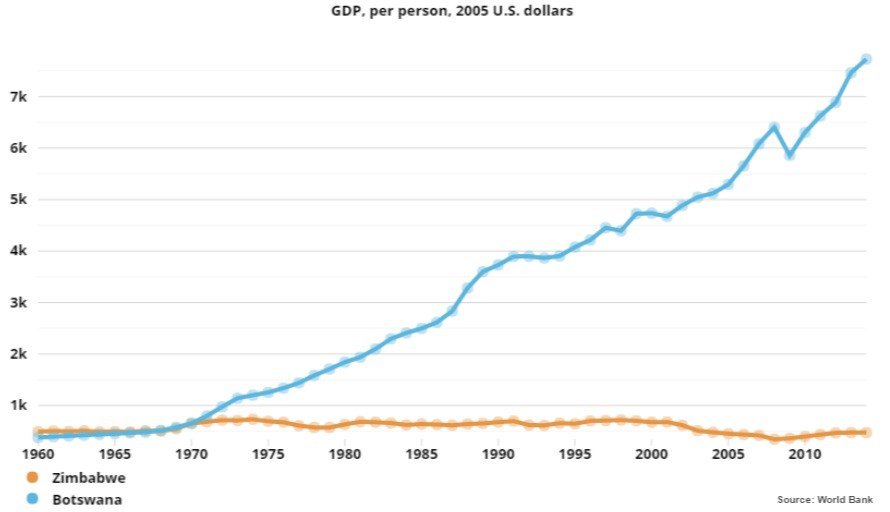
Of course, this is pure nonsense. Botswana and Zimbabwe share a border and their climate and natural resources are exceptionally similar. Yet, since 2004, food production has increased by 29 percent in Botswana, while declining by 9 percent in Zimbabwe. It is not drought but government policies that make nations starve!

slush3

As befits a dictatorship, Zimbabwe is one of the most corrupt places on earth. The notion that GCF funds will be will used for environmental “adaptation and mitigation” is a dangerous fantasy.

Like much foreign aid before it, most of the “green aid” money will likely end up in the pockets of some of the cruelest and most corrupt people on earth. Congress must stand firm and refuse to appropriate any money for the fund.

slush4

This post first appeared at Human Progress.

Marian L. Tupy is the editor of HumanProgress.org and a senior policy analyst at the Center for Global Liberty and Prosperity. 

This article was published by The Foundation for Economic Education and may be freely distributed, subject to a Creative Commons Attribution 4.0 International License, which requires that credit be given to the author.

Venezuela Is Facing Runaway Financial Catastrophe – Article by Emily Skarbek

Venezuela Is Facing Runaway Financial Catastrophe – Article by Emily Skarbek

The New Renaissance HatEmily Skarbek
******************************

Debt, capital flight, food shortages, and hyperinflation take hold

Often, economists want to isolate questions of public debt and analyse these issues as if public choice considerations weren’t at play. Perhaps less studied are the ways in which debt practices can systematically exert pressure on formal political institutions.

But if you want to understand what is going on in Venezuela today, you can’t do so without looking at this political-economy nexus.

For regular people living in Venezuela, the situation is bleak. As the Economist reports, food queues start at 3 am, with the real possibility there won’t be anything for those at the end of the line. And the queues are growing longer and violent.

Real wages fell by 35% last year, 76% of Venezuelans are now poor, supplies of medicines have fallen to 1/5 of their normal level.

The government has admitted that in the 12 months to September 2015 the economy contracted by 7.1% and inflation was 141.5%. Even Nicolás Maduro, Chávez’s hapless heir and successor, called these numbers “catastrophic”.

The IMF thinks worse is in store: it reckons inflation will surge to 720% this year and that the economy will shrink by 8%, after contracting by 10% in 2015. The Central Bank is printing money to cover much of a fiscal deficit of around 20% of GDP.

In a case study of Venezuela from 1984 to 2013, Reinhart and Santos examine the relationship among domestic debt, financial repression, and external vulnerability. The paper begins with a narrative of the evolution of domestic and external debt in Venezuela over the period.

Despite soaring oil prices from 2006 to 2013, net consolidated external debt of Venezuela rose from US $26.9 to US $104.3 billion. The central government, however, only accounted for roughly a fifth of that increment.

The difference, US $60.9 billion (78%), owed to standard practices of the Bolivarian revolution, and was issued by state owned enterprises and the relatively new Fondo Comun China-Venezuela (FCCV). The FCCV is a special-purpose vehicle that allows Venezuela to withdraw from a rolling line of credit at the Chinese Development Bank in exchange for future shipments of oil.

Domestic debt in local currency also climbed, rising from 36.298 million bolivares (VEF) in 2006 to 420.502 million in 2013. The nominal increase of 1,060% (an average annual rate of 42%) was partially offset by an accumulated price increase of 528% (or an average annual rate of 30%), reducing the cumulative increase in real domestic debt to about 85% (or 9% per annum).

During much of this period, the combination of exchange controls and interest ceilings created a captive domestic audience for domestic government debt despite markedly negative real ex post interest rates. The significant losses imposed on domestic bondholders escalated over time, owing to accelerating inflation.

Unlike foreign currency-denominated debt, debt in domestic currency may be reduced through financial repression (i.e., taxes on bondholders and savers producing negative real interest rates). Reinhart and Santos find the financial repression “tax rate” is significantly higher in years of exchange controls and legislated interest rate ceilings. In Venezuela, the “haircut” on depositors and bondholders via negative ex post real interest has exceeded 30% per annum on several occasions.

Confiscating the wealth of those responsible for capital savings can partially ameliorate the existing stock of domestic debt in the short run, but at the expense of encouraging capital flight and undermining any semblance of trust in crucial economic institutions.

The paper documents that capital flight has been a chronic feature in the Venezuelan economy, “representing on average of 4.7% of GDP at the official exchange rate and 7.1% of GDP at the parallel market exchange rate, while siphoning away 17.2% of total exports.”

By all measures, exchange controls proved ineffective at reducing capital flight. In fact, “when measured as percent of GDP at the average parallel market, rate capital flight turned out to be significantly higher in years of controls (8.0% vs 5.2%).

Hayek would not be surprised. Over his professional career he argued disastrous monetary policy commits the state to taking measures that weaken the proper functioning of the market. In order to combat inflation, states will attempt to impose further controls that “would not only make the price mechanism wholly ineffective, but also make inevitable an ever-increasing central direction of all economic activity.”

In Venezuela, Chávez turned the would-be checks and balances of the state — the Supreme Court and the electoral authority — into extensions of executive power. He packed the court and they then threw out those legislators necessary for the opposition to get the two-thirds majority needed to change the constitution.

President Nicolás Maduro seems prepared to continue the repression and price controls, calling the owner of Venezuela’s largest privately-held company a thief and publicly blaming him for the country’s dire economic condition.

It is perhaps fitting that it was at a Mont Pèlerin Conference in Caracas where Hayek famously quipped:

We now have a tiger by the tail: how long can this inflation continue? If the tiger (of inflation) is freed he will eat us up; yet if he runs faster and faster while we desperately hold on, we are still finished!

I’m glad I won’t be here to see the final outcome…

Emily Skarbek is Lecturer in Political Economy at King’s College London and guest blogs on EconLog. Her website is EmilySkarbek.com. Follow her on Twitter @EmilySkarbek.​

This article was published by The Foundation for Economic Education and may be freely distributed, subject to a Creative Commons Attribution 4.0 International License, which requires that credit be given to the author.

Who Won in Iowa? And Why? – Article by Daniel Bier

Who Won in Iowa? And Why? – Article by Daniel Bier

The New Renaissance HatDaniel Bier
******************************

It depends on what was really at stake

On Monday, the political world watched as the early results trickled in from the Iowa caucuses. First, Donald Trump was ahead, then Ted Cruz overtook him, then Marco Rubio started creeping up. In the final count, Cruz won convincingly with 28 percent, Trump came in second with 24 percent, and Rubio took home bronze with 23 percent.

Commentators are scrambling now to read the tea leaves of these results. A lot of the alleged meaning depends on the hopes and expectations people had before. The last (and typically best) Iowa poll, released just two days before the caucuses, had Trump at 28 percent, Cruz at 23 percent, and Rubio at 15 percent.

Trump, it was thought, had run a lazy campaign and had very little grassroots mobilization, so maybe he would get crushed by better organized rivals. And though he did lose to Cruz, and barely beat Rubio, it’s hardly the death blow some hoped. It turns out that at least a quarter of the highly motivated GOP base in Iowa really do like Trump, in spite of his lackadaisical operation, and the polls that show him in the lead aren’t skewed or exaggerated.

Cruz’s triumph, driven by evangelical voters, might seem to bode well for his nomination prospects. Rubio did better than expected, so maybe that means something. Carson, Jeb, and Rand garnered very modest support; the rest of the pack did so poorly they didn’t received any delegates at all, and some are already dropping out.

This week, pollsters will be furiously dialing potential voters. Pundits will be scribbling and shouting, all angling for some unique or authoritative or contrarian perspective on these results.

But there’s one source of information that’s a better predictor of where the wind is blowing than polls, statistical models, or expert forecasts: the market. Specifically, betting markets, where people are forced to put their money where their mouth is.

With hard cash on the line, the incentive to be right is powerful — and, it turns out, pretty effective.

Here’s what the betting odds looked like for most of this endless campaign season. Early on, there’s a lot of uncertainty, but the odds of Trump actually winning the nomination were always consistently low, despite his huge leads in the polls. Bettors didn’t believe voters would really go for him, or that the party insiders would allow him to succeed.

betting-odds-oct-dec

But in the last month, something changed. Maybe it was because the party insiders didn’t seem to be doing anything to stop Trump. Maybe it was because the mainstream never coalesced around a “establishment” candidate. Maybe it was because Trump’s long-predicted crash in the polls never materialized.

Either way, Trump’s odds started steadily improving in January, and Christie, Cruz, and Rubio started slipping. On January 13, at 7:01 AM, Trump took the lead for the first time, and after that, his odds soared. On the day of the Iowa caucuses, bettors put his probability of winning the Republican nomination at over 50 percent.

betting-odds-january

But as the results started trickling in, and it became clear that Cruz would beat Trump, the markets reacted.

In just 90 minutes, Trump’s odds of winning the nomination cratered — falling from over 50 percent to about 25 percent — and Marco Rubio’s soared, from about 30 percent to over 55 percent. As for Cruz’s big win, it barely brought him back to where he stood two weeks ago.

betting-odds-feb

According the markets, Rubio won in Iowa, and Trump lost.

If you’re concerned about the rise of Trump’s fascist, populist demagoguery — its virulent and xenophobic identity politics, economic nationalism, and lawless authoritarianism — this might seem to be good news, of a sort.

But the bad news is that Trump’s loss is probably due in large part to his rival’s embrace of Trumpism. At the Atlantic, Peter Beinart notes that Rubio “surged by borrowing Trump’s message while pledging to more effectively package it.”

In the final weeks before Iowa, Rubio grew markedly more anti-immigration. Having previously warned against using terrorism as a pretext to restrict legal immigration, the Florida senator in mid-January declared that because of the rise of ISIS, “the entire system of legal immigration must now be reexamined for security first and foremost.”

He also followed Trump’s lead on trade, suggesting that he might oppose the Trans-Pacific Partnership agreement he had once praised.

Rubio echoed Trump when it came to the rights of Muslims, too. Asked in a January debate about Trump’s call for banning Muslim immigration, Rubio praised the billionaire for having “tapped in to some of that anger that’s out there about this whole issue because this president has consistently underestimated the threat of ISIS.” … The listener who didn’t already know Rubio’s position might well have thought he supports Trump’s plan.

When asked about Trump’s call for closing mosques, Rubio did Trump one better, declaring that, “It’s not about closing down mosques. It’s about closing down any place — whether it’s a cafe, a diner, an Internet site — any place where radicals are being inspired.”

… Having once pitched himself as a bridge between the GOP and the changing face of twenty-first century America, Rubio instead began appealing to “all of us who feel out of place in our own country.”

Here is the moderate, establishment candidate calling the whole system of legal immigration into question, attacking foreign trade, fear-mongering about religious minorities, calling to shut down and censor the Internet, and blowing tribalist dog whistles.

Of course, Rubio isn’t Trump: he’s a politician. If he captures the nomination, he’ll try to pivot from identity politics and emphasize his “moderate” credentials. He’s still an establishment figure, with the credibility of being sophisticated, eloquent, and (above all) “electable” — everything Trump isn’t.

But this is the larger problem. Trump has convinced the establishment that they need to embrace his priorities and methods in order to maintain control. Worse, he might be right. This may be the most troubling development in the whole Trump saga, and not just because the establishment won’t flatly repudiate a man conjuring up religious tests, concentration camps, and mass deportation.

By rallying long-suppressed nationalist factions, Trump has shifted the margins of acceptable debate more than any other political figure in recent memory. “Trump has redefined what “moderate” means,” Beinart argues.

In 2008 and 2012, Mitt Romney and John McCain never had to praise a rival for suggesting a religious litmus test for entering the country. During their presidential bids, Romney and McCain both shifted right on illegal immigration. But they didn’t backpedal on their support for legal immigration.

Trump probably couldn’t win the general election, and if he did, he couldn’t institute his agenda effectively without the network of interest groups that make policy happen. That’s what makes him so dangerous: he’s unconstrained by the traditional network of interests, compromises, and pressures of the status quo — nobody has any idea what he might try to do.

But that’s also what makes his candidacy a long shot. The more established candidates might very well win and effectively implement their agenda — pushing the bounds of executive power that Bush and Obama softened into playdough — without triggering an open constitutional or political crisis. Their embrace of Trump’s agenda is a troubling sign both of how the political landscape has shifted and what might now come from even a “moderate” presidency.

The ballots say Cruz won. The markets say it was Rubio. But, in time, we may find that it was Trump after all.

Daniel Bier is the editor of Anything Peaceful. He writes on issues relating to science, civil liberties, and economic freedom.

This article was published by The Foundation for Economic Education and may be freely distributed, subject to a Creative Commons Attribution 4.0 International License, which requires that credit be given to the author.

Is Congress Declaring War on ISIS…or on You? – Article by Ron Paul

Is Congress Declaring War on ISIS…or on You? – Article by Ron Paul

The New Renaissance HatRon Paul
******************************

Passage of Senator Mitch McConnell’s authorization for war against ISIS will not only lead to perpetual US wars across the globe, it will also endanger our civil and economic liberties. The measure allows the president to place troops anywhere he determines ISIS is operating. Therefore, it could be used to justify using military force against United States citizens on US territory. It may even be used to justify imposing martial law in America.

The President does not have to deploy the US military to turn America into a militarized police state, however. He can use his unlimited authority to expand programs that turn local police forces into adjuncts of the US military, and send them increasing amounts of military equipment. Using the threat of ISIS to justify increased police militarization will be enthusiastically supported by police unions, local officials, and, of course, politically-powerful defense contractors. The only opposition will come from citizens whose rights have been violated by a militarized police force that views the people as the enemy.

Even though there is no evidence that the federal government’s mass surveillance programs have prevented even a single terrorist attack, we are still continuously lectured about how we must sacrifice our liberty for security. The cries for the federal government to take more of our privacy will grow louder as the war party and its allies in the media continue to hype the threat of terrorism. A president armed with the authority to do whatever it takes to stop ISIS will no doubt heed these calls for new restrictions on our privacy.

Following last year’s mass shooting in California, President Obama called for restricting the Second Amendment rights of any American on the “terrorist watch list.” The president also used the attacks to expand the unconstitutional gun background check system via executive action. Can anyone doubt that President Obama — or a future anti-gun president — will use the absolute power to do whatever is necessary to stop terrorism as a justification for imposing new gun control measures? Using the war on ISIS to justify more gun control will be particularly attractive since even many pro-gun politicians will support gun control measures if they are marketed as part of the war on terror.

As the American economy faces continued stagnation, and as challenges to the dollar’s status as the world’s reserve currency mount, an increasingly authoritarian government will impose new restrictions on our economic activities and new limits on our financial privacy. In particular, our ability to move assets out of the country will be limited, and new reporting and other requirements will limit our ability to use cash without being treated as criminals or terrorists. Those who carry large amounts of cash will find themselves at increased risk of having the cash confiscated by police under civil asset forfeiture laws.

If Senator McConnell’s declaration of perpetual war passes, presidents could use the war on ISIS as a justification to impose new restrictions on our use of cash and our financial privacy via executive action. After all, they will say, the government needs to make sure cash is not being used to support ISIS.

The only way to protect both liberty and security is to stop trying to impose our will on other countries by military force. The resentment created by America’s militaristic foreign policy is ISIS’s most effective recruiting tool. Adopting a non-interventionist foreign policy that seeks peace and free trade with all would enable the government to counter legitimate threats to our safety without creating an authoritarian police state.

Ron Paul, MD, is a former three-time Republican candidate for U. S. President and Congressman from Texas.

This article is reprinted with permission from the Ron Paul Institute for Peace and Prosperity.