Browsed by
Category: Politics

Nevada Transhumanist Party – Formation and Membership Invitation – Video by G. Stolyarov II

Nevada Transhumanist Party – Formation and Membership Invitation – Video by G. Stolyarov II

The New Renaissance HatG. Stolyarov II
September 22, 2015
******************************

Mr. Stolyarov introduces the Nevada Transhumanist Party, officially registered with the Nevada Secretary of State on August 31, 2015. All individuals who have a rational faculty and ability to form political opinions are welcome to become either Nevada Members or Allied Members.

Read the Constitution and Bylaws of the Nevada Transhumanist Party.

See the official filed documents with the Nevada Secretary of State.

Join the Nevada Transhumanist Party Facebook group: https://www.facebook.com/groups/NevadaTranshumanistParty/.

NTP-Logo-9-1-2015References

– Website of United States Transhumanist Party
– Zoltan Istvan’s Webpage
– Immortality Bus Website
– “The Transhumanist Wager” – Wikipedia
– “Thoughts on Zoltan Istvan’s The Transhumanist Wager: A Review” – Article by G. Stolyarov II

Blame America? No, Blame Neocons! – Article by Ron Paul

Blame America? No, Blame Neocons! – Article by Ron Paul

The New Renaissance HatRon Paul
September 21, 2015
******************************
Is the current refugee crisis gripping the European Union “all America’s fault”? That is how my critique of US foreign policy was characterized in a recent interview on the Fox Business Channel. I do not blame the host for making this claim, but I think it is important to clarify the point.

It has become common to discount any criticism of US foreign policy as “blaming America first.” It is a convenient way of avoiding a real discussion. If aggressive US policy in the Middle East – for example in Iraq – results in the creation of terrorist organizations like al-Qaeda in Iraq, is pointing out the unintended consequences of bad policy blaming America? Is it “blaming America” to point out that blowback – like we saw on 9/11 – can be the result of unwise US foreign policy actions like stationing US troops in Saudi Arabia?

In the Fox interview I pointed out that the current refugee crisis is largely caused by bad US foreign policy actions. The US government decides on regime change for a particular country – in this case, Syria – destabilizes the government, causes social chaos, and destroys the economy, and we are supposed to be surprised that so many people are desperate to leave? Is pointing this out blaming America, or is it blaming that part of the US government that makes such foolish policies?

Accusing those who criticize US foreign policy of “blaming America” is pretty selective, however. Such accusations are never leveled at those who criticize a US pullback. For example, most neocons argue that the current crisis in Iraq is all Obama’s fault for pulling US troops out of the country. Are they “blaming America first” for the mess? No one ever says that. Just like they never explain why the troops were removed from Iraq: the US demanded complete immunity for troops and contractors and the Iraqi government refused.

Iraq was not a stable country when the US withdrew its troops anyway. As soon as the US stopped paying the Sunnis not to attack the Iraqi government, they started attacking the Iraqi government. Why? Because the US attack on Iraq led to a government that was closely allied to Iran and the Sunnis could not live with that! It was not the US withdrawal from Iraq that created the current instability, but the invasion. The same is true with US regime-change policy toward Syria. How many Syrians were streaming out of Syria before US support for Islamist rebels there made the country unlivable? Is pointing out this consequence of bad US policy also blaming America first?

Last year I was asked by another Fox program whether I was not “blaming America” when I criticized the increasingly confrontational US stand toward Russia. Here’s how I put it then:

I don’t blame America. I am America, you are America. I don’t blame you. I blame bad policy. I blame the interventionists. I blame the neoconservatives who preach this stuff, who believe in it like a religion — that they have to promote American goodness even if you have to bomb and kill people.

In short, I don’t blame America; I blame neocons.

Ron Paul, MD, is a former three-time Republican candidate for U. S. President and Congressman from Texas.

This article is reprinted with permission from the Ron Paul Institute for Peace and Prosperity.

Japan Liberalizes Gene Therapy and Regenerative Medicine – Article by Alex Tabarrok

Japan Liberalizes Gene Therapy and Regenerative Medicine – Article by Alex Tabarrok

The New Renaissance HatAlex Tabarrok
September 17, 2015
******************************

Japan is liberalizing its approval process for regenerative medicine:

Regenerative medicines in Japan can now get conditional marketing approval based on results from mid-stage, or Phase II, human trials that demonstrate safety and probable efficacy.

Once lagging behind the United States and the European Union on approval times, there is now an approximately three-year trajectory for approvals, according to Frost’s Kumar. That compares with seven to 10 years before. …

Around the world, companies have also faced setbacks while pushing such treatments. In the U.S., Geron Corp., which started the first nation-approved trial of human embryonic stem cells, ended the program in 2011, citing research costs and regulatory complexities. …

While scientists globally have worked for years in this field, treatments have been slow to come to market. But there is hope in Japan that without the political red tape, promising therapies will emerge faster and there will be speedier rewards.

Japan is liberalizing because with their aging population treatments for diseases like Alzheimer’s and Parkinson’s disease are in high demand.

Under the new system, a firm with a gene or regenerative therapy (e.g. stem cells) can get conditional approval with a small trial. Conditional approval means that the firm will be able to sell its procedure while continuing to gather data on efficacy for a period of up to seven years. At the end of the seven-year period, the firm must either apply for final marketing approval or withdraw the product.

The system is thus similar to what Bart Madden proposed for pharmaceuticals in Free to Choose Medicine.*

Due to its size and lack of price controls, the US pharmaceutical market is the most lucrative pharmaceutical market in the world.

Unfortunately, this also means that the US FDA has an outsize influence on total world investment. The Japanese market is large enough, however, that a liberalized approval process if combined with a liberalized payment model could increase total world R&D.

Breakthroughs made in Japan will be available for the entire world so we should all applaud this important liberalization.

This post first appeared at Marginal Revolution.

* Editor’s note from the Foundation for Economic Education: There may well by a direct connection here. According to Madden, an early version of his proposal in Free to Choose Medicine was published in a booklet by the Heartland Institute, which was then translated and distributed in Japan by a Japanese free-market think tank.

For more on free markets in medicine, see Bart Madden’s article “The Pathway to Faster Cures” in the autumn print edition of the Freeman and on The Rational Argumentator.

Alex Tabarrok is a professor of economics at George Mason University. He blogs at Marginal Revolution with Tyler Cowen. 

Congress Fiddles While the Economy Burns – Article by Ron Paul

Congress Fiddles While the Economy Burns – Article by Ron Paul

The New Renaissance HatRon Paul
September 14, 2015
******************************

Reports that the official unemployment rate has fallen to 5.1 percent may appear to vindicate the policies of easy money, corporate bailouts, and increased federal spending. However, even the mainstream media has acknowledged that the official numbers understate the true unemployment rate. This is because the federal government’s unemployment figures do not include the 94 million Americans who have given up looking for work or who have settled for part-time employment. John Williams of Shadow Government Statistics estimates the real unemployment rate is between 23 and 24 percent.

Disappointingly, but not surprisingly, few in Washington, DC acknowledge that America’s economic future is endangered by excessive spending, borrowing, taxing, and inflating. Instead, Congress continues to waste taxpayer money on futile attempts to run the economy, run our lives, and run the world.

For example, Congress spent the majority of last week trying to void the Iranian nuclear agreement. This effort was spearheaded by those who think the US should waste trillions of dollars on another no-win Middle East war. Congressional war hawks ignore how America’s hyper-interventionist foreign policy feeds the growing rebellion against the dollar’s world reserve currency status. Of course, the main reason many are seeking an alternative to the dollar is their concern that, unless Congress stops creating — and the Federal Reserve stops monetizing — massive deficits, the US will experience a Greek-like economic crisis.

Despite the clear need to reduce federal spending, many Republicans are trying to cut a deal with the Democrats to increase spending. These alleged conservatives are willing to lift the “sequestration” limits on welfare spending if President Obama and congressional democrats support lifting the “sequestration” limits on warfare spending. Even sequestration’s minuscule, and largely phony, cuts are unbearable for the military-industrial complex and the rest of the special interests that control our federal government.

The only positive step toward addressing our economic crisis that the Senate may take this year is finally holding a roll call vote on the Audit the Fed legislation. Even if the audit legislation lacks sufficient support to overcome an expected presidential veto, just having a Senate vote will be a major step forward.

Passage of the Audit the Fed bill would finally allow the American people to know the full truth about the Fed’s operations, including its deals with foreign central banks and Wall Street firms. Revealing the full truth about the Fed will likely increase the number of Americans demanding that Congress end the Fed’s monetary monopoly. This suspicion is confirmed by the hysterical attacks on and outright lies about the audit legislation spread by the Fed and its apologists.

Every day, the American people see evidence that, despite the phony statistics and propaganda emanating from Washington, high unemployment and rising inflation plague the economy. Economic anxiety has led many Americans to support an avowed socialist’s presidential campaign. Perhaps more disturbingly, many other Americans are supporting the campaign of an authoritarian crony capitalist. If there is a major economic collapse, many more Americans — perhaps even a majority — will embrace authoritarianism. An economic crisis could also lead to mob violence and widespread civil unrest, which will be used to justify new police state measures and crackdowns on civil liberties.

Unless the people demand an end to the warfare state, the welfare state, and fiat money, our economy will continue to deteriorate until we are faced with a major crisis. This crisis can only be avoided by rejecting the warfare state, the welfare state, and fiat money. Those of us who know the truth must redouble our efforts to spread the ideas of liberty.

Ron Paul, MD, is a former three-time Republican candidate for U. S. President and Congressman from Texas.

This article is reprinted with permission from the Ron Paul Institute for Peace and Prosperity.

The Importance of Zoltan Istvan’s Transhumanist Presidential Campaign – Article by G. Stolyarov II

The Importance of Zoltan Istvan’s Transhumanist Presidential Campaign – Article by G. Stolyarov II

The New Renaissance Hat
G. Stolyarov II
September 13, 2015
******************************

 Zoltan Istvan – journalist, transhumanist philosopher, and author of the novel The Transhumanist Wager – is currently touring the western United States on his Immortality Bus, spreading the message that indefinite life extension is achievable through the progress of science and technology, and should become a political priority. Istvan is running for President of the United States. He knows that he is almost certainly not going to win the 2016 Presidential election, but he seeks to maximize public awareness of the opportunities and questions posed by emerging technologies, and he has thus far done so on an impressively minimal budget. Istvan has founded the United States Transhumanist Party and has encouraged the formation of State-level parties in order to improve his chances of recognition as a candidate at the federal level. On August 31, 2015, Wendy Stolyarov and I officially formed the Nevada Transhumanist Party and registered it with the Secretary of State. (See the officially filed Constitution and Bylaws here and a searchable version here; also join the Facebook group here, as Allied Membership is open to anyone with a rational faculty and ability to form political opinions.) The Nevada Transhumanist Party Platform adopts and expands upon many of the planks of the United States Transhumanist Party Platform – but also imparts upon them a heightened libertarian and individualistic flavor.

Even while I also do not expect Zoltan Istvan to win the Presidency in 2016, and while I recognize the even greater difficulty of qualifying for ballot access for State-level offices (in Nevada, this would require submitting a petition with the signatures of 5,431 registered voters and is thus not a near-term priority for the Nevada Transhumanist Party), I still unequivocally endorse Istvan’s campaign. Why have I made this decision? I present my reasoning here. Whether or not readers will view Istvan as their preferred choice for President, the motives for his campaign and its impact have a much broader significance that should be considered by all.

NTP-Logo-9-1-20151. Voting should not be about who wins. In fact, much of the sub-optimal equilibrium of the two-party system in the United States arises from a misguided “expectations trap” – where each voter fears expressing his or her principles by voting for the candidate closest to that voter’s actual policy preferences. Instead, voters who are caught in the expectations trap will tend to vote for the “lesser evil” (in their view) from one party, because they tend to think that the consequences of the election of the candidate from the other party will be dire indeed, and they do not want to “take their vote away” from the slightly less objectionable candidate. This thinking rests on the false assumption that a single individual’s vote, especially in a national election, can actually sway the outcome. Given that the probabilities of this occurring are negligible, the better choice – the choice consistent with individual autonomy and the pursuit of principle – is to vote solely based on one’s preference, without any regard for how others will vote or how the election will turn out. One is free to persuade others to vote a certain way, of course, or to listen to arguments from others – but these persuasive efforts, to have merit, should be based on the actual positions and character of the candidates involved, and not on appeals to sacrifice one’s intellectual integrity in order to fulfill the “collective good” of avoiding the victory of the “absolutely terrible” (not quite) candidate from one major party, whose policy choices are likely to be near-identical to the “only slightly terrible” candidate from the other major party. While an individual’s vote cannot actually affect who wins, it can – if exercised according to preference – send a signal as to what issues voters actually care about. Whichever politicians do get elected would see a large outpouring of third-party support as a signal of public discontentment and will perhaps be prompted by this signal to shift their stances on policy issues based on the vote counts they observe. Even a few thousand votes for the Transhumanist Party can send a sufficient signal that many Americans are becoming interested in accelerating technological innovation and the freedom from obstacles posed to it by legacy institutions.

2. Life and liberty necessarily go together. You cannot have liberty if you are not alive, and you cannot live well unless you have liberty. In “Liberty Through Long Life” (2013), I discussed the many emerging technologies that could facilitate dramatic improvements in individual liberty, but also noted that “there is a common requirement for one to enjoy all of these potential breakthroughs, along with many others that may be wholly impossible to anticipate: one has to remain alive for a long time. The longer one remains alive, the greater the probability that one’s personal sphere of liberty would be expanded by these innovations.” In “Liberty or Death: Why Libertarians Should Proclaim That Death is Wrong” (2014), I expressed a corollary to this insight: “If we argue for liberty today, it will still likely take decades of the most ardent advocacy and activism to undo the harms caused by ongoing and escalating infringements of every natural and constitutional right of even the most law-abiding citizens. Therefore, while I support every effort – conventional or radically innovative – to move our societies and governments in the direction of liberty, it is essential to recognize that the success of such efforts will take an immense amount of time. If you do not remain alive during that time, then you will die without having known true liberty.”

Unfortunately, given the current combination of political, economic, and societal conditions – including the decidedly un-libertarian mindsets of the majority of the world’s population today – the transformation of existing societies into libertarian havens will not occur anytime soon. Politics as usual – and even libertarian argumentation as usual – will not get us there in time for us. And yet we should continue to strive to actualize the libertarian ideals; we should do so by championing radical life extension as well as societal transformation by means of emerging technologies, so that the balance of resources and incentives can gradually shift in favor of individualistic, pro-liberty mindsets and behaviors – without violent revolutions or other personally damaging upheavals.

Zoltan Istvan is attempting to do exactly what I have advocated in “The Imperative of Technological Progress: Why Stagnation Will Lead to Disaster and How Techno-Optimism Can Overcome It” (2015): “The key to achieving a freer, more prosperous, and longer-lived future is to educate both elites and the general public to accurately weigh the opportunities and risks of emerging technologies. […] By simply arguing the techno-optimist case and educating people from all walks of life about the tremendous beneficial potential of emerging technologies, we can each do our part to ensure that the 21st century will become known as an era of humankind’s great liberation from its age-old limitations, and not a lurch back into the bog of premodern barbarism.” By becoming a prominent techno-optimist advocate, Istvan has even transcended the typical issue-specific policy debates. I may disagree with some of Istvan’s specific policy stances (for instance, his suggestion that college should be free and mandatory for all) – but these disagreements are greatly outweighed by my support for Istvan’s larger role as a visible champion of a radical acceleration of technological progress – the only path that will enable the libertarian ideal to ever be actualized for us.

3. Zoltan Istvan has successfully and beneficially co-opted politics as a vehicle for techno-optimist discourse. Zoltan Istvan is achieving for the cause of transhumanism – the overcoming of age-old human limitations through science and technology – what Ron Paul achieved for the cause of libertarianism during his Presidential runs in 2008 and 2012 (both of which I supported). Ron Paul also did not win the Presidency (although he became an impressive contender for it), but the educational impact of his campaign was tremendous – particularly raising awareness on the issues of a peaceful foreign policy and respect for civil liberties and social freedoms, but also to some extent on the dangers of central banking and inflationary monetary policy. A new generation of activists for liberty came of age during the Ron Paul campaigns and obtained valuable experience and a platform for advocating meaningful policy changes. While Ron Paul was not the sole influence on the recent decisions in many states to completely decriminalize marijuana, the 2015 legalization of same-sex marriage in the United States, and the United States’ avoidance of war with both Russia and Iran, he certainly helped sway the political climate in the direction of these victories for liberty. The Republicans lost both the 2008 and 2012 Presidential Elections, and deserved to lose, in part because the Republican Party establishment deliberately sidelined Ron Paul and rigged the rules against him. Meanwhile, Ron Paul ended up a longer-term winner – an intellectual inspiration to a growing segment of the American population, many of whom continue to deeply respect his example and unwavering integrity.

Zoltan Istvan is venturing even further in the direction of politics-as-education, completely discarding the damaging notion of politics-as-horse-race. Instead of throwing much of his effort into the task of winning the election – which often requires duplicitous rhetoric, creation of a fake persona, and appeals to the lowest common denominator, hardly recipes for true progress – Istvan holds nothing back in expressing what he actually thinks about the desired directions for politics and government. In particular, he emphasizes issues that other candidates systematically avoid – such as the implications of human genetic modification or the possibilities of radical life extension in the coming decades. By prominently communicating that these technologies are not mere science fiction but proximate opportunities, Istvan may persuade large numbers of people to press for the removal of political and other institutional barriers to these technologies’ development and dissemination. Public awareness of possibilities for tremendous technological improvement may result in a greater groundswell of advocacy for the “Six Libertarian Reforms to Accelerate Life Extension” that I outlined in 2013. Zoltan Istvan is, furthermore, an ardent champion of taking resources away from offensive inter-human wars, which needlessly destroy many innocent lives, and instead devoting those resources to technological innovation – so that we can stand a chance of winning the real war that we should be fighting against the forces of ruin. Even this alone – giving the world a few decades of breathing room from organized slaughter staged by national governments – would have a colossal, salutary effect on progress and human well-being.

4. The most vital political change will be achieved by visionaries on the fringes, who do not care about the winds of popular opinion. Mainstream politicians – particularly officeholders who seek reelection – are most often lagging, rather than leading, indicators of societal change. In order to keep the favor of their constituents, politicians need to either respond to ever-shifting public opinion or to create the illusion of doing so (a more common course of action in the increasingly oligarchic American political system). For good or for ill, third parties have most often been the originators of policy proposals that were eventually adopted by a future political establishment. To successfully advocate principled positions – such as the maximization of individual liberty and the elimination of political barriers to life-extension research and treatments – does not require holding political office, but it does require visibly persuading many people – both ordinary voters and elites – that these positions are correct. Those politicians who mostly care about remaining in office will never drive these changes themselves, but they might find themselves impelled to jump on the bandwagon if enough support accumulates. I hope that, because of what Zoltan Istvan is doing today, major party platforms in the 2020s and 2030s will include at least some favorable mentions of life-extending medical research, if not calls for the removal of legacy institutional barriers to the acceleration of such research.

Because of the first-time Transhumanist political presence, the 2016 US Presidential election will be unlike any other. This time, especially given the completely unpalatable candidates from both the Republican and Democratic Parties, it is time to try a radically different approach. Jettisoning the conventional aims of electoral politics and turning it instead into a peaceful, honest, innovative, and spectacular educational campaign for techno-optimism and longevity, is a promising approach that could bear fruit for advocates of liberty, even many years and decades into the future.

This essay may be freely reproduced using the Creative Commons Attribution Share-Alike International 4.0 License, which requires that credit be given to the author, G. Stolyarov II. Find out about Mr. Stolyarov here.

Has Donald Trump Unleashed the Neo-Nazis? – Article by Jeffrey A. Tucker

Has Donald Trump Unleashed the Neo-Nazis? – Article by Jeffrey A. Tucker

The New Renaissance HatJeffrey A. Tucker
September 8, 2015
******************************

Donald Trump went from clown to contender in a mere 30 days. He is now polling in at 30% among Republicans, a 12-point spread from Ben Carson who is #2. Trump still loses next to Hillary by 2 points, but her nomination is not secure.

A race of Sanders vs. Trump would be quite the sight, straight out of the 1930s. It’s the Reds vs. the Browns all over again. My own sense is that the Browns could win this. Then we have a serious problem. As much as we loathe the establishment, it could be worse.

It’s time libertarians get serious about realizing that there exists such a thing as Brown-shirted socialism. It masquerades as patriotism. It seeks national greatness. It celebrates the majority race and dehumanizes the other. It is violently protectionist. On cultural matters, it is anti-leftist (“politically incorrect”). It is unapologetically authoritarian.

Even given all this, we are mostly mystified by it. It doesn’t strike us as a coherent ideology. It seems like a string of bad policy ideas (and some not terrible ones too) rather than a real political tradition. This is because we, as libertarians, are well-schooled to fear the socialist left but have little preparation to understand the threat from the other side.

Events of the last weeks should heighten our consciousness. There really is a brown-shirt movement in the U.S. It’s been building for many years. They have their organizations, books, websites, and splits within splits. The neo-Nazis are the most extreme variant. But fascism has many other types of expression, each reflecting a special interest, but each of them leading to a special kind of authoritarianism.

That the neo-Nazis support Trump is an established fact. Notorious racist, anti-semite, and unapologetic former KKK grand dragon David Duke has endorsed Donald Trump for president. So has the mega-popular website Stormfront.org, with its overtly neo-Nazi editorial outlook.

The American Nazi Party (yes, there is such a thing, as founded by George Lincoln Rockwell) is also all-in with support: “He tells it as the majority of the population FEELS, and he’s far ahead in the polls because of it.”

When Trump was asked about all of this, his response was that he didn’t know about it, but that this is not surprising since “everyone likes me.” He said he would be happy to repudiate their support “if that would make you feel better.”

Is this just the leftwing media looking for any excuse to smear a great American? Many of his supporters think so. And this is because the American left has been traditionally reckless about flinging the labels racist and anti-semite (and so on) against anyone with whom they disagree. However, let’s remember that just because the boy cries wolf constantly doesn’t mean that wolves do not exist.

Some people say that this supposed neo-Nazi/racist/nativist group is tiny and irrelevant? That’s what I used to think.

Until recently. I was a critic of Trump early on, for his trade and immigration views. I wrote an article that ended up in Newsweek.

Then I became a target. My social feed blew up with scum of the earth suddenly taking me on as their enemy. I was the target of the most vicious hate campaign I’ve ever experienced. I wish this on no one.

In the course of two weeks, blocking accounts of neo-Nazis and their affiliated friends became a part-time job. I now know more than I ever wanted to know about a movement that is actually large and growing right in the United States. You can call it extreme right if you want to, but its views on politics are not that different in substance from the extreme left. They have different styles but they are both authoritarian to the core, lustful for power to achieve their own aims.

As regards the right-wing authoritarians, Trump is their savior.

Here is a typical example. A Twitter account (“Seth Rubenstienberg”) features a Nazi-era caricature of a Jew. It posts incendiary posts such as this one: “if whites ever manage to get another ethno-state in the future, women’s bodies should be regulated. None of this my choice bullshit.”

The account has only 216 followers. That does not sound like much. But I’ve banned at least 50 such accounts. Multiply that account by 1,000 times and you have something serious going on. And when all these people are tweeting at you at once, it can be overwhelming.

It’s been true with Facebook too. The neo-Nazis came crawling out of their holes in the ground to denounce me as an enemy of the race, a self-hating white, a “cuckservative” (their favorite term for their enemies), and so on.

They having been posting on my wall incessantly. Many of their accounts celebrate other movements with only one degree of separation from the real deal. Instead of announcing themselves as neo-Nazis, they choose other causes: white nationalism, protectionism, anti-immigration, men’s rights, the hope for theocracy, and so on.

But for me, it’s become so inevitable as to become boring. I’ve learned to smell these people a mile away. You dig a bit and you land right where we started: straight-out hate rooted in Nazi ideology.

I’ve banned one FB account every few hours for weeks now — truly offensive material.

On the one hand, it is a credit to American democracy that we have such free speech, and I would oppose any government shutdowns of such accounts and sites. The worst mistake anyone could ever make in opposition to brown-shirted politics is to shut them down by force. That only reinforces their deluded perceptions that they have hit on a fundamental truth, and are being persecuted for it.

But free speech reigns on social media, and it’s given me an education about the existence — and the danger — of this movement that I once supposed was an invention of the “liberal media.”

Here is the question I keep asking myself. I’ve been on social media for a long time. Why is this just now happening? The answer is Trump. His free-wheeling style and open attacks on immigrants and foreigners, and hard-core promotion of trade isolationism, has emboldened them as never before.

As for how important they are, consider that the most popular neo-Nazi website, The Daily Stormer, has a higher traffic ranking than the Cato Institute or Heritage Foundation. These people are not irrelevant. They are real and growing.

Why should I care? I’m a devoted follower of the economist Ludwig von Mises (1881-1973), a genius and a Jew. He was driven out of his home in Austria because of the rise of Hitler. And why did Hitler rise? Because a population was fed up with the corrupt political system and a failing economic structure — a situation not unlike our own.

Mises was a dedicated opponent of the socialist left. His first major book on political theory (1922) took them on. But, little more than a decade later, it was not the red shirts that ruined his life. It was the brownshirts who are socialists of a type but use race hatred, misogyny, nativism, and the hope for religious and political domination as a means of control. They drove him from his home and stole his money and books. He barely escaped death.

Are we seeing the rise of a fascist movement in the U.S., and has Trump unleashed them? Is this our Road to Serfdom? Judging from Trump’s rise, and what I’ve experienced in the last week, there is no basis for pretending otherwise.

Jeffrey Tucker is Chief Liberty Officer of Liberty.me (http://liberty.me/join), a subscription-based, action-focused social and publishing platform for the liberty minded. He is also distinguished fellow Foundation for Economic Education (http://fee.org), executive editor of Laissez-Faire Books, research fellow Acton Institute, founder CryptoCurrency Conference, and author six books. He is available for speaking and interviews via tucker@liberty.me.

The Real Refugee Problem – And How To Solve It – Article by Ron Paul

The Real Refugee Problem – And How To Solve It – Article by Ron Paul

The New Renaissance HatRon Paul
September 7, 2015
******************************
Last week Europe saw one of its worst crises in decades. Tens of thousands of migrants entered the European Union via Hungary, demanding passage to their hoped-for final destination, Germany.

While the media focuses on the human tragedy of so many people uprooted and traveling in dangerous circumstances, there is very little attention given to the events that led them to leave their countries. Certainly we all feel for the displaced people, especially the children, but let’s not forget that this is a man-made crisis and it is a government-made crisis.

The reason so many are fleeing places like Syria, Libya, Afghanistan, and Iraq is that US and European interventionist foreign policy has left these countries destabilized with no hopes of economic recovery. This mass migration from the Middle East and beyond is a direct result of the neocon foreign policy of regime change, invasion, and pushing “democracy” at the barrel of a gun.

Even when they successfully change the regime, as in Iraq, what is left behind is an almost uninhabitable country. It reminds me of the saying attributed to a US major in the Vietnam War, discussing the bombing of Ben Tre: “It became necessary to destroy the town in order to save it.”

The Europeans share a good deal of blame as well. France and the UK were enthusiastic supporters of the attack on Libya and they were early backers of the “Assad must go” policy. Assad may not be a nice guy, but the forces that have been unleashed to overthrow him seem to be much worse and far more dangerous. No wonder people are so desperate to leave Syria.

Most of us have seen the heartbreaking photo of the young Syrian boy lying drowned on a Turkish beach. While the interventionists are exploiting this tragedy to call for direct US attacks on the Syrian government, in fact the little boy was from a Kurdish family fleeing ISIS in Kobane. And as we know there was no ISIS in either Iraq or Syria before the 2003 US invasion of Iraq.

As often happens when there is blowback from bad foreign policy, the same people who created the problem think they have a right to tell us how to fix it – while never admitting their fault in the first place.

Thus we see the disgraced General David Petraeus in the news last week offering his solution to the problem in Syria: make an alliance with al-Qaeda against ISIS! Petraeus was head of the CIA when the US launched its covert regime-change policy in Syria, and he was in charge of the “surge” in Iraq that contributed to the creation of al-Qaeda and ISIS in Iraq and Syria. The idea that the US can salvage its disastrous Syria policy by making an alliance with al-Qaeda is horrific. Does anyone think the refugee problem in Syria will not be worse if either al-Qaeda or ISIS takes over the country?

Here is the real solution to the refugee problem: stop meddling in the affairs of other countries. Embrace the prosperity that comes with a peaceful foreign policy, not the poverty that goes with running an empire. End the Empire!

Ron Paul, MD, is a former three-time Republican candidate for U. S. President and Congressman from Texas.

This article is reprinted with permission from the Ron Paul Institute for Peace and Prosperity.

Blame the Federal Reserve, Not China, for Stock-Market Crash – Article by Ron Paul

Blame the Federal Reserve, Not China, for Stock-Market Crash – Article by Ron Paul

The New Renaissance HatRon Paul
September 6, 2015
******************************

Following the historic stock-market downturn two weeks ago, many politicians and so-called economic experts rushed to the microphones to explain why the market crashed and to propose “solutions” to our economic woes. Not surprisingly, most of those commenting not only failed to give the right answers, they failed to ask the right questions.

Many blamed the crash on China’s recent currency devaluation. It is true that the crash was caused by a flawed monetary policy. However, the fault lies not with China’s central bank but with the US Federal Reserve. The Federal Reserve’s inflationary policies distort the economy, creating bubbles, which in turn create a booming stock market and the illusion of widespread prosperity. Inevitably, the bubble bursts, the market crashes, and the economy sinks into a recession.

An increasing number of politicians have acknowledged the flaws in our monetary system. Unfortunately, some members of Congress think the solution is to force the Fed to follow a “rules-based” monetary policy. Forcing the Fed to “follow a rule” does not change the fact that giving a secretive central bank the power to set interest rates is a recipe for economic chaos. Interest rates are the price of money, and, like all prices, they should be set by the market, not by a central bank and certainly not by Congress.

Instead of trying to “fix” the Federal Reserve, Congress should start restoring a free-market monetary system. The first step is to pass the Audit the Fed legislation so the people can finally learn the full truth about the Fed. Congress should also pass legislation ensuring individuals can use alternative currencies free of federal-government harassment.

When bubbles burst and recessions hit, Congress and the Federal Reserve should refrain from trying to “stimulate” the economy via increased spending, corporate bailouts, and inflation. The only way the economy will ever fully recover is if Congress and the Fed allow the recession to run its course.

Of course, Congress and the Fed are unlikely to “just stand there” if the economy further deteriorates. There have already been reports that the Fed will use last week’s crash as an excuse to once again delay raising interest rates. Increased spending and money creation may temporally boost the economy, but eventually they will lead to a collapse in the dollar’s value and an economic crisis more severe than the Great Depression.

Ironically, considering how popular China-bashing has become, China’s large purchase of US Treasury notes has helped the US postpone the day of reckoning. The main reason countries like China are eager to help finance our debt is the dollar’s world reserve currency status. However, there are signs that concerns over the US government’s fiscal irresponsibility and resentment of our foreign policy will cause another currency (or currencies) to replace the dollar as the world reserve currency. If this occurs, the US will face a major dollar crisis.

Congress will not adopt sensible economic policies until the people demand it. Unfortunately, while an ever-increasing number of Americans are embracing Austrian economics, too many Americans still believe they must sacrifice their liberties in order to obtain economic and personal security. This is why many are embracing a charismatic crony capitalist who is peddling a snake oil composed of protectionism, nationalism, and authoritarianism.

Eventually the United States will have to abandon the warfare state, the welfare state, and the fiat money system that fuels leviathan’s growth. Hopefully the change will happen because the ideas of liberty have triumphed, not because a major economic crisis leaves the US government with no other choice.

Ron Paul, MD, is a former three-time Republican candidate for U. S. President and Congressman from Texas.

This article is reprinted with permission from the Ron Paul Institute for Peace and Prosperity.

Third Interview of Gennady Stolyarov II and Wendy Stolyarov by Roen Horn of the Eternal Life Fan Club – May 2, 2015

Third Interview of Gennady Stolyarov II and Wendy Stolyarov by Roen Horn of the Eternal Life Fan Club – May 2, 2015

The New Renaissance Hat
G. Stolyarov II and Wendy Stolyarov
September 6, 2015
******************************

ELFC_DIW_Third_InterviewNote by Mr. Stolyarov: On May 2, 2015, a hot spring day in Roseville, California, Wendy Stolyarov and I visited Roen Horn of the Eternal Life Fan Club and had a lengthy discussion with him on a wide variety of subjects: life extension, our illustrated children’s book Death is Wrong, healthcare policy, criminal punishment, and the political prospects of the Transhumanist Party and third parties in general. This was Roen’s third interview with us (watch the first and second interviews as well), and his skillfully edited recording offers a glimpse into its best segments. This conversation occurred approximately four months before Wendy and I took the step to found the Nevada Transhumanist Party, but my comments in this interview are a good example of the evolution of my thinking in this direction, as I was already inclined toward endorsing Zoltan Istvan’s 2016 Presidential run.

Watch the interview here.

Join the Nevada Transhumanist Party here.

Bernie Is Wrong: Trade Is Awesome for the Poor and for America – Article by Corey Iacono

Bernie Is Wrong: Trade Is Awesome for the Poor and for America – Article by Corey Iacono

The New Renaissance HatCorey Iacono
August 28, 2015

******************************

The socialist senator is totally wrong about free trade

Sen. Bernie Sanders, the Democratic presidential hopeful, is no fan of free trade. In an interview with Vox, Sanders’ made his anti-trade position clear: “Unfettered free trade has been a disaster for the American people.”

He also noted that he voted against all the free trade agreements that were proposed during his time in Congress and that if elected President he would “radically transform trade policies” in favor of protectionism.

Sanders and his ilk accuse their intellectual opponents of promoting “trickle-down economics,” but that is precisely what he is advocating when it comes to trade. The argument for protectionism ultimately relies on the belief that protecting domestic corporations from foreign competition and keeping consumer prices high will somehow benefit society as whole.

However, the real effect of protectionism is to increase monopoly and consequently reduce overall economic welfare. In fact, according to a paper by economists at the Federal Reserve Bank of Minneapolis, “Government policies…such as tariffs and other forms of protection are an important source of monopoly” that lead to “significant welfare losses.”

In contrast to Sanders’ assertion that the expansion of free trade has been a disaster for the American people, there is a near unanimous consensus among economists that the opposite is true.

An IGM Poll of dozens of the most renowned academic economists found that, weighted for each respondent’s confidence in their answer, 96 percent of economists agreed, “Freer trade improves productive efficiency and offers consumers better choices, and in the long run these gains are much larger than any effects on employment.”

When the vast majority of economists of all sorts of ideological stripes agree that free trade is a good thing, maybe, just maybe, they’re onto something.

In fact, they surely are. Using four different methods, economists at the Petersen Institute for International Economics estimated the economic benefits from the expansion of technology that facilitates international trade (such as container ships), as well as the removal of government-imposed barriers to international trade (such as tariffs). Since the end of World War II, they generated “an increase in US income of roughly $1 trillion a year,” which translates into an increase in “annual income of about $10,000 per household.”

This result is mostly driven by the fact that foreign businesses produce many goods which are used in the production process at a lower cost than their domestic competitors. Access to these low-cost foreign inputs allows American businesses to decrease their production costs and consequently increase their total output, making the nation as a whole much wealthier than it otherwise would have been.

Moreover, contrary to common conjecture, the benefits of international trade haven’t simply accrued to the wealthy alone. Low and middle income individuals tend to spend a greater share of their income on cheap imported consumer goods than those with higher incomes. As a result, international trade tends to benefit these income groups more so than the wealthy.

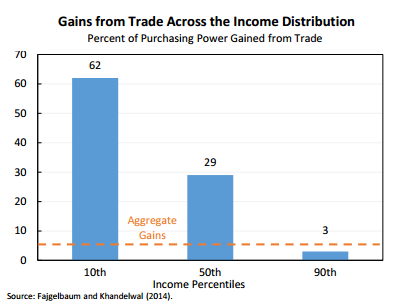
Corey Iacono Sanders ArticleIndeed, according to the President’s Council of Economic Advisers, middle income consumers have about 29 percent greater purchasing power as a result of international trade.

In other words, middle income consumers can buy 29 percent more goods and services as a result of the access to low-cost imports from foreign countries.

Low income consumers see even greater gains with 62 percent higher purchasing power as a result of trade. In contrast, the top 10 percent of income earners only saw an increase in purchasing power of 3 percent as a result of trade.

On top of that, international trade has provided benefits by bringing new and innovative products to American consumers.

According seminal research by Christian Broda of the University of Chicago and David E. Weinstein of Colombia University, the variety of imported goods increased three-fold from 1972 to 2001. The value to American consumers of this import induced expanded product variety is estimated to be equivalent to 2.6 percent of national income, about $450 billion as of 2014. That’s not exactly small change.

The spread of free trade has also made considerable contributions to environmental protection, gender equality, and global poverty reduction. As a result of the spread of clean technology facilitated by freer trade, “every 1 percent increase in income as a result of trade liberalization (the removal of government-imposed barriers to trade), pollution concentrations fall by 1 percent,” according to the Council of Economic Advisers.

The CEA also has found that “industries with larger tariff declines saw greater reductions in the [gender] wage gap,” suggesting that facilitating foreign competition through trade liberalization reduces the ability of employers to discriminate against women.

In regards to global poverty reduction, research has shown that in response to US import tariff cuts, developing countries, such as Vietnam, export more to the US, leading to higher incomes and less poverty.

Despite the large gains from trade America has already reaped, there is still room for improvement (contrary to Sen. Sanders’ accusations of “unfettered” free trade). The PIIE economists estimate that further trade liberalization would increase “US household income between $4,000 and $5,300 annually,” leading the them to conclude that, “in the future as in the past, free trade can significantly raise income — and quality of life — in the United States.”

Ultimately, the conclusion that most economists seem to reach is that, from being a disaster, the expansion of free trade has been a tremendous success, and that further trade liberalization would most likely make Americans, and the rest of the world, considerably better off.

Don’t let fear-mongering about foreigners and China scare you: free trade benefits everyone, especially the poor, while protectionism benefits only the politically powerful.

Corey Iacono is a student at the University of Rhode Island majoring in pharmaceutical science and minoring in economics. 

This article was published by The Foundation for Economic Education and may be freely distributed, subject to a Creative Commons Attribution 4.0 International License, which requires that credit be given to the author.