Browsed by
Category: Politics

Why Do Banks Keep Going Bankrupt? – Article by Kirby R. Cundiff

Why Do Banks Keep Going Bankrupt? – Article by Kirby R. Cundiff

The New Renaissance Hat
Kirby R. Cundiff
November 4, 2013
******************************

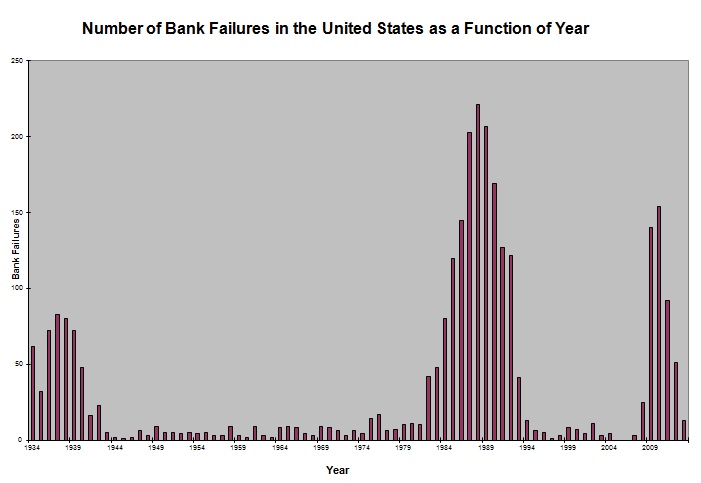
The banking industry is unstable. Banks are regularly going bankrupt. Crises in the banking industry have occurred in three distinct time periods during the twentieth century—during the Great Depression of the 1930s, during the Savings and Loan crisis of the 1980s and 1990s, and during the Great Recession from 2007 to present.

Why the banking industry is so vulnerable to bankruptcies and what can be done to correct this problem?

Debt to assets, or leverage, ratios vary significantly from industry to industry. They are typically under ten percent in most high tech industries and go up to forty percent for public utilities. Average debt ratios in the banking and financial services industry are in the fifty to seventy percent range, however, and many banks have much higher leverage ratios.

Firms attempt to minimize their total financing costs or Working Average Cost of Capital (WACC). The component costs of capital (cost of debt and cost of equity) are determined by investors’ perceptions of the risk and return possibilities associated with buying debt or equity in a given company or individual.

A credit card loan has a higher interest rate than a home loan because the credit card loan is riskier—i.e. there are no assets to seize if the money is not paid back. Similarly, a high-risk company normally pays a higher interest rate on its debt than a lower-risk company and increasing leverage is normally associated with increasing risk. Due to deposit insurance, however, this isn’t the case with banks.

Moral Hazard

The Federal Deposit Insurance Corporation (FDIC) insures deposits up to $250,000 in the United States. Most of the European countries (including Cyprus) have similar organizations that insure deposits up to 100,000 EUR. (See Deposit Insurance.)

Since depositors believe that their bank accounts are insured by governments, they do not generally know or care how much risk banks incur when they invest their depositors’ money. This creates a moral hazard problem with very little oversight by depositors of a bank’s management of their assets. Bank managers can take a lot of risk and, if they make profits, they keep the money. If they lose money, the taxpayers pay for the losses. In theory, this moral hazard problem is mitigated by subordinated debt, investors with deposits over the deposit insurance limit, and banking regulations. But these approaches are clearly not working.

In a series of agreements called the Basel Accords, the Basel Committee on Bank Supervision (BCBS) provides certain recommendations on banking regulations in regards to capital risk, market risk and operational risk. The purpose of these accords is to ensure financial institutions have enough capital to meet their obligations. The Tier I and Tier II capital controls of the Basel Agreements are supposed to prevent banks from taking too much risk with depositors’ assets. Tier 1 capital consists largely of shareholders’ equity. Tier 2 capital comprises undisclosed reserves, revaluation reserves, general provisions, hybrid instruments and subordinated debt.

The capital ratios are:

  •   Tier 1 capital ratio = Tier 1 capital / Risk-adjusted assets
  •   Total capital (Tier 1 and Tier 2) ratio = Total capital (Tier 1 + Tier 2) / Risk-adjusted assets
  •   Leverage ratio = Tier 1 capital / Average total consolidated assets

To be well-capitalized under federal bank regulatory definitions, a bank holding company must have a Tier 1 capital ratio of at least six percent, a total capital ratio of at least ten percent, and a leverage ratio of at least five percent (Capital).

The leverage ratios allowed under the Basel agreements are far higher than the typical leverag ratios in most industries and are far higher than would exist in a free-market financial system. Under a free-market system, depositors would not put their money in overly-leveraged banks and banks would be forced to decrease their leverage ratios and behave more like mutual or money market funds. Banks would be less likely to use short-term liabilities (deposits) to fund long-term assets (loans).

The S&L Crisis

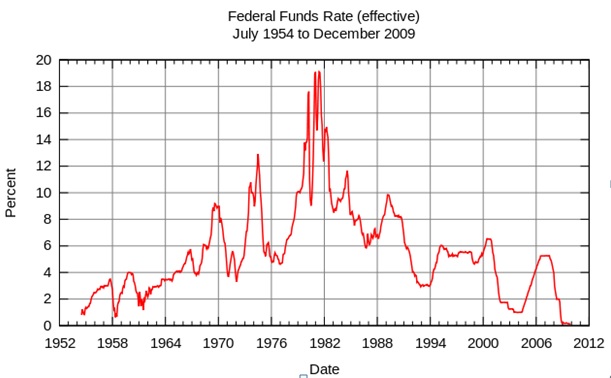
Massive bank leverage would not create as much instability if the money supply was stable as in the 1800s under the gold standard. Under the current debt-is-money system, inflation and interest rates can vary wildly from year to year. The Savings and Loan Associations (S&Ls) made many low interest 30-year fixed rate home loans when inflation was low in the 1960s—five percent interest rate loans were typical. As inflation increased, the S&Ls still had these long-term home loans on their books, but the market now demanded higher interest rates on deposits (eighteen percent at times). The interest rates that many savings and loans were receiving on their assets (30-year fixed rate loans) were much lower than the interest rates the same S&Ls were paying on their liabilities (deposits). This duration mismatch resulted in the mass insolvency of the Savings and Loan Industry and a bailout of the S&Ls by the American tax payers exceeding $100 billion.

The Great Recession

The banking defaults of the Great Recession (2007 to present) were also caused by unstable interest rates combined with high leverage. The Federal Reserve lowered rates in the early 2000s to stimulate the economy after the bursting of the dot.com bubble. This resulted in many people borrowing money at very low interest rates to buy homes. Then the Federal Reserve raised interest rates and many people were no longer able to make their home payments. Again the result was massive bank insolvency and a substantial decrease in home values. Another huge taxpayer -funded bailout of the banking system followed, and the Federal Reserve has been printing money ever since, trying to stimulate the economy in the wake of yet another bubble it created.  The disbursements associated with placing into conservatorship government-sponsored enterprises Fannie Mae and Freddie Mac by the U.S. Treasury, the Troubled Asset Relief Program (TARP), and the Federal Reserve’s Maiden Lane Transactions are probably around $400 billion. How much of these disbursements will be paid back is currently unclear.

During the recent crises in Cyprus, proposals were seriously considered to ignore the 100,000 EUR deposit insurance and seize a fraction of even small depositors’ money. Most depositors lost access to their accounts for over a week and large depositors are still likely to lose a large fraction of their assets. This crisis has made some depositors more likely to pay attention to the solvency of their banks, but most depositors still believe that deposit insurance will cover any possible losses. If banks are to become more stable, the amount of equity relative to debt in the banking system must be drastically increased to something resembling what it would be without government deposit insurance, central bank subsidies, and treasury bailouts. Given the lobbying power of bankers in Washington, DC and around the word, such is unlikely to occur. The boom-bust cycle of banking bubbles followed by banking crises will most surely continue.

For further reading on this topic see this from The Freeman.
Kirby R. Cundiff, Ph.D. is an Associate Professor of Finance at the Rochester Institute of Technology. He is a Chartered Financial Analyst and a CERTIFIED FINANCIAL PLANNERTM Professional. 
This article was originally published by The Foundation for Economic Education.


What Was Not Said About Iraq – Article by Ron Paul

What Was Not Said About Iraq – Article by Ron Paul

The New Renaissance Hat
Ron Paul
November 4, 2013
******************************
October was Iraq’s deadliest month since April, 2008. In those five and a half years, not only has there been no improvement in Iraq’s security situation, but things have gotten much worse. More than 1,000 people were killed in Iraq last month, the vast majority of them civilians. Another 1,600 were wounded, as car bombs, shootings, and other attacks continue to maim and murder.As post-“liberation” Iraq spirals steadily downward, Prime Minister Nuri al-Maliki was in Washington last week to plead for more assistance from the United States to help restore order to a society demolished by the 2003 US invasion. Al-Qaeda has made significant recent gains, Maliki told President Obama at their meeting last Friday, and Iraq needs more US military aid to combat its growing influence.

Obama pledged to work together with Iraq to address al-Qaeda’s growing presence, but what was not said was that before the US attack there was no al-Qaeda in Iraq. The appearance of al-Qaeda in Iraq coincided with the US attack. They claimed we had to fight terror in Iraq, but the US invasion resulted in the creation of terrorist networks where before there were none. What a disaster.

Maliki also told President Obama last week that the war in next-door Syria was spilling over into Iraq, with the anti-Assad fighters setting off bombs and destabilizing the country. Already more than 5,000 people have been killed throughout Iraq this year, and cross-border attacks from Syrian rebels into Iraq are increasing those numbers. Again, what was not said was that the US government had supported these anti-Assad fighters both in secret and in the open for the past two years.

Earlier in the week a group of Senators – all of whom had supported the 2003 US invasion of Iraq – sent a strongly-worded letter to Obama complaining that Maliki was far too close to the Iranian government next door. What was not said was that this new closeness between the Iraqi and Iranian governments developed under the US-installed government after the US invasion of Iraq.

Surely there is plenty of blame that can be placed on Maliki and the various no-doubt corrupt politicians running Iraq these days. But how was it they came to power? Were we not promised by those promoting the war that it would create a beach-head of democracy in the Middle East and a pro-American government?

According to former Treasury Secretary Paul O’Neill, in early 2001 as the new Bush administration was discussing an attack on Iraq, then-Defense Secretary Donald Rumsfeld said, “Imagine what the region would look like without Saddam and with a regime that’s allied with US interests. It would change everything in the region and beyond it. It would demonstrate what US policy is all about.”

We see all these years later now how ridiculous this idea was.

I have long advocated the idea that since we just marched in, we should just march out. That goes for US troops and also for US efforts to remake Iraq, Afghanistan, Libya, and everywhere the neocon wars of “liberation” have produced nothing but chaos, destruction, and more US enemies overseas. We can best improve the situation by just leaving them alone.

The interventionists have unfortunately neither learned their lesson from the Iraq debacle nor have they changed their tune. They are still agitating for regime change in Syria, even as they blame the Iraqi government for the destabilization that spills over. They are still agitating for a US attack on Iran, with Members of Congress introducing legislation recently that would actually authorize US force against Iran.

It looks like a very slow learning curve for our bipartisan leaders in Washington. It’s time for a change.

Ron Paul, MD, is a former three-time Republican candidate for U. S. President and Congressman from Texas.

This article is reprinted with permission from the Ron Paul Institute for Peace and Prosperity.

Mises Explains the Drug War – Article by Laurence M. Vance

Mises Explains the Drug War – Article by Laurence M. Vance

The New Renaissance Hat
Laurence M. Vance
October 26, 2013
******************************

Air travelers were outraged when the FAA announced that there would be flight delays because air-traffic controllers had to take furloughs as a result of sequester budget cuts. But there is another federal agency whose budget cuts Americans should be cheering — the Drug Enforcement Administration.

According to the Office of Management and Budget’s report to Congress on the effects of sequestration, the DEA will lose $166 million from its $2.02 billion budget. Other agencies that are part of the expansive federal drug war apparatus are getting their drug-fighting budgets cut as well.

These cuts, no matter how small they may actually end up being, are certainly a good thing since over 1.5 million Americans are arrested on drug charges every year, with almost half of those arrests just for marijuana possession.

Although 18 states have legalized medical marijuana, seven states have decriminalized the possession of certain amounts of marijuana, and Colorado and Washington have legalized marijuana for recreational use, it is still the case that in the majority of the 50 states, possession of even a small amount of marijuana can still result in jail time, probation terms, or fines. The federal government still classifies marijuana as a Schedule I controlled substance under the Controlled Substances Act, with a high potential for abuse and with no acceptable medical use.

Since the federal government has not followed its own Constitution, which nowhere authorizes the federal government to ban drugs or other any substance, it is no surprise that it has not followed the judgment of Ludwig von Mises when it comes to the drug war.

The war on drugs is a failure. It has failed to prevent drug abuse. It has failed to keep drugs out of the hands of addicts. It has failed to keep drugs away from teenagers. It has failed to reduce the demand for drugs. It has failed to stop the violence associated with drug trafficking. It has failed to help drug addicts get treatment. It has failed to have an impact on the use or availability of most drugs in the United States.

None of this means that there is necessarily anything good about illicit drugs, but as Mises explains “It is an established fact that alcoholism, cocainism, and morphinism are deadly enemies of life, of health, and of the capacity for work and enjoyment; and a utilitarian must therefore consider them as vices.” But, as Mises contends, the fact that something is a vice is no reason for suppression by way of commercial prohibitions, “nor is it by any means evident that such intervention on the part of a government is really capable of suppressing them or that, even if this end could be attained, it might not therewith open up a Pandora’s box of other dangers, no less mischievous than alcoholism and morphinism.”

The other mischievous dangers of the drug war that have been let loose are legion. The war on drugs has clogged the judicial system, unnecessarily swelled prison populations, fostered violence, corrupted law enforcement, eroded civil liberties, destroyed financial privacy, encouraged illegal searches and seizures, ruined countless lives, wasted hundreds of billions of taxpayer dollars, hindered legitimate pain treatment, turned law-abiding people into criminals, and unreasonably inconvenienced retail shopping. The costs of drug prohibition far outweigh any possible benefits.

But that’s not all, for once the government assumes control over what one can and can’t put into his mouth, nose, or veins or regulates the circumstances under which one can lawfully introduce something into his body, there is no limit to its power and no stopping its reach. Again, as Mises makes clear “[o]pium and morphine are certainly dangerous, habit-forming drugs. But once the principle is admitted that it is the duty of government to protect the individual against his own foolishness, no serious objections can be advanced against further encroachments.”

“As soon as we surrender the principle that the state should not interfere in any questions touching on the individual’s mode of life,” Mises goes on, “we end by regulating and restricting the latter down to the smallest detail.”

Mises tells us exactly what the slippery slope of drug prohibition leads to. He asks why what is valid for morphine and cocaine should not be valid for nicotine and caffeine. Indeed: “Why should not the state generally prescribe which foods may be indulged in and which must be avoided because they are injurious?” But it gets worse, for “if one abolishes man’s freedom to determine his own consumption, one takes all freedoms away.”

“Why limit the government’s benevolent providence to the protection of the individual’s body only?” Mises asks. “Is not the harm a man can inflict on his mind and soul even more disastrous than any bodily evils? Why not prevent him from reading bad books and seeing bad plays, from looking at bad paintings and statues and from hearing bad music?”

When it comes to bad habits, vices, and immoral behavior of others, in contrast to the state, which does everything by “compulsion and the application of force,” Mises considered tolerance and persuasion to be the rules.

“A free man must be able to endure it when his fellow men act and live otherwise than he considers proper,” Mises explains. “He must free himself from the habit, just as soon as something does not please him, of calling for the police.”

For Mises, there is one path to social reform, and “[h]e who wants to reform his countrymen must take recourse to persuasion. This alone is the democratic way of bringing about changes. If a man fails in his endeavors to convince other people of the soundness of his ideas,” Mises concludes, “he should blame his own disabilities. He should not ask for a law, that is, for compulsion and coercion by the police.”

In a free society, it couldn’t be any other way.

Laurence M. Vance is an Associated Scholar of the Mises Institute and the author of Social Insecurity, The War on Drugs is a War on Freedom, and War, Christianity, and the State: Essays on the Follies of Christian Militarism. Send him mail. See Laurence M. Vance’s article archives.

You can subscribe to future articles by Laurence M. Vance via this RSS feed.

This article was published on Mises.org and may be freely distributed, subject to a Creative Commons Attribution United States License, which requires that credit be given to the author.

Economies are Not Destroyed in a Day – Article by Nicolás Cachanosky

Economies are Not Destroyed in a Day – Article by Nicolás Cachanosky

The New Renaissance Hat
Nicolás Cachanosky
October 26, 2013
******************************

Earlier this month, Argentina’s leading conservative paper, La Nación published an unsigned editorial comparing the economies of Argentina and Venezuela. The editorial concluded that as economic freedom declines in Argentina, and as Argentina adopts more of what Chavez called “twenty-first century socialism,” it is becoming increasingly similar to Venezuela. Is this true? Will Argentina suffer the same fate as Venezuela where poverty is increasing and toilet paper can be a luxury?

The similarities of regulations and economic problems facing both countries are indeed striking in spite of obvious differences in the two countries. Yet, when people are confronted with the similarities, it is common to hear replies like “but Argentina is not Venezuela, we have more infrastructure and resources.”

Institutional changes, however, define the long-run destiny of a country, not its short-run prosperity.

Imagine that Cuba and North Korea became, overnight, the two most free-market, limited-government countries in the world. The two countries would have immediately gained civil liberties and economic freedom, but they would still have to accumulate wealth and to develop their economies. The institutional change affects the political situation immediately, but a new economy requires time to take shape. For example, as China opened parts of its economy to international markets, the country started to grow, and we are now seeing the effects of decades of relative economic liberalization. It is true that many areas in China continue to lack significant freedoms, but it would be a much different China today had it refused to change its institutions decades ago.

The same occurs if one of the wealthiest and developed countries in the world were to adopt Cuban or North Korean institutions overnight. The wealth and capital does not vanish in 24 hours. The country would shift from capital accumulation to capital consumption and it might take years or even decades to drain the coffers of previous accumulated wealth. In the meantime, the government has the resources to play the game of Bolivarian (i.e., Venezuelan) populist socialism and enjoy the wealth, highways, electrical infrastructure, and communication networks that were the result of the more free-market institutional realities of the past.

Eventually, though, highways start to deteriorate from the lack of maintenance (or trains crash in the station killing dozens of passengers), the energy sector starts to waver, energy imports become unavoidable, and the communication network becomes obsolete. In other words, economic populism is financed with resources accumulated by non-populist institutions.

According to the Fraser Institute’s Economic Freedom of the World project, Argentina ranked 34th-best in the year 2000. By 2011, however, Argentina fell to 137, next to countries like Ecuador, Mali, China, Nepal, Gabon, and Mozambique. There is no doubt that Argentina enjoys a higher rate of development and wealth than those other countries. But, can we still be sure that this will be the situation 20 or 30 years from now? The Argentinean president is known for having said that she would like Argentina to be a country like Germany, but the path to becoming like Switzerland or Germany involves adopting Swiss and German-type institutions, which Argentina is not doing.

The adoption of Venezuelan institutions in Argentina, came along with high growth rates. These growth rates, however, are misleading:

First, economic growth, properly speaking, is not an increase in “production,” but an increase in “production capacity.” The growth in observed GDP after a big crisis is economic recovery, not economic growth properly understood.

Second, you can increase your production capacity by investing in the wrong economic activities. Heavy price regulation, as takes place in Argentina (now accompanied by high rates of inflation), misdirects resource allocation by affecting relative prices. We might be able to see and even touch the new investment, but such capital is the result of a monetary illusion. The economic concept of capital does not depend on the tangibility or size of the investment (i.e, on its physical properties), but on its economic value. When the time comes for relative prices to adjust to reflect real consumer preferences, and the market value of capital goods drops, capital is consumed or destroyed in economic terms even if the physical qualities of capital goods remains unchanged.

Third, production can increase not because investment increases, but because people are consuming invested capital, as is the case when there is an increase in the rate that machinery and infrastructure wear out.

I’m not saying that there is no genuine growth in Argentina, but it remains a fact that a nontrivial share of the Argentinean GDP growth can be explained by: (1) recovery, (2) misdirection of investment, and (3) capital consumption. If that weren’t the case, employment creation wouldn’t have stagnated and the country’s infrastructure should be shining rather than falling into pieces.

Most economists and policy analysts seem to have a superficial reading of economic variables. If an economy is healthy, then economic variables look good, GDP grows, and inflation is low. But the fact that we observe good economic indicators does not imply that the economy is healthy. There’s a reason why a doctor asks for tests from a patient that appears well. Feeling well doesn’t mean there might not be a disease that shows no obvious symptoms at the moment. The economist who refuses to have a closer look and see why GDP grows is like a doctor who refuses to have a closer look at his patient. The Argentinian patient has caught the Bolivarian disease, but the most painful symptoms have yet to surface.

NOTE: This is a translated and expanded version of an original piece published in Economía Para Todos (Economics for Everyone).

Nicolás Cachanosky is Assistant Professor of Economics at Metropolitan State University of Denver. See Nicolás Cachanosky’s article archives.

You can subscribe to future articles by Nicolás Cachanosky via this RSS feed.

This article was published on Mises.org and may be freely distributed, subject to a Creative Commons Attribution United States License, which requires that credit be given to the author.

The FDA: A Pain From the Neck to the Big Toe – Article by Mark Thornton

The FDA: A Pain From the Neck to the Big Toe – Article by Mark Thornton

The New Renaissance Hat
Mark Thornton
October 25, 2013
******************************

I recently experienced severe pain in my feet, particularly in the big toes. In my imagination it felt like my feet had been run over by a truck and that several of my toes had been broken. But I knew that was not the case, and that the pain came on slowly at first, and then spread to other parts of my feet until I could barely walk.

My first approach was to take some ibuprofen to relieve the pain and swelling. When this did not resolve the matter, I thought perhaps a new pair of soft shoes might work. That idea also failed, and with a little internet research I realized I had a classic case of the gout. I was soon off to see my doctor to determine what the problem was and to get it solved with the powers of modern medicine.

The doctor confirmed that I had the gout. I was not pleased to find out, that in my case, the gout was probably brought on by another drug that I had been taking daily, against my better judgment. However, I was pleased to learn that I would no longer have to take it, that as part of my treatment I was being prescribed an ancient and natural drug, and that I would only have to take this drug “as needed.”

I was off to get my prescription filled at the pharmacy when a thought came to mind: if this drug was as natural and ancient as advised by my doctor, why did I need a prescription in the first place? Upon inspection the prescription was for Colcrys, the brand name of the drug colchicine. Furthermore, when I picked up my prescription the price was much higher than I anticipated given that it was a natural drug. When questioned, the pharmacy technician replied that the actual price was much higher and that my insurance paid for more than three-quarters of the bill. The cash price (without insurance) was $198.99 which is $6.63 per pill if taken daily, or nearly $20 per dose if used to treat flare-ups.

An extremely high price for an ancient natural drug? I knew I had a new case to solve and that the solution was probably the same old answer.

After conducting some research on Wikipedia, I learned the following: Colchicine can be used to treat gout, Behcet’s disease, pericarditis, and the Mediterranean fever. It has been in use as a medicine for over 3,000 years. After serving as ambassador to France, Benjamin Franklin brought colchicum plants back to America in order to treat his own gout. Modern science has further refined the drug for better medicinal use.

Colcrys has been used to treat gout for a very long time, although the Food and Drug Administration (FDA) had not approved Colcrys specifically for the treatment of gout prior to 2009. Alternative drugs, such as Allopurinal, are also used to treat gout and related ailments. Until recently, you could treat your own gout using one of these medicines for pennies a day.

In the summer of 2009, the Food and Drug Administration approved Colcrys as a treatment for gout flare-ups and the Mediterranean fever. The FDA gave pharmaceutical company URL Pharma an exclusive marketing agreement for selling Colcrys in exchange for completing studies on Colcrys and paying the FDA a $45 million application fee.

This deal effectively created a patented drug with no generic alternative. Therefore it gave the company a monopoly for the duration of the agreement. URL Pharma immediately raised the price from less than a dime to nearly $5 dollars per pill. Comprehensive medical insurance does substantially reduce the price to consumers, but it does not reduce the cost. Insurance only spreads the cost-burden across policy holders.

At the same time, doctors are encouraged by pharmaceutical companies to employ more expensive and profitable treatments. As a result the overall cost burden increases. Evidence suggests that doctors are prescribing Colcrys in large volumes to treat gout flare-ups and as a long-term preventative measure.

Once again the federal government has taken something that was both cheap and beneficial and turned it into a monopoly that hurts the general public and drives up the cost of medical care to the benefit of Big Pharma.

Note: Just because it is natural and produced in a pharmaceutical environment, does not mean that Colcrys is harmless. It can be considered toxic in large amounts, has a long list of possible side effects, and is not recommended for people with certain conditions.

Mark Thornton is a senior resident fellow at the Ludwig von Mises Institute in Auburn, Alabama, and is the book review editor for the Quarterly Journal of Austrian Economics. He is the author of The Economics of Prohibition, coauthor of Tariffs, Blockades, and Inflation: The Economics of the Civil War, and the editor of The Quotable Mises, The Bastiat Collection, and An Essay on Economic Theory. Send him mail. See Mark Thornton’s article archives.

You can subscribe to future articles by Mark Thornton via this RSS feed.

This article was published on Mises.org and may be freely distributed, subject to a Creative Commons Attribution United States License, which requires that credit be given to the author.

Debt-Ceiling Crises: Imagined and Real – Article by D. W. MacKenzie

Debt-Ceiling Crises: Imagined and Real – Article by D. W. MacKenzie

The New Renaissance Hat
D. W. MacKenzie
October 14, 2013
******************************

The federal government shutdown and impending debt ceiling “deadline” have led to near panic over possible default on the national debt. This imagined “default crisis” is a canard used for demagogic fearmongering. That said, the long-term federal financial issues are all too serious.

If federal officials simply continue on with their current financial plans, the U.S. government could run into trouble in early November. Without a debt ceiling increase, the Treasury would be unable to meet some of its financial obligations. Treasury bills would take a hit in international markets. With T-bills losing value in markets, interest rates—especially short-term interest rates—would start to rise. Rising interest rates would impair recovery from the 2008 financial crisis.

The assertion that a debt crisis would impair an already weak economic recovery is correct. However, any claim that the federal government is up against a hard deadline to meet its legal financial obligations is utterly untrue. The federal government holds vast amounts of property, all of which is available to be sold off. How much is needed to cover federal interest payments?

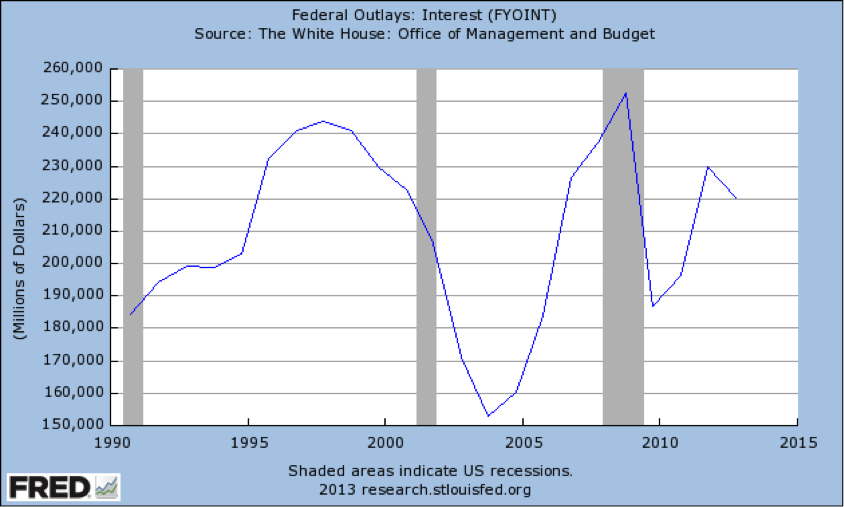
Interest rates are, for the moment, very low. Accordingly, interest payments on the debt are a small percentage of the total federal budget, despite the large size of the national debt.

With annual interest payments at a couple of hundred billion dollars, there is no impending debt-ceiling default crisis.

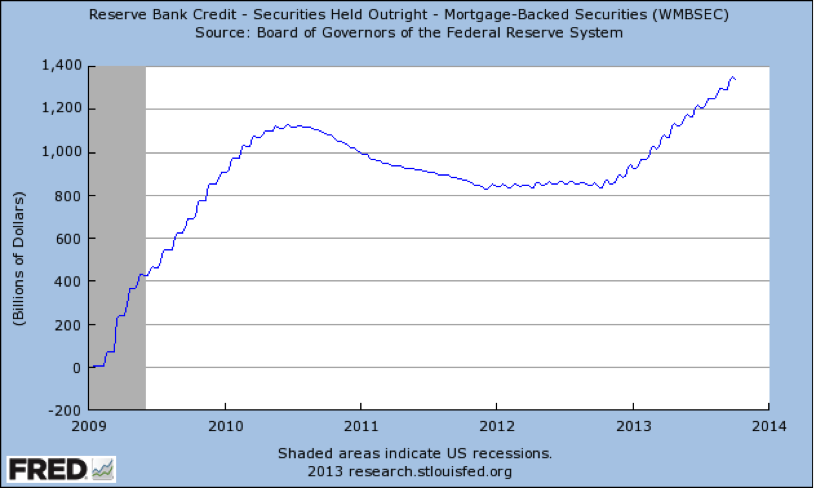
How exactly could the federal government pay interest on the national debt? To start with, the Federal Reserve now holds large numbers of mortgage-backed securities. There is some uncertainty over the market value of these securities, but their face value is immense, well over one trillion dollars. Sales of some of the better quality mortgage-backed securities could fund interest payments in the short term.

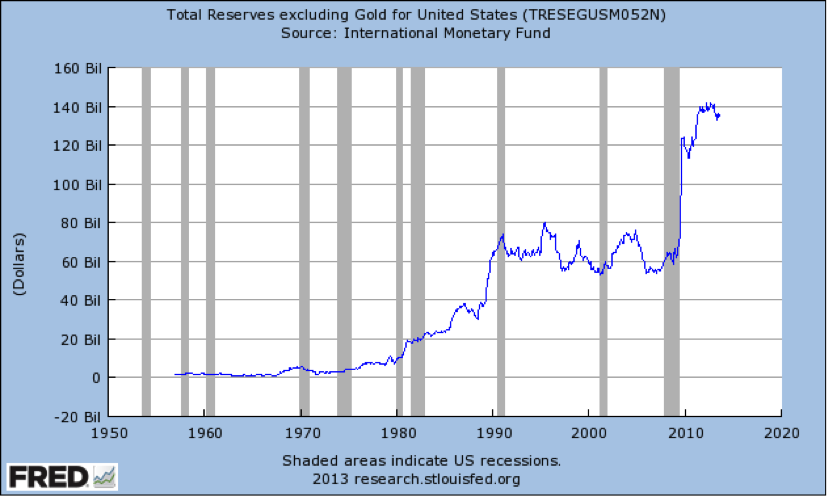
U.S. gold reserves are also substantial. The U.S. holds thousands of tons of gold at Fort Knox and at the New York Federal Reserve.

Sales of a small part of U.S. gold reserves could be used to make immediate interest payments.

The U.S. government also holds large amounts of idle real estate. The federal government spends $8 billion on vacant buildings annually. That’s for an estimated total of 55,000 to 77,000 buildings. The fact that our federal officials aren’t sure how many buildings they manage is itself disturbing, and a sign of incompetence. However, it seems that there are at least over 50,000 such buildings. How many hours would it take for federal employees who “manage” these buildings to post some of them on eBay? Surely sales of these properties would raise enough money to cover federal interest for about a month or two of the next year, even if each of these buildings sold for only a half a million dollars on average.

Efficient, competent public officials could simply announce auctions and begin to sell some of these buildings. Of course, red tape could delay property auctions. However, the Fed could make immediate interest payments by using its discretionary powers to sell mortgage-backed securities and gold reserves. President Obama could, in the meantime, expedite sales of vacant federal buildings—not to mention federal lands—by cutting red tape. (See map of federally managed land.)

The President has already acted in arbitrary—and some would say illegal—ways: by granting special exemptions from the Affordable Care Act to favored corporations, by using drones to kill U.S. citizens, and by targeting unfriendly political groups for audits. If Obama really wants save his beloved federal government from default, why shouldn’t he just use the extraordinary powers that he has already claimed to order the immediate sale of vacant buildings? The point here is not to encourage further illegality on the part of this President (he needs no assistance in such matters). The point here is that Obama does not have his back against a wall; there is no “gun to his head.” Obama has already claimed more than enough discretionary powers to prevent a debt-ceiling default in November. If default does happen it is entirely his choice, given that he has legal options and has already assumed various unconstitutional powers.

Obama has occasionally mentioned that some programs might be trimmed or cut. As Obama put it in 2010, “We cannot sustain a system that bleeds billions of taxpayer dollars on programs that have outlived their usefulness, or exist solely because of the power of a politician, lobbyist, or interest group.” He added, “We simply cannot afford it.”

The federal government holds over 700 million barrels of oil in the Strategic Petroleum Reserve. Obama could raise billions of dollars for interest payments without selling the whole reserve. Some people might see sales of the SPR as irresponsible. However, the oil in this reserve is a small fraction of monthly oil consumption, U.S. oil production is rising, and owners of foreign oil have overwhelming financial interests in continued oil sales to the United States.

The federal government also holds a Strategic Helium Reserve. It was created for “national security,” for blimps used by the military leading up to and during World War II. This program is archaic and the government already sells some helium. It could sell all of it and shut this program down.

Default on the debt is always possible. Obama and his people at the Treasury Department could have refused to pay interest on the national debt last month even though they had this money at hand. They could choose to default next month even though they can get the money—either through legal means or according to Obama’s demonstrated willingness to act illegally. The sale of federal assets and closing of federal programs would do more than just meet short-term interest payments on the national debt. Movement of securities, gold, buildings, oil, and helium would put these resources in the hands of people who would not merely put these resources to better use, but to actual use. The leeway that exists in federal finances points to longer-term financial and economic problems. Why would Obama engage in fearmongering on the national debt when obvious solutions to this problem exist? For that matter, why would federal officials hold so many idle resources for so long?

The reason why the federal government runs deficits nearly every year, despite collecting trillions in annual taxes, is because it wastes vast amounts of money on dysfunctional programs and special-interest payoffs. An efficient government would not need to tax and borrow nearly as much as does the federal government. The gross inefficiency of government has put federal finances in long-term jeopardy.

The real debt ceiling is determined by the ability of all working Americans to pay more taxes. How much more can we pay? Continued structural deficits and rising entitlement spending will result in default on the national debt, but not for a number of years. The existing path of long-term federal spending does surpass the capacity of taxpayers to fund the federal government, as it is currently designed. Future default on the national debt will have severe consequences. However, Obama’s willingness to engage in demagoguery on the immediate debt-ceiling issue is one of many signs that politicians are unwilling to take necessary steps to fix long-term fiscal finances.

The legal debt-ceiling crisis of 2013 is manufactured and phony. Even if Congress refuses to raise the legal debt ceiling this year, there are many ways of avoiding immediate default. The real problem we face is wasteful and irresponsible spending that will make default unavoidable eventually. Long-run default is, of course, avoidable. What we need are real cuts in federal spending, actual sales of federal assets and properties, and rationality in federal finances. Cutting spending and selling assets are easier said than done. Achieving smaller government will require a dramatic shift in public opinion. Americans need to realize that politicians who try to scare us are the ones that we really should fear.

D. W. MacKenzie is an assistant professor of economics at Carroll College in Helena, Montana. 

This article was originally published by The Foundation for Economic Education.
Illiberal Belief #22: Persuasion is Force – Article by Bradley Doucet

Illiberal Belief #22: Persuasion is Force – Article by Bradley Doucet

The New Renaissance Hat
Bradley Doucet
October 13, 2013
******************************
I must admit, I love a good television commercial. The creativity that goes into the best TV ad is as impressive and enjoyable to me as a quality drama, comedy, or documentary. “You feel sad for the Moo Cow Milker? That is because you are crazy. Tacky items can easily be replaced with better IKEA.” But damn those clever Swedes! They have, through the alchemy of advertising, forced me into outfitting my entire apartment with their stylish yet affordable household items.I kid, of course; but there is a certain line of thought out there that cannot abide advertising, and that credits it with all manner of evil. Advertising, they say, makes us fat by brainwashing us into wanting fast food and sugary cereal. It makes men want to buy beer, fancy cars, or anything else associated with hot women. (A current TV commercial makes fun of the “scantily-clad women washing car” cliché by having a group of sumo wrestlers wash a new Subaru.) Advertising makes women dissatisfied with their appearance and hence creates a need for fashion and beauty products that would not otherwise exist. Yes, because as we all know, humans do not naturally enjoy fatty, sugary foods, men would not drink beer or drive fancy cars in the absence of advertising, and women need corporations to teach them to care about their looks. Puh-lease.

Think of the Children

Advertising is about the transmission of information, and it is also about convincing people to buy something. In other words, it is a form of persuasion, but this use of persuasion is implicitly equated with the use of force by its detractors. Sometimes, as in the case of the French website RAP (“Résistance à l’Agression Publicitaire” or “Resistance to Advertising Aggression”), the equating of persuasion and force is explicit. The site features an illustration of a police officer brandishing a billy club accompanied by the slogan, “Ne vous laissez pas matraquer par la pub,” which translates, “Don’t let yourself be bludgeoned by advertising.”

Usually, though, the message is less overt, as it is on Commercial Alert’s website, whose slogan is “Protecting communities from commercialism.” The site complains about the psychology profession “helping corporations influence children for the purpose of selling products to them.” Here, the word “influence” seems none too menacing, but its effect is quickly bolstered by the words “crisis,” “epidemic,” “complicity,” and “onslaught.” Force may not be explicitly mentioned, but these words bring to mind infectious disease, crime, and violent conquest. Without coming right out and saying it, the implication is clear―although one could argue, ironically enough, that this effect was meant to be subliminal.

Now, are children more vulnerable than adults to the persuasive nature of advertising? Of course they are, especially when very young. But it is part of the job of parents (and later, teachers) to equip children with the tools necessary to judge competing claims and see through manipulative techniques. I’ll be the first to admit that there is room for improvement in this area―and a free market in education would go a long way toward providing that improvement―but as far as advertising goes, most kids are savvy to the more outlandish claims well before they even reach adolescence. As people grow up, they learn through experience that beer doesn’t bring babes (though a little may beneficially lower one’s own inhibitions) and that makeup will only get you so far. At any rate, treating all adults like children is hardly a fair way to deal with the fact that some minority of people will remain gullible their entire lives.

Of Words and Bullets

Many of those who really hate advertising share a worldview that involves rich, powerful corporations controlling everything. In fact, there is a sense in which this view has some merit, for it is true that large corporations often gain unfair advantage over their competitors, suppliers, and customers. When this happens, though, it happens through the gaining of political influence, which means the use of actual, legally sanctioned force to hogtie the competition, restrict consumers’ choices, or extract taxpayers’ hard-earned income. In a truly free market, the government would not have the authority to dole out special privileges, as it does in our mixed economies. Without any goodies to fight over, corporations would have no legal means of squashing competitors and could only succeed by being as efficient as possible and persuading customers to buy their products (and if their products do not satisfy, they will not get many repeat customers). To target this persuasion as a serious problem when actual, legal force is being used surely reveals an inverted sense of priorities, or at least a serious misunderstanding about the sources of society’s woes.

Another example of the implicit equating of persuasion with force is the thinking behind legislated limits on the amounts individuals can spend expressing their political views during an election―in essence, limits on political advertising. Here, as in commercial advertising, the purpose is clear: if persuasion is force, then the government is perfectly justified in countering that initiation of force with retaliatory force. If words are bullets, then words can be met with bullets. But it is clear what happens to free speech in such a scenario. Instead of competing voices clamouring for your attention, one monolithic government propaganda machine decides what can and cannot be said. In the political realm, this works against new or historically small parties trying to break through since they have a disproportionately hard time attracting many small contributions in order to pay for ads to get their message out. This leads to a situation in which a couple of largely indistinguishable parties become more and more firmly entrenched.

In fact, the notion that persuasion is force brings to mind nothing so much as George Orwell’s novel, 1984, in which the government has destroyed the precision of words by continually reinforcing its contradictory slogans: war is peace, freedom is slavery, ignorance is power, and love is hate. It is shocking to observe the smug self-righteousness of those who hold forth on the enormous manipulative power of advertising and who are so sure that they, of all people, have not been brainwashed. But in fact, it is they who have been, if not brainwashed, then at least misled about the relative power of advertising versus the average Joe’s ability to think and judge for himself. They have bought, hook, line, and sinker, the most superficial critique of capitalism, when our mixed form of capitalism has plenty of real abuses crying out for correction.

The Power of Persuasion

The point is not that persuasion is powerless. I am engaged in trying to persuade you of something right now, and if I didn’t think I had a chance of succeeding, I wouldn’t waste my time. The point, rather, is that persuasion must be met with persuasion, words and rhetorical techniques must be answered with more words and more rhetoric. If free competition is allowed in the marketplace of ideas, no one’s victory is assured, and we needn’t fret too much over the use of psychological tricks, because the trickster’s competitors can use them too, or overtly challenge them instead. (See Gennady Stolyarov II’s article “The Victory of Truth Is Never Assured!” for a related call to action.)

If we are still worried, though, it is undeniable that better education―freer education―would produce a less pliant population, especially important for the issue of political persuasion. The other thing that would help is fighting for full freedom of competition, in both commerce (no special government privileges) and politics (no limits on political speech). In other words, we need to eliminate the government’s use of force in the realms of education, commerce, and political campaigning. Agitating for the government to solve our problems for us with the use of more force will only make matters worse, and further infantilize us in the process.

Bradley Doucet is Le Québécois Libre‘s English Editor. A writer living in Montreal, he has studied philosophy and economics, and is currently completing a novel on the pursuit of happiness. He also writes for The New Individualist, an Objectivist magazine published by The Atlas Society, and sings.
New Fed Boss Same as the Old Boss – Article by Ron Paul

New Fed Boss Same as the Old Boss – Article by Ron Paul

The New Renaissance Hat
Ron Paul
October 13, 2013
******************************

The news that Janet Yellen was nominated to become the next Chairman of the Board of Governors of the Federal Reserve System was greeted with joy by financial markets and the financial press. Wall Street saw Yellen’s nomination as a harbinger of continued easy money. Contrast this with the hand-wringing that took place when Larry Summers’ name was still in the running. Pundits worried that Summers would be too cautious, too hawkish on inflation, or too close to big banks.

The reality is that there wouldn’t have been a dime’s worth of difference between Yellen’s and Summers’ monetary policy. No matter who is at the top, the conduct of monetary policy will be largely unchanged: large-scale money printing to bail out big banks. There may be some fiddling around the edges, but any monetary policy changes will be in style only, not in substance.

Yellen, like Bernanke, Summers, and everyone else within the Fed’s orbit, believes in Keynesian economics. To economists of Yellen’s persuasion, the solution to recession is to stimulate spending by creating more money. Wall Street need not worry about tapering of the Fed’s massive program of quantitative easing under Yellen’s reign. If anything, the Fed’s trillion dollars of yearly money creation may even increase.

What is obvious to most people not captured by the system is that the Fed’s loose monetary policy was the root cause of the current financial crisis. Just like the Great Depression, the stagflation of the 1970s, and every other recession of the past century, the current crisis resulted from the creation of money and credit by the Federal Reserve, which led to unsustainable economic booms.

Rather than allowing the malinvestments and bad debts caused by its money creation to liquidate, the Fed continually tries to prop them up. It pumps more and more money into the system, piling debt on top of debt on top of debt. Yellen will continue along those lines, and she might even end up being Ben Bernanke on steroids.

To Yellen, the booms and bust of the business cycle are random, unforeseen events that take place just because. The possibility that the Fed itself could be responsible for the booms and busts of the business cycle would never enter her head. Nor would such thoughts cross the minds of the hundreds of economists employed by the Fed. They will continue to think the same way they have for decades, interpreting economic data and market performance through the same distorted Keynesian lens, and advocating for the same flawed policies over and over.

As a result, the American people will continue to suffer decreases in the purchasing power of the dollar and a diminished standard of living. The phony recovery we find ourselves in is only due to the Fed’s easy money policies. But the Fed cannot continue to purchase trillions of dollars of assets forever. Quantitative easing must end sometime, and at that point the economy will face the prospect of rising interest rates, mountains of bad debt and malinvested resources, and a Federal Reserve which holds several trillion dollars of worthless bonds.

The future of the US economy with Chairman Yellen at the helm is grim indeed, which provides all the more reason to end our system of central economic planning by getting rid of the Federal Reserve entirely. Ripping off the bandage may hurt some in the short run, but in the long term everyone will be better off. Anyway, most of this pain will be borne by the politicians, big banks, and other special interests who profit from the current system. Ending this current system of crony capitalism and moving to sound money and free markets is the only way to return to economic prosperity and a vibrant middle class.

Ron Paul, MD, is a former three-time Republican candidate for U. S. President and Congressman from Texas.

This article is reprinted with permission from the Ron Paul Institute for Peace and Prosperity.

An Opening to Iran? – Article by Ron Paul

An Opening to Iran? – Article by Ron Paul

The New Renaissance Hat
Ron Paul
October 6, 2013
******************************
Last week, for the first time since the 1979 Iranian revolution, the US president spoke with his Iranian counterpart. Their 15-minute telephone call was reported to open the door to further high-level discussions. This is a very important event.I have been saying for years that we should just talk to the Iranians. After all, we talked to the Soviets when they actually had thousands of nuclear missiles pointed at us! The Iranians have none, according to our own intelligence services. I even suggested a few years ago that we should “offer friendship” to them. Unfortunately, so many so-called experts have a stake in keeping tensions high and pushing us to war. They did not want to hear what I was saying. It seems, though, this is beginning to change now with these recent events.

The phone call was one of the most important moves away from war and conflict in a long time. Taken with the Obama administration’s decision to hold off on bombing Syria, we should be encouraged.

It is also probably a good sign that this phone call has infuriated the neoconservatives at home, the pro-war faction in Israel, and the hard-liners in Iran. Now that a process of negotiation has begun, the chance of war has been significantly reduced. The US is very unlikely to bomb Iran while it is talking with them, and Israel is also unlikely to start a war while the US is at the negotiating table with the Iranian leadership.

But we should also remain very cautious. Obama’s war on Syria was only stopped because the American people finally stood up and said “enough.” The message was received loud and clear and it shocked the neocons pushing war. They were used to being in charge of foreign policy.

In a recent CNN poll, more than 75% of Americans favored negotiations with Iran. This is very good news, but those pushing for war will not give up that easily. Believe it or not, some Members of Congress have recently introduced legislation to authorize war on Iran – even as these first steps toward a peaceful resolution of our differences begin to bear fruit!

So no, they will not give up that easily. There are many in the president’s own Cabinet who do not want to see US/Iranian relations improve. Even the president himself seems unable to avoid provocative statements — such as his claim that the Iranians are only willing to talk because the sanctions have been so successful in bringing them to the table. That is a false and unnecessary boast, and if he continues in such a way he will destroy what progress has been made.

But we are in the majority now. There are more than three-quarters of us who do not want war on Iran. It is essential that we keep the pressure on the Administration to ignore the war demands in both political parties and among the so-called foreign policy experts. There will be much more war propaganda coming our way as the warmongers get more desperate. Americans must see this propaganda for what it is. They should educate themselves and become familiar with alternative news sources to gain the tools to counter the propaganda. We do have a better chance at peace, but this is no time to let down our guard!

Ron Paul, MD, is a former three-time Republican candidate for U. S. President and Congressman from Texas.

This article is reprinted with permission from the Ron Paul Institute for Peace and Prosperity.

Internet Sales Tax Could Crush Small Businesses – Article by Ron Paul

Internet Sales Tax Could Crush Small Businesses – Article by Ron Paul

The New Renaissance Hat
Ron Paul
September 26, 2013
******************************

One unique aspect of my homeschool curriculum is that students can start and manage their own online business. Students will be responsible for deciding what products or services to offer, getting the business up and running, and marketing the business’s products. Students and their families will get to keep the profits made from the business. Hopefully, participants in this program will develop a business that can either provide them with a full-time career or a way to supplement their income.

Internet commerce is the most dynamic and rapidly growing sector of the American economy. Not surprisingly, the Internet is also relatively free of taxes and regulations, although many in Washington are working to change that. For example, earlier this year the Senate passed the Marketplace Fairness Act, more accurately referred to as the national Internet sales tax act. This bill, which passed the Senate earlier this year, would require Internet businesses to collect sales tax for all 10,000 American jurisdictions that assess sales taxes. Internet business would thus be subject to audits from 46 states, six territories, and over 500 Native American tribal nations.

Proponents of the bill deny it will hurt small business because the bill only applies to Internet business that make over a million dollars in out-of-state revenue. However, many small Internet businesses with over a million dollars in out-of-state revenues operate on extremely thin profit margins, so even the slightest increase in expenses could put them out of businesses.

Some businesses may even try to avoid increasing their sales so as to not have to comply with the Internet sales tax. It is amazing that some of the same conservatives who rightly worry over Obamacare’s effects on job creation and economic growth want to impose new taxes on the most dynamic sector of the economy.

Proponents of the law claim that there is software that can automatically apply sales taxes. However, anyone who has ever dealt with business software knows that no program is foolproof. Any mistakes made by the software, or even errors in installing it, could result in a small business being subject to expensive and time-consuming audits.

Some say that it is a legitimate exercise of Congress’s Commerce Clause power to give state governments the authority to force out-of-state businesses to collect sales taxes. But if that were the case, why shouldn’t state governments be able to force you to pay sales taxes where you physically cross state lines to make a purchase? The Commerce Clause was intended to facilitate the free flow of goods and services across state lines, not to help states impose new burdens on out of state businesses.

The main proponents of this bill are large retailers and established Internet business. Big business can more easily afford to comply with a national Internet sales tax. In many cases, they are large enough that they already have a “physical presence” in most states and thus already have to collect state sales taxes. These businesses are seeking to manipulate the political process to disadvantage their existing and future small competitors. The Internet sales tax is a bad idea for consumers, small Internet business, and perhaps most importantly, the next generation of online entrepreneurs.

For more information about the small business program well as all other aspects of the Homeschool curriculum, please go here. And to purchase a copy of my new book, The School Revolution: A New Answer for Our Broken Education System, please go here.

Ron Paul, MD, is a former three-time Republican candidate for U. S. President and Congressman from Texas.

This article is reprinted with permission from the Ron Paul Institute for Peace and Prosperity.