Browsed by
Category: Science

Mr. Stolyarov Cited in The Heartland Institute’s Articles on Water-Usage Monitoring and Lawn-Care Pesticides

Mr. Stolyarov Cited in The Heartland Institute’s Articles on Water-Usage Monitoring and Lawn-Care Pesticides

The New Renaissance Hat
G. Stolyarov II
May 11, 2015
******************************

I am pleased to announce that The Heartland Institute has cited me in two of its recent articles on environmental policy issues.

* “EPA May Force Hotels to Monitor Shower Use”: This article by Kenneth Artz includes my comments regarding how granular water-usage monitoring in hotels (encouraged by the Environmental Protection Agency) may diminish guests’ experience and how attempts by the EPA and certain environmentalist activists to pressure businesses and individuals to use “low-flow” toilets and shower heads constitute a regression in the level of civilization in many places.

* “’Turf’ War in Maryland County: Activists Push to Ban Lawn Chemicals”: This article by Kenneth Artz cites my objections to what appears to be a blanket, reflexive ban on all pesticides deemed “nonessential” – instead of a careful, objective, scientific investigation of whether various specific substances might pose health risks to others.

Can Most People Become Techno-Optimists? – Panel Discussion by G. Stolyarov II, Demian Zivkovic, Philippe Castonguay, Roen Horn, Sylvester Geldtmeijer, and Laurens Wes

Can Most People Become Techno-Optimists? – Panel Discussion by G. Stolyarov II, Demian Zivkovic, Philippe Castonguay, Roen Horn, Sylvester Geldtmeijer, and Laurens Wes

Techno-Optimism_Panel_ImageThe New Renaissance Hat

G. Stolyarov II, Demian Zivkovic, Philippe Castonguay, Roen Horn, Sylvester Geldtmeijer, and Laurens Wes

May 9, 2015
******************************

What are the key approaches and opportunities for restoring an optimistic view of technology, progress, and the future among the majority of people – and to counter apocalyptic, Malthusian, and neo-Luddite thinking?

On May 9, 2015, Mr. Stolyarov, the author of Death is Wrong – the illustrated children’s book on indefinite life extension  – invited a panel of future-oriented thinkers to discuss this question. Watch the discussion here.

Panelists

***

Demian Zivkovic is a student of artificial intelligence and philosophy, and founder and president of the Institute of Exponential Sciences – https://www.facebook.com/IEScience/ –  an international transhumanist think tank / education institute comprised of a group of transhumanism-oriented scientists, professionals, students, journalists and entrepreneurs interested in the interdisciplinary approach to advancing exponential technologies and promoting techno-positive thought.

Demian and the IES have been involved in several endeavors, including interviewing professor Aubrey de Grey, organizing lectures on exponential sciences with guests including de Grey, and spreading “Death is Wrong” – Mr. Stolyarov’s illustrated children’s book on indefinite life extension – in The Netherlands. Demian Zivkovic is a strong proponent of transhumanism, hyperreality, and hypermodernism. He is currently working on his ambition of raising enough capital to make a real difference in life extension and transhumanist thought.

Demian invites anybody who is interested in forwarding a technologically positive vision of the future to get involved with the Institute of Exponential Sciences via its Facebook page – https://www.facebook.com/IEScience/.

***

Philippe Castonguay is currently pursuing a B.Sc. in Psychology while doing research in computational neuroscience. His main research topics are the influence of noise on the stability of chaotic neural network models, mechanisms of recurrent neural integration on a network scale and high-dimensional data representations. Philippe is also an executive member of Bricobio, a DIY biohacking group in Montreal and co-founder of Montreal Futurists, a Montreal group that wants to promote transhumanist/futurist ideas and prepare the population for the integration of related technologies in the society.

***

Sylvester Geldtmeijer is a Dutch citizen and sound designer. He has been interested in transhumanism, science, and technology since childhood, when he was fascinated with science fiction and imagining a highly advanced technological world where every problem can be solved with science. He emphasizes the ability of science to help people, especially through medical advancements, and considers Deep Brain Stimulation to be one of the most important inventions of our time. He hopes that technological advances will produce an era in which children can grow up without struggling with any learning difficulties or physical obstacles.

Sylvester would like to share the following words of inspiration with our viewers:

For some the age of reason is too far,
For some the age of utopization will also be too far.
But for idealists reason is not just an accomplishment;
It’s development –
Just like utopia isn’t a place;
It’s a state of mind.

***

Roen Horn is a philosopher and lecturer on the importance of trying to live forever. He founded the Eternal Life Fan Club – http://eternallifefanclub.com/ – in 2012 to encourage fans of eternal life to start being more strategic with regard to this goal. To this end, one major focus of the club has been on life-extension techniques, everything from lengthening telomeres to avoiding risky behaviors. Currently, Roen’s work may be seen in the many memes, quotes, essays, and video blogs that he has created for those who are exploring their own thoughts on this, or who want to share and promote the same things. Like many other fans of eternal life, Roen is in love with life, and is very inspired by the world around him and wants to impart in others the same desire to discover all this world has to offer.

***

Laurens Wes is a Dutch engineer and chief engineering officer at the Institute of Exponential Sciences. Furthermore he is the owner of Intrifix, a company focused on 3D-printing and software solutions. Aside from these tasks, Laurens is very interested in transhumanism, longevity, just about all fields of science, entrepreneurship, and expressing creativity. He is a regular speaker for the IES and is very committed to educating the public on accelerated technological developments and exponential sciences.

The Costs of Hysteria: How Economists are Misleading the Public on Climate-Change Policy – Article by Robert P. Murphy

The Costs of Hysteria: How Economists are Misleading the Public on Climate-Change Policy – Article by Robert P. Murphy

The New Renaissance Hat
Robert P. Murphy
May 5, 2015
******************************

Suppose the “scientific consensus” on climate change is right. Let’s also stipulate, for the sake of argument, that the computer projections used by the United Nations and the US government are correct, and that economists are able to translate those data into meaningful projections about costs and benefits to people living in the future with climate change.

Despite what the public has been led to believe, the situation is not a crisis at all — and certainly not something that demands drastic government actions to avert serious damage to the environment. In fact, implementing the wrong policy can cause far more damage than it can prevent.

It’s understandable that the public has no idea of the real state of the literature on climate change policy, because even professional economists use utterly misleading rhetoric in this arena. To show what I mean, first, let’s quote from a recent Noah Smith Bloomberg article, which urges left-liberals to support the Trans-Pacific Partnership (TPP) trade deal:

One of the bigger economic issues under debate right now is the Trans-Pacific Partnership (TPP), the multilateral trade deal that would include most countries in the Asia-Pacific region as well as the US. Many people both here and abroad are suspicious of trade deals, while economists usually support them. This time around, however, the dynamic is a little bit different — the TPP is getting some pushback from left-leaning economists such as Paul Krugman.

Krugman’s point is that since US trade is already pretty liberalized … the effect of further liberalization will be small.… I’m usually more of a free-trade skeptic than the average economist.… But in this case, I’m strongly on the pro-TPP side. There are just too many good arguments in favor.

University of California-Berkeley economist Brad DeLong does some quick back-of-the-envelope calculations, and estimates that the TPP would increase the world’s wealth by a total of $3 trillion. Though that’s not a big deal in the grand scheme of things, it’s one of the best reforms that’s feasible in the current polarized political situation. (emphasis added)

To summarize the flavor of Smith’s discussion, he thinks the TPP is “one of the bigger economic issues” today, and that its potential windfall to humanity of $3 trillion is “not a big deal in the grand scheme of things” but certainly worth pursuing if attainable. Krugman disagrees with Smith’s assessment, but their differences are clearly quibbles over numbers and strategies; it’s not as if Smith thinks Krugman is a “Ricardo denier” or accuses Krugman of hating poor Asians by opposing the trade deal.

We get a much different tone if instead we look at Smith discussing climate-change policy. For example, in June 2014, Smith wrote a Bloomberg piece on five ways to fight global warming. In the interest of brevity, let me simply quote Smith’s concluding paragraph:

If we do these five things, then the US can still save the world from global warming, even though we’re no longer the main cause of the problem. And the short-run cost to our economy will be very moderate. Saving the world on the cheap sounds like a good idea to me. (emphasis added)

Clearly, there is a chasm in the rhetoric between Smith’s two Bloomberg pieces. When discussing the TPP, it’s an honest disagreement between experts over a trade agreement that Smith thinks is definitely worthwhile, but in the grand scheme is not that big a deal. In contrast, government policies concerning climate change literally involve the fate of the planet.

At this point, most readers would wonder what the problem is. After all, isn’t man-made climate change a global crisis? Why shouldn’t Smith use much stronger rhetoric when describing it?

I am making this comparison because according to one of the pioneers in climate-change economics, William Nordhaus, even if all governments around the world implemented the textbook-perfect carbon tax, the net gain to humanity would be … drumroll please … $3 trillion. In other words, one of the world’s experts on the economics of climate change estimates that the difference to humanity between (a) implementing the perfect carbon-tax policy solution and (b) doing absolutely nothing was about the same difference as DeLong estimated when it comes to the TPP.

To be more specific, the $3 trillion Nordhaus estimate comes from the 2008 calibration of his Dynamic Integrated Climate-Economy (DICE) model. (The numbers have gone up since then, but I studied his 2008 calibration in great detail.) Note that this isn’t some “denier” computer simulation, rejected by the serious scientists. On the contrary, Nordhaus’s DICE model was one of only three chosen by the Obama administration when it set up a working group to estimate the monetary damages of carbon dioxide emissions. To help the reader understand the trade-offs humanity faces when it comes to climate change, let me reproduce table 4 from my Independent Review article that critically evaluated Nordhaus’s model:    
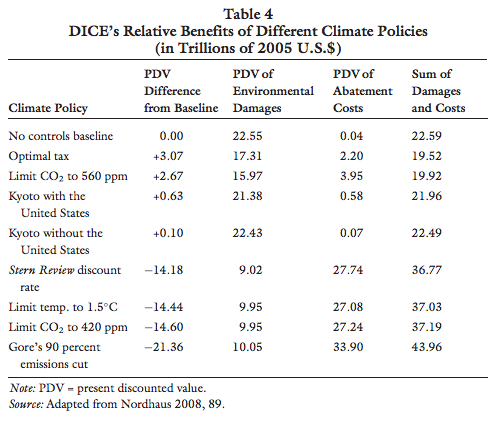
The table shows Nordhaus’s estimates (made in 2008 based on the “consensus” scientific assessments of the time) of the net benefits of various possible governmental climate policy approaches. The first row shows what happens if governments do nothing. There will be $22.55 trillion (in present value terms, and quoted in 2005 dollars) of environmental damage, but virtually no economic costs of complying with regulations, for a total harm of $22.59 trillion.

In contrast, if governments around the world implemented Nordhaus’s recommended “optimal” carbon tax, the world would be spared a little more than $5 trillion in future environmental damage, while future economic output would be $2.2 trillion lower due to complying with the carbon tax. Adding it all up, humanity would suffer total harms of $19.52 trillion, meaning the world would be $3.07 trillion wealthier with the optimal, global carbon tax (because $22.59 − $19.52 = $3.07).

Central to the economic way of thinking is the concept of trade-offs. Every possible policy — including a policy of doing nothing — comes with costs. But the public tends to hear about only one set of costs, not the full array. For example, as the earlier table shows, the wrong climate policy can be much, much worse than doing nothing. Nordhaus evaluated Al Gore’s suggestion to cut emissions by 90 percent, and estimated that it would make humanity some $21 trillion poorer compared to the do-nothing baseline — a net harm seven times greater than the net benefits of the textbook-optimal approach.

My point here is not to trumpet Nordhaus’s numbers as being gospel. (My Independent Review article was a full-blown critique of his model.) Rather, I am pointing out that even one of the leading models that underpins the so-called consensus on climate-change activism shows that this is hardly the planetary crisis that the rhetoric of Smith and others would suggest. The actual numbers are in the same ballpark as those of trade deals — and nobody thinks the fate of the planet hangs on the passage of a trade deal.

More generally, what even most economists have failed to convey to the public is that climate-change policies at best will affect things on the margin. Nordhaus’s table beautifully illustrates this. The optimal carbon tax doesn’t eliminate the climate-change damage that his computer simulations predict. On the contrary, the carbon tax only reduces it from about $23 trillion down to $17 billion. The reason it doesn’t make sense to enact a more aggressive carbon tax is that the (marginal) harm to the conventional economy would exceed the (marginal) environmental benefit. There are several policies in the table that reduce environmental damage below the $17 trillion mark, but they hurt the economy so much more that, on net, they are inferior approaches.

It is understandable that noneconomists would fail to employ marginal analysis and would engage in overblown rhetoric when discussing something as controversial as climate-change policy. However, too many professional economists have also fallen into this bad habit, including not just Smith but also Krugman and many others.

Robert P. Murphy has a PhD in economics from NYU. He is the author of The Politically Incorrect Guide to Capitalism and The Politically Incorrect Guide to The Great Depression and the New Deal.

This article was originally published by The Foundation for Economic Education and may be freely distributed, subject to a Creative Commons Attribution 4.0 International License, which requires that credit be given to the author.

Protein Modification as a Biomarker of Aging – Article by Reason

Protein Modification as a Biomarker of Aging – Article by Reason

The New Renaissance Hat
Reason
April 19, 2015
******************************

The development of fairly consistent, accurate means to measure biological age – as opposed to chronological age – from a tissue sample is an important thread in aging research. Aging is a process of damage accumulation, and rejuvenation would be achieved through damage repair. Research and development aimed at significant extension of healthy life span can only become cost-effective given good ways to measure damage, however. There must be some reliable means to quickly assess the results of a treatment that claims a degree of rejuvenation through the partial repair of a specific form of cellular or molecular damage. In some cases this might seem easy. Take senescent cell clearance, for example: you run the therapy in mice, and compare a range of measures known to scale by senescent cell count in tissue samples before and after the treatment regimen. However, all that really tells you is how well the therapy clears senescent cells. All aspects of biology interact with one another, and age is a global phenomenon. To determine how aged an individual is and how effective a treatment might be when it comes to the practical outcome of additional healthy life span added there is presently little to be done other than wait and see.

The biggest challenge in the development of life-extending therapies is funding and cost. On the one hand there is far too little funding directed towards finding ways to treat aging. On the other hand effectively evaluating an alleged means of treating aging currently requires lifespan studies, and even in mice that takes far too long and costs far too much to be done casually. If there were standardized, quick and easy markers of physiological age that could be assessed before and after a treatment, then this research and development might be able to proceed ten times as rapidly, and evaluation of possible therapies would be open to far more research groups. There are many, many more laboratories with the capacity and funding to carry out a speculative $100,000 study versus a speculative $1,000,000 study.

All of this is to explain why there is considerable interest in developing a cheap biomarker of aging that can reliably assess physiological age from a tissue sample. No-one wants to run a five-year mouse study if there is a ten-minute alternative that produces an answer of about the same accuracy. That ten-minute alternative doesn’t yet exist, but some lines of research seem promising, such as work on DNA methylation patterns that appear to be fairly consistent among individuals over the course of aging. There is also the suggestion that the approach should be to measure the fundamental forms of damage thought to cause aging – but all of them, not just the one being treated by the therapy under consideration. At the present time that might be more onerous than finding a good set of secondary consequences that are reactions to damage, such as epigenetic changes.

The open-access paper linked below covers a fairly wide range of topics. The structures of our cells and tissues are built of proteins, and these proteins are constantly damaged and replaced. Many varied mechanisms toil constantly to remove proteins and cellular components as soon as they show damage or dysfunction. Nonetheless the difference between young tissue and old tissue is that old tissues have far more damage: misfolded proteins, malfunctioning structures inside cells, metabolic waste products such as advanced glycation endproducts (AGEs) gumming together structures in between cells, and so on and so forth. The damage leaks through, and even damage repair mechanisms are not invulnerable; they falter with age due to much the same set of issues as causes dysfunction elsewhere. In the future repair technologies, such as those outlined in the SENS proposals, will bring about rejuvenation by reversing these forms of damage. Since these issues are a part of full set of causes of aging, they are also potential markers of aging.

Protein modification and maintenance systems as biomarkers of ageing

Changes in the abundance and post-translational modification of proteins and accumulation of some modified proteins have been proposed to represent hallmarks of biological ageing. Non-enzymatic protein glycation is a common post-translational modification of proteins in vivo, resulting from reactions between glucose or its metabolites and amino groups on proteins, this process is termed “Maillard reaction” and leads to the formation of advanced glycation endproducts (AGEs). During normal ageing, there is accumulation of AGEs of long-lived proteins such as collagens and several cartilage proteins. AGEs, either directly or through interactions with their receptors, are involved in the pathophysiology of numerous age-related diseases, such as cardiovascular and renal diseases and neurodegeneration.
 ***
Beside protein glycation, it is also well known that levels of oxidised proteins increase with age, due to increased protein damage induced by reactive oxygen species (ROS), decreased elimination of oxidized protein (i.e. repair and degradation), or a combination of both. Since the proteasome is in charge of both general protein turnover and removal of oxidized protein, its fate during ageing has received considerable attention, and evidence has been provided for impairment of the proteasome function with age in different cellular systems. Thus, these protein maintenance systems may also be viewed as potential biomarkers of ageing.
  ***
It is expected that a combination of several biomarkers will provide a much better tool to measure biological age than any single biomarker in isolation. For the most part, the markers based on proteins and their modifications that have been chosen are directly related with mechanistic aspects of the ageing process. Indeed, they are relevant to such important physiological features such as protein homeostasis and glycoprotein secretion that have been previously documented as being altered with age. Therefore, it is expected that they may be less influenced by other factors not necessarily related with ageing.
Reason is the founder of The Longevity Meme (now Fight Aging!). He saw the need for The Longevity Meme in late 2000, after spending a number of years searching for the most useful contribution he could make to the future of healthy life extension. When not advancing the Longevity Meme or Fight Aging!, Reason works as a technologist in a variety of industries. 
 ***

This work is reproduced here in accord with a Creative Commons Attribution license. It was originally published on FightAging.org.

Peter Thiel on Longevity Research and the Defeat of Aging – Article by Reason

Peter Thiel on Longevity Research and the Defeat of Aging – Article by Reason

The New Renaissance Hat
Reason
April 4, 2015
******************************

It has always been the case that the cause of serious rejuvenation research needs more well-regarded individuals to stand up and talk in public about the road ahead, the prospects for success, and the righteousness of the goal. Just lay out the situation as it is, no need for salesmanship: it is simply the need for this to be a topic not left on the edge of polite society. Aging is by far the greatest cause of suffering and death in the world, and we should all be doing more than we are to help bring an end to all of that pain, disease, and loss. For that to happen, the vast majority of people who never think about aging and rarely think about medical research need to give the topic at least as much thought and approval as presently goes towards the cancer research community.

We find ourselves in a peculiar time. Technological barriers to the successful treatment of aging are next to non-existent; progress is falling out of the woodwork even at low levels of funding and interest; this is an age of revolutionary gains in the tools of biotechnology, and that drives the pace of medicine while the cost of meaningful research plummets. This isn’t a space race situation in which the brute force of vast expenditure was used to wrest a chunk of the 21st century into the 20th and land men on the moon. If following the SENS program aimed at repair of the causes of aging, the cost of implementing the first prototype, working rejuvenation treatments in old mice would by current estimates be only 1-2% of the Apollo Program budget. There was vast popular approval for the space race to match the vast expense. The path to human rejuvenation is in exactly the opposite situation: there is very little support for the goal of treating aging as medical condition, but the costs of doing so successfully are so small that given even a minority of the public in favor those funds would be raised.

This is why advocacy is so very important. This is why people with large soapboxes can help greatly simply by talking on the topic. Investor and philanthropist Peter Thiel has been supporting scientific programs such as SENS and related areas in biotechnology for a decade now, but I notice that he is more vocal and direct in public about this cause now that other organizations such as Google Ventures are making large investments. This is all good; we need a sea change in the level of public support for rejuvenation research, and their understanding of the prospects for the future. Aging is far from set in stone, and a range of the biotechnologies needed to treat aging and bring it under medical control are on the verge of breaking out into commercial development, or just a few years away from that point. All it takes to turn the stream into a rapids is a little more rain.

Peter Thiel’s quest to find the key to eternal life – Washington Post

Quote:

WP: Why aging?

Thiel: I’ve always had this really strong sense that death was a terrible, terrible thing. I think that’s somewhat unusual. Most people end up compartmentalizing, and they are in some weird mode of denial and acceptance about death, but they both have the result of making you very passive. I prefer to fight it. Almost every major disease is linked to aging. One in a thousand get cancer after age 30. Nixon declared war on cancer in 1971, and there has been frustratingly slow progress. One-third of people age 85 and older have Alzheimer’s or dementia, and we’re not even motivated to start a war on Alzheimer’s. At the end of the day, we need to do more.

WP: All your philanthropic projects are founded on the idea that there’s something wrong with the way the current system works. What are the challenges you see in biomedical research?

Thiel: I worry the FDA is too restrictive. Pharmaceutical companies are way too bureaucratic. A tiny fraction of a fraction of a fraction of NIH [National Institutes of Health] spending goes to genuine anti-aging research. The whole thing gets treated like a lottery ticket. Part of the problem is that aging research doesn’t always lend itself to being a great for-profit business, but it’s a very important area for a philanthropic investment. NIH grant-making decisions end up being consensus-oriented, focused on doing things that a peer review committee thinks makes sense. So you end up with a very conservative bias in terms of what gets done. [On the other hand,] the original DARPA [Defense Advanced Research Projects Agency] was phenomenally successful. You had a guy running it, and he just gave out the money. It was more focused on substance and less on the grant-writing process. That’s the direction we should go. I worry that right now, we have people who are very nimble in the art of writing grants who have squeezed out the more creative.

WP: You’re currently funding Cynthia Kenyon, Aubrey de Grey and a number of other researchers on anti-aging. What was it about these individuals and their work that got your attention?

Thiel: They think far outside the conventional wisdom and are far more optimistic about what can be done. I think that’s important to motivate the research.

WP: How long is long enough? Is there an optimal human life span?

Thiel: I believe if we could enable people to live forever, we should do that. I think this is absolute. There are many people who stop trying because they think they don’t have enough time. Because they are 85. But that 85-year-old could have gotten four PhDs from 65 to 85, but he didn’t do it because he didn’t think he had enough time. If it’s natural for your teeth to start falling out, then you shouldn’t get cavities replaced? In the 19th century, people made the argument that it was natural for childbirth to be painful for women and therefore you shouldn’t have pain medication. I think the nature argument tends to go very wrong. . . . I think it is against human nature not to fight death.

WP: Assuming the breakthrough in eternal life doesn’t come in our lifetime, what do you hope to have achieved through your philanthropy before you die? What would you like to be remembered for?

Thiel: I think if we made some real progress on the aging thing, I think that would be an incredible legacy to have. I have been fortunate with my business successes, so I would like to encourage, coordinate and help finance the many great scientists and entrepreneurs that will help bring about the technological future. It’s sort of not important for me to get credit for the specific discoveries, but if I can act as a supporter, mentor and financier, I think that feels like the right thing.

Reason is the founder of The Longevity Meme (now Fight Aging!). He saw the need for The Longevity Meme in late 2000, after spending a number of years searching for the most useful contribution he could make to the future of healthy life extension. When not advancing the Longevity Meme or Fight Aging!, Reason works as a technologist in a variety of industries. 
 ***

This work is reproduced here in accord with a Creative Commons Attribution license. It was originally published on FightAging.org.

Google, Entrepreneurs, and Living 500 Years – Article by Edward Hudgins

Google, Entrepreneurs, and Living 500 Years – Article by Edward Hudgins

The New Renaissance Hat
Edward Hudgins
March 29, 2015
******************************

“Is it possible to live to be 500?”

“Yes,” answers Bill Maris of Google, without qualifications.

A Bloomberg Markets piece on “Google Ventures and the Search for Immortality” documents how the billions of dollars Maris invests each year is transforming life itself. But the piece also makes clear that the most valuable asset he possesses —and that, in others, makes those billions work—is entrepreneurship.

Google’s Bio-Frontiers

Maris, who heads a venture capital fund set up by Google, studied neuroscience in college. So perhaps it is no surprise that he has invested over one-third of the fund’s billions in health and life sciences. Maris has been influenced by futurist and serial inventor Ray Kurzweil who predicts that by 2045 humans and machines will merge, radically transforming and extending human life, perhaps indefinitely. Google has hired Kurzweil to carry on his work towards what he calls this “singularity.”

Maris was instrumental in creating Calico, a Google company that seeks nothing less than to cure aging, that is, to defeat death itself.  This and other companies in which Maris directs funds have specific projects to bring about this goal, from genetic research to analyzing cancer data.

Maris observes that “There are a lot of billionaires in Silicon Valley, but in the end, we are all heading for the same place. If given the choice between making a lot of money or finding a way to live longer, what do you choose?”

Google Ventures does not restrict its investments to life sciences. For example, it helped with the Uber car service and has put money into data management and home automation tech companies.

“Entrepreneuring” tomorrow

Perhaps the most important take-away from the Bloomberg article is the “why” behind Maris’s efforts. The piece states that “A company with $66 billion in annual revenue isn’t doing this for the money. What Google needs is entrepreneurs.” And that is what Maris and Google Ventures are looking for.

They seek innovators with new, transformative and, ultimately, profitable ideas and visions. Most important, they seek those who have the strategies and the individual qualities that will allow them to build their companies and make real their visions.

Entrepreneurial life

But entrepreneurship is not just a formula for successful start-ups. It is a concept that is crucial for the kind of future that Google and Maris want to bring about, beyond the crucial projects of any given entrepreneur.

Entrepreneurs love their work. They aim at productive achievement. They are individualists who act on the judgments of their own minds. And they take full responsibility for all aspects of their enterprises.

On this model, all individuals should treat their own lives as their own entrepreneurial opportunities. They should love their lives. They should aim at happiness and flourishing—their big profit!—through productive achievement. They should act on the judgments of their own minds. And they should take full responsibility for every aspect of their lives.

And this entrepreneurial morality must define the culture of America and the world if the future is to be the bright one at which Google and Maris aim. An enterprise worthy of a Google investment would seek to promote this morality throughout the culture. It would seek strategies to replace cynicism and a sense of personal impotence and social decline with optimism and a recognition of personal efficacy and the possibility of social progress.

So let’s be inspired by Google’s efforts to change the world, and let’s help promote the entrepreneurial morality that is necessary for bringing it about.

Dr. Edward Hudgins directs advocacy and is a senior scholar for The Atlas Society, the center for Objectivism in Washington, D.C.

Copyright, The Atlas Society. For more information, please visit www.atlassociety.org.

Maybe the Hardest Nut for a New Scientist to Crack: Finding a Job – Article by Bryan Gaensler

Maybe the Hardest Nut for a New Scientist to Crack: Finding a Job – Article by Bryan Gaensler

The New Renaissance Hat
Bryan Gaensler
March 29, 2015
******************************

The typical biography of a scientist might look something like this.

At a young age, a boy or girl discovers a love for science. Their dream is to become perhaps a geologist, a chemist, or a marine biologist.

At school they work hard at math and science, and they supplement this with everything else they can get their hands on: books, documentaries, public talks and visits to museums. They take all the right courses at college and then embark on a PhD in their chosen field.

After many years of hard effort (including chunks of time racked with doubt and frustration), they complete a solid body of work that contains some genuinely new discoveries. They’ve had the chance to meet some of the big names they read about as a kid, and now actually know some of them on a first-name basis.

The day a young graduate receives his or her science diploma is the most thrilling and satisfying day of their life. They are finally, officially, a scientist.

But there’s one thing that all those years of study and research has not prepared them for: the job market.

Scientist_Telescope
There must be a job out there somewhere…. Michael Salerno, CC BY-NC-SA

Pounding the pavement as a scientist

No matter what your profession, job hunting is not fun. But for scientists and other researchers, it’s a weird world of intense competition, painfully long time scales, and uncertain outcomes.

The strangest thing about a scientific career is that the application deadlines are often ridiculously early. Hoping to find a university position starting in September? If you wait until February or March to begin your job search, you’ve likely left it way too late. The application deadlines for some of the juiciest positions were way back in November and December.

Because of this advanced schedule, only the things that someone accomplishes a year or more before actually needing a new job will matter for their career prospects. Any amazing discoveries made after the application deadline are largely irrelevant.

The problem is that this is not always how science works.

For many important research topics, all the headline results emerge only at the very end. Students whose research is part of a massive longitudinal study or who are members of a big project team suddenly find themselves at a huge disadvantage, because they often can’t provide instant evidence of the quality of their work a whole year before needing a job.

The other daunting thing is the intensity of the competition. For most specialized scientific topics, there are far more PhD degrees than job postings: across all of science, doctoral degrees outnumber faculty positions by a ratio of 12 to one. An advertisement for a fellowship or junior faculty position will routinely draw hundreds of applications, and only 1%-2% of graduates will eventually land a coveted professorship.

How to proceed, when the odds are so stacked against you? Inevitably, the only way to counter the competition is to apply for lots of positions. A budding scientist is expected to apply for a dozen or more jobs, spread all over the world.

This situation immediately creates some challenges and problems.

By increasing the quantity of applications, the quality suffers. In an ideal world, an applicant will provide a carefully wrought narrative, weaving a story as to how their skills and background perfectly dovetail with the interest of the department they hope will hire them. But there’s no time for that. Instead one typically sends out a generic CV and research plan, and then essentially just hopes for the best.

The process is also incredibly inefficient. Professors all over write endless careful letters of recommendation, most of which have little bearing on the outcome. Selection panels spend hundreds of hours reading huge piles of applications, but can only afford a scant 10-15 minutes considering the merits of each candidate.

What’s more, not everyone can freely pursue jobs anywhere the market will take them. Young children, aging parents and other personal circumstances result in a large pool of outstanding scientists with strong geographic constraints, and hence limited options.

Overall, the harsh reality is that many applicants will simply not get any offers. A lifelong dream of being a scientist, combined with an advanced postgraduate degree, is tragically not a guarantee of a scientific career.

Good scientists should be able to find jobs

The frustration, disappointment and disillusionment grow every year. Things need to change.

First, employers need to make much more of an effort to tell applicants what sort of scientist they are looking for. Instead of reducing the job searching process to the scientific equivalent of speed dating, advertisements need to set out a clear and detailed set of selection criteria, with lots of context and background on the role and working environment. By properly telling the community what they’re looking for, labs and research institutes can focus their time on candidates with useful qualifications, and applicants can focus their energy on only those jobs for which they have a realistic chance.

Second, we need to create flexible career paths. Part-time positions, “two body” hires for couples with both members in academia, and accommodation of career interruptions need to become de rigueur, rather than whispered legends we’ve all only ever heard about second- or third-hand.

And finally, a specialist science degree needs to move beyond the expectation that it offers training only in one particular type of science.

A good scientist graduates with passion, vision and brilliance, and also with persistence, organization, rigor, eloquence and clarity. A scientist can incisively separate out truth from falsehoods, and can solve complicated problems with precious little starting information. These are highly desired attributes. The scientific community needs not just accept but celebrate that the skills and values we cherish are the paths to a wide range of stimulating and satisfying careers – both in and out of academia.

Bryan Gaensler is an award-winning astronomer and passionate science communicator, who is internationally recognised for his groundbreaking work on dying stars, interstellar magnets and cosmic explosions. A former Young Australian of the Year, NASA Hubble Fellow, Harvard professor and Australian Laureate Fellow, Gaensler is currently the Director of the Dunlap Institute for Astronomy and Astrophysics at the University of Toronto. He gave the 2001 Australia Day Address to the nation, was awarded the 2011 Pawsey Medal for outstanding research by a physicist aged under 40, and in 2013 was elected as a Fellow of the Australian Academy of Science. His best-selling popular science book Extreme Cosmos was published worldwide in 2012, and has subsequently been translated into four other languages.

This article is republished pursuant to a Creative Commons Attribution No-Derivatives license. It was originally published by The Conversation.

Movement for Indefinite Life Extension (MILE) Demonstration – March 21, 2015

Movement for Indefinite Life Extension (MILE) Demonstration – March 21, 2015

Segment 1

On Saturday, March 21, 2015, Gennady Stolyarov II and Wendy Stolyarov co-hosted the first segment of the Movement for Indefinite Life Extension (MILE) Demonstration between 7:00 a.m. and 10:00 a.m. Pacific Time.

Segment 2

The second MILE Demonstration segment, hosted by Roen Horn and Desiree Duffy, is available here.

Description: “We are for awareness that bio-sciences and technologies have opened up the option of expediting a world effort to make gains toward eradicating the roots and diseases of aging, and other forms of involuntary death. Our lives are in our hands, and we must act with urgency.”

Find out more on the MILE Demonstration Facebook page.

Resources
– “Paul Sandford McGlothin” – Wikipedia
– Living the CR Way – Website
– Death is Wrong – Illustrated children’s book on indefinite life extension by Gennady Stolyarov II and Wendy Stolyarov –
– “The Aristotelian Golden Mean as Conducive to Good Health in the Pursuit of Life Extension” – Article by Gennady Stolyarov II
– A History of Life-Extensionism in the Twentieth Century by Ilia Stambler
– “Ending Aging” Song by Paul Steven Thompson – Noelternative
– Art by Elitanna (Valentinia Korshunakova)
– Roy Carl Stanley – US House Candidate – Green Party of Texas
– Roy Carl Stanley on Twitter

Adam Alonzi Interviews G. Stolyarov II on Indefinite Life Extension and “Death is Wrong”

Adam Alonzi Interviews G. Stolyarov II on Indefinite Life Extension and “Death is Wrong”

The New Renaissance Hat
G. Stolyarov II and Adam Alonzi
February 22, 2015
******************************

Today I had a pleasant and erudite discussion with Adam Alonzi regarding the feasibility and desirability of attaining indefinite longevity in our lifetimes, as well as Death is Wrong and its impact.

References

– Adam Alonzi’s YouTube Channel
– Adam Alonzi Reads Death is Wrong

Updates on a Crowdfunded Mouse Lifespan Study – Article by Reason

Updates on a Crowdfunded Mouse Lifespan Study – Article by Reason

The New Renaissance Hat
Reason
January 3, 2015
******************************

For all that I think it isn’t an efficient path forward, one likely to produce meaningful results in moving the needle on human life spans, there is considerable interest in testing combinations of existing drugs and various dietary compounds in mice to see if healthy life is extended. I expect that as public interest grows in the prospects for aging research to move from being an investigative to an interventional field, wherein researchers are actively trying to treat aging, we’ll only see more of this. There is certainly a sizable portion of the research community who think that the the best path ahead is in fact the pharmaceutical path of drug discovery in search of ways to slightly slow the aging process. To their eyes slightly slowing the aging process is all that is plausible, and adding five healthy years to life by 2035 would be a grand success. Google’s Calico initiative looks set to take that path, for example, which I is why I’m not all that hopeful it will produce meaningful results in terms of healthy years gained and ways to help the old suffer less.

There is a considerable overlap between researchers aiming to gently slow aging via drug discovery and researchers whose primary motivation is still investigation, not intervention: to produce a complete catalog of metabolism and how it changes with age, and it’s someone else’s problem to actually use that data. So we have, for example, the Interventions Testing Program at the NIA. This program was long fought for by researchers tired of the lack of rigor in most mouse life span studies, and the people involved are essentially engaged in replacing a lot of carelessly optimistic past results with the realistic view that very little other than calorie restriction and exercise actually does reliably extend life in mice if you go about the studies carefully. This is good science, but it isn’t the road to extended human life spans: it instead has much more to do with understanding the process of aging at a very detailed level. That task is vast and will take a very long time even in this age of computing and biotechnology.

To my eyes the right way to go is the repair approach: build the biotechnologies needed to repair the forms of cellular and molecular damage produced as a side-effect of the normal operation of metabolism, and which clearly distinguish old tissues from young tissues. If you want rejuvenation of the old, a path to adding decades to healthy life, and to eliminate all age-related disease, then repair is the way to go. Fix the damage, don’t just tinker with the engines of life in ways that might possibly slow down damage accumulation just a little. This strategic direction can allow researchers to largely bypass the great complexity of the progression of aging and focus instead on fixing things that are already well known and well cataloged. But I say this a lot, and will continue to do so until more than just a small fraction of the research community agree with me.

Back to mice and lifespan studies: in this day and age institutional research is far from the only way to get things done. Early-stage research is becoming quite cheap as the tools of biotechnology improve, and the global economy allows quality scientific work to be performed in locations that are lot less expensive than the US or Western Europe. We have crowdfunding, the internet, and a supportive community, which means that any group of ambitious researchers can raise a few tens of thousands of dollars and set an established lab in the Ukraine to running a set of mouse lifespan studies. So that happened back in 2013, and has been ongoing since then despite the present geopolitical issues in that part of the world. It is perhaps worth noting that this is the same group that found no effect on longevity from transfusions of young blood plasma into old mice. The studies mentioned below used pre-aged mice, starting at old age as a way to try to discover effects more rapidly, an approach that is fairly widespread.

I am a little mouse and I want to live longer: updates

Quote:

Dear contributors, we wish you a happy New Year! We are sorry to be taken by a very-expected but very time-consuming c60 lifespan study to digest the data in a way to make the long report we had announced. So, for the New Year and in order for you not to wait longer, please find at least the main results so far:

1) 23 months old C57BL6 mice received a mixture of 6 therapies that had already been reported to extend the lifespan of mice: Aspirin; Everolimus (mTOR inhibitor, similar action as rapamycin); Metoprolol (beta blocker); Metformin (anti-diabetic drug); Simvastatin (lowers LDL cholesterol); Ramipril (ACE inhibitor).

The drugs were given in the food, at doses that had been reported to extend lifespan … when taken individually. Some people are given that combination of medicines so we hoped that the drug interaction would not be too damaging, and we had wondered if some lifespan synergy within some of these drugs could lead to an overall high lifespan (e.g. if the different drugs improve different functions). But we observed a lifespan reduction in males and in females.

2) In the food of some remaining females we mixed low doses of 4 medications against cardiovascular conditions: Simvastatin; Thiazide (lowers blood pressure); Losartan potassium (angiotensin receptor blocker, lowers blood pressure); Amlodipine (calcium channel blocker, lowers blood pressure).

The question was: taken at a low-to-medium dose, could these drugs that many aged persons take have some overall preventive effect? We transposed to mice an ongoing polypill clinical trial in the UK, using a basic human-mouse conversion scale. Again, a decrease in lifespan was observed.

3) Adaptations of the first combination of drugs actually extended lifespan!

We started at age 18 months instead of 23 months, reduced the dose (as a function of weight) and gave a) the 6 compounds b) ‘only’ aspirin+metformin+everolimus. The results are to be analysed in greater details as we haven’t analyzed the latest data yet. Also, whatever the refined analysis, we would already like to indicate that it would be good to reproduce the experiment in some other conditions, e.g. hybrid mice; in particular as the mortality rates of these mice was higher than the first series (but in a consistent way that supports the life extending effect).

4) Ongoing C60 experiments

After many difficulties in setting the experiment (cross-border transportation in current geopolitical times, checking absorption in mice/ detecting C60/correct source of C60, administration tried in food and replaced by gavage, training for gavage and various measures) we have transposed the popular lifespan test with c60 fullerenes reported in rats by Baati et al. to mice (CBA strain, common in the lab) and with more animals (N=17 per group). There are three groups (gavage of water, of olive oil, of C60 dissolved in olive oil), there are … a lot of health measures and a lot of gavage (at the beginnings of the experiment as administrations are first very frequent and then gradually less frequent). Given that the experiment starts with mid-aged animals, the results are expected for the beginning of 2016.

The original C60 results from a few years back were greeted with some skepticism in the research community, given the very large size of the effect claimed and the small number of animals tested. There was, I think, also a certain annoyance: now that someone had made what was on the face of it an unlikely claim of significant lifespan extension via administration of C60, then some other group was going to have to waste their time in disproving it. We’ll see how that all turns out, I suppose. This is science as it works in practice.

At some point the broad structural classes of research illustrated by the Interventions Testing Program and this crowdfunded mouse study will meet in the middle, and the process of funding and organizing scientific programs will be a far more complicated, dynamic, and public affair than is presently the case. I think this will be for the better. All that we have we owe to science, and a majority of the public thinks all too little of the work that will determine whether they live in good health or suffer and die a few decades from now. The more they can see what is going on, the better for all of us in the end, I think.

Reason is the founder of The Longevity Meme (now Fight Aging!). He saw the need for The Longevity Meme in late 2000, after spending a number of years searching for the most useful contribution he could make to the future of healthy life extension. When not advancing the Longevity Meme or Fight Aging!, Reason works as a technologist in a variety of industries. 
***

This work is reproduced here in accord with a Creative Commons Attribution license. It was originally published on FightAging.org.