Browsed by
Category: Technology

Brain Scanning Technology and the Functions of the Cerebellum (2004) – Article by G. Stolyarov II

Brain Scanning Technology and the Functions of the Cerebellum (2004) – Article by G. Stolyarov II

The New Renaissance Hat
G. Stolyarov II
July 28, 2014
******************************
Note from the Author: This essay was originally written in 2004 and published on Associated Content (subsequently, Yahoo! Voices) in 2007.  I seek to preserve it as a valuable resource for readers, subsequent to the imminent closure of Yahoo! Voices. Therefore, this essay is being published directly on The Rational Argumentator for the first time.  
***
~ G. Stolyarov II, July 28, 2014

**

Brain scanning technology has enabled modern scientists to obtain a greatly improved understanding of perhaps the most complex and fascinating human organ. It has helped to more effectively treat brain disorders as well as to shed some light on the functions of the brain’s cerebellum and its role in smoothly facilitating basic everyday human activities.

Brain scans that record brain activity during the performance of certain tasks can assist scientists in pinpointing which regions are responsible for given tasks, as well as the interrelationships of certain brain regions in performing a given task.

The perception of music, for example, is controlled by several discrete and seemingly disjoint regions of the brain, but scanning technology allows scientists to perceive connections between those regions where none would have been fathomable using the naked eye alone.

Because of scanning technology, people with brain disorders may be given more specific remedies based on their particular afflictions (for example, if a person is epileptic and experiences seizures, there is no longer the need to make a giant and debilitating cut through the entire brain; it is necessary only to treat malfunctions in those regions directly responsible for epileptic fits). Also, it may become possible to extract brain tumors in such a manner as to minimally invade the regions of the brain responsible for certain crucial functions.

With the help of brain scanning technology, modern science has obtained increased insight into the functions of a vital part of the brain, the cerebellum. The cerebellum controls activities such as walking, the mechanical motions of writing, running, grasping onto objects, operating a keyboard, driving (for those with extensive experience), eating, and drinking. Humans do not have to think about performing the physical movements associated with these activities, even when those movements are quite complex. Most people with computer experience can type without looking at the keyboard and hit the right letter every time; this is because the cerebellum has automated the typing function. If one had to think about every movement one’s fingers made on the keys, typing would be an impossibly long and arduous process!

These activities are performed automatically so as to free room in the conscious mind for tasks of even greater complexity and variety, which constantly challenge human beings. If routine tasks required constant conscious exertion, then new learning as well as addressing diverse challenges such as problem solving, inventing, or writing would be impossible.

Progress: Creation and Maintenance (2010) – Article by G. Stolyarov II

Progress: Creation and Maintenance (2010) – Article by G. Stolyarov II

The New Renaissance Hat
G. Stolyarov II
Originally Published March 8, 2010
as Part of Issue CCXXXVIII of The Rational Argumentator
Republished July 22, 2014
******************************
Note from the Author: This essay was originally published as part of Issue CCXXXVIII of The Rational Argumentator on March 8, 2010, using the Yahoo! Voices publishing platform. Because of the imminent closure of Yahoo! Voices, the essay is now being made directly available on The Rational Argumentator.
~ G. Stolyarov II, July 22, 2014
***

One frequently encounters the identification of human creativity and inventiveness as driving forces for progress in technology and society. In part, this identification is correct: it is through the human creative faculty – the ability to bring forth new combinations of matter and new ideas – that improvements to the human condition arise. But while creation is a necessary component to progress, it is not a sufficient component.

Consider that the human creative faculty has existed since the emergence of our species; even cave dwellers exhibited it, to the extent that they could take even a little leisure time in their highly dangerous, subsistence-based lives. Cave paintings and tools from several tens of thousands of years ago show clearly that our remote ancestors had the ability, and the desire, to reshape the world in an attempt to improve their condition. And yet, for the vast majority of human history – up until the 18th-century Enlightenment and the subsequent Industrial Revolution – real progress has been so slow and minuscule as to be virtually imperceptible within an ordinary person’s lifetime. This was the case despite the fact that every generation had its share of great thinkers, artists, and even mechanical tinkerers.

The other necessary component of progress is maintenance of what has already been created. While creation is an ever-present ability within human beings, there are also destructive forces that counteract and diminish its fruits. Nature itself is the source of many such forces: disease, decay, and death are omnipresent unless counteracted by arduous and continual human effort. Just as billions of lives have been lost in complete oblivion to the ravages of “natural causes” – from catastrophic disasters to senescence – so have innumerable works of art, architecture, literature, and technology been lost to these perils. Consider that even the extant works of great known philosophers such as Aristotle or composers such as Georg Philipp Telemann are a fraction of what these great men of the past are known to have created, but which was buried by the sands of time. Imagine, also, what the pitifully short lifespans throughout most human history did to diminish the output of creative geniuses, who, in better times, might have continued to innovate for decades more.

Maintenance is the ability to preserve and transmit existing knowledge, techniques, and objects. It can be performed through sheer effort of will – but only to a point. A European monk or an Arabic scholar in the Middle Ages could spend a lifetime meticulously copying by hand a single book from centuries before his time, only to have it vandalized by one of his successors some generations hence. Even the work of Archimedes was subjected to such savage mistreatment.

Since the Industrial Revolution, and especially since the Information Revolution, the techniques for the preservation of physical goods and knowledge have become tremendously more reliable than was possible in premodern societies. The ability to make multiple copies of an object and potentially inexhaustible copies of an idea – and to maintain detailed visual, textual, and auditory records of particular times, places, and activities, with little effort by historical standards, has preserved many of the accomplishments of prior and current thinkers for the creative faculties of humans to expand upon.

It is doubtful that we, in our time, are inherently more creative than our ancestors. But we do have a much more diverse and advanced subject matter to which to apply our creativity. Where we are free to do so, we may arrange these building blocks of innovation in much the same way that our ancestors arranged sticks and stones – except that the consequences of our actions are much more powerful, life-enhancing, and durable. Our infrastructure and our methods for maintaining and transmitting knowledge separate us from our ancestors to the extent that, to them, we would be as gods.

And yet, none of the wonders that enable progress in our time are ever guaranteed to continue, though not due to inanimate nature and lower life forms alone; those have always been in a steady retreat wherever human reason and productivity were unleashed at anywhere near their fullest extent. But the folly, ignorance, sloth, and envy of other men can all too easily slow the growth of progress-nourishing infrastructure to a crawl, or even reverse it and usher in a new Dark Ages. Coercive policies, economic misconduct and capital consumption, massive wars, widespread prohibitions on peaceful and productive activities, superstitions and irrational taboos, pervasive and disproportionate fears – as embodied in the “Dark Green” environmentalists’ progress-killing “precautionary principle” – and a desire for “security” over liberty, for “tradition” over growth, and for stasis over innovation, are all forces that counteract and threaten the maintenance of our civilization. In most times and places, only a handful of people have been immune to deleterious anti-progressive beliefs and their consequences, but there is no reason why we cannot all rise above such anti-life thinking. We all have the creative faculty in us, and we can all think.

The importance of maintenance to human progress can be carried into the life of the individual with profound consequences that can produce massive personal growth and productivity via a change of habits. A mere creation of reproducible records of one’s past achievements – and their publication on the Internet, where possible – can create a formidable store of knowledge to which the creator and others can refer and which they can build upon. The concepts of open-source software and distributed computing, for instance, are built on this elementary principle, but it can be applied to so many more areas of life. The creative faculty is with us every day, and every day it produces original ideas and methods for improving our lives. But, without adequate maintenance – including the establishment of a concrete form for these innovations – these gifts from within our minds will fade away into insignificance, much like the ruins of antiquity. Developing an improved infrastructure for the products of one’s own mind may be the first step toward revitalizing the infrastructure of civilization itself.

Click here to read more articles in Issue CCXXXVIII of The Rational Argumentator.

***
LEV: The Game – Play to Win Indefinite Life – Article by G. Stolyarov II

LEV: The Game – Play to Win Indefinite Life – Article by G. Stolyarov II

The New Renaissance Hat
G. Stolyarov II
July 20, 2014
******************************

LEV: The Game is a work in progress, whose potential to spread the message of indefinite life extension to the general public encourages me greatly. Developed by a team from Belgium – consisting of Anthony Lamot, Mathieu Hinderyckx, and Maxime Devos – this Android mobile game is currently in its Alpha phase. The creators have initiated an Indiegogo fundraiser to raise 6000 Euros (approximately 8100 US dollars at July 2014 exchange rates) in order to greatly expand the game and add its most complex and engaging elements. You can watch their video introduction to the game and the fundraiser here.

The premise of LEV: The Game is the same as the aim of those of us who wish to extend our lives without end. One’s character is challenged with living for as long as possible and attaining longevity escape velocity by reversing the damage of senescence at a faster rate than it accumulates. Every year in the game, the character receives an allotment of energy points with which to purchase power-ups, such as stem-cell therapies, applications of nano-medicine, cybernetic enhancements, or simple increments of diet and exercise. Each power-up can either increase the remaining expected lifespan, increase the rate at which energy points accumulate (called “productivity” in the game), or reduce the character’s rate of bodily decay. The player needs to achieve a delicate balancing of these power-ups to avoid expiring before he/she accumulates enough energy points to purchase the next life-extending advance.

Becoming an Alpha tester of LEV: The Game is absolutely free, and I was pleased to be able to participate in mid-July 2014. After eight attempts, I succeeded in getting a character to reach the age of 200, which is the game’s current victory condition. If the developers can raise their desired funds, they anticipate extending the gameplay to enable one’s character to reach the age of 1000.

LEV_Maximus_VIII_ScreenshotTo become an Alpha tester, you will need to join the LEV: The Game (Alpha) Google Group, using a Google account that is also linked to a mobile phone or tablet that runs the Android operating system. After you join, you can download the game from the Google Play store here. Remember to click the “Become a Tester” button to enable the download to work. When testing the game in this early stage, make sure you un-pause it first using the speed settings in the top-left-hand portion of the screen, before navigating to any of the other available windows.

Why LEV: The Game is Immensely Important

Our ability to achieve indefinite life extension personally will depend on the amount of resources and support from the general public invested in the overcoming of age-related bodily damage. Most people, unfortunately, continue to either be resigned to the inevitability of death, or to argue against the desirability of indefinite longevity due to extremely basic misconceptions. Even apart from the absurdly false boredom argument, overpopulation argument, and “playing God” argument, there is a more basic fallacy – the Tithonus error, which posits that becoming chronologically older necessarily means becoming biologically more decrepit. Yet the only way indefinite longevity could be achieved would be for people to remain biologically young, so that their susceptibility to deadly diseases does not increase beyond that of people in their twenties today. How could longevity advocates get the general public to understand this? Convincing people through arguments alone may often fail, simply because the Dragon-Tyrant of death is so ubiquitous and so overwhelming that many people will grasp at any straw, no matter how flimsy, to avoid being confronted with the grave injustice of their current predicament.

But a game gives a fresh, different, and engaging way to see and experience what indefinite longevity would truly entail. Anyone playing LEV: The Game would quickly see that becoming increasingly frail is no way to increase life expectancy. Your character will die if he/she experiences sufficient biological decay. You will be able to see a graph of the character’s remaining life expectancy and the rate at which decay is expected to proceed during the years they have left. If you apply the most effective combinations of power-ups, you will also see the life-expectancy curve shift upward – sometimes slightly, at other times by massive jumps. The latter situation reflects what can happen once humans begin to undergo periodic rejuvenation therapies to remove age-related damage, as posited in Dr. Aubrey de Grey’s SENS approach.

Furthermore, LEV: The Game encourages its players to engage in paradigm-shifting thinking about their own future trajectories. Instead of planning for gradual debilitation and eventual death, as most people do today when projecting their careers, retirements, finances, and family lives, a strikingly different mindset can take hold – the quest for perpetual maintenance and a return to youthfulness that may be possible at any chronological age, with sufficient technological advances and vigilance regarding one’s health. I admire the integration in LEV: The Game of biomedical treatments, cybernetic enhancements, and simple prudent habits – such as a healthy diet, regular exercise, cognitive activity, and access to relevant health information (even “Quantified Self” is a power-up that one can purchase). We should all strive to live the most informed and healthy lives possible, given present technology, in order to maximize our chances of surviving to the next wave of breakthroughs on the way to longevity escape velocity.

Not a day passes when I do not think about innovative ways to reach the general public with the message of indefinite life extension. For years, I have advocated the gamification of this literally vital idea as one of the most powerful ways to catalyze cultural change on this issue. I am immensely pleased to now witness such an effort taking off, due to the excellent work of Messrs. Lamot, Hinderyckx, and Devos. I donated to the Indiegogo fundraiser to help propel LEV: The Game to its hopefully world-changing final version. I hope that all readers of this article will be able to do the same.

Ancient Chinese Inventions and Discoveries (2002) – Essay by G. Stolyarov II

Ancient Chinese Inventions and Discoveries (2002) – Essay by G. Stolyarov II

The New Renaissance Hat
G. Stolyarov II
July 18, 2014
******************************
Note from the Author: This essay was originally written in 2002 and published in three parts on Associated Content (subsequently, Yahoo! Voices) in 2007.  The essay earned over 10,900 page views on Associated Content/Yahoo! Voices, and I seek to preserve it as a valuable resource for readers, subsequent to the imminent closure of Yahoo! Voices. Therefore, this essay is being published directly on The Rational Argumentator for the first time.  ***
***
~ G. Stolyarov II, July 18, 2014
***

The civilization of ancient China produced a wide array of innovations in science and technology which preceded the rest of the world by centuries and sometimes by millennia. This essay examines some of these remarkable inventions and discoveries.  Chinese inventors developed numerous mechanical implements, engineering advances, and new substances such as gunpowder, which took centuries to spread to or be replicated in other parts of the world. Furthermore, this essay explores the reasons for ancient China’s lack of systematic progress or an industrial revolution despite the presence there of numerous inventive thinkers.

Mathematics

Beginning in the 14th Century BC, the Chinese developed a decimal, or base ten system of recording numbers. This is one of the earliest such systems known.

In the first century AD, Chinese scholars compiled a volume of mathematics, Jin Zhang Suanshu,(Arithmetic in Nine Chapters). Mathematician Zu Chongzhi (429-500) calculated the first 12 digits of the value of pi, while his son, Zu Gengzhi, updated the Jin Zhang Suanshu and determined the correct formula for the volume of a sphere, V= (pi/4)d^3, where d is the diameter.

Paper

Paper was invented by Cai Lun, a scientist at the Imperial Court in 105 AD. It was produced from bamboo and hemp fibers dissolved in water situated in a mold. When the water was drained and the mixture dried, the first genuine design of paper appeared. The Chinese also developed a precursor to the first paper currency in the world, printed in the Ninth Century AD in order to lighten the load carried by tax collectors.

Cast Iron

The first methods for developing raw iron into workable material with the capacity to be crafted into weapons and ornaments were developed in the 4th Century BC, when the Chinese became able to lower iron’s melting temperature by adding phosphorus to the heated metal.

In the 2nd Century BC, this technology served to bring about the manufacture of steel by mixing wrought and cast iron at high temperatures or draining the carbon component from cast iron.

Chain Pump

Invented in China during the 1st Century BC, A chain pump consists of a chain attached to itself at the ends, which carries along it pallets of raw materials, such as water or sand, which are elevated to impressive heights up to about four meters.

Agricultural Technology

The Chinese were the first civilization in the world to plant crops in rows, beginning in the 6th Century BC, in order to obtain rapid crop growth without the crops’ mutual interference. Chinese farmers accomplished this 2200 years before any other culture.

Beginning in the 3rd Century BC, horses were utilized in China to haul loads on farms using an upgraded harness with a collar and chest strap (known a trace harness or horse collar) , which reduced the attachment’s burden on the animal and permitted a single horse to move a ton and a half of material.

The 3rd Century BC also saw the advent of the moldboard plow, or kuan, the design of which included a sharp center for digging into the ground and gradually-sloped wings at the side in order to discard excess soil and ease the friction on the plow.

The wheelbarrow was invented in the 1st Century BC and enabled Chinese farmers to transport massive loads over vast distances with ease.

Gunpowder

Gunpowder was invented in China during the 8th Century AD as a mixture of charcoal, sulfur, and saltpeter and used primarily for fireworks. The fireworks were launched from rockets made of hollowed bamboo tubes. These rockets were lighted through use of matches, invented in the 6th Century AD, carved of pinewood and coated with sulfur. Other civilizations borrowed this aspect and discovered its military utility.

In 1150, fireworks were elaborated as a result of the first multi-staged rockets, where several smaller tubes were attacked to main meter-tall stick, which were ignited in mid-air after the main rocket’s energy became depleted.

Natural-Gas Drilling

During the 1st Century BC, the Chinese discovered methods to drill some 1.5 kilometers into the Earth’s surface. A derrick was constructed, followed by a small shaft that extended until the Earth’s layer of hard rock was reached. Then a cast iron drill would be lowered with bamboo cables, after which the process would often consume years before any actual fuels were located.

Mechanical Clock

Invented in the 8th Century AD, the mechanical clock rapidly spread to other regions of the world. Chinese designs were crucial to inspiring European clock inventors such as Pope Sylvester II. The Chinese mechanical clock was powered by falling water or mercury, which then transmitted the energy to a chain-drive.

Segmental Arch Bridge

A segmental arch, invented by engineer Li Ch’un in the 7th Century AD, consists of only a small fragment of a circle instead of earlier semicircular arches. Ch’un constructed his first bridge over the Chiao Shui River in 610, which was notably lighter, more durable, and more material-efficient than earlier bridges. It is still in frequent use today.

Belt-Drive

A belt-drive (or driving belt) was attached around wheels to ensure smooth transition of mechanical energy between them. Invented in China during the 1st Century BC, the belt-drive was applied extensively to silk manufacture and spinning machines.

The belt-drive made possible the invention of the spinning wheel in 1270, since it provided sufficient cover and attachment for a rimless construction such as a spinning wheel, where a network of threads replaces the rim.

Printing Press

Movable character blocks were invented by Bi Sheng in 1045. A method for arranging and printing pages in mass quantities was devised. However, this was not efficient when applied to the Chinese language, which possesses over 5000 characters, and thus could not spur on the same printing revolution as that which occurred in Europe.

Magnetic Compass

The first magnetic compass was invented in China during the 3rd Century AD, utilizing a piece of magnetite (an ore of iron) which was heated and aligned in a North/South position, afterward being contained in a bowl of water where it floated on a piece of reed. This was integral to early 2nd millennium Chinese explorations in the Indian Ocean.

Other Noteworthy Advances

The Chinese were the first to develop a kite in the 4th Century BC. Craftsmen like Kungshu P’an possessed mastery to the extent of developing kites that stayed afloat for three days. These kites had military applications as well, carrying messages to isolated troop formations on the battlefield.

Commissioned by the imperial government in 132 AD, mathematician and cartographer Chang Heng devised the first seismograph, which allowed fairly accurate forecasts of earthquakes, leading to more efficient economic planning.

The Yellow Emperor’s Manual of Corporeal Medicine, composed in the 2nd Century BC, contains an advanced treatise on the circulation of blood. This was published fifteen centuries before William Harvey developed a work of comparable caliber in the West.

Why the Ancient Chinese Failed to Achieve Routine Technological Progress

Despite numerous ingenious technological innovations throughout its history, China failed to develop an industrial revolution and a routine theory like the Scientific Method to render inventions and discoveries systematic and not merely the spontaneous products of ingenious minds.

Ancient China was a generally stagnant society which, despite the presence of numerous brilliant thinkers, failed to achieve any regular technological progress until the late 19th century. So dramatic was this stagnation that it led Victor Hugo to compare China to “a fetus in a jar.” While it witnessed numerous promising technological developments in their embryonic stages, ancient China failed to harness these developments into a consistent advance.

The reason for this unfortunate lack of progress was above all institutional. Although the earlier Han and Tang dynasties among others were receptive to advancements and scientific practice, the Ming, following the defeat of the Mongols, isolated China from the remainder of the world and focused on civil stability to a greater extent than technological progress.

The heavily Confucian paradigm of the era from 1368 to 1911 focused more on adaptation to nature and the arts rather than the sciences. Scholars were trained in extensive law memorization rather than further studies of the external world. This caused China to lag behind the West, and contact with the Occident was required to re-establish its rich technological tradition.

Sources

1997 World Book Encyclopedia: Vol. 3 C-Ch. World Book Inc. Chicago. 1997.

Franklin Institute Online. “China: Ancient Arts and Sciences.” Available March 31, 2002: http://sln.fi.edu/tfi/info/current/china.html

Latourette, Kenneth S. A Short History of the Far East. The Macmillan Company. New York. 1964.

Reischauer, Edwin O. Fairbank, John K. East Asia: The Great Tradition. Houghton Mifflin Company. Boston. 1960.

Schurmann, Franz. Schell, Orville. Imperial China. Random House Inc. New York. 1967.

Think Quest Library of Entries. “Ancient Chinese Technology.” Available March 31, 2002: http://www.thinkquest.org/library/lib/site_sum_outside.html?tname=23062&url=23062/frameset.html.

Wagner, Donald B. “Liu Hui and Zu Gengzhi on the Volume of a Sphere.” Available March 31, 2002: http://www.staff.hum.ku.dk/dbwagner/SPHERE/SPHERE.html.

Free PDF of «Смерть неправильна!» – Russian Translation of “Death is Wrong”

Free PDF of «Смерть неправильна!» – Russian Translation of “Death is Wrong”

The New Renaissance Hat
G. Stolyarov II
June 28, 2014
******************************

A free PDF version of «Смерть неправильна!» – the Russian translation of Death is Wrong – is now available for download from The Rational Argumentator. You can obtain your copy here and may spread it to Russian-speaking audiences as widely as you wish.

«Смерть неправильна!» was translated into Russian by Marcus Baylin.

cover_final_russian_6x9

«Смерть неправильна!» – Russian Translation of “Death is Wrong” – Translated by Marcus Baylin – Post by G. Stolyarov II

«Смерть неправильна!» – Russian Translation of “Death is Wrong” – Translated by Marcus Baylin – Post by G. Stolyarov II

The New Renaissance Hat
G. Stolyarov II
June 27, 2014
******************************

cover_final_russian_6x9The Russian translation of Death is Wrong – «Смерть неправильна!» – generously translated by Marcus Baylin – is now available via Google Books. You can see a complete preview here.

A paperback version can be obtained from Createspace for $11.23 here.

Amazon has begun to carry the paperback version here.

For some reason, the Amazon Kindle format does not yet support Cyrillic characters, so I have instead decided to offer an electronic version through Google Play.

The electronic version will be downloadable for FREE on Google Play within the next 24 hours on this page.

You have my permission to spread the electronic version of the book to Russian-speaking audiences as widely as possible, with no strings attached.

We can also send some free paperback Russian books to anyone who is willing to distribute them to Russian-speaking children. (This offer is good while supplies last; we have resources to ship 171 copies of Death is Wrong in either English or Russian. If you are interested, e-mail me at gennadystolyarovii@gmail.com with (i) your name, (ii) your MAILING ADDRESS, (iii) your support for indefinite life extension, (iv) the NUMBER OF COPIES of Death is Wrong requested, and (v) your plan for spreading the books to children, free of cost to them.)

Gennady Stolyarov II Interviewed on Transhumanism by Rebecca Savastio of Guardian Liberty Voice

Gennady Stolyarov II Interviewed on Transhumanism by Rebecca Savastio of Guardian Liberty Voice

The New Renaissance Hat
G. Stolyarov II
May 26, 2014
******************************
Rebecca Savastio of Guardian Liberty Voice has published an excellent interview with me, which mentions Death is Wrong in its introduction and delves into various questions surrounding transhumanism and emerging technologies. In my responses, I also make reference to writings by Ray Kurzweil, Max More, Julian Simon, and Singularity Utopia. Additionally, I cite my 2010 essay, “How Can I Live Forever: What Does and Does Not Preserve the Self“.
***
I was pleased to be able to advocate in favor of transformative technological progress on multiple fronts.
***
Read Ms. Savastio’s article containing the interview: “Gennady Stolyarov on Transhumanism, Google Glass, Kurzweil, and Singularity“.
“Death is Wrong” Fundraiser: Another Ship Returns to Harbor after Braving the Seas for the Cause – Article by Eric Schulke

“Death is Wrong” Fundraiser: Another Ship Returns to Harbor after Braving the Seas for the Cause – Article by Eric Schulke

The New Renaissance Hat
Eric Schulke
April 26, 2014
******************************

On December 2nd of 2013, the Movement for Indefinite Life Extension began a contest for people to send in their ideas on how to spend money on outreach for the cause. The following question was asked:

If you were to receive a check in the mail with $5,000 to inform as many people as possible about the desirability and the prospects for indefinite life extension, to get them interested in the people, projects and organizations working directly or indirectly toward indefinite life extension, then how might you spend it?

Six entries were entered into a poll.

The entry with the most votes was Gennady Stolyarov’s entry to distribute 1,000 copies of his and his wife Wendy’s great new children’s book Death is Wrong. Their winning entry won them one of four books that were given away for the contest: a signed copy of The Transhumanist Wager, which was generously contributed to the project by its author, Zoltan Istvan.

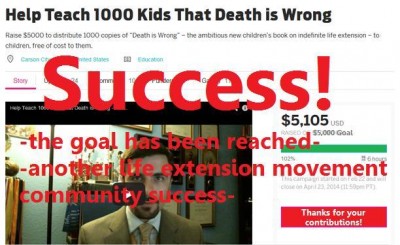
A group of us put our heads together and came up with a plan to raise the money. The fundraiser was launched on February 23rd of 2014 and successfully completed on April 23rd of 2014.

It is a great success on multiple levels for the Death is Wrong book and vision in itself, which supports indefinite-life-extension research and philosophy in general, and which is written by one of the many Movement for Indefinite Life Extension leaders, Gennady Stolyarov.

It is also a great success for the Movement for Indefinite Life Extension in general on many levels. It is one of the first major projects the MILE has executed in its upcoming series of projects to work to reach 80,000 “likes” at MILE Facebook page for the Year 3 goal, which begins on July 17th 2014, and tasks us with collectively helping to achieve the group victory of moving from 8,000 likes, to 80,000 likes by the July 17th of the following year, 2015.

Rodney Ashby and Jason Shields helped us get the momentum rolling and did fundraising throughout, and Tonya Scholz gave the project a big hand. Gennady Stolyarov made an amazing media tour for the project, finding himself talking about it in interviews and getting mentions and reports from a variety of sources. Most of them are of his own arranging, some of these outlets picked the story up on their own, and there are some opportunities that I arranged. They include, but are not limited to, the following:

There were 92 contributions from over 80 individuals and one group, including, but not limited to:

There were also at least 13 anonymous donations. I did a count of all of the donors that I brought in. A close, conservative estimate is that I brought in around 70% of them.

We ended up raising $5,141, compounding on the success by $141. That means that we raised enough to distribute 29 more books than projected. Those of us that worked with this didn’t take a single dime as a cut of this. I put a hundred dollars or so in ads into it, and Wendy and Gennady have given countless hours of their time to rewarding donors. Countless others, like general activists and reporters, have put their time and resources into this. The Life Extension Foundation made an inspiring and generous $1,255 dollar donation to close the deal.

Gennady and I have already secured the distribution of 140 copies, and there are now over 1,000 total available for distribution. An order even went out to Aubrey de Grey, whose work is one of the many topics that is talked about in the book. Gennady Stolyarov writes in the Indiegogo update page that,

Update of April 16, 2014: I am delighted to announce that a shipment of 10 Death is Wrong books was made yesterday to Dr. Aubrey de Grey himself at the SENS Research Foundation. Since Dr. de Grey’s work is a crucial inspiration for Death is Wrong and my longevity activism more generally, I am immensely pleased that he has agreed to receive this shipment and make the books available for distribution.

We encourage the distribution of Death is Wrong books to places like schools, libraries, and directly to parents and children. We ask people to order as many copies as they think they may be able to give away to kids and people with kids, at Transhuman and health events, rallies, and similar events. Gennady has instructions on how to order them free of charge:

Instructions for Longevity Activists to Request Copies of Death is Wrong

– Send an e-mail to gennadystolyarovii@gmail.com

– Provide your name, your mailing address, a statement of your support for indefinite life extension, and a brief description of your plan to spread the book to children in your local area. Remember that all copies received pursuant to this initiative would need to be offered to children free of charge (as gifts or reading opportunities) and may not be resold.

– Provide the number of copies of Death is Wrong that you are requesting.

– Preferably, provide an indication that you would be willing to send photographs of the books that have been delivered to you as well as events where you will be distributing the books.

The project has been a great community effort. The Movement for Indefinite Life extension is our collective spirit, not an organization. Together we collect supporters for all of the constructive projects and organizations. There must have been over 150 people involved. More activists flexed their life-extension muscles, and we helped more people that want to get involved to take the first step. If you’ve ever saved money, then you know how incremental change adds up. You cannot achieve the saving of $8,000 unless you first get to $2,000, and $6,000, and so forth.

It’s an example of elements coming together for a movement, like this article says:

A movement occurs when, one, a large number of people have a need that, two, lines up with the necessary ingredients to make it happen, and those two things are sparked by, three, a catalyst.

The need to survive has always been here. The ingredients have been getting added to the mix since the dawn of the Scientific Revolution. The element of the love for life is in the air, thick with explosive properties, fueled by indefinite-life-extension research and outreach from around the world and across time. People are busy working on rallies, conferences, events, interviews, getting the message out, and all the rest. The tools and the ability to make this happen are ripe, and growing more and better yields of produce by the month. Every time you put a match to it, it erupts in indefinite-life-extension activism. Be that spark today and get in on this movement.

We have more projects like this ahead, and there are plenty of others to choose from in the communities, pages, groups, organizations, sites, and other venues, around the world, growing here toward that tipping point where we can have the opportunity to spill across the ticker tapes of screens and the minds of the young and old alike, lighting hearts and minds on fire with desire to chip in together to make this happen. This is an incredible opportunity, this time here, fertile with tools and insights, unleashed capabilities beyond our wildest dreams. People are already capable of tons of incredible things that you don’t even know about yet.

Columbus went on a fantastic voyage. When you think of those times, and how fulfilling and enthralling it must have been for them to be able to be part of that, realize that indefinite life extension, all this Transhumanism, is an even greater frontier, and you are in an even more incredible and glorious position than people like Columbus and his crew. It’s a position here where anybody, where you, can help sail out into these incredible frontiers that are opened up through the ever-expanding fields of science and technology.

Eric Schulke was a director at LongeCity during 2009-2013. He has also been an activist with the Movement for Indefinite Life Extension and other causes for over 13 years.

Death is Wrong - by Gennady Stolyarov II, Illustrated by Wendy Stolyarov

“Death is Wrong” Fundraiser Success – Video by G. Stolyarov II

“Death is Wrong” Fundraiser Success – Video by G. Stolyarov II

The New Renaissance Hat
G. Stolyarov II
April 23, 2014
******************************

A compounded victory! We have raised enough funds through Indiegogo to provide at least 1029 free paperback copies of Death is Wrong to children throughout the world.

Please watch my video announcement of the fundraiser’s success! (The number of available books has increased since I mentioned being able to provide 1024 books in the video.)

140 copies have been distributed; 159 are immediately ready to go upon request. Within 15 days, we will have the funds to distribute all of the remaining books to activists who ask for them.

Extensive thanks go to Bill Faloon of the Life Extension Foundation and Tonya Scholz, who persuaded Mr. Faloon to provide the Life Extension Foundation’s support. They have my eternal gratitude for their generous willingness to step in and get us the rest of the way to our goal. Thank you, also, to every single one of our 92 funders and hundreds of supporters throughout the world!

Earlier today I was interviewed by Tonya Scholz and Sandra Lopez on their Social Chats livestreamed radio program. We had a delightful conversation about Death is Wrong and the amazing reach it has had thus far. You can listen to the recording of the interview here.

Also, I am happy to announce that the five-day window for free downloads of the Kindle version has resulted in 318 downloads – an additional way in which the book has spread significantly!

Instructions for Longevity Activists to Request Copies of Death is Wrong

– Send an e-mail to gennadystolyarovii@gmail.com

– Provide your name, your mailing address, a statement of your support for indefinite life extension, and a brief description of your plan to spread the book to children in your local area. Remember that all copies received pursuant to this initiative would need to be offered to children free of charge (as gifts or reading opportunities) and may not be resold.

– Provide the number of copies of Death is Wrong that you are requesting.

– Preferably, provide an indication that you would be willing to send photographs of the books that have been delivered to you as well as events where you will be distributing the books.

Mr. Stolyarov’s Article “Indefinite Lifespans Are Possible in Our Lifetimes” Published by Viral Global News

Mr. Stolyarov’s Article “Indefinite Lifespans Are Possible in Our Lifetimes” Published by Viral Global News

The New Renaissance Hat
G. Stolyarov II
April 22, 2014
******************************

I was pleased to contribute a guest article to Viral Global News, titled “Indefinite Lifespans Are Possible in Our Lifetimes”. The article discusses my illustrated children’s book Death is Wrong, my effort to spread 1000 paperback copies to children, free of cost to them, as well as the basics of Dr. Aubrey de Grey’s research program of SENS (Strategies for Engineered Negligible Senescence), through whose realization the reversal of senescence and the achievement of indefinite longevity would be possible within the next several decades. Read the article here.

Here is the list of references accompanying my article. Please refer to these sources if you would like a more in-depth look at the topics I briefly discuss.

References

– Death is Wrong in paperback format on Amazon

– Death is Wrong in Kindle format on Amazon

– Indiegogo Campaign: Help Teach 1000 Kids That Death is Wrong

– “Fable of the Dragon-Tyrant” by Nick Bostrom

– “Life Span Extension Research and Public Debate: Societal Considerations”. Aubrey D.N.J. de Grey. Methuselah Foundation and SENS Research Foundation. 2007.

– “Negligible senescence” – Wikipedia

– “Turritopsis dohrnii” – Wikipedia

– “Transdifferentiation” – Wikipedia

– SENS Research Foundation

– Chart of types of aging-related damage in “A Reimagined Research Strategy for Aging” – SENS Research Foundation

– “Living to 1000: an interview with Aubrey de Grey”. Zander Redwood. 80,000 Hours. April 12, 2012.

– Genentech Alzheimer’s Prevention Trial

– “Progress Against Aging”. Campaign Against Aging. 2010.

– Aubrey de Grey’s video response to Gennady Stolyarov II’s question on how to make up lost progress in anti-aging research – in “Projects to accelerate radical healthy longevity” – Video by the London Futurists

– “How Google’s Calico aims to fight aging and ‘solve death’” – Arion McNicoll – CNN – October 3, 2013

– Human Longevity, Inc.

SENS Research on the seven types of damage constituting senescence:

– Cell Loss and Atrophy

– Dysfunctional/Senescent Cells

– Nuclear Mutations

– Mitochondrial Mutations

– Extracellular Junk

– Intracellular Junk

– Extracellular Crosslinks