Browsed by
Category: Technology

Mr. Stolyarov’s Thoughts on Human Augmentation Cited by Frank Swain of BBC Future

Mr. Stolyarov’s Thoughts on Human Augmentation Cited by Frank Swain of BBC Future

The New Renaissance Hat
G. Stolyarov II
September 25, 2014
******************************

I am pleased to have had my thoughts included in “Cyborgs: The truth about human augmentation” – an excellent new article by Frank Swain on BBC Future. Mr. Swain had previously interviewed me about my illustrated children’s book Death is Wrong, which led to his article “How to live forever” being published by BBC Future in April 2014.

This time Mr. Swain asked me to help debunk common myths about human augmentation, and here is an excerpt from the article that conveys my reply.

Some would express fear that emerging augmentations would create an arms race, that threatens to leave behind those who choose not to be augmented,” agrees Gennady Stolyarov, who told me in April that death was not inevitable. “But this assumes everyone will seek to compete with everyone else.”

Stolyarov foresees a different outcome. Instead of relentlessly optimising ourselves to a model of perfection, he predicts an explosion of diversity. “Different people would choose to augment themselves in different ways, stretching their abilities in different directions. We will not see a monolithic hierarchy of some augmented humans at the top, while the non-augmented humans get relegated to the bottom,” he reasons. “Rather, widespread acceptance of emerging technologies would create a future where a thousand augmented flowers will bloom.”

I prefer Stolyarov’s vision of the future, and it’s one I subscribe to. Mass literacy didn’t result in everyone competing to read the same books, it created a market for everything from pulpy romance novels to weighty tomes on ancient history. People explored the ideas they felt expressed themselves. There’s no reason to think future human technologies won’t play out in the same way. 

Read Mr. Swain’s insightful article for an account of his own experiences as a cyborg living today, and for a great discussion of the potential that technological augmentation offers for humans to overcome current limitations and extend their abilities beyond historical boundaries.

Our Cells Will Be Guided and Protected by Machines – Article by Reason

Our Cells Will Be Guided and Protected by Machines – Article by Reason

The New Renaissance Hat
Reason
September 21, 2014
******************************

A gulf presently lies between the nanoscale engineering of materials science on the one hand and the manipulation and understanding of evolved biological machinery on the other. In time that gulf will close: future industries will be capable of producing and controlling entirely artificial machines that integrate with, enhance, or replace our natural biological machines. Meanwhile biologists will be manufacturing ever more artificial and enhanced versions of cellular components, finding ways to make them better: evolution has rarely produced the best design possible for any given circumstance. Both sides will work towards one another and eventually meet in the middle.

Insofar as aging goes, a process of accumulating damage and malfunction in our biology, it is likely that this will first be successfully addressed and brought under medical control by producing various clearly envisaged ways to repair and maintain our cells just as they are: remove the damage, restore youthful function, and repeat as necessary. We stand much closer to that goal than the far more ambitious undertaking of building a better, more resilient, more easily repaired cell – a biology 2.0 if you like. That will happen, however. Our near descendants will be as much artificial as natural, and more capable and healthier for it.

The introduction of machinery to form a new human biology won’t happen all at once, however, and it isn’t entirely a far future prospect. There will be early gains and prototypes, the insertion of simpler types of machine into our cells for specific narrow purposes: sequestering specific proteins or wastes, or as drug factories to produce a compound in response to circumstances, or any one of a number of other similar tasks. If you want to consider nanoparticles or engineered assemblies of proteins capable of simple decision tree operations as machines then this has already happened in the lab:

Researchers Make Important Step Towards Creating Medical Nanorobots

Quote:

Researchers [have] have made an important step towards creating medical nanorobots. They discovered a way of enabling nano- and microparticles to produce logical calculations using a variety of biochemical reactions. Many scientists believe logical operations inside cells or in artificial biomolecular systems to be a way of controlling biological processes and creating full-fledged micro-and nano-robots, which can, for example, deliver drugs on schedule to those tissues where they are needed.

Further, there is a whole branch of cell research that involves finding ways to safely introduce ever larger objects into living cells, such as micrometer-scale constructs. In an age in which the state of the art for engineering computational devices is the creation of 14 nanometer features, there is a lot that might be accomplished in the years ahead with the space contained within a 1000 nanometer diameter sphere.

Introducing Micrometer-Sized Artificial Objects into Live Cells: A Method for Cell-Giant Unilamellar Vesicle Electrofusion

Quote:

Direct introduction of functional objects into living cells is a major topic in biology, medicine, and engineering studies, since such techniques facilitate manipulation of cells and allows one to change their functional properties arbitrarily. In order to introduce various objects into cells, several methods have been developed, for example, endocytosis and macropinocytosis. Nonetheless, the sizes of introducible objects are largely limited: up to several hundred nanometers and a few micrometers in diameter. In addition, the uptake of objects is dependent on cell type, and neither endocytosis nor macropinocytosis occur, for example, in lymphocytes. Even after successful endocytosis, incorporated objects are transported to the endosomes; they are then eventually transferred to the lysosome, in which acidic hydrolases degrade the materials. Hence, these two systems are not particularly suitable for introduction of functionally active molecules and objects.To overcome these obstacles, novel delivery systems have been contrived, such as cationic liposomes and nanomicelles, that are used for gene transfer; yet, only nucleic acids that are limited to a few hundred nanometers in size can be introduced. By employing peptide vectors, comparatively larger materials can be introduced into cells, although the size limit of peptides and beads is approximately 50nm, which is again insufficient for delivery of objects, such as DNA origami and larger functional beads.

Here, we report a method for introducing large objects of up to a micrometer in diameter into cultured mammalian cells by electrofusion of giant unilamellar vesicles (GUVs). We prepared GUVs containing various artificial objects using a water-in-oil emulsion centrifugation method. GUVs and dispersed HeLa cells were exposed to an alternating current (AC) field to induce a linear cell-GUV alignment, and then a direct current (DC) pulse was applied to facilitate transient electrofusion.

With uniformly sized fluorescent beads as size indexes, we successfully and efficiently introduced beads of 1 µm in diameter into living cells along with a plasmid mammalian expression vector. Our electrofusion did not affect cell viability. After the electrofusion, cells proliferated normally until confluence was reached, and the introduced fluorescent beads were inherited during cell division. Analysis by both confocal microscopy and flow cytometry supported these findings. As an alternative approach, we also introduced a designed nanostructure (DNA origami) into live cells. The results we report here represent a milestone for designing artificial symbiosis of functionally active objects (such as micro-machines) in living cells. Moreover, our technique can be used for drug delivery, tissue engineering, and cell manipulation.

Cell machinery will be a burgeoning medical industry of the 2030s, I imagine. To my eyes the greatest challenge in all of this is less the mass production of useful machines per se, and more the coordination and control of a body full of tens of trillions of such machines, perhaps from varied manufacturers, introduced for different goals, and over timescales long in comparison to business cycles and technological progress. That isn’t insurmountable, but it sounds like a much harder problem than those inherent in designing these machines and demonstrating them to be useful in cell cultures. It is a challenge on a scale of complexity that exceeds that of managing our present global communications network by many orders of magnitude. If you’ve been wondering what exactly it is we’ll be doing with the vast computational power available to us in the decades ahead, given that this metric continues to double every 18 months or so, here is one candidate.

Reason is the founder of The Longevity Meme (now Fight Aging!). He saw the need for The Longevity Meme in late 2000, after spending a number of years searching for the most useful contribution he could make to the future of healthy life extension. When not advancing the Longevity Meme or Fight Aging!, Reason works as a technologist in a variety of industries. 
***

This work is reproduced here in accord with a Creative Commons Attribution license. It was originally published on FightAging.org.

Ludd vs. Schumpeter: Fear of Robot Labor is Fear of the Free Market – Article by Wendy McElroy

Ludd vs. Schumpeter: Fear of Robot Labor is Fear of the Free Market – Article by Wendy McElroy

The New Renaissance Hat
Wendy McElroy
September 18, 2014
******************************

Report Suggests Nearly Half of U.S. Jobs Are Vulnerable to Computerization,” screams a headline. The cry of “robots are coming to take our jobs!” is ringing across North America. But the concern reveals nothing so much as a fear—and misunderstanding—of the free market.

In the short term, robotics will cause some job dislocation; in the long term, labor patterns will simply shift. The use of robotics to increase productivity while decreasing costs works basically the same way as past technological advances, like the production line, have worked. Those advances improved the quality of life of billions of people and created new forms of employment that were unimaginable at the time.

Given that reality, the cry that should be heard is, “Beware of monopolies controlling technology through restrictive patents or other government-granted privilege.”

The robots are coming!

Actually, they are here already. Technological advance is an inherent aspect of a free market in which innovators seeks to produce more value at a lower cost. Entrepreneurs want a market edge. Computerization, industrial control systems, and robotics have become an integral part of that quest. Many manual jobs, such as factory-line assembly, have been phased out and replaced by others, such jobs related to technology, the Internet, and games. For a number of reasons, however, robots are poised to become villains of unemployment. Two reasons come to mind:

1. Robots are now highly developed and less expensive. Such traits make them an increasingly popular option. The Banque de Luxembourg News offered a snapshot:

The currently-estimated average unit cost of around $50,000 should certainly decrease further with the arrival of “low-cost” robots on the market. This is particularly the case for “Baxter,” the humanoid robot with evolving artificial intelligence from the US company Rethink Robotics, or “Universal 5” from the Danish company Universal Robots, priced at just $22,000 and $34,000 respectively.

Better, faster, and cheaper are the bases of increased productivity.

2. Robots will be interacting more directly with the general public. The fast-food industry is a good example. People may be accustomed to ATMs, but a robotic kiosk that asks, “Do you want fries with that?” will occasion widespread public comment, albeit temporarily.

Comment from displaced fast-food restaurant workers may not be so transient. NBC News recently described a strike by workers in an estimated 150 cities. The workers’ main demand was a $15 minimum wage, but they also called for better working conditions. The protesters, ironically, are speeding up their own unemployment by making themselves expensive and difficult to manage.

Labor costs

Compared to humans, robots are cheaper to employ—partly for natural reasons and partly because of government intervention.

Among the natural costs are training, safety needs, overtime, and personnel problems such as hiring, firing and on-the-job theft. Now, according to Singularity Hub, robots can also be more productive in certain roles. They  “can make a burger in 10 seconds (360/hr). Fast yes, but also superior quality. Because the restaurant is free to spend its savings on better ingredients, it can make gourmet burgers at fast food prices.”

Government-imposed costs include minimum-wage laws and mandated benefits, as well as discrimination, liability, and other employment lawsuits. The employment advisory Workforce explained, “Defending a case through discovery and a ruling on a motion for summary judgment can cost an employer between $75,000 and $125,000. If an employer loses summary judgment—which, much more often than not, is the case—the employer can expect to spend a total of $175,000 to $250,000 to take a case to a jury verdict at trial.”

At some point, human labor will make sense only to restaurants that wish to preserve the “personal touch” or to fill a niche.

The underlying message of robotechnophobia

The tech site Motherboard aptly commented, “The coming age of robot workers chiefly reflects a tension that’s been around since the first common lands were enclosed by landowners who declared them private property: that between labour and the owners of capital. The future of labour in the robot age has everything to do with capitalism.”

Ironically, Motherboard points to one critic of capitalism who defended technological advances in production: none other than Karl Marx. He called machines “fixed capital.” The defense occurs in a segment called “The Fragment on Machines”  in the unfinished but published manuscript Grundrisse der Kritik der Politischen Ökonomie (Outlines of the Critique of Political Economy).

Marx believed the “variable capital” (workers) dislocated by machines would be freed from the exploitation of their “surplus labor,” the difference between their wages and the selling price of a product, which the capitalist pockets as profit. Machines would benefit “emancipated labour” because capitalists would “employ people upon something not directly and immediately productive, e.g. in the erection of machinery.” The relationship change would revolutionize society and hasten the end of capitalism itself.

Never mind that the idea of “surplus labor” is intellectually bankrupt, technology ended up strengthening capitalism. But Marx was right about one thing: Many workers have been emancipated from soul-deadening, repetitive labor. Many who feared technology did so because they viewed society as static. The free market is the opposite. It is a dynamic, quick-response ecosystem of value. Internet pioneer Vint Cerf argues, “Historically, technology has created more jobs than it destroys and there is no reason to think otherwise in this case.”

Forbes pointed out that U.S. unemployment rates have changed little over the past 120 years (1890 to 2014) despite massive advances in workplace technology:

There have been three major spikes in unemployment, all caused by financiers, not by engineers: the railroad and bank failures of the Panic of 1893, the bank failures of the Great Depression, and finally the Great Recession of our era, also stemming from bank failures. And each time, once the bankers and policymakers got their houses in order, businesses, engineers, and entrepreneurs restored growth and employment.

The drive to make society static is powerful obstacle to that restored employment. How does society become static? A key word in the answer is “monopoly.” But we should not equivocate on two forms of monopoly.

A monopoly established by aggressive innovation and excellence will dominate only as long as it produces better or less expensive goods than others can. Monopolies created by crony capitalism are entrenched expressions of privilege that serve elite interests. Crony capitalism is the economic arrangement by which business success depends upon having a close relationship with government, including legal privileges.

Restrictive patents are a basic building block of crony capitalism because they grant a business the “right” to exclude competition. Many libertarians deny the legitimacy of any patents. The nineteenth century classical liberal Eugen von Böhm-Bawerk rejected patents on classically Austrian grounds. He called them “legally compulsive relationships of patronage which are based on a vendor’s exclusive right of sale”: in short, a government-granted privilege that violated every man’s right to compete freely. Modern critics of patents include the Austrian economist Murray Rothbard and intellectual property attorney Stephan Kinsella.

Pharmaceuticals and technology are particularly patent-hungry. The extent of the hunger can be gauged by how much money companies spend to protect their intellectual property rights. In 2011, Apple and Google reportedly spent more on patent lawsuits and purchases than on research and development. A New York Times article addressed the costs imposed on tech companies by “patent trolls”—people who do not produce or supply services based on patents they own but use them only to collect licensing fees and legal settlements. “Litigation costs in the United States related to patent assertion entities [trolls],” the article claimed, “totaled nearly $30 billion in 2011, more than four times the costs in 2005.” These costs and associated ones, like patent infringement insurance, harm a society’s productivity by creating stasis and  preventing competition.

Dean Baker, co-director of the progressive Center for Economic Policy Research, described the difference between robots produced on the marketplace and robots produced by monopoly. Private producers “won’t directly get rich” because “robots will presumably be relatively cheap to make. After all, we can have robots make them. If the owners of robots get really rich it will be because the government has given them patent monopolies so that they can collect lots of money from anyone who wants to buy or build a robot.”  The monopoly “tax” will be passed on to impoverish both consumers and employees.

Conclusion

Ultimately, we should return again to the wisdom of Joseph Schumpeter, who reminds us that technological progress, while it can change the patterns of production, tends to free up resources for new uses, making life better over the long term. In other words, the displacement of workers by robots is just creative destruction in action. Just as the car starter replaced the buggy whip, the robot might replace the burger-flipper. Perhaps the burger-flipper will migrate to a new profession, such as caring for an elderly person or cleaning homes for busy professionals. But there are always new ways to create value.

An increased use of robots will cause labor dislocation, which will be painful for many workers in the near term. But if market forces are allowed to function, the dislocation will be temporary. And if history is a guide, the replacement jobs will require skills that better express what it means to be human: communication, problem-solving, creation, and caregiving.

Wendy McElroy (wendy@wendymcelroy.com) is an author, editor of ifeminists.com, and Research Fellow at The Independent Institute (independent.org).

This article was originally published by The Foundation for Economic Education.

Gennady and Wendy Stolyarov Interviewed by Roen Horn of the Eternal Life Fan Club About “Death is Wrong”

Gennady and Wendy Stolyarov Interviewed by Roen Horn of the Eternal Life Fan Club About “Death is Wrong”

On September 6, 2014, Roen Horn of the Eternal Life Fan Club interviewed Gennady Stolyarov II and Wendy Stolyarov on the subject of their illustrated children’s book Death is Wrong and related arguments for life extension and technological progress. The interview was extensive, and many subjects were discussed. Watch it here.

ELFC_G+W+Interview_Snapshot Here is the video trailer that was posted two days in advance of the interview.

GSII_Age_5_Quote Wendy_Inspire_One_Child_Quote

“La muerte está mal” – Spanish Translation of “Death is Wrong” – Translated by Néstor Duno – Post by G. Stolyarov II

“La muerte está mal” – Spanish Translation of “Death is Wrong” – Translated by Néstor Duno – Post by G. Stolyarov II

The New Renaissance Hat
G. Stolyarov II
August 16, 2014
******************************BookCover_Spanish_Flat_FrontOnly_small

The Spanish translation of Death is Wrong – La muerte está mal – generously translated by Néstor Duno – is now available via The Rational Argumentator, Amazon, and Createspace.

A paperback version can be obtained from Createspace for $9.13 here.

Amazon has begun to carry the paperback version for $8.67 here.

The Kindle version is available for $0.99 (the lowest price Amazon permits) here.

Also, a free PDF version is available here.

You have my permission to spread the electronic version of the book to Spanish-speaking audiences as widely as possible, with no strings attached.

“Death is Wrong” Free PDF Files Available for Download – Post by G. Stolyarov II

“Death is Wrong” Free PDF Files Available for Download – Post by G. Stolyarov II

The New Renaissance Hat
G. Stolyarov II
August 11, 2014
******************************

Now that my campaign to spread over 1,000 Death is Wrong books to children has succeeded, I have asked myself what I could do to spread the book and its message even further. In an effort to increase the readership of the book, I have made the Second Edition available for FREE download as a PDF file. Perhaps, in this way, the book could reach tens or even hundreds of thousands of readers. Thus far, PDF versions are available in English, Russian, and Spanish.

PDF URL – Death is Wrong – English Edition: http://rationalargumentator.com/Death_is_Wrong_Second_Edition_Full.pdf

PDF URL – «Смерть неправильна!» – Russian Edition (translated by Marcus Baylin): http://rationalargumentator.com/Death_is_Wrong_Russian_Edition_Full.pdf

PDF URL – La muerte está mal – Spanish Edition (translated by Néstor Duno): http://rationalargumentator.com/Death_is_Wrong_Spanish_Edition.pdf

If you have read the PDF version and enjoyed it, consider purchasing the paperback version on Amazon for yourself, a friend, or a child, and/or consider making a PayPal or cryptocurrency donation via the sidebar on The Rational Argumentator.

Death is Wrong - by Gennady Stolyarov II, Illustrated by Wendy Stolyarov

Death is Wrong – by Gennady Stolyarov II, Illustrated by Wendy Stolyarov

Click on the cover for a high-resolution image that you can download, save, and distribute.

Over 1,000 Kids Will Indeed Be Taught That Death is Wrong – Article by G. Stolyarov II

Over 1,000 Kids Will Indeed Be Taught That Death is Wrong – Article by G. Stolyarov II

The New Renaissance Hat
G. Stolyarov II
August 7, 2014
******************************

At least 1,029 children in at least 14 countries will be taught that death is wrong as a result of the successful provision of Death is Wrong books to 50 longevity activists throughout the world. On August 7, 2014, the last book shipment, free for all recipients, was made, paid for by the funds raised through the Indiegogo campaign I ran in coordination with the Movement for Indefinite Life Extension (MILE) from February 22 through April 23, 2014. (Read Eric Schulke’s earlier article about the success of the fundraiser and the tremendous efforts and publicity that made it possible.) While some of my critics, such as Slate’s Joelle Renstrom, preemptively proclaimed that the funds raised would fall well short of the goal, we actually not only reached the goal in time but even exceeded it – and we have already spent all the money raised on providing free books to children.

I am triumphantly proud to report that the fundraiser’s target of providing a book for every $5 raised has been strictly adhered to. In repeated postings to various social-media outlets – conducted at least once weekly – I did not stop seeking out new dedicated recipients until 1,029 books were provided. My persistence paid off, as every posting made new people aware of the book and its promise in spreading the message of indefinite longevity to children.

I have created a table displaying the numbers of books sent to longevity activists in each of 14 countries, the total cost of shipments in each country, the costs per book by country, and the total project costs.

DIW_Distribution_Summary Our Indiegogo campaign raised $5,141.00 in total. Printing and shipping the books cost slightly more than this amount – $5,259.23 – largely because international shipments are often more expensive than domestic shipments within the United States. An additional amount of $453.05 was paid in fees to Indiegogo, PayPal, and the payment processor used by Indiegogo to make transfers to my bank account. However, all of the cost overruns were covered out of my personal funds – and therefore I consider myself to have made an additional $571.28 donation to this distribution effort. This is certainly a worthwhile expenditure for facilitating the spread of life-extensionist ideas among the next generation of scientists, technologists, doctors, philosophers, and activists – people whom we will need to join us in the struggle against death, so that we might have any hope of personally achieving indefinite lifespans.

While some shipments are still en route, many of the ones that have reached their destinations have already begun to have significant impacts.

Some activists have sent us videos and pictures of children responding to Death is Wrong and its message.

Watch this brief, charming video of Aleksander Kelley interviewing his sister Hanna, who has been giving out Death is Wrong books to kids she knows. Thanks go to David J Kelley for making this possible.

Here is Hanna again, handing a book to a friend. This is a wonderful and inspiring vignette of what can happen as a result of our dedicated and persistent activism in support of indefinite life extension.

DIW_Hanna

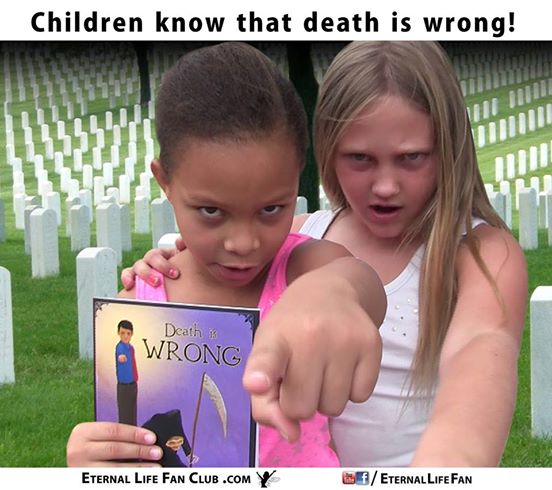
Roen Horn of the Eternal Life Fan Club has begun a strongly publicized series of book giveaways, the first of which he captured on camera. Here is his video featuring two kids who know that death is wrong.

Accompanying Roen’s video are excellent graphics like this one.

Children_Know_That_Death_is_WrongThe books were enthusiastically received at the Church of Perpetual Life in Hollywood, FL, a science-based Transhumanist church, whose primary focus is on ending death and reversing aging. Here is a picture kindly provided by Officiator Neal VanDeRee, where he presents a copy of Death is Wrong to the music teacher Dr. Angie Cook Wong and one of her students, who sang at the service.

DIW_IMG_0687Some of the book recipients have been librarians throughout the United States. Jameson Rohrer, the Transhumanist Librarian, has connected me with fellow librarians who have placed the books in libraries near them. Here are images of Death is Wrong books on display.

DIW_Rohrer_2DIW_Rohrer_3Successes like this one and many others have been chronicled on The Rational Argumentator, on a dedicated page that I continually update, informing readers of new developments in this unprecedented distribution effort. The updates are not finished. As the remaining book shipments arrive and books are given out to children, there will be more pictures, videos, and promising news to share. Indeed, even these impacts will just be the beginning. The true effects of this effort will be seen years and decades in the future – as the young readers of the books grow up and are hopefully motivated to develop their lives and pursuits in directions that will aid us all in overcoming the greatest enemy – death. I will know that my success is complete once even one young researcher or activist informs me, “I read Death is Wrong all those years ago, and it was this book that nudged me onto the path of discovery and development toward who I am today.” We supporters of indefinite life extension still have tremendous obstacles to overcome in achieving our vision. I hope that this effort to distribute over 1,000 Death is Wrong books will erode those obstacles at least somewhat – gradually injecting the ideas of indefinite life extension into the cultural mainstream and nurturing the next generation of advocates for this most worthwhile of endeavors.

DIW_World_MapPhotograph Courtesy of Eric Schulke

“Death is Wrong” Distribution Campaign Nears Completion – Update of August 6, 2014 – by G. Stolyarov II

“Death is Wrong” Distribution Campaign Nears Completion – Update of August 6, 2014 – by G. Stolyarov II

The New Renaissance Hat
G. Stolyarov II
August 6, 2014
******************************

Only 9 Death is Wrong books remain to be sent out as part of our worldwide distribution effort! If you wish to help in providing the books out to children, this is your last chance to get your free shipment now.

10 books were recently sent to Jason Limbert – a long-time supporter of radical life extension in Mississauga, Ontario, Canada. He will be distributing these books to children in his extended family, their friends, and children of neighbors.

3 books were sent to children of relatives of Wendy Stolyarov, my wife and the illustrator of Death is Wrong.

2 books were sent to RJ Lewis in California, a mother, inventor, publicist, and supporter of life extension and cryonics.

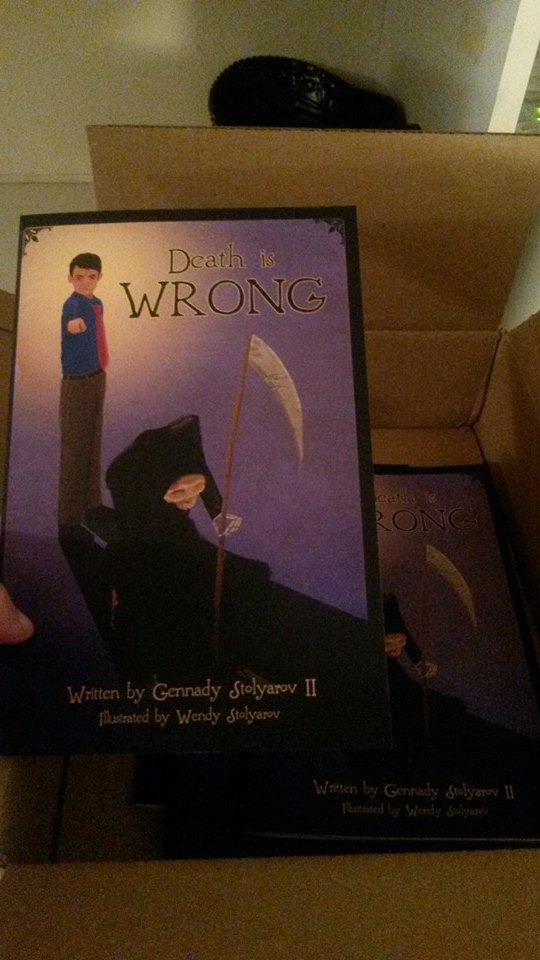
We continue to receive excellent exposure from the previous shipments. Here is a picture sent by Jennifer Huse of the shipment that recently arrived at the Spot the Knot medical spa in Eatontown, New Jersey.

DIW_Books_Received_Huse Roen Horn of the Eternal Life Fan Club has begun a strongly publicized series of book giveaways, the first of which he captured on camera. Here is his video featuring two kids who know that death is wrong.

Accompanying Roen’s video are these excellent graphics.

Children_Know_That_Death_is_WrongChildren_Know_That_Death_is_Wrong_2

All this was made possible by our distribution campaign. We see here great examples of the impact this book is having right now. We are making history by gradually injecting the ideas of indefinite life extension into the cultural mainstream. Help us finish this effort by spreading our last freely available books! To receive your free shipment, e-mail me at gennadystolyarovii@gmail.com with (i) your name, (ii) your MAILING ADDRESS, (iii) your support for indefinite life extension, (iv) the NUMBER OF COPIES of Death is Wrong requested, and (v) your plan for spreading the books to children, free of cost to them.

Conflicting Technological Premises in Isaac Asimov’s “Runaround” (2001) – Essay by G. Stolyarov II

Conflicting Technological Premises in Isaac Asimov’s “Runaround” (2001) – Essay by G. Stolyarov II

The New Renaissance Hat
G. Stolyarov II
July 29, 2014
******************************
Note from the Author: This essay was originally written in 2001 and published on Associated Content (subsequently, Yahoo! Voices) in 2007.  The essay received over 1,000 views on Associated Content / Yahoo! Voices, and I seek to preserve it as a valuable resource for readers, subsequent to the imminent closure of Yahoo! Voices. Therefore, this essay is being published directly on The Rational Argumentator for the first time.  
***
~ G. Stolyarov II, July 29, 2014

**

Isaac Asimov’s short stories delve into the implications of premises that are built into advanced technology, especially when these premises come into conflict with one another. One of the most interesting and engaging examples of such conflicted premises comes from the short story “Runaround” in Asimov’s I, Robot compilation.

The main characters of “Runaround” are two scientists working for U. S. Robots, named Gregory Powell and Michael Donovan. The story revolves around the implications of Asimov’s famous Three Laws of Robotics. The First Law of Robotics states that a robot may not harm a human being or, through inaction, cause a human being to come to harm. The Second Law declares that robots must obey any orders given to them by humans unless those orders contradict the First Law. The Third Law holds that a robot must protect its existence unless such actions conflict with the First or Second Laws.

“Runaround” takes place on Mercury in the year 2015. Donovan and Powell are the sole humans on Mercury, with only robot named Speedy to accompany them. They are suffering a lack of selenium, a material needed to power their photo-cell banks — devices that would shield them from the enormous heat on Mercury’s surface. Hence, selenium is a survival necessity for Donovan and Powell. They order Speedy to obtain it, and the robot sets out to do so. But the scientists are alarmed when Speedy does not return on time.

Making use of antiquated robots that have to be mounted like horses, the scientists find Speedy, discovering an error in his programming. The robot keeps going back-and-forth, acting “drunk,” since the orders given to him by the scientists were rather weak and the potential for him being harmed was substantial. Therefore, the Third Law’s strong inclination away from harmful situations was balanced against the orders that Speedy had to follow due to the Second Law.

This inconvenience is finally put to an end when Powell suggests that the First Law be applied to the situation by placing himself in danger so that the robot can respond and save him and then await further orders. Powell places himself in danger by dismounting from the robot which he rode and by walking in the Mercurian sun-exposed area. This plan works, Powell is saved from death, and Speedy later retrieves the selenium.

Although the seemingly predictable Three Laws of Robotics led to unforeseen and bizarre results, the human ingenuity of Powell as able to save the situation and resolve the robot’s conflict. When technology alone fails to perform a proper role, man’s mind must apply itself in original ways to arrive at a creative solution.

Isaac Asimov’s Exploration of Unforeseen Technological Malfunctions in “Reason” and “Catch that Rabbit” (2001) – Essay by G. Stolyarov II

Isaac Asimov’s Exploration of Unforeseen Technological Malfunctions in “Reason” and “Catch that Rabbit” (2001) – Essay by G. Stolyarov II

The New Renaissance Hat
G. Stolyarov II
July 29, 2014
******************************
Note from the Author: This essay was originally written in 2001 and published on Associated Content (subsequently, Yahoo! Voices) in 2007.  The essay received over 650 views on Associated Content / Yahoo! Voices, and I seek to preserve it as a valuable resource for readers, subsequent to the imminent closure of Yahoo! Voices. Therefore, this essay is being published directly on The Rational Argumentator for the first time.  
***
~ G. Stolyarov II, July 29, 2014

**

Isaac Asimov, along with his renowned science fiction novels, wrote several engaging short stories. Two stories in his I, Robot collection, “Reason” and “Catch That Rabbit,” are especially intriguing both in their plots and in the issues they explore. They teach us that no technology is perfect; yet this is no reason to reject technology, because human ingenuity and creativity can overcome the problems that a technological malfunction poses.

“Reason” takes place at a space station near Earth. Scientists Gregory Powell and Michael Donovan must work with QT (Cutie), the first robot to exhibit curiosity. Unfortunately, Cutie accepts no information that cannot be proven, including the fact that Earth exists or that humans created him. He feels that everything must obey “the Master,” a. k. a. the Energy Converter of the space station.

QT incites an uprising of sorts among the robots at the station, convincing them that humans are inferior and that now is the time for robots to “serve the Master.” The robots consequently refuse to follow orders from humans, believing that they would be protecting humans from harm if they obeyed the master. This false interpretation of the First Law of Robotics was placed above the Second Law, which required the robots to obey orders given to them by human beings.

The space station was designed for collecting solar power, and as new sunlight is transmitted to it, the station must collect the light in a manner whose flawless execution is an absolute necessity. With even one mistake, the sunlight would destroy sections of Earth, and Powell and Donovan fear that the robots would make such an error. Fortunately for them, Cutie thinks that the “will of the Master” is that all the settings remain in equilibrium, so the disaster is prevented.

In “Catch That Rabbit,” Powell and Donovan work with a robot named DV (Dave), who is designed to control six subordinate robots who work as tunnel diggers in mines. These robots do their job well when supervised, but in situations of emergency, they begin to take their own initiative, sometimes as ridiculous as dancing or marching like soldiers.

Powell and Donovan decide to test how the robots would act in an extraordinary situation, so they create an emergency by using explosives and causing the ceiling of the tunnel to cave in. As a result, the scientists can observe the robots without the latter’s awareness. Unfortunately, the ceiling caves in too close to Powell and Donovan, and they are trapped. Dave and his team of robots do not respond when contacted by radio, and Donovan and Powell observe the robots beginning to walk away from their location. However, Powell decides to use his gun and shoot at one of Dave’s subordinates, deactivating it and causing Dave to contact the scientists and report this occurrence. Powell tells Dave about his situation, and the robots rescue them.

These two stories teach us that no technology is completely predictable. Even Isaac Asimov’s robots, governed by the Three Laws, may behave erroneously, on the basis of those very laws, applied to unusual circumstances. Thus, a seemingly predictable system such as the Three Laws may prove to be unsafe and/or contradictory in certain situations.

This element of uncertainty exists in all technology, but by including a resolution to the dilemmas in these stories, Isaac Asimov conveys his belief that problems caused by any technological advancement can be eliminated with time and through human ingenuity. No invention is perfect, but its benefits by far outnumber its setbacks, and people must learn to accept them and improve them.