Browsed by
Tag: Austrian Economics

The Other Half of the Inflation Story: Credit Expansion Adds Noise to Price Signals – Article by Sanford Ikeda

The Other Half of the Inflation Story: Credit Expansion Adds Noise to Price Signals – Article by Sanford Ikeda

The New Renaissance Hat
Sanford Ikeda
May 7, 2015
******************************

More money means higher prices. It’s too bad not everyone understands that connection. Even some economists don’t get it. Readers of the Freeman do, I’m sure. And they also understand why that’s a bad thing.

Increasing the supply of money and credit, other things equal, will cause a general rise in wages and prices across an economy. When the Federal Reserve, the central bank of the United States, excessively “prints money,” the result is “inflation” as it’s now commonly called. For those who get the new money after everyone else has spent theirs, inflation means incomes will now buy fewer goods, and every dollar lent before prices rose will be worth less when it’s returned.

If inflation continues, people will eventually learn to demand more for what they sell and lend in order to compensate for the purchasing power that inflation keeps eating away. That, in turn, will cause prices to rise faster, which makes planning for households and businesses even more difficult. In the past, that difficulty has led to hyperinflation and a breakdown of the entire economic system.

But as awful as all this may be, it’s really only half the story, and perhaps not even the worse half. What follows is a highly simplified story of what happens.

The structure of production

If you’d like to build a sturdy house, you’ll need to have some kind of blueprint or plan that will tell you two things:

  1. how the frame, floor, walls, roof, plumbing, and electrical system will all fit together; and
  2. the order in which to put these components together.

Even if the house was made entirely of identical stones, you would need to know how to fit them together to form the floor, walls, chimney, and other structural components. No two stones would serve exactly the same function in the overall plan.

The economy is like a house in the sense that each of its parts, which we might call “capital,” needs to mesh in a certain way if the eventual result will be order and not chaos. But there are two big differences between a house and an economy. The first is that the economy is not only much bigger, but it consists of a multitude of “houses” or private enterprises that have to fit together or coordinate, and so it’s an unimaginably more complex phenomenon than even the most elaborate house.

The second major difference is that a house is consciously constructed for a purpose, typically for someone to live in it. But an economic system is neither consciously designed by anyone nor intended to fulfill any particular purpose, other than perhaps to enable countless people with plans to do the best they can to achieve success. It’s a spontaneous order.

The way all the pieces of capital, from all the diverse people in the economy who own them, fit together is called the capital structure of production.

Credit expansion distorts the structure of production

When people decide to spend a certain portion of their incomes on consumption today, they are at the same time deciding to save some portion for consumption for the future. The amount that they save then gets lent out to borrowers and investors in the market for loanable funds. The rate of interest is the price of making those transactions across time. That is, when you decide to increase your saving, other things equal, the rate of interest (what some economists call the “natural rate of interest”) will fall. The falling interest rate makes borrowing more attractive to producers who invest today to produce more goods in the future.

That’s great, because when the market for loanable funds is operating freely without distortions, that means when people who saved today try to consume more in the future, there actually is more in the future for them to consume . Businesses today invested more at the lower rates precisely in order to have more to sell in the future when consumers want to buy more.

Now, if the Federal Reserve prints more money and that money goes into the loanable funds market, that will also increase the supply of loans and lower the interest rate and induce more borrowing and investment for future output. The difference here is that the supply of loans increases not because people are saving more now in order to consume more in the future, but only because of the credit expansion. That means that in the future, when businesses have more goods to sell, consumers won’t be able to buy them (because they didn’t save enough to do so) at prices that will cover all of the businesses’ costs. Prices will have to drop in order for markets to clear. Sellers suffer losses and workers lose their jobs.

And, oh yes, all that credit expansion also causes inflation.

While this process sounds rather involved, it’s still a highly simplified version of what has come to be known as the Austrian business cycle theory. (For a more advanced version, see here.) Of course, each instance in reality is significantly different from any other, but the narrative is essentially the same: credit expansion distorts the structure of production, and resources eventually become unemployed.

The explanation is more involved than the typical inflation-is-bad story that we’re more familiar with. Indeed, that probably explains why it’s the less-well-known half of the story. Even Milton Friedman and the monetarists pay little attention to the capital structure, choosing instead to focus on the problems of inflationary expectations.

Again, for Austrians, the problem arises when credit expansion artificially lowers interest rates and sets off an unsustainable “boom”; the solution is when the structure of production comes back into alignment with people’s actual preferences for consumption and saving, which is the “bust.” Most modern macroeconomists see it exactly the opposite way: the bust is the problem, and the boom is the solution.

An intricate, dynamic jigsaw puzzle

To close, I’d like to use an analogy I learned from Steve Horwitz (whom I heartily welcome back as a fellow columnist here at the Freeman).

The market economy is like a giant jigsaw puzzle in which each piece represents a unique unit of capital. When the system is allowed to operate without government intervention, the profit-and-loss motive tends to bring the pieces together in a complementary way to form a harmonious mosaic (although in a dynamic world, it couldn’t achieve perfection).

Credit expansion, then, is like someone coming along and making too many of some pieces and too few of others — and then, during the boom, trying to force them together, severely distorting the overall picture. During the bust, people realize they have to get rid of some pieces and try to discover where the others actually fit. That requires challenging adjustments and may take some time to accomplish. But if the government tries to “help” by stimulating the creation of more superfluous pieces, it will only confuse matters and make the process of adjustment take that much longer.

Inflation is bad enough. Unfortunately, it’s only half the story.

Sanford Ikeda is a professor of economics at Purchase College, SUNY, and the author of The Dynamics of the Mixed Economy: Toward a Theory of Interventionism.

This article was originally published by The Foundation for Economic Education.
Michel Chevalier’s Case Against the Patent System – Article by Louis Rouanet

Michel Chevalier’s Case Against the Patent System – Article by Louis Rouanet

The New Renaissance Hat
Louis Rouanet
April 17, 2015
******************************

Michel Chevalier (1806–1879) was a very influential French economist during the second half of the nineteenth century. He is still widely known in France for being the architect of the Cobden-Chevalier Treaty of 1860 which was the free-trade agreement between France and Great Britain. Michel Chevalier is, however, less known for his major contribution to the intellectual property debate. [1] Contrary to Jean Baptiste Say, Gustave de Molinari, and many other French economists, Chevalier fiercely opposed the patent system. As Fritz Machlup remarked: “Among French economists, Michel Chevalier was probably the most emphatic in the joint antagonism to tariffs and patents, declaring that both ‘stem from the same doctrine and result in the same abuses.’”

Taking a fresh look at Michel Chevalier’s major work, Les Brevets d’invention (1878), we find it to be not only a well-written and powerful book, but also has remained impressively relevant. The arguments advanced by Chevalier anticipate the current arguments of the present opponents of intellectual property.

Patents as Contrary to Freedom and Economic Progress

Michel Chevalier argues that patents cannot be justified if they are contrary to freedom, even if beneficial to technological change. For him “From the moment we can make effective the patent only through inquisitorial expedients, violence, and subversion of liberty of labor, it is proof that we must renounce patents.” Chevalier rejects utilitarianism as a sufficient method to justify or refute the patent system. Chevalier’s opposition to patents, however, is not just based on moral arguments but shows the disastrous effects of this system for both foreign trade and the economy in general.

According to Chevalier, patents are of the same nature as privileges and monopolies which were prevalent during the Ancien Régime. They are also comparable in their effects to protectionist policies:

In absolute terms, patents diminish the productive power of nations that recognize them: evident proposition for those who believe that freedom, free competition, is the great lever of industrial progress.

Chevalier goes on to note the conservative and anti-innovation nature of monopolies and gives many examples of monopolies during the Ancien Régime. According to him, the innovators during the Ancien Régime weren’t rewarded, not because of the absence of patents, but because of the corporation guild system which was destroying competition and freedom to entry into markets. Thus, the innovators were constantly sued by guilds and consumers rarely benefited from their inventions. This argument is still relevant today. Indeed, companies protected from competition and government-owned corporations are often less innovative and more subject to conservative measures. Sectors typically run by government such as schools experience very little technological progress. On the other hand, the competitive process of the market gives incentives for the actors to differentiate from the other producers. As Pascal Salin stated, the company which makes the highest profits on a free market is the company which is the best positioned to “invent the future.” The essential virtue of competition is that it encourages producers to innovate in order to better serve the needs of consumers.

As one of his more striking examples, Chevalier examines the case of aniline — a dye and major innovation in the chemical industry — and shows how monopoly, resulting from patents, leads to hampered innovation. His interpretation of the problems caused by patents in the chemical industry at the time is consistent with more recent studies done by Boldrin and Levine in Against Intellectual Monopoly, now the seminal work on the topic.

Innovation as a Process

Chevalier understood that innovation is, above all, a process and that giving privileges to the innovator will destroy this process, leading to less and not more inventions. He wrote:

Every industrial discovery is the product of the general ferment of ideas, the result of an internal work which was accomplished with the support of a large number of successive or simultaneous collaborators in society, often for centuries.

This argument regarding the cumulative nature of innovation is still the most powerful argument against intellectual monopoly today and has also been the theme of several recent studies.2 Similar to Chevalier, Hayek saw innovation as a process and stated that “it is not obvious that such forced scarcity [intellectual property] is the most effective way to stimulate the human creative process.”

In an 1862 debate in the Académe des Sciences Morales et Politiques, Chevalier gave the example of Louis Daguerre, one of the inventors of photography, who didn’t seek a patent for his system of photography. According to Chevalier, the absence of a patent led to necessary improvements of the daguerreotype and fostered its widespread use. His conclusion is the following:

The spirit of man proceeds only by successive trials and repeated attempts. Discoveries do not arrive with a single bound to the degree of perfection or completion, which is reserved for them; there must be renewed, persevering efforts, cut by breaks that allow, so to speak, to breath. … If it is true that the invention must pass through the hands of twenty people before reaching its final state, it follows that the exclusive privilege granted to the first patented, and to each of his followers, prevents this practical result rather than facilitate it.

The Increasing Number of Patents and Negative Consequences

Already during the nineteenth century, legal instability and uncertainty challenged the actual efficiency of the patent system and the economists were very much aware of this problem. Chevalier warned that the patent system would lead to legal uncertainty for the companies and would lead the industry back to a guild system where no entrepreneur would dare to enter a market for fear of being sued by patent holders. Chevalier was ahead of his time by denouncing what can be considered the ancestors of today’s patent trolls.

Chevalier concluded his 1862 article by stating: “I think I have said enough to show that the patent legislation has been an eccentricity of the legislator.” He went further in 1863 and added that “[a]ll friends of industrial and social progress must work together to rescue the industry of obstacles, obsolete remains of the past. Patents must disappear first.” [3]

1. Fritz Machlup and Edith Penrose briefly discussed Michel Chevalier in “The Patent Controversy in the Nineteenth Century,” Journal of Economic History, 1950.

2. See Alberto Galasso et Mark Schankerman, “Patents and Cumulative Innovation: Causal Evidence from the Courts”, NBER working paper, 21 June 2014 ; and also, Alessandro Nuvolari, “Collective Invention during the British Industrial Revolution: The Case of the Cornish Pumping Engine,” Cambridge Journal of Economics 28, No. 3 (2004).

3. Quoted in Eugène Pouillet, “Traité théorique et pratique des brevets d’invention et de la contrefaçon,” 1909, pp. x–xi.

Louis Rouanet is a student at Sciences Po Paris (Institute of Political Studies) where he studies economics and political science.

This article was originally published by the Ludwig von Mises Institute. Permission to reprint in whole or in part is hereby granted, provided full credit is given.

A Portrait of the Classical Gold Standard – Article by Marcia Christoff-Kurapovna

A Portrait of the Classical Gold Standard – Article by Marcia Christoff-Kurapovna

The New Renaissance Hat
Marcia Christoff-Kurapovna
April 15, 2015
******************************

“The world that disappeared in 1914 appeared, in retrospect, something like our picture of Paradise,” wrote the economist Cecil Hirsch in his June 1934 review of R.W. Hawtrey’s classic, The Art of Central Banking (1933). Hirsch bemoaned the loss of the far-sighted restraint that had once prevailed among the “bankers’ banks” of the West, concluding that modern times “had failed to attain the standard of wisdom and foresight that prevailed in the 19th century.”That wisdom and foresight was once upon a time institutionalized throughout an international monetary culture — gold-based, wary of credit, and contemptuous of debt, public or private. This world included central banks including the Bank of England, the Bank of France, the Swiss National Bank, the early Federal Reserve, the Imperial Bank of Austria-Hungary, and the German Reichsbank. But the entrenched hard-money ideology of the time restrained all of them. The Bank of Russia, for example, which once required 50 percent to 100 percent gold backing of all notes issued, possessed the second largest gold reserves on the planet at the turn of the twentieth century.

“The countries that were tied together in the gold standard system represented to a not inconsiderable degree a community of interest in and responsibility for the maintenance of economic and financial stability throughout the world,” recounted Aldoph C. Miller, member of the Federal Reserve Board from 1914 to 1936, in The Proceedings of the Academy of Political Science, in May 1936. “The gold standard was the one outstanding symbol of unity and economic solidarity which the nineteenth century world had developed.”

It was a time when “automatic market forces,” as economists of the day referred to them, prevailed over monetary management. Redeemability of money in (fine) gold ensured, within limits, stability in foreign exchange rates. Credit was extended only as far as reserve ratios would allow, and central banks were required to keep fixed reserves of gold against notes-in-circulation and against demand deposits.

When Markets Dominated Monetary “Policy”

Gold flows regulated international price relationships through markets, which adjusted themselves accordingly: prices rose when there was an influx of gold — for example, when one country received a debt payment from another country (always in gold), or during such times as the California or Australian gold rushes of the 1870s. These inflows meant credit expansion and a rise in prices. An outflow of gold meant credit was contracted and price deflation followed.

The efficiency of that standard was not impeded by the major central banks in such a way that “any disturbance of economic or financial character originating at any point in the world which might threaten the continued maintenance of economic equilibrium was quickly detected by foreign exchanges,” Miller, the Federal Reserve board member, noted in his paper. “In this way, the gold standard system became in a very real sense a regime or rule of economic health, a method of catching economic disturbances in the bud.”

The Bank of England, the grand master of them all, was the financial center of the universe, whose tight handle on its credit policies was so disciplined that the secured the top spot while not even holding the largest gold reserves. Consistent in its belief that protection of reserves was the chief, and only important, criterion of credit policy, England became the leading exporter of capital, the free market for gold, the international discount market, and international banker for the trade of other countries, as well as her own. The world was in this sense on the sterling standard.

The Bank of France, wisely admonished by its founder, Napoleon, to make sure France was always a creditor country, was so replete with reserves it made England a 500 million franc loan (in 1915 numbers) at the onset of the World War I. Switzerland, perhaps the last “19th-century-style” hold-out today with unlimited-liability private bankers and strict debt-ceiling legislation, also required high standards of its National Bank, founded in 1907. By the 1930s that country had higher banking reserves than the US; the Swiss franc was never explicitly devalued, unlike nearly every other Western nation’s currency, and the country’s domestic price level remained the most stable in the world.

For a time, the disciplined mindset of these banks found its way across the Atlantic, where the idea of a central bank had been long the subject of hot debate in the US. The economist H. Parker Willis, writing about the controversy in The Journal of the Proceedings of the Academy of Political Science, October 1913, admonished: “The Federal Reserve banks are to be ‘bankers’ banks,’ and they are intended to do for the banker what he himself does for the public.”

At first, the advice was heeded: in September 1916, almost two years after its founding on December 23,1913, the fledgling Fed worked out an amendment to its gold policy on the basis of a very conservative view of credit. This new policy sought to restrain “the undue and unnecessary expansion of credit,” wrote Fed board member Miller, in an article for The American Economic Review, in June 1921.

The Bank of Russia, during the second half of the nineteenth century steered itself through the Crimean War, the Russo-Turkish War, the Russo-Japanese War, impending Balkan wars — not to mention all that was to follow — and managed to emerge with sound fiscal policies and massive gold reserves. According to The Economist of May 20, 1899, Russian holdings were 95 million pounds sterling of gold, while the Bank of France held 78 million sterling worth. (Austria-Hungary held 30 million sterling worth of gold and the Bank of England 30 million sterling worth of both gold and silver.) “Russia up to the very moment of rupture [with Japan, 1904–1905], was working imperturbably at the progressive consolidation of her finances,” reported Karl Helfferich of the University of Berlin, at a meeting of The Royal Economic Society [UK] in December 1904. “Even in years of industrial crises and defective harvest, her foreign trade showed an excess of exports over imports more than sufficient to compensate payments sent abroad. And, as guarantee her monetary system she has succeeded in a amassing and maintaining a vast reserve of gold.”

These banks, in turn, drew on the medieval/Renaissance and Baroque-era banking traditions of the Hanseatic League, the Bank of Venice, and Amsterdam banks. Payment-on-demand “in good and heavy gold” was like a blood-oath binding the banker-client relationship. The transfer of credit “did not arise from any such substitution of credit for money,” noted Charles F. Dunbar, in The Quarterly Journal of Economics of April 1892, “but from the simple fact that the transfer in-bank saved the necessity of counting coin and manual delivery of every transaction.”

Bankers were forbidden to deal in certain commodities, could not make loans or create credit for the purchase of such commodities, and forbade both foreigners and citizens from buying silver on credit unless the same amount in cash was in the bank. According to Dunbar, a Venetian law of 1403 on reserve requirements became the basis of US banking law on the deposits of public securities in the late 1800s.

After the fall of bi-metallism in the 1870s, gold continued to perform monetary functions among the main countries of the Western world (and the well-administered Bank of Japan). It was the only medium of exchange and the only currency with unrestricted legal tender. It became the vaunted “measure of value.” Bank currency notes were simply used as auxiliary to gold and, in general, did not enjoy the privilege of legal tender.

The End of An Era

It was certainly not a flawless system, or without periodic crises. But central banks had to act in an exceptionally prudent manner given the all-over public distrust of paper money.

As economist Andrew Jay Frame of the University of Chicago, writing in The Journal of Political Economy, in January 1912, noted: “During panics in Britain in 1847 and 1866, when cash payments were suspended, the floodgates of cash were opened [by The Bank of England], the governor sent word to the street that solvent banks would be accommodated, and the panic was relieved.” Frame then adds: “However, this extra cash and the increased loans that went with it were very quickly put to an end to avoid credit expansion.”

The US was equally confident of its prudent attitude. Aldoph Miller, writing of Federal Reserve policy, remarked: “The three chief elements of the policy of a central bank or system of reserve holding institutions are best disclosed in connection with the attitude towards 1) gold 2) currency 3) credit.” He noted proudly: “The federal reserve system has met [these] tests on the whole with remarkable success.”

But after World War I, a different international landscape was left behind. England had been displaced as the center of international finance; the US and France emerged as the chief post-war creditor countries. The mechanism of the gold standard to which depreciated currencies could be related no longer existed. Only the US was left with a full gold standard. England and France had a gold bullion standard and other countries (Germany, primarily) had a gold-exchange standard.

A matrix of unbalanced trade relationships began to saturate the international economy. Then, with so many foreign countries attendant upon its speculative boom, the US manipulated its own domestic credit policies to ease credit and exchange-standard controls. This eventually culminated in an international financial crisis of 1931. Under Bretton Woods (1944), the gold standard was effectively abandoned: domestic convertibility was illegal and the role of gold was very constrained in favor of the dollar.

“It was, at least in theory, simple enough in the old days,” wrote a wistful W. Randolph Burgess, head of the New York Federal Reserve, in 1938. “In the present strange new world, where the old gold portents have lost their former meaning, where is the radio beam which the central banker may follow? What is the equivalent of gold?

The men of his era and of the late nineteenth century understood the meaning of such a question and, more importantly, why it is one that must be asked. But theirs was a different world, indeed — one without “QE,” ZIRP,” or “Unknown Knowns” as fiscal policy. And there were no helicopters, either.

Marcia Christoff-Kurapovna is at work on the biography of a prominent European head of state and businessman.  Her work has appeared in such publications as The Wall Street Journal, The Economist and Foreign Affairs.

This article was originally published by the Ludwig von Mises Institute. Permission to reprint in whole or in part is hereby granted, provided full credit is given.

Why We Need Deflation and Higher Interest Rates – Article by John P. Cochran

Why We Need Deflation and Higher Interest Rates – Article by John P. Cochran

The New Renaissance Hat
John P. Cochran
April 5, 2015
******************************

The Fed is seemingly slightly out of step with other central bankers as it recently hinted at possible future rate hikes in the official announcement following its March 20, 2015 meeting. But as many commentators have recognized, Janet Yellen, a strong proponent of Keynesian more-inflation-as-cure-for-unemployment policy, later downplayed the significance of the announcement. She was careful to indicate that rates would stay low for the near future and when (and if) rate increases begin, they will be measured. The Fed, like central bankers elsewhere, stays committed to a 2 percent inflation target as it continues a policy driven by a fear of deflation, a fear that is not supported by either good economic theory or economic history properly interpreted.

The errors of deflation-phobia can be drawn from Philipp Bagus’s excellent and recently released In Defense of Deflation. Bagus points out

In the economic mainstream, there are basically two main strands in contemporary deflation theories. The first strand can be represented by economists who in some way are inspired by Keynesian theories like Ben Bernanke, Lars E.O. Svensson, Marvin Goodfriend, or Paul Krugman. The first group fears that price deflation might put the economy in a liquidity trap and opposes all price deflation categorically. It represents the deflation phobia in its clearest form.

It is these theorists and their colleagues who currently dominate central bank thinking and make the case (weak and often only asserted as an imperative) for a positive inflation buffer.

Bagus does recognize a second group of mainstream economists with a more balanced view of deflation:

The second strand has representatives like Claudio Borio, Andrew Filardo, Michael Bordo, John L. Lane, and Angela Redish. Inspired by the Chicago School, the second group is more free market oriented. Bordo, for instance, received his doctoral degree from the University of Chicago. This group distinguishes between two types of deflation: good deflation and bad deflation.

Deflation Leads to Increases in Real Interest Rates, Which Brings Recovery

However, the main water carriers against this erroneous overemphasis by economists and the mainstream press on the alleged evils of deflation have been the Austrians. In his essays “A Reformulation of the Austrian Business Cycle Theory” and “An Austrian Taxonomy of Deflation” Joseph Salerno dismantles deflation-phobia and illustrates the benefits of higher interest rates. Moreover, “A Reformulation” is also a strong argument on why current policy retards recovery and why a policy which would allow financial markets to adjust to a new higher natural rate of interest is essential for restoring normalcy and prosperity. Salerno begins with examining why it is so unpleasant when an economy must adjust to fix the malinvestments and overconsumption that appeared in the boom phase:

The ABCT, when correctly formulated, does indeed explain the asymmetry between the boom and bust phases of the business cycle. The malinvestment and overconsumption that occur during the inflationary boom cause a shattering of the production structure that accounts for the pervasive unemployment and impoverishment that is observed during the recession. Before recovery can begin, the production structure must be painstakingly pieced back together again in a new pattern, because the intertemporal preferences of consumers have changed dramatically due to the redistribution and losses of income and wealth incurred during the inflation. This of course takes time.

At the heart of the problem is the fact that central bank-induced inflation has “wreaked havoc” on prices and consequently on economic calculation:

In addition, the recession-adjustment process is further prolonged by the fact that the boom has wreaked havoc with monetary calculation, the very moorings of the market economy. Entrepreneurs have discovered that their spectacular successes during the boom were merely a prelude to a sudden and profound failure of their forecasts and calculations to be realized. Until they have regained confidence in their forecasting abilities and in the reliability of economic calculation they will be understandably averse to initiating risky ventures even if they appear profitable. But if the market is permitted to work, this entrepreneurial malaise cures itself as the restriction of demand for factors of production drives down wages and other costs of production relative to anticipated product prices. The “natural interest rate,” i.e., the rate of return on investment in the structure of production, thus increases to the point where entrepreneurs are enticed to renew their investment activities and initiate the adjustment process. Success feeds on itself, entrepreneurs’ spirits rise, and the recovery gains momentum.

The market can only cure itself, Salerno explains, if prices are allowed to adjust, including decreases in “wages and other costs of production relative to anticipated product prices.” At the same time, it’s the resulting “steep rise” in real interest rates that draws capitalists and entrepreneurs back into the marketplace:

The rise in the natural interest rate that overcomes the pandemic demoralization among capitalists and entrepreneurs and sparks the recovery is reflected in the credit markets. For recovery to begin again, there needs to be a steep rise in the “real,” or inflation-adjusted, interest rate observed in financial markets. High interest rates do not stifle the recovery but are the sure sign that the readjustment of relative prices required to realign the production structure with economic reality is proceeding apace. The mislabeled “secondary deflation,” whether or not it is accompanied by an incidental monetary contraction, is thus an integral part of the adjustment process. It is the prerequisite for the renewal of entrepreneurial boldness and the restoration of confidence in monetary calculation. Decisions by banks and capitalist-entrepreneurs to temporarily hold rather than lend or invest a portion of accumulated savings in employing the factors of production and the corresponding rise of the loan and natural rates above some estimated “true” time preference rate does not impede but speeds up the recovery. This implies, of course, that any political attempt to arrest or reverse the decline in factor and asset prices through monetary manipulations or fiscal stimulus programs will retard or derail the recession-adjustment process.

New Defenders of Deflation

Citing work by Claudio Borio, head of the Monetary and Economic department at the BIS, listed above by Bagus, The Telegraph, ran a recent story by Szu Ping Chan, “Low Rates Will Trigger Civil Unrest as Central Banks Lose Control,” also highly critical of fear-of-deflation policy committed to 2 percent (or higher) inflation targets. Ms. Chan highlights work by Borio:

A separate paper co-authored by Mr Borio argued that periods of deflation has less economic costs than sustained falls in property prices. Its analysis of 38 economies over a period of more than 100 years showed economies grew by an average of 3.2pc during deflationary periods, compared with 2.7pc when prices were rising.

It said drawing blind comparisons with the 1930s were misguided. “The historical evidence suggests that the Great Depression was the exception rather than the rule,” said Hyun Shin, head of research at the BIS.

Mr. Bagus, Ms. Chan, and Mr. Borio have highlighted for us yet again why it is essential that institutional changes be made that lead to withering away of fiat money and create the possibility for sound money.

John P. Cochran is emeritus dean of the Business School and emeritus professor of economics at Metropolitan State University of Denver and coauthor with Fred R. Glahe of The Hayek-Keynes Debate: Lessons for Current Business Cycle Research. He is also a senior scholar for the Mises Institute and serves on the editorial board of the Quarterly Journal of Austrian Economics. Send him mail. See John P. Cochran’s article archives.

This article was published on Mises.org and may be freely distributed, subject to a Creative Commons Attribution United States License, which requires that credit be given to the author.

Diversity in Goals Brings Diversity in Value – Article by Frank Shostak

Diversity in Goals Brings Diversity in Value – Article by Frank Shostak

The New Renaissance Hat
Frank Shostak
November 28, 2014
******************************

A major problem with the mainstream framework of thinking is that people are presented as if a scale of preferences were hard-wired in their heads. Regardless of anything else this scale remains the same all the time. Valuations however, do not exist by themselves regardless of the things to be valued. On this Rothbard wrote,

There can be no valuation without things to be valued. 1

Valuation is the outcome of the mind valuing things. It is a relation between the mind and things.

Purposeful action implies that people assess or evaluate various means at their disposal against their ends. An individual’s ends set the standard for human valuations and thus choices. By choosing a particular end an individual also sets a standard of evaluating various means.

For instance, if my end is to provide a good education for my child, then I will explore various educational institutions and will grade them in accordance with my information regarding the quality of education that these institutions are providing. Observe that the standard of grading these institutions is my end, which, in this case, is to provide my child with a good education. Or, for instance, if my intention is to buy a car, and there are all sorts of cars available in the market, then I have to specify to myself the specific ends that the car will help me achieve. I need to establish whether I plan to drive long distances or just a short distance from my home to the train station and then catch the train. My final end will dictate how I will evaluate various cars. Perhaps I will conclude that for a short distance, a second-hand car will do the trick.

Since an individual’s ends determine the valuations of means and thus his choices, it follows that the same good will be valued differently by an individual as a result of changes in his ends. At any point in time, people have an abundance of ends that they would like to achieve. What limits the attainment of various ends is the scarcity of means. Hence, once a larger variety of means become available, a greater number of ends — or goals — can be accommodated (i.e., people’s living standards will increase).

Another limitation on attaining various goals is the availability of suitable means. Thus to quell my thirst in the desert, I require water. If no one willing to sell water is nearby, any diamonds in my possession will be of no help in this regard.

Frank Shostak is an adjunct scholar of the Mises Institute and a frequent contributor to Mises.org. His consulting firm, Applied Austrian School Economics, provides in-depth assessments and reports of financial markets and global economies. See Frank Shostak’s article archives.

This article was published on Mises.org and may be freely distributed, subject to a Creative Commons Attribution United States License, which requires that credit be given to the author.

The End of Quantitative Easing Is Not the End of Bad Policy – Article by John P. Cochran

The End of Quantitative Easing Is Not the End of Bad Policy – Article by John P. Cochran

The New Renaissance Hat
John P. Cochran
November 7, 2014
******************************

Recently the financial press and media has been abuzz as the Federal Reserve moved closer to the anticipated end to its massive bond and mortgage backed securities purchases known as quantitative easing. James Bullard, President of the St. Louis Federal Reserve Bank, stirred controversy last week when he suggested the Fed should consider continuing the bond buying program after October. But at the October 29th meeting, the policy makers did as anticipated and “agreed to end its asset purchase program.” However one voting member agreed with Mr. Bullard. Per the official press release, “Voting against the action was Narayana Kocherlakota, who believed that, in light of continued sluggishness in the inflation outlook and the recent slide in market-based measures of longer-term inflation expectations, the Committee should commit to keeping the current target range for the federal funds rate at least until the one-to-two-year ahead inflation outlook has returned to 2 percent and should continue the asset purchase program at its current level” (emphasis added).

The action yesterday completes the phase out, which began in January 2014, of the controversial QE3 under the leadership of Ben Bernanke and continued unabated under Janet Yellen.

“Not the End of Monetary Easing”

While the headline in the Wall Street Journal highlighted the action as closing a “chapter on easy money,” a closer look illustrates this is perhaps not the case. The Journal, on the editorial page the same day offers a better perspective, supported by data and the rhetoric in the press release. Much to the determent of future economic prosperity, “The end of Fed bond buying is not the end of monetary easing.”

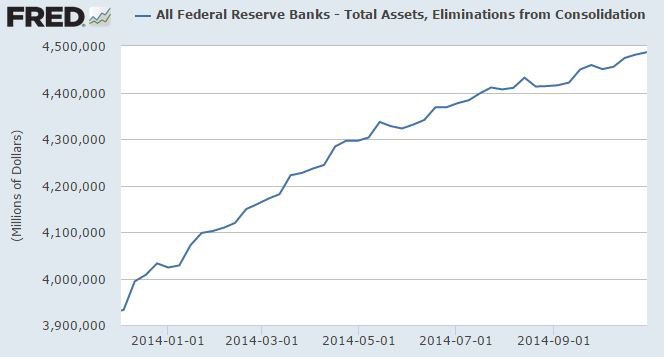
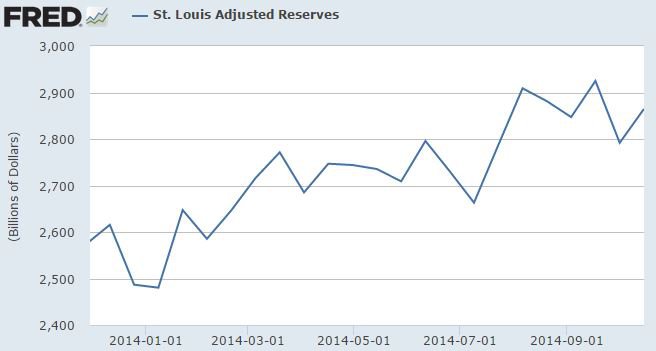
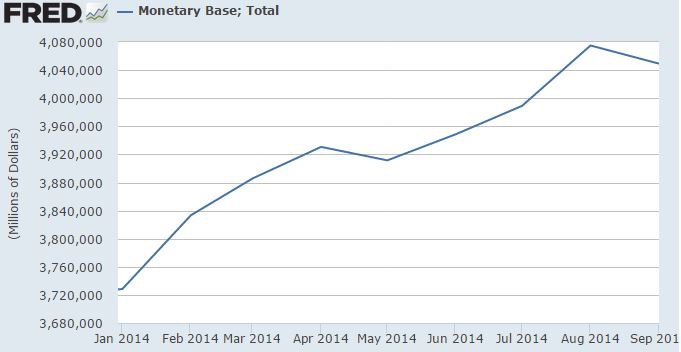
While quantitative easing has contributed to the massive expansion of the Fed balance sheet — now nearly $4.5 trillion in assets — it is not the whole story. Even as the Fed ends new buying of favored assets, the Fed balance sheet will not shrink. As pointed out by the Wall Street Journal, “QE is not over, and the Fed will still reinvest the principal payments from its maturing securities.” Even more relevant, during the phase out there was a continuing expansion of three broad measures of Fed activity; St. Louis Fed adjusted reserves (Figure 1), the monetary base (Figure 2), and Federal Reserve Banks — Total Assets, Eliminations from Consolidation program (Figure 3). (All data from FRED economic data series St. Louis Federal Reserve. Calculations are mine.)

Figure 1: St. Louis Fed Adjusted Reserves

Figure 2: The Monetary Base

Figure 3: Federal Reserve Banks — Total Assets, Eliminations from Consolidation

The Fed’s Balance Sheet Continues to Expand

Despite some ups and downs, adjusted reserves increased 15.8 percent from January 2014 through September 2014, the monetary base by 8.6 percent, and consolidated assets by 10.7 percent. Given QE purchases were $85 billion per month at their peak, this continuing expansion of the Fed balance sheet and the other relevant monetary aggregates, the phase out and end of quantitative easing represents not a change in policy stance, but only a shift in tools. Monetary distortion has continued unabated. The only plus in the change is that more traditional tools of monetary manipulation create only the traditional market distortions; Cantillon effects, false relative prices, particularly interest rates, and the associated misdirection of production and malinvestments. Temporarily gone is the more dangerous Mondustrial Policy where the central bankers further distort credit allocation by picking winners and losers.

As illustrated by the Fed speak in the press release, post QE3-forward policy will, despite John Taylor’s optimism that this would not be the case, continued to be biased against a return to a more balanced, less potentially self-defeating rules-based policy. Instead driven by the Fed’s unwise dual mandate and the strong belief by Fed leadership in Tobin Keynesianism, policy will continue to “foster maximum employment.” This despite strong theoretical arguments (Austrian business cycle theory and the more mainstream natural unemployment rate hypothesis)[1] and good empirical evidence that any short-run positive impact monetary policy may have on employment and production is temporary and in the long run, per Hayek, cause greater instability and potentially even higher unemployment.

The Lasting Legacy of QE

As pointed out by David Howden in “QE’s Seeds Are Already Sown,” and as emphasized by Hayek (in Unemployment and Monetary Policy: Government as Generator of the “Business Cycle”), and recently formalized by Ravier (in “Rethinking Capital-Based Macroeconomics”), the seeds of easy money and credit creation, even when sown during times with unused capacity, bring forth the weeds of instability, malinvestment, bust, and economic displacement. They do not bring the promised return to prosperity, sustainable growth, and high employment.

Since the phase-out is only apparent, and not a real change in policy direction, Joe Salerno’s warning (“A Reformulation of Austrian Business Cycle Theory in Light of the Financial Crisis,” p. 41) remains relevant:

(G)iven the unprecedented monetary interventions by the Fed and the enormous deficits run by the Obama admin­istration, ABCT also explains the precarious nature of the current recovery and the growing probability that the U.S economy is headed for a 1970s-style stagflation.

While highly unlikely there is still time to do the right thing, follow the policy advice of Rothbard and the Austrians, as argued earlier in more detail here and here. Despite some short run costs which are likely small compared to the cost of a decade of stagnation, such a policy is the only reliable route to return the economy to sustainable prosperity.

John P. Cochran is emeritus dean of the Business School and emeritus professor of economics at Metropolitan State University of Denver and coauthor with Fred R. Glahe of The Hayek-Keynes Debate: Lessons for Current Business Cycle Research. He is also a senior scholar for the Mises Institute and serves on the editorial board of the Quarterly Journal of Austrian Economics. Send him mail. See John P. Cochran’s article archives.

This article was published on Mises.org and may be freely distributed, subject to a Creative Commons Attribution United States License, which requires that credit be given to the author.

Inflation’s Not the Only Way Easy Money Destroys Wealth – Article by Frank Shostak

Inflation’s Not the Only Way Easy Money Destroys Wealth – Article by Frank Shostak

The New Renaissance Hat
Frank Shostak
October 14, 2014
******************************

The US Federal Reserve can keep stimulating the US economy because inflation is posing little threat, Federal Reserve Bank of Minneapolis President Kocherlakota said. “I am expecting an inflation rate to run below two percent for the next four years, through 2018,” he said. “That means there is more room for monetary policy to be helpful in terms of … boosting demand without running up against generating too much inflation.”

The yearly rate of growth of the official consumer price index (CPI) stood at 1.7 percent in August against two percent in July. According to our estimate, the yearly rate of growth of the CPI could close at 1.4 percent by December. By December next year we forecast the yearly rate of growth of 0.6 percent.

Does Demand Create More Supply?

It seems that the Minneapolis Fed President holds that by boosting the demand for goods and services — by means of additional monetary pumping — it is possible to strengthen economic growth. He believes that by means of strengthening the demand for goods and services the production of goods and services will follow suit. But why should that be so?

If by means of monetary pumping one could strengthen the economic growth then it would imply that — by means of monetary pumping — it is possible to create real wealth and generate an everlasting economic prosperity.

This would also mean that world wide poverty should have been erased a long time ago. After all, most countries today have central banks that possess the skills to create money in large amounts. Yet world poverty remains intact.

Despite massive monetary pumping since 2008, and the policy interest rate of around zero, Fed policymakers seem to be unhappy with the so-called economic recovery. Note that the Fed’s balance sheet, which stood at $0.86 trillion in January 2007 jumped to $4.4 trillion by September this year.

Production Comes Before Demand

We suggest that there is no such thing as an independent category called demand. Before an individual can exercise demand for goods and services, he/she must produce some other useful goods and services. Once these goods and services are produced, individuals can exercise their demand for the goods they desire. This is achieved by exchanging things that were produced for money, which in turn can be exchanged for goods that are desired. Note that money serves here as the medium of exchange — it produces absolutely nothing. It permits the exchange of something for something. Any policy that results in monetary pumping leads to an exchange of nothing for something. This amounts to a weakening of the pool of real wealth — and hence to reduced prospects for the expansion of this pool.

What is required to boost the economic growth — the production of real wealth — is to remove all the factors that undermine the wealth generation process. One of the major negative factors that undermine the real wealth generation is loose monetary policy of the central bank, which boosts demand without the prior production of wealth. (Once the loopholes for the money creation out of “thin air” are closed off the diversion of wealth from wealth generators towards non-productive bubble activities is arrested. This leaves more real funding in the hands of wealth generators — permitting them to strengthen the process of wealth generation (i.e., permitting them to grow the economy).

Artificially Boosted Demand Destroys Wealth

Now, the artificial boosting of the demand by means of monetary pumping leads to the depletion of the pool of real wealth. It amounts to adding more individuals that take from the pool of real wealth without adding anything in return — an economic impoverishment.

The longer the reckless loose policy of the Fed stays in force the harder it gets for wealth generators to generate real wealth and prevent the pool of real wealth from shrinking.

Finally, the fact that the yearly rate of growth of the CPI is declining doesn’t mean that the Fed’s monetary pumping is going to be harmless. Regardless of price inflation monetary pumping results in an exchange of nothing for something and thus, impoverishment.

Frank Shostak is an adjunct scholar of the Mises Institute and a frequent contributor to Mises.org. His consulting firm, Applied Austrian School Economics, provides in-depth assessments and reports of financial markets and global economies. See Frank Shostak’s article archives.

This article was published on Mises.org and may be freely distributed, subject to a Creative Commons Attribution United States License, which requires that credit be given to the author.

Plot Holes in Fiction and in Life – Article by Sanford Ikeda

Plot Holes in Fiction and in Life – Article by Sanford Ikeda

The New Renaissance Hat
Sanford Ikeda
August 23, 2014
******************************

Fans of J.R.R. Tolkien’s trilogy The Lord of the Rings (LOTR) have long been aware of a possible plot hole. The central narrative concerns the hero, Frodo Baggins, who must destroy a powerful ring by walking through forbidding terrain and defeating or eluding monstrous foes and throwing the ring into a live volcano. The journey takes many months and costs Frodo and his companions dearly.

Over the years, many readers have noticed a much easier and less dangerous solution. Why, they ask, didn’t Frodo just have Gandalf ask his friends the mighty eagles to fly him swiftly over enemy territory so he could then simply toss the ring into the volcano? I’ve run across this post on Facebook a few times, which cleverly patches that hole with only a slight change in the narrative. (Others argue that there’s really no hole to patch because the “eagle solution” itself has flaws. And so the debate continues.)

Anyway, it occurred to me that the kind of social theory that I and many Austrian economists engage in could usefully be framed in terms of plot holes.

What’s a plot hole?

I’ll define a plot hole as a failure of logic, a factual mistake, or an obvious solution to a critical problem central to a story. (Here’s a slightly different definition from Wikipedia.) Of course, any particular plot hole may involve more than one of these errors of fact, logic, or perception, and there may be more kinds of plot holes than these. But here are examples of each of the ones I’ve mentioned. They come from movies, but some of them, such as the plot hole in Lord of the Rings, have literary counterparts.

Factual hole: In the movie Independence Day, key characters survive a massive fireball by ducking into the open side-door of a tunnel just as the inferno blasts by. Anyone who knows about firestorms would tell you that the super-heated air alone would instantly kill anyone in that situation.

Logical hole: In Citizen Kane, miserable Charles Foster Kane dies alone. How then does anyone know that his last word was “Rosebud”? Keep in mind that it’s a reporter’s search for the meaning of that word that drives the story forward.

Perceptual hole: The LOTR problem mentioned above is an example of this. No one seems to realize that there may be a much safer and effective way to defeat the enemy.

I would think that one of the things that makes writing fiction difficult is that events and characters have to hang together. The writer needs always to keep in mind the rules of the universe she’s creating, to recall what her characters know and when they know it, and to make sure that these details all constrain every action and event.

Life is full of “plot holes”

In real life, we make mistakes all the time. I think it’s interesting that those mistakes appear to fit neatly into the three categories of plot holes I’ve identified.

Factual hole/error: A person who doesn’t know the difference between liters and gallons buys a 100-liter barrel to hold 100 gallons of rainwater. No explanation necessary.

Logical hole/error: Thinking that since you’ve made a string of bad investment decisions, your next decision is therefore more likely to be a good one. But it’s quite the contrary: If you’ve been consistently making bad decisions, it follows that if nothing else changes, your next decision will also be bad one. (See “gambler’s fallacy.”)

Perceptual hole/error: Selling your car for $15,000 when, unbeknownst to you, you could have sold it for $20,000. The better deal simply escapes your notice and, if you were ever to learn about it, you would feel regret.

Here’s the difference though: In fiction, a writer can get away with any of these three plot holes as long as no reader sees it. Even if you do notice one, but you otherwise enjoy the story, you might be willing to overlook it. But in real life, you can’t ignore factual or logical plot holes. If you try to, they will come back and bite you. It will be painfully obvious that you can’t put 100 gallons of water into a 100-liter barrel. And if you bet on your next investment being a winner because you’ve just had a bunch of losers, it’s very likely that you’ll be disappointed. These kinds of holes you’re bound to discover.

I wrote about errors in an earlier column, but the distinction comes from my great teacher Israel Kirzner. He identifies a class of errors that derive from “overoptimism.” The more optimistic you are, the more likely it is that you’ll deliberately pass up solid opportunities for gain and thus the more likely it is that you’ll be disappointed. That’s not to say that optimism is a bad thing. If you weren’t optimistic and so never acted on that optimism, you’d never know if that optimism were warranted or not. You would never learn.

The other kind of error, what Kirzner calls “overpessimism,” happens when you’re so pessimistic that you unwittingly pass up a realizable opportunity. And because you don’t take chances, you don’t learn. This type of error is akin to a perceptual hole. Thinking you can only get $15,000 for your car means not selling to someone who would in fact pay more. Here, it’s not inevitable that you will discover your error because, after all, someone does buy your car (for $15,000). But you could have done better if you’d been more alert.

So errors of overpessimism, what I’m calling perceptual holes, are very different from factual and logical holes in that they are much harder to detect.

Plot holes and social theory

For many Austrian economists like me, economics, as a branch of a social theory, accepts as a datum that people are prone to make mistakes. But given the right rules of the game—private property, free association—they can discover those mistakes and correct them via an entrepreneurial-competitive process. Unlike plot holes in fiction writing, then, plot holes in living social systems are a feature, not a bug.

So our challenge as flesh-and-blood people, and what makes our lives interesting, is to discover plot holes, especially perceptual ones, and to fill them in. The challenge of social theorists is to understand as much we can about how that happens. In novels it’s the people outside the story who discover holes; in society it’s the people living the story who do.

Plot holes in novels spell failure. Plot holes in real life mean opportunity.

Sanford Ikeda is an associate professor of economics at Purchase College, SUNY, and the author of The Dynamics of the Mixed Economy: Toward a Theory of Interventionism.
***
This article was originally published by The Foundation for Economic Education.
Confusing Capitalism with Fractional-Reserve Banking – Article by Frank Hollenbeck

Confusing Capitalism with Fractional-Reserve Banking – Article by Frank Hollenbeck

The New Renaissance Hat
Frank Hollenbeck
August 10, 2014
******************************

Today, capitalism is blamed for our current disastrous economic and financial situation and a history of incessant booms and busts. Support for capitalism is eroding worldwide. In a recent global poll, 25 percent (up 2 percent from 2009) of respondents viewed free enterprise as “fatally flawed and needs to be replaced.” The number of Spaniards who hold this view increased from 29 percent in 2009 to 42 percent, the highest amongst those polled. In Indonesia, the percentage went from 17 percent to 32 percent.

Most, if not all, booms and busts originate with excess credit creation from the financial sector. These respondents, incorrectly, assume that this financial system structured on fractural reserve banking is an integral part of capitalism. It isn’t. It is fraud and a violation of property rights, and should be treated as such.

In the past, we had deposit banks and loan banks. If you put your money in a deposit bank, the money was there to pay your rent and food expenses. It was safe. Loan banking was risky. You provided money to a loan bank knowing funds would be tied up for a period of time and that you were taking a risk of never seeing this money again. For this, you received interest to compensate for the risk taken and the value of time preference. Back then, bankers who took a deposit and turned it into a loan took the risk of shortly hanging from the town’s large oak tree.

During the early part of the nineteenth century, the deposit function and loan function were merged into a new entity called a commercial bank. Of course, very quickly these new commercial banks realized they could dip into deposits, essentially committing fraud, as a source of funding for loans. Governments soon realized that such fraudulent activity was a great way to finance government expenditures, and passed laws making this fraud legal. A key interpretation of law in the United Kingdom, Foley v. Hill, set precedence in the financial world for banking laws to follow:

Foley v. Hill and Others, 1848:

Money, when paid into a bank, ceases altogether to be the money of the principal; it is then the money of the banker, who is bound to an equivalent by paying a similar sum to that deposited with him when he is asked for it. … The money placed in the custody of a banker is, to all intents and purposes, the money of the banker, to do with it as he pleases; he is guilty of no breach of trust in employing it; he is not answerable to the principal if he puts it into jeopardy, if he engages in a hazardous speculation; he is not bound to keep it or deal with it as the property of his principal; but he is, of course, answerable for the amount, because he has contracted, having received that money, to repay to the principal, when demanded, a sum equivalent to that paid into his hands. [1]

In other words, when you put your money in a bank it is no longer your money. The bank can do anything it wants with it. It can go to the casino and play roulette. It is not fraud legally, and the only requirement for the bank is to run a Ponzi scheme, giving you the money deposited by someone else if they lost your money and you happen to come back asking for your money. This legalization of fraud is essentially one of the main reasons no one went to jail after the debacle of 2008.

The primary cause of the financial panics during the nineteenth century was this fraudulent nature of fractional reserve banking. It allowed banks to create excessive credit growth which led to boom and bust cycles. If credit, instead, grew as fast as slow moving savings, booms and bust cycles would be a thing of the past.

Critics of the gold standard, (namely, Krugman, et al.), usually point to these cycles as proof that it failed as a monetary system. They are confusing causation with association. The gold standard did not cause these financial panics. The real cause was fractional reserve banking that was grafted onto the gold standard. The gold standard, on the contrary, actually greatly limited the severity of these crises, by limiting the size of the money multiplier.

This is why in the early days of banking in the US, some wildcat bankers would establish themselves in the most inaccessible locations. This was to ensure that few would actually come and convert claims for gold into actual gold since banks had created claims that far exceeded the actual gold in their vaults. And, if by chance a depositor tried to convert his claims into gold, they would be treated as thieves, as though they were stealing the bank’s property by asking for their gold back.

The Federal Reserve System was created following the panics of 1903 and 1907 to counterbalance the negative impact of fractional reserve banking. One hundred years after its creation, the Fed can only be given a failing grade. Money is no longer a store of value, and the world has experienced two of its worst financial crises. Instead of a counterbalance, the central bank has fed and expanded the size of the beast. This was to be expected.

That global poll on capitalism also found that almost half (48 percent) of respondents felt that the problems of capitalism could be resolved with added regulations and reform. Janet Yellen also holds this view, and that regulation, not interest rates, should be the main tool to avoid another costly boom and bust in global finance. This is extremely naïve. We already have more compliance officers in banks than loan officers. Recent banking legislation, Dodd-Frank, and the Vickers and Liikanen reports will probably make the situation even worse. Banks will always be able to use new technologies and new financial instruments to stay one step ahead of the regulators. We continue to put bandages on a system that is rotten to the core. Banking in its current form is not capitalism. It is fraud and crony capitalism, kept afloat by ever-more desperate government interventions. It should be dismantled. Under a system of 100 percent reserves, loan banks (100 percent equity-financed investment trusts) would be like any other business and would not need any more regulation than that of the makers of potato chips.

Notes

[1] Quoted in Murray Rothbard’s, The Mystery of Banking (Auburn, AL: Mises Institute, 2008), p. 92.

Frank Hollenbeck teaches finance and economics at the International University of Geneva. He has previously held positions as a Senior Economist at the State Department, Chief Economist at Caterpillar Overseas, and as an Associate Director of a Swiss private bank. See Frank Hollenbeck’s article archives.

This article was published on Mises.org and may be freely distributed, subject to a Creative Commons Attribution United States License, which requires that credit be given to the author.

Dispelling Popular Great Depression Myths: Robert Murphy’s “The Politically Incorrect Guide to the Great Depression and the New Deal” (2009) – Article by G. Stolyarov II

Dispelling Popular Great Depression Myths: Robert Murphy’s “The Politically Incorrect Guide to the Great Depression and the New Deal” (2009) – Article by G. Stolyarov II

The New Renaissance Hat
G. Stolyarov II
Originally Published November 25, 2009
as Part of Issue CCXIX of The Rational Argumentator
Republished July 23, 2014
******************************
Note from the Author: This essay was originally published as part of Issue CCXIX of The Rational Argumentator on November 25, 2009, using the Yahoo! Voices publishing platform. Because of the imminent closure of Yahoo! Voices, the essay is now being made directly available on The Rational Argumentator.
~ G. Stolyarov II, July 23, 2014
***

Download a free audio recording of this essay here.

We live in times when fact and propaganda are all too easily – and often deliberately – conflated. I recall, a long time ago, sitting in my public high school’s Advanced Placement US History course, when the instructor explicitly mentioned “lack of government regulation” as one of the causes of the Great Depression. The odd aspect was that he prefaced this explanation with an explicit warning to me that I would not like what he was about to say.

It was as if he knew that he was presenting an ideologically charged position as fact – and he did it anyway, because, in his mind, no other interpretation of the Great Depression was possible. He and millions like him would benefit immensely from reading Robert P. Murphy’s The Politically Incorrect Guide to the Great Depression and the New Deal.

The myth of the Great Depression being caused by laissez-faire capitalism – and being solved by either the New Deal, World War II, or both – is so prevalent that in popular-opinion surveys, Franklin Delano Roosevelt routinely appears in the top five of all US presidents, while the name of Herbert Hoover has become synonymous with government inaction during an economic crisis. Hundreds of books, essays, and even works of fiction have been published to challenge these notions – but somehow the fallacies have prevailed; and they have been eagerly exploited by the would-be FDRs of the past seven decades.

For millions of Americans who have not studied Austrian economics and the Mises/Hayek theory of the business cycle, or read the brilliant critiques of the New Deal by H.L. Mencken, Isabel Paterson, Albert Jay Nock, Garet Garrett, and John T. Flynn, the commonplace myth of laissez-faire as ruinous and FDR as savior appears true, self-evident, and incontestable. Unfortunately, many of these same people vote for politicians and policies that promise a “New New Deal.” Such a plan would further exacerbate the current economic crisis, which is fueled by hyperregulation, Federal Reserve manipulation of the money supply, and the unforeseen consequences of prior interventions, including the original New Deal.

Murphy’s work seeks to correct popular misunderstandings of the Great Depression by attacking them directly. Virtually every single commonly encountered assertion – that the Depression was caused by the excesses of capitalism, that Hoover exacerbated the Depression by “doing nothing,” that the New Deal revitalized economic activity and mitigated unemployment, and that World War II energized the United States into recovery – is refuted at length. In the course of this debunking, the reader is treated to concise, elegant explanations of the Austrian theory of the business cycle, the economics of tax reduction, the virtues of the gold standard and the dangers of fiat currencies, and to discussions of the errors both in Keynesian prescriptions for deficit spending and in the Chicago School’s suggestion that the Federal Reserve triggered the Great Depression by failing to inflate sufficiently.

To add flavor to the book and enable readers to identify with more concrete aspects of the policies it criticizes, Murphy discusses many of the follies and corruptions of the New Deal: FDR’s use of “lucky numbers” to set the price of gold, the persecution of the Schechter brothers for defying the National Recovery Administration’s restrictions on poultry production, FDR’s attempt to pack the Supreme Court with his supporters after the court ruled in favor of the Schechter brothers, the confiscation of private citizens’ gold holdings, and the New Dealers’ pervasive use of government funding to bribe and intimidate constituencies into supporting FDR’s policies.

Murphy skillfully reminds us that the politicians who seek to suppress our economic and political liberties in favor of a central plan are neither omniscient nor benevolent; they quite frequently pull policy prescriptions out of thin air and they are anything but evenhanded, tolerant, or concerned for objective human wellbeing. Behind the lofty rhetoric and faux amiability of men like FDR stands the harsh, impatient, implacable, and often indiscriminate enforcer, in the mold of those thugs who broke into peaceful men’s homes to ensure that they were not violating the National Industrial Recovery Act by sewing clothes at night.

If there is any hope for an intellectual rejection of New Deal ideology in the United States, Murphy’s book will be one of the crucial elements motivating it. Murphy bridges the gulf between high theory and the concerns accessible to the majority of readers. While it is unfortunate that, given the state of education in our time, most Americans would not be able to immunize themselves against common economic fallacies by directly reading Menger, Mises, Hayek, and Rothbard, Murphy helps bring some of the key ideas of these thinkers into a format more accessible to a layman with no formal economic training.

Murphy also incorporates the work of such historians as Burton Folsom and Paul Johnson, and he draws on biographical information to shed light on the lives, motivations, and personalities of Calvin Coolidge, Herbert Hoover, and other key figures of the 1920s and 1930s. Murphy does for the popular understanding of the Great Depression in the early 21st century what Frederic Bastiat did for free trade in the mid-19th and what Leonard Read and Henry Hazlitt did for basic economic principles in the 20th.

I am a former student of Murphy, and I can credit his instruction for enabling me to advance from a basic understanding of Austrian economics to the publication of a paper in the Quarterly Journal of Austrian Economics. From personal experience, I know him to be well-read, cosmopolitan, sophisticated, and capable of articulating the arguments – and recognizing the strengths and weaknesses – of an immense variety of theories and worldviews. At the same time, he possesses a talent for communicating complex and challenging ideas, connecting them to concrete phenomena, and even joking about them.

As such, he is eminently suited to bringing some of the most important economic and historical insights of the 20th century to a mass audience. Indeed, it might reasonably be hoped that thousands of readers of this book will use it as a gateway to discovering the works of the many free-market thinkers cited therein. The lists of suggested readings (“Books You’re Not Supposed to Read”) peppered throughout the text make it a worthwhile purchase by themselves.

Perhaps someday my old US history teacher, and men like him, will use The Politically Incorrect Guide to the Great Depression in their courses to balance the many explicitly pro-New Deal and prointerventionist texts and presentations that dominate public-school curricula today. If this is too much to hope for, then at least this book has the potential to appeal to many young students and be sought out by them on their own initiative – as an antidote to the fallacies they encounter from “mainstream” sources.

Read other articles in The Rational Argumentator’s Issue CCXIX.