Browsed by
Tag: Federal Reserve

What Did Fed Chairman Yellen Tell Obama? – Article by Ron Paul

What Did Fed Chairman Yellen Tell Obama? – Article by Ron Paul

The New Renaissance HatRon Paul
******************************

This week, President Obama and Vice President Biden held a hastily arranged secret meeting with Federal Reserve Chairman Janet Yellen. According to the one paragraph statement released by the White House following the meeting, Yellen, Obama, and Biden simply “exchanged notes” about the economy and the progress of financial reform. Because the meeting was held behind closed doors, the American people have no way of knowing what else the three might have discussed.

Yellen’s secret meeting at the White House followed an emergency secret Federal Reserve Board meeting. The Fed then held another secret meeting to discuss bank reform. These secret meetings come on the heels of the Federal Reserve Bank of Atlanta’s estimate that first quarter GDP growth was .01 percent, dangerously close to the official definition of recession.

Thus the real reason for all these secret meetings could be a panic that the Fed’s eight-year explosion of money creation has not just failed to revive the economy, but is about to cause another major market meltdown.

Establishment politicians and economists find the Fed’s failures puzzling. According to the Keynesian paradigm that still dominates the thinking of most policymakers, the Fed’s money creation should have produced such robust growth that today the Fed would be raising interest rates to prevent the economy from “overheating.”

The Fed’s response to its failures is to find new ways to pump money into the economy. Hence the Fed is actually considering implementing “negative interest rates.” Negative interest rates are a hidden tax on savings. Negative interest rates may create the short-term illusion of growth, but, by discouraging savings, they will cause tremendous long-term economic damage.

Even as Yellen admits that the Fed “has not taken negative interest rates off the table,” she and other Fed officials are still promising to raise rates this year. The Federal Reserve needs to promise future rate increases in order to stop nervous investors from fleeing US markets and challenging the dollar’s reserve currency status.

The Fed can only keep the wolves at bay with promises of future rate increases for so long before its polices cause a major dollar crisis. However, raising rates could also cause major economic problems. Higher interest rates will hurt the millions of Americans struggling with student loan, credit card, and other forms of debt. Already over 40 percent of Americans who owe student loan debt are defaulting on their payments. If Federal Reserve policies increase the burden of student loan debt, the number of defaults will dramatically increase leading to a bursting of the student loan bubble.

By increasing the federal government’s cost of borrowing, an interest rate increase will also make it harder for the federal government to manage its debt. Increased costs of debt financing will place increased burden on the American people and could be the last straw that finally pushes the federal government into a Greek-style financial crisis.

The no-win situation the Fed finds itself in is a sign that we are reaching the inevitable collapse of the fiat currency system. Unless immediate steps are taken to manage the transition, this collapse could usher in an economic catastrophe dwarfing the Great Depression. Therefore, those of us who know the truth must redouble our efforts to spread the ideas of liberty.

If we are successful, we may be able to force Congress to properly manage the transition by cutting spending in all areas and auditing, then ending, the Federal Reserve. We may also be able to ensure the current crisis ends not just the Fed but the entire welfare-warfare state.

Ron Paul, MD, is a former three-time Republican candidate for U. S. President and Congressman from Texas.

This article is reprinted with permission from the Ron Paul Institute for Peace and Prosperity.

Dumb and Dumber – From Negative Interest Rates to Helicopter Money – Article by Paul-Martin Foss

Dumb and Dumber – From Negative Interest Rates to Helicopter Money – Article by Paul-Martin Foss

The New Renaissance Hat
Paul-Martin Foss
******************************

We’ve all run into someone who thinks that all it take to bring about prosperity is to give everyone a million dollars. If everyone is a millionaire, we’ll all be rich and be able to afford anything we want, or so the thinking goes. Any sound economist knows that wouldn’t be the case, however. If everyone were given a million dollars the increased amount of money chasing the existing stock of goods would merely result in a massive rise in prices. No one would be better off, at least not once prices were once again equilibrated. The concept of giving everyone a million dollars is so absurd that no one takes it seriously. That is, they don’t take it seriously when a million dollars is the proposed amount. When the amount is smaller, all of a sudden it becomes a viable and increasingly-discussed policy proposal: helicopter money.

Ben Bernanke was derided for bringing up the possibility of helicopter money in 2002, although the idea dates back to Milton Friedman. What Bernanke did say was:

Like gold, U.S. dollars have value only to the extent that they are strictly limited in supply. But the U.S. government has a technology, called a printing press (or, today, its electronic equivalent), that allows it to produce as many U.S. dollars as it wishes at essentially no cost. By increasing the number of U.S. dollars in circulation, or even by credibly threatening to do so, the U.S. government can also reduce the value of a dollar in terms of goods and services, which is equivalent to raising the prices in dollars of those goods and services. We conclude that, under a paper-money system, a determined government can always generate higher spending and hence positive inflation.

In fact, if you read that speech you will see Bernanke touting the effectiveness of policies which the Fed has since tried and failed at, as well some policies which the Fed has not yet tried and which we hope it never will.

As a decade of stimulus, quantitative easing, and zero or below-zero interest rates has now proven to be an absolute failure, helicopter money is once again being discussed as a potential central bank action, by central bankers who have no idea what to do and who are grasping at straws. The chief fixed income analyst at Nordea bank has publicly speculated that the European Central Bank (ECB) might be able to distribute 1,300 euros to each European citizen in a bid to boost inflation.

This bid to boost inflation makes the age-old error of confusing more money and higher prices with greater wealth. We know from our million-dollar example that that isn’t the case. So why try on a small scale what fails at the large scale? It is like the minimum wage debate, in which those who favor boosting minimum wages argue that it will result in workers being better-paid and more well-off. Yet we know that raising the minimum wage will result in some workers losing their jobs, as businesses cannot absorb all the increased costs and must dismiss their least-productive workers. The challenge to the proponents of minimum wages always is, if $15 an hour is so good, why not $15,000 an hour? Well, that’s because such a large increase would make abundantly clear what the minimum wage proponents are trying to hide. Minimum wages make some workers better off, but they do so by forcing other workers out of work, thus their wage falls to $0. In the same way, if the ECB could give 1,300 euros to each person, why not 1,300,000 euros? Because prices would rise in result and quickly negate any short-term benefit gained by the monetary increase. That type of hypothetical question exposes the farce of such handouts.

If helicopter money is implemented, those who first gain the use of the new money may benefit by increasing consumption before prices rise, while others will see prices rise before they are able or willing to use the money. But the end result will be higher prices but no overall increase in welfare. The economy will not see any sort of burst in productivity from a one-shot injection. So what will be proposed next? How about multiple injections of helicopter money over extended periods of time? That would seem to follow.

But again, anticipation and expectation of future injections would not lead to economic growth. It would only serve to further raise prices as new money enters the economy and transfers wealth to those who first use the new money from those who don’t. Economic growth comes not from more money or higher prices, but from savings and investment. No matter where in the economy central bank monetary injections enter, they cannot and will not result in real economic growth.

Zero interest rates didn’t do what central banks thought they would do, so they moved to quantitative easing. QE didn’t do what central banks thought it would do, so they moved or are moving to negative interest rates. Negative interest rates won’t work either so, assuming they don’t completely destroy the banking system beforehand, central banks may very well resort to helicopter money. Guess what, that won’t work either. How much more suffering will central banks have to impose on their countries before people realize that they are monetarily, morally, and intellectually bankrupt?

Paul-Martin Foss is the founder, President, and Executive Director of the Carl Menger Center for the Study of Money and Banking, a think tank dedicated to educating the American people on the importance of sound money and sound banking.

This article was published on Mises.org and may be freely distributed, subject to a Creative Commons Attribution United States License, which requires that credit be given to the author.

Central Banks Should Stop Paying Interest on Reserves – Article by Brendan Brown

Central Banks Should Stop Paying Interest on Reserves – Article by Brendan Brown

The New Renaissance Hat
Brendan Brown
******************************

In 2008, the Federal Reserve began paying interest on reserve balances held on deposit at the Fed. It took more than seven decades from the US leaving the gold standard — in 1933 — for the fiat regime to do this and thus revoke a cardinal element of the old gold-based monetary system: the non-payment of any interest on base money.

The academic catalyst to this change came from Milton Friedman’s essay “The Optimum Quantity of Money” where he argued that the opportunity cost of paper money (any foregoing of interest compared to on alternative money-like instruments such as savings deposits) should be equal to its virtually-zero marginal cost of production. Opportunity cost could indeed be brought down to zero if base money (bank reserves, currency) in large part paid interest at the market rate. Under the gold standard, the opportunity cost of holding base money largely in metallic form (gold coin) was indeed typically significant. All forms of base money paid no interest. And the stream of interest income foregone in terms of present value was equal in principle to the marginal cost of gold production (this was equal to the gold price).

Interest on Reserves are Important to Controlling Markets and Imposing Negative Rates
Friedman, however, did not identify the catch-22 of his proposal. If the officials of the fiat money regime indeed take steps to close the gap between the marginal production cost and opportunity cost of base money, with both at zero, then there can be no market mechanism free of official intervention and manipulation for determining interest rates.

That is what we are now finding out in the few years since central banks in the US, Europe, and Japan started paying interest on reserves. (The ECB was authorized to do this since its launch in 1999, while the Fed and BoJ began following the 2008 financial crisis.) Central banks can now bind the invisible hand operating in the interest rate market to an extent almost unprecedented in peacetime. In some cases, central banks have even deployed a negative interest rate “tool” which would have been impossible under the prior status quo where base money paid no interest.

How We Got Here
The signing into law of the Financial Services Regulatory Relief Act in 2006 authorized the Federal Reserve to begin paying interest on reserves held by depository institutions beginning October 1, 2011. On the insistence of then Fed Chief Bernanke, that date was brought forward to October 1, 2008 by the Emergency Economic Stabilization Act. He was in the process of dispensing huge loans to troubled financial institutions but wanted nonetheless to keep interest rates at a positive level (one purpose here was to protect the money market fund industry).

Accordingly, the Federal Reserve Board amended its regulation D so that the interest rate paid on required reserves and on excess reserves would be at levels tied (according to distinct formulas at the start) to market rates. An official communiqué explained that the new procedure would eliminate the opportunity cost of holding required reserves (and thereby “deregulate”) and help to establish a lower limit for the Federal Funds rate, becoming thereby a useful tool of monetary policy.

This was useful indeed from the viewpoint of rate manipulators: by setting the rate on excess reserves the Fed could now determine the path of short-term interest rates and strongly influence longer term rates regardless of how the supply of monetary base was growing relative to trend demand. By contrast, under the gold standard and the subsequent first seven decades of the fiat money regime, interest rates in the money market were determined by forces which brought demand for base money into balance with the path of supply as set by gold mining conditions or by central bank policy decision respectively. A rise in rates meant that the public and the banks would economize on their direct or indirect holdings of base money and conversely.

Back Before the Fed Paid Interest on Reserves
Yes, under the fiat money system the central bank could effectively peg a short-term rate and supply whatever amount of base money was needed to underwrite that — but the consequential growth of supply in base money was a variable which got wide attention and remained an ostensible policy concern. Right up until the Greenspan era, the FOMC implemented policy decisions by directing the New York Fed money desk to increase or reduce the pace of reserve growth and changes in the Fed funds rate occurred ostensibly to accomplish that purpose. This old method of determining money market interest rates under a fiat regime — in which banks’ need for reserves was minute given deposit insurance, a generous lender of last resort, and too-big-to-fail — depended on the banking industry enduring what was essentially a tax on its deposit business, which was then magnified by fairly high legal reserve requirements. Thus, it is not surprising that the original impetus to paying interest on reserves, whether in the US or Europe, came from the banking lobby. There was no such burden under the gold standard even though the yellow metal earned no interest. Banks in honoring their pledge to deposit clients that their funds were convertible into gold had to visibly hold large amounts of the metal in their vaults or at hand in a reserve center. Actual and potential demand for monetary base by the public is more limited under a fiat money regime than under the gold standard as bank notes are hardly such a distinct asset as gold coin from other financial instruments.

More Problems with Friedmanite “Solutions”
Friedman, when he advocated eliminating the opportunity cost of base money under a fiat regime, hypothesized that this could occur under a long-run declining trend of prices rather than by the payment of interest. The real rate of return on base money could then be in line with the equilibrium real interest rate. This proposal for perpetually declining prices would also have been problematic, though. The interest rate would fluctuate, and in boom times be well above the rate of price decline. In any case, the rate of price decline would surely vary (sometimes into positive territory) in a well-functioning economy even when the long-run trend was constant (downward). The equilibrium real interest rate would be below the rate of price decline sometimes (for example, during business downturns), meaning that market rates even at zero would be too high. That situation did not occur often under the gold standard where prices were expected to be on a flat trend from a very long-run perspective and move pro-cyclically (falling to a low-point in the recession from which they were expected to rise in the subsequent business expansion, meaning that real interest rates would then be negative).

What Can Be Done?
So what is to be done to escape the curse? A starting point in the US would be for Congress to ban the payment of interest on bank reserves. And the US should use its financial power with respect to the IMF to argue that Japan and Europe act similarly within a spirit of G-7 coordination such as to combat monetary instability. We have seen in recent years how rate manipulation and negative rates are made possible by the payment of interest on reserves, and are potent weapons of currency warfare. Yes, the ban in the immediate would force the Federal Reserve to slim down its balance sheet so that supply and demand for base money would balance at a low positive level of interest rates. The Fed might have to swap its holdings of long-maturity debt for T-bills at the Treasury window so as to avoid any dislocation of the long-term interest rate market in consequence. That, not the Yellen-Fischer “rate lift off day and beyond,” is the road back to monetary normalcy.

Brendan Brown is an associated scholar of the Mises Institute and is author of Euro Crash: How Asset Price Inflation Destroys the Wealth of Nations and The Global Curse of the Federal Reserve: Manifesto for a Second Monetarist Revolution. See Brendan Brown’s article archives.

This article was published on Mises.org and may be freely distributed, subject to a Creative Commons Attribution United States License, which requires that credit be given to the author.

Why Negative Interest Rates Will Fail – Article by Frank Hollenbeck

Why Negative Interest Rates Will Fail – Article by Frank Hollenbeck

The New Renaissance HatFrank Hollenbeck
******************************

It is now just a matter of time before the US central bank follows the central banks of Japan, the EU, Denmark, Sweden and Switzerland in setting negative rates on reserve deposits.

The goal of such rates is to force banks to lend their excess reserves. The assumption is that such lending will boost aggregate demand and help struggling economies recover. Using the same central bank logic as in 2008, the solution to a debt problem is to add on more debt. Yet, there is an old adage: you can bring a horse to water but you cannot make him drink! With the world economy sinking into recession, few banks have credit-worthy customers and many banks are having difficulties collecting on existing loans.

Italy’s non-performing loans have gone from about 5 percent in 2010 to over 15 percent today. The shale oil bust has left many US banks with over a trillion dollars of highly risky energy loans on their books. The very low interest rate environment in Japan and the EU has done little to spur demand in an environment full of malinvestments and growing government constraints.

Central bank policies have also driven government bond yields into negative territory. Nearly $7 trillion of government bonds are currently trading at negative rates.

But, economic theory presupposes that negative rates are an impossibility. After all, why would you buy a one-year treasury bill for $1,005 that will get you $1,000 in a year, when you can stuff your mattress with the $1,005 and still have $1,005 in a year? Some would say that storing money is costly and risky, but that is also true for most assets.

The reason is actually quite simple and shows how distortive monetary policy has become worldwide: It makes sense to purchase a bill for $1,005 if you intend to sell it before it matures to the central bank for more than $1,005. In today’s world, the central bank is often ultimately expected to purchase the bill and lose money on it. It’s just another type of debt monetization.

(And it is, by the way, something the Germans emphatically wanted to avoid when the ECB was initially created.)

We Just Need to Print More Money!
The real problem is the way monetary policy is taught in almost every undergraduate and graduate program in the world. Pick up any macroeconomics textbook and it will explain how interest rates are determined by the demand and supply of liquidity. The economy is treated as a car, and interest rates are viewed as the gas petal. When reality does not match up with the model, today’s economist, instead of questioning the model and theory, assumes that more of the same will ultimately force reality into the model.

The problem arises from a fundamental misunderstanding about the role of interest rates. Mises in 1912 had this to say about our current enlightened view on money:

[This view of money] regards interest as a compensation of the temporary relinquishing of money in the broader sense — a view, indeed, of unsurpassable naiveté. Scientific critics have been perfectly justified in treating it with contempt; it is scarcely worth even cursory mention. But it is impossible to refrain from pointing out that these very views on the nature of interest holds an important place in popular opinion, and that they are continually being propounded afresh and recommended as a basis for measures of banking policy.

In fact, interest rates reflect the ratio of the value assigned to current consumption relative to the value assigned to future consumption. That is, money isn’t just some commodity that can solve our problems if we just create more of it. Money serves a key function of coordinating output with demand across time.

So, the more you interfere with interest rates, the more you create a misalignment between demand and supply across time, and the greater will be the adjustment to realign output with demand to return the economy to sustainable economic growth with rising standards of living (see here and here). Negative rates will only ensure an ever greater misalignment between output and demand.

As with Japan, Western economies that pursue a long-term policy of low or negative interest rates can expect decades of low growth unless these “unorthodox” monetary policies are rapidly abandoned. Recessions are not a problem of insufficient demand. They are a problem of supply being misaligned with demand.

The War on Cash
Meanwhile, a goal of some of the attendees at Davos and others has been to push the world toward a cashless society since an increase in cash holdings would limit the effectiveness of negative rates. They know that if they eliminate cash, central banks will have greater control over the money supply and the ability to guide the economy toward their macroeconomic goals.

As long as there is physical cash, people will hold cash in times of uncertainty. It is a wise alternative when all other options seem unproductive or irrational — and keeping cash in a bank at a time of negative rates is, all things being equal, irrational. Central banks, not surprisingly, would therefore like to take away the ability to hold cash outside the banking system. Worst of all, people who hold cash outside the system might be saving it instead of spending it. Naturally, from the Keynesian perspective, this must be stopped.

This is just the latest frontier in the radical monetary policy we’ve been increasingly witnessing since the 2008 financial crisis. The best monetary policy, however, is no monetary policy at all, and central bankers should take an extended holiday so that the world economy can finally heal itself.

Frank Hollenbeck teaches finance and economics at the International University of Geneva. He has previously held positions as a Senior Economist at the State Department, Chief Economist at Caterpillar Overseas, and as an Associate Director of a Swiss private bank.

This article was published on Mises.org and may be freely distributed, subject to a Creative Commons Attribution United States License, which requires that credit be given to the author.

What Markets Are Telling Us – Article by Ron Paul

What Markets Are Telling Us – Article by Ron Paul

The New Renaissance HatRon Paul
******************************
Last week US stock markets tumbled yet again, leaving the Dow Jones index down almost 1500 points for the year. In fact, most major world markets are in negative territory this year. There are many Wall Street cheerleaders who are trying to say that this is just a technical correction, that the bottom is near, and that everything will be getting better soon. They are ignoring the real message the markets are trying to send: you cannot print your way to prosperity.

People throughout history have always sought to acquire wealth. Most of them understand that it takes hard work, sacrifice, savings, and investment. But many are always looking for that “get rich quick” scheme. Monetary cranks throughout history have thought that just printing more money would result in greater wealth and prosperity. Every time this was tried it resulted in failure. Huge economic booms would be followed by even larger busts. But no matter how many times the cranks were debunked both in theory and practice, the same failed ideas kept coming back.

The intellectual descendants of those monetary cranks are now leading the world’s central banks, which is why the last decade has seen an explosion of money creation. And what do the central bankers have to show for it? Lackluster employment numbers that have not kept up with population growth, increasing economic inequality, a rising cost of living, and constant fear and uncertainty about what the future holds.

The past decade has been a lot like the 1920s, when prices would have dropped without intervention, but the Federal Reserve kept the price level steady through injections of easy money into the economy. The result in the 1920s was the Great Depression. But in the 1920s prices were dropping because of increased production. More goods being produced meant lower prices, which the Fed then tried to prop up by printing money. Unlike the “Roaring 20s” however, the economy isn’t quite as strong today. It’s more of a gasp than a roar.

Production today is barely above 2007 levels, while heavily-indebted households already hurt during the financial crisis don’t want to keep spending. The bad debts and mal-investments from the last Federal Reserve-induced boom were never liquidated, they were merely papered over with more easy money. The underlying economic fundamentals remain weak but the monetary cranks who run the Fed keep trying to pump more and more money into the system. They fail to realize that easy money is the cause, not the cure, of recessions and depressions. They didn’t realize that prices needed to drop in order to clear all the bad debt and mal-investments out of the system. Because they don’t realize that, we are on the verge of yet another financial crisis.

Don’t be confused by any stock market rallies over the next few months and think that the worst is over. Remember that after Black Tuesday in 1929 the Dow Jones rallied over the next year before it began slowly and steadily to sink again. The central bankers will do everything they can to delay the inevitable. If they had allowed housing prices to fall in 2008 and hadn’t bailed out the big Wall Street banks, the economy would have corrected itself. Yes, it would have been a severe correction, but it would have been nothing compared to the inevitable correction that will present itself when the Fed runs out of easy money options. The Fed may try to cut interest rates again, maybe even going negative, or it will do more quantitative easing, but that won’t work. Creating more money does not lead to economic growth and well-being. The more money the Federal Reserve creates, the more ordinary Americans will end up suffering.

Ron Paul, MD, is a former three-time Republican candidate for U. S. President and Congressman from Texas.

This article is reprinted with permission from the Ron Paul Institute for Peace and Prosperity.

The Fed Passes the Buck: Blame Oil and China – Article by C. Jay Engel

The Fed Passes the Buck: Blame Oil and China – Article by C. Jay Engel

The New Renaissance HatC. Jay Engel
******************************

There are a handful of themes out there on recent market action that are either totally wrong or otherwise highly misleading. For instance, regarding the recent calamity in the capital markets, one especially apparent dichotomy has presented itself as offering two choices as to what, exactly, is causing the painful turbulence.

There are some who, in a complete echo of the news headlines, are quick to point the finger at both oil and China. And yet there are others who point the finger at the Fed for “raising rates too early.” Along with the second is the observation that “inflation is totally MIA” and therefore it was ludicrous that the Fed felt the need to “raise interest rates.” Both of these tend to express anguish over the “strong dollar.”

Both of these miss the entire point, and the cause of the current trouble. For one thing, it is ridiculous to blame oil for the falling markets when the falling oil is the very thing that needs to be explained. It is wholly unsatisfactory to explain something by describing it. It works well for headlines, and for shifting the blame away from where it really belongs, but one must learn to look deeper. One cannot expect to impress anyone by explaining that the plane is crashing to the ground because it is no longer flying. What is the cause of oil’s magnificent plummet toward the bottom? That is the true question.

Moreover, the problem with the “China thesis” is that it doesn’t explain anything either. It merely observes a correlation in the markets and therefore makes it highly convenient to put the blame on “the other guys.” Let me not be misunderstood here: the Chinese and US economies are certainly influenced by each other, especially in our age of fluctuating fiat currencies. But ultimately, both China and the US — indeed the entire world — are being dragged down by past actions of their respective central banks and more specifically the illusion of prosperity via monetary and credit expansion.

Which leads to the second theme: putting the blame on the Fed for “raising rates” too early. That is, there are a good many who argue that if the Fed had never announced in December that it was going to seek minuscule increases in the Federal Funds rate, none of the recent market drops would have happened. They will say things like “inflation was never a threat, so the Fed was irresponsible to raise rates.”

Money-Supply Inflation vs. Price “Inflation”
This is confused. First, it must be constantly emphasized that the meaning of inflation, contrary to the mainstream’s application of it, is more appropriately defined an increase in the money supply, not “rising prices.” The reason why the Fed and proponents of central banking prefer the “rising prices” definition is because it obscures the chief source of our present economic condition. It rips the blame away from the Fed and toward all kinds of other “market forces” and therefore encourages the central bank to swoop in to the rescue rather than be the object of severe suspicion. Indeed, as Mises observed (page 420 of Human Action):

What many people today call inflation or deflation is no longer the great increase or decrease in the supply of money, but its inexorable consequences, the general tendency toward a rise or a fall in commodity prices and wage rates. This innovation is by no means harmless. It plays an important role in fomenting the popular tendencies toward inflationism.

First of all there is no longer any term available to signify what inflation used to signify. It is impossible to fight a policy which you cannot name. …

The second mischief is that those engaged in futile and hopeless attempts to fight the inevitable consequences of inflation — the rise in prices — are disguising their endeavors as a fight against inflation. While merely fighting symptoms, they pretend to fight the root causes of the evil. Because they do not comprehend the causal relation between the increase in the quantity of money on the one hand and the rise in prices on the other, they practicalIy make things worse.

Rising prices can be a result of inflation, but it is not itself inflation. So then, inflation was actually very high in the last decade due to the Fed’s QE and other monetary policy schemes. Second, it should never be ignored that “rising prices” can easily be found in the capital markets themselves. It doesn’t take an investment guru to observe the staggering levels to which the various market indexes have reached. Digging only a little bit farther into the surface reveals the absurd prices for the so-called highest valued stock such as Facebook, Amazon, Apple, and so on.

Where All That Money Went
More importantly, however, is the fact that much of the newly created money has not even come close to creating “widespread [consumer price] inflation” due to the actual structure of the current, post-crises banking regime. In fact, Jeffrey Snider, among others, have argued that it is literally impossible for “price inflation” to take place as a direct result of QE due to the way that money currently enters the system as reserves. “Price inflation” would need to come from the actions of individual banks themselves who are at present cautious about their consumer lending practices. Therefore the Fed is not creating “price inflation,” but something far worse: capital misallocation.

The point here is simply that those who want the interest rates to be continually suppressed so that economic activity will be encouraged, don’t even realize that this is literally the cause of bubble creations, not productive economic activity.

It used to be, under the pre-crises fractional-reserve model, that there would be loads of malinvestment as a result of banks creating new loans (new economic activity would take place, and then collapse back down). But now, money is created, not by commercial banks, but mostly by the Fed itself. Which means that, in the phraseology of David Stockman, the new money is simply sloshing around the canyons of Wall Street and pushing up equity and bond prices, rather than reaching the “real economy.”

The Bubble Only Prolongs the Problem
Thus, contrary to those blaming the Fed for causing stocks to fall by “raising rates” (which Joe Salerno reflects on here) we want to stress the fact that, in raising rates, the most that the Fed could do is unravel previously made mistakes. In other words, there is nothing praiseworthy in the first place about artificially propped up stock market levels. We have no interest in lauding the longevity of the bubble, because the bubble is the enemy of the healthy economy. The collapsing equity markets reveal where bubbles were formed and that our alleged prosperity is an illusion. And this is precisely what former Dallas Fed Chairman Richard Fisher stated in a conversation on CNBC last week when he confessed: “We frontloaded a tremendous market rally to create a wealth effect.”

And thus, the money expansion must inevitably cycle back down. Fisher himself admits: “… and an uncomfortable digestive period is likely now.” What was inflated up to the top, must deflate down to the floor. That is the only way for an economy to recover: bad credit needs to be liquidated. Unfortunately, it is painful indeed.

That is the true cause of the recent calamity. The dollar is “strengthening” by virtue of our credit system cracking at the seams. In other words, the so-called “strong dollar,” is merely one side of the pendulum swing of a volatile collapsing banking system. It shouldn’t be assumed that the dollar is becoming more sound; it is not. But if we might ever again have a sound currency, we first have to face the music.

And thus oil too, after years of being elevated up toward the heavens via the Fed’s monetary shenanigans, is experiencing its own inevitable bust. The illusion is being exposed.

Unfortunately, the Fed is a wild card, so we stay tuned to whether it will let the markets recover, or continue the perpetual cycle of money creation. My own advice for the Fed is neither to “raise rates” nor to lower them. But rather, to let go and let the market correct itself. For we have a lot of correction ahead of us.

C. Jay Engel is an investment advisor at The Sullivan Group, an independent, Austrian-School oriented, wealth management firm in northern California. He is especially interested in wealth preservation in lieu of our era of rogue Central Banking. He is an avid reader of the Austro-libertarian literature and a dedicated proponent of private property and sound money. Feel free to email C. Jay, visit his blog, and follow him on Twitter.

This article was published on Mises.org and may be freely distributed, subject to a Creative Commons Attribution United States License, which requires that credit be given to the author.

Is the Auto-Loan Bubble Ready to Pop? – Article by Tommy Behnke

Is the Auto-Loan Bubble Ready to Pop? – Article by Tommy Behnke

The New Renaissance HatTommy Behnke
******************************

On Tuesday, it was announced that over seventeen million new vehicles were sold in 2015, the highest it’s ever been in United States history.

While the media claims that this record has been reached because of drastic improvements to the US economy, they are once again failing to account for the central factor: credit expansion.

When interest rates are kept artificially low, individuals are misled into spending more than they otherwise would. In hindsight, they discover that their judgment errors wreaked havoc on their financial well-being.

This is a lesson that the country should have learned from the Subprime Crisis of 2008. Excessive credit creation led too many individuals to buy homes, build homes, and invest in the housing industry. This surge in artificial demand temporarily spiked prices, resulting in over four million foreclosed homes and the killing of over nine million US jobs.

Instead of learning from the mistakes that sent shock waves throughout most of the planet, the Federal Reserve has continued with its expansionist policies. Since 2009, the money supply has increased by four trillion, while the federal funds rate has remained at or near zero percent. Consequently, the housing bubble has been replaced with several other bubbles, including one in the automotive industry.

Automotive companies have taken advantage of the cheap borrowing costs, increasing vehicle production by over 100 percent since 2009:

Behnke 1_0Source: OICA

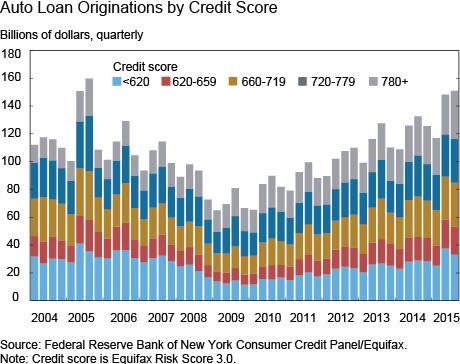
In order to generate more vehicle purchases, these companies have incentivized consumers with hot, hard-to-resist offers, similar to the infamous “liar loans” and “no-money down” loans of the 2008 recession. Dealerships have increased spending on sales incentives by 14 percent since last year alone, and the banners in their shops now proudly proclaim their acceptance of any and all loan applications — “No Credit. Bad Credit. All Credit. 100 Percent Approval.” As a result, auto loans have increased by nearly $80 billion since 2009, many of which have been given to individuals with far-from-stellar credit scores. Today, almost 20 percent of all auto loans are given to individuals with credit scores below 620:

Behnke 2.pngSource: New York Fed

Not only are more auto loans being originated, but they are also increasing in duration. The average loan term is now sixty-seven months (that’s 5.58 years) for new cars and sixty-two (that’s 5.16 years) months for used cars. Both are record numbers.

Average transaction prices for new and used cars are also at their record highs. Used car prices have increased by nearly 25 percent since 2009, while new car prices have increased by over 15 percent. Part of this has to do with the increasing demand for cars generated by the upsurge in auto loans. The main reason, however, is that consumers — taking advantage of the accessibility of cheap credit — are purchasing more expensive body styles. This follows the housing bubble trend, when the median size of a newly built single-family home rose to 2,272 square feet at the start of 2007.

We all know the end result of the Great Recession — prices soared, millions of houses were foreclosed, and unemployment surged. Demand for homes then plummeted, and home prices ultimately dropped by 20 percent each month.

The auto bubble has yet to burst, but its negative effects are already starting to gradually appear. For one, delinquencies on car loans have increased by nearly 120 percent, from just over 1 percent in 2010 to 2.62 percent in 2014. Since cars rapidly depreciate in value, this number is projected to spike. By the time these six, seven, and eight year no-money down loans are due to be paid in full, many of these vehicles won’t be worth paying off anymore — maintenance and loan costs will start exceeding the value of the cars.

According to the Center for Responsible Lending, one in every six title-loan borrowers is already facing repossession fees. If defaults sharply increase in the coming years as projected, the market will become flooded with used cars, and their prices will, with near certainty, fall to a significant degree.

At a time when labor force participation is at its lowest level since 1977 — at a time when real wages are rising less than they have since at least the 1980s — it is imperative that the Federal Reserve stop misleading individuals into making irrational investments. The economy is simply too frail to continue weathering these endless business cycles. Economists, politicians, and the general populace need to start learning from their economic history so they can begin recognizing that favoring debt over thrift isn’t beneficial to the country’s financial well-being. Failure to do so will simply lead to more bubbles, more malinvestment, and more economic headaches in the years to come.

Tommy Behnke is an economics major and Mises University alumnus.

This article was published on Mises.org and may be freely distributed, subject to a Creative Commons Attribution United States License, which requires that credit be given to the author.

Do We Need the Fed? – Article by Ron Paul

Do We Need the Fed? – Article by Ron Paul

The New Renaissance HatRon Paul
******************************

Stocks rose Wednesday following the Federal Reserve’s announcement of the first interest rate increase since 2006. However, stocks fell just two days later. One reason the positive reaction to the Fed’s announcement did not last long is that the Fed seems to lack confidence in the economy and is unsure what policies it should adopt in the future.

At her Wednesday press conference, Federal Reserve Chair Janet Yellen acknowledged continuing “cyclical weakness” in the job market. She also suggested that future rate increases are likely to be as small, or even smaller, than Wednesday’s. However, she also expressed concerns over increasing inflation, which suggests the Fed may be open to bigger rate increases.

Many investors and those who rely on interest from savings for a substantial part of their income cheered the increase. However, others expressed concern that even this small rate increase will weaken the already fragile job market.

These critics echo the claims of many economists and economic historians who blame past economic crises, including the Great Depression, on ill-timed money tightening by the Fed. While the Federal Reserve is responsible for our boom-bust economy, recessions and depressions are not caused by tight monetary policy. Instead, the real cause of economic crisis is the loose money policies that precede the Fed’s tightening.

When the Fed floods the market with artificially created money, it lowers the interest rates, which are the price of money. As the price of money, interest rates send signals to businesses and investors regarding the wisdom of making certain types of investments. When the rates are artificially lowered by the Fed instead of naturally lowered by the market, businesses and investors receive distorted signals. The result is over-investment in certain sectors of the economy, such as housing.

This creates the temporary illusion of prosperity. However, since the boom is rooted in the Fed’s manipulation of the interest rates, eventually the bubble will burst and the economy will slide into recession. While the Federal Reserve may tighten the money supply before an economic downturn, the tightening is simply a futile attempt to control the inflation resulting from the Fed’s earlier increases in the money supply.

After the bubble inevitably bursts, the Federal Reserve will inevitably try to revive the economy via new money creation, which starts the whole boom-bust cycle all over again. The only way to avoid future crashes is for the Fed to stop creating inflation and bubbles.

Some economists and policy makers claim that the way to stop the Federal Reserve from causing economic chaos is not to end the Fed but to force the Fed to adopt a “rules-based” monetary policy. Adopting rules-based monetary policy may seem like an improvement, but, because it still allows a secretive central bank to manipulate the money supply, it will still result in Fed-created booms and busts.

The only way to restore economic stability and avoid a major economic crisis is to end the Fed, or at least allow Americans to use alternative currencies. Fortunately, more Americans than ever are studying Austrian economics and working to change our monetary system.

Thanks to the efforts of this growing anti-Fed movement, Audit the Fed had twice passed the House of Representatives, and the Senate is scheduled to vote on it on January 12. Auditing the Fed, so the American people can finally learn the full truth about the Fed’s operations, is an important first step in restoring a sound monetary policy. Hopefully, the Senate will take that step and pass Audit the Fed in January.

Ron Paul, MD, is a former three-time Republican candidate for U. S. President and Congressman from Texas.

This article is reprinted with permission from the Ron Paul Institute for Peace and Prosperity.


How Money Disappears in a Fractional-Reserve Money System – Article by Frank Shostak

How Money Disappears in a Fractional-Reserve Money System – Article by Frank Shostak

The New Renaissance Hat
Frank Shostak
******************************

Most experts are of the view that the massive monetary pumping by the US central bank during the 2008 financial crisis saved the US and the world from another Great Depression. On this the Federal Reserve Chairman at the time Ben Bernanke is considered the man that saved the world. Bernanke in turn attributes his actions to the writings of Professor Milton Friedman who blamed the Federal Reserve for causing the Great Depression of 1930s by allowing the money supply to plunge by over 30 percent.

Careful analysis will however show that it is not a collapse in the money stock that sets in motion an economic slump as such, but rather the prior monetary pumping that undermines the pool of real funding that leads to an economic depression.

Improving the Economy Requires Time and Savings
Essentially, the pool of real funding is the quantity of consumer goods available in an economy to support future production. In the simplest of terms: a lone man on an island is able to pick twenty-five apples an hour. With the aid of a picking tool, he is able to raise his output to fifty apples an hour. Making the tool, (adding a stage of production) however, takes time.

During the time he is busy making the tool, the man will not be able to pick any apples. In order to have the tool, therefore, the man must first have enough apples to sustain himself while he is busy making it. His pool of funding is his means of sustenance for this period—the quantity of apples he has saved for this purpose.

The size of this pool determines whether or not a more sophisticated means of production can be introduced. If it requires one year of work for the man to build this tool, but he has only enough apples saved to sustain him for one month, then the tool will not be built—and the man will not be able to increase his productivity.

The island scenario is complicated by the introduction of multiple individuals who trade with each other and use money. The essence, however, remains the same: the size of the pool of funding sets a brake on the implementation of more productive stages of production.

When Banks Create the Illusion of More Wealth
Trouble erupts whenever the banking system makes it appear that the pool of real funding is larger than it is in reality. When a central bank expands the money stock, it does not enlarge the pool of funding. It gives rise to the consumption of goods, which is not preceded by production. It leads to less means of sustenance.

As long as the pool of real funding continues to expand, loose monetary policies give the impression that economic activity is being boosted. That this is not the case becomes apparent as soon as the pool of real funding begins to stagnate or shrink. Once this happens, the economy begins its downward plunge. The most aggressive loosening of money will not reverse the plunge (for money cannot replace apples).

The introduction of money and lending to our analysis will not alter the fact that the subject matter remains the pool of the means of sustenance. When an individual lends money, what he in fact lends to borrowers is the goods he has not consumed (money is a claim on real goods). Credit then means that unconsumed goods are loaned by one productive individual to another, to be repaid out of future production.

The existence of the central bank and fractional reserve banking permits commercial banks to generate credit, which is not backed up by real funding (i.e., it is credit created out of “thin air”).

Once the unbacked credit is generated it creates activities that the free market would never approve. That is, these activities are consuming and not producing real wealth. As long as the pool of real funding is expanding and banks are eager to expand credit, various false activities continue to prosper.

Whenever the extensive creation of credit out of “thin air” lifts the pace of real-wealth consumption above the pace of real-wealth production this undermines the pool of real funding.

Consequently, the performance of various activities starts to deteriorate and banks’ bad loans start to rise. In response to this, banks curtail their loans and this in turn sets in motion a decline in the money stock.

Does every curtailment of lending cause the decline in the money stock?

For instance, Tom places $1,000 in a savings deposit for three months with Bank X. The bank in turn lends the $1,000 to Mark for three months. On the maturity date, Mark repays the bank $1,000 plus interest. Bank X in turn after deducting its fees returns the original money plus interest to Tom.

So what we have here is that Tom lends (i.e., gives up for three months) $1,000. He transfers the $1,000 through the mediation of Bank X to Mark. On the maturity date Mark repays the money to Bank X. Bank X in turn transfers the $1,000 to Tom. Observe that in this case existent money is moved from Tom to Mark and then back to Tom via the mediation of Bank X. The lending is fully backed here by $1,000. Obviously the $1,000 here doesn’t disappear once the loan is repaid to the bank and in turn to Tom.

Why the Money Supply Shrinks
Things are, however, completely different when Bank X lends money out of thin air. How does this work? For instance, Tom exercises his demand for money by holding some of his money in his pocket and the $1,000 he keeps in the Bank X demand deposit. By placing $1,000 in the demand deposit he maintains total claim on the $1,000. Now, Bank X helps itself and takes $100 from Tom’s deposit and lends this $100 to Mark. As a result of this lending we now have $1,100 which is backed by $1,000 proper. In short, the money stock has increased by $100. Observe that the $100 loaned doesn’t have an original lender as it was generated out of “thin air” by Bank X. On the maturity date, once Mark repays the borrowed $100 to Bank X, the money disappears.

Obviously if the bank is continuously renewing its lending out of thin air then the stock of money will not fall. Observe that only credit that is not backed by money proper can disappear into thin air, which in turn causes the shrinkage in the stock of money.

In other words, the existence of fractional reserve banking (banks creating several claims on a given dollar) is the key instrument as far as money disappearance is concerned. However, it is not the cause of the disappearance of money as such.

Banks Lend Less as the Quality of Borrowers Worsens
There must be a reason why banks don’t renew lending out of thin air. The main reason is the severe erosion of real wealth that makes it much harder to find good quality borrowers. This in turn means that monetary deflation is on account of prior inflation that has diluted the pool of real funding.

It follows then that a fall in the money stock is just a symptom. The fall in the money stock reveals the damage caused by monetary inflation but it however has nothing to do with the damage.

Contrary to Friedman and his followers (including Bernanke), it is not the fall in the money supply and the consequent fall in prices that burdens borrowers. It is the fact that there is less real wealth. The fall in the money supply, which was created out of “thin air,” puts things in proper perspective. Additionally, as a result of the fall in money, various activities that sprang up on the back of the previously expanding money now find it hard going.

It is those non-wealth generating activities that end up having the most difficulties in serving their debt since these activities were never generating any real wealth and were really supported or funded, so to speak, by genuine wealth generators. (Money out of “thin air” sets in motion an exchange of nothing for something — the transferring of real wealth from wealth generators to various false activities.) With the fall in money out of thin air their support is cut-off.

Contrary to the popular view then, a fall in the money supply (i.e., money out of “thin air”), is precisely what is needed to set in motion the build-up of real wealth and a revitalizing of the economy.

Printing money only inflicts more damage and therefore should never be considered as a means to help the economy. Also, even if the central bank were to be successful in preventing a fall in the money supply, this would not be able to prevent an economic slump if the pool of real funding is falling.

Frank Shostak is an Associated Scholar of the Mises Institute. His consulting firm, Applied Austrian School Economics, provides in-depth assessments and reports of financial markets and global economies. He received his bachelor’s degree from Hebrew University, master’s degree from Witwatersrand University and PhD from Rands Afrikaanse University, and has taught at the University of Pretoria and the Graduate Business School at Witwatersrand University.

This article was originally published by the Ludwig von Mises Institute. Permission to reprint in whole or in part is hereby granted, provided full credit is given.

Does the Bell Toll for the Fed? – Article by Ron Paul

Does the Bell Toll for the Fed? – Article by Ron Paul

The New Renaissance HatRon Paul
November 9, 2015
******************************
Last week Federal Reserve Chair Janet Yellen hinted that the Federal Reserve Board will increase interest rates at the board’s December meeting. The positive jobs report that was released following Yellen’s remarks caused many observers to say that the Federal Reserve’s first interest rate increase in almost a decade is practically inevitable.

However, there are several reasons to doubt that the Fed will increase rates anytime in the near future. One reason is that the official unemployment rate understates unemployment by ignoring the over 94 million Americans who have either withdrawn from the labor force or settled for part-time work. Presumably the Federal Reserve Board has access to the real unemployment numbers and is thus aware that the economy is actually far from full employment.

The decline in the stock market following Friday’s jobs report was attributed to many investors’ fears over the impact of the predicted interest rate increase. Wall Street’s jitters about the effects of a rate increase is another reason to doubt that the Fed will soon increase rates. After all, according to former Federal Reserve official Andrew Huszar, protecting Wall Street was the main goal of “quantitative easing,” so why would the Fed now risk a Christmastime downturn in the stock markets?

Donald Trump made headlines last week by accusing Janet Yellen of keeping interest rates low because she does not want to risk another economic downturn in President Obama’s last year in office. I have many disagreements with Mr. Trump, but I do agree with him that the Federal Reserve’s polices may be influenced by partisan politics.

Janet Yellen would hardly be the first Fed chair to allow politics to influence decision-making. Almost all Fed chairs have felt pressure to “adjust” monetary policy to suit the incumbent administration, and almost all have bowed to the pressure. Economists refer to the Fed’s propensity to tailor monetary policy to suit the needs of incumbent presidents as the “political” business cycle.

Presidents of both parties, and all ideologies, have interfered with the Federal Reserve’s conduct of monetary policy. President Dwight D. Eisenhower actually threatened to force the Fed chair to resign if he did not give in to Ike’s demands for easy money, while then-Federal Reserve Chair Arthur Burns was taped joking about Fed independence with President Richard Nixon.

The failure of the Fed’s policies of massive money creation, corporate bailouts, and quantitative easing to produce economic growth is a sign that the fiat money system’s day of reckoning is near. The only way to prevent the monetary system’s inevitable crash from causing a major economic crisis is the restoration of a free-market monetary policy.

One positive step Congress may take this year is passing the Audit the Fed bill. Fortunately, Senator Rand Paul is using Senate rules to force the Senate to hold a roll-call vote on Audit the Fed. The vote is expected to take place in the next two-to-three weeks. If Audit the Fed passes, the American people can finally learn the full truth about the Fed’s operations. If it fails, the American people will at least know which senators side with them and which ones side with the Federal Reserve.

Allowing a secretive central bank to control monetary policy has resulted in an ever-expanding government, growing income inequality, a series of ever-worsening economic crises, and a steady erosion of the dollar’s purchasing power. Unless this system is changed, America, and the world, will soon experience a major economic crisis. It is time to finally audit, then end, the Fed.

Ron Paul, MD, is a former three-time Republican candidate for U. S. President and Congressman from Texas.

This article is reprinted with permission from the Ron Paul Institute for Peace and Prosperity.