Browsed by
Tag: Federal Reserve

The Fed Desperately Tries to Maintain the Status Quo – Article by Ronald-Peter Stöferle

The Fed Desperately Tries to Maintain the Status Quo – Article by Ronald-Peter Stöferle

The New Renaissance HatRonald-Peter Stöferle
November 5, 2015
******************************

During the press conferences of recent FOMC meetings, millions of well-educated investment professionals have been sitting in front of their screens, chewing their fingernails, listening as if spellbound to what Janet Yellen has to tell them. Will she finally raise the federal funds rate that has been zero bound for over six years?

Obviously, each decision is accompanied by nervousness on the markets. Investors are fixated by a fidgety curiosity ahead of each Fed decision and never fail to meticulously observe Janet Yellen and the FOMC, and engage in monetary ornithology on doves (growth- and employment-oriented FOMC members) and hawks (inflation-oriented FOMC members).

Fed watchers also hope for some enlightening information from Ben Bernanke. According to Reuters, some market participants paid some $250,000 just to join one of several dinners, where the ex-chairman spilled the beans. Apparently, he does not expect the federal funds rate to return to its long-term average of about 4 percent during his lifetime.

In a conversation with Jim Rickards, Bernanke stated that a rate hike would only be possible in an environment in which “the U.S. economy is growing strongly enough to bear the costs of higher rates.” Moreover, a rate increase would have to be clearly communicated and anticipated by the markets — not to protect individual investors from losses, Bernanke assures us, but rather to prevent jeopardizing the stability of the “system as a whole.”

It is axiomatic that zero-interest-rate-policy (ZIRP) cannot be a permanent fixture. Indeed, Janet Yellen has been going on about increasing rates for almost two years now. But, how much more lead time will it require to “prepare” the markets? In both September and October the FOMC chickened out, even though we are not talking about hiking the rate back to “monetary normalcy” in one blow. The decision on the table is whether or not to increase the rate by a trifling quarter point!

The Fed’s quandary can be understood a little better by examining what “monetary normalcy,” or a “normal interest rate,” is supposed to be. Or, even more fundamentally: what is an interest rate?

We “Austrians” understand an interest rate as an expression of market participants’ time preference. The underlying assumption is that people are inclined to consume a certain product sooner rather than later. Hence, if savers restrict their current consumption and provide the resources for investment instead, they do so only on condition that they will be compensated by increased opportunities for consumption in the future. In free markets, the interest rate can be regarded as a measure of the compensation payment, where people are willing to trade present goods for future goods. Such an interest rate is commonly referred to as the “natural interest rate.” Consequently, the FOMC bureaucrats would ideally set as a goal a “normal interest rate” that equals the “natural” one.This, however, remains unlikely.

Six Years of “Unconventional” Monetary Policy
ZIRP was introduced six years ago in response to the financial crisis, and three QE programs have been conducted. This so-called “unconventional monetary policy” is supposed to be abandoned as soon as the economy has gathered pace. Despite the tremendous magnitude of these market interventions, the momentum in the US economy is rather lame. Weak Q1 data, which probably resulted from a weak trade balance due to a 15 percent rise of the US dollar, shocked even the most pessimistic of analysts; the OECD and the IMF have revised down their 2015 growth estimates. A long-lasting, self-sustaining growth is out of the question. This confirms the assumption that ZIRP fuels everything under the sun — see “The Unseen Consequences of Zero-Interest-Rate Policy” — except long-term productive investment.And what about unemployment and inflation that are key elements of the Fed’s mandate? The conventional unemployment rate (U3) has returned to its long-run normal level, so the view prevails that things are developing well. However, those figures conceal a workforce participation rate that has fallen by more than 3 percent since 2008, indicating that some 2.5 million Americans are currently no longer actively looking for a new job. However, should the economic situation improve, they would likely rejoin the labor force. Furthermore, the proportion of those only working part-time due to a lack of full-time positions is much higher now than before the crisis. “True” unemployment currently stands rather at about 7.25 percent.

A Weak Economy and Weak Inflation
With regard to inflation, the Fed’s target is 2 percent, as measured by growth of the PCE-index. This aims to buffer the fiat money system against the threat of price deflation. In a deflationary environment, it is believed, the debt-servicing capacity of market participants (e.g., governments, private enterprises, financial institutions, and private households) would come under intense pressure and likely trigger a chain reaction in which loans collapse and the monetary system implodes.

In many countries, and among them the US, inflation is remarkably low — partly due to transitory effects of lower energy and import prices — while low interest rates have merely weaved their way to asset price inflation so far. But, as price reactions to monetary policy maneuvers may occur with a lag of a few years, we should expect that sooner or later inflation will also spill over to normal markets.

As a response to anything short of massive improvement of economic and employment data, a rate hike is scarcely likely, and inflation in the short-term is also unlikely. Moreover, the current composition of the FOMC — which is extremely dovish — implies inflation-sensitive voices are relatively underrepresented. This gives rise to the suspicion that rate hikes are not very likely at all in the scenario in the short-term.

What Will the Fed Do If There’s Real Economic Trouble?
One is concerned about economic development, which has a shaky foundation and headwinds from other parts of the world; it appears that growth has cooled down substantially in the BRICS countries. Meanwhile, China might be on the brink of a severe recession. (Indeed, China was possibly the most decisive factor to nudge the Fed away from raising rates in September and October.) This implies that world-wide interest rates will remain at very low levels and a significant rate hike in the US would represent a sharp deviation in this environment, bringing with it massive competitive disadvantages.

The markets are noticeably pricing out a significant rate hike. The production structure has long since adapted to ZIRP and “short-term gambling, punting on momentum-driven moves, on levered buybacks” are further lifting the opportunity costs of abandoning it. In order to try to rescue its credibility, the Fed may decide to try some timid, quarter-point increases.

But what will they do if markets really crash? Indeed, they are terrified of the avalanche that they might trigger. If there are any symptoms that portend calamity, the Fed will inevitably return to ZIRP, launch a QE4, or might even introduce negative interest rates. Hence, there does not seem to be a considerable degree of latitude such that a return to conventional monetary policy could seriously be expected.

“The Fed is raising rates!” — This has become a running gag.

Ronald-Peter Stöferle is a Chartered Market Technician (CMT) and a Certified Financial Technician (CFTe). During his studies in business administration and finance at the Vienna University of Economics and the University of Illinois at Urbana-Champaign, he worked for Raiffeisen Zentralbank (RZB) in the field of Fixed Income/Credit Investments. In 2006 he began writing reports on gold. His six benchmark reports called “In GOLD we TRUST” drew international coverage on CNBC, Bloomberg, the Wall Street Journal, The Economist and the Financial Times. He was awarded “2nd most accurate gold analyst” by Bloomberg in 2011.

This article was originally published by the Ludwig von Mises Institute. Permission to reprint in whole or in part is hereby granted, provided full credit is given.

Today’s War Against Deflation Will Make Us Poorer – Article by Frank Shostak

Today’s War Against Deflation Will Make Us Poorer – Article by Frank Shostak

The New Renaissance HatFrank Shostak
October 29, 2015
******************************

The yearly growth rate of the US consumer price index (CPI) fell to 0 percent in September 2015, from 0.2 percent in August and, 1.7 percent in September last year.

The yearly growth rate of the European Monetary Union CPI fell to minus 0.1 percent in September from 0.1 percent in the previous month and 0.3 percent in September last year.
Shostak 1 102915_0
Also, the growth momentum of the UK CPI fell into the negative in September with the yearly growth rate closing at minus 0.1 percent from 0 percent in August and 1.2 percent in September last year.

The growth momentum of China’s CPI eased in September with the yearly growth rate falling to 1.6 percent from 2 percent in August.

Shostak 2 102915
Deflation Fears Gain Steam
Consequently, many experts are expressing concern regarding the declining growth momentum of the CPI and are of the view that rather than tightening the monetary stance, central banks should loosen their stance further in order to counter the emergence of deflation, which is regarded as a major threat to economic well-being of individuals. For most experts, deflation is bad news since it generates expectations of a decline in prices. As a result, they believe, consumers are likely to postpone their buying of goods at present since they expect to buy these goods at lower prices in the future. This weakens the overall flow of spending and in turn weakens the economy. Hence, such commentators believe that policies that counter deflation will also counter the slump.
***
Will Reversing Deflation Prevent a Slump?

If deflation leads to an economic slump, then policies that reverse deflation should be good for the economy, so it is held.

Reversing deflation will simply involve introducing policies that support general increases in the prices of goods, i.e., price inflation. With this way of thinking inflation could actually be an agent of economic growth.

According to most experts, a little bit of inflation can actually be a good thing. Mainstream economists believe that inflation of 2 percent is not harmful to economic growth, but that inflation of 10 percent could be bad for the economy.

There’s good reason to believe, however, that at a rate of inflation of 10 percent, it is likely that consumers are going to form rising inflation expectations.

According to popular thinking, in response to a high rate of inflation, consumers will speed up their expenditures on goods at present, which should boost economic growth. So why then is a rate of inflation of 10 percent or higher regarded by experts as a bad thing?

Clearly there is a problem with the popular way of thinking.

Price Inflation vs. Money-Supply Inflation
Inflation is not about general increases in prices as such, but about the increase in the money supply. As a rule the increase in the money supply sets in motion general increases in prices. This, however, need not always be the case.

The price of a good is the amount of money asked per unit of it. For a constant amount of money and an expanding quantity of goods, prices will actually fall.

Prices will also fall when the rate of increase in the supply of goods exceeds the rate of increase in the money supply.

For instance, if the money supply increases by 5 percent and the quantity of goods increases by 10 percent, prices will fall by 5 percent.

A fall in prices cannot conceal the fact that we have inflation of 5 percent here on account of the increase in the money supply.

The Problem Is Really Wealth Formation, not Rising Prices
The reason why inflation is bad news is not because of increases in prices as such, but because of the damage inflation inflicts to the wealth-formation process. Here is why:

The chief role of money is the medium of exchange. Money enables us to exchange something we have for something we want.

Before an exchange can take place, an individual must have something useful that he can exchange for money. Once he secures the money, he can then exchange it for the good he wants.

But now consider a situation in which the money is created “out of thin air,” increasing the money supply.

This new money is no different from counterfeit money. The counterfeiter exchanges the printed money for goods without producing anything useful.

He in fact exchanges nothing for something. He takes from the pool of real goods without making any contribution to the pool.

The economic effect of money that was created out of thin air is exactly the same as that of counterfeit money — it impoverishes wealth generators.

The money created out of thin air diverts real wealth toward the holders of new money. This weakens the wealth generators’ ability to generate wealth and this in turn leads to a weakening in economic growth.

Note that as a result of the increase in the money supply what we have here is more money per unit of goods, and thus, higher prices.

What matters however is not that price rises, but the increase in the money supply that sets in motion the exchange of nothing for something, or “the counterfeit effect.”

The exchange of nothing for something, as we have seen, weakens the process of real wealth formation. Therefore, anything that promotes increases in the money supply can only make things much worse.

Why Falling Prices Are Good
Since changes in prices are just a symptom, as it were — and not the primary causative factor — obviously countering a falling growth momentum of the CPI by means of loose a monetary policy (i.e., by creating inflation) is bad news for the process of wealth generation, and hence for the economy.

In order to maintain their lives and well-being, individuals must buy goods and services in the present. So from this perspective a fall in prices cannot be bad for the economy.

Furthermore, if a fall in the growth momentum of prices emerges on the back of the collapse of bubble activities in response to a softer monetary growth then this should be seen as good news. The less non-productive bubble activities that are around the better it is for the wealth generators and hence for the overall pool of real wealth.

Likewise, if a fall in the growth momentum of the CPI emerges on account of the expansion in real wealth for a given stock of money, this is obviously great news since many more people could now benefit from the expanding pool of real wealth.

We can thus conclude that contrary to the popular view, a fall in the growth momentum of prices is always good news for the wealth generating process and hence for the economy.

Frank Shostak is an Associated Scholar of the Mises Institute. His consulting firm, Applied Austrian School Economics, provides in-depth assessments and reports of financial markets and global economies. He received his bachelor’s degree from Hebrew University, master’s degree from Witwatersrand University and PhD from Rands Afrikaanse University, and has taught at the University of Pretoria and the Graduate Business School at Witwatersrand University.

This article was originally published by the Ludwig von Mises Institute. Permission to reprint in whole or in part is hereby granted, provided full credit is given.

The Fed Can’t Raise Rates, But Must Pretend It Will – Article by Thorsten Polleit

The Fed Can’t Raise Rates, But Must Pretend It Will – Article by Thorsten Polleit

The New Renaissance HatThorsten Polleit
October 26, 2015
******************************

Waiting for Godot is a play written by the Irish novelist Samuel B. Beckett in the late 1940s in which two characters, Vladimir and Estragon, keep waiting endlessly and in vain for the coming of someone named Godot. The storyline bears some resemblance to the Federal Reserve’s talk about raising interest rates.

Since spring 2013, the Fed has been playing with the idea of raising rates, which it had suppressed to basically zero percent in December 2008. So far, however, it has not taken any action. Upon closer inspection, the reason is obvious. With its policy of extremely low interest rates, the Fed is fueling an artificial economic expansion and inflating asset prices.

Selected US Interest Rates in Percent

Raising short-term rates would be like taking away the punch bowl just as the party gets going. As rates rise, the economy’s production and employment structure couldn’t be upheld. Neither could inflated bond, equity, and housing prices. If the economy slows down, let alone falls back into recession, the Fed’s fiat money pipe dream would run into serious trouble.

This is the reason why the Fed would like to keep rates at the current suppressed levels. A delicate obstacle to such a policy remains, though: If savers and investors expect that interest rates will remain at rock bottom forever, they would presumably turn their backs on the credit market. The ensuing decline in the supply of credit would spell trouble for the fiat money system.

To prevent this from happening, the Fed must achieve two things. First, it needs to uphold the expectation in financial markets that current low interest rates will be increased again at some point in the future. If savers and investors buy this story, they will hold onto their bank deposits, money market funds, bonds, and other fixed income products despite minuscule yields.

Second, the Fed must succeed in continuing to postpone rate hikes into the future without breaking peoples’ expectation that rates will rise at some point. It has to send out the message that rates will be increased at, say, the forthcoming FOMC meeting. But, as the meeting approaches, the Fed would have to repeat its trickery, pushing the possible date for a rate hike still further out.

If the Fed gets away with this “Waiting for Godot” strategy, savings will keep flowing into credit markets. Borrowers can refinance their maturing debt with new loans and also increase total borrowing at suppressed interest rates. The economy’s debt load can continue to build up, with the day of reckoning being postponed for yet again.

However, there is the famous saying: “You can fool all the people some of the time and some of the people all the time, but you cannot fool all the people all the time.” What if savers and investors eventually become aware that the Fed will not bring interest rates back to “normal” but keep them at basically zero, or even push them into negative territory?

If a rush for the credit market exit would set in, it would be upon the Fed to fill debtors’ funding gap in order to prevent the fiat system from collapsing. The central bank would have to monetize outstanding and newly originated debt on a grand scale, sending downward the purchasing power of the US dollar — and with it many other fiat currencies around the world.

The “Waiting for Godot” strategy does not rule out that the Fed might, at some stage, nudge upward short-term borrowing costs. However, any rate action should be minor and rather short-lived (like they were in Japan), and it wouldn’t bring interest rates back to “normal.” The underlying logic of the fiat money system simply wouldn’t admit it.

Selected Japanese Interest Rates in Percent

The Fed — and basically all central banks around the world — are unlikely to accept deflation clearing out the debt, which would topple the economic and political structures built upon it. Fending off an approaching recession-depression with more credit-created fiat money and extremely low, perhaps even negative, interest rates is what one can expect them to do.

Murray N. Rothbard put it succinctly: “We can look forward … not precisely to a 1929-type depression, but to an inflationary depression of massive proportions.”

Dr. Thorsten Polleit is the Chief Economist of Degussa (www.degussa-goldhandel.de) and Honorary Professor at the University of Bayreuth. He is the winner of the O.P. Alford III Prize in Political Economy and has been published in the Austrian Journal of Economics. His personal website is www.thorsten-polleit.com.

This article was published on Mises.org and may be freely distributed, subject to a Creative Commons Attribution United States License, which requires that credit be given to the author.

Congress Fiddles While the Economy Burns – Article by Ron Paul

Congress Fiddles While the Economy Burns – Article by Ron Paul

The New Renaissance HatRon Paul
September 14, 2015
******************************

Reports that the official unemployment rate has fallen to 5.1 percent may appear to vindicate the policies of easy money, corporate bailouts, and increased federal spending. However, even the mainstream media has acknowledged that the official numbers understate the true unemployment rate. This is because the federal government’s unemployment figures do not include the 94 million Americans who have given up looking for work or who have settled for part-time employment. John Williams of Shadow Government Statistics estimates the real unemployment rate is between 23 and 24 percent.

Disappointingly, but not surprisingly, few in Washington, DC acknowledge that America’s economic future is endangered by excessive spending, borrowing, taxing, and inflating. Instead, Congress continues to waste taxpayer money on futile attempts to run the economy, run our lives, and run the world.

For example, Congress spent the majority of last week trying to void the Iranian nuclear agreement. This effort was spearheaded by those who think the US should waste trillions of dollars on another no-win Middle East war. Congressional war hawks ignore how America’s hyper-interventionist foreign policy feeds the growing rebellion against the dollar’s world reserve currency status. Of course, the main reason many are seeking an alternative to the dollar is their concern that, unless Congress stops creating — and the Federal Reserve stops monetizing — massive deficits, the US will experience a Greek-like economic crisis.

Despite the clear need to reduce federal spending, many Republicans are trying to cut a deal with the Democrats to increase spending. These alleged conservatives are willing to lift the “sequestration” limits on welfare spending if President Obama and congressional democrats support lifting the “sequestration” limits on warfare spending. Even sequestration’s minuscule, and largely phony, cuts are unbearable for the military-industrial complex and the rest of the special interests that control our federal government.

The only positive step toward addressing our economic crisis that the Senate may take this year is finally holding a roll call vote on the Audit the Fed legislation. Even if the audit legislation lacks sufficient support to overcome an expected presidential veto, just having a Senate vote will be a major step forward.

Passage of the Audit the Fed bill would finally allow the American people to know the full truth about the Fed’s operations, including its deals with foreign central banks and Wall Street firms. Revealing the full truth about the Fed will likely increase the number of Americans demanding that Congress end the Fed’s monetary monopoly. This suspicion is confirmed by the hysterical attacks on and outright lies about the audit legislation spread by the Fed and its apologists.

Every day, the American people see evidence that, despite the phony statistics and propaganda emanating from Washington, high unemployment and rising inflation plague the economy. Economic anxiety has led many Americans to support an avowed socialist’s presidential campaign. Perhaps more disturbingly, many other Americans are supporting the campaign of an authoritarian crony capitalist. If there is a major economic collapse, many more Americans — perhaps even a majority — will embrace authoritarianism. An economic crisis could also lead to mob violence and widespread civil unrest, which will be used to justify new police state measures and crackdowns on civil liberties.

Unless the people demand an end to the warfare state, the welfare state, and fiat money, our economy will continue to deteriorate until we are faced with a major crisis. This crisis can only be avoided by rejecting the warfare state, the welfare state, and fiat money. Those of us who know the truth must redouble our efforts to spread the ideas of liberty.

Ron Paul, MD, is a former three-time Republican candidate for U. S. President and Congressman from Texas.

This article is reprinted with permission from the Ron Paul Institute for Peace and Prosperity.

Blame the Federal Reserve, Not China, for Stock-Market Crash – Article by Ron Paul

Blame the Federal Reserve, Not China, for Stock-Market Crash – Article by Ron Paul

The New Renaissance HatRon Paul
September 6, 2015
******************************

Following the historic stock-market downturn two weeks ago, many politicians and so-called economic experts rushed to the microphones to explain why the market crashed and to propose “solutions” to our economic woes. Not surprisingly, most of those commenting not only failed to give the right answers, they failed to ask the right questions.

Many blamed the crash on China’s recent currency devaluation. It is true that the crash was caused by a flawed monetary policy. However, the fault lies not with China’s central bank but with the US Federal Reserve. The Federal Reserve’s inflationary policies distort the economy, creating bubbles, which in turn create a booming stock market and the illusion of widespread prosperity. Inevitably, the bubble bursts, the market crashes, and the economy sinks into a recession.

An increasing number of politicians have acknowledged the flaws in our monetary system. Unfortunately, some members of Congress think the solution is to force the Fed to follow a “rules-based” monetary policy. Forcing the Fed to “follow a rule” does not change the fact that giving a secretive central bank the power to set interest rates is a recipe for economic chaos. Interest rates are the price of money, and, like all prices, they should be set by the market, not by a central bank and certainly not by Congress.

Instead of trying to “fix” the Federal Reserve, Congress should start restoring a free-market monetary system. The first step is to pass the Audit the Fed legislation so the people can finally learn the full truth about the Fed. Congress should also pass legislation ensuring individuals can use alternative currencies free of federal-government harassment.

When bubbles burst and recessions hit, Congress and the Federal Reserve should refrain from trying to “stimulate” the economy via increased spending, corporate bailouts, and inflation. The only way the economy will ever fully recover is if Congress and the Fed allow the recession to run its course.

Of course, Congress and the Fed are unlikely to “just stand there” if the economy further deteriorates. There have already been reports that the Fed will use last week’s crash as an excuse to once again delay raising interest rates. Increased spending and money creation may temporally boost the economy, but eventually they will lead to a collapse in the dollar’s value and an economic crisis more severe than the Great Depression.

Ironically, considering how popular China-bashing has become, China’s large purchase of US Treasury notes has helped the US postpone the day of reckoning. The main reason countries like China are eager to help finance our debt is the dollar’s world reserve currency status. However, there are signs that concerns over the US government’s fiscal irresponsibility and resentment of our foreign policy will cause another currency (or currencies) to replace the dollar as the world reserve currency. If this occurs, the US will face a major dollar crisis.

Congress will not adopt sensible economic policies until the people demand it. Unfortunately, while an ever-increasing number of Americans are embracing Austrian economics, too many Americans still believe they must sacrifice their liberties in order to obtain economic and personal security. This is why many are embracing a charismatic crony capitalist who is peddling a snake oil composed of protectionism, nationalism, and authoritarianism.

Eventually the United States will have to abandon the warfare state, the welfare state, and the fiat money system that fuels leviathan’s growth. Hopefully the change will happen because the ideas of liberty have triumphed, not because a major economic crisis leaves the US government with no other choice.

Ron Paul, MD, is a former three-time Republican candidate for U. S. President and Congressman from Texas.

This article is reprinted with permission from the Ron Paul Institute for Peace and Prosperity.

Bernie Is Wrong: Trade Is Awesome for the Poor and for America – Article by Corey Iacono

Bernie Is Wrong: Trade Is Awesome for the Poor and for America – Article by Corey Iacono

The New Renaissance HatCorey Iacono
August 28, 2015

******************************

The socialist senator is totally wrong about free trade

Sen. Bernie Sanders, the Democratic presidential hopeful, is no fan of free trade. In an interview with Vox, Sanders’ made his anti-trade position clear: “Unfettered free trade has been a disaster for the American people.”

He also noted that he voted against all the free trade agreements that were proposed during his time in Congress and that if elected President he would “radically transform trade policies” in favor of protectionism.

Sanders and his ilk accuse their intellectual opponents of promoting “trickle-down economics,” but that is precisely what he is advocating when it comes to trade. The argument for protectionism ultimately relies on the belief that protecting domestic corporations from foreign competition and keeping consumer prices high will somehow benefit society as whole.

However, the real effect of protectionism is to increase monopoly and consequently reduce overall economic welfare. In fact, according to a paper by economists at the Federal Reserve Bank of Minneapolis, “Government policies…such as tariffs and other forms of protection are an important source of monopoly” that lead to “significant welfare losses.”

In contrast to Sanders’ assertion that the expansion of free trade has been a disaster for the American people, there is a near unanimous consensus among economists that the opposite is true.

An IGM Poll of dozens of the most renowned academic economists found that, weighted for each respondent’s confidence in their answer, 96 percent of economists agreed, “Freer trade improves productive efficiency and offers consumers better choices, and in the long run these gains are much larger than any effects on employment.”

When the vast majority of economists of all sorts of ideological stripes agree that free trade is a good thing, maybe, just maybe, they’re onto something.

In fact, they surely are. Using four different methods, economists at the Petersen Institute for International Economics estimated the economic benefits from the expansion of technology that facilitates international trade (such as container ships), as well as the removal of government-imposed barriers to international trade (such as tariffs). Since the end of World War II, they generated “an increase in US income of roughly $1 trillion a year,” which translates into an increase in “annual income of about $10,000 per household.”

This result is mostly driven by the fact that foreign businesses produce many goods which are used in the production process at a lower cost than their domestic competitors. Access to these low-cost foreign inputs allows American businesses to decrease their production costs and consequently increase their total output, making the nation as a whole much wealthier than it otherwise would have been.

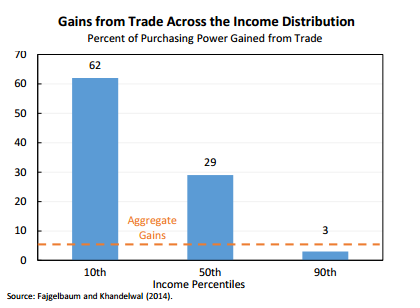
Moreover, contrary to common conjecture, the benefits of international trade haven’t simply accrued to the wealthy alone. Low and middle income individuals tend to spend a greater share of their income on cheap imported consumer goods than those with higher incomes. As a result, international trade tends to benefit these income groups more so than the wealthy.

Corey Iacono Sanders ArticleIndeed, according to the President’s Council of Economic Advisers, middle income consumers have about 29 percent greater purchasing power as a result of international trade.

In other words, middle income consumers can buy 29 percent more goods and services as a result of the access to low-cost imports from foreign countries.

Low income consumers see even greater gains with 62 percent higher purchasing power as a result of trade. In contrast, the top 10 percent of income earners only saw an increase in purchasing power of 3 percent as a result of trade.

On top of that, international trade has provided benefits by bringing new and innovative products to American consumers.

According seminal research by Christian Broda of the University of Chicago and David E. Weinstein of Colombia University, the variety of imported goods increased three-fold from 1972 to 2001. The value to American consumers of this import induced expanded product variety is estimated to be equivalent to 2.6 percent of national income, about $450 billion as of 2014. That’s not exactly small change.

The spread of free trade has also made considerable contributions to environmental protection, gender equality, and global poverty reduction. As a result of the spread of clean technology facilitated by freer trade, “every 1 percent increase in income as a result of trade liberalization (the removal of government-imposed barriers to trade), pollution concentrations fall by 1 percent,” according to the Council of Economic Advisers.

The CEA also has found that “industries with larger tariff declines saw greater reductions in the [gender] wage gap,” suggesting that facilitating foreign competition through trade liberalization reduces the ability of employers to discriminate against women.

In regards to global poverty reduction, research has shown that in response to US import tariff cuts, developing countries, such as Vietnam, export more to the US, leading to higher incomes and less poverty.

Despite the large gains from trade America has already reaped, there is still room for improvement (contrary to Sen. Sanders’ accusations of “unfettered” free trade). The PIIE economists estimate that further trade liberalization would increase “US household income between $4,000 and $5,300 annually,” leading the them to conclude that, “in the future as in the past, free trade can significantly raise income — and quality of life — in the United States.”

Ultimately, the conclusion that most economists seem to reach is that, from being a disaster, the expansion of free trade has been a tremendous success, and that further trade liberalization would most likely make Americans, and the rest of the world, considerably better off.

Don’t let fear-mongering about foreigners and China scare you: free trade benefits everyone, especially the poor, while protectionism benefits only the politically powerful.

Corey Iacono is a student at the University of Rhode Island majoring in pharmaceutical science and minoring in economics. 

This article was published by The Foundation for Economic Education and may be freely distributed, subject to a Creative Commons Attribution 4.0 International License, which requires that credit be given to the author.

Keeping the Bubble-Boom Going – Article by Thorsten Polleit

Keeping the Bubble-Boom Going – Article by Thorsten Polleit

The New Renaissance HatThorsten Polleit
August 19, 2015

******************************

The US Federal Reserve is playing with the idea of raising interest rates, possibly as early as September this year. After a six-year period of virtually zero interest rates, a ramping up of borrowing costs will certainly have tremendous consequences. It will be like taking away the punch bowl on which all the party fun rests.

Low Central Bank Rates have been Fueling Asset Price Inflation

The current situation has, of course, a history to it. Around the middle of the 1990s, the Fed’s easy monetary policy — that of Chairman Alan Greenspan — ushered in the “New Economy” boom. Generous credit and money expansion resulted in a pumping up of asset prices, in particular stock prices and their valuations.

US Federal Funds Rate in Percent and the S&P 500 Stock Market Index

A Brief History of Low Interest Rates

When this boom-bubble burst, the Fed slashed rates from 6.5 percent in January 2001 to 1 percent in June 2003. It held borrowing costs at this level until June 2004. This easy Fed policy not only halted the slowdown in bank credit and money expansion, it sowed the seeds for an unprecedented credit boom which took off as early as the middle of 2002.

When the Fed had put on the brakes by having pushed rates back up to 5.25 percent in June 2006, the credit boom was pretty much doomed. The ensuing bust grew into the most severe financial and economic meltdown seen since the late 1920s and early 1930s. It affected not only in the US, but the world economy on a grand scale.

Thanks to Austrian-school insights, we can know the real source of all this trouble. The root cause is central banks’ producing fake money out of thin air. This induces, and necessarily so, a recurrence of boom and bust, bringing great misery for many people and businesses and eventually ruining the monetary and economic system.

Central banks — in cooperation with commercial banks — create additional money through credit expansion, thereby artificially lowering the market interest rates to below the level that would prevail if there was no credit and money expansion “out of thin air.”

Such a boom will end in a bust if and when credit and money expansion dries up and interest rates go up. In For A New Liberty (1973), Murray N. Rothbard put this insight succinctly:

Like the repeated doping of a horse, the boom is kept on its way and ahead of its inevitable comeuppance by repeated and accelerating doses of the stimulant of bank credit. It is only when bank credit expansion must finally stop or sharply slow down, either because the banks are getting shaky or because the public is getting restive at the continuing inflation, that retribution finally catches up with the boom. As soon as credit expansion stops, the piper must be paid, and the inevitable readjustments must liquidate the unsound over-investments of the boom and redirect the economy more toward consumer goods production. And, of course, the longer the boom is kept going, the greater the malinvestments that must be liquidated, and the more harrowing the readjustments that must be made.

To keep the credit-induced boom going, more credit and more money, provided at ever lower interest rates, are required. Somehow central bankers around the world seem to know this economic insight, as their policies have been desperately trying to encourage additional bank lending and money creation.

Why Raise Rates Now?

Why, then, do the decision makers at the Fed want to increase rates? Perhaps some think that a policy of de facto zero rates is no longer warranted, as the US economy is showing signs of returning to positive and sustainable growth, which the official statistics seem to suggest.

Others might fear that credit market investors will jump ship once they convince themselves that US interest rates will stay at rock bottom forever. Such an expectation could deal a heavy, if not deadly, blow to credit markets, making the unbacked paper money system come crashing down.

In any case, if Fed members follow up their words with deeds, they might soon learn that the ghosts they have been calling will indeed appear — and possibly won’t go away. For instance, higher US rates will suck in capital from around the word, pulling the rug out from under many emerging and developed markets.

What is more, credit and liquidity conditions around the world will tighten, giving credit-hungry governments, corporate banks, and consumers a painful awakening after having been surfing the wave of easy credit for quite some time.

China, which devalued the renminbi exchange rate against the US dollar by a total of 3.5 percent on August 11 and 12, seems to have sent the message that it doesn’t want to follow the Fed’s policy — and has by its devaluation made the Fed’s hiking plan appear as an extravagant undertaking.

A normalization of interest rates, after years of excessively low interest rates, is not possible without a likely crash in production and employment. If the Fed goes ahead with its plan to raise rates, times will get tough in the world’s economic and financial system.

To be on the safe side: It would be the right thing to do. The sooner the artificial boom comes to an end, the sooner the recession-depression sets in, which is the inevitable process of adjusting the economy and allowing an economically sound recovery to begin.

Dr. Thorsten Polleit is the Chief Economist of Degussa (www.degussa-goldhandel.de) and Honorary Professor at the University of Bayreuth. He is the winner of the O.P. Alford III Prize in Political Economy and has been published in the Austrian Journal of Economics. His personal website is www.thorsten-polleit.com.

This article was published on Mises.org and may be freely distributed, subject to a Creative Commons Attribution United States License, which requires that credit be given to the author.

Asset-Price Inflation Enters Its Dangerous Late Phase – Article by Brendan Brown

Asset-Price Inflation Enters Its Dangerous Late Phase – Article by Brendan Brown

The New Renaissance HatBrendan Brown
August 12, 2015
******************************

Asset price inflation, a disease whose source always lies in monetary disorder, is not a new affliction. It was virtually inevitable that the present wild experimentation by the Federal Reserve — joined by the Bank of Japan and ECB — would produce a severe outbreak. And indications from the markets are that the disease is in a late phase, though still short of the final deadly stage characterized by pervasive falls in asset markets, sometimes financial panic, and the onset of recession.

Global Signs of Danger

A key sign of danger, recognizable from historical patterns of how the disease progresses, is the combination of steep speculative temperature falls in some markets, with still-high — and in some cases, soaring — temperatures in other markets. Another sign is some pull-back in the carry trade, featuring, in particular, the uncovered arbitrage between a low (or zero) interest rate, and higher rate currencies. For now, however, this is still booming in some areas of the global market-place. Specifically, we now observe steep falls in commodity markets (also in commodity currencies and mining equities) which were the original area of the global market-place where the QE-asset price inflation disease attacked (back in 2009–11). Previously hot real estate markets in emerging market economies (especially China and Brazil) have cooled at least to a moderate extent. Most emerging market currencies — with the key exception of the Chinese yuan — once the darling of the carry traders, are in ugly bear markets. The Shanghai equity market bubble has burst.Yet in large areas of the high-yield credit markets (including in particular the so-called covenant-lite paper issued by highly leveraged corporations) speculative temperatures remain at scorching levels. Meanwhile, Silicon Valley equities (both in the public and private markets), and private equity funds enjoy fantasy valuations. Ten-year Spanish and Italian government bond yields are hovering below 2 percent, and hot spots in global advanced-economy real estate — whether San Francisco, Sydney, or Vancouver — just seem to get hotter, even though we should qualify these last two observations by noting the slump in the Canadian and Australian dollars. Also, there is tentative evidence that London high-end real estate is weakening somewhat.

How to Identify Late Stages of Asset Inflation

We can identify similar late phases of asset price inflation characterized by highly divergent speculative temperatures across markets in past episodes of the disease. In 1927–28, steep drops of speculative temperature in Florida real estate, the Berlin stock market, and then more generally in US real estate, occurred at the same time as speculative temperatures continued to soar in the US equity market. In the late 1980s, a crash in Wall Street equities (October 1987) did not mark the end-stage of asset price inflation but a late phase of the disease which featured still-rising speculation in real estate and high-yield credits.In the next episode of asset price inflation (the mid-late 1990s), the Asian currency and debt crisis in 1997, and the bursting of the Russian debt bubble the following year, accompanied still rising speculation in equities culminating in the Nasdaq bubble. In the episode of the mid-2000s, the first quakes in the credit markets during summer 2007 did not prevent a further build-up of speculation in equity markets and a soaring of speculative temperatures in winter 2007–08 and spring 2008 in commodity markets, especially oil.What insights can we gain from the identification of the QE-asset price inflation disease as being in a late phase?The skeptics would say not much. Each episode is highly distinct and the disease can “progress” in very different ways. Any prediction as to the next stage and its severity has much more to do with intuition than scientific observation. Indeed some critics go as far as to suggest that diagnosis and prognosis of this disease is so difficult that we should not even list it as such. Historically, such critics have ranged from Milton Friedman and Anna Schwartz (who do not even mention the disease in their epic monetary history of the US), to Alan Greenspan and Ben Bernanke who claimed throughout their years in power — and these included three virulent attacks of asset price inflation originating in the Federal Reserve — that it was futile to try to diagnose bubbles.

We Can’t Ignore the Problem Just Because It’s Hard to Measure

Difficulties in diagnosis though do not mean that the disease is phantom or safely ignored as just a minor nuisance. That observation holds as much in the field of economics as medicine. And indeed there may be a reliable way in which to prevent the disease from emerging in the first place. The critics do not engage with those who argue that the free society’s best defense against the asset price inflation disease is to follow John Stuart Mill’s prescription of making sure that “the monkey wrench does not get into the machinery of money.”Instead, the practitioners of “positive economics” demonstrate an aversion to analyzing a disease which cannot be readily identified by scientific measurement. Yes, the disease corrupts market signals, but by how much, where, and in what time sequence? Some empiricists might acknowledge the defining characteristic of the disease as “where monetary disequilibrium empowers forces of irrationality in global markets.” They might agree that flawed mental processes as described by the behavioral finance theorists become apparent at such times. But they despair at the lack of testable propositions.

Mis-Measuring Increases in Asset Prices

The critics who reject the usefulness of studying asset price inflation have no such qualms with respect to its twin disease — goods and services inflation. After all, we can depend on the official statisticians! In the present monetary inflation, a cumulative large decline in equilibrium real wages across much of the labor market, together with state of the art “hedonic accounting” (adjusting prices downward to take account of quality improvements) has meant that the official CPI has climbed by “only” 11 percent since the peak of the last business cycle (December 2007). The severity of the asset price inflation disease makes it implausible that the official statisticians are measuring correctly the force of monetary inflation in goods and services markets.

What Is the Final Stage?

A progression of the asset price inflation disease into its final stage (general speculative bust and recession) would mean the end of monetary inflation and also inflation in goods and services markets. What could bring about this transition? Most plausibly it will be a splintering of rose-colored spectacles worn by investors in the still hot speculative markets rather than Janet Yellen’s much heralded “lift-off” (raising official short-term rates from zero). What could cause the splinter? Perhaps it will be a sudden rush for the exit in the high-yield credit markets, provoked by alarm at losses on energy-related and emerging market paper. Or financial system stress could jump in consequence of the steep falls of speculative temperature already occurring (including China and commodities). Perhaps there will be a run from those European banks and credit funds which are up to their neck in Spanish and Italian government bonds. Or the Chinese currency could tumble as Beijing pulls back its support and the one trillion US dollar carry trade into the People’s Republic implodes. Perhaps scandal and shock, accompanied by economic disappointment will break the fantasy spell regarding US corporate earnings, especially in Silicon Valley. As the late French President Mitterrand used to say, “give time to Time!”

Brendan Brown is an associated scholar of the Mises Institute and is author of Euro Crash: How Asset Price Inflation Destroys the Wealth of Nations and The Global Curse of the Federal Reserve: Manifesto for a Second Monetarist Revolution. See Brendan Brown’s article archives.

This article was published on Mises.org and may be freely distributed, subject to a Creative Commons Attribution United States License, which requires that credit be given to the author.

The Fed’s Confusion Over the “Natural Rate” of Unemployment and Inflation – Article by Frank Shostak

The Fed’s Confusion Over the “Natural Rate” of Unemployment and Inflation – Article by Frank Shostak

The New Renaissance Hat
Frank Shostak
July 20, 2015
******************************
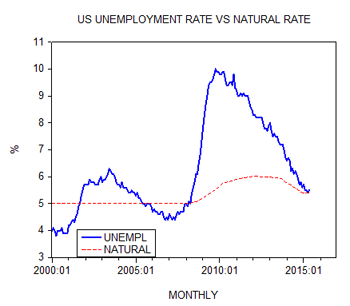
In May, the US unemployment rate stood at 5.5 percent against the rate of 5.3 percent for the “natural unemployment,” also known as the Non-Accelerating Inflation Rate of Unemployment (NAIRU).

According to the popular view, once the actual unemployment rate falls to below the NAIRU, or the natural unemployment rate, the rate of inflation tends to accelerate and economic activity becomes overheated. (This acceleration in the rate of inflation takes place through increases in the demand for goods and services. It also lifts the demand for workers and puts pressure on wages, reinforcing the growth in inflation).

By this way of thinking, the central bank must step in and lift interest rates to prevent the rate of inflation from getting out of control.

daily july 17 350

Recently, however, some experts have raised the possibility that the natural unemployment rate is likely to be much lower than the government official estimate of 5.3 percent. In fact, earlier this year, economists at the Chicago Fed argued that the natural unemployment rate since October last year has fallen to 4.3 percent.

The reasons for this decline are demographic changes and an increase in the level of education. (The natural unemployment rate tends to fall, so it is held, with the rising age of the labor force and with its education.)

Experts are of the view that these factors should continue to lower the natural unemployment rate for at least the remainder of the decade.

It is held that a lower natural rate may help explain why wage inflation and price inflation remain low, despite the actual unemployment rate recently reaching 5.5 percent.

Advocates for a lower natural rate also claim a lower rate would mean the Fed can keep interest rates lower for longer without worrying about lifting the rate of inflation.

Why NAIRU Is an Arbitrary Measure

The NAIRU however, is an arbitrary measure; it is derived from a statistical correlation between changes in the consumer price index and the unemployment rate. What matters here for Fed economists and others is whether the theory “works” (i.e., whether it can predict the future rate of increases in the consumer price index).

This way of thinking doesn’t consider whether a theory corresponds to reality. Here we have a framework, which implies that “anything goes” as long as one can make accurate predictions.

The purpose of a theory however is to present the facts of reality in a simplified form. A theory has to originate from reality and not from some arbitrary idea that is based on a statistical correlation.

If “anything goes,” then we could find by means of statistical methods all sorts of formulas that could serve as forecasting devices.

For example, let us assume that high correlation has been established between the income of Mr. Jones and the rate of growth in the consumer price index — the higher the rate of increase of Mr. Jones’s income, the higher the rate of increase in the consumer price index.

Therefore we could easily conclude that in order to exercise control over the rate of inflation the central bank must carefully watch and control the rate of increases in Mr. Jones’s income. The absurdity of this example matches that of the NAIRU framework.

Inflation Is Not Caused by Increased Economic Activity

Contrary to mainstream thinking, strong economic activity as such doesn’t cause a general rise in the prices of goods and services and economic overheating labeled as inflation.

Regardless of the rate of unemployment, as long as every increase in expenditure is supported by production, no overheating can occur.

The overheating emerges once expenditure is rising without the backup of production — for instance, when the money stock is increasing. Once money increases, it generates an exchange of nothing for something, or consumption without preceding production, which leads to the erosion of real wealth.

As a rule, rises in the money stock are followed by rises in the prices of goods and services.

Prices are another name for the amount of money that people spend on goods they buy.

If the amount of money in an economy increases while the number of goods remains unchanged more money will be spent on the given number of goods i.e., prices will increase.

Conversely, if the stock of money remains unchanged it is not possible to spend more on all the goods and services; hence no general rise in prices is possible. By the same logic, in a growing economy with a growing number of goods and an unchanged money stock, prices will fall.

Frank Shostak is an adjunct scholar of the Mises Institute and a frequent contributor to Mises.org. His consulting firm, Applied Austrian School Economics, provides in-depth assessments and reports of financial markets and global economies.

This article was originally published by the Ludwig von Mises Institute. Permission to reprint in whole or in part is hereby granted, provided full credit is given.

Soros Pushes US Bailouts and Weapons for Ukraine – Article by Ron Paul

Soros Pushes US Bailouts and Weapons for Ukraine – Article by Ron Paul

The New Renaissance Hat
Ron Paul
June 8, 2015
******************************

If you look at the track record of the interventionists you might think they would pause before taking on more projects. Each of their past projects has ended in disaster yet still they press on. Last week the website Zero Hedge posted a report about hacked emails between billionaire George Soros and Ukrainian President Poroshenko.

Soros is very close to the Ukrainian president, who was put in power after a US-backed coup deposed the elected leader of Ukraine last year. In the email correspondence, Soros tells the Ukrainian leadership that the US should provide Ukraine “with same level of sophistication in defense weapons to match the level of opposing force.” In other words, despite the February ceasefire, Soros is pushing behind the scenes to make sure Ukraine receives top-of-the-line lethal weapons from the United States. Of course it will be up to us to pay the bill because Ukraine is broke.

But Soros seems to have the money part covered as well. In an email to Ukrainian leaders, he wrote that Ukraine’s “first priority must be to regain control of financial markets.” Soros told Poroshenko that the IMF would need to come through with a $15 billion package, which was confident would lead the Fed to also come through with more money. He wrote: “the Federal Reserve could be asked to extend a $15 billion three months swap arrangement with the National Bank of Ukraine. That would reassure the markets and avoid a panic.”

How would the Fed be convinced to do that? Soros assured Poroshenko: “I am ready to call Jack Lew of the US Treasury to sound him out about the swap agreement.”

So George Soros will use his influence in the US government to put the American people on the hook for a bankrupt Ukraine — forcing us to pay for weapons, more military training, and Ukraine’s crippling debt.

Who is thrilled with Soros’ drawing the US government into more intervention in the region? The military-industrial complex for one is happy at the prospect of big weapons “sales” to Ukraine. The bankers are thrilled. Washington power-brokers are thrilled. There is something in this for everyone who is politically well-connected. The only losers are the people who will be forced to pay for it, the American taxpayers.

No one seems to ask why we are involved in Ukraine at all. Is it really any of our business if the east wants to break away from the west? Is it a vital US interest which flag the people wish to hang in Donetsk?

One thing we should be sure of is that Ukraine’s debt will not be paid. As in other bailouts, much of it will be transferred to the US taxpayer through the IMF and the Federal Reserve. All of this is only possible because of the perception that the dollar is still the world’s reserve currency. But this too is coming to an end. US military and financial interventionism worldwide are only speeding up the process.

Ron Paul, MD, is a former three-time Republican candidate for U. S. President and Congressman from Texas.

This article is reprinted with permission from the Ron Paul Institute for Peace and Prosperity.