Browsed by
Tag: FEE

Microaggressions and Microwonders – Are Mountains Out of Molehills Proof the World’s Getting Better? – Article by Steven Horwitz

Microaggressions and Microwonders – Are Mountains Out of Molehills Proof the World’s Getting Better? – Article by Steven Horwitz

The New Renaissance Hat
Steven Horwitz
May 27, 2015
******************************

A recurring theme of recent human history is that the less of something bad we see in the world around us, the more outrage we generate about the remaining bits.

For example, in the 19th century, outrage about child labor grew as the frequency of child labor was shrinking. Economic forces, not legislation, had raised adult wages to a level at which more and more families did not need additional income from children to survive, and children gradually withdrew from the labor force. As more families enjoyed having their children at home or in school longer, they became less tolerant of those families whose situations did not allow them that luxury, and the result was the various moral crusades, and then laws, against child labor.

We have seen the same process at work with cigarette smoking in the United States. As smoking has declined over the last generation or two, we have become ever less tolerant of those who continue to smoke. Today, that outrage continues in the form of new laws against vaping and e-cigarettes.

The ongoing debate over “rape culture” is another manifestation of this phenomenon. During the time that reasonably reliable statistics on rape in the United States have been collected, rape has never been less frequent than it is now, and it is certainly not as institutionalized as a practice in the Western world as it was in the past. Yet despite this decline — or in fact because of it — our outrage at the rape that remains has never been higher.

The talk of the problem of “microaggressions” seems to follow this same pattern. The term refers to the variety of verbal and nonverbal forms of communication that are said to constitute disrespect for particular groups, especially those who have been historically marginalized. So, for example, the use of exclusively masculine pronouns might be construed as a “microaggression” against women, or saying “ladies and gentlemen” might be seen as a microaggression against transsexuals. The way men take up more physical space on a train or bus, or the use of the phrase “walk-only zones” (which might offend the wheelchair-bound) to describe pedestrian crossways, are other examples.

Those who see themselves as the targets of microaggressions have often become very effective entrepreneurs of outrage in trying to parlay these perceived slights into indications of much more pervasive problems of sexism or racism and the like. Though each microaggression individually might not seem like much, they add up. So goes the argument.

I don’t want to totally dismiss the underlying point here, as it is certainly true that people say and do things (often unintentionally) that others will find demeaning, but I do want to note how this cultural phenomenon fits the pattern identified above. We live in a society in which the races and genders (and classes!) have never been more equal. Really profound racism and sexism is far less prominent today than it was 50 or 100 years ago. In a country where the president is a man of color and where one of our richest entertainers is a woman of color, it’s hard to argue that there hasn’t been significant progress.

But it is exactly that progress that leads to the outrage over microaggressions. Having steadily pushed back the more overt and damaging forms of inequality, and having stigmatized them as morally offensive, we have less tolerance for the smaller bits that remain. As a result, we take small behaviors that are often completely unintended as offenses and attempt to magnify them into the moral equivalent of past racism or sexism. Even the co-opting of the word “aggression” to describe what is, in almost all cases, behavior that is completely lacking in actual aggression is an attempt to magnify the moral significance of those behaviors.

Even if we admit that some of such behaviors may well reflect various forms of animus, there are two problems with the focus on microaggressions.

First, where do we draw the line? Once these sorts of behaviors are seen as slights with the moral weight of racism or sexism, we can expect to see anyone and everyone who feels slighted about anything someone else said or did declare it a “microaggression” and thereby try to capture the same moral high ground.

We are seeing this already, especially on college campuses, where even the mere discussion of controversial ideas that might make some groups uncomfortable is being declared to be a microaggression. In some cases this situation is leading faculty to stop teaching anything beyond the bland.

Second, moral equivalence arguments can easily backfire. For example, if we, as some feminists were trying to do in the 1980s, treat pornography as the equivalent of rape, hoping to make porn look worse, we might end up causing people to treat real physical rape less seriously given that they think porn is largely harmless.

So it goes with microaggressions: if we try to raise men taking up too much room on a bus seat into a serious example of sexism, then we risk people reacting by saying, “Well, if that’s what sexism is, then why should I really worry too much about sexism?” The danger is that when far more troubling examples of sexism or racism appear (for example, the incarceration rates of African-American men), we might be inclined to treat them less seriously.

It is tempting to want to flip the script on the entrepreneurs of microaggression outrages and start to celebrate their outrages as evidence of how far we’ve come. If men who take the middle armrest on airplanes (as obnoxious as that might be) are a major example of gender inequality, we have come far indeed. But as real examples of sexism and racism and the like do still exist, I’d prefer another strategy to respond to the talk of microaggressions.

Let’s spend more time celebrating the “microwonders” of the modern world. Just as microaggression talk magnifies the small pockets of inequality left and seems to forget the larger story of social progress, so does our focus on large social and economic problems in general cause us to forget the larger story of progress that is often manifested in tiny ways.

We live in the future that prior generations only imagined. We have the libraries of the world in our pockets. We have ways of easily connecting with friends and strangers across the world. We can have goods and even services of higher quality and lower cost, often tailored to our particular desires, delivered to our door with a few clicks of a button. We have medical advances that make our lives better in all kinds of small ways. We have access to a variety of food year-round that no king in history had. The Internet brings us happiness every day through the ability to watch numerous moments of humor, human triumph, and joy.

Even as we recognize that the focus on microaggressions means we have not yet eliminated every last trace of inequality, we should also recognize that it means we’ve come very far. And we should not hesitate to celebrate the microwonders of progress that often get overlooked in our laudable desire to continue to repair an imperfect world.

Steven Horwitz is the Charles A. Dana Professor of Economics at St. Lawrence University and the author of Microfoundations and Macroeconomics: An Austrian Perspective, now in paperback.

This article was published by The Foundation for Economic Education and may be freely distributed, subject to a Creative Commons Attribution 4.0 International License, which requires that credit be given to the author.
The Pathway to Faster Cures – When It Comes to Life-Saving Drugs, We Need More Than Modest Reform – Article by Bartley J. Madden

The Pathway to Faster Cures – When It Comes to Life-Saving Drugs, We Need More Than Modest Reform – Article by Bartley J. Madden

The New Renaissance Hat
Bartley J. Madden
May 26, 2015
******************************

Rob Donahue used to ride horses. He was a modern-day cowboy until he was stricken with amyotrophic lateral sclerosis (ALS). Now his muscles are weak. He can’t ride horses anymore. And his condition is worsening quickly. ALS will degenerate Donahue’s neurons and nervous system, and he will probably die in less than five years.

Another ALS sufferer, Nick Grillo, is trying to change all that. He’s put together a petition on Change.org to urge the FDA to fast-track approval of a new drug, GM-604, that would help people like Donahue and others like him.

“People can’t wait five, ten, 15 years for the clinical trial process,” said Grillo. “Things need to happen much quicker.”

But ALS is just one illness, and GM-604 is just one medicine. There are thousands of Americans suffering — many with terminal illnesses — while waiting on the FDA approval process.

Paradigm change

A paradigm change is essential because FDA culture has led to a situation where it costs an average of $1.5 billion and 12 or more years of clinical testing to bring a new drug to market. Medical innovation cannot thrive when only very large firms can afford to research and develop new drugs.

Another problem is that the FDA’s first goal is not to maximize innovation, but to minimize the chances that an FDA-approved drug leads to unanticipated adverse side effects and negative publicity. In particular, the FDA’s efficacy testing requirements have resulted in an ever-increasing load of money and time on drug developers. We can’t count on FDA bureaucrats to fix the broken system they created.

Even Congress, whose cottage industry is to regulate, admits that the current FDA system is a roadblock to fast-paced innovation. Congress’s own 21st Century Cures Initiative has led to many good ideas for delivering medical treatments, but even if successful, these ideas would bring only incremental improvements.

Americans deserve a bold plan to achieve genuine large-scale change enabling us to live longer, healthier, and more productive lives. And most importantly, we need a mechanism for allowing patients to exercise choice consistent with their own preferences for risk.

Congressional hearings: the missing seat at the table

The missing seat at the table is for someone who represents freedom — that is, the right of patients, advised by their doctors, to make informed decisions as to the use of not-yet-FDA-approved drugs.

Freedom in response to suffering and subjugation is a powerful rallying call. The Women’s Right to Vote constitutional amendment in 1920 and the Civil Rights Act of 1964 were not about incremental improvements; each was a paradigm change that brought forth a different and better future.

Absent from the congressional hearings over health care, however, has been a freedom agenda, specifically one designed to eliminate the FDA’s monopoly on access to new drugs.

Venture capitalists, where have you gone?

We hear very little about those who suffer and die because they were not able to access drugs stuck in the FDA’s testing pipeline, or about drugs that were never brought to market because FDA procedures made the development costs too high. There is an invisible graveyard filled with people who have died because of drug lag and drug loss.

The FDA’s deadly over-caution is why venture capitalists shy away from investing in biopharmaceutical startup firms. Venture capitalists are willing to take big risks on ideas that may fail. But failure due to regulatory risk is just too big a hurdle to overcome. Capital providers have other opportunities, even if those opportunities don’t involve cures for disease.

High costs and slow innovation are the hallmark of a monopoly. And, as medical science continues its rapid pace of innovation, the cost of lost opportunities for better health will increase even faster. The solution is to introduce consumer choice and competition.

Free to choose medicine

Three self-reinforcing principles are needed to bring rapid innovation to the biopharmaceutical marketplace.

First, we need a free-to-choose track that operates independently of the FDA and runs alongside the conventional FDA clinical testing track — a competitive alternative. After a new drug has successfully passed safety trials and shows initial effectiveness in early clinical trials, a drug developer could request that the drug be available for sale. Such an arrangement would allow for new drugs to be available up to seven years earlier than waiting for a final FDA approval decision.

Second, free-to-choose treatment results, including patients’ genetic data, would be posted on an open-access database. Patients and their physicians would be able to make informed decisions about the use of approved drugs versus not-yet-approved drugs. The resulting treasure trove of observational data would reveal, in real time on the Internet, which subsets of patients do extremely well or poorly using a particular new drug. This broad population of users — in contrast to the tight similarity of clinical trial patients — would better inform the biopharmaceutical industry, yielding better R&D decisions and faster innovation.

Third, some drug developers would want to provide free-to-choose drugs in order to quickly demonstrate that their drugs were effective, thereby enhancing the ability to raise needed capital. For patients who need insurance reimbursement and for developers seeking formal FDA recognition of their drugs’ safety and effectiveness, another kind of incentive is needed. That is, FDA observational approval would be based on treatment results reflected in observational data posted on the open-access Internet database.

In the foreword to my 2012 book, Free to Choose Medicine: Better Drugs Sooner at Lower Cost, Nobel Laureate economist Vernon Smith wrote, “These three design components for patient/doctor control of medical treatment are both innovative and soundly based. With this conceptual blueprint, legislation could be crafted to promote both expanded consumer choice and the discipline of choice to the long-term benefit of society.”

Opposition

FDA proponents would bolster the fear that “unsafe” drugs could flood the marketplace. But the FDA cannot define what is “safe.” Only patients with their unique health conditions, treatment profiles, and preferences for taking risk can define what is safe for them. That is what freedom is all about: individual choice. Keep in mind that the likely large number of free-to-choose patients with widely varying health conditions would yield uniquely useful safety data superior to safety readouts from clinical trial data.

The free-to-choose medicine plan is voluntary and would not disturb those who want to use only approved drugs. A reasonable implementation schedule would first allow the new system to be used by patients fighting a life-threatening illness, as they are the ones most in need of access to the latest drug advancements.

Biopharmaceutical firms likely to oppose such a plan would include larger firms who consider their expertise in dealing with the FDA bureaucracy as an especially valued competitive advantage over their smaller competitors. We should expect support from firms with a high level of scientific skill, but limited skill and resources in dealing with FDA bureaucracy. Nevertheless, even those firms initially opposed should question their current business models, which produce sky-high prescription drug prices and the very real chance that government at some future point will impose price controls. Why not set into motion an alternative that can lead to radically lower development and approval costs with concomitant lower prescription drug prices while maintaining industry profitability levels?

Trial lawyer organizations will be expected to contribute mightily to defeat any freedom-based legislation. They do not want Americans legally taking personal responsibility by way of voluntary contracts, even if there are life-saving benefits to be had.

Patients are the ultimate beneficiaries of competition, and they are a powerful force for those who want a fundamental restructuring of the FDA. Right-to-try state laws are designed to allow those dealing with life-threatening illnesses access to not-yet-approved drugs. These laws’ enormous popularity indicates that a well-run campaign could generate similar support at the federal level for free-to-choose medicine.

Freedom should be part of the national debate on 21st century medical legislation. For that to happen, we need to give freedom lovers and chronic sufferers a seat at the table.

Every American should have the right to make informed decisions that can improve health or save lives. Freedom is not something to fear; it is the best route forward to a more innovative, efficient, and humane medical system.

Bartley J. Madden is a founder of Tomorrow’s Cures Today.  His website is www.LearningWhatWorks.com.
 ****

This article was originally published by The Foundation for Economic Education.

Fantasy Bookstore Fights Fantasy Economics – San Francisco Sci-Fi Lovers Do Battle With the Minimum Wage – Article by Gary McGath

Fantasy Bookstore Fights Fantasy Economics – San Francisco Sci-Fi Lovers Do Battle With the Minimum Wage – Article by Gary McGath

The New Renaissance Hat
Gary McGath
May 18, 2015
******************************

Borderlands is an independent bookstore in San Francisco with an enthusiastic following among science fiction fans. It’s not just a place to buy books, but in the words of its mission statement “a social and professional center for readers, writers, publishers, reviewers, artists and other individuals with a strong interest in the fields of Science Fiction, Fantasy, Horror and Macabre Fiction.” Authors frequently appear there, and readers meet for discussions.

Like other bookstores, Borderlands has found staying in business difficult. It nearly closed early in 2015, and management put the blame for this on the city’s increase in the minimum wage. On February 1, it announced:

In November, San Francisco voters overwhelmingly passed a measure that will increase the minimum wage within the city to $15 per hour by 2018.

Although all of us at Borderlands support the concept of a living wage in principal [sic] and we believe that it’s possible that the new law will be good for San Francisco — Borderlands Books as it exists is not a financially viable business if subject to that minimum wage.

Consequently we will be closing our doors no later than March 31st.  The cafe will continue to operate until at least the end of this year.

Thanks to sponsorship from its community, Borderlands was able to avoid closing and is still in business, at least for now. Still, its crisis graphically shows one of the damaging consequences of minimum wage laws.

If the cost of something goes up, people will buy less of it, or if they can’t, they’ll make up for it in some other way. This applies to employees as much as to anything else. Some businesses can raise their prices to meet increased labor costs, but books are a highly competitive market, and consumers are very sensitive to price changes.

Small businesses in general have fewer options. A large operation may be able to absorb the cost or find ways to pass it on. It can reduce hours, require extra duties, or replace people with machines. These options don’t work well when the staff is small and the love of what they’re doing is a big reason they stay there.

Borderlands is hardly a unique case. The management was careful not to take a position against the minimum wage, but zero dollars for unemployed workers isn’t a “living wage,” and it’s meaningless to say that putting low-wage employees out of work is “good for San Francisco.” It is individuals, not a city, who have to get food and a place to live.

A paid sponsorship program was the key to Borderlands’ short-term survival. Science fiction fans are heavily networked, and many work in well-paying jobs, so the store benefited from a community with money to spare.

Well-known authors like Seanan McGuire and Cory Doctorow helped publicize the cause. Borderlands deserves credit for its innovative approach, but other businesses aren’t always so lucky, and they will fold without being widely noticed or mourned. Fans of bookstores realized, perhaps too late, that for the industry to survive as a whole, the bookstore must be profitable as a business venture, rather than a charity case.

Minimum-wage increases aren’t magic money. Any cost increase has to come out of something, and low-paying jobs that can’t justify the increase are the first place they’ll come out of. Thinking it happens for free is just fantasy.

Gary McGath is a freelance software engineer living in Nashua, New Hampshire.

This article was originally published by The Foundation for Economic Education.
The Other Half of the Inflation Story: Credit Expansion Adds Noise to Price Signals – Article by Sanford Ikeda

The Other Half of the Inflation Story: Credit Expansion Adds Noise to Price Signals – Article by Sanford Ikeda

The New Renaissance Hat
Sanford Ikeda
May 7, 2015
******************************

More money means higher prices. It’s too bad not everyone understands that connection. Even some economists don’t get it. Readers of the Freeman do, I’m sure. And they also understand why that’s a bad thing.

Increasing the supply of money and credit, other things equal, will cause a general rise in wages and prices across an economy. When the Federal Reserve, the central bank of the United States, excessively “prints money,” the result is “inflation” as it’s now commonly called. For those who get the new money after everyone else has spent theirs, inflation means incomes will now buy fewer goods, and every dollar lent before prices rose will be worth less when it’s returned.

If inflation continues, people will eventually learn to demand more for what they sell and lend in order to compensate for the purchasing power that inflation keeps eating away. That, in turn, will cause prices to rise faster, which makes planning for households and businesses even more difficult. In the past, that difficulty has led to hyperinflation and a breakdown of the entire economic system.

But as awful as all this may be, it’s really only half the story, and perhaps not even the worse half. What follows is a highly simplified story of what happens.

The structure of production

If you’d like to build a sturdy house, you’ll need to have some kind of blueprint or plan that will tell you two things:

  1. how the frame, floor, walls, roof, plumbing, and electrical system will all fit together; and
  2. the order in which to put these components together.

Even if the house was made entirely of identical stones, you would need to know how to fit them together to form the floor, walls, chimney, and other structural components. No two stones would serve exactly the same function in the overall plan.

The economy is like a house in the sense that each of its parts, which we might call “capital,” needs to mesh in a certain way if the eventual result will be order and not chaos. But there are two big differences between a house and an economy. The first is that the economy is not only much bigger, but it consists of a multitude of “houses” or private enterprises that have to fit together or coordinate, and so it’s an unimaginably more complex phenomenon than even the most elaborate house.

The second major difference is that a house is consciously constructed for a purpose, typically for someone to live in it. But an economic system is neither consciously designed by anyone nor intended to fulfill any particular purpose, other than perhaps to enable countless people with plans to do the best they can to achieve success. It’s a spontaneous order.

The way all the pieces of capital, from all the diverse people in the economy who own them, fit together is called the capital structure of production.

Credit expansion distorts the structure of production

When people decide to spend a certain portion of their incomes on consumption today, they are at the same time deciding to save some portion for consumption for the future. The amount that they save then gets lent out to borrowers and investors in the market for loanable funds. The rate of interest is the price of making those transactions across time. That is, when you decide to increase your saving, other things equal, the rate of interest (what some economists call the “natural rate of interest”) will fall. The falling interest rate makes borrowing more attractive to producers who invest today to produce more goods in the future.

That’s great, because when the market for loanable funds is operating freely without distortions, that means when people who saved today try to consume more in the future, there actually is more in the future for them to consume . Businesses today invested more at the lower rates precisely in order to have more to sell in the future when consumers want to buy more.

Now, if the Federal Reserve prints more money and that money goes into the loanable funds market, that will also increase the supply of loans and lower the interest rate and induce more borrowing and investment for future output. The difference here is that the supply of loans increases not because people are saving more now in order to consume more in the future, but only because of the credit expansion. That means that in the future, when businesses have more goods to sell, consumers won’t be able to buy them (because they didn’t save enough to do so) at prices that will cover all of the businesses’ costs. Prices will have to drop in order for markets to clear. Sellers suffer losses and workers lose their jobs.

And, oh yes, all that credit expansion also causes inflation.

While this process sounds rather involved, it’s still a highly simplified version of what has come to be known as the Austrian business cycle theory. (For a more advanced version, see here.) Of course, each instance in reality is significantly different from any other, but the narrative is essentially the same: credit expansion distorts the structure of production, and resources eventually become unemployed.

The explanation is more involved than the typical inflation-is-bad story that we’re more familiar with. Indeed, that probably explains why it’s the less-well-known half of the story. Even Milton Friedman and the monetarists pay little attention to the capital structure, choosing instead to focus on the problems of inflationary expectations.

Again, for Austrians, the problem arises when credit expansion artificially lowers interest rates and sets off an unsustainable “boom”; the solution is when the structure of production comes back into alignment with people’s actual preferences for consumption and saving, which is the “bust.” Most modern macroeconomists see it exactly the opposite way: the bust is the problem, and the boom is the solution.

An intricate, dynamic jigsaw puzzle

To close, I’d like to use an analogy I learned from Steve Horwitz (whom I heartily welcome back as a fellow columnist here at the Freeman).

The market economy is like a giant jigsaw puzzle in which each piece represents a unique unit of capital. When the system is allowed to operate without government intervention, the profit-and-loss motive tends to bring the pieces together in a complementary way to form a harmonious mosaic (although in a dynamic world, it couldn’t achieve perfection).

Credit expansion, then, is like someone coming along and making too many of some pieces and too few of others — and then, during the boom, trying to force them together, severely distorting the overall picture. During the bust, people realize they have to get rid of some pieces and try to discover where the others actually fit. That requires challenging adjustments and may take some time to accomplish. But if the government tries to “help” by stimulating the creation of more superfluous pieces, it will only confuse matters and make the process of adjustment take that much longer.

Inflation is bad enough. Unfortunately, it’s only half the story.

Sanford Ikeda is a professor of economics at Purchase College, SUNY, and the author of The Dynamics of the Mixed Economy: Toward a Theory of Interventionism.

This article was originally published by The Foundation for Economic Education.

The Costs of Hysteria: How Economists are Misleading the Public on Climate-Change Policy – Article by Robert P. Murphy

The Costs of Hysteria: How Economists are Misleading the Public on Climate-Change Policy – Article by Robert P. Murphy

The New Renaissance Hat
Robert P. Murphy
May 5, 2015
******************************

Suppose the “scientific consensus” on climate change is right. Let’s also stipulate, for the sake of argument, that the computer projections used by the United Nations and the US government are correct, and that economists are able to translate those data into meaningful projections about costs and benefits to people living in the future with climate change.

Despite what the public has been led to believe, the situation is not a crisis at all — and certainly not something that demands drastic government actions to avert serious damage to the environment. In fact, implementing the wrong policy can cause far more damage than it can prevent.

It’s understandable that the public has no idea of the real state of the literature on climate change policy, because even professional economists use utterly misleading rhetoric in this arena. To show what I mean, first, let’s quote from a recent Noah Smith Bloomberg article, which urges left-liberals to support the Trans-Pacific Partnership (TPP) trade deal:

One of the bigger economic issues under debate right now is the Trans-Pacific Partnership (TPP), the multilateral trade deal that would include most countries in the Asia-Pacific region as well as the US. Many people both here and abroad are suspicious of trade deals, while economists usually support them. This time around, however, the dynamic is a little bit different — the TPP is getting some pushback from left-leaning economists such as Paul Krugman.

Krugman’s point is that since US trade is already pretty liberalized … the effect of further liberalization will be small.… I’m usually more of a free-trade skeptic than the average economist.… But in this case, I’m strongly on the pro-TPP side. There are just too many good arguments in favor.

University of California-Berkeley economist Brad DeLong does some quick back-of-the-envelope calculations, and estimates that the TPP would increase the world’s wealth by a total of $3 trillion. Though that’s not a big deal in the grand scheme of things, it’s one of the best reforms that’s feasible in the current polarized political situation. (emphasis added)

To summarize the flavor of Smith’s discussion, he thinks the TPP is “one of the bigger economic issues” today, and that its potential windfall to humanity of $3 trillion is “not a big deal in the grand scheme of things” but certainly worth pursuing if attainable. Krugman disagrees with Smith’s assessment, but their differences are clearly quibbles over numbers and strategies; it’s not as if Smith thinks Krugman is a “Ricardo denier” or accuses Krugman of hating poor Asians by opposing the trade deal.

We get a much different tone if instead we look at Smith discussing climate-change policy. For example, in June 2014, Smith wrote a Bloomberg piece on five ways to fight global warming. In the interest of brevity, let me simply quote Smith’s concluding paragraph:

If we do these five things, then the US can still save the world from global warming, even though we’re no longer the main cause of the problem. And the short-run cost to our economy will be very moderate. Saving the world on the cheap sounds like a good idea to me. (emphasis added)

Clearly, there is a chasm in the rhetoric between Smith’s two Bloomberg pieces. When discussing the TPP, it’s an honest disagreement between experts over a trade agreement that Smith thinks is definitely worthwhile, but in the grand scheme is not that big a deal. In contrast, government policies concerning climate change literally involve the fate of the planet.

At this point, most readers would wonder what the problem is. After all, isn’t man-made climate change a global crisis? Why shouldn’t Smith use much stronger rhetoric when describing it?

I am making this comparison because according to one of the pioneers in climate-change economics, William Nordhaus, even if all governments around the world implemented the textbook-perfect carbon tax, the net gain to humanity would be … drumroll please … $3 trillion. In other words, one of the world’s experts on the economics of climate change estimates that the difference to humanity between (a) implementing the perfect carbon-tax policy solution and (b) doing absolutely nothing was about the same difference as DeLong estimated when it comes to the TPP.

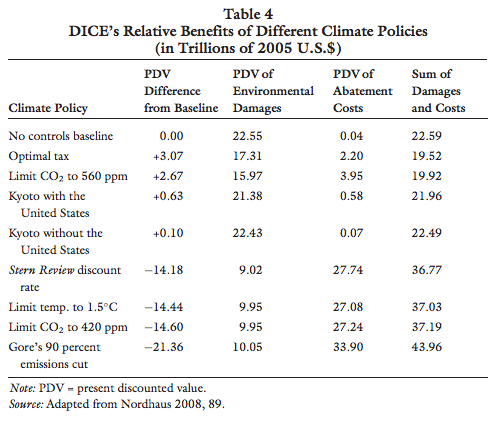
To be more specific, the $3 trillion Nordhaus estimate comes from the 2008 calibration of his Dynamic Integrated Climate-Economy (DICE) model. (The numbers have gone up since then, but I studied his 2008 calibration in great detail.) Note that this isn’t some “denier” computer simulation, rejected by the serious scientists. On the contrary, Nordhaus’s DICE model was one of only three chosen by the Obama administration when it set up a working group to estimate the monetary damages of carbon dioxide emissions. To help the reader understand the trade-offs humanity faces when it comes to climate change, let me reproduce table 4 from my Independent Review article that critically evaluated Nordhaus’s model:    

The table shows Nordhaus’s estimates (made in 2008 based on the “consensus” scientific assessments of the time) of the net benefits of various possible governmental climate policy approaches. The first row shows what happens if governments do nothing. There will be $22.55 trillion (in present value terms, and quoted in 2005 dollars) of environmental damage, but virtually no economic costs of complying with regulations, for a total harm of $22.59 trillion.

In contrast, if governments around the world implemented Nordhaus’s recommended “optimal” carbon tax, the world would be spared a little more than $5 trillion in future environmental damage, while future economic output would be $2.2 trillion lower due to complying with the carbon tax. Adding it all up, humanity would suffer total harms of $19.52 trillion, meaning the world would be $3.07 trillion wealthier with the optimal, global carbon tax (because $22.59 − $19.52 = $3.07).

Central to the economic way of thinking is the concept of trade-offs. Every possible policy — including a policy of doing nothing — comes with costs. But the public tends to hear about only one set of costs, not the full array. For example, as the earlier table shows, the wrong climate policy can be much, much worse than doing nothing. Nordhaus evaluated Al Gore’s suggestion to cut emissions by 90 percent, and estimated that it would make humanity some $21 trillion poorer compared to the do-nothing baseline — a net harm seven times greater than the net benefits of the textbook-optimal approach.

My point here is not to trumpet Nordhaus’s numbers as being gospel. (My Independent Review article was a full-blown critique of his model.) Rather, I am pointing out that even one of the leading models that underpins the so-called consensus on climate-change activism shows that this is hardly the planetary crisis that the rhetoric of Smith and others would suggest. The actual numbers are in the same ballpark as those of trade deals — and nobody thinks the fate of the planet hangs on the passage of a trade deal.

More generally, what even most economists have failed to convey to the public is that climate-change policies at best will affect things on the margin. Nordhaus’s table beautifully illustrates this. The optimal carbon tax doesn’t eliminate the climate-change damage that his computer simulations predict. On the contrary, the carbon tax only reduces it from about $23 trillion down to $17 billion. The reason it doesn’t make sense to enact a more aggressive carbon tax is that the (marginal) harm to the conventional economy would exceed the (marginal) environmental benefit. There are several policies in the table that reduce environmental damage below the $17 trillion mark, but they hurt the economy so much more that, on net, they are inferior approaches.

It is understandable that noneconomists would fail to employ marginal analysis and would engage in overblown rhetoric when discussing something as controversial as climate-change policy. However, too many professional economists have also fallen into this bad habit, including not just Smith but also Krugman and many others.

Robert P. Murphy has a PhD in economics from NYU. He is the author of The Politically Incorrect Guide to Capitalism and The Politically Incorrect Guide to The Great Depression and the New Deal.

This article was originally published by The Foundation for Economic Education and may be freely distributed, subject to a Creative Commons Attribution 4.0 International License, which requires that credit be given to the author.

Meaningful and Vacuous “Privilege” – Article by G. Stolyarov II

Meaningful and Vacuous “Privilege” – Article by G. Stolyarov II

The New Renaissance Hat
G. Stolyarov II
December 3, 2013
******************************

Sanford Ikeda’s concise and insightful lists of 14 common fallacies about the free market (available in two installments from The Freeman here and here) motivate careful thought about the commonly used and misused term “privilege” and the conflations in which it can result. In discussing the second fallacy regarding the free market, that it is identical to a system where the government grants special privileges to businesses, Dr. Ikeda writes that “People sometimes define ‘privilege’ as any advantage a person or group may have over others. Certainly such advantages exist today and would exist in a free market—you may be born into a wealthy family or have superior drive and resourcefulness—but these advantages are consistent with the absence of privilege in the libertarian sense, as long as you acquired such advantages without fraud or the initiation of physical violence against the person or property of others.”

Indeed, the increasingly common usage of the term “privilege” to mean any advantage whatsoever eviscerates it of any genuine meaning it once had. This problem in today’s discourse spreads far beyond discussions of connections between businesses and governments.

Certainly, the very fact that one individual is different from another – with a different set of experiences, different physique, different knowledge, and even different standing room at any particular time – provides that individual with opportunities that the other lacks, while rendering him or her limited in ways that the other is not. Unfortunately, this trivial fact is increasingly being misconstrued in some circles to suggest vile inequities arising out of innocuous human differences. People who have not aggressed against, or even demeaned or ridiculed, anyone are increasingly being identified as “privileged” simply for belonging to broadly and crudely defined groups – be it all people of European descent, all males, or even all non-overweight people (witness the pseudo-concept of “thin privilege”) or people who are not disabled. (“Ableism” is apparently an emerging sin in the vocabulary of the increasingly militant and vitriolic collectivistic “social justice” movement – which is about neither true individual-oriented justice nor the preservation of a civilized and tolerant society.)  Such a vacuously expansive view of privilege is a tremendous insult to the true victims of coercive privilege throughout history – from slaves in all eras, to women who in prior eras were denied suffrage and property rights, to the freethinkers and forbears of liberty and reason, whose voices were too often snuffed out by the arbitrary power of absolute monarchs and theocrats in the pre-Enlightenment world.

Thomas Jefferson, an opponent of privilege in its meaningful sense, put it best when he expressed in his 1826 letter to Roger C. Weightman “the palpable truth, that the mass of mankind has not been born with saddles on their backs, nor a favored few booted and spurred, ready to ride legitimately, by the grace of god.” Jefferson was a staunch opponent of the coercive privilege that enabled some to gain artificial advantages by restricting others from pursuing life-improving courses of action. Accidents of birth, or special lobbying skills, should not, in a just system, enable a person to acquire prerogatives which could not be earned through the free, peaceful exercise of that person’s abilities. Jefferson saw the future and strength of the American republic in the hoped-for emergence of a “natural aristocracy of talent and virtue” – people who, when allowed the liberty to flourish through honest work and competition, would become role models for others solely through their examples. This natural aristocracy would not need force to maintain its prominence, because the traits of the most knowledgeable, most industrious, and most virtuous people will be emulated by any who earnestly seek to improve their own lives and who have the freedom to acquire knowledge and make their own decisions.

Yet Jefferson’s natural aristocracy would be denounced as an example of horrid “privilege” by the “social justice” types – simply due to the necessarily unequal distribution of outcomes on a free market of open and honest production, competition, and cooperation. After all, not everyone can originate the same ideas at the same time. Not everyone can take advantage of the same opportunity for entrepreneurial profit, whose attainment, as economist Israel Kirzner demonstrated in Competition and Entrepreneurship, arises out of alertness to opportunities that others have missed. Kirzner writes that “Because the participants in [a] market are less than omniscient, there are likely to exist, at any given time, a multitude of opportunities that have not yet been taken advantage of. Sellers may have sold for prices lower than the prices which were in fact obtainable… Buyers may have bought for prices higher than the lowest prices needed to secure what they are buying…” (43). Would it be an example of unacceptable “privilege” for an alert entrepreneur to remedy such an arbitrage opportunity and thereby bring otherwise-unrealized value to consumers?

Yes, the free exercise of human abilities will produce outcomes where some people will have some advantages over some others (while, of course, leaving fully open the possibility that those very others will have their own distinct advantages, obtained through hard work, knowledge, or sheer luck). But, as long as coercion is not involved in securing and maintaining those advantages, the people endowed with them are not “booted and spurred” to ride the rest of us. As Dr. Ikeda points out, the differences among people are a source of strength harnessed by the free market: “The free market gives you an incentive to profit from associating with and learning from others who might be very different from you, who operate outside your normal social networks.” By incentivizing and facilitating these interactions, the free market encourages greater tolerance, understanding, and visible societal heterogeneity of the sort that constitutes the best safeguard against truly heinous oppressions based on collectivistic stereotypes. Instead of condemning others as being too “privileged” simply on account of innocuous differences, it is far more productive to think about how those differences can help one achieve one’s own values through honest, peaceful, and productive interaction, cooperation, and exchange.