Browsed by
Tag: FEE

The Islamic State by Any Other Name – Article by Sarah Skwire

The Islamic State by Any Other Name – Article by Sarah Skwire

The New Renaissance HatSarah Skwire
******************************
Terrorists Don’t Deserve to Choose What They’re Called

ISIS does not want to be called Daesh. The group considers the acronym insulting and dismissive. An increasing number of its opponents do not want it to be called the “Islamic State.” They fear that this shorthand reifies the terrorist group’s claims to be a legitimate government.

The debate reminds us that names have power.

Avid readers of fairy tales have always known this. Calling Rumpelstiltskin by his real name banishes him and foils his baby-stealing plans. Speaking your name to a witch or wizard can give them power over you. Patrick Rothfuss’s wildly popular Kingkiller Chronicles contains a magic system where learning the name of an element — like the wind — gives a person magical control over it. And everyone knows what happens when you say Beetlejuice’s name three times.

Converts to new religions often take new names to honor the transformation. We mark significant passages in our lives — birth, marriage, death — with new names. Miss Smith becomes Mrs. Jones. Junior becomes Senior when Senior dies. There’s even an old Jewish tradition that says that, in times of serious illness, one should take a new name in order to fool the Angel of Death.

Whether we believe in magic or religion or not, we feel the power of names throughout our lives. Who didn’t go through a childhood phase of wanting a different name? I was wildly jealous of Catholic friends who got to choose confirmation names. A college friend declared that her first day in college was “time to get a nickname” and had us all brainstorm until she found one she liked. It stuck for the whole four years, and long after. Other college friends made legal name changes to more accurately reflect their cultures or their lives. As an adult, I declined to change my name when I got married because I wanted to hold onto myself. I thought for months about choosing my daughters’ names.

I’m a strong advocate of calling people what they like to be called. My kids try on nicknames like I try on jewelry — experimenting with their identities from day to day and solemnly explaining that from now on, they shall answer to nothing other than “Pumpernickel,” or that “Abby” is now verboten and “Abigail” is in favor. I happily acquiesce in all the changes as they figure out who they are. And I love the new nicknames they create for me. (The latest is “Bob,” because that’s what it sounds like when you say “Mom” with a head cold.)

I think, too, that it is important to use the names that transgendered individuals have chosen for themselves, and the pronouns that reflect their gender — even if it’s an awkward or hard-to-remember change for me. The same goes for other communities based on culture, race, religion, or other common identity. At a bare minimum, as we go through the world, we should have the liberty to say peacefully who we are. And it is a small thing for us to do, generally, to give the respect and the acknowledgement that comes with using someone’s requested name.

But ISIS, or Daesh, is another matter entirely.

It is too late to treat Daesh as Yoko Ono requested that John Lennon’s assassin be treated — by denying it the dignity of a name we deign to speak aloud. We have done nothing but name it and talk about it and publicize its actions. It is probably inappropriate for a family publication to suggest that we might take the Wonderella approach to express our contempt. But we certainly can use an accurate translation of the name they have chosen and turn it into a mildly insulting acronym.

Apparently, it bugs them.

Good.

Sarah Skwire is the poetry editor of the Freeman and a senior fellow at Liberty Fund, Inc. She is a poet and author of the writing textbook Writing with a Thesis. She is a member of the FEE Faculty Network.

This article was published by The Foundation for Economic Education and may be freely distributed, subject to a Creative Commons Attribution United States License, which requires that credit be given to the author.

How Waze Makes Roads Safer than the Police – How an App Improved My Driving – Article by Jeffrey A. Tucker

How Waze Makes Roads Safer than the Police – How an App Improved My Driving – Article by Jeffrey A. Tucker

The New Renaissance HatJeffrey A. Tucker
******************************

The app economy has improved our lives in thousands of small ways, with seemingly endless opportunities to download and use gadgets that help us throughout the day, whatever our needs. Most are free or purchasable at a nominal charge.

Forget the ingredients for Shepherd’s Pie? Find it in seconds on the smartphone. Worried about the side effects of a new drug? They are there for you. Not sure about the quality of the restaurant you are about to enter? The crowds are anxious to tell you. Need a burrito for lunch? Uber will bring you one. (You can get a flu shot and a kitty, too.)

The truth is that we live completely different lives than we did ten years ago. We have unprecedented access to all life’s necessities, including medical and nutrition information, mapping information, the weather anywhere, plus hundreds of communication apps that allow text, audio, and video with half the human race, instantly, at no charge.

New Waze of Driving
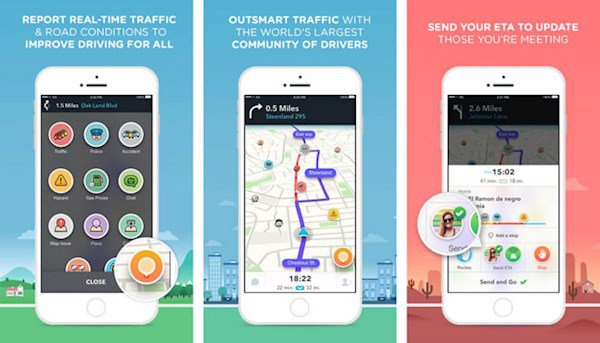
The app I’m most excited about today is a navigation tool called Waze. It provides mapping, plus delightful instructions on how to get from here to there. But beyond that, it crowdsources information to make the trip more efficient and safer than it otherwise would be. In big cities, Waze will take you through circuitous routes to avoid high traffic areas. It alerts you to accidents, road blocks, and debris on the road.

Impressively, it allows drivers to report where the police are staking out speed traps. It tells you whether the officer in question is visible or hidden. You can also confirm or deny the report.

14627-10326-waze-appstore-l

Police have objected to this feature of the app. Why? Because it means that drivers are better able to avoid getting ticketed. But think about this: the app actually succeeds in causing people to obey the law better by slowing down and being safer, as a way of avoiding fines.

Why would police object? If the whole point of traffic police is to get people to drive more safely, knowing about police presence achieves that goal.

Of course, we all know the real reason. The goal of the police on roads is not to inspire better driving but rather catch people in acts of lawbreaking so that they can collect revenue that funds their department. In other words, the incentives of the police are exactly the opposite of the promised results. Instead of seeking good driving, they are seeking lawbreaking as a means of achieving a different outcome: maximum revenue collection.

The whole ethos of Waze is different. It helps you become aware of your external surroundings, and conscious that other drivers are in a similar situation as you are, just trying to get to their destinations quickly and safely. We are there are help each other.

The Community Matters
For me this effected a big change in the whole way I drive. There is a tendency from your first years of driving to treat other drivers as obstacles. Your goal is to outsmart others who are crowding the road, moving around them quickly and navigating the roads with a chip on your shoulder. If there are no cops around, you drive as fast as possible.

I never intended to drive this way, but now I know that I have been, since I first received my government permission slip to drive. Once behind the wheel, I tended to think of myself as a lone actor.

Waze has subtly changed my outlook on driving. Other drivers become your benefactors because it is they who are reporting on traffic accidents, cars on the side the road, blocked streets, and the presence of police. They are all doing you favors. If you report, others thank you for doing so. You even see icons of evidence that your friends are driving, too.

Safety is priority one. Waze won’t let you type in a new address while you are driving. You have to stop the car before you can do that.

The app manages to create a sense of community out of drivers on the road, and that changes the way you think when you drive. Now I leave Waze on even when I already know the directions. It’s my connection to the community. I find my whole outlook on driving has changed. For the first time in my life, I can honestly say that I’m a safer and more responsible driver.

So thank you Waze — a product of brilliant entrepreneurship, distributed on private networks, performing a public service.

Compare with the people who are charged with the task of making our roads safe and are paid by our tax dollars to do it. Not only do they fail to accomplish what this one free application has done, they are actively seeking to cripple it.

Baby Steps to a Better World
Maybe this seems like too small a life improvement to justify mentioning? Not so. All great steps toward a better world occur at the margin, bit by bit, through trial and error, one innovation at a time. You look back at the progress of a decade and that’s where the awe comes into play.

It is not through large bills written by legislators and signed by presidents that the world improves. It is through small innovations, inauspicious downloads, incremental improvements in our existing paths that gradually build a better world. Waze is only one of a billion but it points to the right method and approach to an improved life.

Jeffrey Tucker is Director of Digital Development at FEE, CLO of the startup Liberty.me, and editor at Laissez Faire Books. Author of five books, he speaks at FEE summer seminars and other events. His latest book is Bit by Bit: How P2P Is Freeing the World.  Follow on Twitter and Like on Facebook. 

This article was published by The Foundation for Economic Education and may be freely distributed, subject to a Creative Commons Attribution United States License, which requires that credit be given to the author.

Who Are the Syrian Refugees? – Article by Alex Nowrasteh

Who Are the Syrian Refugees? – Article by Alex Nowrasteh

The New Renaissance Hat
Alex Nowrasteh
November 20, 2015
******************************

This is the demographic information on all 2,234 Syrian refugees admitted to the United States from October 2010 through November 2015, according to the Refugee Processing Center.

Data on religion for all refugees is from the same source; some additional information comes from the American Community Survey.

Gender and Age

Refugees from Syria are overwhelmingly young. 43 percent of all Syrian refugees are children under the age of 14.

syrian-ages

The gender ratios for Syrian refugees are more balanced. 53 percent are male, 47 percent are female.

syrian-genders

Males aged 14-30, the most potentially dangerous group, are 13 percent of all Syrian refugees.

syrian-males-prime-age

Religion

Data on religion was collected for all Syrian refugees admitted from fiscal year 2011 to today.

About 96 percent of the refugees are Muslim of any denomination; about 3 percent are Christians of any denomination. About 1 percent are nonreligious or of other faiths.

syrian-religions

The Syrian refugee flow is much more Muslim than the global average. Of all refugees resettled in the United States, 44 percent are Christian, compared to less than 3 percent from Syria.

all-refugees-religion

Note about worldwide religious data: I suspect there is some double counting.  

Ethnicity

The Syrian refugees are 87 percent Arab and 10 percent Kurdish, with small representations from other ethnic groups.

syrian-ethnicity


Education Level

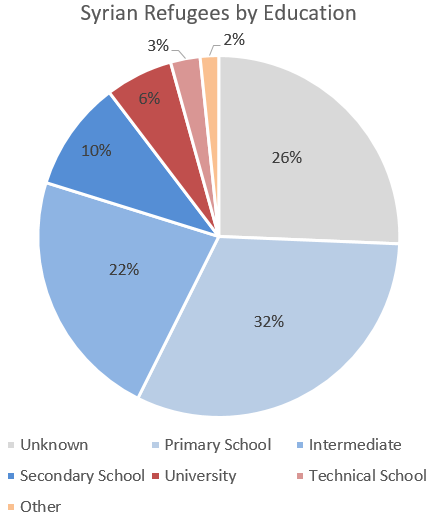
Since 43 percent of the Syrian refugees are under the age of 14, and 56 percent are under 20, Syrian refugees tend to be less educated. 9.4 percent have a technical, university, college, or graduate school level of education. Since the refugee flow skews young, this group should become more educated as they age.

syrian-education

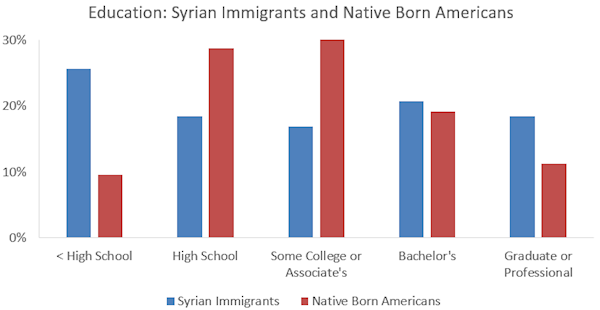
Adult Syrian Americans — over age 25 and born in Syria — are more educated than the current refugee flow.

Overall, Syrian Americans are both more and less educated than the population as a whole. 44 percent of Syrian immigrants have just a high school diploma or less, compared to 38 percent of native born Americans, but 39 percent of Syrian Americans have a bachelor’s degree or higher, compared to 30 percent of the native born.

syrian-vs-american-ed

Sources: American Community Survey, 2014, 1-Year Sample, S0501 and S0201 Syrians

Location

Syrians resettled in the United States are highly concentrated in a few states.

Six states (CA, TX, MI, IL, AZ, and PA) have together received more than half of Syrian refugees.

syrian-state

Twenty states (AR, CO, ID, IN, KS, LA, ME, MD, MN, MO, NV, NH, NM, OK, OR, TN, UT, VA, WA, and WV) have received fewer than 50 refugees.

Fourteen states (AL, AK, DE, HI, IA, MS, MT, NE, ND, RI, SC, SD, VT, and WY) and Washington, DC, have not received any.

Alex Nowrasteh is the immigration policy analyst at the Cato Institute’s Center for Global Liberty and Prosperity.

This article was originally published by The Foundation for Economic Education.

Why Open Borders? – Article by Jeffrey A. Tucker

Why Open Borders? – Article by Jeffrey A. Tucker

The New Renaissance HatJeffrey A. Tucker
September 15, 2015
******************************

Two dear friends of mine just experienced incredible struggles with immigration control in the United States, one from Australia and one from Canada. Both are enormously talented, in love with the freedom that America represents to the world — or once did anyway.

One barely got in after months of waiting, even though a willing, begging employer was waiting. The other was deported with a single day’s notice.

Each has been a captive of bureaucrats with awesome power. Their stories are tragic. Natives know nothing about this ghastly system and how it treats human beings. We never experience it.

The labyrinth of bureaucracy is jaw-dropping. The arbitrary power exercised by “our” bureaucrats is frightening. The loss to our nation’s productivity is mindboggling. Hearing these stories, you can’t help but apologize for the way our own government treats people who want to love this country and contribute to its greatness.

And to think that for the first 100 years of this country’s existence we had zero national immigration restrictions. The whole world was invited in — and this invitation led to the most prosperous society the world has ever known. In these times, there were no passports. For the most part, everyone was free to move around the earth — and this was thought to be the very essence of liberty.

Today, we have an effective ban on immigration. You can’t come to the U.S. to live and work legally unless you are family, highly educated, or get in as a refugee. Other than that, the barriers to legal immigration are impossibly high. The wait lines for employment visas are impossibly long, and people from the world’s largest population centers aren’t even eligible.

Meanwhile, the government spends $18 billion on stopping immigration — more than all other federal criminal enforcement agencies combined. This is money spent to stop people from freely exchanging labor for money. That the whole thing is a massive flop is revealed by the 11 million illegal immigrants in this country, and the half million apprehended crossing the border each year — surely only a fraction of those who were not.

But apparently, that’s not enough. Donald Trump is soaring in popularity by calling for mass deportations and building a wall around the country, in effort to double down on a failed government policy. Other candidates are alarmed at his rhetoric, but echo his core claim that there is some kind of crisis going on.

Meanwhile, this is a huge debate among people who otherwise swear fealty to “limited government.” Many people who claim to want freedom seem to have no problem with the implications of a closed-border policy: national IDs, national work permits, non-stop surveillance, harassment of all businesses, a “papers please” culture, mass deportation, tens of billions in waste, bureaucrats wrecking the American dream, broken families, the rights of Americans and foreigners transgressed at every turn.

In this environment of political hysteria, in which the rankest form of racial fear has reared its head, few dare to stand up and call for the only liberty-minded answer: open borders.

Just the phrase causes people to sputter in shock. The objections start flying: wages will fall, welfare will explode, people will vote for the wrong people, there will be cultural confusion, the national language will evaporate, crime will soar — on and on the parade of horribles marches.

The more you look into the research, the more these objections fall away. Immigrants cause less crime than natives. Immigration does not cause unemployment. Immigrants don’t consume more public benefits than natives; in fact, they use fewer. Indeed, they have kept Social Security afloat, even though they will never get a dime from the system. They don’t love liberty less: they poll in as more libertarian. Indeed, every one of these and other claims in Trump’s immigration policy paper are patently wrong.

Apparently, the facts don’t matter. And as for humane values and human rights, forget it. Immigration restriction is a fundamental attack the rights of at least two parties: the person who wants to employ someone currently outside the border and the person who wants to come work. It’s a thuggish interference with an economic exchange, like any other arbitrary restriction on trade.

So often, in many recent discussions I’ve had online, what’s going on here is just a shoot-from-hip bias. It’s exactly the same kind of fears that make people object to getting rid of the minimum wage, cutting taxes, eliminating tariffs, privatizing the TSA, eliminating zoning laws, cutting government spending, legalizing pot, and so on.

It’s freedom itself that people fear.

Once freedom goes away, it is difficult to imagine how things would work if it came back. The notion of freedom then scares people, and it becomes easy to think up a thousand different scenarios in which freedom can’t possibly work. Surely disaster will ensue!

This was a problem during alcohol Prohibition. The system wasn’t working, but the prospect of making its consumption and production legal again elicited a kind of panic. Would our streets be filled with staggering drunks? Would scarce income be squandered on liquor? Would families break apart?

The lack of imagination concerning how freedom can work is the single biggest barrier in the U.S. to ending the war on immigration.

Imagine if the U.S. had massive border controls between states, with checkpoints and passports and drug-sniffing dogs, and if you had to have permission to change from a job in Ohio to a job in Vegas, or if a Virginian could be deported from New Jersey for overstaying, or if you had to wait years to obtain the right documentation to move from one state to another, or if the labor market was so tightly regulated that an employer in another state could only hire you if they could prove they had no other options.

If all that were true, anyone who suggested open borders and a free labor market between states in the U.S. would be considered a dangerous loon.

But here is the clarifying fact: the conditions that allow free migration between states within the U.S. are identical with regard to free migration between the U.S., Mexico, and Canada. The only difference happens to be the government that issues citizenship documents.

I live in Georgia. What if I started a movement to prohibit immigrants from Chicago to Georgia? Why would I suggest such a crazy thing? Because I believe that crime is higher in Chicago, welfare is more widely used, their imported labor would drive down wages, they vote in ways that are regrettable, and people there just don’t get the ways of the American South.

Should we have immigration controls between states? It sounds preposterous (though Trump could probably sell the idea). But the claims that we can’t have free immigration into the U.S. follow the exact same logic.

Every argument for immigration restrictions into the United States as a whole applies with equal validity for immigration controls between states, counties, cities, and even towns. And yet we do not have such controls. Why does it work so well? Because freedom works.

How can we begin to imagine what open borders would be like? We need an experiment in that exact thing. It just so happens that we have just such an experiment. There are 28 countries that have historically been at war for thousands of years. They all have different languages, different religions, and different folkways. At various periods, people from these countries have hated each other to the point of causing genocide.

Then one day, starting with an agreement that began to be implemented twenty years ago (the Schengen Agreement), they opened all the borders. Anyone from these countries can live and work anywhere. They can travel freely, on the same passports. No bureaucracy stops their freedom of movement and their freedom to produce.

The results have been spectacular. It’s the greatest experiment in completely open borders the world has seen in more than a century. It’s called the European Union. And it works. It points toward the ideal: a world in which everyone is free to move about the earth without fear of gun, wall, or barbed wire.

Let’s not fear freedom and free trade (which means, free trade in capital and labor). In the end, Ludwig von Mises was right: “Without the reestablishment of freedom of migration throughout the world, there can be no lasting peace.”

Jeffrey Tucker is Chief Liberty Officer of Liberty.me (http://liberty.me/join), a subscription-based, action-focused social and publishing platform for the liberty-minded. He is also distinguished fellow of the Foundation for Economic Education (http://fee.org), executive editor of Laissez-Faire Books, research fellow of the Acton Institute, founder of the CryptoCurrency Conference, and author of six books. He is available for speaking and interviews via tucker@liberty.me.

Why the Candidates Keep Giving Us Reasons to Use the “F” Word – The Electoral Clown Car Is Full of Nationalistic Socialists – Article by Steven Horwitz

Why the Candidates Keep Giving Us Reasons to Use the “F” Word – The Electoral Clown Car Is Full of Nationalistic Socialists – Article by Steven Horwitz

The New Renaissance HatSteven Horwitz
August 6, 2015
******************************

“There are far too many candidates,” writes Dana Milbank at the Washington Post. “And to gain attention they are juggling, tooting horns and blowing slide whistles like so many painted performers emerging from a clown car.” The two clowns making the most noise in recent weeks are Bernie Sanders and Donald Trump.

At first glance, it would seem they couldn’t be more different: a Democrat and a Republican, a friend of the unions and a CEO, a man of relatively modest means by congressional standards and one of the wealthiest men in the United States. But a closer look reveals some interesting similarities and teaches us an important lesson about the history of ideas. What Sanders and Trump have in common is no laughing matter.

Recent articles by libertarians on both candidates have suggested that they are both strongly nationalist. Dan Bier tore apart Sanders for his views on immigration, and both Jeff Tucker and Jason Kuznicki have associated Trump with nationalism and perhaps even a variant of fascism. I think they are all on to something: Sanders and Trump have a lot more in common than many think. But before I get there, we need to take a detour into the history of socialism and fascism.

In its original conception, Marxian socialism was strongly internationalist. Marx’s theory was based on the idea of class struggle and the disparity in power between those who owned the means of production (the capitalists) and those who did not (the proletariat).

Marxism has nothing to do with nationality. It’s all about class, defined as whether or not one owns capital. For true Marxists, a German worker has much more in common with a Russian worker or an Italian worker than he or she does with a German capitalist. Marxism did not give any importance to national borders.

For many in the early 20th century, this was a problem with Marxism, especially in the aftermath of World War I. Much like today, people were looking for a “third way” between capitalism and socialism. For many of those people, that third way was fascism.

Today we use the word fascism as an epithet, especially for bossy people. We associate it with dictatorships, and especially with Nazism. It turns out that fascism was a fairly well-worked-out theory of how to organize a society, and in its original form was not about racism or anti-Semitism directly. Fascism was an attempt to combine what people saw as the best parts of capitalism and socialism, and then to do so in the context of putting nationality before class.

The most extensive writing about how fascism would work came from the Italians in the 1920s and 1930s, and interested readers should find a copy of Luigi Villari’s The Economics of Fascism to see the details. (You can find a nice summary of those ideas in Sheldon Richman’s entry on fascism in the online Concise Encyclopedia of Economics.)

The fascists argued that the whole notion of class conflict was the problem. Instead of pitting class against class and tearing nations apart, why not bring all the parties together and give them the chance to cooperate with each other rather than struggle their way to socialism? The fascist economy was built around a series of cartels where the state, the nominal owners of the means of production, and the workers (represented by labor unions) would get together and figure out what to produce, how to produce it, what to charge, and how much profit would be “allowed.”

The fascists agreed with socialism’s desire not to leave markets to spontaneous ordering forces, but they thought the nation-state should direct the economy, not the workers. Both capitalism and socialism involved conflict, not cooperation. The same third-way thinking, and some of the same structures, were present in the first two years of the New Deal in the United States. The cartels of the National Recovery Administration were modeled after Italian fascism, and FDR and Mussolini were mutual admirers.

You can see how fascism took elements of both capitalism and socialism, then added nationalism. The idea was to look out for the welfare of the nation-state first. The Italian capitalist and the Italian worker were both Italians first and foremost, and that should be the first call on their allegiance. Lashing socialism to the glorification of the nation-state gives us fascism, and you can see why anyone who represented a threat to national identity would quickly become a problem.

This is one reason why the German version of fascism so easily linked up with a long history of German anti-Semitism. The Nazis were undoubtedly socialist (recall that Nazi is short for National Socialist German Workers Party), as even a quick glance at their 1920 platform will tell you. They were also, even at that date, fiercely nationalist. In Hitler’s hands, that national pride quickly became a desire to glorify the Aryan race.

Plus, recall that Jews were disproportionately both capitalists and supporters of the Marxist revolution in Russia — not to mention the symbol of the cosmopolitan, rootless nomad for centuries. Many of those who wanted to reject both capitalism and Marxian socialism saw the Jews as the symbol of both.

So what does this have to do with Bernie Sanders and Donald Trump?

I would argue that they are both “nationalist socialists.” That is, they both embody key elements of fascism. They both think the nation comes first, and they both think the United States is an organization (not a spontaneous order) that should be under someone’s control.

The difference is that Sanders sees both the problems and the solutions from the workers’ perspective, so he’s focusing on both the exploitation by capitalists and keeping immigrants out to protect the wages of US workers. The losses to US workers matter more than the large gains to foreign-born workers coming here.

Trump sees all of this from the CEO/owner/capitalist perspective. He thinks the United States is, or should be, like a big firm where we all work together for a common goal. He envisions himself as the CEO, negotiating deals with other countries as if they, too, were just big corporate firms. But nations are not firms — they are spontaneous orders.

As I argued in an earlier column, “Socialism Is War and War Is Socialism,” this desire to turn spontaneous orders into hierarchies is characteristic of both war and socialism. It is also deeply embedded in fascism, and Sanders and Trump exemplify that tendency among the presidential candidates, though they do so with different emphases and rhetoric.

Their commonalities are also why our conventional binary left-right political spectrum makes no sense. That one candidate is perceived as far to the left and the other as (to some degree) a right-wing capitalist shows the depth of our failure to understand history. They have both rejected the spontaneous order of the market as well as the cosmopolitanism of liberalism and socialism. They are fascist brothers under the skin.

That both are getting the attention and support of so many Americans should be a matter of grave concern. After all, some clowns are far more scary than funny.

Steven Horwitz is the Charles A. Dana Professor of Economics at St. Lawrence University and the author of Microfoundations and Macroeconomics: An Austrian Perspective, now in paperback.

This article was published by The Foundation for Economic Education and may be freely distributed, subject to a Creative Commons Attribution 4.0 International License, which requires that credit be given to the author.
Does America Ban Immigration? – The Land of the Free Isn’t, For Most People – Article by David Bier

Does America Ban Immigration? – The Land of the Free Isn’t, For Most People – Article by David Bier

The New Renaissance Hat
David Bier
August 3, 2015
******************************

The United States has a de facto ban on immigration. We can debate about whether this prohibition is necessary, but its existence is undeniable. Other than a few exceptions for family members, refugees, and the highly-educated, it is virtually impossible to come to the United States to live and work legally.

Historically, America held its doors open to all. But in the 1920s, a coalition of unions, progressives, and eugenicists combined to slam them shut. Within a year of passing Alcohol Prohibition, America also banned almost all forms of immigration, cutting immigration by nearly 80 percent.

Alcohol regained its legal status, but immigration never quite recovered.

Today, the government lets in almost a million immigrants each year, but this impressive-sounding number misses the entire legal, historical, and global context of our immigration system. We must compare it to the number who would come if only they could do so legally — and the reality is that most types of immigration are entirely prohibited. To deny the ban on immigration because it has exceptions is like denying Alcohol Prohibition because it allowed communion wine.

The half million people apprehended at the border each year and the 11 million unauthorized immigrants in the country are the clear evidence of this prohibition. The massive immigration underground points to an obvious yet largely ignored fact: If there was a legal way for them to come, they would have taken it. But, trouble is, one doesn’t exist.

The drastic shortage of visas is evident in the unbelievably long wait times for permanent residency. For certain categories, the wait is decades. For employment-based visas, certain Indian and Chinese workers will wait more than a decade. For Mexico, three different family-based categories have wait times over 18 years. There’s northward of 4.3 million people in these lines alone.

Yet these impossible lines hide a deeper problem: most would-be immigrants have no line to stand in at all.

The reality is this: 92 percent of legal immigrants are either 1) immediate family members of US citizens or permanent residents, 2) refugees or asylees, or 3) college graduates — and over 80 percent those needed an advanced degree or at least $500,000 to invest in projects in the United States.

This leaves less than 65,000 visas for everyone else. More two-thirds of these come through a lottery system for which 11 million people applied last year. People in most of the largest countries in the world, including India, China, and Mexico, aren’t even eligible to apply.

This legal flow amounts to barely 7 percent of the average number of immigrants apprehended at the border each year since 2004 (and, of course, that doesn’t count those who crossed successfully, or those who entered and overstayed their visas, or those who would come if there was a legal opportunity). For people without a college degree or a close American relative, the Statue of Liberty’s “Golden Door” is almost completely shut.

Meanwhile, PhDs, scientists, movie stars, pro-athletes, and other elites have a number of different work visas available to them. These allow them to live and work year-round in the United States.

By contrast, there is no work visa that allows lesser-skilled laborers to live and work year-round in this country. Unsurprisingly, this lesser-skilled demographic is disproportionately represented in the illegal population, 85 percent of whom lack a college degree.

Another reason we know that illegal immigration is being driven by the lack of a legal alternative is because of what happened when the government allowed foreign workers to come and go legally.

Thanks to a fluke of history, America had a brief period when it experimented with freer migration between the United States and Mexico. In the 1950s and ‘60s, the Bracero guest worker program let in about 5 million Mexican farmworkers. From 1956 to 1965, when the program was at its height, the number of unauthorized immigrants at the border averaged just 41,000, compared to over 436,000 a year in the prior decade.

After it was terminated in 1966 by another union-led coalition, illegal immigration never again fell to such low levels — not even for a single year, let alone an entire decade. By the 1980s, a million or more immigrants were routinely being caught by Border Patrol every year.

Supporters of the ban on immigration will say that America is at its breaking point, that we’re overwhelmed, that we can’t “handle” any more immigrants. But this fear is groundless: As a share of its population, America admitted four times as many immigrants each year in the early 1900s as it did in 2014. For a century from 1830-1929, immigration was twice as high as a share of the population as it was in the last two decades.

In absolute terms, America admits more immigrants than any other country, but relative to its size, US immigration levels are far lower than many Western countries. Controlling for population, Canada, Australia, and New Zealand all have higher levels of immigration than America today — even as high as the United States in the early 20th century — and they have not collapsed into chaos or poverty.

Immigration prohibition is real. Millions of people cross the border illegally (and thousands of businesses hire them illegally) for the same reason bootleggers had to brew booze in bathtubs. And, for the same reasons we repealed Alcohol Prohibition, we should also finally end America’s ban on immigration.

David Bier is an immigration policy analyst at the Niskanen Center. He is an expert on visa reform, border security, and interior enforcement. From 2013 to 2015, he drafted immigration legislation as senior policy advisor for Congressman Raúl Labrador, a member of the House Judiciary Committee’s Subcommittee on Immigration and Border Security. Previously, Mr. Bier was an immigration policy analyst at the Competitive Enterprise Institute.  

This article was published by The Foundation for Economic Education and may be freely distributed, subject to a Creative Commons Attribution 4.0 International License, which requires that credit be given to the author.

Handcuffed and Helpless – Article by T.K. Coleman

Handcuffed and Helpless – Article by T.K. Coleman

The New Renaissance HatT.K. Coleman
July 28, 2015

******************************

There’s a naive idea floating around that an innocent person should never be afraid of cops.


Editors’ Note from the Foundation for Economic Education: FEE faculty T.K. Coleman is consistently one of our students’ favorite speakers and teachers. His insight and magnetism would be impossible to replace. We not only consider him a friend, but a member of the FEE family.

Recently T.K. related the story of his experience with police abuse. We cannot independently verify the account he gives here, but we offer his story based on our belief in T.K. Coleman as a human being and as a friend to our organization.

We believe it is important to cover the problem of police abuse from the perspective of one who has experienced it.

What you are about to read is not a philosophical argument. It’s a personal testimony. The aim of telling this story is neither to make a political statement, nor to score points for a particular ideology. For almost three years, I’ve mostly held it in. But it’s become clear to me that it’s time to give a more detailed account to a broader audience.

*             *             *

One Friday night, my wife and I were driving through a small town on the way to a comedy club in Manhattan Beach, California. We were going to hang out and share a few laughs. On the way, we were pulled over by the police.

Two officers approached our car. One of them came to my window. The other one came to her window.

Without asking to see my license or registration, the officer on my side told me to get out of the car. I immediately and respectfully complied without raising a single question or objection. And in case you’re wondering, I wasn’t dressed in gang colors, nor was I wearing a hoodie.

When I exited the car, he turned me around, handcuffed me, threw me against the side of my car, and did a complete body search on me. As he groped me, he said, “This is how we do it in LA.”

I remember seeing a woman walking across the street holding hands with her little girl. We made eye-contact. She picked her little girl up and jogged in the other direction. Who could blame her? If I saw one of society’s most trusted authority figures manhandling a guy, I’d also assume this was a potentially dangerous situation.

The officer then removed the wallet from my pocket and pulled out the cash.

“Why do you have so much cash on you?”

“Sir, I honestly didn’t feel like a $100 was a lot of cash to have on me. I’m going out with my wife tonight and just wanted to have a little cash on me.”

“We’ll see.”

Next, he asked me where I lived. I told him my address. He laughed and said, “This n****r knows his address.” Then he walked me to the police car and literally threw me in the back seat and shut the door. From the back seat of a police car, I watched the officer join his partner who was already busy questioning my wife. They also made her get out of the car. They both got in her face and started questioning her.

Imagine what goes on inside of a man’s head when he’s handcuffed and helpless as he watches two men with guns get in his wife’s face. Imagine the complex blend of confusion, fear, irrational optimism, and rage that festers inside one’s soul as he watches one cop take his wife’s purse and pour all the contents out, while the other officer literally crawls around inside our car for several minutes.

They spent about 10 more minutes aggressively questioning my wife.

One of the officers returned to the car with my wallet and proceeded to look up my info in the system.

“You got any baby momma drama?” he asked me.

“I don’t have any children, sir.”

“You sure you ain’t got no baby momma drama?”

“I am certain I have no children, sir. There are no women out there who are even under the impression that I am the father of their child.”

“Are you clean? Are you clean? You ain’t got no drugs? You ain’t got nothing on you? No baby momma drama?” he says.

“I am clean,” I said.

For the entire time we were talking, my eyes were deadlocked on that other officer and my wife. After what felt like an eternity, the officer let me out of the car and took off the handcuffs.

“You’re good,” he told me.

As I slowly walked back to our car, I said to one of the officers, “Sir, I’m not trying to be antagonistic or disrespectful, but is there a reason for why I was pulled over?”

“We just had to check you out.”

I wanted to say, “What does that even mean?” But more importantly, I wanted to get us out of that situation safely. Given the way he man-handled me earlier, it was obvious to me that I was dealing with guys who weren’t above breaking protocol. So I just walked back to the car, took a deep breath, asked my wife if she was alright, and did my best Denzel Washington from Glory impersonation as I tried to keep it together.

Our comedy show started at 8 P.M. We were pulled over at about 7:30. When they let us go, it was about 10 minutes after the hour. We decided we couldn’t go home, or it would feel as if we let them win. So we drove to a local cinema, watched a movie, came back home, had some coffee, and just stayed up talking with each other about it.

*             *             *

I’m grateful that we didn’t get killed. I’m grateful that my wife didn’t get assaulted. I’m grateful that they didn’t plant drugs on me or put me in the hospital.

But my gratitude doesn’t change the fact that these men abused their power, disrespected my wife, laid their hands on my body in an inappropriate way, scared the hell out of us both, made us miss our show, and treated us like criminals simply because they felt entitled to do so.

They will not ruin my life, nor will they determine my destiny, but I want to put this story on the record because this was neither the first nor the second time something like this happened to me, and I sincerely believe that things like this happen all over the country.

There’s this naive idea floating around that people should never be afraid of cops as long as they’re innocent and compliant. For a lot of people in this country, that’s simply not true. This isn’t about playing some mythical race-card, nor is it about me promoting the idea that all cops are evil. I’m sure there are lots of cops who are nice to their kids and fun to hang out with when they’re having beer with their buddies. (I’m also sure that’s true of a lot of so-called thugs.)

But if we want to have intelligent discussions about authority in this country, we have to stop using a logic that tells us that people in authority always have a fair reason for doing what they do. We do a lot of talking about what people can do to avoid being abused by cops. We don’t talk as much as we should about the abuse that happens to people who follow all those instructions. If we can’t question authority, we are doomed.

*             *             *

Here’s a habit I picked up early on: When I see police officers, I shift into my A-game.

If I feel an itch on my forehead, I’ll notify the cops first before scratching the itch because I want them to feel safe and secure about the movement of my hand. This is a technique I refer to as “not getting shot.”

I learned techniques like this from the first day I received my driver’s license. Growing up in the suburbs, I was always afraid to drive my dad’s Lincoln Town Car.

I was too afraid to tell him, but I would cringe when he’d ask me to drive his car because I knew I would be pulled over and harassed by cops whose worldview wasn’t big enough to imagine me in a nice car (even though it was normal to see young people driving nice cars in the neighborhood where I grew up).

I remember driving my dad’s car once, and he left his toolbox in the back seat. A cop pulled me over and asked why I had a toolbox. Fair enough. I told him my dad was in real estate and construction, and that I was working with him at one of his buildings. The cop had me step out of the car, handcuffed me, and searched the toolbox while I sat on the curb in handcuffs.

“Are there any other weapons in this car besides this hammer here?”

My overly diplomatic reply was this: “With all due respect, sir, the hammer is not a weapon, but rather one of many tools in that toolbox we use for work. However, I understand where you’re coming from and I can see how you might be inclined to see it as a weapon, but those tools are only used for work.”

He let me go. I can only imagine what my fate would have been if I hadn’t learned about the loaded question fallacy. Two points for philosophy. Hurray.

By the way, the officer gave me no warnings, citations, or explanations. Like the guys from my earlier story, he just wanted to “check me out.”

Unfortunately, my techniques don’t make me feel all that secure, nor does the fact that today I drive a car that’s a lot more modest than my dad’s. At every stage of my adulthood, I’ve been pulled over by cops, dragged out of my car, handcuffed, spoken to like I was a stupid little boy, humiliated in public, called racial slurs, and manhandled by multiple guys with badges multiples times (without being arrested or charged with anything), in spite of the fact that I’ve never been armed, and I’ve always complied with their every request.

When I spent two years without having a car, it was one of the most peaceful, cop-free times in my life. I would still get harassed at times, but it was so much harder for them to come up with excuses for stopping me. I have never been physically or psychologically abused by drug-dealing “thugs,” but I have definitely been abused by police who thought it was okay to push me around because I fit their stereotype of a thug.

Some people automatically feel safer when cops are around, but that’s not a universal experience. It’s certainly not mine. I’m not angry at every cop, but I am deeply concerned about the frighteningly popular belief that you must have done something wrong if you were abused by one.

*             *             *

When I first wrote about this on my Facebook page, I only had my family and friends in mind. Prior to that, I’d never shared the full details with anyone except for a small group of people.

But more and more, I’d been involved in conversations about police brutality. It seems to be on everyone’s mind. And while I acknowledge that these issues are more complex than many people make them out to be, there was one recurring element in many of these conversations that really irked me: The idea that a police officer would never mistreat someone if they conducted themselves in the right way. I know from personal experience that this assumption is false.

Indeed, I know many people who have been mistreated by authorities who abuse their power and they’re simply afraid to talk about it. Since I shared a version of this account on Facebook, over 1500 hundred people have shared my Facebook post. I’ve received tons of messages from people who have been victims of various kinds of abuse, not just from cops, but abuse in general. Many of them thanked me for inspiring them to tell their own story. I’ve even had police officers apologize to me on behalf of other police officers.

But why are people so often silent in the face of abuse? They don’t want to risk their careers; they don’t want to make enemies at their church; they don’t want to be associated with the wrong political party; they don’t want to be seen as liars; they don’t want anyone targeting them.

And I get it. Just since I shared this on social media, people have called me a liar, a bullshitter, a slanderer, a cop hater and an attention seeker. Honestly, I can relate with those people who would rather just stay silent than suffer the indignity of the aftermath — which so often just adds insult to injury.

But then there are the people who find inspiration, perhaps to tell their own story. I wrote this for them. Some have asked why I would write something like this if I have no chance of bringing the cops to justice. My answer is that I wrote this primarily in hopes that some people’s minds will be opened and others’ hearts will be healed due to what I went through. Most importantly, I wrote this so that people who stay silent — for whatever reason — will know they aren’t alone.

I wish I had footage of what happened. I wish I had had the opportunity to obtain badge numbers, names, or license plate numbers without fear. Instead all I could think was “Please God let me out of this situation alive.” “Please don’t let them hurt my wife.” “What in the world is happening to me?” When they finally let me go, I was mostly just relieved that we were going to get out safe.

Believe it or not, there was a point when it did occur to me to try to get some information on these police officers. When I asked the one cop why we had been stopped, I thought about getting a look at their license plate number right then. But it occurred to me that things could escalate again if they perceived me as antagonizing them. I was scared of what they might do next if they noticed me looking at their car as if I were trying to obtain their information.

*             *             *

After my wife and I left, we calmed down. I started to reflect on things. I wished I could have gotten something — a badge number, a license tag, anything. Still, I decided to report it. The next day, I called the police department in the town where we were pulled over. I spoke with an officer who was appalled by my story, but who said it couldn’t be his department. He asked me if I was sure it wasn’t the state police. I honestly didn’t know. He believed my story, though, and he told me that if those were his guys, he would deal with them harshly. He apologized on behalf of police officers. We talked for almost an hour and he promised to have a meeting with his department about my story.

I also called state police as well as the departments for a couple surrounding towns but with the same results. My lack of evidence made things difficult. I tried hard to channel my anger in the direction of holding those officers accountable, but ultimately fell short. So, all I have is my story and the hope that some good can come from telling it.

All I ask of you, dear reader, is that you consider it an invitation to rethink the way some of these police encounters are framed and construed by all parties. If you’re skeptical of my version of events, that’s fine. I encourage you to keep on doubting.

But please don’t be selective in your skepticism. Question me. Question others. Question the police. Question authority. Most importantly, question your own assumptions. The truth will come will eventually come from people willing to search for it.

T.K. Coleman is a philosopher, writer, lecturer, entrepreneur, and life coach living in Los Angeles, California. He is the co-founder and Education Director for Praxis, a 10-month apprenticeship program that combines a traditional liberal arts education with practical skills training, professional development, and real-world business experience.

This article was published by The Foundation for Economic Education and may be freely distributed, subject to a Creative Commons Attribution 4.0 International License, which requires that credit be given to the author.

Imagine a Political Party That Really Supports Equal Rights – Real Heroes: William Leggett – Article by Lawrence W. Reed

Imagine a Political Party That Really Supports Equal Rights – Real Heroes: William Leggett – Article by Lawrence W. Reed

The New Renaissance Hat
Lawrence W. Reed
July 10, 2015
******************************

Each week, Mr. Reed will relate the stories of people whose choices and actions make them heroes. See the table of contents for previous installments.


Death from yellow fever complications claimed journalist William Leggett at the tender age of 38, days before he would have assumed his first political office. President Martin Van Buren had just named Leggett US ambassador to Guatemala. In the early 19th century, as temptations were rising to divert Americans’ constitutional framework toward bigger government, Leggett (to borrow a phrase from 20th-century journalist William F. Buckley) stood athwart history yelling, “Stop!”

Leggett’s fame is inextricably intertwined with the term Locofoco. Here’s the story.

Imagine a political movement that says it’s committed to “equal rights” — and means it. Not just equality in a few cherry-picked rights but all human rights, including the most maligned: property rights. Imagine a movement whose raison d’être is to oppose any and all special privileges from government for anybody.

When it comes to political parties, most of them in recent American history like to say they’re for equal rights. But surely the first lesson of politics is this: what the major parties say and do are two different things.

In American history, no such group has ever been as colorful and as thorough in its understanding of equal rights as one that flashed briefly across the political skies in the 1830s and ‘40s. They were called “Locofocos.” If I had been around back then, I would have proudly joined their illustrious ranks.

The Locofocos were a faction of the Democratic Party of President Andrew Jackson, concentrated mostly in the Northeast and New York in particular, but with notoriety and influence well beyond the region. Formally called the Equal Rights Party, they derived their better-known sobriquet from a peculiar event on October 29, 1835.

Democrats in New York City were scrapping over how far to extend Jackson’s war against the federally chartered national bank at a convention controlled by the city’s dominant political machine, Tammany Hall. (Jackson had killed the bank in 1832 by vetoing its renewal.) When the more conservative officialdom of the convention expelled the radical William Leggett, editor of the Evening Post, they faced a full-scale revolt by a sizable and boisterous rump. The conservatives walked out, plunging the meeting room into darkness as they left by turning off the gas lights. The radicals continued to meet by the light of candles they lit with matches called loco focos — Spanish for “crazy lights.”

With the Tammany conservatives gone and the room once again illuminated, the Locofocos passed a plethora of resolutions. They condemned the national bank as an unconstitutional tool of special interests and an engine of paper-money inflation. They assailed all monopolies, by which they meant firms that received some sort of privilege or immunity granted by state or federal governments. They endorsed a “strict construction” of the Constitution and demanded an end to all laws that “directly or indirectly infringe the free exercise of equal rights.” They saw themselves as the true heirs of Jefferson, unabashed advocates of laissez-faire and of minimal government confined to securing equal rights for all and dispensing special privileges for none.

Three months later, in January 1836, the Locofocos held a convention to devise a platform and to endorse candidates to run against the Tammany machine for city office in April. They still considered themselves Democrats: rather than bolt and form a distinct opposition party, they hoped to steer the party of Jefferson and Jackson to a radical reaffirmation of its principled roots.

“We utterly disclaim any intention or design of instituting any new party, but declare ourselves the original Democratic party,” they announced.

The “Declaration of Principles” the Locofocos passed at that January gathering is a stirring appeal to the bedrock concept of rights, as evidenced by these excerpts:

  • “The true foundation of Republican Government is the equal rights of every citizen, in his person and property, and in their management.”
  • “The rightful power of all legislation is to declare and enforce only our natural rights and duties, and to take none of them from us.”
  • “No man has a natural right to commit aggression on the equal rights of another; and this is all the law should enforce on him.”
  • “The idea is quite unfounded that on entering into society, we give up any natural right.”

The convention pronounced “hostility to any and all monopolies by legislation,” “unqualified and uncompromising hostility to paper money as a circulating medium, because gold and silver are the only safe and constitutional currency,” and “hostility to the dangerous and unconstitutional creation of vested rights by legislation.”

From affirmative action to business subsidies, today’s Congress and state legislatures routinely bestow advantages on this or that group at the expense of others. The Locofoco condemnation of such special privilege couldn’t be clearer:

We ask that our legislators will legislate for the whole people and not for favored portions of our fellow-citizens, thereby creating distinct aristocratic little communities within the great community. It is by such partial and unjust legislation that the productive classes of society are … not equally protected and respected as the other classes of mankind.

William Leggett, whose expulsion from the October gathering by the Tammany Democrats sparked the Locofocos into being, was the intellectual linchpin of the whole movement. After a short stint editing a literary magazine called the Critic, he was hired as assistant to famed poet and editor William Cullen Bryant at the New York Evening Post in 1829. Declaring “no taste” for politics at first, he quickly became enamored of Bryant’s philosophy of liberty.

He emerged as an eloquent agitator in the pages of the Post, especially in 1834 when he took full charge of its editorial pages while Bryant vacationed in Europe. Leggett struck a chord with the politically unconnected and with many working men and women hit hard by the inflation of the national bank.

In the state of New York at the time, profit-making businesses could not incorporate without special dispensation from the legislature. This meant, as historian Richard Hofstadter explained in a 1943 article, that “men whose capital or influence was too small to win charters from the lawmakers were barred from such profitable lines of corporate enterprise as bridges, railroads, turnpikes and ferries, as well as banks.”

Leggett railed against such privilege: “The bargaining and trucking away of chartered privileges is the whole business of our lawmakers.” His remedy was “a fair field and no favor,” free-market competition unfettered by favor-granting politicians. He and his Locofoco followers were not anti-wealth or anti-bank, but they were vociferously opposed to any unequal application of the law. To Leggett and the Locofocos, the goddess of justice really was blindfolded. His relentless rebukes of what we would call today “crony capitalism” are well represented in this excerpt from an 1834 editorial:

Governments have no right to interfere with the pursuits of individuals, as guaranteed by those general laws, by offering encouragements and granting privileges to any particular class of industry, or any select bodies of men, inasmuch as all classes of industry and all men are equally important to the general welfare, and equally entitled to protection.

The Locofocos won some local elections in the late 1830s and exerted enough influence to see many of their ideas embraced by no less than Martin Van Buren when he ran successfully for president in 1836. By the middle of Van Buren’s single term, the Locofoco notions of equal rights and an evenhanded policy of a small federal government were reestablished as core principles of the Democratic Party. There they would persist for more than half a century after Leggett’s death, through the last great Democratic president, Grover Cleveland, in the 1880s and 1890s. Sadly, those essentially libertarian roots have long since been abandoned by the party of Jefferson and Jackson.

Upon Leggett’s untimely death in 1839, poet William Cullen Bryant penned an eloquent obituary in which he wrote, in part, the following tribute:

As a political writer, Mr. Leggett attained, within a brief period, a high rank and an extensive and enviable reputation. He wrote with great fluency and extraordinary vigor; he saw the strong points of a question at a glance, and had the skill to place them before his readers with a force, clearness and amplitude of statement rarely to be found in the writings of any journalist that ever lived. When he became warmed with his subject, which was not unfrequently the case, his discussions had all the stirring power of extemporaneous eloquence.

His fine endowments he wielded for worthy purposes. He espoused the cause of the largest liberty and the most comprehensive equality of rights among the human race, and warred against those principles which inculcate distrust of the people, and those schemes of legislation which tend to create an artificial inequality in the conditions of men. He was wholly free — and, in this respect his example ought to be held up to journalists as a model to contemplate and copy — he was wholly free from the besetting sin of their profession, a mercenary and time-serving disposition. He was a sincere lover and follower of truth, and never allowed any of those specious reasons for inconsistency, which disguise themselves under the name of expediency, to seduce him for a moment from the support of the opinions which he deemed right, and the measures which he was convinced were just. What he would not yield to the dictates of interest he was still less disposed to yield to the suggestions of fear.

We sorrow that such a man, so clear-sighted, strong minded and magnanimous has passed away, and that his aid is no more to be given in the conflict which truth and liberty maintain with their numerous and powerful enemies.

If you’re unhappy that today’s political parties give lip service to equal rights as they busy themselves carving up what’s yours and passing out the pieces, don’t blame me. I’m a Locofoco and a fan of William Leggett.

For further information, see:

Lawrence W. (“Larry”) Reed became president of the Foundation for Economic Education (FEE) in 2008. Prior to that, he was a founder and president for twenty years of the Mackinac Center for Public Policy in Midland, Michigan. He also taught Economics full-time and chaired the Department of Economics at Northwood University in Michigan from 1977 to 1984.

He holds a B.A. degree in Economics from Grove City College (1975) and an M.A. degree in History from Slippery Rock State University (1978), both in Pennsylvania. He holds two honorary doctorates, one from Central Michigan University (Public Administration—1993) and Northwood University (Laws—2008).

This article was originally published by The Foundation for Economic Education and may be freely distributed, subject to a Creative Commons Attribution 4.0 International License, which requires that credit be given to the author.
Mandatory Vaccinations Can Be Compatible with Liberty – Article by Randal John Meyer

Mandatory Vaccinations Can Be Compatible with Liberty – Article by Randal John Meyer

The New Renaissance HatRandal John Meyer
July 7, 2015
******************************

We can take comfort that modern science can handle infectious diseases. Questionable studies such as reports linking vaccinations to autism have been debunked. Despite the empirically demonstrable efficacy of vaccines, some people have decided to forego vaccinations for themselves or for children under their custody. Accordingly, libertarians have been forced to examine their own tenets to evaluate whether compulsory vaccinations are compatible with the principles of individual freedom.

I believe they are.

A major pitfall for libertarians examining this question is the consideration of whether mandatory vaccinations are too paternalistic. But because vaccinations prevent harm to others with incidental paternalistic effects, I argue that they are justified. Because certain deadly diseases are communicable from human-to-human contact, transmission can be prevented by using medically safe vaccines.

Vaccines do not always and in every case protect individuals who receive them. Bacteria and viruses can mutate, preventing vaccines from conquering them. And, over time, a particular vaccine can become less effective. But when given to a large enough population and updated periodically to counter mutations, vaccines act like a computer firewall, protecting the entire population. And if a significant enough portion of the population chooses not to be vaccinated, then the whole population becomes more susceptible to an outbreak. Immunization of a critical proportion of the population in this manner is called “herd immunity.” Though it may seem paradoxical, it becomes important to ensure that the vast majority of people get immunized to prevent harm.

Libertarian philosophy holds that it is justifiable to prevent unauthorized harm of one individual against another. Accordingly, even libertarians who have adopted principles such as the nonaggression axiom or the harm principle can see that vaccination is a means of preventing harm. Moreover, even libertarians who follow a strict Rothbardian nonaggression principle consider the prospect of aggression to be indistinguishable from actual aggression. And this is reasonable: preventing imminent harm is as good as stopping present harm.

University of Arizona professor Joel Feinberg has argued that “it is always a good reason in support of legislation that it would probably be effective in preventing (eliminating or reducing) harm to persons other than the actor and there is probably no other means that is equally effective at no greater cost to other values.”

John Stuart Mill famously notes in On Liberty that “the only purpose for which power can be rightfully exercised over any member of a civilized community, against his will, is to prevent harm to others.”

The questions of whether the nonimmunized members of a population pose a risk to others — as well as the effectiveness of vaccinations in preventing that harm — turn on facts. To address such questions, let’s take a look at the disease that has lead to most of this recent controversy: measles.

If one imagines a community with an immunity rate of 96–99 percent for measles due to vaccination (and most states fall below this rate), it is statistically unlikely that there will be an outbreak of measles in this population due to herd immunity. When only 95 percent of the population is vaccinated, an outbreak is possible. When the percentage vaccinated falls below 90 percent, the rate of infection per 10,000 children more than doubles. If the rate falls low enough, we can expect pandemics. “Before mass vaccination was introduced, measles used to follow a cyclic pattern, with [epidemics occurring each] period of about 2 years in Europe and North America,” according to research by V.A.A. Jansen and N. Stollenwerk.

From 1840 through 1990, measles killed nearly 200 million people globally. But from 2000 through 2012, measles deaths decreased by 78 percent after the UN sponsored immunization. During this period, 68 percent of the populations of member countries were immunized to herd immunity levels. In the United States, the vaccination rate among infants was 91 percent, considerably below the 96–99 percent needed for herd immunity to be maintained. In fact, in some enclaves, such as the Orange County school district, the immunization rate dropped to 50–60 percent among kindergarteners. This failure to vaccinate, at least in part due to the existence of the state philosophical exemption from vaccination, allowed the measles outbreak to occur in 2015 in more than a dozen states.

No individual has the right to expose other individuals to that risk.

Alternatively, there is parallel argument from the libertarian principles regarding common defense. According to David Boaz in his updated book, The Libertarian Mind, “most libertarians” believe that “governments should exist … [to provide] national defense against external threats.” The entire human race is at war with microbes, such as viruses, and has undergone massive assaults. Examples include the bubonic plague, smallpox, and polio. Each day, an individual’s immune system destroys numerous potential pathogens. Liberty-restraint principles allow for collectivization of defense efforts against equally deadly foes: our immune systems are not alone in this. Vaccines are instruments of that ongoing war.

People should not be compelled to be vaccinated for noncommunicable diseases, of course, but we don’t want any of these serious pathogens to reemerge. Measles, mumps, rubella, and pertussis cases are all on the rise in the United States. Polio has returned in more than 10 countries; the World Health Organization believes it constitutes a global health emergency. Childhood vaccines save nearly $40 billion in direct and indirect costs, in addition to numerous lives.

It is important to note, as well, that compulsory vaccination can accomplish herd immunity by means short of forced procedures. On one level, the civil law could be used to hold nonvaccinated adults and the parents of nonvaccinated children financially liable with punitive damages for their role in any public health emergency. Exclusion from various types of public space or activities could be justified, yet enforcement would be difficult, if not impossible, particularly in urban areas. On a more restrictive level, the state could use the criminal law to impose fines on parents or declare that such action constitutes child neglect. Regardless, more extreme measures for noncompliant adults would only be appropriate if more restrictive means could not achieve herd immunity thresholds.

Thus, it can be argued that vaccination policy approaching infringement on individual and parental choice does not pose an issue per se with mainstream libertarian thought, given the narrowness of the means of vaccination (how little it imposes on the recipient’s liberty) and the degree of relatively certain harm to others that is thereby prevented.

The harm of nonvaccination for serious communicable diseases poses a significant enough risk for others to become infected that it justifies such small impositions on personal liberty. A policy of voluntary vaccination, or the granting of philosophical exceptions to the general vaccination requirement, causes much more potential harm than requiring people to get a vaccination does.

Randal John Meyer is a Research Fellow at Brooklyn Law School. Randal was born in Rochester, New York. He has a J.D. from Brooklyn Law School, where he was an articles editor on the Brooklyn Law Review, and he has a B.A. in General Philosophy and in Philosophy, Politics, and Law from SUNY Binghamton. He has been cited for his published work on constitutional law, terrorism, and civil liberties, which has appeared in the Brooklyn Law Review, New York Journal of Law and Liberty Blog, and Brooklyn Law Review Practicum.

This article was published by The Foundation for Economic Education and may be freely distributed, subject to a Creative Commons Attribution 4.0 International License, which requires that credit be given to the author.

Socialism Is War and War Is Socialism – Both Forms of Central Planning Are Reactionary, Not Progressive – Article by Steven Horwitz

Socialism Is War and War Is Socialism – Both Forms of Central Planning Are Reactionary, Not Progressive – Article by Steven Horwitz

The New Renaissance Hat
Steven Horwitz
June 10, 2015
******************************

“[Economic] planning does not accidentally deteriorate into the militarization of the economy; it is the militarization of the economy.… When the story of the Left is seen in this light, the idea of economic planning begins to appear not only accidentally but inherently reactionary. The theory of planning was, from its inception, modeled after feudal and militaristic organizations. Elements of the Left tried to transform it into a radical program, to fit into a progressive revolutionary vision. But it doesn’t fit. Attempts to implement this theory invariably reveal its true nature. The practice of planning is nothing but the militarization of the economy.”

—Don Lavoie, National Economic Planning: What Is Left?

Libertarians have long confounded our liberal and conservative friends by being both strongly in favor of free markets and strongly opposed to militarism and foreign intervention. In the conventional world of “right” and “left,” this combination makes no sense. Libertarians are often quick to point out the ways in which free trade, both within and across national borders, creates cooperative interdependencies among those who trade, thereby reducing the likelihood of war. The long classical liberal tradition is full of those who saw the connection between free trade and peace.

But there’s another side to the story, which is that socialism and economic planning have a long and close connection with war and militarization.

As Don Lavoie argues at length in his wonderful and underappreciated 1985 book National Economic Planning: What Is Left?, any attempt to substitute economic planning (whether comprehensive and central or piecemeal and decentralized) for markets inevitably ends up militarizing and regimenting the society. Lavoie points out that this outcome was not an accident. Much of the literature defending economic planning worked from a militaristic model. The “success” of economic planning associated with World War I provided early 20th century planners with a specific historical model from which to operate.

This connection should not surprise those who understand the idea of the market as a spontaneous order. As good economists from Adam Smith to F.A. Hayek and beyond have appreciated, markets are the products of human action but not human design. No one can consciously direct an economy. In fact, Hayek in particular argued that this is true not just of the economy, but of society in general: advanced commercial societies are spontaneous orders along many dimensions.

Market economies have no purpose of their own, or as Hayek put it, they are “ends-independent.” Markets are simply means by which people come together to pursue the various ends that each person or group has. You and I don’t have to agree on which goals are more or less important in order to participate in the market.

The same is true of other spontaneous orders. Consider language. We can both use English to construct sentences even if we wish to communicate different, or contradictory, things with the language.

One implication of seeing the economy as a spontaneous order is that it lacks a “collective purpose.” There is no single scale of values that guides us as a whole, and there is no process by which resources, including human resources, can be marshaled toward those collective purposes.

The absence of such a collective purpose or common scale of values is one factor that explains the connection between war and socialism. They share a desire to remake the spontaneous order of society into an organization with a single scale of values, or a specific purpose. In a war, the overarching goal of defeating the enemy obliterates the ends-independence of the market and requires that hierarchical control be exercised in order to direct resources toward the collective purpose of winning the war.

In socialism, the same holds true. To substitute economic planning for the market is to reorganize the economy to have a single set of ends that guides the planners as they allocate resources. Rather than being connected with each other by a shared set of means, as in private property, contracts, and market exchange, planning connects people by a shared set of ends. Inevitably, this will lead to hierarchy and militarization, because those ends require trying to force people to behave in ways that contribute to the ends’ realization. And as Hayek noted in The Road to Serfdom, it will also lead to government using propaganda to convince the public to share a set of values associated with some ends. We see this tactic in both war and socialism.

As Hayek also pointed out, this is an atavistic desire. It is a way for us to try to recapture the world of our evolutionary past, where we existed in small, homogeneous groups in which hierarchical organization with a common purpose was possible. Deep in our moral instincts is a desire to have the solidarity of a common purpose and to organize resources in a way that enables us to achieve it.

Socialism and war appeal to so many because they tap into an evolved desire to be part of a social order that looks like an extended family: the clan or tribe. Soldiers are not called “bands of brothers” and socialists don’t speak of “a brotherhood of man” by accident. Both groups use the same metaphor because it works. We are susceptible to it because most of our history as human beings was in bands of kin that were largely organized in this way.

Our desire for solidarity is also why calls for central planning on a smaller scale have often tried to claim their cause as the moral equivalent of war. This is true on both the left and right. We have had the War on Poverty, the War on Drugs, and the War on Terror, among others. And we are “fighting,” “combating,” and otherwise at war with our supposedly changing climate — not to mention those thought to be responsible for that change. The war metaphor is the siren song of those who would substitute hierarchy and militarism for decentralized power and peaceful interaction.

Both socialism and war are reactionary, not progressive. They are longings for an evolutionary past long gone, and one in which humans lived lives that were far worse than those we live today. Truly progressive thinking recognizes the limits of humanity’s ability to consciously construct and control the social world. It is humble in seeing how social norms, rules, and institutions that we did not consciously construct enable us to coordinate the actions of billions of anonymous actors in ways that enable them to create incredible complexity, prosperity, and peace.

The right and left do not realize that they are both making the same error. Libertarians understand that the shared processes of spontaneous orders like language and the market can enable all of us to achieve many of our individual desires without any of us dictating those values for others. By contrast, the right and left share a desire to impose their own sets of values on all of us and thereby fashion the world in their own images.

No wonder they don’t understand us.

Steven Horwitz is the Charles A. Dana Professor of Economics at St. Lawrence University and the author of Microfoundations and Macroeconomics: An Austrian Perspective, now in paperback.

This article was published by The Foundation for Economic Education and may be freely distributed, subject to a Creative Commons Attribution 4.0 International License, which requires that credit be given to the author.