Browsed by
Tag: Foundation for Economic Education

Fast-Tracking Safe Drugs without Sacrificing Scientific Rigor – Article by Alex Tabarrok

Fast-Tracking Safe Drugs without Sacrificing Scientific Rigor – Article by Alex Tabarrok

The New Renaissance HatAlex Tabarrok
******************************

Here’s how to do it

In a post earlier this year, I noted that Japan has significantly liberalized its approval process for regenerative medicine. Writing in Forbes, Bart Madden and Nobelist Vernon Smith outline a similar proposal for the United States.

Recently, Japanese legislation has implemented the core Free To Choose Medicine (FTCM) principles of allowing not-yet-approved drugs to be sold after safety and early efficacy has been demonstrated; in addition, observational data gathered for up to seven years from initial launch will be used to determine if formal drug approval is granted. …

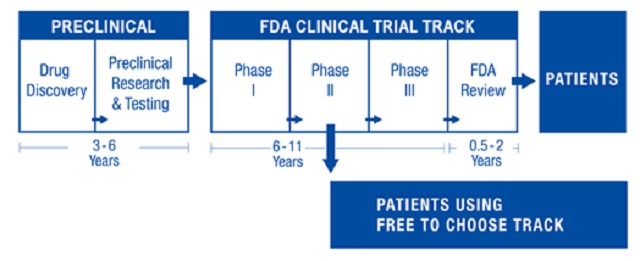
FTCM legislation in the U.S. would create a dual track system (see figure below) that preserves the existing FDA clinical trial process while offering patients an alternative. Patients, advised by their doctors, would be able to contract with a drug developer to use not-yet-approved drugs after Phase I safety trials are successfully completed and one or more Phase II trials have demonstrated continued safety and initial efficacy.

The resulting early access could make FTCM drugs available up to seven years before conventional FDA approval, which entails Phase III randomized control trials and a lengthy FDA review before the FDA makes an approval decision. …

bartgraph

The heart of the dual track system is the Tradeoff Evaluation Drug Database (TEDD) which would be available to the public through a government-supervised web portal. TEDD would contain all treatment results of FTCM drugs including patients’ health characteristics and relevant biomarkers, but no personal identification.

This open access database would be a treasure-trove of information to aid drug developers in making better R&D decisions consistent with fast-paced learning and innovation. …

Today’s world of accelerating medical advancements is ushering in an age of personalized medicine in which patients’ unique genetic makeup and biomarkers will increasingly lead to customized therapies in which samples are inherently small. This calls for a fast-learning, adaptable FTCM environment for generating new data.

In sharp contrast, the status quo FDA environment provides a yes/no approval decision based on statistical tests for an average patient, i.e., a one-size-fits-all drug approval process.

I hold the Bartley J. Madden Chair in Economics at the Mercatus Center, so I am biased, but this is an important proposal. Japan is leading the way and similar ideas are being discussed in Great Britain, but as the most important pharmaceutical market in the world, the United States has an outsize influence on world drug development. We need to lower costs and speed new drugs to market.

This post first appeared at Marginal Revolution.

Alex Tabarrok is a professor of economics at George Mason University. He blogs at Marginal Revolution with Tyler Cowen.

Where Is Speech Most Restricted in America? – Article by George C. Leef

Where Is Speech Most Restricted in America? – Article by George C. Leef

The New Renaissance HatGeorge C. Leef
******************************

Tolerance of speech and thought is being throttled here first

A good argument can be made that free speech is least safe on private college campuses.

At public universities, the First Amendment applies, thus giving students, faculty members, and everyone else protection against official censorship or punishment for saying things that some people don’t want said.

A splendid example of that was brought to a conclusion earlier this year at Valdosta State University, where the school’s president went on a vendetta against a student who criticized his plans for a new parking structure — and was clobbered in court. (I discussed that case here.)

But the First Amendment does not apply to private colleges and universities because they don’t involve governmental action. Oddly, while all colleges that accept federal student aid money must abide by a vast host of regulations, the Supreme Court ruled in Rendell-Baker v. Kohn that acceptance of such money does not bring them under the umbrella of the First Amendment.

At private colleges, the protection for freedom of speech has to be found (at least, in most states) in the implicit contract the school enters into with each incoming student. Ordinarily, the school holds itself out as guaranteeing certain things about itself and life on campus in its handbook and other materials. If school officials act in ways that depart significantly from the reasonable expectations it created, then the college can be held liable.

As the Foundation for Individual Rights in Education (FIRE) puts it, “There is a limit to ‘bait-and-switch’ techniques that promise academic freedom and legal equality but deliver authoritarianism and selective censorship.”

With that legal background in mind, consider a recent case at Colorado College. If Franz Kafka or George Orwell had toyed with a similar plot, they’d probably have rejected it as too far-fetched.

Back in November, a student, Thaddeus Pryor, wrote the following reply to a comment (#blackwomenmatter) on the social media site Yik Yak: “They matter, they’re just not hot.” Another student, offended that someone was not taking things seriously, complained to college officials. After ascertaining that the comment had been written by Pryor, the Dean of Students summoned him to a meeting.

Pryor said that he was just joking. What he did not realize is that there are now many things that must not be joked about on college campuses. Some well-known American comedians have stopped playing on our campuses for exactly that reason, as Clark Conner noted in this Pope Center article.

In a subsequent letter, Pryor was informed by the Senior Associate Dean of Students that his anonymous six word comment violated the school’s policy against Abusive Behavior and Disruption of College Activities.

Did that comment actually abuse anyone? Did it in any way disrupt a college activity?

A reasonable person would say “of course not,” but many college administrators these days are not reasonable. They are social justice apparatchiks, eager to use their power to punish perceived enemies of progress like Thaddeus Pryor.

For having joked in a way that offended the wrong people, Pryor was told that he was suspended from Colorado College until June, 2017. Moreover, he is banned from setting foot on campus during that time. And in the final “pound of flesh” retribution, the school intends to prohibit him from taking any college credits elsewhere.

With FIRE’s able assistance, Pryor is appealing his punishment. Perhaps the college’s attorney will advise the president to back off since its own “Freedom of Expression” policy hardly suggests to students that they will be subject to severe punishment for merely making offensive jokes on a social media site. If the case were to go to trial, there is a strong likelihood that a jury would find Colorado College in breach of contract.

Even if the school retreats from its astounding overreaction to Pryor’s comment, the administration should worry that alums who aren’t happy that their school has fallen under the spell of thought control will stop supporting it.

This incident is emblematic of a widespread problem in American higher education today: administrators think it’s their job to police what is said on campus, even comments on a social media app. Many colleges and universities have vague speech codes and “harassment” policies that invite abuse; those positions tend to attract mandarins who are not scholars and do not value free speech and unfettered debate. They are committed to “progressive” causes and will gladly use their power to silence or punish anyone who doesn’t go along.

American colleges have been suffering through a spate of ugly protests this fall. Among the demands the protesters usually make is that the school mandate “diversity training” for faculty and staff. Instead of that, what most schools really need is tolerance training, with a special emphasis on the importance of free speech. Those who don’t “get it” should be advised to find other employment.

George Leef is the former book review editor of The Freeman. He is director of research at the John W. Pope Center for Higher Education Policy.

This article was published by The Foundation for Economic Education and may be freely distributed, subject to a Creative Commons Attribution 4.0 International License, which requires that credit be given to the author.
The Islamic State by Any Other Name – Article by Sarah Skwire

The Islamic State by Any Other Name – Article by Sarah Skwire

The New Renaissance HatSarah Skwire
******************************
Terrorists Don’t Deserve to Choose What They’re Called

ISIS does not want to be called Daesh. The group considers the acronym insulting and dismissive. An increasing number of its opponents do not want it to be called the “Islamic State.” They fear that this shorthand reifies the terrorist group’s claims to be a legitimate government.

The debate reminds us that names have power.

Avid readers of fairy tales have always known this. Calling Rumpelstiltskin by his real name banishes him and foils his baby-stealing plans. Speaking your name to a witch or wizard can give them power over you. Patrick Rothfuss’s wildly popular Kingkiller Chronicles contains a magic system where learning the name of an element — like the wind — gives a person magical control over it. And everyone knows what happens when you say Beetlejuice’s name three times.

Converts to new religions often take new names to honor the transformation. We mark significant passages in our lives — birth, marriage, death — with new names. Miss Smith becomes Mrs. Jones. Junior becomes Senior when Senior dies. There’s even an old Jewish tradition that says that, in times of serious illness, one should take a new name in order to fool the Angel of Death.

Whether we believe in magic or religion or not, we feel the power of names throughout our lives. Who didn’t go through a childhood phase of wanting a different name? I was wildly jealous of Catholic friends who got to choose confirmation names. A college friend declared that her first day in college was “time to get a nickname” and had us all brainstorm until she found one she liked. It stuck for the whole four years, and long after. Other college friends made legal name changes to more accurately reflect their cultures or their lives. As an adult, I declined to change my name when I got married because I wanted to hold onto myself. I thought for months about choosing my daughters’ names.

I’m a strong advocate of calling people what they like to be called. My kids try on nicknames like I try on jewelry — experimenting with their identities from day to day and solemnly explaining that from now on, they shall answer to nothing other than “Pumpernickel,” or that “Abby” is now verboten and “Abigail” is in favor. I happily acquiesce in all the changes as they figure out who they are. And I love the new nicknames they create for me. (The latest is “Bob,” because that’s what it sounds like when you say “Mom” with a head cold.)

I think, too, that it is important to use the names that transgendered individuals have chosen for themselves, and the pronouns that reflect their gender — even if it’s an awkward or hard-to-remember change for me. The same goes for other communities based on culture, race, religion, or other common identity. At a bare minimum, as we go through the world, we should have the liberty to say peacefully who we are. And it is a small thing for us to do, generally, to give the respect and the acknowledgement that comes with using someone’s requested name.

But ISIS, or Daesh, is another matter entirely.

It is too late to treat Daesh as Yoko Ono requested that John Lennon’s assassin be treated — by denying it the dignity of a name we deign to speak aloud. We have done nothing but name it and talk about it and publicize its actions. It is probably inappropriate for a family publication to suggest that we might take the Wonderella approach to express our contempt. But we certainly can use an accurate translation of the name they have chosen and turn it into a mildly insulting acronym.

Apparently, it bugs them.

Good.

Sarah Skwire is the poetry editor of the Freeman and a senior fellow at Liberty Fund, Inc. She is a poet and author of the writing textbook Writing with a Thesis. She is a member of the FEE Faculty Network.

This article was published by The Foundation for Economic Education and may be freely distributed, subject to a Creative Commons Attribution United States License, which requires that credit be given to the author.

How Waze Makes Roads Safer than the Police – How an App Improved My Driving – Article by Jeffrey A. Tucker

How Waze Makes Roads Safer than the Police – How an App Improved My Driving – Article by Jeffrey A. Tucker

The New Renaissance HatJeffrey A. Tucker
******************************

The app economy has improved our lives in thousands of small ways, with seemingly endless opportunities to download and use gadgets that help us throughout the day, whatever our needs. Most are free or purchasable at a nominal charge.

Forget the ingredients for Shepherd’s Pie? Find it in seconds on the smartphone. Worried about the side effects of a new drug? They are there for you. Not sure about the quality of the restaurant you are about to enter? The crowds are anxious to tell you. Need a burrito for lunch? Uber will bring you one. (You can get a flu shot and a kitty, too.)

The truth is that we live completely different lives than we did ten years ago. We have unprecedented access to all life’s necessities, including medical and nutrition information, mapping information, the weather anywhere, plus hundreds of communication apps that allow text, audio, and video with half the human race, instantly, at no charge.

New Waze of Driving
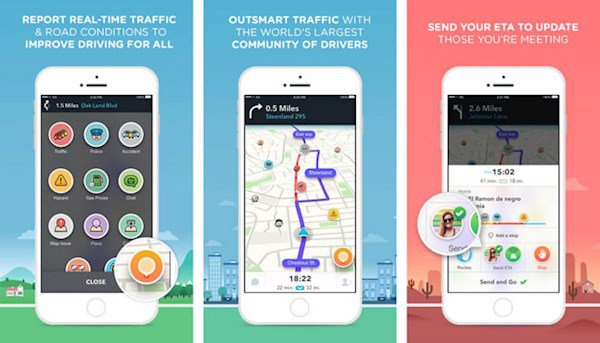
The app I’m most excited about today is a navigation tool called Waze. It provides mapping, plus delightful instructions on how to get from here to there. But beyond that, it crowdsources information to make the trip more efficient and safer than it otherwise would be. In big cities, Waze will take you through circuitous routes to avoid high traffic areas. It alerts you to accidents, road blocks, and debris on the road.

Impressively, it allows drivers to report where the police are staking out speed traps. It tells you whether the officer in question is visible or hidden. You can also confirm or deny the report.

14627-10326-waze-appstore-l

Police have objected to this feature of the app. Why? Because it means that drivers are better able to avoid getting ticketed. But think about this: the app actually succeeds in causing people to obey the law better by slowing down and being safer, as a way of avoiding fines.

Why would police object? If the whole point of traffic police is to get people to drive more safely, knowing about police presence achieves that goal.

Of course, we all know the real reason. The goal of the police on roads is not to inspire better driving but rather catch people in acts of lawbreaking so that they can collect revenue that funds their department. In other words, the incentives of the police are exactly the opposite of the promised results. Instead of seeking good driving, they are seeking lawbreaking as a means of achieving a different outcome: maximum revenue collection.

The whole ethos of Waze is different. It helps you become aware of your external surroundings, and conscious that other drivers are in a similar situation as you are, just trying to get to their destinations quickly and safely. We are there are help each other.

The Community Matters
For me this effected a big change in the whole way I drive. There is a tendency from your first years of driving to treat other drivers as obstacles. Your goal is to outsmart others who are crowding the road, moving around them quickly and navigating the roads with a chip on your shoulder. If there are no cops around, you drive as fast as possible.

I never intended to drive this way, but now I know that I have been, since I first received my government permission slip to drive. Once behind the wheel, I tended to think of myself as a lone actor.

Waze has subtly changed my outlook on driving. Other drivers become your benefactors because it is they who are reporting on traffic accidents, cars on the side the road, blocked streets, and the presence of police. They are all doing you favors. If you report, others thank you for doing so. You even see icons of evidence that your friends are driving, too.

Safety is priority one. Waze won’t let you type in a new address while you are driving. You have to stop the car before you can do that.

The app manages to create a sense of community out of drivers on the road, and that changes the way you think when you drive. Now I leave Waze on even when I already know the directions. It’s my connection to the community. I find my whole outlook on driving has changed. For the first time in my life, I can honestly say that I’m a safer and more responsible driver.

So thank you Waze — a product of brilliant entrepreneurship, distributed on private networks, performing a public service.

Compare with the people who are charged with the task of making our roads safe and are paid by our tax dollars to do it. Not only do they fail to accomplish what this one free application has done, they are actively seeking to cripple it.

Baby Steps to a Better World
Maybe this seems like too small a life improvement to justify mentioning? Not so. All great steps toward a better world occur at the margin, bit by bit, through trial and error, one innovation at a time. You look back at the progress of a decade and that’s where the awe comes into play.

It is not through large bills written by legislators and signed by presidents that the world improves. It is through small innovations, inauspicious downloads, incremental improvements in our existing paths that gradually build a better world. Waze is only one of a billion but it points to the right method and approach to an improved life.

Jeffrey Tucker is Director of Digital Development at FEE, CLO of the startup Liberty.me, and editor at Laissez Faire Books. Author of five books, he speaks at FEE summer seminars and other events. His latest book is Bit by Bit: How P2P Is Freeing the World.  Follow on Twitter and Like on Facebook. 

This article was published by The Foundation for Economic Education and may be freely distributed, subject to a Creative Commons Attribution United States License, which requires that credit be given to the author.

Enlightened Selfies – Narcissism and Human Rights – Article by B.K. Marcus

Enlightened Selfies – Narcissism and Human Rights – Article by B.K. Marcus

The New Renaissance Hat
B.K. Marcus
******************************

When the press refers to “Generation Selfie,” do we sense a sneer? It’s almost as if the term selfie is shorthand not for self-portrait but for self-involved, self-absorbed, or simply selfish.

Selfies are widespread among millennials, many of whom grew up with camera phones. A poll commissioned by electronics maker Samsung reveals that fully 30 percent of all photos taken by 18- to 24-year-olds are selfies. For many of us, the selfie is just the new normal, whether or not we fill our own smartphones with self-regarding snapshots. But, as Pamela Rutledge writes for Psychology Today, some see the selfie generation “as proof of cultural — or at least generational — narcissism and moral decline.” And calling Generation Selfie a bunch of narcissists may not be rhetorical excess: according to a paper in the journal Personality and Individual Differences, selfie-posting behavior is indeed associated with narcissistic personality disorder.

Does this mean that modern society is growing more self-obsessed?

Belief in the “moral decay” epitomized by self-directed amateur photography results from a more general conviction that the virtues of community and altruism are being driven out by our culture’s overemphasis on the individual. Whether the culprit is capitalism, technology, or Western civilization more generally, the idea is that historically recent developments are fracturing our communal bonds and leading to a loss of empathy, compassion, and duty — replacing concern for the well-being of a larger group with a privileging of the atomized individual.

Inventing the Modern Self

But the development is not, in fact, historically recent. The selfie as we now know it may seem like a result of social media and the camera phone, but our society’s apparent obsession with visual self-presentation is much older — and significantly more beneficial — than the critics understand.

“It’s easy to make fun of our penchant for taking selfies,” writes popular science author Steven Johnson in How We Got to Now: Six Innovations That Made the Modern World, “but in fact there is a long and storied tradition behind that form of self-expression.”

The original selfie generation emerged in Renaissance Italy, the product of a different technological innovation. Centuries before the bidirectional camera phone, there was the culturally disruptive technology of the glass mirror.

“The interesting thing about self-portraiture,” Johnson tells us, “is that it effectively doesn’t exist as an artistic convention in Europe before 1400.” That’s because, for most of human history, we got very few chances to see ourselves as others see us. The best we could do was a rippled reflection glimpsed in water or a tarnished image on a metal pot.

That all changed when glassmakers “figured out a way to combine their crystal-clear glass with a new innovation in metallurgy, coating the back of the glass with an amalgam of tin and mercury to create a shiny and highly reflective surface. For the first time, mirrors became part of the fabric of everyday life.”

One result was the invention of linear perspective in painting. Prior to the Renaissance, visual representation was more symbolic, less what we would now call realistic. Renaissance artists used the new technology of the mirror to compare what they put on the canvas with what they saw framed in the glass. Sometimes, of course, what they saw in the looking glass was their own reflection.

“The mirror helped invent the modern self,” Johnson writes, “in some real but unquantifiable way.”

Soon after, “social conventions as well as property rights and other legal customs began to revolve around the individual rather than the older, more collective units: the family, the tribe, the city, the kingdom.” Furthermore, “orienting laws around individuals led directly to an entire tradition of human rights and the prominence of individual liberty in legal codes.”

Inventing Humanity

In a different investigation of the individualist tradition, historian Lynn Hunt observes in her book Inventing Human Rights, “For rights to be human rights, all humans everywhere in the world must possess them equally and only because of their status as human beings.”

There was no such understanding of humanity for most of history. Love, compassion, and sympathy may have existed from the beginning, but only between people in narrowly defined groups. The treatment for outsiders was far more harsh.

Slavery and torture, today considered egregious violations of human rights, went unquestioned before a few hundred years ago. Since at least the time of Aristotle, it was typical to divide the world between “us,” the naturally civilized, and “them,” the naturally enslaved. Torture, in the ancient world, was originally limited to slaves, but over time, the practice became more acceptable, and in the second century it was expanded to include nominally free lower-class victims. By the Middle Ages, torture before execution had become a form of spectacle, public entertainment for the whole family.

How, then, did we develop a sense of universal humanity and of natural rights for all human beings? Specifically, Hunt asks about the Enlightenment thinkers in 18th-century France and America, for whom such rights were “self-evident.”

How did these men, living in societies built on slavery, subordination, and seemingly natural subservience, ever come to imagine men not at all like them and, in some cases, women too, as equals?

And how did the 18th-century public come to agree with them? The answer Hunt offers is that the so-called self-evidence of individual human rights was largely the result of widespread reading in a genre that was still relatively new at the time: the epistolary novel. Enlightenment thinkers were familiar with first-person narrative in a way that earlier generations would have found alien. Novels introduced readers to the inner lives of characters unlike themselves.

Johnson, too, talks about the emergence of the novel and its impact on the moral imagination, but he traces the origins of the modern novel itself to the same innovation that gave rise to linear perspective in painting: “The psychological novel … is the kind of story you start wanting to hear once you begin spending meaningful hours of your life staring at yourself in the mirror.”

Thinking about themselves as the individuals staring back through the glass, “people began writing about their interior lives with far more scrutiny,” and “the novel emerged as a dominant form of storytelling, probing the inner mental lives of its characters with an unrivaled depth.”

The Innovation of Empathy

What does this sort of growing self-obsession have to do with the rights of others?

Empathy, Hunt points out, “requires a leap of faith, of imagining that someone else is like you.” This is the idea that “novels generated … by inducing new sensations about the inner self.”

Or as Johnson puts it,

Entering a novel, particularly a first-person narrative, was a kind of conceptual parlor trick: it let you swim through the consciousness, the thoughts and emotions, of other people more effectively than any aesthetic form yet invented.

Spending time in someone else’s head, even if that someone else is fictional, is practice for thinking about real people’s experiences.

So, according to this story, the technology of glass mirrors leads to linear perspective, the Renaissance, and a new literary form called the novel. The novel, in turn, transforms the popular imagination in such a way that even strangers — those outside your immediate family, class, and religious affiliation — come to be understood as autonomous individuals with their own inner lives, much like your own. And for the first time in history, people come to question the practices of torture and slavery, practices at least as old as civilization and far more universal than any understanding of rights prior to the Enlightenment.

The “invention” of the individual ushered in not ever more selfishness and less regard for the group, but an expanding empathy and a more inclusive, approaching universal, sense of “us” — a waning relegation of those outside our moral community.

Trading with the Other

Johnson notes that the technological innovation at the beginning of the story isn’t enough by itself to have produced the larger cultural shift:

The Renaissance also benefited from a patronage system that enabled its artists and scientists to spend their days playing with mirrors instead of, say, foraging for nuts and berries. A Renaissance without the Medici — not the individual family, of course, but the economic class they represent — is as hard to imagine as the Renaissance without the mirror.

The same can be said about the economy that produced the Enlightenment: it is hard to imagine an era of growing empathy, open-mindedness, and belief in universal rights without the market that provided a growing readership for the epistolary novel.

Capitalism establishes the conditions in which individualism can thrive. Individualism, in turn, helps the market economy to grow and to propagate the belief in rights-bearing individuals.

Contrary to today’s critics, then, who assume that the individualist mentality leads to the absence of empathy, with the advent of individualism came the invention of empathy, at least as applied to those outside the tribe, clan, or caste.

Maybe narcissists do feel compelled to photograph themselves. Camera phones make it easier than ever. But the myth of Narcissus is ancient. And the history of reflective technology points us to a different understanding of cause and effect for the selfie generation.

The 21st-century self-portrait can play the same role now as its earlier incarnations did during the Renaissance and the Enlightenment. Like individualism more generally, the selfie invites us to explore questions of identity and of where we fit in an ever more interconnected community.

B.K. Marcus is editor of the Freeman. His website is bkmarcus.com.

This article was published by The Foundation for Economic Education and may be freely distributed, subject to a Creative Commons Attribution 4.0 International License, which requires that credit be given to the author.

Who Are the Syrian Refugees? – Article by Alex Nowrasteh

Who Are the Syrian Refugees? – Article by Alex Nowrasteh

The New Renaissance Hat
Alex Nowrasteh
November 20, 2015
******************************

This is the demographic information on all 2,234 Syrian refugees admitted to the United States from October 2010 through November 2015, according to the Refugee Processing Center.

Data on religion for all refugees is from the same source; some additional information comes from the American Community Survey.

Gender and Age

Refugees from Syria are overwhelmingly young. 43 percent of all Syrian refugees are children under the age of 14.

syrian-ages

The gender ratios for Syrian refugees are more balanced. 53 percent are male, 47 percent are female.

syrian-genders

Males aged 14-30, the most potentially dangerous group, are 13 percent of all Syrian refugees.

syrian-males-prime-age

Religion

Data on religion was collected for all Syrian refugees admitted from fiscal year 2011 to today.

About 96 percent of the refugees are Muslim of any denomination; about 3 percent are Christians of any denomination. About 1 percent are nonreligious or of other faiths.

syrian-religions

The Syrian refugee flow is much more Muslim than the global average. Of all refugees resettled in the United States, 44 percent are Christian, compared to less than 3 percent from Syria.

all-refugees-religion

Note about worldwide religious data: I suspect there is some double counting.  

Ethnicity

The Syrian refugees are 87 percent Arab and 10 percent Kurdish, with small representations from other ethnic groups.

syrian-ethnicity


Education Level

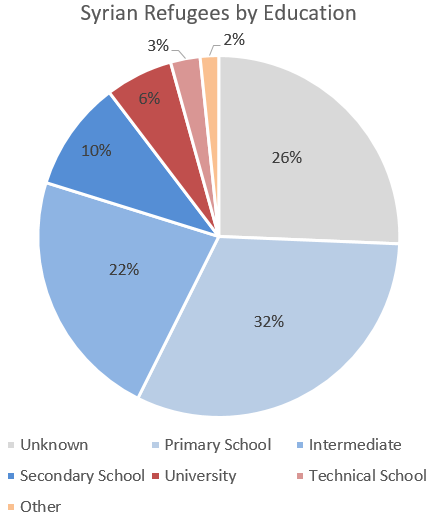
Since 43 percent of the Syrian refugees are under the age of 14, and 56 percent are under 20, Syrian refugees tend to be less educated. 9.4 percent have a technical, university, college, or graduate school level of education. Since the refugee flow skews young, this group should become more educated as they age.

syrian-education

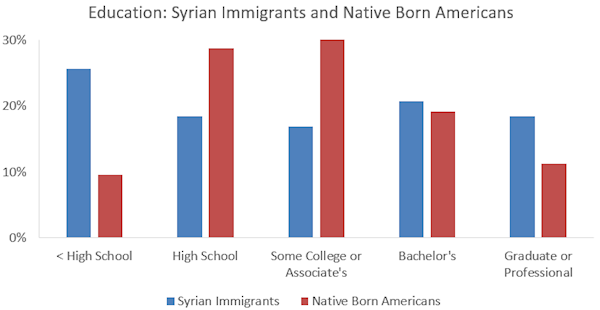
Adult Syrian Americans — over age 25 and born in Syria — are more educated than the current refugee flow.

Overall, Syrian Americans are both more and less educated than the population as a whole. 44 percent of Syrian immigrants have just a high school diploma or less, compared to 38 percent of native born Americans, but 39 percent of Syrian Americans have a bachelor’s degree or higher, compared to 30 percent of the native born.

syrian-vs-american-ed

Sources: American Community Survey, 2014, 1-Year Sample, S0501 and S0201 Syrians

Location

Syrians resettled in the United States are highly concentrated in a few states.

Six states (CA, TX, MI, IL, AZ, and PA) have together received more than half of Syrian refugees.

syrian-state

Twenty states (AR, CO, ID, IN, KS, LA, ME, MD, MN, MO, NV, NH, NM, OK, OR, TN, UT, VA, WA, and WV) have received fewer than 50 refugees.

Fourteen states (AL, AK, DE, HI, IA, MS, MT, NE, ND, RI, SC, SD, VT, and WY) and Washington, DC, have not received any.

Alex Nowrasteh is the immigration policy analyst at the Cato Institute’s Center for Global Liberty and Prosperity.

This article was originally published by The Foundation for Economic Education.

Why Open Borders? – Article by Jeffrey A. Tucker

Why Open Borders? – Article by Jeffrey A. Tucker

The New Renaissance HatJeffrey A. Tucker
September 15, 2015
******************************

Two dear friends of mine just experienced incredible struggles with immigration control in the United States, one from Australia and one from Canada. Both are enormously talented, in love with the freedom that America represents to the world — or once did anyway.

One barely got in after months of waiting, even though a willing, begging employer was waiting. The other was deported with a single day’s notice.

Each has been a captive of bureaucrats with awesome power. Their stories are tragic. Natives know nothing about this ghastly system and how it treats human beings. We never experience it.

The labyrinth of bureaucracy is jaw-dropping. The arbitrary power exercised by “our” bureaucrats is frightening. The loss to our nation’s productivity is mindboggling. Hearing these stories, you can’t help but apologize for the way our own government treats people who want to love this country and contribute to its greatness.

And to think that for the first 100 years of this country’s existence we had zero national immigration restrictions. The whole world was invited in — and this invitation led to the most prosperous society the world has ever known. In these times, there were no passports. For the most part, everyone was free to move around the earth — and this was thought to be the very essence of liberty.

Today, we have an effective ban on immigration. You can’t come to the U.S. to live and work legally unless you are family, highly educated, or get in as a refugee. Other than that, the barriers to legal immigration are impossibly high. The wait lines for employment visas are impossibly long, and people from the world’s largest population centers aren’t even eligible.

Meanwhile, the government spends $18 billion on stopping immigration — more than all other federal criminal enforcement agencies combined. This is money spent to stop people from freely exchanging labor for money. That the whole thing is a massive flop is revealed by the 11 million illegal immigrants in this country, and the half million apprehended crossing the border each year — surely only a fraction of those who were not.

But apparently, that’s not enough. Donald Trump is soaring in popularity by calling for mass deportations and building a wall around the country, in effort to double down on a failed government policy. Other candidates are alarmed at his rhetoric, but echo his core claim that there is some kind of crisis going on.

Meanwhile, this is a huge debate among people who otherwise swear fealty to “limited government.” Many people who claim to want freedom seem to have no problem with the implications of a closed-border policy: national IDs, national work permits, non-stop surveillance, harassment of all businesses, a “papers please” culture, mass deportation, tens of billions in waste, bureaucrats wrecking the American dream, broken families, the rights of Americans and foreigners transgressed at every turn.

In this environment of political hysteria, in which the rankest form of racial fear has reared its head, few dare to stand up and call for the only liberty-minded answer: open borders.

Just the phrase causes people to sputter in shock. The objections start flying: wages will fall, welfare will explode, people will vote for the wrong people, there will be cultural confusion, the national language will evaporate, crime will soar — on and on the parade of horribles marches.

The more you look into the research, the more these objections fall away. Immigrants cause less crime than natives. Immigration does not cause unemployment. Immigrants don’t consume more public benefits than natives; in fact, they use fewer. Indeed, they have kept Social Security afloat, even though they will never get a dime from the system. They don’t love liberty less: they poll in as more libertarian. Indeed, every one of these and other claims in Trump’s immigration policy paper are patently wrong.

Apparently, the facts don’t matter. And as for humane values and human rights, forget it. Immigration restriction is a fundamental attack the rights of at least two parties: the person who wants to employ someone currently outside the border and the person who wants to come work. It’s a thuggish interference with an economic exchange, like any other arbitrary restriction on trade.

So often, in many recent discussions I’ve had online, what’s going on here is just a shoot-from-hip bias. It’s exactly the same kind of fears that make people object to getting rid of the minimum wage, cutting taxes, eliminating tariffs, privatizing the TSA, eliminating zoning laws, cutting government spending, legalizing pot, and so on.

It’s freedom itself that people fear.

Once freedom goes away, it is difficult to imagine how things would work if it came back. The notion of freedom then scares people, and it becomes easy to think up a thousand different scenarios in which freedom can’t possibly work. Surely disaster will ensue!

This was a problem during alcohol Prohibition. The system wasn’t working, but the prospect of making its consumption and production legal again elicited a kind of panic. Would our streets be filled with staggering drunks? Would scarce income be squandered on liquor? Would families break apart?

The lack of imagination concerning how freedom can work is the single biggest barrier in the U.S. to ending the war on immigration.

Imagine if the U.S. had massive border controls between states, with checkpoints and passports and drug-sniffing dogs, and if you had to have permission to change from a job in Ohio to a job in Vegas, or if a Virginian could be deported from New Jersey for overstaying, or if you had to wait years to obtain the right documentation to move from one state to another, or if the labor market was so tightly regulated that an employer in another state could only hire you if they could prove they had no other options.

If all that were true, anyone who suggested open borders and a free labor market between states in the U.S. would be considered a dangerous loon.

But here is the clarifying fact: the conditions that allow free migration between states within the U.S. are identical with regard to free migration between the U.S., Mexico, and Canada. The only difference happens to be the government that issues citizenship documents.

I live in Georgia. What if I started a movement to prohibit immigrants from Chicago to Georgia? Why would I suggest such a crazy thing? Because I believe that crime is higher in Chicago, welfare is more widely used, their imported labor would drive down wages, they vote in ways that are regrettable, and people there just don’t get the ways of the American South.

Should we have immigration controls between states? It sounds preposterous (though Trump could probably sell the idea). But the claims that we can’t have free immigration into the U.S. follow the exact same logic.

Every argument for immigration restrictions into the United States as a whole applies with equal validity for immigration controls between states, counties, cities, and even towns. And yet we do not have such controls. Why does it work so well? Because freedom works.

How can we begin to imagine what open borders would be like? We need an experiment in that exact thing. It just so happens that we have just such an experiment. There are 28 countries that have historically been at war for thousands of years. They all have different languages, different religions, and different folkways. At various periods, people from these countries have hated each other to the point of causing genocide.

Then one day, starting with an agreement that began to be implemented twenty years ago (the Schengen Agreement), they opened all the borders. Anyone from these countries can live and work anywhere. They can travel freely, on the same passports. No bureaucracy stops their freedom of movement and their freedom to produce.

The results have been spectacular. It’s the greatest experiment in completely open borders the world has seen in more than a century. It’s called the European Union. And it works. It points toward the ideal: a world in which everyone is free to move about the earth without fear of gun, wall, or barbed wire.

Let’s not fear freedom and free trade (which means, free trade in capital and labor). In the end, Ludwig von Mises was right: “Without the reestablishment of freedom of migration throughout the world, there can be no lasting peace.”

Jeffrey Tucker is Chief Liberty Officer of Liberty.me (http://liberty.me/join), a subscription-based, action-focused social and publishing platform for the liberty-minded. He is also distinguished fellow of the Foundation for Economic Education (http://fee.org), executive editor of Laissez-Faire Books, research fellow of the Acton Institute, founder of the CryptoCurrency Conference, and author of six books. He is available for speaking and interviews via tucker@liberty.me.

Why the Candidates Keep Giving Us Reasons to Use the “F” Word – The Electoral Clown Car Is Full of Nationalistic Socialists – Article by Steven Horwitz

Why the Candidates Keep Giving Us Reasons to Use the “F” Word – The Electoral Clown Car Is Full of Nationalistic Socialists – Article by Steven Horwitz

The New Renaissance HatSteven Horwitz
August 6, 2015
******************************

“There are far too many candidates,” writes Dana Milbank at the Washington Post. “And to gain attention they are juggling, tooting horns and blowing slide whistles like so many painted performers emerging from a clown car.” The two clowns making the most noise in recent weeks are Bernie Sanders and Donald Trump.

At first glance, it would seem they couldn’t be more different: a Democrat and a Republican, a friend of the unions and a CEO, a man of relatively modest means by congressional standards and one of the wealthiest men in the United States. But a closer look reveals some interesting similarities and teaches us an important lesson about the history of ideas. What Sanders and Trump have in common is no laughing matter.

Recent articles by libertarians on both candidates have suggested that they are both strongly nationalist. Dan Bier tore apart Sanders for his views on immigration, and both Jeff Tucker and Jason Kuznicki have associated Trump with nationalism and perhaps even a variant of fascism. I think they are all on to something: Sanders and Trump have a lot more in common than many think. But before I get there, we need to take a detour into the history of socialism and fascism.

In its original conception, Marxian socialism was strongly internationalist. Marx’s theory was based on the idea of class struggle and the disparity in power between those who owned the means of production (the capitalists) and those who did not (the proletariat).

Marxism has nothing to do with nationality. It’s all about class, defined as whether or not one owns capital. For true Marxists, a German worker has much more in common with a Russian worker or an Italian worker than he or she does with a German capitalist. Marxism did not give any importance to national borders.

For many in the early 20th century, this was a problem with Marxism, especially in the aftermath of World War I. Much like today, people were looking for a “third way” between capitalism and socialism. For many of those people, that third way was fascism.

Today we use the word fascism as an epithet, especially for bossy people. We associate it with dictatorships, and especially with Nazism. It turns out that fascism was a fairly well-worked-out theory of how to organize a society, and in its original form was not about racism or anti-Semitism directly. Fascism was an attempt to combine what people saw as the best parts of capitalism and socialism, and then to do so in the context of putting nationality before class.

The most extensive writing about how fascism would work came from the Italians in the 1920s and 1930s, and interested readers should find a copy of Luigi Villari’s The Economics of Fascism to see the details. (You can find a nice summary of those ideas in Sheldon Richman’s entry on fascism in the online Concise Encyclopedia of Economics.)

The fascists argued that the whole notion of class conflict was the problem. Instead of pitting class against class and tearing nations apart, why not bring all the parties together and give them the chance to cooperate with each other rather than struggle their way to socialism? The fascist economy was built around a series of cartels where the state, the nominal owners of the means of production, and the workers (represented by labor unions) would get together and figure out what to produce, how to produce it, what to charge, and how much profit would be “allowed.”

The fascists agreed with socialism’s desire not to leave markets to spontaneous ordering forces, but they thought the nation-state should direct the economy, not the workers. Both capitalism and socialism involved conflict, not cooperation. The same third-way thinking, and some of the same structures, were present in the first two years of the New Deal in the United States. The cartels of the National Recovery Administration were modeled after Italian fascism, and FDR and Mussolini were mutual admirers.

You can see how fascism took elements of both capitalism and socialism, then added nationalism. The idea was to look out for the welfare of the nation-state first. The Italian capitalist and the Italian worker were both Italians first and foremost, and that should be the first call on their allegiance. Lashing socialism to the glorification of the nation-state gives us fascism, and you can see why anyone who represented a threat to national identity would quickly become a problem.

This is one reason why the German version of fascism so easily linked up with a long history of German anti-Semitism. The Nazis were undoubtedly socialist (recall that Nazi is short for National Socialist German Workers Party), as even a quick glance at their 1920 platform will tell you. They were also, even at that date, fiercely nationalist. In Hitler’s hands, that national pride quickly became a desire to glorify the Aryan race.

Plus, recall that Jews were disproportionately both capitalists and supporters of the Marxist revolution in Russia — not to mention the symbol of the cosmopolitan, rootless nomad for centuries. Many of those who wanted to reject both capitalism and Marxian socialism saw the Jews as the symbol of both.

So what does this have to do with Bernie Sanders and Donald Trump?

I would argue that they are both “nationalist socialists.” That is, they both embody key elements of fascism. They both think the nation comes first, and they both think the United States is an organization (not a spontaneous order) that should be under someone’s control.

The difference is that Sanders sees both the problems and the solutions from the workers’ perspective, so he’s focusing on both the exploitation by capitalists and keeping immigrants out to protect the wages of US workers. The losses to US workers matter more than the large gains to foreign-born workers coming here.

Trump sees all of this from the CEO/owner/capitalist perspective. He thinks the United States is, or should be, like a big firm where we all work together for a common goal. He envisions himself as the CEO, negotiating deals with other countries as if they, too, were just big corporate firms. But nations are not firms — they are spontaneous orders.

As I argued in an earlier column, “Socialism Is War and War Is Socialism,” this desire to turn spontaneous orders into hierarchies is characteristic of both war and socialism. It is also deeply embedded in fascism, and Sanders and Trump exemplify that tendency among the presidential candidates, though they do so with different emphases and rhetoric.

Their commonalities are also why our conventional binary left-right political spectrum makes no sense. That one candidate is perceived as far to the left and the other as (to some degree) a right-wing capitalist shows the depth of our failure to understand history. They have both rejected the spontaneous order of the market as well as the cosmopolitanism of liberalism and socialism. They are fascist brothers under the skin.

That both are getting the attention and support of so many Americans should be a matter of grave concern. After all, some clowns are far more scary than funny.

Steven Horwitz is the Charles A. Dana Professor of Economics at St. Lawrence University and the author of Microfoundations and Macroeconomics: An Austrian Perspective, now in paperback.

This article was published by The Foundation for Economic Education and may be freely distributed, subject to a Creative Commons Attribution 4.0 International License, which requires that credit be given to the author.

Does America Ban Immigration? – The Land of the Free Isn’t, For Most People – Article by David Bier

Does America Ban Immigration? – The Land of the Free Isn’t, For Most People – Article by David Bier

The New Renaissance Hat
David Bier
August 3, 2015
******************************

The United States has a de facto ban on immigration. We can debate about whether this prohibition is necessary, but its existence is undeniable. Other than a few exceptions for family members, refugees, and the highly-educated, it is virtually impossible to come to the United States to live and work legally.

Historically, America held its doors open to all. But in the 1920s, a coalition of unions, progressives, and eugenicists combined to slam them shut. Within a year of passing Alcohol Prohibition, America also banned almost all forms of immigration, cutting immigration by nearly 80 percent.

Alcohol regained its legal status, but immigration never quite recovered.

Today, the government lets in almost a million immigrants each year, but this impressive-sounding number misses the entire legal, historical, and global context of our immigration system. We must compare it to the number who would come if only they could do so legally — and the reality is that most types of immigration are entirely prohibited. To deny the ban on immigration because it has exceptions is like denying Alcohol Prohibition because it allowed communion wine.

The half million people apprehended at the border each year and the 11 million unauthorized immigrants in the country are the clear evidence of this prohibition. The massive immigration underground points to an obvious yet largely ignored fact: If there was a legal way for them to come, they would have taken it. But, trouble is, one doesn’t exist.

The drastic shortage of visas is evident in the unbelievably long wait times for permanent residency. For certain categories, the wait is decades. For employment-based visas, certain Indian and Chinese workers will wait more than a decade. For Mexico, three different family-based categories have wait times over 18 years. There’s northward of 4.3 million people in these lines alone.

Yet these impossible lines hide a deeper problem: most would-be immigrants have no line to stand in at all.

The reality is this: 92 percent of legal immigrants are either 1) immediate family members of US citizens or permanent residents, 2) refugees or asylees, or 3) college graduates — and over 80 percent those needed an advanced degree or at least $500,000 to invest in projects in the United States.

This leaves less than 65,000 visas for everyone else. More two-thirds of these come through a lottery system for which 11 million people applied last year. People in most of the largest countries in the world, including India, China, and Mexico, aren’t even eligible to apply.

This legal flow amounts to barely 7 percent of the average number of immigrants apprehended at the border each year since 2004 (and, of course, that doesn’t count those who crossed successfully, or those who entered and overstayed their visas, or those who would come if there was a legal opportunity). For people without a college degree or a close American relative, the Statue of Liberty’s “Golden Door” is almost completely shut.

Meanwhile, PhDs, scientists, movie stars, pro-athletes, and other elites have a number of different work visas available to them. These allow them to live and work year-round in the United States.

By contrast, there is no work visa that allows lesser-skilled laborers to live and work year-round in this country. Unsurprisingly, this lesser-skilled demographic is disproportionately represented in the illegal population, 85 percent of whom lack a college degree.

Another reason we know that illegal immigration is being driven by the lack of a legal alternative is because of what happened when the government allowed foreign workers to come and go legally.

Thanks to a fluke of history, America had a brief period when it experimented with freer migration between the United States and Mexico. In the 1950s and ‘60s, the Bracero guest worker program let in about 5 million Mexican farmworkers. From 1956 to 1965, when the program was at its height, the number of unauthorized immigrants at the border averaged just 41,000, compared to over 436,000 a year in the prior decade.

After it was terminated in 1966 by another union-led coalition, illegal immigration never again fell to such low levels — not even for a single year, let alone an entire decade. By the 1980s, a million or more immigrants were routinely being caught by Border Patrol every year.

Supporters of the ban on immigration will say that America is at its breaking point, that we’re overwhelmed, that we can’t “handle” any more immigrants. But this fear is groundless: As a share of its population, America admitted four times as many immigrants each year in the early 1900s as it did in 2014. For a century from 1830-1929, immigration was twice as high as a share of the population as it was in the last two decades.

In absolute terms, America admits more immigrants than any other country, but relative to its size, US immigration levels are far lower than many Western countries. Controlling for population, Canada, Australia, and New Zealand all have higher levels of immigration than America today — even as high as the United States in the early 20th century — and they have not collapsed into chaos or poverty.

Immigration prohibition is real. Millions of people cross the border illegally (and thousands of businesses hire them illegally) for the same reason bootleggers had to brew booze in bathtubs. And, for the same reasons we repealed Alcohol Prohibition, we should also finally end America’s ban on immigration.

David Bier is an immigration policy analyst at the Niskanen Center. He is an expert on visa reform, border security, and interior enforcement. From 2013 to 2015, he drafted immigration legislation as senior policy advisor for Congressman Raúl Labrador, a member of the House Judiciary Committee’s Subcommittee on Immigration and Border Security. Previously, Mr. Bier was an immigration policy analyst at the Competitive Enterprise Institute.  

This article was published by The Foundation for Economic Education and may be freely distributed, subject to a Creative Commons Attribution 4.0 International License, which requires that credit be given to the author.

Handcuffed and Helpless – Article by T.K. Coleman

Handcuffed and Helpless – Article by T.K. Coleman

The New Renaissance HatT.K. Coleman
July 28, 2015

******************************

There’s a naive idea floating around that an innocent person should never be afraid of cops.


Editors’ Note from the Foundation for Economic Education: FEE faculty T.K. Coleman is consistently one of our students’ favorite speakers and teachers. His insight and magnetism would be impossible to replace. We not only consider him a friend, but a member of the FEE family.

Recently T.K. related the story of his experience with police abuse. We cannot independently verify the account he gives here, but we offer his story based on our belief in T.K. Coleman as a human being and as a friend to our organization.

We believe it is important to cover the problem of police abuse from the perspective of one who has experienced it.

What you are about to read is not a philosophical argument. It’s a personal testimony. The aim of telling this story is neither to make a political statement, nor to score points for a particular ideology. For almost three years, I’ve mostly held it in. But it’s become clear to me that it’s time to give a more detailed account to a broader audience.

*             *             *

One Friday night, my wife and I were driving through a small town on the way to a comedy club in Manhattan Beach, California. We were going to hang out and share a few laughs. On the way, we were pulled over by the police.

Two officers approached our car. One of them came to my window. The other one came to her window.

Without asking to see my license or registration, the officer on my side told me to get out of the car. I immediately and respectfully complied without raising a single question or objection. And in case you’re wondering, I wasn’t dressed in gang colors, nor was I wearing a hoodie.

When I exited the car, he turned me around, handcuffed me, threw me against the side of my car, and did a complete body search on me. As he groped me, he said, “This is how we do it in LA.”

I remember seeing a woman walking across the street holding hands with her little girl. We made eye-contact. She picked her little girl up and jogged in the other direction. Who could blame her? If I saw one of society’s most trusted authority figures manhandling a guy, I’d also assume this was a potentially dangerous situation.

The officer then removed the wallet from my pocket and pulled out the cash.

“Why do you have so much cash on you?”

“Sir, I honestly didn’t feel like a $100 was a lot of cash to have on me. I’m going out with my wife tonight and just wanted to have a little cash on me.”

“We’ll see.”

Next, he asked me where I lived. I told him my address. He laughed and said, “This n****r knows his address.” Then he walked me to the police car and literally threw me in the back seat and shut the door. From the back seat of a police car, I watched the officer join his partner who was already busy questioning my wife. They also made her get out of the car. They both got in her face and started questioning her.

Imagine what goes on inside of a man’s head when he’s handcuffed and helpless as he watches two men with guns get in his wife’s face. Imagine the complex blend of confusion, fear, irrational optimism, and rage that festers inside one’s soul as he watches one cop take his wife’s purse and pour all the contents out, while the other officer literally crawls around inside our car for several minutes.

They spent about 10 more minutes aggressively questioning my wife.

One of the officers returned to the car with my wallet and proceeded to look up my info in the system.

“You got any baby momma drama?” he asked me.

“I don’t have any children, sir.”

“You sure you ain’t got no baby momma drama?”

“I am certain I have no children, sir. There are no women out there who are even under the impression that I am the father of their child.”

“Are you clean? Are you clean? You ain’t got no drugs? You ain’t got nothing on you? No baby momma drama?” he says.

“I am clean,” I said.

For the entire time we were talking, my eyes were deadlocked on that other officer and my wife. After what felt like an eternity, the officer let me out of the car and took off the handcuffs.

“You’re good,” he told me.

As I slowly walked back to our car, I said to one of the officers, “Sir, I’m not trying to be antagonistic or disrespectful, but is there a reason for why I was pulled over?”

“We just had to check you out.”

I wanted to say, “What does that even mean?” But more importantly, I wanted to get us out of that situation safely. Given the way he man-handled me earlier, it was obvious to me that I was dealing with guys who weren’t above breaking protocol. So I just walked back to the car, took a deep breath, asked my wife if she was alright, and did my best Denzel Washington from Glory impersonation as I tried to keep it together.

Our comedy show started at 8 P.M. We were pulled over at about 7:30. When they let us go, it was about 10 minutes after the hour. We decided we couldn’t go home, or it would feel as if we let them win. So we drove to a local cinema, watched a movie, came back home, had some coffee, and just stayed up talking with each other about it.

*             *             *

I’m grateful that we didn’t get killed. I’m grateful that my wife didn’t get assaulted. I’m grateful that they didn’t plant drugs on me or put me in the hospital.

But my gratitude doesn’t change the fact that these men abused their power, disrespected my wife, laid their hands on my body in an inappropriate way, scared the hell out of us both, made us miss our show, and treated us like criminals simply because they felt entitled to do so.

They will not ruin my life, nor will they determine my destiny, but I want to put this story on the record because this was neither the first nor the second time something like this happened to me, and I sincerely believe that things like this happen all over the country.

There’s this naive idea floating around that people should never be afraid of cops as long as they’re innocent and compliant. For a lot of people in this country, that’s simply not true. This isn’t about playing some mythical race-card, nor is it about me promoting the idea that all cops are evil. I’m sure there are lots of cops who are nice to their kids and fun to hang out with when they’re having beer with their buddies. (I’m also sure that’s true of a lot of so-called thugs.)

But if we want to have intelligent discussions about authority in this country, we have to stop using a logic that tells us that people in authority always have a fair reason for doing what they do. We do a lot of talking about what people can do to avoid being abused by cops. We don’t talk as much as we should about the abuse that happens to people who follow all those instructions. If we can’t question authority, we are doomed.

*             *             *

Here’s a habit I picked up early on: When I see police officers, I shift into my A-game.

If I feel an itch on my forehead, I’ll notify the cops first before scratching the itch because I want them to feel safe and secure about the movement of my hand. This is a technique I refer to as “not getting shot.”

I learned techniques like this from the first day I received my driver’s license. Growing up in the suburbs, I was always afraid to drive my dad’s Lincoln Town Car.

I was too afraid to tell him, but I would cringe when he’d ask me to drive his car because I knew I would be pulled over and harassed by cops whose worldview wasn’t big enough to imagine me in a nice car (even though it was normal to see young people driving nice cars in the neighborhood where I grew up).

I remember driving my dad’s car once, and he left his toolbox in the back seat. A cop pulled me over and asked why I had a toolbox. Fair enough. I told him my dad was in real estate and construction, and that I was working with him at one of his buildings. The cop had me step out of the car, handcuffed me, and searched the toolbox while I sat on the curb in handcuffs.

“Are there any other weapons in this car besides this hammer here?”

My overly diplomatic reply was this: “With all due respect, sir, the hammer is not a weapon, but rather one of many tools in that toolbox we use for work. However, I understand where you’re coming from and I can see how you might be inclined to see it as a weapon, but those tools are only used for work.”

He let me go. I can only imagine what my fate would have been if I hadn’t learned about the loaded question fallacy. Two points for philosophy. Hurray.

By the way, the officer gave me no warnings, citations, or explanations. Like the guys from my earlier story, he just wanted to “check me out.”

Unfortunately, my techniques don’t make me feel all that secure, nor does the fact that today I drive a car that’s a lot more modest than my dad’s. At every stage of my adulthood, I’ve been pulled over by cops, dragged out of my car, handcuffed, spoken to like I was a stupid little boy, humiliated in public, called racial slurs, and manhandled by multiple guys with badges multiples times (without being arrested or charged with anything), in spite of the fact that I’ve never been armed, and I’ve always complied with their every request.

When I spent two years without having a car, it was one of the most peaceful, cop-free times in my life. I would still get harassed at times, but it was so much harder for them to come up with excuses for stopping me. I have never been physically or psychologically abused by drug-dealing “thugs,” but I have definitely been abused by police who thought it was okay to push me around because I fit their stereotype of a thug.

Some people automatically feel safer when cops are around, but that’s not a universal experience. It’s certainly not mine. I’m not angry at every cop, but I am deeply concerned about the frighteningly popular belief that you must have done something wrong if you were abused by one.

*             *             *

When I first wrote about this on my Facebook page, I only had my family and friends in mind. Prior to that, I’d never shared the full details with anyone except for a small group of people.

But more and more, I’d been involved in conversations about police brutality. It seems to be on everyone’s mind. And while I acknowledge that these issues are more complex than many people make them out to be, there was one recurring element in many of these conversations that really irked me: The idea that a police officer would never mistreat someone if they conducted themselves in the right way. I know from personal experience that this assumption is false.

Indeed, I know many people who have been mistreated by authorities who abuse their power and they’re simply afraid to talk about it. Since I shared a version of this account on Facebook, over 1500 hundred people have shared my Facebook post. I’ve received tons of messages from people who have been victims of various kinds of abuse, not just from cops, but abuse in general. Many of them thanked me for inspiring them to tell their own story. I’ve even had police officers apologize to me on behalf of other police officers.

But why are people so often silent in the face of abuse? They don’t want to risk their careers; they don’t want to make enemies at their church; they don’t want to be associated with the wrong political party; they don’t want to be seen as liars; they don’t want anyone targeting them.

And I get it. Just since I shared this on social media, people have called me a liar, a bullshitter, a slanderer, a cop hater and an attention seeker. Honestly, I can relate with those people who would rather just stay silent than suffer the indignity of the aftermath — which so often just adds insult to injury.

But then there are the people who find inspiration, perhaps to tell their own story. I wrote this for them. Some have asked why I would write something like this if I have no chance of bringing the cops to justice. My answer is that I wrote this primarily in hopes that some people’s minds will be opened and others’ hearts will be healed due to what I went through. Most importantly, I wrote this so that people who stay silent — for whatever reason — will know they aren’t alone.

I wish I had footage of what happened. I wish I had had the opportunity to obtain badge numbers, names, or license plate numbers without fear. Instead all I could think was “Please God let me out of this situation alive.” “Please don’t let them hurt my wife.” “What in the world is happening to me?” When they finally let me go, I was mostly just relieved that we were going to get out safe.

Believe it or not, there was a point when it did occur to me to try to get some information on these police officers. When I asked the one cop why we had been stopped, I thought about getting a look at their license plate number right then. But it occurred to me that things could escalate again if they perceived me as antagonizing them. I was scared of what they might do next if they noticed me looking at their car as if I were trying to obtain their information.

*             *             *

After my wife and I left, we calmed down. I started to reflect on things. I wished I could have gotten something — a badge number, a license tag, anything. Still, I decided to report it. The next day, I called the police department in the town where we were pulled over. I spoke with an officer who was appalled by my story, but who said it couldn’t be his department. He asked me if I was sure it wasn’t the state police. I honestly didn’t know. He believed my story, though, and he told me that if those were his guys, he would deal with them harshly. He apologized on behalf of police officers. We talked for almost an hour and he promised to have a meeting with his department about my story.

I also called state police as well as the departments for a couple surrounding towns but with the same results. My lack of evidence made things difficult. I tried hard to channel my anger in the direction of holding those officers accountable, but ultimately fell short. So, all I have is my story and the hope that some good can come from telling it.

All I ask of you, dear reader, is that you consider it an invitation to rethink the way some of these police encounters are framed and construed by all parties. If you’re skeptical of my version of events, that’s fine. I encourage you to keep on doubting.

But please don’t be selective in your skepticism. Question me. Question others. Question the police. Question authority. Most importantly, question your own assumptions. The truth will come will eventually come from people willing to search for it.

T.K. Coleman is a philosopher, writer, lecturer, entrepreneur, and life coach living in Los Angeles, California. He is the co-founder and Education Director for Praxis, a 10-month apprenticeship program that combines a traditional liberal arts education with practical skills training, professional development, and real-world business experience.

This article was published by The Foundation for Economic Education and may be freely distributed, subject to a Creative Commons Attribution 4.0 International License, which requires that credit be given to the author.