Browsed by
Tag: freedom

By the Numbers: Is Private Gun Ownership Responsible for Police Militarization? – Article by Daniel J. Bier

By the Numbers: Is Private Gun Ownership Responsible for Police Militarization? – Article by Daniel J. Bier

The New Renaissance Hat
Daniel J. Bier
September 3, 2014
******************************

Are private guns to blame for police militarization and racial tensions with cops? That’s the conclusion of Adam Winkler, a Huffington Post blogger and law professor at UCLA. In the wake of a police officer shooting an unarmed black teenager in Ferguson, Missouri, Winkler argues that private gun ownership is a major culprit for the tensions between citizens and cops.

The problems of racial harassment and police militarization are exacerbated by the fact that America has a heavily-armed civilian population. … Whatever one’s personal views about guns, there is no denying their presence in every American city, from Philadelphia to Ferguson. Nor should we fail to recognize the profound impact this has on law enforcement.

Because there are so many guns out there, police officers are trained to live in fear of the very people they are supposed to protect and serve. … At training academies throughout the nation, new recruits are taught that cop-killers need two things: a will to kill and an opportunity to act. There’s little an officer can do about will … Officers can, however, limit the opportunities for a cop-killer to act by being prepared and quick to defend themselves.

He further contends that police militarization is actually in part the result of private gun ownership: “The Brown protests have also set off a debate about militarization of the police since 9/11. That militarization is partially a result of our heavily-armed civilian population. The armored vehicles that have become the symbol of militarization are being purchased by law enforcement agencies to protect officers against gunfire.”

There are many problems with this argument, but first let me note that the armored vehicles Winkler mentions, such as MRAPs, are designed to protect soldiers from landmines and IEDs in wartime, not to protect peace officers from gunfire. They are mine-resistant, not bullet-resistant, vehicles. If guns are really the concern, “overkill” just doesn’t even cut it here.

But the biggest issue with Winkler’s claim is that widespread private gun ownership far predated police militarization. Large numbers of private citizens have owned firearms throughout American history.

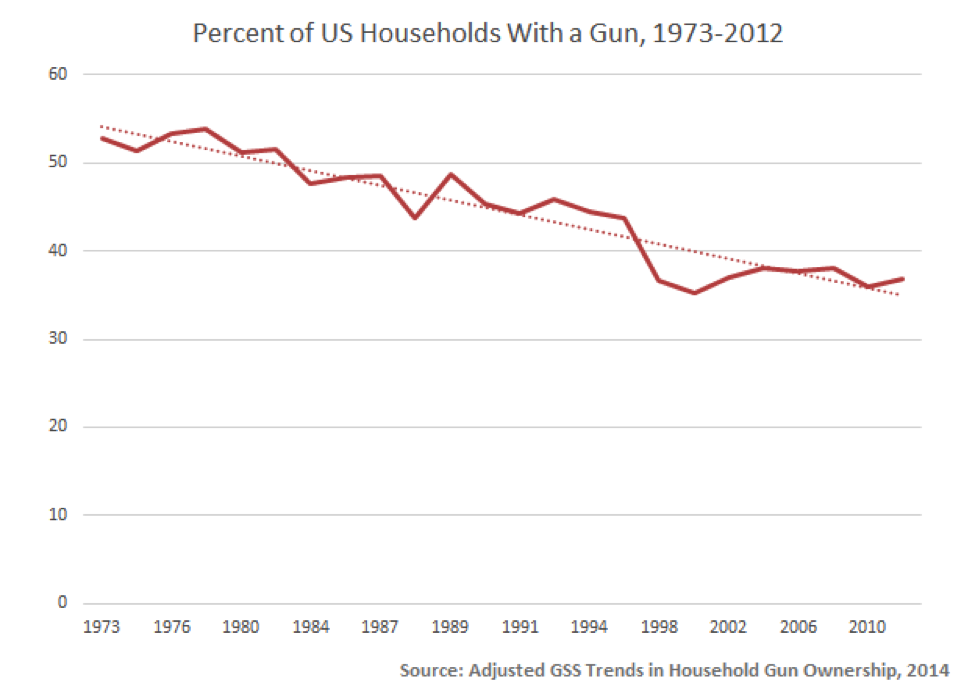
Moreover, gun ownership in the United States has been declining, both before and throughout the process of militarizing law enforcement. The 1980s saw early stirrings of it, with the spread of SWAT teams and Reagan-era “tough on crime” policies. It grew in the mid-1990s under the Clinton administration, which authorized the DoD’s 1033 program, expanding and formalizing the process for giving military gear to police. Finally, after 9/11, militarization took off in earnest, with two wars, paranoia about terrorism, a booming defense industry, and billions of dollars in Homeland Security money to drive it.

Meanwhile, rates of gun ownership through the U.S. dropped or stagnated. Winkler drops the oft-quoted and often misunderstood statistic that there are “320 million guns in the United States, approximately one per person,” but apparently doesn’t recognize that this stat doesn’t mean everyone gets a gun. (A good way to check: Look around you. Do you see any guns? No? Okay, myth busted.) Today, the actual rate of gun ownership is just 34 percent, down from an average of over 52 percent in the 1970s.

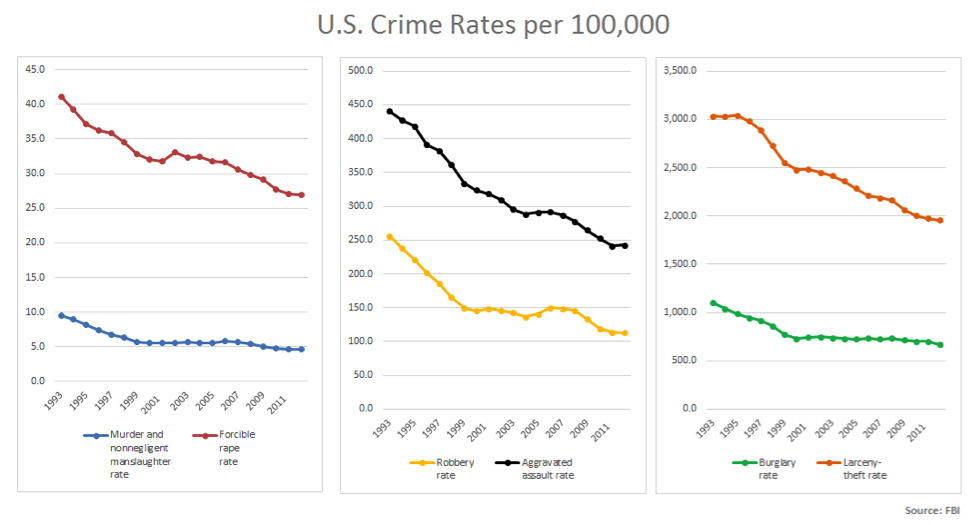
Not only is gun ownership down, so is crime—dramatically so. Starting in 1990, and continuing through recessions, terrorist attacks, and wars, crime has fallen. Murder, rape, robbery, assault—even property crimes—are all down. Cops toting .50 caliber machine guns and driving landmine-resistant vehicles cannot be responding to an epidemic of violence, because one simply doesn’t exist.

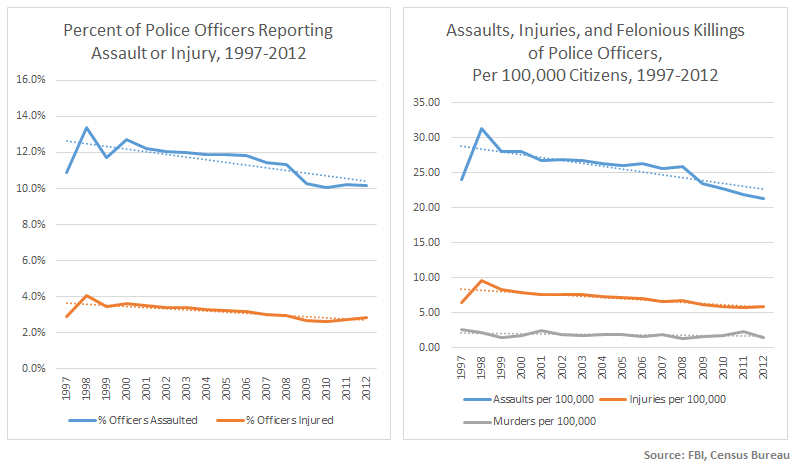
But even if far fewer people own guns and commit crimes than did so in the past, it’s still possible that police officers are uniquely under threat in recent years. Maybe killings, assaults, and injuries of police are on the rise. But they’re not.

In every way, this theory fails to align with the facts. Not only is gun ownership down, but so are crime and attacks on police. Private gun ownership is not responsible for militarization, racial profiling, or tensions with police.

But Winkler is right about one thing: Police officers are being taught to be paranoid about citizens and guns, and that fear is being channeled against minorities, from ATF stings targeted at poor blacks and Hispanics, to New York’s racist stop-and-frisk program, to New Jersey’s felony prosecution of a single mom who tried to do the right thing.

But the reason isn’t that there is more of a threat than there used to be. It’s that people are being systematically misinformed—by reporting like Winkler’s—about the risks they actually face. Telling poor minorities that hostilities with police are really partly their fault—and that if they would just give up their guns, everything would be okay—is not just absurd, it’s actively harmful.

Daniel Bier is the executive editor of The Skeptical Libertarian. He writes on issues relating to science, skepticism, and economic freedom, focusing on the role of evolution in social and economic development.

This article was originally published by The Foundation for Economic Education.
The Rational Argumentator’s Twelfth Anniversary Manifesto

The Rational Argumentator’s Twelfth Anniversary Manifesto

The New Renaissance Hat
G. Stolyarov II
August 31, 2014
******************************

The Rational Argumentator marks its 12-year anniversary on August 31, 2014. This publication has now reached a venerable age by Internet standards, and its impact only continues to grow. I am pleased to announce that TRA’s trajectory has followed closely the aspirations expressed in the Eleventh Anniversary Manifesto, with many milestones reached and many vital projects completed. There is no doubt in my mind that TRA’s twelfth year was its best so far. Despite the turmoil in the world, The Rational Argumentator has stood firm in its efforts to champion a better way – a path of rationality, individual freedom, and technological progress – in a resolute rejection of the barbaric methods and short-sighted goals of certain “world leaders” today. To memorialize TRA’s unwavering commitment to the improvement of the human condition over the past dozen years, I have added to its header the words “Championing Reason, Rights, and Progress Since 2002”.

Total twelfth-year visitation for all TRA features was 1,430,226 page views – a record high and a significant 32.77% increase over the eleventh-year visitation of 1,077,192 page views. The previous record year for visitation was the ninth year, which brought 1,398,438 page views, and the twelfth year exceeded this amount by 2.27%. TRA’s lifetime visitation stands at 8,176,586 page views. 314 new regular TRA features were published in 2014, in addition to many special features, some of which amount to hundreds of pages of reading. This has been a major increase from the 208 features published during TRA’s eleventh year and even the 306 features published during TRA’s tenth year. In addition to increasing my own content production, I have restored to typical historical levels TRA’s practice of republishing thoughtful works by other authors.

Unprecedented public exposure and reach has been achieved by means of my children’s book Death is Wrong, illustrated by the wonderful Wendy Stolyarov. With tremendous support from the life-extensionist/transhumanist movement, The Rational Argumentator served as the hub for a massive fundraising and book-distribution effort to spread 1,029 free paperback copies of Death is Wrong to children in 14 countries. 92 generous donors and 50 activists throughout the world made this effort possible. Our Indiegogo fundraiser was successfully completed on April 23, 2014, and all 1,029 books were sent out as of August 7, 2014. Communities such as MILE – the Movement for Indefinite Life Extension, LongeCity, and the Life Extension Foundation were crucial in spreading the word about this effort and facilitating widespread awareness of our goal and its importance. For a great example of the outpouring of pro bono support motivated by Death is Wrong, watch this Book Trailer video, masterfully created by Peter Caramico of LongeCity. Death is Wrong has been featured by Fast Company, Mashable, Psychology Today, the BBC, TheBlaze, VICE Motherboard, Slashdot, and other prominent publications. This has enabled many more people to become aware of the feasibility and desirability of pursuing indefinite life extension in our lifetimes. As a side benefit, it has also brought more visitation to The Rational Argumentator.

In an effort to maximize the spread of Death is Wrong, after the conclusion of the distribution of paperback books, I took the next step of making the electronic editions of the book – available in English, Russian, and Spanish – freely downloadable in PDF format. Thus far, over 1,216 copies have been downloaded directly from The Rational Argumentator, and the files have spread to many external sites as well. This has essentially more than doubled the spread of the book’s message since the completion of the paperback-distribution campaign. In the meantime, another freely available work of mine, Eden against the Colossus ­­– which I republished in January 2013, has already been downloaded over 3,300 times. My strategy of making my works as easy to obtain as possible has certainly gone a long way toward ensuring that their message continues to influence the world to the maximal realistic extent.

Overall, my efforts to make my past writings available for free download directly from The Rational Argumentator’s domain have been successfully completed. In addition to the most up-to-date and thorough Third Edition of A Rational Cosmology, released in September 2013, nearly all of my older musical compositions have been remastered, and free MP3 files of the remastered versions have been made available on this page. I hope to continue to gradually release music videos of each of my compositions, accompanied by my works of fractal art. 47 videos are available already, out of 76 total videos that could be made for each of my extant compositions.

An added impetus to the project to host all of my works on The Rational Argumentator was given in July 2014, with the announcement by Yahoo! of the abrupt forthcoming closure of Yahoo! Voices (formerly Associated Content), where I had published 1,321 features since 2007 and where my works had garnered 3,190,261 page views. Yahoo’s mismanagement of Associated Content since its 2010 acquisition had made the site distinctly less appealing for original, intellectual contributors. Most of my spare time in July 2014 was spent on rescuing my previously published articles – including many sections of educational study guides – to ensure their continued availability directly on The Rational Argumentator. While I will no longer receive revenue from the page views on these works, I am happy that they have not been lost to the world due to Yahoo’s disastrous decision. Many articles were republished as new features on The Rational Argumentator. Some articles were also placed in my archive page of selected writings from Associated Content/Yahoo! Voices. Every single study guide in my Free Tools for Rational Education section – including my widely utilized actuarial study guides – is now available either in a conveniently downloadable PDF format or (for smaller study guides) in the form of multiple interconnected HTML pages.

Through repeated content-rescue efforts since 2009, I have learned my lesson: always host my own material myself, if I wish to see it preserved indefinitely. Almost every single large, commercial content site on which I published in the past, or which I attempted to use to earn modest revenue streams from my content, is now defunct. Geocities, Helium.com, Today.com, Adbrite, Associated Content, and Yahoo! Voices are all gone; The Rational Argumentator has outlasted them all. The Rational Argumentator will continue to outlast any sites that are driven by a short-termist mentality of sacrificing quality of content to the quarterly bottom line. This is because The Rational Argumentator is motivated by my quest for permanence – in knowledge, in achievement, in existence itself. As long as I live (which I hope will be indefinitely), so shall The Rational Argumentator persist.

Dissent Under Socialism – Article by Sanford Ikeda

Dissent Under Socialism – Article by Sanford Ikeda

The New Renaissance Hat
Sanford Ikeda
August 26, 2014
******************************

The Daily Mail reports that “France’s Socialist government provoked outrage … by becoming the first in the world to ban protests against Israeli action in Palestine.” The socialist interior minister justified the ban by citing the potential for violent clashes in Paris between opposing groups, which he deemed a “threat to public order.”

My object here is not to comment on any aspect of the conflict in the Middle East or on this ban, which may or may not be justified. What caught my eye in the story is the following quote:

Sylvie Perrot, another pro-Palestine activist from Paris, said: “Fascist states stop people demonstrating against wars—it is beyond belief that French Socialists are following their example.”

Au contraire! 

If you understand the nature of socialism, it’s quite believable.

Collectivism and dissent

Let me begin by defining “collectivism” as any economic system in which the State controls the principal means of production. Collectivism requires central planning of some kind over the resources the State controls. The particular brand of collectivism we’re talking about depends on the aims of the controllers. 

In theory, “socialism” aims to unite people around the world regardless of nationality toward a common internationalist goal, while in theory “fascism” aims to unite people of a particular nation toward a common nationalist goal. The ends differ but all forms of collectivism use the same means: State control (de facto or de jure) over the means of production. Given their common collectivist roots, then, it shouldn’t be surprising that fascism and socialism employ similar policies.

Even more than that, however, F. A. Hayek points out, in The Road to Serfdom:  

That socialism so long as it remains theoretical is internationalist, while as soon as it is put into practice … it becomes violently nationalist, is one of the reasons why “liberal socialism” as most people in the Western world imagine it is purely theoretical, while the practice of socialism is everywhere totalitarian.

I would recommend the chapters in The Road to Serfdom where Hayek explains why this is the case (especially “Individualism and Collectivism,” “Planning and Democracy,” “Planning and the Rule of Law,” and “The Socialist Roots of Naziism”), but here are two important points in that explanation.

First, to the degree that the State undertakes central planning of the resources it controls, it can’t allow any person to interfere with or oppose the plan. Or, as Hayek puts it, “If the state is precisely to foresee the incidence of its actions, it means that it can leave those affected no choice.”

Second, the more resources the State controls, the wider the scope and more detailed its planning necessarily becomes so that delay in any part of the system becomes intolerable. There is little room for unresponsiveness, let alone dissent. Hayek again:

If people are to support the common effort without hesitation, they must be convinced that not only the end aimed at but also the means chosen are the right ones. The official creed, to which adherence must be enforced, will therefore comprise all the views about facts on which the plan is based. Public criticism or even expressions of doubt must be suppressed because they tend to weaken public support. [emphasis added]

My point is that even if genuine socialism of some kind did exist in France (or anywhere else), the government there could not allow spontaneous political demonstrations, for the reasons Hayek outlines in The Road to Serfdom. Collective political ends must trump individual expression. 

That a socialist government would ban political demonstrations should then come as no surprise.

The problem is central planning 

Friends of mine have objected that these arguments are misplaced because genuine socialism doesn’t exist in France, and that political parties who brand themselves “socialist” aren’t really socialist at all, at least in the sense defined here. 

But Hayek’s point is that intolerance for dissent grows with the scope of central planning. Thus, the principle also applies in the case of a mixed economy, such as the United States, with more limited central planning. To the extent that the U.S. government tries to pursue collectivist ends—say, during times of war—the greater the pressure on public officials to quell open displays of protest.

Moreover, the more things the central government plans for, the less freedom—of expression, assembly, association—there can be. If the State controls all means of production and all resources are placed in the hands of the authorities, then in effect all forms of expression—in politics, science, religion, art—are political and any form of dissent from the official creed is intolerable and must be forbidden. That would lead, and has led, to the death of free inquiry, because dissent, rebellion, and radical criticism are essential to the growth of knowledge.

One of the political virtues of private property is that it establishes a sphere of autonomy in which we are safe from the threat of physical violence. In that sphere of autonomy, we can say or not say, or do or not do, anything we like, so long as we don’t initiate physical violence against others. Private property is the garage where we can form a band or invent the personal computer or paint protest signs. As private property disappears, not only do our economic liberties disappear, but so too do our political liberties.

What is not forbidden …

Indeed, taken to its logical conclusion, under pure collectivism no freedom at all would remain, and not only the freedom to peacefully assemble in protest against government activities. In a completely collectivist system, it’s not a stretch to say that what isn’t forbidden would in fact be mandatory.

From California, which at least for now is a ways off from pure collectivism, comes an even-nuttier though still-scary scenario:

A Southern California couple received a letter from Glendora city officials threatening to fine them $500 if they don’t get their sun-scorched brown lawn green again, reports AP. Which Laura Whitney and Michael Korte would gladly do, except for one thing: They could also be fined $500 if they water their lawn too much; they’re currently only watering twice a week.

Thus, what is mandatory may also be forbidden. Don’t forget, 1984 was 30 years ago.

Sanford Ikeda is an associate professor of economics at Purchase College, SUNY, and the author of The Dynamics of the Mixed Economy: Toward a Theory of Interventionism.
***
This article was originally published by The Foundation for Economic Education.
The Incompatibility of Individual Rights with the Coerced Institutionalization of the “Mentally Ill” (2002) – Article by G. Stolyarov II

The Incompatibility of Individual Rights with the Coerced Institutionalization of the “Mentally Ill” (2002) – Article by G. Stolyarov II

The New Renaissance Hat
G. Stolyarov II
July 29, 2014
******************************
Note from the Author: This essay was originally written in 2002 and published on Associated Content (subsequently, Yahoo! Voices) in 2007.  The essay received over 600 views on Associated Content / Yahoo! Voices, and I seek to preserve it as a valuable resource for readers, subsequent to the imminent closure of Yahoo! Voices. Therefore, this essay is being published directly on The Rational Argumentator for the first time.  
***
~ G. Stolyarov II, July 29, 2014

**

The idea that “mentally ill” persons must be locked in institutions against their wishes is a profoundly authoritarian idea, opposed to the rights of the individual and the founding principles of the United States. Yet it is an idea held by many elites and members of the psychiatric establishment today.

Let us examine the following statement by a prominent contemporary psychiatrist, Dr. Ralph Slovenko: “Crazy people are [now] everywhere. Modern notions of civil liberties and fiscal considerations have combined to produce a population of very disturbed people in every city in America. The notion of local treatment alternatives for mentally incapacitated citizens in a cruel hoax. It is clear that the vast majority of dangerously impaired people are out there in the streets.” (Dr. Ralph Slovenko, professor of law and psychiatry at Wayne State University. 2000. pp.47-48)

This man proclaims, without even any subtlety, that individual rights, the foundation of freedom and prosperity in this country, are a root of derangement within the country’s populace!

Slovenko seeks to deny citizens of the United States the ability to select treatment within their communities should they detect a genuine mental illness and volitionally attempt a recovery. Instead he suggests (as is the application of this particular argument) that persons designated as “insane” or “mentally ill” must be locked against their consent in government-owned institutions for treatment.

Civil liberties as well as concern of officials for proper spending of public funds (which does not encompass the imprisonment of persons who have not committed a crime) had resulted in widespread deinstitutionalization during the 1950s, but people like Dr. Slovenko have been clamoring for the reinstatement of asylums ever since.

In George Orwell’s 1984, the free spirits who resist the Party’s rule are arrested, imprisoned, and subsequently transferred to a facility subordinate to the Ministry of Love in which they undergo a combination of torture and “rehabilitation”, their will the resist broken under a hail of Party dogma. They are declared delusional since their frame of mind differs from that imposed by the social paradigm. Because they see the truth of a single reality and the need to interact with it, they are declared mentally ill and “treated”. Frighteningly enough, real people in our time like Dr. Slovenko also seek to coercively ensnare such “dangerous” persons.

Dr. Slovenko’s words in particular remind one of the major fear of Party officials in George Orwell’s 1984, the so-called “thoughtcrime”, by which concept a man’s freedom, not merely the freedom to do what he pleases but to think what he pleases, is forever deprived from him as a result of the contents of his mind not being in accordance with “socially acceptable” beliefs, i.e. those of the dominant oligarchy. Slovenko suggests precisely that, the containment of persons not for the criminal deed, but for “inclination” or deviation in outward behavior and thought that would brand them with the subjective label, “insane”.

Ethical Lessons on Principled Parenthood in the Film “A Thousand Clowns” (2004) – Essay by G. Stolyarov II

Ethical Lessons on Principled Parenthood in the Film “A Thousand Clowns” (2004) – Essay by G. Stolyarov II

The New Renaissance Hat
G. Stolyarov II
July 29, 2014
******************************
Note from the Author: This essay was originally written in 2004 and published on Associated Content (subsequently, Yahoo! Voices) in 2007.  I seek to preserve it as a valuable resource for readers, subsequent to the imminent closure of Yahoo! Voices. Therefore, this essay is being published directly on The Rational Argumentator for the first time.  
***
~ G. Stolyarov II, July 29, 2014

**

Raising a child into a competent, intelligent human being is no light task. It is necessary to imbue the child with a sound system of values, but also to prevent his perpetual dependence on external authority for answers and guidance. The two aims need not be antagonistic and can reinforce one another, as the upbringing of Nick Burns by his uncle, Murray Burns, in the 1965 film A Thousand Clowns demonstrates. Murray is able to endow Nick with a moral framework that guides Nick’s further judgments, but he does so in a non-intrusive manner that suggests rather than commands. The plot of the film demonstrates how this approach can produce an integrated person who triumphs over the obstacles posed by the dominant society.

Nick’s entry into Murray’s home occurred at the age of five, when his reckless vagabond mother abandoned him there. Due to his presence under Murray’s guardianship since such an early age, Nick’s upbringing is almost entirely determined by Murray. This is not to say that Nick is stifled or deprived in any manner. Formerly a child living on the streets with his mother, Nick now enters a special school for talented children, and is able to retain his place there for many years. There is no doubt that Murray’s acumen, wit, spontaneity, insight, and individualistic courage permeated Nick’s experiences from an early age, and that Nick absorbed these qualities. Nick’s dialogue within the film is indicative of a sophistication that one does not typically find in a twelve-year-old. When Nick and Murray walk through New York City on Irving R. Feldman’s Birthday, a holiday that Murray had invented, Nick earnestly addresses Murray with respect to the latter’s unemployment. He presents realistic concerns about the future of his upbringing, Murray’s financial security, and the very ability of the two to remain in the same household. Nick has a foresight into matters of consequence that approaches that of an adult. While other kids his age would “live for today” and simply enjoy themselves during a day on which they had skipped school and were able to enjoy a walk across town, Nick is able to extract the best from both worlds. After he raises his concern, he is still able to visit the Statue of Liberty with Murray and enjoy the unique and magnificent sights that Murray is able to show him. Nick’s upbringing has allowed him to exhibit an integrated personality, combining serious thought with pleasure. He is not a young Albert Amundsen, who “talks as if he had written everything down beforehand,” but is unable to realize to a bond of joy can exist between two people, outside mere “practicality” and adherence to societal norms. At the same time, Nick is also more practical than Murray himself, as the latter tends to lean toward enjoying himself at the present moment while compromising long-term security.

How was Murray’s upbringing able to produce a person more adult and more reasonable than Murray himself? A part of the answer lies in Murray’s laissez-faire approach to parenthood. Unlike a majority of parents, who establish stringent guidelines for children with regard to the smallest minutiae, Murray allows Nick immense free rein. Until the age of thirteen, Nick is allowed to go by whatever name he pleases, as he tests varying roles and identities in order to find out which one will suit him best when he becomes “an actual person.” Murray does not want his nephew to become a mirror image of him; instead he “[wants] him to know the special thing that he is; [he wants] him to see the wild possibilities.” Since Murray recognizes the need to raise Nick as a unique and unprecedented individual, his approach is not one of domination, regulation, and imposition, but of suggestion, demonstration, and camaraderie. Murray does not intervene in Nick’s schooling; he is confident that Nick is capable of managing his own formal education. Indeed, Nick performs well in his special school without being unnecessarily obsessive about his learning. He is able to skip school on special days, such as Irving R. Feldman’s Birthday, in order to share much-valued time with his uncle. In the modern culture, the compartmentalization of education into a separate rigid sphere of existence prevents most typical students from spending adequate amounts of time with their family, but Nick has learned to “own his days and name them.” He will not permit schedules and routines to intervene with the people and things genuinely valuable to him.

Though Murray allows Nick’s schooling to follow its own path, Murray, too, acts as a teacher for Nick in vital matters of principle, ideas and phenomena that cannot necessarily be taught in a classroom. During Irving R. Feldman’s Birthday, Murray points out to Nick the gray masses of people rushing off to work, pushing to enter a bus, running desperately to catch the next train and meet someone else’s schedule, being mired in a routine that prevents them from living life on their own terms and in accordance to their own principles. Murray shows Nick a scenario and allows Nick’s observations to determine his conclusions; it is a far more effective method of teaching than the common “When I tell you something, believe it!” approach. Murray is able to share his values and impressions of the world with Nick without forcing Nick to adopt them. They merely become matters for Nick’s consideration, but Nick, like an adult, is given the authority to analyze them on their own merits. Because Nick is granted the responsibility typical of an adult, he is able to think like one and interact with the world as every man’s intellectual equal, not a subordinate.

The culmination of Murray’s upbringing of Nick manifests itself when Chuckles the Chipmunk enters their home in an attempt to persuade Murray to return to work. Rather than being tactful, Chuckles seeks to psychologically dominate Murray and Nick. He carries in a cardboard statue of himself and, when it falls, forcefully urges Murray to put it up once more. He thrusts corny and uninteresting remarks at Nick and expects Nick to laugh due to the sheer weight of Chuckles’ authority. Nick, however, frankly admits that Chuckles’ jokes and routines are not humorous. Though he wishes that Murray would find a job, he does not wish for Murray to take this one. Chuckles calls Nick a “freak” simply because Nick does not display the deference that Chuckles receives as a societal norm. But, after Nick resists the label placed upon him and nearly forces Chuckles out of the apartment, the Chipmunk begins to assume a more respectful posture. He informs Murray that his show has suffered without Murray’s writing, and that Murray would be an integral component of the program. Rather than acting with pseudo-superiority and condescension toward Murray, Chuckles begins to treat him as an equal, and Murray accepts the job offer. In the meantime, he can be content knowing that he has taught Nick the individuality and devotion to principle that he intended to transmit. Earlier, Murray states to Sandy Markowitz that he wants Nick to “understand the sneaky, subtle, important reason he was born a human being and not a chair.” Now, Nick has fully demonstrated his non-chairness. He will not be sat on by those who expect him to bear their burden. He will not feign his emotions or his moral sanction simply to be polite to those who do not give him the same courtesy in return. He will analyze each situation on its own merits, rather than on his society’s expectations of conformity to this social worker or that Chipmunk. And he will meet with courage and dignity whatever challenges the society poses to him.

Indeed, challenges to Murray’s relationship with Nick abound. When Albert Amundsen enters Murray’s home, accompanied by Sandy Markowitz, he already carries orders from the Child Welfare Board to confiscate Nick from Murray. His job is merely to inform Murray that this is the case, not to give Murray any authority in deciding otherwise or interacting with Amundsen on an equal level. But rather than be the quiet, complacent, and somewhat miserable child that Amundsen expects Nick to be, Nick acts jovially, telling jokes and stories about his genuinely satisfying relationship with Murray. Sandy, despite Albert’s strict reprimands against such conduct, begins to laugh, as she is genuinely entertained by Nick’s conduct and personality. She becomes convinced that there is no reason to separate Nick from Murray, as both seem to be satisfied with their relationship.

The audience is moved to ponder the idea that a dominant paradigm’s expectations of a “good” household may not hold or be necessary in every individual case. A “parent” need not work from 9 to 5 in order to provide a beneficent environment for his child. And if he does work, he need not grovel before authority in order to receive his paycheck. Moreover, elements outside the financial realm play a crucial role in the sound upbringing of a child. Nick is able to receive both learning and leisure, work and play, under Murray’s care. Amundsen informs Murray that his “is a distorted picture of this world.” However, when comparing Nick to a self-evidently absurd character like Chuckles, who “keeps touching [himself] to make sure that [he] is real,” but who would likely fit Amundsen’s characterization of a “sound” member of society, one must seriously question the validity of Amundsen’s statement. While Chuckles is not even sure of his own existence, and Sandy, when she is under Albert’s aegis of “societal respectability,” has not “the slightest idea of who [she is],” Nick moves firmly toward establishing a unique, colorful, principled identity. Nick, no matter what name he will go by, is sure never to become just a series of different facades put before each person he meets, devoid of personality and self-esteem. The individual that is Nick does exist; this is not a matter of doubt either for Nick or for the viewers of the film.

The ending of A Thousand Clowns is indicative of victory for Murray’s relationship with Nick. Murray returns to work, which foretells his ability to continue to provide for Nick materially, while not compromising his principles intellectually. Because Nick has refused to show deference to Chuckles, the latter agreed to approach Murray as a human being and not a chair. Murray is thus able to work on his own terms, and to be certain that Nick has become his own person. The objections of the Child Welfare Board to Murray’s continued guardianship over Nick have now become null and void, as Murray, with Nick’s indispensable help, has demonstrated that one need not conform to the norms of conduct put before him in order to live and prosper, soaring like an eagle far above the realm of the mundane, mediocre, and perfunctory.

The Emersonian Qualities of Lucas Jackson in the Film “Cool Hand Luke” (2003) – Essay by G. Stolyarov II

The Emersonian Qualities of Lucas Jackson in the Film “Cool Hand Luke” (2003) – Essay by G. Stolyarov II

The New Renaissance Hat
G. Stolyarov II
July 28, 2014
******************************
Note from the Author: This essay was originally written in 2003 and published on Associated Content (subsequently, Yahoo! Voices) in 2007.  The essay earned over 1,000 page views on Associated Content/Yahoo! Voices, and I seek to preserve it as a valuable resource for readers, subsequent to the imminent closure of Yahoo! Voices. Therefore, this essay is being published directly on The Rational Argumentator for the first time.  
***
~ G. Stolyarov II, July 28, 2014

**

Lucas Jackson, the protagonist of the 1967 film Cool Hand Luke, displays the kind of conviction in his own worth that Ralph Waldo Emerson recommends in Self-Reliance. From cutting off the heads of parking meters to encouraging his friends in prison to tar a road at an impressive rate, Luke rebels and rises above the oppression imposed on him.

Within the opening scene of Cool Hand Luke, the parking meters are symbolic of societal restraint on individual freedom and choice. By arbitrary fiat of local government, the meters place a limit on the duration of time for which an individual can place his car at a particular location, thus limiting the amount of time an individual can spend going about his own business outside the car in the vicinity and diverting an individual’s funds into the stagnant coffers of bureaucracy.

Luke’s destruction of the parking meters is symbolic of the individualist’s attempt to defy societal restrictions. Though he is drunk and semi-conscious, he nevertheless directs his actions not toward some wanton spree of murder or theft but toward the elimination of a nuisance to individual liberty. In return, to paraphrase Ralph Waldo Emerson’s Self-Reliance, society “whips him with its displeasure,” as he is apprehended, arrested, and locked in a facility where his own liberty becomes virtually nil.

Self-Reliance has further relevance to Luke’s demeanor in prison. Emerson writes, “I cannot consent to pay for a privilege where I have intrinsic right. Few and mean as my gifts may be, I actually am, and do not need for my own assurance or the assurance of my fellows any secondary testimony.”

Luke epitomizes this philosophy when he neglects to degrade himself to the level of the standard “new meat” prison novice. He proudly asserts his name as “Lucas Jackson” during Carl’s declaration of the rules and refuses to submit his dignity to Dragline’s decision to recognize him as a significant member of the prison community. He realizes that he does not need the recognition of others in order to exhibit his self-worth or actualize his potential, but rather that those characteristics flow from within himself.

Later, when the prisoners are forced to tar an extensive stretch of road in oppressive heat, Luke encourages his comrades to labor to their fullest capacity and finish the tarring job at a far swifter pace than had been expected of them. He realizes that an intelligent approach that facilitates coordinated activity among the members of the group would both accomplish the task and frame it as a challenge to be aspired toward in the minds of the prisoners.

Luke transcends what has been assigned to him and transforms the dull routine into a search for his own objective, leisure time that is immensely difficult to acquire in a road prison. Once he establishes the tempo of work, all the other members of his gang gravitate toward his approach and undertake a lively, motivated effort. This is reminiscent of Emerson’s proposition that men will come to admire and uphold the man of intrinsic determination and self-reliance. Ultimately, not only is the ardor of the assignment alleviated by the workers’ internal drive, but they receive additional leisure afterward to use as they please.

Courageous Individualism in Ralph Waldo Emerson’s “Self-Reliance” and the Film “Cool Hand Luke” (2003) – Essay by G. Stolyarov II

Courageous Individualism in Ralph Waldo Emerson’s “Self-Reliance” and the Film “Cool Hand Luke” (2003) – Essay by G. Stolyarov II

The New Renaissance Hat
G. Stolyarov II
July 28, 2014
******************************
Note from the Author: This essay was originally written in 2003 and published on Associated Content (subsequently, Yahoo! Voices) in 2007.  The essay earned over 6,300 page views on Associated Content/Yahoo! Voices, and I seek to preserve it as a valuable resource for readers, subsequent to the imminent closure of Yahoo! Voices. Therefore, this essay is being published directly on The Rational Argumentator for the first time.  
***
~ G. Stolyarov II, July 28, 2014

**

“For nonconformity the world whips you with its displeasure,” writes Ralph Waldo Emerson in his renowned treatise, Self-Reliance. For nonconformity, the world also forces you to pave roads in the scorching heat, dig ditches only to fill them again later, and, of course, spend nights in the box. Both Emerson and the 1967 film Cool Hand Luke emphasize the repression and intimidation that a man of greatness encounters in a regimented, entrenched society. Yet both Emerson’s vision of the self-reliant man and the integrity of Lucas Jackson persevere through any and all barriers imposed upon them by the dictates of others. The lessons of individual dignity and the autonomy of one’s mind can be applied to the creator man who seeks to triumph amid the atmosphere of today’s world as well.

Through cultural norms and stigmatization, as well as outright coercive actions, certain societies seek to shackle the men of creativity and initiative. Lucas Jackson is imprisoned in a “corrective road prison” for the grievous crime of cutting off the heads of several public parking meters. The parking meters themselves are symbolic of societal restraint on individual freedom and choice. By arbitrary fiat of local government, the meters place a cap on the duration of time for which an individual can place his car at a particular location, thus limiting the amount of time an individual can spend going about his own business in the vicinity and diverting an individual’s funds into the stagnant coffers of bureaucracy. Luke’s destruction of the parking meters reflects the individualist’s attempt to defy societal restrictions. Though he is drunk and semi-conscious, he nevertheless directs his actions not toward some wanton spree of murder or theft but toward the elimination of a nuisance to individual liberty. In return, society lashes at him with the fullest extent of its brute force, as he is apprehended, arrested, and locked in a facility where his own liberty becomes virtually nil. Even had he murdered, Luke’s ultimate punishment would likely not have been as severe, for the totalitarian environment of the prison will eventually kill him for his adamant individualism.

Luke’s genuine trials begin when he no longer faces the law as applied to free citizens, but the petty whims of his prison bosses. Emerson’s work analyzes the consequences of such a transformation of environment. “It is easy enough for a firm man who knows the world to brook the rage of the cultivated classes. But… when the unintelligent brute force that lies at the bottom of society is made to growl and mow, it needs the habit of magnanimity… to treat it godlike as a trifle of no concernment.” Emerson’s statement was meant as a general social commentary. The dominant-paradigm-entrenched academic or big government advocate may treat the freethinker with aversion, stigma, and heated criticism, which amount to mere grumbling at the sidelines of the individualist’s path. But when the men who wallow and revel in ignorance, sloth, and brutality are invested with the capacity to direct a better man’s fate, the man of reason and initiative will encounter the most infernal conditions possible.

The prison bosses are the most uncultured and sadistic of men outside the Gestapo. Boss Godfrey’s hobby is, put plainly, to shoot things. After Luke’s first escape, Godfrey, with a grim equanimity, blows the head off a rattlesnake in the grass. In the final showdown of the bosses with Luke near the church, Godfrey will with a similarly unperturbed conscience launch a bullet through Luke’s chest. Boss Paul is a man who loves to bring about and witness the writhing and suffering of the prisoners; after Luke’s second escape, Paul orders him to dig a ditch only to conspire with another boss for the latter to periodically come by and inform Luke that forming the ditch is against prison rules. These frequent recurrences of contradictory instructions are accompanied by beatings intended to force Luke down on his knees in utter submission, pleading for mercy. They are ultimately aimed not at his body, but at his spirit, thrusting a rational, aspiring man into a realm of the chaotic, incompatible, unknowable, and savage. This is the lowest of the unintelligent brute force that Emerson addresses, worse than even the hollers and threats of the rabble that occasionally befall a free man.

The unlivable realm of the prison is rendered even more so by the Captain’s mocking friendliness, a façade, with the essence of despotism lying hidden not too deeply underneath. The Captain regularly speaks with a deliberately soothing voice, informing the prisoners that “We are trying to help you here. We are doing this for your own good.” Emerson, viewing the matter from the perspective of the individualist, realizes the gross fallacy of such a claim. He writes, “What I must do is all that concerns me, not what the people think. This rule, equally arduous in actual and in intellectual life, may serve for the whole distinction between greatness and meanness. It is the harder, because you will always find those who think they know what is your duty better than you know it.” The Captain is such a man, who holds that the ultimate good is the blind obedience of a regimented automaton to his social engineers. But the Captain’s philosophy on its own is a wobbly construct that would crumble upon meeting the first wind of greatness, were it not reinforced by the fist, the rifle, and the sweat and blood of its prey. When Luke objects to the Captain’s mentality, stating, “You shouldn’t be so kind to me, Captain,” thereby rejecting the Captain’s idea of “help,” he is struck violently to the ground. Then the Captain resumes his tone of mocking kindness, pronouncing, “What we’ve had here is a failure to communicate.” According to the Captain, the man of independence must either renounce it willingly or renounce it through the imposition of societally legitimized brute force. In any case, renounce it he must, and if pseudo-polite paternalistic exhortations fail, the growl and lunge of the worst elements possible in man will bring about the social engineers’ aim.

Few men less deserving than Luke had ever been thrust into such hostile surroundings, from which physical escape will be met with pursuit and mental dissent with the box or the fist. Yet even there, Luke, and Emerson’s vision of the independent spirit, are able to persevere. From the beginning, when Carl lists all the innumerable infractions for which one can be put in the box, Luke is not intimidated. He responds with a relaxed shrug and presents his characteristic Luke smile, then anticipates that Carl’s next sentence will end with “a night in the box.” Carl notices that Luke is not the typical “new meat” prisoner and asks with an authoritative voice, “Well, what have we got here?” Unflinchingly, Luke responds, “We got a Lucas Jackson.” Luke possesses a firm pride in his identity and inherent human dignity, qualities that he will not permit a regimented environment to shatter. Emerson writes: “I cannot consent to pay for a privilege where I have intrinsic right. Few and mean as my gifts may be, I actually am, and do not need for my own assurance or the assurance of my fellows any secondary testimony.” Luke epitomizes this philosophy when he neglects to degrade himself to the level of the standard “new meat” prison novice. He refuses to subordinate the fact of his existence to Dragline’s decision to recognize him as a significant member of the prison community. He realizes that he needs not the recognition of others in order to exhibit his self-worth or actualize his potential, but rather that those characteristics flow from within himself.

Initially, Luke’s open defiance of a long-standing prison tradition is met with great indignation and outright aggression on the part of his peers and Dragline. Luke adheres to the expression of the truth as observed by his mind, no matter how controversial, displeasing, or unconventional such honesty may be. Emerson writes, “I ought to go upright and vital, and speak the rude truth in all ways,” and Luke agrees. When Luke does not hesitate to assert his reason in regard to Dragline’s needless lust-filled commentary concerning a woman he had spotted during a round of work, he encounters the climax of Dragline’s rage. Luke is challenged to a fight, and repeatedly pummeled to the ground. Yet he remains adamant and continues to stand every time, not intending to devastate Dragline so much as to assert that such tactics of brute aggression will not conquer him. Luke recovers from every failure, ever-ready to recover and fight another round. Like the Emersonian man of all professions and opportunities, Luke “always like a cat falls on his feet. He has not once chance, but a hundred chances.” And, using one of those chances, Luke wins the fight in a far more meaningful way than would have been if Dragline were physically subdued. He is able to earn Dragline’s deepest respect through his resiliency, as Dragline realizes that this man of persistence, conviction, and integrity is not a cynical upstart, but rather a valuable potential friend.

Through the firm exercise of his creativity and autonomy, Luke is able to beautify the social conditions of his circle of fellow inmates and earn a general, profound, lasting respect. In order to do this, Luke implicitly recognizes another Emersonian insight: “Do that which is assigned you, and you cannot hope too much or dare too much.” If Luke had merely fallen in line with “the way things had always been done” in the prison, he would have encountered the same arduous, scorching, monotonous routine, a condition deliberately intended to stunt his ambitions and aspirations. When the prison bosses “reward” Luke’s gang for exemplary work by delegating to it a colossal road tarring job, Luke encourages his comrades to labor to their fullest capacity and finish the endeavor at a far swifter pace than had been expected of them. He realizes that an intelligent approach that facilitates coordinated activity among the members of the group would both accomplish the task and frame it as a challenge to be aspired toward in the minds of the prisoners. Luke transcends what has been assigned to him and transforms the dull routine into a search for his own objective, leisure time that is immensely difficult to acquire in a road prison. One he establishes the tempo of work, all the other members of his gang gravitate toward his approach and undertake a lively, motivated effort. This is reminiscent of Emerson’s proposition that men will come to admire and uphold the man of intrinsic determination and self-reliance, that, in the grand scheme of events, every institution is but “the lengthened shadow of one man,” the man who dared to introduce a radical change in the way a given matter was approached. Ultimately, not only is the ardor of the assignment alleviated by the workers’ internal drive, but they receive additional leisure afterward to use as they please.

Even as prison conditions become intolerable, Luke does not surrender his will to freedom up to the inevitable climax of the life-or-death struggle between him and his totalitarian overlords. Upon the death of Luke’s mother, the bosses seek to amplify his misery by sentencing him to three nights in the box, intended to decisively strike at his mind while it was still recovering from a blow. Luke realizes that no amount of ingenious coping, no invention of lively leisure activities of poker games, road tarring races, and egg-eating events will conceal the grim realities of the inhuman, whimsical, arbitrary condition imposed upon him. He must, and he will, liberate his body and his mind. After a failed escape attempt, he does not hesitate to stage another, despite the increased vigilance of the bosses. Man of reason that he is, he is able to spot the deficiencies of every one of his plans. The first escape, he is apprehended by a policeman due to the suspicious appearance of his prison clothes. During the second escape, he largely evades “civilized” roadways until he is able to remove his chains and mislead the prison dogs. Nevertheless, he is unable to fully disable his abusers’ means of pursuit. His third escape, co-orchestrated with Dragline, is a brilliantly executed theft of all the prison vehicles’ keys and use of one of the trucks to drive considerably far away from the prison prior to continuing the journey on foot. Every time, Luke is able to, through his autonomous thought, revise his errors and fall on his feet once more. Had he grasped but one more key Emersonian insight, he might have survived in body. “It is only as a man puts off all foreign support, and stands alone, that I see him to be strong and to prevail. He is weaker by every recruit to his banner.” Luke’s escape jointly with Dragline is his crucial mistake, for Dragline remains unable to fend for himself when necessity compels the two of them to split up. He lacks Luke’s tactical ingenuity and quickly falls into the hands of the search parties from the prison, leading them to Luke, misled into believing that Luke’s voluntary surrender, and the sparing of his life, could be achieved. Dragline, however well-intentioned, remains a follower, subject to the mercy of higher forces, be it the positive influence of Luke, or the soothing promises of the Captain. Dragline is not of the “class of great men,” in that his longings and hopes had all been derived from his admiration of Luke, not the products of his own mind.

Dragline does not expect his compliance to bring about Luke’s demise, but Luke, true to his nature, cannot bear to accept confinement once more. Instead of blindly subverting himself to the bosses, he proudly steps to the window of the church and announces, echoing the Captain’s one-time words, that “what we’ve had here is a failure to communicate.” Mr. Jackson recognizes that he is not to blame for not falling in line with prison impositions, but rather that the bosses had grossly misjudged his nature by seeking to stifle it “for his own good.” Yet the bosses come not in pursuit of communication, but of blood. Realizing that the individualist always shall overcome every form of degradation and every barrier, the bosses, with Godfrey as their agent, seek to render it impossible for Luke to ever rise again.

Thus ends the life of Lucas Jackson, but not the integrity that characterized it. Dragline realizes that no negotiation, no compromise, between freedom and submission are possible, and lunges at Godfrey, leading to the destruction of the boss’s grim and concealing sunglasses. Before he is imprisoned once more, Dragline at last rises to the level of grasping that, which is beyond persecution. “What the man acquires is living property, which does not wait the beck of rulers, or mobs, or revolutions, or fire, or storm, or bankruptcies, but perpetually renews itself wherever the man breathes.” The dauntless innovation and longing for liberty in the autonomous man cannot be dethroned by any physical means; it can only be diminished by a voluntary subordination of the individual’s mind to tyranny, which Luke had refused to accommodate. The legacy of Luke thus lingers on, as he remains, in Dragline’s words, “a natural born world shaker,” whose radiant smile and confident posture remain vivid in the prisoner’s minds. In its own characteristic way, Luke’s greatness has been released from the box and into eternity, as “the triumph of his principles” has at last granted him peace. What remains for the living prisoners is to discover on their own what Luke had known, and rely on his example as a steppingstone, but not a definitive standard, for their autonomous development.

The relevance of Luke’s example and Emerson’s message to the political situation today is of greater magnitude than it has ever been. Today, if parking meters were the only restriction placed on our autonomy, or if a mere widespread facetiousness in human interactions, of the manner that Emerson denounced, had afflicted our society, we would have been living in a comparatively promising and free world. Alas, the scope of our current confinement by far exceeds this.

The government of this country has usurped almost every sphere of human activity, shackling the creative entrepreneurial innovators through “antitrust” laws, restricting the amount of market share a business may through its owners’ skill and the quality of its product acquire. It has erected barriers to the advancement of thoughtful freethinkers by the imposition of affirmative action initiatives that prevent their attainment of education for faults not their own. It has presumed to dictate to businessmen and settlers what forms of land usage are permissible by standard of societal sanction, through laws of eminent domain and environmental preserves that force men to “absolve themselves in the reflex way” not only to their neighbors and the community, but the bureaucrats, the lobbyists, the endangered spotted slugs and numb lifeless rocks. It has imposed a quasi-prison environment on the young people of this country through the encouragement of forced volunteerism, in menial tasks similar to road tarring, within the schools, and the impending fear of the military draft that will make Godfreys of our officers and “new meat” of our boys, which the politicians implicitly advocate by maintaining draft registration. And all disagreement is reduced to virtually naught, since the freethinkers (often prosperous, industrious men) are extorted for gargantuan sums of their income to fund this socialist behemoth. Some of this income is expended in false philanthropy, becoming the “wicked dollar” that Emerson did not wish to give, that is used to uphold in a state of prison-like dependency hordes of welfare recipients who can be counted on to vote in their overlord incumbents and by the sheer volume of their holler overrule all dissent in the passage of the next statist subversion of liberty. And if any of these intelligent voices dissents by refusing to sacrifice his money for causes that will do him harm, the full weight of government retaliation is borne upon him. What can a man of independent convictions and self-reliant disposition do in such a setting, that grows more restrictive by the day?

Henry David Thoreau, Emerson’s friend and fellow thinker, tried the tactic of civil disobedience in defiance of a tax that was used to fund what was in his opinion an unjustified Mexican War. Thoreau was thrown in prison and, though he demonstrated considerable fortitude of conviction, he did not defeat the tax. Emerson’s fellow abolitionist and friend John Brown attempted to, through an armed raid on Harper’s Ferry, unseat an institution of slavery, which was backed by the coercive hand of big government, with only a handful of arms and supporters. He was executed for the attempt, and, though he became a martyr for the abolitionist cause, he did not defeat slavery. Lucas Jackson confronted the nuisance of parking meters with the saw and the cruelties of the prison with escapes. He, too, received a bullet in the chest in the end and failed to eradicate the root of his sufferings. Though all three of those men preserved their dignity intact through their punishments, they did not accomplish their aims, for they overlooked the fact that the complete triumph of individualism requires another approach.

Of the individualist, Emerson writes that “the moment he acts from himself, tossing the laws, the books, idolatries, and customs out of the window, we pity him no more, but thank and revere him, — and that teacher shall restore the life of man to splendor, and make his name dear to all history. It is easy to see that a greater self-reliance must work a revolution in all the offices and relations of men; in their religion; in their education; in their pursuits; their modes of living; their association; in their property; in their speculative views.” Emerson advocates not an armed revolution, nor even overt disobedience of the law, but rather a mode of living that exemplifies a man who loves, and takes advantage of, the freedom to use his mind. Emerson did not go to prison for tax evasion; nor did he start a slave revolt; nor would he have decapitated parking meters today. Nevertheless, his ideas and influence have spread to the present day in precisely the manner that he intended. He did not wish to be worshipped as an idol or regarded as an unquestionable sage, but rather to give men a stimulus to more closely examine their habits and the capacities that only they can unleash from within. Rather, he is a thinker who should be analyzed with a critical intelligence, and whose views should serve as useful tools and steppingstones, but not finished products or ends-in-themselves.

Emerson’s key proposition in regard to self-reliance as a vehicle for reform is that voluntary persuasion and personal example can eliminate a societal peril. In a man’s every implicit gesture, he reveals a certain mode of function that is inextricably tied to his nature. “Your genuine action will explain itself and will explain your other genuine actions. Your conformity explains nothing.”

A man who opposes the usurpations of government, or the spread of cultural decadence, or the increasing “faraway escapes” that many modern men seek from their lives, must speak firmly and act firmly for the establishment of a freer world where individual creativity is left unbridled. He should not cower for fear that the public will reject his claims simply because he does not hold two and half Ph. Ds in the subject that he addresses. The Ph. Ds themselves are too often handed out by the zealous guardians of the current political and cultural paradigm, the entrenched academic elites who endlessly cite Marx, Roosevelt, and Keynes, and preach “of my obligation to put all poor men in good situations.” If deference to authority and the miserable record of the ages in the political sphere is abandoned, and the clarity and logic of the advocates of freedom is exposed, then, as the fellow inmates reached toward Luke, the public will gravitate toward the new, original, promising thinkers who uphold as their highest value the individual’s intrinsic right to exist and to be let alone. The politicians will abandon their pragmatic give-and-take approach to matters where liberty is at stake, and will realize that only the triumph of solid, uncompromising principles within them will maintain them the support of a reformed constituency.

Arguments Against Eminent Domain and Its Use for the Benefit of Private Parties (2005) – Article by G. Stolyarov II

Arguments Against Eminent Domain and Its Use for the Benefit of Private Parties (2005) – Article by G. Stolyarov II

The New Renaissance Hat
G. Stolyarov II
July 26, 2014
******************************
Note from the Author: This essay was originally written in 2005 and published on Associated Content (subsequently, Yahoo! Voices) in 2007.  The essay earned over 8,300 page views on Associated Content/Yahoo! Voices, and I seek to preserve it as a valuable resource for readers, subsequent to the imminent closure of Yahoo! Voices. Therefore, this essay is being published directly on The Rational Argumentator for the first time.  
***
~ G. Stolyarov II, July 26, 2014

*

The power of eminent domain has had a lengthy history, first originating in the Middle Ages and becoming enshrined in British common law. It is included in the U.S. Constitution as a means of government appropriating private property if this appropriation serves a “public use.” However, under the 5th Amendment, the government is obligated to provide “just compensation” for any property thus taken, which is usually interpreted to mean that the government must pay the market value of the property to the owner from whom it is taken.

Recently, however, governments at all levels have begun to stretch these powers to encompass one private party’s land being taken for the benefit of another, especially if the other is a larger business that has the potential of bringing in greater tax revenues. This is a measure of questionable constitutionality, and even far more questionable morality. It is desirable to abolish such seizures of private land for the purposes of redistribution to other private entities, and to at least limit eminent domain powers to seizures that will only be directed toward benefiting government projects and infrastructure. That is, the power of eminent domain might still be invoked to build a public road or school, but not a shopping mall or apartment building. The arguments in favor of this restriction are overwhelming, even though it does not go as far as complete eminent domain opponents such as myself would like.

First, for somebody who values property rights, private property is an absolute, not to be contingent on “the public interest.” If the individual sees the benefits of keeping his property as outweighing those of selling it, he can either refuse to sell it or ask for more compensation. Anybody but the owner should be allowed to take the property only with the owner’s consent.

Often, current governments do not even give market value to “compensate” for seizures, but, even if they did, there are subjective values that owners associate with their property which are hard to quantify and which only the owners themselves can enumerate accurately. As the story of certain homeowners in the 2005 Supreme Court case of Kelo v. New London shows, some of them have built their dream homes out of places that were run-down when they first purchased them. And, after they had invested their lifetime’s work into those houses, the houses were condemned by the government. Surely, a coercive demand that they accept “market value” is not sufficient to compensate such a deeply personal investment.

Furthermore, “the public interest” is a collectivist notion, which ignores the fact that only individuals exist and that invoking “the public interest” in fact implies that the government should coercively back some private interests over others.

The policy of eminent domain has, recently, been used with blatantly power-hungry justifications. Business X brings in less tax money than Business Y might, so X must be demolished to give way to Y. Y is also a larger business that might create more jobs, so this justifies putting out of work those individuals who are currently employed by X. The flaw with this reasoning is that it views individuals as fungible, or substitutable for one another. It should not matter how many other individuals benefit from a government policy if it ruins the livelihood and property of even one innocent person. Individual rights are absolute.

Advocates of eminent-domain redistribution of property to private parties will attempt to state that the government can actually bring about “efficiency” through the use of eminent domain power to achieve “urban renewal.” However, economic theory from Adam Smith on has shown that the free market achieves any goal more efficiently than the government. A business that thrives because of government favors through eminent domain is not thriving because it functions better than others in market competition. As a matter of fact, that business might well not be favored by supply and demand, and has therefore not been able to acquire the land it seeks under a mode of free, voluntary market exchange. Therefore, its owners are seeking to gain what they have not earned by expropriating it from those who have earned it.

The kind of eminent domain supported by the Supreme Court in Kelo v. New London is pure legalized theft. It is time to recognize it as such.


An Analysis of Ethical Issues in the Film “The Rain Man” (2004) – Article by G. Stolyarov II

An Analysis of Ethical Issues in the Film “The Rain Man” (2004) – Article by G. Stolyarov II

The New Renaissance Hat
G. Stolyarov II
July 26, 2014
******************************
Note from the Author: This essay was originally written in 2004 and published on Associated Content (subsequently, Yahoo! Voices) in 2007.  The essay earned over 17,200 page views on Associated Content/Yahoo! Voices, and I seek to preserve it as a valuable resource for readers, subsequent to the imminent closure of Yahoo! Voices. Therefore, this essay is being published directly on The Rational Argumentator for the first time.  
***
~ G. Stolyarov II, July 26, 2014

**

The central ethical dilemma of the 1988 film The Rain Man concerns the proper treatment to be afforded to Raymond, an autistic man who is capable of performing immense feats of mathematical calculation but is psychologically attached to predetermined habits and routines, thus being unable to adapt to changing situations around him. Should Raymond be given a chance to live in an open setting, where he can freely interact with the world around him, or should he be confined to an institution?

Raymond’s brother, Charlie, discovers Raymond’s existence only after the death of their father, who had willed the vast majority of his inheritance to Raymond. Charlie is at first immensely spiteful at his father’s decision and removes Raymond from the mental institution, attempting to blackmail the doctor in charge to transfer $1.5 million to Charlie. Charlie is easily frustrated by Raymond’s habits and oddities, as well as his need to always receive precisely the treatment to which he had become accustomed.

However, Charlie later discovers Raymond’s intelligent side during a trip to Las Vegas, where Raymond employs his astoundingly swift processing skills to win $86,000 while gambling. The two brothers subsequently forge an emotional bond, and Charlie is reluctant to return Raymond to the institution. He demonstrates the wish to take care of his brother and points out that Raymond has learned numerous new skills and information during the trip. However, the doctors in charge of Raymond show Charlie that Raymond’s autonomy is greatly impaired; they ask Raymond a series of mutually exclusive questions, to which Raymond merely answers, “Yes.”

Suzanne, Charlie’s girlfriend, thinks that Charlie’s initial treatment of Raymond is too harsh and intolerant. She would like to see Raymond afforded a more flexible and less dominating treatment by Charlie, and is upset that Charlie is using Raymond in order to blackmail the doctor into giving Charlie money. Eventually, however, she becomes pleased by Charlie’s increasing proximity to and genuine care for his brother.

Charlie’s initial “kidnapping” of Raymond was based on Charlie’s perception that Raymond was an easily manipulated disabled person who would comply with Charlie’s scheme to extort money from the doctor. Nevertheless, Raymond proves to have a personality of his own, which at first greatly irritates Charlie, but which Charlie eventually comes to love and refuses to relinquish. The doctor remains firm in his stance not to give the money of Charlie’s father in exchange for Raymond, and Charlie rejects a $250,000 offer in exchange for which he was to have severed all involvement with Raymond. After the doctors demonstrate Raymond’s incapacity to make significant decisions, Charlie reluctantly agrees to allow him to return to the mental institution.

Despite the fact that Charlie and Raymond must separate at the end, Charlie promises to visit frequently, and his influence on Raymond has not been in vain. Raymond and Charlie now share jokes, and Raymond’s range of comfort with respect to the products, services, and activities of daily life has been greatly amplified. Raymond, moreover, had assisted in rendering Charlie’s financial state more secure than it had been in the beginning of the film by winning $86,000 in Las Vegas. Charlie also learns to be more patient and tolerant in his relations with other human beings. He learns to discover the merits and values offered by others rather than merely lashing out at them in frustration.

The decision to return Raymond to the mental institution demonstrated first and foremost the principle of nonmaleficence. The doctors wished to ascertain that Raymond would not pose a danger to his own life by certain irrational and perhaps involuntary reactions, such as banging his head against a window as a result of hearing a smoke alarm. However, this action denied some of Charlie’s attempts at beneficence toward Raymond, as Charlie attempted to provide Raymond shelter, entertainment, and opportunity beyond what Raymond was used to or what was offered at the hospital. Though some of Charlie’s influence remained with Raymond, the doctors’ decision prevented additional improvements to Raymond’s state due to the concern that attempts at these would undermine Raymond’s already delicate condition. The principle of autonomy was also denied, as Raymond was deemed incapable of making his own choices; the doctors demonstrated that he would give contradictory answers to the questions asked of him, and thus argued that their paternalistic supervision over his decision-making would benefit him most.

An alternative decision with respect to Raymond’s fate would have been to allow Raymond to remain with Charlie, but under the supervision of various doctors and psychological counselors. In this way, the doctors could have continued to exercise precautionary measures against Raymond’s self-destructive activities, while Charlie could have continued to broaden Raymond’s comfort zone and eventually render him fit for rudimentary social interaction. This would both benefit Raymond and protect him from harm, fulfilling the principles of beneficence and nonmaleficence.

Moreover, Raymond would, with an expanded worldview, gain greater autonomy in making his own decisions. A freer environment (where constraints are flexible rather than rigid) would enable Raymond to have the greatest possible degree of personal autonomy that he is capable of carrying out. Moreover, the principle of justice requires that Raymond be given the same right to the pursuit of happiness as is afforded to non-autistic persons. This means that absolute paternalism over Raymond should be off-limits to his guardians, who need not regulate every detail of Raymond’s life in order to ensure his security. This decision would be more consistent with the ethics of principlism than the one actually carried out in the film.

Commonly Misunderstood Concepts: Health Care (2009) – Article by G. Stolyarov II

Commonly Misunderstood Concepts: Health Care (2009) – Article by G. Stolyarov II

The New Renaissance Hat
G. Stolyarov II
Originally Published October 12, 2009
as Part of Issue CCXI of The Rational Argumentator
Republished July 24, 2014
******************************
Note from the Author: This essay was originally published as part of Issue CCXI of The Rational Argumentator on October 12, 2009, using the Yahoo! Voices publishing platform. Because of the imminent closure of Yahoo! Voices, the essay is now being made directly available on The Rational Argumentator.
~ G. Stolyarov II, July 24, 2014
****
***

It is an odd society indeed where such a seemingly simple idea as health care is so severely misunderstood. Health care, as the constituents of the term suggest, is simply caring for one’s health, where health – of course – is the physical integrity and unobstructed functioning of one’s body. A healthy person is one whose body is not breaking down, one who is not in constant pain, one who is going to live for a long time unless some unforeseen external peril – such as an accident or an assault – violates the integrity of one’s body from without.

In a society where there exists advanced scientific medical knowledge, it is possible to benefit one’s health by consulting with certain individuals who specialize in aspects of this knowledge. These individuals are also useful in detecting diseases or other malfunctions that are not obvious to the intelligent layman, and they also do a commendable job in researching cures for diseases that have hitherto been without remedy. Most doctors are to be praised for the excellent work they do, and I am confident that any doctor worthy of his M.D. degree would strongly concur with the fundamental understanding of health care that I posit here.

Most people will recognize that doctors play an important and sometimes necessary role in the provision of health care. What many people today fail to recognize, however, is that doctors are never a sufficient part of genuinely effective health care. Doctors can indeed often detect signs of illness and recommend remedies, but to expect a doctor to perform all of your health care for you is just like expecting a teacher to perform all of your education for you. Doctors and teachers can both help and can even at times make the difference between success and failure, but without your participation and your vigilance, failure is inevitable.

What are other crucial components of health care? They are not esoteric, and they do not require specialized knowledge. They include eating in moderation, exercising regularly, avoiding harmful substances, practicing at most monogamy, keeping one’s surroundings clean, and avoiding risks to life and limb as much as possible. There are also numerous over-the-counter medications and first aid practices, that, if used intelligently, can enable individuals to recover from many minor and even some major perils. These habits are not just little frills added on to the body of health care; they are that body, and without them, one will be quite dead quite soon – but not before racking up absurd amounts of medical expenses. I will note that in the 20th century, human life expectancy in the West surged from the mid-to-late forties to the late seventies. Although medical advances were phenomenal during that time, the vast majority of the increase can be attributed to improvements in overall cleanliness of infrastructure and healthier habits. With the advent of sanitation, regular dental hygiene, automatic washers and dryers, and efficient household cleaning supplies, a lot of infectious diseases that formerly wiped out millions were kept at bay – mostly not by doctors, but by ordinary laypersons living their lives in a superior manner to that of their ancestors. New technologies motivated new behaviors, and these everyday behaviors are our first and so far our best line of defense against disease and decay.

Of course, some people who lead their lives in the most health-conscious manner possible can still be afflicted by catastrophic diseases for reasons that are none of their fault. As far as medical science is aware, many cancers do not appear to be caused by any active human behavior; indeed, some are an unfortunate product of poor genes. And, of course, there is the ultimate killer – senescence – which afflicts all humans, given the current level of medical technology. It is imperative that these perils be eradicated as soon as possible, and the best doctors, scientists, and media advocates are needed to enable a victory over what can justly be called the greatest threats to humans everywhere. I will add that it is a matter of justice that a person who suffers from a disease which he did not cause receive prompt, efficacious, and affordable care. But the vital question – and the question many people today neglect to consider – is how this just state of affairs can possibly come about.

Reality only works in certain ways, in accord with immutable natural laws. Wishing for a good outcome will not make it so, and even acting toward that outcome will only work if the right actions are undertaken. Any reasonable, moral person will agree that it is preferable for all reasonable, moral people to be healthy rather than not. What many people fail to recognize is that any process of improvement takes time, and that surrogate measures that attempt to bring about the improvement instantaneously are not only illusory but can also be severely counterproductive.

As a case in point, I bring forth the oft-encountered contemporary confusion of health care with health insurance. Too many people today believe that it is not taking care of oneself and visiting doctors when necessary that constitutes good health care, but rather the presence ofhealth insurance, which – at least in theory – promises to pay for some of the medical attention one receives from doctors. These individuals see statistics stating that millions do not have health insurance, and they mistakenly assume that these individuals do not have adequate health care. But it is entirely possible for a person to have healthy habits and – especially if this person is young – to not require extensive or expensive medical attention. It is also possible for a person to be sufficiently wealthy to afford to pay for the doctors he wishes to visit. Moreover, it is possible for a person to rely on the charity of doctors in providing any medically necessary attention – as was the case for centuries before health insurance came about, when most doctors would treat all patients but would charge them differential rates based on their ability to pay. In effect, with these traditional doctors, the rich voluntarily subsidized the poor on a largely free market, in a manner beyond the wildest dreams of the advocates of socialized medicine today.

Of course, the presence of health insurance cannot avert the need to seek the attentions of doctors. Indeed, a well-known concept in insurance, moral hazard, suggests that in some cases, an insured individual may actually be more likely to fall victim to a peril than an uninsured individual, because the insured individual is shielded from some of the financial consequences of the loss. Insurance can make life easier for some people in some cases, and it can also be a good safeguard for catastrophes, but it is neither necessary nor sufficient for proper health care. Indeed, the manner in which health insurance has developed in the United States is one of the contributing factors to the astronomically increasing prices of specialized medical care. Health insurance in the U. S. is not provided on a largely free market like most forms of property insurance. Instead, it is mostly tied to one’s employment by virtue of the market-distorting tax breaks that employers receive for providing health insurance. One does not need to worry about what happens with one’s car insurance if one loses a job, but losing one’s job can severely damage one in the realm of health insurance.

Since employers began to receive favorable treatment from the federal government for providing health insurance in the 1940s, the health insurance snowball has continued to embroil more people in a crisis of increasing proportions. The people who got the subsidized insurance had an incentive to spend more money than they usually would on doctors – often an outcome of hypochondria rather than of a reasonable concern for health. As demand for medical services rose, so did the cost, and so the people who did not have insurance – especially the elderly and unemployed – found it more difficult to afford even basic services. The federal government’s solution? Medicare and Medicaid, which put the elderly and unemployed in the same position to spend more freely that the previously insured had. This, of course, further increased the demand for and price of specialized medical services. With the recent vast expansion of Medicare under the Bush administration, it is no surprise that prices have further skyrocketed.

Now, because so many people have subsidized health insurance, it has become extremely difficult to afford medical care for catastrophic situations without it. This is not a necessary component of health care in a quasi-advanced society; it is a creation of bad policies that incrementally expanded the scope of the present crisis. An even worse policy is on the horizon; it is not socialized healthcare yet, but in some respects it may even be worse. The Obama administration and its supporters in Congress threaten to require everyone to purchase health insurance and to eliminate the aspect that makes it insurance – selection and pricing on the basis of the risks posed by the insureds. Forcing people to purchase health insurance and prohibiting discrimination on the basis of pre-existing conditions are the same as making the healthy subsidize the ill and charging everyone roughly the same general rates. With this kind of incentive system in place, it is only logical to assume that many people who otherwise would have lived spectacularly would begin to demand medically unnecessary attention simply to be net beneficiaries of the system where everyone ostensibly subsidizes everyone else. This cannot continue indefinitely, as resources are finite, and the inevitable recourse by the government will be the rationing of medical services – a political selection of who lives and who dies. This scenario – so common in many countries in the West today, including Britain and Canada – is the opposite of genuine health care. Indeed, denying care to an individual who could afford it and placing that individual on a waiting list on which he dies is nothing short of murder.

Only a massive shift in public opinion and government policy can extricate us from the entanglement of health care with health insurance and return us to the direct relationship between patients and doctors, as well as the optimal amount of motivation for each individual to care for his own health. Until then, stay healthy and try to make sure that you do not need the care that gets rationed – if you can.

Read other articles in The Rational Argumentator’s Issue CCXI.