Browsed by
Tag: longevity

Fast Company Publishes Article on “Death is Wrong” – Post by G. Stolyarov II

Fast Company Publishes Article on “Death is Wrong” – Post by G. Stolyarov II

The New Renaissance Hat
G. Stolyarov II
February 24, 2014
******************************

Earlier this month I was interviewed by Leanne Butkovic of Fast Company. The result is this article about Death is Wrong – which also mentions the new Indiegogo fundraiser. There is an extensive question-and-answer portion, where the answers were transcribed from our 50-minute Skype conversation.

This is great progress for spreading awareness of the book and increasing its cultural impact.


Join Us in This Project to Tell Children That Death is Wrong – Article by Eric Schulke

Join Us in This Project to Tell Children That Death is Wrong – Article by Eric Schulke

The New Renaissance Hat
Eric Schulke
February 23, 2014
******************************

Reaching and teaching our youth about the concepts of life and death that are presented in the new children’s book Death is Wrong will be one of the most critical things we can do for the Indefinite Life Extension Movement. Ideas and beliefs form and incubate so easily in the minds of children as they they seek to understand and make sense of their “new” world in which they are exploring. Sadly, the societal concepts of Life and Death take root very early in their development and grow into solid belief structures that become extremely hard to change.

We began a new fundraiser today to raise monies to help distribute a 1,000 copies of the book Death is Wrong, by Gennady Stolyarov II. Friends, this is a project that can go a long way in helping both our children and their parents in conceiving a world where death no longer has its hold. A thousand books might not seem like a lot in the grand scheme of things, but it can make a huge difference. These books will sit upon on the shelves of schools, public libraries, college campuses, among other venues, for years to come. They will be there when the inquisitive, young minds seek answers about Indefinite Life Extension. They will be added to the many educational tools available to our teachers and other educators.

In elementary school, I discovered priceless information in my library. I remember that the more I read, discovered, and learned about this world, the more excited I was to search the shelves for more gems of knowledge. I believe these books will aid thousands of kids to think and truly ponder the value and feasibility of indefinite life extension. Even if we only reach a fraction of our goal, say 30% as an example, it would prove invaluable to the 300 children whose hands this book would fall into.

Through this project, other children will be able to have these books delivered to their homes, where they will end up on their nightstands and bookshelves in their rooms; many of them becoming their most prized possessions. I often think back to some of the key books that shaped my life, which I had as a child.

Still, in other areas, this campaign will make it possible for more parents to have this book readily accessible, to impress the importance of indefinite life extension upon their kids.

There are many varied options for distribution of this book. Indefinite Life Extension Activists who wish to spread copies of this book will be able to make requests to the Author once the fundraiser has been completed.

Startup

The truth of Indefinite Life Extension is a blazing fire that is hard to put out. The more places it can be kindled, the faster we can set this world on fire with awareness of this vital cause.

When I was a child, I expressed a deep long-term anger over death, and was sure that somebody was going to tell me that something was going to be done about it. Nobody did. I remember how crushing that was to me. I felt betrayed by the world I found myself born into. Then over the years, my feelings of betrayal incrementally grew into the norm of society. Like a frog in a pot of water that was slowly being heated, I didn’t jump out right away. If books like Death is Wrong were available at the time, the adults who were around would have had more options on how to answer my questions, where to direct me, how to console me, and what to say; to encourage me to ponder life and death on my own and reach my own conclusions.

As the author, Gennady Stolyarov II, writes,

Death is Wrong fills an important void and inspires a new generation to join the struggle for a greatly increased longevity. Virtually everyone learns about death as a child, and the initial reaction is the correct one: feelings of bewilderment, horror, and outrage. Yet, there has been no resource to validate these completely correct and natural first impressions. Almost immediately, our young ones are met with excuses and rationalizations, so that they might be consoled and return to a semblance of normalcy. Over millennia of facing inevitable demises, humans have constructed elaborate edifices of rationalization, designed to keep thoughts of death from intruding upon their day-to-day lives.

Max Planck has said that,

A new scientific truth does not triumph by convincing its opponents and making them see the light, but rather because its opponents finally die, and a new generation grows up that is familiar with it.

It’s also fairly common sense. We all know that the older a person gets, the more likely they are to stay “buckled in” with the “safety” of their belief systems and various perspectives on life and death.

Our “opponents” will eventually see the light, too. With regards to this fundraiser, we are not concerned with opponents as much as we are with people who are simply uninformed; individuals who have not been given enough information and an opportunity to ponder indefinite life extension and its far reaching implications. It is our sole duty to inform people. If we were trapped in a cave with a crowd of people and we found a way out, it would be incumbent upon us to show them the way out too. Some won’t listen and some will blatantly choose not to leave, but at the very least, they had the knowledge and the option to escape.

As for our children, our children will listen. Let us not leave them behind to die. Let us fan this spark of knowledge in their minds that will grow into the raging infernos of passion and activism for this earth-changing cause that is waiting to become a reality. As this knowledge is disseminated throughout the world, the more people will rally to its cause. Let’s start now, before it’s too late.

Carrara Marmor Steinbruch - Carrara  marble stone pit 10

The movement for indefinite life extension continues to move forward through various individuals, projects and organizations. We must continue chipping away. As each bit of momentum picks up, we will soon be able to look back and see that the steep side of this mountain is gone. We will have made it to the other side. Please consider giving to this cause and spreading this important information to our youth and their parents and educators.

Eric Schulke was a director at LongeCity during 2009-2013. He has also been an activist with the Movement for Indefinite Life Extension and other causes for over 13 years.

Thanks go to Jason Shields for his work in editing this article.

Help Teach 1000 Children That Death is Wrong – Indiegogo Fundraiser

Help Teach 1000 Children That Death is Wrong – Indiegogo Fundraiser

Help me teach 1000 children that death is wrong.

I have partnered with the Movement for Indefinite Life Extension to initiate an ambitious new Indiegogo fundraiser to get 1000 copies of Death is Wrong to children, free of cost to them, by using my ability to obtain highly discounted paperback copies on Createspace. My goal is to raise $5,000, which will enable me to order and ship 1000 copies to longevity activists throughout the United States.

Support this campaign to help create the next generation of scientists, technologists, futurists, philosophers, and advocates of indefinite life extension!


Theorizing That Some Change in the Aging Brain is Optimization, Not Degeneration – Article by Reason

Theorizing That Some Change in the Aging Brain is Optimization, Not Degeneration – Article by Reason

The New Renaissance Hat
Reason
February 9, 2014
******************************

The nature of neural networks is perhaps better understood by more people nowadays than used to the be the case. Forms of neural network are used for a range of computational purposes, where they have proved useful as a way to economically discover solutions to difficult problems in pattern recognition, optimization, and other fields. How a particular solution works isn’t always clear, especially when using larger networks, but if it can be proven to work well then why worry?

We ourselves are neural networks: the complex adaptive phenomena that we choose to call the self arises from comparatively simple exchanges between many, many neurons. The machine is the connections and the state of its neurons, constantly altering itself in response to circumstances and its own operation.

The brain, like all tissues, suffers due to the accumulation of cellular and molecular damage that drives aging. But which of the characteristic differences between a young brain and an old brain are aging, and which are the expected operation of the neural network as it processes and reprocesses the data gathered throughout life? In some cases the classification is obvious: broken blood vessels and white matter hyperintensities are damage, as is the amyloid that accumulates in Alzheimer’s disease. We would be better off without them, and they harm us by destroying physical structures needed for operation of the brain. Once researchers start looking at the structure of neural connections, or activity in response to stimulus, or gene expression maps in various portions of the brain things become a little less clear, however:

The Brain Ages Optimally to Model Its Environment: Evidence from Sensory Learning over the Adult Lifespan

Quote:

The aging brain shows a progressive loss of neuropil, which is accompanied by subtle changes in neuronal plasticity, sensory learning and memory. Neurophysiologically, aging attenuates evoked responses – including the mismatch negativity (MMN). This is accompanied by a shift in cortical responsivity from sensory (posterior) regions to executive (anterior) regions, which has been interpreted as a compensatory response for cognitive decline.

Theoretical neurobiology offers a simpler explanation for all of these effects – from a Bayesian perspective, as the brain is progressively optimized to model its world, its complexity will decrease. A corollary of this complexity reduction is an attenuation of Bayesian updating or sensory learning.

Here we confirmed this hypothesis using magnetoencephalographic recordings of the mismatch negativity elicited in a large cohort of human subjects, in their third to ninth decade. Employing dynamic causal modeling to assay the synaptic mechanisms underlying these non-invasive recordings, we found a selective age-related attenuation of synaptic connectivity changes that underpin rapid sensory learning. In contrast, baseline synaptic connectivity strengths were consistently strong over the decades. Our findings suggest that the lifetime accrual of sensory experience optimizes functional brain architectures to enable efficient and generalizable predictions of the world.

My suspicion is that it would be faster to implement rejuvenation biotechnologies and then assess what happens to an aging brain that remains physiologically young than to fully pick apart and understand present contributions to changes over time in the brain.

This line of research is of interest because of a potential threat to extreme longevity, past the present limits of human life span, once we have build the necessary medical technologies. The threat is this: it is possible that the brain is like the immune system, in that it is poorly structured for long term use, and will fail for reasons inherent to that structure, even in the absence of damage. We have no reason to suspect that this is the case, but equally there is no good reason to rule this out – the scientific community simply doesn’t understand enough about the detailed operation of the brain to say either way with confidence.

On the plus side, this is a comparatively remote potential threat, something that lies decades past all the other fatal forms of damage and age-related disease that we have to deal with. Old people with little physical damage to their brains are sharp and on the ball, to the degree allowed by their failing bodies and decades of increasing caution required in their interaction with the world. Further, by the time we are at the point of worrying about this, biotechnology will be far more advanced. So it is, I think, worth considering, but not worth panicking over.

Reason is the founder of The Longevity Meme (now Fight Aging!). He saw the need for The Longevity Meme in late 2000, after spending a number of years searching for the most useful contribution he could make to the future of healthy life extension. When not advancing the Longevity Meme or Fight Aging!, Reason works as a technologist in a variety of industries. 

This work is reproduced here in accord with a Creative Commons Attribution license. It was originally published on FightAging.org.

A Spanish-Language Interview With Aubrey de Grey – Post by Reason

A Spanish-Language Interview With Aubrey de Grey – Post by Reason

The New Renaissance Hat
Reason
February 2, 2014
******************************

SENS Research Foundation cofounder Aubrey de Grey has been in the European press of late – such as the interview quoted below. Automated translation of colloquial Spanish is almost as bad as that of Russian, so proceed with caution. Even so there is much to be said for living in an age in which I can complain about the quality of automated translation: its existence greatly lowers the barriers to ongoing communication between regions of the world.

Quote:
Question: My daughter asked me why we die. What should I say?


Answer: You can say that the human body is a machine, a very complicated machine, but it should not surprise us that it stops working, because that happens to all machines, including cars. The good news is that cars can last much longer than was planned if given a really good and complete maintenance. That’s why there are cars that are one hundred years old even if they were designed to only last ten or twenty. It should be the same for the human body, and the only reason it does not happen is that our body is so complicated that we have not yet understood how to do that maintenance. But we’re working on it.

Question: So I tell my daughter that she will live a thousand years?

Answer: Of course, we do not know, but I think we have at least 50% chance of developing these maintenance technologies if we collect enough money to support research. In 20 or 25 years we will have therapies that affect people who are then 60 or 70 years old and rejuvenate them to the point of granting an additional 30 years of healthy life. That means they will have another 30 years in which we can build even better therapies and rejuvenate them once again. This is what I call the “escape velocity of aging” and is the reason I think the people who are born now may avoid the problems of being old. That means your longevity depends on the risk of dying from accidents, but not on the date you were born.

Reason is the founder of The Longevity Meme (now Fight Aging!). He saw the need for The Longevity Meme in late 2000, after spending a number of years searching for the most useful contribution he could make to the future of healthy life extension. When not advancing the Longevity Meme or Fight Aging!, Reason works as a technologist in a variety of industries. 

This work is reproduced here in accord with a Creative Commons Attribution license. It was originally published on FightAging.org.

More Recent Coverage of SENS Research – Article by Reason

More Recent Coverage of SENS Research – Article by Reason

The New Renaissance Hat
Reason
January 31, 2014
******************************

SENS stands for the Strategies for Engineered Negligible Senescence, a research and development plan first assembled more than a decade ago by biomedical gerontologist Aubrey de Grey. This was a work of vision and synthesis: taking decades of research results from many diverse fields of medical research whose scientists had comparatively little contact with one another, and little interest in working on ways to treat aging, and pulling these results together into a convincing argument as to (a) which forms of cellular and molecular damage cause aging, and (b) how to go about developing the means of repair for this damage.

Aging is damage, and repair is rejuvenation. Sufficiently comprehensive implementations of SENS should not only prevent aging and age-related disease, but also reverse the effects of aging in the old. This isn’t a matter of hand-waving: the capabilities in molecular biology and research plans to build therapies are outlined in considerable detail at the SENS Research Foundation website and in related scientific papers. You should take a look if you haven’t recently. The estimated cost of developing this to the point of demonstration in mice is on a par with the total cost of development of a single drug: perhaps $1-2 billion over 10-20 years.

It is pleasing to chart the changing character of press coverage over the years for SENS rejuvenation research and its figurehead advocate and organizer Aubrey de Grey. In the past ten years of increasing support within the scientific community and an influx of millions of dollars in philanthropic funding for research, it has become ever harder for journalists to stick their heads in the sand and pretend that SENS is either fringe or not real science. The gatekeepers of the establishment are never kind to any form of change or progress in the early days.

Measured by budget the SENS Research Foundation is a presently a tenth of the size of the well-established and mainstream Buck Institute for Aging Research. This is still larger than a good many labs in the field, and funding for SENS research has grown considerably over the past few years. Skilled molecular biologists in numerous laboratories are working on aspects of the SENS program of development for rejuvenation therapies. This work is still at the level of building tools and foundations for later progress, but it is very much real, tangible medical research. This is a new and upcoming field, the future of medical science and aging.

Aubrey de Grey: Out to Defy Death

Quote:

Spend a moment asking yourself, “What is the world’s worst problem?”

Biomedical gerontologist Aubrey de Grey, Ph.D., has an answer that may be radically different from yours. For him, it’s aging, and he not only makes a convincing case for why this is so, but he’s devoting his life to doing something about it. Dr. de Grey is the founder of SENS, a research foundation that aims to help build the regenerative medicine industry, an industry that arguably has the best chance for curing the diseases of aging. Surprisingly, he’s having more success than the people who were calling him a maverick and a heretic five years ago ever imagined.

First they ignore you, then they laugh at you, then they fight you, then you win. To my eyes, things have made it to the early stages of the winning part of that saying these days, certainly insofar as the scientific community is concerned. (Much more remains to be done in order to sell the public on the idea that radical life extension is a real possibility and that the relevant research is important and should be supported.) SENS is far more than Aubrey de Grey nowadays: it’s his vision, but has grown to be shared quite widely. There are dozens of influential allied scientists and laboratories, a number of high-net-worth philanthropists providing support, many advocates, a SENS Research Foundation staff, fundraisers, and, of course, the numerous researchers working to build the tools needed for future rejuvenation treatments.

Quote:

The SENS Foundation is a public charity based in California, and its purpose is to fill a niche in the research funding chain. Private sector research, particularly in the drug industry, has funds to drive important research, but only after it’s clear that the odds of success are good, the time frame is reasonably short, and the potential for profit large. At the other end of the research spectrum, public sector research funding is available for basic research that doesn’t have an immediate commercial purpose.

However, in Dr. de Grey’s view, and his colleagues’ as well, there’s a midway point between the private sector funding and the public sector, and this midpoint is often neglected. Research that may yield incalculable commercial success (and public benefit as well), may be at such an early stage of development that it doesn’t yet attract commercial funders. “We exist to make sure that this kind of intermediate research is not neglected,” he says.

People no longer refer to Aubrey de Grey as a “maverick” or “heretic.” “These days, I’m more often called ‘controversial,'” he says, sounding pleased with this new characterization.

“Controversial,” after all can be translated as, “might be right.”

Reason is the founder of The Longevity Meme (now Fight Aging!). He saw the need for The Longevity Meme in late 2000, after spending a number of years searching for the most useful contribution he could make to the future of healthy life extension. When not advancing the Longevity Meme or Fight Aging!, Reason works as a technologist in a variety of industries. 

This work is reproduced here in accord with a Creative Commons Attribution license. It was originally published on FightAging.org.

Gennady and Wendy Stolyarov’s Forthcoming Presentation on “Death is Wrong” at Transhuman Visions 2.0

Gennady and Wendy Stolyarov’s Forthcoming Presentation on “Death is Wrong” at Transhuman Visions 2.0

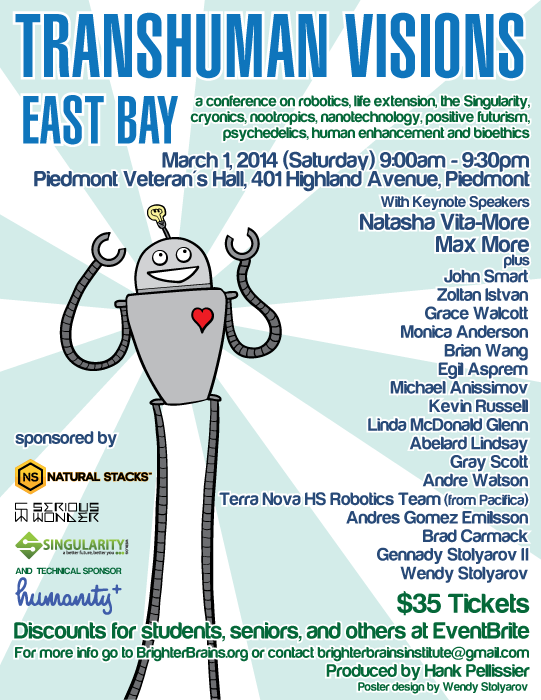
I invite all of my readers to join me at the Transhuman Visions 2.0 East Bay conference in Piedmont, CA, on Saturday, March 1, 2014. I will be there with my wife Wendy Stolyarov to deliver the opening presentation about Death is Wrong, our new ambitious illustrated children’s book on indefinite life extension. For a prelude to my presentation, I invite you to read my article, “Why I Wrote a Children’s Book on Indefinite Life Extension“. Also, autographed copies of Death is Wrong will be available for sale.

The Transhuman Visions 2.0 East Bay conference is produced by the Brighter Brains Institute and its energetic, prolific, and creative founder, Hank Pellissier. For detailed information about the conference, see the official Brighter Brains Institute page here.

The poster for this event was designed by none other than Wendy Stolyarov. It is a testament to her skill in graphic design and the new standard of excellence her art brings to the transhumanist movement.

Transhuman Visions 2.0 East Bay – Poster by Wendy Stolyarov
Pioneers on Time’s Trail – Article by Eric Schulke

Pioneers on Time’s Trail – Article by Eric Schulke

The New Renaissance Hat
Eric Schulke
January 5, 2014
******************************

The universe, the cities, the souls, times come and past, the big picture of it all, its fortune and fate, happenstance and chance coiling through the airwaves, weaving in and out throughout the corridors and shores and floors… We call it existence, and it’s big, really big.

History’s timeline is like a long path, and we here represent the spot on that trail that time is currently manifested as. The stars in the background are the only imprint remaining that spans history’s trail of mementos, like Dachau death marches and Choctaw trails. Even relics continue the slide as they slowly fade, mountains of their days, now chiseled away by time’s currents.

It’s all wild, legendary, mythical, incredible, and ours – each one of ours. There are worlds of complex mechanisms inside atoms, inside cells, inside creatures, inside ecosystems, on planets, in galaxies, and on and on, leaving us wondering if it really could be like an endless fractal in both directions, and desperate for a chance to know. The long, arduous labors of our prokaryotic precursors are now beginning to bud curious new transhuman fruit. Each one of us materializes on the timeline of humanity, like rickety roller coasters set up on temporary take-down stages for traveling theater, just hoping to stay on the tracks. We have conquered a planet under these circumstances. Like Alexander the Great crossing countries atop Bucephalus, we ride through the universe atop the planet Earth, trying to keep our grip on the reins while we hop from stage to stage.

Not even a percent of a percent of this territory is mapped. What does that mean for all that is outside of the speck of light we are in so far? Trillions upon trillions upon trillions of lives and scenarios are interacting and going down around us every day. You might see an ant fighting with a mutant form of a June bug and be able to contemplate their struggle, but miss the fact that this mutation will soon change the landscape of the area in profound ways. You might just dirt-bike right over the top of them without ever even contemplating that, all the while thinking about the prospects of a ranch-style house in this area and the philosophy of a progressive struggle in a capitalist climate. All this occurs while unknowns surround us. Maybe an unfathomable machine is being created on a planet whose distance we can’t conceive, illuminating answers we never dreamt possible. Maybe an amazingly complex civilization is at its height. Perhaps there are other dimensions with wonders that would blow our minds while they’re blowing our minds.

The poorest among the industrialized citizens today still have their “junky” cars, and stereos, lighters, cell phones, watches (scratch that, clocks are on cell phones now), 3 TVs with “only” 8 basic channels, “old” computers and “slow” internet connections, FDA-tested food, state-of-the-art health technology with emergency transport, malls and restaurants just down the street, the freedom to fly anywhere in the world after a few weeks’ saving, and so many other things. These are our poorest people. They are richer than the richest kings and queens of old. In the same kind of way that the poorest among us today have many times more than the richest kings and queens of centuries ago, so will the poorest of us in a post-definite lifespan world be richer than the richest Forbes List billionaire among us today.

Think of the ancient history: the richest of the kings and queens with the golden thrones, crowns, everything jewel-encrusted, exotic animals, limitless concubines, slaves, best fish tank, singing canaries, speedy buggies, salted turnips, and best open-hole bathroom that money could buy. What is that money worth to them now? Time is money, and if you don’t have any, then you’re dead broke.

Some of these ancients remain with us as mummies today. Now there’s an interesting collision of worlds. Those who could still be here, who want to be here, gave it their best shot, and are still here, now in rags begging for us to come up with a solution to bring them back to life. It was a nice try. Their notions lived on in the DNA of their progeny, working it out, better and better, building the tools and emerging today among us as cryonics, a surer form of mummification. We don’t have the cures or the salves for the mummies, but you still have a shot. You are them; you are the same people, the same blood; you are the ancients, but the future can still be theirs/yours. 1,000 BC, 2,100 AD – it’s all ancient history to the people of 45,000 AD.

We know what is going on in parts of this place we are in, but what about everywhere else? What about how it all interacts? What it all means as a whole? Do we think we can guess what is going on everywhere? We can hardly ever even guess who the culprit is in a typical television murder mystery. Can we even guess what is going on in all the buildings of one single town? Some of those points of light in the nighttime sky are entire galaxies unto themselves. Some of them are entire universes. That space between might not end.

This paper could be expanded to fill libraries with volumes on the limitless and profound, mind-blowing, unencapsulatable nature of it. No, libraries are filled with volumes on exactly that, and even those haven’t begun to scratch the surface of what it means to exist.

So here we are, pioneers on time’s trail, the precursors, surviving caravans retooling for a star trek. What does the big picture of existence have in store for us on the trail ahead?

Eric Schulke was a director at LongeCity during 2009-2013. He has also been an activist with the Movement for Indefinite Life Extension and other causes for over 13 years.

Why Prioritize SENS Research for Human Longevity? – Article by Reason

Why Prioritize SENS Research for Human Longevity? – Article by Reason

The New Renaissance Hat
Reason
December 29, 2013
******************************

Why do I vocally support rejuvenation research based on the Strategies for Engineered Negligible Senescence (SENS) over other forms of longevity science? Why do I hold the view that SENS and SENS-like research should be prioritized and massively funded? The short answer to this question is that SENS-derived medical biotechnology has a much greater expected utility – it will most likely produce far better outcomes, and at a lower cost – than other presently ongoing lines of research into creating greater human longevity.

What is SENS?

But firstly, what is SENS? It is more an umbrella collection of categories than a specific program, though it is the case that narrowly focused SENS research initiatives run under the auspices of the SENS Research Foundation. On the science side of the house, SENS is a synthesis of existing knowledge from the broad mainstream position regarding aging and the diseases of aging: that aging is caused by a stochastic accumulation of damage at the level of cells and protein machinery in and around these cells. SENS is a proposal, based on recent decades of research, as to which of the identified forms of damage and change in old tissues are fundamental – i.e. which are direct byproducts of metabolic operation rather than cascading effects of other fundamental damage. On the development side of the house, SENS pulls together work from many subfields of medical research to show that there are clear and well-defined ways to produce therapies that can repair, reverse, or make irrelevant these fundamental forms of biological damage associated with aging.

(You can read about the various forms of low-level damage that cause aging at the SENS Research Foundation website and elsewhere. This list includes: mitochondrial DNA mutations; buildup of resilient waste products inside and around cells; growing numbers of senescent and other malfunctioning cells; loss of stem cells; and a few others).

Present arguments within the mainstream of aging research are largely over the relative importance of damage type A versus damage type B, and how exactly the extremely complex interaction of damage with metabolism progresses – but not what that damage actually is. A large fraction of modern funding for aging research goes towards building a greater understanding this progression; certainly more than goes towards actually doing anything about it. Here is the thing, however: while understanding the dynamics of damage in aging is very much a work in progress, the damage itself is well known. The research community can accurately enumerate the differences between old tissue and young tissue, or an old cell and a young cell – and it has been a good number of years since anything new was added to that list.

If you can repair the cellular damage that causes aging, it doesn’t matter how it happens or how it affects the organism when it’s there. This is the important realization for SENS – that much of the ongoing work of the aging research community is largely irrelevant if the goal is to get to human rejuvenation as rapidly as possible. Enough is already known of the likely causes of aging to have a reasonable expectation of being able to produce laboratory demonstrations of rejuvenation in animal models within a decade or two, given large-scale funding.

Comparing Expected Values

Expected value drives human endeavor. What path ahead do we expect to produce the greatest gain? In longevity science the investment is concretely measured in money and time, and we might think of the expected value in terms of years of healthy life added by the resulting therapies. The cost of these therapies really isn’t much of a factor – all major medical procedures and other therapies tend to converge to similar costs over time, based on their category: consider a surgery versus an infusion versus a course of pills, for example, where it’s fairly obvious that the pricing derives from how much skilled labor is involved and how much care the patient requires as a direct result of the process.

On the input side, there are estimates for the cost in time and money to implement SENS therapies for laboratory mice. For the sake of keeping things simple, I’ll note that these oscillate around the figures of a billion dollars and ten years for the crash program of fully-funded research. A billion dollars is about the yearly budget of the NIA these days, give or take, which might be a third of all research funding directed towards aging – by some estimates, anyway, though this is a very hard figure to verify in any way. It’s by no means certain the that the general one-third/two-thirds split between government and private research funding extends to aging research.

On the output side, early SENS implementations would be expected to take an old mouse and double its remaining life expectancy – e.g. produce actual rejuvenation, actual repair, and reversal of the low-level damage that causes aging, with repeated applications at intervals producing diminishing but still measurable further gains. This is the thing about a rejuvenation therapy that works; you can keep on applying it to sweep up newly accruing damage.

So what other longevity science do we have to compare against? The only large running programs are those that have grown out of the search for calorie-restriction mimetic drugs. So there is the past decade or so of research into sirtuins, and there is growing interest in mTOR and rapamycin analogs that looks to be more of the same, but slightly better (though that is a low bar to clear).

In the case of sirtuins, money has certainly flowed. Sirtris itself sold for ~$700 million, and it’s probably not unreasonable to suggest that a billion dollars have gone into broader sirtuin-related research and development over the past decade. What does the research community have to show for that? Basically nothing other than an increased understanding of some aspects of metabolism relating to calorie restriction and other adaptations that alter lifespan in response to environmental circumstances. Certainly no mice living longer in widely replicated studies as is the case for mTOR and rapamycin – the sirtuin results and underlying science are still much debated, much in dispute.

The historical ratio of dollars to results for any sort of way to manipulate our metabolism to slow aging is exceedingly poor. The thing is, this ratio shouldn’t be expected to get all that much better. Even if marvelously successful, the best possible realistic end result of a drug that slows aging based on what is known today – say something that extracts the best side of mTOR manipulation with none of the side-effects of rapamycin – is a very modest gain in human longevity. It can’t greatly repair or reverse existing damage, it can’t much help those who are already old become less damaged, it will likely not even be as effective as actual, old-fashioned calorie restriction. The current consensus is that calorie restriction itself is not going to add more than a few years to a human life – though it certainly has impressive health benefits.

(A sidebar: we can hope that one thing that ultimately emerges from all this research is an explanation as to how humans can enjoy such large health benefits from calorie restriction, commensurate with those seen in animals such as mice, without also gaining longer lives to match. But if just eating fewer calories while obtaining good nutrition could make humans reliably live 40% longer, I think that would have been noted at some point in the last few thousand years, or at least certainly in the last few hundred).

From this perspective, traditional drug research turned into longevity science looks like a long, slow slog to nowhere. It keeps people working, but to what end? Not producing significant results in extending human longevity, that’s for sure.

Ergo…

The cost of demonstrating that SENS is the right path or the wrong path – i.e. that aging is simply an accumulation of damage, and the many disparate research results making up the SENS vision are largely correct about which forms of change in aged tissue are the fundamental forms of damage that cause aging – is tiny compared to the cost of trying to safely eke out modest reductions in the pace of aging by manipulating metabolism via sirtuins or mTOR.

The end result of implementing SENS is true rejuvenation if aging is caused by damage: actual repair, actual reversal of aging. The end result of spending the same money and time on trying to manipulate metabolism to slow aging can already be observed in sirtuin research, and can reasonably be expected to be much the same the next time around the block with mTOR – it produces new knowledge and little else of concrete use, and even when it does eventually produce a drug candidate, it will likely be the case that you could do better yourself by simply practicing calorie restriction.

The expectation value of SENS is much greater than that of trying to slow aging via the traditional drug-discovery and development industry. Ergo the research and development community should be implementing SENS. It conforms to the consensus position on what causes aging, it costs far less than all other proposed interventions into the aging process, and the potential payoff is much greater.

Reason is the founder of The Longevity Meme (now Fight Aging!). He saw the need for The Longevity Meme in late 2000, after spending a number of years searching for the most useful contribution he could make to the future of healthy life extension. When not advancing the Longevity Meme or Fight Aging!, Reason works as a technologist in a variety of industries. 

This work is reproduced here in accord with a Creative Commons Attribution license.  It was originally published on FightAging.org.