Browsed by
Tag: reason

The Destructive Nature of the Mystical Rebellion Against Reason in Lisel Mueller’s “Monet Refuses the Operation” (2003) – Essay by G. Stolyarov II

The Destructive Nature of the Mystical Rebellion Against Reason in Lisel Mueller’s “Monet Refuses the Operation” (2003) – Essay by G. Stolyarov II

The New Renaissance Hat
G. Stolyarov II
July 29, 2014
******************************
Note from the Author: This essay was originally written in 2003 and published on Associated Content (subsequently, Yahoo! Voices) in 2007.  The essay received over 1,200 views on Associated Content / Yahoo! Voices, and I seek to preserve it as a valuable resource for readers, subsequent to the imminent closure of Yahoo! Voices. Therefore, this essay is being published directly on The Rational Argumentator for the first time.  
***
~ G. Stolyarov II, July 29, 2014

**

“Monet Refuses the Operation” by Lisel Mueller, though unintentionally, reveals an intriguing insight; that mystical rebellion against reason is primarily fueled by physical shortcomings and defects.

In the poem, Claude Monet, the aging artist heading inexorably toward blindness, rejects a doctor’s offer to restore his vision. He extols his present incapacitated state by discarding as purportedly insignificant all that had been previously accessible to him. He rejects artistic principles necessary for conveying a realistic three-dimensional perspective, such as the horizon line and even the entire objective of creating a three-dimensional portrayal.

Moreover, the fictional Monet seeks to abolish “fixed notions of top and bottom” and the essential characteristics of Euclidean regularity, identity, and consistency which ubiquitously dominate actuality. Instead, he, with his link to reality (his sight) severed, reverts to the dazed, bumbling, confused notion of Heraclitean flux, which in itself incapacitates man’s reason, understanding, and cognitive capacity. The absolutes, which he has departed from, he disdainfully dubs “youthful errors.”

But what, in fact, is senescence but a departure from an optimal link with reality? With senescence, the body decays, as do the physical aspects of consciousness. The senses are no longer as keen, nor one’s insights as adaptable to the attainment of fresh, innovative, yet still firmly grounded and objective discoveries, as they had once been. This deterioration in Monet is amplified by the decay of his sight and causes him to lapse from clarity to delusion. The old, blind, sick Monet is fomenting a reaction against youth, health, certainty, and forthrightness.

Descriptions of the habits of the blind in Annie Dillard’s “Seeing” also suggest a direct link between physical incapacity and mystical tendencies. For example, many of the blind, having no knowledge of the appearance of their gestures and exterior to the receptacles of sight, do not groom themselves properly and mar their undertakings by aesthetically awkward movements. Despite their knowledge that a world of the seen and objectively perceptible exists, many nevertheless continue to act in utter disregard of it.

This belief in the irrelevancy of reason is an instance of mysticism. The disease, is, however curable along with its physical symptoms. Once cataract operations are performed on these unfortunate individuals, they reform their habits and begin to distinguish objects instead of viewing random and indeterminate color patches. They become conscientious about their appearances and gradually renounce their former abhorrence of the visual world. A girl who spends her first two weeks of sight in denial, a spillover remnant of mysticism, later on admits the beauty of her new endowment and thereby gains access to a tool of empowerment.

While blindness is a physical defect, mysticism is a defect of the mind. It is not curable automatically, as the fictional Monet’s actively resisting example proves. However, a removal of the physical obstacles between one and the absolute enable an exposure to the world of truth, to which delusional untruth can then be compared. The inclinations of a man’s reason and common sense are evident, and it takes extensive self-deceit to subvert them. Thus, he whose physical state is sound is dependent solely on his volition to cure his mysticism. Will he choose darkness and flux, like the fictional Monet, or light, color, and proportion, like the newly-sighted girl?

Commonly Misunderstood Concepts: Employment (2009) – Article by G. Stolyarov II

Commonly Misunderstood Concepts: Employment (2009) – Article by G. Stolyarov II

The New Renaissance Hat
G. Stolyarov II
Originally Published November 26, 2009
as Part of Issue CCXX of The Rational Argumentator
Republished July 24, 2014
******************************
Note from the Author: This essay was originally published as part of Issue CCXX of The Rational Argumentator on November 26, 2009, using the Yahoo! Voices publishing platform. Because of the imminent closure of Yahoo! Voices, the essay is now being made directly available on The Rational Argumentator.
~ G. Stolyarov II, July 24, 2014
****
****

The mistaken identification of wealth with money, which I refuted in an earlier installment of this series, results in yet another damaging fallacy: the idea that the only legitimate “employment” is work performed for somebody else in exchange for money. This cultural confusion has become so deep-rooted that even people who own their own businesses or function as independent contractors are classified as “self-employed” – which, despite the second component of that term, is somehow seen as distinct from being “employed,” which has become in the minds of many identical to working for a formal organization on a fixed schedule for largely fixed compensation. There is nothing wrong with the latter kind of employment; indeed, I am currently engaged in it, and it pays well. It is a practical and a tremendously useful way to earn a living for many. But the societal stigma against many individuals who choose not to pursue that path needs to end.

I am not here seeking to justify individuals who refuse to work out of sloth or rebelliousness – or individuals who choose to subsist off of the welfare system. Indeed, I am not at all seeking to justify individuals who refuse to work at all. Rather, I seek to effectuate a cultural re-identification of employment with doing actual useful work – physical or mental – irrespective of how much, or how little, money that work earns. If wealth is not money but rather useful goods and services, then useful employment is any activity that generates useful goods and services. Some such activities happen to be highly compensated with money, either because there is large market demand for them or because they are subsidized by private institutions or governments. But other such activities arise out of individuals’ volunteer efforts, hobbies and interests, and desires to improve their immediate environment. An individual who devotes himself or herself primarily to the latter sorts of activities can be as worthy of respect and just as productive as an individual who makes a six-figure monetary income.

First, it is essential to recognize that either market value or institutional advantages that result in monetary subsidies are not necessarily a reflection of genuine wealth creation or usefulness. For instance, numerous products of high culture – including philosophy, literature, and classical music – are not in high demand among the masses, who simply do not understand such products. The creators of high culture will not earn as great an income on the market as the creators of light magazines and popular music. However, these same creators will contribute a much longer-lasting value to human knowledge, refinement, and moral standards for generations to come, whereas the creators of more popular works are unlikely to remain in demand for more than two generations. There is nothing wrong with this differential in compensation, per se, as people who do not appreciate high culture are entitled to vote with their dollars however they please. But this state of affairs does invalidate any notion that the amount of money one receives from one’s work is in any manner connected with one’s worth as a human being or one’s contribution to improving one’s own life and the lives of others – both in the short term and in the long term. Many creators of more refined works have even decided that it is unwise to try to make a living from such works and depend on their approval by a mass audience; instead, they have decided to subsidize their own creations and the dissemination of these works by means of a monetary income they earn from another occupation. This allows for works of high culture to be created exactly as the author intended them to be; if the author is talented and has a consistent vision, such works will be much more likely to endure long into the future.

Another important recognition is that some work is either impossible to transfer to the market given present technology or is prohibitively expensive to transfer. For instance, if I wish to go into my kitchen and get myself a beverage, it would be highly impractical for me to hire another individual to do this for me. If I get the beverage myself, I do not either collect or spend any money – provided that I already own the beverage, the glass, and the living space. But it cannot be denied that the act of getting the beverage was desirable to me and improved the quality of my life. Likewise, numerous actions that an individual performs to improve his or her own skills – such as reading books, practicing musical instruments, and doing mathematical problems – cannot be outsourced to other individuals and retain their value for the individual, which arises from the act of learning new skills that the individual himself would be able to use in the future. Indeed, it is true that all of us, if we have even the slightest desire to live well, will perform a wide variety of work every day for which we receive no monetary compensation at all! If we did not perform this work, it is unlikely that we would be in any position to earn any money, either.

A popular source of contempt in contemporary culture is the individual who, instead of leaving the home to work for money, chooses to remain at home and maintain it in good working order. This is, in my judgment, the single most egregious consequence of the fallacy that employment is the same as working for money. Working within the home – especially when supported by the monetary income of another family member – is a tremendously useful and life-affirming occupation; it facilitates a division of labor where various family members can specialize in the tasks they are most skilled at performing, thereby making good use of the principle of comparative advantage. Moreover, it enables a greater degree of care for any children in the household and provides a source of relief for those individuals who simply do not like working outside the home on a fixed schedule.

I note that there is nothing in this implying that any particular gender of individual should choose to stay at home, or that a family cannot function well if all of its members choose to work outside the home. Rather, I argue that a productive family can exist irrespective of which of its members do or do not choose to work for money. Indeed, for a family which has accumulated sufficient money and physical goods, it is possible to maintain productivity and a high standard of living even if none of its members earns a regular monetary income. Even if an individual has never earned any money in his or her life and, say, lives off a vast inheritance, it is still possible for that individual to perform useful and productive work. Indeed, one of the arguments that the great Austrian economist Friedrich Hayek made for the right of inheritance can be summarized as follows. Even if the vast majority of people who inherit their money will spend it unwisely, it is enough for one out of a thousand inheritors to be a great thinker and innovator. This individual, through his inheritance, will have the time and leisure to bring his vision to fruition, without needing to worry about providing for his day-to-day subsistence. The result could be a tremendous philosophical, technological, or artistic breakthrough that improves the lives of millions for centuries to come – and this result is worth the wasteful spending any other heirs might engage in.

Of course, the manner of productive work one does is often constrained by one’s current material situation. Many people will work for money, even if they wish to do something else, because they need the money to maintain the standard of living they wish to have. Increases in monetary income can go a long way toward improving both one’s access to leisure and one’s level of security and comfort. On the other hand, the same goals can also be achieved in part by spending less of the money one already earns and by living within one’s means – never letting one’s expenses exceed one’s income, which is akin to deficit spending for individuals, and not taking out interest-bearing debt, unless there is no other option, and the good the debt would fund could be seen as a necessity – such as a house. Devoting some time to managing one’s spending and establishing less expensive lifestyle choices is just productive as working to earn a salary increase.

If you wish to work to earn money, by all means do so. If you would rather focus on working in the home or doing volunteer work of any sort, this is excellent as well. Provided that one works and has useful outcomes to show for it, there is no need to feel any inferiority in one’s own case or any disrespect for others.

Read other articles in The Rational Argumentator’s Issue CCXX.

Commonly Misunderstood Concepts: Wealth (2009) – Article by G. Stolyarov II

Commonly Misunderstood Concepts: Wealth (2009) – Article by G. Stolyarov II

The New Renaissance Hat
G. Stolyarov II
Originally Published November 16, 2009
as Part of Issue CCXVIII of The Rational Argumentator
Republished July 24, 2014
******************************
Note from the Author: This essay was originally published as part of Issue CCXVIII of The Rational Argumentator on November 16, 2009, using the Yahoo! Voices publishing platform. Because of the imminent closure of Yahoo! Voices, the essay is now being made directly available on The Rational Argumentator.
~ G. Stolyarov II, July 24, 2014
****

****

Many of the economic and personal fallacies of our time arise from the mistaken belief that wealth and money are identical. In fact, while money is in many cases an important gateway to wealth, it does not even approach describing what wealth truly is.

In our time, money may be equated to wealth even less justifiably than it could have been in times past – when most money was identified with precious metals, such as gold and silver, which had uses other than as media of exchange. Currently, money in virtually all countries consists of pieces of paper which are decreed to be money by government fiat. Legal tender laws force individuals to accept these special pieces of paper as payment for products, services, or debts. The supply of these pieces of paper is controlled by the government’s printing press – typically located at either the central bank or the treasury department.

Why do people seek and hold this money? They do so because they expect to be able to purchase with it actual goods and services – either now or in the future. This means that the money is not seen as valuable in itself; it is seen as valuable because of the other things it can obtain. However, the supply of these other things is not dependent on the number of pieces of paper in circulation. Rather, it is dependent on real factors that affect individuals’ and businesses’ abilities to produce actual goods and services. Thus, having more pieces of paper does not automatically make one wealthier. If the government simply chooses to print more of them, while no external factors affect the production of goods and services, then there will simply be more pieces of paper for the same amount of real goods and services. We would therefore get inflation: prices in terms of the pieces of paper will increase in proportion to the volume of new pieces of paper introduced. Of course, inflation has disastrous impacts on individuals’ existing savings, incentives for frugality, and transaction costs. It also constitutes an unjustified redistribution of wealth from the producers who earn it to the politically connected elites who get priority access to the new pieces of paper. Creating more “money” can often destroy actual wealth and productivity.

But there is another respect in which money is not equivalent to wealth. Consider the fact that, even without inflation, the same amount of money will not purchase the same goods and services in every area. Indeed, a tiny, cramped apartment in the center of a major city may often cost more money than a spacious house in a small town. An individual earning the same amount of money in each area would be able to have a much higher standard of living in the small town. It is quite possible that the individual’s opportunities to earn more money in a big city will be greater, but the prices of goods will not increase in a one-to-one ratio with that individual’s relative salary increase. Rather, the prices are most likely to be higher in a ratio that is greater or smaller than the individual’s ratio of salaries – thereby making life in the city either less or more attractive to the individual. How much money one makes is not an indicator of the rate at which one accumulates wealth; a better indicator is what one can buy for one’s money.

These thoughts should give pause to both advocates of the government’s power of the printing press and to indiscriminate salary chasers. Both may be devoting their time and energy to the pursuit of numerical illusions rather than substantive benefits. A much more sophisticated and nuanced understanding of wealth is needed in order to truly thrive and lead a good life.

To achieve an understanding of wealth, we need to ask ourselves why we seek money in the first place. Ultimately, every unit of money – even one saved or invested for many years – goes to fund some human consumption. Money can pay for either goods – material objects – or services – human behaviors performed for the benefit of the payer. It is actual goods and services that constitute wealth, not the money. Moreover, the money price of these goods and services is irrelevant from the standpoint of the wealth of the person who owns them. If I have a table, I am no less wealthy if I cannot sell the table at all – nor am I any wealthier just because I have the potential to sell it for five million dollars. I still have the same table, and its physical qualities are unchanged. If I actually do sell it, I might become wealthier, but only insofar as my five million dollars would enable me to purchase more tables, better tables, or other goods and services I value. The important principle to recognize is that one either has potential wealth in the form of money or actual wealth in the form of the goods and services one has purchased. One does not have both at the same time in the same object. Fiat money is wealth only insofar as it can reasonably be expected to procure actual goods and services. Goods and services constitute wealth in themselves while they last. Capital goods that can produce other goods can also be described as potential wealth – but it is also true that they are not money while one owns them as goods.

A further distinction should be made. Not all material objects are goods, and not all human behaviors are services. Some material objects – such as clouds of poison gas in one’s living room – are active bads. Likewise, some human behaviors – such as people raping or murdering one another – are active disservices. The only way to comprehensively define wealth is with regard to a standard by which goods and services can be identified. The most fundamental standard from both a moral and a practical standpoint is the principle that the life of every innocent individual is the greatest and most basic good – where an innocent individual is one who has not violated this principle through actions such as murder or the attempt at murder. Thus, any object that promotes any individual’s life is a good; any behavior that promotes any individual’s life is a service. The more life-promoting objects one has – and the more life-promoting behaviors one either is able to elicit from others or is able to initiate oneself – the wealthier one is.

Everything else is a matter of means and context. How one gets wealth – whether it be through money, barter, gifts, or one’s own work and transformation of raw materials – has no bearing on the nature of that wealth; all of us who are not self-destructive pursue a wide variety of means that fundamentally aim at the goal of improving our lives. Ethically, the means ought to be non-coercive; we must not intrude on other people’s prerogatives to control their lives just like they must not intrude on ours. Wealth is still wealth, even if acquired through dishonest or evil means – but immoral means of wealth acquisition will destroy other wealth on net, through damage to property and human beings and their incentives to produce.

Moreover, it is possible for the same object to be beneficial in some circumstances and harmful in others. For instance, a piece of rope used to tie a knot may be extremely useful, while the same piece of rope strung across the floor of a room might be a tripping hazard. However, the same item or behavior in the exact same context should produce the same results; actual situations are never precisely repeatable, but we can at least estimate an object’s usefulness or lack thereof by analyzing situations where it has been applied in similar ways.

This view has practical implications beyond the scope of one’s views on economics or politics. Most items in our lives should be viewed not in terms of how we might be able to resell them to others, but rather in terms of what use they are to us personally. There is nothing wrong with resale as such, but it is not a behavior that can be imposed on all objects – and, indeed, economic bubbles are created when the expectation of resale for continually rising prices is applied by enough people to too many commodities. Those of us who acquire an item for our own use – which includes our purchases of art, furniture, automobiles, and yes, even houses – are not in the same position as businessmen who produce or acquire items for the specific purpose of reselling them at a profit. Businessmen see their inventories as potential money generators – an indirect route to greater wealth; consumers ought to see their property as useful in itself and any resale as incidental or fortuitous – a kind of loss mitigation once one is no longer able or willing to make good use of the property. We have adjusted quite well to the idea that the resale value of an automobile or a computer is virtually always much lower than its purchase price. In the role of consumers, we should adopt the same default expectation for houses – and for everything else. But the silly notion that one is entitled to resell any property at a higher price than one purchased it must be discarded, as it results in the foolish pursuit of higher-priced items in the vain hope of their further appreciation in price – without any expert knowledge of how markets in these items actually work. This turns many a layman into a speculator, while enticing him to take out loans with his fanciful expectations as collateral – as happened all too often during the housing bubble. Moreover, it engenders the disastrous attitude that price decreases – which make goods such as houses more affordable for people – are in some manner harmful. But one cannot destroy wealth by making goods easier to earn through honest work – nor can one create wealth by piggybacking off of others’ expectations of price increases.

Leave the house-flipping to the experts, and buy a house that you would want to live in, just as you buy clothes you want to wear and computers you want to use. That house would constitute real wealth for you, irrespective of its market price, and it will be there irrespective of financial market or currency value fluctuations – if you actually own the house or have a fixed-rate mortgage. To maximize your wealth, you should act in such a manner as to improve your access to actual goods and services that you value. Pieces of paper and expectations can only get you so far. And remember that your own ability to do useful work – including work that does not bring immediate monetary returns – is one of your most reliable gateways to wealth.

Read other articles in The Rational Argumentator’s Issue CCXVIII.

Immanuel Kant’s Ideas on Knowledge, Science, Morality, and Rational Free Will (2002) – Essay by G. Stolyarov II

Immanuel Kant’s Ideas on Knowledge, Science, Morality, and Rational Free Will (2002) – Essay by G. Stolyarov II

The New Renaissance Hat
G. Stolyarov II
July 23, 2014
******************************
Note from the Author: This essay was originally written in 2002 and published in three parts on Associated Content (subsequently, Yahoo! Voices) in 2007.  The essay earned over 23,000 page views on Associated Content/Yahoo! Voices, and I seek to preserve it as a valuable resource for readers, subsequent to the imminent closure of Yahoo! Voices. Therefore, this essay is being published directly on The Rational Argumentator for the first time.  The essay should be read as a factual exposition, not an endorsement, of Kant’s views.***
***
~ G. Stolyarov II, July 23, 2014
***

Immanuel Kant’s Early Life and Ideas on Knowledge

***

Immanuel Kant was born in 1724 in the East Prussian city of Konigsberg (modern Kaliningrad, although the post-Communist leadership of the Russian Federation is considering an alteration of its name to “Kantgrad”), in the middle-class family of a manufacturer of saddles. He lived on a moderate income, sufficient for him to attend the university within the city and display the reputation of a formidable student.

Kant was a man of rather fragile health and a “late bloomer”, and thus spent the better portion of his youth slowly obtaining knowledge sufficient to gradually ascend the hierarchy within the university. His early years were spent constantly engaging in social activities and exposing himself to both the mundane and the ideological worlds. However, his contemporaries perceived that despite his insightful mind and abundance of ideas, Kant would never emerge as a leading philosopher due to the worldly distractions that he faced.

The young Kant became determined to prove his doubters wrong. He altered his routine, beginning in his late twenties and intensifying as he neared old age, into a rigid, nearly mechanical working discipline, forfeiting most interpersonal interactions other than those with his students (he was a private tutor earning a meager income prior to having earned his doctorate in 1755). He resolved never to marry nor acquire a family that would divert him from the task of becoming the prominent thinker who revolutionized Western thought.

Kant’s first work was composed in 1746, and titled Thoughts on the True Estimation of Living Forces. His ideology developed from that point into the formidable and thought-provoking philosophical doctrine that one would encounter in Critique of Pure Reason (First Edition published in 1781, the Second Edition in 1787).

Kant argues that there exists a difference between individual perception of the world and the absolute reality in which the human species dwells. He refers to the external world as “things-in-themselves,” of which every person possesses a varying and inaccurate understanding due to the unique manner in which an individual’s mind would process this information. This activity is known as synthesis, and involves the assimilation of data into the mind, after which it is blended with and connected to previous experiences to thus add to one’s perception.

Kant rejects the existence of a priori intuitive postulates within the human mind, claiming that so-called “intuition” is a product of having received information, then engaged in discourse on or analysis of the topic that the information concerns, and, at last, forged a conclusion, a point where synthesis forms the understanding that becomes a portion of our perception. Kant divides intuition into two categories, “sensible,” which is presented with material after which it undergoes synthesis and extracts an “insight” from it, and “intellectual,” which actually “creates” truth. Only God, according to Kant’s doctrine, would possess intellectual intuition.

Immanuel Kant’s Ideas on Science and Morality

***

According to  Immanuel Kant, no person may possess inherent wisdom about reality. This is best summarized in the philosopher’s famous expression, “Thoughts without content are empty; intuitions without data are blind.”

Indeed, Kant believes that in order for us to utilize our sensible intuition, we must possess two stimuli, “physical sensation” and “moral duty.” The first of the two addresses a portion of Kantian thought known as “empirical realism,” a reasoning that defines that absolute reality as the entire universe in which all human beings dwell. Every time we acquire external data from that absolute reality, our perception of it assumes a greater degree of accuracy. And what would be the optimal way of acquiring such data with only minimal if any contact with other persons’ perceptions (which are, like ours, inaccurate, only in different ways, since each human being possesses a unique arsenal of experiences)?

Scientific exploration is, therefore, the key to an ultimate comprehension of things-in-themselves. Kant was a fervent admirer of Newtonian thought and the Scientific Method, which permitted scientists to ascend to unprecedented heights in their understanding of and control over nature.

The second stimulus to action, moral duty, provides the explanation for the purpose of all human actions toward the comprehension of the universe. This portion of Kant’s doctrine has been dubbed by the philosopher as “transcendental idealism,” since it establishes a framework outside the natural world upon which correct actions are based. Kant sees the ultimate virtues to be the attempts to reach three goals which are not yet found in reality, God, freedom, and the immortality of individuals. God, the Creator and Supreme Being of the universe, must be fathomed, properly interpreted, and obeyed in accordance with his true desires. Freedom, the individual liberty to act as one wishes and to grant all others this right, must be instituted through societal reforms and a development of ideology to understand the proper order that would establish such an atmosphere. And, at last, every human being must rise to possess the right to exist for an indefinite length of time that he may obey the commandments of God and practice his freedoms. Kant states that all which is right and moral must be based upon those three principles.

As such, Kant separates the scientific realm (which describes what is) from the moral realm (which explains what ought to be), but he considers these two realms to go hand-in-hand — ultimately advocating putting the scientific realm in service to moral one.

Immanuel Kant’s View of Rational Free Will and Its Implications for Criminal Justice

***

In the view of Immanuel Kant (1724 – 1804), all individuals possess a “rational free will” and are capable of recognizing the three pillars of morality – God, freedom, and immortality – and acting accordingly with them. Kant recognizes that every intended deed is purposeful and selected by the person who commits it.

According to Kant, no set of circumstances, no matter how great their severity, can force a person to abandon the three moral virtues unless the individual himself selects to do so. And this selection, then, permits for punishment to be distributed to an individual based on the action undertaken. Thus, every deed committed with the intention of being so done implies a moral accountability within the human responsible.

This model of thought is of immense help to understanding what actions Kant saw as necessary for the creation of justice within the real world, since, once again, every individual’s worldview is based upon that individual’s own set of experiences. Thus, any judgment by one individual of another’s set of “data” will be subjective and skewed, which perverts any prospect for objective justice. That is, unless an objective framework such as one of “God, freedom, immortality” is used to evaluate a deed and not the person responsible, while properly rewarding or punishing the latter.

A Kantian justice system would thus solely focus on what was done, rather than on the character of the person who did it. No excuses regarding a criminal’s genome, upbringing, history of mental illness, or socioeconomic status can exonerate him from receiving punishment for the criminal act. The fact that a man was abused during his childhood does not justify his infliction of similar abuse on others later in life. The fact that a mother who drowned her five children was suffering from post-partum depression does not nullify her responsibility for the act and the need to punish her to the utmost extent possible.

Indeed, a court organized on Kantian lines might be able to exercise its functions using purely objective, factual considerations. Evaluating the evidence in a specific case, the court could conclusively determine what was done, and who did it, from which the punishment for the perpetrator would follow algorithmically, being already stipulated in the law. Whether the criminal is a “nice person” or has a history of past troubles would have no bearing on the outcome – thus eliminating the need for subjective opinions entering the analysis. Neither aloof nor passionate behavior on the part of the defendant in the courtroom would have the ability to sway the court’s decision one bit.

“Human Nature” is Tautological (2009) – Article by G. Stolyarov II

“Human Nature” is Tautological (2009) – Article by G. Stolyarov II

The New Renaissance Hat
G. Stolyarov II
Originally Published March 10, 2009
as Part of Issue CLXXXIX of The Rational Argumentator
Republished July 23, 2014
******************************
Note from the Author: This essay was originally published as part of Issue CLXXXIX of The Rational Argumentator on March 10, 2009, using the Yahoo! Voices publishing platform. Because of the imminent closure of Yahoo! Voices, the essay is now being made directly available on The Rational Argumentator.
~ G. Stolyarov II, July 23, 2014
***


What is meant by the term “human nature”? In one sense, it is supremely uninformative. The “nature” of any existent can be defined simply as “that which that existent is.” To say that “X is human nature,” is simply to say “X is what humans are and/or do.” This is fine by itself, provided that it is not used as an explanation for any particular human characteristic or activity. X may be human nature, but X does not occur because of human nature. To say that human nature is the cause of any phenomenon is to say that such a phenomenon causes itself. To say that “some people steal because of human nature” is to say that “some people steal because they steal” or that “some people steal because that is the way humans are.” This is not particularly enlightening as to why some people actually steal.

The striking fact about uses of “human nature” in discourse is that the term is virtually never invoked to account for all the wonderful things people do. Few, if any, people say that humans build great buildings, create art, invent machines, and save lives because “that’s just human nature.” But when it comes to some humans killing, stealing, lying, raping, and committing a host of other abuses, “human nature” virtually never leaves the discussion. This leads me to suspect that a lot of presuppositions are smuggled in under the umbrella label of “human nature” which are not implicit in the term. Namely, most people whose discussions are peppered by the term frequently presuppose that all human beings somehow have even the worst vices “in their nature.”

If “human nature” is “the way human beings are,” then it is clearly contrary to empirical evidence to suppose that killing, stealing, lying, and other vices are inherent in human nature. We can find numerous examples of good, upstanding people who have never killed or stolen – and even a few whom we cannot imagine lying. Surely, “the way they are” is such that they do not kill, steal, or lie. This is as much a part of their human nature as killing, stealing, and lying are a part of the natures of genocidal dictators in North Korea, Iran, Zimbabwe, and Sudan. There is no reason to suppose that anyone is capable of any vice just because some people have been observed engaging in some vices.

The facts that some people do commit vices that others do not commit and that no vice is universal to human beings indicates to us that no vice is inherent to human nature – the way humans are. Rather, every vice is incidental to human nature. That is, the natures of some humans happen to be vicious, just as the natures of some cats happen to be white (not that there is anything wrong with white cats). But vice is no more an inseparable part of humanity than whiteness is an inseparable part of cathood. It may well be that some people will always be irreparably vicious, no matter what external stimuli short of death are applied to them. This is why it may be reasonable to advocate killing genocidal sadists and other comparable entities. But this is no commentary on all the other humans of this world.

Moreover, it is essential to recognize that prevailing trends with regard to behavior change over time. 300 years ago, if two Western, upper-class males had a dispute, it would often culminate in a duel to the death. Today, the disputants would be more likely to sit down and quasi-civilly discuss their differences. The statistical prevalence of each kind of behavior has changed dramatically. Moreover, the change has been an unambiguous improvement. “What humans are” does not need to be static and set in stone. Rather, as incentives, institutions, and motivations change, so does behavior – and the sum of our behaviors constitutes our “natures.”

The view of “human nature” that I have presented thus far is fully in accord with the principle of individualism. This principle asserts that each human being is fundamentally different and should be judged on his or her own qualities, and not on the qualities of other human beings who happen to share some direct or indirect association. Moreover, individualism holds that each human being can control his or her own behaviors to a substantial extent. Each person is free to choose virtue but is just as free to choose vice, and each person must be prepared to be judged by the rest of us on the basis of his or her choices. The question remains, of course, what would motivate people to choose virtue as opposed to vice?

Granting that people always have free will to act virtuously or viciously, what would lead people to want to pursue either course of action? Earlier, I described some incentives for moral behavior that motivate people to pursue virtuous and beneficial courses of action with regard to themselves and others. On the other hand, what motivates vice? The kinds of vice that do damage to others – killing, stealing, infliction of injury, and deception – all seem to stem from some sense of personal inadequacy. Either one does not have enough things and wishes to take away the things owned by others, or one feels slighted, deprived, or persecuted in some manner by others and wishes to correct this perceived victimization by destroying its perceived source. Harm that people do to themselves seems to stem either from a conviction that their lives are not quite worth living or from a simple failure to consider all of the long-term harmful consequences of their decisions.

Exploring the common human motivations for committing immoral acts might lead us to an understanding of how to alter these motivations and direct the “natural” desires of more people toward virtue. For instance, if a person is motivated to steal by a lack of food, then if this person had food, he might not resort to stealing (provided, of course, that he recognizes the change in conditions and does not continue to resort to stealing due to the inertia of habit). On the other hand, the new-found presence of food might get the person to focus on some other attribute he believes to be lacking in his life – say, a car – and steal that. How might it be possible to get such a person to refrain from stealing? Clearly, all people perceive some kinds of inadequacies in their lives. The ways that people’s incentives are structured will lead them to consider whether moral or immoral means are the best ways to compensate for such inadequacies.

The proper incentive structure to give to each person is such that the costs of any vicious act will be greater than its perceived benefits. I note that these costs can be both external – such as any kind of punishment – or internal – such as a feeling of self-loathing and disappointment for having committed an immoral act. Well-developed internal aversions to vicious conduct reduce the need for external incentives to encourage virtue. A wide variety of institutions, technologies, and patterns of interaction shape both people’s external and internal incentives. Yet what is most important to remember is that we are not fated to be locked into any particular configuration of incentives, motivations, and outcomes. These continually fluctuate and sometimes experience radical directional shifts. In shaping these incentives, we ought to lose the defeatism of those who claim that “human nature” will forever sentence us to suffer evil instead of correcting it. Rather, we must act such that our individual, incremental effects are for the better rather than for the worse.

Read other articles in The Rational Argumentator’s Issue CLXXXIX.

The Human Rational Faculty and the Necessity of Property Rights (2005) – Article by G. Stolyarov II

The Human Rational Faculty and the Necessity of Property Rights (2005) – Article by G. Stolyarov II

The New Renaissance Hat
G. Stolyarov II
July 20, 2014
******************************
Note from the Author: This essay was originally written in 2005 and published on Associated Content (subsequently, Yahoo! Voices) in 2007.  I seek to preserve it as a valuable resource for readers, subsequent to the imminent closure of Yahoo! Voices. Therefore, this essay is being published directly on The Rational Argumentator for the first time.  
***
~ G. Stolyarov II, July 20, 2014
***
Each individual is, by his fundamental and inextricable identity, a rational being, with a means of accurately identifying and analyzing reality with his mind. The individual’s rational faculty is his sole gateway to knowledge, and the sole means by which he can direct the application of his knowledge to the external world.
***

Nobody else’s activity of any sort can substitute for the individual’s own thinking, just as nobody else’s activity can substitute for an individual’s own digestion. Each individual is also fundamentally a volitional being, and can choose to default on the responsibility of thinking for himself, thereby also choosing to bear the consequences.

However, whatever he chooses, it remains irrefutably true that he still possesses the capacity to be rational. From this capacity it is implied that he ought to be allowed to be rational, i.e., that he has a natural right to use his reason and benefit from the applications thereof.

Nobody should be permitted to intervene with another individual’s use of reason, nor to substitute his reasoning for another’s and force another to agree with or accept the consequences of his reasoning unless the other explicitly consents.

When two individuals come to an agreement, each has used his own reasoning to embrace it. When, however, such a clear, unambiguous agreement is not present, the individual who presumes to place his thoughts in the stead of another’s is committing the initiation of force, which is the opposite of reason.

Since all natural rights are derived from the human capacity to reason, all violations of natural rights are derived from the initiation of force by some individuals against others.

The only manner in which reason can have any concrete, material expression is by means of property, i.e., those material entities which belong to an individual as a consequence of his use of reason. Even the very capacity to reason itself is dependent on property, as the individual mind is a material entity, and, were it not for the concrete biological mechanisms of the brain, there would not be abstract thought.

Thus, to be able to reason, the individual must have a property in his physical mind. In order for his physical mind to function, an individual must also have property in his physical body, since, not only is the mind part of the body but, without the proper functioning of the remainder of the body, the mind would not be able to survive. In summation, the right to the use of one’s reason implies the right to property in oneself and, as a corollary, the right to use one’s reason to determine what shall happen to one’s mind and body.

Celebrations of the Creator-Individual in Ayn Rand’s “The Fountainhead” and Ludwig van Beethoven’s Ninth Symphony (2007) – Article by G. Stolyarov II

Celebrations of the Creator-Individual in Ayn Rand’s “The Fountainhead” and Ludwig van Beethoven’s Ninth Symphony (2007) – Article by G. Stolyarov II

The New Renaissance Hat
G. Stolyarov II
July 19, 2014

******************************

Note from the Author: This essay was originally published on Associated Content (subsequently, Yahoo! Voices) in 2007.  I seek to preserve it as a valuable resource for readers, subsequent to the imminent closure of Yahoo! Voices. Therefore, this essay is being published directly on The Rational Argumentator for the first time.  
***
~ G. Stolyarov II, July 19, 2014
***

Few books offer as resounding a manifesto of the individual’s value and potential as The Fountainhead by Ayn Rand. The image of Howard Roark, the serene architect who refuses to build anything that does not meet his criteria of esthetic excellence, who takes on the culturally prevailing attitudes of collectivism, compromise, and mediocrity, and wins, is a tribute to one man’s determination in resisting the gargantuan pressures exerted by his society to render him just like everyone else.

The Fountainhead presents a masterful philosophical exposition of the mind of the creator-individual as the root of all human accomplishments, and as a treasure that one must not allow to become tarnished by the impulse to conform. It additionally provides a model for how rational men can interact with one another, as value-traders who seek from each other, rather than blandness and conventionality, the profoundest and most impeccable work their minds can produce.

The Fountainhead teaches that the source of man’s productivity lies within himself, and Roark’s struggles have demonstrated that adhering with integrity to the desire to be productive and independent often involves overcoming great obstacles. Nevertheless, with the proper fortitude, consistency, and resolve, the creator-individual will have his way.

The journey of the creator-individual from struggle to ecstatic accomplishment is, too, reflected in Ludwig van Beethoven’s Ninth Symphony. Beethoven’s monumental, dynamic, and logically intricate passages are capable of conveying both struggle and tension in the first three movements and an outpouring of joy, benevolence, and triumph in the fourth.

The symphony is a tribute both to Beethoven in particular, as he had written this ultimate of compositions a time when he was wrestling against crippling cases of deafness and disease, and to Man in general, for man’s proper occupation, in his life and in his work, is to struggle and to prevail. The vigor of man’s resistance against gloom, chaos, and decay will bring about a directly proportional result of glory, happiness, and accomplishment.

The works of Ayn Rand and Ludwig van Beethoven celebrate those creators and creations which affirm the highest possibilities open to man, and provide the intellectual fuel for audiences to pursue them. What Roark built with steel and concrete, what Ayn Rand captured in words, is also what Beethoven expressed through music. Using his or her medium of choice, the creator-individual strives to transform the world in an ennobling, enlightening, life-affirming manner – inspiring other creators to further heights of accomplishment.

Particular, Principled, Context-Specific Justice (2010) – Article by G. Stolyarov II

Particular, Principled, Context-Specific Justice (2010) – Article by G. Stolyarov II

The New Renaissance Hat
G. Stolyarov II
Originally Published April 11, 2010
as Part of Issue CCXLIV of The Rational Argumentator
Republished July 18, 2014
******************************
Note from the Author: This essay was originally published as part of Issue CCXLIV of The Rational Argumentator on April 11, 2010, using the Yahoo! Voices publishing platform. Because of the imminent closure of Yahoo! Voices, the essay is now being made directly available on The Rational Argumentator. The arguments in it continue to be relevant to discussions regarding justice, natural law, and a merit-based society, and therefore it is fitting for this publication to provide these arguments a fresh presence.
~ G. Stolyarov II, July 18, 2014
***

Here, I will briefly outline the fundamental features of a new approach to justice that departs radically from the egalitarian view typical of our era. A departure from egalitarianism may appear to some to be reactionary – with the alternative being a reversion to the older, class-based systems of justice, where different individuals were afforded different treatments on the basis of membership in rather arbitrarily defined groups. However, the approach of particular, principled, context-specific justice is in fact highly progressive in that it rejects the collectivism and suffering of innocents inherent in both class-based and egalitarian systems of justice. If we use an analogy to medical evolution, class-based justice could be compared to the pre-scientific treatments of bleeding and leeches; egalitarian justice could be compared to a mass-marketed pill that helps some people, but not in all ways, and also causes substantial adverse side effects in others; particular and context-specific justice is like an army of tiny nano-machines, repairing specific instances of bodily damage cell by cell without damaging healthy tissues. What nano-medicine promises to accomplish for the principle of health, particular and context-specific justice can accomplish in advancing the principle of merit.

The best way of encapsulating particular, principled, context-specific justice is to say that justice should not be blind. Indeed, justice should see as much as possible about the situation which is being judged and use all relevant information to arrive at a remedy specifically tailored to that situation. Any simplification of this principle – including the invocation of group- or class-based stereotypes, inflexible norms, and binding precedents – leads a departure from the just outcome.

It is a necessary component of justice that no innocent person should be harmed by its application – and that no guilty person should be harmed by it beyond the extent specifically warranted by his guilt. To hold otherwise is to embrace not justice, but pseudo-pragmatic trade-offs, where the suffering of some innocents is weighed against the perceived greater or lesser suffering of other innocents. To enforce such trade-offs is not within the legitimate power of any human being, nor is it necessitated by the natures of things or genuine practicality.

Unfortunately, “justice” as conceived by many of our contemporaries – egalitarian justice, or, phrased less generously, one-size-fits-all justice – necessitates the making of trade-offs that harm innocent people in virtually every case. Egalitarian justice is based on the premise that all persons must be treated in the same manner, irrespective of their individual qualities, context, and the consequences of a particular treatment. The uniform treatment is intended to produce the “greatest good for the greatest number” – but it often results in the lowering of the manner in which people are actually treated to a mediocre level, or even to the level of the lowest common denominator. Egalitarian justice typically imposes mandates or prohibitions deemed to improve the position of the “average person” or the majority of people; in reality, such impositions hamstring the above-average individuals while providing only slight, if any, benefits for the others. Indeed, many egalitarians, after the failure of their attempts to elevate the majority through one-size-fits-all measures, resort to insisting that everyone must “share the burden” equally – i.e., suffer by the same amount in situations where, before, no suffering was necessary.

Egalitarian justice is misguided, because it is premised on the idea that justice applies fundamentally to collectives of people, as opposed to individuals – who are the basic units where human perception, thinking, creation, and decision-making are concerned. Egalitarian justice seeks – at least in its best-intentioned variant – to bring about societal improvement by imposing the same rules and treatments upon all of society.

By contrast, reason and morality – natural law – require that every individual be treated in accordance with the merits or demerits of that individual’s own actions. Individuals who act rationally and morally, to the genuine benefit of themselves and others, should be rewarded, and individuals who act detrimentally – by harming others or themselves – should suffer the naturally ensuing adverse consequences of their actions. Individuals who harm only themselves are already punished sufficiently by the harm they inflict; there is no need for an external entity to disproportionately magnify that harm. However, individuals whose actions also adversely affect innocent others will not always be thwarted in time to prevent the harm. Hence arises the need for societal institutions, external to a particular situation where harm to others can be caused, to prevent or remedy such harm. This is the function of justice.

Thus, to have true justice in a particular case, it is clear that the harm to innocent persons in that case must be prevented or remedied – and, just as importantly, no harm must be caused by the process of justice itself. This is impossible to accomplish without a finely targeted approach: one that attempts to fathom the particular situation in all its relevant details, to establish the harm being committed or threatened, and to develop a way of neutralizing that harm which will punish only the guilty, and only in proportion to their guilt. A simplistic rule, conceived to apply to a myriad of diverse cases, apart from the context of these particular cases, is not adequate to this task.

It may seem at first glance that the attainment of particular justice precludes the application of any principles whatsoever. After all, are principles not themselves general rules that are developed apart from any given particular case? Yet it is not possible to reach a non-arbitrary decision on any matter without having some standards on which to base that decision. And there are indeed standards which are universally applicable to all human beings – derivable from the desirability of human life and flourishing, and from the mechanisms by which such values can be preserved and expanded. Among these standards are the natural rights of all humans: the right to act in the furtherance of one’s life, the right to acquire and keep property by naturally legitimate means, the right to interact with consenting others, and the right to be free from aggression, expropriation, and unwarranted punishment.

Indeed, the very definition of what constitutes an unjust harm is dependent on the principles of natural law. For instance, it is not an unjust harm if a person becomes displaced from a particular field of work because technological advances by others rendered that field of work obsolete. Because the technological advances and their creators did not rob, injure, kill, threaten, or defraud anyone, they are in complete accord with justice. The people displaced from their jobs may be worse off temporarily, but they always have an opportunity to retrain themselves in a society that respects their rights. Moreover, because they did not have the right to hold a particular job in the first place – as such a job was the result of an agreement that requires the continuing consent of two parties – they lost nothing to which they were entitled. On the other hand, it may be salutary from the standpoint of voluntary, private morality for the employers of such displaced individuals to offer to support their re-training or to aid them in finding alternate jobs.

But the universal standards of natural law are not the standards used by egalitarian justice; rather, egalitarianism tends to develop highly concrete criteria that are applied irrespective of whether they satisfy the abstract universal principles of justice. According to the most widespread embodiments of this philosophy, everyone must be subjected to the same minutiae, in an attempt to approximate just outcomes on a society-wide level. By contrast, in true justice, universal principles are not tied to any specific set of objects, procedures, or prescriptions for concrete behaviors. Rather, each principle can only be properly applied by considering the context in which it is relevant. To say, for instance, that honesty is a universal principle does not translate into concrete mandates or prohibitions for every situation; while it may not be justified to lie in most situations, in some – including situations where an aggressor demands the truth so as to inflict harm on its basis – lying may be morally necessary. It is an unfortunate characteristic of the egalitarian thinking of our era that abstract principles often become reified into a laundry list of byzantine particulars, whose “uniform” imposition then becomes seen as synonymous with justice – to the detriment of the very principles of justice that were supposed to be advanced in the first place.

While universal moral principles do not change, there are two important aspects of the world that do change continually: (1) our knowledge and understanding of these principles and (2) the specific concretes of our existence, to which those principles need to be applied. Moral philosophy is, and should be, an ever-evolving discipline, not because there are no truths to be found, but because no one can claim to have found all the truths or to have developed all of the facets of any true idea. At the same time, new discoveries, inventions, and societal changes raise new questions and dilemmas regarding how moral principles ought to be applied. The attempt of egalitarianism to set uniform concrete norms that apply to all people in all cases stands in defiance of the dynamic context in which we live and strive to fathom justice and reality. Egalitarianism, even based on the best effort to integrate the most advanced knowledge and the most rational thinking currently available, freezes justice in time and cuts off the prospects for a variety of innovative approaches that often occur simultaneously with one another within different subsets of any given society.

Because of the complexity of individual circumstances, every concrete norm, applied too broadly, will harm some innocent people. Particular, principled, context-specific justice would avoid this problem by being flexible with respect to concrete norms. For this, the discretion of the entity that dispenses justice is of foremost importance. Without discretion, no deviation from a concrete norm is possible – and, consequently, there is no way to avert innocent suffering. Discretion by a reasonable intelligent person, however, can avoid all of the obvious harms of a given norm – and the most competent and scrupulous dispensers of justice can even structure remedies so as to avoid subtle and indirect harms. Discretion should not be unlimited, and its exercise should be allowed in such a manner as would not extend the authority of the dispenser of justice beyond its intended sphere. Moreover, every care should be taken to prevent such discretion from resulting in draconian outcomes. But the limits imposed upon discretion should never prevent contextually warranted leniency or experimentation with remedies that are more palatable to all parties involved than those suggested by precedent or tradition.

To apply a general principle properly to a given situation, knowledge of the situation is crucial. The difference between true justice and egalitarian justice is akin to the difference between two applications of the principle of healthy eating: one approach makes choices regarding the nutritional value of every particular item of food one encounters, in the context in which one encounters it, while the other approach develops in advance a “diet” that consists of context-independent prohibitions on certain foods and requirements for certain other foods. Following a sub-optimal strategy for healthy eating may still make one healthier on net and, in that case, is not perilous. But this is because the individual is the basic moral unit; actions that benefit an individual on net while causing some discomfort, inconvenience, or inefficiency to that individual are therefore acceptable. But there can be no legitimate consideration of what benefits “society on net” which disregards harms to any individuals that occur in the process. Society is not a moral unit, and harms to its “components” cannot be brushed aside as necessary to advance an ostensibly greater goal.

Of course, for particular, principles-based justice to be applied to any systematic extent, both prevailing legal systems and moral understandings would need to change; the latter change would most likely need to precede the former, at least among the people who can affect the legal systems. Egalitarian justice attempts to treat particular situations independently of context or consequences; such treatment cannot be reconciled with the principles of justice. True justice encounters reality directly and infuses into it improvements – protections for the innocent, punishments for the guilty, and a closer approximation of a society where natural law is obeyed and the principle of merit is reflected.

Read other articles in The Rational Argumentator’s Issue CCXLIV.

Another View of Aging Science: That We Don’t Know Enough – Article by Reason

Another View of Aging Science: That We Don’t Know Enough – Article by Reason

The New Renaissance Hat
Reason
June 27, 2014
******************************

Early this month I pointed out an example of the viewpoint on aging research that focuses on drugs, lifestyle, and metabolic manipulation and sees present work in that area to be a matter of significant and ongoing process. I disagree, for reasons that were explained in that post. Today, I’ll take a glance at a different view of the science of aging and longevity, one that is far more popular in the mainstream research community, and with which I also vehemently disagree.

Researchers in this field might be loosely divided into three camps, which are as follows ordered from largest to smallest: (a) those who study aging as a phenomenon without seeking to produce treatments, (b) those who see to slow aging through development of means to alter the operation of metabolism, such as calorie restriction mimetic drugs, and (c) those who aim to produce rejuvenation biotechnology capable of reversing aging. The vast majority of the aging research community at present consider that too little is known of the details of the progression of aging to make significant inroads in the design of treatments, and that the way forward is fundamental research with little hope of meaningful application for the foreseeable future. This attitude is captured here:

Let me ask you this: ‘Why can’t we cure death yet?’

Quote:

We can’t ‘cure death’ because biology is extremely complicated. Without a fundamental understanding of how biological organisms work on a molecular level, we’re left to educated guesses on how to fix things that are breaking in the human body. Trying to cure disease without a full understanding of the underlying principles is like trying to travel to the moon without using Newton’s laws of motion.

The reason we haven’t cured death is because we don’t really understand life.

This is only half true, however. It is true if your goal is to slow down aging by engineering metabolism into a new state of safe operation in which the damage of aging accumulates more slowly. This is an enormous project. It is harder than anything that has been accomplished by humanity to date, measured on any reasonable scale of complexity. The community has only a few footholds in the vast sea of interactions that make up the progression of metabolism and damage through the course of aging, and this is despite the fact that there exists an easily obtained, very well studied altered state of metabolism that does in fact slow aging and extend life. Calorie restriction can be investigated in almost all laboratory species, and has been the subject of intense scrutiny for more than a decade now. Yet that barely constitutes a start on the long road of figuring out how to replicate the effects of calorie restriction on metabolism, let alone how to set off into the unknown to build an even better metabolic state of operation.

Listing these concerns is not even to start in on the fact that even if clinicians could perfectly replicate the benefits of calorie restriction, these effects are still modest in the grand scheme of things. It probably won’t add more than ten years to your life, and it won’t rejuvenate the old, nor restore any of their lost functionality. It is a way of slowing down remaining harm, not repairing the harm that has happened. All in all it seems like a poor use of resources.

People who argue that we don’t understand enough of aging to treat it are conveniently omitting the fact that the research community does in fact have a proven, time-tested consensus list of the causes of aging. These are the fundamental differences between old tissue and young tissue, the list of changes that are not in and of themselves caused by any other process of aging. This is the damage that is the root of aging. There are certainly fierce arguments over which of these are more important and how in detail they actually interact with one another and metabolism to cause frailty, disease, and death. I’ve already said as much: researchers are still in the early days of producing the complete map of how aging progresses at the detail level. The actual list of damage and change is not much debated, however: that is settled science.

Thus if all you want to do is produce good treatments that reverse the effects of aging, you don’t need to know every detail of the progression of aging. You just need to remove the root causes. It doesn’t matter which of them are more or less important, just remove them all, and you’ll find out which were more or less important in the course of doing so – and probably faster than those who are taking the slow and stead scholarly route of investigation. If results are what we want to see then instead of studying ever more esoteric little corners of our biology, researchers might change focus on ways to repair the known forms of damage that cause aging. In this way treatments can be produced that actually rejuvenate patients, and unlike methods of slowing aging will benefit the old by reversing and preventing age-related disease.

This is exactly analogous to the long history of building good bridges prior to the modern age of computer simulation and materials science. With the advent of these tools engineers can now build superb bridges, of a quality and size that would once have been impossible. But the engineers of ancient Rome built good bridges: bridges that allowed people to cross rivers and chasms and some of which still stand today. Victorian engineers built better bridges to facilitate commerce that have stood the test of time, and they worked with little more than did the Romans in comparison to today’s technologies. So the aging research community could begin to build their bridges now, we don’t have to wait for better science. Given that we are talking about aging, and the cost of aging is measured in tens of millions of lives lost and hundreds of millions more left suffering each and every year, it is amazing to me that there are not more initiatives focused on taking what is already known and settled about the causes of aging and using that knowledge to build rejuvenation treatments.

What we see instead is a field largely focused on doing nothing but gathering data, and where there are researchers interesting in producing treatments, they are almost all focused on metabolic engineering to slow aging. The long, hard road to nowhere helpful. Yet repairing the known damage of aging is so very obviously the better course for research and development when compared to the prospect of an endless exploration and cataloging of metabolism. If we want the chance of significant progress towards means of treating aging in our lifetime, only SENS and other repair-based approaches have a shot at delivering. Attempts to slow aging are only a distraction: they will provide a growing flow of new knowledge of our biochemistry and the details of aging, but that knowledge isn’t needed in order to work towards effective treatments for aging today.

Reason is the founder of The Longevity Meme (now Fight Aging!). He saw the need for The Longevity Meme in late 2000, after spending a number of years searching for the most useful contribution he could make to the future of healthy life extension. When not advancing the Longevity Meme or Fight Aging!, Reason works as a technologist in a variety of industries. 
***

This work is reproduced here in accord with a Creative Commons Attribution license. It was originally published on FightAging.org.

The Single Bullet That Killed 16 Million – Article by Edward Hudgins

The Single Bullet That Killed 16 Million – Article by Edward Hudgins

The New Renaissance Hat
Edward Hudgins
June 27, 2014
******************************
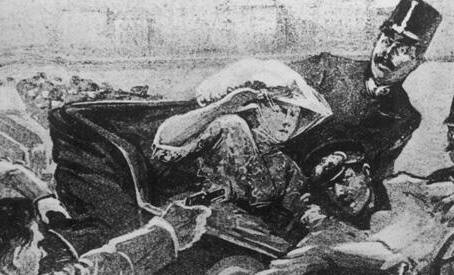
A century ago, on June 28, 1914, Serbian nationalist Gavrilo Princip shot and killed Archduke Franz Ferdinand, heir to the emperorship of Austria-Hungary, along with his wife, on their visit to Sarajevo.
Gavrilo Pirincip fires on the Archduke and Archduchess, June 28, 1914

World War I led to 16 million military and civilian deaths, plus nearly 20 million wounded. And the misery and horror of that war resulted in another casualty: confidence in the Enlightenment enterprise and human progress.

Enlightenment Europe

In the late seventeenth century Isaac Newton’s discovery of the laws of universal gravitation dramatically demonstrated the power of the human mind. Understanding of the world and the universe—what we call modern science—became a central Enlightenment goal.

At the same time, the struggle for Parliamentary supremacy in England led John Locke to pen his powerful treatise on individual liberty. Creating governments limited to protecting life, liberty, and the pursuit of happiness also became a central Enlightenment goal, which culminated in the creation of United States.

Enlightenment values were not limited to Britain or America. They were universal and created a European-wide culture of individualism, freedom, and reason.

Collectivist anti-Enlightenment

But Enlightenment thinkers and activists not only had to fight entrenched oligarchs and rigid religious dogma. Starting with Jean-Jacques Rousseau, a school of thought—if thought it could be called—arose that opposed individualism with the good of “society,” or the group, and rejected reason in favor of emotion and instinct.

The French Revolution starting in 1789 saw Enlightenment ideas losing ground to reactionary and collectivist forces. The result was the Terror and the guillotine, dictatorship and a new monarchy, and the carnage of the Napoleonic wars–the first great modern global conflict, which ended in 1815 at Waterloo.

In the century that followed Europe suffered only short regional conflicts, most relating to the unification of Italy and of Germany. The Industrial Revolution was creating prosperity. Governments were granting citizens rights to political participation and were recognizing their civil liberties. By the early twentieth century, continued progress seemed inevitable.

Pernicious nationalism

But the pernicious collectivist ideology combined with a major European cultural defect: nationalism. This form of collectivism meant more than just an appreciation for the aesthetic achievements—art, music, literature—of the individuals in one’s ethnic group. It meant putting one’s group or one’s country, right or wrong, ahead of universal values and principles. Kill for King or Kaiser!

There’s an irony in the fact that poor Franz Ferdinand wanted to recreate Austria-Hungary as a federation in which the minority groups—that were always either dominated by Viennese elites or at one another’s throats—would have autonomy similar to that enjoyed by the American states. If only Princip had waited a while.

Unfortunately, the volatile combination of nationalism, an interlocking treaty system, and the Britain-Germany imperial rivalry only required a spark like the Sarajevo assassination to set off a global conflagration.

Collectivism vs. collectivism

After World War I, individualism and “selfishness” got much of the blame for the conflict. And science was no longer associated only with progress. It had created machine guns, tanks, and poison gas, and made possible a fearful slaughter.

Idealists created the League of Nations to prevent such wars in the future. But they tried to cure the problem of nationalism with more nationalism, simply accentuating the problem. Indeed, Hitler used the principle of self-determination of peoples as an excuse to unify all Germans into one Reich by force. His form of collectivism also entailed enslaving and wiping out “inferior” races.

The catastrophe of World War II was followed by a Cold War, which saw the Soviet Union asserting another form of collectivism, pitting one economic “class” against another. Western Europe opposed the brutal Soviet kill-the-rich socialism with a kinder, gentler, loot-the-rich democratic socialism. The Soviet Union with its communist empire collapsed in 1991, and Western European democratic socialism is going through a similar disintegration in slow motion.

Still recovering from the Great War

Today, Enlightenment values are making a comeback. The communications and information revolutions, and the application of new technologies in medicine, transportation, and other fields, again demonstrate the power of the human mind and the benefits it confers.

Furthermore, many of the new entrepreneurs understand that it is they as individual visionaries who are transforming the world. And while their achievements benefit everyone, they strive because they love their work and they love to achieve. They pursue happiness. They hold Enlightenment values—though in many cases their politics still need to catch up.

The world is still digging out from the consequences of that single bullet a century ago, which led to the deaths of millions. Putting our country and the world back on the path to liberty and prosperity will require a recommitment to the Enlightenment values that created all the best in the modern world.

***

Dr. Edward Hudgins directs advocacy and is a senior scholar for The Atlas Society, the center for Objectivism in Washington, D.C.

Copyright, The Atlas Society. For more information, please visit www.atlassociety.org.