Browsed by
Tag: united states

James Blish’s “At Death’s End”: An Early View of the Prospects for Indefinite Life Extension – Article by G. Stolyarov II

James Blish’s “At Death’s End”: An Early View of the Prospects for Indefinite Life Extension – Article by G. Stolyarov II

The New Renaissance Hat
G. Stolyarov II
March 14, 2015
******************************
At-Deaths-End-ASF-May-1954-900

                “At Death’s End”, written by James Blish (1921-1975), was published in the May 1954 issue of Astounding Science Fiction magazine. Surprisingly, this short story is still only accessible in hard copy, within the original Astounding Science Fiction edition. Apart from a brief review by Robert W. Franson, who introduced me to this work, there is today surprisingly little literary analysis devoted to “At Death’s End” – even though it offers a fascinating glimpse into how a science-fiction writer from an earlier era perceived the prospects for indefinite human longevity, from the vantage point of the scientific knowledge available at the time. The world portrayed by Blish is, in some respects, surprisingly like our own. In others, however, it overlooks the complexity of the treatments that would be necessary to achieve actual radical life extension.

                The future (shortly after 2000) that Blish depicts is one where national governments are obsessed with “security” and “defense” – much like the United States today. It appears that the Cold War is still underway in this world (and it could be said that it has been resurrected in ours as well); however, space travel and space colonies are also prominent. The protagonist, Colonel Paige Russell, is himself a spacefarer who begins the story by journeying to the headquarters of pharmaceutical firm Jno. Pfitzner & Sons, Inc., to bring back soil samples from Ganymede and Callisto. In the midst of a society where an entrenched military-industrial complex has taken hold (even to the point of top positions – such as head of the FBI – becoming hereditary), a fundamentalist religious revival has also emerged, though the religionists often use machines to preach in their stead. This development, too, bears striking similarities to the rise of televangelism and the fundamentalist “religious right” in the United States during the late 1970s and 1980s. The overall society depicted by Blish is more permeated with religion than our own, as the alternative to the preachy fundamentalist religiosity of the Believers is portrayed as being a more subdued but still inextricable personal faith. Paige claims,

I’ve no religion of my own, but I think that when the experts talk about ‘faith’ they mean something different than the shouting kind, the kind the Believers have. […] Real faith is so much a part of the world you live in that you seldom notice it, and it isn’t always religious in the formal sense. Mathematics is based on faith, for instance, for those who know it. (17-18)

Even many religious individuals today would disagree with the notion that mathematics is based on faith – and certainly the many atheists and agnostics who are fond of mathematics and of the scientific method would rightly recognize that these logic-based and evidence-based approaches are as far from faith as one can get. And yet Blish intends Paige’s position to be the level-headed, sensible, rational one, compared to the alternative – showing that Blish did not foresee the extent to which skepticism of religious faith would become a widespread, though still a minority, position.

                Blish’s extrapolation of medical progress is remarkably prescient in certain respects. Paige learns of the history of medicine from Anne Abbott, the daughter of Pfitzner’s leading researcher:

In between 1940 and 1960, a big change came in in Western medicine. Before 1940 – in the early part of the century – the infectious diseases were major killers. By 1960 they were all but knocked out of the running. […] In the 1950s, for instance, malaria was the world’s greatest killer. Now it’s as rare as diphtheria. We still have both diseases with us – but how long has it been since you heard of a case of either? […] Life insurance companies, and other people who kept records, began to be alarmed at the way the degenerative diseases were coming to the fore. Those are such ailments as hardening of the arteries, coronary heart disease, the rheumatic diseases, and almost all the many forms of cancer – diseases where one or another body mechanism suddenly goes haywire, without any visible cause. (20-21)

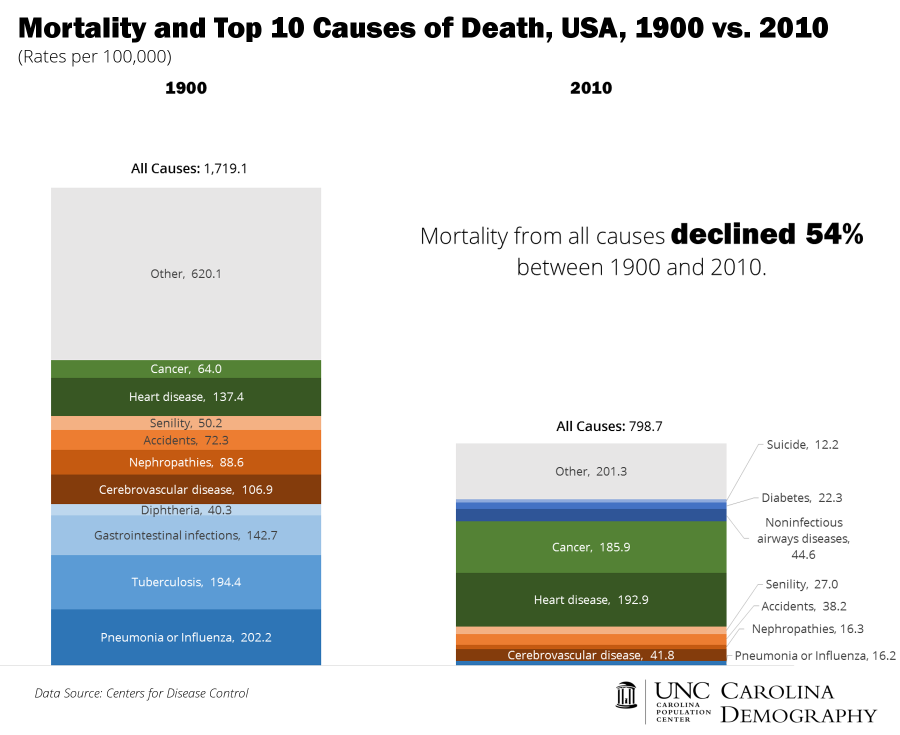
The shift from infectious diseases being the primary killers, to the vast majority of people dying from the degenerative diseases of “old age”, is precisely what happened during the latter half of the twentieth century, throughout the world. The top killers in the early 20th century were infectious diseases that have been virtually wiped out today, as this chart from the Carolina Population Center shows. (For more details, see “Mortality and Cause of Death, 1900 v. 2010” by Rebeca Tippett.) Additional major progress is evident in the 54% absolute decline in mortality from all causes during the time period between 1900 and 2010.
                Blish was foresighted enough to attempt a conceptual decoupling of chronological and biological age. Anne Abbott explains to Paige that “Old age is just the age; it’s not a thing in itself, it’s just the time of life when most degenerative diseases strike” (21). She recounts that “When the actuaries first began to notice that the degenerative diseases were on the rise, they thought that it was just a sort of side-effect of the decline of the infectious diseases. They thought that cancer was increasing because more people were living long enough to come down with it” (21). Anne then proceeds to discuss findings that some cancers are caused by viruses – which is actually the case for a minority of cancers (approximately 17.8% of cancers in 2002, as estimated by the World Health Organization). In the world portrayed by Blish, a rising incidence of degenerative diseases caused by viral infections led the National Health Service to fund research efforts by companies like Pfitzner, in an effort to address the threat.

                Incidentally, Blish also foresaw the rise in major government expenditures on medical research. Anne explains that “the result of [the first world congress on degenerative diseases] was that the United States Department of Health, Welfare and Security somehow got a billion-dollar appropriation for a real mass attack on the degenerative diseases” (22). Of course, in our world, major scientific conventions on degenerative diseases – both governmental and private – are far more routine. Indeed, a small but dynamic private organization – the SENS Research Foundation – has itself hosted six world-class conferences on rejuvenation biotechnology to date. In the United States, billions of dollars each year are indeed spent on research into degenerative diseases. The budget of the National Institute on Aging exceeds $1 billion annually (it amounts to $1,170,880,000 for Fiscal Year 2015). Unfortunately, in practice, even this level of funding – from both private and governmental sources – has thus far proven wholly insufficient to comprehensively reverse biological senescence and defeat all degenerative diseases.

                In Blish’s imagined future, the battle against senescence could be won far more easily than in our present. Pfitzner’s key project is a sweeping solution to all lifespan-limiting ailments – a broad-range “antitoxin against the aging toxin of humans” (36). In this world, Paige, who later becomes trained in Pfitzner’s research techniques, can pronounce that “We know that the aging toxin exists in all animals; we know it’s a single, specific substance, quite distinct from the ones that cause the degenerative diseases, and that it can be neutralized. […] So what you’re looking for now is not an antibiotic – an anti-life drug – but an anti-agathic, an anti-death drug” (36). If only it were that simple! Today, even the most ambitious engineering-based approach toward defeating senescence, Dr. Aubrey de Grey’s SENS program, recognizes not one but seven distinct types of aging-related damage that accumulate in the organism. Dr. de Grey’s strategy of periodically reversing the damage is more straightforward than the alternative approach of re-engineering the tremendously complex metabolic processes of the body that malfunction over time, and which are still quite incompletely understood. In Blish’s world, a single company, working covertly, with relatively modest funding (compared to the funds available to research organizations in our world), can develop an “anti-agathic” drug that does for senescence what antibiotics did for deadly infectious disease.

                Without spoiling the ending, I will only mention that it is friendly to the prospects of radical life extension and portrays it in a positive light – one additional reason for recommending that “At Death’s End” be included within the canon of proto-transhumanist and life-extensionist literary works. Furthermore, the viability of indefinite life extension in Blish’s vision is closely intertwined with humanity’s future as a spacefaring species – another progress-friendly position. Blish comes across as a thoughtful, scientifically literate (for his era) writer, who extrapolated the world-changing trends of his time to arrive at a tense, conflict-ridden, but still eminently hopeful vision for the future, where the best of human intellect and aspiration are able to overcome the perils of militarism, fundamentalism, decay, and death.

              The author of “At Death’s End” himself succumbed to death at the age of 54, on July 30, 1975. He did not live to see the world of 2000 and compare it to his prognosis. Unfortunately, Blish seems to have disregarded the tremendous harms of tobacco smoke and was even employed by the Tobacco Institute from 1962 to 1968. A genealogical profile lists Blish’s cause of death as “Recurrent cancer per smoking, metastasized.” This brilliant, forward-thinking mind unfortunately could not escape one of the most common collective delusions of his time – the fascination with and normalization of one of the least healthy habits imaginable, one that is the most statistically likely to lower life expectancy (by about 10 years). This is quite sad, as it would have been fascinating to learn how Blish’s projections for the future would have been affected by additional decades of his experience of societal and technological changes. One of the major trends in longevity improvement over the past several decades has been a major decline in the smoking rate, which decreased to an all-time low in the United States in 2013 (the latest year for which statistics are currently available). Surely, to come closer to death’s end, as many humans as possible should abandon what are now known to be obviously life-shortening habits.

              While an anti-agathic drug is not in our future, James Blish’s vision of the defeat of senescence can still serve to inspire those who endeavor to solve this colossal problem in our world, during our lifetimes. Let us hope that, through the efforts of longevity researchers and through increases in funding and public attitudinal support for their projects, we will arrive at death’s end before death ends us.

Don’t Be Fooled by the Federal Reserve’s Anti-Audit Propaganda – Article by Ron Paul

Don’t Be Fooled by the Federal Reserve’s Anti-Audit Propaganda – Article by Ron Paul

The New Renaissance Hat
Ron Paul
March 9, 2015
******************************
In recent weeks, the Federal Reserve and its apologists in Congress and the media have launched numerous attacks on the Audit the Fed legislation. These attacks amount to nothing more than distortions about the effects and intent of the audit bill.

Fed apologists continue to claim that the Audit the Fed bill will somehow limit the Federal Reserve’s independence. Yet neither Federal Reserve Chair Janet Yellen nor any other opponent of the audit bill has ever been able to identify any provision of the bill giving Congress power to dictate monetary policy. The only way this argument makes sense is if the simple act of increasing transparency somehow infringes on the Fed’s independence.

This argument is also flawed since the Federal Reserve has never been independent from political pressure. As economists Daniel Smith and Peter Boettke put it in their paper “An Episodic History of Modern Fed Independence,” the Federal Reserve “regularly accommodates debt, succumbs to political pressures, and follows bureaucratic tendencies, compromising the Fed’s operational independence.”

The most infamous example of a Federal Reserve chair bowing to political pressure is the way Federal Reserve Chairman Arthur Burns tailored monetary policy to accommodate President Richard Nixon’s demands for low interest rates. Nixon and Burns were even recorded mocking the idea of Federal Reserve independence.

Nixon is not the only president to pressure a Federal Reserve chair to tailor monetary policy to the president’s political needs. In the fifties, President Dwight Eisenhower pressured Fed Chairman William Martin to either resign or increase the money supply. Martin eventually gave in to Ike’s wishes for cheap money. During the nineties, Alan Greenspan was accused by many political and financial experts — including then-Federal Reserve Board Member Alan Blinder — of tailoring Federal Reserve policies to help President Bill Clinton.

Some Federal Reserve apologists make the contradictory claim that the audit bill is not only dangerous, but it is also unnecessary since the Fed is already audited. It is true that the Federal Reserve is subject to some limited financial audits, but these audits only reveal the amount of assets on the Fed’s balance sheets. The Audit the Fed bill will reveal what was purchased, when it was acquired, and why it was acquired.

Perhaps the real reason the Federal Reserve fears a full audit can be revealed by examining the one-time audit of the Federal Reserve’s response to the financial crisis authorized by the Dodd-Frank law. This audit found that between 2007 and 2010 the Federal Reserve committed over $16 trillion — more than four times the annual budget of the United States — to foreign central banks and politically influential private companies. Can anyone doubt a full audit would show similar instances of the Fed acting to benefit the political and economic elites?

Some fed apologists are claiming that the audit bill is part of a conspiracy to end the Fed. As the author of a book called End the Fed, I find it laughable to suggest that I, and other audit supporters, are hiding our true agenda. Besides, how could an audit advance efforts to end the Fed unless the audit would prove that the American people would be better off without the Fed? And don’t the people have a right to know if they are being harmed by the current monetary system?

For over a century, the Federal Reserve has operated in secrecy, to the benefit of the elites and the detriment of the people. It is time to finally bring transparency to monetary policy by auditing the Federal Reserve.

Ron Paul, MD, is a former three-time Republican candidate for U. S. President and Congressman from Texas.

This article is reprinted with permission from the Ron Paul Institute for Peace and Prosperity.

How Many More Wars? – Article by Ron Paul

How Many More Wars? – Article by Ron Paul

The New Renaissance Hat
Ron Paul
February 17, 2015
******************************

Last week President Obama sent Congress legislation to authorize him to use force against ISIS “and associated persons and forces” anywhere in the world for the next three years. This is a blank check for the president to start as many new wars as he wishes, and it appears Congress will go along with this dangerous and costly scheme.

Already the military budget for next year is equal to all but the very peak spending levels during the Vietnam war and the Reagan military build-up, according to the Project on Defense Alternatives. Does anyone want to guess how much will be added to military spending as a result of this new war authorization?

The US has already spent nearly two billion dollars fighting ISIS since this summer, and there hasn’t been much to show for it. A new worldwide war on ISIS will likely just serve as a recruiting tool for jihadists. We learned last week that our bombing has led to 20,000 new foreign fighters signing up to join ISIS. How many more will decide to join each time a new US bomb falls on a village or a wedding party?

The media makes a big deal about the so-called limitations on the president’s ability to use combat troops in this legislation, but in reality there is nothing that would add specific limits. The prohibition on troops for “enduring” or “offensive” ground combat operations is vague enough to be meaningless. Who gets to determine what “enduring” means? And how difficult is it to claim that any ground operation is “defensive” by saying it is meant to “defend” the US? Even the three year limit is just propaganda: who believes a renewal would not be all but automatic if the president comes back to Congress with the US embroiled in numerous new wars?

If this new request is not bad enough, the president has announced that he would be sending 600 troops into Ukraine next month, supposedly to help train that country’s military. Just as the Europeans seem to have been able to negotiate a ceasefire between the opposing sides in that civil war, President Obama plans to pour gasoline on the fire by sending in the US military. The ceasefire agreement signed last week includes a demand that all foreign military forces leave Ukraine. I think that is a good idea and will go a long way to reduce the tensions. But why does Obama think that restriction does not apply to us?

Last week also saw the Senate confirm Ashton Carter as the new Secretary of Defense by an overwhelming majority. Carter comes to the Pentagon straight from the military industrial complex, and he has already announced his support for sending lethal weapons to Ukraine. Sen. John McCain’s strong praise for Carter is not a good sign that the new secretary will advise caution before undertaking new US interventions.

As we continue to teeter on the verge of economic catastrophe, Washington’s interventionists in both parties show no signs of slowing. The additional tens of billions or more that these new wars will cost will not only further undermine our economy, but will actually make us less safe. Can anyone point to a single success that the interventionists have had over the last 25 years?

As I have said, this militarism will end one way or the other. Either enough Americans will wake up and demand an end to Washington’s foreign adventurism, or we will go broke and be unable to spend another fiat dollar on maintaining the global US empire.

Ron Paul, MD, is a former three-time Republican candidate for U. S. President and Congressman from Texas.

This article is reprinted with permission from the Ron Paul Institute for Peace and Prosperity.


How Embargoes Destroy Freedom – Article by Ryan W. McMaken

How Embargoes Destroy Freedom – Article by Ryan W. McMaken

The New Renaissance Hat
Ryan W. McMaken
February 12, 2015
******************************

In the wake of the Obama administration’s partial normalization of relations with Cuba, proponents of the embargo condemned the move, with National Review publishing an unsigned editorial claiming that allowing Americans to trade freely with the island nation amounts to giving comfort to murderous dictators. NR’s editors concluded with:

The Cuban government is not legitimate, and never has been. It is a one-party dictatorship with a gulag, an archipelago of prisons into which democrats and dissidents are thrown. We hope that the new American policy — Obama’s policy — does not benefit the Cuban dictatorship and harm Cuban democrats. We fear that yesterday was a good day for the Castros and a bad day for the Cuban people, and for American foreign policy.

This is all very interesting from an international relations perspective, and there is no doubt that the Cuban regime is a brutal regime. On the other hand, why does the brutality of the Cuban regime make it alright for the US regime to jail and persecute private American citizens who attempt to trade with people in Cuba?

That is, after all, the position of those who favor the embargo. Embargoes are not something where a magic fairy waves her wand and Cuba suddenly becomes invisible to Americans.

No, supporting an embargo means supporting the government when it fines, prosecutes, and jails peaceful citizens who attempt to engage in truly free trade. Support for an embargo also requires support for a customs bureaucracy that spies on merchants and consumers, and the whole panoply of enforcement programs necessary to punish those who run afoul of the government’s arbitrary pronouncements on what kind of trade is acceptable, and what kind is verboten. Naturally, this is all paid for by the taxpayers.

How the American Federal Government Punishes Trade

To get a taste of the reality of embargoes, one need only consult the Treasury Department’s summary of the Cuban embargo as administered by the “Office of Foreign Assets Control.”

For those who think the embargo has something to do with freedom, they might wish to consult the section on punishments for trading with people in Cuba:

Criminal penalties for violating the Regulations range up to 10 years in prison, $1,000,000 in corporate fines, and $250,000 in individual fines. Civil penalties up to $65,000 per violation may also be imposed. The Regulations require those dealing with Cuba (including traveling to Cuba) to maintain records for five years and, upon request from OFAC, to furnish information regarding such dealings.

Nothing says “freedom” like $250,000 fines and mandatory presentation of five years of private records upon demand from the federal government.

Private companies, of course, regard such potentially draconian sanctions as no joke, and companies must spend time and resources training employees and business associates to be sure that they do not find themselves in violation of federal law. This manual from Snap-on Tools is one example of how private companies must stay up to date on details such as this:

The U.S. Treasury Department’s Office of Foreign Assets Control (OFAC) maintains strict embargoes banning, and lesser sanctions limiting U.S companies and their foreign subsidiaries from entering into commercial transactions with specified foreign countries, persons and business entities. Congress recently quintupled the maximum civil fines per violation of many of these sanctions from $11,000 to $50,000 (each unlawful shipment constitutes a violation), and doubled maximum potential criminal penalties assessed willful violations from 10 years to 20 years in prison. Moreover, enforcement is being given a much higher priority…

It’s easy to see why those who favor greater government intervention in the economy would have no problem with such a program, but it’s alleged defenders of free markets like the editors at National Review who appear to be most insistent that the US government keep all its agents armed and ready, and a prison cell open for anyone who violates their federal programs of choice.

Embargoes as Mercantilist Prohibition

At their heart, embargoes are nothing but a specific type of prohibition. Sometimes, the government imposes prohibitions on transactions involving certain goods, such as cannabis. Other times, the prohibition extends to all transactions with people in a certain place. The fundamentals are the same, however, in that they prohibit peaceful exchange, with heavy penalties for violators.

Moreover, embargoes are a throwback to the mercantilism of the days of yore when economic policy was viewed as a tool of international affairs, and should be designed, at least in part, to benefit the regime of the home country.

Historically, the mercantilist regimes of old tightly controlled trade opportunities which were debated as part of armistice agreements, such as the Peace of Utrech (1713) when the British were able to force the Spanish to allow exactly one ship of merchandise annually into Spanish colonies. At home, during the same era, the British state forbade its own citizens with valuable engineering knowledge from leaving the country, lest they emigrate to a foreign land and share their knowledge with foreigners. The economic needs of the state superceded those of the individual.

This is the type of economic policy that precipitated the American Revolution, when Americans in the colonies were allowed to trade with only specified nation-states and territories in such a way that was seen as advantageous to the British Crown. The freedom fighters in that conflict engaged in rampant smuggling throughout eastern North America to avoid taxes and to trade with the French and the Spanish who were hardly paragons of democratic liberalism.

Unfortunately, the Americans did not learn their lesson in the revolution, and got to work erecting their own trade restrictions by the late eighteenth century. The greatest crime of the era, however, was Thomas Jefferson’s embargo against the British which crippled the shipping and shipbuilding industries in the United States. Naturally, it was pointed out at the time that the Constitution did not permit any such action on the part of the federal government. No such quaint considerations restrain the American state or its pro-embargo allies today.

Cuba is not the only country subject to embargoes handed out by the American state, and North Korea, Iran, and Syria are in similar positions. The question is often asked as to whether or not these sanctions work. I would certainly claim that they do not work in accomplishing their stated purposes, but whether or not they work is really beside the point. Those who advocate for such embargoes need to back up a step and first prove that it is moral and legitimate for nation-states to dictate to the people who pay the bills (i.e., the taxpayers) with whom they are allowed to trade. A society that actually respects private property rights, of course, will accept no such proposition and will respect the right of private citizens to dispose of their property as they see fit. On the other hand, those who believe that it’s the prerogative of governments to micromanage private property and throw violators in prison are encouraged to move somewhere that the government can take a robust and active role in such things. Cuba, for instance.

Ryan W. McMaken is the editor of Mises Daily and The Free Market. He has degrees in economics and political science from the University of Colorado, and was the economist for the Colorado Division of Housing from 2009 to 2014. He is the author of Commie Cowboys: The Bourgeoisie and the Nation-State in the Western Genre. 
***
This article was published on Mises.org and may be freely distributed, subject to a Creative Commons Attribution United States License, which requires that credit be given to the author.
To Prevent World War III, Do Not Arm Ukraine’s Regime – Article by G. Stolyarov II

To Prevent World War III, Do Not Arm Ukraine’s Regime – Article by G. Stolyarov II

The New Renaissance Hat
G. Stolyarov II
February 8, 2015
******************************

“I can no longer say that this Cold War will not lead to a ‘Hot War.’ I fear that they could risk it. […]The statements and propaganda on both sides make me fear the worst. If anyone loses their nerve in this charged atmosphere, we will not survive the next few years. […]I do not say such things lightly….I am a man with a conscience. But that’s how it is. I’m really extremely worried.”

~ Mikhail Gorbachev

“I’m uneasy about beginning a process of military engagement without knowing where it will lead us and what we’ll do to sustain it. […] I believe we should avoid taking incremental steps before we know how far we are willing to go. This is a territory 300 miles from Moscow, and therefore has special security implications.”

~ Henry Kissinger

“It is an extremely dangerous development, which has been brewing ever since Washington violated its verbal promises to Gorbachev and began expanding NATO to the East, right to Russia’s borders, and threatening to incorporate Ukraine, which is of great strategic significance to Russia and of course has close historical and cultural links. […] The Russian autocracy is far from blameless, but we are now back to earlier comments: we have come perilously close to disaster before, and are toying with catastrophe again. It is not that possible peaceful solutions are lacking.”

~ Noam Chomsky

“Outside countries should leave Ukraine to resolve the conflict itself. However, even as the US demands that the Russians de-escalate, the United States is busy escalating! […] Why is ‘winning’ Ukraine so important to Washington? Why are they risking a major war with Russia to deny people in Ukraine the right to self-determination? Let’s just leave Ukraine alone!”

~ Ron Paul

One can rarely find four thinkers as distinct from one another as Gorbachev, Kissinger, Chomsky, and Ron Paul, and yet, for all of their differences, each of them is clearly guided by a systematic, thoroughly considered intellectual framework. All four of these thinkers have concluded, starting from different practical and moral premises, that further escalation of the Ukraine crisis by the United States would be a dangerous, deeply inadvisable behavior.

Two of these thinkers – Gorbachev and Kissinger – played crucial roles in helping to maneuver the world out of the existential danger of the Cold War. One might consider them to have made tactical or even moral errors, but they deserve recognition for being among the cooler heads that prevailed, helping defuse decades-long tensions between the United States and the Soviet Union that could have easily ended in a nuclear holocaust.

The other two thinkers – Chomsky and Paul – are thought leaders of principled polar opposites of American thought, left-progressivism and right-libertarianism. While sharply at odds over economics, philosophy, and politics, these two systems are both vastly superior to the American political establishment, which is dominated by a tight alliance of special-interest pressure groups, whose primary purpose is to protect existing political privileges through lobbying at the expense of innovative entrepreneurs, consumers, and people of merit in general. Left-progressives and right-libertarians each have a vision of human dignity and morality that is driven by principles and conscience. The American political establishment, represented by virtually indistinguishable “neoconservative” Republicans and “humanitarian interventionist” Democrats, is driven solely by the impulse to entrench the politically connected interests of the status quo at all costs. While both right-libertarians and left-progressives strongly favor peace as an integral component in their project to improve human well-being, the amoral interventionist political establishment in the United States does not care about human well-being. Bombs will drop, drones will massacre innocent civilians, everyone will be deprived of privacy, dignity, and due process – but they will have their privileges and their dominance, even though the world might burn for it.

The “neoconservatives” and “humanitarian interventionists” in the United States speak and act out of misguided short-sightedness, but the pressure they constantly exert on President Barack Obama could be the greatest threat to world peace and the progress of human civilization today, turning a tragic but local conflict into one that could escalate into World War III.

Obama rose to power through left-progressive idealistic rhetoric, but he has shown to be far more inclined toward accommodation to the entrenched political establishment. Even so, he has been reluctant to send lethal weapons to Ukraine, as vestiges of his left-progressivism have given him justified unease at the prospect. Yet the chorus of establishment hawks has recently grown to a warmongering holler. The worst among them are John McCain and Lindsey Graham, who even seek to mandate that Obama send weapons to the Ukrainian regime of Petro Poroshenko and Arseniy Yatseniuk. This same regime has been confirmed to have murdered over 5,300 of its own civilian population, to have employed savage, indiscriminate tactics – such as the deliberate shelling of densely populated neighborhoods and the use of cluster munitions – to have reinstituted military conscription at the point of a gun, and to have incorporated overtly fascist paramilitary “volunteer” units into Ukraine’s military structure. American “neoconservative” and “humanitarian interventionist” politicians, in the name of humanitarian ideals (mostly, vague sound bites about “territorial integrity” and “national self-determination” – neither of which concepts they actually respect with any consistency), seek to aid and abet genuine moral monsters who have already killed thousands and terrorized and displaced millions.

The civil war in Ukraine has thus far been confined within the borders of Ukraine, with modest support from Vladimir Putin’s regime for the Donetsk and Luhansk separatists. (If Putin’s support were indeed decisive or fully commensurate with his abilities, he would have occupied all of Ukraine by now – but his behavior demonstrates that this is not his intention. Putin does not have any grand design on Ukraine, and his sporadic assistance to the separatists has largely been reactive, to prevent their complete obliteration.) If the United States funnels weapons to the Poroshenko/Yatseniuk regime, a local conflict will be turned into a global one, with the United States fighting a proxy war against Russia. If the United States then makes the fateful step of introducing ground troops, the proxy war will quickly turn into a direct war. From a direct conventional war to a nuclear war is only a small step, which is why the actual strategists of the Cold War – wiser men than today’s hawks – understood that it would be unacceptable for the militaries of the United States and the Soviet Union to ever fight one another directly.

Arming the Ukrainian government will perpetuate its ability to inflict a massive death toll upon civilians. Furthermore, it would be completely counterproductive to any lasting peace. Both the separatists and Putin will see it as a validation of the claim that the United States has been behind the “regime change” in Ukraine all along. They will furthermore see it as another step toward Ukraine’s absorption into NATO – an alliance that was originally formed specifically to counter the Soviet Union. One of Putin’s consistent demands throughout the past year has been for a commitment that Ukraine’s membership in NATO would be out of the question. It should be an easy commitment to give – considering that NATO has no real appetite to allow Ukraine to join, and Ukraine’s precarious situation would only endanger the security of all other NATO members, who would be compelled to assist in any of Ukraine’s wars. Yet, instead of acceding to this one demand – which could resolve everything – Western governments have given the Poroshenko/Yatseniuk regime every hope of eventual NATO membership, with no intention of following through. Still, sending weapons at this juncture would strongly reinforce this hope on the part of Poroshenko and Yatseniuk, and the corresponding fear on the part of Putin.

While thoughtful men of principle and even hyper-intelligent ruthless pragmatists (like Kissinger) are against escalating the Ukraine crisis, the “neoconservatives” and “humanitarian interventionists” are neither thoughtful nor pragmatic. Many of them are driven by blind hatred for Russia and a desire to re-ignite the Cold War to re-live its alleged glory days. They would again place the world just a few steps away from nuclear annihilation, just to re-enter a paradigm which is conceptually familiar to them. They are so afraid of a possible new world of hyper-pluralism, individualism, accelerating technological progress, and the irrelevance of national boundaries – that they would place all humankind at risk just to avert their discomfort. Perhaps some of them truly believe their own rhetoric – that Vladimir Putin is a new Hitler and that the annexation of Crimea – a historically Russian territory until Khrushchev gave it to Ukraine in 1954 in order to gain support from the leadership of the Ukrainian Soviet Socialist Republic – is in any way similar to Hitler’s annexation of Czechoslovakia in 1938. (Never mind that Putin has never perpetrated a Holocaust and that the ethnic chauvinists, xenophobes, and anti-Semites are predominantly fighting on the side of the Ukrainian government and wearing Nazi emblems – while many of Putin’s unofficial allies have donned the emblems used by the Russian resistance to the Nazi invasion during World War II!) Perhaps some of the hawks truly believe that the United States has a moral duty to spread “democracy” and “self-determination” at the barrel of a gun to the rest of the world, and to serve as a global policeman, punishing all violations of these vaunted American principles. Yet what the ordinary people who suffer the consequences of American foreign-policy interventionism see are not “democracy” and “self-determination”, but rather dead bodies and homes reduced to rubble. Yes, Vladimir Putin is a ruthless autocrat who suppresses dissent and free inquiry. Yes, Viktor Yanukovych was a corrupt kleptocrat who sometimes employed thugs to deter and punish criticism of his expropriation of the Ukrainian people. At worst, Yanukovych may have ordered snipers from the Berkut police to fire upon the Maidan protesters during his last days in power (although it is perplexing why the snipers fired upon both the protesters and at Berkut police themselves). But neither of them murdered thousands of innocents among their own population, nor used indiscriminate shelling against them. It is one matter to suffer under a repressive autocracy, which will spare you if you keep your head down; it is quite another to quake under omnipresent brutality, murder, and destruction, from which no one is safe and where your next trip to the grocery store could result in your limbs being torn from your body. People who, under Yanukovych, were able to eke out a modest living and hope for gradual improvement, have been devastated and sometimes utterly destroyed by the savage Ukrainian civil war. A swath of Third-World barbarism has been carved out of a region that had, for seventy years, only known drab Second-World sub-optimality. Even if Putin were attempting to resurrect the Soviet Union – quite a far-fetched allegation – the Ukrainian government is creating another Liberia in Europe.

As tragic as it might be, Putin’s most advantageous response to any US decision to send arms to Ukraine would be to immediately escalate the situation, before those arms could arrive to make a difference on the battlefield. This means that the trickle of Putin’s support for the separatists would become a flood, and it would not be surprising if Russian forces directly and openly entered Ukraine and pressed toward Kiev. Undoubtedly, the Ukrainian military would put up a stiff resistance and turn every civilian settlement along the way into another Donetsk Airport. Tens of thousands of soldiers and innocent civilians would be killed in the process, and all of their lives would be lost in vain. Nobody truly wants this outcome, but the hawks in the US Congress are blinded by their desire to punish Russia. They fail to realize that this carnage is precisely the result they would get by further goading Putin on with escalation from the American side. In the face of such thoughtless saber-rattling, one should applaud the frantic, heroic efforts of European leaders – particularly Germany’s Angela Merkel and France’s François Hollande – to forestall a deadly and irreversible sequence of events and to reach a diplomatic solution.

“A bad peace is better than a good war,” counsels an old Jewish and Russian proverb. Benjamin Franklin agreed. “There was never a good War, or a bad Peace,” he wrote in his bestselling Poor Richard’s Almanack – one of 18th-century America’s civilizing moral influences. Right now a sub-optimal peace – what some would consider a bad peace – is the best that could be hoped for in Ukraine. This would involve some manner of sustainable demarcation between the territory held by the Ukrainian government and the rebel People’s Republics of Donetsk and Luhansk. It does not matter whether this demarcation takes the form of officially recognized independence or broad “regional autonomy” – as long as the shells stop falling and the civilians stop dying. National borders are artificial fictions, but human lives are real. It does not matter where officials and diplomats decide to draw their lines on the map, as long as the result is a mutually acceptable understanding of future behaviors, by which living humans would be spared from slaughter.

The Minsk Agreement reached in September 2014 was unsustainable precisely because the Ukrainian government never intended to abide by the agreed-upon demarcation line; Ukrainian troops stubbornly held onto the ghastly, apocalyptic ruin of the once-state-of-the-art Donetsk Airport, despite the fact that it will never be usable as an airport again. According to the Minsk Agreement, the Donetsk Airport was to fall within the autonomous separatist-held territory. Its location was sufficiently close to the city of Donetsk for the Ukrainian army to continue to shell civilian neighborhoods. Understandably, the separatist rebels could not tolerate such a situation of perpetual bombardments, and so they threw their forces at the airport in wave after wave of bloody assaults, until it finally fell. Unfortunately, what also fell in this struggle was the entire premise of a sustainable demarcation line. The Ukrainian government would not respect its commitments, so the separatists saw no need to respect theirs as well. They have launched an offensive in the hopes of creating more buffer territory around their capitals of Donetsk and Luhansk. Tragically, this offensive involves shelling of population centers such as Debaltseve and Mariupol, whose residents are innocent victims, much like the inhabitants of Luhansk and Donetsk. In perpetrating these attacks, the separatists have become as bad as the regime forces they oppose – using the same indiscriminate tactics and the same mass-impact weapons.

It does not matter which side bombards the civilians of Eastern Ukraine, who used to be one another’s neighbors and whose social, cultural, and economic lives used to be tightly intertwined. All of these assaults are a savage, ultimately pointless folly. The lives they take can never be restored, and the ill will they engender can never abate. This is why the idea that the Ukrainian government should ever regain de facto control over the separatist-occupied regions is an absurdity. Who would accept living under a government that murdered their neighbors and families and ruined what meager livelihoods they had? A lasting peace agreement might keep these territories nominally within the boundaries of Ukraine, in order to save face diplomatically, but the actual governance of these territories must be delegated to the people who live there, even if these people would make economically and politically counterproductive decisions. Donetsk and Luhansk might well become neo-communist enclaves and will certainly need decades of painstakingly slow economic recovery to restore 2013-level standards of living. However unfortunate this may all be, it is better than children being blown to bits. If peace is restored, along with free movement across borders (which existed prior to the civil war), the more ambitious and talented residents of these territories will be able to emigrate to the West, to Israel, or even to Russia, where their prospects would be greatly improved. Such emigration has already been happening for decades and has enabled the best minds and the better cultural vestiges of the former Soviet republics to be preserved.

With two key points – (i) broad autonomy for the rebel-held areas, separated by a buffer zone to prevent shelling of population centers, and (ii) a commitment for Ukraine never to join NATO – a peace plan might just avert escalation of the savage Ukrainian civil war. There may still be occasional violations of any resulting cease-fire, since neither side has full control over its fighters. However, redirecting the incentives and conversation away from escalation and toward peaceful coexistence is imperative to avoid making this tragedy worse. Eventually, if peace becomes the general rule rather than the exception, armed attacks in the region could equilibrate to a level very close to zero, and the Donetsk and Luhansk People’s Republics could become unofficial statelets, like Transnistria, Abkhazia, and South Ossetia – de facto autonomous enclaves that are governed poorly but pose no threat to world peace or to anyone outside their boundaries.

If, on the other hand, weapons are sent to the Poroshenko/Yatseniuk regime and events spiral out of control into a World War III, then all of human civilization would be in grave danger. Decades of economic, technological, and cultural progress could be wiped out in days. The infrastructure – not just in Eastern Ukraine but in the West itself – could be devastated sufficiently to bring about another Dark Age, if humankind survives at all. Gone would be the dreams of colonizing other planets, dramatically extending human lifespans and curing chronic diseases, creating radical abundance through technological innovation, and obliterating age-old superstitions and oppressions. The old hawks who seek to relive the Cold War would plunge the world into a predicament far worse – all because they could not let go of their fear, their hatred, and their obsolete zero-sum “us versus them” worldview. Putin would, of course, also be complicit in such a scenario, but not because he would have made the first move. His foremost objective – as has been the case for every Russian autocrat – will be to avoid humiliation and save face, to claim a dignified resolution with an image of strength – no matter what the substantive outcome, in order to avoid domestic unrest. For Russian strongmen, much is forgiven – but losing a war (or seeming to lose it) is unacceptable and is practically a sentence of deposition, if not death. This is why, if the West ratchets up military pressure on Putin, he will have no incentive to put the brakes on the deadly cycle of escalation.

The saber-rattling of hawks in the US Congress and their supporters threatens the progress and the very survival of humankind. One can only hope that cooler heads – the thinkers, the thoughtful idealists, the pragmatists, the diplomats – will prevail and enable a local conflict to remain local and to eventually subside. The next few decades will be crucial for setting the course of human civilization for millennia hence – if people of conscience will be able to wrest those millennia from the short-sighted jingoists who would rob us of them.

No Doubt: US Taxpayers Will be Robbed to Arm Poroshenko – Article by Ron Paul

No Doubt: US Taxpayers Will be Robbed to Arm Poroshenko – Article by Ron Paul

The New Renaissance Hat
Ron Paul
February 5, 2015
******************************
President Petro Poroshenko, who the US, along with the Europeans and NATO, helped place in power after last year’s coup, has declared that he has “no doubt” America’s taxpayers will provide the lethal weapons he desires to fight the separatists in eastern Ukraine. I never had any doubt, either. Of course it’s all to stop “Russian aggression.” NATO’s expansionism is never considered an important issue in the very dangerous war.

Our policy in Ukraine is a far cry from “neutrality,” staying out of the internal affairs of others, or avoiding entangling alliances. It is more like being the policeman of the world and claiming the title of the greatest arms manufacturer of all history. The military-industrial complex must be pleased with its repeated successes.

I’m sure the neo-cons are also ecstatic. And sadly it looks like Sen. Lindsey Graham may get his way and get US troops further involved.

The claimed need for our sending lethal weapons to Ukraine is to combat the Russian troops supposedly already in Ukraine. Yet the propagandists never provide any evidence to verify this assertion.

Both sides are now recruiting and even drafting the young to prepare them to do the fighting. There’s evidence that resistance is building to this effort. It would be nice if the young victims of wars started by old people and foreigners would just go on strike and refuse to fight. Let the instigators of the war put their own “boots on the ground.”

Reprinted with permission from author’s Facebook page.

Ron Paul, MD, is a former three-time Republican candidate for U. S. President and Congressman from Texas.

This article is reprinted with permission from the Ron Paul Institute for Peace and Prosperity.

The Failed ‘Yemen Model’ – Article by Ron Paul

The Failed ‘Yemen Model’ – Article by Ron Paul

The New Renaissance Hat
Ron Paul
February 1, 2015
******************************
Last September President Obama cited his drone program in Yemen as a successful model of US anti-terrorism strategy. He said that he would employ the Yemen model in his effort to “degrade and ultimately destroy” ISIS in Iraq and Syria.
 ***

But just a week ago, the government in Yemen fell to a Shiite militia movement thought to be friendly to Iran. The US embassy in Yemen’s capital was forced to evacuate personnel and shut down operations.

If Yemen is any kind of model, it is a model of how badly US interventionism has failed.

In 2011 the US turned against Yemen’s long-time dictator, Saleh, and supported a coup that resulted in another, even more US-friendly leader taking over in a “color revolution.” The new leader, Hadi, took over in 2012 and soon became a strong supporter of the US drone program in his country against al-Qaeda in the Arab Peninsula.

But last week Hadi was forced to flee from office in the coup. The media reports that the US has lost some of its intelligence capability in Yemen, which is making it more difficult to continue the drone strikes. Nevertheless, the White House said last week that its drone program would continue as before, despite the disintegration of the Yemeni government.

And the drone strikes have continued. Last Monday, in the first US strike after the coup, a 12 year-old-boy was killed in what is sickeningly called “collateral damage.” Two alleged “al-Qaeda militants” were also killed. On Saturday yet another drone strike killed three more suspected militants.

The US government has killed at least dozens of civilian non-combatants in Yemen, but even those it counts as “militants” may actually be civilians. That is because the Obama administration counts any military-aged male in the area around a drone attack as a combatant.

It was al-Qaeda in the Arabian Peninsula that claimed responsibility for the brutal shooting at an anti-religious magazine in Paris last month. At least one of the accused shooters cited his anger over US policy in the Middle East as a motivation for him to attack.

Does anyone wonder why, after 14 years of drone strikes killing more than 800 al-Qaeda militants, it seems there are still so many of them? As a Slate Magazine article this week asked, “what if the drones themselves are part of the problem?” That is an excellent question and one that goes to the heart of US anti-terrorist strategy. What if it is US interventionism in general and drone strikes in particular that are motivating so many people to join anti-US militant movements? What if it is interventionist and militarist Western foreign policy that is motivating people to shoot up magazines and seek to bring terrorism back to the countries they see as aggressors?

That is the question that the interventionists fear most. If blowback is real, if they do not hate us because we are so rich and free but because of what our governments are doing to them, then US interventionism is making us less safe and less free.

The disintegration of Yemen is directly related to US drone policy. The disintegration of Libya is directly related to US military intervention. The chaos and killing in Syria is directly related to US support for regime change. Is there not a pattern here?

The lesson from Yemen is not to stay the course that has failed so miserably. It is to end a failed foreign policy that is killing civilians, creating radicals, and making us less safe.

Ron Paul, MD, is a former three-time Republican candidate for U. S. President and Congressman from Texas.

This article is reprinted with permission from the Ron Paul Institute for Peace and Prosperity.

If the Fed Has Nothing to Hide, It Has Nothing to Fear – Article by Ron Paul

If the Fed Has Nothing to Hide, It Has Nothing to Fear – Article by Ron Paul

The New Renaissance Hat
Ron Paul
January 19, 2015
******************************
Since the creation of the Federal Reserve in 1913, the dollar has lost over 97 percent of its purchasing power, the US economy has been subjected to a series of painful Federal Reserve-created recessions and depressions, and the federal government has grown to dangerous levels thanks to the Fed’s policy of monetizing the debt. Yet the Federal Reserve still operates under a congressionally-created shroud of secrecy.No wonder almost 75 percent of the American public supports legislation to audit the Federal Reserve.

The new Senate leadership has pledged to finally hold a vote on the audit bill this year, but, despite overwhelming public support, passage of this legislation is by no means assured.

The reason it may be difficult to pass this bill is that the 25 percent of Americans who oppose it represent some of the most powerful interests in American politics. These interests are working behind the scenes to kill the bill or replace it with a meaningless “compromise.” This “compromise” may provide limited transparency, but it would still keep the American people from learning the full truth about the Fed’s conduct of monetary policy.

Some opponents of the bill say an audit would somehow compromise the Fed’s independence. Those who make this claim cannot point to anything in the text of the bill giving Congress any new authority over the Fed’s conduct of monetary policy. More importantly, the idea that the Federal Reserve is somehow independent of political considerations is laughable. Economists often refer to the political business cycle, where the Fed adjusts its policies to help or hurt incumbent politicians. Former Federal Reserve Chairman Arthur Burns exposed the truth behind the propaganda regarding Federal Reserve independence when he said, if the chairman didn’t do what the president wanted, the Federal Reserve “would lose its independence.”

Perhaps the real reason the Fed opposes an audit can be found by looking at what has been revealed about the Fed’s operations in recent years. In 2010, as part of the Dodd-Frank bill, Congress authorized a one-time audit of the Federal Reserve’s activities during the financial crisis of 2008. The audit revealed that between 2007 and 2008 the Federal Reserve loaned over $16 trillion — more than four times the annual budget of the United States — to foreign central banks and politically influential private companies.

In 2013 former Federal Reserve official Andrew Huszar publicly apologized to the American people for his role in “the greatest backdoor Wall Street bailout of all time” — the Federal Reserve’s quantitative easing program. Can anyone doubt an audit would further confirm how the Fed acts to benefit economic elites?

Despite the improvements shown in the (federally manipulated) economic statistics, the average American has not benefited from the Fed’s quantitative easing program. The abysmal failure of quantitative easing in the US may be one reason Switzerland stopped pegging the value of the Swiss Franc to the Euro following reports that the European Central Bank is about to launch its own quantitative easing program.

Quantitative easing is just the latest chapter in the Federal Reserve’s hundred-year history of failure. Despite this poor track record, Fed apologists still claim the American people benefit from the Federal Reserve System. But, if that were the case, why wouldn’t they welcome the opportunity to let the American people know more about monetary policy? Why is the Fed acting like it has something to hide if it has nothing to fear from an audit?

The American people have suffered long enough under a monetary policy controlled by an unaccountable, secretive central bank. It is time to finally audit — and then end — the Fed.

Ron Paul, MD, is a former three-time Republican candidate for U. S. President and Congressman from Texas.

This article is reprinted with permission from the Ron Paul Institute for Peace and Prosperity.

The Real Meaning of the 1914 Christmas Truce – Article by Ron Paul

The Real Meaning of the 1914 Christmas Truce – Article by Ron Paul

The New Renaissance Hat
Ron Paul
December 28, 2014
******************************
One hundred years ago last week, on Christmas Eve, 1914, German and British soldiers emerged from the horrors of World War One trench warfare to greet each other, exchange food and gifts, and to wish each other a Merry Christmas. What we remember now as the “Christmas Truce” began with soldiers singing Christmas carols together from in the trenches. Eventually the two sides climbed out of the trenches and met in person. In the course of this two-day truce, which lasted until December 26, 1914, the two sides also exchanged prisoners, buried their dead, and even played soccer with each other.
***

How amazing to think that the celebration of the birth of the Prince of Peace could bring a brief pause in one of the most destructive wars in history. How sad that it was not to last.

The Christmas Truce showed that given the choice, people do not want to be out fighting and killing each other. It is incredibly damaging to most participants in war to face the task of killing their fellow man. That is one reason we see today an epidemic of PTSD and suicides among US soldiers sent overseas on multiple deployments.

The Christmas Truce in 1914 was joyous for the soldiers, but it was dangerous for the political leadership on both sides. Such fraternization with the “enemy” could not be tolerated by the war-makers. Never again was the Christmas Truce repeated on such a scale, as the governments of both sides explicitly prohibited any repeat of such a meeting. Those who had been greeting each other had to go back to killing each other on orders from those well out of harm’s way.

As much as national governments would like to stamp out such humanization of the “enemy,” it is still the case today that soldiers on the ground will meet and share thoughts with those they are meant to be killing. Earlier this month, soldiers from opposing sides of the Ukraine civil war met in eastern Ukraine to facilitate the transfer of supplies and the rotation of troops. They shook hands and wished that the war would be over. One army battalion commander was quoted as saying at the meeting, “I think it’s a war between brothers that nobody wants. The top brass should sort things out. And us? We are soldiers, we do what we’re told.”

I am sure these same sentiments exist in many of the ongoing conflicts that are pushed by the governments involved – and in many cases by third-party governments seeking to benefit from the conflict.

The encouraging message we should take from the Christmas Truce of 100 years ago is that given the opportunity, most humans do not wish to kill each other. As Nazi leader Hermann Goering said during the Nuremberg war crimes trials, “naturally, the common people don’t want war; neither in Russia nor in England nor in America, nor for that matter in Germany.” But, as he added, “the people can always be brought to the bidding of the leaders. That is easy. All you have to do is tell them they are being attacked and denounce the pacifists for lack of patriotism and exposing the country to danger. It works the same way in any country.”

This is where our efforts must be focused. To oppose all war propaganda perpetrated by governments against the will of the people.

Ron Paul, MD, is a former three-time Republican candidate for U. S. President and Congressman from Texas.

This article is reprinted with permission from the Ron Paul Institute for Peace and Prosperity.

House Chooses New Cold War With Russia – Article by Ron Paul

House Chooses New Cold War With Russia – Article by Ron Paul

The New Renaissance Hat
Ron Paul
December 7, 2014
******************************
Last week the US House voted overwhelmingly in favor of an anti-Russia resolution so full of war propaganda that it rivals the rhetoric from chilliest era of the Cold War. Ironically, much of the bill condemns Russia for doing exactly what the US government has been doing for years in Syria and Ukraine!

For example, one of the reasons to condemn Russia in the resolution is the claim that Russia is imposing economic sanctions on Ukraine. But how many rounds of sanctions has US government imposed on Russia for much of the past year? I guess sanctions are only bad when used by countries Washington doesn’t like.

The resolution condemns Russia for selling weapons to the Assad government in Syria. But the US has been providing weapons to the rebels in Syria for several years, with many going to terrorist groups like al-Qaeda and ISIS that the US is currently bombing!

The resolution condemns what it claims is a Russian invasion of Ukraine (for which it offers no proof) and Russian violation of Ukrainian sovereignty. But it was the US, by backing a coup against the democratically elected Yanukovich government in February, that first violated that country’s sovereignty. And as far as a military presence in Ukraine, it is the US that has openly sent in special forces and other military advisors to assist the government there. How many times have top US military and CIA officials visited Kiev to offer advice and probably a lot more?

The resolution condemns Russia for what it claims are attempts to “illicitly acquire information” about the US government. But we learned from the Snowden revelations that the NSA is spying on most rest of the world, including our allies! How can the US claim the moral authority to condemn such actions in others?

The resolution attacks Russian state-funded media, claiming that they “distort public opinion.” At the same time the bill demands that the thousands of US state-funded media outlets step up their programming to that part of the world! It also seeks “appropriate responses” to Russian media influence in the rest of the world. That should be understood to mean that US diplomats would exert pressure on foreign countries to shut down television networks like RT.

The resolution condemns what it claims is Russia’s provision of weapons to the Russian-speaking eastern part of Ukraine, which seeks closer ties with Russia, while demanding that the US government start providing weapons to its proxies on the other side.

As I have said, this is one of the worst pieces of legislation I can remember. And trust me, I have seen some pretty bad bills. It is nothing but war propaganda and it will likely lead to all sorts of unintended consequences.

Only ten Members – five from each party – opposed this reckless resolution. Probably most of those who voted in favor did not bother to read the bill. Others who read it and still voted in favor may have calculated that the bill would not come up in the Senate. So they could vote yes and please the hawks in their districts – and more importantly remain in good graces of the hawks who run foreign policy in Washington – without having to worry about the consequences if the bill became law.

Whatever the case, we must keep an eye on those Members of Congress who vote to take us closer to war with Russia. We should thank those ten Members who were able to resist the war propaganda. The hawks in Washington believe that last month’s election gave them free rein to start more wars. Now more than ever they must be challenged!

Ron Paul, MD, is a former three-time Republican candidate for U. S. President and Congressman from Texas.

This article is reprinted with permission from the Ron Paul Institute for Peace and Prosperity.