Browsed by
Tag: united states

Who Wants to be Defense Secretary? – Article by Ron Paul

Who Wants to be Defense Secretary? – Article by Ron Paul

The New Renaissance Hat
Ron Paul
November 30, 2014
******************************
It seems nobody wants to be Secretary of Defense in the Obama administration. The president’s first two Defense Secretaries, Robert Gates and Leon Panetta, both complained bitterly this month about their time in the administration. The president’s National Security Council staff micro-managed the Pentagon, they said at a forum last week.

Former Secretary Gates revealed that while he was running the Defense Department, the White House established a line of communication to the Joint Special Operations Command to discuss matters of strategy and tactics, cutting the Defense Secretary out of the loop. His successor at the Pentagon, Leon Panetta, made similar complaints.

Last week President Obama’s third Secretary of Defense, Chuck Hagel, was forced out of office after complaining in October that the administration had no coherent policy toward Syria. He did have a point: while claiming recent US bombing in Syria is designed to degrade and destroy ISIS, many in the administration continue pushing for “regime change” against Syrian president Assad – who is also fighting ISIS. Chairman of the Joint Chiefs of Staff, Gen. Martin Dempsey, has spoken out in favor of further US escalation in Syria and Iraq despite President Obama’s promise of “no combat troops” back to the region.

Shortly after Chuck Hagel’s ouster, the media reported that the president favored Michelle Flournoy to replace him. She would have been the first female defense secretary, but more tellingly she would come to the position from a think tank almost entirely funded by the military industrial complex. The Center for a New American Security, which she founded in 2007, is the flagship of the neocon wing of the Democratic Party. The Center has argued against US troops ever leaving Iraq and has endorsed the Bush administration’s doctrine of preventative warfare. The Center is perhaps best known for pushing the failed counterinsurgency (COIN) doctrine in Iraq and Afghanistan. The COIN doctrine was said at the time to have been the key to the US victory in Iraq and Afghanistan. Now that the US is back in Iraq and will continue combat operations in Afghanistan next year, you don’t hear too much about COIN and victories.

Flournoy turned down Obama before she was even asked, however. She is said to be waiting for a Hillary Clinton presidency, where her militarism may be even more appreciated. With the next Senate to be led by neocons like John McCain, a Hillary Clinton presidency would find little resistance to a more militaristic foreign policy.

So President Obama cannot keep defense secretaries on the job and his top Pentagon pick is not interested in serving the last stretch of a lame duck administration. There is bickering and fighting within the administration about who should be running the latest US wars in the Middle East and elsewhere.

Here is one thing none of them are fighting about: the US policy of global intervention. All sides agree that the US needs to expand its war in the Middle East, that the US must continue to provoke Russia via Ukraine, and that regime-change operations must continue worldwide. There is no real foreign policy debate in Washington. But the real national security crisis will come when their militarism finally cripples our economy and places us at the mercy of the rest of the world.

Ron Paul, MD, is a former three-time Republican candidate for U. S. President and Congressman from Texas.

This article is reprinted with permission from the Ron Paul Institute for Peace and Prosperity.

The Internet Memory Hole – Article by Wendy McElroy

The Internet Memory Hole – Article by Wendy McElroy

The New Renaissance Hat
Wendy McElroy
November 24, 2014
******************************

Imagine you are considering a candidate as a caregiver for your child. Or maybe you are vetting an applicant for a sensitive position in your company. Perhaps you’re researching a public figure for class or endorsing him in some manner. Whatever the situation, you open your browser and assess the linked information that pops up from a search. Nothing criminal or otherwise objectionable is present, so you proceed with confidence. But what if the information required for you to make a reasoned assessment had been removed by the individual himself?

Under “the right to be forgotten,” a new “human right” established in the European Union in 2012, people can legally require a search engine to delete links to their names, even if information at the linked source is true and involves a public matter such as an arrest. The Google form for requesting removal asks the legally relevant question of why the link is “irrelevant, outdated, or otherwise objectionable.” Then it is up to the search engine to determine whether to delete the link.

The law’s purpose is to prevent people from being stigmatized for life. The effect, however, is to limit freedom of the press, freedom of speech, and access to information. Each person becomes a potential censor who can rewrite history for personal advantage.

It couldn’t happen here

The process of creating such a law in the United States is already underway. American law is increasingly driven by public opinion and polls. The IT security company Software Advice recently conducted a survey that found that “sixty-one percent of Americans believe some version of the right to be forgotten is necessary,” and “thirty-nine percent want a European-style blanket right to be forgotten, without restrictions.” And politicians love to give voters what they want.

In January 2015, California will enforce the Privacy Rights for California Minors in the Digital World law. This is the first state version of a “right to be forgotten” law. It requires “the operator of an Internet Web site, online service, online application, or mobile application to permit a minor, who is a registered user … to remove, or to request and obtain removal of, content or information posted … by the minor.” (There are some exceptions.)

Meanwhile, the consumer-rights group Consumer Watchdog has floated the idea that Google should voluntarily provide Americans with the right to be forgotten. On September 30, 2014, Forbes stated, “The fight for the right to be forgotten is certainly coming to the U.S., and sooner than you may think.” For one thing, there is a continuing hue and cry about embarrassing photos of minors and celebrities being circulated.

Who and what deserves to be forgotten?

What form would the laws likely take? In the Stanford Law Review (February 13, 2012), legal commentator Jeffrey Rosen presented three categories of information that would be vulnerable if the EU rules became a model. First, material posted could be “unlinked” at the poster’s request. Second, material copied by another site could “almost certainly” be unlinked at the original poster’s request unless its retention was deemed “necessary” to “the right of freedom of expression.” Rosen explained, “Essentially, this puts the burden on” the publisher to prove that the link “is a legitimate journalistic (or literary or artistic) exercise.” Third, the commentary of one individual about another, whether truthful or not, could be vulnerable. Rosen observed that the EU includes “takedown requests for truthful information posted by others.… I can demand takedown and the burden, once again, is on the third party to prove that it falls within the exception for journalistic, artistic, or literary exception.”

Search engines have an incentive to honor requests rather than to absorb the legal cost of fighting them. Rosen said, “The right to be forgotten could make Facebook and Google, for example, liable for up to two percent of their global income if they fail to remove photos that people post about themselves and later regret, even if the photos have been widely distributed already.” An October 12, 2014, article in the UK Daily Mail indicated the impact of compliance on the free flow of public information. The headline: “Google deletes 18,000 UK links under ‘right to be forgotten’ laws in just a month: 60% of Europe-wide requests come from fraudsters, criminals and sex offenders.”

American backlash

America protects the freedoms of speech and the press more vigorously than Europe does. Even California’s limited version of a “right to be forgotten” bill has elicited sharp criticism from civil libertarians and tech-freedom advocates. The IT site TechCrunch expressed the main practical objection: “The web is chaotic, viral, and interconnected. Either the law is completely toothless, or it sets in motion a very scary anti-information snowball.” TechCrunch also expressed the main political objection: The bill “appears to create a head-on collision between privacy law and the First Amendment.”

Conflict between untrue information and free speech need not occur. Peter Fleischer, Google’s global privacy counsel, explained, “Traditional law has mechanisms, like defamation and libel law, to allow a person to seek redress against someone who publishes untrue information about him.… The legal standards are long-standing and fairly clear.” Defamation and libel are controversial issues within the libertarian community, but the point here is that defense against untrue information already exists.

What of true information? Truth is a defense against being charged with defamation or libel. America tends to value freedom of expression above privacy rights. It is no coincidence that the First Amendment is first among the rights protected by the Constitution. And any “right” to delete the truth from the public sphere runs counter to the American tradition of an open public square where information is debated and weighed.

Moreover, even true information can have powerful privacy protection. For example, the Fourth Amendment prohibits the use of data that is collected via unwarranted search and seizure. The Fourteenth Amendment is deemed by the Supreme Court to offer a general protection to family information. And then there are the “protections” of patents, trade secrets, copyrighted literature, and a wide range of products that originate in the mind. Intellectual property is controversial, too. But again, the point here is that defenses already exist.

Reputation capital

Reputation capital consists of the good or bad opinions that a community holds of an individual over time. It is not always accurate, but it is what people think. The opinion is often based on past behaviors, which are sometimes viewed as an indicator of future behavior. In business endeavors, reputation capital is so valuable that aspiring employees will work for free as interns in order to accrue experience and recommendations. Businesses will take a loss to replace an item or to otherwise credit a customer in order to establish a name for fairness. Reputation is thus a path to being hired and to attracting more business. It is a nonfinancial reward for establishing the reliability and good character upon which financial remuneration often rests.

Conversely, if an employee’s bad acts are publicized, then a red flag goes up for future employers who might consider his application. If a company defrauds customers, community gossip could drive it out of business. In the case of negative reputation capital, the person or business who considers dealing with the “reputation deficient” individual is the one who benefits by realizing a risk is involved. Services, such as eBay, often build this benefit into their structure by having buyers or sellers rate individuals. By one estimate, a 1 percent negative rating can reduce the price of an eBay good by 4 percent. This system establishes a strong incentive to build positive reputation capital.

Reputation capital is particularly important because it is one of the key answers to the question, “Without government interference, how do you ensure the quality of goods and services?” In a highly competitive marketplace, reputation becomes a path to success or to failure.

Right-to-be-forgotten laws offer a second chance to an individual who has made a mistake. This is a humane option that many people may choose to extend, especially if the individual will work for less money or offer some other advantage in order to win back his reputation capital. But the association should be a choice. The humane nature of a second chance should not overwhelm the need of others for public information to assess the risks involved in dealing with someone. Indeed, this risk assessment provides the very basis of the burgeoning sharing economy.

History and culture are memory

In “The Right to Be Forgotten: An Insult to Latin American History,” Eduardo Bertoni offers a potent argument. He writes that the law’s “name itself“ is “an affront to Latin America; rather than promoting this type of erasure, we have spent the past few decades in search of the truth regarding what occurred during the dark years of the military dictatorships.” History is little more than preserved memory. Arguably, culture itself lives or dies depending on what is remembered and shared.

And yet, because the right to be forgotten has the politically seductive ring of fairness, it is becoming a popular view. Fleischer called privacy “the new black in censorship fashion.” And it may be increasingly on display in America.

Wendy McElroy (wendy@wendymcelroy.com) is an author, editor of ifeminists.com, and Research Fellow at The Independent Institute (independent.org).

This article was originally published by The Foundation for Economic Education.

Living the Easy Life – Article by Doug Bandow

Living the Easy Life – Article by Doug Bandow

The New Renaissance Hat
Doug Bandow
November 24, 2014
******************************

CAIRO — “I could be arrested when I leave here,” said a journalist I met at the tony Marriott near Cairo’s Tahir Square. A student activist acting as an interpreter observed that he, too, could be detained at any time. A veteran human rights activist calmly stated, “Some of our groups will be closed. Some of us will be imprisoned. It is inevitable.”

Most foreigners travel to Egypt to play tourist. I visited with a human rights delegation. As a result, I came away with a very different picture than do most foreigners of this fascinating nation.

I was also reminded how lucky Americans — and, indeed, most Westerners — are. Forget American exceptionalism or manifest destiny.

Most important are the basic characteristics of a free society. The rule of law. Civil liberties. Criminal procedures. Legal safeguards. Democratic processes. Obviously, even nations that purport to have all of these often fall short. However, few Americans, Europeans, or citizens of democratic Asian nations live in constant fear of arrest, imprisonment, and torture. Those in rule-oriented societies rarely see every authority figure as a threat.

In Egypt, the uncertainty began when I arrived. On both of my trips the government knew about me because my host organization had requested meetings on my delegation’s behalf. Both times I was pulled aside. The first time an entry guard took my passport and I waited for an hour before being waved on. The second time the delay was far shorter, with security officials formally welcoming me — after asking for my phone number and hotel destination.

Of course, the United States occasionally stops people from entering, but not typically because the visitors want to assess America’s human rights record. Most often, foreigners get blocked from visiting if officials believe they want to stay.

Even after leaving the arrivals area on my first trip, I had to wait again while the videographer joining us unsuccessfully tried to persuade officials to let him bring his camera into the country. The Egyptians said no. (He went on to rent a smaller one.) While there are places in the United States where you can’t film, no one’s going to stop you from having a camera of any sort.

Both visits were filled with interviews relating all sorts of harrowing stories. Most every society has injustice, and errors are sadly common in US jurisprudence. However, most Americans don’t expect a visit to a friend to turn into a stint in prison.

In Egypt, for reasons of political repression and personal revenge, people face arbitrary arrest, perpetual detention, fraudulent trials, and horrific imprisonment. No doubt, some of the accounts we heard could be exaggerated or even false, but reports from people in many walks of life and across the political spectrum were consistent and demonstrated that the slightest resistance to state authority risks freedom and even life. Indeed, being in the wrong place at the wrong time can be equivalent to a death sentence.

Moreover, those with whom we met were vulnerable to arrest. Students told us about classmates arrested at demonstrations. Journalists discussed colleagues detained after criticizing the regime. Attorneys reported on lawyers detained while representing defendants. Family members described the arrest of husbands and wives, brothers and sisters, fathers and mothers. No one is exempt from persecution.

Nor is there any effective oversight or appeal to limit official abuse. If you were tortured or suffered from inhumane prison conditions, you can complain only to the public prosecutor. But that government office seems strangely uninterested in following up on allegations against government officials. Accountability obviously is less than perfect in the United States, but here, at least, there are alternative channels of protest: private lawsuits, media coverage, public demonstrations. That’s one of the advantages of pluralistic societies. Authoritarian regimes rarely view themselves as bound by any rules.

While members of my delegation, largely Americans and Europeans, felt relatively secure, we knew other foreigners had been arrested for various offenses. At least in the United States no meeting other than one involving a criminal conspiracy could land a listener in jail.

In fact, on my second trip we found ourselves attacked by a pro-coup television talk show host (government critics long ago were driven off the air) and the head of a “human rights” council (sponsored by the regime) who cheerfully mixed fact and fantasy. No harm was done since I don’t plan on running for office in Egypt, but the regime obviously has tools short of prison for use against foreign critics.

Evidence of extreme force is everywhere. Tanks next to prisons; armored personnel carriers in city squares and on city streets; concrete blast barriers, barbed wire, and armed sentries around sensitive government installations; portable fences piled high near potential protest points; and a ubiquitous mix of uniformed and plain clothes security personnel.

It is unsettling enough to be stopped by a policeman in the United States. After hearing stories of dubious arrests followed by months of detention, no one wants to end up anywhere near an Egyptian cop. After clearing passport control to leave on my second trip, I waited with a friend for a couple of other members of our group to emerge. While we were talking, a border agent came over and asked us for our passports. I assume we were targeted since we were conveniently nearby. He gave our passports back after barely glancing at them. But I felt uneasy the entire time.

Egypt is a fascinating country with hospitable people. Although there was much to frustrate typical Westerners — for instance, we joked about being on “Egypt time” — the chaotic streets were a source of energy. The economic and social challenges facing Egypt would be enormous in the best of cases, but, tragically, the nation suffers under an unashamed military dictatorship. Consequently liberty is limited and frequently at risk.

Despite all of the problems faced by those in the West, even imperfectly free societies offer extraordinary advantages we should never forget and should work to protect. Walking the streets of Cairo, I thought: there but for the grace of God go I. With my US passport I can leave and return to a society that, despite enormous problems, generally respects people’s lives, liberty, and dignity.

Doug Bandow is a senior fellow at the Cato Institute and the author of a number of books on economics and politics. He writes regularly on military non-interventionism.

This article was originally published by The Foundation for Economic Education.
Internet Gambling Ban: A Winner for Sheldon Adelson, A Losing Bet for the Rest of Us – Article by Ron Paul

Internet Gambling Ban: A Winner for Sheldon Adelson, A Losing Bet for the Rest of Us – Article by Ron Paul

The New Renaissance Hat
Ron Paul
November 16, 2014
******************************
Most Americans, regardless of ideology, oppose “crony capitalism” or “cronyism.” Cronyism is where politicians write laws aimed at helping their favored business beneficiaries. Despite public opposition to cronyism, politicians still seek to use the legislative process to help special interests.For example, Congress may soon vote on legislation outlawing Internet gambling. It is an open secret, at least inside the Beltway, that this legislation is being considered as a favor to billionaire casino owner, Sheldon Adelson. Mr. Adelson, who is perhaps best known for using his enormous wealth to advance a pro-war foreign policy, is now using his political influence to turn his online competitors into criminals.Supporters of an Internet gambling ban publicly deny they are motivated by a desire to curry favor with a wealthy donor. Instead, they give a number of high-minded reasons for wanting to ban this activity. Some claim that legalizing online gambling will enrich criminals and even terrorists! But criminalizing online casinos will not eliminate the demand for online casinos. Instead, passage of this legislation will likely guarantee that the online gambling market is controlled by criminals. Thus, it is those who support outlawing online gambling who may be aiding criminals and terrorists.

A federal online gambling ban would overturn laws in three states that allow online gambling. It would also end the ongoing debate over legalizing online gambling in many other states. Yet some have claimed that Congress must pass this law in order to protect states rights! Their argument is that citizens of states that ban Internet gambling may easily get around those laws by accessing online casinos operating in states where online gambling is legalized.

Even if the argument had merit that allowing states to legalize online gambling undermines laws in other states, it would not justify federal legislation on the issue. Nowhere in the Constitution is the federal government given any authority to regulate activities such as online gambling. Arguing that “states rights” justifies creating new federal crimes turns the Tenth Amendment, which was intended to limit federal power, on its head.

Many supporters of an Internet gambling ban sincerely believe that gambling is an immoral and destructive activity that should be outlawed. However, the proposed legislation is not at all about the morality of gambling. It is about whether Americans who do gamble should have the choice to do so online, or be forced to visit brick-and-mortar casinos.

Even if there was some moral distinction between gambling online or in a physical casino, prohibiting behavior that does not involve force or fraud has no place in a free society. It is no more appropriate for gambling opponents to use force to stop people from playing poker online than it would be for me to use force to stop people from reading pro-war, neocon writers.

Giving government new powers over the Internet to prevent online gambling will inevitably threaten all of our liberties. Federal bureaucrats will use this new authority to expand their surveillance of the Internet activities of Americans who have no interest in gambling, just as they used the new powers granted by the PATRIOT Act to justify mass surveillance.

The proposed ban on Internet gambling is a blatantly unconstitutional infringement on our liberties that will likely expand the surveillance state. Worst of all, it is all being done for the benefit of one powerful billionaire. Anyone who thinks banning online gambling will not diminish our freedoms while enriching criminals is making a losing bet.

Ron Paul, MD, is a former three-time Republican candidate for U. S. President and Congressman from Texas.

This article is reprinted with permission from the Ron Paul Institute for Peace and Prosperity.

Just Cause, or Just ‘Cause? – Article by Bradley Doucet

Just Cause, or Just ‘Cause? – Article by Bradley Doucet

The New Renaissance Hat
Bradley Doucet
November 9, 2014
******************************
The fact that there are some bad people doing some bad things halfway around the world does not mean that “we” have to do something about it. There can be no such thing as an open-ended obligation to help everyone who’s being oppressed, pillaged, raped, enslaved, or murdered by their unprincipled fellows, because such an obligation would be effectively infinite. It would eat up all of our resources. And by and large, we don’t help every person or group of people fight off every aggressor or group of aggressors. Which is a good thing, because our “help” often makes things worse.

So why do we choose to respond when we do choose to respond? Or rather, why do our leaders choose to respond when they do? Is it because it’s the right thing to do? Or do they do it simply because, for whatever combination of factors, they can? A particularly unflattering enemy, perhaps, who can easily be demonized, for reasons both justified and not, and one who cannot really fight back, at least not in any way that would impose serious, widespread repercussions on the voting populace. An enemy, furthermore, who is far enough away that all the collateral damage, all of the innocents killed by our noble bombs dropped from our heroic jets, can be easily ignored, and who anyway look different and talk different and worship the wrong deity.

There is injustice, to be sure, and the gut reaction to want to fight injustice is a good and noble one, but we successfully repress it, or rather our leaders do, when it comes to places like North Korea and Russia, which would be very costly adventures indeed. We cautiously avoid getting into a war with such villains, whom we engaged with zeal just a couple of generations ago. Mutually Assured Destruction surely has something to do with it, but I think we can claim a certain moral progress as well, though perhaps it has not quite kept pace with our material progress.

No more great wars, then, even if they could be justified, because the cost is just too great. But little wars are fine, once in a while, when they can be justified, even if they always seem to do more harm than good. Keeps the troops in fighting form, you know, and keeps the voting public from focusing on domestic problems.

Keeps us from having to come up with more creative ways of responding to aggressors, also. Like, for the billions spent on all those guns and bombs, all those fighting forces and roaring jets and aircraft carriers, above and beyond what is needed to legitimately dissuade or fend off foreign aggressors, we could maybe do something to impede the recruiting efforts of terrorist organizations instead of helping them sign up new members. Instead of feeding their grievances by bombing weddings, maybe we could, I don’t know, drop crates filled with delicious food, or DVDs of television programs showing the richness and complexity of Western life in order to counter their caricatures of our depravity. Maybe we could support the translation of classic liberal tracts into all the languages of the world, as some organizations already do, and smuggle them across the various walls and checkpoints that keep our fellow human beings from escaping their prison countries, in order to counter the propaganda that keeps those walls from crumbling and those checkpoints from being overrun.

These are just the most obvious ideas off the top of my head, but I’m sure we can crack this nut and come up with a thousand innovative ways of responding to homicidal whack jobs that would be better than sending in the flying aces with their deadly payloads. It’s tempting, and even justified, to want to fight fire with fire. But the properly understood cost, in terms of money and lives and opportunities lost and enemies strengthened, even for the “small” wars we fight nowadays, is higher than the meagre benefits we imagine they will bring us. A proper accounting would show the folly of just about every war, and show that just about every war is really fought just because.

Bradley Doucet is Le Québécois Libre‘s English Editor and the author of the blog Spark This: Musings on Reason, Liberty, and Joy. A writer living in Montreal, he has studied philosophy and economics, and is currently completing a novel on the pursuit of happiness. He also writes for The New Individualist, an Objectivist magazine published by The Atlas Society, and sings.
How Wilson and the Fed Extended the Great War – Article by Brendan Brown

How Wilson and the Fed Extended the Great War – Article by Brendan Brown

The New Renaissance Hat
Brendan Brown
November 9, 2014
******************************

As the world reflects on the incomprehensible horror of the Great War which erupted 100 years ago there is a question which goes unasked in the media coverage. How was there no peace deal between the belligerents in 1915 or at latest 1916 once it became clear to all — especially after the Battle of the Somme — that the conflict had developed into a stalemate and holocaust of youth?

While there had been some early hopes for peace in 1916, they quickly evaporated as it became clear that the British government would not agree to a compromise deal. The political success of those who opposed compromise was based to a considerable degree on the argument that soon the US would enter the conflict on the Entente’s (Britain and France) side.

Although the US had allowed the Entente (but not the Central Powers) to access Wall Street without restriction during the first two years of the war, the historical evidence shows that President Wilson had been inclined to threaten Britain with the ending of its access to vital US market financing for its war effort if it failed to negotiate seriously for peace. But Wilson was dissuaded from urging peace on the negotiators by his political adviser Colonel House.

A less well-known story is the role of the then-newly created Fed (which opened its doors in 1914) and its allies within the Wilson administration in facilitating Entente finance. Two prominent Fed members — Paul Warburg and Adolph Miller — had fought a rear-guard campaign seeking to restrict their new institution from discounting trade bills or buying acceptances (largely financing munitions) issued by the belligerents (in practice, the Entente Powers). But, they had been thwarted by the persistence of the New York Fed chief Benjamin Strong (closely allied to J.P. Morgan and others who were gaining tremendously from arranging loans to France and Britain) and the Treasury Secretary McAdoo, the son-in-law of President Wilson. (McAdoo, whose railroad company had been bailed out personally by J.P. Morgan, was also a voting member of the Federal Reserve Board).

Milton Friedman has argued that the creation of the Federal Reserve made no difference to the US monetary and economic outcomes during the period of neutrality (up until March 1917) or during the US participation in the war (to November 1918). The difference, Friedman contended, came afterward when the Fed allowed rapid monetary growth to continue for a further year. Under the pre-Fed regime, Friedman argues, the US would also have experienced huge inflows of gold during the period of neutrality and under existing procedures (for official US gold purchases), and these would have fueled rapid growth of high-powered money and hence inflation. In the period of war participation, the Treasury would have printed money with or without the Fed (as indeed had occurred during the Civil War).

There are two big caveats to consider about Friedman’s “the Fed made no difference” case. The first is that the administration and Wall Street’s ability to facilitate the flow of finance to the Entente would have been constricted in the absence of backdoor support (via trade acceptances and bills) by the new “creature of Jekyll Island” (the Fed). The second is that both camps within the Fed (Benjamin Strong on the one hand, and Paul Warburg and Adolph Miller on the other) were united in welcoming the accumulation of gold on their new institutions’ balance sheet. They saw this as strengthening the metallic base of the currency (both were concerned that the Fed’s creation should not be the start of a journey toward fiat money) and also as a key factor in their aims to make New York the number-one financial center in the world, displacing London in that role.

Without those hang-ups it is plausible that the US would have trodden the same path as Switzerland in dealing with the flood of gold from the belligerents and its inflationary potential. That path was the suspension of official gold purchases and effective temporary floating of the gold price. The latter might have slumped to say $10–14 per ounce from the then official level of $21 and correspondingly the dollar (like the Swiss franc) would have surged, while Sterling and the French franc come under intense downward pressure. In effect the Entente Powers would not have been able to finance their war expenditures by dumping gold in the US and having this monetized by the Fed and Treasury — a process which effectively levied an inflation tax on US citizens.

This suspension of gold purchases would have meant a better prospect of there being a gold-standard world being recreated in the ensuing peace. The exhaustion of British gold holdings during the war ruled out the resurrection of Sterling as gold money. Its so-called return to gold in 1925 was in fact a fixed exchange rate link to the US dollar. The US would have been spared much of the cumulative wartime inflation. The Fed would not have been so flush with gold that it could have tolerated the big monetary binge through 1919 before ultimately being forced by a decline in its free gold position to suddenly tighten policy sharply and induce the Great Recession of 1920–21. That episode led on to the Fed focusing during the 1920s on modern monetary management (counter-cyclical policy changes and price stabilization). The consequences of that focus, ultimately fatal to the gold order, were the Great Boom and the Great Depression.

Brendan Brown is an associated scholar of the Mises Institute and is author of Euro Crash: How Asset Price Inflation Destroys the Wealth of Nations and The Global Curse of the Federal Reserve: Manifesto for a Second Monetarist Revolution. See Brendan Brown’s article archives.

This article was published on Mises.org and may be freely distributed, subject to a Creative Commons Attribution United States License, which requires that credit be given to the author.

The End of Quantitative Easing Is Not the End of Bad Policy – Article by John P. Cochran

The End of Quantitative Easing Is Not the End of Bad Policy – Article by John P. Cochran

The New Renaissance Hat
John P. Cochran
November 7, 2014
******************************

Recently the financial press and media has been abuzz as the Federal Reserve moved closer to the anticipated end to its massive bond and mortgage backed securities purchases known as quantitative easing. James Bullard, President of the St. Louis Federal Reserve Bank, stirred controversy last week when he suggested the Fed should consider continuing the bond buying program after October. But at the October 29th meeting, the policy makers did as anticipated and “agreed to end its asset purchase program.” However one voting member agreed with Mr. Bullard. Per the official press release, “Voting against the action was Narayana Kocherlakota, who believed that, in light of continued sluggishness in the inflation outlook and the recent slide in market-based measures of longer-term inflation expectations, the Committee should commit to keeping the current target range for the federal funds rate at least until the one-to-two-year ahead inflation outlook has returned to 2 percent and should continue the asset purchase program at its current level” (emphasis added).

The action yesterday completes the phase out, which began in January 2014, of the controversial QE3 under the leadership of Ben Bernanke and continued unabated under Janet Yellen.

“Not the End of Monetary Easing”

While the headline in the Wall Street Journal highlighted the action as closing a “chapter on easy money,” a closer look illustrates this is perhaps not the case. The Journal, on the editorial page the same day offers a better perspective, supported by data and the rhetoric in the press release. Much to the determent of future economic prosperity, “The end of Fed bond buying is not the end of monetary easing.”

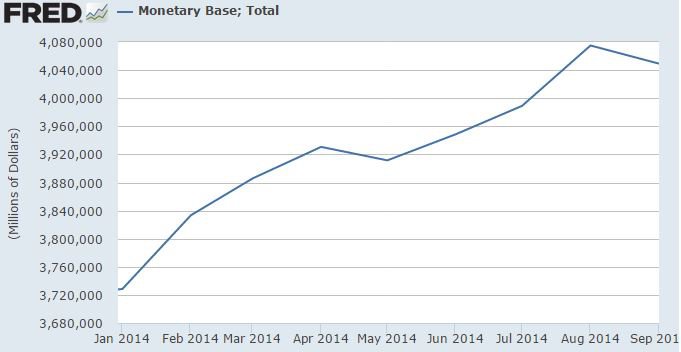
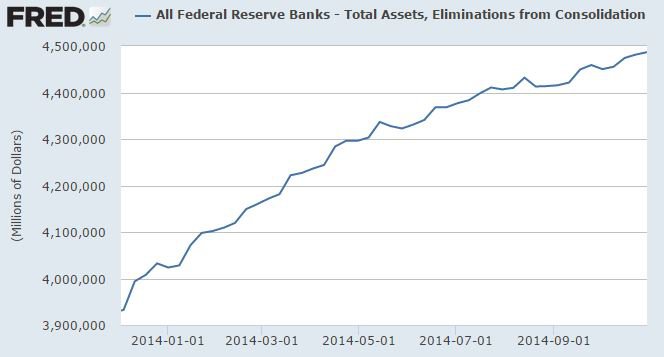
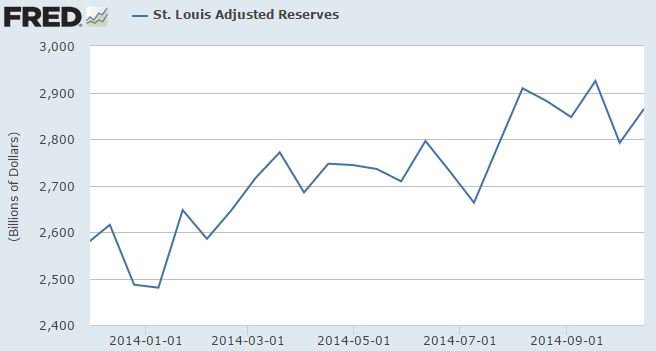
While quantitative easing has contributed to the massive expansion of the Fed balance sheet — now nearly $4.5 trillion in assets — it is not the whole story. Even as the Fed ends new buying of favored assets, the Fed balance sheet will not shrink. As pointed out by the Wall Street Journal, “QE is not over, and the Fed will still reinvest the principal payments from its maturing securities.” Even more relevant, during the phase out there was a continuing expansion of three broad measures of Fed activity; St. Louis Fed adjusted reserves (Figure 1), the monetary base (Figure 2), and Federal Reserve Banks — Total Assets, Eliminations from Consolidation program (Figure 3). (All data from FRED economic data series St. Louis Federal Reserve. Calculations are mine.)

Figure 1: St. Louis Fed Adjusted Reserves

Figure 2: The Monetary Base

Figure 3: Federal Reserve Banks — Total Assets, Eliminations from Consolidation

The Fed’s Balance Sheet Continues to Expand

Despite some ups and downs, adjusted reserves increased 15.8 percent from January 2014 through September 2014, the monetary base by 8.6 percent, and consolidated assets by 10.7 percent. Given QE purchases were $85 billion per month at their peak, this continuing expansion of the Fed balance sheet and the other relevant monetary aggregates, the phase out and end of quantitative easing represents not a change in policy stance, but only a shift in tools. Monetary distortion has continued unabated. The only plus in the change is that more traditional tools of monetary manipulation create only the traditional market distortions; Cantillon effects, false relative prices, particularly interest rates, and the associated misdirection of production and malinvestments. Temporarily gone is the more dangerous Mondustrial Policy where the central bankers further distort credit allocation by picking winners and losers.

As illustrated by the Fed speak in the press release, post QE3-forward policy will, despite John Taylor’s optimism that this would not be the case, continued to be biased against a return to a more balanced, less potentially self-defeating rules-based policy. Instead driven by the Fed’s unwise dual mandate and the strong belief by Fed leadership in Tobin Keynesianism, policy will continue to “foster maximum employment.” This despite strong theoretical arguments (Austrian business cycle theory and the more mainstream natural unemployment rate hypothesis)[1] and good empirical evidence that any short-run positive impact monetary policy may have on employment and production is temporary and in the long run, per Hayek, cause greater instability and potentially even higher unemployment.

The Lasting Legacy of QE

As pointed out by David Howden in “QE’s Seeds Are Already Sown,” and as emphasized by Hayek (in Unemployment and Monetary Policy: Government as Generator of the “Business Cycle”), and recently formalized by Ravier (in “Rethinking Capital-Based Macroeconomics”), the seeds of easy money and credit creation, even when sown during times with unused capacity, bring forth the weeds of instability, malinvestment, bust, and economic displacement. They do not bring the promised return to prosperity, sustainable growth, and high employment.

Since the phase-out is only apparent, and not a real change in policy direction, Joe Salerno’s warning (“A Reformulation of Austrian Business Cycle Theory in Light of the Financial Crisis,” p. 41) remains relevant:

(G)iven the unprecedented monetary interventions by the Fed and the enormous deficits run by the Obama admin­istration, ABCT also explains the precarious nature of the current recovery and the growing probability that the U.S economy is headed for a 1970s-style stagflation.

While highly unlikely there is still time to do the right thing, follow the policy advice of Rothbard and the Austrians, as argued earlier in more detail here and here. Despite some short run costs which are likely small compared to the cost of a decade of stagnation, such a policy is the only reliable route to return the economy to sustainable prosperity.

John P. Cochran is emeritus dean of the Business School and emeritus professor of economics at Metropolitan State University of Denver and coauthor with Fred R. Glahe of The Hayek-Keynes Debate: Lessons for Current Business Cycle Research. He is also a senior scholar for the Mises Institute and serves on the editorial board of the Quarterly Journal of Austrian Economics. Send him mail. See John P. Cochran’s article archives.

This article was published on Mises.org and may be freely distributed, subject to a Creative Commons Attribution United States License, which requires that credit be given to the author.

Once-Peaceful Canada Turns Militaristic; Blowback Follows – Article by Ron Paul

Once-Peaceful Canada Turns Militaristic; Blowback Follows – Article by Ron Paul

The New Renaissance Hat
Ron Paul
October 30, 2014
******************************
In 1968 the government of Canada decided to openly admit Americans seeking to avoid being drafted into the US war on Vietnam. Before, would-be immigrants were technically required to prove that they had been discharged from US military service. This move made it easier for Americans to escape President Johnson’s war machine by heading north.
***

Although a founding member of NATO, Canada did not join the United States in its war against Vietnam. The Canadian government did not see a conflict 7,000 miles away as vital to Canada’s national interest so Canada pursued its own foreign policy course, independent of the United States.

How the world has changed. Canada’s wise caution about military adventurism even at the height of the Cold War has given way to a Canada of the 21st century literally joined at Washington’s hip and eager to participate in any bombing mission initiated by the D.C. interventionists.

Considering Canada’s peaceful past, the interventionist Canada that has emerged at the end of the Cold War is a genuine disappointment. Who would doubt that today’s Canada would, should a draft be re-instated in the US, send each and every American resister back home to face prison and worse?

As Glenn Greenwald pointed out this past week:

Canada has spent the last 13 years proclaiming itself a nation at war. It actively participated in the invasion and occupation of Afghanistan and was an enthusiastic partner in some of the most extremist War on Terror abuses perpetrated by the U.S.

Canada has also enthusiastically joined President Obama’s latest war on Iraq and Syria, pledging to send fighter jets to participate in the bombing of ISIS (and likely many civilians in the process).

But Canada’s wars abroad came back home to Canada last week.

Though horrific, it should not be a complete surprise that Canada found itself hit by blowback last week, as two attacks on Canadian soil left two Canadian military members dead.

Greenwald again points out what few dare to say about the attacks:

Regardless of one’s views on the justifiability of Canada’s lengthy military actions, it’s not the slightest bit surprising or difficult to understand why people who identify with those on the other end of Canadian bombs and bullets would decide to attack the military responsible for that violence.

That is the danger of intervention in other people’s wars thousands of miles away. Those at the other end of foreign bombs – and their surviving family members or anyone who sympathizes with them – have great incentive to seek revenge. This feeling should not be that difficult to understand.

Seeking to understand the motivation of a criminal does not mean that the crime is justified, however. We can still condemn and be appalled by the attacks while realizing that we need to understand the causation and motivation. This is common sense in other criminal matters, but it seems to not apply to attacks such as we saw in Canada last week. Few dare to point out the obvious: Canada’s aggressive foreign policy is creating enemies abroad that are making the country more vulnerable to attack rather than safer.

Predictably, the Canadian government is using the attacks to restrict civil liberties and expand the surveillance state. Like the US PATRIOT Act, Canadian legislation that had been previously proposed to give the government more authority to spy on and aggressively interrogate its citizens has been given a shot in the arm by last week’s attacks.

Unfortunately Canada has unlearned the lesson of 1968: staying out of other people’s wars makes a country more safe; following the endless war policy of its southern neighbor opens Canada up to the ugly side of blowback.

Ron Paul, MD, is a former three-time Republican candidate for U. S. President and Congressman from Texas.

This article is reprinted with permission from the Ron Paul Institute for Peace and Prosperity.

National Service is Anti-Liberty and Un-American – Article by Ron Paul

National Service is Anti-Liberty and Un-American – Article by Ron Paul

The New Renaissance Hat
Ron Paul
October 19, 2014
******************************
Former Clinton Administration Labor Secretary Robert Reich recently called on the government to force young people to spend two years either “serving” in the military or performing some other type of government-directed “community service.” Neoconservative Senator John McCain has introduced legislation creating a mandatory national service program very similar to Reich’s proposal. It is not surprising that both a prominent progressive and a leading neocon would support mandatory national service, as this is an issue that has long united authoritarians on the left and right.Proponents of national service claim that young people have a moral obligation to give something back to society. But giving the government power to decide our moral obligations is an invitation to totalitarianism.
***

Mandatory national service is not just anti-liberty, it is un-American. Whether or not they admit it, supporters of mandatory national service do not believe that individuals have “inalienable rights.” Instead, they believe that rights are gifts from the government, and, since government is the source of our rights, government can abridge or even take away those rights whenever Congress decides.

Mandatory national service also undermines private charitable institutions. In a free society, many people will give their time or money to service projects to help better their communities, working with religious or civic associations. But in a society with government-enforced national service, these associations are likely to become more reliant on government-supplied forced labor. They will then begin to tailor their programs to satisfy the demands of federal bureaucrats instead of the needs of the community.

The very worst form of national service is, of course, the military draft, which forces young people to kill or be killed on government orders. The draft lowers the cost of an interventionist foreign policy because government need not compete with private employers for recruits. Anyone who refuses a draft notice runs the risk of being jailed, so government can provide lower pay and benefits to draftees than to volunteers.

As the burden of our hyper-interventionist foreign policy increases, it is increasingly likely that there will be serious attempts to reinstate the military draft. General Martin Dempsey, the chairman of the Joint Chiefs of Staff, continues to suggest that US troops on the ground may be needed to fight “Operation Inherent Resolve” in Iraq and Syria. A major escalation requiring a large US troop deployment will likely add pressure to consider a military draft.

The only real way the American people can protect their children from the military draft is to demand an end to the foreign policy that sees the US military as the solution to any and every problem — from ISIS to Ebola — anywhere in the world.

Some who share my opposition to a militaristic foreign policy support the draft because they think a draft will increase public opposition to war. However, the existence of a draft did not stop the American government from launching unconstitutional wars in Vietnam and Korea. While the draft did play a role in mobilizing political opposition to Vietnam, it took almost a decade and the deaths of thousands of American draftees for that opposition to reach critical mass.

It is baffling that conservatives who (properly) oppose raising taxes would support any form of national service, including the military draft. It is similarly baffling that liberals who oppose government interference with our personal lives would support mandatory national service. Mandatory national service is a totalitarian policy that should be rejected by all who value liberty.

Ron Paul, MD, is a former three-time Republican candidate for U. S. President and Congressman from Texas.

This article is reprinted with permission from the Ron Paul Institute for Peace and Prosperity.

Inflation’s Not the Only Way Easy Money Destroys Wealth – Article by Frank Shostak

Inflation’s Not the Only Way Easy Money Destroys Wealth – Article by Frank Shostak

The New Renaissance Hat
Frank Shostak
October 14, 2014
******************************

The US Federal Reserve can keep stimulating the US economy because inflation is posing little threat, Federal Reserve Bank of Minneapolis President Kocherlakota said. “I am expecting an inflation rate to run below two percent for the next four years, through 2018,” he said. “That means there is more room for monetary policy to be helpful in terms of … boosting demand without running up against generating too much inflation.”

The yearly rate of growth of the official consumer price index (CPI) stood at 1.7 percent in August against two percent in July. According to our estimate, the yearly rate of growth of the CPI could close at 1.4 percent by December. By December next year we forecast the yearly rate of growth of 0.6 percent.

Does Demand Create More Supply?

It seems that the Minneapolis Fed President holds that by boosting the demand for goods and services — by means of additional monetary pumping — it is possible to strengthen economic growth. He believes that by means of strengthening the demand for goods and services the production of goods and services will follow suit. But why should that be so?

If by means of monetary pumping one could strengthen the economic growth then it would imply that — by means of monetary pumping — it is possible to create real wealth and generate an everlasting economic prosperity.

This would also mean that world wide poverty should have been erased a long time ago. After all, most countries today have central banks that possess the skills to create money in large amounts. Yet world poverty remains intact.

Despite massive monetary pumping since 2008, and the policy interest rate of around zero, Fed policymakers seem to be unhappy with the so-called economic recovery. Note that the Fed’s balance sheet, which stood at $0.86 trillion in January 2007 jumped to $4.4 trillion by September this year.

Production Comes Before Demand

We suggest that there is no such thing as an independent category called demand. Before an individual can exercise demand for goods and services, he/she must produce some other useful goods and services. Once these goods and services are produced, individuals can exercise their demand for the goods they desire. This is achieved by exchanging things that were produced for money, which in turn can be exchanged for goods that are desired. Note that money serves here as the medium of exchange — it produces absolutely nothing. It permits the exchange of something for something. Any policy that results in monetary pumping leads to an exchange of nothing for something. This amounts to a weakening of the pool of real wealth — and hence to reduced prospects for the expansion of this pool.

What is required to boost the economic growth — the production of real wealth — is to remove all the factors that undermine the wealth generation process. One of the major negative factors that undermine the real wealth generation is loose monetary policy of the central bank, which boosts demand without the prior production of wealth. (Once the loopholes for the money creation out of “thin air” are closed off the diversion of wealth from wealth generators towards non-productive bubble activities is arrested. This leaves more real funding in the hands of wealth generators — permitting them to strengthen the process of wealth generation (i.e., permitting them to grow the economy).

Artificially Boosted Demand Destroys Wealth

Now, the artificial boosting of the demand by means of monetary pumping leads to the depletion of the pool of real wealth. It amounts to adding more individuals that take from the pool of real wealth without adding anything in return — an economic impoverishment.

The longer the reckless loose policy of the Fed stays in force the harder it gets for wealth generators to generate real wealth and prevent the pool of real wealth from shrinking.

Finally, the fact that the yearly rate of growth of the CPI is declining doesn’t mean that the Fed’s monetary pumping is going to be harmless. Regardless of price inflation monetary pumping results in an exchange of nothing for something and thus, impoverishment.

Frank Shostak is an adjunct scholar of the Mises Institute and a frequent contributor to Mises.org. His consulting firm, Applied Austrian School Economics, provides in-depth assessments and reports of financial markets and global economies. See Frank Shostak’s article archives.

This article was published on Mises.org and may be freely distributed, subject to a Creative Commons Attribution United States License, which requires that credit be given to the author.