Browsed by
Tag: united states

Multilateral Agreement on East Ukraine Situation Gives Peace a Chance – Post by G. Stolyarov II

Multilateral Agreement on East Ukraine Situation Gives Peace a Chance – Post by G. Stolyarov II

The New Renaissance Hat
G. Stolyarov II
April 17, 2014
******************************

I am immensely relieved that a deal among the governments of Russia, Ukraine, the United States, and the European Union has been reached in an effort to avert violence and de-escalate the increasingly troubling crisis in East Ukraine. (See the Washington Post article by Karen DeYoung and Anne Gearan, describing the deal. Also see this article from BBC News.) While the deal does not resolve all of the outstanding key issues of contention among the parties (the various territorial and policy disputes), it is a tremendous step in the right direction in denouncing the use of violence, rejecting bigoted mindsets such as anti-Semitism and exclusivist nationalism more generally, offering those who have not committed violence a chance to return to civilian life unscathed, and holding all sides to the promise to disarm and marginalize violent militants. I have written previously that war would be the worst option for Ukraine and the world in general. Any agreement that takes us even a small step away from war and toward a civilized, peaceful resolution is a welcome development in defense of a bright, cosmopolitan future of advancing technology and rising living standards for all – instead of meaningless carnage and destruction.

If Vladimir Putin’s regime was indeed behind the arming and organizing of the insurgents in the Donetsk region, then Russia’s accession to this deal can be expected to be followed by the disempowerment of the insurgency. If the havoc wreaked by the separatist uprising cannot last without Putin’s assistance, then withdrawal of that assistance would hopefully restore a semblance of peace and safety for civilians.

War is the Worst Choice for Ukraine and the World – Article by G. Stolyarov II

War is the Worst Choice for Ukraine and the World – Article by G. Stolyarov II

The New Renaissance Hat
G. Stolyarov II
April 14, 2014
******************************

As I write this, people have already been killed in the confrontation between pro-Putin militants of the self-proclaimed “Republic of Donetsk” in Eastern Ukraine and the “anti-terrorist” forces sent by the interim Ukrainian government to suppress the insurgents. (Calling them “rebels”, “separatists”, “militants”, even “provocateurs” may be legitimate – but the use of the label “terrorist” here only further eviscerates any meaning that term once had in referring to people who deliberately kill civilians to make a political or ideological point.) It is not precisely clear what is happening on the ground – who is prevailing, and who is responsible for the initiation of force. What is clear, however, is that a deadly tragedy may be about to occur – unless reason, common sense, and every longing for peace and civilization are marshaled against it.

I have no love for Vladimir Putin or his regime. He is clearly an authoritarian despot, with little respect for the rights of his own people or those of others. He will pursue an agenda of personal power and aggrandizement through nationalistic rhetoric and attempts to rekindle the alleged glory of Imperial and Soviet Russia. Yet, despotic as he may be, one would hope that Putin is not suicidally stupid. It was one matter to seize control of Crimea, with its majority Russian-speaking population and popular support for annexation by Russia. Occupying the rest of Ukraine – in which even many ethnic Russians have no enthusiasm for union with Russia – is another matter entirely. A protracted occupation of Ukraine, amidst an unsympathetic populace – to say the least! – would bog down the Russian military and imperil an already precarious economic situation.  It would also risk the lives of many Russian soldiers in a prolonged partisan uprising, much like the one that the Soviet regime had to deal with for decades in Ukraine during the last century.  A reasonable person would hope that Putin recognizes this and does not stray from his characteristic modus operandi – which, however ruthless, is nonetheless marked by caution and pragmatic calculation.

Until the uprisings that led to the declaration of the “Republic of Donetsk”, it seemed to me that Putin’s conduct of “military training exercises” on Ukraine’s Eastern border was a strategic bluff. While the cover of military exercises affords Putin plausible deniability, he could also sincerely agree to withdraw the troops in subsequent negotiations, in exchange for the West’s recognition of the legitimacy of the Crimea annexation and a more loosely federated Ukraine. If Putin had pursued this approach, he would have likely gotten away with annexing Crimea after nothing worse than some griping and minor sanctions levied by Western governments.

Yet it is now unclear whether the separatist uprisings in the Donetsk region were orchestrated by provocateurs employed by Putin’s regime (as many in the Ukrainian government and foreign-policy hawks in the West allege), or whether they largely arose from local Russian nationalists who were inspired by the Crimea annexation and sought to repeat it in Eastern Ukraine (as many of the separatists do appear to be ordinary civilians). Nonetheless, Putin’s regime has officially endeavored to maintain plausible deniability – which means that an escalation of military force against the separatists by the Ukrainian government would give Putin exactly the pretext he would need to invade Eastern Ukraine, if that is indeed his goal.

The “anti-terrorist” operation by the Ukrainian government of President Oleksandr Turchynov and Prime Minister Arseniy Yatseniuk is – like any attempt by Putin to even consider an invasion of Eastern Ukraine – an act of suicidal folly. Not only do Turchynov and Yatseniuk undermine their own legitimacy in the eyes of Eastern Ukrainians by treating their own citizens as “terrorists” (), they also create the actual war that they accuse Putin of fomenting! Logic suggests only two possibilities: either the separatists are Russian provocateurs, or they are not. If they are indeed Russian provocateurs, then Turchynov and Yatseniuk have effectively initiated hostilities against Russian forces. If the separatists are not Russian provocateurs, then Turchynov and Yatseniuk are deploying military and “counter-terrorist” forces against their own people, instead of dealing with any insurgent or criminal behaviors via the police and the civilian justice system. Either way, the Ukrainian government is not doing itself any favors and is itself engaged in dangerous brinksmanship, which, unless restraint wins the day, could cost the lives of at least thousands of innocent Ukrainian civilians.

If this crisis were merely an episode of competing follies between two Eastern European regimes, I might have left the matter at that. Unfortunately, prominent neoconservative war hawks such as John McCain and certain NATO generals, such as Supreme Allied Commander Philip Breedlove, remain unable to transcend the insane era of the Cold War, when the civilized world was never far from nuclear annihilation due to the geopolitical rivalry between the United States and the Soviet Union. They continue to call for “harsh” and “forceful” measures to be taken against Putin’s regime – whatever that means. Economic sanctions would, of course, be wholly counterproductive and would further impoverish Russian civilians, driving more of them, in desperation, to further embrace Putin’s nationalistic agenda. But military action of any sort by NATO or the United States would be an absolute calamity for human civilization – risking not just another cold war, but World War III between the world’s two major nuclear powers. Such a war would paralyze the progress of humankind for decades and lead to the eradication of much of the infrastructure needed to make comfortable, prosperous lives possible.

The neoconservative and NATO hawks are the Western mirror image of Putin’s nationalistic aggrandizement. They warn of the United States’ weakening image in foreign policy, of a perceived softness of the Obama administration’s response. They fear, in essence, a loss of American “national honor” and “national pride” if the United States were to withdraw from its role as global policeman and global human-rights enforcer. But they overlook the essential question: Why should the United States government be involved in the situation in Ukraine? There is no danger to American citizens, to whom the United States government’s duty of protection is owed, even in the worst-case scenario of Putin’s troops occupying all of Ukraine (which, as explained earlier, will not happen unless Putin is suicidally stupid). There is no compelling “national security” rationale of any sort for military or even extensive policy intervention in an area of the world separated from the United States by an ocean and most of the European continent!

The United States government is drowning in runaway debt, and the country is only beginning to recover from disastrous decade-long occupations of Iraq and Afghanistan. Thousands of American troops have been killed in the prior interventions of this millennium; tens of thousands more have come home physically and mentally scarred forever.  And the hawks want them to fight in yet another part of the world which most Americans understand nothing about, for no tangible gain, in the name of the geopolitical posturing of regimes whose leaders care not at all about them and will not bear a single physical cost of the massive killings, tortures, property destruction, and other atrocities that war inevitably brings with it? War is always fought at the behest of and for the benefit of corrupt, power-hungry leaders, and all the costs are always borne by innocent civilians and by very young armed men who know not what they fight for and who kill one another senselessly, even though they could have been good friends in other circumstances.

As the Wikileaks revelations about the conduct of some American troops in Iraq and Afghanistan showed the world, the US military is not uniquely righteous or humanitarian; torture, sadism, and perversity in the conduct of war marred the US military record, too.

The description of the horrors of war and the immense beneficence and moral imperative of peace by the great Renaissance humanist thinker Desiderius Erasmus is just as true today as it was in the early 16th century when these words were written:

Peace is at once the mother and the nurse of all that is good for man; war, on a sudden and at one stroke, overwhelms, extinguishes, abolishes, whatever is cheerful, whatever is happy and beautiful, and pours a foul torrent of disasters on the life of mortals. Peace shines upon human affairs like the vernal sun. The fields are cultivated, the gardens bloom, the cattle are fed upon a thousand hills, new buildings arise, riches flow, pleasures smile, humanity and charity increase, arts and manufactures feel the genial warmth of encouragement, and the gains of the poor are more plentiful.

But no sooner does the storm of war begin to lower, than what a deluge of miseries and misfortune seizes, inundates, and overwhelms all things within the sphere of its action! The flocks are scattered, the harvest trampled, the husbandman butchered, villas and villages burnt, cities and states that have been ages rising to their flourishing state subverted by the fury of one tempest, the storm of war. So much easier is the task of doing harm than of doing good — of destroying than of building up!

As with the remarkable surge of grassroots opposition that prevented US intervention in Syria in 2013, it is time for the American public to vociferously denounce any military intervention in Ukraine. It is not surprising, as a recent Washington Post article highlighted, that “The less Americans know about Ukraine’s location, the more they want to intervene”! Education of Americans, not the inflammation of their zeal, should be the priority. The conflict in Ukraine today is a clash between two extremely ugly nationalisms – and ignorant neoconservative jingoists would add their own third flavor of nationalism to the mix. It is time for civilized individuals everywhere to reject all nationalism and all war. All of us humans – in Ukraine, Russia, the West, and everywhere else – face a choice for the next several decades. If we pursue the path of peace and non-intervention, we can become a spacefaring, cosmopolitan civilization. We are on the verge of major breakthroughs in life extension, robotics, artificial intelligence, nanoscale manufacturing, and ubiquitous, affordable energy. If we pursue the path of war, then humankind will instead become suffocated in the muck of jingoistic tribalism, with a promising future washed away by rivers of blood and consumed by an inferno of bombs.  The next few weeks will indicate which of these futures we face.

William James Sidis Biography – Video by Adam Alonzi

William James Sidis Biography – Video by Adam Alonzi

The New Renaissance Hat
Adam Alonzi
April 4, 2014
******************************

This video is an audio piece with a few pictures, a precursor to a larger collection of videos on history’s greatest geniuses, which Adam Alonzi has been planning for some time. The entire transcript can be found here.

Contribute to Mr. Alonzi’s Kickstarter project to fund his documentary series on history’s greatest geniuses. Just $500 of combined pledges can bring this highly promising series into being!

Note by Gennady Stolyarov II, Editor-in-Chief of The Rational Argumentator: I applaud this video – a good narrative with a thought-provoking message. What a shame that Sidis died so young and completely misunderstood by the general public – in spite of being intellectually active and immensely insightful all his life. Both in his time and now, people of exceptional brilliance are severely under-appreciated, as are attempts to push progress forward and extricate humanity out of the stagnation of mediocrity and the status quo.

I am a proud supporter of Mr. Alonzi’s Kickstarter campaign – and I encourage everyone to contribute to enable him to create his video series on genius. Any amount would help.

Adam Alonzi is the author of Praying for Death and A Plank in Reason. He is also a futurist, inventor, DIY enthusiast, biotechnologist, programmer, molecular gastronomist, consummate dilletante and columnist at The Indian Economist.

David Brooks, The Whigs, and Corporate Welfare – Article by Thomas J. DiLorenzo

David Brooks, The Whigs, and Corporate Welfare – Article by Thomas J. DiLorenzo

The New Renaissance Hat
Thomas J. DiLorenzo
February 8, 2014

******************************

In a January 30 column David Brooks, the house neoconservative of the New York Times, urged Obama to ignore both his socialist/egalitarian base and the “conservative tradition that believes in limiting government to enhance freedom.” Obama already has nothing but hateful contempt for the latter tradition and needs no convincing by a right-wing statist like David Brooks.

The president should also abandon his life-long infatuation with and devotion to socialism as well, advises David Brooks. In its place he should pursue an agenda of crony capitalism disguised as a “social mobility agenda” with the help of professional propagandists and perverters of American history such as Brooks and his fellow neoconservatives. Of course, Brooks doesn’t use these less-than-flattering words to describe his Machiavellian agenda. He talks of “a third ancient tradition” in American history, namely, “the Whig tradition, which begins with people like Henry Clay, Daniel Webster and Abraham Lincoln.”

Either Brooks knows nothing at all, whatsoever, about the Whig Party tradition in American history, or he is lying through his teeth about it. For he describes it as having been devoted to “using the power of government to give marginalized Americans the tools to compete in a capitalist economy.” The Whigs, says Brooks, “fought against the divisive populist Jacksonians” who supposedly sought to “pit classes against each other.” Every bit of this is exactly the opposite of the truth. The Whigs were the party of crony capitalism, of government of plutocracy, by the plutocracy, for the plutocracy. That is why so many historians have marveled over how a man like Abe Lincoln, who grew up so poor, would become the political water carrier for the Northeastern moneyed elite in American politics.

The most divisive economic issue in American politics during the heyday of the Whig Party (1832–1852) was the battle over free trade versus protectionism. If the Whigs stood for anything, they stood for corporate welfare in the form of high protectionist tariffs that would plunder the masses for the benefit of the few. This meant, for the most part, plundering Southern farmers more than anyone for the benefit of Northern manufacturers who would be protected from international competition by the high tariffs. As John C. Calhoun once said, what “protectionism” protects the public from is low prices. Next to slavery, protectionism was the biggest assault on property rights in America during the first half of the nineteenth century. The Whigs did not believe in “sacred” property rights, as Brooks foolishly writes. Their entire political agenda was based on the government-enforced attenuation of property rights for the benefit of the wealthy and politically-connected.

Next to political plunder through protectionism, the Whigs stood for the worst sort of crony capitalism in the form of needless corporate welfare for road-, canal-, and railroad-building corporations. This was euphemistically called “internal improvement subsidies” at the time. Private capital markets financed thousands of miles of private roads during the first decades of the nineteenth century. As of 1800 there were 69 privately-financed road-building companies in America that would build more than 400 private roads over the next 40 years, as economist Daniel Klein has documented. The great railroad entrepreneur James J. Hill also proved that government subsidies were not needed to build a transcontinental railroad as he and his investors and business partners built and managed the Great Northern Railroad without a dime of government subsidy, not even “land grants.”

When the Whigs did get their way and conned state government into funding “internal improvement subsidies”, it was an unmitigated financial disaster. Very few, if any, projects were ever finished; taxpayers were stuck with enormous government debts to pay off; much of the money was simply stolen; and by 1860 every state except for Massachusetts had amended its constitution to prohibit the use of tax dollars for corporations with which to do anything, according to economic historian Carter Goodrich.

Edgar Lee Masters, the famous 1930s-era poet, playwright (author of The Spoon River Anthology), and law partner of Clarence Darrow, perfectly described the Whig Party on page 27 of his book, Lincoln the Man. Describing the leader of the Whigs, Henry Clay, Masters wrote:

Clay was the champion of that political system which doles favors to the strong in order to win and to keep their adherence to the government. His system offered shelter to devious schemes and corrupt enterprises. … He was the beloved son [figuratively speaking] of Alexander Hamilton with his corrupt funding schemes, his superstitions concerning the advantage of a public debt, and a people taxed to make profits for enterprises that cannot stand alone. His example and doctrines led to the creation of a party that had no platform to announce, because its principles were plunder and nothing else.

This is exactly correct, and exactly the opposite of what David Brooks wants his New York Times audience to believe. Clay’s agenda, which Alexander Hamilton originally labeled “The American System,” was really an Americanized version of the corrupt mercantilist system the American founders had fought a revolution against. The Hamilton/Clay/Lincoln “American System” included protectionism, corporate welfare, and a central bank to dispense even more corporate welfare subsidies to politically-connected businesses. It was a recipe for political power based on using taxpayer dollars to line the pockets of the (mostly Northern state) business plutocracy at the expense of the general public. Some things never change in a democracy.

It is equally outrageous for Brooks to claim that the Jacksonians were “divisive” and wanted to “pit classes against each other.” This was the function of David Brooks’s beloved Whigs, who were simply an early version of the neoconservatives; it was the libertarian Jacksonians who opposed politicized divisiveness and the pitting of classes against each other. This is exemplified in President Andrew Jackson’s famous veto of the re-chartering of the Second Bank of the United States, a precursor of the Fed.

The Whigs championed a central bank. The Bank of the United States (BUS) even paid both of Brooks’s heroes, Clay and Webster, many thousands of dollars as bribery money to promote the continuation of the bank despite the fact that it was well known that the BUS had corrupted politics and generated boom-and-bust cycles. In vetoing the re-chartering of the BUS (which was not overturned), Jackson wrote:

It is to be regretted that the rich and powerful too often bend the acts of government to their selfish purposes. … In the full enjoyment of the gifts of Heaven and the fruits of superior industry, economy and virtue, every man is equally entitled to protection by the law; but when the laws undertake to add to these natural and just advantages artificial distinctions, to grant titles, gratuities, and exclusive privileges, to make the rich richer and the potent more powerful, the humble members of society — the farmers, mechanics and laborers — who have neither the time nor the means of securing like favors to themselves, have a right to complain of the injustice of their Government. … In the act before me [the bill to re-charter the BUS] there seems to be a wide and unnecessary departure from these just principles.

Neither Jackson nor the Jacksonians were “perfect” libertarians, but by their motto of “equal rights” they meant equality under the law and opposition to the use of the state to dispense “exclusive privileges” and special favors to special interests. They stood for exactly the opposite of what David Brooks claims they stood for, in other words.

Brooks’s commentary turns to slapstick humor at one point when he claims that the Whigs, who were, after all, politicians, were somehow “family-oriented in their moral and social attitudes.” (I assume that he threw this into his article to further dupe the “evangelical Christian” base of the Republican Party into accepting his thesis). The leader of the Whigs, the slave-owning Kentucky hemp plantation patriarch Henry Clay, was indeed “family oriented” in that he had 11 children. But he was also a notorious gambler who rang up $40,000 in personal debt in the 1820s and was famous for staying out late carousing and dancing with women other than his wife while he was in Washington and the wife was back home in Kentucky, according to several biographies.

Armed with this absurdly false history of American politics, Brooks argues for an explosion of governmental central planning by Obama during the rest of his term. He wants Obama to employ “social entrepreneurs” to fundamentally transform American society by “improving family patterns,” expanding early childhood education, “structuring neighborhoods,” paying “young men wage subsidies so they are worth marrying,” training “middle-aged workers” for jobs, and generally micromanaging everyone’s life from cradle to grave. In his words, government should promote “[social] mobility issues from the beginning to the end of the lifespan.”

Something very much like this has been tried before. It was called totalitarian socialism, and it failed miserably.

Thomas DiLorenzo is professor of economics at Loyola University Maryland and a member of the senior faculty of the Mises Institute.

He is the author of The Real Lincoln; Lincoln Unmasked; How Capitalism Saved America; and Hamilton’s Curse: How Jefferson’s Archenemy Betrayed the American Revolution — And What It Means for Americans Today. Send him mail.

This article was published on Mises.org and is reprinted pursuant to a Creative Commons Attribution License.

Congress Defers to President On NSA Reform – Article by Ron Paul

Congress Defers to President On NSA Reform – Article by Ron Paul

The New Renaissance Hat
Ron Paul
January 12, 2014
******************************
Congress’s decline from the Founders’ vision as “first among equals” in government to an echo chamber of the unitary executive, has been a slow but steady process. In the process we have seen a steady stream of unconstitutional wars and civil-liberties abuses at home. Nowhere is this decline more evident than in the stark contrast between the Congressional response to intelligence agencies’ abuses during the post-Watergate era and its response to the far more serious NSA abuses uncovered in recent years.In 1975, Senator Frank Church (D-ID) convened an historic select committee to investigate the US intelligence services for possible criminality in the wake of Watergate. Thanks in part to reporting by Seymour Hersh and others, abuses by the CIA, NSA, and FBI had come to light, including the monitoring of US peace activists.The Church Committee played its proper Congressional role, checking the power of the executive branch as it had been spiraling out of control since the 1950s and the early CIA covert action programs. The Committee sought to protect US citizens against abuses by their government after those abuses had come to light through leaks of secret government documents.

The parallel to the present NSA scandals cannot be ignored. What is completely different, however, is that Congress is today acting as an advocate for the executive branch’s continuing abuses, and as an opponent to the civil liberties of US citizens. Not only has Congress – with a precious few exceptions – accepted the NSA’s mass spying program on American citizens, it has actually been encouraging the president to continue and expand the program!

Where once there was a Congressional committee to challenge and oppose the president’s abuse of power, today the president himself has been even allowed by a complacent Congress to hand pick his own NSA review commission!

Are we really expected to believe that a commission appointed by the president to look into the activities of the president’s intelligence services will come to anything more than a few superficial changes to give the impression of real reform?

One of the president’s commission recommendations is that the NSA cease holding our phone records and demand that the private phone companies retain those records instead – for the NSA to access as it wishes. This is supposed to be reform?

The president will make a speech this Friday to tell the rest of us which of the suggestions made by his own commission he will decide to implement. Congress has no problem with that. Rep. Adam B. Schiff (D-Calif.) admitted last week that Congress has no intention of asserting itself in the process. “It’s my hope that [Obama will] do as much as he can through the executive process because the legislative process will be difficult, perilous and long.”

Senator Church famously said back in 1975:

In the need to develop a capacity to know what potential enemies are doing, the United States government has perfected a technological capability that enables us to monitor the messages that go through the air… We must know, at the same time, that capability at any time could be turned around on the American people, and no American would have any privacy left… There would be no place to hide…. I know the capacity that is there to make tyranny total in America, and we must see to it that this agency and all agencies that possess this technology operate within the law and under proper supervision so that we never cross over that abyss. That is the abyss from which there is no return.”

Have we reached that point? Let us hope not. Real reform begins with the repeal of the PATRIOT Act and of the 2001 Authorization for the Use of Military Force. If we keep our eye on that goal and not allow ourselves to become distracted with the president’s phony commissions we might force Congress to listen.

Ron Paul, MD, is a former three-time Republican candidate for U. S. President and Congressman from Texas.

This article is reprinted with permission from the Ron Paul Institute for Peace and Prosperity.

You Cannot Negotiate With Iran? – Article by Ron Paul

You Cannot Negotiate With Iran? – Article by Ron Paul

The New Renaissance Hat
Ron Paul
December 2, 2013
******************************
You cannot negotiate with Iran. That is what they told us for years. The Iranian leadership is too fanatical, they are not rational actors, they are “not like us.” One US official even recently said that deception is part of the Iranian DNA. But just over a week ago negotiations between the five permanent UN Security Council Members plus Germany and the Iranians produced an historic agreement that may be first step toward a new era in US relations with the Middle East.As Middle East expert Eric Margolis pointed out this week, for Iran’s major concessions it will only receive “$7 billion – of its own money, which has been frozen abroad by US-led sanctions.” That sounds like quite a bit of compromise for such a “fanatical” country.

Earlier this summer the same people made the same arguments about Syria. You cannot negotiate with Syrian President Assad, they said. He is insane; he is another Hitler. But not only was it possible, a deal was signed ending the threat of a US strike in exchange for Syria agreeing to give up its chemical weapons and the ability to manufacture new ones. Syria upheld its end of the agreement and the chemicals were all accounted for on schedule.

Why have the interventionists, the neocons, and the special interest groups claimed for so long that negotiation and diplomacy was tantamount to surrender; that countries such as Iran and Syria “only understand force”? It is because these groups are afraid of diplomacy. They do not want a peaceful resolution to these conflicts. They see US foreign relations only in the starkest terms: do what we say and we will give you aid, disobey us and we will bomb you.

Now the warmongers who call themselves “foreign policy experts” have been exposed. The whole world sees that they are wrong. Their advice is bad. Their limited vision of how foreign affairs should be conducted is actually dangerous to the United States. It is now clear that there are workable alternatives.

As with the US threats against Syria, public opinion polls on talks with Iran demonstrate that the American people are solidly behind diplomacy and opposed to another war. According to one recent poll, Americans support the deal reached with Iran by a margin of two-to-one.

Congress, however, is once again far behind the American people. Even as US negotiators were reaching agreement with their Iranian counterparts, US representatives and Senators were drafting legislation to increase sanctions on Iran. Instead of listening to the American people, many in Congress seem attached to special interests like the Israel and Saudi lobbies, which oppose anything less than full Iranian capitulation. Israel refuses to join the Non-Proliferation Treaty yet it seeks to dictate the rules of the treaty to those who have signed it. Saudi Arabia is desperate to control the region politically and economically, and it views an Iran that is free to sell oil and other products on the open market as a threat to Saudi power.

For too long both Israel and the Saudis have benefited from a US military guarantee. It has created “moral hazard” that only encourages more belligerent behavior on both of their parts. It remains to be seen whether this six month trial period will develop into a permanent move toward normalization of relations with Iran. What if Congress refuses to give Iran its own money back? But we are moving in the right direction and we should be optimistic.

A better US relationship with Iran may signal the beginning of the end of US meddling in the region and serve as an incentive for Saudi Arabia, Israel, and the Gulf States to solve their problems themselves. This would be a great boost to US national security, just as an Iran open to US business and trade would be a great boost to our economic security. Is peace finally breaking out? Let’s hope so.

Ron Paul, MD, is a former three-time Republican candidate for U. S. President and Congressman from Texas.

This article is reprinted with permission from the Ron Paul Institute for Peace and Prosperity.

Life Expectancy is Growing at the Upper End, Too – Video by G. Stolyarov II

Life Expectancy is Growing at the Upper End, Too – Video by G. Stolyarov II

Mr. Stolyarov provides evidence that increasing life expectancy is occurring for the oldest individuals, and that rises in average longevity are not just due to reductions in mortality among infants and young adults.

References
– “Life Expectancy is Growing at the Upper End, Too” – Post by G. Stolyarov II
– “Centenarians are the fastest-growing age segment: Number of 100-year-olds to hit 6 million by 2050” – New York Daily News and The Associated Press – July 21, 2009
– “Living to 100: 80% are women, report shows” – USA Today – December 10, 2012
– “Number of centenarians hits new high in Japan” – Medical Xpress – September 13, 2011
– “Jeanne Calment” – Wikipedia
– “Jiroemon Kimura” – Wikipedia

Why Do Banks Keep Going Bankrupt? – Article by Kirby R. Cundiff

Why Do Banks Keep Going Bankrupt? – Article by Kirby R. Cundiff

The New Renaissance Hat
Kirby R. Cundiff
November 4, 2013
******************************

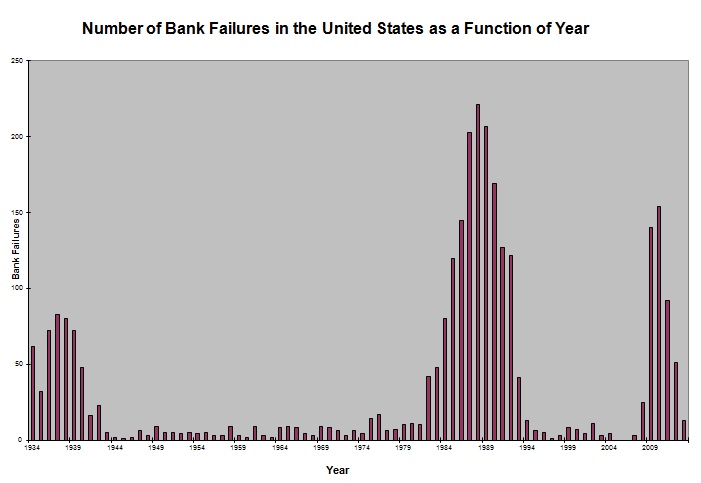
The banking industry is unstable. Banks are regularly going bankrupt. Crises in the banking industry have occurred in three distinct time periods during the twentieth century—during the Great Depression of the 1930s, during the Savings and Loan crisis of the 1980s and 1990s, and during the Great Recession from 2007 to present.

Why the banking industry is so vulnerable to bankruptcies and what can be done to correct this problem?

Debt to assets, or leverage, ratios vary significantly from industry to industry. They are typically under ten percent in most high tech industries and go up to forty percent for public utilities. Average debt ratios in the banking and financial services industry are in the fifty to seventy percent range, however, and many banks have much higher leverage ratios.

Firms attempt to minimize their total financing costs or Working Average Cost of Capital (WACC). The component costs of capital (cost of debt and cost of equity) are determined by investors’ perceptions of the risk and return possibilities associated with buying debt or equity in a given company or individual.

A credit card loan has a higher interest rate than a home loan because the credit card loan is riskier—i.e. there are no assets to seize if the money is not paid back. Similarly, a high-risk company normally pays a higher interest rate on its debt than a lower-risk company and increasing leverage is normally associated with increasing risk. Due to deposit insurance, however, this isn’t the case with banks.

Moral Hazard

The Federal Deposit Insurance Corporation (FDIC) insures deposits up to $250,000 in the United States. Most of the European countries (including Cyprus) have similar organizations that insure deposits up to 100,000 EUR. (See Deposit Insurance.)

Since depositors believe that their bank accounts are insured by governments, they do not generally know or care how much risk banks incur when they invest their depositors’ money. This creates a moral hazard problem with very little oversight by depositors of a bank’s management of their assets. Bank managers can take a lot of risk and, if they make profits, they keep the money. If they lose money, the taxpayers pay for the losses. In theory, this moral hazard problem is mitigated by subordinated debt, investors with deposits over the deposit insurance limit, and banking regulations. But these approaches are clearly not working.

In a series of agreements called the Basel Accords, the Basel Committee on Bank Supervision (BCBS) provides certain recommendations on banking regulations in regards to capital risk, market risk and operational risk. The purpose of these accords is to ensure financial institutions have enough capital to meet their obligations. The Tier I and Tier II capital controls of the Basel Agreements are supposed to prevent banks from taking too much risk with depositors’ assets. Tier 1 capital consists largely of shareholders’ equity. Tier 2 capital comprises undisclosed reserves, revaluation reserves, general provisions, hybrid instruments and subordinated debt.

The capital ratios are:

  •   Tier 1 capital ratio = Tier 1 capital / Risk-adjusted assets
  •   Total capital (Tier 1 and Tier 2) ratio = Total capital (Tier 1 + Tier 2) / Risk-adjusted assets
  •   Leverage ratio = Tier 1 capital / Average total consolidated assets

To be well-capitalized under federal bank regulatory definitions, a bank holding company must have a Tier 1 capital ratio of at least six percent, a total capital ratio of at least ten percent, and a leverage ratio of at least five percent (Capital).

The leverage ratios allowed under the Basel agreements are far higher than the typical leverag ratios in most industries and are far higher than would exist in a free-market financial system. Under a free-market system, depositors would not put their money in overly-leveraged banks and banks would be forced to decrease their leverage ratios and behave more like mutual or money market funds. Banks would be less likely to use short-term liabilities (deposits) to fund long-term assets (loans).

The S&L Crisis

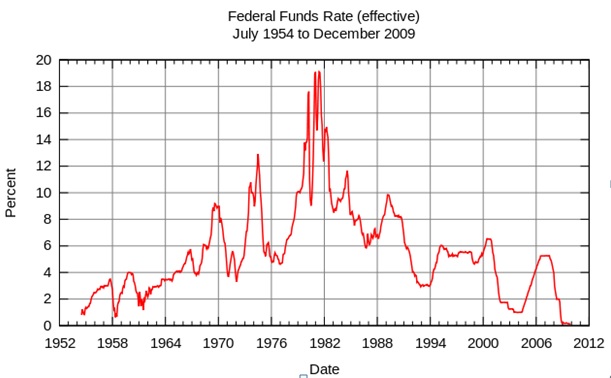
Massive bank leverage would not create as much instability if the money supply was stable as in the 1800s under the gold standard. Under the current debt-is-money system, inflation and interest rates can vary wildly from year to year. The Savings and Loan Associations (S&Ls) made many low interest 30-year fixed rate home loans when inflation was low in the 1960s—five percent interest rate loans were typical. As inflation increased, the S&Ls still had these long-term home loans on their books, but the market now demanded higher interest rates on deposits (eighteen percent at times). The interest rates that many savings and loans were receiving on their assets (30-year fixed rate loans) were much lower than the interest rates the same S&Ls were paying on their liabilities (deposits). This duration mismatch resulted in the mass insolvency of the Savings and Loan Industry and a bailout of the S&Ls by the American tax payers exceeding $100 billion.

The Great Recession

The banking defaults of the Great Recession (2007 to present) were also caused by unstable interest rates combined with high leverage. The Federal Reserve lowered rates in the early 2000s to stimulate the economy after the bursting of the dot.com bubble. This resulted in many people borrowing money at very low interest rates to buy homes. Then the Federal Reserve raised interest rates and many people were no longer able to make their home payments. Again the result was massive bank insolvency and a substantial decrease in home values. Another huge taxpayer -funded bailout of the banking system followed, and the Federal Reserve has been printing money ever since, trying to stimulate the economy in the wake of yet another bubble it created.  The disbursements associated with placing into conservatorship government-sponsored enterprises Fannie Mae and Freddie Mac by the U.S. Treasury, the Troubled Asset Relief Program (TARP), and the Federal Reserve’s Maiden Lane Transactions are probably around $400 billion. How much of these disbursements will be paid back is currently unclear.

During the recent crises in Cyprus, proposals were seriously considered to ignore the 100,000 EUR deposit insurance and seize a fraction of even small depositors’ money. Most depositors lost access to their accounts for over a week and large depositors are still likely to lose a large fraction of their assets. This crisis has made some depositors more likely to pay attention to the solvency of their banks, but most depositors still believe that deposit insurance will cover any possible losses. If banks are to become more stable, the amount of equity relative to debt in the banking system must be drastically increased to something resembling what it would be without government deposit insurance, central bank subsidies, and treasury bailouts. Given the lobbying power of bankers in Washington, DC and around the word, such is unlikely to occur. The boom-bust cycle of banking bubbles followed by banking crises will most surely continue.

For further reading on this topic see this from The Freeman.

Kirby R. Cundiff, Ph.D. is an Associate Professor of Finance at the Rochester Institute of Technology. He is a Chartered Financial Analyst and a CERTIFIED FINANCIAL PLANNERTM Professional. 

This article was originally published by The Foundation for Economic Education.


What Was Not Said About Iraq – Article by Ron Paul

What Was Not Said About Iraq – Article by Ron Paul

The New Renaissance Hat
Ron Paul
November 4, 2013
******************************
October was Iraq’s deadliest month since April, 2008. In those five and a half years, not only has there been no improvement in Iraq’s security situation, but things have gotten much worse. More than 1,000 people were killed in Iraq last month, the vast majority of them civilians. Another 1,600 were wounded, as car bombs, shootings, and other attacks continue to maim and murder.As post-“liberation” Iraq spirals steadily downward, Prime Minister Nuri al-Maliki was in Washington last week to plead for more assistance from the United States to help restore order to a society demolished by the 2003 US invasion. Al-Qaeda has made significant recent gains, Maliki told President Obama at their meeting last Friday, and Iraq needs more US military aid to combat its growing influence.

Obama pledged to work together with Iraq to address al-Qaeda’s growing presence, but what was not said was that before the US attack there was no al-Qaeda in Iraq. The appearance of al-Qaeda in Iraq coincided with the US attack. They claimed we had to fight terror in Iraq, but the US invasion resulted in the creation of terrorist networks where before there were none. What a disaster.

Maliki also told President Obama last week that the war in next-door Syria was spilling over into Iraq, with the anti-Assad fighters setting off bombs and destabilizing the country. Already more than 5,000 people have been killed throughout Iraq this year, and cross-border attacks from Syrian rebels into Iraq are increasing those numbers. Again, what was not said was that the US government had supported these anti-Assad fighters both in secret and in the open for the past two years.

Earlier in the week a group of Senators – all of whom had supported the 2003 US invasion of Iraq – sent a strongly-worded letter to Obama complaining that Maliki was far too close to the Iranian government next door. What was not said was that this new closeness between the Iraqi and Iranian governments developed under the US-installed government after the US invasion of Iraq.

Surely there is plenty of blame that can be placed on Maliki and the various no-doubt corrupt politicians running Iraq these days. But how was it they came to power? Were we not promised by those promoting the war that it would create a beach-head of democracy in the Middle East and a pro-American government?

According to former Treasury Secretary Paul O’Neill, in early 2001 as the new Bush administration was discussing an attack on Iraq, then-Defense Secretary Donald Rumsfeld said, “Imagine what the region would look like without Saddam and with a regime that’s allied with US interests. It would change everything in the region and beyond it. It would demonstrate what US policy is all about.”

We see all these years later now how ridiculous this idea was.

I have long advocated the idea that since we just marched in, we should just march out. That goes for US troops and also for US efforts to remake Iraq, Afghanistan, Libya, and everywhere the neocon wars of “liberation” have produced nothing but chaos, destruction, and more US enemies overseas. We can best improve the situation by just leaving them alone.

The interventionists have unfortunately neither learned their lesson from the Iraq debacle nor have they changed their tune. They are still agitating for regime change in Syria, even as they blame the Iraqi government for the destabilization that spills over. They are still agitating for a US attack on Iran, with Members of Congress introducing legislation recently that would actually authorize US force against Iran.

It looks like a very slow learning curve for our bipartisan leaders in Washington. It’s time for a change.

Ron Paul, MD, is a former three-time Republican candidate for U. S. President and Congressman from Texas.

This article is reprinted with permission from the Ron Paul Institute for Peace and Prosperity.

An Opening to Iran? – Article by Ron Paul

An Opening to Iran? – Article by Ron Paul

The New Renaissance Hat
Ron Paul
October 6, 2013
******************************
Last week, for the first time since the 1979 Iranian revolution, the US president spoke with his Iranian counterpart. Their 15-minute telephone call was reported to open the door to further high-level discussions. This is a very important event.I have been saying for years that we should just talk to the Iranians. After all, we talked to the Soviets when they actually had thousands of nuclear missiles pointed at us! The Iranians have none, according to our own intelligence services. I even suggested a few years ago that we should “offer friendship” to them. Unfortunately, so many so-called experts have a stake in keeping tensions high and pushing us to war. They did not want to hear what I was saying. It seems, though, this is beginning to change now with these recent events.

The phone call was one of the most important moves away from war and conflict in a long time. Taken with the Obama administration’s decision to hold off on bombing Syria, we should be encouraged.

It is also probably a good sign that this phone call has infuriated the neoconservatives at home, the pro-war faction in Israel, and the hard-liners in Iran. Now that a process of negotiation has begun, the chance of war has been significantly reduced. The US is very unlikely to bomb Iran while it is talking with them, and Israel is also unlikely to start a war while the US is at the negotiating table with the Iranian leadership.

But we should also remain very cautious. Obama’s war on Syria was only stopped because the American people finally stood up and said “enough.” The message was received loud and clear and it shocked the neocons pushing war. They were used to being in charge of foreign policy.

In a recent CNN poll, more than 75% of Americans favored negotiations with Iran. This is very good news, but those pushing for war will not give up that easily. Believe it or not, some Members of Congress have recently introduced legislation to authorize war on Iran – even as these first steps toward a peaceful resolution of our differences begin to bear fruit!

So no, they will not give up that easily. There are many in the president’s own Cabinet who do not want to see US/Iranian relations improve. Even the president himself seems unable to avoid provocative statements — such as his claim that the Iranians are only willing to talk because the sanctions have been so successful in bringing them to the table. That is a false and unnecessary boast, and if he continues in such a way he will destroy what progress has been made.

But we are in the majority now. There are more than three-quarters of us who do not want war on Iran. It is essential that we keep the pressure on the Administration to ignore the war demands in both political parties and among the so-called foreign policy experts. There will be much more war propaganda coming our way as the warmongers get more desperate. Americans must see this propaganda for what it is. They should educate themselves and become familiar with alternative news sources to gain the tools to counter the propaganda. We do have a better chance at peace, but this is no time to let down our guard!

Ron Paul, MD, is a former three-time Republican candidate for U. S. President and Congressman from Texas.

This article is reprinted with permission from the Ron Paul Institute for Peace and Prosperity.