Cultural Appropriation Is Love – Article by T.J. Brown

Cultural Appropriation Is Love – Article by T.J. Brown

The New Renaissance HatT.J. Brown
******************************

I’ve never been able to get into the Halloween spirit. Maybe that’s because most of my childhood’s trick-or-treating consisted of candy corn. But as I’ve grown, I’ve gained a new appreciation for this holiday. It’s an exhibition and embrace of cultural diversity through costumes and tog.

Honoring the Other  

When I see a beautiful Caucasian woman dressing up as a Salsa Dancer, or a group of Asian college students dressed as the Jackson Five, it resonates with me in a very positive way. The Salsa Dancer dressed as such because she sees the beauty of the culture, attire, and people that are associated. She adores this culture so much that she’s willing to spend her own money to embody it for a single night. The Asian kids dressing up as the Jackson Five clearly have not only knowledge of the legendary African-American pop sensation, but have also been impacted by the cultural talents they delivered to the market.

This is why I see Cultural Appropriation as a gesture of love within humanity. It’s a refreshing deviation from conventional US ethnocentric patriotism and isolation. I’m thrilled to see people dressing up as diverse identities from around the globe, and not just wearing American Flag trucker hats and Confederate bikinis.

As our culture becomes more and more politically correct and censorious of “offensive” displays of cultural mimicry, diversity has become less about expressions of humanistic cooperation, and more about competitive oppression.

In PC parlance, that Salsa Dancer costume is actually insensitive to the economic suffering of Hispanic women who had to subject themselves to patriarchal theater. That Jackson Five getup ignores the capitalist exploitation by the music industry of black artists during the American Civil Rights movement. This is the narrative you will commonly hear pushed on many progressive university campuses and blog sites.

Some find this to be annoying, but I’d actually go as far as to call it outright insulting and abusive. Who are you to tell someone that they aren’t allowed to express their love for another culture because you arbitrarily hold exclusive claim to it? Who are you to micromanage identity and dictate what types of multiculturalism is tolerable and intolerable?

In the attempt made by progressives to socially abolish what they rule as problematic cultural appropriation, the actual effect is to make harmonious ethnic relations less likely to occur.

That Which Separates Us

Once a white man dressing up as an Arabian Sheik or a black man dressing up as an Irish bagpiper was met with excitement and interest. Now there exists a mob to ridicule them into hiding for being racist bigots. Basically they are saying to these men, “You are different and should stick to your own kind.”

How is that helpful to advancing equality or association? Now these two men are intellectually isolated, likely fostering resentment for diversity. This is dangerous for everyone, especially cultural minorities.

The far left and the Alt-Right have become enablers of each other. While the Alt-Right shames whites for abandoning their heritage and culture and demands that non-whites appropriate European culture, the far left shames whites (primarily) for embracing and adopting cultural differences and contrasts and demands they NOT appropriate.

Neither side wants to break down polarities; neither side wants a free and natural marketplace of voluntary inclusivity and association. I oppose both these factions, which is why I endorse more cultural appropriation not only on Halloween, but every day.

A world without cultural appropriation is a world without learning, emulation, aspiration, celebration, and progress. It is a frozen and dull world of isolation and insularity.

You don’t have to be an assimilative glob of clay to be properly molded by the right or a self-hating ally of the left. Culture is spontaneous, and your expression of it should be as well. So to the white girls, wear box braids if you want. To the black girls, don’t let haters stop you from rocking that blonde relaxer. Dress up as cowboys and Indians, black and white celebrities.

If you’re trans and want to dress as a cis person or visa-versa, do it. Your life is not present to be ordered and manipulated by central planners, governments, fascists, or social justice warriors. Your life is present to pursue your own self-interests and to find what makes you happy. Accusations of degeneracy or racism be damned.

tj-brown-01-edited

TJ Brown

Taleed J. Brown is a content intern at the Foundation for Economic Education (FEE) and hosts the popular YouTube channel “That Guy T“.

This article was originally published on FEE.org. Read the original article.

“Inferno” and the Overpopulation Myth – Article by Jonathan Newman

“Inferno” and the Overpopulation Myth – Article by Jonathan Newman

The New Renaissance Hat
Jonathan Newman
******************************

Inferno is a great thriller, featuring Tom Hanks reprising his role as Professor Robert Langdon. The previous movie adaptations of Dan Brown’s books (Angels and Demons and The Da Vinci Code) were a success, and I expect Inferno will do well in theaters, too.

Langdon is a professor of symbology whose puzzle solving skills and knowledge of history come in high demand when a billionaire leaves a trail of clues based on Dante’s Inferno to a biological weapon that would halve the world’s population.

The villain, however, has good motives. As a radical Malthusian, he believes that the human race needs halving if it is to survive at all, even if through a plague. Malthus’s name is not mentioned in the movie, but his ideas are certainly there. Inferno provides us an opportunity to unpack this overpopulation fear, and see where it stands today.

Thomas Malthus (1766–1834) thought that the potential exponential growth of population was a problem. If population increases faster than the means of subsistence, then, “The superior power of population cannot be checked without producing misery or vice.”

Is overpopulation a problem?

The economics of population size tell a different, less scary, story. While it is certainly possible that some areas can become too crowded for some people’s preferences, as long as people are free to buy and sell land for a mutually agreeable price, overcrowding will fix itself.

As an introvert who enjoys nature and peace and quiet, I am certainly less willing to rent an apartment in the middle of a busy, crowded city. The prices I’m willing to pay for country living versus city living reflect my preferences. And, to the extent that others share my preferences or even have the opposite preferences, the use and construction of homes and apartments will be economized in both locations. Our demands and the profitability of the varied real estate offerings keep local populations in check.

But what about on a global scale? The Inferno villain was concerned with world population. He stressed the urgency of the situation, but I don’t see any reason to worry.

Google tells me that we could fit the entire world population in Texas and everybody would have a small, 100 square meter plot to themselves. Indeed, there are vast stretches of land across the globe with little to no human inhabitants. Malthus and his ideological followers must have a biased perspective, only looking at the crowded streets of a big city.

If it’s not land that’s a problem, what about the “means of subsistence”? Are we at risk of running out of food, medicine, or other resources because of our growing population?

No. A larger population not only means more mouths to feed, but also more heads, hands, and feet to do the producing. Also, as populations increase, so does the variety of skills available to make production even more efficient.  More people means everybody can specialize in a more specific and more productive comparative advantage and participate in a division of labor. Perhaps this question will drive the point home: Would you rather be stranded on an island with two other people or 20 other people?

Malthus wouldn’t be a Malthusian if he could see this data

The empirical evidence is compelling, too. In the graph below, we can see the sort of world Malthus saw: one in which most people were barely surviving, especially compared to our current situation. Our 21st century world tells a different story. Extreme poverty is on the decline even while world population is increasing.

world-population-in-extreme-poverty-absoluteHans Rosling, a Swedish medical doctor and “celebrity statistician,” is famous for his “Don’t Panic” message about population growth. He sees that as populations and economies grow, more have access to birth control and limit the size of their families. In this video, he shows that all countries are heading toward longer lifespans and greater standards of living.

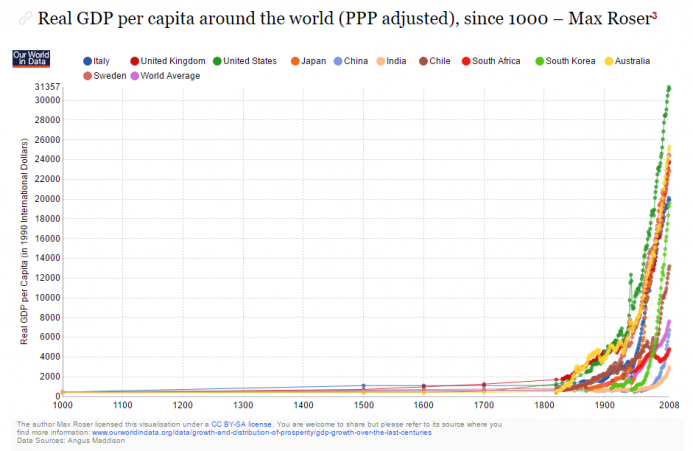
Finally, there’s the hockey stick of human prosperity. Estimates of GDP per capita on a global, millennial scale reveal a recent dramatic turn.

rgdp-per-capita-since-1000

The inflection point coincides with the industrial revolution. Embracing the productivity of steam-powered capital goods and other technologies sparked a revolution in human well-being across the globe. Since then, new sources of energy have been harnessed and computers entered the scene. Now, computers across the world are connected through the internet and have been made small enough to fit in our pockets. Goods, services, and ideas zip across the globe, while human productivity increases beyond what anybody could have imagined just 50 years ago.

I don’t think Malthus himself would be a Malthusian if he could see the world today.

Jonathan Newman is a recent graduate of Auburn University and a Mises Institute Fellow. Contact: email

This article was published on Mises.org and may be freely distributed, subject to a Creative Commons Attribution United States License, which requires that credit be given to the author.

Horror: Pirate Contacts Lenses! – Article by Andrew Quinlan

Horror: Pirate Contacts Lenses! – Article by Andrew Quinlan

The New Renaissance Hat
Andrew Quinlan
******************************

This Halloween, scores of consumers have purchased nearly 100,000 pairs of “counterfeit, illegal, and unapproved” colored contacts for costumes, all of which have been seized by “Double Vision,” an FDA-led consumer safety campaign.

Not surprisingly, optometrists and their favored lens manufacturers like Johnson & Johnson are using this news hook as a means of inciting fear. They are now stepping on the gas of their congressional lobbying efforts so that their bill, The Contact Lens Consumer Health Protection Act (CLCHPA), is passed into law.

The CLCHPA’s objective is to rid the country of the free market reforms brought about by The Fairness in Contact Lens Consumer Act (FCLCA), a 2003 bill that opened the contacts lens industry to free market competition for the first time.

Before the passage of this bill, eye patients had virtually no rights, while optometrists had almost total control over the sale of contact lenses. Doctors were not obligated to give patients copies of their prescriptions. As a result, they could mandate specifically where patients were allowed to purchase lenses. This usually meant that consumers had no choice but to purchase Johnson & Johnson’s Acuvue lenses—eye doctors’ favored brand—directly from optometrists at inflated retail costs.

The Republican-controlled Congress’ 2003 FCLCA legislation stopped this government-created monopoly by enforcing consumer rights. It forced doctors to give patients copies of their prescriptions and gave them only an 8-hour window to file complaints regarding third-party sale requests, halting the process of “pocket vetoing” valid sales.

As a result, consumers were left with far more buying options. With barriers to entry significantly curtailed, third-party lens sellers like Walmart, Costco, and 1-800 Contacts had a much easier time selling contacts. This, in turn, led prices for contact lenses to spiral downward, allowing over 41 million Americans to purchase more than $7 billion worth of contact lenses every year.

Eye Safety?

Enraged, optometrist associations and contact lens vendors like Johnson & Johnson immediately began lobbying Congress to change the law. For the past decade, they have been claiming that these third-party vendors are jeopardizing the eye safety of millions of Americans. Specifically, they have expressed concern that these lenses pose a risk of developing keratitis, an eye infection affecting the cornea.

For these reasons, members of the medical lobby drafted the CLCHPA, a new bill that will greatly increase regulations in the contact lens industry, making it extremely difficult for third-party lens vendors to stay in business.

The bill is a solution in search of a problem. It will re-capture the contact lens industry and propel prices upwards, all while failing to increase safety even the slightest degree.

It is ridiculous that some doctors are correlating buying contact lenses from reputable third-party companies like Costco, Walmart, and 1-800 Contacts with purchasing them illegally from a Halloween street vendor.

For one, the lenses sold by third-party sellers are federally regulated. You still need a prescription to purchase contact lenses from online sellers (although numerous studies, as well as practices in other nations, have shown that even prescriptions are not necessary), and doctors still have the ability to strike down each sale if there is a legitimate health concern.  

In a letter written to the CLCHPA’s authors, Dr. Paul B. Donzis, a professor of ophthalmology at UCLA, made clear that buying contacts from online sellers poses no danger.  “Based on…authoritative scientific articles, it appears that online sales of contact lenses have not contributed to any increase in the incidence of contact lens related injury,” he said.

Moreover, the medical studies match the doctor’s rhetoric. A 20-year epidemiologic study conducted by Doctors  Schein, Stapleton, and Keay, published in 2007 by the medical journal Eye & Contact Lens, found that there has not been any increase in microbial keratitis since the online contact industry sprouted up and began providing more and better affordable choices for consumers.

The empirical data is as clear as day: no one is at risk from purchasing lenses from third-party contact lens vendors. The only risk that third-party vendors pose is to the market share of the crony medical lobby.

This Halloween, Congress should not be duped by the false claims coming from the mouths of the medical lobby. Congress is tricked often enough. This time, they should give American families a treat by reading through these prominent medical studies and striking down the anti-consumer Contact Lens Consumer Health Protection Act (CLCHPA) once and for all.

quinlan

Andrew Quinlan

Andrew F. Quinlan is co-founder and president of the Center for Freedom and Prosperity (@CFandP).

This article was originally published on FEE.org. Read the original article.

Your Problem with Gays or Guns Is Not Political – Article by Robin Koerner

Your Problem with Gays or Guns Is Not Political – Article by Robin Koerner

The New Renaissance Hat
Robin Koerner
******************************

Not too long ago, perhaps as a rite of passage before becoming a new American, I did something I’d done only once before: I went to a range and shot some guns. Lots of guns. All shapes, ages, and sizes.

For a guy born British, such a thing feels very strange – because guns feature nowhere in British culture.

Accordingly, I was unsurprised by the reaction of my mother when I called home and told her that I’d had a great time learning about firearms and discovering I wasn’t a bad shot, even with a second-world-war Enfield. “That’s the last thing I’d ever imagine you’d enjoy doing,” she said to me. She wasn’t being judgmental: it was an expression of genuine surprise.

“That’s because you just can’t imagine why nice or normal people would enjoy guns … because you don’t know any … no Brits know any,” I replied.

Mom thoughtfully agreed.

Many decent people who have no interest in guns simply can’t imagine what it must be like to be someone who is passionate about something whose primary purpose is to kill people. Although the gun debate is waged using words, logic, and fact (to different ends by both sides of course), the arguments constructed using these three tools are not what brings people to their pro- or anti-gun position. Rather, most people are emotionally or intuitively committed to a position first, and deploy these tools retroactively in defense of their position. Despite what we like to think, most, if not all, of our political views come about this way. Studies show, time and time again, that David Hume was right, when he claimed,

And as reasoning is not the source, whence either disputant derives his tenets; it is in vain to expect that any logic, which speaks not to the affections, will ever engage him to embrace sounder principles.

Do You Want to Kill People?

What most anti-gun people are really feeling (rather than thinking) is that there has to be something strange about you if you like guns. I mean, why would you like by something whose primary purpose is to kill people? If you do, you can’t be like me. You are sufficiently different that I am suspicious of your worldview or your motives or both. You are culturally “other.”

Productive engagement, and the pervasive acceptance of individual rights, involves bridging such cultural gaps. With the gun-rights issue, as with all others, the best way to bridge such gaps is the same way all forms of cultural segregation (because that is what we are really talking about) have been permanently broken down over time: get to know, and spend personal time with, those on the other side of the gap.

It works both ways. People who favor more gun regulation are not actually motivated by taking away your liberty. And people who favor robust Second Amendment protections do not have a higher threshold for the acceptance of violence or aggression. You’ll know this when you have them as friends, and having such friends causes the all-or-nothing arguments that make such dramatic claims about the fundamental differences between you and the people on the other side of the issue to cease to be credible.

This mistaking of differences of cultural identity for political differences, or, the erroneous idea that political differences drive different cultural identities, rather than the other way around, severely hobbles our ability to protect all of our liberties and empowers political partisans who have a vested interest in maintaining power by keeping us insolubly divided.

The Rise of Subcultures

Just as gun owners form a kind of (albeit highly porous) sub-culture, the LGBT community does too. Some people who have been brought up in a socially conservative or religious subculture simply can’t imagine even wanting to do (let alone actually doing) the things that those in another subculture (LBGT) do as a matter of course. Again, if I can’t even imagine your experience or desires, then we are deeply culturally separated. Just as gun-control advocates feel a twinge of disgust, or at least condescension, toward the culture of gun owners, some of our religious friends feel similarly about the LBGT subculture.

“Disgust” is of course a very strong word, and most of us sublimate it deeply, but it captures the sense that the division among our “political” subcultures is more visceral than rational. Reason is applied later to justify in the conscious mind the position that the subconscious makes us emotionally comfortable with.

Now, I have, or certainly used to have, a distinctly conservative streak when it comes to the raising of children, and I have an instinctive respect for any political position that is genuinely motivated by requiring adults to do the best by the children whom they create. I can understand, then, the real discomfort of those who sincerely believe that children benefit from having male and female role-models at home, and that society should be very wary of sanctioning anything that does not place the well-being of children above the proclivities of their parents.

However, two of my friends – and two of the kindest and most responsible people I know – happen to be gay partners who adopted a(n American-born) daughter. Phil and Michael are giving their adopted daughter a wonderful life. Their love for her is boundless. The security, values, and richness of experience that they are providing her will set her up forever. And the gap between the life that Mia Joy has and that which she would otherwise have makes the general question “Should gay couples should be able to adopt” sound something between silly and faintly insulting when applied to this particular, inspiring case.

I am blessed with close gay friends with whom I identify as much as I do with many of my straight friends. So for me, the question of gay marriage and adoption, for example, is not so much a political argument that needs logical “deciding,” but the very intuition of the existence of some gay “other” on which the very argument depends has disappeared. As that cultural gap is bridged through actual human relationship, the separateness of that “other group,” on which any suspicion I may have of their motivations depends, ceases to exist.

I’ve had many gay friends for many years. And now I am getting many gun-owning friends too. And because they are all good people (they’d not be my friends otherwise, would they?), I see both groups as doing essentially the same thing when they defend their rights – insisting on being allowed to be themselves, and defend the validity of the way they experience the world – as long as they harm no one else.

But That’s Wrong

Of course, if you’re reading this and you don’t like guns, you’re thinking, “That’s wrong. Guns harm people.” Not in the hands of my friends, they don’t. And if you’re reading this and you don’t like gays, you’re thinking, “That’s wrong. Gay adoption is bad for the children.”

Not by my friends, it isn’t.

If I were going to take a stand against gay adoption, I would have to imagine saying to Phil and Mike, “You should not be allowed to what you have done for Mia Joy, and I would use the force of law to stop you.” Even if I could make an abstract political argument against gay adoption, I cannot say that to them in good conscience. And if I were going to take a stand against my open-carrying friend, Rob, I’d have to imagine saying to him, “You should not be allowed to own that to protect your family – or to protect your country against a tyrannical state, should it ever come to that, and I would use the force of law to stop you.” Even if I could make an abstract political argument against private gun ownership, I could not say that to him in good conscience.

Friendship

By becoming friends with Phil and Mike, and with Rob, their respective subcultures cease to be alien to me.

The truth is that, because I know Rob as a grounded, kind man, I also know that the rest of us are better off when people like him have a few of the guns – rather than their all being in the hands of our political masters. And because I know Phil and Michael as being rather like Rob in those respects, I simply know that the rest of us are better off when people like them have a few of America’s children.

And there’s not a political argument in sight.

You’ll appreciate my delight, then, when, during my day at the range with Rob, he told me that his local organization in defense of the second amendment accepted the open offer made by the organizers of his city’s annual gay pride event to support them by marching with them. The two groups have now formed an ongoing alliance, reflecting the fact, of course, that they are really doing the same thing: protecting the right of people to do anything they want for people they love as long as they harm no one else.

That’s when you know that you really care about liberty: the excitement of marching in support of someone who wants to protect and celebrate their freedom overcomes your “cultural discomfort” (should you have any) with what they want to do with it.

If we can challenge ourselves by focusing as much on nurturing our human connection with our political opponents by relating to them as people, we’d discover a wonderful paradox: we’d all feel, from our opposed initial positions, increased success in getting our opponents to see the world our way.

Dissolving Political Differences

How is that possible?

It’s possible because collapsing the subcultural divides in our society through actual human relationship does something bigger and better than resolving our political differences: it dissolves them. It dissolves them because it reveals that much of what we thought were differences of political principle are really rationalizations of the suspicion we feel toward those whose experiences and pleasures we simply cannot imagine sharing.

As in history, so in psychology: culture precedes politics.

Robin Koerner is British born, and recently became a citizen of the USA. A decade ago, he founded WatchingAmerica.com, an organization of over 200 volunteers that translates and posts in English views about the USA from all over the world.

Now, as a political and economic commentator for the Huffington Post, Independent Voter Network, and other outlets, Robin may be best known for having coined the term “Blue Republican” to refer to liberals and independents who joined the GOP to support Ron Paul’s bid for the presidency in 2011/12 (and, in so doing, launching the largest coalition that existed for that candidate).

Robin’s current work as author of the book, “If You Can Keep It”, a trainer and a consultant, focuses on bringing people together across political divisions, with a view to winning supporters for good causes, rather than just arguments. He is driven by the conviction that more unites us as people and as Americans than divides us as partisans, and if we can find common ground and understand the forces that really drive political change, then “We the People” will be able to do what the Founders implored us to do – maintain our natural rights against power and its abuse. As he says, people and their well-being are the only legitimate ends of politics.

This article was originally published on FEE.org. Read the original article.

UNITY Biotechnology Raises $116M for Senescent Cell Clearance Development – Article by Reason

UNITY Biotechnology Raises $116M for Senescent Cell Clearance Development – Article by Reason

The New Renaissance HatReason
******************************

The whispers of late have had it that UNITY Biotechnology was out raising a large round of venture funding, and their latest press release shows that this was indeed the case. The company, as you might recall, is arguably the more mainstream of the current batch of startups targeting the clearance of senescent cells as a rejuvenation therapy. The others include Oisin Biotechnologies, SIWA Therapeutics, and Everon Biosciences, all with different technical approaches to the challenge. UNITY Biotechnology is characterized by a set of high profile relationships with noted laboratories, venture groups, and big names in the field, and, based on the deals they are doing, appear to be focused on building a fairly standard drug development pipeline: repurposing of apoptosis-inducing drug candidates from the cancer research community to clear senescent cells, something that is being demonstrated with various drug classes by a range of research groups of late. Senescent cells are primed to apoptosis, so a nudge in that direction provided to all cells in the body will have little to no effect on normal cells, but tip a fair proportion of senescent cells into self-destruction. Thus the UNITY Biotechnology principals might be said to be following the standard playbook to build the profile of a hot new drug company chasing a hot new opportunity, and clearly they are doing it fairly well so far.

UNITY Biotechnology Announces $116 Million Series B Financing

Quote:

UNITY Biotechnology, Inc. (“UNITY”), a privately held biotechnology company creating therapeutics that prevent, halt, or reverse numerous diseases of aging, today announced the closing of a $116 million Series B financing. The UNITY Series B financing ranks among the largest private financings in biotech history and features new investments from longtime life science investors ARCH Venture Partners, Baillie Gifford, Fidelity Management and Research Company, Partner Fund Management, and Venrock. Other investors include Bezos Expeditions (the investment vehicle of Jeff Bezos) and existing investors WuXi PharmaTech and Mayo Clinic Ventures. Proceeds from this financing will be used to expand ongoing research programs in cellular senescence and advance the first preclinical programs into human trials.

The financing announcement follows the publication of research that further demonstrates the central role of senescent cells in disease. The paper, written by UNITY co-founders Judith Campisi and Jan van Deursen and published today, describes the central role of senescent cells in atherosclerotic disease and demonstrates that the selective elimination of senescent cells holds the promise of treating atherosclerosis in humans. In animal models of both early and late disease, the authors show that selective elimination of senescent cells inhibits the growth of atherosclerotic plaque, reduces inflammation, and alters the structural characteristics of plaque such that higher-risk “unstable” lesions take on the structural features of lower-risk “stable” lesions. “This newly published work adds to the growing body of evidence supporting the role of cellular senescence in aging and demonstrates that the selective elimination of senescent cells is a promising therapeutic paradigm to treat diseases of aging and extend healthspan. We believe that we have line of sight to slow, halt, or even reverse numerous diseases of aging, and we look forward to starting clinical trials with our first drug candidates in the near future.”

So this, I think, bodes very well for the next few years of rejuvenation research. It indicates that at least some of the biotechnology venture community understands the likely true size of the market for rejuvenation therapies, meaning every human being much over the age of 30. It also demonstrates that there is a lot of for-profit money out there for people with credible paths to therapies to treat the causes of aging. It remains frustrating, of course, that it is very challenging to raise sufficient non-profit funds to push existing research in progress to the point at which companies can launch. This is a problem throughout the medical research and development community, but it is especially pronrounced when it comes to aging. The SENS view of damage repair, which has long incorporated senescent cell clearance, is an even tinier and harder sell within the aging research portfolio – but one has to hope that funding events like this will go some way to turn that around.

From the perspective of being an investor in Oisin Biotechnologies, I have to say that this large and very visible flag planted out there by the UNITY team is very welcome. The Oisin team should be able to write their own ticket for their next round of fundraising, given that the gene therapy technology they are working on has every appearance of being a superior option in comparison to the use of apoptosis-inducing drugs: more powerful, more configurable, and more adaptable. When you are competing in a new marketplace, there is no such thing as too much validation. The existence of well-regarded, well-funded competitors is just about the best sort of validation possible. Well-funded competitors who put out peer-reviewed studies on a regular basis to show that the high-level approach you and they are both taking works really well is just icing on the cake. Everyone should have it so easy. So let the games commence! Competition always drives faster progress. Whether or not I had skin in this game, it would still be exciting news. The development of rejuvenation therapies is a game in which we all win together, when new treatments come to the clinic, or we all lose together, because that doesn’t happen fast enough. We can and should all of us be cheering on all of the competitors in this race. The quality and availability of the outcome is all that really matters in the long term. Money comes and goes, but life and health is something to be taken much more seriously.

Now with all of that said, one interesting item to ponder in connection to this round of funding for UNITY is the degree to which it reflects the prospects for cancer therapies rather than the prospects for rejuvenation in the eyes of the funding organizations. In other words, am I being overly optimistic in reading this as a greater understanding of the potential for rejuvenation research in the eyes of the venture community? It might be the case that the portions of the venture community involved here understand the market for working cancer drugs pretty well, and consider that worth investing in, with the possibility of human rejuvenation as an added bonus, but not one that is valued appropriately in their minds. Consider that UNITY Biotechnology has partnered with a noted cancer therapeutics company, and that the use of drugs to inducing apoptosis is a fairly well established approach to building cancer treatments. That is in fact why there even exists a range of apoptosis-inducing drugs and drug candidates for those interested in building senescent cell clearance therapies to pick through. Further, the presence of large numbers of senescent cells does in fact drive cancer, and modulating their effects (or removing them) to temper cancer progress is a topic under exploration in the cancer research community. So a wager on a new vision, or a wager on the present market? It is something to think about.

Reason is the founder of The Longevity Meme (now Fight Aging!). He saw the need for The Longevity Meme in late 2000, after spending a number of years searching for the most useful contribution he could make to the future of healthy life extension. When not advancing the Longevity Meme or Fight Aging!, Reason works as a technologist in a variety of industries.
***
This work is reproduced here in accord with a Creative Commons Attribution license. It was originally published on FightAging.org.
If the Word “Liberal” Is Up for Grabs, Can We Have It Back? – Article by Jeffrey A. Tucker

If the Word “Liberal” Is Up for Grabs, Can We Have It Back? – Article by Jeffrey A. Tucker

The New Renaissance Hat
Jeffrey Tucker
******************************

A spectacular column in The New York Times by novelist Lionel Shriver makes the point. The new literary and academic establishment in the humanities has become so illiberal, particularly in its preposterous condemnation of “cultural appropriation,” that even the word liberal itself is falling out of fashion.

It’s so bad that Shriver was denounced and condemned for arguing that it is just fine for novelists to write characters into their work that are not of the same cultural, racial, and demographic background of the writer. Not very controversial, right?

Explosion followed. Yes, that’s how bad it’s gotten out there. The literary habit that built civilization, the musical tactic that brought us the Nutcracker and Carmen, the technological tendency that build modernity from the Middle Ages to the present, the political rhetoric that ended slavery and emancipated women, the artistic strategy that has brought the world together in mutual understanding and in unprecedented ways, now stands condemned as the micro-aggression of cultural appropriation.

She writes:

How did the left in the West come to embrace restriction, censorship and the imposition of an orthodoxy at least as tyrannical as the anti-Communist, pro-Christian conformism I grew up with? Liberals have ominously relabeled themselves “progressives,” forsaking a noun that had its roots in “liber,” meaning free. To progress is merely to go forward, and you can go forward into a pit.

Protecting freedom of speech involves protecting the voices of people with whom you may violently disagree. In my youth, liberals would defend the right of neo-Nazis to march down Main Street. I cannot imagine anyone on the left making that case today.

It’s right. The people who stole the word liberal  – gradually circa 1900-1933 – seem to be in the process of tossing out the last modicum of respect for liberty they had even as recently as ten years ago. If you are considered a thief for showing appreciation for other cultures, learning from people unlike yourself, using art and literature to draw attention to certain human universals, there is really nothing left of liberty.

If these are your views, you really should relinquish the word liberal. And the truly great thing is that this is happening right now thus leaving it, perhaps, to be reappropriated by actual lovers of liberty.

Do Not Talk about Beyoncé’s Lemonade!

I experienced the intolerance for disruptive ideas earlier this year in the strangest way. Beyoncé’s Lemonade – a feature-length pop operetta about betrayal and forgiveness –  had just come out. I devoured it, was challenged by it, learned from it, and found themes within it that I was ready to write about: particularly the Hayekian themes I found in the work.

However, just as I started putting together my thoughts, the Internet filled up with dire warnings: if you are a white man, do not write about Beyoncé’s Lemonade!

I can’t write about Beyoncé’s Lemonade? Really? Why not? Because it is a story about the experience of black women in America, and it would be disrespectful to appropriate this experience and this art to serve your own private desire to interpret the work.

Others took a more moderate position: do not yet write about Beyoncé’s Lemonade. Give it a few days, a few weeks, a few months, so as to allow women of color to at least have the first chance to comment and write.

Now, I can’t say I was entirely intimidated to silence by this demand. However, I did hesitate, maybe briefly perceiving some plausibility to the claim. It makes some sense that the intended audience would become the dominant voice of interpretation. I’m ok with that, but would my adding my voice somehow prohibit this? I doubt it, seriously.

Still, I was thinking. So I let it go. The next day, I actually asked a “woman of color” who is a friend, and she said, “that’s the dumbest thing I’ve ever heard. I want to know what you as a white man have to say about this!” That was cool, but I felt the moment passing.

Did I really relish hurling myself into the meat grinder of leftist fanaticism, being condemned as a racist cultural appropriator because I dared to say something about Beyoncé’s Lemonade? Not much. It is always easier not to speak than to speak.

As I look back, this was a mistake on my part, but it does illustrate how illiberalism and dogmatic demands to keep your thoughts to yourself can have a chilling effect on public culture.

Who Is Against Freedom of Speech Today?

In the postwar period, the mantle of principle on the matter of free speech moved from left to right. Recall that William F. Buckley’s God and Man at Yale (1953) was essentially an argument against academic freedom. It said that leftists were invoking this principle to advocate for ideas (atheism and Keynesianism) that contradict the values of the donating alumni to Yale itself. It was due to this erudite but essentially illiberal treatise that the postwar right gained the impression of being “anti-intellectual.”

What a difference sixty years make. Today the organizations most passionately for academic freedom and freedom of speech are the Young Americans for Liberty, the Students for Liberty, and the Foundation for Individual Rights in Education – three organizations that, rightly or wrongly, are considered to be on the right side of the political debate. At this very time, the other side has developed a kind of allergy to the demand for free speech. Everyone is triggered by everyone else.

Around the same time, Leonard Read and his circle deeply regretted the loss of the term liberal. With some reservations and lingering doubts, they revived the term libertarian as a substitute. It was supposed to be a synonym. But IMHO, it’s not nearly as good because it lacks the history, the broadness of mind, the high aspiration for society as a whole.

The True Meaning of Liberal

There really is only one way forward. That is the way offered by the liberal tradition – a tradition variously and pragmatically sampled by the left and the right but not really believed in full by either. After all, if your ambition is to control society, you can’t really claim the mantle.

It’s a beautiful thing that the word itself seems to have been abandoned by all modern political players, who prefer other terms. Fine. Liberalism has the most brilliant heritage in every language. It means individual rights, freedom of expression and enterprise and association, suspicion of government, and a confidence that society can organize itself better on its own without any institution making and enforcing a central plan.

Liberalism built civilization. It makes sense that the word would be abandoned when the dominant players in politics today have every interest in tearing it down by circumscribing freedom. But therein lies an opportunity.

In 2015 I made a commitment to stop using the term liberal in a derogatory way. I think I’ll complete this year by committing to using it in a completely positive way. Will you join me? We might be the only self-described liberals in the United States, and, perhaps then, we can make a contribution to regaining the term’s true meaning.

Or we might just say, reappropriate it.

Jeffrey TuckerJeffrey Tucker

Jeffrey Tucker is Director of Content for the Foundation for Economic Education and CLO of the startup Liberty.me. Author of five books, and many thousands of articles, he speaks at FEE summer seminars and other events. His latest book is Bit by Bit: How P2P Is Freeing the World.  Follow on Twitter and Like on Facebook. Email. 

This article was originally published on FEE.org. Read the original article.

Canadians Confused by the Correct Use of the Term “Liberal” – Article by Jeffrey A. Tucker

Canadians Confused by the Correct Use of the Term “Liberal” – Article by Jeffrey A. Tucker

The New Renaissance Hat
Jeffrey Tucker
******************************

The Canadian Broadcasting Corporation has been following the political upheavals in the US with some curiosity. In light of this piece, they called me to discuss where the Republican ticket is representing capitalism well. In the course of the interview, I described myself as a fan of commercial society, free enterprise, deregulation, and therefore a classical liberal. I said later that I’m a radical liberal.

Much to the amazement of the producers, it was this section of the interview (which was heard by more than a million people) that caused the biggest response. They were flooded with comments of confusion. Why does this guy call himself a liberal?

The producers were intrigued enough to do an entire segment on the topic, the results of which were interesting and substantial. Of course the topic is complex because the meaning of the word has changed so much in the last 100 years. The corruption of the term became so intense following World War II that the leftover liberals had to change their name to libertarians.

And today matters are in flux. In Eastern Europe and large parts of Latin America, the term is used correctly. In Europe, it is a mix. In the UK, the word liberal is coming back as a description of people who celebrate commercial society, favor peace, support civil liberties, and reject big government. In the US, the term has been left on the table, but is still mostly associated with the opposite of its traditional meaning.

The result of the CBC’s investigative efforts are as follows.

On last week’s episode of The 180, we spoke with Jeffrey Tucker, a self-described ‘classical liberal.’ He argued Donald Trump is giving capitalism a bad name, by presenting himself as a titan of industry, when he’s really more of an entertainer.

After that interview, we received notes from people questioning Tucker’s bona-fides as a ‘liberal,’ since he spoke highly of individual liberties, free markets, and limited government. Some said Tucker was clearly a ‘neo-liberal,’ some said he was a ‘large R conservative,’ presumably meaning Republican, while others thought the term ‘classical liberal’ had plenty of negative connotations all on its own.

So what is a classical liberal?

First off, you should totally click the play button on this page to hear the audio explainer. It’s got all kinds of fun music and clips of people using the word ‘liberal’ in weird and hilarious ways. Like when Rush Limbaugh said the Soviet Union and Cuba and China were run by ‘liberals.’ Weird.

Part of the problem with the word ‘liberal’ is it’s used differently across time, and across countries. In Canada, the word mostly means a supporter of the Liberal Party, or someone in the political middle. In the United States, it means a strong social progressive, and in some circles can mean a socialist or a communist. In Europe it’s associated with internationalism and free migration. In Australia, in the words of Australian Liberal Party leader Malcolm Turnbull, it means the primacy of “freedom, the individual, and the market.” 

That last one, the Australian definition, is probably closest to what political scientists consider a classical liberal view.

John Locke

If you want to get what classical liberalism is, and where liberalism as an ideology comes from, you gotta know about this guy, John Locke. 

Locke was an English philosopher who lived in the 17th century, and one of the most important people in the development of liberalism, both classical and modern, according to Barbara Arneil, Professor of Political Science at the University of British Columbia.

“In essence what he introduced to the political lexicon was the idea of individual rights. He said individuals have rights by nature, and if the government does not serve those rights, then the people could get together and reject the government. So in essence, this idea of individuals and their rights begins the notion that the government is answerable to individual people.”

This was still a time of kings and emperors and lords and barons, so Locke’s ideas were rather significant. And these liberal ideas influenced a good deal of western society, including the founding documents of the United States of America.

“Thomas Jefferson drew a lot of his philosophy from John Locke. He saw him as the greatest political thinker. So there’s a lot of Locke in the American Declaration of Independence. On the economic side, Locke was also somebody who developed the idea of the right to private property. So we have both the political and economic repercussions and we see them right around the world. All the bills of rights, really originate with Locke’s original idea.” 

So if someone says they’re a classical liberal as opposed to modern liberal, they’re probably more in line with Locke’s original sentiments.

Times change, so do words, and so do ideas

At some point, liberalism shifted from its emphasis on individual liberties, to include regulating business, and using the government to support individuals, rather than simply leaving them alone. According to Lee Ward, Associate Professor of Politics and International Studies at the University of Regina, the shift is part of the industrial revolution throughout the 18th and 19th centuries.

“The term liberalism takes on a new kind of meaning, politically. Sometimes called ‘welfare liberalism. At that point, liberalism is accommodating the new demands produced by industrialization. So classical liberals in the 17th century were talking about an economy that was very rudimentary compared to what we have today. A bank in the 17th century doesn’t mean the same thing as a bank in the 20th century. So by the time you get to the 20th century, liberalism has changed.”

To Barbara Arneil at UBC, it’s not simply that the definition of liberalism changed, it’s that over time, some people changed their conception of ‘freedom’. Whereas classical liberals think of liberty as being free from interference, modern liberalism considers whether the government can support people in society to freely pursue their goals.

“I think the thread that remains throughout all liberal thought is the idea of the individual and their freedom. So initially, freedom is understood as being free of restraints. But now we have a different definition of freedom, and it’s about  having the necessary supports to have freedom that has any meaning.”

The concepts of liberalism, both classical and modern, are political philosophies and ideologies not specific political affiliations, and these concepts, among others, influence parties across the Canadian spectrum.

Labels and insults

In the United States, ‘liberal’ is often used as an epithet. To some degree, the terms ‘neo-liberal’ or ‘social conservative’ or ‘socialist’ are also used as negative descriptors in Canada. 

To Ward, it’s not particularly helpful to use philosophical terminology as a pejorative, or to try and sum up a person’s character or values with a snippy line about liberals, conservatives, socialists, or anarchists.

“I worry that sometimes we throw out terminology as weapons, as rhetorical jabs. Understand that behind all of the different perspectives and ideologies, there’s some claim to justice there. And even if I disagree in large measure with much of what’s being said, there’s is some truth that is being expressed. There’s something good in it. As good as it is to be engaged in politics and to really care about what’s happening, it’s also good to step back sometimes and to understand that when we use terms like conservative, liberal, progressive, socialist, they’re all reflecting a certain claim to justice, and there’s probably something in each of those that we can agree with.”

According to Ward, if we could understand that behind all the terms we throw around to describe people, there is a rich intellectual history, we could have more respectful and constructive political debate.

Jeffrey Tucker

Jeffrey Tucker

Jeffrey Tucker is Director of Content for the Foundation for Economic Education and CLO of the startup Liberty.me. Author of five books, and many thousands of articles, he speaks at FEE summer seminars and other events. His latest book is Bit by Bit: How P2P Is Freeing the World.  Follow on Twitter and Like on Facebook. Email. 

This article was originally published on FEE.org. Read the original article.

The Bad Economics Behind “Monopoly” – Article by Chris Calton

The Bad Economics Behind “Monopoly” – Article by Chris Calton

The New Renaissance Hat
Chris Calton
******************************

In 1868, a young Henry George wrote an editorial on the nearly completed Pacific Railroad that was soon to connect his state of California with the rest of the country. This editorial, “What the Railroad Will Bring Us,” acknowledged the progress that railroads would signify in the industrializing economy of the Gilded Age, but George saw this as a boon only for the privileged few. Like many thinkers of his time, he was concerned with the “labor question,” which he referred to as one of “the riddles of a Sphinx, which not to answer is death.” Why was there poverty in an age of economic expansion?

Henry George believed that he figured out the riddle after a horseback ride in Oakland Hills, California. While stopping to give his horse a drink of water, George engaged in polite conversation with a farmer, casually asking the value of the land around him. The farmer told him of some land for sale nearby for $1,000 per acre. With this thought in mind, George concluded that land values would inevitably rise as the population grew, and speculators — that economic specter historians love to fear — could own land unproductively to profit merely off its natural increase in value. This, George decided, was the reason why there was poverty in a progressing economy.

In 1879, George published the book Progress and Poverty, formally laying out this conundrum and his answer to it. In it, he detailed for the first time his “Single Tax Plan” that proposed to tax land in proportion to its increase in value, which he believed would lead to the end of property rights in land entirely.

Apparently, George’s idea hit home with a lot of people at the time. His book outsold every book the year it was published except for the Bible, and a movement to form “Single Tax Clubs” spread throughout the country and beyond. Henry George became a Gilded Age rockstar.monopoly1

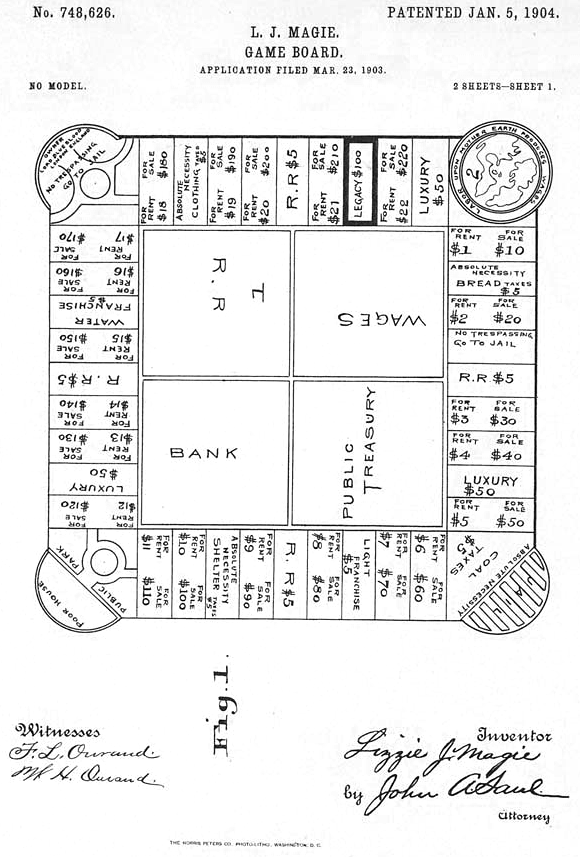
Among his followers was a woman named Elizabeth Magie. She believed that George’s land value tax plan was the solution to economic woes, and she wanted to bring this idea to as many people as she could. To do this, she developed The Landlord’s Game. This board game intended to demonstrate the horrors of land accumulation and rent, and to illustrate the benefit of George’s Single Tax Plan.

The original game, patented in 1904, closely resembles the modern game of Monopoly, that would later evolve out of it. Players started in a square that said “Labor Upon Mother Earth Produces Wages.” As the original rules state, “Each time a player goes around the board he is supposed to have performed so much labor upon Mother Earth, for which after passing the beginning-point he receives his wages, one hundred dollars, and is checked upon the tally-sheet as having been around once.”

Most of the squares look at least somewhat familiar. Many gave sale prices and rent costs, not unlike modern monopoly. This was explicitly meant to illustrate the belief that land rent transactions were involuntary, a notion that Benjamin Powell has already addressed. The railroads are also present, representing “transportation, and when a player stops upon one of these spaces he must pay five dollars to the ‘R.R.’” Less familiar squares demonstrated the horrors of private property rights by saying “No Trespassing. Go to Jail” from which the more ambiguous “Go Directly to Jail” corner would evolve in the modern game.

cal2

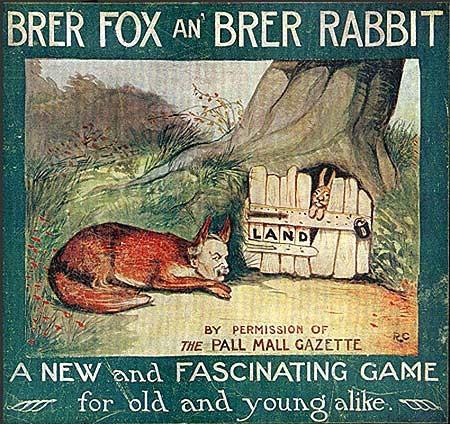
In 1913, a version of the game was picked up in Britain called Brer Fox an’ Brer Rabbit, taking the name from the African fables of Brother Fox and Brother Rabbit (the native language of African slaves lacked the diphthong syllable, so the word “brother” was pronounced “br’er” when told in English). In this, the clever Br’er Rabbit represented the wily landowner earning his immoral rents. The pesky Br’er Fox was meant to represent British reform leader David Lloyd George, who was of no relation to Henry George but was a strong supporter of his land value tax. In 1909, Lloyd George came up with the “People’s Budget” which instituted a version of Henry George’s land tax and planted the seeds for the British welfare state. His face is imposed on the figure of Br’er Fox on the original cover for the British game.

cal3

This version of the game was actually used to educate students about Henry George’s ideas in places like the University of Pennsylvania and Columbia. The Landlord’s Game and its British variant attempted to teach people the socialistic concepts that wages come from land, private property in land was immoral and destructive, and the economy is a zero-sum environment. The game evolved over time into the modern version Monopoly, whose invention is falsely credited to Charles Darrow.

Today, of course, the specifically Georgist elements have been removed from the game. There are no longer any “No Trespassing” squares, and what once was known as “The Poor House” where bankrupt players were forced to go upon running out of money is now the “Free Parking” square. The several “Absolute Necessity Taxes” across the board (perhaps the one aspect of the game’s educational commentary that libertarians could agree with) have been reduced to the Luxury and Income Tax squares. And of course, the unambiguously socialistic “Mother Earth” starting square became simply “Go.” Nonetheless, the modern variant retains the zero-sum myths of monopoly land accumulation, and in this, the legacy of Henry George is retained. If you’ve ever finished a game of monopoly with a frustrated player overturning the board and scattering the pieces, then it’s possible that Lizzie Magie accomplished her original goal.

Chris Calton is a Mises University alumnus and an economic historian. See his YouTube channel here.

This article was published on Mises.org and may be freely distributed, subject to a Creative Commons Attribution United States License, which requires that credit be given to the author.

Hurricane Matthew Has No Silver Lining – Article by Dan Sanchez

Hurricane Matthew Has No Silver Lining – Article by Dan Sanchez

The New Renaissance Hat
Dan Sanchez
******************************

Hurricane Matthew is barreling down on the southeast Atlantic coast. Sadly, the region is not only plagued by disastrous weather, but economic fallacies that compound the disaster. Like clockwork, outrage and policies against “price gouging” were the first to emerge.

For some intellectuals, common sense is for mere commoners.And now, just as predictably, the Broken Window Fallacy is emerging on the horizon. Discussion about the storm is playing out just like the famous parable of the broken window, created by Frederic Bastiat, and updated for modern audiences by Henry Hazlitt. In Hazlitt’s version of the parable, a youth throws a brick through the window of a bakery. Neighbors gather around to commiserate with the baker over his misfortune.

Similarly, decent people all over the country are sending their hearts out to the unfortunate people whose homes and businesses are in Hurricane Matthew’s path. The category 4 hurricane is sure to break a great many windows. In fact, in one video I saw, debris shattered a house’s window right behind an intrepid weather reporter as he was talking to the camera.

Of course, the damage will go far beyond broken windows. Entire houses and businesses will be flooded. Lives will be financially ruined. Some lives have already been lost entirely. It is only common sense to recognize such vast destruction as pure loss and misfortune.

But for some intellectuals, common sense is for mere commoners. They delight in using more sophisticated reasoning to arrive at contrarian conclusions, which they generously share with their ignorant, benighted brethren.

Taking Away Resources

In the parable, the clever ones among the crowd console the baker by pointing out the social good that will come from his private misfortune. As Hazlitt puts the argument:

How much does a new plate glass window cost? Three hundred dollars? That will be quite a sum. After all, if windows were never broken, what would happen to the glass business? Then, of course, the thing is endless. The glazier will have $300 more to spend with other merchants, and these in turn will have $300 more to spend with still other merchants, and so ad infinitum. The smashed window will go on providing money and employment in ever-widening circles. The logical conclusion from all this would be, if the crowd drew it, that the little hoodlum who threw the brick, far from being a public menace, was a public benefactor.

And now, this very morning, we have a USA Today writer playing this exact same role in the discussion of Hurricane Matthew. Paul Davidson consoles the storm’s victims as follows:

But hurricanes typically don’t harm a nation’s economic growth. And much of the losses in the region are later offset. Most damaged homes, businesses and infrastructure are repaired or rebuilt, generating economic activity. And at least some of the disruptions to retail and other businesses are made up in the following weeks and months as consumers release pent-up demand. (Emphasis added.)

The problem with Davidson’s analysis is the same problem that beset the 19th century writers whom Bastiat was lampooning when he wrote the broken window parable. Their clever contrarianism is more sophistical than sophisticated. As Bastiat put it, they only look at “the seen” and entirely neglect “the unseen.” The “unseen” is the opportunity cost of repairing damage. As is so often the case, sound economics vindicates common sense by giving the unseen its due regard. As Hazlitt wrote:

Now let us take another look. The crowd is at least right in its first conclusion. This little act of vandalism will in the first instance mean more business for some glazier. The glazier will be no more unhappy to learn of the incident than an undertaker is to learn of a death. But the shopkeeper will be out $300 that he was planning to spend for a new suit. Because he has had to replace a window, he will have to go without the suit (or some equivalent need or luxury). Instead of having a window and $300 he now has merely a window. Or, as he was planning to buy the suit that very afternoon, instead of having both a window and a suit he must be content with the window and no suit. If we think of him as part of the community, the community has lost a new suit that might otherwise have come into being, and is just that much poorer.

The glazier’s gain of business, in short, is merely the tailor’s loss of business. No new “employment” has been added. The people in the crowd were thinking only of two parties to the transaction, the baker and the glazier. They had forgotten the potential third party involved, the tailor. They forgot him precisely because he will not now enter the scene. They will see the new window in the next day or two. They will never see the extra suit, precisely because it will never be made. The see only what is immediately visible to the eye.

Indeed, we can consider even more “unseen” victims of the vandal. A new suit can be considered a consumption good. But what if the baker would have otherwise spent the $300 on a producer’s good? What if he would have used it to buy a new, more efficient oven? The need to repair the window would have prevented that investment: an investment that could have increased the amount of baked goods available to the community. All those consumers who would have benefited from that greater abundance would then have also suffered a loss.

Similarly, USA Today’s Davidson sees the “economic activity” generated by the repairing and rebuilding of homes, businesses, and infrastructure that will be damaged or destroyed by Hurricane Matthew. But he neglects the economic activity that would have created entirely new goods and services: activity now made impossible because the resources needed are tied up restoring old goods and services.

Hazlitt also deals handily with the counterargument that the replacements will be more modern and better than what was destroyed:

It is sometimes said that the Germans or the Japanese had a postwar advantage over the Americans because their old plants, having been destroyed completely by bombs during the war, could be replaced with the most modern plants and equipment and thus produce more efficiently and at lower costs than the Americans with their older and half-obsolete plants and equipment. But if this were really a clear net advantage, Americans could easily offset it by immediately wrecking their old plants, junking all the old equipment. In fact, all manufacturers in all countries could scrap all their old plants and equipment every year and erect new plants and install new equipment.

The simple truth is that there is an optimum rate of replacement, a best time for replacement. It would be an advantage for a manufacturer to have his factory and equipment destroyed by bombs only if the time had arrived when, through deterioration and obsolescence, his plant and equipment had already acquired a null or a negative value and the bombs fell just when he should have called in a wrecking crew or ordered new equipment anyway.

We do the victims of Hurricane Matthew no service by offering them false consolation. Sound economics, common sense, and common decency all arrive at the same conclusion: that natural disasters truly are disasters to those afflicted. And the victims deserve our unstinting sympathy and support.

dan-sanchez


Dan Sanchez

Dan Sanchez is Managing Editor of FEE.org. His writings are collected at DanSanchez.me.

This article was originally published on FEE.org. Read the original article.

Trump: The Moral Monster Beyond Hope – Post by G. Stolyarov II

Trump: The Moral Monster Beyond Hope – Post by G. Stolyarov II

The New Renaissance Hat
G. Stolyarov II
******************************

Two excellent recent editorials highlight the unprecedented danger that Donald Trump poses to liberty and basic human decency in America.

Nina Khrushcheva, great-granddaughter of Nikita Khrushchev, writes of how Donald Trump has brought Soviet-Style politics, particularly the sweeping use of the Big Lie, to the United States. (“Trump Through Russian Eyes”. Project Syndicate. September 27, 2016)

Khrushcheva observes,

Indeed, from my perspective, many of the nastiest and most perverse features of Russian politics now seem present in the United States as well. The Big Lie – invented in Nazi Germany, perfected in the Soviet Union, and wielded expertly by Russian President Vladimir Putin – is today a core component of Donald Trump’s presidential campaign.

***

So far, Trump has been allowed to get away with his lies. The news media have largely been what Lenin called ‘useful idiots,’ so eager to use Trump to boost their own ratings that they did not notice or care that they were also boosting his. No surprise, then, that an emboldened Trump now delivers lies of ever more breathtaking audacity.

Harvard political theorist Danielle Allen likens Donald Trump to Gilgamesh – and not in a flattering manner. (“Donald Trump is a walking, talking example of the tyrannical soul”. The Washington Post. October 8, 2016.) In the early “Epic of Gilgamesh”, the king Gilgamesh (before he journeys on his quest to obtain eternal life) is an arbitrary, capricious tyrant with no regard for any other individuals’ rights or for basic human dignity and decency. Only when Gilgamesh realizes that death is a fundamental problem affecting everyone (him, too), is he impelled away from tyranny and toward wisdom.

But it is too much to hope that Trump would all of a sudden turn from a populist demagogue and would-be tyrant into a life-extension supporter. Instead, Trump should be recognized as completely devoid of moral character, and a completely lost cause for anyone who thought that he might somehow magically transform himself into a reasonable person.

It is time to break free from the spell of the Big Lie and universally denounce Trump for the moral monster he is. All people of good moral character must stand against Trump. Support anyone else you wish (Libertarian, Democrat, Green, Transhumanist, McMullin, none of the above) – but express the conviction that a decent, humane society should not allow such an unseemly, tyrannical brute as Trump to have any degree of power.

This post may be freely reproduced using the Creative Commons Attribution Share-Alike International 4.0 License, which requires that credit be given to the author, G. Stolyarov II. Find out about Mr. Stolyarov here.