Fifteen Years Into the Afghan War, Do Americans Know the Truth? – Article by Ron Paul

Fifteen Years Into the Afghan War, Do Americans Know the Truth? – Article by Ron Paul

The New Renaissance HatRon Paul
******************************
Last week marked the fifteenth anniversary of the US invasion of Afghanistan, the longest war in US history. There weren’t any victory parades or photo-ops with Afghanistan’s post-liberation leaders. That is because the war is ongoing. In fact, 15 years after launching a war against Afghanistan’s Taliban government in retaliation for an attack by Saudi-backed al-Qaeda, the US-backed forces are steadily losing territory back to the Taliban.

What President Obama called “the good war” before took office in 2008, has become the “forgotten war” some eight years later. How many Americans know that we still have nearly 10,000 US troops in Afghanistan? Do any Americans know that the Taliban was never defeated, but now holds more ground in Afghanistan than at any point since 2001? Do they know the Taliban overran the provincial capital of Kunduz last week for a second time in a year and they threaten several other provincial capitals?

Do Americans know that we are still wasting billions on “reconstruction” and other projects in Afghanistan that are, at best, boondoggles? According to a recent audit by the independent US government body overseeing Afghan reconstruction, half a billion dollars was wasted on a contract for a US company to maintain Afghan military vehicles. The contractor “fail[ed] to meet program objectives,” the audit found. Of course they still got paid, like thousands of others getting rich off of this failed war.

Do Americans know that their government has spent at least $60 billion to train and equip Afghan security forces, yet these forces are still not capable of fighting on their own against the Taliban? We recently learned that an unknown but not insignificant number of those troops brought to the US for training have deserted and are living illegally somewhere in the US. In the recent Taliban attack on Kunduz, it was reported that thousands of Afghan security personnel fled without firing a shot.

According to a recent study by Brown University, the direct costs of the Iraq and Afghanistan wars thus far are nearly five trillion dollars. The indirect costs are virtually incalculable.

Perhaps Afghanistan is the “forgotten war” because to mention it would reveal how schizophrenic is US foreign policy. After all, we have been fighting for 15 years in Afghanistan in the name of defeating al-Qaeda, while we are directly and indirectly assisting a franchise of al-Qaeda to overthrow the Syrian government. How many Americans would applaud such a foreign policy? If they only knew, but thanks to a media only interested in promoting Washington’s propaganda, far too many Americans don’t know.

I have written several of these columns on the various anniversaries of the Afghan (and Iraq) wars, pointing out that the wars are ongoing and that the result of the wars has been less stable countries, a less stable region, a devastated local population, and an increasing probability of more blowback. I would be very happy to never have to write one of these again. We should just march home.

Ron Paul, MD, is a former three-time Republican candidate for U. S. President and Congressman from Texas.

This article is reprinted with permission from the Ron Paul Institute for Peace and Prosperity.

An Example of the Glaring Lack of Ambition in Aging Research – Post by Reason

An Example of the Glaring Lack of Ambition in Aging Research – Post by Reason

The New Renaissance HatReason
******************************

The mainstream of aging research, at least in public, is characterized by a profound lack of ambition when it comes to treating aging as a medical condition. Researchers talk about slightly altering the trajectory of aging as though that is the absolute most that is possible, the summit of the mountain, and are in many cases ambivalent when it comes to advocating for even that minimal goal. It is this state of affairs that drove Aubrey de Grey and others into taking up advocacy and research, given that there are clear paths ahead to rejuvenation, not just a slight slowing of aging, but halting and reversing the causes of aging. Arguably embracing rejuvenation research programs would in addition cost less and take a much shorter span of time to produce results, since these programs are far more comprehensively mapped out than are efforts to produce drugs to alter the complex operations of metabolism so as to slightly slow the pace at which aging progresses. It is most frustrating to live in a world in which this possibility exists, yet is still a minority concern in the research community. This article is an example of the problem, in which an eminent researcher in the field takes a look at a few recently published books on aging research, and along the way reveals much about his own views on aging as an aspect of the human condition that needs little in the way of a solution. It is a terrible thing that people of this ilk are running the institutes and the funding bodies: this is a field crying out for disruption and revolution in the name of faster progress towards an end to aging.

How can we overcome our niggling suspicion that there is something dubious, if not outright wrong, about wanting to live longer, healthier lives? And how might we pursue longer lives without at the same time falling prey to quasiscientific hype announcing imminent breakthroughs? In order to understand why aging is changing, and what this means for our futures, we need to learn more about the aging process itself. As a biologist who specializes in aging, I have spent more than four decades on a quest to do exactly this. Not only have I asked why aging should occur at all (my answer is encapsulated in a concept called disposability theory), but I have also sought to understand the fastest-growing segment of the population – those aged 85 and above. The challenges inherent in understanding and tackling the many dimensions of aging are reflected in a clutch of new books on the topic. Are these books worth reading? Yes and no. They take on questions like: Can we expect increases in human longevity to continue? Can we speed them up? And, on the personal level, what can we do to make our own lives longer and healthier? If nothing else, these books and their varied approaches reveal how little we actually know.

To find out more about factors that can influence our individual health trajectories across ever-lengthening lives, my colleagues and I began, in 2006, the remarkable adventure of the still ongoing Newcastle 85+ Study, an extremely detailed investigation of the complex medical, biological, and social factors that can affect a person’s journey into the outer reaches of longevity. For each individual, we determined whether they had any of 18 age-related conditions (e.g., arthritis, heart disease, and so on). Sadly, not one of our 85-year-olds was free of such illnesses. Indeed, three quarters of them had four or more diseases simultaneously. Yet, when asked to self-rate their health, an astonishing 78 percent – nearly four out of five – responded “good,” “very good,” or “excellent.” This was not what we had expected. The fact that these individuals had so many age-related illnesses fit, of course, with the popular perception of the very old as sadly compromised. But the corollary to this perception – that in advanced old age life becomes a burden, both to the individuals themselves and to others – was completely overturned. Here were hundreds of old people, of all social classes and backgrounds, enjoying life to the fullest, and apparently not oppressed by their many ailments.

As for my stake in the enterprise, I began investigating aging when I was in my early 20s – well before I had any sense of my own body aging. Quite simply, I was curious. What is this mysterious process, and why does it occur? Everything else in biology seems to be about making things work as well as they can, so how is it that aging destroys us? Now that I am growing older myself, my research helps me understand my own body and reinforces the drive to live healthily – to eat lightly and take exercise – though not at the cost of eliminating life’s pleasures. For all that I have learned about aging, my curiosity remains unabated. Indeed, it has grown stronger, partly because as science discovers more about the process, it reveals that there is ever more to learn, ever greater complexity to unravel, and partly because I am now my own subject: through new physical and psychological experiences in myself, I learn more about what older age is really like. I know all too well that the next phase of my life will bring unwelcome changes, and of course it must end badly. But the participants of the Newcastle 85+ Study have shown me that the journey will not be without interest.

Link: https://lareviewofbooks.org/article/want-live-longer-complicated-relationship-longevity/

Reason is the founder of The Longevity Meme (now Fight Aging!). He saw the need for The Longevity Meme in late 2000, after spending a number of years searching for the most useful contribution he could make to the future of healthy life extension. When not advancing the Longevity Meme or Fight Aging!, Reason works as a technologist in a variety of industries.
***
This work is reproduced here in accord with a Creative Commons Attribution license. It was originally published on FightAging.org.
Trump’s Economic Plan Faces Well-Deserved Ridicule – Article by K. William Watson

Trump’s Economic Plan Faces Well-Deserved Ridicule – Article by K. William Watson

The New Renaissance HatK. William Watson
******************************

Earlier this week, the Trump campaign released a white paper written by senior policy adviser Peter Navarro to elaborate and quantify the candidate’s economic plan.  The goal of the paper is to explain how Donald Trump’s promises to renegotiate trade agreements and raise tariffs will promote economic growth and raise revenue for the government.

The plan betrays embarrassing ignorance of how trade negotiations work and a farcically simplistic and erroneous understanding of economics.  In essence, the plan justifies Trump’s policies by reimagining how the world works.

Trump’s entire view of trade and its impact on the U.S. economy is wrong.  He believes that trade is good for the United States only if we export more than we import and that trade relations are a contest between countries, which we are losing because they sell more stuff to us than we sell to them.  He claims to be the tough-guy who will the save the American economy from shrewd foreign cheaters and the inept government officials who let them beat us.

Since that’s not how things work in the real world, he has to rely on falsehoods and bad economics to justify disastrous policies.  This new white paper is just a continuation of that tactic.

But you don’t have to take my word for it.  If you think I’m being too harsh or would like to learn more about the “Trump Trade Doctrine” and what’s wrong with it, I recommend you read lengthier condemnations from experts who have called the plan’s analysis “truly disappointing,” “not only wrong, but foolish,” “magical thinking,” “a complete mess,” and the sort of thing “that would get you flunked out of an AP economics class.”

Bill Watson is a trade policy analyst with Cato’s Herbert A Stiefel Center for Trade Policy Studies. His research focuses on U.S. trade remedy policies, disguised protectionism, and the institutional aspects of global trade liberalization. He manages Free Trade, Free Markets: Rating the Congress, Cato’s online database that tracks votes by Congress and its individual members on bills and amendments affecting the freedom of Americans to trade and invest in the global economy. Watson received a BA in political science from Texas Christian University, a JD from Tulane University Law School, and an LLM in international and comparative law from the George Washington University Law School.

This work by Cato Institute is licensed under a Creative Commons Attribution-NonCommercial-ShareAlike 3.0 Unported License.

After Peres, Is Peace Possible in the Middle East? – Article by Ron Paul

After Peres, Is Peace Possible in the Middle East? – Article by Ron Paul

The New Renaissance HatRon Paul
******************************

The death of former Israeli president and prime minister Shimon Peres last week marks the last of the Zionist “old guard” who successfully fought for a UN mandate to establish the state of Israel in what was formerly British Palestine. Much has been written about Peres since his death. He was a peacemaker. He was a warrior. He was brutal. He was complex. It is possible for all of them to be accurate at the same time.

Was Peres a warrior? That is without question. Israel was established in bloodshed and Peres played an important role in that fight. Also, the brutal Israeli attack on a Palestinian refugee camp at Qana in 1996 took place under Peres’s command. In that attack more than 100 women and children were killed.

But history, and especially Middle East history, can be quite complex. Shimon Peres was above all in favor of trying to find a way for Israelis and Palestinians to live side-by-side. He was right there in spirit when Israeli Prime Minister Yitzhak Rabin had a famous 1993 handshake with Palestinian leader Yassir Arafat. Rabin paid for his efforts with his life, as a right-wing radical assassinated him in 1995.

Shimon Peres was in favor of real negotiations with the Palestinians and he several times inserted himself into the process to urge the hawkish Benjamin Netanyahu to start talking rather than saber rattling. In 2012, for example, Peres made it known again that he favored a two-state solution and that Palestinian leader Mahmoud Abbas was a suitable negotiating partner. He also urged Netanyahu to open up direct talks with Hamas if certain agreements could be made beforehand.

But perhaps his greatest move to avert war only came known with his passing. Former Jerusalem Post editor Steve Linde wrote a fascinating article last week in his old newspaper detailing a meeting he and the Post’s managing editor had with Shimon Peres in 2014. According to Linde, Peres was asked what he thought was his greatest legacy. He replied that he had personally intervened to stop Netanyahu from ordering a preemptive strike on Iran’s nuclear sites. Asked by the journalists when they could report this revelation, Peres responded, “when I’m dead.” So it came to pass last week.

How much for the worse things have become in Israeli-Palestinian relations with the passing on of anyone preferring negotiations to violence! There is little interest among current Israeli leadership to take steps toward negotiation or peace. Innocent Israelis and Palestinians will continue to be killed and injured as long as no compromises are considered. Sadly this position is reinforced in Washington, where the Obama administration just agreed to grant Israel the largest military aid package in US history.

There is much to admire in those who work for peace, even those with stains on their record. I remain convinced that Israeli-Palestinian peace efforts would be much closer to bearing fruit if the US government would stop inserting itself into the process and subsidizing either side. Left alone, both sides would likely produce more leaders interested in ending bloodshed and conflict.

Ron Paul, MD, is a former three-time Republican candidate for U. S. President and Congressman from Texas.

This article is reprinted with permission from the Ron Paul Institute for Peace and Prosperity.

Why Was Coffee Drinking Once Scandalous? – Article by Jeffrey A. Tucker

Why Was Coffee Drinking Once Scandalous? – Article by Jeffrey A. Tucker

The New Renaissance Hat
Jeffrey Tucker
******************************

In 18th-century Europe, many products and services reached a newly emergent middle class for the first time in human history. The capitalist age was maturing, and that meant that average people had money for the first time and lots of choices on how to spend it. One of the new products they could buy was coffee. With that came a great deal of social suspicion and even dread.

None other than Johann Sebastian Bach satirized the puritanical fear of coffee in his delightful and witty “Coffee Cantata.” It was one of the few times he ever tried his hand at pure pop entertainment. Of course he succeeded brilliantly; he was Bach after all!

The “Coffee Cantata” tells the story of a daughter who scandalized her father due to her devotion to coffee. She couldn’t stop singing about how wonderful it is, while her father corrected her constantly.

“You naughty child, you wild girl, ah!” the father yells at his daughter. “When will I achieve my goal: get rid of the coffee for my sake!”

“Father sir, but do not be so harsh!” she responds. “If I couldn’t, three times a day, be allowed to drink my little cup of coffee, in my anguish I will turn into a shriveled-up roast goat.”

She happily agrees to do everything he says in every area of life except one: she will not give up coffee.

And then follows a beautiful tribute to coffee: “How sweet coffee tastes, more delicious than a thousand kisses, milder than muscatel wine. Coffee, I have to have coffee, and, if someone wants to pamper me, ah, then bring me coffee as a gift!”

The father threatens her: “If you don’t give up coffee for me, you won’t go to any wedding parties, or even go out for walks.”

She still refuses.

Then the daughter plays a little game. She has a husband in mind and extracts from him a promise that if she marries him, he must allow her to drink coffee. He agrees. Then she goes to her father, who opposes the marriage, and makes a deal: if she is permitted to marry him, she will give up coffee. The father is delighted, and agrees.

Thus does the daughter gain a new husband, and, much more importantly, a permanent right to drink coffee whenever she wants!

What was this fear of coffee? Why was this such a big deal? It does have some narcotic properties to it, as we all know so well. It can give you a delightful lift.

But that alone does not account for the early opprobrium with which coffee-drinking, particularly for young girls, was greeted. For a fuller account, we need to understand something larger and more socially transformative: the advent of the coffee house itself.

The coffee house was one of the earliest public institutions, operating on a purely commercial basis, that brought a wide variety of social classes, not to mention a mixture between men and women, in a market-based social setting. In the 18th century, coffee houses spread all over Europe and the UK, attracting young people who would sit and drink together and discuss politics, religion, and business, and exchange any manner of ideas.

What the father in the Cantata is actually objecting to is not coffee as such but unapproved, unchaperoned social wanderings.

The Loss of Control

This was a huge departure from the tradition that entitled parents and other social authorities, including governments, to determine what kind of associations their children would have. Coffee houses introduced a kind of anarchy to the social structure, and introduced new risks of randomized contact with ideas and people that parents could no longer control. Coffee represented freedom itself – the freedom to mix, mingle, and consume what one wanted.

Indeed, coffee houses became a great source of public controversy. In England, in the 17th Century, Charles II tried to ban them all on grounds that they were “places where the disaffected met, and spread scandalous reports concerning the conduct of His Majesty and his Ministers.” Even a century later, women were banned from attending them, and this was true in France as well. Germany had more liberal laws concerning women and coffee but public suspicion was still high, as the “Coffee Cantata” suggests.

houghton_ec65a100674w_-_womens_petition_against_coffee

Women who were banned from coffee houses developed a very clever response. In the famous “Women’s Petition Against Coffee” of 1674, women said that coffee was responsible for the “enfeeblement” of men. Historians say the campaign contributed to the gender integration of coffee houses.

We see, then, that the commercial availability of coffee actually contributed to the advance of women’s rights!

Looking back at the astonishing success of Starbucks in our own time, it doesn’t seem surprising. They too serve as gathering spots, social mixers, places of business, and centers of conversation and ideas. We are more accustomed to it now than centuries ago, and yet even today, how much political controversy is engendered by access to products and services of which social authorities disapprove?

War on pot anyone?

As the “Coffee Cantata” concludes:

Cats do not give up mousing,
girls remain coffee-sisters.
The mother adores her coffee-habit,
and grandma also drank it,
so who can blame the daughters!


Jeffrey Tucker


Jeffrey Tucker

Jeffrey Tucker is Director of Content for the Foundation for Economic Education and CLO of the startup Liberty.me. Author of five books, and many thousands of articles, he speaks at FEE summer seminars and other events. His latest book is Bit by Bit: How P2P Is Freeing the World.  Follow on Twitter and Like on Facebook. Email. 

This article was originally published on FEE.org. Read the original article.

Our Economic Malaise Is Impacting Young Workers the Most – Article by Ryan McMaken

Our Economic Malaise Is Impacting Young Workers the Most – Article by Ryan McMaken

The New Renaissance Hat
Ryan McMaken
******************************

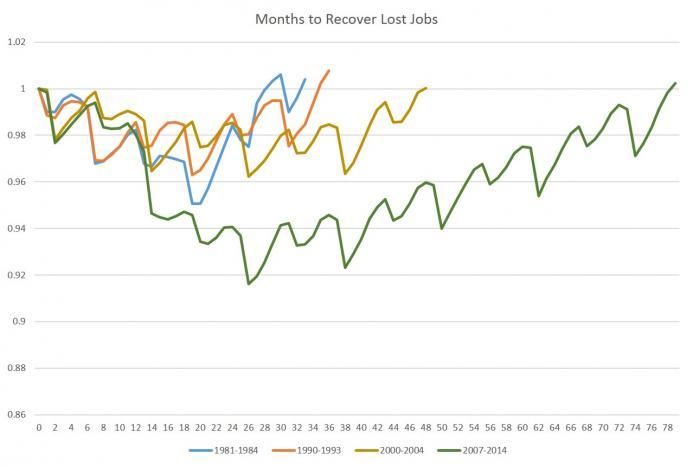
In the wake of the 2007-2009 recession, 78 months passed before employment returned to where it had been before the crisis. This was, by far, the longest period needed to recover from job losses in decades. The second-longest period needed to recover jobs occurred after the 2002 recession when about 50 months were needed to recover lost jobs:

economic_malaise_young_people_1

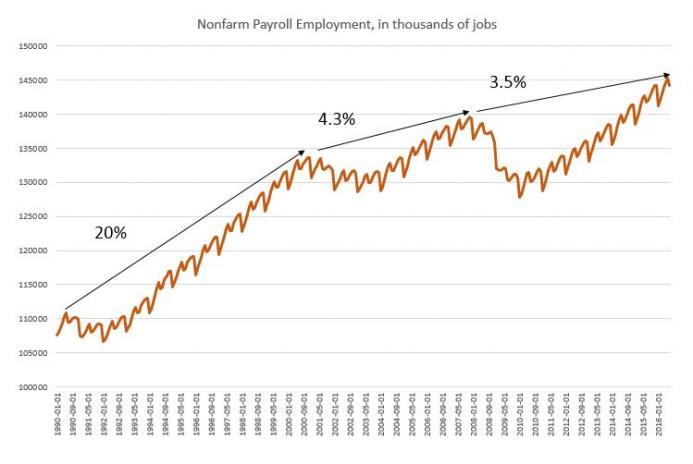
Moreover, we see that in recent cycles, job growth during each recovery has been getting weaker and weaker over time:

economic_malaise_young_people_2

Some observers of the rose-colored-glasses-wearing variety have attempted to explain away the most recent malaise in job gains by claiming that fewer jobs are needed because so many Baby Boomers are aging out of the work force, and because people are so much wealthier, they argue, workers are leaving the labor force for non-economic reasons. That is, people are leaving the labor force for reasons other than being discouraged workers.

These claims are plausible, but the empirical data we have does not support them.

Keep in mind that ever since the 2007-2009 recession, the U-6 unemployment rate, which includes underemployed workers (i.e., involuntary part timers) and discourage workers, has reached multi-decade highs in recent years, and even now, is only at levels seen during the worst of the last recession:

economic_malaise_young_people_3

This is not simply a matter of fewer jobs being created because workers are going away.

To get a sense of the situation, we have to first look at the demographics of the working age population and the labor force.

(This demographic data on the working-age population is only currently available through the first quarter of 2015, so the time series ends in early 2015.)

economic_malaise_young_people_4

The top line is the total working age population (ages 15-65) published by the OECD and the World Bank. According to this measure, there is no decline in the working age population.

If people were aging out of the work force in droves to the point of driving a net exodus, we would see a downturn in the blue line. We don’t see that. In fact, from the beginning of the last recession at the end of 2007 to the first quarter of 2015, the working age population increased by 7.5 million people.

During that same period, the US economy added 801,000 jobs. That is, after the initial loss of 10 million jobs, the US economy began to add jobs again, but after more than seven full years, had only added a net of 801,000 jobs.

But maybe only 801,000 jobs were added because very few of those 7.5 million people wanted to be in the work force.

Well, it’s a safe bet that not all of them wanted to be in the work force, but we do know that using the standard BLS measure for the work force that 2.4 million people entered the work force during the period when only 801,000 jobs were added. (See the green line above.) That means over that time period, you had 1.6 million new people in the labor force while half that many jobs were added.

And this labor force measure only takes into account active job seekers and employed people. It ignores discouraged workers and involuntary part timers.

So we find that both the official labor force and the working age population were increasing at levels substantially above the employment levels.

Indeed, the only way we can find a number that suggests more jobs were added than workers is to look at the working-age population for ages between 25 and 54. That is, if we exclude all potential workers under 25 and all above 54, then yes, the working age population did decline by 1 million jobs. (See the red line above.)

In real life, though, the work force includes quite a few people who are, say, 22 years old, and quite a few who are 60 years old. If those people are included, the working age population is growing considerably.

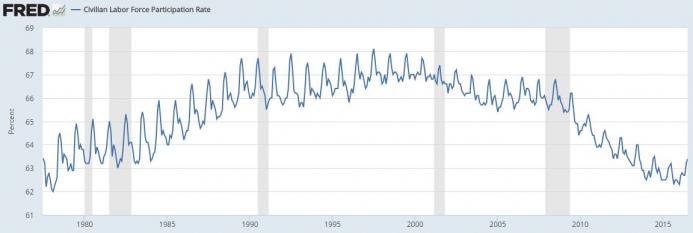
Meanwhile, workforce participation has been falling for a number of years, and is now at some of the lowest levels that have been seen in more than 30 years. From 2014 to 2016, work force participation ranged from about 62 percent to 64 percent. That’s the lowest participation rate seen since the the early 1980s.

economic_malaise_young_people_5

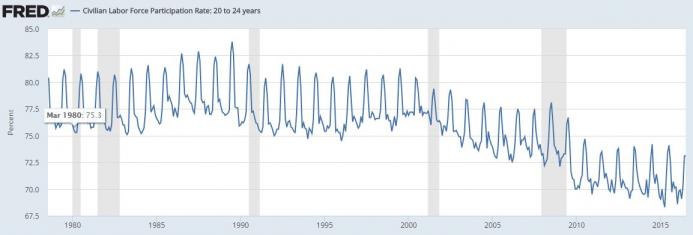
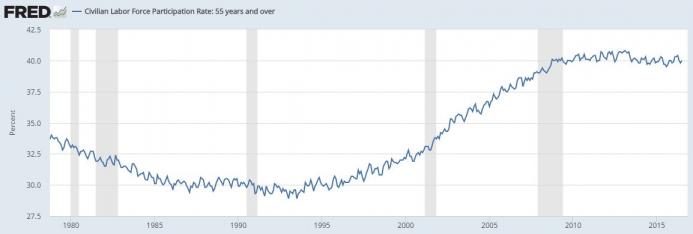
Many have assumed this means that many older workers are leaving the work force. Unfortunately, it seems that it is young workers who are most likely to leave the labor force, which is problematic for future productivity. For young workers in the 20-24 age range, work force participation has been falling for more than a decade, and fell off significantly during the last recession:

economic_malaise_young_people_6

Meanwhile, labor force participation for 55-and-older individuals has held steady:

economic_malaise_young_people_7

It appears unlikely that it is now unnecessary to add jobs at a rate comparable to past recoveries because so many older workers are leaving the work force. Nor is it likely that young people are leaving the work force because they are so prosperous. It’s more likely that young people are leaving the work force as discouraged workers.

This supposition is further strengthened by the fact that the unemployment rate in the 16-24 age range has been above 10 percent for the past nine years. It was especially high even before the last recession.

But, unemployment among over-55 workers is among the lowest of all demographic groups, with a rate between 3 percent and 4 percent in recent years.

In other words, older workers are sticking around and doing relatively well. It appears that younger workers, meanwhile, are more likely to be unemployed, underemployed, or even totally out of the workforce as discouraged workers.

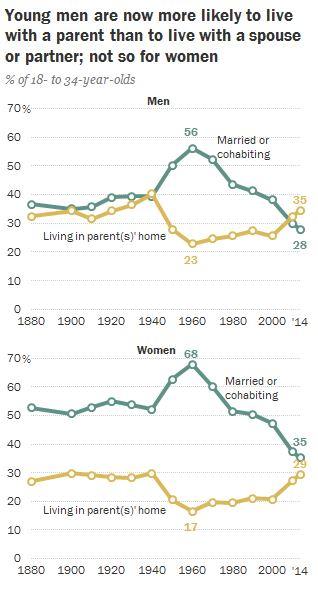
One phenomenon that gives us a reason to think this is the fact that the number of young people living with their parents has reached historic highs in the United States. As Pew recently reported:

In 2014, for the first time in more than 130 years, adults ages 18 to 34 were slightly more likely to be living in their parents’ home than they were to be living with a spouse or partner in their own household.

Living at home is more likely for men than for women, but in both cases, more young people are living with their parents than during any other period since World War II:

economic_malaise_young_people_8

Those who attempt to spin the current job numbers as simply the effects of people happily leaving the work force appear to be mistaken in assuming that older workers are leaving, and that younger workers need not work because they’re so unusually productive.

If young workers were so productive, is it too much to believe that they would choose to rent an apartment rather than live with their parents?

Once we look a the demographics behind the current job numbers, we actually find the situation is more alarming that we might have thought otherwise. We seem to be in a situation where younger workers are participating in the work force less, and putting off acquiring essential job skills that will lead to more productivity later.

Older workers are still sticking around in numbers large enough to keep the overall labor force number growing.

However, while both the working age population and the labor force are growing, overall job creation simply is not keeping up.

At some point, those 30-year olds living with their parents are doing to need full-time work, but will they have the job experience necessary (and thus the productivity) necessary to support the lifestyle to which they have become accustomed?

Or, will they simply enter the workforce with few job skills following a decade of part-time work or no work forced on them by our weak economy? When that happens, we’re likely to see a continued decline in the household and personal incomes.

Ryan W. McMaken is the editor of Mises Daily and The Free Market. He has degrees in economics and political science from the University of Colorado, and was the economist for the Colorado Division of Housing from 2009 to 2014. He is the author of Commie Cowboys: The Bourgeoisie and the Nation-State in the Western Genre. 

This article was published on Mises.org and may be freely distributed, subject to a Creative Commons Attribution United States License, which requires that credit be given to the author.

Children Should be Encouraged to Read Fantasy Fiction – Article by Jon Miltimore

Children Should be Encouraged to Read Fantasy Fiction – Article by Jon Miltimore

The New Renaissance HatJon Miltimore
******************************

Recently I spoke with a friend who expressed some angst that his 12-year-old son was primarily interested in reading fantasy novels. Efforts to introduce the lad to higher forms of literature were proving more difficult than he’d expected.

Not to worry. Fantasy novels and science fiction yarns, I said, are often gateways to the higher forms of literature. This was not just my opinion, I added, it was my experience.

When I was 12, I was not yet much of a fan of reading. I had enjoyed some young adult fiction writers (S.E. Hinton, R.L. Stein, Christopher Pike, etc.) and enjoyed the histories of NFL football teams, but I didn’t have a passion for books. That changed when my father gave me J.R.R. Tolkien’s Lord of the Rings.

For years my father had tried to get me interested in the classics and his favorite histories to no avail. Then he tried a new tactic. Perhaps taking a tip from Montaigne, he gave me Tolken’s epic trilogy, which I devoured in a couple weeks. Terry Brooks’ Shannara books followed, and then the first few books of Robert Jordan’s Wheel of Time series. Then a new book came out with a cool title — A Game of Thrones — that blew them all away.

I bring all this up not to demonstrate how big of a fantasy dork I am. (I also occasionally played real-time strategy computer games. Sue me.) I share it to make a point: these books taught me to love reading.

Fantasy fiction is often pooh-poohed by academics and intellectuals, but it can whet the appetite learning. In my case, the great historical fictions of James Clavell, Gary Jennings, and Ken Follet followed Lord of the Rings. Tolstoy, Nabokov, and Dostoevsky came not long after; then the histories of Foote, Barzun, and Michener.

But the case for fantasy fiction goes beyond my personal experience. Scientific research shows there are clear positive neural affects to novel reading. For example, Emory University researchers found that students experienced heightened activity in the left temporal lobe of the brain, the area associated with semantics, for days after reading novels.

It should go without saying that reading nothing but fantasy fiction, even good fantasy fiction, is not a path to a well-rounded education or intellectual maturity. But fantasy novels can awaken imaginations, inspire creativity, and create a passion for story-telling.

So if you’re a little worried that your teenage daughter seems a little too obsessed with, say, Hunger Games, relax. She’ll likely be reading George Eliot and Byron in a year or two.

—

Jon Miltimore is the Senior Editor of Intellectual Takeout. Follow him on Facebook.

This article was originally published on Intellectual Takeout.

How the Education System Destroys Social Networks – Article by Jeffrey A. Tucker

How the Education System Destroys Social Networks – Article by Jeffrey A. Tucker

The New Renaissance HatJeffrey A. Tucker
******************************

I was at a restaurant for lunch and had time to visit with the waitress, who turns out to be a college graduate from a good institution. She has a degree in European languages. Here she is waiting tables with nondegreed people, some five years her junior, some 10 years her elder.

She is making good money, but so are her co-workers. You have to wonder: given her position, what was the professional advantage to her of those four hard years in school and the $100K spent on them? What were the opportunity costs?

This is not another article to disparage the value of a college degree. I would like to raise a more fundamental question. It concerns the strange way in which our education system has overly segmented our lives into a series of episodic upheavals, each of which has little to do with the other, the value of one accomplishment being oddly disconnected from the next stage, and none of them directly connecting to our professional goals except in the unusual case.

From the earliest age until adulthood, we’ve been hurled from institution to institution in a way that eventually sets young people back from developing continuity of plans and a social support system to realize their goals. At the end of it all, people find themselves back where they started: figuring out their market worth and trying to find a buyer for their services.

Instead of drawing down on accumulated capital, they end up starting fresh at age 22. Even after years of building social capital, they are drawing down on a nearly empty account.

There is something seriously wrong with this system. Shouldn’t our investments in our friendship networks extend across and beyond the stages of our development to make more of a difference in our lives?

The post-graduation diaspora

In a couple of months, for example, many millions of high school students will graduate. Celebration! Sort of. It’s great to finish school. But what’s next?

Many students find themselves devastated to lose the only social group and friendship network they’ve ever known. They worked for years to cultivate it, and in an instant, it is blown apart. They are left with a piece of paper, a yearbook of memories, a transcript, and, perhaps a few recommendation letters from teachers — recommendations that do them little good in the marketplace.

“Don’t ever change,” they write in each other’s yearbooks. The sentiment expresses a normal longing to hold on to the investment the students make in each other’s lives, even as everything about the system tries to take that investment from them.

Is this the way it should be?

Then, the same group, or at least many among them, look forward to college, where they are mostly, again, starting from scratch in a social sense. It can be very scary. College students begin their new experience isolated. They work for another four years to develop a network — a robust social group — to find their footing and to establish both a reputation and sense of self. This is the only world they’ve known for years, and they have invested their hearts and souls into the experience.

The social fabric ends up rich and wonderful, with intense friendships based on shared lives.

Finally, after four years, the graduation march plays, the tassel is moved from one side of the cap to the other, and the whole social apparatus goes up in smoke — again. Then, another diaspora.

Once again, students find themselves nearly alone, with few hooks into the world of commerce and employment. They have a degree but few opportunities to monetize it. Their social network is of limited use to them. All they have, yet again, is a piece of paper. Plus they have recommendation letters from professors that still do them little good in the marketplace.

This not always the case. There are workarounds, and digital networking is helping. People join fraternities and social clubs, and those can be useful going forward. But it might take years for these connections to yield results. The more immediate question is this: What do I do now? Lacking a broad sense of the way the world works, and missing any influential hooks into prevailing networks, a college grad can often find herself feeling isolated once again, starting over for the third time.

The failure of the central plan

This is the system that the civic culture has created for us. For the years from the ages of 14 through 22, students’ primary focus of personal investment and social capital building is centered on their peers. But their peers are just the same as they are: hoping for a good future but having few means to get from here to there.

Why does this keep happening? Looking at the big picture, you can start to see a serious problem with the educational system politicians have built for us. It is keeping people “on track” — but is it a track that prepares people for the future?

A core principle of the education system, as owned and controlled by government, is Stay in school and stay with your class. This is the emphasis from the earliest grades all the way through the end of college. The accidents of birth determine your peer group, your primary social influences, and the gang you rely on for social support.

To be “held back” is considered disgraceful, and to be pushed forward a grade is considered dangerous for personal development. Your class rank is your world, the definition of who you are — and it stays with you for decades. Everyone is on a track as defined by a ruling class: here is what you should and must know when. All your peers are with you.

Many factors entrench this reality. The public school system is organized on the assumption of homogeneity, a central plan imposed from the top down. It didn’t happen all at once. It came about slowly over the course of 100-plus years, from the universalization of compulsory schooling, to the prohibition of youth work, to the gradual nationalization of curricula.

In the end, we find the lives of young people strictly segmented by stages that are strangely discontinuous. Where are the professional contacts that result? Where are the friends who can smooth your way into the world of professional work? They aren’t among your former classmates. Your peers are all in the same position you are in.

Laws that lock people out

The workplace might help to mitigate this problem, but it’s incredibly difficult for young people to get a regular job thanks to “child labor” laws that exclude teens from the workforce. For this reason, only one in four high school kids has any real experience outside their peer group. They miss all the opportunities to learn and grow that come from the workplace — learning from examples of personal initiative, responsibility, independence, and accountability.

There are extremely narrow conditions under which a 14-year-old can find legal employment, but few businesses want to bother with the necessary documentation and restrictions. A 16-year-old has a few more opportunities, but, even here, these young people can’t work in kitchens or serve alcohol. The full freedom to engage a larger community outside the segmented class structure doesn’t come until after you graduate high school.

By the time the opportunity comes around to do authentic remunerative work, a student’s life is filled with other interests, mostly social, but also extracurricular. Instead of working a job, people are doing a thousand other things, and there seems to be no time left. It’s not uncommon for people to graduate with no professional experiences whatsoever to draw on. Their peers are their only asset, their only really valuable relationships, but these relationships have little commercial value.

How natural is any of this?

If you look at the social structure of homeschooling co-ops, for example, younger kids and older kids mix it up in integrated social environments, and they learn from each other. Parents of all ages are well integrated too, and it creates a complex social environment. The parents know all the kids and, together, they form a diverse microsociety of mutual interests. This is one reason that homeschooled kids can seem remarkably precocious and poised around people of all ages. They are not being artificially pegged into slots and held there against their will.

A better way

When you read about the experiences of successful people in the late 19th century, they talk of their exciting and broad experiences in life, working in odd jobs, meeting strange people of all ages and classes, performing tasks outside their comfort zone, encountering adult situations in business that taught them important lessons. They didn’t learn these things from sitting in a desk, listening to a teacher, repeating facts on tests, and staying with their class. They discovered the world through mixing it up, having fabulous and sometimes weird experiences, being with people who are not in their age cohort. They drew on these experiences for years following.

The system to which we have become accustomed is not of our choosing, and it certainly isn’t organic to the social order. It has been inflicted on us, one piece of legislation at a time. It is the result of an imposed, rather than evolved, order. Why wait until age 22 to get serious about your life?  Why stick with only one career choice in the course of your appointed 40 years in professional life? Why retire at the young age of 65, just because the federal government wants you to do so?

Think about this the next time you attend a graduation. Are the students shedding only tears of joy? Or, in the sudden mixture of emotions, is there also the dawning realization that they are witnessing the destruction of a social order they worked so hard to cultivate? Are they also overwhelmed with the knowledge that, in short order, they will have to recreate something entirely new again? Where is the continuity? Where is the evidence of an evolved and developing order of improved opportunities?

The most important question is this: What are the alternatives?

Bring back apprenticeships. Bring back remunerative work for the young. Look beyond the central plan, and don’t get trapped. Rethink the claim that staying in school is an unmitigated good. Find other ways to prevent your heavy investments in others from dissipating; ensure instead that they will pay more immediate returns. Our friends should remain in our lives — and yield a lifetime of returns.

Jeffrey Tucker

Jeffrey Tucker

Jeffrey Tucker is Director of Content for the Foundation for Economic Education and CLO of the startup Liberty.me. Author of five books, and many thousands of articles, he speaks at FEE summer seminars and other events. His latest book is Bit by Bit: How P2P Is Freeing the World.  Follow on Twitter and Like on Facebook. Email. 

This article was originally published on FEE.org. Read the original article.

The ADA Attack on Online Courses Hurts the Disabled, Too – Article by Alex Tabarrok

The ADA Attack on Online Courses Hurts the Disabled, Too – Article by Alex Tabarrok

The New Renaissance HatAlex Tabarrok
******************************

The Department of Justice has sent a letter to UC Berkeley threatening a lawsuit unless the university modifies all of its free online educational materials to meet conditions of accessibility. In response the Vice Chancellor for Undergraduate Education writes:

…we have attempted to maximize the accessibility of free, online content that we have made available to the public. Nevertheless, the Department of Justice has recently asserted that the University is in violation of the Americans with Disabilities Act because, in its view, not all of the free course and lecture content UC Berkeley makes available on certain online platforms is fully accessible to individuals with hearing, visual or manual disabilities.

…We look forward to continued dialog with the Department of Justice regarding the requirements of the ADA and options for compliance. Yet we do so with the realization that, due to our current financial constraints, we might not be able to continue to provide free public content under the conditions laid out by the Department of Justice to the extent we have in the past.

In many cases the requirements proposed by the department would require the university to implement extremely expensive measures to continue to make these resources available to the public for free. We believe that in a time of substantial budget deficits and shrinking state financial support, our first obligation is to use our limited resources to support our enrolled students. Therefore, we must strongly consider the unenviable option of whether to remove content from public access.

In short, the DOJ is saying that unless all have access, none can and UC Berkeley is replying that none will. I sympathize with UC Berkeley’s position. The cost of making materials accessible can be high and the cost is extremely high per disabled student. It would likely be much cheaper to help each disabled student on an individual basis than requiring all the material to be rewritten, re-formatted and reprogrammed (à la one famous example).

An even greater absurdity is that online materials are typically much easier to access than classroom materials even when they do not fully meet accessibility rules. How many teachers, for example, come with captions? (And in multiple languages?) How about volume control? How easy is it for the blind to get to campus? In theory, in-class materials are also subject to the ADA but in practice everyone knows that that is basically unworkable. I guarantee, for example, that professors throughout the UC-system routinely show videos or use powerpoints that do not meet accessibility guidelines. Thus, by raising the costs of online education, the most accessible educational format, the ADA may have the unintended consequence of slowing access. Put simply, raising the costs of online education makes it more difficult for anyone to access educational materials including the disabled.

Addendum: By the way, if you are wondering, all of MRU’s videos for our Principles of Microeconomics and Principles of Macroeconomics courses are captioned in English and most are also professionally captioned in Spanish, Arabic and Chinese.

This post first appeared at Marginal Revolution.

Alex Tabarrok is a professor of economics at George Mason University. He blogs at Marginal Revolution with Tyler Cowen.

Proxima Centauri B – Painting by Wendy Stolyarov

Proxima Centauri B – Painting by Wendy Stolyarov

wendy_stolyarov_proxima_centauri_bProxima Centauri B – by Wendy Stolyarov

Note: Left-click on this image to get a full view of this digital work of fractal art.

Inspired by the recently-discovered habitable exoplanet orbiting Proxima Centauri, this painting depicts a risk-taking space colonist/engineer overseeing the construction of a Hyperloop (with the aid of sentient drones!) in a bright, and hopefully near, future.

Inspiration: “An Epochal Discovery: A Habitable Planet Orbits a Nearby Star” – Rebecca Boyle, The Atlantic, August 24, 2016

See the index of Wendy Stolyarov’s art works. 

Visit Wendy Stolyarov’s website and view her art portfolio.

Wendy D. Stolyarov is an accomplished writer, thinker, artist, and graphic designer, who brings her immense talent and capacity for innovation to The Rational Argumentator and the wider movement for the advancement of Reason, Rights, and Progress. Mrs. Stolyarov uses computer technology masterfully to produce precise, realistic, life-affirming art. She has also contributed multiple essays to TRA and designed many of the magazine’s newer logos, including its banner and the New Renaissance top hat. Mrs. Stolyarov is married to G. Stolyarov II, the Editor-in-Chief of The Rational Argumentator. She is the illustrator for Death is Wrong, the children’s book on indefinite life extension written by Mr. Stolyarov in 2013.