We’re Going Deeper into Debt as Real Incomes Fall – Article by Victor Xing

We’re Going Deeper into Debt as Real Incomes Fall – Article by Victor Xing

The New Renaissance HatVictor Xing

New York Fed President Dudley recently commented that “real consumer spending growth appears to have moderated somewhat from the relatively robust pace of the second half of 2015.” While this may suggest headwinds from cyclical economic conditions, there are emerging signs that ultra-accommodative policy also acts as a constraint on consumer spending via income effects. Instead of inducing savers to spend and borrow, rapid asset price appreciation as a result of monetary easing has outpaced wage growth, and pass-through services inflation subsequently reduced discretionary income and forced already-levered consumers to save instead of spend. This unintended consequence worked against accommodative policy’s desired substitution effects and suggests further easing would likely yield diminishing results if asset price appreciation continues to outpace real income growth.

Asset Price and Services Inflation Outpaced Real Wage Growth
Post-2008 policy accommodation broadly lowered funding costs for consumers and businesses to supported asset price appreciation. However, rising prices have also made assets less affordable, and home buyers “priced out” of their respective housing markets subsequently became involuntary renters. Not only do they not benefit from rising home values, higher education, and medical care inflation also outpaced aggregate real wage growth (Chart 1) to weigh on renters’ discretionary spending.

xing1In response with rising commercial real estate prices (Chart 2), businesses also pass on higher operating costs in the form of services inflation. Year-over-year personal consumption expenditure — services (chain-type price index) has been well-anchored in the 2% range (2.13% in Feb 2016) since 4Q 2011.

xing2Another factor constraining consumer spending is the well-publicized effect of student debt burden. This supports a view that household spending may be at a lower potential than during prior cycles, thus magnifying the costs of higher services inflation as a result of asset price appreciation.

Consumers Redlining their Engines: Inability To Pay $400 Emergency Expense
Accommodative monetary policy encourages consumers to spend and borrow rather than hoarding cash. However, cash-strapped consumers already facing the pressure of debt burden would likely do neither.

Federal Reserve’s recent Report on the Economic Well-Being of U.S. Households highlighted signs that some consumers are already stretching their spending power to meet existing obligations. 47% of respondents reported that a $400 emergency expense would be “more challenging to handle” (unable to use cash or a credit card that they pay off at the end of the mouth). Results from middle-income household with $40,000 to $100,000 annual income were similarly downbeat, where 44% of respondents indicated difficulties (Chart 3).

Chart 3: Percent of respondents who would completely pay an emergency expense that costs $400 using cash or a credit card that they pay off at the end of the month (by race/ethnicity and household income)

xing3Source: Federal Reserve Board of Governors

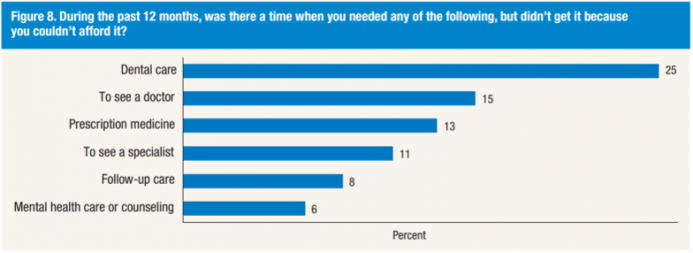
Chart 4: During the past 12 months, was there a time when you needed any of the following, but didn’t get it because you couldn’t afford it?

xing4Source: Federal Reserve Board of Governors

A survey on health-care expenses was also discouraging. 31% of respondents reported going without some type of medical care in the preceding 12 months due to inability to afford the cost. 45% of those surveyed under a household income of $40,000 reported similar decisions to defer treatment.

In the section “spending relative to income,” Fed researchers reported that one-in-five respondents with spending exceeded their income (leveraged spending). These are signs that consumers were taking advantage of lower rates, but the spending does not appear to be sustainable without corresponding rise in real wage growth.

Rising Renter Cost Burden
Another factor constraining discretionary spending is rising renter cost burden. The Harvard Joint Center for Housing Studies projected a “fairly bleak picture of severe renter burden across the U.S. for the coming decade.” The report acknowledged falling incomes among renters and the persisting gap between renter income and renter housing costs (Chart 6), as well as severely burdened renter households (housing costs of more than 50% of household income) reaching 11.8 million in 2015 (Chart 7), or about one in four renters.

Assuming the correlation between rental price inflation and asset price inflation holds, further declines in housing affordability as a result of policy easing would exacerbate renter burden — one likely needs rising real wages to offset.

Chart 5: In the past 12 months, would you say that your household’s total spending was more, less, or the same as your income? (by household income)

xing5Source: Federal Reserve Board of Governors

xing6xing7

Impacts of “Long and Variable Lags” Between Asset Price Inflation and Real Wage Growth
Financial market participants play an essential role in the transmission of Federal Reserve’s monetary policy by affecting financial conditions — the following components are part of the GS Financial Conditions Index:

  • Short-term bond yield
  • Long-term corporate credit spread
  • Stock market variable
  • Exchange rate

The Federal Reserve only has effective control of the very front-end of the Treasury curve via conventional monetary policy. Nevertheless, unconventional policies such as QE, as well as forward guidance on SOMA principal reinvestments also allow the central bank to affect longer-term funding costs via the expectations and “recruitment channel.” Under this mechanism, asset prices take little time to react to changing policy stances, while impacts on income growth and economic conditions would often take longer to manifest.

Such lag between asset price appreciation and changing economic conditions carries a hidden cost — if asset price inflation becomes well entrenched ahead of broad-based economic growth, those without assets would be penalized just to maintain their life-style, and the reduction in their discretionary spending would serve as a disinflationary drag to Federal Reserve’s effort to reflate the economy.

Conclusion
Inefficiencies within the monetary policy transmission mechanism have resulted in income effects becoming greater than the substitution effects. Under this scenario, ultra-accommodative policy may induce further saving by asset-less consumers to further weigh on aggregate demand. Additionally, policymakers should exercise caution if increasingly aggressive and unconventional reflationary policies do not yield intended results.

Victor Xing is founder and investment analyst at Kekselias, Inc. He is formerly a fixed-income trading analyst for the Capital Group Companies with 5 years of experience on its interest rates trading desk.

This article was published on Mises.org and may be freely distributed, subject to a Creative Commons Attribution United States License, which requires that credit be given to the author.

Why Modern Luddites Are Attacking Uber Drivers – Article by Mateusz Machaj

Why Modern Luddites Are Attacking Uber Drivers – Article by Mateusz Machaj

The New Renaissance HatMateusz Machaj
******************************

Earlier this year, a number of Uber cars in Poland came under attack by a group of vandals who were likely taxi drivers. In general, these types of vandalism have a long tradition in human history and have contributed to keeping populations’ general living standards at very low levels.

Attacks on Uber drivers are simply the latest chapter in a long story of efforts to intimidate and destroy innovators who are moving markets and societies in new and unfamiliar directions.

Reactions to Early Machines
For a very long time, separation of grain from the chaff was done in a very primitive manner. The process took weeks, involved hard working men, hard working women feeding them, and also children working as additional helpers. Finally, someone invented a threshing machine that allowed farmers to get rid of all this hard work: the machine could do the job much faster with less physical labor involved.

The change happened contrary to what many historical books claim: the move to threshing machines did not occur because of the patent system put in place 150 years before the change. It happened because social and political forces were too weak to stop it from happening.

Beginning in the eighteenth century in Europe, the entrepreneurial class was growing. They were a group of small profit-driven innovators interested in selling various products, and beating their competitors to markets. This “Great Change” was driven forward by many cultural, religious, political, legal, and technological factors.

At first, threshing machines were very imperfect. They didn’t always work well, and they also were expensive. There was a lot of room for improvements, and for making them better, faster, and cheaper. As they were slowly improved, it quickly became apparent the new machines were more efficient than the old manual methods. It was only a matter of time until someone would realize that steam engines could be combined with the threshing machines.

Not surprisingly, threshing machines were not welcomed by everyone. Swing Riots flared up and the Luddite movement attempted to crush technological innovation. Despite such obstacles, the entrepreneurs won out, paving the way for the future chain of market innovations, well symbolized by the modern farmer sitting in the modern air-conditioned tractor (with a good stereo system). Over the past two hundred years, agricultural workers were reduced from more than 80 percent of workers to less than 5 percent.

Economic Growth and Social Change
One of the big mysteries of human history is the question of why rapid technological and innovative growth started only around the nineteenth century. Many new ideas and technological changes were present for ages (and invented centuries before). Other cultures introduced many new innovative ideas as well.

Some steam engines were even being used in ancient times. They were applied in narrow places, however, due to social and political circumstances.

One early example of political resistance is related to us through the Roman Emperor Vespasian’s opposition to new labor saving innovations. Faced with the prospect of replacing workers with machines, Vespasian reputedly said: “You must let me feed my poor commons.”

Vespasian’s reaction is understandable; it is hard to predict what will happen in response to innovations that make certain job skills obsolete. And it’s not just the workers who fear the change. The ruling class, faced with an idle and unemployed population might also fear social upheaval.

The words of Peter Green summarize many of these concerns:

The ruling class were scared, as the Puritans said, of Satan finding work for idle hands to do. One of the great things about not developing the source of energy that did not depend on muscle power was the fear of what the muscles might get up to if they weren’t kept fully employed. The sort of inventions that were taken up and used practically were the things that needed muscle power to start with, including the Archimedean screw. On the other hand, consider that marvelous box gear of Hero’s: it was never used. That would have been a real conversion of power. What got paid for? The Lagids tended to patronize toys, fraudulent temple tricks in large quantities, and military experiments.

Naturally, human history is complicated and subject to many different factors. Nevertheless, there appears to be some truth in the argument that fixed social and political structure did not favor society open to the widespread adoption of innovation. Otherwise, it is hard to explain why so many new technical discoveries were not applied for so long, even though science and intelligence supplied them centuries before. We had to wait for the new political and social arrangements that either were tolerant of new innovations, or were unable to stop them.

Uber and Beyond
Everywhere we look, we see both the creative and destructive power of innovation. First threshing machine sellers lead to reductions in agricultural employment. Later, tractors killed the threshing machines. Telegraph and railway killed communication systems that relied on horses. Cars destroyed the horse industry. Mass production of textiles destroyed the demand for hand-crafted items. Big stores destroyed smaller shops, now discount shops (in parts of Europe) are destroying big stores. Video rentals hampered the cinema industry, now Netflix and others killed video rentals, while Napster’s success (despite its illegality) predicted a coming end to the old music industry. China’s growth and cheap efficient outsourcing reshaped traditional industries in developed countries. (From an economic perspective there is no difference between hiring cheaper labor or hiring a better machine.)

Dell smashed the traditional computer industry with eliminating many middle men. Ikea did something similar in the furniture industry. The internet destroyed regular newspapers, while Google smashed the marketing industry. Amazon destroys bookstores around the world, while Uber is doing the same with the taxi industry.

Economic progress decreases employments in one place, allows for creation of new ones, even in the service sector. During the process of liquidating employment positions, huge economic development is capable of multiplying per capita production within one generation, positively affecting all social classes.

The current state of affairs is not the end of history. Those companies, innovative today, will be endangered tomorrow. Even Jeff Bezos, creator of Amazon.com, admits Amazon won’t last forever:

Companies have short life spans. … And Amazon will be disrupted one day. I don’t worry about it ’cause I know it’s inevitable. Companies come and go. And the companies that are, you know, the shiniest and most important of any era, you wait a few decades and they’re gone.

Mateusz Machaj, PhD in economics; is a founder of the Polish Ludwig von Mises Institute. He has been a summer fellow at the Ludwig von Mises Institute. He is assistant professor at the Institute of Economic Sciences at the University of Wroclaw.

This article was published on Mises.org and may be freely distributed, subject to a Creative Commons Attribution United States License, which requires that credit be given to the author.

Trump and Hillary Don’t Know How to Fix the Economy – Article by Justin Murray

Trump and Hillary Don’t Know How to Fix the Economy – Article by Justin Murray

The New Renaissance HatJustin Murray
******************************

Recently, Hillary Clinton was taped ridiculing Donald Trump for lacking a detailed plan for the American economy. The message, so it goes, is that Trump is not suited for the presidency because he doesn’t have a plan on how to turn the American economy around.

But is it really more dangerous to elect a president who makes up economic policy on the fly than one who proclaims to have a detailed plan for us?

The answer to this is no, it is not more dangerous to elect someone who makes up economic policy by the seat of his pants — as Donald Trump is prone to do — than it is to elect someone who thinks she can have the future of the economy neatly mapped out. However, this does not imply that seat-of-the-pants method is less dangerous either. The underlying problem is we have two competing people who think they can manage the American economy.

The core of why both philosophies are equally dangerous is best summarized by F.A. Hayek and the pretense of knowledge. Hayek notes in his speech in 1974:

Unlike the position that exists in the physical sciences, in economics and other disciplines that deal with essentially complex phenomena, the aspects of the events to be accounted for about which we can get quantitative data are necessarily limited and may not include the important ones … in the study of such complex phenomena as the market, which depend on the actions of many individuals, all the circumstances which will determine the outcome of a process … will hardly ever be fully known or measurable.

We are incapable of knowing what the future will bring. No president can come up with a detailed or air tight plan or can accumulate a sufficient stable of experts to be able to guide the behavior, wants, and needs of 320 million people.

For example, if we were to have asked George Bush and his economic experts in 2002 to develop a five year plan for cell phones, we would have built up a massive production capacity and R&D structure around miniaturizing phones as that was all the rage. If someone said in 2002 that people in the future would give up physical buttons and want larger screens, they would have been looked upon as mad. People are buying smaller and smaller phones, there’s no way they could touch the screen and get anything done! But come 2007, Apple introduces the iPhone and the older-style button phone has nearly vanished from the marketplace. Had the government decided it needed to plan the economy around smaller phones, we wouldn’t be enjoying a mobility revolution.

This extends well beyond cellular phones and into all walks of our lives. We don’t need central planning on how we consume our energy, what cars we can buy, what we charge people for borrowing money, and so forth.

All behavior is risky. Even if central planners could somehow canvass all of our wants and needs, figured out when exactly we want to satisfy those needs, and determined who gets what in a world of scarcity, the planners would still fail. This is because even we have no idea what we’ll want in the future. If we were to ask someone to write down exactly what they would buy on August 14, 2017 and put it in an envelope then open it up and compare it to what was bought on that day, there is little doubt the results would be wildly different.

The planner is going to do no better. Instead of a single individual failing to predict his own habits in a fun exercise, we’ll be malinvesting untold amounts of money into unwanted industries and imposing counterproductive and dangerous rules on businesses — the effects of which are impossible to predict. Furthermore, central planning shuts down innovation and the entrepreneurial process because it assumes to know today what is wanted tomorrow. Most innovation arises when someone produces a product we had no idea we wanted and couldn’t fathom existing.

Does Hillary Clinton’s plan for the economy make her a more qualified president than Donald Trump, who will likely create plans spontaneously? No, it makes them equally dangerous as both assume they have the ability to do what countless officials over the centuries have never managed to do — predict the future.

Justin Murray received his MBA in 2014 from the University of St. Gallen in Switzerland.

This article was published on Mises.org and may be freely distributed, subject to a Creative Commons Attribution United States License, which requires that credit be given to the author.

Would Ayn Rand Wear a School Uniform? – Article by Edward Hudgins

Would Ayn Rand Wear a School Uniform? – Article by Edward Hudgins

The New Renaissance HatEdward Hudgins
******************************

My 5-year-old daughters were very excited. My wife had taken them to the craft store to buy T-shirts with sketches on them that they could color themselves with special markers. They couldn’t wait to wear them to nursery school to show their friends!

But many schools still look not only to dress codes but even school uniforms to meet a number of serious problems in the education system. Is this an assault on individuality? What would Ayn Rand do? Would she wear a uniform? Or would she say, “My dress is none of your business”?

Dealing with the discipline deficit
Private schools can set their own standards, and some—Catholic ones, most notably—require standard garb. But such requirements are more problematic in government schools. (Let’s grant that government shouldn’t even be running schools.) Still, the question here is, what are the pros and cons of uniforms?

The problem is well known. In spite of increased spending, academic achievement by most semi-objective measures like SAT scores is flat at best. Worse, teachers often aren’t allowed to discipline or expel disruptive students, and administrators aren’t allowed to fire subpar teachers.

Worse still, many schools are plagued by violence. Some, with metal detectors, security guards, and barbed wire, look more like prisons!

Many see dress as part of the problem.

Kids often judge one other by what they wear. Not sporting the latest fashion for 15-year-olds? Loser! Bullying is a serious problem in most schools, and the frumpy or unstylish are most often the target of insults. And kids are assaulted and even killed for their overpriced Air Jordans. Then there are the kids who wear their pants down, exposing their rear ends, or who otherwise resemble circus freaks in part of the gangsta culture.

School uniforms could remove dress as a source of superficial judgment and much of the associated social dysfunction. Students would be encouraged to judge one another by the content of their character. And uniforms can give many kids a sense of order and personal discipline.

Expressing one’s individual identity
So who could object? Well, I could, when I was a baby-boomer high school activist many decades ago. My dress was conservative, but I didn’t like seeing The Man hunting down my peers in the hallways for too-short skirts or too-long hair. Let’s grant that the boomers turned out to be a problematic generation.

Still, my little girls like choosing the outfits they will wear each morning to school. They have a sense of how they want to look. So far they haven’t wanted to dress like pole dancers or hookers. They are more concerned about who wears the owl and who wears the mermaid T-shirt!

And when kids progress to adolescence, they are finding their own identity and experimenting with their appearance and much else. Seriously, is a little bit of purple hair and a few tattoos really such a problem? Does forcing them to conform really help them mature? Or does it simply instill in them a hatred for all authority and standards?

Educating for values and virtues
This brings us back to Rand, specifically the Objectivist ethics she espoused. Education isn’t simply pouring facts into the heads of students; it is about moral education.

It is about teaching and training students to think, to value reason above all, and to cultivate the virtue of rationality. It is teaching them to value productive work as the central purpose of their lives. It is teaching them to value honesty—always facing objective reality. It is about teaching them to value independence—judging with their own minds. It is about teaching them to value integrity—living in accordance with their values. It is about teaching them to value justice—to give others what they have earned, not only in a commercial sense but a spiritual one as well.

Today’s schools and culture have failed to instill these values. This failure, in addition to the normal challenges of growing to adulthood, is why some parents find school uniforms, in some contexts, to provide something of a substitute. Many choose to homeschool to cut through the entire mess of schools as institutions.

But all parents rightly concerned about their children’s education should focus first on instilling in them the values and virtues they’ll need to live flourishing and prosperous lives, and to defend those values in the culture and to every teacher, school administrator, and politician to create a society worthy of virtuous individuals.

Explore

Sara Pentz, “Education for a New Enlightenment.” June 1, 2007.

“Schools for Individualists: TNI’s Interview with Marsha Familaro Enright.” February 4, 2011.

Dr. Edward Hudgins directs advocacy and is a senior scholar for The Atlas Society, the center for Objectivism in Washington, D.C.

Copyright The Atlas Society. For more information, please visit www.atlassociety.org.

Thomas Carlyle: The Founding Father of Fascism – Article by Jeffrey A. Tucker

Thomas Carlyle: The Founding Father of Fascism – Article by Jeffrey A. Tucker

The New Renaissance HatJeffrey A. Tucker
******************************

Thomas Carlyle fits the bill in every respect

***

Have you heard of the “great man” theory of history?

The meaning is obvious from the words. The idea is that history moves in epochal shifts under the leadership of visionary, bold, often ruthless men who marshal the energy of masses of people to push events in radical new directions. Nothing is the same after them.

In their absence, nothing happens that is notable enough to qualify as history: no heroes, no god-like figures who qualify as “great.” In this view, we need such men.  If they do not exist, we create them. They give us purpose. They define the meaning of life. They drive history forward.

Great men, in this view, do not actually have to be fabulous people in their private lives. They need not exercise personal virtue. They need not even be moral. They only need to be perceived as such by the masses, and play this role in the trajectory of history.

Such a view of history shaped much of historiography as it was penned in the late 19th century and early 20th century, until the revisionists of the last several decades saw the error and turned instead to celebrate private life and the achievements of common folk instead. Today the “great man” theory history is dead as regards academic history, and rightly so.

Carlyle the Proto-Fascist

Thomas_CarlyleThe originator of the great man theory of history is British philosopher Thomas Carlyle (1795-1881), one of the most revered thinkers of his day. He also coined the expression “dismal science” to describe the economics of his time. The economists of the day, against whom he constantly inveighed, were almost universally champions of the free market, free trade, and human rights.

His seminal work on “great men” is On Heroes,  Hero-Worship, and the Heroic in History (1840). This book was written to distill his entire worldview.

Considering Carlyle’s immense place in the history of 19th century intellectual life, this is a surprisingly nutty book. It can clearly be seen as paving the way for the monster dictators of the 20th century. Reading his description of “great men” literally, there is no sense in which Mao, Stalin, and Hitler — or any savage dictator from any country you can name — would not qualify.

Indeed, a good case can be made that Carlyle was the forefather of fascism. He made his appearance in the midst of the age of laissez faire, a time when the UK and the US had already demonstrated the merit of allowing society to take its own course, undirected from the top down. In these times, kings and despots were exercising ever less control and markets ever more. Slavery was on its way out. Women obtained rights equal to men. Class mobility was becoming the norm, as were long lives, universal opportunity, and material progress.

Carlyle would have none of it. He longed for a different age. His literary output was devoted to decrying the rise of equality as a norm and calling for the restoration of a ruling class that would exercise firm and uncontested power for its own sake. In his view, some were meant to rule and others to follow. Society must be organized hierarchically lest his ideal of greatness would never again be realized. He set himself up as the prophet of despotism and the opponent of everything that was then called liberal.

Right Authoritarianism of the 19th Century

Carlyle was not a socialist in an ideological sense. He cared nothing for the common ownership of the means of production. Creating an ideologically driven social ideal did not interest him at all. His writings appeared and circulated alongside those of Karl Marx and his contemporaries, but he was not drawn to them.

Rather than an early “leftist,” he was a consistent proponent of power and a raving opponent of classical liberalism, particularly of the legacies of Adam Smith and John Stuart Mill. If you have the slightest leanings toward liberty, or affections for the impersonal forces of markets, his writings come across as ludicrous. His interest was in power as the central organizing principle of society.

Here is his description of the “great men” of the past:

“They were the leaders of men, these great ones; the modellers, patterns, and in a wide sense creators, of whatsoever the general mass of men contrived to do or to attain; all things that we see standing accomplished in the world are properly the outer material result, the practical realization and embodiment, of Thoughts that dwelt in the Great Men sent into the world: the soul of the whole world’s history….

One comfort is, that Great Men, taken up in any way, are profitable company. We cannot look, however imperfectly, upon a great man, without gaining something by him. He is the living light-fountain, which it is good and pleasant to be near. The light which enlightens, which has enlightened the darkness of the world; and this not as a kindled lamp only, but rather as a natural luminary shining by the gift of Heaven; a flowing light-fountain, as I say, of native original insight, of manhood and heroic nobleness;—in whose radiance all souls feel that it is well with them. … Could we see them well, we should get some glimpses into the very marrow of the world’s history. How happy, could I but, in any measure, in such times as these, make manifest to you the meanings of Heroism; the divine relation (for I may well call it such) which in all times unites a Great Man to other men…

Carlyle established himself as the arch-opponent of liberalism — heaping an unrelenting and seething disdain on Smith and his disciples.And so on it goes for hundreds of pages that celebrate “great” events such as the Reign of Terror in the aftermath of the French Revolution (one of the worst holocausts then experienced). Wars, revolutions, upheavals, invasions, and mass collective action, in his view, were the essence of life itself. The merchantcraft of the industrial revolution, the devolution of power, the small lives of the bourgeoisie all struck him as noneventful and essentially irrelevant. These marginal improvements in the social sphere were made by the “silent people” who don’t make headlines and therefore don’t matter much; they are essential at some level but inconsequential in the sweep of things.

To Carlyle, nothing was sillier than Adam Smith’s pin factory: all those regular people intricately organized by impersonal forces to make something practical to improve people’s lives. Why should society’s productive capacity be devoted to making pins instead of making war? Where is the romance in that?

Carlyle established himself as the arch-opponent of liberalism — heaping an unrelenting and seething disdain on Smith and his disciples. And what should replace liberalism? What ideology? It didn’t matter, so long as it embodied Carlyle’s definition of “greatness.”

No Greatness Like the Nation-State

Of course there is no greatness to compare with that of the head of the nation-state.

“The Commander over Men; he to whose will our wills are to be subordinated, and loyally surrender themselves, and find their welfare in doing so, may be reckoned the most important of Great Men. He is practically the summary for us of all the various figures of Heroism; Priest, Teacher, whatsoever of earthly or of spiritual dignity we can fancy to reside in a man, embodies itself here, to command over us, to furnish us with constant practical teaching, to tell us for the day and hour what we are to do.”

Why the nation-state? Because within the nation-state, all that is otherwise considered immoral, illegal, unseemly, and ghastly, can become, as blessed by the law, part of policy, civic virtue, and the forward motion of history. The leader of the nation-state baptizes rampant immorality with the holy water of consensus. And thus does Napoleon come in for high praise from Carlyle, in addition to the tribal chieftains of Nordic mythology. The point is not what the “great man” does with his power so much as that he exercises it decisively, authoritatively, ruthlessly.

The exercise of such power necessarily requires the primacy of the nation-state, and hence the protectionist and nativist impulses of the fascist mindset.

Consider the times in which Carlyle wrote. Power was on the wane, and humankind was in the process of discovering something absolutely remarkable: namely, the less society is controlled from the top, the more the people thrive in their private endeavors. Society needs no management but rather contains within itself the capacity for self organization, not through the exercise of the human will as such, but by having the right institutions in place. Such was the idea of liberalism.

Liberalism was always counterintuitive. The less society is ordered, the more order emerges from the ground up. The freer people are permitted to be, the happier the people become and the more meaning they find in the course of life itself. The less power that is given to the ruling class, the more wealth is created and dispersed among everyone. The less a nation is directed by conscious design, the more it can provide a model of genuine greatness.

Such teachings emerged from the liberal revolution of the previous two centuries. But some people (mostly academics and would-be rulers) weren’t having it. On the one hand, the socialists would not tolerate what they perceived to be the seeming inequality of the emergent commercial society. On the other hand, the advocates of old-fashioned ruling-class control, such as Carlyle and his proto-fascist contemporaries, longed for a restoration of pre-modern despotism, and devoted their writings to extolling a time before the ideal of universal freedom appeared in the world.

The Dismal Science

One of the noblest achievements of the liberal revolution of the late 18th and 19th centuries — in addition to the idea of free trade — was the movement against slavery and its eventual abolition. It should not surprise anyone that Carlyle was a leading opponent of the abolitionist movement and a thoroughgoing racist. He extolled the rule of one race over another, and resented especially the economists for being champions of universal rights and therefore opponents of slavery.

As David Levy has demonstrated, the claim that economics was a “dismal science” was first stated in an essay by Carlyle in 1848, an essay in which non-whites were claimed to be non-human and worthy of killing. Blacks were, to his mind, “two-legged cattle,” worthy of servitude for all times.

Carlyle’s objection to economics as a science was very simple: it opposed slavery. Economics imagined that society could consist of people of equal freedoms, a society without masters and slaves. Supply and demand, not dictators, would rule. To him, this was a dismal prospect, a world without “greatness.”

The economists were the leading champions of human liberation from such “greatness.” They understood, through the study of market forces and the close examination of the on-the-ground reality of factories and production structures, that wealth was made by the small actions of men and women acting in their own self interest. Therefore, concluded the economists, people should be free of despotism. They should be free to accumulate wealth. They should pursue their own interests in their own way. They should be let alone.

Carlyle found the whole capitalist worldview disgusting. His loathing foreshadowed the fascism of the 20th century: particularly its opposition to liberal capitalism, universal rights, and progress.

Fascism’s Prophet

Once you get a sense of what capitalism meant to humanity – universal liberation and the turning of social resources toward the service of the common person – it is not at all surprising to find reactionary intellectuals opposing it tooth and nail. There were generally two schools of thought that stood in opposition to what it meant to the world: the socialists and the champions of raw power that later came to be known as fascists. In today’s parlance, here is the left and the right, both standing in opposition to simple freedom.

Carlyle came along at just the right time to represent that reactionary brand of power for its own sake. His opposition to emancipation and writings on race would emerge only a few decades later into a complete ideology of eugenics that would later come to heavily inform 20th-century fascist experiments. There is a direct line, traversing only a few decades, between Carlyle’s vehement anti-capitalism and the ghettos and gas chambers of the German total state.

Do today’s neo-fascists understand and appreciate their 19th century progenitor? Not likely. The continuum from Carlyle to Mussolini to Franco to Donald Trump is lost on people who do not see beyond the latest political crisis. Not one in ten thousand activists among the European and American “alt-right” who are rallying around would-be strong men who seek power today have a clue about their intellectual heritage.

Hitler turned to Goebbels, his trusted assistant, and asked for a final reading. It was Carlyle.And it should not be necessary that they do. After all, we have a more recent history of the rise of fascism in the 20th-century from which to learn (and it is to their everlasting disgrace that they have refused to learn).

But no one should underestimate the persistence of an idea and its capacity to travel time, leading to results that no one intended directly but are still baked into the fabric of the ideological structure. If you celebrate power for its own sake, herald immorality as a civic ideal, and believe that history rightly consists of nothing more than the brutality of great men with power, you end up with unconscionable results that may not have been overtly intended but which were nonetheless given license by the absence of conscience opposition.

As time went on, left and right mutated, merged, diverged, and established a revolving door between the camps, disagreeing on the ends they sought but agreeing on the essentials. They would have opposed 19th-century liberalism and its conviction that society should be left alone. Whether they were called socialist or fascists, the theme was the same. Society must be planned from the top down. A great man — brilliant, powerful, with massive resources at his disposal — must lead. At some point in the middle of the 20th century, it became difficult to tell the difference but for their cultural style and owned constituencies. Even so, left and right maintained distinctive forms. If Marx was the founding father of the socialist left, Carlyle was his foil on the fascist right.

Hitler and Carlyle

In his waning days, defeated and surrounded only by loyalists in his bunker, Hitler sought consolation from the literature he admired the most. According to many biographers, the following scene took place. Hitler turned to Goebbels, his trusted assistant, and asked for a final reading. The words he chose to hear before his death were from Thomas Carlyle’s biography of Frederick the Great. Thus did Carlyle himself provide a fitting epitaph to one of the “great” men he so celebrated during his life: alone, disgraced, and dead.

Jeffrey Tucker is Director of Digital Development at FEE, CLO of the startup Liberty.me, and editor at Laissez Faire Books. Author of five books, he speaks at FEE summer seminars and other events. His latest book is Bit by Bit: How P2P Is Freeing the World.  Follow on Twitter and Like on Facebook. 

This article was published by The Foundation for Economic Education and may be freely distributed, subject to a Creative Commons Attribution United States License, which requires that credit be given to the author.

This TRA feature has been edited in accordance with TRA’s Statement of Policy.

Which Culture Can Make 120 Years Old the Prime of Life? – Article by Edward Hudgins

Which Culture Can Make 120 Years Old the Prime of Life? – Article by Edward Hudgins

The New Renaissance HatEdward Hudgins
******************************
Emma Morano, age 116, is the last person alive born in the nineteenth century. New cutting-edge technologies could mean that more than a few people born at the end of the twentieth century will be in the prime of life when they reach that age. But this future will require a culture of reason that is currently dying out in our world.
emma_morano
Is the secret to a long life raw eggs or genetics?
Signorina Morano was born in Italy on Nov 29, 1899. On the recent passing of Susannah Mushatt Jones, who was born a few months before her, Morano inherited the title of world’s oldest person. She still has a ways to go to best the longevity record of the confirmed oldest person who ever lived, Jeanne Calment (1875-1997) who made it to 122.Every oldster offers their secret to long life. Morano attributes her feat to remaining single, adding that she likes to eat raw eggs. But the reason living things die, no matter what their diet, is genetic. Cellular senescence, the fancy word for aging, means the cells of almost every organism are programmed to break down at some point. Almost, because at least one organism, the hydra, a tiny fresh-water animal, seems not to age.

Defying death
Researches are trying to discover what makes the hydra tick so that they find ways to reprogram human cells so we will stop aging. As fantastic as this sounds, it is just one part of a techno-revolution that could allow us to live decades or even centuries longer while retaining our health and mental faculties. Indeed, the week the Morano story ran, both the Washington Post and New York Times featured stories about scientists who approach aging not as an unavoidable part of our nature but as a disease that can be cured.

Since 2001, the cost of sequencing a human genome has dropped from $100 million to just over $1,000. This is spurring an explosion in bio-hacking to figure out how to eliminate ailments like Parkinson’s and Alzheimer’s. We also see nanotechnology dealing with failing kidneys. New high-tech devices deal with blindness and other such disabilities.

An achievement culture and longevity
But this bright future could be fading. Here’s why.

The source of all human achievement is the human mind, our power to understand our world and thus to control it for our own benefit; Ayn Rand called machines “the frozen form of a living intelligence.”

But America, the country that put humans on the Moon, is becoming the stupid country. Despite increased government education spending, test results in science and most other subjects have remained flat for decades. On international ratings, American students are behind students in most other developed countries. It’s a good thing America still has a relatively open immigration policy! Many of the tech people here come from overseas, especially India, because America still offers enough opportunity to make up for its failing schools.

Apollo_11_nasa-69-hc-916am

The deeper problem is found in the prevailing values in our culture. In the 1950s and ‘60s many young people, inspired by the quest for the Moon, aspired to be scientists and engineers, to train their minds. Many went into the research labs of private firms that became the production leaders of the world. It was a culture that celebrated achievement.

Today, many young people, perverted by leftist dogma, hunger to be political enforcers, to train themselves in power and manipulation. Many go into campaigns and government to wrest wealth from producers to pay for “entitlements,” and to make the country more “equal” by tearing producers down. A growing portion of the culture demonizes achievement and envious of success.

Were they to live for 120 healthy years, individuals with the older, pro-achievement values would find their souls even more enriched by their extended careers of achievement. But individuals in the newer, anti-achievement culture would find their souls embittered as they focused enviously on degrading their productive fellows.

All who want long lives worth living need to not only promote science but also the values of reason and achievement. That’s the way to create a pro-longevity culture.

Explore

Edward Hudgins, “Google, Entrepreneurs, and Living 500 Years.” March 12, 2015.

Edward Hudgins, “How Anti-Individualist Fallacies Prevent Us from Curing Death.” April 22, 2015.

Bradley Doucet, “Book Review: The Green-Eyed Monster.” March 2008.

David Kelley, “Hatred of the Good.” April 2008.

Dr. Edward Hudgins directs advocacy and is a senior scholar for The Atlas Society, the center for Objectivism in Washington, D.C.

Copyright The Atlas Society. For more information, please visit www.atlassociety.org.

Three Popular Myths behind Trump’s Success – Article by Barry Brownstein

Three Popular Myths behind Trump’s Success – Article by Barry Brownstein

The New Renaissance HatBarry Brownstein

******************************
Why the Unprincipled Worst Get on Top

“Nothing sinks people faster in their careers than arrogance,” according to Stephen R. Covey, the bestselling author of The Seven Habits of Highly Effective People. But it is hard to imagine a less humble or more arrogant individual than Donald Trump, and to date, his shoot-from-the-hip, prideful, self-referencing arrogance has not sunk his career.

In his book Principle-Centered Leadership, Covey described “politics without principle” as a politics of personality focused on “the instant creation of an image that sells well in the social and economic marketplace. You see politicians spending millions of dollars to create an image, even though it’s superficial, lacking substance, in order to get votes and gain office.”

The marketplace imposes a check on empty promotion and false confidence, which is why, as Covey observes, the most successful leaders in the private sector are often also quite humble.

So why do the arrogant do so well in elections? Is there something different about the political process that allows the worst to succeed?

In his seminal book The Road to Serfdom, Nobel laureate F.A. Hayek offers part of the answer. He lists three widely held beliefs that allow arrogant politicians to emerge.

Belief 1: We should be able to get out of our economic difficulties without pain.

As Hayek saw it, some people blame “the system” for their troubles and “wish to be relieved of the bitter choice which hard facts often impose upon them.” They “are only too ready to believe that the choice is not really necessary, that it is imposed upon them merely by the particular economic system under which we live.”

Let the implication of Hayek’s words sink in. The successful politicians may be those who increasingly blame the “system.”

With a majority of Americans feeling economically insecure, there is plenty of fear for Trump to exploit and a ready audience for promises that he can ease the economic pain of ordinary Americans.

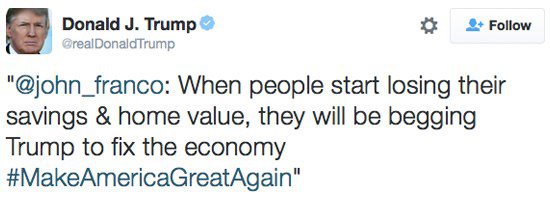
Trump postures as a great fixer. Consider this retweet on Trump’s official Twitter page:

trumptweet20150824

He promises that things are going to be “great again,” once he gets us a better deal with China. Trump tells us he gets what he wants. To purchase a hotel in Miami, he brags, “I went in and punched and punched and beat the hell out of people, and I ended up getting it.”

Of course, Trump is not alone. In their arrogance, politicians will claim to fix social pain points — while they create many, many more.

Belief 2: Government should command or partially command significant portions of the economy.

Hayek observes that many well-meaning people ask, “Why should it not be possible that the same sort of system, if it be necessary to achieve important ends, be run by decent people for the good of the community as a whole?”

Those who believe in command economies think that when things go wrong, it must be because the wrong people are in charge. They don’t question their core belief that controls are needed.

History, economics, and the contemporary world teach lessons of command-and-control societies that have experienced economic failure. Yet, the wrong-person-in-charge belief is sadly all too common.

In her book The Art of Choosing, social psychologist and business professor Sheena Iyengar reports on 2007 research about societal attitudes in East Germany. She observes that among former East Germans, “more than 90% believed socialism was a good idea in principle, one that had just been poorly implemented in the past.”

Look around at your friends and neighbors who are supporting a candidate who advocates top-down solutions to social and economic problems. With few exceptions, they want the same things that you want: prosperity and peace for their family and the world. It is not that they want different outcomes than you do. They simply don’t understand that command economies are inherently, fatally flawed and cannot accomplish those goals.

Without examining their core beliefs, decent people tell themselves they’re choosing the “right” person to put in charge. Arrogant politicians are standing by, posturing as the “right” people.

Belief 3: There is a “good of the community as a whole” that our current economy is not meeting.

It is essential to understand why there can be no such thing as the “good of the community as a whole.” Hayek explains,

The “social goal” or “common purpose” for which society is to be organized is usually vaguely described as the “common good,” the “general welfare,” or the “general interest.” It does not need much reflection to see that these terms have no sufficiently definite meaning to determine a particular course of action.

All top-down solutions will be win-lose, benefiting some and harming others, for as Hayek explains,

The welfare and happiness of millions cannot be measured on a single scale of less or more. The welfare of the people, like the happiness of a man, depends up on a great many things that can be provided in an infinite variety of combinations.

Some see health care as a common good and a human right that the market system has failed to provide. In my FEE essay, “Castro and Obama Are Wrong about ‘Human Rights’” (FEE.org, March 25, 2016), I explain why real rights are win-win, not win-lose. “Rights” such as health care are win-lose and not real rights at all.

The arrogant believe they know what is best for you and best for the community. To them the course of action is clear. However, Hayek warns that in collectivist ethics, the ends justify the means and thus lead to amoral totalitarianism:

There is literally nothing which the consistent collectivist must not be prepared to do if it serves “the good of the whole” because “the good of the whole” is to him the only criterion of what ought to be done.

The Consequences of Our False Beliefs

Since there is no majority to agree on a specific plan of action to promote a nonexistent “common good,” the worst get on top in a centrally planned economy.

The “worst” will take advantage of the fact that agreement can be more readily forged by focusing on a “negative program.” Hayek writes,

It seems to be almost a law of human nature that it is easier for people to agree on a negative program — on the hatred of an enemy, on the envy of those better off — than on any positive task. The contrast between the “we” and the “they,” the common fight against those outside the group, seems to be an essential ingredient in any creed which will solidly knit together a group for common action. It is consequently always employed by those who seek, not merely support of a policy, but the unreserved allegiance of huge masses.

The “mass” that the “worst” seek to mobilize will include those who themselves are not grounded on principles. Hayek cautions that those having “imperfectly formed ideas are easily swayed”; their “passions and emotions are readily aroused.”

Hayek helps us to understand why the careers of arrogant politicians do not sink fast. The careers of arrogant politicians rise as long as we believe in a common good, seek the “right” politicians to be in charge, and support those who promise to shelter us from the work of examining our beliefs and the pain of making a different choice.

We shouldn’t be surprised when the outcome is not what we expect. As Freeman editor B.K. Marcus observes, “The more decisions we cede to the political process, the less we should expect anyone to protect our interests” (“Why Do We Believe These Pathological Liars?” FEE.org, April 27, 2016).

As individuals, we can question our core beliefs. We can humbly “try to live in harmony with natural laws and universal principles.” And we can demand the same of our politicians.

Barry Brownstein is professor emeritus of economics and leadership at the University of Baltimore. He is the author of The Inner-Work of Leadership. He blogs at BarryBrownstein.com, Giving up Control, and America’s Highest Purpose.

This article was published by The Foundation for Economic Education and may be freely distributed, subject to a Creative Commons Attribution 4.0 International License, which requires that credit be given to the author.

Chasing 2 Percent Inflation: A Really Bad Idea – Article by John Chapman

Chasing 2 Percent Inflation: A Really Bad Idea – Article by John Chapman

The New Renaissance HatJohn Chapman

******************************

In just two years, inflation targeting (namely, the quest for 2 percent inflation) has gone from the lunatic fringe of economics to mainstream dogma. Much of the allure springs from notions that a little inflation motivates people to speed up spending, thereby greatly increasing the efficacy of central bank stimulus. It is touted as a cure for sagging demand and a defense against the (overly) dreaded deflation.

Other benefits include melting away some of the massive government and private debts and improving people’s perception of progress as they see their nominal wages rise. Employers can lower real wages without unpopular dollar pay cuts. The Fed can allow price increases to signal the need for production responses, allow for minor supply shocks and for monopolistic industries to increase prices all without a monetary response that would hurt other elements of the economy.

For the politicians it provides a tax windfall in the form of capital gains taxes on inflated assets and income taxes on interest that simply reflects inflation. It also necessitates printing more money thereby earning seigniorage (profits from printing money) for the government. In addition, it provides cover for competitive currency devaluation and is a great excuse to kick the can down the road: “Let’s not tighten before we reach our highly desired inflation target.”

What’s Magical about 2 Percent Inflation?
Then there is the question of why 2 percent? Perhaps that was seen as a still comfortable rate during some past periods of strong growth. Conditions today are very different, which perhaps suggests they are trying to imitate past growth by copying symptoms instead of substance. Of course for politicians, permission to print money is a godsend, and with inflation all around the developed world below 2 percent, it was “all aboard!”

Clearly not all of the features above are desirable, but even some of the touted ones are underwhelming. While increased inflation expectations will speed up spending, it is far from being the reservoir of perpetual demand that some seem to believe. Essentially, a onetime increase in expectations of a new steady rate of inflation would speed up purchases for the period ahead, but with negligible net effects in subsequent periods — a onetime phase shift in demand.

The Danger of Raising Interest Rates
After almost eight years of stimulus, the Fed has taken its first timid steps toward normalizing monetary policy. That means we will soon have to contend with something entirely absent during the years of easy money — a bill for all of the goodies passed out and the distortions created. And what a bill! A 3 percent rise in average interest rates on just our present government debt over the next few years would ultimately amount to over $500 billion a year in additional interest expense, equal to roughly 1/7 of current Federal tax receipts. Those bills start arriving with a vengeance when rates go back up, and for the first time in years the market will see concrete evidence of whether the US and other governments are willing to pay the price of continuing to have viable currencies.

Prior to the appearance of inflation targeting, I was already dreading the impact of political interference with efforts to return to normal. But targeting makes every politician an economist, able to make simplistic, grandstanding statements with the authority of the Fed’s own model. This makes the problem far worse.

Two percent, which has (foolishly) been defined as desirable, will quickly be interpreted as an average. “So what’s the big deal,” critics will say, “about a pop to 3 percent or more, after all it has spent years ‘below target’, and if you excluded a handful of ‘temporary exceptions’, it would still be only 2 percent …?” Imagine the political storm if the Fed decided to quickly raise rates a couple of full percentage points in response to a surge in inflation to 3 percent.

There are a lot of people (especially politicians) whose short-term interests would be harmed by a sharp rise in interest rates. Lulled by today’s relative calm, many fail to appreciate how explosive the situation becomes when we transition from the concerned waiting of the long easy money period to the concrete tests of our credibility during renormalization. If we had to temporarily sacrifice half a percent from our already tepid growth rate to preserve the credibility of the dollar, that would pale next to the cost of worldwide panic and collapse. Unfortunately the sacrifice part is up front.

Americans think of inflation as a purely monetary phenomenon, which the mighty and independent Fed has handled in the past and will again if necessary. Actually once the inflation genie starts to escape from the bottle it becomes purely a political problem. Even the most determined central banker is helpless if the people refuse to accept the paper money, the politicians balk and take away the bank’s independence, or there is an opposition political party promising a credible-sounding and painless alternative plan. It comes down to what the market sees as the political will and ability to pay the short-term cost of reining in the inflation.

The Political Advantages of the 2 Percent Target
Political resistance to the cost of moving back to normal plus our willingness to decisively confront signs of panic will be watched carefully by owners of dollars and dollar instruments. This is a huge liquid pool which could stampede en masse into wealth storage and productive assets. Such a run would quickly become unstoppable and would mean a collapse of the world economy. Inflation targeting greatly facilitates the political opposition to decisive Fed action right at the first critical test points where there might still be hope of heading off an uncontrollable panic.

Deliberately seeking higher inflation amounts to intentionally damaging people’s faith in a fiat currency, one already in danger from massive debt, disquiet over novel monetary policy, and noises from Congress about reducing Fed independence. Targeting also provides a handy excuse to delay returning to normal, thereby worsening the mounting distortions. Finally, it invites wholesale political interference with the Fed’s efforts to manage an orderly return to normal financial conditions.

John Chapman is a retired commodity trader, having headed his own small trading firm for over thirty years. Prior to that he worked in the international division of a large New York bank, managed foreign exchange hedging for a major NY commodity firm, and worked as a silver trader.

Economics, especially money and banking, has been a passion of his since college. In 1990 he took a trip to South America for the express purpose of studying inflation “at its source.” His formal economics credentials consist of half a dozen courses, five of which were as an undergraduate at MIT (where he majored in aeronautical engineering.) He also received an MBA from the University of Arizona.

This article was published on Mises.org and may be freely distributed, subject to a Creative Commons Attribution United States License, which requires that credit be given to the author.

Major Mouse Testing Program Crowdfunding Campaign Announcement by International Longevity Alliance

Major Mouse Testing Program Crowdfunding Campaign Announcement by International Longevity Alliance

The New Renaissance HatInternational Longevity Alliance

******************************

Editor’s Note: The Rational Argumentator strongly supports the Major Mouse Testing Project crowdfunding campaign, and I have personally pledged $100 to this effort. Furthermore, I am honored that copies of my illustrated children’s book Death is Wrong are being made available as rewards for certain tiers of contributors to this research fundraiser.

~ Gennady Stolyarov II, Editor-in-Chief, The Rational Argumentator, May 11, 2016

The International Longevity Alliance is conducting a crowdfunding campaign to support the investigation of senolytic drugs’ potential to extend life. The team is going to study the combination of three senolytic drugs – Dasatinib, Venetoclax, and Quercetin – in mice, to see if the removal of senescent cells can ensure extended maximum lifespan. With highly devoted scientists and volunteers working for MMTP, the project needs only $60,000 to begin this experiment, as the researchers would need only to buy the mice and pay for their housing, the substances to test, and the battery of tests to analyze health changes.

Will you help to fund this research? Then please go to Lifespan.io, and choose the donation that suits you best and receive the deepest gratitude of the team and a nice useful souvenir to remember your input into the investigation of longevity therapies!

MMTP_Project1_StairFind out more about the International Longevity Alliance here.

You Are Not Obligated to Support Trump – Video by G. Stolyarov II

You Are Not Obligated to Support Trump – Video by G. Stolyarov II

The New Renaissance Hat
G. Stolyarov II
******************************

It does not matter that Donald Trump will win the Republican Presidential nomination. In his new video, Mr. Stolyarov emphasizes that you should vote your conscience and support the candidate closest to your personal ideals, not the candidate who has an “R” next to his name.