No, “Big Data” Can’t Predict the Future – Article by Per Bylund

No, “Big Data” Can’t Predict the Future – Article by Per Bylund

The New Renaissance HatPer Bylund
******************************

With Google’s dominance in the online search engine market we entered the Age of Free. Indeed, services offered online are nowadays expected to be offered at no cost. Which, of course, does not mean that there is no cost to it, only that the consumer doesn’t pay it. Early attempts financed the services with ads, but we soon saw a move toward making the consumer the product. Today, free and unfree services alike compete for “users” and then make money off the data they collect.

Data has always been used, but what’s new for our time is the very low (or even zero) marginal cost for collecting and analyzing huge amounts of data. The concept of “Big Data” is taking over and is predicted to be “the future” of business.

There’s a problem here, and it is the over-reliance on the Law of Large Numbers in social forecasting. Statistical probabilities for events may mathematically converge to the mean, but is it applicable in the real world? The answer is most definitely yes in the natural sciences. Repeated controlled experiments will weed out erroneous explanations or causes to phenomena, at least assuming we’re good enough at separating and controlling those causes.

What about the social sciences? In this age of scientism, as Hayek called it, we’re told “Big Data” will completely transform production, logistics, and sales. The reason for this is that vendors can better target customers and even foresee what they might want next. Amazon.com does this on their web site in crude form, where they make suggestions based on your purchase history and what others with similar purchase histories have searched for. Sometimes it works, and sometimes it doesn’t.

There is some regularity to our interests and behavior. All of us are, after all, human beings — and we’re formed in certain cultures. So one American with interests x, y, and z may have other interests similar to another American who also has an interest in x, y, and z.

Human Behavior Is Unpredictable
But similarity is not the same thing as prediction. Amazon.com’s suggestions or the highly annoying ads following you around web sites are useful methods for sellers because they can somewhat accurately identify what not to offer. Exclusion of very low-probability interests increases the probability for suggesting something that the person behind the eyeballs focusing on the computer screen may be interested in.

To use as prediction, however, exclusion of almost-zero probability events is far from sufficient. Indeed, prediction requires that we are able to accurately exclude all but one or a couple highly probable outcomes. And we have to be able to rely on that these predictions turn out to be true. Otherwise we’re just playing games, and so we’re making guesses. Sure, they’re educated guesses (because we’ve excluded the impossible and almost-impossible), but they’re still games and guesses.

Where Big Data Fails
Speaking of guesses, Microsoft’s Bing search engine, which powers the Windows digital assistant Cortana among other things, has produced a prediction engine with the purpose of predicting sports and other results. They rely on very advanced algorithms and huge amounts of collected data.

Amazingly, they did very well initially and predicted the outcomes of the World Cup perfectly. So maybe we can use Big Data to get a glimpse of the future?

No, not so. The Bing teams are learning a lesson only Austrians and, more specifically, Misesian praxeologists, seem to be alone in grasping: that there are no constants in human action, and therefore that predictions of social phenomena are impossible. Pattern predictions, as Hayek called them, may not be impossible, but predictions of exact magnitudes are. For instance, we can rely on economic law (such as “demand curves slope downward”) to estimate an outcome such as “the price will be lower than it otherwise would have been,” but we can’t say exactly what that price will be.

When it comes to sports, reality shows and other competitions between individuals or teams, the story is exactly the same. The team with a better track record doesn’t always win. Why? They have objectively performed better than the other team, perhaps exclusively so, but this doesn’t say anything about the future. We’re not here referring to the philosophical doubt as in “will the sun shine tomorrow?” (maybe something changes completely the sun’s ability to shine during the night).

The Social Sciences Are Different
In the social sciences we’re dealing with complex phenomena. Action and, especially, its outcome is the result of a complex system of social interaction, psychology, and much more. Are the players in both teams as motivated and focused as they were before? Did anything in their personal lives affect their mindsets or psyches? How do the players within their teams and players in other teams react on each other before and during the game? A team with a poor track record can upset a team with an objectively better track record; this happens all the time. Sometimes for the sole reason that the better team underestimates the worse team, or because the underdog feels no pressure to perform and therefore plays less defensively.

Bing’s prediction engine struggles with this, just as we would predict. As Windows Central reported recently, the prediction engine had its “worst week yet” picking only four of fourteen winners in the NFL. Overall, its track record was approximately two-thirds right and one-third wrong (95–53). It’s definitely better than tossing a coin, but pretty far from actually predicting the results.

In other words, if you’re placing bets you may want to use the Bing prediction engine. That is, unless you have the type of tacit, implicit understanding of what’s going on that the engine is missing. Maybe you can beat it, or maybe not. In either case, you cannot count on coming out a victor each and every time.

The reason for this is that the outcome simply cannot be predicted perfectly — or even close to it. Even the players themselves cannot predict who’ll win a game, but they may have inside information about whether their own team seems motivated and focused. It is not a perfect method, however, and it certainly cannot be scientific.

Even with Big Data there’s no predicting of social events — there’s only guessing. Yes, guessing with access to huge amounts of data is easier, at least if the data is reliable and relevant. But a good guess is not the same thing as a prediction; it is still a guess, and it can be wrong. Winning every time requires luck.

Per L. Bylund, PhD, is Assistant Professor of Entrepreneurship and Records-Johnston Professor of Free Enterprise in the School of Entrepreneurship at Oklahoma State University. Visit his website at PerBylund.com.

This article was originally published by the Ludwig von Mises Institute. Permission to reprint in whole or in part is hereby granted, provided full credit is given.
How Waze Makes Roads Safer than the Police – How an App Improved My Driving – Article by Jeffrey A. Tucker

How Waze Makes Roads Safer than the Police – How an App Improved My Driving – Article by Jeffrey A. Tucker

The New Renaissance HatJeffrey A. Tucker
******************************

The app economy has improved our lives in thousands of small ways, with seemingly endless opportunities to download and use gadgets that help us throughout the day, whatever our needs. Most are free or purchasable at a nominal charge.

Forget the ingredients for Shepherd’s Pie? Find it in seconds on the smartphone. Worried about the side effects of a new drug? They are there for you. Not sure about the quality of the restaurant you are about to enter? The crowds are anxious to tell you. Need a burrito for lunch? Uber will bring you one. (You can get a flu shot and a kitty, too.)

The truth is that we live completely different lives than we did ten years ago. We have unprecedented access to all life’s necessities, including medical and nutrition information, mapping information, the weather anywhere, plus hundreds of communication apps that allow text, audio, and video with half the human race, instantly, at no charge.

New Waze of Driving
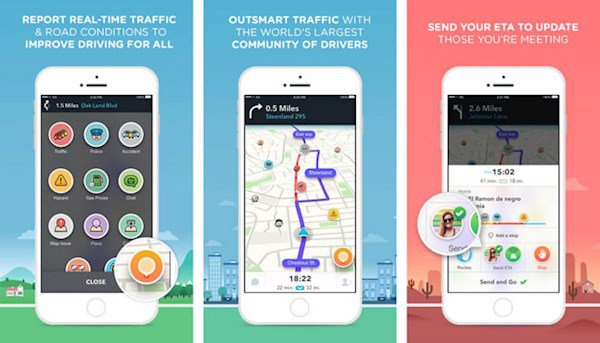
The app I’m most excited about today is a navigation tool called Waze. It provides mapping, plus delightful instructions on how to get from here to there. But beyond that, it crowdsources information to make the trip more efficient and safer than it otherwise would be. In big cities, Waze will take you through circuitous routes to avoid high traffic areas. It alerts you to accidents, road blocks, and debris on the road.

Impressively, it allows drivers to report where the police are staking out speed traps. It tells you whether the officer in question is visible or hidden. You can also confirm or deny the report.

14627-10326-waze-appstore-l

Police have objected to this feature of the app. Why? Because it means that drivers are better able to avoid getting ticketed. But think about this: the app actually succeeds in causing people to obey the law better by slowing down and being safer, as a way of avoiding fines.

Why would police object? If the whole point of traffic police is to get people to drive more safely, knowing about police presence achieves that goal.

Of course, we all know the real reason. The goal of the police on roads is not to inspire better driving but rather catch people in acts of lawbreaking so that they can collect revenue that funds their department. In other words, the incentives of the police are exactly the opposite of the promised results. Instead of seeking good driving, they are seeking lawbreaking as a means of achieving a different outcome: maximum revenue collection.

The whole ethos of Waze is different. It helps you become aware of your external surroundings, and conscious that other drivers are in a similar situation as you are, just trying to get to their destinations quickly and safely. We are there are help each other.

The Community Matters
For me this effected a big change in the whole way I drive. There is a tendency from your first years of driving to treat other drivers as obstacles. Your goal is to outsmart others who are crowding the road, moving around them quickly and navigating the roads with a chip on your shoulder. If there are no cops around, you drive as fast as possible.

I never intended to drive this way, but now I know that I have been, since I first received my government permission slip to drive. Once behind the wheel, I tended to think of myself as a lone actor.

Waze has subtly changed my outlook on driving. Other drivers become your benefactors because it is they who are reporting on traffic accidents, cars on the side the road, blocked streets, and the presence of police. They are all doing you favors. If you report, others thank you for doing so. You even see icons of evidence that your friends are driving, too.

Safety is priority one. Waze won’t let you type in a new address while you are driving. You have to stop the car before you can do that.

The app manages to create a sense of community out of drivers on the road, and that changes the way you think when you drive. Now I leave Waze on even when I already know the directions. It’s my connection to the community. I find my whole outlook on driving has changed. For the first time in my life, I can honestly say that I’m a safer and more responsible driver.

So thank you Waze — a product of brilliant entrepreneurship, distributed on private networks, performing a public service.

Compare with the people who are charged with the task of making our roads safe and are paid by our tax dollars to do it. Not only do they fail to accomplish what this one free application has done, they are actively seeking to cripple it.

Baby Steps to a Better World
Maybe this seems like too small a life improvement to justify mentioning? Not so. All great steps toward a better world occur at the margin, bit by bit, through trial and error, one innovation at a time. You look back at the progress of a decade and that’s where the awe comes into play.

It is not through large bills written by legislators and signed by presidents that the world improves. It is through small innovations, inauspicious downloads, incremental improvements in our existing paths that gradually build a better world. Waze is only one of a billion but it points to the right method and approach to an improved life.

Jeffrey Tucker is Director of Digital Development at FEE, CLO of the startup Liberty.me, and editor at Laissez Faire Books. Author of five books, he speaks at FEE summer seminars and other events. His latest book is Bit by Bit: How P2P Is Freeing the World.  Follow on Twitter and Like on Facebook. 

This article was published by The Foundation for Economic Education and may be freely distributed, subject to a Creative Commons Attribution United States License, which requires that credit be given to the author.

How Money Disappears in a Fractional-Reserve Money System – Article by Frank Shostak

How Money Disappears in a Fractional-Reserve Money System – Article by Frank Shostak

The New Renaissance Hat
Frank Shostak
******************************

Most experts are of the view that the massive monetary pumping by the US central bank during the 2008 financial crisis saved the US and the world from another Great Depression. On this the Federal Reserve Chairman at the time Ben Bernanke is considered the man that saved the world. Bernanke in turn attributes his actions to the writings of Professor Milton Friedman who blamed the Federal Reserve for causing the Great Depression of 1930s by allowing the money supply to plunge by over 30 percent.

Careful analysis will however show that it is not a collapse in the money stock that sets in motion an economic slump as such, but rather the prior monetary pumping that undermines the pool of real funding that leads to an economic depression.

Improving the Economy Requires Time and Savings
Essentially, the pool of real funding is the quantity of consumer goods available in an economy to support future production. In the simplest of terms: a lone man on an island is able to pick twenty-five apples an hour. With the aid of a picking tool, he is able to raise his output to fifty apples an hour. Making the tool, (adding a stage of production) however, takes time.

During the time he is busy making the tool, the man will not be able to pick any apples. In order to have the tool, therefore, the man must first have enough apples to sustain himself while he is busy making it. His pool of funding is his means of sustenance for this period—the quantity of apples he has saved for this purpose.

The size of this pool determines whether or not a more sophisticated means of production can be introduced. If it requires one year of work for the man to build this tool, but he has only enough apples saved to sustain him for one month, then the tool will not be built—and the man will not be able to increase his productivity.

The island scenario is complicated by the introduction of multiple individuals who trade with each other and use money. The essence, however, remains the same: the size of the pool of funding sets a brake on the implementation of more productive stages of production.

When Banks Create the Illusion of More Wealth
Trouble erupts whenever the banking system makes it appear that the pool of real funding is larger than it is in reality. When a central bank expands the money stock, it does not enlarge the pool of funding. It gives rise to the consumption of goods, which is not preceded by production. It leads to less means of sustenance.

As long as the pool of real funding continues to expand, loose monetary policies give the impression that economic activity is being boosted. That this is not the case becomes apparent as soon as the pool of real funding begins to stagnate or shrink. Once this happens, the economy begins its downward plunge. The most aggressive loosening of money will not reverse the plunge (for money cannot replace apples).

The introduction of money and lending to our analysis will not alter the fact that the subject matter remains the pool of the means of sustenance. When an individual lends money, what he in fact lends to borrowers is the goods he has not consumed (money is a claim on real goods). Credit then means that unconsumed goods are loaned by one productive individual to another, to be repaid out of future production.

The existence of the central bank and fractional reserve banking permits commercial banks to generate credit, which is not backed up by real funding (i.e., it is credit created out of “thin air”).

Once the unbacked credit is generated it creates activities that the free market would never approve. That is, these activities are consuming and not producing real wealth. As long as the pool of real funding is expanding and banks are eager to expand credit, various false activities continue to prosper.

Whenever the extensive creation of credit out of “thin air” lifts the pace of real-wealth consumption above the pace of real-wealth production this undermines the pool of real funding.

Consequently, the performance of various activities starts to deteriorate and banks’ bad loans start to rise. In response to this, banks curtail their loans and this in turn sets in motion a decline in the money stock.

Does every curtailment of lending cause the decline in the money stock?

For instance, Tom places $1,000 in a savings deposit for three months with Bank X. The bank in turn lends the $1,000 to Mark for three months. On the maturity date, Mark repays the bank $1,000 plus interest. Bank X in turn after deducting its fees returns the original money plus interest to Tom.

So what we have here is that Tom lends (i.e., gives up for three months) $1,000. He transfers the $1,000 through the mediation of Bank X to Mark. On the maturity date Mark repays the money to Bank X. Bank X in turn transfers the $1,000 to Tom. Observe that in this case existent money is moved from Tom to Mark and then back to Tom via the mediation of Bank X. The lending is fully backed here by $1,000. Obviously the $1,000 here doesn’t disappear once the loan is repaid to the bank and in turn to Tom.

Why the Money Supply Shrinks
Things are, however, completely different when Bank X lends money out of thin air. How does this work? For instance, Tom exercises his demand for money by holding some of his money in his pocket and the $1,000 he keeps in the Bank X demand deposit. By placing $1,000 in the demand deposit he maintains total claim on the $1,000. Now, Bank X helps itself and takes $100 from Tom’s deposit and lends this $100 to Mark. As a result of this lending we now have $1,100 which is backed by $1,000 proper. In short, the money stock has increased by $100. Observe that the $100 loaned doesn’t have an original lender as it was generated out of “thin air” by Bank X. On the maturity date, once Mark repays the borrowed $100 to Bank X, the money disappears.

Obviously if the bank is continuously renewing its lending out of thin air then the stock of money will not fall. Observe that only credit that is not backed by money proper can disappear into thin air, which in turn causes the shrinkage in the stock of money.

In other words, the existence of fractional reserve banking (banks creating several claims on a given dollar) is the key instrument as far as money disappearance is concerned. However, it is not the cause of the disappearance of money as such.

Banks Lend Less as the Quality of Borrowers Worsens
There must be a reason why banks don’t renew lending out of thin air. The main reason is the severe erosion of real wealth that makes it much harder to find good quality borrowers. This in turn means that monetary deflation is on account of prior inflation that has diluted the pool of real funding.

It follows then that a fall in the money stock is just a symptom. The fall in the money stock reveals the damage caused by monetary inflation but it however has nothing to do with the damage.

Contrary to Friedman and his followers (including Bernanke), it is not the fall in the money supply and the consequent fall in prices that burdens borrowers. It is the fact that there is less real wealth. The fall in the money supply, which was created out of “thin air,” puts things in proper perspective. Additionally, as a result of the fall in money, various activities that sprang up on the back of the previously expanding money now find it hard going.

It is those non-wealth generating activities that end up having the most difficulties in serving their debt since these activities were never generating any real wealth and were really supported or funded, so to speak, by genuine wealth generators. (Money out of “thin air” sets in motion an exchange of nothing for something — the transferring of real wealth from wealth generators to various false activities.) With the fall in money out of thin air their support is cut-off.

Contrary to the popular view then, a fall in the money supply (i.e., money out of “thin air”), is precisely what is needed to set in motion the build-up of real wealth and a revitalizing of the economy.

Printing money only inflicts more damage and therefore should never be considered as a means to help the economy. Also, even if the central bank were to be successful in preventing a fall in the money supply, this would not be able to prevent an economic slump if the pool of real funding is falling.

Frank Shostak is an Associated Scholar of the Mises Institute. His consulting firm, Applied Austrian School Economics, provides in-depth assessments and reports of financial markets and global economies. He received his bachelor’s degree from Hebrew University, master’s degree from Witwatersrand University and PhD from Rands Afrikaanse University, and has taught at the University of Pretoria and the Graduate Business School at Witwatersrand University.

This article was originally published by the Ludwig von Mises Institute. Permission to reprint in whole or in part is hereby granted, provided full credit is given.

Will Banning Genetic Engineering Kill You? – Article by Edward Hudgins

Will Banning Genetic Engineering Kill You? – Article by Edward Hudgins

The New Renaissance HatEdward Hudgins
******************************

One headline reads “British baby given genetically-edited immune cells to beat cancer in world first.” Another headline reads “Top biologists debate ban on gene-editing.” It’s a literal life-and-death debate.

And if you care to live, pay attention to this philosophical clash!

Exponential growth in genetic engineering

Genetic engineering is on an exponential growth path. In 2001 the cost of sequencing a human-sized genome was about $100 million. By 2007 the cost was down to $10 million.

layla-richard-genetic-engineeringNow it’s just over $1,000. Scientists and even do-it-yourself biohackers can now cheaply access DNA information that could allow them to discover cures for diseases and much more.

Recently, for example, baby Layla Richards [at right] was diagnosed with leukemia. But when none of the usual treatments worked, doctors created designer immune cells, injected them into the little girl and the treatment worked. She was cured.

Designer babies?

But there have been concerns about such engineering for decades; indeed, precautionary guidelines were drawn up by a group of biologists at the 1975 Asilomar conference in California. And now, at a joint conference in Washington, D.C. of the National Academies of Medicine and Sciences, the Chinese Academy of Sciences and the Royal Society of the United Kingdom, a cutting-edge genetic engineering tool known as CRISPR-Cas9 came under attack because it can be used to edit the genomes of sperm, eggs, and embryos.

National Institutes of Health director Francis Collins argued that the children that would result from such editing “can’t give consent to having their genomes altered” and that “the individuals whose lives are potentially affected by germline manipulation could extend many generations into the future.” Hille Haker, a Catholic theologian from Loyola University Chicago, agreed and proposed a two year ban on all research into such manipulation of genomes. Others argued that such manipulation could lead to “designer babies,” that is, parents using this technology to improve or enhance the intelligence and strength of their children.

These arguments are bizarre to say the least.

Damning to misery

To begin with, there is virtual universal agreement among religious and secular folk alike that from birth and until a stage of maturity at which they can potentially guide their lives by their own reason, the consent of children is not needed when their parents make many potentially life-altering decisions for them. Why should this reasonable rule be different for decisions made by parents before a child is born?

And consider that the principal decisions with gene-editing technology would be to eliminate the possibility of the child later in life having Alzheimer’s or Parkinson’s diseases, cancers, and a host of other ailments that plague humanity. Is it even conceivable that any rational individual would not thank their parents for ensuring their health and longevity? Isn’t this what all parents wish for their children? Why would anyone deny parents the tools to ensure healthy children? How much continued misery and death are those who would delay genetic research or ban this new technology inflicting on parents and children alike?

And so what if the “slippery slope” is parents ensuring that their children are more intelligent or stronger? Right now such traits are a matter of a genetic lottery and every parent hopes for the best. What parent wouldn’t jump at the chance to ensure such beneficial capacities for their children?

A privileged biological elite?

Some might pull out the ugly egalitarian argument that the “rich” could produce biologically elite “superchildren,” leaving the rest of humanity behind: an inferior, impoverished breed to be exploited. But this is the same spurious argument made about every technology that initially allows more prosperous individuals to better themselves ahead of others. We heard two decades ago that only the “rich” would be able to afford computers and the internet, allowing them to be more informed and, thus, enabling them to oppress the downtrodden masses. But exponential changes in technologies ensure that just as computers and the internet have become inexpensive and available to all, so will genetic enhancements become after the techniques are perfected for prosperous beta-testers.

And in any case, just as it is immoral to deprive those who honestly earn their wealth of the fruits of their labor just because others have yet to earn theirs, so it is immoral to deprive them of the opportunity to provide the best biology for their children just because it will take time for the technology to become available to all.

Precautionary principle or proactionary principle?

Many opponents of genetic engineering fall back on the so-called “precautionary principle.” This is the notion that if products or technologies pose any imaginable risks—often highly speculative or vague ones unsupported by any sound science—then such products or technologies should be severely restricted, regulated, or banned. The burden is placed on innovators to prove that no harm to humans will result from their innovations.

But had this standard been applied in the past, we would not have the modern world today. Indeed, by this standard, precaution would dictate that fire was just too dangerous for humans and that cavemen should have been barred from rubbing two sticks together.

Max More, a founder of the transhumanist philosophy, offers instead the “proactionary principle.” He argues that “People’s freedom to innovate technologically is highly valuable, even critical, to humanity.” And “Progress should not bow to fear, but should proceed with eyes wide open.” And that we need to “Protect the freedom to innovate and progress while thinking and planning intelligently for collateral effects.”

Freedom to progress

Fortunately, more individuals than More reason this way. At the D.C. conference, University of Manchester Professor John Harris argued “We all have an inescapable moral duty: To continue with scientific investigation to the point at which we can make a rational choice. We are not yet at that point. It seems to me, consideration of a moratorium is the wrong course. Research is necessary.” But the opinion of academics one way or another might not matter. Just as it was do-it-yourselfers and innovators in garages that made the computer and information revolution, genetic innovations might well come from such achievers as well. But they won’t do it if they are not free to do so.

If you value your life and the lives and health of your children, you had better work for this freedom to innovate.

Dr. Edward Hudgins directs advocacy and is a senior scholar for The Atlas Society, the center for Objectivism in Washington, D.C.

Copyright The Atlas Society. For more information, please visit www.atlassociety.org.

Enlightened Selfies – Narcissism and Human Rights – Article by B.K. Marcus

Enlightened Selfies – Narcissism and Human Rights – Article by B.K. Marcus

The New Renaissance Hat
B.K. Marcus
******************************

When the press refers to “Generation Selfie,” do we sense a sneer? It’s almost as if the term selfie is shorthand not for self-portrait but for self-involved, self-absorbed, or simply selfish.

Selfies are widespread among millennials, many of whom grew up with camera phones. A poll commissioned by electronics maker Samsung reveals that fully 30 percent of all photos taken by 18- to 24-year-olds are selfies. For many of us, the selfie is just the new normal, whether or not we fill our own smartphones with self-regarding snapshots. But, as Pamela Rutledge writes for Psychology Today, some see the selfie generation “as proof of cultural — or at least generational — narcissism and moral decline.” And calling Generation Selfie a bunch of narcissists may not be rhetorical excess: according to a paper in the journal Personality and Individual Differences, selfie-posting behavior is indeed associated with narcissistic personality disorder.

Does this mean that modern society is growing more self-obsessed?

Belief in the “moral decay” epitomized by self-directed amateur photography results from a more general conviction that the virtues of community and altruism are being driven out by our culture’s overemphasis on the individual. Whether the culprit is capitalism, technology, or Western civilization more generally, the idea is that historically recent developments are fracturing our communal bonds and leading to a loss of empathy, compassion, and duty — replacing concern for the well-being of a larger group with a privileging of the atomized individual.

Inventing the Modern Self

But the development is not, in fact, historically recent. The selfie as we now know it may seem like a result of social media and the camera phone, but our society’s apparent obsession with visual self-presentation is much older — and significantly more beneficial — than the critics understand.

“It’s easy to make fun of our penchant for taking selfies,” writes popular science author Steven Johnson in How We Got to Now: Six Innovations That Made the Modern World, “but in fact there is a long and storied tradition behind that form of self-expression.”

The original selfie generation emerged in Renaissance Italy, the product of a different technological innovation. Centuries before the bidirectional camera phone, there was the culturally disruptive technology of the glass mirror.

“The interesting thing about self-portraiture,” Johnson tells us, “is that it effectively doesn’t exist as an artistic convention in Europe before 1400.” That’s because, for most of human history, we got very few chances to see ourselves as others see us. The best we could do was a rippled reflection glimpsed in water or a tarnished image on a metal pot.

That all changed when glassmakers “figured out a way to combine their crystal-clear glass with a new innovation in metallurgy, coating the back of the glass with an amalgam of tin and mercury to create a shiny and highly reflective surface. For the first time, mirrors became part of the fabric of everyday life.”

One result was the invention of linear perspective in painting. Prior to the Renaissance, visual representation was more symbolic, less what we would now call realistic. Renaissance artists used the new technology of the mirror to compare what they put on the canvas with what they saw framed in the glass. Sometimes, of course, what they saw in the looking glass was their own reflection.

“The mirror helped invent the modern self,” Johnson writes, “in some real but unquantifiable way.”

Soon after, “social conventions as well as property rights and other legal customs began to revolve around the individual rather than the older, more collective units: the family, the tribe, the city, the kingdom.” Furthermore, “orienting laws around individuals led directly to an entire tradition of human rights and the prominence of individual liberty in legal codes.”

Inventing Humanity

In a different investigation of the individualist tradition, historian Lynn Hunt observes in her book Inventing Human Rights, “For rights to be human rights, all humans everywhere in the world must possess them equally and only because of their status as human beings.”

There was no such understanding of humanity for most of history. Love, compassion, and sympathy may have existed from the beginning, but only between people in narrowly defined groups. The treatment for outsiders was far more harsh.

Slavery and torture, today considered egregious violations of human rights, went unquestioned before a few hundred years ago. Since at least the time of Aristotle, it was typical to divide the world between “us,” the naturally civilized, and “them,” the naturally enslaved. Torture, in the ancient world, was originally limited to slaves, but over time, the practice became more acceptable, and in the second century it was expanded to include nominally free lower-class victims. By the Middle Ages, torture before execution had become a form of spectacle, public entertainment for the whole family.

How, then, did we develop a sense of universal humanity and of natural rights for all human beings? Specifically, Hunt asks about the Enlightenment thinkers in 18th-century France and America, for whom such rights were “self-evident.”

How did these men, living in societies built on slavery, subordination, and seemingly natural subservience, ever come to imagine men not at all like them and, in some cases, women too, as equals?

And how did the 18th-century public come to agree with them? The answer Hunt offers is that the so-called self-evidence of individual human rights was largely the result of widespread reading in a genre that was still relatively new at the time: the epistolary novel. Enlightenment thinkers were familiar with first-person narrative in a way that earlier generations would have found alien. Novels introduced readers to the inner lives of characters unlike themselves.

Johnson, too, talks about the emergence of the novel and its impact on the moral imagination, but he traces the origins of the modern novel itself to the same innovation that gave rise to linear perspective in painting: “The psychological novel … is the kind of story you start wanting to hear once you begin spending meaningful hours of your life staring at yourself in the mirror.”

Thinking about themselves as the individuals staring back through the glass, “people began writing about their interior lives with far more scrutiny,” and “the novel emerged as a dominant form of storytelling, probing the inner mental lives of its characters with an unrivaled depth.”

The Innovation of Empathy

What does this sort of growing self-obsession have to do with the rights of others?

Empathy, Hunt points out, “requires a leap of faith, of imagining that someone else is like you.” This is the idea that “novels generated … by inducing new sensations about the inner self.”

Or as Johnson puts it,

Entering a novel, particularly a first-person narrative, was a kind of conceptual parlor trick: it let you swim through the consciousness, the thoughts and emotions, of other people more effectively than any aesthetic form yet invented.

Spending time in someone else’s head, even if that someone else is fictional, is practice for thinking about real people’s experiences.

So, according to this story, the technology of glass mirrors leads to linear perspective, the Renaissance, and a new literary form called the novel. The novel, in turn, transforms the popular imagination in such a way that even strangers — those outside your immediate family, class, and religious affiliation — come to be understood as autonomous individuals with their own inner lives, much like your own. And for the first time in history, people come to question the practices of torture and slavery, practices at least as old as civilization and far more universal than any understanding of rights prior to the Enlightenment.

The “invention” of the individual ushered in not ever more selfishness and less regard for the group, but an expanding empathy and a more inclusive, approaching universal, sense of “us” — a waning relegation of those outside our moral community.

Trading with the Other

Johnson notes that the technological innovation at the beginning of the story isn’t enough by itself to have produced the larger cultural shift:

The Renaissance also benefited from a patronage system that enabled its artists and scientists to spend their days playing with mirrors instead of, say, foraging for nuts and berries. A Renaissance without the Medici — not the individual family, of course, but the economic class they represent — is as hard to imagine as the Renaissance without the mirror.

The same can be said about the economy that produced the Enlightenment: it is hard to imagine an era of growing empathy, open-mindedness, and belief in universal rights without the market that provided a growing readership for the epistolary novel.

Capitalism establishes the conditions in which individualism can thrive. Individualism, in turn, helps the market economy to grow and to propagate the belief in rights-bearing individuals.

Contrary to today’s critics, then, who assume that the individualist mentality leads to the absence of empathy, with the advent of individualism came the invention of empathy, at least as applied to those outside the tribe, clan, or caste.

Maybe narcissists do feel compelled to photograph themselves. Camera phones make it easier than ever. But the myth of Narcissus is ancient. And the history of reflective technology points us to a different understanding of cause and effect for the selfie generation.

The 21st-century self-portrait can play the same role now as its earlier incarnations did during the Renaissance and the Enlightenment. Like individualism more generally, the selfie invites us to explore questions of identity and of where we fit in an ever more interconnected community.

B.K. Marcus is editor of the Freeman. His website is bkmarcus.com.

This article was published by The Foundation for Economic Education and may be freely distributed, subject to a Creative Commons Attribution 4.0 International License, which requires that credit be given to the author.

Future City Concept – Art by Eric Dima-ala

Future City Concept – Art by Eric Dima-ala

future_city_concept_by_frenicNote: Left-click on this image to get a full view of this digital work of art.

Created by digital artist Eric Dima-ala, this futuristic matte painting captures the glittering beauty of a bustling nighttime cityscape.

Visit Eric Dima-Ala’s website for more of his matte paintings and illustrations.

This work is licensed under a Creative Commons Attribution-Noncommercial-No Derivative Works 3.0 License and was originally posted on DeviantArt.

Space Elevator – Art by Glenn Clovis

Space Elevator – Art by Glenn Clovis

space_elevator_by_glennclovis-d7egmifNote: Left-click on this image to get a full view of this digital work of art.

Created by digital artist Glenn Clovis, this art was created for the 23rd Exhibition of The Luminarium, “KIBERNETIK”. The entire exhibit can be viewed here.

Visit Glenn Clovis’s DeviantArt page and view his other art.

This work is licensed under a Creative Commons Attribution-Noncommercial-No Derivative Works 3.0 License.

Jason Hope on Philanthropy – Article by Reason

Jason Hope on Philanthropy – Article by Reason

The New Renaissance Hat
Reason
November 30, 2015
******************************

Jason Hope, you might recall, has provided half a million dollars in research funding to the SENS Research Foundation, used to establish a SENS laboratory at Cambridge in order to push forward with the Foundation’s AGE-breaker program. AGE-breakers are drugs or other treatments capable of breaking down advanced glycation end-products (AGEs). These are a class of metabolic waste product that accumulate in our tissues to cause significant harm that includes the progressive loss of elasticity in skin and blood vessels.

There is, on the whole, far too little work undertaken today on AGE-breaker treatments in comparison to the benefits that a treatment could bring. What little research has taken place over the past twenty years unfortunately produced no effective therapies. As it turned out the AGEs that are important in short-lived laboratory animals are not the same at all as those that are important in humans – something that would have been challenging to identify until comparatively recently, and which resulted in promising animal studies that then went nowhere in commercial trials.

Now, however, researchers know that the vast majority of all AGEs in human tissues consist of just one type, called glucosepane – so the way is open for bold philanthropists and forward-looking researchers to build therapies that will be effective in removing this contribution to degenerative aging. Glucospane removal is one of the areas in which the SENS Research Foundation and its backers pick up the slack, undertaking important rejuvenation research that is neglected by the mainstream, even though it was exactly the mainstream research community that produced all of the studies and evidence that demonstrate the important role of glucospane in aging.

In any case, I should point out that Jason Hope runs a website and blog in which he discusses his take on philanthropy and his support for research aimed at extending healthy human life and rejuvenating the old. This makes for an interesting follow-on from yesterday’s post on big philanthropy. More folk of this ilk would certainly be a good thing, and I’m always pleased to see more of the better connected people in this world of ours speaking openly of their support for rejuvenation biotechnology.

Philanthropy

Quote:

Philanthropy has become a big focus for me. The organizations I have chosen to stand behind have come from many facets of my life. One of my passions has become the research done at the SENS Research Foundation. Their involvement in anti aging is not just about wanting to live forever. It’s about creating a longer, better quality of life.

Foundations like SENS are taking a different approach to anti-aging. They are focused on finding cures for disease that break down the body and thus cause us to age faster than we should. Disease like Alzheimer’s and heart and lung disease affect all functions of the body. Traditional medicine looks at treating these diseases after they happen. We want to focus on stopping these diseases from ever happening. We have spent so much time focused on medication for treating disease and not enough time on preventing that disease from ever happening.

By supporting scientific research that thrives through innovation and is not afraid to challenge the modern school of thought we will continue to break down walls.

A 21st-Century Philanthropic Model For Philanthropy

Quote:

Can you conceive of a world without age-related disease, disability and suffering? What about a world in which it’s possible for the average person to live 120 healthy years? While it may sound like a utopian dream, such a world is the exact goal of some of society’s most brilliant scientists and visionary leaders. At this very minute, groundbreaking work is underway at universities across the globe as researchers attempt to apply regenerative medicine to age-related disease through the repair of damage to tissue, cells and molecules within the body. While this research couldn’t be possible without the leadership of the world’s wealthiest philanthropists, it also relies upon the collective power of everyday people who have joined forces in their commitment to a better quality of life for all.

Traditionally, big ticket donors have been the primary target for fundraising programs. Research has consistently shown that the bulk of donor funds come from a small percentage of the wealthiest donors: in fact, a full 75 percent of funds raised come from gifts of over $1 million.

Instead of resigning themselves solely to the influence of the individual, non-profits are turning to the collective power of a group. The MFoundation’s “The 300 Pledge” fundraising campaign is an exciting example of this method in practice. The 300 Pledge asks 300 funders to commit $1,000 a year for 25 years toward critical research aimed at ending age-related diseases. When broken down, this goal is manageable for many households: just $3 a day or $85 a month – less than your daily tab at Starbucks. Obviously, the model is working: to date, 291 people have taken up the challenge, with nine spots remaining.

As evidenced by the magnificent philanthropy of people like Peter Thiel, Bill Gates and others like them, it’s obvious that one person can make a difference. However, fundraising challenges, like MFoundation’s “The 300,” also demonstrate the power of a dedicated group of people to foster real world change for the billions of people living in the world today as well as the generations that follow. In doing so, those who take up the challenge create a unique and world-altering legacy for themselves.

Reason is the founder of The Longevity Meme (now Fight Aging!). He saw the need for The Longevity Meme in late 2000, after spending a number of years searching for the most useful contribution he could make to the future of healthy life extension. When not advancing the Longevity Meme or Fight Aging!, Reason works as a technologist in a variety of industries. 
***

This work is reproduced here in accord with a Creative Commons Attribution license. It was originally published on FightAging.org.

SENS Research Foundation Joins the Global #GivingTuesday Movement – Press Release by SENS Research Foundation

SENS Research Foundation Joins the Global #GivingTuesday Movement – Press Release by SENS Research Foundation

The New Renaissance Hat
SENS Research Foundation
November 28, 2015
******************************
Every Dollar Contributed Up to the First $5,000 Will Be Quadrupled, Turning into $20,000.
 ***

MOUNTAIN VIEW, Calif. — November 24, 2015 — The SENS Research Foundation (SRF), a non-profit organization focused on transforming the way the world researches and treats age-related disease, has joined #GivingTuesday, a global day of giving that harnesses the collective power of individuals, communities and organizations to encourage philanthropy and celebrate generosity worldwide. Every dollar donated to SRF up to the first $5,000 will be quadrupled, making every dollar raised turn into $20,000.

Occurring this year on December 1, #GivingTuesday is held annually on the Tuesday after Thanksgiving (in the U.S.) and the widely recognized shopping events Black Friday and Cyber Monday to kick-off the holiday giving season and inspire people to collaborate in improving their local communities and to give back in impactful ways to the charities and causes they support.

SENS Research Foundation is aiming to reach a goal of $20,000 with the help of contributors who have pledged to match each dollar raised up to the first $5,000. The Croeni Foundation, a philanthropic organization dedicated to giving, the environment and health, has pledged to match the first $5,000 raised dollar for dollar. The foundation gave SRF an unrestricted $5,000 earlier this year, as well. Aubrey de Grey, CSO of SENS Research Foundation, has offered a dollar for dollar matching challenge up to $5,000. And Fight Aging! will match every dollar up to $125,000 through December 31, 2015. Fight Aging! encourages the development of medical technologies, lifestyles, and other means to help people live comfortably, healthily, and capably for as long as they desire.

“We are looking forward to participating in #GivingTuesday for a second year, and offer our thanks to Jan Croeni and the Croeni Foundation, as well as Aubrey de Grey and Fight Aging! for their support,” said Jerri Barrett, vice president of outreach, SENS Research Foundation. “Today’s cost for the treatment and care of chronic diseases of aging costs around $40,000 per second and will only continue to go up, as we spend more money per patient, while the number of patients is increasing. As a society, we need to change our ways and start treating age-related diseases more intelligently. The funds we raise on #GivingTuesday will help facilitate our efforts to do just that, as we work to continue learning how to prevent or reverse age-related diseases.”

Those who are interested in joining SENS Research Foundation’s #GivingTuesday initiative can donate at www.sens.org/donate. To learn more about #GivingTuesday participants and activities or to join the celebration of giving, please visit: http://www.givingtuesday.org/

About SENS Research Foundation (SRF)

SENS Research Foundation is a 501(c)(3) nonprofit that works to research, develop, and promote comprehensive regenerative medicine solutions for the diseases of aging. SRF is focused on a damage repair paradigm for treating the diseases of aging, which it advances through scientific research, advocacy, and education. SENS Research Foundation supports research projects at universities and institutes around the world with the goal of curing such age-related diseases as heart disease, cancer, diabetes and Alzheimer’s disease. Educating the public and training researchers to support a growing regenerative medicine field are also major endeavors of the organization that are being accomplished though advocacy campaigns and educational programs. For more information, visit www.sens.org.

Media Contact:
Jerri Barrett
408-204-7229
jerri.barrett@sens.org

The Immortals Among Us – Article by Reason

The Immortals Among Us – Article by Reason

The New Renaissance Hat
Reason
November 26, 2015
******************************

Let us define immortality as being a state of agelessness, which seems a common colloquial usage these days. More precisely this means that the risk of death due to intrinsic causes such as wear and tear damage of vital organs remains the same over time, perhaps due to advanced medical interventions. Falling pianos are still going to kill you, and a hypothetical biologically young immortal in a hypothetical environment maintaining today’s first world extrinsic mortality rate would have a half-life of 500 years or so, meaning that at any age, there is a 50% chance of evading a life-ending event for another 500 years. There are no human immortals by this criteria of a static intrinsic mortality rate, it seems, though for a while it looked like very old humans might have essentially flat but very high mortality rates in the same way as very old flies do. Immortality in a state of advanced frailty and coupled with a 90% or higher yearly mortality rate isn’t the sort of circumstance that most people would aspire to, of course. It barely improves on the actual circumstance that the oldest of people find themselves in, all too briefly.

However, let us think beyond the box. Consider the small horde of children that you’ll find playing and running in any junior schoolyard here and now. By the time the survivors of their cohorts reach a century of age, the 2100s will have arrived. If the current very slow trend in increasing adult life expectancy continues, adding a year of remaining life expectancy at 60 for every passing decade, then something like 25% of these present children will live to see that centenary. But I don’t for one moment believe that this trend will continue as it has in the past. Past increases in life expectancy were an incidental side-effect of general improvements in medicine across the board, coupled with increasing wealth and all the benefits that brings. Across all of that time, no-one was seriously trying to intervene in the aging process, to address the causes of aging, or to bring aging under medical control. Times are changing, and now many groups aiming to build some of the foundations needed to create exactly this outcome. You may even have donated to support some of them, such as the SENS Research Foundation. The trend in longevity in an age in which researchers are trying to treat the causes of aging will be very different from the trend in longevity in an age in which no such efforts are taking place.

You don’t have to dig very far into the state of the science to see that the first rejuvenation treatments are very close, their advent limited only by funding. If funding were no issue for senescent cell clearance, for example, it would absolutely, definitively be in clinics a decade from now. Other necessary technologies are more distant, but not that much more distant – the 2030s will be an exciting time for the medical sciences. For the occupants of today’s junior playground, it seems foolish to imagine that by age 60 they will not have access to rejuvenation treatments after the SENS model at various stages of maturity, many having having been refined for more than 30 years, at the height of their technology cycle, and just giving way to whatever radical new improvement happens next.

Take a moment for a sober look at the sweeping differences and expanded technological capabilities that exist between today, the 1960s, and the 1910s. So very much has been achieved, and that pace of progress is accelerating. Those junior playground athletes of today will live to see a world even more radically different and advanced than our present time is in comparison to the First World War era. These are the immortals among us. The majority of them will have the opportunity to attain actuarial escape velocity, to keep on using ever-improving versions of rejuvenation treatments until they are gaining life expectancy at a faster rate than they are aging. Their cellular damage, the wear and tear created by the normal operation of metabolism, will be repaired as fast as it is is generated. It is the rest of us, those of us who are no longer spring chickens, who are faced with much more of a race to the goal. The degree to which we can successfully fund and advocate the necessary research is the determinant of whether we can scrape by into the age of rejuvenation treatments, or whether we will gain modest benefits but still age to death – because we were born too soon, and because the rest of the world didn’t get its collective act together rapidly enough in what is now the very tractable matter of building a cure for aging.

Reason is the founder of The Longevity Meme (now Fight Aging!). He saw the need for The Longevity Meme in late 2000, after spending a number of years searching for the most useful contribution he could make to the future of healthy life extension. When not advancing the Longevity Meme or Fight Aging!, Reason works as a technologist in a variety of industries. 
***

This work is reproduced here in accord with a Creative Commons Attribution license. It was originally published on FightAging.org.