Thanks to “Wiretapping” Laws, Your Cell Phone Is a Felony Machine – Article by Gary McGath

Thanks to “Wiretapping” Laws, Your Cell Phone Is a Felony Machine – Article by Gary McGath

The New Renaissance HatGary McGath
******************************

The prosecutions are clearly meant to chill free speech

In 2006, police in Nashua, New Hampshire, filed charges against Michael Gannon for using a security system in his home. When he brought a security recording to the police to back up a complaint about how he was treated, they arrested him and charged him with “felony wiretapping” — recording what happened in his own house. They were later forced to drop the charges under intense publicity.

The relevant New Hampshire law is titled “Wiretapping and Eavesdropping,” but it isn’t restricted to electronic communications.

It’s a felony if someone “willfully intercepts, endeavors to intercept, or procures any other person to intercept or endeavor to intercept, any telecommunication or oral communication.”

Intercepting means “the aural or other acquisition of, or the recording of, the contents of any telecommunication or oral communication through the use of any electronic, mechanical, or other device.” Oral communication means “any verbal communication uttered by a person who has a reasonable expectation that the communication is not subject to interception, under circumstances justifying such expectation,” but the law doesn’t define “reasonable expectation.”

Recording what someone else says can be a felony unless it falls under the reasonable-expectation exception. Burglars don’t expect to be recorded. I live in the same city as Gannon; if thieves broke into my home and I recorded their activity, would I dare bring the evidence to the police?

The New Hampshire law is a “two-party consent” law; you can’t even record your own conversation with someone else without letting him or her know. Nine to twelve states, depending on interpretation, have two-party consent requirements.

In recent years activists have successfully pushed back against using those laws to prevent or punish recording police activity. Courts have held that when they’re on duty, cops don’t have a reasonable expectation of privacy. Governments can still use the law against people who record other public speech, though.

In 2015, in Portsmouth, New Hampshire, Christopher David was charged with felony wiretapping for recording a conversation on a public street. He recorded a private citizen telling him he could be prosecuted for running an Uber vehicle, which the city has banned. It’s easy to suspect the city is going after him for competing with the city’s taxis, but officially, his “crime” is recording words directed at him in public.

Illinois had a similarly draconian law often used to punish recording the police, which the state’s Supreme Court struck down. The court held:

The recording provision of the eavesdropping statute … burdens substantially more speech than is necessary to serve a legitimate state interest in protecting conversational privacy. Thus, it does not survive intermediate scrutiny. We hold that the recording provision is unconstitutional on its face because a substantial number of its applications violate the First Amendment.

Any legal prohibition ought to satisfy the question, “What harm to someone does it deter?” Recording a person who comes up to you in public and tells you something doesn’t injure him in any way. If he’s giving away information he doesn’t want known, that’s on his own head.

Eugene Volokh notes that without a clear definition of privacy, prohibitions ostensibly designed to protect it can seriously infringe on free speech. “Once restrictions on people’s speech are accepted in the name of ‘privacy,’ people will likely use them to argue for other restrictions on ‘privacy’ grounds, even when the matter involves a very different sort of ‘privacy.’” This is a serious matter, because “the right to information privacy — my right to control your communication of personally identifiable information about me — is a right to have the government stop you from speaking about me.”

Modern technology allows anyone to make video recordings in public, and if anyone’s voice is picked up without consent, the recording could be a crime punishable by years in jail. David Rittgers, an attorney and legal policy analyst at the Cato Institute, argues, “I think in this modern age where everyone has a ‘felony machine’ in their pocket — a cell phone — the [all-party] consent law is outdated.”

When the government surreptitiously captures records of our private communications, it tells us we shouldn’t worry if we have nothing to hide. When we record people speaking openly in public, quite a different standard applies.

Most of the debate about abusive wiretapping and eavesdropping laws has focused on their use to protect police officers caught misbehaving. The problem doesn’t stop there, though. When “reasonable expectation of privacy” isn’t clearly delimited, any recording of what people say in public can become an excuse to throw people in jail.

Gary McGath is a freelance software engineer living in Nashua, New Hampshire.

This article was published by The Foundation for Economic Education and may be freely distributed, subject to a Creative Commons Attribution 4.0 International License, which requires that credit be given to the author.

Being Good for Goodness’ Sake – Article by Bradley Doucet

Being Good for Goodness’ Sake – Article by Bradley Doucet

The New Renaissance HatBradley Doucet
******************************

“Dear Santa,” begins an Internet meme that’s been making the rounds, accompanied by some innocent-looking drawing of a small child or a woman decorating a tree, “I’m writing to tell you I’ve been naughty and it was worth it, you fat, judgmental bastard.”

Fair enough, I say. Who died and made Jolly Old Saint Nick the arbiter of all things good and bad, anyway? And frankly, the extensive surveillance that’s he’s gotta have going on 24/7, 365 days a year, is more than a little bit creepy.

But if I reject the authority of the guy in red to tell me what to do, does that mean I can do whatever I please? Just gather as many resources and as much power over my fellows as I can, by whatever means I choose, fair or foul, even becoming top ape of the tribe if possible?

Such a life, no matter where you end up in the pecking order, is frankly impoverished. I don’t have anything against material riches per se, but we humans are not merely animals; we are rational animals. This doesn’t mean we are always or automatically rational, but rather that we have the ability to reason instead of being swept along exclusively by impulse and instinct.

Yet reason is not merely a tool, our particular means of getting what we need to survive, akin to another animal’s claws or teeth or brute strength. It is that, but it is also much more. Having the faculty of reason, we also have a psychological need to use it not only to better our lives, but to determine what constitutes a good life. It may be going too far to say that the unexamined life is not worth living at all, but the unexamined life is surely less than optimally satisfying.

So, what makes a good life? Physical pleasure is one good thing, to be sure, but only one, and its pursuit can distract us from the more subtle and deeper satisfactions of being human. Acquiring knowledge and learning skills, making and appreciating art, and cultivating relationships with others all take us beyond the simple pleasures we have in common with the beasts.

Even this does not quite capture what it means to live a fully human life, though, because it ignores the issue of dealing with others. Given that other human beings, like me, tend to want pleasure and knowledge and art and relationships, I am more likely to get these good things for myself if I treat other people with respect, cooperating and trading with them. To say the same thing another way, there are instrumental reasons for acting in an ethical manner in one’s dealings with other people.

These reasons do carry a certain weight. But it’s conceivable that one could lie, cheat, manipulate, and force others to give one what one wants, or some close enough facsimile, especially if one is smarter or stronger or richer or otherwise more resourceful than the norm. Are there any deeper reasons, besides the instrumental ones, not to trample the rights of others if one has a fairly good chance of getting away with it?

The answer, of course, is yes. For one thing, like most humans, I care about other people and their interests. Admittedly I don’t care equally about all 7.3 billion of you. Some of you, I don’t even know. Still, I don’t want to do you harm if I can avoid it—and lying to you, cheating you, manipulating you, or initiating force against you are themselves harms, however I may try to disguise this fact and keep anyone, myself included, from recognizing it.

And even more fundamentally, from a certain perspective, it’s also a matter of self-respect. Using deception, manipulation, or force to get what I want from other human beings—instead of treating them as the rational animals they are, with interests and goals and plans of their own—is quite simply beneath me. Respecting others’ rights is intrinsically valuable to me because of what it does to me if I violate them: I become less fully human.¹ I lose face with myself, and all of my pleasures become shadows of themselves: sour when they should be sweet; pale instead of bright and bold; a little out of tune.

Living a fully human life does not mean foregoing the animal pleasures. It does not mean sacrificing your interests to those of others. But it does mean striving to live a rational life, which implies living with honour and recognizing the basic humanity of your fellow human beings—whether or not some dude at the North Pole, or anywhere else, is watching.

1. This idea, and indeed the inspiration for the present short article, is from the second half of Roderick T. Long’s “Reason and Value: Aristotle versus Rand,” Objectivist Studies, No. 3, The Atlas Society, 2000, p. 51: “To violate the rights of others, then, is to lessen one’s own humanity.”

Bradley Doucet is a writer living in Montreal. He has studied philosophy and economics, and is currently completing a novel on the pursuit of happiness. He also is QL’s English Editor.
Fast-Tracking Safe Drugs without Sacrificing Scientific Rigor – Article by Alex Tabarrok

Fast-Tracking Safe Drugs without Sacrificing Scientific Rigor – Article by Alex Tabarrok

The New Renaissance HatAlex Tabarrok
******************************

Here’s how to do it

In a post earlier this year, I noted that Japan has significantly liberalized its approval process for regenerative medicine. Writing in Forbes, Bart Madden and Nobelist Vernon Smith outline a similar proposal for the United States.

Recently, Japanese legislation has implemented the core Free To Choose Medicine (FTCM) principles of allowing not-yet-approved drugs to be sold after safety and early efficacy has been demonstrated; in addition, observational data gathered for up to seven years from initial launch will be used to determine if formal drug approval is granted. …

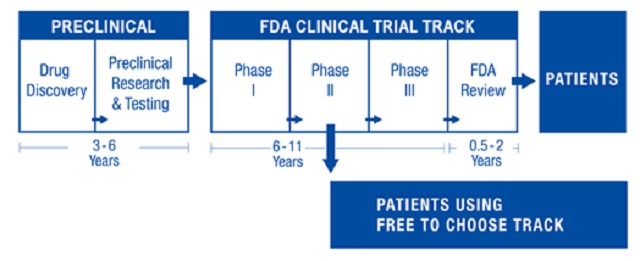
FTCM legislation in the U.S. would create a dual track system (see figure below) that preserves the existing FDA clinical trial process while offering patients an alternative. Patients, advised by their doctors, would be able to contract with a drug developer to use not-yet-approved drugs after Phase I safety trials are successfully completed and one or more Phase II trials have demonstrated continued safety and initial efficacy.

The resulting early access could make FTCM drugs available up to seven years before conventional FDA approval, which entails Phase III randomized control trials and a lengthy FDA review before the FDA makes an approval decision. …

bartgraph

The heart of the dual track system is the Tradeoff Evaluation Drug Database (TEDD) which would be available to the public through a government-supervised web portal. TEDD would contain all treatment results of FTCM drugs including patients’ health characteristics and relevant biomarkers, but no personal identification.

This open access database would be a treasure-trove of information to aid drug developers in making better R&D decisions consistent with fast-paced learning and innovation. …

Today’s world of accelerating medical advancements is ushering in an age of personalized medicine in which patients’ unique genetic makeup and biomarkers will increasingly lead to customized therapies in which samples are inherently small. This calls for a fast-learning, adaptable FTCM environment for generating new data.

In sharp contrast, the status quo FDA environment provides a yes/no approval decision based on statistical tests for an average patient, i.e., a one-size-fits-all drug approval process.

I hold the Bartley J. Madden Chair in Economics at the Mercatus Center, so I am biased, but this is an important proposal. Japan is leading the way and similar ideas are being discussed in Great Britain, but as the most important pharmaceutical market in the world, the United States has an outsize influence on world drug development. We need to lower costs and speed new drugs to market.

This post first appeared at Marginal Revolution.

Alex Tabarrok is a professor of economics at George Mason University. He blogs at Marginal Revolution with Tyler Cowen.

“A Morte é um Erro” – Portuguese Translation of “Death is Wrong” – Translated by Eric Pedro Alvaro – Post by G. Stolyarov II

“A Morte é um Erro” – Portuguese Translation of “Death is Wrong” – Translated by Eric Pedro Alvaro – Post by G. Stolyarov II

The New Renaissance Hat
G. Stolyarov II
******************************

A free PDF version of A Morte é um Erro – the Portuguese translation of Death is Wrong – is now available for download from The Rational Argumentator. You can obtain your copy here and may spread it to Portuguese-speaking audiences as widely as you wish.

A Morte é um Erro was generously translated into Portuguese by Eric Pedro Alvaro.

Death_is_Wrong_Portuguese_CoverPaperback copies of A Morte é um Erro can be purchased in the following venues:

Createspace

Amazon

Kindle copies of A Morte é um Erro can be purchased on Amazon for $0.99.

***

Se você já se perguntou, “Por que as pessoas morrem?” então este livro é para você. A resposta é que não, a morte não é necessária, inevitável ou boa. Na verdade, a morte é um erro. A morte é uma inimiga de todos nós, que deve ser combatida com ciência, medicina e tecnologia. Este livro lhe apresenta os maiores, mais desafiantes e mais revolucionários movimentos para prolongar radicalmente o tempo de vida humano, para que você então simplesmente não precise morrer.

Você aprenderá sobre algumas plantas e animais com um tempo de vida incrivelmente longo, sobre recentes descobertas científicas em relação a ampliação do tempo de vida em humanos, e sobre simples e poderosos argumentos que podem refutar as comuns desculpas para a morte. Se você alguma vez já pensou que a morte é injusta e que ela deve ser derrotada, você não está sozinho. Leia este livro, e se torne parte desta importante busca na história da humanidade.

Este livro foi escrito pelo filósofo e futurólogo Gennady Stolyarov II e ilustrado pela artista Wendy Stolyarov. Com o intuito de lhe mostrar que, não importa quem é você e o que você pode fazer, sempre há uma forma de ajudar humanidade em sua batalha contra morte.

Refuting Ayn Rand’s “Immortal Robot” Argument – Article by G. Stolyarov II

Refuting Ayn Rand’s “Immortal Robot” Argument – Article by G. Stolyarov II

The New Renaissance HatG. Stolyarov II

******************************

Here I refute an argument that has been leveled against proponents of indefinite human longevity from a surprising direction – those sympathetic to the Objectivist philosophy of Ayn Rand. Some advocates of Ayn Rand’s philosophy believe that indefinite life would turn human beings into “immortal, indestructible robots” that, according to Ayn Rand, would have no genuine values. Both of these claims are false. Indefinite life would not turn humans into indestructible robots, nor would an indestructible robot with human abilities lack values or motivation for doing great things. In Ayn Rand’s own words, “Achieving life is not the equivalent of avoiding death.” (John Galt’s speech in For the New Intellectual, p. 135)

Rand’s “immortal robot” argument is found in “The Objectivist Ethics” (The Virtue of Selfishness, p. 15): “To make this point fully clear, try to imagine an immortal, indestructible robot, an entity which moves and acts, but which cannot be affected by anything, which cannot be changed in any respect, which cannot be damaged, injured or destroyed. Such an entity would not be able to have any values; it would have nothing to gain or to lose; it could not regard anything as for or against it, as serving or threatening its welfare, as fulfilling or frustrating its interests. It could have no interests and no goals.”

The “immortal robot” argument needs to be challenged because it originates from Ayn Rand, who otherwise espouses numerous rational ideas. I myself agree with most of the fundamental principles that Ayn Rand advocates. However, in some of her particular reasoning – at least, if applied to the wrong context – she can be off-target in such a way as to retard further progress. The often-leveled argument, derived by contemporary non-transhumanist Objectivists from the above-quoted passage, is that achieving indefinite longevity would turn human beings into Ayn Rand’s description of the “immortal, indestructible robot”.

In responding to Rand’s argument, several points can be made in relation to prolonging human life indefinitely and lifting the death sentence that hangs over all of us. First, at no point in time will human beings become the “immortal, indestructible robots” that Ayn Rand describes. The simple reason for this is that our existence is physical and contingent on certain physical prerequisites being fulfilled. The moment one of these physical prerequisites is lacking, our existence ceases. This will always be the case, even if we no longer have a necessary upper limit on our lifespans. For instance, biomedical advances that would greatly expand human lifespans – allowing periodic reversions to a more youthful biological state and therefore the possibility of an indefinite existence – would not turn humans into indestructible robots. There would still be the need to actively turn back biological processes of decay, and the active choice to pursue such treatments or not. People who live longer by successfully combating senescence could still get run over by a car or experience a plane crash. They would retain potential vulnerability to certain perils – such as death from accidents – although, as I have explained in “Life Extension and Risk Aversion”, they may be more diligent in seeking to greatly reduce the probability of such outcomes. If it is ever the case that death by senescence and the myriad diseases which kill many human beings today can be averted, then human beings will try to avert the other possibilities of death – for instance, by developing safer modes of transportation or engaging in fewer wars.

It is possible to significantly reduce the likelihood that one can be destroyed, without ever eliminating the theoretical potential of such destruction. Furthermore, because human beings have free will, they always have at least the hypothetical option of choosing to undermine the physical prerequisites of their own lives. In my view, no sane, rational being would actually choose to pursue that option, but the option is there nonetheless. For anybody who seeks to commit suicide by immediate or gradual means, or by refusing to take advantage of life-prolonging techniques once they become available, there is virtually nothing in the world that could prevent this, apart from rational persuasion (which may or may not be successful).

Even with indefinite longevity, human beings will always be vulnerable to some actual or hypothetical perils or poor choices. Moreover, when we manage to avoid one kind of peril, other kinds of perils may become more pressing as they come into the frame of awareness of longer-lived beings. If we do manage to live for hundreds of thousands of years, we will be far more subject to long-term geological changes and fluctuations of the Earth’s climate, such as the cycle of ice ages, whereas today humans do not live long enough to experience these massive shifts. Most of us today do not worry about the consequences of huge glaciers advancing over the continents, but humans who live for millennia will see this as a pressing problem for their own lifetimes. Likewise, the longer we live, the greater the likelihood that we will experience a global cataclysm, such as a supervolcano or an asteroid hitting the Earth. Human ingenuity and resources would need to be devoted toward confronting and even preventing these perils – a highly desirable outcome in general, since the perils exist irrespective of our individual lifespans, but most humans currently lack the long-term vision or orientation to combat them.

Moreover, the need to reject the “immortal robot” argument when discussing indefinite life extension does not stem solely from a desire to achieve philosophical correctness. Rather, we should recognize the potential for actually achieving meaningful, unprecedented longevity increases within our own lifetimes. For instance, the SENS Research Foundation is a nonprofit biogerontological research organization whose founder, Dr. Aubrey de Grey, has outlined an engineering-based approach to reversing the seven principal types of damage that accumulate in the human body with age. (SENS stands for “Strategies for Engineered Negligible Senescence”.) Dr. de Grey has stated that, with proper funding, there is approximately a 50 percent probability of these rejuvenation treatments being developed 20-25 years from now. (The 20-year figure is presented in this transcript from a recent NPR interview of Aubrey de Grey – quoted in “Discussing Science and Aging: Aubrey de Grey and Cynthia Kenyon at NPR” by Reason at FightAging.org.) The SENS Research Foundation is not the only entity pursuing radical life extension. Major commercial efforts toward research into reversing biological aging – such as Calico, created and funded by Google (now Alphabet, Inc.) – have been launched already. Thus, it is premature to conclude that death is a certainty for those who are alive today. Medical advances on the horizon could indeed turn many humans into beings who are still potentially vulnerable to death, but no longer subject to any upper limit on their lifespans.

It is therefore ill-advised to pin any ethical justifications for the ultimate value of human life to the current contingent situation, where it just so happens that human lifespans are finite because we have not achieved the level of technological advancement to overcome senescence yet. If such advances are achieved, common interpretations of the “immortal robot” argument and its derivative claims would suggest that life for human beings would transform from an ultimate value to some lesser value or to no value at all. This implication reveals a flaw in arguments that rely on the finitude of life and the inevitability of death. How is it that, by making life longer, healthier, and of higher quality (with less suffering due to the diseases of old age), humans would, in so doing, deprive life of its status as an ultimate value? If life is improved, it does not thereby lose a moral status that it previously possessed.

Yet another important recognition is that some animals have already attained negligible senescence. Their lifespans are de facto finite, but without a necessary upper limit. Suppose that evolution had taken a different course and rational beings had descended from tortoises rather than from primates. Then these rational beings would have negligible senescence without the need for medical intervention to achieve it. Would their lives thereby lack a type of value which the proponents of the “immortal robot” argument attribute to human lives today? Again, a conclusion of this sort illustrates a flaw in the underlying argument.

But suppose that a true immortal, indestructible robot could exist and be identical to human beings in every other respect. It would possess human biological processes and ways of thinking but be made of extremely strong materials that did not deteriorate or that automatically renewed themselves so as to rapidly, automatically repair any injury. Ayn Rand’s argument would still be mistaken. Even if death were not a possibility for such a being, it could still pursue and enjoy art, music, inventions, games – any activity that is appealing from the perspective of the senses, the intellect, or the general civilizing project of transforming chaos into order and transforming simpler orders into more complex ones.

The fear of death is not the sole motivator for human actions by far. Indeed, most great human accomplishments are a result of positive, not negative motivations. Rand acknowledged this when she wrote that “Achieving life is not the equivalent of avoiding death.” At least in the short term, you do not need to do much to avoid death. You could just sit there, stay out of trouble, eat, drink, keep warm, sleep – and you survive to the next day. But that is not a full life, according to Rand. Obviously, one needs to avoid death to have a full life. Survival is necessary, but it is not sufficient. Many thinkers sympathetic to the Objectivist school, such as Edward Younkins, Tara Smith, Douglas Den Uyl, Douglas Rasmussen, Tibor Machan, George Reisman, and Lester Hunt, have extended this insight to conclude that survival is not enough; one should also pursue flourishing. (Younkins provides an excellent overview of this perspective in “Flourishing and Happiness in a Nutshell”.)

I concur fully with the goal of flourishing and recognize the existence of numerous positive motivations besides mere survival. For example, the desire to see oneself create something, to witness a product of one’s mind become embodied in the physical reality, is a powerful motivation indeed. One can furthermore seek to take esthetic pleasure from a particular object or activity. This does not require even a thought of death. Moreover, to appreciate certain kinds of patterns in existence, which are present in art, in technology, and even in games, does not require any thought of death. Many people play games, even if those games do not contribute anything to their survival. This does not mean, however, that doing so is irrational; rather, it is another creative way to channel the activities of the human mind. Via games, the human mind essentially creates its own field of endeavor, a rule system within which it operates. By operating within that rule system, the mind exercises its full potential, whereas just by sitting there and only doing what is absolutely necessary to survive, the mind would have missed some essential part of its functioning.

Creating art and music, undertaking scientific discoveries, envisioning new worlds – actual and fictional – does not rely on having to die in the future. None of these activities even rely on the threat of death. The immortal, indestructible robot, of course, might not engage in precisely the same activities as we do today. It would probably not need to worry about earning its next meal by working for somebody else, but it could still paint a painting, just because it would like to see its mental processes – in this scenario, processes greatly resembling our own – have some kind of external consequence and embodiment in the external reality. Such external embodiment is a vital component of flourishing.

Fear of death is not the sole motivator for human action, nor the sole prerequisite for value, as Ayn Rand acknowledged. There is more to life than that. Life is not merely about survival and should be about the pursuit of individual flourishing as well. Survival is a necessary prerequisite, but, once it is achieved, an individual is free to pursue higher-order values, such as self-actualization. The individual would only be further empowered in the quest for flourishing and self-actualization in a hypothetical environment where no threats to survival existed.

While we will never be true immortal robots, such immortal robots could nonetheless flourish and truly achieve life. As a result, the “immortal robot” argument fails on multiple counts and is not a valid challenge to indefinite life extension.

This essay may be freely reproduced using the Creative Commons Attribution Share-Alike International 4.0 License, which requires that credit be given to the author, G. Stolyarov II. Find out about Mr. Stolyarov here.

Where Is Speech Most Restricted in America? – Article by George C. Leef

Where Is Speech Most Restricted in America? – Article by George C. Leef

The New Renaissance HatGeorge C. Leef
******************************

Tolerance of speech and thought is being throttled here first

A good argument can be made that free speech is least safe on private college campuses.

At public universities, the First Amendment applies, thus giving students, faculty members, and everyone else protection against official censorship or punishment for saying things that some people don’t want said.

A splendid example of that was brought to a conclusion earlier this year at Valdosta State University, where the school’s president went on a vendetta against a student who criticized his plans for a new parking structure — and was clobbered in court. (I discussed that case here.)

But the First Amendment does not apply to private colleges and universities because they don’t involve governmental action. Oddly, while all colleges that accept federal student aid money must abide by a vast host of regulations, the Supreme Court ruled in Rendell-Baker v. Kohn that acceptance of such money does not bring them under the umbrella of the First Amendment.

At private colleges, the protection for freedom of speech has to be found (at least, in most states) in the implicit contract the school enters into with each incoming student. Ordinarily, the school holds itself out as guaranteeing certain things about itself and life on campus in its handbook and other materials. If school officials act in ways that depart significantly from the reasonable expectations it created, then the college can be held liable.

As the Foundation for Individual Rights in Education (FIRE) puts it, “There is a limit to ‘bait-and-switch’ techniques that promise academic freedom and legal equality but deliver authoritarianism and selective censorship.”

With that legal background in mind, consider a recent case at Colorado College. If Franz Kafka or George Orwell had toyed with a similar plot, they’d probably have rejected it as too far-fetched.

Back in November, a student, Thaddeus Pryor, wrote the following reply to a comment (#blackwomenmatter) on the social media site Yik Yak: “They matter, they’re just not hot.” Another student, offended that someone was not taking things seriously, complained to college officials. After ascertaining that the comment had been written by Pryor, the Dean of Students summoned him to a meeting.

Pryor said that he was just joking. What he did not realize is that there are now many things that must not be joked about on college campuses. Some well-known American comedians have stopped playing on our campuses for exactly that reason, as Clark Conner noted in this Pope Center article.

In a subsequent letter, Pryor was informed by the Senior Associate Dean of Students that his anonymous six word comment violated the school’s policy against Abusive Behavior and Disruption of College Activities.

Did that comment actually abuse anyone? Did it in any way disrupt a college activity?

A reasonable person would say “of course not,” but many college administrators these days are not reasonable. They are social justice apparatchiks, eager to use their power to punish perceived enemies of progress like Thaddeus Pryor.

For having joked in a way that offended the wrong people, Pryor was told that he was suspended from Colorado College until June, 2017. Moreover, he is banned from setting foot on campus during that time. And in the final “pound of flesh” retribution, the school intends to prohibit him from taking any college credits elsewhere.

With FIRE’s able assistance, Pryor is appealing his punishment. Perhaps the college’s attorney will advise the president to back off since its own “Freedom of Expression” policy hardly suggests to students that they will be subject to severe punishment for merely making offensive jokes on a social media site. If the case were to go to trial, there is a strong likelihood that a jury would find Colorado College in breach of contract.

Even if the school retreats from its astounding overreaction to Pryor’s comment, the administration should worry that alums who aren’t happy that their school has fallen under the spell of thought control will stop supporting it.

This incident is emblematic of a widespread problem in American higher education today: administrators think it’s their job to police what is said on campus, even comments on a social media app. Many colleges and universities have vague speech codes and “harassment” policies that invite abuse; those positions tend to attract mandarins who are not scholars and do not value free speech and unfettered debate. They are committed to “progressive” causes and will gladly use their power to silence or punish anyone who doesn’t go along.

American colleges have been suffering through a spate of ugly protests this fall. Among the demands the protesters usually make is that the school mandate “diversity training” for faculty and staff. Instead of that, what most schools really need is tolerance training, with a special emphasis on the importance of free speech. Those who don’t “get it” should be advised to find other employment.

George Leef is the former book review editor of The Freeman. He is director of research at the John W. Pope Center for Higher Education Policy.

This article was published by The Foundation for Economic Education and may be freely distributed, subject to a Creative Commons Attribution 4.0 International License, which requires that credit be given to the author.

Waking Up to the Reality of Fascism – Article by Jeffrey A. Tucker

Waking Up to the Reality of Fascism – Article by Jeffrey A. Tucker

The New Renaissance HatJeffrey A. Tucker
******************************

The great extant threat to liberty is nativist authoritarianism

Donald Trump is on a roll, breaking new ground in uses for [centralized] power.

Closing the internet? Sure. “We have to see Bill Gates and a lot of different people… We have to talk to them about, maybe in certain areas, closing that Internet up in some ways.”

Registering Muslims? Lots of people thought he misspoke. But he later clarified: “There should be a lot of systems, beyond databases. We should have a lot of systems.”

Why not just bar all Muslims at the border? Indeed, and to the massive cheers of his supporters, Trump has called for the “total and complete shutdown of Muslims entering the United States.”

Internment camps? Trump cites the FDR precedent: Italians, Germans, and Japanese “couldn’t go five miles from their homes. They weren’t allowed to use radios, flashlights. I mean, you know, take a look at what FDR did many years ago and he’s one of the most highly respected presidents.”

Rounding up millions of people? He’ll create a “deportation force” to hunt down and remove 11 million illegal immigrants.

Killing wives and children? That too. “When you get these terrorists, you have to take out their families.”

Political Vocabulary

This litany of ideas has finally prompted mainstream recognition of the incredibly obvious: If Donald Trump has an ideology, it is best described as fascism.

Even Republican commentators, worried that he might be unstoppable, are saying it now. Military historian and Marco Rubio adviser Max Boot tweeted that “Trump is a fascist. And that’s not a term I use loosely or often. But he’s earned it.” Bush adviser John Noonan said the same.

The mainstream press is more overt. CNN’s Chris Cuomo asked Trump point blank if he is a fascist. The Atlantic writes: “It’s hard to remember a time when a supposedly mainstream candidate had no interest in differentiating ideas he’s endorsed from those of the Nazis.”

There is a feeling of shock in the air, but anyone paying attention should have seen this last summer. Why did it take so long for the consciousness to dawn?

The word fascism has been used too often in political discourse, and almost always imprecisely. It’s a bit like the boy who cried wolf. You warn about wolves so much that no one takes you seriously when a real one actually shows up.

Lefties since the late 1930s have tended to call non-leftists fascists — which has led to a discrediting of the word itself. As time went on, the word became nothing but a vacuous political insult. It’s what people say about someone with whom they disagree. It doesn’t mean much more than that.

Then in the 1990s came Godwin’s Law: “As an online discussion grows longer, the probability of a comparison involving Nazis or Hitler approaches 100 percent.” This law provided a convenient way to dismiss all talk of fascism as Internet babblings deployed in the midst of flame wars.

Godwin’s Law made worse the perception that followed the end of World War II: that fascism was a temporary weird thing that afflicted a few countries but had been vanquished from the earth thanks to the Allied war victory. It would no longer be a real problem but rather a swear word with no real substance.

Fascism Is Real

Without the term fascism as an authentic descriptor, we have a problem. We have no accurate way to identify what is in fact the most politically successful movement of the 20th century. It is a movement that still exists today, because the conditions that gave rise to it are unchanged.

The whole burden of one of the most famous pro-freedom books of the century — Hayek’s The Road to Serfdom — was to warn that fascism was a more immediate and pressing danger to the developed world than Russian-style socialism. And this is for a reason: Hayek said that “brown” fascism did not represent a polar opposite of “red” socialism. In the interwar period, it was common to see both intellectuals and politicians move fluidly from one to the other.

“The rise of Fascism and Nazism was not a reaction against the socialist trends of the preceding period,” wrote Hayek, “but a necessary outcome of those tendencies.”

In Hayek’s reading, the dynamic works like this. The socialists build the state machinery, but their plans fail. A crisis arrives. The population seeks answers. Politicians claiming to be anti-socialist step up with new authoritarian plans that purport to reverse the problem. Their populist appeal taps into the lowest political instincts (nativism, racism, religious bigotry, and so on) and promises a new order of things under better, more efficient rule.

Last July, I heard Trump speak, and his talk displayed all the features of fascist rhetoric. He began with trade protectionism and held up autarky as an ideal. He moved to immigration, leading the crowd to believe that all their economic and security troubles were due to dangerous foreign elements among us. Then came the racial dog whistles: Trump demanded of a Hispanic questioner whether he was a plant sent by the government of Mexico.

There was more. He railed against the establishment that is incompetent and lacking in energy. He bragged about his lack of interest-group ties — which is another way of saying that only he can become the purest sort of dictator, with no quid pro quos to tie him down. (My article on this topic is here.)

Trump is clearly not pushing himself as a traditional American president, heading an executive branch and working with Congress and the judicial branch. He imagines himself as running to head a personal state: his will would be the one will for the country. He has no real plans beyond putting himself in charge — not only of the government but, he imagines, the entire country. It’s a difference of substance that is very serious.

The rest of the campaign has been easy to predict. He refashioned himself as pro-family, anti-PC, and even pro-religion. These traits come with the package — both a reaction to the far left and a fulfillment of its centralist ambitions.

The key to understanding fascism is this: It preserves the despotic ambitions of socialism while removing its most politically unpopular elements. In an atmosphere of fear and loathing, it assures the population that it can keep its property, religion, and faith — provided all these elements are channeled into a grand national project under a charismatic leader of high competence.

Douthat’s Analysis

As the realization has spread that Trump is the real deal, so has the quality of reflection on its implication. Most impressive so far has been Ross Douthat’s article in the New York Times. As he explains, Trump displays as least seven features of Umberto Eco’s list of fascist traits:

A cult of action, a celebration of aggressive masculinity, an intolerance of criticism, a fear of difference and outsiders, a pitch to the frustrations of the lower middle class, an intense nationalism and resentment at national humiliation, and a “popular elitism” that promises every citizen that they’re part of “the best people of the world.”

In this, Trump is different from other American politicians who have been called fascist, writes Douthat. George Wallace was a local-rights guy and hated Washington, whereas Trump loves power and thinks only in terms of centralization. Pat Buchanan’s extreme nativism was always tempered by his attachment to Catholic moral teaching that puts brakes on power ambitions.

Ross Perot was called a fascist, but actually he was a government reformer who wanted to bring business standards to government finance, which is very different from wanting to manage the entire country. And, for all his nonsense about jobs going to Mexico, Perot generally avoided racialist dog whistles.

Why Now and Not Before?

Why has genuine fascism been kept at bay in America? Why has the American right never taken the final step that might have plunged it into authoritarian, nativist aspirations?

Here Douthat is especially insightful:

Part of the explanation has to be that the American conservative tradition has always included important elements — a libertarian skepticism of state power, a stress on localism and states’ rights, a religious and particularly Protestant emphasis on the conscience of an individual over the power of the collective — that inoculated our politics against fascism’s appeal.

Douthat singles out libertarianism as an ideological brake on fascist longings. This is precisely right. Libertarianism grows out of the liberal tradition, which is about far more than merely hating the ruling-class establishment. Classical liberalism has universalist longings, embodied in its defenses of free trade, free speech, free migration, and freedom of religion. The central-planning feature of fascistic ideology is absolutely ruled out by libertarian love for spontaneous social and economic forces at work in society.

As for “energy” emanating from the executive branch, the liberal tradition can’t be clearer. No amount of intelligence, resources, or determined will from the top down can make [central planning] work. The problem is the apparatus itself, not the personalities and values of the rulers who happen to be in charge.

(I’m leaving aside the deep and bizarre irony that many self-professed libertarians have fallen for Trump, a fact which should be deeply embarrassing to anyone and everyone who has affection for human liberty. And good for Ron Paul for denouncing Trump’s authoritarianism in no uncertain terms.)

Can He Win?

Douthat seriously doubts that Trump can finally win over Republicans, due to “his lack of any real religious faith, his un-libertarian style and record, his clear disdain for the ideas that motivate many of the most engaged Republicans.”

I’m not so sure. The economic conditions that led to a rise of Hitler in Germany, Mussolini in Italy, and Franco in Spain are nowhere close to being replicated here. Even so, income growth has stagnated, middle-class social ambitions are frustrated, and many aspects of [federal] government services are failing […] Add fear of terrorism to the mix, and the conditions, at least for some, are nearly right. What Trumpism represents is an attempt to address these problems through more of the same means that have failed in the past.

It’s time to dust off that copy of The Road to Serfdom and realize that the biggest threats to liberty come from unexpected places. While the rank and file are worrying themselves about the influence of progressive professors and group identity politics, they need to open their eyes to the possibility that the gravest threat to American rights and liberties exists within their own ranks.


If you want to understand more about fascism and its history, see this chapter from John T. Flynn’s As We Go Marching.

Jeffrey Tucker is Director of Digital Development at FEE, CLO of the startup Liberty.me, and editor at Laissez Faire Books. Author of five books, he speaks at FEE summer seminars and other events. His latest book is Bit by Bit: How P2P Is Freeing the World.  Follow on Twitter and Like on Facebook. 

This article was published by The Foundation for Economic Education and may be freely distributed, subject to a Creative Commons Attribution United States License, which requires that credit be given to the author.

This TRA feature has been edited in accordance with TRA’s Statement of Policy.

Phoenix Station – Art by Glenn Clovis

Phoenix Station – Art by Glenn Clovis

phoenix_station_by_glennclovis-d6v3c7mNote: Left-click on this image to get a full view of this digital work of art.

Created by digital artist Glenn Clovis, this art was featured in the 22nd Exhibition of The Luminarium, “Illuminate V”. The entire exhibit can be viewed here.

Visit Glenn Clovis’s DeviantArt page and view his other art.

This work is licensed under a Creative Commons Attribution-Noncommercial-No Derivative Works 3.0 License.

Zero-Gravity Orbital Habitation Causes Changes That Are at Least Superficially Similar to Accelerated Aging – Article by Reason

Zero-Gravity Orbital Habitation Causes Changes That Are at Least Superficially Similar to Accelerated Aging – Article by Reason

The New Renaissance HatReason
******************************

That old people will go into orbit to escape the rigors of gravity and thus live longer in their declining years was a staple of golden age and later science fiction. These works were written at a time in which our knowledge of human biochemistry – and the application of that knowledge to medicine – was crude in comparison to today. It is fascinating that we can say that for such a short span of years, a mere short lifetime past, but the differences between the medicine of the 1950s and the medicine of today are profound indeed. The writers of that time largely envisaged a future incorporating great gains in energy generation, and a consequent diaspora from Earth, while computation, medicine and the human condition remained much unchanged; older spacemen in the outer reaches struggling with heart disease in their fifties. Instead we found that expanding the generation, storage, transmission, and application of energy is very hard, and the largely unanticipated information revolution occurred instead. We lost the near future of cheap heavy lift to orbit and the solar system at our beck and call, but gained Moore’s Law, biotechnology, nanotechnology, a pervasive internet, and medical progress that is in the early stages of conquering heart disease and may yet save us from all of degenerative aging.

As it turns out, retreating from the rigors of gravity may well have the opposite effect to that imagined by the authors of the last century. Among the alterations produced by orbital habitation in zero gravity are those that appear, at least superficially, much like accelerated aging of the cardiovascular system. The root causes have yet to be pinned down, since very few people are actually researching this topic, but since the onset of these symptoms is fairly rapid, I’d guess at the cause being more a matter of regulatory dysfunction than increased tissue damage, such as the presence of cross-links related to arterial stiffening in aging. Here I’ll point out a few links to the work of one research group on this topic in recent years:

Waterloo to lead new experiment aboard International Space Station

Quote:

The experiment will link changes in astronauts’ hearts and blood vessels with specific molecules in the blood to determine why astronauts experience conditions that mimic aging-related problems and chronic diseases on earth. The findings will help identify important indicators for chronic disease and assist with the development of early interventions for people on earth. “We know that astronauts return from space with stiffer arteries and resistance to insulin, conditions affecting many adults as they age. For the first time, we will be able to track exactly how – and why – the body’s blood vessels change, and use these findings to potentially improve quality of life and the burden of chronic disease.” “In space, astronauts’ bodies show aging-like changes much faster than on Earth. The International Space Station provides a unique platform to study aging-related conditions providing insights that can be used to help understand some of the biggest health issues affecting society. Our research to date suggests that even though astronauts exercise every day, the actual physical demands of tasks of daily living are greatly reduced due to the lack of gravity. This lifestyle seems to cause changes in the vascular system and in the body’s ability to regulate blood glucose that would normally take years to develop on earth.”

U.Waterloo – Vascular Aging and Space Research Program

Quote:

We study factors related to cardiovascular health with aging. One focus is on blood pressure regulation and its impact on brain blood flow to help us understand some of the factors that could contribute to falls in the elderly, especially those that occur on rising from bed. Another focus is on aging blood vessels. We have reported a strong link between peripheral arterial stiffness and a reduction in brain blood flow. Our space research program is very active. We recently completed the study Cardiovascular and Cerebrovascular Control on Return from the International Space Station (CCISS). We are currently collecting data for the project Cardiovascular Health Consequences of Long-Duration Space Flight (Vascular).

Cardiovascular Health Consequences of Long-Duration Space Flight (Vascular)

Quote:

Cardiovascular Health Consequences of Long-Duration Space Flight (Vascular) investigates the impact of long-duration space flight on the blood vessels of astronauts. Space flight accelerates the aging process, and it is important to understand this process to develop specific countermeasures. Data is collected before, during, and after space flight to assess inflammation of the artery walls, changes in blood vessel properties, and cardiovascular fitness. Spaceflight can cause stiffening of the arteries, affecting the body’s ability to control blood pressure. This investigation assessed the blood vessels of astronauts and found decreased flexibility of the carotid artery during flight. Researchers found no relationship between the level of physical fitness and this decrease. The experiment also provided data on the mechanisms behind increased arterial stiffness from spaceflight. Further research is needed to establish effective ways to counter the cardiovascular consequences of spaceflight and ultimately help treat increased arterial stiffness from aging on Earth, which can cause high blood pressure and organ damage.

Impaired cerebrovascular autoregulation and reduced CO2 reactivity after long duration spaceflight

Quote:

Long duration habitation on the International Space Station (ISS) is associated with chronic elevations in arterial blood pressure in the brain compared with normal upright posture on Earth and elevated inspired carbon dioxide. Although results from short-duration spaceflights suggested possibly improved cerebrovascular autoregulation, animal models provided evidence of structural and functional changes in cerebral vessels that might negatively impact autoregulation with longer periods in microgravity. Seven astronauts (1 woman) spent 147 ± 49 days on ISS. Preflight testing (30-60 days before launch) was compared with postflight testing on landing day or the morning 1 or 2 days after return to Earth. The results indicate that long duration missions on the ISS impaired dynamic cerebrovascular autoregulation and reduced cerebrovascular carbon dioxide reactivity.

Recent findings in cardiovascular physiology with space travel

Quote:

The cardiovascular system undergoes major changes in stress with space flight primarily related to the elimination of the head-to-foot gravitational force. A major observation has been that the central venous pressure is not elevated early in space flight yet stroke volume is increased at least early in flight. Recent observations demonstrate that heart rate remains lower during the normal daily activities of space flight compared to Earth-based conditions. Structural and functional adaptations occur in the vascular system that could result in impaired response with demands of physical exertion and return to Earth. Cardiac muscle mass is reduced after flight and contractile function may be altered. Regular and specific countermeasures are essential to maintain cardiovascular health during long-duration space flight.

Reason is the founder of The Longevity Meme (now Fight Aging!). He saw the need for The Longevity Meme in late 2000, after spending a number of years searching for the most useful contribution he could make to the future of healthy life extension. When not advancing the Longevity Meme or Fight Aging!, Reason works as a technologist in a variety of industries.
This work is reproduced here in accord with a Creative Commons Attribution license. It was originally published on FightAging.org.
The Islamic State by Any Other Name – Article by Sarah Skwire

The Islamic State by Any Other Name – Article by Sarah Skwire

The New Renaissance HatSarah Skwire
******************************
Terrorists Don’t Deserve to Choose What They’re Called

ISIS does not want to be called Daesh. The group considers the acronym insulting and dismissive. An increasing number of its opponents do not want it to be called the “Islamic State.” They fear that this shorthand reifies the terrorist group’s claims to be a legitimate government.

The debate reminds us that names have power.

Avid readers of fairy tales have always known this. Calling Rumpelstiltskin by his real name banishes him and foils his baby-stealing plans. Speaking your name to a witch or wizard can give them power over you. Patrick Rothfuss’s wildly popular Kingkiller Chronicles contains a magic system where learning the name of an element — like the wind — gives a person magical control over it. And everyone knows what happens when you say Beetlejuice’s name three times.

Converts to new religions often take new names to honor the transformation. We mark significant passages in our lives — birth, marriage, death — with new names. Miss Smith becomes Mrs. Jones. Junior becomes Senior when Senior dies. There’s even an old Jewish tradition that says that, in times of serious illness, one should take a new name in order to fool the Angel of Death.

Whether we believe in magic or religion or not, we feel the power of names throughout our lives. Who didn’t go through a childhood phase of wanting a different name? I was wildly jealous of Catholic friends who got to choose confirmation names. A college friend declared that her first day in college was “time to get a nickname” and had us all brainstorm until she found one she liked. It stuck for the whole four years, and long after. Other college friends made legal name changes to more accurately reflect their cultures or their lives. As an adult, I declined to change my name when I got married because I wanted to hold onto myself. I thought for months about choosing my daughters’ names.

I’m a strong advocate of calling people what they like to be called. My kids try on nicknames like I try on jewelry — experimenting with their identities from day to day and solemnly explaining that from now on, they shall answer to nothing other than “Pumpernickel,” or that “Abby” is now verboten and “Abigail” is in favor. I happily acquiesce in all the changes as they figure out who they are. And I love the new nicknames they create for me. (The latest is “Bob,” because that’s what it sounds like when you say “Mom” with a head cold.)

I think, too, that it is important to use the names that transgendered individuals have chosen for themselves, and the pronouns that reflect their gender — even if it’s an awkward or hard-to-remember change for me. The same goes for other communities based on culture, race, religion, or other common identity. At a bare minimum, as we go through the world, we should have the liberty to say peacefully who we are. And it is a small thing for us to do, generally, to give the respect and the acknowledgement that comes with using someone’s requested name.

But ISIS, or Daesh, is another matter entirely.

It is too late to treat Daesh as Yoko Ono requested that John Lennon’s assassin be treated — by denying it the dignity of a name we deign to speak aloud. We have done nothing but name it and talk about it and publicize its actions. It is probably inappropriate for a family publication to suggest that we might take the Wonderella approach to express our contempt. But we certainly can use an accurate translation of the name they have chosen and turn it into a mildly insulting acronym.

Apparently, it bugs them.

Good.

Sarah Skwire is the poetry editor of the Freeman and a senior fellow at Liberty Fund, Inc. She is a poet and author of the writing textbook Writing with a Thesis. She is a member of the FEE Faculty Network.

This article was published by The Foundation for Economic Education and may be freely distributed, subject to a Creative Commons Attribution United States License, which requires that credit be given to the author.