Free Study Guide on Public-Choice Economics – Third Edition – by G. Stolyarov II

Free Study Guide on Public-Choice Economics – Third Edition – by G. Stolyarov II

The New Renaissance Hat
G. Stolyarov II
July 3, 2014
******************************

The Third Edition of the popular Free Study Guide on Public-Choice Economics, prior editions of which have received over 31,000 views, is now available for download. Click here to download a free PDF copy of the Third Edition of this study guide.

This study guide covers 20 areas of public-choice theory and related topics in a question-and-answer format, with questions developed by Mr. Stolyarov on the basis on his notes taken in Stolyarovian Shorthand during the 2008 session of the Public Choice Economics course at Hillsdale College, taught by the renowned economist and professor, Dr. Gary Wolfram.

See more educational offerings in The Rational Argumentator’s section of Free Tools for Rational Education.

Ceremonial plastic sword, awarded to Mr. Stolyarov in 2008 for receiving the highest grade in Professor Gary Wolfram’s Public Choice Economics course at Hillsdale College.

Ceremonial plastic sword, awarded to Mr. Stolyarov in 2008 for receiving the highest grade in Professor Gary Wolfram’s Public Choice Economics course at Hillsdale College.

Why I Do Not Adhere to Anarcho-Capitalism (2009) – Article by G. Stolyarov II

Why I Do Not Adhere to Anarcho-Capitalism (2009) – Article by G. Stolyarov II

The New Renaissance Hat
G. Stolyarov II
Originally Published August 9, 2009,
as Part of Issue CCII of The Rational Argumentator
Republished July 2, 2014
******************************
Note from the Author: This essay was originally published as part of Issue CII of The Rational Argumentator on August 9, 2009, using the Yahoo! Voices publishing platform. Because of the imminent closure of Yahoo! Voices, the essay is now being made directly available on The Rational Argumentator. The arguments in it continue to be relevant to discussions regarding minarchism and anarcho-capitalism, and therefore it is fitting for this publication to provide these arguments a fresh presence.
~ G. Stolyarov II, July 2, 2014
***

As one of the many libertarians who loves individual freedom and free markets but nevertheless perceives an important role for government, I have been challenged numerous times on my stance. The best way to describe my position is that I am a minarchist in theory; I happen to agree with Thomas Jefferson that “that government is best which governs least,” and yet I recognize that an active government is necessary for combating force and fraud and for ensuring that the natural rights of individuals are not transgressed upon by other private parties. In practice, I am an incrementalist – a strong supporter of evolutionary change rather than revolutionary change of any sort. I believe that real-world political reform is a delicate process, and that the sequence of transitions matters just as much as the abstract desirability of any given transition. We want to implement the right changes, but we also need to implement them in the right order – just as a doctor who wishes to cure a patient using theoretically sound procedures cannot just apply the procedures in an arbitrary sequence and hope to succeed.

Following Murray Rothbard (who, unlike me, was a noted anarcho-capitalist), I believe that liberty is the most desirable political end, but it is not necessarily the most desirable end of all. The length, prosperity, and security of every individual’s life are to me much more important – and I see liberty as the surest means of attaining those ends to the greatest extent. However, it is possible for those ends to also be partially and tolerably well attained – at least in the short term – in an environment that lacks complete liberty. This is why I developed a rough system that “measures” degrees of government oppression using a mixture of cardinal and ordinal approaches. Irrespective of the particular criteria of comparison, any reasonable thinker will agree that some governments today are much more tolerable than others – and a few are quite innocuous and even outright beneficent, especially when we consider governments over smaller jurisdictions, such as states and localities, and particular agencies of those governments which do not employ coercion to any substantial extent. Metaphysically, I agree with Ayn Rand that there is an objective reality, where A = A – i.e., every particular thing is what it is and not what one’s mental model of it happens to be. Thus, I believe in judging every particular instance of government or governance not just as “government or governance in general” but rather as precisely what it is specifically – which means that a government is nothing more than the sum of the people who compose it and their actions, which need to be judged on their own merits or lack thereof. I am therefore open to the possibility that some governments may be able to solve some problems without infringing on natural rights at all. I am equally open, of course, to the possibility that those problems may be solved on the free market without government participation.

Here, I will present a basic outline of my objections to anarcho-capitalism as it is typically presented today. Anarcho-capitalism can be defined as the position that government is unnecessary altogether and that market-based services can provide all of the essential functions of government recognized by the minarchist as legitimate – including police protection, protection from foreign invaders, enforcement of contracts, and adjudication of disputes.

My Foremost Political Goal

I define a state of complete liberty as the absence of the initiation of violence or coercive dishonesty by any individual against any other individual. By “violence” I mean the physical disruption of either the integrity of an individual’s body or that of the material things which that individual owns. The term “coercive dishonesty” encompasses fraud, breach of contract, bad-faith dealings, and failure to fully disclose information that would affect the decision of a party in a business transaction. By “initiating” violence or coercive dishonesty I mean being the first party to inflict such acts on another, without having had such acts inflicted on oneself by that other and without defending some other innocent party against those acts inflicted by that other. I do not consider retaliatory force – provided that it is a proportional response to the initiated force and does not harm innocent parties – to be illegitimate or undesirable.

Thus, I believe that the state of the world which minimizes violence and coercive dishonesty as much as possible is the most desirable state. To be sure, both many governments and many private parties throughout history have engaged in these heinous acts – and I am not defending any entities that have. My position does not embrace governments as they currently are, but as they can be and ought to be. Anarcho-capitalists may object to my position by arguing that few, if any, governments in history have subscribed to minarchist principles and initiated no violence or coercive dishonesty. To this, I will reply by quoting John Lennon: “You may call me a dreamer, but I’m not the only one.” Few, if any, societies in history have been viably anarcho-capitalist, either. Neither my position nor the anarcho-capitalists’ has any existing real-world incarnation. The question before us, then, is which of these positions would result in less overall violence and coercive dishonesty if implemented in practice?

Objection 1: Lack of an Ultimate Arbiter

Anarcho-capitalists posit that dispute resolution – be it of the character of police action or judicial proceedings – can occur among entirely private entities on the free market without any government involvement at all. For sake of conciseness, I will call the entities that engage in this manner of dispute resolution DRAs – or dispute resolution agencies.

It is true that many forms of dispute resolution can occur without government participation and do occur in this manner today – within families and business arrangements subject to private arbitration. If a private dispute is resolved satisfactorily by the relevant private parties themselves, then there is no need for recourse to government. However, there also exist instances – all too many today, as evidenced by the overwhelmed American judicial system – where private parties cannot reconcile their differences solely through private means. Anarcho-capitalists’ typical response to this is that in a wholly free market (as they define it, that is, with no government altogether) ex ante arrangements would exist whereby, if DRA X and DRA Y – representing two different and opposing parties in a dispute – could not reach a mutually satisfactory decision, the power of decision would be delegated to a third DRA – Z. This is conceivable, but it is by no means guaranteed that such an arrangement would occur in all cases. Thus, under anarcho-capitalism, there is nothing theoretically preventing there being no ultimate resolution to a dispute – ever – from the standpoint of legitimacy, in which case there would be no recourse left but to the principle of “might makes right.” If a dispute cannot be resolved peacefully, then it will devolve into violence – which is the least desirable of all outcomes. Anarcho-capitalism lacks an ultimate arbiter that would step in irrespective of prior contractual arrangements or lack thereof in order to quell the initiation of violence if it were to occur.

It is conceivable that a government could leave most dispute resolution to the private market – unless the market has demonstrated its failure to achieve lasting, peaceable resolution. In that case, the government, as the ultimate arbiter, would need to intervene and offer a resolution, either through a decision of its courts or through the interposition of armed agents whose presence would prevent violence from erupting. It is important to remind my readers that my foremost objective is the prevention of violence breaking out. If two private DRAs were about to begin a miniature war – and they happened not to have contractual procedures in place for preventing it beforehand – then it is desirable for a third agency with greater powers than a mere private entity to decisively put an end to such coercive and damaging behavior.

Objection 2: Lack of Legitimate Enforcement against Violent Non-Parties to Contracts

The way an anarcho-capitalist society would work – according to most of its advocates – is that all members would bind themselves by contracts in their mutual interactions, and the contracts would stipulate consequences for non-compliance. This raises an interesting issue: What if a person within the society refused to bind himself by any contracts whatsoever and simply raided, stole, and murdered as he saw fit? If there is no law other than what individuals choose to bind themselves by, then what legitimate recourse do other non-coercive members of the society have against this initiator of violence? Moreover, if this person were to team up with a host of others who similarly chose not to bind themselves by any contracts that prohibit initiation of force, could not a formidable criminal gang form and terrorize – if not overwhelm – the peaceful portions of the anarcho-capitalist society? Of course, somebody in the anarcho-capitalist society could always simply kill or detain the aggressors in practice, without regard for whether the aggressors broke a contract or not. However, such an act would not be legitimate in an anarcho-capitalist society. Illegitimate acts can and do occur – both with and without governments – but what counts as an illegitimate act matters. Under a government, murder can and does happen, but murder is considered illegitimate. Under anarcho-capitalism, murder by non-parties to any contracts is not illegitimate, but punishing by force a person who commits such a murder is illegitimate. A system where legitimacy fails to apply to actions with obvious morality and desirability is a troubling system indeed.

Objection 3: The Oxymoron and the Danger of Markets in Force

A market arrangement is an arrangement based on voluntary participation of all parties – an arrangement where trading is substituted for compulsion. On a free market for a typical good or service – such as an item of food or a construction job, for instance – no individual is required to buy and no individual is required to sell, except on terms mutually favorable and explicitly agreed upon. However, the term “market” no longer applies in this sense when any element of compulsion is introduced. When a “market service” involves wielding weapons and enacting violence against individuals who do not wish to have this violence inflicted upon them, it ceases to be a “market service” and becomes something quite different. This does not necessarily make such a service illegitimate, of course – as the potential for retaliatory force is a necessary component in minimizing the initiation of force. However, this difference does invalidate the application of typical principles of analyzing markets to such “services.” There can be no market-based analysis of a service that does not entirely rely on voluntary consent from all parties involved.

One of the glaring dangers of a “market service” specializing in the use of force is that such a service could simply use the force it “produces” to extort or steal other people’s wealth instead of earning it in voluntary trades. Without an external authority to enforce a prohibition on this behavior, there is no guarantee that such behavior would not occur. A free-market DRA would not always do this, of course, but there are conceivable scenarios where every incentive would favor such behavior. Only when there are substantial disincentives to the use of force from other armed parties on a free market or when the DRA administrator is particularly humane, benevolent, and enlightened could a DRA be reasonably expected not to violate individual rights. There are two ways for such incentives to arise without reliance on anyone’s personal virtues. Either 1) there could exist a “balance of power” among the DRAs such that each of them is afraid of transgressing against clients of the other or 2) there could exist an authority external to the DRAs that would always protect the parties unjustly aggressed upon, irrespective of the power differential between the aggressors and the targets of aggression. I favor solution 2), because it is not as contingent on a particular balance of power being in place.

Moreover, many anarcho-capitalists claim that one of the problems with government is that it has a monopoly on the use of force and that, as a monopoly, it necessarily offers a lower quality and lower quantity of its product at higher prices. I urge the reader to recall, however, that we are not here discussing a monopoly on otherwise entirely voluntary transactions. It is useful to ask the question whether it is desirable to have force offered in “higher quality,” higher quantities, and a lower price. I, for one, would prefer it to be more expensive to kill a person rather than less – and for the methods of killing to be both of lower quality (i.e., less reliable at killing) and available in lower quantities. Perhaps a monopoly on force has the potential to minimize the use of force compared to “competition” in force. This, I believe, is an empirical question – but even the question itself challenges many anarcho-capitalists’ assertions that governments are necessarily bad because they are monopolies on the use of force.

Objection 4: Each Person a Judge in His Own Case

This objection to anarcho-capitalism comes from none other than one of history’s first libertarians – John Locke. Locke believed that a government is necessary to resolve disputes and decide on punishments, because no individual is qualified to be an impartial judge in his own case. Virtually all of us, when we feel wronged, have a tendency to exaggerate the magnitude of the injury we have suffered and to demand a punishment that is likely to be disproportionate to the offense. On the other hand, when a person has wronged somebody else, he has an incentive to maintain his innocence or to argue that his act was not as grievous as was truly the case. A third party, not itself a victim or a perpetrator of the wrongful act, is needed to ascertain both the facts of the case and the apportionment of guilt and punishment. Sometimes, such a third party could indeed be a private arbiter. However, it is entirely possible for two private DRAs to each be vested – either emotionally, financially, or both – in the interests of their particular clients in a manner that would detract from objectivity in reaching a decision. In that case, I believe that an indispensable role exists for government to provide the desirable impartial arbitration.

Objection 5: Over-Emphasis on Names, Under-Emphasis on Reality

My concern with anarcho-capitalism is it substitutes consideration of the names of political arrangements for the reality of those arrangements – i.e., the physical actions performed by physical people in the physical world. Whether a function is called a “market” function or a “government” function is not as important as the physical movements involved in carrying out that function. If the physical movements involved do not cause disruption of body or property (as in violence) and do not involve the formation of chemical reactions corresponding to false impressions of reality in the brains of parties to a transaction (as in coercive dishonesty), then the action is legitimate from the standpoint of natural law. On the other hand, if the physical movements of individuals correspond to acts of violence or coercive dishonesty, then these actions are illegitimate – irrespective of whether the individuals call themselves (or are called by others) government officials, free-market DRAs, or private gangsters.

Anarcho-capitalists might respond here by noting that, in the 20th century, governments have killed more people than possibly all private crime in human history. This is true – but it does not undermine the case for any government whatsoever. The killing was done by some governments – such as the governments of Nazi Germany, the USSR, and Maoist China – but not others, such as many of the governments of American cities, towns, and villages. Moreover, even in the governments that perpetrated the killings, only some of the officials were responsible for either ordering the killings, promoting them as desirable, or carrying them out. Millions of government employees have never committed a single coercive action (and yes, that even includes their mode of earning a living – as quite a few government positions are not tax-financed). It does not seem fair to lump a peaceful bureaucrat doing research or mediating consumer complaints at his desk with an NKVD officer massacring villagers in the Ukraine. Both are “government” functionaries, but they could not be farther apart in terms of what they do, and the atrocities of the latter do not de-legitimize the former. The anarcho-capitalist characterization of all government as violent, coercive, and unnecessary is a poor substitute for a thorough consideration of reality. Moreover, it is a violation of the principle of methodological individualism, which evaluates the actions of each person as an individual person, and not primarily as a member of a collective. Collectives do not act or think; only individual people do – although the incentives people face depend on the institutional structure to which those people are subject.

Objection 6: No Practical Application

To date, I have not found a single viable proposal for the attainment of anarcho-capitalism in the real world. Anarcho-capitalists have tended to spend most of their time on either 1) describing what an ideal anarcho-capitalist society would be like or 2) discussing why government, in its various manifestations, is undesirable. At the same time, some anarcho-capitalists have disdained and even actively discouraged participation in “the system” as it currently is, because that would grant “implicit recognition” to existing power structures. During the 2008 Republican Primaries, for instance, many anarcho-capitalists (though, of course, not all of them; I do not mean to offer a blanket characterization) endeavored to actively dissuade people from supporting the Ron Paul movement, arguing that attempting to reform the U.S. government from within would grant legitimacy to the structures of the U.S. government. These anarchists were preoccupied with formal structures over the substantive functions of the government – which could be better or worse than they are today. Moreover, these anti-Ron-Paul anarcho-capitalists undermined a movement that had the potential to eliminate many of the abuses of the U. S. federal government against its subjects’ liberties.

I happen to believe that political theory is more than a mind game; it has relevance to the real world, and it ought to have real-world implications for how we act in our own lives. It is not enough to simply state that one would like the world to be a certain way. Rather, a specific, technical, and quite involved series of steps is necessary to transition from the status quo to any state considered desirable. To simply contemplate the end outcome without any idea of how to attain it or even approach it is to divorce one’s political thinking from reality. We find ourselves today with a highly imperfect political system – one that involves numerous violations of individual liberties and also jeopardizes the economic prosperity and technological progress of the Western world. To solve today’s political problems, we cannot but participate in government in some way for the purposes of reforming it or at least protecting ourselves. To reject government altogether instead of endeavoring to improve it is to hide from the real, pressing problems of our time.

Perhaps the anarcho-capitalist ideal will be realizable in some distant future time, once human beings have progressed morally and technologically to such an extent that the initiation of force is no longer lucrative to anybody. I even suggested that this would happen in my short story, “The Fate of War.” In that enlightened time, violence would altogether not be within the realm of human consideration, and a viable anarcho-capitalism would be the natural corollary to that state of affairs.

Meanwhile, however, we are alive today – and if we do not have that which we consider good within our lifetimes, we shall not have it at all. If it is liberty we want – and the anarcho-capitalists have not come up with a viable way to have it without government – then we must have liberty with government. This endeavor will require working through government as well as through private channels; it will require not rejecting the existing system, but modifying it incrementally to move it toward more liberty and less violence. At the same time, a revolution against government is the least desirable course of action, because it would devastate our current levels of prosperity, health, and stability. Individuals who are wealthy, productive, and in control of their lives will come, over time, to civilly demand increasing amounts of independence from centralized control. On the other hand, individuals whose livelihoods have been ruined and whose prospects for upward mobility have been thwarted by an unstable macroeconomic and political climate – which inevitably accompanies revolutions – are easy prey for demagogues and would-be tyrants. Advocates of freedom must be patient, civil, and cautious. While challenging abuses of government authority as such abuses occur, freedom-loving people ought never to do anything that would undermine the standard of living or the safety and comfort of people in the Western world.


The Rational Argumentator Accepts Litecoin Donations – Post by G. Stolyarov II

The Rational Argumentator Accepts Litecoin Donations – Post by G. Stolyarov II

The New Renaissance Hat
G. Stolyarov II
June 28, 2014
******************************

Litecoin_LogoI am pleased to announce that The Rational Argumentator now accepts Litecoin donations, in addition to the previously accepted Bitcoin and Dogecoin donations. This development is in accord with TRA’s welcoming stance toward all cryptocurrencies and support for innovative approaches to creating truly decentralized media of exchange and stores of value.

You can donate Litecoin to The Rational Argumentator using the following donation address (also found in the “Cryptocurrency Donations” section of the sidebar of TRA’s interface): LbmbsP92kruVoAEcWD29PL1cQUnNdjhqzR

Free PDF of «Смерть неправильна!» – Russian Translation of “Death is Wrong”

Free PDF of «Смерть неправильна!» – Russian Translation of “Death is Wrong”

The New Renaissance Hat
G. Stolyarov II
June 28, 2014
******************************

A free PDF version of «Смерть неправильна!» – the Russian translation of Death is Wrong – is now available for download from The Rational Argumentator. You can obtain your copy here and may spread it to Russian-speaking audiences as widely as you wish.

«Смерть неправильна!» was translated into Russian by Marcus Baylin.

cover_final_russian_6x9

«Смерть неправильна!» – Russian Translation of “Death is Wrong” – Translated by Marcus Baylin – Post by G. Stolyarov II

«Смерть неправильна!» – Russian Translation of “Death is Wrong” – Translated by Marcus Baylin – Post by G. Stolyarov II

The New Renaissance Hat
G. Stolyarov II
June 27, 2014
******************************

cover_final_russian_6x9The Russian translation of Death is Wrong – «Смерть неправильна!» – generously translated by Marcus Baylin – is now available via Google Books. You can see a complete preview here.

A paperback version can be obtained from Createspace for $11.23 here.

Amazon has begun to carry the paperback version here.

For some reason, the Amazon Kindle format does not yet support Cyrillic characters, so I have instead decided to offer an electronic version through Google Play.

The electronic version will be downloadable for FREE on Google Play within the next 24 hours on this page.

You have my permission to spread the electronic version of the book to Russian-speaking audiences as widely as possible, with no strings attached.

We can also send some free paperback Russian books to anyone who is willing to distribute them to Russian-speaking children. (This offer is good while supplies last; we have resources to ship 171 copies of Death is Wrong in either English or Russian. If you are interested, e-mail me at gennadystolyarovii@gmail.com with (i) your name, (ii) your MAILING ADDRESS, (iii) your support for indefinite life extension, (iv) the NUMBER OF COPIES of Death is Wrong requested, and (v) your plan for spreading the books to children, free of cost to them.)

Another View of Aging Science: That We Don’t Know Enough – Article by Reason

Another View of Aging Science: That We Don’t Know Enough – Article by Reason

The New Renaissance Hat
Reason
June 27, 2014
******************************

Early this month I pointed out an example of the viewpoint on aging research that focuses on drugs, lifestyle, and metabolic manipulation and sees present work in that area to be a matter of significant and ongoing process. I disagree, for reasons that were explained in that post. Today, I’ll take a glance at a different view of the science of aging and longevity, one that is far more popular in the mainstream research community, and with which I also vehemently disagree.

Researchers in this field might be loosely divided into three camps, which are as follows ordered from largest to smallest: (a) those who study aging as a phenomenon without seeking to produce treatments, (b) those who see to slow aging through development of means to alter the operation of metabolism, such as calorie restriction mimetic drugs, and (c) those who aim to produce rejuvenation biotechnology capable of reversing aging. The vast majority of the aging research community at present consider that too little is known of the details of the progression of aging to make significant inroads in the design of treatments, and that the way forward is fundamental research with little hope of meaningful application for the foreseeable future. This attitude is captured here:

Let me ask you this: ‘Why can’t we cure death yet?’

Quote:

We can’t ‘cure death’ because biology is extremely complicated. Without a fundamental understanding of how biological organisms work on a molecular level, we’re left to educated guesses on how to fix things that are breaking in the human body. Trying to cure disease without a full understanding of the underlying principles is like trying to travel to the moon without using Newton’s laws of motion.

The reason we haven’t cured death is because we don’t really understand life.

This is only half true, however. It is true if your goal is to slow down aging by engineering metabolism into a new state of safe operation in which the damage of aging accumulates more slowly. This is an enormous project. It is harder than anything that has been accomplished by humanity to date, measured on any reasonable scale of complexity. The community has only a few footholds in the vast sea of interactions that make up the progression of metabolism and damage through the course of aging, and this is despite the fact that there exists an easily obtained, very well studied altered state of metabolism that does in fact slow aging and extend life. Calorie restriction can be investigated in almost all laboratory species, and has been the subject of intense scrutiny for more than a decade now. Yet that barely constitutes a start on the long road of figuring out how to replicate the effects of calorie restriction on metabolism, let alone how to set off into the unknown to build an even better metabolic state of operation.

Listing these concerns is not even to start in on the fact that even if clinicians could perfectly replicate the benefits of calorie restriction, these effects are still modest in the grand scheme of things. It probably won’t add more than ten years to your life, and it won’t rejuvenate the old, nor restore any of their lost functionality. It is a way of slowing down remaining harm, not repairing the harm that has happened. All in all it seems like a poor use of resources.

People who argue that we don’t understand enough of aging to treat it are conveniently omitting the fact that the research community does in fact have a proven, time-tested consensus list of the causes of aging. These are the fundamental differences between old tissue and young tissue, the list of changes that are not in and of themselves caused by any other process of aging. This is the damage that is the root of aging. There are certainly fierce arguments over which of these are more important and how in detail they actually interact with one another and metabolism to cause frailty, disease, and death. I’ve already said as much: researchers are still in the early days of producing the complete map of how aging progresses at the detail level. The actual list of damage and change is not much debated, however: that is settled science.

Thus if all you want to do is produce good treatments that reverse the effects of aging, you don’t need to know every detail of the progression of aging. You just need to remove the root causes. It doesn’t matter which of them are more or less important, just remove them all, and you’ll find out which were more or less important in the course of doing so – and probably faster than those who are taking the slow and stead scholarly route of investigation. If results are what we want to see then instead of studying ever more esoteric little corners of our biology, researchers might change focus on ways to repair the known forms of damage that cause aging. In this way treatments can be produced that actually rejuvenate patients, and unlike methods of slowing aging will benefit the old by reversing and preventing age-related disease.

This is exactly analogous to the long history of building good bridges prior to the modern age of computer simulation and materials science. With the advent of these tools engineers can now build superb bridges, of a quality and size that would once have been impossible. But the engineers of ancient Rome built good bridges: bridges that allowed people to cross rivers and chasms and some of which still stand today. Victorian engineers built better bridges to facilitate commerce that have stood the test of time, and they worked with little more than did the Romans in comparison to today’s technologies. So the aging research community could begin to build their bridges now, we don’t have to wait for better science. Given that we are talking about aging, and the cost of aging is measured in tens of millions of lives lost and hundreds of millions more left suffering each and every year, it is amazing to me that there are not more initiatives focused on taking what is already known and settled about the causes of aging and using that knowledge to build rejuvenation treatments.

What we see instead is a field largely focused on doing nothing but gathering data, and where there are researchers interesting in producing treatments, they are almost all focused on metabolic engineering to slow aging. The long, hard road to nowhere helpful. Yet repairing the known damage of aging is so very obviously the better course for research and development when compared to the prospect of an endless exploration and cataloging of metabolism. If we want the chance of significant progress towards means of treating aging in our lifetime, only SENS and other repair-based approaches have a shot at delivering. Attempts to slow aging are only a distraction: they will provide a growing flow of new knowledge of our biochemistry and the details of aging, but that knowledge isn’t needed in order to work towards effective treatments for aging today.

Reason is the founder of The Longevity Meme (now Fight Aging!). He saw the need for The Longevity Meme in late 2000, after spending a number of years searching for the most useful contribution he could make to the future of healthy life extension. When not advancing the Longevity Meme or Fight Aging!, Reason works as a technologist in a variety of industries. 
***

This work is reproduced here in accord with a Creative Commons Attribution license. It was originally published on FightAging.org.

The Police State Needed to Enforce Vice Laws – Article by Bradley Doucet

The Police State Needed to Enforce Vice Laws – Article by Bradley Doucet

The New Renaissance Hat
Bradley Doucet
June 27, 2014
******************************
What if Canadian governments rigorously enforced all the laws of the land, outrageous price tag and complaints from bleeding-heart civil-rights types be damned? It might be literally impossible economically speaking, with the costs in terms of extra police and prisons approaching and even surpassing 100% of GDP. This is all the more likely given the lost productivity associated with throwing millions of people in jail. But leaving aside the economic calculation, which I have neither the resources nor the expertise to carry out, I want to focus instead on the fact that rigorously enforcing Canadian laws would involve throwing millions of people in jail.
***

Don’t believe me? I have two words for you: drug laws. According to the Centre for Addiction and Mental Health, 44% of Canadians say they have used marijuana at least once, and hence have broken the law. Next time you’re sitting on a bus, look to your left, then look to your right: On average, one of those two people has at least tried marijuana, assuming only that bus riders are statistically representative of Canadians in the relevant ways. That’s roughly 15 million Canadians who would have done jail time if our laws were perfectly enforced.

Even if we just incarcerate those who have used marijuana in the past year, we’re talking about approximately 1 in 8 Canadians aged 15-64, which means locking up some 3 million people. More, really, because I know there are some aging hippies and recently retired baby boomers over the age of 65 out there who are still toking up.

Of course, this ignores the dynamic effects of massively ramping up enforcement levels. If we really put our money (all of it?) where our mouths are when it comes to drug laws and made a serious effort to arrest every last person who took a pull on a joint before passing it along, there would be some significant decrease in the number of people who smoke marijuana. But this would mean spending a whole lot more money. Even the United States, which spends over $50 billion a year on the drug war, only arrested around 750,000 people in 2012 for marijuana law violations (650,000 of which for mere possession). Given that both countries have similar rates of marijuana use, this means that most of the roughly 25 million Americans aged 15-64 who smoked pot last year got away with it.

But economics aside, if we get really serious about enforcing drug laws, we could say goodbye to anything resembling privacy. The draconian measures required even to approach total compliance with our drug laws would be positively Orwellian: cops on every corner, stopping and frisking passersby that look suspicious (or foreign); road traffic slowing to a crawl thanks to checkpoints at major intersections where you have to show your papers and pee into a cup; random no-knock raids at every third door, during which swat team members may or may not shoot the family dog; warrantless wiretapping of every phone call and email message, carried out by humourless killjoys drunk on their power; cameras in all our bedrooms and bathrooms, watched by perverted busybodies who couldn’t cut it as airport security goons.

Patently impossible, you say. We wouldn’t stand for it, you object. Maybe. But then, why do we stand for selective enforcement, with its unavoidable, inherent injustices? If the police and the courts can’t apply the law equally to all, then officers and prosecutors and judges will apply it at their discretion. Since humans are far from flawless, they will apply it disproportionately, according to conscious or subconscious prejudices. Or they will target gadflies like Marc Emery, whose five-year exile to a US prison is finally coming to an end. Was he extradited and thrown in the slammer for selling marijuana seeds over the Internet, or for criticizing the powers that be a little too loudly and a little too effectively?

The Canadian government’s new bill proposing to outlaw sex work (or rather, to outlaw the buying of sex, but not the selling of sex) would similarly not be enforceable to any significant degree without a massive police state. Arrest every person who visits a prostitute? We’ll need many more cops, much more surveillance, many more courts, and many more prisons. And while prostitutes would not be thrown in jail, arresting all their clients would effectively make it impossible for them to practice their trade. Which of course would be the point, if the law were fully enforced. It won’t be, so again we’ll be left with selective, discretionary enforcement, with the added benefit of making prostitutes’ lives more dangerous while appearing to be doing something.

But this unattractive choice between a police state on the one hand and discriminatory, opportunistic enforcement on the other is a false dichotomy. As my QL colleague Adam Allouba recently wrote in a different context, “a far better solution is to make as little of the human experience subject to legislated rules as possible.” We wouldn’t want to do away with laws against such clearly destructive acts as murder, assault, theft, and fraud. But why exactly can’t we follow the lead of places like the Netherlands when it comes to voluntary exchanges of money for sex or soft drugs?

Our existing and soon-to-be-adopted vice laws rest on the assumption that either buyers (of pot) or sellers (of sex) are victims. Now, the very illegality of the activities in question may indeed increase the incidence of peripheral crimes like gang violence or human trafficking. But by and large, voluntary exchanges themselves do not involve victims—just people who have made choices of which you may disapprove. And the lack of any real victim is precisely what makes vice “crimes” so difficult to prosecute without gargantuan budgets and a blatant disregard for people’s rights. In this day and age, knowing all that we know, we can, and should, do better.

Bradley Doucet is Le Québécois Libre‘s English Editor and the author of the blog Spark This: Musings on Reason, Liberty, and Joy. A writer living in Montreal, he has studied philosophy and economics, and is currently completing a novel on the pursuit of happiness. He also writes for The New Individualist, an Objectivist magazine published by The Atlas Society, and sings.
The Single Bullet That Killed 16 Million – Article by Edward Hudgins

The Single Bullet That Killed 16 Million – Article by Edward Hudgins

The New Renaissance Hat
Edward Hudgins
June 27, 2014
******************************
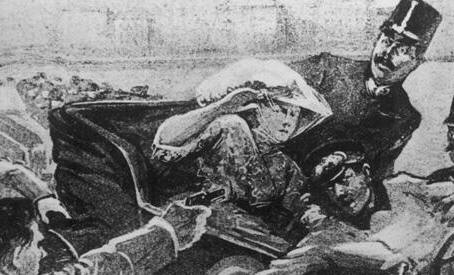
A century ago, on June 28, 1914, Serbian nationalist Gavrilo Princip shot and killed Archduke Franz Ferdinand, heir to the emperorship of Austria-Hungary, along with his wife, on their visit to Sarajevo.
Gavrilo Pirincip fires on the Archduke and Archduchess, June 28, 1914

World War I led to 16 million military and civilian deaths, plus nearly 20 million wounded. And the misery and horror of that war resulted in another casualty: confidence in the Enlightenment enterprise and human progress.

Enlightenment Europe

In the late seventeenth century Isaac Newton’s discovery of the laws of universal gravitation dramatically demonstrated the power of the human mind. Understanding of the world and the universe—what we call modern science—became a central Enlightenment goal.

At the same time, the struggle for Parliamentary supremacy in England led John Locke to pen his powerful treatise on individual liberty. Creating governments limited to protecting life, liberty, and the pursuit of happiness also became a central Enlightenment goal, which culminated in the creation of United States.

Enlightenment values were not limited to Britain or America. They were universal and created a European-wide culture of individualism, freedom, and reason.

Collectivist anti-Enlightenment

But Enlightenment thinkers and activists not only had to fight entrenched oligarchs and rigid religious dogma. Starting with Jean-Jacques Rousseau, a school of thought—if thought it could be called—arose that opposed individualism with the good of “society,” or the group, and rejected reason in favor of emotion and instinct.

The French Revolution starting in 1789 saw Enlightenment ideas losing ground to reactionary and collectivist forces. The result was the Terror and the guillotine, dictatorship and a new monarchy, and the carnage of the Napoleonic wars–the first great modern global conflict, which ended in 1815 at Waterloo.

In the century that followed Europe suffered only short regional conflicts, most relating to the unification of Italy and of Germany. The Industrial Revolution was creating prosperity. Governments were granting citizens rights to political participation and were recognizing their civil liberties. By the early twentieth century, continued progress seemed inevitable.

Pernicious nationalism

But the pernicious collectivist ideology combined with a major European cultural defect: nationalism. This form of collectivism meant more than just an appreciation for the aesthetic achievements—art, music, literature—of the individuals in one’s ethnic group. It meant putting one’s group or one’s country, right or wrong, ahead of universal values and principles. Kill for King or Kaiser!

There’s an irony in the fact that poor Franz Ferdinand wanted to recreate Austria-Hungary as a federation in which the minority groups—that were always either dominated by Viennese elites or at one another’s throats—would have autonomy similar to that enjoyed by the American states. If only Princip had waited a while.

Unfortunately, the volatile combination of nationalism, an interlocking treaty system, and the Britain-Germany imperial rivalry only required a spark like the Sarajevo assassination to set off a global conflagration.

Collectivism vs. collectivism

After World War I, individualism and “selfishness” got much of the blame for the conflict. And science was no longer associated only with progress. It had created machine guns, tanks, and poison gas, and made possible a fearful slaughter.

Idealists created the League of Nations to prevent such wars in the future. But they tried to cure the problem of nationalism with more nationalism, simply accentuating the problem. Indeed, Hitler used the principle of self-determination of peoples as an excuse to unify all Germans into one Reich by force. His form of collectivism also entailed enslaving and wiping out “inferior” races.

The catastrophe of World War II was followed by a Cold War, which saw the Soviet Union asserting another form of collectivism, pitting one economic “class” against another. Western Europe opposed the brutal Soviet kill-the-rich socialism with a kinder, gentler, loot-the-rich democratic socialism. The Soviet Union with its communist empire collapsed in 1991, and Western European democratic socialism is going through a similar disintegration in slow motion.

Still recovering from the Great War

Today, Enlightenment values are making a comeback. The communications and information revolutions, and the application of new technologies in medicine, transportation, and other fields, again demonstrate the power of the human mind and the benefits it confers.

Furthermore, many of the new entrepreneurs understand that it is they as individual visionaries who are transforming the world. And while their achievements benefit everyone, they strive because they love their work and they love to achieve. They pursue happiness. They hold Enlightenment values—though in many cases their politics still need to catch up.

The world is still digging out from the consequences of that single bullet a century ago, which led to the deaths of millions. Putting our country and the world back on the path to liberty and prosperity will require a recommitment to the Enlightenment values that created all the best in the modern world.

***

Dr. Edward Hudgins directs advocacy and is a senior scholar for The Atlas Society, the center for Objectivism in Washington, D.C.

Copyright, The Atlas Society. For more information, please visit www.atlassociety.org.

Heterogeneity: A Capital Idea! – Article by Sanford Ikeda

Heterogeneity: A Capital Idea! – Article by Sanford Ikeda

The New Renaissance Hat
Sanford Ikeda
June 26, 2014
******************************

When Thomas Piketty’s Capital in the 21st Century was released in English earlier this year it sparked vigorous debate on the issue of wealth inequality. Despite the prominence of the word in the title, however, capital has not itself become a hot topic. Apparently none of his defenders have taken the opportunity to explore capital theory, and, with a few exceptions, neither have his critics.

To prepare to read Mr. Piketty’s book I’ve been studying Ludwig Lachmann’s Capital and Its Structure, which, along with Israel M. Kirzner’s Essay on Capital, is among the clearest expositions of Austrian capital theory around. A hundred years ago the “Austrian economists”—i.e. scholars such as Eugen von Böhm-Bawerk who worked in the tradition of Carl Menger—were renowned for their contributions to the theory of capital. Today capital theory is still an essential part of modern Austrian economics, but few others delve into its complexities. Why bother?

Capital is Heterogeneous


Among the Austrians, Böhm-Bawerk viewed capital as “produced means of production” and for Ludwig von Mises “capital goods are intermediary steps on the way toward a definite goal.” (Israel Kirzner uses the metaphor of a “half-baked cake.”)  Lachmann then places capital goods in the context of a person’s plan: “production plans are the primary object of the theory of capital.” You can combine capital goods in only a limited number of ways within a particular plan. Capital goods then aren’t perfect substitutes for one another. Capital is heterogeneous.

Now, mainstream economics treats capital as a homogenous glob. For instance, both micro- and macroeconomists typically assume Output (Q) is a mathematical function of several factor inputs, e.g. Labor (L) and Capital (K) or

Q = f(L,K).

In this function, not only is output homogenous (whether we’re talking about ball-bearings produced by one firm or all the goods produced by all firms in an economy) but so are all labor inputs and all capital inputs used to produce them. In particular, any capital good can substitute perfectly for any other capital good in a firm or across all firms. A hammer can perfectly replace, say, a helicopter or even a harbor.

On the other hand, capital heterogeneity implies several things.

First, according to Mises, heterogeneity means that, “All capital goods have a more or less specific character.” A capital good can’t be used for just any purpose:  A hammer generally can’t be used as a harbor. Second, to make a capital good productive a person needs to combine it with other capital goods in ways that are complementary within her plan: Hammers and harbors could be used together to help repair a boat. And third, heterogeneity means that capital goods have no common unit of measurement, which poses a problem if you want to add up how much capital you have:  One tractor plus two computers plus three nails doesn’t give you “six units” of capital.

Isn’t “money capital” homogeneous? The monetary equivalent of one’s stock of capital, say $50,000, may be useful for accounting purposes, but that sum isn’t itself a combination of capital goods in a production process. If you want to buy $50,000 worth of capital you don’t go to the store and order “Six units of capital please!” Instead, you buy specific units of capital according to your business plan.

At first blush it might seem that labor is also heterogeneous. After all, you can’t substitute a chemical engineer for a pediatrician, can you? But in economics we differentiate between pure “labor” from the specific skills and know-how a person possesses. Take those away—what we call “human capital”—and then indeed one unit of labor could substitute for any other. The same goes for other inputs such as land. What prevents an input from substituting for another, other than distance in time and space, is precisely its capital character.

One more thing. We’re talking about the subjective not the objective properties of a capital good. That is, what makes an object a hammer and not something else is the use to which you put it. That means that physical heterogeneity is not the point, but rather heterogeneity in use. As Lachmann puts it, “Even in a building which consisted of stones completely alike these stones would have different functions.” Some stones serve as wall elements, others as foundation, etc. By the same token, physically dissimilar capital goods might be substitutes for each other. A chair might sometimes also make a good stepladder.

But, again, what practical difference does it make whether we treat capital as heterogeneous or homogenous? Here, briefly, are a few consequences.

Investment Capital and Income Flows


When economists talk about “returns to capital” they often do so as if income “flows” automatically from an investment in capital goods. As Lachmann says:

In most of the theories currently in fashion economic progress is apparently regarded as the automatic outcome of capital investment, “autonomous” or otherwise. Perhaps we should not be surprised at this fact: mechanistic theories are bound to produce results that look automatic.

But if capital goods are heterogeneous, then whether or not you earn an income from them depends crucially on what kinds of capital goods you buy and exactly how you combine them, and in turn how that combination has to complement the combinations that others have put together. You build an office-cleaning business in the hopes that someone else has built an office to clean.

There’s nothing automatic about it; error is always a possibility. Which brings up another implication.

Entrepreneurship


Lachmann:

We are living in a world of unexpected change; hence capital combinations, and with them the capital structure, will be ever changing, will be dissolved and re-formed. In this activity we find the real function of the entrepreneur.

We don’t invest blindly. We combine capital goods using, among other things, the prices of inputs and outputs that we note from the past and the prices of those things we expect to see in the future. Again, it’s not automatic. It takes entrepreneurship, including awareness and vision. But in the real world—a world very different from the models of too many economists—unexpected change happens. And when it happens the entrepreneur has to adjust appropriately, otherwise the usefulness of her capital combinations evaporates. But that’s the strength of the market process.

A progressive economy is not an economy in which no capital is ever lost, but an economy which can afford to lose capital because the productive opportunities revealed by the loss are vigorously exploited.

In a dynamic economy, entrepreneurs are able to recombine capital goods to create value faster than it disappears.

Stimulus Spending


As the economist Roger Garrison notes, Keynes’s macroeconomics is based on labor, not capital. And when capital does enter his analysis Keynes regarded it the same way as mainstream economics: as a homogeneous glob.

Thus modern Keynesians, such as Paul Krugman, want to cure recessions by government “stimulus” spending, without much or any regard to what it is spent on, whether hammers or harbors. (Here is just one example.)  But the solution to a recession is not to indiscriminately increase overall spending. The solution is to enable people to use their local knowledge to invest in capital goods that complement existing capital combinations, within what Lachmann calls the capital structure, in a way that will satisfy actual demand. (That is why economist Robert Higgs emphasizes “real net private business investment” as an important indicator of economic activity.)  The government doesn’t know what those combinations are, only local entrepreneurs know, but its spending patterns certainly can and do prevent the right capital structures from emerging.

Finally, no one can usefully analyze the real world without abstracting from it. It’s a necessary tradeoff. For some purposes smoothing the heterogeneity out of capital may be helpful. Too often though the cost is just too high.

Sanford Ikeda is an associate professor of economics at Purchase College, SUNY, and the author of The Dynamics of the Mixed Economy: Toward a Theory of Interventionism.
***
This article was originally published by The Foundation for Economic Education.
Haven’t We Already Done Enough Damage in Iraq? – Article by Ron Paul

Haven’t We Already Done Enough Damage in Iraq? – Article by Ron Paul

The New Renaissance Hat
Ron Paul
June 16, 2014
******************************
In 2006, I invited the late General Bill Odom to address my Thursday Congressional luncheon group. Gen. Odom, a former NSA director, called the Iraq war “the greatest strategic disaster in American history,” and told the surprised audience that he could not understand why Congress had not impeached the president for pushing this disaster on the United States. History continues to prove the General’s assessment absolutely correct.In September, 2002, arguing against a US attack on Iraq, I said the following on the House Floor:

No credible evidence has been produced that Iraq has or is close to having nuclear weapons. No evidence exists to show that Iraq harbors al Qaeda terrorists. Quite to the contrary, experts on this region recognize Hussein as an enemy of the al Qaeda and a foe to Islamic fundamentalism.

Unfortunately, Congress did not listen.

As we know, last week the second largest city in Iraq, Mosul, fell to the al-Qaeda allied Islamic State in Iraq and Syria (ISIS). Last week an al-Qaeda that had not been in Iraq before our 2003 invasion threatened to move on the capitol, Baghdad, after it easily over-ran tens of thousands of Iraqi military troops.

The same foreign policy “experts” who lied us into the Iraq war are now telling us we must re-invade Iraq to deal with the disaster caused by their invasion! They cannot admit they were wrong about the invasion being a “cakewalk” that would pay for itself, so they want to blame last week’s events on the 2011 US withdrawal from Iraq. But the trouble started with the 2003 invasion itself, not the 2011 troop withdrawal. Anyone who understands cause and effect should understand this.

The Obama administration has said no option except for ground troops is off the table to help the Iraqi government in this crisis. We should not forget, however, that the administration does not consider Special Forces or the CIA to be “boots on the ground.” So we may well see Americans fighting in Iraq again.

It is also likely that the administration will begin shipping more weapons and other military equipment to the Iraqi army, in the hopes that they might be able to address the ISIS invasion themselves. After years of US training, costing as much as $20 billion, it is unlikely the Iraqi army is up to the task. Judging from the performance of the Iraqi military as the ISIS attacked, much of that money was wasted or stolen.

A big US government weapons transfer to Iraq will no doubt be favored by the US military-industrial complex, which stands to profit further from the Iraq meltdown. This move will also be favored by those in Washington who realize how politically unpopular a third US invasion of Iraq would be at home, but who want to “do something” in the face of the crisis. Shipping weapons may be an action short of war, but it usually leads to war. And as we have already seen in Iraq and Syria, very often these weapons fall into the hands of the al-Qaeda we are supposed to be fighting!

Because of the federal government’s foolish policy of foreign interventionism, the US is faced with two equally stupid choices: either pour in resources to prop up an Iraqi government that is a close ally with Iran, or throw our support in with al-Qaida in Iraq (as we have done in Syria). I say we must follow a third choice: ally with the American people and spend not one more dollar or one more life attempting to re-make the Middle East. Haven’t we have already done enough damage?

Ron Paul, MD, is a former three-time Republican candidate for U. S. President and Congressman from Texas.

This article is reprinted with permission from the Ron Paul Institute for Peace and Prosperity.