“Protein Folding for Life Extension” Open Badges for Folding@home Participation – Post by G. Stolyarov II

“Protein Folding for Life Extension” Open Badges for Folding@home Participation – Post by G. Stolyarov II

The New Renaissance Hat
G. Stolyarov II
June 8, 2014
******************************

I am pleased to offer five levels of Open Badges as rewards for contributing computing power to the Folding@home project at http://folding.stanford.edu/, which enables anyone in the world to devote computational resources to protein-folding simulations that help advance the fight against a multitude of diseases – such as Alzheimer’s Disease, Parkinson’s Disease, and many cancers. The Longevity Meme Folding@home team seeks to promote increased participation in Folding@home as one way to combat disease and help dramatically lengthen human lifespans within our lifetimes, with the goal of enabling humans to live lives without any upper limit.

These badges were designed by the artist and illustrator Wendy Stolyarov and is issued by  The Rational Argumentator, in conjunction with LongeCity and the Longevity Meme Folding@home team.

You can store these digital badges and share them via Mozilla Backpack to display your achievements to others. The following are the qualifying criteria for each badge:

● Level 1: 5,000 points earned on Folding@home;

● Level 2: 10,000 points earned on Folding@home;

● Level 3: 50,000 points earned on Folding@home;

● Level 4: 100,000 points earned on Folding@home;

● Level 5: 500,000 points earned on Folding@home.

To request a badge, simply send an e-mail to gennadystolyarovii@gmail.com. Include your user name on Folding@home so that your points earned could be verified. You can earn a badge no matter what team you are on, if any, as everyone’s commitment of resources to the protein-folding effort helps the prospects of indefinite life extension. However, you are also encouraged to join The Longevity Meme team in order to help improve its ranking and raise public awareness of the effort life-extension activists are putting into the fight against disease.

Level 1 Folder - Protein Folding for Life Extension

Level 2 Folder - Protein Folding for Life Extension

Level 1 Folder - Protein Folding for Life Extension

Level 4 Folder - Protein Folding for Life Extension

Level 5 Folder - Protein Folding for Life Extension

Life-Extension Activism Opportunities for All – Article by G. Stolyarov II

Life-Extension Activism Opportunities for All – Article by G. Stolyarov II

The New Renaissance Hat
G. Stolyarov II
June 5, 2014
******************************

You do not need to be a biologist or medical doctor to help hasten the arrival of indefinite life extension. An important array of activist endeavors, which are laying the groundwork for the eventual achievement of unlimited lifespans, can be implemented by anybody. They range from giving out books to playing games to simply running one’s computer – all the while making important contributions to scientific progress and the receptiveness of the general culture to the feasibility and desirability of indefinite longevity.

If you want to glimpse the possibilities in 90 seconds, watch my recent video, “What Anyone Can Do to Advance Indefinite Life Extension”.

In this article, I offer a more detailed overview of some immediately available activism options that anyone can pursue. The time commitment involved in each ranges from minimal to modest, but virtually any of them can fit into the schedule of anyone who recognizes the value of this amazing life we have and the importance of prolonging it as far as possible.

Movement for Indefinite Life Extension (MILE)

MILE_Logo
The Movement for Indefinite Life Extension (MILE) is not a formal organization, but rather a coalition of activists working toward the common goal of achieving indefinite lifespans for people alive today. The MILE coordinates projects and shares articles, images, and news stories via its Facebook group – also accessible using the URL http://themile.info. One of the MILE’s major purposes is to raise awareness of the feasibility and desirability of indefinite life extension and to create a critical mass of support for this most vital of goals. The number of “likes” on the MILE Facebook page is a concise indicator of the movement’s reach, and the eventual goal of the MILE is to achieve 8 million likes by July 17, 2017. Following an incremental approach, the MILE seeks to raise its support by an order of magnitude each year. The goal of 800 supporters was readily exceeded prior to July 17, 2013, and the MILE has launched a concerted effort to reach its Year 2 goal of 8,000 supporters by July 17, 2014. Eric Schulke, who spearheads and coordinates the efforts of the MILE, has launched the MILE Year 2 Goal Fundraiser to fund hundreds of dollars of Facebook advertisements that have already shown success in spreading the message of indefinite life extension to new demographics.

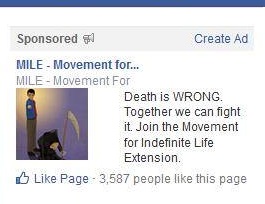
I am proud to have contributed resources to run several ads for MILE that incorporate the core message and the cover image of my children’s book Death is Wrong. These MILE/Death is Wrong ads were designed by my wife and illustrator Wendy Stolyarov and are accompanied by the following text:

Death is WRONG.
Together we can fight it.
Join the Movement for Indefinite Life Extension.
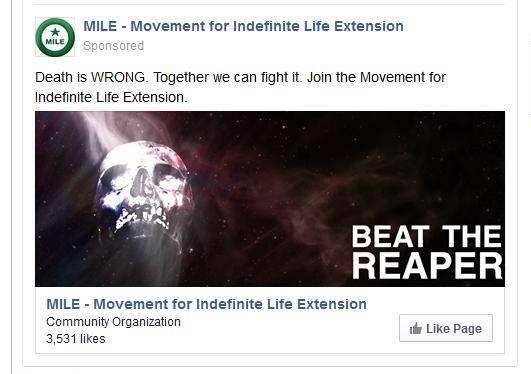
Reaper_MILE_Ad_FBDIW_MILE_AdTo help the MILE reach its Year 2 goal, you can start by clicking the “Like” button on the MILE Facebook page. Beyond that, if you would like to contribute to the advertising campaign and even develop your own custom advertisement that conveys the message of indefinite life extension, this would go a long way toward building the critical mass needed to catalyze public support for life-extension research.

Death is Wrong Book Distribution to Children

DIW_HannaAfter the successful conclusion on April 23, 2014, of my Indiegogo fundraiser to spread over 1,000 copies of the illustrated children’s book Death is Wrong to kids, free of cost to them, I have worked assiduously to coordinate a worldwide distribution effort. Already, 644 out of the 1,029 total available books have been sent to longevity activists throughout the world. Countries where the books have been shipped thus far include the United States, Canada, Mexico, the United Kingdom, the Netherlands, Poland, India, Indonesia, and Singapore. Tens of dedicated longevity supporters have already come forward to request absolutely free shipments of books, but we need more activists to help us distribute the remaining 385 books in their local areas.

Recipients have wide discretion to use their creativity in how to offer the Death is Wrong books to children, as long as the books are made available free of cost and are not resold. Books may be given away to kids directly, lent to multiple kids, given to schools and libraries that will accept them, or used at public readings – among possible other options.

The early successes of the book-distribution effort are among the most heartening and encouraging developments I have observed. Here are some photographs that longevity activists have sent in of their book shipments.

DIW_Amechazurra_ShipmentDIW_Books_Received_CvdB_3
DIW_Books_Received

Here is a charming interview by Aleksander Kelley of his sister Hanna, who is spreading Death is Wrong to the kids she knows.

Help make future scenes like this happen. Requesting a shipment of Death is Wrong books is simple. Send me an e-mail to gennadystolyarovii@gmail.com with (i) your name, (ii) your mailing address, (iii) your statement of support for indefinite life extension, (iv) the number of copies of Death is Wrong requested, and (v) your plan for spreading the books to children, free of cost to them.

Once the shipments arrive, any additional images and videos of the books and events at which they are shared would be most welcome. They can help spread the message of indefinite life extension even further and show the world that the momentum for this cause continues to grow.

Distributed Computing for Medical Science

Would you like to help cure cancer, Alzheimer’s disease, Huntington’s disease, and other deadly ailments, just by running your computer? Most people’s computers spend much time absolutely idle; how about putting that idle time to good use, at minimal additional cost? Distributed computing initiatives such as Folding@home, Rosetta@home, and World Community Grid are absolutely free to join. You just need to download a program that runs the calculations involved in protein-folding simulations and other research efforts while you are not using your computer. Already, these distributed computing initiatives have led to several major medical research breakthroughs, such as this one by Chiba Cancer Center in Japan, which has identified seven drug candidates in the fight against childhood cancer. You can read more about the applications of protein-folding simulations to disease research in this brief post by David Baker of the University of Washington.

While no single medical breakthrough will achieve indefinite lifespans yet, every victory against death and diseases will help us approach that goal. The more of us survive the common killers of our time, the more of us stand a chance of personally witnessing the arrival of longevity escape velocity.

As an additional way to raise the profile of the ideas of indefinite life extension, it is recommended to join a distributed-computing team that explicitly embraces the struggle against senescence and death. On Folding@home, The Longevity Meme team has been folding for years and is ranked 156th out of 220,186 teams as of June 5, 2014. I am spearheading a collaborative effort between The Longevity Meme team, LongeCity, and my online magzine – The Rational Argumentator – to attract renewed participation in Folding@home and The Longevity Meme team among longevity advocates. To provide an additional incentive to join, I am offering a series of five Protein Folding for Life Extension Open Badges, designed by Wendy Stolyarov and available via Badg.us.


FaH-Square-L1 FaH-Square-L2 FaH-Square-L3 FaH-Square-L4 FaH-Square-L5These are badges that you can store and share via Mozilla Backpack to share your achievements with others. The following are the qualifying criteria for each badge:

● Level 1: 5,000 points earned on Folding@home;

● Level 2: 10,000 points earned on Folding@home;

● Level 3: 50,000 points earned on Folding@home;

● Level 4: 100,000 points earned on Folding@home;

● Level 5: 500,000 points earned on Folding@home.

To request a badge, simply send an e-mail to gennadystolyarovii@gmail.com. Include your user name on Folding@home so that your points earned could be verified. You can earn a badge no matter what team you are on, if any, as everyone’s commitment of resources to the protein-folding effort helps the prospects of indefinite life extension. However, you are also encouraged to join The Longevity Meme team in order to help improve its ranking and raise public awareness of the effort life-extension activists are putting into the fight against disease.

On Rosetta@home, the LongeCity team explicitly embraces the ideas of indefinite life extension. On World Community Grid, the Endthedisease team supports life extension and has been involved in numerous disease-fighting computational efforts since 2007. Later this year, the Endthedisease team is anticipated to begin running contests with prizes for top contributors.

Games to Fight Disease

By flying a spaceship through an asteroid field in a computer game, you can help cancer researchers analyze data at a much faster rate than they could before. Play to Cure: Genes in Space is a mobile game released by Cancer Research UK, which anyone with a tablet or mobile phone can play for free. The stated aim of this game is to hasten the day when all cancers are cured – which is, incidentally, the key objective of one of the seven prongs of Dr. Aubrey de Grey’s SENS approach; Dr. de Grey has emphasized that cancer is by far the predominant way by which age-related nuclear mutations harm us.

You can read about the mechanics of and science behind Play to Cure here and watch this video introduction to the game.

Foldit is another free game that enthusiasts of life-extension research can play in order to add the human touch to protein-folding simulations. In 2011, Foldit players discovered the protein structure of a retroviral protease of the Mason-Pfizer monkey virus, an AIDS-like disease in monkeys.

See this list from the Citizen Science Center for more possibilities regarding games you could play and simultaneously participate in innovative citizen-science initiatives – including many devoted to the fight against disease. Games hold out the promise of enabling monumental contributions to scientific research by the general public. A game designed to be sufficiently engaging could attract thousands of non-scientists to do the work that research scientists could conceivably outsource in order to accelerate the rate at which certain kinds of data analysis are performed. The more quickly scientists can iterate through their experiments as a result, the sooner the cures to major diseases will arrive.

Conclusion

Of course, I would urge all life-extension supporters to donate even modest amounts of money to research and advocacy organizations such as the SENS Research Foundation and the Methuselah Foundation, as well as crowdfunded life-extension research projects that are being undertaken with increasing frequency. Yet, I hope that this overview has led readers to recognize that much can be done in addition to monetary donations. Integrate the active pursuit of indefinite longevity into your life, and you will continue to find easy but extremely important ways to become part of the solution to the most pressing problem of all time. Through our efforts, we will hopefully someday be able to celebrate humankind’s greatest victories in the fight against our mutual enemy: death.

What Anyone Can Do to Advance Indefinite Life Extension – Video by G. Stolyarov II

What Anyone Can Do to Advance Indefinite Life Extension – Video by G. Stolyarov II

Mr. Stolyarov provides a quick overview of ideas that anyone can implement to accelerate the pace of technological progress and bring about indefinite life extension for many who are alive today.

This is Mr. Stolyarov’s entry in the MILE Video Contest.

References
– SENS Research Foundation
– Methuselah Foundation
– MILE – Movement for Indefinite Life Extension
– Folding@home
– The Longevity Meme Folding@home Team
– Open Badges for Participating in Folding@home
– Rosetta@home
– World Community Grid
– Foldit
– Play to Cure

Movement for Indefinite Life Extension Year Two Goal Advertisement Fundraiser – Article by Eric Schulke

Movement for Indefinite Life Extension Year Two Goal Advertisement Fundraiser – Article by Eric Schulke

The New Renaissance Hat
Eric Schulke
June 3, 2014
******************************

We are collecting $100 pledges for this Movement for Indefinite Life Extension Year Two Goal Advertisement Fundraiser (MILE y2 Fund). At this time there is a total of $600 pledged. If you want to get in on this, then send us a message at the Movement for Indefinite Life Extension Facebook page. The deadline for making pledges is 20:00 CST, June 15th 2014. You can either have us place the ads for you by sending the money in via PayPal, or you can request to place your own, and we will set you up with the basics.

The Movement for Indefinite Life Extension, which is more like a group spirit that promotes everybody, rather than something like a Foundation or Corporation, is pushing a 5-year goal to inform 8 million people about the individuals, projects, and organizations that are working directly or indirectly toward the goal of indefinite life extension. It is executed in 5 progressive steps.

mile_year_2_goal_fund_movement_for_indefinite_life_extension_year_two_goal_july_17_2014_8000_likes_facebook_dot_com_slash_movement_for_indefinite_life_extensionYear One, which was completed on July 17th of last year, 2013, had the goal of reaching 800 “likes” in this awareness driving campaign.

We are now on our way to the Year Two goal of 8,000 “likes”, with the goal’s deadline coming up soon on July 17, 2014. We are right on schedule with saturation of organic likes and are confident that we can come in on time with the goal of 8,000, and probably exceed it, by the deadline, with around $1,000 in Facebook ads that are targeted to like-minded people and groups. (Of course, the more donations, the better. We’re all working to drive awareness to a critical mass of at least 8 million people for the final goal.)

Millions of people are hearing and learning about the work that is going on to make indefinite healthy life spans a reality, through all the press, events, projects, and endeavors that people around the world have been working on over the decades. With advertisements, we can find more of them and get them to consider putting their weight behind the general movements of transhumanism and indefinite life extension. The rate at which we grow to critical mass, and generate awareness, matters. The clock is ticking.

The important cause of life is the incentive. In addition to that, there is the small incentive that the group of people that pledges to this Movement for Indefinite Life Extension Year Two Goal Fundraiser, will be written about as instrumental leaders in the success of the Movement for Indefinite Life Extension Year Two Goal, and in the movement in general.

Eric Schulke was a director at LongeCity during 2009-2013. He has also been an activist with the Movement for Indefinite Life Extension and other causes for over 13 years.

“Death is Wrong” – Book Distribution and Call to Action – May 28, 2014 – Video by G. Stolyarov II

“Death is Wrong” – Book Distribution and Call to Action – May 28, 2014 – Video by G. Stolyarov II

Mr. Stolyarov provides an update regarding the effort to distribute over 1,000 free, paperback copies of Death is Wrong to children.

As of May 28, 2014, 644 books have been sent out, and 385 remain to be distributed, out of an eventual goal of 1,029 books provided to children, free of cost to them.

Instructions for Longevity Activists to Request Copies of “Death is Wrong”

– Send an e-mail to gennadystolyarovii@gmail.com

– Provide (i) your name, (ii) your mailing address, (iii) a statement of your support for indefinite life extension, and (iv) a brief description of your plan to spread the book to children in your local area. Remember that all copies received pursuant to this initiative would need to be offered to children free of charge (as gifts or reading opportunities) and may not be resold.

– Provide the number of copies of Death is Wrong that you are requesting.

– Preferably, provide an indication that you would be willing to send photographs of the books that have been delivered to you as well as events where you will be distributing the books.

References
– Death is Wrong on Amazon:
* Paperback version
* Kindle version
– Death is Wrong Official Home Page
– “Spreading the Word That Death is Wrong” – Article by Gennady Stolyarov II
– Updates Regarding Book-Distribution Effort
– Death is Wrong Book Trailer – Video by Peter Caramico

Natural Disasters Don’t Increase Economic Growth – Article by Frank Hollenbeck

Natural Disasters Don’t Increase Economic Growth – Article by Frank Hollenbeck

The New Renaissance Hat
Frank Hollenbeck
May 27, 2014
******************************

Hurricane season is nearly upon us, and every time a hurricane strikes, television and radio commentators and would-be economists are quick to proclaim the growth-boosting consequences of the vicissitudes of nature. Of course, if this were true, why wait for the next calamity? Let’s create one by bulldozing New York City and marvel at the growth-boosting activity engendered. Destroying homes, buildings, and capital equipment will undoubtedly help parts of the construction industry and possibly regional economies, but it is a mistake to conclude it will boost overall growth.

Every year, this popular misconception is trotted out although Frédéric Bastiat in 1848 clearly put it to rest with his parable of the broken window. Suppose we break a window. We will call up the window repairman, and pay him $100 for the repair. People watching will say this is a good thing. What would happen to the repairman if no windows were broken? Also, the $100 will allow the repairman to buy other goods and services creating income for others. This is “what is seen.”

If instead, the window had not been broken, the $100 may have purchased a new pair of shoes. The shoemaker would have made a sale and spent the money differently. This is “what is not seen.”

Society (in this case these three members) is better off if the window had not been broken, since we are left with an intact window and a pair of shoes, instead of just a window. Destruction does not lead to more goods and services or growth. This is what should be foreseen.

One of the first attempts to quantify the economic impact of a catastrophe was a 1969 book, The Economics of Natural Disasters. The authors, Howard Kunreuther and Douglas Dacy, largely did a case study on the Alaskan earthquake of 1964, the most powerful ever recorded in North America. They, unsurprisingly, concluded that Alaskans were better off after the quake, since money flooded in from private sources and generous grants and loans from the federal government. Again, this was “what is seen.”

While construction companies benefit from the rebuilding after a disaster, we must always ask, where does the money come from? If the funds come from FEMA or the National Flood Insurance Program (NFIP), the federal government had to tax, borrow, or print the money. Taxpayers are left with less money to spend elsewhere.

The economics of disasters remains a small field of study. There have been a limited number of empirical studies examining the link between growth and natural disasters. They can be divided into studies examining the short-term and long-term impact of disasters. The short-term studies, in general, found a negative relationship between disasters and growth while a lesser number of long-run studies have had mixed results.

The most cited long-run study is “Do Natural Disasters Promote Long-Run Growth?” by Mark Skidmore and Hideki Toya who examined the frequency of disasters in 89 countries against their economic growth rates over a 30-year period. They tried to control for a variety of factors that might skew the findings, including country size, size of government, distance from the equator and openness to trade. They found a positive relationship between climate disasters (e.g., hurricanes and cyclones), and growth. The authors explain this finding by invoking what might be called Mother Nature’s contribution to what economist Joseph Schumpeter famously called capitalism’s “creative destruction.” By destroying old factories and roads, airports, and bridges, disasters allow new and more efficient infrastructure to be rebuilt, forcing the transition to a sleeker, more productive economy. Disasters perform the economic service of clearing out outdated infrastructure to make way for more efficient replacements.

There are three major problems with these empirical studies. The first is counterfactual. We cannot measure what growth would have been had the disaster never occurred. The second is association versus causation. We cannot say whether the disaster caused the growth or was simply associated with it.

The third problem is what economists call “ceteris paribus.” It is impossible to hold other factors constant and measure the exclusive impact of a disaster on growth. There are no laboratories to test macroeconomics concepts. This is the same limitation to Rogoff’s and Reinhart’s work on debt and growth, and many other bilateral relationships in economics. Using historical data from the early 1900s, researchers found that as the price of wheat increased, the consumption of wheat also increased. They triumphantly proclaimed that the demand curve was upward sloping. Of course, this relationship is not a demand curve, but the intersection points between supply and demand. The “holding everything else constant” assumption had been violated. In economics, empirical data can support a theoretical argument, but it cannot prove or disprove it.

So what do we do if the empirical studies have serious limitations? We go back to theory. We know a demand curve is downward sloping because of substitution and income effects. Wal-Mart does not run a clearance to sell less output! Theory also holds that natural disasters reduce growth (i.e., the more capital destroyed, the greater the negative impact on growth).

More capital means more growth. Robinson Crusoe will catch more fish if he sacrifices time fishing with his hands to build a net. Now, suppose a hurricane hits the island and destroys all of his nets. Robinson could go back to fishing with his bare hands and his output would have been permanently reduced. He could suffer an even greater decline in output by taking time to make new nets. The Skidmore-Toya explanation is to have him apply new methods and technologies to build even better nets, allowing him to catch more fish than before the hurricane. Of course, we may ask, if he had this knowledge, why didn’t Robinson build those better nets before the hurricane? This is where the Skidmore-Toya logic falls apart. Robinson did not build better nets before the hurricane because it was not optimal for him to do so.

If a company decides to replace an old machine with a new one, among the primary considerations are the initial price of the new machine, the applicable interest rate, and the reduced yearly costs of operation of the new machine. Using net present value analysis, the company determines the optimum time to make the switch (a real option). A hurricane forces a switch to occur earlier than would have been optimal under a price and profit motive. The hurricane therefore created a different path for growth. The creative destruction would have occurred, but on a different, more optimal, timeline.

The same conclusions can also be drawn from manmade disasters. Contrary to what many Keynesian economists would have you believe, WWII did not grow the US out of the great depression. Capitalism did!

Frank Hollenbeck teaches finance and economics at the International University of Geneva. He has previously held positions as a Senior Economist at the State Department, Chief Economist at Caterpillar Overseas, and as an Associate Director of a Swiss private bank. See Frank Hollenbeck’s article archives.

This article was published on Mises.org and may be freely distributed, subject to a Creative Commons Attribution United States License, which requires that credit be given to the author.

Healthy, Peaceful Death Does Not Exist – Article by Advocate of Negligible Senescence

Healthy, Peaceful Death Does Not Exist – Article by Advocate of Negligible Senescence

The New Renaissance Hat
Advocate of Negligible Senescence
May 26, 2014
******************************
ANS_Saved_Near_Death

Most people want to die of in their sleep, in peace, of old age, without pain and surrounded by their family and loved ones after achieving success and after having done something worthwhile.But the facts suggest, that such a peaceful end is granted to very few people, while most people have to endure different disabilities and diseases associated with aging and terrible pain and decreased function, performance, and the lack of joy coming with it.The Global Burden of Disease (GBD) project originated in 1990 in a collaboration between the World Health Organization, Harvard School of Public Health, the Institute for Health Metrics and Evaluation (IHME), and the World Bank.

The focus of the Global Burden of Disease Study is to provide a detailed statistical analysis of the impact of diseases leading to death and disability across various regions around the world. The purpose of the study is to reveal gaps between current and ideal health circumstances and develop strategies to reduce this gap.

The 2010 Global Burden of Disease study reveals a significant shift in the nature of disease worldwide. There has been a significant increase in chronic disease worldwide. This is due to demographics of aging, and the subsequent increase of age-related disease.

Worldwide, the contribution of different risk factors to disease burden has changed substantially, with a shift away from risks for communicable diseases in children towards those for non-communicable diseases in adults.

As life expectancy has increased, the number of healthy years lost to disability has also increased in most countries, consistent with the expansion of morbidity hypothesis, which has implications for health planning and health-care expenditure.One of the key findings reveals that we are living longer, but under an increased burden of chronic disease that impairs our quality of life.These results are distressing: men can expect to spend an average of 9.2 years and women 11.5 years with some form of a chronic disability. In other words, during the last decade of lives, on average, our quality of life might become significantly impaired by the presence of a chronic disease.

The paradox, then – the fact that people want to be actively saved if they are near or at the moment of death, but also want to die peacefully – seems to be rooted in a pretty profound medical illiteracy.

Healthy people don’t die in their sleep, “peacefully” or otherwise. You don’t hear about too many 25-year-olds dying suddenly of heart attacks or strokes during their nightly slumber.

When people in their twenties die, it’s usually considered tragic. When babies are found dead in their cribs, it’s referred to by a name (“Sudden Infant Death Syndrome”). But when elderly people die, in bed or otherwise, there tends to be a curious tone of, “Well, at least they went peacefully.”

The increase in life expectancy and the resulting growth of the elderly population are also thought to be driving up the number of elderly people with disabilities.

Typically in the case of dying in your sleep due to old age, an autopsy can determine exactly what went wrong, or what stopped working. For example, your heart could simply get tired and stop beating, because it’s been working hard for the past eighty or ninety years.

The phrase “natural causes” or dying “of old age” is a very strange one really. Ultimately what it means is that someone who dies of natural causes, dies of aging in a way that has not been given an additional name; so really it’s just a matter of terminology. The difference is between dying of “natural causes” and dying of some other specifically named thing that doesn’t really often affect young adults.

Searching for a cure for age-related ill health, a problem that kills more people than all other causes combined, is a moral imperative. The Advocate for Negligible Senescence publishes articles that discuss and educate the public about research to combat senescence. See the Advocate’s Facebook page.  
Gennady Stolyarov II Interviewed on Transhumanism by Rebecca Savastio of Guardian Liberty Voice

Gennady Stolyarov II Interviewed on Transhumanism by Rebecca Savastio of Guardian Liberty Voice

The New Renaissance Hat
G. Stolyarov II
May 26, 2014
******************************
Rebecca Savastio of Guardian Liberty Voice has published an excellent interview with me, which mentions Death is Wrong in its introduction and delves into various questions surrounding transhumanism and emerging technologies. In my responses, I also make reference to writings by Ray Kurzweil, Max More, Julian Simon, and Singularity Utopia. Additionally, I cite my 2010 essay, “How Can I Live Forever: What Does and Does Not Preserve the Self“.
***
I was pleased to be able to advocate in favor of transformative technological progress on multiple fronts.
***
Read Ms. Savastio’s article containing the interview: “Gennady Stolyarov on Transhumanism, Google Glass, Kurzweil, and Singularity“.
The VA Scandal is Just the Tip of the Military-Abuse Iceberg – Article by Ron Paul

The VA Scandal is Just the Tip of the Military-Abuse Iceberg – Article by Ron Paul

The New Renaissance Hat
Ron Paul
May 25, 2014
******************************
President Obama held a press conference last week to express his outrage over reports that the Veterans Administration was routinely delaying treatment to veterans, with some veterans even dying while on alleged secret waiting lists. The president said that, “if these allegations prove to be true, it is dishonorable, it is disgraceful, and I will not tolerate it, period.” He vowed that, together with Congress, he would “make sure we’re doing right by our veterans across the board.”

The president is right to be upset over the mistreatment of US military veterans, especially those who return home with so many physical and mental injuries.  Veterans should not be abused when they seek the treatment promised them when they enlisted. But his outrage over military abuse is selective. He ignores the most egregious abuse of the US armed forces: sending them off to fight, become maimed, and die in endless conflicts overseas that have no connection to US national security.

It is ironic that the same week the president condemned the alleged mistreatment of veterans by the VA, he announced that he was sending 80 armed troops to Chad to help look for a group of girls kidnapped by the Nigerian Islamist organization Boko Haram. Is there any mistreatment worse than sending the US military into a violent and unstable part of the world to conduct a search operation that is in no way connected to the defense of the United States?

As Judge Andrew Napolitano said last week, “Feeling sorry for somebody is not a sufficient basis for sending American men and women into harm’s way.”

We are naturally upset over reports that Nigerian girls have been kidnapped by this armed Islamist organization. Unfortunately, cruel and unjust acts are committed worldwide on a regular basis. What the media is not reporting about this terrible situation, however, is that it was US interventionism itself that strengthened Boko Haram, and inadvertently may have even helped the kidnappers commit their crime.

Back in early 2012, just months after the US-led attack on Libya overthrew Gaddafi and plunged the country into chaos, the UN issued a report warning about the proliferation of weapons from that bombed out country. UN investigators found – eight months before the attack that killed the US ambassador in Benghazi – that, “Some of the weapons … could be sold to terrorist groups like al Qaeda in the Islamic Maghreb, Boko Haram or other criminal organizations.”

The US, NATO, and the UN are guilty of creating the unrest currently engulfing much of northern Africa, as they all pushed lies to promote an attack on Libya that destabilized the region. Now the president is launching an intervention in Chad and Nigeria to solve the problems created by his own intervention in Libya. This pattern is the same in places like Ukraine, where the US-backed coup in February has led to chaos and unrest that leads to even more intervention, including NATO’s saber-rattling on the Russian border. Has anyone in the Administration or Congress ever considered that interventionism itself might be the real problem?

As Americans celebrate the Memorial Day holiday, we should remember that though the VA’s alleged abuse and neglect of US veterans is scandalous, the worse abuse comes from a president and a compliant Congress that send the US military to cause harm and be harmed overseas in undeclared, unnecessary, and illegal interventions. The best way to honor the US military is to honor the Constitution, and to keep in mind the wise advice of our Founding Fathers to avoid all foreign interventionism.

Ron Paul, MD, is a former three-time Republican candidate for U. S. President and Congressman from Texas.

This article is reprinted with permission from the Ron Paul Institute for Peace and Prosperity.

The Slowly Spreading Realization That Aging Can Be Defeated – Article by Reason

The Slowly Spreading Realization That Aging Can Be Defeated – Article by Reason

The New Renaissance Hat
Reason
May 21, 2014
******************************

At some point in the next ten to twenty years the public at large, consisting of people who pay little attention to the ins and outs of progress in medicine, will start to wake up to realize that much longer healthy lives have become a possibility for the near future. The preliminaries to this grand awakening have been underway for a while, gradually, and will continue that way for a while longer. A few people every day in ordinary walks of life notice that, hey, a lot of scientists are talking about greatly extending human life spans these days, and, oh look, large sums of money are floating around to back this aim. There will be a slow dawning of realization, one floating light bulb at a time, as the concept of radical life extension is shifted in another brain from the “science fiction” bucket to the “science fact” bucket.

Some folk will then go back to what they were doing. Others will catch the fever and become advocates. A tiny few will donate funds in support of research or pressure politicians to do the same. Since we live in an age of pervasive communication, we see this process as it occurs. Many people are all to happy to share their realizations on a regular basis, and in this brave new world everyone can be a publisher in their own right.

Here is an example that I stumbled over today; a fellow with a day-to-day focus in a completely unrelated industry took notice and thought enough of what is going on in aging research to talk about it. He is still skeptical, but not to the point of dismissing the current state and prospects for longevity science out of hand: he can see that this is actionable, important knowledge.

What if de Grey and Kurzweil are half right?

Quote:

I think these guys – and the whole movement to conquer aging – is fascinating. I am highly skeptical of the claims, however. Optimism is all well and good, and I have no off-hand holes to poke in their (very) well-articulated arguments. But at the same time, biology is fiendishly complex, the expectations beyond fantastical.

Still though, I have to wonder: What if guys like de Grey and Kurzweil are half right, or even just partially right? What if, 30 years from now, it becomes physically impossible to tell a 30-year-old from a 70-year-old by physical appearance alone? It sounds nutty. But it’s a lot less nuttier, and a lot closer to the realm of possibility, than living to 1,000 – which, again, some very smart people have taken into their heads as an achievable thing.

People who don’t take care of themselves are insane. Ok, not actually “insane.” But seriously, given the potential rewards AND the risks, not taking care of your body and mind – not treating both with the utmost respect and care – seems absolutely nuts. At the poker table I see these young kids whose bodies are already turning to mush, and a part of me just wants to grab them by the shirt collar and say “Dudes! What the hell is WRONG with you!!!”

If it is possible – just realistically possible, mind you – that I could still be kicking ass and taking names at 125 years old, then I want to be working as hard as I can to preserve and maintain my equipment here and now. No matter what miracles medical science will achieve in future, working from the strongest, healthiest base possible will always improve the potential results, perhaps by an order of magnitude. Individuals who go into old age with fit, healthy bodies and sound minds, and longstanding habits to maintain both, may find potential for extended performance at truly high quality of life that was never before imaginable.

As the foundations of rejuvenation biotechnology are assembled and institutions like the SENS Research Foundation continue to win allies in the research community and beyond, the number of people experiencing this sort of epiphany will grow. The more the better and the sooner the better, as widespread support for the cause of defeating aging through medical science is necessary for more rapid progress: large scale funding always arrives late to the game, attracted by popular sentiment. The faster we get to that point, the greater our chances of living to benefit from the first working rejuvenation treatments.

Reason is the founder of The Longevity Meme (now Fight Aging!). He saw the need for The Longevity Meme in late 2000, after spending a number of years searching for the most useful contribution he could make to the future of healthy life extension. When not advancing the Longevity Meme or Fight Aging!, Reason works as a technologist in a variety of industries. 
***

This work is reproduced here in accord with a Creative Commons Attribution license. It was originally published on FightAging.org.