Browsed by
Category: Economics

3 Kinds of Economic Ignorance – Article by Steven Horwitz

3 Kinds of Economic Ignorance – Article by Steven Horwitz

The New Renaissance HatSteven Horwitz
******************************

Do you know what you don’t know?

Nothing gets me going more than overt economic ignorance.

I know I’m not alone. Consider the justified roasting that Bernie Sanders got on social media for wondering why student loans come with interest rates of 6 or 8 or 10 percent while a mortgage can be taken out for only 3 percent. (The answer, of course, is that a mortgage has collateral in the form of a house, so it is a lower-risk loan to the lender than a student loan, which has no collateral and therefore requires a higher interest rate to cover the higher risk.)

When it comes to economic ignorance, libertarians are quick to repeat Murray Rothbard’s famous observation on the subject:

It is no crime to be ignorant of economics, which is, after all, a specialized discipline and one that most people consider to be a “dismal science.” But it is totally irresponsible to have a loud and vociferous opinion on economic subjects while remaining in this state of ignorance.

Economic ignorance comes in different forms, and some types of economic ignorance are less excusable than others. But the most important implication of Rothbard’s point is that the worst sort of economic ignorance is ignorance about your economic ignorance. There are varying degrees of blameworthiness for not knowing certain things about economics, but what is always unacceptable is not to recognize that you may not know enough to be speaking with authority, nor to understand the limits of economic knowledge.

Let’s explore three different types of economic ignorance before we return to the pervasive problem of not knowing what you don’t know.

1. What Isn’t Debated

Let’s start with the least excusable type of economic ignorance: not knowing agreed-upon theories or results in economics. There may not be a lot of these, but there are more than nonspecialists sometimes believe. Bernie Sanders’s inability to understand why uncollateralized loans have higher interest rates would fall into this category, as this is an agreed-upon claim in financial economics. Donald Trump’s bashing of free trade (and Sanders’s, too) would be another example, as the idea that free trade benefits the trading countries on the whole and over time is another strongly agreed-upon result in economics.

Trump and Sanders, and plenty of others, who make claims about economics, but who remain ignorant of basic teachings such as these, should be seen as highly blameworthy for that ignorance. But the deeper failing of many who make such errors is that they are ignorant of their ignorance. Often, they don’t even know that there are agreed-upon results in economics of which they are unaware.

2. Interpreting the Data

A second type of economic ignorance that is, in my view, less blameworthy is ignorance of economic data. As Rothbard observed, economics is a specialized discipline, and nonspecialists can’t be expected to know all the relevant theories and facts. There are a lot of economic data out there to be searched through, and often those data require careful statistical interpretation to be easily applied to questions of public policy. Economic data sources also require theoretical interpretation. Data do not speak for themselves — they must be integrated into a story of cause and effect through the framework of economic theory.

That said, in the world of the Internet, a lot of basic economic data are available and not that hard to find. The problem is that many people believe that certain empirical facts are true and don’t see the need to verify them by actually checking the data. For example, Bernie Sanders recently claimed that Americans are routinely working 50- and 60-hour workweeks. No doubt some Americans are, but the long-term direction of the average workweek is down, with the current average being about 34 hours per week. Longer lives and fewer working years between school and retirement have also meant a reduction in lifetime working hours and an increase in leisure time for the average American. These data are easily available at a variety of websites.

The problem of statistical interpretation can be seen with data on economic inequality, where people wrongly take static snapshots of the shares of national income held by the rich and poor to be evidence of the decline of the poor’s standard of living or their ability to move up and out of poverty.

People who wish to opine on such matters can, again, be forgiven for not knowing all the data in a specialized discipline, but if they choose to engage with the topic, they should be aware of their own limitations, including their ability to interpret the data they are discussing.

3. Different Schools of Thought

The third type of economic ignorance, and the least blameworthy, is ignorance of the multiple perspectives within the discipline of economics. There are multiple schools of thought in economics, and many empirical questions and historical facts have a variety of explanations. So a movie like The Big Short that clearly suggests that the financial crisis and Great Recession were caused by a lack of regulation might be persuasive to people who have never heard an alternative explanation that blames the combination of Federal Reserve policy and misguided government intervention in the housing market for the problems. One can make similar points about the Great Depression and the difference between Hayekian and Keynesian explanations of business cycles more generally.

These issues involving schools of thought are excellent examples of Rothbard’s point about the specialized nature of economics and what the nonspecialist can and cannot be expected to know. It is, in fact, unrealistic to expect nonexperts to know all of the arguments by the various schools of thought.

Combining Ignorance and Arrogance

What is missing from all of these types of economic ignorance — and what is often missing from knowledgeable economists themselves — is what we might call “epistemic humility,” or a willingness to admit how little we know. Noneconomists are often unable to recognize how little they know about economics, and economists are often unable to admit how little they know about the economy.

Real economic “expertise” is not just mastery of theories and facts. It is a deeper understanding of the variety of interpretations of those theories and facts and humility in the face of our limits in applying that knowledge in attempting to manage an economy. The smartest economists are the ones who know the limits of economic expertise.

Commentators with opinions on economic matters, whether presidential candidates or Facebook friends, could, at the very least, indicate that they may have biases or blind spots that lead to uses of data or interpretive frameworks with which experts might disagree.

The worst type of economic ignorance is the type of ignorance that is the worst in all fields: being ignorant of your own ignorance.

Steven Horwitz is the Charles A. Dana Professor of Economics at St. Lawrence University and the author of Hayek’s Modern Family: Classical Liberalism and the Evolution of Social Institutions. He is a member of the FEE Faculty Network.

This article was published by The Foundation for Economic Education and may be freely distributed, subject to a Creative Commons Attribution 4.0 International License, which requires that credit be given to the author.

Venezuela’s Bizarre System of Exchange Rates – Article by Emiliana Disilvestro & David Howden

Venezuela’s Bizarre System of Exchange Rates – Article by Emiliana Disilvestro & David Howden

The New Renaissance HatEmiliana Disilvestro & David Howden
******************************

Venezuela is currently going through its worst crisis in history, replete with an endless list of interesting problems. Foremost among these are severe shortages in even the most basic of necessities. Economists have used these shortages as textbook examples to illustrate the pernicious effects of price controls.

Few people, however, are aware that many of the country’s problems are caused by a complex monetary arrangement that makes use of four different exchange rates simultaneously. The result is that Venezuela can either be extremely cheap, or unbearably expensive, depending on the rate used.

Monetary chaos began in 2003 when the late President Hugo Chavez imposed currency controls to stem capital flight after an oil strike. At the time, one US dollar could fetch 1.6 Venezuelan bolivars. Today, barely ten years later, that same dollar can buy 172 bolivars, a devaluation of over 99 percent! Of course, that is in the official (i.e., government regulated) market. On the black market, the exchange rate is currently nearly 900 bolivars to the US dollar. That is, if you can find anyone selling dollars, or more importantly, looking to buy the badly tarnished Venezuelan currency.

This devaluation is in and of itself a large problem, both for consumers who must deal with high degrees of price inflation and for businesses that must undergo long-term capital planning decisions with a constantly moving monetary unit. However, it is the volatility of the exchange rate caused by the government’s continuous changes to currency restrictions and official rates that is proving the most cumbersome problem.

A Very Complex System of Exchange Rates

Currently there are four exchange rates: First is the official one, called CENCOEX, and which charges 6.30 bolivars to the dollar. It is only intended for the importation of food and medicine.

The next two exchange rates are SICAD I (12 bolivars per dollar) and SICAD 2 (50 bolivars per dollar); they assign dollars to enterprises that import all other types of goods. Because of the fact that US dollars are limited, coupons are auctioned only sporadically; usually weekly in the case of SICAD 1 and daily for SICAD 2. However, due to the economic crisis, no dollars have been allocated for these foreign exchange transactions and there hasn’t been an auction since August 18, 2015. As of November 2015, the Venezuelan government held only $16 billion in foreign exchange reserves, the lowest level in over ten years, and an amount that will dry up completely in four years time at the current rate of depletion.

The last and newest exchange rate is the SIMADI, currently at 200 bolivars per dollar. This rate is reserved for the purchase and sale of foreign currency to individuals and businesses.

There are many problems in Venezuela as a result of this complex system. The most obvious is the near impossibility to actually get assigned to these rates due to the complex bureaucratic process one must navigate to apply for them. In response to these difficulties, Venezuelans must rely on the black market to meet their demands for foreign currency. Therefore, people naturally rely on the black market rate, which although it is much less advantageous (at 900 vs. anywhere from 6.3 to 200 bolivars per dollar on the “official” market), at least offers the possibility to procure the much needed foreign exchange.

Corruption, which is a main characteristic of Venezuela’s political regime, is another problem derived from this complex monetary system. Officials within the government and those connected to it have taken advantage of their positions of power and influence to mismanage the money assigned for other, productive and necessary, institutions. Thus, well-connected individuals obtain US dollars through the legal channels and then sell them on the black market at a higher price. (This activity is one of the only ways to consistently earn high levels of profits in the beleaguered Venezuelan economy, and is only available to those privileged few who are connected to the proper government officials.)

This point is especially important when studying the vast array of shortages. The embezzlement of foreign currency intended for importing basic goods, e.g., foreign exchange reserved for the CENCOEX and SICAD exchange rates, leave legitimate businessmen with no options to obtain legally the necessary currencies to import goods. Owing to the rapidly depreciating bolivar, US dollars are hoarded as a means of savings, thus further exacerbating the foreign exchange shortage for importers. As a consequence, imports are unable to be paid for, leading to shortages on top of those already caused by extensive and damaging price controls.

The Poor Suffer the Most

These problems affect directly all citizens, but are especially pernicious to lower-income individuals. Many suppliers will only sell what few goods they have for US dollars, eschewing accepting bolivars in the payment of their wares. Black market currency sellers set up shop outside supermarkets to accommodate this phenomenon, but it must be noted that only the upper-middle and higher income earners are able to afford to pay the black market rate. The result is that the lower-income segment of Venezuelan society, those who price and currency controls are supposedly helping, are not able to obtain the currency necessary to buy simple goods and services (and the wealthy can only do so at a high price).

Although the business community demands to be paid in US dollars this harms lower-income individuals unduly and is a completely rational response. If businesses kept selling their scarce supply of goods at the official rate their shelves would deplete faster than they already do. Venezuelans earn income at the official rate of 6.30 bolivars to the US dollar while businesses must pay a much higher rate in order to import goods. This difference must be accounted for by stores asking for prices commensurate with what they must pay to stock their shelves.

The complex exchange rate system in Venezuela is not only a good example of unnecessary government meddling in the economy, but also explains why a corrupt political regime has been able to retain power for so long despite more than a decade of hardship imposed on the country. The use of several exchange rates has made it easy for the Chávez and Maduro governments and their followers to make enormous profits by embezzling the money assigned to the business community and individuals. By doing so, they have completely devalued the bolivar and impoverished what was once one of the richest countries in the world.

Emiliana Disilvestro studies international business at Saint Louis University at its Madrid campus.

David Howden is Chair of the Department of Business and Economics and professor of economics at St. Louis University’s Madrid Campus, and Academic Vice President of the Ludwig von Mises Institute of Canada.

This article was published on Mises.org and may be freely distributed, subject to a Creative Commons Attribution United States License, which requires that credit be given to the author.

One Bill Could Massively Improve Access to Lifesaving Drugs – Article by Alex Tabarrok

One Bill Could Massively Improve Access to Lifesaving Drugs – Article by Alex Tabarrok

The New Renaissance HatAlex Tabarrok
******************************

Reciprocity is an effective and common-sense idea

Senators Ted Cruz (R-Texas) and Mike Lee (R-Utah) have just introduced a bill that would implement an idea that I have long championed: making drugs, devices, and biologics that are approved in other developed countries also approved for sale in the United States.

Highlights of the “Reciprocity Ensures Streamlined Use of Lifesaving Treatments Act (S. 2388), or the RESULT Act,” include:

  • Amending the Food, Drug and Cosmetic Act to allow for reciprocal approval of drugs, devices and biologics from foreign sponsors in certain trusted, developed countries including EU member countries, Israel, Australia, Canada and Japan.
  • Encouraging the FDA to expeditiously review life-saving drug and device applications, this legislation would provide the FDA with a 30-day window to approve or deny a sponsor’s application….
  • The HHS Secretary is instructed to approve a drug, device or biologic if the FDA confirms the product is:
    • Lawfully approved for sale in one of the listed countries;
    • Not a banned device by current FDA standards;
    • There is a public health or unmet medical need for the product.
  • If a promising application for a life-saving drug is declined Congress is granted the authority to disapprove of a denied application and override an FDA decision with a majority vote via a joint resolution.

In explaining why he introduced the bill, Senator Cruz argued:

We continue to lose far too many of our loved ones to the “invisible graveyard,” as economist Alex Tabarrok has described: lives that could have been saved but for a bureaucratic barrier that rejects medical cures and innovation…

The bill I am introducing takes the first step to reverse this trend. It provides for reciprocal drug approval, so that cures and medical devices that are already approved in other countries can more expeditiously come to the U.S.

This post first appeared at Marginal Revolution.

Alex Tabarrok is a professor of economics at George Mason University. He blogs at Marginal Revolution with Tyler Cowen.

Good News, Bernie Sanders: Average Workweeks Are Getting Shorter – Article by Chelsea Follett

Good News, Bernie Sanders: Average Workweeks Are Getting Shorter – Article by Chelsea Follett

The New Renaissance HatChelsea Follett
******************************

Capitalism is letting people choose more leisure

Senator Bernie Sanders recently tweeted the following:

sanders.tweetFortunately, the gruelingly long workweek described by Sanders is not the norm. In fact, leisure time has been on the rise. In 1950, an average U.S. worker worked 1,984 hours a year, or about 38 hours a week. In 2015, an average American worker worked 1,767 hours, or about 34 hours a week.

workhours

That means that the average U.S. worker had 217 more hours for leisure or other pursuits in 2015 than in 1950. That is about 9 days of extra time.

The 50-hour workweek described by Sanders is more common in China, where the average worker worked 2,432 hours in 2015, or around 47 hours a week.

This post first appeared at HumanProgress.org.
Compare other countries over time with their interactive dataset.

Chelsea Follett (Chelsea German) works at the Cato Institute as a Researcher and Managing Editor of HumanProgress.org.

This article was published by The Foundation for Economic Education and may be freely distributed, subject to a Creative Commons Attribution 4.0 International License, which requires that credit be given to the author.
Comparative Advantage: An Idea Whose Time Has Passed – Article by Michael Munger

Comparative Advantage: An Idea Whose Time Has Passed – Article by Michael Munger

The New Renaissance HatMichael Munger
******************************

The Division of Labor Is the Engine That Drives Prosperity

Many economists will tell you that the most important principle in economics is comparative advantage — the idea that it is expensive to grow oranges in Alaska or to flood rice paddies in Saudi Arabia, so Alaska and Saudi Arabia should import oranges and rice, respectively, and base local production on the advantages of local conditions. We got this idea from classical economist David Ricardo, who famously observed in 1821 that England and Portugal would both be wealthier if Portugal exported its wine and imported England’s textiles, and vice versa.

Ricardo’s principle even demonstrated the advantages of trading with those who are less productive at everything. For example, my wife is an attorney. She is also a fast and accurate typist. Yet she hires a secretary who is considerably slower at typing. Secretaries get paid less than attorneys, so if my wife specializes in law and the secretary specializes in typing, my wife can earn more for her firm and a secretary gets a job. Both end up better off. That’s true even though my wife is better at both jobs: comparative advantage means trade helps everyone.

Division of Labor Trumps Comparative Advantage

The problem is that fixed comparative advantage — derived from weather, culture, and location — is vanishing in the modern world. Ricardo’s classical formulation leaves no space for human creativity, no role for division of labor, and no room for innovation to affect the dynamics of cost.

So economists have it wrong, as my friend Russ Roberts argued in 2010. The most important principle in economics is opportunity cost. Here’s proof: you can define opportunity cost without resorting to comparative advantage. But you can’t possibly define comparative advantage without invoking opportunity cost.

The notion of comparative advantage is empirically misleading, because it sounds deterministic. There are few situations where fixed factors make the relative opportunity costs of different actions immutable. Instead, cost and productivity differences are endogenous, the consequence of human ingenuity and the division of labor. Today’s cost advantage for one country may disappear if another country finds a better, cheaper way to produce the product. And the way to specialize is to exploit the division of labor.

Sock City

What nation lost the most manufacturing jobs from 1990 to 2000? China. That may seem surprising, given the media stereotype of how we “ship US jobs overseas,” but it’s true (PDF). In 1990, Chinese manufacturing meant large sheds filled with hundreds of people working with sewing machines and other small tools. The scale was huge, with at least 100 million manufacturing workers. But productivity was terrible.

In the late 1990s, China began to automate, taking advantage of division of labor. A thousand women with sewing machines in a barn turned into 25 women running enormous machines in a factory, with a gigantic increase in productivity. A fraction of the workers produced 10 times as much output, increasing productivity a hundredfold and forcing 97.5 percent of the workers out. But those workers found new jobs, as China used the division of labor more and more effectively. The country’s advantage was not climate, not soil quality, but human action consciously designing production processes that were cheaper and faster.

Nowhere did productivity rise faster than in the city of Datang in Guangdong Province. Part of Datang is actually called “Sock City,” because more than a third of all socks sold in the entire world (yes, the world) are manufactured there. Datang boasts more than 8,000 hosiery makers ringing the city center, and they produced more than 11 billion pairs of socks in 2012. The socks you’ll find at Walmart — or even at Neiman Marcus or another more upscale store — were likely made in or around Datang.

The concentration of manufacturing at Sock City means this: there is a well-developed labor market for exotic sock-making specialties. The occupations that are well known in Datang don’t exist elsewhere, because no other location has been able to take such full advantage of the division of labor. What limits the division of labor in Datang? Only the extent of the market, just as Adam Smith said in The Wealth of Nations. And remember that Datang is producing at a rate of nearly two pairs of socks per year, for every human on the planet. Datang’s market is Earth.

It wasn’t always that way. Datang does not have any comparative advantage, at least not in the way Ricardo meant. The climate is not especially favorable, the city is not near an essential natural-resource base, and sock making is not part of traditional culture. Datang’s dominance is new and is overtaking historical frontrunners like Fort Payne, Alabama, the self-proclaimed Sock Capital of the World.

Fort Payne “began making stockings in 1907 and once boasted of producing 1 of every 8 pairs worn on the planet,” writes Don Lee in “The New Foreign Aid,” published April 10, 2005, in the Los Angeles Times. However, he explains,

China’s advantages in the global marketplace are moving well beyond cheap equipment, material and labor. The country also exploits something called clustering in a way that the United States just can’t match.… Industrial clusters are like one-stop production centers, achieving economies of scale and driving innovation by geographically bunching suppliers, manufacturers and contractors.…

Meanwhile, American producers, pummeled by imports from China and elsewhere, saw their share of the US hosiery market fall from 69% in 2000 to 44% in 2003, according to the latest industry data.

Comparative advantage is fixed and exogenous. Opportunity cost is mutable, the product of innovation. Datang’s Sock City itself may soon lose its dominance.

Who “should” produce socks? Comparative advantage here is no guide; the situation is more like comparing two street porters who appear to be quite similar. One of the street porters figures out ways to make socks much more cheaply. Over time, the advantage in opportunity cost grows because of the improvements in dexterity, tool use, and design of new production processes. Human ingenuity created an opportunity for nations to specialize in activities where their opportunity costs were lower. Specialization and trade are what produce prosperity, and opportunity costs guide the choice of what each country should specialize in. My comparative advantage today may be your comparative advantage next year. But all the street porters started out the same.

Focus on Opportunity Cost

Economists routinely act as if three related key concepts — division of labor, comparative advantage, and opportunity cost — are distinct.

They are not. Comparative advantage is not a separate concept at all. It is simply an explanation of the implications of the division of labor (the engine that drives prosperity) and opportunity cost (the concept that guides the choice of which activities a person, or a nation, should specialize in).

Admittedly, it was a significant intellectual achievement to show that the weaker trading partner benefits from trade, even if the stronger partner is better at everything. But those fixed differences have largely disappeared in many markets. The question of what should be produced, and where, is now answered by dynamic processes of market signals and price movements, driven by human ingenuity and creativity. The cost savings resulting from successfully dividing labor and automating production processes dwarf the considerations that made comparative advantage a useful concept in economics.

Let’s downgrade comparative advantage from our list of key concepts in economics, and recognize that the human mind is the mainspring of a market economy.

Michael Munger is the director of the philosophy, politics, and economics program at Duke University. He is a past president of the Public Choice Society.

This article was published by The Foundation for Economic Education and may be freely distributed, subject to a Creative Commons Attribution 4.0 International License, which requires that credit be given to the author.

Why Is the Middle Class Shrinking? – Article by Steven Horwitz

Why Is the Middle Class Shrinking? – Article by Steven Horwitz

The New Renaissance HatSteven Horwitz
******************************

Two Arguments in Favor of Economic Inequality

Economic inequality continues to be a major political issue even as the headlines scream about terrorism and climate change. Bernie Sanders has made it a centerpiece of his presidential campaign, and other candidates have addressed it along the way. And a recent study by the Pew Research Center has added new, though misplaced, fuel to the fire of those concerned about inequality.

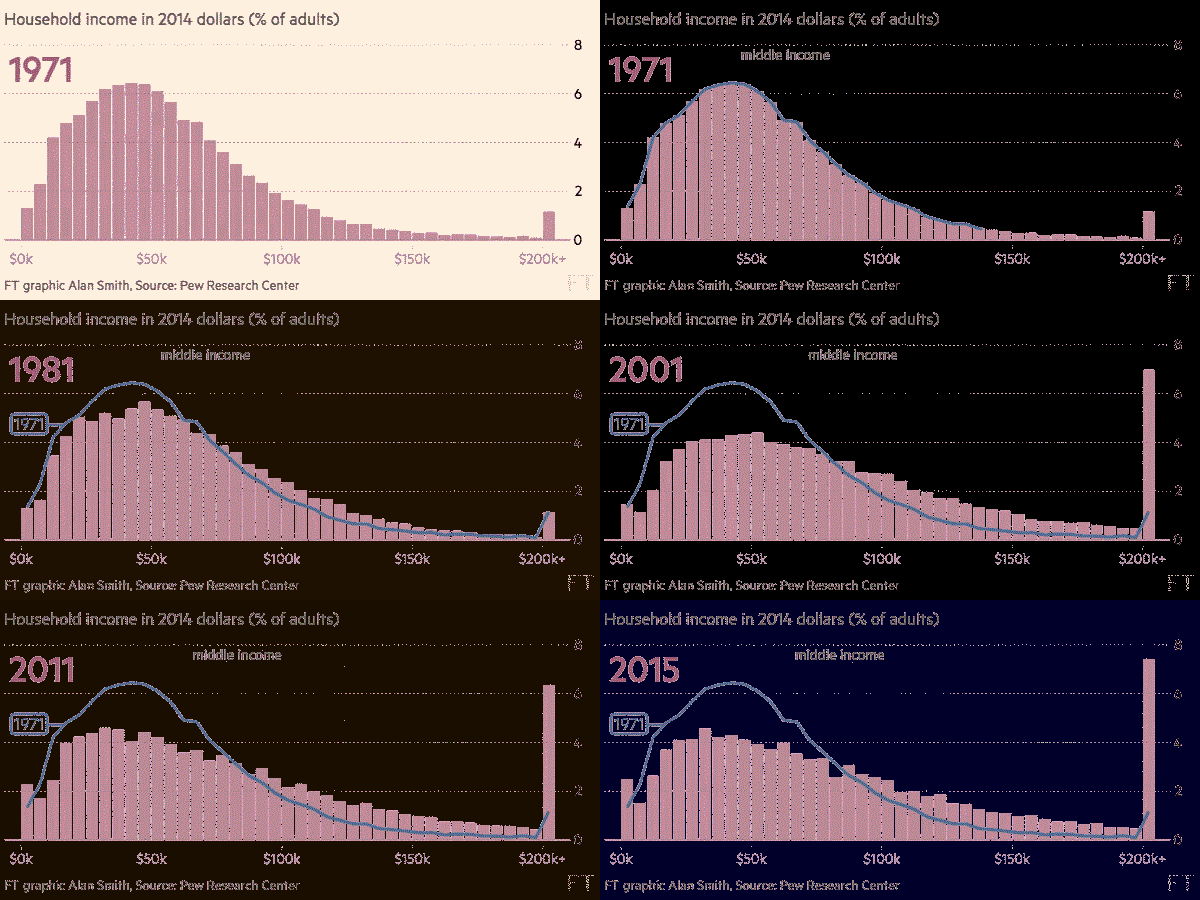
The Pew study has been discussed in the media, and one key point has been grossly misunderstood. Among other things, the study found that the American middle class is shrinking and is now just under half of the population. Commentators quickly began to refer to the “hollowing out” of the middle class and to tie this study to the concerns about growing inequality.

However, a close look at the data shows that the middle class has shrunk since 1971 because more members of the middle class have moved up the income ladder than down it.

Don’t believe me? Look for yourself at the terrific graphic that the Financial Times created to illustrate the data:

ft2015inequalitygraphYou can watch as the folks on the left slowly slide to the right over 44 years. When you compare the 1971 distribution with the 2015 one, what do you see? A growth in households earning around $80,000 or above, adjusted for inflation, since 1971 and a significant decline in those making less than that amount (with the exception of the folks right around $0). It’s true that there’s not a fat middle class anymore, but why should that trouble us if there are more high-income households and fewer low-income households overall?

The funny part of this is that if you read the story in the Financial Times that accompanies this graphic, it’s as if they never actually looked at the graphic they produced. Their narrative is at odds with it, as the narrative proclaims the doom-and-gloom story that the graphic actually refutes. As they say, never let the facts get in the way of a good story.

This growth in household income may, to some extent, be a by-product of the same economic processes that have produced the concerns about inequality, illustrated in this graphic by the significant growth of the ultra-rich.

There are far more very rich people today than there were 44 years ago, but the growth of the upper class has gone hand in hand with the enrichment of a large number of less-well-off households. Are there ways in which economic inequality is good, then? I think the answer to that question is yes. If so, then, what are they? Here are two defenses of economic inequality that proponents of the free market could make.

First is the more obvious one: growing inequality is good because it might be a consequence of economic institutions that produce all kinds of results that we think are desirable. For example, if competitive markets lead to peace and rising prosperity for all but also create inequality along the way by allowing some folks to get very rich, then we should at least tolerate that inequality because the things that produce it also produce other things we like.

This is the usual defense libertarians invoke, and it’s a good argument. The critic, however, might say that even if the defense is true, it doesn’t prove that inequality is necessary for that result. There’s a difference between saying, “Good economic institutions will produce inequality while creating good economic outcomes for all,” and saying, “Good economic outcomes for all can’t be produced without inequality.” The critic would likely ask how reducing the inequality that markets produce will harm their ability to produce those good results.

And here is where we come back to the Pew study and get a second defense of inequality. One way the middle class (and all of us) has become richer in the last generation is that the cost of so many goods and services has dropped in terms of the number of hours we have to work at the average wage in order to purchase them. The lower price of basic goods has enabled more and more people to afford things like large TVs, smartphones, and new, cheaper medications.

One thing that has made this process happen is inequality. In The Constitution of Liberty, F.A. Hayek argued,

A large part of the expenditure of the rich, though not intended for that end, thus serves to defray the cost of the experimentation with the new things that, as a result, can later be made available to the poor.… Even the poorest today owe their relative material well-being to the results of past inequality.

Having a group of very rich people is what enables yesterday’s luxuries to become today’s basics.

There are two parts to this process: cost bearing and discovery. The very rich are able to afford the high prices of new technologies, thereby providing an incentive for firms to market new and expensive products. Once the rich pay the high initial price and cover the fixed costs of research and development, sellers can begin to price closer to the much lower marginal cost of producing additional units, making the good much more affordable to more people.

But the rich are also an economic canary in the coal mine that informs producers whether they are getting it right.

For example, a critic of inequality might complain that no one “really needs” a $100,000 luxury car with all kinds of new high-tech gadgets on it. But the fact that some can afford it and want to buy it helps the car companies figure out which new features might be popular. Rear-view cameras were once only available on top-end cars, but they have slowly become a standard feature. The same may soon be true of collision warning systems now available on high-end models of some cars.

In fact, everything we think of as basics today was once the province of only the well-off. The first microwaves were expensive and bought mostly by the rich. I can remember my parents paying about $900 for a VCR in the late 1970s. VCRs, of course, fetch a price close to zero these days. The rich who bought the early LCD TVs helped manufacturers defray the fixed production costs and figure out what people wanted, and now these TVs are in the vast majority of houses at a more affordable price.

The inequality at any point in time is a key part of the process that creates wealth for the rest of society over the years to follow. The very rich enable producers to experiment and cover their costs, and that makes more goods more affordable for the rest of us, from fun toys to life-saving necessities.

The inequality produced by the market is a key part of how the market moves forward, enriching all of us in the process. And that’s why the middle class is shrinking: the rich, through the competitive market, have helped make the middle class richer.

Steven Horwitz is the Charles A. Dana Professor of Economics at St. Lawrence University and the author of Hayek’s Modern Family: Classical Liberalism and the Evolution of Social Institutions. He is a member of the FEE Faculty Network.

This article was published by The Foundation for Economic Education and may be freely distributed, subject to a Creative Commons Attribution 4.0 International License, which requires that credit be given to the author.

The Hoverboard’s Patent Problem – Article by Jeffrey A. Tucker

The Hoverboard’s Patent Problem – Article by Jeffrey A. Tucker

The New Renaissance HatJeffrey A. Tucker
******************************

Who has the right to make a “hoverboard”?

Shane Chen of Portland, Oregon, owns the patent to one of the hottest holiday gifts this season. It is a kind of hoverboard, a small item that keeps its user upright using infrared sensors, gyroscopes, and motors. You have probably seen them all over your city. You might even have been approached by a street seller.

The authorized version — licensed by Chen himself — is being made and distributed by Razor USA. Prices started at $1,000 and up, but competition from cheap knockoffs, selling for as low as $200, has brought the price for the authorized version to $600. Still, there are places online where you can get them for $200. If experience in new products in a guide to the future, in a year, they will be available for less than $100.

And truly, these knockoffs are everywhere. Small entrepreneurs are importing them from small manufacturers by the thousands and selling them on the streets. They are making and selling so fast that quality control has been… lax. There are anecdotal reports of explosions and sudden acceleration (parodies on this Saturday night live skit). Amazon has refused to sell many brands.

The patent has proven difficult to enforce. Razor is spending up to $1 million per week to sue unauthorized manufactures. It’s a reminder: it’s never enough just own the government-granted monopoly rights to produce something. It always costs money to enforce it. You have to investigate. You have to litigate. You have to win. And by the time that day comes, you might have lost vast market share.

If the product is popular enough, the task is essentially hopeless. The resources and time expended on patent enforcement might instead of gone to innovation and marketing toward actually making profits. Enforcing a monopoly isn’t necessarily the same as making money. Indeed, it is the opposite.

The Case of Eli Whitney
The hoverboard saga brings to mind the history of one of the 19th-century’s most famous inventions: the cotton gin. The holder of the patent was Eli Whitney. A year after his graduation from Yale, he designed and constructed an improvement in the cotton gin — a technology that had existed since the ancient world. He obtained the patent on a single feature, a brush-like extension that improved the way the seeds were extracted from the cotton.

According to Boldrin and Levine, Eli and his partner Phineas Miller has dreams of getting rich with a monopoly pricing scheme. They would install their machines throughout the South and ask a royalty of two fifths, payable in ginned cotton. This prospect seriously annoyed farmers throughout the region, understandably.

So it became a common practice for farmers to reverse engineer the innovation — not a difficult thing to do. Rather than lease the Whitney machine, they would just make their own. Does this violate anyone’s rights? Of course not. A design of a contraption is made scarce and “owned” only by legislation. To forcibly prevent farmers from making their own machines is actually an invasion of their rights.

Still, with the prospect of riches dancing in his head, Eli and Phineas set out to sue every farmer who reverse engineered their design. “Whitney and Miller spent a lot of time and money trying to enforce their patent on the cotton gin, but with little success,” write Boldrin and Levine. “Between 1794 and 1807 they went around the South bringing to court everyone in sight, yet received little compensation for their strenuous efforts.”

Meanwhile, the gin led to vast increases in productivity. The cotton industry boomed. But the holders of the patent became ever poorer.

Fortunately, the story ends well. Whitney learned that suing people is less profitable than actually marketing products. His next project was to invent a machine that created interchangeable parts for muskets. Having learned his lesson, he did not seek a patent for his innovation. He just got busy right away and began selling. (His main customer, as it turns out, became the US Army.)

He finally did strike it big. As Boldrin and Levine summarize the lesson: “It was not as a monopolist of the cotton gin, but rather as the competitive manufacturer of muskets that Whitney finally became rich.”

Will Shane Chen Learn the Lesson?
The hoverboard, like the cotton gin, is in enormous demand. All the government power is the world will not prevent hundreds of manufacturers from making them, driving the price down and down until everyone can afford one. That one million per week that Razor is spending on trying to stop copycats is probably better spent on marketing and innovation — actually selling stuff rather than trying to prevent others from selling stuff.

Absent the government regulation, how can innovators make money? They have the first-mover advantage. This is what provides a period of high profitability before others get in on the act. This is the competitive market at work, inspiring everyone to serve the customer ever more faithfully through lower prices and better products.

Another factor that gives advantage to the innovators is trust. Even now, you can go to the drug store and see name-brand products living alongside store-branded products. Both make money. Both appeal to certain market segments. One producer’s gain does not necessarily come at the expense of other producers, unless the government intervenes.

It is common wisdom to say that the patent system is broken. But what is broken about it? It’s not that the system is abused. It is that it is used at all. Industrial monopolies achieved through government grants of special privileges create waste — and the ongoing lawsuits concerning the hoverboard are a case in point.

Whether it is ginning cotton or zipping around on city sidewalks, a true innovative society encourages as much production and innovation as possible, in service of the masses who love the newest and coolest thing.

Jeffrey Tucker is Director of Digital Development at FEE, CLO of the startup Liberty.me, and editor at Laissez Faire Books. Author of five books, he speaks at FEE summer seminars and other events. His latest book is Bit by Bit: How P2P Is Freeing the World.  Follow on Twitter and Like on Facebook. 

This article was published by The Foundation for Economic Education and may be freely distributed, subject to a Creative Commons Attribution United States License, which requires that credit be given to the author.

Why Capitalists Are Repeatedly “Fooled” By Business Cycles – Article by Frank Shostak

Why Capitalists Are Repeatedly “Fooled” By Business Cycles – Article by Frank Shostak

The New Renaissance Hat
Frank Shostak
******************************

According to the Austrian business cycle theory (ABCT) the artificial lowering of interest rates by the central bank leads to a misallocation of resources because businesses undertake various capital projects that — prior to the lowering of interest rates —weren’t considered as viable. This misallocation of resources is commonly described as an economic boom.

As a rule, businessmen discover their error once the central bank — which was instrumental in the artificial lowering of interest rates — reverses its stance, which in turn brings to a halt capital expansion and an ensuing economic bust.

From the ABCT one can infer that the artificial lowering of interest rates sets a trap for businessmen by luring them into unsustainable business activities that are only exposed once the central bank tightens its interest-rate stance.

Critics of the ABCT maintain that there is no reason why businessmen should fall prey again and again to an artificial lowering of interest rates.

Businessmen are likely to learn from experience, the critics argue, and not fall into the trap produced by an artificial lowering of interest rates.

Correct expectations will undo or neutralize the whole process of the boom-bust cycle that is set in motion by the artificial lowering of interest rates.

Hence, it is held, the ABCT is not a serious contender in the explanation of modern business cycle phenomena. According to a prominent critic of the ABCT, Gordon Tullock,

One would think that business people might be misled in the first couple of runs of the Rothbard cycle and not anticipate that the low interest rate will later be raised. That they would continue to be unable to figure this out, however, seems unlikely. Normally, Rothbard and other Austrians argue that entrepreneurs are well informed and make correct judgments. At the very least, one would assume that a well-informed businessperson interested in important matters concerned with the business would read Mises and Rothbard and, hence, anticipate the government action.

Even Mises himself had conceded that it is possible that some time in the future businessmen will stop responding to loose monetary policy thereby preventing the setting in motion of the boom-bust cycle. In his reply to Lachmann (Economica, August 1943) Mises wrote,

It may be that businessmen will in the future react to credit expansion in another manner than they did in the past. It may be that they will avoid using for an expansion of their operations the easy money available, because they will keep in mind the inevitable end of the boom. Some signs forebode such a change. But it is too early to make a positive statement.

Do Expectations Matter?
According to the critics then, if businessmen were to anticipate that the artificial lowering of interest rates is likely to be followed some time in the future by a tighter interest-rate stance, their conduct in response to this anticipation will neutralize the occurrence of the boom-bust cycle phenomenon. But is it true that businessmen are likely to act on correct expectations as critics are suggesting?

Furthermore, the key to business cycles is not just businessmen’s conduct but also the conduct of consumers in response to the artificial lowering of interest rates — after all, businessmen adjust their activities in accordance with expected consumer demand. So on this ground one could generalize and suggest that correct expectations by people in an economy should prevent the boom-bust cycle phenomenon. But would it?

For instance, if an individual John, as a result of a loose central bank stance, could lower his interest rate payment on his mortgage why would he refuse to do that even if he knows that a lower interest rate leads to boom-bust cycles?

As an individual the only concern John has is his own well-being. By paying less interest on his existent debt John’s means have now expanded. He can now afford various ends that previously he couldn’t undertake.

As a result of the central bank’s easy stance the demand for John’s goods and services and other mortgage holders has risen. (Again it must be realized that all this couldn’t have taken place without the support from the central bank, which accommodates the lower interest-rate stance.)

Now, the job of a businessman is to cater to consumers’ future requirements. So whenever he observes a lowering in interest rates he knows that this most likely will provide a boost to the demand for various goods and services in the months ahead.

Hence if he wants to make a profit he would have to make the necessary arrangements to meet the future demand.

For instance, if a builder refuses to act on the likely increase in the demand for houses because he believes that this is on account of the loose monetary policy of the central bank and cannot be sustainable, then he will be out of business very quickly.

To be in the building business means that he must be in tune with the demand for housing. Likewise any other businessman in a given field will have to respond to the likely changes in demand in the area of his involvement if he wants to stay in business.

A businessman has only two options — either to be in a particular business or not to be there at all. Once he has decided to be in a given business this means that the businessman is likely to cater for changes in the demand for goods and services in this particular business irrespective of the underlying causes behind changes in demand.

Failing to do so will put him out of business very quickly. Now, regardless of expectations once the central bank tightens its stance most businessmen will “get caught.” A tighter stance will undermine demand for goods and services and this will put pressure on various business activities that sprang up while the interest-rate stance was loose. An economic bust emerges.

We can conclude that correct expectations cannot prevent boom-bust cycles once the central bank has eased its interest-rate stance. The only way to stop the menace of boom-bust cycles is for the central bank to stop the tampering with financial markets. As a rule however, central banks respond to the bust by again loosening their stance and thereby starting the new boom-bust cycle phase.

Frank Shostak is an Associated Scholar of the Mises Institute. His consulting firm, Applied Austrian School Economics, provides in-depth assessments and reports of financial markets and global economies. He received his bachelor’s degree from Hebrew University, master’s degree from Witwatersrand University and PhD from Rands Afrikaanse University, and has taught at the University of Pretoria and the Graduate Business School at Witwatersrand University.

This article was originally published by the Ludwig von Mises Institute. Permission to reprint in whole or in part is hereby granted, provided full credit is given.

Do We Need the Fed? – Article by Ron Paul

Do We Need the Fed? – Article by Ron Paul

The New Renaissance HatRon Paul
******************************

Stocks rose Wednesday following the Federal Reserve’s announcement of the first interest rate increase since 2006. However, stocks fell just two days later. One reason the positive reaction to the Fed’s announcement did not last long is that the Fed seems to lack confidence in the economy and is unsure what policies it should adopt in the future.

At her Wednesday press conference, Federal Reserve Chair Janet Yellen acknowledged continuing “cyclical weakness” in the job market. She also suggested that future rate increases are likely to be as small, or even smaller, than Wednesday’s. However, she also expressed concerns over increasing inflation, which suggests the Fed may be open to bigger rate increases.

Many investors and those who rely on interest from savings for a substantial part of their income cheered the increase. However, others expressed concern that even this small rate increase will weaken the already fragile job market.

These critics echo the claims of many economists and economic historians who blame past economic crises, including the Great Depression, on ill-timed money tightening by the Fed. While the Federal Reserve is responsible for our boom-bust economy, recessions and depressions are not caused by tight monetary policy. Instead, the real cause of economic crisis is the loose money policies that precede the Fed’s tightening.

When the Fed floods the market with artificially created money, it lowers the interest rates, which are the price of money. As the price of money, interest rates send signals to businesses and investors regarding the wisdom of making certain types of investments. When the rates are artificially lowered by the Fed instead of naturally lowered by the market, businesses and investors receive distorted signals. The result is over-investment in certain sectors of the economy, such as housing.

This creates the temporary illusion of prosperity. However, since the boom is rooted in the Fed’s manipulation of the interest rates, eventually the bubble will burst and the economy will slide into recession. While the Federal Reserve may tighten the money supply before an economic downturn, the tightening is simply a futile attempt to control the inflation resulting from the Fed’s earlier increases in the money supply.

After the bubble inevitably bursts, the Federal Reserve will inevitably try to revive the economy via new money creation, which starts the whole boom-bust cycle all over again. The only way to avoid future crashes is for the Fed to stop creating inflation and bubbles.

Some economists and policy makers claim that the way to stop the Federal Reserve from causing economic chaos is not to end the Fed but to force the Fed to adopt a “rules-based” monetary policy. Adopting rules-based monetary policy may seem like an improvement, but, because it still allows a secretive central bank to manipulate the money supply, it will still result in Fed-created booms and busts.

The only way to restore economic stability and avoid a major economic crisis is to end the Fed, or at least allow Americans to use alternative currencies. Fortunately, more Americans than ever are studying Austrian economics and working to change our monetary system.

Thanks to the efforts of this growing anti-Fed movement, Audit the Fed had twice passed the House of Representatives, and the Senate is scheduled to vote on it on January 12. Auditing the Fed, so the American people can finally learn the full truth about the Fed’s operations, is an important first step in restoring a sound monetary policy. Hopefully, the Senate will take that step and pass Audit the Fed in January.

Ron Paul, MD, is a former three-time Republican candidate for U. S. President and Congressman from Texas.

This article is reprinted with permission from the Ron Paul Institute for Peace and Prosperity.


Science Fiction and Communist Reality – Article by Lawrence W. Reed

Science Fiction and Communist Reality – Article by Lawrence W. Reed

The New Renaissance HatLawrence W. Reed
******************************

Real Heroes: Stanislaw Lem

Each week, Mr. Reed will relate the stories of people whose choices and actions make them heroes. See the table of contents for previous installments.


Polish science fiction writer Stanislaw Lem (1921–2006) “skillfully dissected the 20th century’s foolhardy efforts to create utopias by stifling individuality and economic freedoms.” So said cultural critic Bruce Edward Walker. Lem was best known internationally as author of the classic Solaris — twice adapted for the silver screen — but the majority of his fiction featured damning allegories against the suppression of the human spirit.

Lem ranks high in the Polish pantheon of independent thinkers and dissidents, any list of which would be long and distinguished. Poland’s role in the historic unraveling of the Soviet empire was pivotal by any measure. And while world leaders from Pope John Paul II to Ronald Reagan to Margaret Thatcher played a part, the audacity of the homegrown resistance is a story that is still underemphasized to this day.

In November 1986, I spent nearly two weeks in Poland with the anticommunist underground. This was five years after the Warsaw government declared martial law and threw many pro-freedom activists in jail. It was still many months before the big changes of 1989 that would liberate Eastern Europe from the communist yoke. One night during my visit, I met in a private home with a half-dozen underground printers. They were eager to impress me with examples of many great pro-freedom books they had illegally translated, printed, and distributed throughout the country.

I asked, “Where did you get the paper to publish all this stuff?”

“From two places,” replied a young man named Pavel. “One, we smuggle it in from the West. Two, we steal it from communists.”

When I asked him to explain the second source, he revealed that many of the workers in the communist government’s publishing houses were sympathetic to the resistance. When those workers saw the opportunity, they smuggled the paper out or even printed resistance literature on the government’s own printing presses.

The impressive stack of illegally printed books those printers showed me included works by great scholars of liberty from the West — Freeman writers F.A. Hayek, Ludwig von Mises, and Murray N. Rothbard, to name just three. I later raised $5,000 for the underground to translate, publish, and distribute Milton Friedman’s classic Free to Choose, a copy of which I proudly display today in a glass case in my study. But there were books, essays, and ideas by native Poles that the underground took risks to disseminate as well. Stanislaw Lem was one of them.

Born in 1921, Lem survived both Nazi occupation and Soviet rule in the town of his birth, which was known alternately as Lwów in free Poland, Lvov in the Soviet Union, and Lviv in modern Ukraine. His father was a doctor, and Lem was poised to follow in his footsteps until Hitler’s invasion in 1939. He was forced to work as a mechanic but became a crack saboteur: “I learnt to damage German vehicles in such a way that it wouldn’t be discovered,” he said.

Lem resumed his medical studies following the war, eventually finishing his degree in Cracow in 1946. He intended to pursue a career in theoretical biology, but abandoned his plans rather than adhere to the since-discredited practices of Soviet geneticist Trofim Lysenko. He turned to writing, only to have his first novel, The Hospital of the Transfiguration, banned by communist censors for nearly a decade.

By 1951, Lem realized that his only hope of publishing was to mask his views as allegorical works of science fiction. State apparatchiks in charge of expunging subversive works from the public square were too stupid to appreciate his subtlety, but Polish intellectuals and many ordinary readers knew full well what the underlying message was. What Lem did with a wrench to German vehicles, he later did with pen and ink to the communist state.

Lem used his considerable intellect (he reportedly had an IQ of 180) and writing skills to parody Soviet and Polish leaders and subtly convey the torments of communist life. He is seen as in the same mold as satirical fantasists Jonathan Swift, George Orwell, and Franz Kafka. In the estimation of many who took great risks to criticize the Soviet and allied Eastern European regimes, his work sits comfortably alongside such anti-totalitarian classics as Arthur Koestler’s Darkness at Noon and Alexander Solzhenitsyn’s The Gulag Archipelago.

Lem’s writings have been translated into at least 40 languages, have sold nearly 30 million copies, and span a wide range from screenplays, short stories, and mystery novels to more serious matters of philosophy, cybernetics, and the nature of intelligence itself.

The Astronauts, published in 1951, was followed by Time Not Lost, a fictionalized account of Nazi occupation of Poland. Return from the Stars, published in 1961, presented a world devoid of “the hell of passion, and then it turned out that in the same sweep, heaven, too, had ceased to be. Everything now is lukewarm.” This bland reality, noted reviewer Marilyn Jurich, “reduces the possibility of individuals accepting personal risks,” resulting in “a monotone, denatured safe world at the cost of direct experience in a nature that is open, unknown, risky; a world where wild animals have disappeared along with human emotion and initiative. Individuals have few means left to test physical capacity or mental endurance.”

Nightmarish Conformity

The short story “The Thirteenth Voyage,” in the collection The Star Diaries, depicts the totalitarian urge at its most invasive. In that story, the Angelicans, a group of social engineers, determine that all human foibles can be solved by collectivization, producing a nightmarish, stagnant conformity. Having lived through collectivism of both the national socialist and communist varieties, Lem knew his subject well.

Lem published his last collection of fiction in 1988, before the collapse of the Berlin Wall and the subsequent implosion of the Soviet Union. He told interviewer Istvan Csicsery-Ronay Jr. in 1985,

The literature of the 20th century has lost its battle, or at least finds itself in retreat.… The tales of refugees from totalitarian countries reduce themselves to an exhaustive catalogue of social and psychological suffering that such systems treat their citizens to. These books cannot pick their readers up, and the lessons they teach are not pleasant. One could say that the job of literature is not primarily to entertain, move, and cheer us up, but as [Joseph] Conrad said, to ‘bring the visible world to justice.’ Well, in order to bring this world to justice, it is first necessary to understand it with one’s intellect, to appreciate the wealth of its diversity.

Another Polish dissident, Stefan Kisielewski, was once jailed for an eloquent three-word sentence: “Socialism is stupidism.”

As a rule, dictators understand the power of ideas better than most people, which is why they often make it illegal to simply harbor a certain thought or give that thought expression in ink on paper.

Thankfully, courageous men and women like Stanislaw Lem found creative ways around evil regimes — a key reason those very regimes now exist, with a few exceptions, only in the history books.

For further information, see:

Lawrence W. (“Larry”) Reed became president of FEE in 2008 after serving as chairman of its board of trustees in the 1990s and both writing and speaking for FEE since the late 1970s. Follow on Twitter and Like on Facebook.

This article was published by The Foundation for Economic Education and may be freely distributed, subject to a Creative Commons Attribution 4.0 International License, which requires that credit be given to the author.