Browsed by
Category: Economics

A Libertarian Defense of Tenure – Article by Aeon Skoble and Steven Horwitz

A Libertarian Defense of Tenure – Article by Aeon Skoble and Steven Horwitz

The New Renaissance HatAeon Skoble and Steven Horwitz
******************************

Tenure protects the right to be unpopular

Libertarians are understandably frustrated with the state of higher education today. Libertarian ideas often do not get covered, or are covered unfairly. Faculty are overwhelmingly left-of-center, and government subsidies have driven up costs, leading to higher student debt.

These are legitimate concerns of course. However, the solution to these problem is not to abolish the institution of tenure. Tenure is not anti-liberty, and it provides important protections for those who are libertarians (and conservatives) in academia. In addition, it has some efficiency properties that explain why it has survived and might well do so even in a world where the state had no role in higher ed.

There are many potential objections to tenure. For some, the idea that a tenured professor cannot be fired strikes them as a rejection of the free market. Others believe that tenure is a way of protecting leftist faculty, even if their ideas are wrong-headed, and students don’t wish to hear them. In that way, tenure is a kind of monopoly protection for bad ideas. Finally, people across the political spectrum believe that tenure creates so-called “deadwood” faculty who, once they are tenured, no longer have to care about their teaching or research.

First, let’s dispatch a common misconception: it is not true that tenured professors cannot be fired.  Tenured professors can be fired for a variety of reasons.  What tenure does is limit what counts as a valid reason for dismissal in order to protect academic freedom. A tenured professor can be fired if caught plagiarizing, or found guilty of sexual or other forms of harassment, or convicted of violent crime. But if she can be fired for writing an article that the dean disapproves of, she cannot perform her job. And that is where tenure comes in.

Understanding why tenure is a desirable institution requires us to remember the purpose of a university. Universities are, ideally, institutional arrangements that enable scholars to engage in the activities of seeking the truth and then sharing the fruits of our scholarship with students, other scholars, and perhaps the general public.

Essential to that project is that scholars are free to seek the truth as we see it, without interference by others who have different goals. Of course, scholars must play by some very simple rules of the game: do not lie or cheat; do not distort your data or the arguments of your sources; be transparent about conflicts of interest; do not engage in personal attacks or the use of force, among others.

If this sounds familiar, that’s because the search for truth is a discovery process analogous to the market. Just as entrepreneurs in a market require the freedom to discover value where their best judgment takes them, subject to rules against force and fraud, so do scholars in a university require the freedom to discover truth where our best judgment takes us.

Tenure protects scholars like us from interference with our attempts to discover truth. Scholars cannot engage in truth-seeking if we’re facing retaliation from people who don’t like where our research leads. A university cannot be a university without robust protection of the open exchange of ideas and the freedom of each scholar to research in his or her field without intimidation.

By ruling out the possibility of firing a professor simply for the content of her beliefs, tenure ensures that the university will be what Michael Polanyi called “a republic of science,” in which truth-seeking is the highest standard.

Skeptics might argue that even if tenure were abolished, faculty still wouldn’t leave their current jobs because they would find it difficult to get hired elsewhere. But that’s not the point. The point is that we cannot do our jobs without a credible guarantee of academic freedom, and tenure is one way to secure that.

Tenure protects academic freedom in three distinct ways. First, when we engage in research and publishing, we can’t be worried that some administrator, trustee, politician, or even a student activist will find our work offensive and retaliate against us. This will have a chilling effect on our ability to seek the truth, which is our job as college professors. There are numerous examples of libertarian and conservative faculty facing just these sorts of threats, and tenure is the primary reason those threats are empty.

Second, when we construct and teach our curricula, we can’t worry that any of the usual suspects will take offense, or try to substitute their judgment for ours. Finally, when participating in institutional decision making about academic matters, we can’t be afraid to call shenanigans on various administrator-driven fads (of which there are many) that would undermine our ability to engage in research and teaching.

Although we are open to alternative institutional processes if they could be shown to adequately protect academic freedom, abolishing tenure in their absence is a dicey proposition. Absent tenure, it is libertarians and conservatives who would be the first to be persecuted, censored, or silenced.

Politically correct ideas don’t need the protection of tenure because they are popular; tenure protects ideas that are not. Abolishing it would give still more power to the activists and administrators who seek to create an ideologically uniform academy.

Given those concerns, how big is the downside to tenure? If the complaint is that some faculty’s research productivity declines after tenure, then an easy fix is to have continued productivity tied to merit raises.  Nothing about the institution of tenure precludes post-tenure reviews and merit pay. And even if some faculty slack off as publishers, so what? As long as they’re good teachers, mentors, and colleagues, it’s not necessary that all college faculty be active publishers their whole careers.

Tenure offers a beneficial set of incentives for many universities. Faculty want the protections we have outlined above, and universities want to encourage faculty to develop university-specific human capital to better serve their educational vision and the type of students they attract. Faculty don’t necessarily want to make those specific investments if the opportunity cost may be enhancing their publication record so as to make them more attractive in the job market.

Tenure is a commitment by the institution to maintain a faculty member’s employment in return for abiding by some basic rules and demonstrating during the tenure process that they have acquired that institution-specific human capital. The faculty member gets enhanced, but not total, job security, and the institution gets someone committed to its particular needs. In this way, tenure is like marriage: we bind ourselves to an arrangement with high exit costs in order to incentivize ourselves to commit to the relationship. Just as marriage is compatible with a free society, so is tenure.

There are many problems with contemporary higher education, but tenure isn’t one of them. Ending tenure would exacerbate many of those issues while also creating new ones. And in an institutional setting where the opponents of liberty hold most of the cards, getting rid of one of the most important institutions that protects dissent and the ability to seek the truth will only silence the friends of liberty.

Aeon J. Skoble is Professor of Philosophy at Bridgewater State University.

Steven Horwitz is the Charles A. Dana Professor of Economics at St. Lawrence University and the author of Hayek’s Modern Family: Classical Liberalism and the Evolution of Social Institutions. He is a member of the FEE Faculty Network.

This article was published by The Foundation for Economic Education and may be freely distributed, subject to a Creative Commons Attribution 4.0 International License, which requires that credit be given to the author.

Mises on Protectionism and Immigration – Article by Matt McCaffrey

Mises on Protectionism and Immigration – Article by Matt McCaffrey

The New Renaissance HatMatt McCaffrey
******************************

The economic causes and consequences of immigration are among the most important issues facing the world today. Both pro- and anti-immigration advocates are digging in their heels, and both sides look increasingly unlikely to relent. Despite the bleak outlook, however, there is still hope for a peaceful and charitable discussion of the economics of immigration.

With that in mind, I want to consider Mises’s thoughts on the topic. For Mises, emigration and immigration are motivated by a simple economic fact: the conditions of production are not the same in all places. Natural and human conditions change constantly, and as a result, the productivity of land, labor, and capital do so as well. Therefore in order to take advantage of changing conditions and produce in the most productive ways possible, people must constantly migrate to those places where their contributions are most valuable (1919, pp. 84–85).

The desire to move from low-productivity to high-productivity regions is for Mises the fundamental explanation for the migration of peoples, and limits overpopulation (1919, p. 85). We can say a country is relatively overpopulated when the same amount of capital and labor is less productive there than in another nation. Reducing overpopulation means reducing this “disproportion” by allowing for the mobility of persons and goods (1919, p. 86). In Mises’s view, mobility was an achievement of liberalism:

The principles of freedom, which have gradually been gaining ground everywhere since the eighteenth century, gave people freedom of movement. … Now, however — as a result of a historical process of the past — the earth is divided up among nations. Each nation possesses definite territories that are inhabited exclusively or predominantly by its own members. Only a part of these territories has just that population which … it would also have under complete freedom of movement, so that neither an inflow or an outflow of people would take place. The remaining territories are settled in such a way that under complete freedom of movement they would have either to give up or to gain population. Migrations thus bring members of some nations into the territories of other nations. That gives rise to particularly characteristic conflicts between peoples. (1919, pp. 86–87)

Mises has two types of conflict in mind: economic and social. Economic conflict occurs because domestic workers resent that fact that immigration bids down their wages:

[I]n territories of immigration, immigration depresses the wage rate. That is a necessary side effect of migration of workers and not, say, as Social Democratic doctrine wants to have believed, an accidental consequence of the fact that the emigrants stem from territories of low culture and low wages. (1919, p. 87)

Social conflict can also arise. Mises emphasized, however, that in most cases immigrants are obliged to give up their national identity and adapt themselves to the culture of their new home. Only in relatively extreme cases, such as European imperialism, was it historically possible for immigrants to replace original inhabitants and their cultures (1919, p. 89). In fact, according to Mises, strong cultures need not resort to government in order to protect themselves:

A nation that believes in itself and its future, a nation that means to stress the sure feeling that its members are bound to one another not merely by accident of birth but also by the common possession of a culture that is valuable above all to each of them, would necessarily be able to remain unperturbed when it saw individual persons shift to other nations. A people conscious of its own worth would refrain from forcibly detaining those who wanted to move away and from forcibly incorporating into the national community those who were not joining it of their own free will. To let the attractive force of its own culture prove itself in free competition with other peoples — that alone is worthy of a proud nation, that alone would be true national and cultural policy. The means of power and of political rule were in no way necessary for that. (1919, pp. 103–04)

However, for Mises, cultural considerations are mainly an aside. In general, he saw conflicts over immigration as being driven mostly by protectionism rather than insurmountable differences in human beings or cultures (1935). In particular, domestic unions support government policies to restrict immigration and thus keep low-wage competition out of the labor market:

Public opinion has been led astray by the smoke-screen laid down by Marxist ideology which would have people believe that the union-organized “proletariat of all lands” have the same interests and that only entrepreneurs and capitalists are nationalistic. The hard fact of the matter — namely that the unions in all those countries which have more favorable conditions of production, relatively fewer workers and thus higher wages, seek to prevent an influx of workers from less favored lands—has been passed over in silence. (1935)

As Per Bylund notes, this is precisely what is happening in Sweden, where unions prevent the integration of immigrants so as to keep wages high. Protectionism at home also breeds protectionism abroad, as foreign nations try to cope with lower productivity through their own regulations designed to counter “unfair” competition on the world market. As economic conditions worsen in those countries where migration is prevented by the state, conflict becomes inevitable:

[People in these countries] will certainly still have just as much cause to complain as before — not over the unequal distribution of raw materials, but over the erection of migration barriers around the lands with more favorable conditions of production. And it may be that one day they will reach the conclusion that only weapons can change this unsatisfactory situation. Thus, we may face a great coalition of the lands of would-be emigrants standing in opposition to the lands that erect barricades to shut out would-be immigrants. … Without the reestablishment of freedom of migration throughout the world, there can be no lasting peace. (1935)

In this way, protectionist policies inevitably lead to conflict and the destruction of human life and welfare. In fact, Mises even hints that government policies aiming to control the movement and employment of individuals suffer from the same problems socialist central planning does (1919, p. 85). At the same time, entrepreneurship and the division of labor are the foundations of a rational social order, and neither is possible without free labor markets.

The main threat facing society then is illiberal ideology, and the only solution to this “principle of violence” is to develop a consistent liberal philosophy to serve as the basis for a peaceful society (1951, p. 49).

Mises believed that any society that rejected the values of liberalism was doomed. In an age of nationalism, protectionism, and war, it’s easy to see what he meant.

Matt McCaffrey is assistant professor of enterprise at the University of Manchester.

This article was published on Mises.org and may be freely distributed, subject to a Creative Commons Attribution United States License, which requires that credit be given to the author.

The Fed Passes the Buck: Blame Oil and China – Article by C. Jay Engel

The Fed Passes the Buck: Blame Oil and China – Article by C. Jay Engel

The New Renaissance HatC. Jay Engel
******************************

There are a handful of themes out there on recent market action that are either totally wrong or otherwise highly misleading. For instance, regarding the recent calamity in the capital markets, one especially apparent dichotomy has presented itself as offering two choices as to what, exactly, is causing the painful turbulence.

There are some who, in a complete echo of the news headlines, are quick to point the finger at both oil and China. And yet there are others who point the finger at the Fed for “raising rates too early.” Along with the second is the observation that “inflation is totally MIA” and therefore it was ludicrous that the Fed felt the need to “raise interest rates.” Both of these tend to express anguish over the “strong dollar.”

Both of these miss the entire point, and the cause of the current trouble. For one thing, it is ridiculous to blame oil for the falling markets when the falling oil is the very thing that needs to be explained. It is wholly unsatisfactory to explain something by describing it. It works well for headlines, and for shifting the blame away from where it really belongs, but one must learn to look deeper. One cannot expect to impress anyone by explaining that the plane is crashing to the ground because it is no longer flying. What is the cause of oil’s magnificent plummet toward the bottom? That is the true question.

Moreover, the problem with the “China thesis” is that it doesn’t explain anything either. It merely observes a correlation in the markets and therefore makes it highly convenient to put the blame on “the other guys.” Let me not be misunderstood here: the Chinese and US economies are certainly influenced by each other, especially in our age of fluctuating fiat currencies. But ultimately, both China and the US — indeed the entire world — are being dragged down by past actions of their respective central banks and more specifically the illusion of prosperity via monetary and credit expansion.

Which leads to the second theme: putting the blame on the Fed for “raising rates” too early. That is, there are a good many who argue that if the Fed had never announced in December that it was going to seek minuscule increases in the Federal Funds rate, none of the recent market drops would have happened. They will say things like “inflation was never a threat, so the Fed was irresponsible to raise rates.”

Money-Supply Inflation vs. Price “Inflation”
This is confused. First, it must be constantly emphasized that the meaning of inflation, contrary to the mainstream’s application of it, is more appropriately defined an increase in the money supply, not “rising prices.” The reason why the Fed and proponents of central banking prefer the “rising prices” definition is because it obscures the chief source of our present economic condition. It rips the blame away from the Fed and toward all kinds of other “market forces” and therefore encourages the central bank to swoop in to the rescue rather than be the object of severe suspicion. Indeed, as Mises observed (page 420 of Human Action):

What many people today call inflation or deflation is no longer the great increase or decrease in the supply of money, but its inexorable consequences, the general tendency toward a rise or a fall in commodity prices and wage rates. This innovation is by no means harmless. It plays an important role in fomenting the popular tendencies toward inflationism.

First of all there is no longer any term available to signify what inflation used to signify. It is impossible to fight a policy which you cannot name. …

The second mischief is that those engaged in futile and hopeless attempts to fight the inevitable consequences of inflation — the rise in prices — are disguising their endeavors as a fight against inflation. While merely fighting symptoms, they pretend to fight the root causes of the evil. Because they do not comprehend the causal relation between the increase in the quantity of money on the one hand and the rise in prices on the other, they practicalIy make things worse.

Rising prices can be a result of inflation, but it is not itself inflation. So then, inflation was actually very high in the last decade due to the Fed’s QE and other monetary policy schemes. Second, it should never be ignored that “rising prices” can easily be found in the capital markets themselves. It doesn’t take an investment guru to observe the staggering levels to which the various market indexes have reached. Digging only a little bit farther into the surface reveals the absurd prices for the so-called highest valued stock such as Facebook, Amazon, Apple, and so on.

Where All That Money Went
More importantly, however, is the fact that much of the newly created money has not even come close to creating “widespread [consumer price] inflation” due to the actual structure of the current, post-crises banking regime. In fact, Jeffrey Snider, among others, have argued that it is literally impossible for “price inflation” to take place as a direct result of QE due to the way that money currently enters the system as reserves. “Price inflation” would need to come from the actions of individual banks themselves who are at present cautious about their consumer lending practices. Therefore the Fed is not creating “price inflation,” but something far worse: capital misallocation.

The point here is simply that those who want the interest rates to be continually suppressed so that economic activity will be encouraged, don’t even realize that this is literally the cause of bubble creations, not productive economic activity.

It used to be, under the pre-crises fractional-reserve model, that there would be loads of malinvestment as a result of banks creating new loans (new economic activity would take place, and then collapse back down). But now, money is created, not by commercial banks, but mostly by the Fed itself. Which means that, in the phraseology of David Stockman, the new money is simply sloshing around the canyons of Wall Street and pushing up equity and bond prices, rather than reaching the “real economy.”

The Bubble Only Prolongs the Problem
Thus, contrary to those blaming the Fed for causing stocks to fall by “raising rates” (which Joe Salerno reflects on here) we want to stress the fact that, in raising rates, the most that the Fed could do is unravel previously made mistakes. In other words, there is nothing praiseworthy in the first place about artificially propped up stock market levels. We have no interest in lauding the longevity of the bubble, because the bubble is the enemy of the healthy economy. The collapsing equity markets reveal where bubbles were formed and that our alleged prosperity is an illusion. And this is precisely what former Dallas Fed Chairman Richard Fisher stated in a conversation on CNBC last week when he confessed: “We frontloaded a tremendous market rally to create a wealth effect.”

And thus, the money expansion must inevitably cycle back down. Fisher himself admits: “… and an uncomfortable digestive period is likely now.” What was inflated up to the top, must deflate down to the floor. That is the only way for an economy to recover: bad credit needs to be liquidated. Unfortunately, it is painful indeed.

That is the true cause of the recent calamity. The dollar is “strengthening” by virtue of our credit system cracking at the seams. In other words, the so-called “strong dollar,” is merely one side of the pendulum swing of a volatile collapsing banking system. It shouldn’t be assumed that the dollar is becoming more sound; it is not. But if we might ever again have a sound currency, we first have to face the music.

And thus oil too, after years of being elevated up toward the heavens via the Fed’s monetary shenanigans, is experiencing its own inevitable bust. The illusion is being exposed.

Unfortunately, the Fed is a wild card, so we stay tuned to whether it will let the markets recover, or continue the perpetual cycle of money creation. My own advice for the Fed is neither to “raise rates” nor to lower them. But rather, to let go and let the market correct itself. For we have a lot of correction ahead of us.

C. Jay Engel is an investment advisor at The Sullivan Group, an independent, Austrian-School oriented, wealth management firm in northern California. He is especially interested in wealth preservation in lieu of our era of rogue Central Banking. He is an avid reader of the Austro-libertarian literature and a dedicated proponent of private property and sound money. Feel free to email C. Jay, visit his blog, and follow him on Twitter.

This article was published on Mises.org and may be freely distributed, subject to a Creative Commons Attribution United States License, which requires that credit be given to the author.

Why Trump and Sanders See Losers Everywhere – Article by Steven Horwitz

Why Trump and Sanders See Losers Everywhere – Article by Steven Horwitz

The New Renaissance HatSteven Horwitz
******************************

Competition and the Zero-Sum Fallacy

Donald Trump, Bernie Sanders, many political actors, too many intellectuals, and much of the general public share a false and destructive belief about the nature of exchange: that economic activity is something akin to a battle or a full-fledged war in which the goal is for one group to “defeat” another. We see this mentality across the political spectrum.

Zero-Sum Losers

Think of the ways Trump and others on the political right talk about international trade. The basic framework is to see other countries as enemies in competition with us. The goal of trade policy is somehow to “beat” them, because if they are “winning” by selling us a lot of stuff, we must be losing. The result is mistaken policies such as Trump’s proposed 45 percent tariff on Chinese imports.

We see the same us-and-them thinking on the left, where progressives perceive a persistent battle between capital and labor, each trying to defeat the other. For leftists, capital is always the winner and labor is always the loser — unless the government intervenes. The appropriate policy response, from this perspective, is either to limit capital’s gains or, if you’re a bit more radical, to help labor vanquish capital once and for all. One of the related beliefs on the left is that the wealth of capital comes at the expense of labor. That is, capital’s gains come from labor’s losses.

Both arguments share the underlying belief that the winners’ gains must come at the losers’ expense. Economic activity, and specifically wealth creation, is at best seen as what economists would call a “zero-sum game.”

In zero-sum games, the winners’ gains do, in fact, come at the losers’ expense. Think of a poker game where each person buys $100 worth of chips. If there are five players, there is $500 to be apportioned out. If the game ends with me having $250, then the remaining $250 will be split among the other four players. My gain of $150 comes from others’ losses. Playing the game creates winners and losers because it simply reallocates fixed wealth around the group.

Positive-Sum Winners

Market economies, however, are not zero-sum games. Consider the profits of entrepreneurs like Steve Jobs or Bill Gates or Mark Zuckerberg or any of thousands of lesser-known inventors who have become fabulously wealthy by providing us with products and services that we value. Their gains are not our losses. To the contrary: markets are what we call positive-sum games. Entrepreneurs make huge profits, but they can only do so by providing us with products and services we value more than what we give up to obtain them.

Every time you get something yummy from a food truck, for example, you demonstrate the mutual benefit of trade: the truck owner gets your money and you get something delicious to eat. You both gave up something you valued less than the thing you acquired. Trade is made of win.

So when people complain that the United States is “losing to China,” presumably because we have a trade deficit with them, they are falling for the zero-sum fallacy. A trade deficit simply means that we are buying more of their goods and services than they are of ours. This doesn’t mean “they” are winning. First, there’s no “they.” The winners are individual Chinese sellers and the people they employ on one side, and individual US consumers on the other. Portraying trade as a contest between countries is deceptive: trade is always among specific individuals and groups.

Second, both sides are winning. Chinese sellers get US dollars and US consumers get products they like at low prices, which frees up income to buy other goods and services, creating jobs in other sectors of the US economy. Those US dollars, it is worth noting, make their way back to the US as Chinese firms invest in US assets, funding everything from private-sector construction to a small part of our government debt. The dollars we spend on Chinese goods do not just disappear; they come back as investments in US capital goods.

It would be more accurate to see what’s happening here as Chinese sellers arriving at the US border with boatloads of cheap goods for us to buy. Under what logic are we made worse off by the “gift” of lower priced goods?

Misunderstanding “Competition”

I suspect that much of the zero-sum thinking we see with trade is based on a misplaced application of the idea of “competition.” Competition in the market does share a number of features with the sorts of competition that people are more familiar with: sports, games, and war.

All are what F.A. Hayek called “discovery procedures.” We play games as a way to discover which individual or team is best. There’s no way to know who the best hockey team is without the discovery process of the Stanley Cup playoffs. We can’t know the answer just by looking at statistics, as every major upset in sports history demonstrates. In markets, we discover who is producing the best product at the best price by letting sellers and buyers compete. One might say the same about war.

Despite these similarities, however, there’s a critical difference: athletic competition and war are zero-sum and negative-sum games, respectively. In sports, one team wins and the other loses, or there’s a tie. Both of those outcomes are zero-sum. War destroys human and physical capital, and even when one country “wins,” everyone is worse off, making it negative-sum.

Market competition, by contrast, is positive-sum. When sellers compete with other sellers to keep prices low, it’s true that some sellers will win and others will lose, but in that process, all of the buyers win, too, not to mention the other people who will receive more income because the buyers who are paying less for the original product can now buy their products. Wealth is not redistributed, as in a poker game, and there is not an offsetting loser for each winner, as in sports. Instead, additional wealth is created. That makes it a positive-sum game.

Seeing the Bigger Picture

CEOs are used to seeing this process from the narrow perspective of their firms, which often do lose in competition with other firms, leading them to believe the same principles apply between countries, or for the economy as a whole. This may explain why Donald Trump thinks he can “defeat” China in the same way he might outcompete another firm. It also explains why Sanders can believe that we are in a competition to preserve jobs. By focusing on the growth in manufacturing jobs in China, Sanders sees trade as “stealing” US jobs rather than being part of the larger competitive process responsible for the overall growth in US jobs and wealth.

Yes, markets share much with other forms of competition, but the key difference is the one that matters. Markets are positive-sum games, and they are not about one country, one group, or one class defeating another. Competition and trade are the way we produce cooperation and mutual benefit. Failing to understand this important difference easily opens the door to demagogues on both the right and the left.

Steven Horwitz is the Charles A. Dana Professor of Economics at St. Lawrence University and the author of Hayek’s Modern Family: Classical Liberalism and the Evolution of Social Institutions. He is a member of the FEE Faculty Network.

This article was published by The Foundation for Economic Education and may be freely distributed, subject to a Creative Commons Attribution 4.0 International License, which requires that credit be given to the author.

The Good Old Days of Poverty and Filth – Article by Sarah Skwire

The Good Old Days of Poverty and Filth – Article by Sarah Skwire

The New Renaissance HatSarah Skwire
******************************

A Cultural Historian Decries Profit and Progress

Standing in a luxury hotel, cultural historian Luc Sante daydreams about the good old days of homeless alcoholics lighting trash fires in the streets of Manhattan’s Skid Row.

“Over there, next to the flophouse hotel,” Sante reminisced to the Guardian, “is where Nan Goldin lived and worked. Forty years ago there were still lots of vacant lofts here that had been burlesque and vaudeville theatres during the era when storefronts were saloons. There were bars solely inhabited by bums, their heads down on the counter. At night they’d be lined up outside the missions and Salvation Army hostels — veterans from World War Two, from the Korean War, from the Vietnam War. At night, trash fires would be lit in oil drums.”

The French have an elegant phrase for what Sante is doing. They call it nostalgie de la boue, “longing for the mud,” which means a romantic yearning for a primitive or degraded behavior or condition.

The phrase, which was coined by a French dramatist in 1855, has been around for a while and usefully describes the very real way in which the wealthier and healthier inhabitants of modernity look back at the past through a misty, romantic haze.

While it annoys historians when we put a soft-focus filter on history, it doesn’t generally do a lot of damage. We don’t need every medieval romance novel to remind us that the heroine’s breath didn’t smell like cool mint Listerine. It’s probably for the best that the historical re-enactors at Colonial Williamsburg don’t actually use authentic colonial medical remedies for their health problems, and visiting tourists are certainly grateful for modern plumbing and street sanitation. Even the BBC’s determinedly authentic 1900 House had a phone and modern fire protection in case of emergencies.

Any lover of history will occasionally find him or herself dreaming about attending a performance in the pit at Shakespeare’s Globe, or roughing it in the saloons and shacks of a gold rush town. Some of us may even have recently spent an entranced hour or two playing with the Victoria and Albert Museum’s “Design-a-Wig” website. But a good student of history will acknowledge that the Globe was undoubtedly loud, smelly, crowded, and occasionally even dangerous for playgoers. And the rugged romance of the gold rush town is offset by the knowledge that you were probably far more likely to die of gangrene or cholera than you were to strike it even moderately rich. And those glorious 18th-century wigs? Heavy, hot, smelly, and prone to harboring bugs.

But a real case of nostalgie de la boue goes further than the soft-focus filter that ignores the unpleasantness of the past. Rather than ignoring the historical “mud,” nostalgie de la boue actively longs for that kind of unpleasantness and insists that without it, life is less authentic, less meaningful, and altogether worse.

And that is where Luc Sante seems to be. While he is quite correct to note that the ribaldry of Paris has long been a desirable antidote to the humorless Puritanism of American cities, Sante goes entirely off the rails when he insists that his praise for the “materially poor but … imaginatively free and creatively rich” inhabitants of Paris is not a romantic vision.

According to Sante, people ask him, “How can you be promoting the life of the poor in the 19th century when so many of them didn’t eat every day?”

Sante concedes, “Well yeah, it’s bad, but is it really any worse than the situation today when everybody’s fed but you have an incredible percentage of New Yorkers who live in the shelter system – including people who have regular jobs?”

The horrors of the shelter system aside, there’s a great deal to be said for a world where more and more people are fed better every year, and my guess is that a great number of the imaginatively free Parisians that Sante dreams of would have enjoyed the occasional extra baguette. It is possible to value historical creativity and intellectual independence without also having to praise historical dietary deficits. (And it is worth noting, should Sante happen to read this, that the feeding of all those extra people is not due entirely, or even primarily, to “the shelter system.” It’s the market economy and all that goes with it that is making the world better fed every year.)

Sante continues his nostalgia for the mud when he argues, “In the Paris I write about, people ran businesses to make a living, not to make a profit. Cafes, bars: they’re no longer public institutions or part of a community. There’s no possibility for eccentric self-determination amongst the shopkeepers.”

The distinction Sante draws between “making a living” and “making a profit” is not particularly clear to me. It suggests, perhaps, an unstated assumption that there is such a thing as an agreed-upon “correct” amount of profit for a business or businessperson to make — beyond which all profit becomes filthy lucre. Possibly he is making an equally indefensible assumption that businesspeople in the past weren’t interested in being as successful as they could be and that it is only our postmodern cynicism that has unleashed the drive for profit.

Maybe Sante means to say that unlike today’s businesses, the businesses of years ago “made a living” by helping to create a community among their customers rather than just “making a profit” by selling stuff. I think that thousands of today’s small business owners and their Facebook pages, Etsy stores, and farmer’s market stands would beg to differ with his assessment of their importance to their communities.

There’s not necessarily always a problem with nostalgie de la boue. It’s how we got Peaky Blinders, the renewed interest in home canning, restaurants that serve bone marrow, and the great revival of folk music spurred by O Brother Where Art Thou?, after all.

Sante, though, has so much mud in his eyes that he is blind to the tangible and important progress that has been made in human wealth and welfare. His mucky nostalgia leads him to claim that our increasing wealth — which has given us more health, more discretionary income, more food, and more free time — is a danger more pernicious than terrorism. “Money, for me, may not immediately kill people in the way terrorism does, but it does certainly change the fabric of daily life in much deeper and more insidious ways.”

That is a statement of such offensive ignorance that it could only be made by a man standing high above the former Skid Row, looking down through glass, with room service and maid service only a phone call away. I wonder if the men and women in the photographs that Sante treasures would have said the same?

Sarah Skwire is the poetry editor of the Freeman and a senior fellow at Liberty Fund, Inc. She is a poet and author of the writing textbook Writing with a Thesis. She is a member of the FEE Faculty Network.

This article was published by The Foundation for Economic Education and may be freely distributed, subject to a Creative Commons Attribution 4.0 International License, which requires that credit be given to the author.
What Are Your Odds of Making It to the 1%? – Article by Chelsea Follett

What Are Your Odds of Making It to the 1%? – Article by Chelsea Follett

The New Renaissance HatChelsea Follett
******************************

They’re better than you think

Your odds of “making it to the top” might be better than you think, although it’s tough to stay on top once you get there.

According to research from Cornell University, over 50 percent of Americans find themselves among the top 10 percent of income-earners for at least one year during their working lives. Over 11 percent of Americans will be counted among the top 1 percent of income-earners (i.e., people making at minimum $332,000) for at least one year.

How is this possible? Simple: the rate of turnover in these groups is extremely high.

Just how high? Some 94 percent of Americans who reach “top 1 percent” income status will enjoy it for only a single year. Approximately 99 percent will lose their “top 1 percent” status within a decade.

Now consider the top 400 U.S. income-earners — a far more exclusive club than the top 1 percent. Between 1992 and 2013, 72 percent of the top 400 retained that title for no more than a year. Over 97 percent retained it for no more than a decade.

HumanProgress.org advisory board member Mark Perry put it well in his recent blog post on this subject:

Whenever we hear commentary about the top or bottom income quintiles, or the top or bottom X% of Americans by income (or the Top 400 taxpayers), a common assumption is that those are static, closed, private clubs with very little dynamic turnover. …

But economic reality is very different — people move up and down the income quintiles and percentile groups throughout their careers and lives.

What if we look at economic mobility in terms of accumulated wealth, instead of just annual income (as the latter tends to fluctuate more)?

The Forbes 400 lists the wealthiest Americans by total estimated net worth, regardless of their income during any given year. Over 71 percent of Forbes 400 listees — and their heirs — lost their top 400 status between 1982 and 2014.

heirsSo, the next time you find yourself discussing the very richest Americans, whether by wealth or income, keep in mind the extraordinarily high rate of turnover among them.

And even if you never become one of the 11.1 percent of Americans who fleetingly find themselves in the “top 1 percent” of US income-earners, you’re still quite possibly part of the global top 1 percent.

Cross-posted from HumanProgress.org.

Chelsea Follett (Chelsea German) works at the Cato Institute as a Researcher and Managing Editor of HumanProgress.org.

This article was published by The Foundation for Economic Education and may be freely distributed, subject to a Creative Commons Attribution 4.0 International License, which requires that credit be given to the author.
What’s Changed Since 2010? – Article by Daniel Bier

What’s Changed Since 2010? – Article by Daniel Bier

The New Renaissance HatDaniel Bier
******************************

Quite a lot, it turns out

This interesting little table from Goldman Sachs shows a few ways the world changed in the last five years.

Some highlights since 2010:

  • The UN Food Price Index fell by a third.
  • The price of oil fell by two-thirds.
  • Venture capital investments in the US doubled.
  • Global smartphone penetration increased from 19 percent to 75 percent.
  • The cell phone price index fell by over half.
  • Average wages in China rose by more than 50 percent.
  • Beijing air pollution is down by a third.
  • The cost of sequencing a genome fell by 97 percent.
  • The number of summer AirBnB guests increased from 47,000 to 17 million.
  • Bitcoin’s value increased 1,500 fold.

But, as GS points out, 2015 was not all good news:

  • Economic growth has slowed.
  • Life expectancy has not changed much.
  • Africa’s share of global trade remained near 3 percent.
  • The Patriots won the Super Bowl.
  • Japanese GDP per capita remains flat.

Still — on the whole and for most people — things are changing for the better, in more ways than we could ever anticipate.

Here’s to a better today.

(Check out the other data below — lots of amusing and intriguing items.)

chart-11Click on the image for a larger version.

Daniel Bier is the editor of Anything Peaceful. He writes on issues relating to science, civil liberties, and economic freedom.

This article was published by The Foundation for Economic Education and may be freely distributed, subject to a Creative Commons Attribution 4.0 International License, which requires that credit be given to the author.

Is the Auto-Loan Bubble Ready to Pop? – Article by Tommy Behnke

Is the Auto-Loan Bubble Ready to Pop? – Article by Tommy Behnke

The New Renaissance HatTommy Behnke
******************************

On Tuesday, it was announced that over seventeen million new vehicles were sold in 2015, the highest it’s ever been in United States history.

While the media claims that this record has been reached because of drastic improvements to the US economy, they are once again failing to account for the central factor: credit expansion.

When interest rates are kept artificially low, individuals are misled into spending more than they otherwise would. In hindsight, they discover that their judgment errors wreaked havoc on their financial well-being.

This is a lesson that the country should have learned from the Subprime Crisis of 2008. Excessive credit creation led too many individuals to buy homes, build homes, and invest in the housing industry. This surge in artificial demand temporarily spiked prices, resulting in over four million foreclosed homes and the killing of over nine million US jobs.

Instead of learning from the mistakes that sent shock waves throughout most of the planet, the Federal Reserve has continued with its expansionist policies. Since 2009, the money supply has increased by four trillion, while the federal funds rate has remained at or near zero percent. Consequently, the housing bubble has been replaced with several other bubbles, including one in the automotive industry.

Automotive companies have taken advantage of the cheap borrowing costs, increasing vehicle production by over 100 percent since 2009:

Behnke 1_0Source: OICA

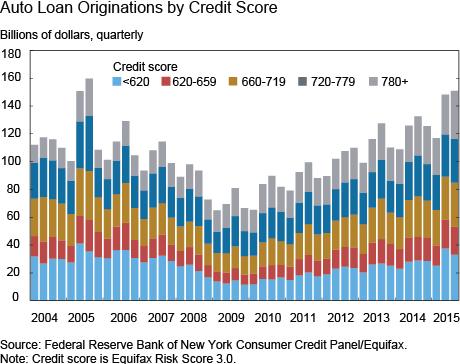
In order to generate more vehicle purchases, these companies have incentivized consumers with hot, hard-to-resist offers, similar to the infamous “liar loans” and “no-money down” loans of the 2008 recession. Dealerships have increased spending on sales incentives by 14 percent since last year alone, and the banners in their shops now proudly proclaim their acceptance of any and all loan applications — “No Credit. Bad Credit. All Credit. 100 Percent Approval.” As a result, auto loans have increased by nearly $80 billion since 2009, many of which have been given to individuals with far-from-stellar credit scores. Today, almost 20 percent of all auto loans are given to individuals with credit scores below 620:

Behnke 2.pngSource: New York Fed

Not only are more auto loans being originated, but they are also increasing in duration. The average loan term is now sixty-seven months (that’s 5.58 years) for new cars and sixty-two (that’s 5.16 years) months for used cars. Both are record numbers.

Average transaction prices for new and used cars are also at their record highs. Used car prices have increased by nearly 25 percent since 2009, while new car prices have increased by over 15 percent. Part of this has to do with the increasing demand for cars generated by the upsurge in auto loans. The main reason, however, is that consumers — taking advantage of the accessibility of cheap credit — are purchasing more expensive body styles. This follows the housing bubble trend, when the median size of a newly built single-family home rose to 2,272 square feet at the start of 2007.

We all know the end result of the Great Recession — prices soared, millions of houses were foreclosed, and unemployment surged. Demand for homes then plummeted, and home prices ultimately dropped by 20 percent each month.

The auto bubble has yet to burst, but its negative effects are already starting to gradually appear. For one, delinquencies on car loans have increased by nearly 120 percent, from just over 1 percent in 2010 to 2.62 percent in 2014. Since cars rapidly depreciate in value, this number is projected to spike. By the time these six, seven, and eight year no-money down loans are due to be paid in full, many of these vehicles won’t be worth paying off anymore — maintenance and loan costs will start exceeding the value of the cars.

According to the Center for Responsible Lending, one in every six title-loan borrowers is already facing repossession fees. If defaults sharply increase in the coming years as projected, the market will become flooded with used cars, and their prices will, with near certainty, fall to a significant degree.

At a time when labor force participation is at its lowest level since 1977 — at a time when real wages are rising less than they have since at least the 1980s — it is imperative that the Federal Reserve stop misleading individuals into making irrational investments. The economy is simply too frail to continue weathering these endless business cycles. Economists, politicians, and the general populace need to start learning from their economic history so they can begin recognizing that favoring debt over thrift isn’t beneficial to the country’s financial well-being. Failure to do so will simply lead to more bubbles, more malinvestment, and more economic headaches in the years to come.

Tommy Behnke is an economics major and Mises University alumnus.

This article was published on Mises.org and may be freely distributed, subject to a Creative Commons Attribution United States License, which requires that credit be given to the author.

CBO: Tangled Web of Welfare Programs Creates High Tax Rates on Participants – Article by Charles Hughes

CBO: Tangled Web of Welfare Programs Creates High Tax Rates on Participants – Article by Charles Hughes

The New Renaissance HatCharles Hughes
******************************

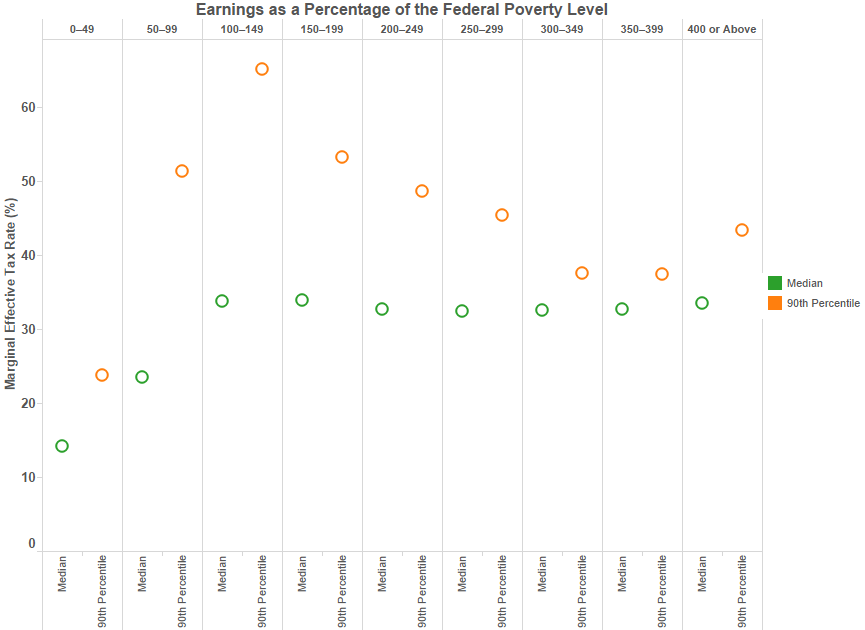
The dozens of different programs that form our tangled welfare system often impose high effective marginal tax rates that make it harder for low-income people to transition out of these programs and lift of those programs and into the middle class. As the people in these programs enter the workforce, get a promotion, or work more hours, they can lose a significant portion of those earnings through reduced benefits and increased taxes. A new report from the Congressional Budget Office (CBO) illustrates this predicament: many households hovering around the poverty level face steeper effective marginal tax rates than even the highest earners. These prohibitively high tax rates can discourage work and limit their prospects, ultimately making them less likely to escape poverty.

Marginal Tax Rates at the Median and 90th Percentiles by Earnings Group, 2016

cbo_tableau_marginal

Source: Congressional Budget Office, “Effective Marginal Tax Rates for Low- and Moderate-Income Workers in 2016,” November 19, 2015.

Note: Figure created using Tableau. 

CBO’s analysis looks at the range of effective marginal tax rates households face at different levels of income. The median marginal tax rate for households just above the poverty level is almost 34 percent, the highest for any income level. Some households that receive larger benefits or higher state taxes have even higher effective rates: 10 percent of households just above the poverty line face a marginal rate higher than 65 percent. For each additional dollar earned in this range, these households would lose almost two-thirds to taxes or lost benefits. The comparable rate for the highest earners, households above 400 percent of the poverty level, is only 43.4 percent. If anything this analysis might understate how steep the effective marginal rates are for some households. CBO only considers the combined effect of income taxes, payroll taxes, SNAP and ACA exchange subsidies, so households that participate in other programs like TANF or housing assistance could face even higher rates. These results mirror some of Cato’s past work investigating the issues and trade-offs involved with these welfare programs.

The nature of the welfare system contributes to the prevalence of these poverty traps. A House and Ways Human Resources Subcommittee recently held a hearing on issue and released a chart illustrating the complex, labyrinthine nature of the welfare system.

WM-Welfare-Chart-AR-amendment-110215-jpegClick on the image for a full-sized view.

New programs were grafted onto the existing system over time, each intended to address a perceived problem afflicting people in poverty, but they can interact in ways that can deter people from striving to create a better life for their families. That’s part of the reason the status quo system, which the Government Accountability Office estimates spends $742 billion at the federal level each year, has achieved such lackluster results to date.

While these shortcomings would seem to indicate that the welfare system is in need of reform, this tangled web has proved resistant to change. One of the last major reforms happened in 1996, when Temporary Assistance for Needy Families (TANF) replaced Aid to Families with Dependent Children (AFDC). Even that reform only addressed one strand of the dozens that make up our tangled system, so while it might have improved that one aspect the larger flaws with the welfare system as a whole have to some extent continued unabated. Even within this one strand there has been little discussion of reform in the past two decades, TANF hasn’t even been properly reauthorized since the Deficit Reduction Act of 2005, it is usually thrown into short-term continuing resolutions or broader omnibus appropriations acts that do not incorporate any meaningful attempts to address the program’s problems. Absent comprehensive, the flawed current system will continue to fall short even as the government funnels hundreds of billions of dollars into it each year.

If the federal government is going to finance a welfare system, it should foster an environment that encourages work and makes it easier for participants to transition out of these programs as they strive to create a better life. The current system falls far short in that regard and needs comprehensive reforms.

Charles Hughes is a research associate at the Cato Institute, where he focuses on federal budget policy, poverty, entitlement reform, and general economics.  Originally from Texas, Hughes joined Cato in 2011 after graduating from the University of Chicago with degrees in Economics and Public Policy.

This work by Cato Institute is licensed under a Creative Commons Attribution-NonCommercial-ShareAlike 3.0 Unported License.