Browsed by
Category: Economics

Fast-Tracking Safe Drugs without Sacrificing Scientific Rigor – Article by Alex Tabarrok

Fast-Tracking Safe Drugs without Sacrificing Scientific Rigor – Article by Alex Tabarrok

The New Renaissance HatAlex Tabarrok
******************************

Here’s how to do it

In a post earlier this year, I noted that Japan has significantly liberalized its approval process for regenerative medicine. Writing in Forbes, Bart Madden and Nobelist Vernon Smith outline a similar proposal for the United States.

Recently, Japanese legislation has implemented the core Free To Choose Medicine (FTCM) principles of allowing not-yet-approved drugs to be sold after safety and early efficacy has been demonstrated; in addition, observational data gathered for up to seven years from initial launch will be used to determine if formal drug approval is granted. …

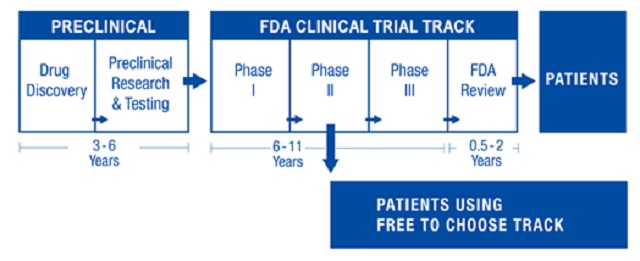
FTCM legislation in the U.S. would create a dual track system (see figure below) that preserves the existing FDA clinical trial process while offering patients an alternative. Patients, advised by their doctors, would be able to contract with a drug developer to use not-yet-approved drugs after Phase I safety trials are successfully completed and one or more Phase II trials have demonstrated continued safety and initial efficacy.

The resulting early access could make FTCM drugs available up to seven years before conventional FDA approval, which entails Phase III randomized control trials and a lengthy FDA review before the FDA makes an approval decision. …

bartgraph

The heart of the dual track system is the Tradeoff Evaluation Drug Database (TEDD) which would be available to the public through a government-supervised web portal. TEDD would contain all treatment results of FTCM drugs including patients’ health characteristics and relevant biomarkers, but no personal identification.

This open access database would be a treasure-trove of information to aid drug developers in making better R&D decisions consistent with fast-paced learning and innovation. …

Today’s world of accelerating medical advancements is ushering in an age of personalized medicine in which patients’ unique genetic makeup and biomarkers will increasingly lead to customized therapies in which samples are inherently small. This calls for a fast-learning, adaptable FTCM environment for generating new data.

In sharp contrast, the status quo FDA environment provides a yes/no approval decision based on statistical tests for an average patient, i.e., a one-size-fits-all drug approval process.

I hold the Bartley J. Madden Chair in Economics at the Mercatus Center, so I am biased, but this is an important proposal. Japan is leading the way and similar ideas are being discussed in Great Britain, but as the most important pharmaceutical market in the world, the United States has an outsize influence on world drug development. We need to lower costs and speed new drugs to market.

This post first appeared at Marginal Revolution.

Alex Tabarrok is a professor of economics at George Mason University. He blogs at Marginal Revolution with Tyler Cowen.

No, “Big Data” Can’t Predict the Future – Article by Per Bylund

No, “Big Data” Can’t Predict the Future – Article by Per Bylund

The New Renaissance HatPer Bylund
******************************

With Google’s dominance in the online search engine market we entered the Age of Free. Indeed, services offered online are nowadays expected to be offered at no cost. Which, of course, does not mean that there is no cost to it, only that the consumer doesn’t pay it. Early attempts financed the services with ads, but we soon saw a move toward making the consumer the product. Today, free and unfree services alike compete for “users” and then make money off the data they collect.

Data has always been used, but what’s new for our time is the very low (or even zero) marginal cost for collecting and analyzing huge amounts of data. The concept of “Big Data” is taking over and is predicted to be “the future” of business.

There’s a problem here, and it is the over-reliance on the Law of Large Numbers in social forecasting. Statistical probabilities for events may mathematically converge to the mean, but is it applicable in the real world? The answer is most definitely yes in the natural sciences. Repeated controlled experiments will weed out erroneous explanations or causes to phenomena, at least assuming we’re good enough at separating and controlling those causes.

What about the social sciences? In this age of scientism, as Hayek called it, we’re told “Big Data” will completely transform production, logistics, and sales. The reason for this is that vendors can better target customers and even foresee what they might want next. Amazon.com does this on their web site in crude form, where they make suggestions based on your purchase history and what others with similar purchase histories have searched for. Sometimes it works, and sometimes it doesn’t.

There is some regularity to our interests and behavior. All of us are, after all, human beings — and we’re formed in certain cultures. So one American with interests x, y, and z may have other interests similar to another American who also has an interest in x, y, and z.

Human Behavior Is Unpredictable
But similarity is not the same thing as prediction. Amazon.com’s suggestions or the highly annoying ads following you around web sites are useful methods for sellers because they can somewhat accurately identify what not to offer. Exclusion of very low-probability interests increases the probability for suggesting something that the person behind the eyeballs focusing on the computer screen may be interested in.

To use as prediction, however, exclusion of almost-zero probability events is far from sufficient. Indeed, prediction requires that we are able to accurately exclude all but one or a couple highly probable outcomes. And we have to be able to rely on that these predictions turn out to be true. Otherwise we’re just playing games, and so we’re making guesses. Sure, they’re educated guesses (because we’ve excluded the impossible and almost-impossible), but they’re still games and guesses.

Where Big Data Fails
Speaking of guesses, Microsoft’s Bing search engine, which powers the Windows digital assistant Cortana among other things, has produced a prediction engine with the purpose of predicting sports and other results. They rely on very advanced algorithms and huge amounts of collected data.

Amazingly, they did very well initially and predicted the outcomes of the World Cup perfectly. So maybe we can use Big Data to get a glimpse of the future?

No, not so. The Bing teams are learning a lesson only Austrians and, more specifically, Misesian praxeologists, seem to be alone in grasping: that there are no constants in human action, and therefore that predictions of social phenomena are impossible. Pattern predictions, as Hayek called them, may not be impossible, but predictions of exact magnitudes are. For instance, we can rely on economic law (such as “demand curves slope downward”) to estimate an outcome such as “the price will be lower than it otherwise would have been,” but we can’t say exactly what that price will be.

When it comes to sports, reality shows and other competitions between individuals or teams, the story is exactly the same. The team with a better track record doesn’t always win. Why? They have objectively performed better than the other team, perhaps exclusively so, but this doesn’t say anything about the future. We’re not here referring to the philosophical doubt as in “will the sun shine tomorrow?” (maybe something changes completely the sun’s ability to shine during the night).

The Social Sciences Are Different
In the social sciences we’re dealing with complex phenomena. Action and, especially, its outcome is the result of a complex system of social interaction, psychology, and much more. Are the players in both teams as motivated and focused as they were before? Did anything in their personal lives affect their mindsets or psyches? How do the players within their teams and players in other teams react on each other before and during the game? A team with a poor track record can upset a team with an objectively better track record; this happens all the time. Sometimes for the sole reason that the better team underestimates the worse team, or because the underdog feels no pressure to perform and therefore plays less defensively.

Bing’s prediction engine struggles with this, just as we would predict. As Windows Central reported recently, the prediction engine had its “worst week yet” picking only four of fourteen winners in the NFL. Overall, its track record was approximately two-thirds right and one-third wrong (95–53). It’s definitely better than tossing a coin, but pretty far from actually predicting the results.

In other words, if you’re placing bets you may want to use the Bing prediction engine. That is, unless you have the type of tacit, implicit understanding of what’s going on that the engine is missing. Maybe you can beat it, or maybe not. In either case, you cannot count on coming out a victor each and every time.

The reason for this is that the outcome simply cannot be predicted perfectly — or even close to it. Even the players themselves cannot predict who’ll win a game, but they may have inside information about whether their own team seems motivated and focused. It is not a perfect method, however, and it certainly cannot be scientific.

Even with Big Data there’s no predicting of social events — there’s only guessing. Yes, guessing with access to huge amounts of data is easier, at least if the data is reliable and relevant. But a good guess is not the same thing as a prediction; it is still a guess, and it can be wrong. Winning every time requires luck.

Per L. Bylund, PhD, is Assistant Professor of Entrepreneurship and Records-Johnston Professor of Free Enterprise in the School of Entrepreneurship at Oklahoma State University. Visit his website at PerBylund.com.

This article was originally published by the Ludwig von Mises Institute. Permission to reprint in whole or in part is hereby granted, provided full credit is given.

How Waze Makes Roads Safer than the Police – How an App Improved My Driving – Article by Jeffrey A. Tucker

How Waze Makes Roads Safer than the Police – How an App Improved My Driving – Article by Jeffrey A. Tucker

The New Renaissance HatJeffrey A. Tucker
******************************

The app economy has improved our lives in thousands of small ways, with seemingly endless opportunities to download and use gadgets that help us throughout the day, whatever our needs. Most are free or purchasable at a nominal charge.

Forget the ingredients for Shepherd’s Pie? Find it in seconds on the smartphone. Worried about the side effects of a new drug? They are there for you. Not sure about the quality of the restaurant you are about to enter? The crowds are anxious to tell you. Need a burrito for lunch? Uber will bring you one. (You can get a flu shot and a kitty, too.)

The truth is that we live completely different lives than we did ten years ago. We have unprecedented access to all life’s necessities, including medical and nutrition information, mapping information, the weather anywhere, plus hundreds of communication apps that allow text, audio, and video with half the human race, instantly, at no charge.

New Waze of Driving
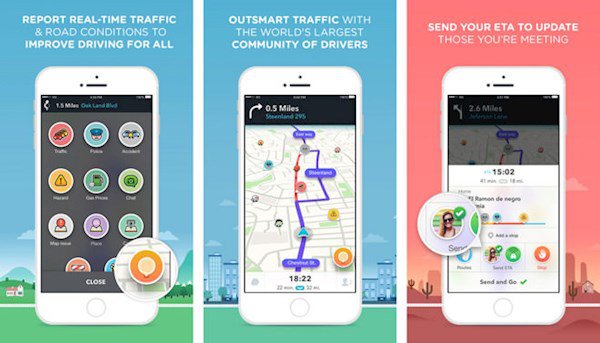
The app I’m most excited about today is a navigation tool called Waze. It provides mapping, plus delightful instructions on how to get from here to there. But beyond that, it crowdsources information to make the trip more efficient and safer than it otherwise would be. In big cities, Waze will take you through circuitous routes to avoid high traffic areas. It alerts you to accidents, road blocks, and debris on the road.

Impressively, it allows drivers to report where the police are staking out speed traps. It tells you whether the officer in question is visible or hidden. You can also confirm or deny the report.

14627-10326-waze-appstore-l

Police have objected to this feature of the app. Why? Because it means that drivers are better able to avoid getting ticketed. But think about this: the app actually succeeds in causing people to obey the law better by slowing down and being safer, as a way of avoiding fines.

Why would police object? If the whole point of traffic police is to get people to drive more safely, knowing about police presence achieves that goal.

Of course, we all know the real reason. The goal of the police on roads is not to inspire better driving but rather catch people in acts of lawbreaking so that they can collect revenue that funds their department. In other words, the incentives of the police are exactly the opposite of the promised results. Instead of seeking good driving, they are seeking lawbreaking as a means of achieving a different outcome: maximum revenue collection.

The whole ethos of Waze is different. It helps you become aware of your external surroundings, and conscious that other drivers are in a similar situation as you are, just trying to get to their destinations quickly and safely. We are there are help each other.

The Community Matters
For me this effected a big change in the whole way I drive. There is a tendency from your first years of driving to treat other drivers as obstacles. Your goal is to outsmart others who are crowding the road, moving around them quickly and navigating the roads with a chip on your shoulder. If there are no cops around, you drive as fast as possible.

I never intended to drive this way, but now I know that I have been, since I first received my government permission slip to drive. Once behind the wheel, I tended to think of myself as a lone actor.

Waze has subtly changed my outlook on driving. Other drivers become your benefactors because it is they who are reporting on traffic accidents, cars on the side the road, blocked streets, and the presence of police. They are all doing you favors. If you report, others thank you for doing so. You even see icons of evidence that your friends are driving, too.

Safety is priority one. Waze won’t let you type in a new address while you are driving. You have to stop the car before you can do that.

The app manages to create a sense of community out of drivers on the road, and that changes the way you think when you drive. Now I leave Waze on even when I already know the directions. It’s my connection to the community. I find my whole outlook on driving has changed. For the first time in my life, I can honestly say that I’m a safer and more responsible driver.

So thank you Waze — a product of brilliant entrepreneurship, distributed on private networks, performing a public service.

Compare with the people who are charged with the task of making our roads safe and are paid by our tax dollars to do it. Not only do they fail to accomplish what this one free application has done, they are actively seeking to cripple it.

Baby Steps to a Better World
Maybe this seems like too small a life improvement to justify mentioning? Not so. All great steps toward a better world occur at the margin, bit by bit, through trial and error, one innovation at a time. You look back at the progress of a decade and that’s where the awe comes into play.

It is not through large bills written by legislators and signed by presidents that the world improves. It is through small innovations, inauspicious downloads, incremental improvements in our existing paths that gradually build a better world. Waze is only one of a billion but it points to the right method and approach to an improved life.

Jeffrey Tucker is Director of Digital Development at FEE, CLO of the startup Liberty.me, and editor at Laissez Faire Books. Author of five books, he speaks at FEE summer seminars and other events. His latest book is Bit by Bit: How P2P Is Freeing the World.  Follow on Twitter and Like on Facebook. 

This article was published by The Foundation for Economic Education and may be freely distributed, subject to a Creative Commons Attribution United States License, which requires that credit be given to the author.

How Money Disappears in a Fractional-Reserve Money System – Article by Frank Shostak

How Money Disappears in a Fractional-Reserve Money System – Article by Frank Shostak

The New Renaissance Hat
Frank Shostak
******************************

Most experts are of the view that the massive monetary pumping by the US central bank during the 2008 financial crisis saved the US and the world from another Great Depression. On this the Federal Reserve Chairman at the time Ben Bernanke is considered the man that saved the world. Bernanke in turn attributes his actions to the writings of Professor Milton Friedman who blamed the Federal Reserve for causing the Great Depression of 1930s by allowing the money supply to plunge by over 30 percent.

Careful analysis will however show that it is not a collapse in the money stock that sets in motion an economic slump as such, but rather the prior monetary pumping that undermines the pool of real funding that leads to an economic depression.

Improving the Economy Requires Time and Savings
Essentially, the pool of real funding is the quantity of consumer goods available in an economy to support future production. In the simplest of terms: a lone man on an island is able to pick twenty-five apples an hour. With the aid of a picking tool, he is able to raise his output to fifty apples an hour. Making the tool, (adding a stage of production) however, takes time.

During the time he is busy making the tool, the man will not be able to pick any apples. In order to have the tool, therefore, the man must first have enough apples to sustain himself while he is busy making it. His pool of funding is his means of sustenance for this period—the quantity of apples he has saved for this purpose.

The size of this pool determines whether or not a more sophisticated means of production can be introduced. If it requires one year of work for the man to build this tool, but he has only enough apples saved to sustain him for one month, then the tool will not be built—and the man will not be able to increase his productivity.

The island scenario is complicated by the introduction of multiple individuals who trade with each other and use money. The essence, however, remains the same: the size of the pool of funding sets a brake on the implementation of more productive stages of production.

When Banks Create the Illusion of More Wealth
Trouble erupts whenever the banking system makes it appear that the pool of real funding is larger than it is in reality. When a central bank expands the money stock, it does not enlarge the pool of funding. It gives rise to the consumption of goods, which is not preceded by production. It leads to less means of sustenance.

As long as the pool of real funding continues to expand, loose monetary policies give the impression that economic activity is being boosted. That this is not the case becomes apparent as soon as the pool of real funding begins to stagnate or shrink. Once this happens, the economy begins its downward plunge. The most aggressive loosening of money will not reverse the plunge (for money cannot replace apples).

The introduction of money and lending to our analysis will not alter the fact that the subject matter remains the pool of the means of sustenance. When an individual lends money, what he in fact lends to borrowers is the goods he has not consumed (money is a claim on real goods). Credit then means that unconsumed goods are loaned by one productive individual to another, to be repaid out of future production.

The existence of the central bank and fractional reserve banking permits commercial banks to generate credit, which is not backed up by real funding (i.e., it is credit created out of “thin air”).

Once the unbacked credit is generated it creates activities that the free market would never approve. That is, these activities are consuming and not producing real wealth. As long as the pool of real funding is expanding and banks are eager to expand credit, various false activities continue to prosper.

Whenever the extensive creation of credit out of “thin air” lifts the pace of real-wealth consumption above the pace of real-wealth production this undermines the pool of real funding.

Consequently, the performance of various activities starts to deteriorate and banks’ bad loans start to rise. In response to this, banks curtail their loans and this in turn sets in motion a decline in the money stock.

Does every curtailment of lending cause the decline in the money stock?

For instance, Tom places $1,000 in a savings deposit for three months with Bank X. The bank in turn lends the $1,000 to Mark for three months. On the maturity date, Mark repays the bank $1,000 plus interest. Bank X in turn after deducting its fees returns the original money plus interest to Tom.

So what we have here is that Tom lends (i.e., gives up for three months) $1,000. He transfers the $1,000 through the mediation of Bank X to Mark. On the maturity date Mark repays the money to Bank X. Bank X in turn transfers the $1,000 to Tom. Observe that in this case existent money is moved from Tom to Mark and then back to Tom via the mediation of Bank X. The lending is fully backed here by $1,000. Obviously the $1,000 here doesn’t disappear once the loan is repaid to the bank and in turn to Tom.

Why the Money Supply Shrinks
Things are, however, completely different when Bank X lends money out of thin air. How does this work? For instance, Tom exercises his demand for money by holding some of his money in his pocket and the $1,000 he keeps in the Bank X demand deposit. By placing $1,000 in the demand deposit he maintains total claim on the $1,000. Now, Bank X helps itself and takes $100 from Tom’s deposit and lends this $100 to Mark. As a result of this lending we now have $1,100 which is backed by $1,000 proper. In short, the money stock has increased by $100. Observe that the $100 loaned doesn’t have an original lender as it was generated out of “thin air” by Bank X. On the maturity date, once Mark repays the borrowed $100 to Bank X, the money disappears.

Obviously if the bank is continuously renewing its lending out of thin air then the stock of money will not fall. Observe that only credit that is not backed by money proper can disappear into thin air, which in turn causes the shrinkage in the stock of money.

In other words, the existence of fractional reserve banking (banks creating several claims on a given dollar) is the key instrument as far as money disappearance is concerned. However, it is not the cause of the disappearance of money as such.

Banks Lend Less as the Quality of Borrowers Worsens
There must be a reason why banks don’t renew lending out of thin air. The main reason is the severe erosion of real wealth that makes it much harder to find good quality borrowers. This in turn means that monetary deflation is on account of prior inflation that has diluted the pool of real funding.

It follows then that a fall in the money stock is just a symptom. The fall in the money stock reveals the damage caused by monetary inflation but it however has nothing to do with the damage.

Contrary to Friedman and his followers (including Bernanke), it is not the fall in the money supply and the consequent fall in prices that burdens borrowers. It is the fact that there is less real wealth. The fall in the money supply, which was created out of “thin air,” puts things in proper perspective. Additionally, as a result of the fall in money, various activities that sprang up on the back of the previously expanding money now find it hard going.

It is those non-wealth generating activities that end up having the most difficulties in serving their debt since these activities were never generating any real wealth and were really supported or funded, so to speak, by genuine wealth generators. (Money out of “thin air” sets in motion an exchange of nothing for something — the transferring of real wealth from wealth generators to various false activities.) With the fall in money out of thin air their support is cut-off.

Contrary to the popular view then, a fall in the money supply (i.e., money out of “thin air”), is precisely what is needed to set in motion the build-up of real wealth and a revitalizing of the economy.

Printing money only inflicts more damage and therefore should never be considered as a means to help the economy. Also, even if the central bank were to be successful in preventing a fall in the money supply, this would not be able to prevent an economic slump if the pool of real funding is falling.

Frank Shostak is an Associated Scholar of the Mises Institute. His consulting firm, Applied Austrian School Economics, provides in-depth assessments and reports of financial markets and global economies. He received his bachelor’s degree from Hebrew University, master’s degree from Witwatersrand University and PhD from Rands Afrikaanse University, and has taught at the University of Pretoria and the Graduate Business School at Witwatersrand University.

This article was originally published by the Ludwig von Mises Institute. Permission to reprint in whole or in part is hereby granted, provided full credit is given.

Enlightened Selfies – Narcissism and Human Rights – Article by B.K. Marcus

Enlightened Selfies – Narcissism and Human Rights – Article by B.K. Marcus

The New Renaissance Hat
B.K. Marcus
******************************

When the press refers to “Generation Selfie,” do we sense a sneer? It’s almost as if the term selfie is shorthand not for self-portrait but for self-involved, self-absorbed, or simply selfish.

Selfies are widespread among millennials, many of whom grew up with camera phones. A poll commissioned by electronics maker Samsung reveals that fully 30 percent of all photos taken by 18- to 24-year-olds are selfies. For many of us, the selfie is just the new normal, whether or not we fill our own smartphones with self-regarding snapshots. But, as Pamela Rutledge writes for Psychology Today, some see the selfie generation “as proof of cultural — or at least generational — narcissism and moral decline.” And calling Generation Selfie a bunch of narcissists may not be rhetorical excess: according to a paper in the journal Personality and Individual Differences, selfie-posting behavior is indeed associated with narcissistic personality disorder.

Does this mean that modern society is growing more self-obsessed?

Belief in the “moral decay” epitomized by self-directed amateur photography results from a more general conviction that the virtues of community and altruism are being driven out by our culture’s overemphasis on the individual. Whether the culprit is capitalism, technology, or Western civilization more generally, the idea is that historically recent developments are fracturing our communal bonds and leading to a loss of empathy, compassion, and duty — replacing concern for the well-being of a larger group with a privileging of the atomized individual.

Inventing the Modern Self

But the development is not, in fact, historically recent. The selfie as we now know it may seem like a result of social media and the camera phone, but our society’s apparent obsession with visual self-presentation is much older — and significantly more beneficial — than the critics understand.

“It’s easy to make fun of our penchant for taking selfies,” writes popular science author Steven Johnson in How We Got to Now: Six Innovations That Made the Modern World, “but in fact there is a long and storied tradition behind that form of self-expression.”

The original selfie generation emerged in Renaissance Italy, the product of a different technological innovation. Centuries before the bidirectional camera phone, there was the culturally disruptive technology of the glass mirror.

“The interesting thing about self-portraiture,” Johnson tells us, “is that it effectively doesn’t exist as an artistic convention in Europe before 1400.” That’s because, for most of human history, we got very few chances to see ourselves as others see us. The best we could do was a rippled reflection glimpsed in water or a tarnished image on a metal pot.

That all changed when glassmakers “figured out a way to combine their crystal-clear glass with a new innovation in metallurgy, coating the back of the glass with an amalgam of tin and mercury to create a shiny and highly reflective surface. For the first time, mirrors became part of the fabric of everyday life.”

One result was the invention of linear perspective in painting. Prior to the Renaissance, visual representation was more symbolic, less what we would now call realistic. Renaissance artists used the new technology of the mirror to compare what they put on the canvas with what they saw framed in the glass. Sometimes, of course, what they saw in the looking glass was their own reflection.

“The mirror helped invent the modern self,” Johnson writes, “in some real but unquantifiable way.”

Soon after, “social conventions as well as property rights and other legal customs began to revolve around the individual rather than the older, more collective units: the family, the tribe, the city, the kingdom.” Furthermore, “orienting laws around individuals led directly to an entire tradition of human rights and the prominence of individual liberty in legal codes.”

Inventing Humanity

In a different investigation of the individualist tradition, historian Lynn Hunt observes in her book Inventing Human Rights, “For rights to be human rights, all humans everywhere in the world must possess them equally and only because of their status as human beings.”

There was no such understanding of humanity for most of history. Love, compassion, and sympathy may have existed from the beginning, but only between people in narrowly defined groups. The treatment for outsiders was far more harsh.

Slavery and torture, today considered egregious violations of human rights, went unquestioned before a few hundred years ago. Since at least the time of Aristotle, it was typical to divide the world between “us,” the naturally civilized, and “them,” the naturally enslaved. Torture, in the ancient world, was originally limited to slaves, but over time, the practice became more acceptable, and in the second century it was expanded to include nominally free lower-class victims. By the Middle Ages, torture before execution had become a form of spectacle, public entertainment for the whole family.

How, then, did we develop a sense of universal humanity and of natural rights for all human beings? Specifically, Hunt asks about the Enlightenment thinkers in 18th-century France and America, for whom such rights were “self-evident.”

How did these men, living in societies built on slavery, subordination, and seemingly natural subservience, ever come to imagine men not at all like them and, in some cases, women too, as equals?

And how did the 18th-century public come to agree with them? The answer Hunt offers is that the so-called self-evidence of individual human rights was largely the result of widespread reading in a genre that was still relatively new at the time: the epistolary novel. Enlightenment thinkers were familiar with first-person narrative in a way that earlier generations would have found alien. Novels introduced readers to the inner lives of characters unlike themselves.

Johnson, too, talks about the emergence of the novel and its impact on the moral imagination, but he traces the origins of the modern novel itself to the same innovation that gave rise to linear perspective in painting: “The psychological novel … is the kind of story you start wanting to hear once you begin spending meaningful hours of your life staring at yourself in the mirror.”

Thinking about themselves as the individuals staring back through the glass, “people began writing about their interior lives with far more scrutiny,” and “the novel emerged as a dominant form of storytelling, probing the inner mental lives of its characters with an unrivaled depth.”

The Innovation of Empathy

What does this sort of growing self-obsession have to do with the rights of others?

Empathy, Hunt points out, “requires a leap of faith, of imagining that someone else is like you.” This is the idea that “novels generated … by inducing new sensations about the inner self.”

Or as Johnson puts it,

Entering a novel, particularly a first-person narrative, was a kind of conceptual parlor trick: it let you swim through the consciousness, the thoughts and emotions, of other people more effectively than any aesthetic form yet invented.

Spending time in someone else’s head, even if that someone else is fictional, is practice for thinking about real people’s experiences.

So, according to this story, the technology of glass mirrors leads to linear perspective, the Renaissance, and a new literary form called the novel. The novel, in turn, transforms the popular imagination in such a way that even strangers — those outside your immediate family, class, and religious affiliation — come to be understood as autonomous individuals with their own inner lives, much like your own. And for the first time in history, people come to question the practices of torture and slavery, practices at least as old as civilization and far more universal than any understanding of rights prior to the Enlightenment.

The “invention” of the individual ushered in not ever more selfishness and less regard for the group, but an expanding empathy and a more inclusive, approaching universal, sense of “us” — a waning relegation of those outside our moral community.

Trading with the Other

Johnson notes that the technological innovation at the beginning of the story isn’t enough by itself to have produced the larger cultural shift:

The Renaissance also benefited from a patronage system that enabled its artists and scientists to spend their days playing with mirrors instead of, say, foraging for nuts and berries. A Renaissance without the Medici — not the individual family, of course, but the economic class they represent — is as hard to imagine as the Renaissance without the mirror.

The same can be said about the economy that produced the Enlightenment: it is hard to imagine an era of growing empathy, open-mindedness, and belief in universal rights without the market that provided a growing readership for the epistolary novel.

Capitalism establishes the conditions in which individualism can thrive. Individualism, in turn, helps the market economy to grow and to propagate the belief in rights-bearing individuals.

Contrary to today’s critics, then, who assume that the individualist mentality leads to the absence of empathy, with the advent of individualism came the invention of empathy, at least as applied to those outside the tribe, clan, or caste.

Maybe narcissists do feel compelled to photograph themselves. Camera phones make it easier than ever. But the myth of Narcissus is ancient. And the history of reflective technology points us to a different understanding of cause and effect for the selfie generation.

The 21st-century self-portrait can play the same role now as its earlier incarnations did during the Renaissance and the Enlightenment. Like individualism more generally, the selfie invites us to explore questions of identity and of where we fit in an ever more interconnected community.

B.K. Marcus is editor of the Freeman. His website is bkmarcus.com.

This article was published by The Foundation for Economic Education and may be freely distributed, subject to a Creative Commons Attribution 4.0 International License, which requires that credit be given to the author.

Does the Bell Toll for the Fed? – Article by Ron Paul

Does the Bell Toll for the Fed? – Article by Ron Paul

The New Renaissance HatRon Paul
November 9, 2015
******************************
Last week Federal Reserve Chair Janet Yellen hinted that the Federal Reserve Board will increase interest rates at the board’s December meeting. The positive jobs report that was released following Yellen’s remarks caused many observers to say that the Federal Reserve’s first interest rate increase in almost a decade is practically inevitable.

However, there are several reasons to doubt that the Fed will increase rates anytime in the near future. One reason is that the official unemployment rate understates unemployment by ignoring the over 94 million Americans who have either withdrawn from the labor force or settled for part-time work. Presumably the Federal Reserve Board has access to the real unemployment numbers and is thus aware that the economy is actually far from full employment.

The decline in the stock market following Friday’s jobs report was attributed to many investors’ fears over the impact of the predicted interest rate increase. Wall Street’s jitters about the effects of a rate increase is another reason to doubt that the Fed will soon increase rates. After all, according to former Federal Reserve official Andrew Huszar, protecting Wall Street was the main goal of “quantitative easing,” so why would the Fed now risk a Christmastime downturn in the stock markets?

Donald Trump made headlines last week by accusing Janet Yellen of keeping interest rates low because she does not want to risk another economic downturn in President Obama’s last year in office. I have many disagreements with Mr. Trump, but I do agree with him that the Federal Reserve’s polices may be influenced by partisan politics.

Janet Yellen would hardly be the first Fed chair to allow politics to influence decision-making. Almost all Fed chairs have felt pressure to “adjust” monetary policy to suit the incumbent administration, and almost all have bowed to the pressure. Economists refer to the Fed’s propensity to tailor monetary policy to suit the needs of incumbent presidents as the “political” business cycle.

Presidents of both parties, and all ideologies, have interfered with the Federal Reserve’s conduct of monetary policy. President Dwight D. Eisenhower actually threatened to force the Fed chair to resign if he did not give in to Ike’s demands for easy money, while then-Federal Reserve Chair Arthur Burns was taped joking about Fed independence with President Richard Nixon.

The failure of the Fed’s policies of massive money creation, corporate bailouts, and quantitative easing to produce economic growth is a sign that the fiat money system’s day of reckoning is near. The only way to prevent the monetary system’s inevitable crash from causing a major economic crisis is the restoration of a free-market monetary policy.

One positive step Congress may take this year is passing the Audit the Fed bill. Fortunately, Senator Rand Paul is using Senate rules to force the Senate to hold a roll-call vote on Audit the Fed. The vote is expected to take place in the next two-to-three weeks. If Audit the Fed passes, the American people can finally learn the full truth about the Fed’s operations. If it fails, the American people will at least know which senators side with them and which ones side with the Federal Reserve.

Allowing a secretive central bank to control monetary policy has resulted in an ever-expanding government, growing income inequality, a series of ever-worsening economic crises, and a steady erosion of the dollar’s purchasing power. Unless this system is changed, America, and the world, will soon experience a major economic crisis. It is time to finally audit, then end, the Fed.

Ron Paul, MD, is a former three-time Republican candidate for U. S. President and Congressman from Texas.

This article is reprinted with permission from the Ron Paul Institute for Peace and Prosperity.

The War on Cars Is a War on Workers and the Poor – Article by Gary M. Galles

The War on Cars Is a War on Workers and the Poor – Article by Gary M. Galles

The New Renaissance Hat
Gary M. Galles
November 6, 2015
******************************

A just-released poll of Los Angeles residents found that 55 percent of respondents indicated their greatest concern was “traffic and congestion,” far ahead of “personal safety” — the next highest area of concern — at 35 percent. So if their city government was working in their best interests, it would be doing something about automobile congestion.

It is. Unfortunately, it will make things worse.

Los Angeles’s recently adopted Mobility Plan 2035 would replace auto lanes in America’s congestion capital with bus and protected bike lanes, as well as pedestrian enhancements, despite heightening congestion for the vast majority who will continue to drive. Even the City’s Environmental Impact Report admitted “unavoidable significant adverse impacts” on congestion, doubling the number of heavily congested (graded F) intersections to 36 percent during evening rush hours.

Driving Saves Time and Offers More Opportunity

Such an effort to ration driving by worsening gridlock purgatory begs asking a central, but largely ignored, question. Why do planners’ attempts to force residents into walking, cycling, and mass transit — supposedly improving their quality of life — attract so few away from driving?

The reason it takes a coercive crowbar to get most people out of their cars is that automobile users have concluded cars are vastly superior to the alternatives.

Why is automobile use so desirable:

  • Automobiles have far greater and more flexible passenger — and cargo-carrying capacities.
  • They allow direct, point-to-point service.
  • They allow self-scheduling rather than requiring advance planning.
  • They save time.
  • They have far better multi-stop trip capability (this is why restrictions on auto use punish working mothers most).
  • They offer a safer, more comfortable, more controllable environment, from the seats to the temperature to the music to the company.

Those massive advantages explain why even substantial new restrictions on automobiles or improvements in alternatives leave driving the dominant choice. However, they also reveal that a policy that will punish the vast majority who will continue to drive cannot serve residents effectively.

How Restrictions on Automobiles Punish the Working Poor the Most

The superiority of automobiles doesn’t stop at the obvious, either. They expand workers’ access to jobs, increasing productivity and incomes, improve purchasing choices, lower consumer prices and widen social options. Reducing roads’ car-carrying capacity undermines those major benefits.

Cars offer a decrease in commuting times (if not hamstrung by city-government planning), providing workers access to many more potential employers and job markets. This improves worker-employer matches, with expanded productivity both benefiting employers and raising workers’ incomes.

One study found that a 10-percent improvement in travel time raised worker productivity 3 percent. And increasing from a 3 mph walking speed to 30 mph driving speed is a 900-percent increase. In a similar vein, a Harvard analysis found that for those lacking high-school diplomas, owning a car increased monthly earnings by $1,100.

Cars are also the only means of assembling enough customers to sustain large stores with highly diverse offerings. Similarly, “automobility” dramatically expands the menu of social opportunities that are accessible.

Supporters like Los Angeles Mayor Eric Garcetti may dismiss the serious adverse effects of the “road diets” they propose (a term whose negative implications were too obvious, getting it benched in favor of the better-sounding “complete streets”). But by demeaning cars as “the old model” and insisting “we have to have neighborhoods that are more self-contained,” the opponents of auto use do nothing to lessen the huge costs or increase the very limited benefits they plan to impose on those they supposedly represent.

Further, the “new model” of curtailing road capacity to force people out of cars is really a recycled old far-inferior model. As urban policy expert Randal O’Toole noted in The Best-Laid Plans:

Anyone who prefers not to drive can find neighborhood … where they can walk to stores that offer a limited selection of high-priced goods, enjoy limited recreation and social opportunities, and take slow public transit vehicles to some but not all regional employment centers, the same as many Americans did in 1920. But the automobile provides people with far more benefits and opportunities than they could ever have without it.

Gary M. Galles is a professor of economics at Pepperdine University. He is the author of The Apostle of Peace: The Radical Mind of Leonard Read. Send him mail. See Gary Galles’s article archives.

This article was published on Mises.org and may be freely distributed, subject to a Creative Commons Attribution United States License, which requires that credit be given to the author.

The Fed Desperately Tries to Maintain the Status Quo – Article by Ronald-Peter Stöferle

The Fed Desperately Tries to Maintain the Status Quo – Article by Ronald-Peter Stöferle

The New Renaissance HatRonald-Peter Stöferle
November 5, 2015
******************************

During the press conferences of recent FOMC meetings, millions of well-educated investment professionals have been sitting in front of their screens, chewing their fingernails, listening as if spellbound to what Janet Yellen has to tell them. Will she finally raise the federal funds rate that has been zero bound for over six years?

Obviously, each decision is accompanied by nervousness on the markets. Investors are fixated by a fidgety curiosity ahead of each Fed decision and never fail to meticulously observe Janet Yellen and the FOMC, and engage in monetary ornithology on doves (growth- and employment-oriented FOMC members) and hawks (inflation-oriented FOMC members).

Fed watchers also hope for some enlightening information from Ben Bernanke. According to Reuters, some market participants paid some $250,000 just to join one of several dinners, where the ex-chairman spilled the beans. Apparently, he does not expect the federal funds rate to return to its long-term average of about 4 percent during his lifetime.

In a conversation with Jim Rickards, Bernanke stated that a rate hike would only be possible in an environment in which “the U.S. economy is growing strongly enough to bear the costs of higher rates.” Moreover, a rate increase would have to be clearly communicated and anticipated by the markets — not to protect individual investors from losses, Bernanke assures us, but rather to prevent jeopardizing the stability of the “system as a whole.”

It is axiomatic that zero-interest-rate-policy (ZIRP) cannot be a permanent fixture. Indeed, Janet Yellen has been going on about increasing rates for almost two years now. But, how much more lead time will it require to “prepare” the markets? In both September and October the FOMC chickened out, even though we are not talking about hiking the rate back to “monetary normalcy” in one blow. The decision on the table is whether or not to increase the rate by a trifling quarter point!

The Fed’s quandary can be understood a little better by examining what “monetary normalcy,” or a “normal interest rate,” is supposed to be. Or, even more fundamentally: what is an interest rate?

We “Austrians” understand an interest rate as an expression of market participants’ time preference. The underlying assumption is that people are inclined to consume a certain product sooner rather than later. Hence, if savers restrict their current consumption and provide the resources for investment instead, they do so only on condition that they will be compensated by increased opportunities for consumption in the future. In free markets, the interest rate can be regarded as a measure of the compensation payment, where people are willing to trade present goods for future goods. Such an interest rate is commonly referred to as the “natural interest rate.” Consequently, the FOMC bureaucrats would ideally set as a goal a “normal interest rate” that equals the “natural” one.This, however, remains unlikely.

Six Years of “Unconventional” Monetary Policy
ZIRP was introduced six years ago in response to the financial crisis, and three QE programs have been conducted. This so-called “unconventional monetary policy” is supposed to be abandoned as soon as the economy has gathered pace. Despite the tremendous magnitude of these market interventions, the momentum in the US economy is rather lame. Weak Q1 data, which probably resulted from a weak trade balance due to a 15 percent rise of the US dollar, shocked even the most pessimistic of analysts; the OECD and the IMF have revised down their 2015 growth estimates. A long-lasting, self-sustaining growth is out of the question. This confirms the assumption that ZIRP fuels everything under the sun — see “The Unseen Consequences of Zero-Interest-Rate Policy” — except long-term productive investment.And what about unemployment and inflation that are key elements of the Fed’s mandate? The conventional unemployment rate (U3) has returned to its long-run normal level, so the view prevails that things are developing well. However, those figures conceal a workforce participation rate that has fallen by more than 3 percent since 2008, indicating that some 2.5 million Americans are currently no longer actively looking for a new job. However, should the economic situation improve, they would likely rejoin the labor force. Furthermore, the proportion of those only working part-time due to a lack of full-time positions is much higher now than before the crisis. “True” unemployment currently stands rather at about 7.25 percent.

A Weak Economy and Weak Inflation
With regard to inflation, the Fed’s target is 2 percent, as measured by growth of the PCE-index. This aims to buffer the fiat money system against the threat of price deflation. In a deflationary environment, it is believed, the debt-servicing capacity of market participants (e.g., governments, private enterprises, financial institutions, and private households) would come under intense pressure and likely trigger a chain reaction in which loans collapse and the monetary system implodes.

In many countries, and among them the US, inflation is remarkably low — partly due to transitory effects of lower energy and import prices — while low interest rates have merely weaved their way to asset price inflation so far. But, as price reactions to monetary policy maneuvers may occur with a lag of a few years, we should expect that sooner or later inflation will also spill over to normal markets.

As a response to anything short of massive improvement of economic and employment data, a rate hike is scarcely likely, and inflation in the short-term is also unlikely. Moreover, the current composition of the FOMC — which is extremely dovish — implies inflation-sensitive voices are relatively underrepresented. This gives rise to the suspicion that rate hikes are not very likely at all in the scenario in the short-term.

What Will the Fed Do If There’s Real Economic Trouble?
One is concerned about economic development, which has a shaky foundation and headwinds from other parts of the world; it appears that growth has cooled down substantially in the BRICS countries. Meanwhile, China might be on the brink of a severe recession. (Indeed, China was possibly the most decisive factor to nudge the Fed away from raising rates in September and October.) This implies that world-wide interest rates will remain at very low levels and a significant rate hike in the US would represent a sharp deviation in this environment, bringing with it massive competitive disadvantages.

The markets are noticeably pricing out a significant rate hike. The production structure has long since adapted to ZIRP and “short-term gambling, punting on momentum-driven moves, on levered buybacks” are further lifting the opportunity costs of abandoning it. In order to try to rescue its credibility, the Fed may decide to try some timid, quarter-point increases.

But what will they do if markets really crash? Indeed, they are terrified of the avalanche that they might trigger. If there are any symptoms that portend calamity, the Fed will inevitably return to ZIRP, launch a QE4, or might even introduce negative interest rates. Hence, there does not seem to be a considerable degree of latitude such that a return to conventional monetary policy could seriously be expected.

“The Fed is raising rates!” — This has become a running gag.

Ronald-Peter Stöferle is a Chartered Market Technician (CMT) and a Certified Financial Technician (CFTe). During his studies in business administration and finance at the Vienna University of Economics and the University of Illinois at Urbana-Champaign, he worked for Raiffeisen Zentralbank (RZB) in the field of Fixed Income/Credit Investments. In 2006 he began writing reports on gold. His six benchmark reports called “In GOLD we TRUST” drew international coverage on CNBC, Bloomberg, the Wall Street Journal, The Economist and the Financial Times. He was awarded “2nd most accurate gold analyst” by Bloomberg in 2011.

This article was originally published by the Ludwig von Mises Institute. Permission to reprint in whole or in part is hereby granted, provided full credit is given.

Today’s War Against Deflation Will Make Us Poorer – Article by Frank Shostak

Today’s War Against Deflation Will Make Us Poorer – Article by Frank Shostak

The New Renaissance HatFrank Shostak
October 29, 2015
******************************

The yearly growth rate of the US consumer price index (CPI) fell to 0 percent in September 2015, from 0.2 percent in August and, 1.7 percent in September last year.

The yearly growth rate of the European Monetary Union CPI fell to minus 0.1 percent in September from 0.1 percent in the previous month and 0.3 percent in September last year.
Shostak 1 102915_0
Also, the growth momentum of the UK CPI fell into the negative in September with the yearly growth rate closing at minus 0.1 percent from 0 percent in August and 1.2 percent in September last year.

The growth momentum of China’s CPI eased in September with the yearly growth rate falling to 1.6 percent from 2 percent in August.

Shostak 2 102915
Deflation Fears Gain Steam
Consequently, many experts are expressing concern regarding the declining growth momentum of the CPI and are of the view that rather than tightening the monetary stance, central banks should loosen their stance further in order to counter the emergence of deflation, which is regarded as a major threat to economic well-being of individuals. For most experts, deflation is bad news since it generates expectations of a decline in prices. As a result, they believe, consumers are likely to postpone their buying of goods at present since they expect to buy these goods at lower prices in the future. This weakens the overall flow of spending and in turn weakens the economy. Hence, such commentators believe that policies that counter deflation will also counter the slump.
***
Will Reversing Deflation Prevent a Slump?

If deflation leads to an economic slump, then policies that reverse deflation should be good for the economy, so it is held.

Reversing deflation will simply involve introducing policies that support general increases in the prices of goods, i.e., price inflation. With this way of thinking inflation could actually be an agent of economic growth.

According to most experts, a little bit of inflation can actually be a good thing. Mainstream economists believe that inflation of 2 percent is not harmful to economic growth, but that inflation of 10 percent could be bad for the economy.

There’s good reason to believe, however, that at a rate of inflation of 10 percent, it is likely that consumers are going to form rising inflation expectations.

According to popular thinking, in response to a high rate of inflation, consumers will speed up their expenditures on goods at present, which should boost economic growth. So why then is a rate of inflation of 10 percent or higher regarded by experts as a bad thing?

Clearly there is a problem with the popular way of thinking.

Price Inflation vs. Money-Supply Inflation
Inflation is not about general increases in prices as such, but about the increase in the money supply. As a rule the increase in the money supply sets in motion general increases in prices. This, however, need not always be the case.

The price of a good is the amount of money asked per unit of it. For a constant amount of money and an expanding quantity of goods, prices will actually fall.

Prices will also fall when the rate of increase in the supply of goods exceeds the rate of increase in the money supply.

For instance, if the money supply increases by 5 percent and the quantity of goods increases by 10 percent, prices will fall by 5 percent.

A fall in prices cannot conceal the fact that we have inflation of 5 percent here on account of the increase in the money supply.

The Problem Is Really Wealth Formation, not Rising Prices
The reason why inflation is bad news is not because of increases in prices as such, but because of the damage inflation inflicts to the wealth-formation process. Here is why:

The chief role of money is the medium of exchange. Money enables us to exchange something we have for something we want.

Before an exchange can take place, an individual must have something useful that he can exchange for money. Once he secures the money, he can then exchange it for the good he wants.

But now consider a situation in which the money is created “out of thin air,” increasing the money supply.

This new money is no different from counterfeit money. The counterfeiter exchanges the printed money for goods without producing anything useful.

He in fact exchanges nothing for something. He takes from the pool of real goods without making any contribution to the pool.

The economic effect of money that was created out of thin air is exactly the same as that of counterfeit money — it impoverishes wealth generators.

The money created out of thin air diverts real wealth toward the holders of new money. This weakens the wealth generators’ ability to generate wealth and this in turn leads to a weakening in economic growth.

Note that as a result of the increase in the money supply what we have here is more money per unit of goods, and thus, higher prices.

What matters however is not that price rises, but the increase in the money supply that sets in motion the exchange of nothing for something, or “the counterfeit effect.”

The exchange of nothing for something, as we have seen, weakens the process of real wealth formation. Therefore, anything that promotes increases in the money supply can only make things much worse.

Why Falling Prices Are Good
Since changes in prices are just a symptom, as it were — and not the primary causative factor — obviously countering a falling growth momentum of the CPI by means of loose a monetary policy (i.e., by creating inflation) is bad news for the process of wealth generation, and hence for the economy.

In order to maintain their lives and well-being, individuals must buy goods and services in the present. So from this perspective a fall in prices cannot be bad for the economy.

Furthermore, if a fall in the growth momentum of prices emerges on the back of the collapse of bubble activities in response to a softer monetary growth then this should be seen as good news. The less non-productive bubble activities that are around the better it is for the wealth generators and hence for the overall pool of real wealth.

Likewise, if a fall in the growth momentum of the CPI emerges on account of the expansion in real wealth for a given stock of money, this is obviously great news since many more people could now benefit from the expanding pool of real wealth.

We can thus conclude that contrary to the popular view, a fall in the growth momentum of prices is always good news for the wealth generating process and hence for the economy.

Frank Shostak is an Associated Scholar of the Mises Institute. His consulting firm, Applied Austrian School Economics, provides in-depth assessments and reports of financial markets and global economies. He received his bachelor’s degree from Hebrew University, master’s degree from Witwatersrand University and PhD from Rands Afrikaanse University, and has taught at the University of Pretoria and the Graduate Business School at Witwatersrand University.

This article was originally published by the Ludwig von Mises Institute. Permission to reprint in whole or in part is hereby granted, provided full credit is given.

On Soda Taxes and Purported Health Benefits – Article by Peter Van Doren

On Soda Taxes and Purported Health Benefits – Article by Peter Van Doren

The New Renaissance HatPeter Van Doren
October 27, 2015
******************************

This week, the New York Times editorial board wrote in support of greater taxes on sweetened drinks, citing new research from a team Mexican and American researchers. They praise the novel design of the tax, which is levied on drink distributors rather than consumers. This caused the tax to be included in shelf prices, making the increase in total cost clear to consumers. The research found that soda consumption fell 12 percent in a year, and 17 percent among the poorest Mexicans.

The Times admits that we do not know whether any health benefits will actually result from soda taxes.  In this article in Regulation, the University of Pennsylvania’s Jonathan Klick and Claremont McKenna’s Eric Helland examined the effects of soda taxes. They conclude that a one percent increase in soda taxes led to a five percent reduction in soda consumption among young people.  But consumers substituted to other beverages.  A 6-calorie reduction in soda consumption was accompanied by an 8-calorie increase in milk consumption and a 2-calorie increase in juice consumption. Thus, the tax on soda led to an increase in overall calorie consumption, which offset the benefits of falling soda consumption. Moreover, there was “no statistically significant effect of soda taxes on body weight or the likelihood of being obese or overweight”.

Peter Van Doren is editor of the quarterly journal Regulation and an expert in the regulation of housing, land, energy, the environment, transportation, and labor. He has taught at the Woodrow Wilson School of Public and International Affairs (Princeton University), the School of Organization and Management (Yale University), and the University of North Carolina at Chapel Hill. From 1987 to 1988 he was the postdoctoral fellow in political economy at Carnegie Mellon University. His writing has been published in the Wall Street Journal, the Washington Post, Journal of Commerce, and the New York Post. Van Doren has also appeared on CNN, CNBC, Fox News Channel, and Voice of America.

He received his bachelor’s degree from the Massachusetts Institute of Technology and his master’s degree and doctorate from Yale University.

This work by Cato Institute is licensed under a Creative Commons Attribution-NonCommercial-ShareAlike 3.0 Unported License.