Browsed by
Category: Economics

Socialism Is War and War Is Socialism – Both Forms of Central Planning Are Reactionary, Not Progressive – Article by Steven Horwitz

Socialism Is War and War Is Socialism – Both Forms of Central Planning Are Reactionary, Not Progressive – Article by Steven Horwitz

The New Renaissance Hat
Steven Horwitz
June 10, 2015
******************************

“[Economic] planning does not accidentally deteriorate into the militarization of the economy; it is the militarization of the economy.… When the story of the Left is seen in this light, the idea of economic planning begins to appear not only accidentally but inherently reactionary. The theory of planning was, from its inception, modeled after feudal and militaristic organizations. Elements of the Left tried to transform it into a radical program, to fit into a progressive revolutionary vision. But it doesn’t fit. Attempts to implement this theory invariably reveal its true nature. The practice of planning is nothing but the militarization of the economy.”

—Don Lavoie, National Economic Planning: What Is Left?

Libertarians have long confounded our liberal and conservative friends by being both strongly in favor of free markets and strongly opposed to militarism and foreign intervention. In the conventional world of “right” and “left,” this combination makes no sense. Libertarians are often quick to point out the ways in which free trade, both within and across national borders, creates cooperative interdependencies among those who trade, thereby reducing the likelihood of war. The long classical liberal tradition is full of those who saw the connection between free trade and peace.

But there’s another side to the story, which is that socialism and economic planning have a long and close connection with war and militarization.

As Don Lavoie argues at length in his wonderful and underappreciated 1985 book National Economic Planning: What Is Left?, any attempt to substitute economic planning (whether comprehensive and central or piecemeal and decentralized) for markets inevitably ends up militarizing and regimenting the society. Lavoie points out that this outcome was not an accident. Much of the literature defending economic planning worked from a militaristic model. The “success” of economic planning associated with World War I provided early 20th century planners with a specific historical model from which to operate.

This connection should not surprise those who understand the idea of the market as a spontaneous order. As good economists from Adam Smith to F.A. Hayek and beyond have appreciated, markets are the products of human action but not human design. No one can consciously direct an economy. In fact, Hayek in particular argued that this is true not just of the economy, but of society in general: advanced commercial societies are spontaneous orders along many dimensions.

Market economies have no purpose of their own, or as Hayek put it, they are “ends-independent.” Markets are simply means by which people come together to pursue the various ends that each person or group has. You and I don’t have to agree on which goals are more or less important in order to participate in the market.

The same is true of other spontaneous orders. Consider language. We can both use English to construct sentences even if we wish to communicate different, or contradictory, things with the language.

One implication of seeing the economy as a spontaneous order is that it lacks a “collective purpose.” There is no single scale of values that guides us as a whole, and there is no process by which resources, including human resources, can be marshaled toward those collective purposes.

The absence of such a collective purpose or common scale of values is one factor that explains the connection between war and socialism. They share a desire to remake the spontaneous order of society into an organization with a single scale of values, or a specific purpose. In a war, the overarching goal of defeating the enemy obliterates the ends-independence of the market and requires that hierarchical control be exercised in order to direct resources toward the collective purpose of winning the war.

In socialism, the same holds true. To substitute economic planning for the market is to reorganize the economy to have a single set of ends that guides the planners as they allocate resources. Rather than being connected with each other by a shared set of means, as in private property, contracts, and market exchange, planning connects people by a shared set of ends. Inevitably, this will lead to hierarchy and militarization, because those ends require trying to force people to behave in ways that contribute to the ends’ realization. And as Hayek noted in The Road to Serfdom, it will also lead to government using propaganda to convince the public to share a set of values associated with some ends. We see this tactic in both war and socialism.

As Hayek also pointed out, this is an atavistic desire. It is a way for us to try to recapture the world of our evolutionary past, where we existed in small, homogeneous groups in which hierarchical organization with a common purpose was possible. Deep in our moral instincts is a desire to have the solidarity of a common purpose and to organize resources in a way that enables us to achieve it.

Socialism and war appeal to so many because they tap into an evolved desire to be part of a social order that looks like an extended family: the clan or tribe. Soldiers are not called “bands of brothers” and socialists don’t speak of “a brotherhood of man” by accident. Both groups use the same metaphor because it works. We are susceptible to it because most of our history as human beings was in bands of kin that were largely organized in this way.

Our desire for solidarity is also why calls for central planning on a smaller scale have often tried to claim their cause as the moral equivalent of war. This is true on both the left and right. We have had the War on Poverty, the War on Drugs, and the War on Terror, among others. And we are “fighting,” “combating,” and otherwise at war with our supposedly changing climate — not to mention those thought to be responsible for that change. The war metaphor is the siren song of those who would substitute hierarchy and militarism for decentralized power and peaceful interaction.

Both socialism and war are reactionary, not progressive. They are longings for an evolutionary past long gone, and one in which humans lived lives that were far worse than those we live today. Truly progressive thinking recognizes the limits of humanity’s ability to consciously construct and control the social world. It is humble in seeing how social norms, rules, and institutions that we did not consciously construct enable us to coordinate the actions of billions of anonymous actors in ways that enable them to create incredible complexity, prosperity, and peace.

The right and left do not realize that they are both making the same error. Libertarians understand that the shared processes of spontaneous orders like language and the market can enable all of us to achieve many of our individual desires without any of us dictating those values for others. By contrast, the right and left share a desire to impose their own sets of values on all of us and thereby fashion the world in their own images.

No wonder they don’t understand us.

Steven Horwitz is the Charles A. Dana Professor of Economics at St. Lawrence University and the author of Microfoundations and Macroeconomics: An Austrian Perspective, now in paperback.

This article was published by The Foundation for Economic Education and may be freely distributed, subject to a Creative Commons Attribution 4.0 International License, which requires that credit be given to the author.
Technology Needs Capital To Produce Economic Growth – Article by Frank Shostak

Technology Needs Capital To Produce Economic Growth – Article by Frank Shostak

The New Renaissance Hat
Frank Shostak
June 8, 2015
******************************

In his article “The Big Meh” Paul Krugman complains that despite all the information technology advances the effect so far has been negligible as far as economic growth is concerned.

Krugman writes “That the whole digital era, spanning more than four decades, is looking like a disappointment. New technologies have yielded great headlines but modest economic results. Why? … The answer is that I don’t know — but neither does anyone else.”

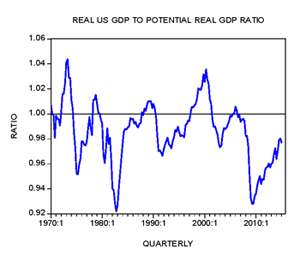
Indeed if one looks at the real gross domestic product to the potential real gross domestic product ratio the economy does appear to be hovering below potential with the ratio of 0.977 registered in Q1 this year.

shostak_june 8 300_1

Contrary to Krugman, we suggest that economists such as Ludwig von Mises and Murray Rothbard have provided a clear answer to the issue of technology and economic growth.

In Man, Economy, and State, Rothbard says that technology, while important, must always work through the investment of capital in order to generate economic growth.

On this issue, Rothbard quotes Mises who says,

What is lacking in (underdeveloped counties) is not knowledge of Western technological methods (“know how”); that is learned easily enough. The service of imparting knowledge, in person or in book form, can be paid for readily. What is lacking is the supply of saved capital needed to put the advanced methods into effect.

Most modern theories that emphasize the importance of new ideas and new technologies give the impression that these ideas and technologies have a “life of their own.” Many experts hold that because of the limited amounts of capital and labor, without technological progress, the opportunities for growth will eventually run out.

We Need Funding To Implement New Ideas

Ideas, unlike material inputs, are not themselves scarce. Consequently, it is argued, new ideas for more efficient processes and new products can make continuous growth possible.

We suggest that regardless of how many ideas people have, what matters is whether these ideas can be implemented. What always limits the implementation of various new techniques is the availability of funding. While ideas and new techniques can result in a better use of scarce resources, they can however, do very little without the pool of real savings.

So regardless of how clever we are and regardless of various technological ideas, without an adequate pool of funding nothing will emerge. It is through the expansion in the pool of real savings that an increase in the stock of capital goods is possible. And it is the increase in the capital goods per worker that permits economic growth to emerge.

To Get More Funding, We Need Savings

Obviously, new ideas and new technology can be introduced during the production of new capital goods (i.e., new technology) and will be imbedded in the capital goods stock. The crux of the matter however, is that capital goods cannot emerge without a prior increase in the pool of funding or pool of real savings.

Take, for instance, a baker John who produced ten loaves of bread. He consumes two loaves of bread whilst the other two loaves — his real savings — he employs to purchase a new part to improve his oven. With a better oven he can now raise the output of bread to twenty loaves. If he still consumes only two loaves, then with a larger savings (now stands at eighteen loaves) he can enhance further his oven by introducing new parts, which will enable the introduction of new technology. Note that all this is made possible on account of real savings.

We suggest that despite new technologies, a major impediment to economic growth has been the relentless central bank tampering with financial markets.

Since 2008 this tampering was made manifest in the extremely loose monetary policy of the Fed that resulted in the massive monetary expansion of the Fed’s balance sheet and the lowering of interest rates to almost nil.

These policies have been responsible for a severe erosion of the pool of real savings and thus a weakening of the process of capital formation. This in turn has undermined real economic growth notwithstanding new information technology.

For Krugman and his followers savings is bad news — it is seen as less demand — hence one shouldn’t be surprised that Krugman is puzzled as to why new ideas haven’t manifested in a more robust economic growth. Contrary to Krugman, boosting so-called aggregate demand whilst undermining the capital formation process, and hence the ability to produce goods and services, cannot strengthen economic growth over time. In fact this way of thinking results in the notion that something can be generated out of nothing.

Frank Shostak is an adjunct scholar of the Mises Institute and a frequent contributor to Mises.org. His consulting firm, Applied Austrian School Economics, provides in-depth assessments and reports of financial markets and global economies.

This article was originally published by the Ludwig von Mises Institute. Permission to reprint in whole or in part is hereby granted, provided full credit is given.

Soros Pushes US Bailouts and Weapons for Ukraine – Article by Ron Paul

Soros Pushes US Bailouts and Weapons for Ukraine – Article by Ron Paul

The New Renaissance Hat
Ron Paul
June 8, 2015
******************************

If you look at the track record of the interventionists you might think they would pause before taking on more projects. Each of their past projects has ended in disaster yet still they press on. Last week the website Zero Hedge posted a report about hacked emails between billionaire George Soros and Ukrainian President Poroshenko.

Soros is very close to the Ukrainian president, who was put in power after a US-backed coup deposed the elected leader of Ukraine last year. In the email correspondence, Soros tells the Ukrainian leadership that the US should provide Ukraine “with same level of sophistication in defense weapons to match the level of opposing force.” In other words, despite the February ceasefire, Soros is pushing behind the scenes to make sure Ukraine receives top-of-the-line lethal weapons from the United States. Of course it will be up to us to pay the bill because Ukraine is broke.

But Soros seems to have the money part covered as well. In an email to Ukrainian leaders, he wrote that Ukraine’s “first priority must be to regain control of financial markets.” Soros told Poroshenko that the IMF would need to come through with a $15 billion package, which was confident would lead the Fed to also come through with more money. He wrote: “the Federal Reserve could be asked to extend a $15 billion three months swap arrangement with the National Bank of Ukraine. That would reassure the markets and avoid a panic.”

How would the Fed be convinced to do that? Soros assured Poroshenko: “I am ready to call Jack Lew of the US Treasury to sound him out about the swap agreement.”

So George Soros will use his influence in the US government to put the American people on the hook for a bankrupt Ukraine — forcing us to pay for weapons, more military training, and Ukraine’s crippling debt.

Who is thrilled with Soros’ drawing the US government into more intervention in the region? The military-industrial complex for one is happy at the prospect of big weapons “sales” to Ukraine. The bankers are thrilled. Washington power-brokers are thrilled. There is something in this for everyone who is politically well-connected. The only losers are the people who will be forced to pay for it, the American taxpayers.

No one seems to ask why we are involved in Ukraine at all. Is it really any of our business if the east wants to break away from the west? Is it a vital US interest which flag the people wish to hang in Donetsk?

One thing we should be sure of is that Ukraine’s debt will not be paid. As in other bailouts, much of it will be transferred to the US taxpayer through the IMF and the Federal Reserve. All of this is only possible because of the perception that the dollar is still the world’s reserve currency. But this too is coming to an end. US military and financial interventionism worldwide are only speeding up the process.

Ron Paul, MD, is a former three-time Republican candidate for U. S. President and Congressman from Texas.

This article is reprinted with permission from the Ron Paul Institute for Peace and Prosperity.

Ex-Im Bank is Welfare for the One Percent – Article by Ron Paul

Ex-Im Bank is Welfare for the One Percent – Article by Ron Paul

The New Renaissance Hat
Ron Paul
June 1, 2015
******************************

This month Congress will consider whether to renew the charter of the Export-Import Bank (Ex-Im Bank). Ex-Im Bank is a New Deal-era federal program that uses taxpayer funds to subsidize the exports of American businesses. Foreign businesses, including state-owned corporations, also benefit from Ex-Im Bank. One country that has benefited from $1.5 billion of Ex-Im Bank loans is Russia. Venezuela, Pakistan, and China have also benefited from Ex-Im Bank loans.With Ex-Im Bank’s track record of supporting countries that supposedly represent a threat to the US, one might expect neoconservatives, hawkish liberals, and other supporters of foreign intervention to be leading the effort to kill Ex-Im Bank. Yet, in an act of hypocrisy remarkable even by DC standards, many hawkish politicians, journalists, and foreign policy experts oppose ending Ex-Im Bank.

This seeming contradiction may be explained by the fact that Ex-Im Bank’s primary beneficiaries include some of America’s biggest and most politically powerful corporations. Many of Ex-Im Bank’s beneficiaries are also part of the industrial half of the military-industrial complex. These corporations are also major funders of think tanks and publications promoting an interventionist foreign policy.

Ex-Im Bank apologists claim that the bank primarily benefits small business. A look at the facts tells a different story. For example, in fiscal year 2014, 70 percent of the loans guaranteed by Ex-Im Bank’s largest program went to Caterpillar, which is hardly a small business.

Boeing, which is also no one’s idea of a small business, is the leading recipient of Ex-Im Bank aid. In fiscal year 2014 alone, Ex-Im Bank devoted 40 percent of its budget — $8.1 billion — to projects aiding Boeing. No wonder Ex-Im Bank is often called “Boeing’s bank.”

Taking money from working Americans, small businesses, and entrepreneurs to subsidize the exports of large corporations is the most indefensible form of redistribution. Yet many who criticize welfare for the poor on moral and constitutional grounds do not raise any objections to welfare for the rich.

Ex-Im Bank’s supporters claim that ending Ex-Im Bank would deprive Americans of all the jobs and economic growth created by the recipients of Ex-Im Bank aid. This claim is a version of the economic fallacy of that which is not seen. The products exported and the people employed by businesses benefiting from Ex-Im Bank are visible to all. But what is not seen are the products that would have been manufactured, the businesses that would have been started, and the jobs that would have been created had the funds given to Ex-Im Bank been left in the hands of consumers.

Another flawed justification for Ex-Im Bank is that it funds projects that could not attract private sector funding. This is true, but it is actually an argument for shutting down Ex-Im Bank. By funding projects that cannot obtain funding from private investors, Ex-Im Bank causes an inefficient allocation of scarce resources. These inefficiencies distort the market and reduce the average American’s standard of living.

Some Ex-Im Bank supporters claim that Ex-Im Bank promotes free trade. Like all other defenses of Ex-Im Bank, this claim is rooted in economic fallacy. True free trade involves the peaceful, voluntary exchange of goods across borders — not forcing taxpayers to subsidize the exports of politically powerful companies.

Ex-Im Bank distorts the market and reduces the average American’s standard of living in order to increase the power of the federal government and enrich politically powerful corporations. Congress should resist pressure from the crony capitalist lobby and allow Ex-Im Bank’s charter to expire at the end of the month. Shutting down Ex-Im Bank would improve our economy and benefit most Americans. It is time to kick Boeing and all other corporate welfare queens off the dole.

Ron Paul, MD, is a former three-time Republican candidate for U. S. President and Congressman from Texas.

This article is reprinted with permission from the Ron Paul Institute for Peace and Prosperity.

Microaggressions and Microwonders – Are Mountains Out of Molehills Proof the World’s Getting Better? – Article by Steven Horwitz

Microaggressions and Microwonders – Are Mountains Out of Molehills Proof the World’s Getting Better? – Article by Steven Horwitz

The New Renaissance Hat
Steven Horwitz
May 27, 2015
******************************

A recurring theme of recent human history is that the less of something bad we see in the world around us, the more outrage we generate about the remaining bits.

For example, in the 19th century, outrage about child labor grew as the frequency of child labor was shrinking. Economic forces, not legislation, had raised adult wages to a level at which more and more families did not need additional income from children to survive, and children gradually withdrew from the labor force. As more families enjoyed having their children at home or in school longer, they became less tolerant of those families whose situations did not allow them that luxury, and the result was the various moral crusades, and then laws, against child labor.

We have seen the same process at work with cigarette smoking in the United States. As smoking has declined over the last generation or two, we have become ever less tolerant of those who continue to smoke. Today, that outrage continues in the form of new laws against vaping and e-cigarettes.

The ongoing debate over “rape culture” is another manifestation of this phenomenon. During the time that reasonably reliable statistics on rape in the United States have been collected, rape has never been less frequent than it is now, and it is certainly not as institutionalized as a practice in the Western world as it was in the past. Yet despite this decline — or in fact because of it — our outrage at the rape that remains has never been higher.

The talk of the problem of “microaggressions” seems to follow this same pattern. The term refers to the variety of verbal and nonverbal forms of communication that are said to constitute disrespect for particular groups, especially those who have been historically marginalized. So, for example, the use of exclusively masculine pronouns might be construed as a “microaggression” against women, or saying “ladies and gentlemen” might be seen as a microaggression against transsexuals. The way men take up more physical space on a train or bus, or the use of the phrase “walk-only zones” (which might offend the wheelchair-bound) to describe pedestrian crossways, are other examples.

Those who see themselves as the targets of microaggressions have often become very effective entrepreneurs of outrage in trying to parlay these perceived slights into indications of much more pervasive problems of sexism or racism and the like. Though each microaggression individually might not seem like much, they add up. So goes the argument.

I don’t want to totally dismiss the underlying point here, as it is certainly true that people say and do things (often unintentionally) that others will find demeaning, but I do want to note how this cultural phenomenon fits the pattern identified above. We live in a society in which the races and genders (and classes!) have never been more equal. Really profound racism and sexism is far less prominent today than it was 50 or 100 years ago. In a country where the president is a man of color and where one of our richest entertainers is a woman of color, it’s hard to argue that there hasn’t been significant progress.

But it is exactly that progress that leads to the outrage over microaggressions. Having steadily pushed back the more overt and damaging forms of inequality, and having stigmatized them as morally offensive, we have less tolerance for the smaller bits that remain. As a result, we take small behaviors that are often completely unintended as offenses and attempt to magnify them into the moral equivalent of past racism or sexism. Even the co-opting of the word “aggression” to describe what is, in almost all cases, behavior that is completely lacking in actual aggression is an attempt to magnify the moral significance of those behaviors.

Even if we admit that some of such behaviors may well reflect various forms of animus, there are two problems with the focus on microaggressions.

First, where do we draw the line? Once these sorts of behaviors are seen as slights with the moral weight of racism or sexism, we can expect to see anyone and everyone who feels slighted about anything someone else said or did declare it a “microaggression” and thereby try to capture the same moral high ground.

We are seeing this already, especially on college campuses, where even the mere discussion of controversial ideas that might make some groups uncomfortable is being declared to be a microaggression. In some cases this situation is leading faculty to stop teaching anything beyond the bland.

Second, moral equivalence arguments can easily backfire. For example, if we, as some feminists were trying to do in the 1980s, treat pornography as the equivalent of rape, hoping to make porn look worse, we might end up causing people to treat real physical rape less seriously given that they think porn is largely harmless.

So it goes with microaggressions: if we try to raise men taking up too much room on a bus seat into a serious example of sexism, then we risk people reacting by saying, “Well, if that’s what sexism is, then why should I really worry too much about sexism?” The danger is that when far more troubling examples of sexism or racism appear (for example, the incarceration rates of African-American men), we might be inclined to treat them less seriously.

It is tempting to want to flip the script on the entrepreneurs of microaggression outrages and start to celebrate their outrages as evidence of how far we’ve come. If men who take the middle armrest on airplanes (as obnoxious as that might be) are a major example of gender inequality, we have come far indeed. But as real examples of sexism and racism and the like do still exist, I’d prefer another strategy to respond to the talk of microaggressions.

Let’s spend more time celebrating the “microwonders” of the modern world. Just as microaggression talk magnifies the small pockets of inequality left and seems to forget the larger story of social progress, so does our focus on large social and economic problems in general cause us to forget the larger story of progress that is often manifested in tiny ways.

We live in the future that prior generations only imagined. We have the libraries of the world in our pockets. We have ways of easily connecting with friends and strangers across the world. We can have goods and even services of higher quality and lower cost, often tailored to our particular desires, delivered to our door with a few clicks of a button. We have medical advances that make our lives better in all kinds of small ways. We have access to a variety of food year-round that no king in history had. The Internet brings us happiness every day through the ability to watch numerous moments of humor, human triumph, and joy.

Even as we recognize that the focus on microaggressions means we have not yet eliminated every last trace of inequality, we should also recognize that it means we’ve come very far. And we should not hesitate to celebrate the microwonders of progress that often get overlooked in our laudable desire to continue to repair an imperfect world.

Steven Horwitz is the Charles A. Dana Professor of Economics at St. Lawrence University and the author of Microfoundations and Macroeconomics: An Austrian Perspective, now in paperback.

This article was published by The Foundation for Economic Education and may be freely distributed, subject to a Creative Commons Attribution 4.0 International License, which requires that credit be given to the author.

The Bait-and-Switch Behind Economic Populism – Article by Nicolás Cachanosky

The Bait-and-Switch Behind Economic Populism – Article by Nicolás Cachanosky

The New Renaissance Hat
Nicolás Cachanosky
May 26, 2015
******************************

Argentina will hold elections this year, and a number of provinces will be electing governors. Buenos Aires, the capital city, is holding elections for mayor, and Mauricio Macri, who is stepping down as mayor, is a favorite to become the next president. Toward the end of the year, a presidential election will be held and Cristina Kirchner, after two consecutive mandates, will have to step down because she cannot be re-elected.

Like Chávez and Maduro in Venezuela, Argentina can be described as a country that fell victim to extreme populism during the Nestor and Cristina Kirchner administrations, which began in 2003. Twelve years later, this populist political project is about to end.

The economic policy of populism is characterized by massive intervention, high consumption (and low investment), and government deficits. This is unsustainable and we can identify several stages as it moves toward its inevitable economic failure. The last decade of extreme populism in Argentina can be described as following just such a pattern.

After observing the populist experience in several Latin American countries, Rudiger Dornbusch and Sebastián Edwards identified four universal stages inherent in populism in their article “Macroeconomic Populism” (1990). Even though populism can present a wide array of policies, certain characteristics seem to be present in most of the cases.

Populism usually fosters social mobilization, political propaganda, and the use of symbols and marketing practices designed to appeal to voter’s sentiments. Populism is especially aimed at those with low income, even if the ruling party cannot explain the source of its leaders’ high income. Populist rulers find it easy to use scapegoats and conspiracy theories to explain why the country is going through a hard time, while at the same time present themselves as the saviors of the nation. It is not surprising that for some, populism is associated with the left and socialist movements, and by others with the right and fascist policies.

The four stages of populism identified by Dornbusch and Edwards are:

Stage I

The populist diagnosis of what is wrong with an economy is confirmed during the first years of the new government. Macroeconomic policy shows good results like growing GDP, a reduction in unemployment, increase in real wages, etc. Because of output gaps, imports paid with central bank reserves, and regulations (maximum prices coupled with subsidies to the firms), inflation is mostly under control.

Stage II

Bottleneck effects start to appear because the populist policies have emphasized consumption over investment, the use of reserves to pay for imports, and the consumption of capital stock. Changes in sensitive relative prices start to become necessary, and this often leads to a devaluation of the exchange rate, price changes in utilities (usually through regulation), and the imposition of capital controls. Government tries, but fails, to control government spending and budget deficits.

The underground economy starts to increase as the fiscal deficit worsens because the cost of the promised subsidies need to keep up with a now-rising inflation. Fiscal reforms are necessary, but avoided by the populist government because they go against the government’s own rhetoric and core base of support.

Stage III

Shortage problems become significant, inflation accelerates, and because the nominal exchange rate did not keep pace with inflation, there is an outflow of capital (reserves). High inflation pushes the economy to a de-monetization. The local currency is used only for domestic transactions, but people save in US dollars.

The fall in economic activity negatively affects tax receipts increasing the deficit even more. The government needs to cut subsidies and increases the rate of the exchange rate, depreciation. Real income starts to fall and signs of political and social instability start to appear. At this point the failure of the populist project becomes apparent.

Stage IV

A new government is swept into office and is forced to engage in “orthodox” adjustments, possibly under the supervision of the IMF or an international organization that provides the funds required to go through policy reforms. Because capital has been consumed and destroyed, real wages fall to levels even lower than those that existed at the beginning of the populist government’s election. The “orthodox” government is then responsible for picking up the pieces and covering the costs of failed policies left from the previous populist regime. The populists are gone, but the ravages of their policies continue to manifest themselves. In Argentina the expression “economic bomb” is used to describe the economic imbalances that government leaves for the next one.

Economic Populism is Alive and Well

Even though Dornbusch and Edwards wrote their article in 1990, the similarities to the situation in countries like Venezuela, Bolivia, and Argentina is notable. In recent years, to keep populist ideas going in the minds of voters, Venezuela created the Ministry of Happiness, and Argentina created a new Secretary of National Thought.

These four stages are actually cyclical. The populist movement uses the fourth stage to criticize the orthodox party, and argues that during the populists’ tenure, things were better. The public opinion discontent with stage IV allows the populist movement to win new elections, receive an economy in a crisis or recession and the cycle starts over again from stage I. It is not surprising that populist governments usually appear following the hard times caused by economic crisis. A more bold populist government could avoid stage IV by finding a way to remain in office, calling off elections, or creating fake election results (as was the case in Venezuela). At such a point, the populist government succeeds in turning the country into a fully authoritarian nation.

Nicolás Cachanosky, a native of Argentina, is assistant professor of economics at Metropolitan State University of Denver.

This article was published on Mises.org and may be freely distributed, subject to a Creative Commons Attribution United States License, which requires that credit be given to the author.

Why Do We Celebrate Rising Home Prices? – Article by Ryan McMaken

Why Do We Celebrate Rising Home Prices? – Article by Ryan McMaken

The New Renaissance Hat
Ryan McMaken
May 26, 2015
******************************

In recent years, home price indices have seemed to proliferate. Case-Shiller, of course, has been around for a long time, but over the past decade, additional measures have been marketed aggressively by Trulia, CoreLogic, and Zillow, just to name a few.

Measuring home prices has taken on an urgency beyond the real estate industry because for many, home price growth has become something of an indicator of the economy as a whole. If home prices are going up, it is assumed, “the economy” must be doing well. Indeed, we are encouraged to relax when home prices are increasing or holding steady, and we’re supposed to become concerned if home prices are going down.

This is a rather odd way of looking at the price of a basic necessity. If the price of food were going upward at the rate of 7 or 8 percent each year (as has been the case with houses in many markets in recent years) would we all be patting ourselves on the back and telling ourselves how wonderful economic conditions are? Or would we be rightly concerned if incomes were not also going up at a similar rate? Would we do the same with shoes and clothing? How about with education?

With housing, though, increases in prices are to be lauded, we are told, even if they outpace wage growth.

We’re Told to Want High Home Prices

But in today’s economy, if home prices are outpacing wage growth, then housing is becoming less affordable. This is grudgingly admitted even by the supporters of ginning up home prices, but the affordability of housing takes a back seat to the insistence that home prices be preserved at all costs.

Behind all of this is the philosophy that even if the home-price/household-income relationship gets out of whack, most problems will nevertheless be solved if we can just get people into a house. Once someone becomes a homeowner, the theory goes, he’ll be sitting on a huge asset that (almost) always goes up in price, meaning that any homeowner will increase in net worth as the equity in his home increases.

Then, the homeowner can use that equity to buy furniture, appliances, and a host of other consumer goods. With all that consumer spending, the economy takes off and we all win. Rising home prices are just a bump in the road, we are told, because if we can just get everyone into a home, the overall benefit to the economy will be immense.

Making Homes Affordable with More Cheap Debt

Not surprisingly, we find a sort of crude Keynesianism behind this philosophy. In this way of thinking, the point of homeownership is not to have shelter, but to acquire something that will encourage more consumer spending. In other words, the purpose of homeownership is to increase aggregate demand. The fact that you can live in the house is just a fringe benefit. This macro-obsession is part of the reason why the government has pushed homeownership so aggressively in recent decades.

The fly in the ointment, of course, is if home prices keep going up faster than wages — ceteris paribus — fewer people will be able to save enough money to come up with either the full amount or even a sizable down payment on a loan.

Not to worry, the experts tell us. We’ll just make it easier, with the help of inflationary fiat money, to get an enormous loan that will allow you to buy a house. Thus, rock-bottom interest rates and low down payments have been the name of the game since the late 1980s.

We started to see the end game at work during the last housing bubble when Fannie Mae introduced the 40-year mortgage in 2005, which just emphasized that when it comes to being a homeowner, the idea is not to pay off the mortgage, but to “buy” a house and just pay the monthly payment until one moves to another house and gets a new thirty- or forty-year loan.

It Pays To Be in Debt

On the surface of it, it’s hard to see how this scenario is fundamentally different from just paying rent every month. If the homeowner stops paying the monthly payment, he’s out on the street, and the bank keeps the house, which is very similar to the scenario in which a renter stops paying a landlord. There’s (at least) one big difference here, however. It makes sense for the homeowner to get a home loan rather than rent an apartment because — if it’s a fixed-rate loan — price inflation ensures the real monthly payment will go down every month. Residential rents, on the other hand, tend to keep up with inflation.

But why would any lending institution make these sorts of long-term loans if the payment in real terms keeps getting smaller? After all, thirty years is a long time for something to go wrong.

Lenders are willing and able to do this because the loans are subsidized and underwritten through government creations like Fannie Mae (which buys up these loans on the secondary market), through bailouts, and through a myriad of other federal programs such as FHA. Naturally, in an unhampered market, a loan of such a long term would require high interest rates to cover the risk. But, Congress and the Fed have come to the rescue with promises of bailouts and easy money, meaning cheap thirty-year loans continue to live on.

So, what we end up with is a complex system of subsidies and favoritism on the part of lenders, homeowners, government agencies, and the Fed. The price of homes keeps going up, increasing the net worth of homeowners, and banks can make long-term loans on fairly risky terms because they know bailouts of various sorts will come if things go wrong.

But problems begin to arise when increases in home prices begin to outpace access to easy money and cheap loans. Indeed, we’re now seeing that homeownership rates are going down in spite of low interest rates, and vacancy rates in rental housing are at a twenty-year low. Meanwhile, new production in housing units is at 1992 levels, offering little relief from rising prices and rents. Obviously, something isn’t going according to plan.

Who Loses?

The old debt-based tricks that once kept homeownership climbing and accessible in the face of rising home prices are no longer working.

From a free market’s perspective, renting a home is neither good nor bad, but American policymakers long ago decided to favor homeowners over renters. Consequently, we’re faced with an economic system that pushes renters toward homeownership — price inflation and the tax code punishes renters more than owners — while simultaneously pushing home prices higher and higher.

During the last housing bubble, however, as homeownership levels climbed, few noticed or cared about this. So many renters became homeowners that rental vacancies climbed to record highs from 2004 to 2009. But in our current economy, one cannot avoid rising rents or hedge against inflation by easily leaving rental housing behind.

This time around, the cost of purchasing housing is going up by 6 to 10 percent per year, but few renters can join the ranks of the homeowners to enjoy the windfall. Instead, they just face record-high rent increases and a record-low inventory in for-sale houses.

There once was a time when rising home prices and rising homeownership rates could happen at the same time; it was possible for the government to stick to its unofficial policy of propping up home prices while also claiming to be pushing homeownership. We no longer live in such a time.

Ryan W. McMaken is the editor of Mises Daily and The Free Market. He has degrees in economics and political science from the University of Colorado, and was the economist for the Colorado Division of Housing from 2009 to 2014. He is the author of Commie Cowboys: The Bourgeoisie and the Nation-State in the Western Genre. 

This article was published on Mises.org and may be freely distributed, subject to a Creative Commons Attribution United States License, which requires that credit be given to the author.

Janet Yellen is Right: She Can’t Predict the Future – Article by Ron Paul

Janet Yellen is Right: She Can’t Predict the Future – Article by Ron Paul

The New Renaissance Hat
Ron Paul
May 25, 2015
******************************
This week I found myself in rare agreement with Janet Yellen when she admitted that her economic predictions are likely to be wrong. Sadly, Yellen did not follow up her admission by handing in her resignation and joining efforts to end the Fed. An honest examination of the Federal Reserve’s record over the past seven years clearly shows that the American people would be better off without it.

Following the bursting of the Federal Reserve-created housing bubble, the Fed embarked on an unprecedented program of bailouts and money creation via quantitative easing (QE) 1, 2, 3, etc. Not only has QE failed to revive the economy, it has further damaged the average American’s standard of living while benefiting the financial elites. None other than Donald Trump has called QE “a great deal for guys like me.”

The failure of quantitative easing to improve the economy has left the Fed reluctant to raise interest rates. Yet the Fed does not want to appear oblivious to the dangers posed by keeping rates artificially low. This is why the Fed regularly announces that the economy will soon be strong enough to handle a rate increase.

There are signs that investors are beginning to realize that the Fed’s constant talk of raising rates is just talk, so they are looking for investments that will protect them from a Fed-caused collapse in the dollar’s value. For example, the price of gold recently increased following reports of stagnant retail sales. An increased gold price in response to economic sluggishness may appear counterintuitive, but it is a sign that investors are realizing quantitative easing is not ending anytime soon.

The increase in the gold price is not the only sign that investors are interested in hard assets to protect themselves from inflation. Recently a Picasso painting sold for a record 180 million dollars. This record may not last long, as an additional two billion dollars worth of art is expected to go on the market in the next few weeks.

Another sign of the increasing concerns about the dollar’s stability is the growing interest in alternative currencies. Investing and using alternative currencies can help average Americans, who do not have millions to spend on Picasso paintings, protect themselves from a currency crisis.

Congress should ensure that all Americans can protect themselves from a dollar crisis by repealing the legal tender laws.

Congress should also take the first step toward monetary reform by passing the Audit the Fed bill. Unfortunately, Audit the Fed is not a part of the Federal Reserve “reform” bill that was passed by the Senate Banking Committee. Instead, the bill makes some minor changes in the Fed’s governance structure. These “reforms” are the equivalent of rearranging deck chairs as the Titanic crashes into the iceberg. Hopefully, the Senate will vote on, and pass, Audit the Fed this year.

The skyrocketing federal debt is also a major factor in the coming economic collapse. The Federal Reserve facilitates deficit spending by monetizing debt. Congress should make real cuts, not just reductions in the “rate of growth,” in all areas. But it should prioritize cutting the billions spent on the military-industrial complex.

Some say that eliminating the welfare-warfare state and the fiat currency system that props it up will cause the people pain. The truth is the only people who will feel any long-term pain from returning to limited, constitutional government are the special interests that profit from the current system. A return to a true free-market economy will greatly improve the lives of the vast majority of Americans.

Ron Paul, MD, is a former three-time Republican candidate for U. S. President and Congressman from Texas.

This article is reprinted with permission from the Ron Paul Institute for Peace and Prosperity.

Fantasy Bookstore Fights Fantasy Economics – San Francisco Sci-Fi Lovers Do Battle With the Minimum Wage – Article by Gary McGath

Fantasy Bookstore Fights Fantasy Economics – San Francisco Sci-Fi Lovers Do Battle With the Minimum Wage – Article by Gary McGath

The New Renaissance Hat
Gary McGath
May 18, 2015
******************************

Borderlands is an independent bookstore in San Francisco with an enthusiastic following among science fiction fans. It’s not just a place to buy books, but in the words of its mission statement “a social and professional center for readers, writers, publishers, reviewers, artists and other individuals with a strong interest in the fields of Science Fiction, Fantasy, Horror and Macabre Fiction.” Authors frequently appear there, and readers meet for discussions.

Like other bookstores, Borderlands has found staying in business difficult. It nearly closed early in 2015, and management put the blame for this on the city’s increase in the minimum wage. On February 1, it announced:

In November, San Francisco voters overwhelmingly passed a measure that will increase the minimum wage within the city to $15 per hour by 2018.

Although all of us at Borderlands support the concept of a living wage in principal [sic] and we believe that it’s possible that the new law will be good for San Francisco — Borderlands Books as it exists is not a financially viable business if subject to that minimum wage.

Consequently we will be closing our doors no later than March 31st.  The cafe will continue to operate until at least the end of this year.

Thanks to sponsorship from its community, Borderlands was able to avoid closing and is still in business, at least for now. Still, its crisis graphically shows one of the damaging consequences of minimum wage laws.

If the cost of something goes up, people will buy less of it, or if they can’t, they’ll make up for it in some other way. This applies to employees as much as to anything else. Some businesses can raise their prices to meet increased labor costs, but books are a highly competitive market, and consumers are very sensitive to price changes.

Small businesses in general have fewer options. A large operation may be able to absorb the cost or find ways to pass it on. It can reduce hours, require extra duties, or replace people with machines. These options don’t work well when the staff is small and the love of what they’re doing is a big reason they stay there.

Borderlands is hardly a unique case. The management was careful not to take a position against the minimum wage, but zero dollars for unemployed workers isn’t a “living wage,” and it’s meaningless to say that putting low-wage employees out of work is “good for San Francisco.” It is individuals, not a city, who have to get food and a place to live.

A paid sponsorship program was the key to Borderlands’ short-term survival. Science fiction fans are heavily networked, and many work in well-paying jobs, so the store benefited from a community with money to spare.

Well-known authors like Seanan McGuire and Cory Doctorow helped publicize the cause. Borderlands deserves credit for its innovative approach, but other businesses aren’t always so lucky, and they will fold without being widely noticed or mourned. Fans of bookstores realized, perhaps too late, that for the industry to survive as a whole, the bookstore must be profitable as a business venture, rather than a charity case.

Minimum-wage increases aren’t magic money. Any cost increase has to come out of something, and low-paying jobs that can’t justify the increase are the first place they’ll come out of. Thinking it happens for free is just fantasy.

Gary McGath is a freelance software engineer living in Nashua, New Hampshire.

This article was originally published by The Foundation for Economic Education.
The Other Half of the Inflation Story: Credit Expansion Adds Noise to Price Signals – Article by Sanford Ikeda

The Other Half of the Inflation Story: Credit Expansion Adds Noise to Price Signals – Article by Sanford Ikeda

The New Renaissance Hat
Sanford Ikeda
May 7, 2015
******************************

More money means higher prices. It’s too bad not everyone understands that connection. Even some economists don’t get it. Readers of the Freeman do, I’m sure. And they also understand why that’s a bad thing.

Increasing the supply of money and credit, other things equal, will cause a general rise in wages and prices across an economy. When the Federal Reserve, the central bank of the United States, excessively “prints money,” the result is “inflation” as it’s now commonly called. For those who get the new money after everyone else has spent theirs, inflation means incomes will now buy fewer goods, and every dollar lent before prices rose will be worth less when it’s returned.

If inflation continues, people will eventually learn to demand more for what they sell and lend in order to compensate for the purchasing power that inflation keeps eating away. That, in turn, will cause prices to rise faster, which makes planning for households and businesses even more difficult. In the past, that difficulty has led to hyperinflation and a breakdown of the entire economic system.

But as awful as all this may be, it’s really only half the story, and perhaps not even the worse half. What follows is a highly simplified story of what happens.

The structure of production

If you’d like to build a sturdy house, you’ll need to have some kind of blueprint or plan that will tell you two things:

  1. how the frame, floor, walls, roof, plumbing, and electrical system will all fit together; and
  2. the order in which to put these components together.

Even if the house was made entirely of identical stones, you would need to know how to fit them together to form the floor, walls, chimney, and other structural components. No two stones would serve exactly the same function in the overall plan.

The economy is like a house in the sense that each of its parts, which we might call “capital,” needs to mesh in a certain way if the eventual result will be order and not chaos. But there are two big differences between a house and an economy. The first is that the economy is not only much bigger, but it consists of a multitude of “houses” or private enterprises that have to fit together or coordinate, and so it’s an unimaginably more complex phenomenon than even the most elaborate house.

The second major difference is that a house is consciously constructed for a purpose, typically for someone to live in it. But an economic system is neither consciously designed by anyone nor intended to fulfill any particular purpose, other than perhaps to enable countless people with plans to do the best they can to achieve success. It’s a spontaneous order.

The way all the pieces of capital, from all the diverse people in the economy who own them, fit together is called the capital structure of production.

Credit expansion distorts the structure of production

When people decide to spend a certain portion of their incomes on consumption today, they are at the same time deciding to save some portion for consumption for the future. The amount that they save then gets lent out to borrowers and investors in the market for loanable funds. The rate of interest is the price of making those transactions across time. That is, when you decide to increase your saving, other things equal, the rate of interest (what some economists call the “natural rate of interest”) will fall. The falling interest rate makes borrowing more attractive to producers who invest today to produce more goods in the future.

That’s great, because when the market for loanable funds is operating freely without distortions, that means when people who saved today try to consume more in the future, there actually is more in the future for them to consume . Businesses today invested more at the lower rates precisely in order to have more to sell in the future when consumers want to buy more.

Now, if the Federal Reserve prints more money and that money goes into the loanable funds market, that will also increase the supply of loans and lower the interest rate and induce more borrowing and investment for future output. The difference here is that the supply of loans increases not because people are saving more now in order to consume more in the future, but only because of the credit expansion. That means that in the future, when businesses have more goods to sell, consumers won’t be able to buy them (because they didn’t save enough to do so) at prices that will cover all of the businesses’ costs. Prices will have to drop in order for markets to clear. Sellers suffer losses and workers lose their jobs.

And, oh yes, all that credit expansion also causes inflation.

While this process sounds rather involved, it’s still a highly simplified version of what has come to be known as the Austrian business cycle theory. (For a more advanced version, see here.) Of course, each instance in reality is significantly different from any other, but the narrative is essentially the same: credit expansion distorts the structure of production, and resources eventually become unemployed.

The explanation is more involved than the typical inflation-is-bad story that we’re more familiar with. Indeed, that probably explains why it’s the less-well-known half of the story. Even Milton Friedman and the monetarists pay little attention to the capital structure, choosing instead to focus on the problems of inflationary expectations.

Again, for Austrians, the problem arises when credit expansion artificially lowers interest rates and sets off an unsustainable “boom”; the solution is when the structure of production comes back into alignment with people’s actual preferences for consumption and saving, which is the “bust.” Most modern macroeconomists see it exactly the opposite way: the bust is the problem, and the boom is the solution.

An intricate, dynamic jigsaw puzzle

To close, I’d like to use an analogy I learned from Steve Horwitz (whom I heartily welcome back as a fellow columnist here at the Freeman).

The market economy is like a giant jigsaw puzzle in which each piece represents a unique unit of capital. When the system is allowed to operate without government intervention, the profit-and-loss motive tends to bring the pieces together in a complementary way to form a harmonious mosaic (although in a dynamic world, it couldn’t achieve perfection).

Credit expansion, then, is like someone coming along and making too many of some pieces and too few of others — and then, during the boom, trying to force them together, severely distorting the overall picture. During the bust, people realize they have to get rid of some pieces and try to discover where the others actually fit. That requires challenging adjustments and may take some time to accomplish. But if the government tries to “help” by stimulating the creation of more superfluous pieces, it will only confuse matters and make the process of adjustment take that much longer.

Inflation is bad enough. Unfortunately, it’s only half the story.

Sanford Ikeda is a professor of economics at Purchase College, SUNY, and the author of The Dynamics of the Mixed Economy: Toward a Theory of Interventionism.

This article was originally published by The Foundation for Economic Education.