Browsed by
Category: Economics

The Costs of Hysteria: How Economists are Misleading the Public on Climate-Change Policy – Article by Robert P. Murphy

The Costs of Hysteria: How Economists are Misleading the Public on Climate-Change Policy – Article by Robert P. Murphy

The New Renaissance Hat
Robert P. Murphy
May 5, 2015
******************************

Suppose the “scientific consensus” on climate change is right. Let’s also stipulate, for the sake of argument, that the computer projections used by the United Nations and the US government are correct, and that economists are able to translate those data into meaningful projections about costs and benefits to people living in the future with climate change.

Despite what the public has been led to believe, the situation is not a crisis at all — and certainly not something that demands drastic government actions to avert serious damage to the environment. In fact, implementing the wrong policy can cause far more damage than it can prevent.

It’s understandable that the public has no idea of the real state of the literature on climate change policy, because even professional economists use utterly misleading rhetoric in this arena. To show what I mean, first, let’s quote from a recent Noah Smith Bloomberg article, which urges left-liberals to support the Trans-Pacific Partnership (TPP) trade deal:

One of the bigger economic issues under debate right now is the Trans-Pacific Partnership (TPP), the multilateral trade deal that would include most countries in the Asia-Pacific region as well as the US. Many people both here and abroad are suspicious of trade deals, while economists usually support them. This time around, however, the dynamic is a little bit different — the TPP is getting some pushback from left-leaning economists such as Paul Krugman.

Krugman’s point is that since US trade is already pretty liberalized … the effect of further liberalization will be small.… I’m usually more of a free-trade skeptic than the average economist.… But in this case, I’m strongly on the pro-TPP side. There are just too many good arguments in favor.

University of California-Berkeley economist Brad DeLong does some quick back-of-the-envelope calculations, and estimates that the TPP would increase the world’s wealth by a total of $3 trillion. Though that’s not a big deal in the grand scheme of things, it’s one of the best reforms that’s feasible in the current polarized political situation. (emphasis added)

To summarize the flavor of Smith’s discussion, he thinks the TPP is “one of the bigger economic issues” today, and that its potential windfall to humanity of $3 trillion is “not a big deal in the grand scheme of things” but certainly worth pursuing if attainable. Krugman disagrees with Smith’s assessment, but their differences are clearly quibbles over numbers and strategies; it’s not as if Smith thinks Krugman is a “Ricardo denier” or accuses Krugman of hating poor Asians by opposing the trade deal.

We get a much different tone if instead we look at Smith discussing climate-change policy. For example, in June 2014, Smith wrote a Bloomberg piece on five ways to fight global warming. In the interest of brevity, let me simply quote Smith’s concluding paragraph:

If we do these five things, then the US can still save the world from global warming, even though we’re no longer the main cause of the problem. And the short-run cost to our economy will be very moderate. Saving the world on the cheap sounds like a good idea to me. (emphasis added)

Clearly, there is a chasm in the rhetoric between Smith’s two Bloomberg pieces. When discussing the TPP, it’s an honest disagreement between experts over a trade agreement that Smith thinks is definitely worthwhile, but in the grand scheme is not that big a deal. In contrast, government policies concerning climate change literally involve the fate of the planet.

At this point, most readers would wonder what the problem is. After all, isn’t man-made climate change a global crisis? Why shouldn’t Smith use much stronger rhetoric when describing it?

I am making this comparison because according to one of the pioneers in climate-change economics, William Nordhaus, even if all governments around the world implemented the textbook-perfect carbon tax, the net gain to humanity would be … drumroll please … $3 trillion. In other words, one of the world’s experts on the economics of climate change estimates that the difference to humanity between (a) implementing the perfect carbon-tax policy solution and (b) doing absolutely nothing was about the same difference as DeLong estimated when it comes to the TPP.

To be more specific, the $3 trillion Nordhaus estimate comes from the 2008 calibration of his Dynamic Integrated Climate-Economy (DICE) model. (The numbers have gone up since then, but I studied his 2008 calibration in great detail.) Note that this isn’t some “denier” computer simulation, rejected by the serious scientists. On the contrary, Nordhaus’s DICE model was one of only three chosen by the Obama administration when it set up a working group to estimate the monetary damages of carbon dioxide emissions. To help the reader understand the trade-offs humanity faces when it comes to climate change, let me reproduce table 4 from my Independent Review article that critically evaluated Nordhaus’s model:    
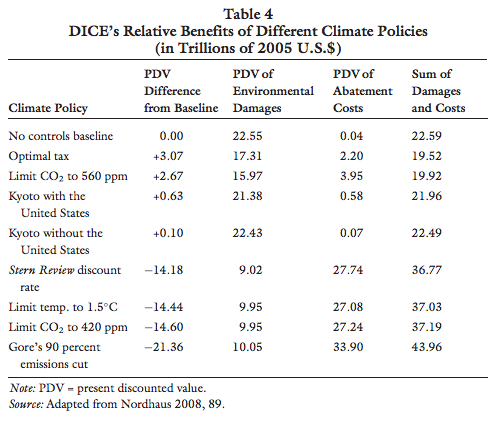
The table shows Nordhaus’s estimates (made in 2008 based on the “consensus” scientific assessments of the time) of the net benefits of various possible governmental climate policy approaches. The first row shows what happens if governments do nothing. There will be $22.55 trillion (in present value terms, and quoted in 2005 dollars) of environmental damage, but virtually no economic costs of complying with regulations, for a total harm of $22.59 trillion.

In contrast, if governments around the world implemented Nordhaus’s recommended “optimal” carbon tax, the world would be spared a little more than $5 trillion in future environmental damage, while future economic output would be $2.2 trillion lower due to complying with the carbon tax. Adding it all up, humanity would suffer total harms of $19.52 trillion, meaning the world would be $3.07 trillion wealthier with the optimal, global carbon tax (because $22.59 − $19.52 = $3.07).

Central to the economic way of thinking is the concept of trade-offs. Every possible policy — including a policy of doing nothing — comes with costs. But the public tends to hear about only one set of costs, not the full array. For example, as the earlier table shows, the wrong climate policy can be much, much worse than doing nothing. Nordhaus evaluated Al Gore’s suggestion to cut emissions by 90 percent, and estimated that it would make humanity some $21 trillion poorer compared to the do-nothing baseline — a net harm seven times greater than the net benefits of the textbook-optimal approach.

My point here is not to trumpet Nordhaus’s numbers as being gospel. (My Independent Review article was a full-blown critique of his model.) Rather, I am pointing out that even one of the leading models that underpins the so-called consensus on climate-change activism shows that this is hardly the planetary crisis that the rhetoric of Smith and others would suggest. The actual numbers are in the same ballpark as those of trade deals — and nobody thinks the fate of the planet hangs on the passage of a trade deal.

More generally, what even most economists have failed to convey to the public is that climate-change policies at best will affect things on the margin. Nordhaus’s table beautifully illustrates this. The optimal carbon tax doesn’t eliminate the climate-change damage that his computer simulations predict. On the contrary, the carbon tax only reduces it from about $23 trillion down to $17 billion. The reason it doesn’t make sense to enact a more aggressive carbon tax is that the (marginal) harm to the conventional economy would exceed the (marginal) environmental benefit. There are several policies in the table that reduce environmental damage below the $17 trillion mark, but they hurt the economy so much more that, on net, they are inferior approaches.

It is understandable that noneconomists would fail to employ marginal analysis and would engage in overblown rhetoric when discussing something as controversial as climate-change policy. However, too many professional economists have also fallen into this bad habit, including not just Smith but also Krugman and many others.

Robert P. Murphy has a PhD in economics from NYU. He is the author of The Politically Incorrect Guide to Capitalism and The Politically Incorrect Guide to The Great Depression and the New Deal.

This article was originally published by The Foundation for Economic Education and may be freely distributed, subject to a Creative Commons Attribution 4.0 International License, which requires that credit be given to the author.

Speaking Truth to Power: Jimmy Lai – Article by Lawrence W. Reed

Speaking Truth to Power: Jimmy Lai – Article by Lawrence W. Reed

The New Renaissance Hat
Lawrence W. Reed
May 4, 2015
******************************

For years, a bust of John James Cowperthwaite sat prominently in the foyer of Jimmy Lai’s Next Media office in Hong Kong, along with others of economists F.A. Hayek and Milton Friedman. If that’s all you ever knew about Jimmy Lai, you could at least surmise that he loves liberty and free markets.

Cowperthwaite had been the architect of Hong Kong’s free-market miracle. He started with a destitute rock and turned it into one of the world’s freest and most prosperous economies. (Indeed, I’ve suggested that he deserves to be recognized annually and everywhere with a Cowperthwaite Day on the anniversary of his birthdate, April 25.) Jimmy Lai is precisely the sort of individual that Cowperthwaite had in mind when he decided that entrepreneurs, not central planners, should drive an economy. Because of what Cowperthwaite had done, Jimmy Lai found a hero himself. And Lai, too, would go on to do great things.

Of the characteristics most often identified with successful entrepreneurship, Jimmy Lai possesses them all in abundance. He is a self-starter who takes initiative (and risk) with enthusiasm. He’s creative and intuitive. He’s passionate and tenacious. Where others see problems, he sees opportunity. He’s a visionary, both in business endeavors and for society at large. He doesn’t hesitate to defy conventional wisdom when it points to a dead end. Whatever he undertakes, he musters the courage to act. He puts his all — money, time, and energy — where his mouth is (and where his convictions are).

On paper, Lai’s early life would seem unlikely to produce a “real hero.” He was born in China the year before it fell under Mao Zedong’s dictatorial rule. Lai was smuggled out of the country and into Hong Kong at age 12. In the absence of child-labor laws, which would have ensured his deprivation there, too, Lai went to work in a garment factory for $8 a month. Fifteen years later, he bought his own garment factory and built it into the giant known as Giordano, now a leading international retailer. Lai’s boundless entrepreneurial zeal, free to operate within Hong Kong’s laissez-faire business environment, yielded jobs for thousands and consumer goods for millions.

But in 1989, Beijing’s infamous Tiananmen Square massacre set Jimmy Lai on a new course. With Hong Kong scheduled to be transferred from British to Chinese rule in just eight years, Lai knew that maintaining traditional freedoms under Beijing’s rule would be a challenge. So he ventured into media, creating what soon became the territory’s largest-circulation magazines, Sudden Weekly and Next. In spite of Beijing’s coercion of advertisers, Jimmy Lai’s tabloid-style newspaper, Apple Daily, is still the premier voice in Asia for the freedoms of speech, press, and enterprise.

Jimmy Lai does not shrink from controversy. The Communist Party of China, he wrote in a 1994 column, is “a monopoly that charges a premium for a lousy service.” He defended the student demonstrators when they went into the streets by the hundreds of thousands in late 2014 in defense of democracy. He routinely exposed corruption in both government and business, including the especially toxic brand of corruption that arises when the two get in bed together. He sold Giordano, the apparel firm he founded, to save it from Beijing’s intense pressure, but he refuses to this day to renounce his principles.

In December 2014, he revealed that he was stepping down as publisher of Apple Daily and chairman of Next Media to devote more time to family and personal interests. A month later, and for the second time, unknown assailants firebombed his home. He remains under intense scrutiny from Beijing, which regularly employs ugly rumors, threats of litigation, and other nefarious means to undermine his influence.

Earlier this year, Lai told the New York Times that he never planned to make his media empire into a family dynasty. His six children (ages 8 to 37) are not in line as heirs to that business or its leadership positions. “I don’t think I should ask my kids to inherit my business, because they can’t start where I did,” he said. “I was from the street. I’m a very different make of person. I’ve been a fighter all my life.”

Whatever the future holds for Jimmy Lai, friends of liberty everywhere can count him as one very brave man.

For additional information:

In the Freeman:

Lawrence W. (“Larry”) Reed became president of the Foundation for Economic Education (FEE) in 2008. Prior to that, he was a founder and president for twenty years of the Mackinac Center for Public Policy in Midland, Michigan. He also taught Economics full-time and chaired the Department of Economics at Northwood University in Michigan from 1977 to 1984.

He holds a B.A. degree in Economics from Grove City College (1975) and an M.A. degree in History from Slippery Rock State University (1978), both in Pennsylvania. He holds two honorary doctorates, one from Central Michigan University (Public Administration—1993) and Northwood University (Laws—2008).

This article was originally published by The Foundation for Economic Education and may be freely distributed, subject to a Creative Commons Attribution 4.0 International License, which requires that credit be given to the author.
Fooled by GDP: Economic Activity versus Economic Growth – Article by Steven Horwitz

Fooled by GDP: Economic Activity versus Economic Growth – Article by Steven Horwitz

The New Renaissance Hat
Steven Horwitz
May 4, 2015
******************************

Even the smartest of economists can make the simplest of mistakes. Two recent books, Violence and Social Orders by Douglass North, John Wallis, and Barry Weingast and Why Nations Fail by Daron Acemoglu and James Robinson both suffer from misunderstanding the concept of economic growth. Both books speak of the high growth rates in the Soviet economy in the mid-20th century. Even if the authors rightly note that such rates could not be sustained, they are still assuming that the aggregate measures they rely on as evidence of growth, such as GDP, really did reflect improvements in the lives of Soviet citizens. It is not clear that such aggregates are good indicators of genuine economic growth.

These misunderstandings of economic growth take two forms. One form is to assume that the traditional measurements we use to track economic activity also describe economic growth, and the other form is to mistake the production of material things for economic growth.

Often at the core of this confusion is the concept of gross domestic product (GDP). Although it is the most frequently used indicator of economic growth, what it really measures is economic activity. GDP is calculated by attempting to measure the market value of final goods and services produced in a particular geographic area over a specific period. By “final” goods and services, we mean the goods and services purchased by the end consumer, and that means excluding the various exchanges of inputs that went into making them. We count the loaf of bread you buy for sandwiches, but not the purchase of flour by the firm that produced the bread.

What GDP does not distinguish, however, is whether the exchanges that are taking place — even the total quantity of final goods — actually improve human lives.

That improvement is what we should be counting as economic growth. Two quick examples can illustrate this point.

First, nations that devote a great deal of resources to building enormous monuments to their leaders will see their GDP rise as a result. The purchase of the final goods and labor services to make such monuments will add to GDP, but whether they improve human lives and should genuinely constitute “economic growth” is much less obvious. GDP tells us nothing about whether the uses of the final goods and services that it measures are better than their alternative uses.

Second, consider how often people point to the supposed silver lining of natural disasters: all the jobs that will be created in the recovery process. I am writing this column at the airport in New Orleans, where, after Katrina, unemployment was very low and GDP measures were high. All of that cleanup activity counted as part of GDP, but I don’t think we want to say that rebuilding a devastated city is “economic growth” — or even that it’s any kind of silver lining. At best, such activity just returns us to where we were before the disaster, having used up in the process resources that could have been devoted to improving lives.

GDP measures economic activity, which may or may not constitute economic growth. In this way, it is like body weight. We can imagine two men who both weigh 250 pounds. One could be a muscular, fit professional athlete with very low body fat, and the other might be on the all-Cheetos diet. Knowing what someone weighs doesn’t tell us if it’s fat or muscle. GDP tells us that people are producing things but says nothing about whether those things are genuinely improving people’s lives.

The Soviet Union could indeed produce “stuff,” but when you look at the actual lives of the typical citizen, the stuff being produced did not translate into meaningful improvements in those lives.

Improving lives is what we really care about when we talk about economic growth.

The second confusion is a particular version of the first one. Too often, we think that economic growth is all about the production of material goods. We see this in discussions of the US economy, where the (supposed) decline of manufacturing is pointed to as a symptom of a poorly growing economy. But if economic growth is really about the accumulation of wealth — which is, in turn, about people acquiring things they value more — then material goods alone aren’t the issue. More physical stuff doesn’t mean that the stuff is improving lives.

More important, though, is that what really matters is subjective value. The purchase of a service is no less able to improve our lives, and thereby be a source of economic growth, than are the production and purchase of material goods. In fact, what we really care about when we purchase a material good is not the thing itself, but the stream of services it can provide us. The laptop I’m working on is valuable because it provides me with a whole bunch of services (word processing, games, Internet access, etc.) that I value highly. It is the subjective satisfaction of wants that we really care about, and whether that comes from a physical good or from human labor does not matter.

This point is particularly obvious in the digital and sharing economies, where so much value is created not through the production of stuff, but by using the things we have more efficiently and precisely. Uber doesn’t require the production of more cars, and Airbnb doesn’t require the production of more dwellings. But by using existing resources better, we create value — and that is what we mean by economic growth.

So what should we look at instead of GDP as we try to ascertain whether we are experiencing economic growth? Look at living standards: of average people, and especially of poor people. How easily can they obtain the basics of life? How many hours do they have to work to do so? Look at the division of labor. How fine is it? Are people able to specialize in narrow areas and still find demand for their products and services?

Economic growth is not the same as economic activity. It’s not about just making more exchanges or producing more stuff. It’s ultimately about getting people the things they want at progressively lower cost, and thereby improving their well-being. That’s what markets have done for the last two centuries. For those of us who understand this point, it’s important not to assume that higher rates of GDP growth or the increased production of physical stuff automatically means we are seeing growth.

Real economic growth is about improving people’s subjective well-being, and that is sometimes harder to see even as the evidence for it is all around us.

Steven Horwitz is the Charles A. Dana Professor of Economics at St. Lawrence University and the author of Microfoundations and Macroeconomics: An Austrian Perspective, now in paperback.

This article was published by The Foundation for Economic Education and may be freely distributed, subject to a Creative Commons Attribution 4.0 International License, which requires that credit be given to the author.

Will the Fed Let Innovation Work Its Magic? – Article by Edin Mujagic

Will the Fed Let Innovation Work Its Magic? – Article by Edin Mujagic

The New Renaissance Hat
Edin Mujagic
April 21, 2015

******************************

Sometimes one finds true gems in one’s archives. Recently I came across a speech by then-chairman of the Fed, Ben Bernanke, from May 18, 2013. It was the commencement speech at Bard College at Simon´s Rock, in Great Barrington, Massachusetts. In it, Bernanke chose to forget for a while the dire straits the Western economy is in and focused on prospects for economic growth in the long run, which he defined as “measured in decades, not months or quarters.”

In short, Bernanke focused on scientific and technological progress, more commonly described as innovation. He envisaged a fourth wave of innovation — the first three being the early industrial era (mid-1700s until mid-1800s), the modern industrial era (from 1880 onwards), and the IT-revolution.

His commencement speech was a speech of hope and of encouragement. But Bernanke did not tell the whole story. The then-Fed chairman failed to mention that living standards will depend on more than innovation. At least as important is the role of the very institution he chaired, the Federal Reserve, and what it does or does not do. If it allows high inflation to take hold — either through action or inaction — that would annihilate a very substantial part of the increase in living standards due to innovation.

And yet, recent history strongly suggests that the Fed will end up destroying a large part of the increase in living standards of those graduates Bernanke was speaking to. For example, at the beginning of 2013 Bernanke spoke at another American college. During the Q&A session, he said that “the worst mistake the Fed can make is to tighten monetary policy too soon.” In other words, the then-chairman essentially promised to raise interest rates too late. Nowadays, Bernanke may be gone from the Fed, but his line of thinking on monetary policy certainly has not, and indeed, this line of thinking reflects dominant Fed policy well beyond the Bernanke years.

Innovation and Living Standards

Bernanke, like Greenspan before him, is counting on innovation to keep the economy moving. As well he should. Technological innovation often leads to more efficient production and greater worker productivity which leads to higher wages and more affordable goods.

But if Bernanke is going to tell students that technology will make their lives better, he should also mention the role that he himself and other central bankers play in stifling the positive effects of innovation.

We can see multiple examples of this phenomenon in recent decades. For example, if we consider the effect that China’s entrance into the global economy should have had on living standards in the US, we find the actual results to be somewhat underwhelming. We should have witnessed growth in living standards similar to what we witnessed toward the end of the nineteenth century as the US industrialized. But in fact, the record of growth in real wealth in the US has been disappointing at best.

For example, technological progress due to the Industrial Revolution and globalization in the late nineteenth century led to continuous deflation in the US, and hence unprecedented increases in welfare. Research by Michael Bordo at Rutgers, shows that on average, prices fell by 1.2 percent each year between 1870 and 1896. Real living standards increased substantially over the same time period. Labor market economists in the United States have been able to reconstruct wage development in the United States since 1830. In every decade the real wage was higher than the preceding decade. That is, until the 1970s.

In contrast, in the decades since the early 1980s, as Asia was joining the world with its own industrial revolution, each year prices increased in the US by more than 2 percent. According to the statistics available from US Census, real median household income in the United States (i.e., income adjusted for inflation) barely moved between 1980 and 2012. This is odd, given the fact that economic growth averaged some 3 percent per annum and labor productivity soared by some 50 percent in total. A working American male earned approximately $48,000 in 1969. Adjusted for inflation, his income had barely grown by the time the current economic crisis started.

The main difference between the two periods is that in 1800s there was no Federal Reserve, and the money supply, while certainly not completely non-inflationary, was restrained by the absence of a central bank.

Lost Opportunities

In an unhampered market, technological progress, innovation, and globalization in the decades before the current crisis should have led to three things: slower wage growth, larger profits, and lower prices. In other words, what firms like Apple accomplished (i.e., the creation of innovative, labor-saving products made available at ever-lower prices) on a micro scale, should have happened on the macro-level as well. Slower wage growth would have been inevitable because of increased global competition in the labor market and the constant and increasing threat of jobs being offshored. Larger profits would have occurred economy-wide because of this fact, and the fact that production costs fell. And finally, lower prices would have spread throughout the economy because, due to technological progress, globalization, falling wages, and falling transportation costs.

The first two effects manifested themselves. As mentioned, real income barely budged in the last few decades in the United States. This becomes evident when we take a look at the total employee compensation in the United States. Measured as a share of GDP, US wages in recent years have been lower than during any other period since World War II. At the end of the war, the ratio was 53.6 percent. Nowadays, we find it below 45 percent.

Moreover, as a rule of thumb, the lower the share of wages in any country’s GDP, the higher the share of profits. So we find the second effect evident as well: profits increased.The third effect, however, falling prices, has been largely prevented by the intervention of the central bank. In fact, the Fed aimed for, and continues to aim for some 2 percent inflation per annum. The Fed has been very successful in preventing prices from falling even when the downward pressure on prices was strong, due to the aforementioned combination of technological progress, innovation, globalization, and free trade.

In more than a century before the inception of the Fed in 1913, cumulative inflation in the United States was approximately 0 percent. Between January 1, 1914 and July 2013, cumulative inflation in the United States stood at 2,236 percent, prompting Milton Friedman to write — way back in 1988 —that “no major institution in the US has so poor a record of performance over so long a period, yet so high a public reputation.”

A logical consequence of any “fourth wave” of innovation should be deflation, or falling prices. Then and only then will the living standards of those graduates who were listening to Bernanke indeed increase strongly. It will not happen as long as the Fed continues to aim for inflation every year and certainly not if the Fed continues to follow its current policy that will, according to many, cause even higher inflation in years to come.

Edin Mujagic has a Master’s degree in macro and monetary economics from Tilburg University (The Netherlands) and is an independent macro-economist and author of Money Murder: How the Central Banks Are Destroying Our Money (published in Dutch, as Geldmoord). He is the youngest-ever member of the Monetaire Kring (Monetary Circle) in the Netherlands, a by-invitation-only policy forum of university professors and senior officials at the central bank, ministry of Finance, banks, pension funds and other financial institutions.

This article was published on Mises.org and may be freely distributed, subject to a Creative Commons Attribution United States License, which requires that credit be given to the author.

Michel Chevalier’s Case Against the Patent System – Article by Louis Rouanet

Michel Chevalier’s Case Against the Patent System – Article by Louis Rouanet

The New Renaissance Hat
Louis Rouanet
April 17, 2015
******************************

Michel Chevalier (1806–1879) was a very influential French economist during the second half of the nineteenth century. He is still widely known in France for being the architect of the Cobden-Chevalier Treaty of 1860 which was the free-trade agreement between France and Great Britain. Michel Chevalier is, however, less known for his major contribution to the intellectual property debate. [1] Contrary to Jean Baptiste Say, Gustave de Molinari, and many other French economists, Chevalier fiercely opposed the patent system. As Fritz Machlup remarked: “Among French economists, Michel Chevalier was probably the most emphatic in the joint antagonism to tariffs and patents, declaring that both ‘stem from the same doctrine and result in the same abuses.’”

Taking a fresh look at Michel Chevalier’s major work, Les Brevets d’invention (1878), we find it to be not only a well-written and powerful book, but also has remained impressively relevant. The arguments advanced by Chevalier anticipate the current arguments of the present opponents of intellectual property.

Patents as Contrary to Freedom and Economic Progress

Michel Chevalier argues that patents cannot be justified if they are contrary to freedom, even if beneficial to technological change. For him “From the moment we can make effective the patent only through inquisitorial expedients, violence, and subversion of liberty of labor, it is proof that we must renounce patents.” Chevalier rejects utilitarianism as a sufficient method to justify or refute the patent system. Chevalier’s opposition to patents, however, is not just based on moral arguments but shows the disastrous effects of this system for both foreign trade and the economy in general.

According to Chevalier, patents are of the same nature as privileges and monopolies which were prevalent during the Ancien Régime. They are also comparable in their effects to protectionist policies:

In absolute terms, patents diminish the productive power of nations that recognize them: evident proposition for those who believe that freedom, free competition, is the great lever of industrial progress.

Chevalier goes on to note the conservative and anti-innovation nature of monopolies and gives many examples of monopolies during the Ancien Régime. According to him, the innovators during the Ancien Régime weren’t rewarded, not because of the absence of patents, but because of the corporation guild system which was destroying competition and freedom to entry into markets. Thus, the innovators were constantly sued by guilds and consumers rarely benefited from their inventions. This argument is still relevant today. Indeed, companies protected from competition and government-owned corporations are often less innovative and more subject to conservative measures. Sectors typically run by government such as schools experience very little technological progress. On the other hand, the competitive process of the market gives incentives for the actors to differentiate from the other producers. As Pascal Salin stated, the company which makes the highest profits on a free market is the company which is the best positioned to “invent the future.” The essential virtue of competition is that it encourages producers to innovate in order to better serve the needs of consumers.

As one of his more striking examples, Chevalier examines the case of aniline — a dye and major innovation in the chemical industry — and shows how monopoly, resulting from patents, leads to hampered innovation. His interpretation of the problems caused by patents in the chemical industry at the time is consistent with more recent studies done by Boldrin and Levine in Against Intellectual Monopoly, now the seminal work on the topic.

Innovation as a Process

Chevalier understood that innovation is, above all, a process and that giving privileges to the innovator will destroy this process, leading to less and not more inventions. He wrote:

Every industrial discovery is the product of the general ferment of ideas, the result of an internal work which was accomplished with the support of a large number of successive or simultaneous collaborators in society, often for centuries.

This argument regarding the cumulative nature of innovation is still the most powerful argument against intellectual monopoly today and has also been the theme of several recent studies.2 Similar to Chevalier, Hayek saw innovation as a process and stated that “it is not obvious that such forced scarcity [intellectual property] is the most effective way to stimulate the human creative process.”

In an 1862 debate in the Académe des Sciences Morales et Politiques, Chevalier gave the example of Louis Daguerre, one of the inventors of photography, who didn’t seek a patent for his system of photography. According to Chevalier, the absence of a patent led to necessary improvements of the daguerreotype and fostered its widespread use. His conclusion is the following:

The spirit of man proceeds only by successive trials and repeated attempts. Discoveries do not arrive with a single bound to the degree of perfection or completion, which is reserved for them; there must be renewed, persevering efforts, cut by breaks that allow, so to speak, to breath. … If it is true that the invention must pass through the hands of twenty people before reaching its final state, it follows that the exclusive privilege granted to the first patented, and to each of his followers, prevents this practical result rather than facilitate it.

The Increasing Number of Patents and Negative Consequences

Already during the nineteenth century, legal instability and uncertainty challenged the actual efficiency of the patent system and the economists were very much aware of this problem. Chevalier warned that the patent system would lead to legal uncertainty for the companies and would lead the industry back to a guild system where no entrepreneur would dare to enter a market for fear of being sued by patent holders. Chevalier was ahead of his time by denouncing what can be considered the ancestors of today’s patent trolls.

Chevalier concluded his 1862 article by stating: “I think I have said enough to show that the patent legislation has been an eccentricity of the legislator.” He went further in 1863 and added that “[a]ll friends of industrial and social progress must work together to rescue the industry of obstacles, obsolete remains of the past. Patents must disappear first.” [3]

1. Fritz Machlup and Edith Penrose briefly discussed Michel Chevalier in “The Patent Controversy in the Nineteenth Century,” Journal of Economic History, 1950.

2. See Alberto Galasso et Mark Schankerman, “Patents and Cumulative Innovation: Causal Evidence from the Courts”, NBER working paper, 21 June 2014 ; and also, Alessandro Nuvolari, “Collective Invention during the British Industrial Revolution: The Case of the Cornish Pumping Engine,” Cambridge Journal of Economics 28, No. 3 (2004).

3. Quoted in Eugène Pouillet, “Traité théorique et pratique des brevets d’invention et de la contrefaçon,” 1909, pp. x–xi.

Louis Rouanet is a student at Sciences Po Paris (Institute of Political Studies) where he studies economics and political science.

This article was originally published by the Ludwig von Mises Institute. Permission to reprint in whole or in part is hereby granted, provided full credit is given.

A Portrait of the Classical Gold Standard – Article by Marcia Christoff-Kurapovna

A Portrait of the Classical Gold Standard – Article by Marcia Christoff-Kurapovna

The New Renaissance Hat
Marcia Christoff-Kurapovna
April 15, 2015
******************************

“The world that disappeared in 1914 appeared, in retrospect, something like our picture of Paradise,” wrote the economist Cecil Hirsch in his June 1934 review of R.W. Hawtrey’s classic, The Art of Central Banking (1933). Hirsch bemoaned the loss of the far-sighted restraint that had once prevailed among the “bankers’ banks” of the West, concluding that modern times “had failed to attain the standard of wisdom and foresight that prevailed in the 19th century.”That wisdom and foresight was once upon a time institutionalized throughout an international monetary culture — gold-based, wary of credit, and contemptuous of debt, public or private. This world included central banks including the Bank of England, the Bank of France, the Swiss National Bank, the early Federal Reserve, the Imperial Bank of Austria-Hungary, and the German Reichsbank. But the entrenched hard-money ideology of the time restrained all of them. The Bank of Russia, for example, which once required 50 percent to 100 percent gold backing of all notes issued, possessed the second largest gold reserves on the planet at the turn of the twentieth century.

“The countries that were tied together in the gold standard system represented to a not inconsiderable degree a community of interest in and responsibility for the maintenance of economic and financial stability throughout the world,” recounted Aldoph C. Miller, member of the Federal Reserve Board from 1914 to 1936, in The Proceedings of the Academy of Political Science, in May 1936. “The gold standard was the one outstanding symbol of unity and economic solidarity which the nineteenth century world had developed.”

It was a time when “automatic market forces,” as economists of the day referred to them, prevailed over monetary management. Redeemability of money in (fine) gold ensured, within limits, stability in foreign exchange rates. Credit was extended only as far as reserve ratios would allow, and central banks were required to keep fixed reserves of gold against notes-in-circulation and against demand deposits.

When Markets Dominated Monetary “Policy”

Gold flows regulated international price relationships through markets, which adjusted themselves accordingly: prices rose when there was an influx of gold — for example, when one country received a debt payment from another country (always in gold), or during such times as the California or Australian gold rushes of the 1870s. These inflows meant credit expansion and a rise in prices. An outflow of gold meant credit was contracted and price deflation followed.

The efficiency of that standard was not impeded by the major central banks in such a way that “any disturbance of economic or financial character originating at any point in the world which might threaten the continued maintenance of economic equilibrium was quickly detected by foreign exchanges,” Miller, the Federal Reserve board member, noted in his paper. “In this way, the gold standard system became in a very real sense a regime or rule of economic health, a method of catching economic disturbances in the bud.”

The Bank of England, the grand master of them all, was the financial center of the universe, whose tight handle on its credit policies was so disciplined that the secured the top spot while not even holding the largest gold reserves. Consistent in its belief that protection of reserves was the chief, and only important, criterion of credit policy, England became the leading exporter of capital, the free market for gold, the international discount market, and international banker for the trade of other countries, as well as her own. The world was in this sense on the sterling standard.

The Bank of France, wisely admonished by its founder, Napoleon, to make sure France was always a creditor country, was so replete with reserves it made England a 500 million franc loan (in 1915 numbers) at the onset of the World War I. Switzerland, perhaps the last “19th-century-style” hold-out today with unlimited-liability private bankers and strict debt-ceiling legislation, also required high standards of its National Bank, founded in 1907. By the 1930s that country had higher banking reserves than the US; the Swiss franc was never explicitly devalued, unlike nearly every other Western nation’s currency, and the country’s domestic price level remained the most stable in the world.

For a time, the disciplined mindset of these banks found its way across the Atlantic, where the idea of a central bank had been long the subject of hot debate in the US. The economist H. Parker Willis, writing about the controversy in The Journal of the Proceedings of the Academy of Political Science, October 1913, admonished: “The Federal Reserve banks are to be ‘bankers’ banks,’ and they are intended to do for the banker what he himself does for the public.”

At first, the advice was heeded: in September 1916, almost two years after its founding on December 23,1913, the fledgling Fed worked out an amendment to its gold policy on the basis of a very conservative view of credit. This new policy sought to restrain “the undue and unnecessary expansion of credit,” wrote Fed board member Miller, in an article for The American Economic Review, in June 1921.

The Bank of Russia, during the second half of the nineteenth century steered itself through the Crimean War, the Russo-Turkish War, the Russo-Japanese War, impending Balkan wars — not to mention all that was to follow — and managed to emerge with sound fiscal policies and massive gold reserves. According to The Economist of May 20, 1899, Russian holdings were 95 million pounds sterling of gold, while the Bank of France held 78 million sterling worth. (Austria-Hungary held 30 million sterling worth of gold and the Bank of England 30 million sterling worth of both gold and silver.) “Russia up to the very moment of rupture [with Japan, 1904–1905], was working imperturbably at the progressive consolidation of her finances,” reported Karl Helfferich of the University of Berlin, at a meeting of The Royal Economic Society [UK] in December 1904. “Even in years of industrial crises and defective harvest, her foreign trade showed an excess of exports over imports more than sufficient to compensate payments sent abroad. And, as guarantee her monetary system she has succeeded in a amassing and maintaining a vast reserve of gold.”

These banks, in turn, drew on the medieval/Renaissance and Baroque-era banking traditions of the Hanseatic League, the Bank of Venice, and Amsterdam banks. Payment-on-demand “in good and heavy gold” was like a blood-oath binding the banker-client relationship. The transfer of credit “did not arise from any such substitution of credit for money,” noted Charles F. Dunbar, in The Quarterly Journal of Economics of April 1892, “but from the simple fact that the transfer in-bank saved the necessity of counting coin and manual delivery of every transaction.”

Bankers were forbidden to deal in certain commodities, could not make loans or create credit for the purchase of such commodities, and forbade both foreigners and citizens from buying silver on credit unless the same amount in cash was in the bank. According to Dunbar, a Venetian law of 1403 on reserve requirements became the basis of US banking law on the deposits of public securities in the late 1800s.

After the fall of bi-metallism in the 1870s, gold continued to perform monetary functions among the main countries of the Western world (and the well-administered Bank of Japan). It was the only medium of exchange and the only currency with unrestricted legal tender. It became the vaunted “measure of value.” Bank currency notes were simply used as auxiliary to gold and, in general, did not enjoy the privilege of legal tender.

The End of An Era

It was certainly not a flawless system, or without periodic crises. But central banks had to act in an exceptionally prudent manner given the all-over public distrust of paper money.

As economist Andrew Jay Frame of the University of Chicago, writing in The Journal of Political Economy, in January 1912, noted: “During panics in Britain in 1847 and 1866, when cash payments were suspended, the floodgates of cash were opened [by The Bank of England], the governor sent word to the street that solvent banks would be accommodated, and the panic was relieved.” Frame then adds: “However, this extra cash and the increased loans that went with it were very quickly put to an end to avoid credit expansion.”

The US was equally confident of its prudent attitude. Aldoph Miller, writing of Federal Reserve policy, remarked: “The three chief elements of the policy of a central bank or system of reserve holding institutions are best disclosed in connection with the attitude towards 1) gold 2) currency 3) credit.” He noted proudly: “The federal reserve system has met [these] tests on the whole with remarkable success.”

But after World War I, a different international landscape was left behind. England had been displaced as the center of international finance; the US and France emerged as the chief post-war creditor countries. The mechanism of the gold standard to which depreciated currencies could be related no longer existed. Only the US was left with a full gold standard. England and France had a gold bullion standard and other countries (Germany, primarily) had a gold-exchange standard.

A matrix of unbalanced trade relationships began to saturate the international economy. Then, with so many foreign countries attendant upon its speculative boom, the US manipulated its own domestic credit policies to ease credit and exchange-standard controls. This eventually culminated in an international financial crisis of 1931. Under Bretton Woods (1944), the gold standard was effectively abandoned: domestic convertibility was illegal and the role of gold was very constrained in favor of the dollar.

“It was, at least in theory, simple enough in the old days,” wrote a wistful W. Randolph Burgess, head of the New York Federal Reserve, in 1938. “In the present strange new world, where the old gold portents have lost their former meaning, where is the radio beam which the central banker may follow? What is the equivalent of gold?”

The men of his era and of the late nineteenth century understood the meaning of such a question and, more importantly, why it is one that must be asked. But theirs was a different world, indeed — one without “QE,” ZIRP,” or “Unknown Knowns” as fiscal policy. And there were no helicopters, either.

Marcia Christoff-Kurapovna is at work on the biography of a prominent European head of state and businessman.  Her work has appeared in such publications as The Wall Street Journal, The Economist and Foreign Affairs.

This article was originally published by the Ludwig von Mises Institute. Permission to reprint in whole or in part is hereby granted, provided full credit is given.

The New Militarism – Who Profits? – Article by Ron Paul

The New Militarism – Who Profits? – Article by Ron Paul

The New Renaissance Hat
Ron Paul
April 14, 2015
******************************
Militarism and military spending are everywhere on the rise, as the new Cold War propaganda seems to be paying off. The new “threats” that are being hyped bring big profits to military contractors and the network of think tanks they pay to produce pro-war propaganda. Here are just a few examples:
***

The German government announced last week that it would purchase 100 more “Leopard” tanks – a 45 percent increase in the country’s inventory. Germany had greatly reduced its inventory of tanks as the end of the Cold War meant the end of any threat of a Soviet ground invasion of Europe. The German government now claims these 100 new tanks, which may cost nearly half a billion dollars, are necessary to respond to the new Russian assertiveness in the region. Never mind that Russia has neither invaded nor threatened any country in the region, much less a NATO member country.

The US Cold War-era nuclear bunker under Cheyenne Mountain, Colorado, which was all but shut down in the 25 years since the fall of the Berlin Wall, is being brought back to life. The Pentagon has committed nearly a billion dollars to upgrading the facility to its previous Cold War-level of operations. US defense contractor Raytheon will be the prime beneficiary of this contract. Raytheon is a major financial sponsor of think tanks like the Institute for the Study of War, which continuously churn out pro-war propaganda. I am sure these big contracts are a good return on that investment.

NATO, which I believe should have been shut down after the Cold War ended, is also getting its own massively expensive upgrade. The Alliance commissioned a new headquarters building in Brussels, Belgium, in 2010, which is supposed to be completed in 2016. The building looks like a hideous claw, and the final cost – if it is ever finished – will be well over one billion dollars. That is more than twice what was originally budgeted. What a boondoggle! Is it any surprise that NATO bureaucrats and generals continuously try to terrify us with tales of the new Russian threat? They need to justify their expansion plans!

So who is the real enemy? The Russians?

No, the real enemy is the taxpayer. The real enemy is the middle class and the productive sectors of the economy. We are the victims of this new runaway military spending. Every dollar or euro spent on a contrived threat is a dollar or euro taken out of the real economy and wasted on military Keynesianism. It is a dollar stolen from a small business owner that will not be invested in innovation, spent on research to combat disease, or even donated to charities that help the needy.

One of the most pervasive and dangerous myths of our time is that military spending benefits an economy. This could not be further from the truth. Such spending benefits a thin layer of well-connected and well-paid elites. It diverts scarce resources from meeting the needs and desires of a population and channels them into manufacturing tools of destruction. The costs may be hidden by the money-printing of the central banks, but they are eventually realized in the steady destruction of a currency.

The elites are terrified that peace may finally break out, which will be bad for their profits. That is why they are trying to scuttle the Iran deal, nix the Cuba thaw, and drum up a new “Red Scare” coming from Moscow. We must not be fooled into believing their lies.

Ron Paul, MD, is a former three-time Republican candidate for U. S. President and Congressman from Texas.

This article is reprinted with permission from the Ron Paul Institute for Peace and Prosperity.

Why We Need Deflation and Higher Interest Rates – Article by John P. Cochran

Why We Need Deflation and Higher Interest Rates – Article by John P. Cochran

The New Renaissance Hat
John P. Cochran
April 5, 2015
******************************

The Fed is seemingly slightly out of step with other central bankers as it recently hinted at possible future rate hikes in the official announcement following its March 20, 2015 meeting. But as many commentators have recognized, Janet Yellen, a strong proponent of Keynesian more-inflation-as-cure-for-unemployment policy, later downplayed the significance of the announcement. She was careful to indicate that rates would stay low for the near future and when (and if) rate increases begin, they will be measured. The Fed, like central bankers elsewhere, stays committed to a 2 percent inflation target as it continues a policy driven by a fear of deflation, a fear that is not supported by either good economic theory or economic history properly interpreted.

The errors of deflation-phobia can be drawn from Philipp Bagus’s excellent and recently released In Defense of Deflation. Bagus points out

In the economic mainstream, there are basically two main strands in contemporary deflation theories. The first strand can be represented by economists who in some way are inspired by Keynesian theories like Ben Bernanke, Lars E.O. Svensson, Marvin Goodfriend, or Paul Krugman. The first group fears that price deflation might put the economy in a liquidity trap and opposes all price deflation categorically. It represents the deflation phobia in its clearest form.

It is these theorists and their colleagues who currently dominate central bank thinking and make the case (weak and often only asserted as an imperative) for a positive inflation buffer.

Bagus does recognize a second group of mainstream economists with a more balanced view of deflation:

The second strand has representatives like Claudio Borio, Andrew Filardo, Michael Bordo, John L. Lane, and Angela Redish. Inspired by the Chicago School, the second group is more free market oriented. Bordo, for instance, received his doctoral degree from the University of Chicago. This group distinguishes between two types of deflation: good deflation and bad deflation.

Deflation Leads to Increases in Real Interest Rates, Which Brings Recovery

However, the main water carriers against this erroneous overemphasis by economists and the mainstream press on the alleged evils of deflation have been the Austrians. In his essays “A Reformulation of the Austrian Business Cycle Theory” and “An Austrian Taxonomy of Deflation” Joseph Salerno dismantles deflation-phobia and illustrates the benefits of higher interest rates. Moreover, “A Reformulation” is also a strong argument on why current policy retards recovery and why a policy which would allow financial markets to adjust to a new higher natural rate of interest is essential for restoring normalcy and prosperity. Salerno begins with examining why it is so unpleasant when an economy must adjust to fix the malinvestments and overconsumption that appeared in the boom phase:

The ABCT, when correctly formulated, does indeed explain the asymmetry between the boom and bust phases of the business cycle. The malinvestment and overconsumption that occur during the inflationary boom cause a shattering of the production structure that accounts for the pervasive unemployment and impoverishment that is observed during the recession. Before recovery can begin, the production structure must be painstakingly pieced back together again in a new pattern, because the intertemporal preferences of consumers have changed dramatically due to the redistribution and losses of income and wealth incurred during the inflation. This of course takes time.

At the heart of the problem is the fact that central bank-induced inflation has “wreaked havoc” on prices and consequently on economic calculation:

In addition, the recession-adjustment process is further prolonged by the fact that the boom has wreaked havoc with monetary calculation, the very moorings of the market economy. Entrepreneurs have discovered that their spectacular successes during the boom were merely a prelude to a sudden and profound failure of their forecasts and calculations to be realized. Until they have regained confidence in their forecasting abilities and in the reliability of economic calculation they will be understandably averse to initiating risky ventures even if they appear profitable. But if the market is permitted to work, this entrepreneurial malaise cures itself as the restriction of demand for factors of production drives down wages and other costs of production relative to anticipated product prices. The “natural interest rate,” i.e., the rate of return on investment in the structure of production, thus increases to the point where entrepreneurs are enticed to renew their investment activities and initiate the adjustment process. Success feeds on itself, entrepreneurs’ spirits rise, and the recovery gains momentum.

The market can only cure itself, Salerno explains, if prices are allowed to adjust, including decreases in “wages and other costs of production relative to anticipated product prices.” At the same time, it’s the resulting “steep rise” in real interest rates that draws capitalists and entrepreneurs back into the marketplace:

The rise in the natural interest rate that overcomes the pandemic demoralization among capitalists and entrepreneurs and sparks the recovery is reflected in the credit markets. For recovery to begin again, there needs to be a steep rise in the “real,” or inflation-adjusted, interest rate observed in financial markets. High interest rates do not stifle the recovery but are the sure sign that the readjustment of relative prices required to realign the production structure with economic reality is proceeding apace. The mislabeled “secondary deflation,” whether or not it is accompanied by an incidental monetary contraction, is thus an integral part of the adjustment process. It is the prerequisite for the renewal of entrepreneurial boldness and the restoration of confidence in monetary calculation. Decisions by banks and capitalist-entrepreneurs to temporarily hold rather than lend or invest a portion of accumulated savings in employing the factors of production and the corresponding rise of the loan and natural rates above some estimated “true” time preference rate does not impede but speeds up the recovery. This implies, of course, that any political attempt to arrest or reverse the decline in factor and asset prices through monetary manipulations or fiscal stimulus programs will retard or derail the recession-adjustment process.

New Defenders of Deflation

Citing work by Claudio Borio, head of the Monetary and Economic department at the BIS, listed above by Bagus, The Telegraph, ran a recent story by Szu Ping Chan, “Low Rates Will Trigger Civil Unrest as Central Banks Lose Control,” also highly critical of fear-of-deflation policy committed to 2 percent (or higher) inflation targets. Ms. Chan highlights work by Borio:

A separate paper co-authored by Mr Borio argued that periods of deflation has less economic costs than sustained falls in property prices. Its analysis of 38 economies over a period of more than 100 years showed economies grew by an average of 3.2pc during deflationary periods, compared with 2.7pc when prices were rising.

It said drawing blind comparisons with the 1930s were misguided. “The historical evidence suggests that the Great Depression was the exception rather than the rule,” said Hyun Shin, head of research at the BIS.

Mr. Bagus, Ms. Chan, and Mr. Borio have highlighted for us yet again why it is essential that institutional changes be made that lead to withering away of fiat money and create the possibility for sound money.

John P. Cochran is emeritus dean of the Business School and emeritus professor of economics at Metropolitan State University of Denver and coauthor with Fred R. Glahe of The Hayek-Keynes Debate: Lessons for Current Business Cycle Research. He is also a senior scholar for the Mises Institute and serves on the editorial board of the Quarterly Journal of Austrian Economics. Send him mail. See John P. Cochran’s article archives.

This article was published on Mises.org and may be freely distributed, subject to a Creative Commons Attribution United States License, which requires that credit be given to the author.

Repeal, Don’t Reform the IMF! – Article by Ron Paul

Repeal, Don’t Reform the IMF! – Article by Ron Paul

The New Renaissance Hat
Ron Paul
April 5, 2015
******************************
A responsible financial institution would not extend a new loan of between 17 and 40 billion dollars to a borrower already struggling to pay back an existing multi-billion dollar loan. Yet that is just what the International Monetary Fund (IMF) did last month when it extended a new loan to the government of Ukraine. This new loan may not make much economic sense, but propping up the existing Ukrainian government serves the foreign policy agenda of the US government.

Since the IMF receives most of its funding from the United States, it is hardly surprising that it would tailor its actions to advance the US government’s foreign-policy goals. The IMF also has a history of using the funds provided to it by the American taxpayer to prop up dictatorial regimes and support unsound economic policies.

Some may claim the IMF does promote free markets by requiring that countries receiving IMF loans implement some positive economic reforms, such as reducing government spending. However, other conditions imposed by the IMF, such as that the country receiving the loan deflate its currency and implement an industrial policy promoting exports, do not seem designed to promote a true free market, much less improve the people’s living standards by giving them greater economic opportunities.

The problem with the IMF cannot be fixed by changing the conditions attached to IMF loans. The fundamental problem with the IMF is that it is funded by resources taken forcibly from the private sector. By taking resources out of private hands and giving them to IMF bureaucrats, the US federal government distorts the marketplace, harming both American taxpayers and the citizens of the countries receiving the IMF loans. The idea that the IMF is somehow better able to allocate capital than are private investors is just as flawed as every other form of central planning. The IMF must be repealed, not reformed.

The IMF is not the only US institution that manipulates the global economy. Over the past several years, a mysterious buyer, identified only as “Belgium,” so named because the buyer acts through a Belgian-domiciled account, has become the third-largest holder of Treasury securities. Belgium’s large purchases always occur at opportune times for the US government, such as when a foreign country sells a large amount of Treasuries. “Belgium” also made large purchases in the months just after the Fed launched the quantitative easing program. While there is no evidence this buyer is working directly with the US government, the timing of these purchases does raise suspicions.

It is not out of the realm of possibility that the Federal Reserve is involved in these purchases. The limited audit of the Federal Reserve’s actions during the financial crisis that was authorized by the Dodd-Frank Act revealed that the Fed actively intervenes in global markets.

What other deals with foreign governments is the Fed making? Is the Fed, like the IMF, working to bail out Greece and other EU countries? Is the Fed working secretly to aid US foreign policy as it did in the early 1980s, when it financed loans to then-US ally Saddam Hussein? The lack of transparency about the Fed’s dealings with overseas central banks and foreign governments is one more reason why Congress needs to pass the audit the fed bill.

By taking money from American taxpayers to support economically weak and oftentimes corrupt governments, the IMF distorts the market, enriches corrupt governments, and harms both the American taxpayer and the residents of the counties receiving IMF “aid.” It is past time to end the IMF along with all instruments of American interventionist foreign policy.

Ron Paul, MD, is a former three-time Republican candidate for U. S. President and Congressman from Texas.

This article is reprinted with permission from the Ron Paul Institute for Peace and Prosperity.

Why Is the Fed Punishing My Parents? – Article by Shawn Ritenour

Why Is the Fed Punishing My Parents? – Article by Shawn Ritenour

The New Renaissance Hat
Shawn Ritenour
March 29, 2015
******************************

In September 1993, President Bill Clinton reassured his radio audience that “if you work hard and play by the rules, you’ll be rewarded with a good life for yourself and a better chance for your children.” Picking up that theme over eighteen years later, President Barack Obama affirmed that “Americans who work hard and play by the rules every day deserve a government and a financial system that does the same.” The trouble is neither the government nor the financial system backed by the Federal Reserve rewards people like my parents, who have worked hard and played by the rules their entire lives, only to have their savings wither away.

Instead, Federal Reserve officials and the intelligentsia who support them are continuously working to make their lives more difficult, frightening the masses of what shoppers look for every day — lower prices. Price deflation, the cry, is disastrous for the economy. They worry that lower prices will reduce profits, leading to shutdowns and lay-offs and that lower prices make it harder for people to pay their debts. Sound economic theory and history, however, both indicate that price deflation is nothing the social economy needs to fear. If prices fall because the economy is more productive, this is unambiguously positive. However, if prices fall because people spend less, their desire is for larger real cash balances. Falling prices help them achieve their goal, which precisely is the purpose of economic activity.

Lower prices and wages can make it harder to pay fixed debt. This, however, serves as an excellent incentive to stay out of debt in the first place, as my parents have done as a result of significant sacrifice. Before creating even more money out of thin are to ward off lower overall prices, we should at least consider some of the ethical issues involved.

Many men from my father’s generation are not unlike John Adams who wrote to his wife that he “must study politics and war, that our sons may have liberty to study mathematics and philosophy.” My father embarked for twenty years of hard labor in a meat packing plant providing for his family until he lost his job due to his union pricing him and his fellow workers out of a job. When his plant closed in the mid-1980s, he embarked on a second successful career with my mother operating their own barbecue business for another twenty-plus years. I saw firsthand the challenges they faced trying to keep quality up and costs down, while producing top-drawer barbecue meat and sandwiches for a demand that was always uncertain. I saw the stress on my mother’s face one week in the early days when they netted a mere $15 before taxes. My father indeed “studied” meat packing and barbecue, in part, so I could go to college and become an economist and college professor.

Additionally, Mom and Dad had the foresight and character to make the sacrifices necessary to stay out of debt. Indeed, they are Paul Krugman’s worst nightmare — a family determined not to live beyond their means. Now retired, like many in their generation they are enjoying life the best they can on an almost fixed income. Because they have no debt, they have been able to live without tremendous economic hardship thus far. The Federal Reserve’s inflationism, however, increasingly makes life for them more difficult as steady price inflation daily chips away at their livelihood. Since 2009, for example, the Consumer Price Index has increased over 9 percent. This masks, however, significantly larger price increases for important necessities. Prices of dairy products are up almost 17 percent since 2009. Gasoline prices are up almost 11 percent despite the recent decline. Prices for meat, poultry, fish, and eggs have increased a whopping 26 percent since 2009. Higher overall prices do not help people like my parents at all. They instead act as a thief, snatching wealth away from them in the form of diminished purchasing power. What they long for is to see the value of their savings increase. Far from creating economic hardship for them, lower overall prices would be a boon.

Both sound economics and ethics, therefore, demand that we give up the anti-deflation rhetoric and the inflation it fuels. Charity demands that we cease striking fear into the hearts of the masses, softening them up for ever higher prices. The Federal Reserve should stop punishing people like my parents who have worked hard and played by the rules their whole lives. After all, what did they ever do to Greenspan, Bernanke, and Yellen?

Shawn Ritenour teaches economics at Grove City College and is the author of Foundations of Economics: A Christian View.

This article was published on Mises.org and may be freely distributed, subject to a Creative Commons Attribution United States License, which requires that credit be given to the author.