Browsed by
Category: Science

Science Fiction and Communist Reality – Article by Lawrence W. Reed

Science Fiction and Communist Reality – Article by Lawrence W. Reed

The New Renaissance HatLawrence W. Reed
******************************

Real Heroes: Stanislaw Lem

Each week, Mr. Reed will relate the stories of people whose choices and actions make them heroes. See the table of contents for previous installments.


Polish science fiction writer Stanislaw Lem (1921–2006) “skillfully dissected the 20th century’s foolhardy efforts to create utopias by stifling individuality and economic freedoms.” So said cultural critic Bruce Edward Walker. Lem was best known internationally as author of the classic Solaris — twice adapted for the silver screen — but the majority of his fiction featured damning allegories against the suppression of the human spirit.

Lem ranks high in the Polish pantheon of independent thinkers and dissidents, any list of which would be long and distinguished. Poland’s role in the historic unraveling of the Soviet empire was pivotal by any measure. And while world leaders from Pope John Paul II to Ronald Reagan to Margaret Thatcher played a part, the audacity of the homegrown resistance is a story that is still underemphasized to this day.

In November 1986, I spent nearly two weeks in Poland with the anticommunist underground. This was five years after the Warsaw government declared martial law and threw many pro-freedom activists in jail. It was still many months before the big changes of 1989 that would liberate Eastern Europe from the communist yoke. One night during my visit, I met in a private home with a half-dozen underground printers. They were eager to impress me with examples of many great pro-freedom books they had illegally translated, printed, and distributed throughout the country.

I asked, “Where did you get the paper to publish all this stuff?”

“From two places,” replied a young man named Pavel. “One, we smuggle it in from the West. Two, we steal it from communists.”

When I asked him to explain the second source, he revealed that many of the workers in the communist government’s publishing houses were sympathetic to the resistance. When those workers saw the opportunity, they smuggled the paper out or even printed resistance literature on the government’s own printing presses.

The impressive stack of illegally printed books those printers showed me included works by great scholars of liberty from the West — Freeman writers F.A. Hayek, Ludwig von Mises, and Murray N. Rothbard, to name just three. I later raised $5,000 for the underground to translate, publish, and distribute Milton Friedman’s classic Free to Choose, a copy of which I proudly display today in a glass case in my study. But there were books, essays, and ideas by native Poles that the underground took risks to disseminate as well. Stanislaw Lem was one of them.

Born in 1921, Lem survived both Nazi occupation and Soviet rule in the town of his birth, which was known alternately as Lwów in free Poland, Lvov in the Soviet Union, and Lviv in modern Ukraine. His father was a doctor, and Lem was poised to follow in his footsteps until Hitler’s invasion in 1939. He was forced to work as a mechanic but became a crack saboteur: “I learnt to damage German vehicles in such a way that it wouldn’t be discovered,” he said.

Lem resumed his medical studies following the war, eventually finishing his degree in Cracow in 1946. He intended to pursue a career in theoretical biology, but abandoned his plans rather than adhere to the since-discredited practices of Soviet geneticist Trofim Lysenko. He turned to writing, only to have his first novel, The Hospital of the Transfiguration, banned by communist censors for nearly a decade.

By 1951, Lem realized that his only hope of publishing was to mask his views as allegorical works of science fiction. State apparatchiks in charge of expunging subversive works from the public square were too stupid to appreciate his subtlety, but Polish intellectuals and many ordinary readers knew full well what the underlying message was. What Lem did with a wrench to German vehicles, he later did with pen and ink to the communist state.

Lem used his considerable intellect (he reportedly had an IQ of 180) and writing skills to parody Soviet and Polish leaders and subtly convey the torments of communist life. He is seen as in the same mold as satirical fantasists Jonathan Swift, George Orwell, and Franz Kafka. In the estimation of many who took great risks to criticize the Soviet and allied Eastern European regimes, his work sits comfortably alongside such anti-totalitarian classics as Arthur Koestler’s Darkness at Noon and Alexander Solzhenitsyn’s The Gulag Archipelago.

Lem’s writings have been translated into at least 40 languages, have sold nearly 30 million copies, and span a wide range from screenplays, short stories, and mystery novels to more serious matters of philosophy, cybernetics, and the nature of intelligence itself.

The Astronauts, published in 1951, was followed by Time Not Lost, a fictionalized account of Nazi occupation of Poland. Return from the Stars, published in 1961, presented a world devoid of “the hell of passion, and then it turned out that in the same sweep, heaven, too, had ceased to be. Everything now is lukewarm.” This bland reality, noted reviewer Marilyn Jurich, “reduces the possibility of individuals accepting personal risks,” resulting in “a monotone, denatured safe world at the cost of direct experience in a nature that is open, unknown, risky; a world where wild animals have disappeared along with human emotion and initiative. Individuals have few means left to test physical capacity or mental endurance.”

Nightmarish Conformity

The short story “The Thirteenth Voyage,” in the collection The Star Diaries, depicts the totalitarian urge at its most invasive. In that story, the Angelicans, a group of social engineers, determine that all human foibles can be solved by collectivization, producing a nightmarish, stagnant conformity. Having lived through collectivism of both the national socialist and communist varieties, Lem knew his subject well.

Lem published his last collection of fiction in 1988, before the collapse of the Berlin Wall and the subsequent implosion of the Soviet Union. He told interviewer Istvan Csicsery-Ronay Jr. in 1985,

The literature of the 20th century has lost its battle, or at least finds itself in retreat.… The tales of refugees from totalitarian countries reduce themselves to an exhaustive catalogue of social and psychological suffering that such systems treat their citizens to. These books cannot pick their readers up, and the lessons they teach are not pleasant. One could say that the job of literature is not primarily to entertain, move, and cheer us up, but as [Joseph] Conrad said, to ‘bring the visible world to justice.’ Well, in order to bring this world to justice, it is first necessary to understand it with one’s intellect, to appreciate the wealth of its diversity.

Another Polish dissident, Stefan Kisielewski, was once jailed for an eloquent three-word sentence: “Socialism is stupidism.”

As a rule, dictators understand the power of ideas better than most people, which is why they often make it illegal to simply harbor a certain thought or give that thought expression in ink on paper.

Thankfully, courageous men and women like Stanislaw Lem found creative ways around evil regimes — a key reason those very regimes now exist, with a few exceptions, only in the history books.

For further information, see:

Lawrence W. (“Larry”) Reed became president of FEE in 2008 after serving as chairman of its board of trustees in the 1990s and both writing and speaking for FEE since the late 1970s. Follow on Twitter and Like on Facebook.

This article was published by The Foundation for Economic Education and may be freely distributed, subject to a Creative Commons Attribution 4.0 International License, which requires that credit be given to the author.
Fast-Tracking Safe Drugs without Sacrificing Scientific Rigor – Article by Alex Tabarrok

Fast-Tracking Safe Drugs without Sacrificing Scientific Rigor – Article by Alex Tabarrok

The New Renaissance HatAlex Tabarrok
******************************

Here’s how to do it

In a post earlier this year, I noted that Japan has significantly liberalized its approval process for regenerative medicine. Writing in Forbes, Bart Madden and Nobelist Vernon Smith outline a similar proposal for the United States.

Recently, Japanese legislation has implemented the core Free To Choose Medicine (FTCM) principles of allowing not-yet-approved drugs to be sold after safety and early efficacy has been demonstrated; in addition, observational data gathered for up to seven years from initial launch will be used to determine if formal drug approval is granted. …

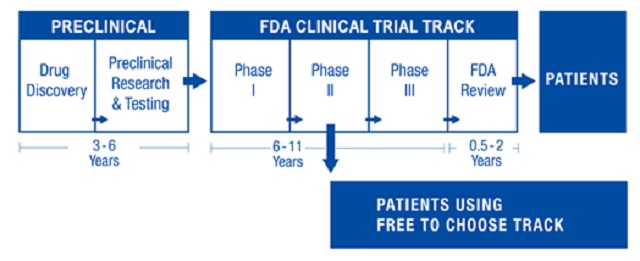
FTCM legislation in the U.S. would create a dual track system (see figure below) that preserves the existing FDA clinical trial process while offering patients an alternative. Patients, advised by their doctors, would be able to contract with a drug developer to use not-yet-approved drugs after Phase I safety trials are successfully completed and one or more Phase II trials have demonstrated continued safety and initial efficacy.

The resulting early access could make FTCM drugs available up to seven years before conventional FDA approval, which entails Phase III randomized control trials and a lengthy FDA review before the FDA makes an approval decision. …

bartgraph

The heart of the dual track system is the Tradeoff Evaluation Drug Database (TEDD) which would be available to the public through a government-supervised web portal. TEDD would contain all treatment results of FTCM drugs including patients’ health characteristics and relevant biomarkers, but no personal identification.

This open access database would be a treasure-trove of information to aid drug developers in making better R&D decisions consistent with fast-paced learning and innovation. …

Today’s world of accelerating medical advancements is ushering in an age of personalized medicine in which patients’ unique genetic makeup and biomarkers will increasingly lead to customized therapies in which samples are inherently small. This calls for a fast-learning, adaptable FTCM environment for generating new data.

In sharp contrast, the status quo FDA environment provides a yes/no approval decision based on statistical tests for an average patient, i.e., a one-size-fits-all drug approval process.

I hold the Bartley J. Madden Chair in Economics at the Mercatus Center, so I am biased, but this is an important proposal. Japan is leading the way and similar ideas are being discussed in Great Britain, but as the most important pharmaceutical market in the world, the United States has an outsize influence on world drug development. We need to lower costs and speed new drugs to market.

This post first appeared at Marginal Revolution.

Alex Tabarrok is a professor of economics at George Mason University. He blogs at Marginal Revolution with Tyler Cowen.

“A Morte é um Erro” – Portuguese Translation of “Death is Wrong” – Translated by Eric Pedro Alvaro – Post by G. Stolyarov II

“A Morte é um Erro” – Portuguese Translation of “Death is Wrong” – Translated by Eric Pedro Alvaro – Post by G. Stolyarov II

The New Renaissance Hat
G. Stolyarov II
******************************

A free PDF version of A Morte é um Erro – the Portuguese translation of Death is Wrong – is now available for download from The Rational Argumentator. You can obtain your copy here and may spread it to Portuguese-speaking audiences as widely as you wish.

A Morte é um Erro was generously translated into Portuguese by Eric Pedro Alvaro.

Death_is_Wrong_Portuguese_CoverPaperback copies of A Morte é um Erro can be purchased in the following venues:

Createspace

Amazon

Kindle copies of A Morte é um Erro can be purchased on Amazon for $0.99.

***

Se você já se perguntou, “Por que as pessoas morrem?” então este livro é para você. A resposta é que não, a morte não é necessária, inevitável ou boa. Na verdade, a morte é um erro. A morte é uma inimiga de todos nós, que deve ser combatida com ciência, medicina e tecnologia. Este livro lhe apresenta os maiores, mais desafiantes e mais revolucionários movimentos para prolongar radicalmente o tempo de vida humano, para que você então simplesmente não precise morrer.

Você aprenderá sobre algumas plantas e animais com um tempo de vida incrivelmente longo, sobre recentes descobertas científicas em relação a ampliação do tempo de vida em humanos, e sobre simples e poderosos argumentos que podem refutar as comuns desculpas para a morte. Se você alguma vez já pensou que a morte é injusta e que ela deve ser derrotada, você não está sozinho. Leia este livro, e se torne parte desta importante busca na história da humanidade.

Este livro foi escrito pelo filósofo e futurólogo Gennady Stolyarov II e ilustrado pela artista Wendy Stolyarov. Com o intuito de lhe mostrar que, não importa quem é você e o que você pode fazer, sempre há uma forma de ajudar humanidade em sua batalha contra morte.

Will Banning Genetic Engineering Kill You? – Article by Edward Hudgins

Will Banning Genetic Engineering Kill You? – Article by Edward Hudgins

The New Renaissance HatEdward Hudgins
******************************

One headline reads “British baby given genetically-edited immune cells to beat cancer in world first.” Another headline reads “Top biologists debate ban on gene-editing.” It’s a literal life-and-death debate.

And if you care to live, pay attention to this philosophical clash!

Exponential growth in genetic engineering

Genetic engineering is on an exponential growth path. In 2001 the cost of sequencing a human-sized genome was about $100 million. By 2007 the cost was down to $10 million.

layla-richard-genetic-engineeringNow it’s just over $1,000. Scientists and even do-it-yourself biohackers can now cheaply access DNA information that could allow them to discover cures for diseases and much more.

Recently, for example, baby Layla Richards [at right] was diagnosed with leukemia. But when none of the usual treatments worked, doctors created designer immune cells, injected them into the little girl and the treatment worked. She was cured.

Designer babies?

But there have been concerns about such engineering for decades; indeed, precautionary guidelines were drawn up by a group of biologists at the 1975 Asilomar conference in California. And now, at a joint conference in Washington, D.C. of the National Academies of Medicine and Sciences, the Chinese Academy of Sciences and the Royal Society of the United Kingdom, a cutting-edge genetic engineering tool known as CRISPR-Cas9 came under attack because it can be used to edit the genomes of sperm, eggs, and embryos.

National Institutes of Health director Francis Collins argued that the children that would result from such editing “can’t give consent to having their genomes altered” and that “the individuals whose lives are potentially affected by germline manipulation could extend many generations into the future.” Hille Haker, a Catholic theologian from Loyola University Chicago, agreed and proposed a two year ban on all research into such manipulation of genomes. Others argued that such manipulation could lead to “designer babies,” that is, parents using this technology to improve or enhance the intelligence and strength of their children.

These arguments are bizarre to say the least.

Damning to misery

To begin with, there is virtual universal agreement among religious and secular folk alike that from birth and until a stage of maturity at which they can potentially guide their lives by their own reason, the consent of children is not needed when their parents make many potentially life-altering decisions for them. Why should this reasonable rule be different for decisions made by parents before a child is born?

And consider that the principal decisions with gene-editing technology would be to eliminate the possibility of the child later in life having Alzheimer’s or Parkinson’s diseases, cancers, and a host of other ailments that plague humanity. Is it even conceivable that any rational individual would not thank their parents for ensuring their health and longevity? Isn’t this what all parents wish for their children? Why would anyone deny parents the tools to ensure healthy children? How much continued misery and death are those who would delay genetic research or ban this new technology inflicting on parents and children alike?

And so what if the “slippery slope” is parents ensuring that their children are more intelligent or stronger? Right now such traits are a matter of a genetic lottery and every parent hopes for the best. What parent wouldn’t jump at the chance to ensure such beneficial capacities for their children?

A privileged biological elite?

Some might pull out the ugly egalitarian argument that the “rich” could produce biologically elite “superchildren,” leaving the rest of humanity behind: an inferior, impoverished breed to be exploited. But this is the same spurious argument made about every technology that initially allows more prosperous individuals to better themselves ahead of others. We heard two decades ago that only the “rich” would be able to afford computers and the internet, allowing them to be more informed and, thus, enabling them to oppress the downtrodden masses. But exponential changes in technologies ensure that just as computers and the internet have become inexpensive and available to all, so will genetic enhancements become after the techniques are perfected for prosperous beta-testers.

And in any case, just as it is immoral to deprive those who honestly earn their wealth of the fruits of their labor just because others have yet to earn theirs, so it is immoral to deprive them of the opportunity to provide the best biology for their children just because it will take time for the technology to become available to all.

Precautionary principle or proactionary principle?

Many opponents of genetic engineering fall back on the so-called “precautionary principle.” This is the notion that if products or technologies pose any imaginable risks—often highly speculative or vague ones unsupported by any sound science—then such products or technologies should be severely restricted, regulated, or banned. The burden is placed on innovators to prove that no harm to humans will result from their innovations.

But had this standard been applied in the past, we would not have the modern world today. Indeed, by this standard, precaution would dictate that fire was just too dangerous for humans and that cavemen should have been barred from rubbing two sticks together.

Max More, a founder of the transhumanist philosophy, offers instead the “proactionary principle.” He argues that “People’s freedom to innovate technologically is highly valuable, even critical, to humanity.” And “Progress should not bow to fear, but should proceed with eyes wide open.” And that we need to “Protect the freedom to innovate and progress while thinking and planning intelligently for collateral effects.”

Freedom to progress

Fortunately, more individuals than More reason this way. At the D.C. conference, University of Manchester Professor John Harris argued “We all have an inescapable moral duty: To continue with scientific investigation to the point at which we can make a rational choice. We are not yet at that point. It seems to me, consideration of a moratorium is the wrong course. Research is necessary.” But the opinion of academics one way or another might not matter. Just as it was do-it-yourselfers and innovators in garages that made the computer and information revolution, genetic innovations might well come from such achievers as well. But they won’t do it if they are not free to do so.

If you value your life and the lives and health of your children, you had better work for this freedom to innovate.

Dr. Edward Hudgins directs advocacy and is a senior scholar for The Atlas Society, the center for Objectivism in Washington, D.C.

Copyright The Atlas Society. For more information, please visit www.atlassociety.org.

Jason Hope on Philanthropy – Article by Reason

Jason Hope on Philanthropy – Article by Reason

The New Renaissance Hat
Reason
November 30, 2015
******************************

Jason Hope, you might recall, has provided half a million dollars in research funding to the SENS Research Foundation, used to establish a SENS laboratory at Cambridge in order to push forward with the Foundation’s AGE-breaker program. AGE-breakers are drugs or other treatments capable of breaking down advanced glycation end-products (AGEs). These are a class of metabolic waste product that accumulate in our tissues to cause significant harm that includes the progressive loss of elasticity in skin and blood vessels.

There is, on the whole, far too little work undertaken today on AGE-breaker treatments in comparison to the benefits that a treatment could bring. What little research has taken place over the past twenty years unfortunately produced no effective therapies. As it turned out the AGEs that are important in short-lived laboratory animals are not the same at all as those that are important in humans – something that would have been challenging to identify until comparatively recently, and which resulted in promising animal studies that then went nowhere in commercial trials.

Now, however, researchers know that the vast majority of all AGEs in human tissues consist of just one type, called glucosepane – so the way is open for bold philanthropists and forward-looking researchers to build therapies that will be effective in removing this contribution to degenerative aging. Glucospane removal is one of the areas in which the SENS Research Foundation and its backers pick up the slack, undertaking important rejuvenation research that is neglected by the mainstream, even though it was exactly the mainstream research community that produced all of the studies and evidence that demonstrate the important role of glucospane in aging.

In any case, I should point out that Jason Hope runs a website and blog in which he discusses his take on philanthropy and his support for research aimed at extending healthy human life and rejuvenating the old. This makes for an interesting follow-on from yesterday’s post on big philanthropy. More folk of this ilk would certainly be a good thing, and I’m always pleased to see more of the better connected people in this world of ours speaking openly of their support for rejuvenation biotechnology.

Philanthropy

Quote:

Philanthropy has become a big focus for me. The organizations I have chosen to stand behind have come from many facets of my life. One of my passions has become the research done at the SENS Research Foundation. Their involvement in anti aging is not just about wanting to live forever. It’s about creating a longer, better quality of life.

Foundations like SENS are taking a different approach to anti-aging. They are focused on finding cures for disease that break down the body and thus cause us to age faster than we should. Disease like Alzheimer’s and heart and lung disease affect all functions of the body. Traditional medicine looks at treating these diseases after they happen. We want to focus on stopping these diseases from ever happening. We have spent so much time focused on medication for treating disease and not enough time on preventing that disease from ever happening.

By supporting scientific research that thrives through innovation and is not afraid to challenge the modern school of thought we will continue to break down walls.

A 21st-Century Philanthropic Model For Philanthropy

Quote:

Can you conceive of a world without age-related disease, disability and suffering? What about a world in which it’s possible for the average person to live 120 healthy years? While it may sound like a utopian dream, such a world is the exact goal of some of society’s most brilliant scientists and visionary leaders. At this very minute, groundbreaking work is underway at universities across the globe as researchers attempt to apply regenerative medicine to age-related disease through the repair of damage to tissue, cells and molecules within the body. While this research couldn’t be possible without the leadership of the world’s wealthiest philanthropists, it also relies upon the collective power of everyday people who have joined forces in their commitment to a better quality of life for all.

Traditionally, big ticket donors have been the primary target for fundraising programs. Research has consistently shown that the bulk of donor funds come from a small percentage of the wealthiest donors: in fact, a full 75 percent of funds raised come from gifts of over $1 million.

Instead of resigning themselves solely to the influence of the individual, non-profits are turning to the collective power of a group. The MFoundation’s “The 300 Pledge” fundraising campaign is an exciting example of this method in practice. The 300 Pledge asks 300 funders to commit $1,000 a year for 25 years toward critical research aimed at ending age-related diseases. When broken down, this goal is manageable for many households: just $3 a day or $85 a month – less than your daily tab at Starbucks. Obviously, the model is working: to date, 291 people have taken up the challenge, with nine spots remaining.

As evidenced by the magnificent philanthropy of people like Peter Thiel, Bill Gates and others like them, it’s obvious that one person can make a difference. However, fundraising challenges, like MFoundation’s “The 300,” also demonstrate the power of a dedicated group of people to foster real world change for the billions of people living in the world today as well as the generations that follow. In doing so, those who take up the challenge create a unique and world-altering legacy for themselves.

Reason is the founder of The Longevity Meme (now Fight Aging!). He saw the need for The Longevity Meme in late 2000, after spending a number of years searching for the most useful contribution he could make to the future of healthy life extension. When not advancing the Longevity Meme or Fight Aging!, Reason works as a technologist in a variety of industries. 
***

This work is reproduced here in accord with a Creative Commons Attribution license. It was originally published on FightAging.org.

SENS Research Foundation Joins the Global #GivingTuesday Movement – Press Release by SENS Research Foundation

SENS Research Foundation Joins the Global #GivingTuesday Movement – Press Release by SENS Research Foundation

The New Renaissance Hat
SENS Research Foundation
November 28, 2015
******************************
Every Dollar Contributed Up to the First $5,000 Will Be Quadrupled, Turning into $20,000.
 ***

MOUNTAIN VIEW, Calif. — November 24, 2015 — The SENS Research Foundation (SRF), a non-profit organization focused on transforming the way the world researches and treats age-related disease, has joined #GivingTuesday, a global day of giving that harnesses the collective power of individuals, communities and organizations to encourage philanthropy and celebrate generosity worldwide. Every dollar donated to SRF up to the first $5,000 will be quadrupled, making every dollar raised turn into $20,000.

Occurring this year on December 1, #GivingTuesday is held annually on the Tuesday after Thanksgiving (in the U.S.) and the widely recognized shopping events Black Friday and Cyber Monday to kick-off the holiday giving season and inspire people to collaborate in improving their local communities and to give back in impactful ways to the charities and causes they support.

SENS Research Foundation is aiming to reach a goal of $20,000 with the help of contributors who have pledged to match each dollar raised up to the first $5,000. The Croeni Foundation, a philanthropic organization dedicated to giving, the environment and health, has pledged to match the first $5,000 raised dollar for dollar. The foundation gave SRF an unrestricted $5,000 earlier this year, as well. Aubrey de Grey, CSO of SENS Research Foundation, has offered a dollar for dollar matching challenge up to $5,000. And Fight Aging! will match every dollar up to $125,000 through December 31, 2015. Fight Aging! encourages the development of medical technologies, lifestyles, and other means to help people live comfortably, healthily, and capably for as long as they desire.

“We are looking forward to participating in #GivingTuesday for a second year, and offer our thanks to Jan Croeni and the Croeni Foundation, as well as Aubrey de Grey and Fight Aging! for their support,” said Jerri Barrett, vice president of outreach, SENS Research Foundation. “Today’s cost for the treatment and care of chronic diseases of aging costs around $40,000 per second and will only continue to go up, as we spend more money per patient, while the number of patients is increasing. As a society, we need to change our ways and start treating age-related diseases more intelligently. The funds we raise on #GivingTuesday will help facilitate our efforts to do just that, as we work to continue learning how to prevent or reverse age-related diseases.”

Those who are interested in joining SENS Research Foundation’s #GivingTuesday initiative can donate at www.sens.org/donate. To learn more about #GivingTuesday participants and activities or to join the celebration of giving, please visit: http://www.givingtuesday.org/

About SENS Research Foundation (SRF)

SENS Research Foundation is a 501(c)(3) nonprofit that works to research, develop, and promote comprehensive regenerative medicine solutions for the diseases of aging. SRF is focused on a damage repair paradigm for treating the diseases of aging, which it advances through scientific research, advocacy, and education. SENS Research Foundation supports research projects at universities and institutes around the world with the goal of curing such age-related diseases as heart disease, cancer, diabetes and Alzheimer’s disease. Educating the public and training researchers to support a growing regenerative medicine field are also major endeavors of the organization that are being accomplished though advocacy campaigns and educational programs. For more information, visit www.sens.org.

Media Contact:
Jerri Barrett
408-204-7229
jerri.barrett@sens.org

The Immortals Among Us – Article by Reason

The Immortals Among Us – Article by Reason

The New Renaissance Hat
Reason
November 26, 2015
******************************

Let us define immortality as being a state of agelessness, which seems a common colloquial usage these days. More precisely this means that the risk of death due to intrinsic causes such as wear and tear damage of vital organs remains the same over time, perhaps due to advanced medical interventions. Falling pianos are still going to kill you, and a hypothetical biologically young immortal in a hypothetical environment maintaining today’s first world extrinsic mortality rate would have a half-life of 500 years or so, meaning that at any age, there is a 50% chance of evading a life-ending event for another 500 years. There are no human immortals by this criteria of a static intrinsic mortality rate, it seems, though for a while it looked like very old humans might have essentially flat but very high mortality rates in the same way as very old flies do. Immortality in a state of advanced frailty and coupled with a 90% or higher yearly mortality rate isn’t the sort of circumstance that most people would aspire to, of course. It barely improves on the actual circumstance that the oldest of people find themselves in, all too briefly.

However, let us think beyond the box. Consider the small horde of children that you’ll find playing and running in any junior schoolyard here and now. By the time the survivors of their cohorts reach a century of age, the 2100s will have arrived. If the current very slow trend in increasing adult life expectancy continues, adding a year of remaining life expectancy at 60 for every passing decade, then something like 25% of these present children will live to see that centenary. But I don’t for one moment believe that this trend will continue as it has in the past. Past increases in life expectancy were an incidental side-effect of general improvements in medicine across the board, coupled with increasing wealth and all the benefits that brings. Across all of that time, no-one was seriously trying to intervene in the aging process, to address the causes of aging, or to bring aging under medical control. Times are changing, and now many groups aiming to build some of the foundations needed to create exactly this outcome. You may even have donated to support some of them, such as the SENS Research Foundation. The trend in longevity in an age in which researchers are trying to treat the causes of aging will be very different from the trend in longevity in an age in which no such efforts are taking place.

You don’t have to dig very far into the state of the science to see that the first rejuvenation treatments are very close, their advent limited only by funding. If funding were no issue for senescent cell clearance, for example, it would absolutely, definitively be in clinics a decade from now. Other necessary technologies are more distant, but not that much more distant – the 2030s will be an exciting time for the medical sciences. For the occupants of today’s junior playground, it seems foolish to imagine that by age 60 they will not have access to rejuvenation treatments after the SENS model at various stages of maturity, many having having been refined for more than 30 years, at the height of their technology cycle, and just giving way to whatever radical new improvement happens next.

Take a moment for a sober look at the sweeping differences and expanded technological capabilities that exist between today, the 1960s, and the 1910s. So very much has been achieved, and that pace of progress is accelerating. Those junior playground athletes of today will live to see a world even more radically different and advanced than our present time is in comparison to the First World War era. These are the immortals among us. The majority of them will have the opportunity to attain actuarial escape velocity, to keep on using ever-improving versions of rejuvenation treatments until they are gaining life expectancy at a faster rate than they are aging. Their cellular damage, the wear and tear created by the normal operation of metabolism, will be repaired as fast as it is is generated. It is the rest of us, those of us who are no longer spring chickens, who are faced with much more of a race to the goal. The degree to which we can successfully fund and advocate the necessary research is the determinant of whether we can scrape by into the age of rejuvenation treatments, or whether we will gain modest benefits but still age to death – because we were born too soon, and because the rest of the world didn’t get its collective act together rapidly enough in what is now the very tractable matter of building a cure for aging.

Reason is the founder of The Longevity Meme (now Fight Aging!). He saw the need for The Longevity Meme in late 2000, after spending a number of years searching for the most useful contribution he could make to the future of healthy life extension. When not advancing the Longevity Meme or Fight Aging!, Reason works as a technologist in a variety of industries. 
***

This work is reproduced here in accord with a Creative Commons Attribution license. It was originally published on FightAging.org.

Google Life Sciences to Fund Heart Disease Program – Article by Reason

Google Life Sciences to Fund Heart Disease Program – Article by Reason

The New Renaissance Hat
Reason
November 22, 2015
******************************

An interesting next step from Google Life Sciences: they are putting forward $50 million in search of a laboratory to propose a program that pushes forward the state of the art in research and treatment of heart disease. Spent over ten years, that would produce an organization about the present size of the SENS Research Foundation, or a tenth of the Buck Institute, for purposes of comparison – and smaller than many of the research groups presently dedicated to the study of heart disease. So this is a sizable and welcome investment in medical research, but the significance is overhyped by the reporting organization here; no-one is going to cure heart disease with a $50 million project, since heart disease is caused by aging, and in the most general sense. This is an effort to change the funding landscape, stir things up, and make some progress.

If you walk through the list of forms of cell and tissue damage that causes degenerative aging, near every one of them contributes to structural failure of the cardiovascular system. The loss of stem cell activity and consequent decline in repair of tissues is only one of these: oxidized lipids that contribute to atherosclerosis in blood vessel walls; extracellular cross-links stiffen blood vessel walls and cause hypertension and consequent structural weakening in the heart; senescent cells wreck havoc on all the tissues they accumulate in; transthyretin amyloids that accumulate with age are implicated in heart disease via their ability to clog the cardiovascular system; and the loss of lysosomal function in long-lived cells, including those of the heart, progressively damages their function. Curing heart disease, removing it from the picture, requires treatments that effectively address near all of the causes of aging.

Quote from “Google Aims a $50 Million Moonshot at Curing Heart Disease” by Davey Alba, WIRED, November 16, 2015:

Cardiovascular disease people on Earth than anything else – over 17 million a year, and the number keeps going up. Of those deaths, more than 40 percent is due to coronary heart disease. Medicine has drugs that can treat it and practices that can help prevent it, but nobody really knows what causes it or how to cure it. Now, Google and the American Heart Association aim to change that by dropping a $50 million funding bomb on the problem. And as you might expect from a Silicon Valley giant that believes in moving fast and breaking things – an approach that hasn’t always transferred well to basic scientific research – the company isn’t spreading the money around. Google Life Sciences and the AHA said the money would go to one team over five years. “Traditional research funding models are often incremental and piecemeal, making it difficult to study a long-term, multifaceted subject. AHA and Google Life Sciences have committed to a bold new approach.”

The AHA, already the largest funder of cardiovascular research in the US outside of the federal government, says the program will be its most heavily funded initiative in nearly a century. Applications begin in January and if all goes according to plan, they’ll be due by February 14th. (Valentine’s Day. Get it?) If you want the $50 million, your idea has to fit on a single page. And Google won’t take a financial or intellectual property stake in the results. The organizations hope that the program will accelerate the field of heart research much like Google’s self-driving car eventually compelled the entire automobile industry to follow its lead.

Link: http://www.wired.com/2015/11/google-aims-a-50-million-moonshot-at-curing-heart-disease/

Reason is the founder of The Longevity Meme (now Fight Aging!). He saw the need for The Longevity Meme in late 2000, after spending a number of years searching for the most useful contribution he could make to the future of healthy life extension. When not advancing the Longevity Meme or Fight Aging!, Reason works as a technologist in a variety of industries. 
***

This work is reproduced here in accord with a Creative Commons Attribution license. It was originally published on FightAging.org.

On Soda Taxes and Purported Health Benefits – Article by Peter Van Doren

On Soda Taxes and Purported Health Benefits – Article by Peter Van Doren

The New Renaissance HatPeter Van Doren
October 27, 2015
******************************

This week, the New York Times editorial board wrote in support of greater taxes on sweetened drinks, citing new research from a team Mexican and American researchers. They praise the novel design of the tax, which is levied on drink distributors rather than consumers. This caused the tax to be included in shelf prices, making the increase in total cost clear to consumers. The research found that soda consumption fell 12 percent in a year, and 17 percent among the poorest Mexicans.

The Times admits that we do not know whether any health benefits will actually result from soda taxes.  In this article in Regulation, the University of Pennsylvania’s Jonathan Klick and Claremont McKenna’s Eric Helland examined the effects of soda taxes. They conclude that a one percent increase in soda taxes led to a five percent reduction in soda consumption among young people.  But consumers substituted to other beverages.  A 6-calorie reduction in soda consumption was accompanied by an 8-calorie increase in milk consumption and a 2-calorie increase in juice consumption. Thus, the tax on soda led to an increase in overall calorie consumption, which offset the benefits of falling soda consumption. Moreover, there was “no statistically significant effect of soda taxes on body weight or the likelihood of being obese or overweight”.

Peter Van Doren is editor of the quarterly journal Regulation and an expert in the regulation of housing, land, energy, the environment, transportation, and labor. He has taught at the Woodrow Wilson School of Public and International Affairs (Princeton University), the School of Organization and Management (Yale University), and the University of North Carolina at Chapel Hill. From 1987 to 1988 he was the postdoctoral fellow in political economy at Carnegie Mellon University. His writing has been published in the Wall Street Journal, the Washington Post, Journal of Commerce, and the New York Post. Van Doren has also appeared on CNN, CNBC, Fox News Channel, and Voice of America.

He received his bachelor’s degree from the Massachusetts Institute of Technology and his master’s degree and doctorate from Yale University.

This work by Cato Institute is licensed under a Creative Commons Attribution-NonCommercial-ShareAlike 3.0 Unported License.

Lifespan Challenge: Support the MitoSENS Mitochondrial Repair Project Research Fundraiser – Video by G. Stolyarov II

Lifespan Challenge: Support the MitoSENS Mitochondrial Repair Project Research Fundraiser – Video by G. Stolyarov II

The New Renaissance HatG. Stolyarov II
October 21, 2015
******************************

Mr. Stolyarov, author of “Death is Wrong” and Chief Executive of the Nevada Transhumanist Party (NTP), challenges all members of the NTP and the general public to donate to life-extension research – particularly, the ongoing MitoSENS Mitochondrial Repair Project for which crowdfunding is currently being conducted on Lifespan.io.

LifespanChallengeSign-513x396