Browsed by
Category: Technology

Space Elevator – Art by Glenn Clovis

Space Elevator – Art by Glenn Clovis

space_elevator_by_glennclovis-d7egmifNote: Left-click on this image to get a full view of this digital work of art.

Created by digital artist Glenn Clovis, this art was created for the 23rd Exhibition of The Luminarium, “KIBERNETIK”. The entire exhibit can be viewed here.

Visit Glenn Clovis’s DeviantArt page and view his other art.

This work is licensed under a Creative Commons Attribution-Noncommercial-No Derivative Works 3.0 License.

On Viewing 2001: The First Transhumanist Film – Article by Edward Hudgins

On Viewing 2001: The First Transhumanist Film – Article by Edward Hudgins

The New Renaissance HatEdward Hudgins
November 20, 2015
******************************

I recently saw 2001: A Space Odyssey again on the big screen. That’s the best way to see this visually stunning cinematic poem, like I saw it during its premiere run in 1968. The film’s star, Keir Dullea, attended that recent screening and afterward offered thoughts on director Stanley Kubrick’s awe-inspiring opus.

2001-space-odyssey-objectivism-transhumanism

He and many others have discussed the visions offered in the film. Some have come to pass: video phone calls and iPad tablets, for example. Others, sadly, haven’t: regularly scheduled commercial flights to orbiting space stations and Moon bases.

But what should engage our attention is that the film’s enigmatic central theme of transformation is itself transforming from science fiction to science fact.

From apes to man

The film’s story came from a collaboration between Kubrick and sci-fi great Arthur C. Clarke. If you’re familiar with Clarke’s pre-2001 novel Childhood’s End and his short story “The Sentinel” you’ll recognize themes in the film.

In the film we see a pre-human species on the brink of starvation, struggling to survive. An alien monolith appears and implants in the brain of one of the more curious man-apes, Moonwatcher, an idea. He picks up a bone and bashes in the skull of one of a herd of pigs roaming the landscape. Now he and his tribe will have all the food they need.

We know from Clarke’s novel, written in conjunction with the film script, that the aliens actually alter Moonwatcher’s brain, giving it the capacity for imagination and implanting a vision of him and his tribe filled with food. He sees that there is an alternative to starvation and acts accordingly. The aliens had juiced evolution. Kubrick gives us the famous scene where Moonwatcher throws the bone in the air. As it falls the scene cuts ahead to vehicle drifting through space. Natural evolution over four million years has now transformed ape-men into modern technological humans.

From stars to starchild

In the film, astronauts discover a monolith buried on the Moon, which sends a signal toward Jupiter. A spaceship is sent to investigate, and astronaut Dave Bowman, played by Dullea, discovers a giant monolith in orbit. He enters it and passes through an incredible hyperspacial stargate. At the end of his journey, Bowman is transformed by the unseen aliens’ monolith into a new, higher life form, an embryo-appearing starchild with, we presume, knowledge and powers beyond anything dreamt of by humans. He is transhuman!

starchild-2001-space-odyssey

Kubrick and Clarke are making obvious references to Nietzsche’s Also Sprach Zarathustra. In that book Nietzsche offers a vision of a human going through three transformations, ending up as a child. “Innocent is the child . . . a new beginning . . . a first movement . . . a holy ‘Yes’.” The child is the creator and the potential for the creation of new values. And, of course, Kubrick used the introduction/sunrise music from the Richard Strauss tone poem named for Nietzsche’s work in the film’s famous opening; in the scene when an idea dawns in the brain of the ape-man; and at the end, when the human is reborn as the starchild. This is as over-the-top symbolism as there ever was!

From evolution to creation

In 2001 natural evolution and alien intervention transform ape-man, to man, to übermensch. Today, we humans are taking control of our own evolution and are beginning to transform ourselves—but into what?

Futurists like Max and Natasha Vita More and Ray Kurzweil have given us the transhumanist philosophy, the idea that we humans can and should use technology to overcome our biological limits, enhancing our physical and mental capacities. Scientists, researchers, and engineers today are doing just this.

They are creating advanced bionic implants and prosthetics to replace lost limbs or body parts. They are working on brain-machine interfaces that could better merge the two. They are experimenting with actually implanting information into brains. They have genetically engineered certain cells to attack only cancer cells. They are working to program nanobots to do the same. And they are understanding the deep mechanisms that cause cells over time to break down, and are exploring ways to “turn off” this process—that is, to actually stop aging. Could we engineer superbrains for real, eternally young übermenschen in decades to come?

Today, the fundamental theme of 2001, human transcendence, is being made real by we humans rather than by alien monoliths. So when you next see this classic film, you might see still see the starchild as a piece of evocative fiction. But you can appreciate that we humans are putting ourselves on a path to something in the future beyond anything dreamt of by humans.

Dr. Edward Hudgins directs advocacy and is a senior scholar for The Atlas Society, the center for Objectivism in Washington, D.C.

Copyright The Atlas Society. For more information, please visit www.atlassociety.org.

The War on Cars Is a War on Workers and the Poor – Article by Gary M. Galles

The War on Cars Is a War on Workers and the Poor – Article by Gary M. Galles

The New Renaissance Hat
Gary M. Galles
November 6, 2015
******************************

A just-released poll of Los Angeles residents found that 55 percent of respondents indicated their greatest concern was “traffic and congestion,” far ahead of “personal safety” — the next highest area of concern — at 35 percent. So if their city government was working in their best interests, it would be doing something about automobile congestion.

It is. Unfortunately, it will make things worse.

Los Angeles’s recently adopted Mobility Plan 2035 would replace auto lanes in America’s congestion capital with bus and protected bike lanes, as well as pedestrian enhancements, despite heightening congestion for the vast majority who will continue to drive. Even the City’s Environmental Impact Report admitted “unavoidable significant adverse impacts” on congestion, doubling the number of heavily congested (graded F) intersections to 36 percent during evening rush hours.

Driving Saves Time and Offers More Opportunity

Such an effort to ration driving by worsening gridlock purgatory begs asking a central, but largely ignored, question. Why do planners’ attempts to force residents into walking, cycling, and mass transit — supposedly improving their quality of life — attract so few away from driving?

The reason it takes a coercive crowbar to get most people out of their cars is that automobile users have concluded cars are vastly superior to the alternatives.

Why is automobile use so desirable:

  • Automobiles have far greater and more flexible passenger — and cargo-carrying capacities.
  • They allow direct, point-to-point service.
  • They allow self-scheduling rather than requiring advance planning.
  • They save time.
  • They have far better multi-stop trip capability (this is why restrictions on auto use punish working mothers most).
  • They offer a safer, more comfortable, more controllable environment, from the seats to the temperature to the music to the company.

Those massive advantages explain why even substantial new restrictions on automobiles or improvements in alternatives leave driving the dominant choice. However, they also reveal that a policy that will punish the vast majority who will continue to drive cannot serve residents effectively.

How Restrictions on Automobiles Punish the Working Poor the Most

The superiority of automobiles doesn’t stop at the obvious, either. They expand workers’ access to jobs, increasing productivity and incomes, improve purchasing choices, lower consumer prices and widen social options. Reducing roads’ car-carrying capacity undermines those major benefits.

Cars offer a decrease in commuting times (if not hamstrung by city-government planning), providing workers access to many more potential employers and job markets. This improves worker-employer matches, with expanded productivity both benefiting employers and raising workers’ incomes.

One study found that a 10-percent improvement in travel time raised worker productivity 3 percent. And increasing from a 3 mph walking speed to 30 mph driving speed is a 900-percent increase. In a similar vein, a Harvard analysis found that for those lacking high-school diplomas, owning a car increased monthly earnings by $1,100.

Cars are also the only means of assembling enough customers to sustain large stores with highly diverse offerings. Similarly, “automobility” dramatically expands the menu of social opportunities that are accessible.

Supporters like Los Angeles Mayor Eric Garcetti may dismiss the serious adverse effects of the “road diets” they propose (a term whose negative implications were too obvious, getting it benched in favor of the better-sounding “complete streets”). But by demeaning cars as “the old model” and insisting “we have to have neighborhoods that are more self-contained,” the opponents of auto use do nothing to lessen the huge costs or increase the very limited benefits they plan to impose on those they supposedly represent.

Further, the “new model” of curtailing road capacity to force people out of cars is really a recycled old far-inferior model. As urban policy expert Randal O’Toole noted in The Best-Laid Plans:

Anyone who prefers not to drive can find neighborhood … where they can walk to stores that offer a limited selection of high-priced goods, enjoy limited recreation and social opportunities, and take slow public transit vehicles to some but not all regional employment centers, the same as many Americans did in 1920. But the automobile provides people with far more benefits and opportunities than they could ever have without it.

Gary M. Galles is a professor of economics at Pepperdine University. He is the author of The Apostle of Peace: The Radical Mind of Leonard Read. Send him mail. See Gary Galles’s article archives.

This article was published on Mises.org and may be freely distributed, subject to a Creative Commons Attribution United States License, which requires that credit be given to the author.

Economic Growth Slashed Global Poverty to Historically Unprecedented Level – Article by Marian L. Tupy

Economic Growth Slashed Global Poverty to Historically Unprecedented Level – Article by Marian L. Tupy

The New Renaissance HatMarian L. Tupy
October 6, 2015
******************************
According to the World Bank, for the first time in human history, “less than 10 percent of the world’s population will be living in extreme poverty by the end of 2015.” The bank has “used a new income figure of $1.90 per day to define extreme poverty, up from $1.25. It forecasts that the proportion of the world’s population in this category will fall from 12.8 percent in 2012 to 9.6 percent.”
Global poverty rate, official and baseline scenario, percent

As scholars have noted, historically speaking, grinding poverty was the norm for most ordinary people. Even in the most economically advanced parts of the world, life used to be miserable. To give one example, at the end of the 18th century, ten million of France’s twenty-three million people relied on some sort of public or private charity to survive and three million were full-time beggars.

Thanks to industrial revolution and trade, economic growth in the West accelerated to historically unprecedented levels. Over the course of the 19th and 20th centuries, real incomes in the West increased fifteen-fold. But the chasm that opened up as a result of the Western take-off is now closing.

Life expectancy at birth, West and the Rest, years

The rise of the non-Western world is, unambiguously, a result of economic growth spurred by the abandonment of central-planning and integration of many non-Western countries into the global economy. After economic liberalization in China in 1978, to give one example, real incomes rose thirteen-fold.

As Princeton University Professor Angus Deaton notes in his book The Great Escape, “[T]he rapid growth of average incomes, particularly in China and India, and particularly after 1975, did much to reduce extreme poverty in the world. In China most of all, but also in India, the escape of hundreds of millions from traditional and long established poverty qualifies as the greatest escape of all.”

Marian L. Tupy is the editor of HumanProgress.org and a senior policy analyst at the Center for Global Liberty and Prosperity. He specializes in globalization and global wellbeing, and the political economy of Europe and sub-Saharan Africa. His articles have been published in the Financial Times, Washington Post, Los Angeles Times, Wall Street Journal, U.S. News and World Report, The Atlantic, Newsweek, The U.K. Spectator, Weekly Standard, Foreign Policy, Reason magazine, and various other outlets both in the United States and overseas. Tupy has appeared on The NewsHour with Jim Lehrer, CNN International, BBC World, CNBC, MSNBC, Al Jazeera, and other channels. He has worked on the Council on Foreign Relations’ Commission on Angola, testified before the U.S. Congress on the economic situation in Zimbabwe, and briefed the Central Intelligence Agency and the State Department on political developments in Central Europe. Tupy received his B.A. in international relations and classics from the University of the Witwatersrand in Johannesburg, South Africa, and his Ph.D. in international relations from the University of St. Andrews in Great Britain.

This work by Cato Institute is licensed under a Creative Commons Attribution-NonCommercial-ShareAlike 3.0 Unported License.

Platform Adoption Statement #1 of the Nevada Transhumanist Party: Religious and Non-Religious Doctrines, Beneficial and Detrimental Technologies, and Voting in Accordance with Individual Conscience

Platform Adoption Statement #1 of the Nevada Transhumanist Party: Religious and Non-Religious Doctrines, Beneficial and Detrimental Technologies, and Voting in Accordance with Individual Conscience

The New Renaissance HatG. Stolyarov II
October 4, 2015
******************************

NTP-Logo-9-1-2015

The following sections are hereby added to the Nevada Transhumanist Party Platform. Pursuant to Article I, Section XXV, these sections are not officially considered part of the Nevada Transhumanist Party Constitution at this time, but shall have equivalent standing to the Platform Sections within that Constitution. It will be possible to officially amend the Nevada Transhumanist Party Constitution to include these statements during periodic biennial filings of Certificates of Continued Existence with the Nevada Secretary of State.

Section XXVI: The Nevada Transhumanist Party welcomes both religious and non-religious individuals who support life extension and emerging technologies. The Nevada Transhumanist Party recognizes that some religious individuals and interpretations may be receptive to technological progress and, if so, are valuable allies to the transhumanist movement. On the other hand, the Nevada Transhumanist Party is also opposed to any interpretation of a religious doctrine that results in the rejection of reason, censorship, violation of individual rights, suppression of technological advancement, and attempts to impose religious belief by force and/or by legal compulsion.

Section XXVII: The Nevada Transhumanist Party is furthermore opposed to any interpretation of a secular, non-religious doctrine that results in the rejection of reason, censorship, violation of individual rights, suppression of technological advancement, and attempts to impose certain beliefs by force and/or by legal compulsion. Examples of such doctrines opposed by the Nevada Transhumanist Party include Stalinism, Maoism, Neo-Malthusianism, the death-acceptance movement, and the doctrine of censorship, now prevalent on many college campuses in the United States, in the name of “social justice”, combatting “triggers” or “microaggressions”, or avoiding subjectively perceived offense.

Section XXVIII: The Nevada Transhumanist Party holds that the vast majority of technologies are beneficial to human well-being and should be enthusiastically advocated for and developed further. However, a minority of technologies could be detrimental to human well-being and, as such, their application, when it results in detrimental consequences, should be opposed. Examples of such detrimental technologies include nuclear, chemical, and biological weapons, mass-surveillance systems such as those deployed by the National Security Agency in the United States, and backscatter X-ray full-body scanners such as those used by the Transportation Security Administration in the United States. Furthermore, the Nevada Transhumanist Party is opposed to the deliberate engineering of new active pathogens or the resurrection of once-existing pathogens, whose spread might not be able to be contained within laboratory settings. While it is impossible to un-learn the knowledge utilized in the creation of such technologies, the Nevada Transhumanist Party holds that all such knowledge should only be devoted toward peaceful, life-affirming, rights-respecting purposes, going forward.

Section XXIX: The Nevada Transhumanist Party holds that each of its members should vote or abstain from voting in accordance with that member’s own individual conscience and judgment. If an official or candidate of the United States Transhumanist Party or the Nevada Transhumanist Party expresses a preference for any particular non-transhumanist candidate for office, then no national or State-level Transhumanist Party, nor any individual transhumanist, ought to be in any manner bound to support that same non-transhumanist candidate.

Adopted on October 4, 2015:

Mr. Gennady Stolyarov II, ASA, ACAS, MAAA, CPCU, ARe, ARC, API, AIS, AIE, AIAF

Chief Executive, Nevada Transhumanist Party

All Food Is Genetically Modified. Now We’re Just Better at It. – Article by Chelsea Follett

All Food Is Genetically Modified. Now We’re Just Better at It. – Article by Chelsea Follett

The New Renaissance Hat
Chelsea Follett
September 11, 2015
******************************
There is huge potential for progress in biotech.

A recent article in Business Insider showing what the ancestors of modern fruits and vegetables looked like painted a bleak picture. A carrot was indistinguishable from any skinny brown root yanked up from the earth at random. Corn looked nearly as thin and insubstantial as a blade of grass. Peaches were once tiny berries with more pit than flesh. Bananas were the least recognizable of all, lacking the best features associated with their modern counterparts: the convenient peel and the seedless interior. How did these barely edible plants transform into the appetizing fruits and vegetables we know today? The answer is human ingenuity and millennia of genetic modification.

Carrot_Comparison(Photo Credit: Genetic Literacy Project and Shutterstock via Business Insider).

Humanity is continuously innovating to produce more food with less land, less water, and fewer emissions. As a result, food is not only more plentiful, but it is also coming down in price.

Tech_Food_Cheaper

The pace of technological advancement can be, if you will pardon the pun, difficult to digest. Lab-grown meat created without the need to kill an animal is already a reality. The first lab-grown burger debuted in 2013, costing over $300,000, but the price of a lab-grown burger patty has since plummeted, and the innovation’s creator “expects to be able to produce the patties on a large enough scale to sell them for under $10 a piece in a matter of five years.”

People who eschew meat are a growing demographic, and lab-grown meat is great news for those who avoid meat solely for ethical reasons. It currently takes more land, energy, and water to produce a pound of beef than it does to produce equivalent calories in the form of chickens, but also grains. So, cultured meat could also lead to huge gains in food production efficiency.

Another beautiful example of human progress in the realm of food is golden rice. The World Health Organization estimates that between 250,000 and 500,000 children become blind every year as a result of vitamin A deficiency, and about half of them die within a year of losing their sight. Golden rice, largely a brainchild of the private Rockefeller Foundation, is genetically engineered to produce beta carotene, which the human body can convert into vitamin A. Golden rice holds the potential to protect hundreds of thousands of children in the developing world from vitamin A deficiency, preserving their sight and, in many cases, saving their lives.

Humans have been modifying food for millennia, and today we’re modifying it in many exciting ways, from cultured meat to golden rice. Sadly, it has become fashionable to fear modern genetically-modified organisms (GMOs), even though scientists overwhelmingly agree that GMOs are safe.

Anti-GMO hysteria motivated the popular restaurant chain Chipotle to proclaim itself “GMO-free” earlier this year (a dubious claim), prompted a political movement calling for the labeling of GM foods (a needless regulation implying to consumers that GMOs are hazardous), and even fueled opposition to golden rice. HumanProgress.org advisory board member Matt Ridley summarized the problem in his recent Wall Street Journal op-ed:

After 20 years and billions of meals, there is still no evidence that [GMOs] harm human health, and ample evidence of their environmental and humanitarian benefits. Vitamin-enhanced GM “golden rice” has been ready to save lives for years, but opposed at every step by Greenpeace. Bangladeshi eggplant growers spray their crops with insecticides up to 140 times in a season, risking their own health, because the insect-resistant GMO version of the plant is fiercely opposed by environmentalists. Opposition to GMOs has certainly cost lives.

Besides, what did GMOs replace? Before transgenic crop improvement was invented, the main way to breed new varieties was “mutation breeding”: to scramble a plant’s DNA randomly, using gamma rays or chemical mutagens, in the hope that some of the monsters thus produced would have better yields or novel characteristics. Golden Promise barley, for example, a favorite of organic brewers, was produced this way. This method still faces no special regulation, whereas precise transfer of single well known genes, which could not possibly be less safe, does.

Fortunately, while regulations motivated by anti-GMO sentiment may slow down progress, they probably cannot do so indefinitely. For those who wish to avoid modern GM foods, the market will always provide more traditional alternatives, and for the rest of us, human ingenuity will likely continue to increase agricultural efficiency and improve food in ways we cannot even imagine. Learn more about the progress we have already made by visiting HumanProgress.org and selecting the “Food” category under “Browse Data.”

Chelsea Follett (Chelsea German) works at the Cato Institute as a Researcher and Managing Editor of HumanProgress.org.
***
Artisanopolis – Seasteading City Concept by Gabriel Scheare, Luke Crowley, Lourdes Crowley, and Patrick White

Artisanopolis – Seasteading City Concept by Gabriel Scheare, Luke Crowley, Lourdes Crowley, and Patrick White

The New Renaissance HatGabriel Scheare, Luke Crowley, Lourdes Crowley, and Patrick White
August 8, 2015
******************************

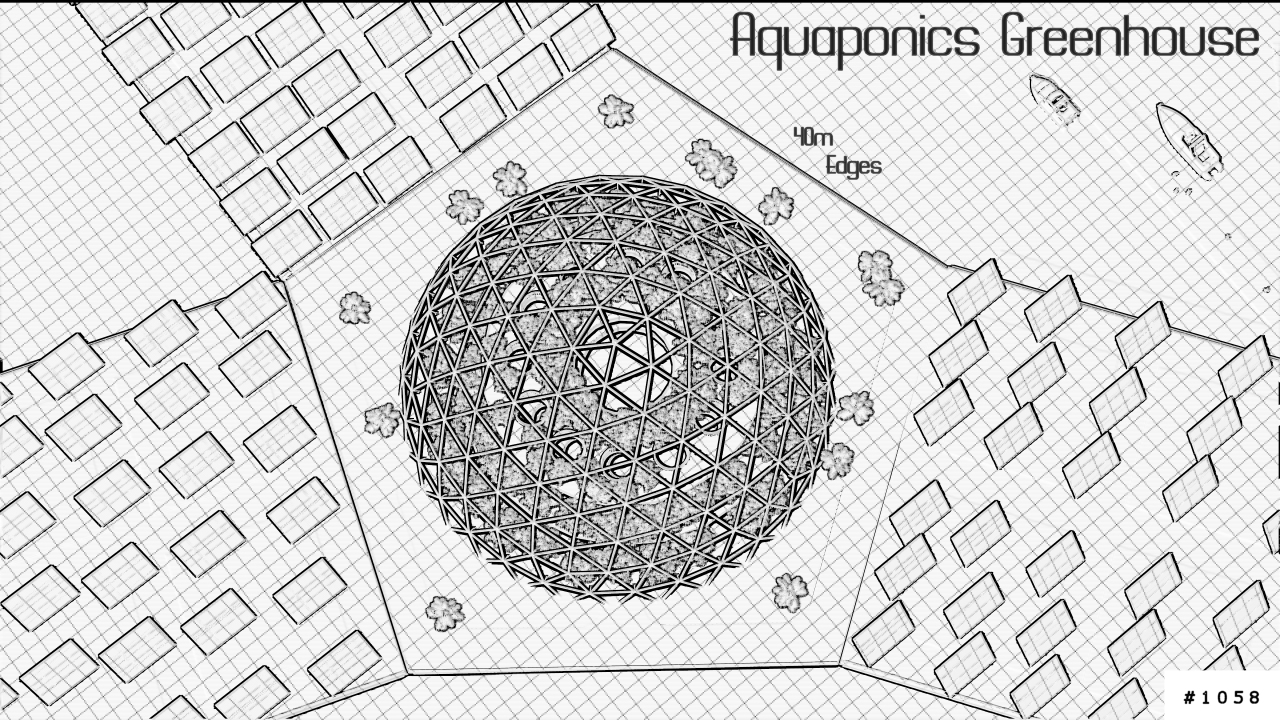
Artisanopolis, created by Gabriel Scheare, Luke & Lourdes Crowley, and Patrick White of Roark 3D and Fortgalt as a gift to The Seasteading Institute, in conjunction with the Institute’s Architectural Design Contest.

Description by The Seasteading Institute: Based on the foundational vision of The Seasteading Institute and DeltaSync, these works of art constitute an attempt at communicating the essence of what the infrastructure of sea-based civilization might look like in the near future. In this age of limited governance options, we intend to suggest an alternative model that allows new communities to form beyond the limiting jurisdictions of existing nation states in order to promote freedom and competition in the marketplace.

Each floating platform can be towed via tugboat from location to location and they can interlock to form sprawling formations over the water’s surface. Ballasts are used to adjust the depth at which the platforms sit in the water and coupling latches lock them together to form larger, cohesive footprints for convenience and stability. Modeled after those found at the seaport of Brighton, England, a large modular wavebreaker surrounds the city to shelter it from rough waters and wind while energy is supplied by renewable means like photovoltaic panel arrays and wave-driven turbines. Aquaponics greenhouse domes provide locally grown food, seawater is desalinated on site to provide drinking water, organic waste is removed via tankers to an off-site composting location, and inorganic waste is recycled. With so much focus on efficiency and sustainability, The Floating City Project promises to serve as a viable template upon which other seasteading projects can be modeled in the future.

All design contest images on this page are under the Creative Commons Attribution License. It means that you are allowed to redistribute and modify images but that you must attribute the original designer when doing so.

Note: Left-click on the images to see them in higher resolution.

Artisanopolis_01 Artisanopolis_02Artisanopolis_03Artisanopolis_04Artisanopolis_05Artisanopolis_06Artisanopolis_07Artisanopolis_08 Artisanopolis_09Artisanopolis_10Artisanopolis_11Artisanopolis_12Artisanopolis_13


The Gig Economy Makes Karl Marx’s Dreams Come True – And It’s All Capitalism’s Doing – Article by Max Borders

The Gig Economy Makes Karl Marx’s Dreams Come True – And It’s All Capitalism’s Doing – Article by Max Borders

The New Renaissance HatMax Borders
August 4, 2015
******************************
When Joe Average steps out of his car after completing his shift for Lyft, he does so on his own terms. Nobody tells him when to start. Nobody tells him when to stop. The siren song that is prime time pricing might have coaxed him off the couch, but ultimately it was his call. And with the rest of his day, he’s going to go fishing. You see, Joe loves to fish — even more than he loves making money. After dinner, he might take some time to criticize the second season of True Detective.

Would ole Karl Marx have been happy with this result?

In The German Ideology, Marx wrote,

For as soon as the distribution of labour comes into being, each man has a particular, exclusive sphere of activity, which is forced upon him and from which he cannot escape. He is a hunter, a fisherman, a herdsman, or a critical critic, and must remain so if he does not want to lose his means of livelihood; while in communist society, where nobody has one exclusive sphere of activity but each can become accomplished in any branch he wishes, society regulates the general production and thus makes it possible for me to do one thing today and another tomorrow, to hunt in the morning, fish in the afternoon, rear cattle in the evening, criticise after dinner, just as I have a mind, without ever becoming hunter, fisherman, herdsman or critic.

Marx should be delighted — oh, except that it’s capitalism, not communism, that’s allowing Joe to be a fisherman and a critic on his own terms.

The sharing or “gig” economy is not only disrupting the way people live and work; it’s dividing the left considerably.

On the one hand, you have the nostalgic leftists who want Joe to work a nine-to-five job and skip the fishing. You know, like people did in the 1950s. As Freeman columnist Steve Horwitz writes, presidential candidate Hillary Clinton

longs for a time like the 1950s when workers had the structure of the corporate world and unions through which to lobby and negotiate for pay and benefits, rather than the so-called “gig” economy of so many modern freelance employees, such as Uber drivers. “This on-demand or so-called gig economy is creating exciting opportunities and unleashing innovation,” Clinton said, “but it’s also raising hard questions about workplace protection and what a good job will look like in the future.”

Joe already told us what a good job looks like. It’s one that lets him spend time fishing and criticizing.

More confusing (or confused, perhaps) is Paul Mason’s writing in the Guardian. He lauds “postcapitalism,” which has all the hallmarks of a society Clinton is worried about:

Postcapitalism is possible because of three major changes information technology has brought about in the past 25 years. First, it has reduced the need for work, blurred the edges between work and free time and loosened the relationship between work and wages.

Bingo. The gig economy. But does it make sense to give capitalism a different name? I suppose one could. After all, Marx coined the term. But Marx’s definition of capitalism is a system based on private ownership of the means of production. Has that dynamic fundamentally changed?

Far from it. The sharing economy is simply decentralizing power by allowing ordinary people to use their own small-scale means of production. By solving coordination problems and lowering transaction costs, technology is augmenting capitalism.

When Joe drives for Lyft, for example, his car is still his car. And now more of his time is his, too. Capitalism, even as Marx defined it, hasn’t fundamentally changed. But the use of technology to awaken sleeping private capital is allowing the system to evolve — and rather nicely if you’re Joe Average, or one of thousands of other workers like him.

Now, I’m not saying that there is nothing interesting going on in the electronic commons. Ideas are being configured and reconfigured in the networked economy. Many of those ideas are being taken out of the intellectual-property regime, thanks to open sourcing, and this can be a good thing. There are fierce debates about whether intellectual property (claims to property in ideas and in nonscarce goods) is justifiable. But passing over those debates, more and more open-source technologies are coming online for exploitation by everyone.

Do open sourcing and the creative commons take us to postcapitalism?

I don’t know. But fundamentally, as long as the process is voluntary and carried out peacefully by a community of cooperators, who cares what you call it? Should we be upset that the guy who founded Lyft is getting rich from the tech? Some people are, because they see the accumulation of wealth as taboo. But Joe’s life is better than it would have been in the absence of Lyft. The company allows him to live more of the life he wants to live.

As long as Joe Average is happier, who cares what Hillary Clinton thinks?

Max Borders is editor of The Freeman magazine and director of content for The Foundation for Economic Education (FEE). He is also author of Superwealth: Why we should stop worrying about the gap between rich and poor. A writer and innovator with a decade of experience in the non-profit world, Max works daily towards a condition of peace, freedom and abundance for all people.

This article was published by The Foundation for Economic Education and may be freely distributed, subject to a Creative Commons Attribution 4.0 International License, which requires that credit be given to the author.

How Anti-Individualist Fallacies Prevent Us from Curing Death – Article by Edward Hudgins

How Anti-Individualist Fallacies Prevent Us from Curing Death – Article by Edward Hudgins

The New Renaissance HatEdward Hudgins
July 3, 2015
******************************

Are you excited about Silicon Valley entrepreneurs investing billions of dollars to extend life and even “cure” death?

It’s amazing that such technologically challenging goals have gone from sci-fi fantasies to fantastic possibilities. But the biggest obstacles to life extension could be cultural: the anti-individualist fallacies arrayed against this goal.

Entrepreneurs defy death

 A recent Washington Post feature documents the “Tech titans’ latest project: Defy death. “ Peter Thiel, PayPal co-founder and venture capitalist, has led the way, raising awareness and funding regenerative medicines. He explains: “I’ve always had this really strong sense that death was a terrible, terrible thing… Most people end up compartmentalizing and they are in some weird mode of denial and acceptance about death, but they both have the result of making you very passive. I prefer to fight it.”

Others prefer to fight as well. Google CEO Larry Page created Calico to invest in start-ups working to stop aging. Oracle’s Larry Ellison has also provided major money for anti-aging research. Google’s Sergey Brin and Facebook’s Mark Zuckerberg both have funded the Breakthrough Prize in Life Sciences Foundation.

Beyond the Post piece we can applaud the education in the exponential technologies needed to reach these goals by Singularity U., co-founded by futurist Ray Kurzweil, who believes humans and machines will merge in the decades to become transhumans, and X-Prize founder Peter Diamandis.

The Post piece points out that while in the past two-thirds of science and medical research was funded by the federal government, today private parties put up two-thirds. These benefactors bring their entrepreneurial talents to their philanthropic efforts. They are restless for results and not satisfied with the slow pace of government bureaucracies plagued by red tape and politics.

“Wonderful!” you’re thinking. “Who could object?”

Laurie Zoloth’s inequality fallacy

 Laurie Zoloth for one. This Northwestern University bioethicist argues that “Making scientific progress faster doesn’t necessarily mean better — unless if you’re an aging philanthropist and want an answer in your lifetime.” The Post quotes her further as saying that “Science is about an arc of knowledge, and it can take a long time to play out.”

Understanding the world through science is a never-ending enterprise. But in this case, science is also about billionaires wanting answers in their lifetimes because they value their own lives foremost and they do not want them to end. And the problem is?

Zoloth grants that it is ”wonderful to be part of a species that dreams in a big way” but she also wants “to be part of a species that takes care of the poor and the dying.” Wouldn’t delaying or even eliminating dying be even better?

The discoveries these billionaires facilitate will help millions of people in the long-run. But her objection seems rooted in a morally-distorted affinity for equality of condition: the feeling that it is wrong for some folks to have more than others—never mind that they earned it—in this case early access to life-extending technologies. She seems to feel that it is wrong for these billionaires to put their own lives, loves, dreams, and well-being first.

We’ve heard this “equality” nonsense for every technological advance: only elites will have electricity, telephones, radios, TVs, computers, the internet, smartphones, whatever. Yes, there are first adopters, those who can afford new things. Without them footing the bills early on, new technologies would never become widespread and affordable. This point should be blindingly obvious today, since the spread of new technologies in recent decades has accelerated. But in any case, the moral essential is that it is right for individuals to seek the best for themselves while respecting their neighbors’ liberty to do the same.

Leon Kass’s “long life is meaningless” fallacy

 The Post piece attributes to political theorist Francis Fukuyama the belief that “a large increase in human life spans would take away people’s motivation for the adaptation necessary for survival. In that kind of world, social change comes to a standstill.”

Nonsense! As average lifespans doubled in past centuries, social change—mostly for the better—accelerated. Increased lifespans in the future could allow individuals to take on projects spanning centuries rather than decades. Indeed, all who love their lives regret that they won’t live to see, experience, and help create the wonders of tomorrow.

The Post cites physician and ethicist Leon Kass who asks: “Could life be serious or meaningful without the limit of mortality?”

Is Kass so limited in imagination or ignorant of our world that he doesn’t appreciate the great, long-term projects that could engage us as individuals seriously and meaningfully for centuries to come? (I personally would love to have the centuries needed to work on terraforming Mars, making it a new habitat for humanity!)

Fukuyama and Kass have missed the profound human truth that we each as individuals create the meaning for our own lives, whether we live 50 years or 500. Meaning and purpose are what only we can give ourselves as we pursue productive achievements that call upon the best within us.

Francis Fukuyama’s anti-individualist fallacy

 The Post piece quotes Fukuyama as saying “I think that research into life extension is going to end up being a big social disaster… Extending the average human life span is a great example of something that is individually desirable by almost everyone but collectively not a good thing. For evolutionary reasons, there is a good reason why we die when we do.”

What a morally twisted reason for opposing life extension! Millions of individuals should literally damn themselves to death in the name of society. Then count me anti-social.

Some might take from Fukuyama’s premise a concern that millions of individuals living to 150 will spend half that time bedridden, vegetating, consuming resources, and not producing. But the life extension goal is to live long with our capacities intact—or enhanced! We want 140 to be the new 40!

What could be good evolutionary reasons why we die when we do? Evolution only metaphorically has “reasons.” It is a biological process that blindly adapted us to survive and reproduce: it didn’t render us immune to ailments. Because life is the ultimate value, curing those ailments rather than passively suffering them is the goal of medicine. Life extension simply takes the maintenance of human life a giant leap further.

Live long and prosper

 Yes, there will be serious ethical questions to face as the research sponsored by benevolent billionaires bears fruit. But individuals who want to live really long and prosper in a world of fellow achievers need to promote human life as the ultimate value and the right of all individuals to live their own lives and pursue their own happiness as the ultimate liberty.

Dr. Edward Hudgins directs advocacy and is a senior scholar for The Atlas Society, the center for Objectivism in Washington, D.C.

Copyright, The Atlas Society. For more information, please visit www.atlassociety.org.

World’s First 3D-Printed Bridge Brings New Age Of Architecture – Article by John Vibes

World’s First 3D-Printed Bridge Brings New Age Of Architecture – Article by John Vibes

The New Renaissance HatJohn Vibes
June 29, 2015
******************************

A new bridge is being planned in Amsterdam, which will be constructed by robots that will utilize a 3D printing technology. The project will be completed by Heijmans, the Dutch company responsible for building the solar roadway and other revolutionary projects that are creating positive change.

Jurre van der Ven, Heijmans’ Innovation Manager recently explained how this idea could change how large building projects like bridges are constructed.

Construction and design are currently rather separate factors in construction – the architect designs something and the constructor interprets the design and builds what he thinks is needed, but using 3D printing for a bridge makes design and construction operate hand-in-hand. For instance, both activities are done at the same time, instead of first building the structure and then adding the design later. This means we will also have to start looking at design in a completely different manner,” Jurre van der Ven said.

Joris Laarman, one of the designers, said that the project was a “fantastic metaphor for connecting the technology of the future with the city’s historic past, in a way which would reveal the best aspects of both worlds.”

A location has not yet been set for the bridge, but it will definitely be built somewhere in Amsterdam.

Below is a video showing how the bridge will be created.

John Vibes writes for True Activist and is an author, researcher and investigative journalist who takes a special interest in the counter-culture and the drug war.

This article (World’s First 3D Printed Bridge Brings New Age Of Architecture) is free and open source. You have permission to republish this article under a Creative Commons license with attribution to the author and TrueActivist.com.

The article was originally published on TrueActivist.com.