Browsed by
Category: Technology

The Hoverboard’s Patent Problem – Article by Jeffrey A. Tucker

The Hoverboard’s Patent Problem – Article by Jeffrey A. Tucker

The New Renaissance HatJeffrey A. Tucker
******************************

Who has the right to make a “hoverboard”?

Shane Chen of Portland, Oregon, owns the patent to one of the hottest holiday gifts this season. It is a kind of hoverboard, a small item that keeps its user upright using infrared sensors, gyroscopes, and motors. You have probably seen them all over your city. You might even have been approached by a street seller.

The authorized version — licensed by Chen himself — is being made and distributed by Razor USA. Prices started at $1,000 and up, but competition from cheap knockoffs, selling for as low as $200, has brought the price for the authorized version to $600. Still, there are places online where you can get them for $200. If experience in new products in a guide to the future, in a year, they will be available for less than $100.

And truly, these knockoffs are everywhere. Small entrepreneurs are importing them from small manufacturers by the thousands and selling them on the streets. They are making and selling so fast that quality control has been… lax. There are anecdotal reports of explosions and sudden acceleration (parodies on this Saturday night live skit). Amazon has refused to sell many brands.

The patent has proven difficult to enforce. Razor is spending up to $1 million per week to sue unauthorized manufactures. It’s a reminder: it’s never enough just own the government-granted monopoly rights to produce something. It always costs money to enforce it. You have to investigate. You have to litigate. You have to win. And by the time that day comes, you might have lost vast market share.

If the product is popular enough, the task is essentially hopeless. The resources and time expended on patent enforcement might instead of gone to innovation and marketing toward actually making profits. Enforcing a monopoly isn’t necessarily the same as making money. Indeed, it is the opposite.

The Case of Eli Whitney
The hoverboard saga brings to mind the history of one of the 19th-century’s most famous inventions: the cotton gin. The holder of the patent was Eli Whitney. A year after his graduation from Yale, he designed and constructed an improvement in the cotton gin — a technology that had existed since the ancient world. He obtained the patent on a single feature, a brush-like extension that improved the way the seeds were extracted from the cotton.

According to Boldrin and Levine, Eli and his partner Phineas Miller has dreams of getting rich with a monopoly pricing scheme. They would install their machines throughout the South and ask a royalty of two fifths, payable in ginned cotton. This prospect seriously annoyed farmers throughout the region, understandably.

So it became a common practice for farmers to reverse engineer the innovation — not a difficult thing to do. Rather than lease the Whitney machine, they would just make their own. Does this violate anyone’s rights? Of course not. A design of a contraption is made scarce and “owned” only by legislation. To forcibly prevent farmers from making their own machines is actually an invasion of their rights.

Still, with the prospect of riches dancing in his head, Eli and Phineas set out to sue every farmer who reverse engineered their design. “Whitney and Miller spent a lot of time and money trying to enforce their patent on the cotton gin, but with little success,” write Boldrin and Levine. “Between 1794 and 1807 they went around the South bringing to court everyone in sight, yet received little compensation for their strenuous efforts.”

Meanwhile, the gin led to vast increases in productivity. The cotton industry boomed. But the holders of the patent became ever poorer.

Fortunately, the story ends well. Whitney learned that suing people is less profitable than actually marketing products. His next project was to invent a machine that created interchangeable parts for muskets. Having learned his lesson, he did not seek a patent for his innovation. He just got busy right away and began selling. (His main customer, as it turns out, became the US Army.)

He finally did strike it big. As Boldrin and Levine summarize the lesson: “It was not as a monopolist of the cotton gin, but rather as the competitive manufacturer of muskets that Whitney finally became rich.”

Will Shane Chen Learn the Lesson?
The hoverboard, like the cotton gin, is in enormous demand. All the government power is the world will not prevent hundreds of manufacturers from making them, driving the price down and down until everyone can afford one. That one million per week that Razor is spending on trying to stop copycats is probably better spent on marketing and innovation — actually selling stuff rather than trying to prevent others from selling stuff.

Absent the government regulation, how can innovators make money? They have the first-mover advantage. This is what provides a period of high profitability before others get in on the act. This is the competitive market at work, inspiring everyone to serve the customer ever more faithfully through lower prices and better products.

Another factor that gives advantage to the innovators is trust. Even now, you can go to the drug store and see name-brand products living alongside store-branded products. Both make money. Both appeal to certain market segments. One producer’s gain does not necessarily come at the expense of other producers, unless the government intervenes.

It is common wisdom to say that the patent system is broken. But what is broken about it? It’s not that the system is abused. It is that it is used at all. Industrial monopolies achieved through government grants of special privileges create waste — and the ongoing lawsuits concerning the hoverboard are a case in point.

Whether it is ginning cotton or zipping around on city sidewalks, a true innovative society encourages as much production and innovation as possible, in service of the masses who love the newest and coolest thing.

Jeffrey Tucker is Director of Digital Development at FEE, CLO of the startup Liberty.me, and editor at Laissez Faire Books. Author of five books, he speaks at FEE summer seminars and other events. His latest book is Bit by Bit: How P2P Is Freeing the World.  Follow on Twitter and Like on Facebook. 

This article was published by The Foundation for Economic Education and may be freely distributed, subject to a Creative Commons Attribution United States License, which requires that credit be given to the author.


Thanks to “Wiretapping” Laws, Your Cell Phone Is a Felony Machine – Article by Gary McGath

Thanks to “Wiretapping” Laws, Your Cell Phone Is a Felony Machine – Article by Gary McGath

The New Renaissance HatGary McGath
******************************

The prosecutions are clearly meant to chill free speech

In 2006, police in Nashua, New Hampshire, filed charges against Michael Gannon for using a security system in his home. When he brought a security recording to the police to back up a complaint about how he was treated, they arrested him and charged him with “felony wiretapping” — recording what happened in his own house. They were later forced to drop the charges under intense publicity.

The relevant New Hampshire law is titled “Wiretapping and Eavesdropping,” but it isn’t restricted to electronic communications.

It’s a felony if someone “willfully intercepts, endeavors to intercept, or procures any other person to intercept or endeavor to intercept, any telecommunication or oral communication.”

Intercepting means “the aural or other acquisition of, or the recording of, the contents of any telecommunication or oral communication through the use of any electronic, mechanical, or other device.” Oral communication means “any verbal communication uttered by a person who has a reasonable expectation that the communication is not subject to interception, under circumstances justifying such expectation,” but the law doesn’t define “reasonable expectation.”

Recording what someone else says can be a felony unless it falls under the reasonable-expectation exception. Burglars don’t expect to be recorded. I live in the same city as Gannon; if thieves broke into my home and I recorded their activity, would I dare bring the evidence to the police?

The New Hampshire law is a “two-party consent” law; you can’t even record your own conversation with someone else without letting him or her know. Nine to twelve states, depending on interpretation, have two-party consent requirements.

In recent years activists have successfully pushed back against using those laws to prevent or punish recording police activity. Courts have held that when they’re on duty, cops don’t have a reasonable expectation of privacy. Governments can still use the law against people who record other public speech, though.

In 2015, in Portsmouth, New Hampshire, Christopher David was charged with felony wiretapping for recording a conversation on a public street. He recorded a private citizen telling him he could be prosecuted for running an Uber vehicle, which the city has banned. It’s easy to suspect the city is going after him for competing with the city’s taxis, but officially, his “crime” is recording words directed at him in public.

Illinois had a similarly draconian law often used to punish recording the police, which the state’s Supreme Court struck down. The court held:

The recording provision of the eavesdropping statute … burdens substantially more speech than is necessary to serve a legitimate state interest in protecting conversational privacy. Thus, it does not survive intermediate scrutiny. We hold that the recording provision is unconstitutional on its face because a substantial number of its applications violate the First Amendment.

Any legal prohibition ought to satisfy the question, “What harm to someone does it deter?” Recording a person who comes up to you in public and tells you something doesn’t injure him in any way. If he’s giving away information he doesn’t want known, that’s on his own head.

Eugene Volokh notes that without a clear definition of privacy, prohibitions ostensibly designed to protect it can seriously infringe on free speech. “Once restrictions on people’s speech are accepted in the name of ‘privacy,’ people will likely use them to argue for other restrictions on ‘privacy’ grounds, even when the matter involves a very different sort of ‘privacy.’” This is a serious matter, because “the right to information privacy — my right to control your communication of personally identifiable information about me — is a right to have the government stop you from speaking about me.”

Modern technology allows anyone to make video recordings in public, and if anyone’s voice is picked up without consent, the recording could be a crime punishable by years in jail. David Rittgers, an attorney and legal policy analyst at the Cato Institute, argues, “I think in this modern age where everyone has a ‘felony machine’ in their pocket — a cell phone — the [all-party] consent law is outdated.”

When the government surreptitiously captures records of our private communications, it tells us we shouldn’t worry if we have nothing to hide. When we record people speaking openly in public, quite a different standard applies.

Most of the debate about abusive wiretapping and eavesdropping laws has focused on their use to protect police officers caught misbehaving. The problem doesn’t stop there, though. When “reasonable expectation of privacy” isn’t clearly delimited, any recording of what people say in public can become an excuse to throw people in jail.

Gary McGath is a freelance software engineer living in Nashua, New Hampshire.

This article was published by The Foundation for Economic Education and may be freely distributed, subject to a Creative Commons Attribution 4.0 International License, which requires that credit be given to the author.

“A Morte é um Erro” – Portuguese Translation of “Death is Wrong” – Translated by Eric Pedro Alvaro – Post by G. Stolyarov II

“A Morte é um Erro” – Portuguese Translation of “Death is Wrong” – Translated by Eric Pedro Alvaro – Post by G. Stolyarov II

The New Renaissance Hat
G. Stolyarov II
******************************

A free PDF version of A Morte é um Erro – the Portuguese translation of Death is Wrong – is now available for download from The Rational Argumentator. You can obtain your copy here and may spread it to Portuguese-speaking audiences as widely as you wish.

A Morte é um Erro was generously translated into Portuguese by Eric Pedro Alvaro.

Death_is_Wrong_Portuguese_CoverPaperback copies of A Morte é um Erro can be purchased in the following venues:

Createspace

Amazon

Kindle copies of A Morte é um Erro can be purchased on Amazon for $0.99.

***

Se você já se perguntou, “Por que as pessoas morrem?” então este livro é para você. A resposta é que não, a morte não é necessária, inevitável ou boa. Na verdade, a morte é um erro. A morte é uma inimiga de todos nós, que deve ser combatida com ciência, medicina e tecnologia. Este livro lhe apresenta os maiores, mais desafiantes e mais revolucionários movimentos para prolongar radicalmente o tempo de vida humano, para que você então simplesmente não precise morrer.

Você aprenderá sobre algumas plantas e animais com um tempo de vida incrivelmente longo, sobre recentes descobertas científicas em relação a ampliação do tempo de vida em humanos, e sobre simples e poderosos argumentos que podem refutar as comuns desculpas para a morte. Se você alguma vez já pensou que a morte é injusta e que ela deve ser derrotada, você não está sozinho. Leia este livro, e se torne parte desta importante busca na história da humanidade.

Este livro foi escrito pelo filósofo e futurólogo Gennady Stolyarov II e ilustrado pela artista Wendy Stolyarov. Com o intuito de lhe mostrar que, não importa quem é você e o que você pode fazer, sempre há uma forma de ajudar humanidade em sua batalha contra morte.

Phoenix Station – Art by Glenn Clovis

Phoenix Station – Art by Glenn Clovis

phoenix_station_by_glennclovis-d6v3c7mNote: Left-click on this image to get a full view of this digital work of art.

Created by digital artist Glenn Clovis, this art was featured in the 22nd Exhibition of The Luminarium, “Illuminate V”. The entire exhibit can be viewed here.

Visit Glenn Clovis’s DeviantArt page and view his other art.

This work is licensed under a Creative Commons Attribution-Noncommercial-No Derivative Works 3.0 License.

Zero-Gravity Orbital Habitation Causes Changes That Are at Least Superficially Similar to Accelerated Aging – Article by Reason

Zero-Gravity Orbital Habitation Causes Changes That Are at Least Superficially Similar to Accelerated Aging – Article by Reason

The New Renaissance HatReason
******************************

That old people will go into orbit to escape the rigors of gravity and thus live longer in their declining years was a staple of golden age and later science fiction. These works were written at a time in which our knowledge of human biochemistry – and the application of that knowledge to medicine – was crude in comparison to today. It is fascinating that we can say that for such a short span of years, a mere short lifetime past, but the differences between the medicine of the 1950s and the medicine of today are profound indeed. The writers of that time largely envisaged a future incorporating great gains in energy generation, and a consequent diaspora from Earth, while computation, medicine and the human condition remained much unchanged; older spacemen in the outer reaches struggling with heart disease in their fifties. Instead we found that expanding the generation, storage, transmission, and application of energy is very hard, and the largely unanticipated information revolution occurred instead. We lost the near future of cheap heavy lift to orbit and the solar system at our beck and call, but gained Moore’s Law, biotechnology, nanotechnology, a pervasive internet, and medical progress that is in the early stages of conquering heart disease and may yet save us from all of degenerative aging.

As it turns out, retreating from the rigors of gravity may well have the opposite effect to that imagined by the authors of the last century. Among the alterations produced by orbital habitation in zero gravity are those that appear, at least superficially, much like accelerated aging of the cardiovascular system. The root causes have yet to be pinned down, since very few people are actually researching this topic, but since the onset of these symptoms is fairly rapid, I’d guess at the cause being more a matter of regulatory dysfunction than increased tissue damage, such as the presence of cross-links related to arterial stiffening in aging. Here I’ll point out a few links to the work of one research group on this topic in recent years:

Waterloo to lead new experiment aboard International Space Station

Quote:

The experiment will link changes in astronauts’ hearts and blood vessels with specific molecules in the blood to determine why astronauts experience conditions that mimic aging-related problems and chronic diseases on earth. The findings will help identify important indicators for chronic disease and assist with the development of early interventions for people on earth. “We know that astronauts return from space with stiffer arteries and resistance to insulin, conditions affecting many adults as they age. For the first time, we will be able to track exactly how – and why – the body’s blood vessels change, and use these findings to potentially improve quality of life and the burden of chronic disease.” “In space, astronauts’ bodies show aging-like changes much faster than on Earth. The International Space Station provides a unique platform to study aging-related conditions providing insights that can be used to help understand some of the biggest health issues affecting society. Our research to date suggests that even though astronauts exercise every day, the actual physical demands of tasks of daily living are greatly reduced due to the lack of gravity. This lifestyle seems to cause changes in the vascular system and in the body’s ability to regulate blood glucose that would normally take years to develop on earth.”

U.Waterloo – Vascular Aging and Space Research Program

Quote:

We study factors related to cardiovascular health with aging. One focus is on blood pressure regulation and its impact on brain blood flow to help us understand some of the factors that could contribute to falls in the elderly, especially those that occur on rising from bed. Another focus is on aging blood vessels. We have reported a strong link between peripheral arterial stiffness and a reduction in brain blood flow. Our space research program is very active. We recently completed the study Cardiovascular and Cerebrovascular Control on Return from the International Space Station (CCISS). We are currently collecting data for the project Cardiovascular Health Consequences of Long-Duration Space Flight (Vascular).

Cardiovascular Health Consequences of Long-Duration Space Flight (Vascular)

Quote:

Cardiovascular Health Consequences of Long-Duration Space Flight (Vascular) investigates the impact of long-duration space flight on the blood vessels of astronauts. Space flight accelerates the aging process, and it is important to understand this process to develop specific countermeasures. Data is collected before, during, and after space flight to assess inflammation of the artery walls, changes in blood vessel properties, and cardiovascular fitness. Spaceflight can cause stiffening of the arteries, affecting the body’s ability to control blood pressure. This investigation assessed the blood vessels of astronauts and found decreased flexibility of the carotid artery during flight. Researchers found no relationship between the level of physical fitness and this decrease. The experiment also provided data on the mechanisms behind increased arterial stiffness from spaceflight. Further research is needed to establish effective ways to counter the cardiovascular consequences of spaceflight and ultimately help treat increased arterial stiffness from aging on Earth, which can cause high blood pressure and organ damage.

Impaired cerebrovascular autoregulation and reduced CO2 reactivity after long duration spaceflight

Quote:

Long duration habitation on the International Space Station (ISS) is associated with chronic elevations in arterial blood pressure in the brain compared with normal upright posture on Earth and elevated inspired carbon dioxide. Although results from short-duration spaceflights suggested possibly improved cerebrovascular autoregulation, animal models provided evidence of structural and functional changes in cerebral vessels that might negatively impact autoregulation with longer periods in microgravity. Seven astronauts (1 woman) spent 147 ± 49 days on ISS. Preflight testing (30-60 days before launch) was compared with postflight testing on landing day or the morning 1 or 2 days after return to Earth. The results indicate that long duration missions on the ISS impaired dynamic cerebrovascular autoregulation and reduced cerebrovascular carbon dioxide reactivity.

Recent findings in cardiovascular physiology with space travel

Quote:

The cardiovascular system undergoes major changes in stress with space flight primarily related to the elimination of the head-to-foot gravitational force. A major observation has been that the central venous pressure is not elevated early in space flight yet stroke volume is increased at least early in flight. Recent observations demonstrate that heart rate remains lower during the normal daily activities of space flight compared to Earth-based conditions. Structural and functional adaptations occur in the vascular system that could result in impaired response with demands of physical exertion and return to Earth. Cardiac muscle mass is reduced after flight and contractile function may be altered. Regular and specific countermeasures are essential to maintain cardiovascular health during long-duration space flight.

Reason is the founder of The Longevity Meme (now Fight Aging!). He saw the need for The Longevity Meme in late 2000, after spending a number of years searching for the most useful contribution he could make to the future of healthy life extension. When not advancing the Longevity Meme or Fight Aging!, Reason works as a technologist in a variety of industries.
This work is reproduced here in accord with a Creative Commons Attribution license. It was originally published on FightAging.org.
No, “Big Data” Can’t Predict the Future – Article by Per Bylund

No, “Big Data” Can’t Predict the Future – Article by Per Bylund

The New Renaissance HatPer Bylund
******************************

With Google’s dominance in the online search engine market we entered the Age of Free. Indeed, services offered online are nowadays expected to be offered at no cost. Which, of course, does not mean that there is no cost to it, only that the consumer doesn’t pay it. Early attempts financed the services with ads, but we soon saw a move toward making the consumer the product. Today, free and unfree services alike compete for “users” and then make money off the data they collect.

Data has always been used, but what’s new for our time is the very low (or even zero) marginal cost for collecting and analyzing huge amounts of data. The concept of “Big Data” is taking over and is predicted to be “the future” of business.

There’s a problem here, and it is the over-reliance on the Law of Large Numbers in social forecasting. Statistical probabilities for events may mathematically converge to the mean, but is it applicable in the real world? The answer is most definitely yes in the natural sciences. Repeated controlled experiments will weed out erroneous explanations or causes to phenomena, at least assuming we’re good enough at separating and controlling those causes.

What about the social sciences? In this age of scientism, as Hayek called it, we’re told “Big Data” will completely transform production, logistics, and sales. The reason for this is that vendors can better target customers and even foresee what they might want next. Amazon.com does this on their web site in crude form, where they make suggestions based on your purchase history and what others with similar purchase histories have searched for. Sometimes it works, and sometimes it doesn’t.

There is some regularity to our interests and behavior. All of us are, after all, human beings — and we’re formed in certain cultures. So one American with interests x, y, and z may have other interests similar to another American who also has an interest in x, y, and z.

Human Behavior Is Unpredictable
But similarity is not the same thing as prediction. Amazon.com’s suggestions or the highly annoying ads following you around web sites are useful methods for sellers because they can somewhat accurately identify what not to offer. Exclusion of very low-probability interests increases the probability for suggesting something that the person behind the eyeballs focusing on the computer screen may be interested in.

To use as prediction, however, exclusion of almost-zero probability events is far from sufficient. Indeed, prediction requires that we are able to accurately exclude all but one or a couple highly probable outcomes. And we have to be able to rely on that these predictions turn out to be true. Otherwise we’re just playing games, and so we’re making guesses. Sure, they’re educated guesses (because we’ve excluded the impossible and almost-impossible), but they’re still games and guesses.

Where Big Data Fails
Speaking of guesses, Microsoft’s Bing search engine, which powers the Windows digital assistant Cortana among other things, has produced a prediction engine with the purpose of predicting sports and other results. They rely on very advanced algorithms and huge amounts of collected data.

Amazingly, they did very well initially and predicted the outcomes of the World Cup perfectly. So maybe we can use Big Data to get a glimpse of the future?

No, not so. The Bing teams are learning a lesson only Austrians and, more specifically, Misesian praxeologists, seem to be alone in grasping: that there are no constants in human action, and therefore that predictions of social phenomena are impossible. Pattern predictions, as Hayek called them, may not be impossible, but predictions of exact magnitudes are. For instance, we can rely on economic law (such as “demand curves slope downward”) to estimate an outcome such as “the price will be lower than it otherwise would have been,” but we can’t say exactly what that price will be.

When it comes to sports, reality shows and other competitions between individuals or teams, the story is exactly the same. The team with a better track record doesn’t always win. Why? They have objectively performed better than the other team, perhaps exclusively so, but this doesn’t say anything about the future. We’re not here referring to the philosophical doubt as in “will the sun shine tomorrow?” (maybe something changes completely the sun’s ability to shine during the night).

The Social Sciences Are Different
In the social sciences we’re dealing with complex phenomena. Action and, especially, its outcome is the result of a complex system of social interaction, psychology, and much more. Are the players in both teams as motivated and focused as they were before? Did anything in their personal lives affect their mindsets or psyches? How do the players within their teams and players in other teams react on each other before and during the game? A team with a poor track record can upset a team with an objectively better track record; this happens all the time. Sometimes for the sole reason that the better team underestimates the worse team, or because the underdog feels no pressure to perform and therefore plays less defensively.

Bing’s prediction engine struggles with this, just as we would predict. As Windows Central reported recently, the prediction engine had its “worst week yet” picking only four of fourteen winners in the NFL. Overall, its track record was approximately two-thirds right and one-third wrong (95–53). It’s definitely better than tossing a coin, but pretty far from actually predicting the results.

In other words, if you’re placing bets you may want to use the Bing prediction engine. That is, unless you have the type of tacit, implicit understanding of what’s going on that the engine is missing. Maybe you can beat it, or maybe not. In either case, you cannot count on coming out a victor each and every time.

The reason for this is that the outcome simply cannot be predicted perfectly — or even close to it. Even the players themselves cannot predict who’ll win a game, but they may have inside information about whether their own team seems motivated and focused. It is not a perfect method, however, and it certainly cannot be scientific.

Even with Big Data there’s no predicting of social events — there’s only guessing. Yes, guessing with access to huge amounts of data is easier, at least if the data is reliable and relevant. But a good guess is not the same thing as a prediction; it is still a guess, and it can be wrong. Winning every time requires luck.

Per L. Bylund, PhD, is Assistant Professor of Entrepreneurship and Records-Johnston Professor of Free Enterprise in the School of Entrepreneurship at Oklahoma State University. Visit his website at PerBylund.com.

This article was originally published by the Ludwig von Mises Institute. Permission to reprint in whole or in part is hereby granted, provided full credit is given.

How Waze Makes Roads Safer than the Police – How an App Improved My Driving – Article by Jeffrey A. Tucker

How Waze Makes Roads Safer than the Police – How an App Improved My Driving – Article by Jeffrey A. Tucker

The New Renaissance HatJeffrey A. Tucker
******************************

The app economy has improved our lives in thousands of small ways, with seemingly endless opportunities to download and use gadgets that help us throughout the day, whatever our needs. Most are free or purchasable at a nominal charge.

Forget the ingredients for Shepherd’s Pie? Find it in seconds on the smartphone. Worried about the side effects of a new drug? They are there for you. Not sure about the quality of the restaurant you are about to enter? The crowds are anxious to tell you. Need a burrito for lunch? Uber will bring you one. (You can get a flu shot and a kitty, too.)

The truth is that we live completely different lives than we did ten years ago. We have unprecedented access to all life’s necessities, including medical and nutrition information, mapping information, the weather anywhere, plus hundreds of communication apps that allow text, audio, and video with half the human race, instantly, at no charge.

New Waze of Driving
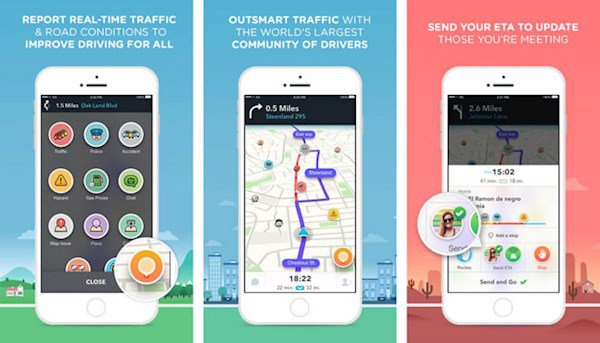
The app I’m most excited about today is a navigation tool called Waze. It provides mapping, plus delightful instructions on how to get from here to there. But beyond that, it crowdsources information to make the trip more efficient and safer than it otherwise would be. In big cities, Waze will take you through circuitous routes to avoid high traffic areas. It alerts you to accidents, road blocks, and debris on the road.

Impressively, it allows drivers to report where the police are staking out speed traps. It tells you whether the officer in question is visible or hidden. You can also confirm or deny the report.

14627-10326-waze-appstore-l

Police have objected to this feature of the app. Why? Because it means that drivers are better able to avoid getting ticketed. But think about this: the app actually succeeds in causing people to obey the law better by slowing down and being safer, as a way of avoiding fines.

Why would police object? If the whole point of traffic police is to get people to drive more safely, knowing about police presence achieves that goal.

Of course, we all know the real reason. The goal of the police on roads is not to inspire better driving but rather catch people in acts of lawbreaking so that they can collect revenue that funds their department. In other words, the incentives of the police are exactly the opposite of the promised results. Instead of seeking good driving, they are seeking lawbreaking as a means of achieving a different outcome: maximum revenue collection.

The whole ethos of Waze is different. It helps you become aware of your external surroundings, and conscious that other drivers are in a similar situation as you are, just trying to get to their destinations quickly and safely. We are there are help each other.

The Community Matters
For me this effected a big change in the whole way I drive. There is a tendency from your first years of driving to treat other drivers as obstacles. Your goal is to outsmart others who are crowding the road, moving around them quickly and navigating the roads with a chip on your shoulder. If there are no cops around, you drive as fast as possible.

I never intended to drive this way, but now I know that I have been, since I first received my government permission slip to drive. Once behind the wheel, I tended to think of myself as a lone actor.

Waze has subtly changed my outlook on driving. Other drivers become your benefactors because it is they who are reporting on traffic accidents, cars on the side the road, blocked streets, and the presence of police. They are all doing you favors. If you report, others thank you for doing so. You even see icons of evidence that your friends are driving, too.

Safety is priority one. Waze won’t let you type in a new address while you are driving. You have to stop the car before you can do that.

The app manages to create a sense of community out of drivers on the road, and that changes the way you think when you drive. Now I leave Waze on even when I already know the directions. It’s my connection to the community. I find my whole outlook on driving has changed. For the first time in my life, I can honestly say that I’m a safer and more responsible driver.

So thank you Waze — a product of brilliant entrepreneurship, distributed on private networks, performing a public service.

Compare with the people who are charged with the task of making our roads safe and are paid by our tax dollars to do it. Not only do they fail to accomplish what this one free application has done, they are actively seeking to cripple it.

Baby Steps to a Better World
Maybe this seems like too small a life improvement to justify mentioning? Not so. All great steps toward a better world occur at the margin, bit by bit, through trial and error, one innovation at a time. You look back at the progress of a decade and that’s where the awe comes into play.

It is not through large bills written by legislators and signed by presidents that the world improves. It is through small innovations, inauspicious downloads, incremental improvements in our existing paths that gradually build a better world. Waze is only one of a billion but it points to the right method and approach to an improved life.

Jeffrey Tucker is Director of Digital Development at FEE, CLO of the startup Liberty.me, and editor at Laissez Faire Books. Author of five books, he speaks at FEE summer seminars and other events. His latest book is Bit by Bit: How P2P Is Freeing the World.  Follow on Twitter and Like on Facebook. 

This article was published by The Foundation for Economic Education and may be freely distributed, subject to a Creative Commons Attribution United States License, which requires that credit be given to the author.

Will Banning Genetic Engineering Kill You? – Article by Edward Hudgins

Will Banning Genetic Engineering Kill You? – Article by Edward Hudgins

The New Renaissance HatEdward Hudgins
******************************

One headline reads “British baby given genetically-edited immune cells to beat cancer in world first.” Another headline reads “Top biologists debate ban on gene-editing.” It’s a literal life-and-death debate.

And if you care to live, pay attention to this philosophical clash!

Exponential growth in genetic engineering

Genetic engineering is on an exponential growth path. In 2001 the cost of sequencing a human-sized genome was about $100 million. By 2007 the cost was down to $10 million.

layla-richard-genetic-engineeringNow it’s just over $1,000. Scientists and even do-it-yourself biohackers can now cheaply access DNA information that could allow them to discover cures for diseases and much more.

Recently, for example, baby Layla Richards [at right] was diagnosed with leukemia. But when none of the usual treatments worked, doctors created designer immune cells, injected them into the little girl and the treatment worked. She was cured.

Designer babies?

But there have been concerns about such engineering for decades; indeed, precautionary guidelines were drawn up by a group of biologists at the 1975 Asilomar conference in California. And now, at a joint conference in Washington, D.C. of the National Academies of Medicine and Sciences, the Chinese Academy of Sciences and the Royal Society of the United Kingdom, a cutting-edge genetic engineering tool known as CRISPR-Cas9 came under attack because it can be used to edit the genomes of sperm, eggs, and embryos.

National Institutes of Health director Francis Collins argued that the children that would result from such editing “can’t give consent to having their genomes altered” and that “the individuals whose lives are potentially affected by germline manipulation could extend many generations into the future.” Hille Haker, a Catholic theologian from Loyola University Chicago, agreed and proposed a two year ban on all research into such manipulation of genomes. Others argued that such manipulation could lead to “designer babies,” that is, parents using this technology to improve or enhance the intelligence and strength of their children.

These arguments are bizarre to say the least.

Damning to misery

To begin with, there is virtual universal agreement among religious and secular folk alike that from birth and until a stage of maturity at which they can potentially guide their lives by their own reason, the consent of children is not needed when their parents make many potentially life-altering decisions for them. Why should this reasonable rule be different for decisions made by parents before a child is born?

And consider that the principal decisions with gene-editing technology would be to eliminate the possibility of the child later in life having Alzheimer’s or Parkinson’s diseases, cancers, and a host of other ailments that plague humanity. Is it even conceivable that any rational individual would not thank their parents for ensuring their health and longevity? Isn’t this what all parents wish for their children? Why would anyone deny parents the tools to ensure healthy children? How much continued misery and death are those who would delay genetic research or ban this new technology inflicting on parents and children alike?

And so what if the “slippery slope” is parents ensuring that their children are more intelligent or stronger? Right now such traits are a matter of a genetic lottery and every parent hopes for the best. What parent wouldn’t jump at the chance to ensure such beneficial capacities for their children?

A privileged biological elite?

Some might pull out the ugly egalitarian argument that the “rich” could produce biologically elite “superchildren,” leaving the rest of humanity behind: an inferior, impoverished breed to be exploited. But this is the same spurious argument made about every technology that initially allows more prosperous individuals to better themselves ahead of others. We heard two decades ago that only the “rich” would be able to afford computers and the internet, allowing them to be more informed and, thus, enabling them to oppress the downtrodden masses. But exponential changes in technologies ensure that just as computers and the internet have become inexpensive and available to all, so will genetic enhancements become after the techniques are perfected for prosperous beta-testers.

And in any case, just as it is immoral to deprive those who honestly earn their wealth of the fruits of their labor just because others have yet to earn theirs, so it is immoral to deprive them of the opportunity to provide the best biology for their children just because it will take time for the technology to become available to all.

Precautionary principle or proactionary principle?

Many opponents of genetic engineering fall back on the so-called “precautionary principle.” This is the notion that if products or technologies pose any imaginable risks—often highly speculative or vague ones unsupported by any sound science—then such products or technologies should be severely restricted, regulated, or banned. The burden is placed on innovators to prove that no harm to humans will result from their innovations.

But had this standard been applied in the past, we would not have the modern world today. Indeed, by this standard, precaution would dictate that fire was just too dangerous for humans and that cavemen should have been barred from rubbing two sticks together.

Max More, a founder of the transhumanist philosophy, offers instead the “proactionary principle.” He argues that “People’s freedom to innovate technologically is highly valuable, even critical, to humanity.” And “Progress should not bow to fear, but should proceed with eyes wide open.” And that we need to “Protect the freedom to innovate and progress while thinking and planning intelligently for collateral effects.”

Freedom to progress

Fortunately, more individuals than More reason this way. At the D.C. conference, University of Manchester Professor John Harris argued “We all have an inescapable moral duty: To continue with scientific investigation to the point at which we can make a rational choice. We are not yet at that point. It seems to me, consideration of a moratorium is the wrong course. Research is necessary.” But the opinion of academics one way or another might not matter. Just as it was do-it-yourselfers and innovators in garages that made the computer and information revolution, genetic innovations might well come from such achievers as well. But they won’t do it if they are not free to do so.

If you value your life and the lives and health of your children, you had better work for this freedom to innovate.

Dr. Edward Hudgins directs advocacy and is a senior scholar for The Atlas Society, the center for Objectivism in Washington, D.C.

Copyright The Atlas Society. For more information, please visit www.atlassociety.org.

Enlightened Selfies – Narcissism and Human Rights – Article by B.K. Marcus

Enlightened Selfies – Narcissism and Human Rights – Article by B.K. Marcus

The New Renaissance Hat
B.K. Marcus
******************************

When the press refers to “Generation Selfie,” do we sense a sneer? It’s almost as if the term selfie is shorthand not for self-portrait but for self-involved, self-absorbed, or simply selfish.

Selfies are widespread among millennials, many of whom grew up with camera phones. A poll commissioned by electronics maker Samsung reveals that fully 30 percent of all photos taken by 18- to 24-year-olds are selfies. For many of us, the selfie is just the new normal, whether or not we fill our own smartphones with self-regarding snapshots. But, as Pamela Rutledge writes for Psychology Today, some see the selfie generation “as proof of cultural — or at least generational — narcissism and moral decline.” And calling Generation Selfie a bunch of narcissists may not be rhetorical excess: according to a paper in the journal Personality and Individual Differences, selfie-posting behavior is indeed associated with narcissistic personality disorder.

Does this mean that modern society is growing more self-obsessed?

Belief in the “moral decay” epitomized by self-directed amateur photography results from a more general conviction that the virtues of community and altruism are being driven out by our culture’s overemphasis on the individual. Whether the culprit is capitalism, technology, or Western civilization more generally, the idea is that historically recent developments are fracturing our communal bonds and leading to a loss of empathy, compassion, and duty — replacing concern for the well-being of a larger group with a privileging of the atomized individual.

Inventing the Modern Self

But the development is not, in fact, historically recent. The selfie as we now know it may seem like a result of social media and the camera phone, but our society’s apparent obsession with visual self-presentation is much older — and significantly more beneficial — than the critics understand.

“It’s easy to make fun of our penchant for taking selfies,” writes popular science author Steven Johnson in How We Got to Now: Six Innovations That Made the Modern World, “but in fact there is a long and storied tradition behind that form of self-expression.”

The original selfie generation emerged in Renaissance Italy, the product of a different technological innovation. Centuries before the bidirectional camera phone, there was the culturally disruptive technology of the glass mirror.

“The interesting thing about self-portraiture,” Johnson tells us, “is that it effectively doesn’t exist as an artistic convention in Europe before 1400.” That’s because, for most of human history, we got very few chances to see ourselves as others see us. The best we could do was a rippled reflection glimpsed in water or a tarnished image on a metal pot.

That all changed when glassmakers “figured out a way to combine their crystal-clear glass with a new innovation in metallurgy, coating the back of the glass with an amalgam of tin and mercury to create a shiny and highly reflective surface. For the first time, mirrors became part of the fabric of everyday life.”

One result was the invention of linear perspective in painting. Prior to the Renaissance, visual representation was more symbolic, less what we would now call realistic. Renaissance artists used the new technology of the mirror to compare what they put on the canvas with what they saw framed in the glass. Sometimes, of course, what they saw in the looking glass was their own reflection.

“The mirror helped invent the modern self,” Johnson writes, “in some real but unquantifiable way.”

Soon after, “social conventions as well as property rights and other legal customs began to revolve around the individual rather than the older, more collective units: the family, the tribe, the city, the kingdom.” Furthermore, “orienting laws around individuals led directly to an entire tradition of human rights and the prominence of individual liberty in legal codes.”

Inventing Humanity

In a different investigation of the individualist tradition, historian Lynn Hunt observes in her book Inventing Human Rights, “For rights to be human rights, all humans everywhere in the world must possess them equally and only because of their status as human beings.”

There was no such understanding of humanity for most of history. Love, compassion, and sympathy may have existed from the beginning, but only between people in narrowly defined groups. The treatment for outsiders was far more harsh.

Slavery and torture, today considered egregious violations of human rights, went unquestioned before a few hundred years ago. Since at least the time of Aristotle, it was typical to divide the world between “us,” the naturally civilized, and “them,” the naturally enslaved. Torture, in the ancient world, was originally limited to slaves, but over time, the practice became more acceptable, and in the second century it was expanded to include nominally free lower-class victims. By the Middle Ages, torture before execution had become a form of spectacle, public entertainment for the whole family.

How, then, did we develop a sense of universal humanity and of natural rights for all human beings? Specifically, Hunt asks about the Enlightenment thinkers in 18th-century France and America, for whom such rights were “self-evident.”

How did these men, living in societies built on slavery, subordination, and seemingly natural subservience, ever come to imagine men not at all like them and, in some cases, women too, as equals?

And how did the 18th-century public come to agree with them? The answer Hunt offers is that the so-called self-evidence of individual human rights was largely the result of widespread reading in a genre that was still relatively new at the time: the epistolary novel. Enlightenment thinkers were familiar with first-person narrative in a way that earlier generations would have found alien. Novels introduced readers to the inner lives of characters unlike themselves.

Johnson, too, talks about the emergence of the novel and its impact on the moral imagination, but he traces the origins of the modern novel itself to the same innovation that gave rise to linear perspective in painting: “The psychological novel … is the kind of story you start wanting to hear once you begin spending meaningful hours of your life staring at yourself in the mirror.”

Thinking about themselves as the individuals staring back through the glass, “people began writing about their interior lives with far more scrutiny,” and “the novel emerged as a dominant form of storytelling, probing the inner mental lives of its characters with an unrivaled depth.”

The Innovation of Empathy

What does this sort of growing self-obsession have to do with the rights of others?

Empathy, Hunt points out, “requires a leap of faith, of imagining that someone else is like you.” This is the idea that “novels generated … by inducing new sensations about the inner self.”

Or as Johnson puts it,

Entering a novel, particularly a first-person narrative, was a kind of conceptual parlor trick: it let you swim through the consciousness, the thoughts and emotions, of other people more effectively than any aesthetic form yet invented.

Spending time in someone else’s head, even if that someone else is fictional, is practice for thinking about real people’s experiences.

So, according to this story, the technology of glass mirrors leads to linear perspective, the Renaissance, and a new literary form called the novel. The novel, in turn, transforms the popular imagination in such a way that even strangers — those outside your immediate family, class, and religious affiliation — come to be understood as autonomous individuals with their own inner lives, much like your own. And for the first time in history, people come to question the practices of torture and slavery, practices at least as old as civilization and far more universal than any understanding of rights prior to the Enlightenment.

The “invention” of the individual ushered in not ever more selfishness and less regard for the group, but an expanding empathy and a more inclusive, approaching universal, sense of “us” — a waning relegation of those outside our moral community.

Trading with the Other

Johnson notes that the technological innovation at the beginning of the story isn’t enough by itself to have produced the larger cultural shift:

The Renaissance also benefited from a patronage system that enabled its artists and scientists to spend their days playing with mirrors instead of, say, foraging for nuts and berries. A Renaissance without the Medici — not the individual family, of course, but the economic class they represent — is as hard to imagine as the Renaissance without the mirror.

The same can be said about the economy that produced the Enlightenment: it is hard to imagine an era of growing empathy, open-mindedness, and belief in universal rights without the market that provided a growing readership for the epistolary novel.

Capitalism establishes the conditions in which individualism can thrive. Individualism, in turn, helps the market economy to grow and to propagate the belief in rights-bearing individuals.

Contrary to today’s critics, then, who assume that the individualist mentality leads to the absence of empathy, with the advent of individualism came the invention of empathy, at least as applied to those outside the tribe, clan, or caste.

Maybe narcissists do feel compelled to photograph themselves. Camera phones make it easier than ever. But the myth of Narcissus is ancient. And the history of reflective technology points us to a different understanding of cause and effect for the selfie generation.

The 21st-century self-portrait can play the same role now as its earlier incarnations did during the Renaissance and the Enlightenment. Like individualism more generally, the selfie invites us to explore questions of identity and of where we fit in an ever more interconnected community.

B.K. Marcus is editor of the Freeman. His website is bkmarcus.com.

This article was published by The Foundation for Economic Education and may be freely distributed, subject to a Creative Commons Attribution 4.0 International License, which requires that credit be given to the author.
Future City Concept – Art by Eric Dima-ala

Future City Concept – Art by Eric Dima-ala

future_city_concept_by_frenicNote: Left-click on this image to get a full view of this digital work of art.

Created by digital artist Eric Dima-ala, this futuristic matte painting captures the glittering beauty of a bustling nighttime cityscape.

Visit Eric Dima-Ala’s website for more of his matte paintings and illustrations.

This work is licensed under a Creative Commons Attribution-Noncommercial-No Derivative Works 3.0 License and was originally posted on DeviantArt.