Browsed by
Category: Technology

Let’s Hope Machines Take Our Jobs: We Want Wealth, Not Jobs – Article by Peter St. Onge

Let’s Hope Machines Take Our Jobs: We Want Wealth, Not Jobs – Article by Peter St. Onge

The New Renaissance Hat
Peter St. Onge
June 11, 2015
******************************

The job-threatening rise of the machines is an economically illiterate meme that refuses to die. We’re actually probably in the early stages of it, a bull-market in neo-luddism, if you will. Bastiat’s “Candlemakers’ Petititon” answered this one long ago, but today I’ll run a little thought experiment that owes it all to good old Bastiat.

Let’s say Weird Al Yankovic invents a machine capable of making everything with a single push of a button. The first thing he does is print up a bunch of machines and sell them for a ton. Weird Al is now a billionaire, and there are thousands of make-everything machines.

This diffusion of Weird Al’s new technology replicates the market process, where new tech spreads in proportion to its usefulness. If you doubt this, because of patents, for example, check out Brazil’s experience with AIDS drugs, where they tore up the patents on humanitarian grounds.

Weird Al’s machines will, at a minimum, be mass produced in Brazil. Or China. Or Mozambique.

So, one way or another, we get a bunch of make-everything machines.

What happens to the jobs? We’re getting everything for near-free now. So all the production jobs disappear. There are still lots of jobs, of course — child care, gardeners, musicians. But all the production jobs have vanished — something like 20 percent of jobs, maybe up to 50 percent when you include knock-on replacement of people by capital (truck drivers, robot bartenders). Heck, let’s go crazy and say 90 percent of the jobs vanished. Nobody’s got a job outside of preschool or performing on a stage. It’s the end of the world, right?

Well, the key is that, now that everything is made with the push of a button, everything’s extremely cheap. For example, a sixteen-bedroom house or a Lamborghini costs almost nothing. Let’s say they now cost ten cents.

The main expense in such a world is probably surface space. All those dime-a-dozen cars have to park somewhere. It’d take a while to “run out” of space, though — divide the world by the people and you get about twenty acres (eight hectares) for a family of four — about 100 large surburban yards. Add in the oceans — floating islands cost nothing, remember — and triple that. We end up with about 300 homes’ worth of space per family.

What about those unemployed people? Well, when a house or a year’s food costs a dime, they’ll be willing to work really cheap. We’ll work for a penny a day. After all, that’s a new house or a year’s food every two weeks.

Who would hire these workers for a penny? Plenty of people. Heck, if workers cost a penny a day I’d hire several for each of my children, just to keep the kids from getting bored. I’d hire another to cook, one to clean, one to run errands. One to keep track of my mail. One to check Facebook for me. At a penny a day I’d personally hire 100 people, easy. You would too — a buck a day’s nothing.

So the remaining 10 percent of workers who didn’t lose their jobs — babysitters, baristas, musicians — would want 100 workers each. Even at a penny, they’d take them all, and they’d be paying an outrageous rate — a tenth-house per day! That’s a daily rate of $15,000 in today’s terms.

Now, those who kept their jobs would, of course, see dropping wages. A barista who made $12 an hour in the old days would have to compete with the hordes of unemployed workers. Maybe her wage would drop to a penny, too. But, remember, a penny now buys $15,000 worth of stuff.

When the smoke clears, most people would make some extremely low wages — a penny a day. And that extremely low wage would be worth an awful lot — $15,000 a day, implying an annual income north of several million dollars in today’s values. Some lucky few would make a dollar a day — probably the people who are good at things machines cannot do: entertainment, child care, being a good listener, strumming the guitar at the retirement home, and laughing at jokes. At a dollar a day, this super-rich elite that excels at human skills — such as making us laugh — would be billionaires in today’s values.

Either way, there would be nothing we think of even remotely as “poverty.” Sure, there’ll be inequality, but it’ll be relative: “Sarah’s got 200 Lamborghinis and I’ve only got 40.”

The upshot is that wages plunge, but production costs plunge even more. Of course, this is based on the ridiculous Weird Al machine. Why do this? To illustrate the absolute worst-case scenario, when machines make everything for near-nothing.

What about going one step further: That the machine destroys all jobs in the whole world — it makes every single thing for us free, and it even keeps the folks entertained and the warm fuzzies flowing at the old folks’ home.

Well, we’ve already got a case study there — the sun. It gives us warmth and mangos for free. And how do we respond? We sit around and lazily enjoy it. So a machine that truly replaced all jobs would simply mean nobody works anymore — life’s somewhere between a non-stop party and a non-stop pleasant walk in the woods followed by a nice bonfire with friends and chardonnay.

We should all be so lucky that the machines do actually take every last job there is.

Peter St. Onge is an assistant professor at Taiwan’s Fengjia University College of Business. He blogs at Profits of Chaos.
***
This article was published on Mises.org and may be freely distributed, subject to a Creative Commons Attribution United States License, which requires that credit be given to the author.
Technology Needs Capital To Produce Economic Growth – Article by Frank Shostak

Technology Needs Capital To Produce Economic Growth – Article by Frank Shostak

The New Renaissance Hat
Frank Shostak
June 8, 2015
******************************

In his article “The Big Meh” Paul Krugman complains that despite all the information technology advances the effect so far has been negligible as far as economic growth is concerned.

Krugman writes “That the whole digital era, spanning more than four decades, is looking like a disappointment. New technologies have yielded great headlines but modest economic results. Why? … The answer is that I don’t know — but neither does anyone else.”

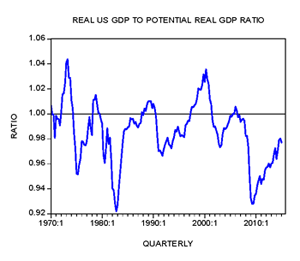
Indeed if one looks at the real gross domestic product to the potential real gross domestic product ratio the economy does appear to be hovering below potential with the ratio of 0.977 registered in Q1 this year.

shostak_june 8 300_1

Contrary to Krugman, we suggest that economists such as Ludwig von Mises and Murray Rothbard have provided a clear answer to the issue of technology and economic growth.

In Man, Economy, and State, Rothbard says that technology, while important, must always work through the investment of capital in order to generate economic growth.

On this issue, Rothbard quotes Mises who says,

What is lacking in (underdeveloped counties) is not knowledge of Western technological methods (“know how”); that is learned easily enough. The service of imparting knowledge, in person or in book form, can be paid for readily. What is lacking is the supply of saved capital needed to put the advanced methods into effect.

Most modern theories that emphasize the importance of new ideas and new technologies give the impression that these ideas and technologies have a “life of their own.” Many experts hold that because of the limited amounts of capital and labor, without technological progress, the opportunities for growth will eventually run out.

We Need Funding To Implement New Ideas

Ideas, unlike material inputs, are not themselves scarce. Consequently, it is argued, new ideas for more efficient processes and new products can make continuous growth possible.

We suggest that regardless of how many ideas people have, what matters is whether these ideas can be implemented. What always limits the implementation of various new techniques is the availability of funding. While ideas and new techniques can result in a better use of scarce resources, they can however, do very little without the pool of real savings.

So regardless of how clever we are and regardless of various technological ideas, without an adequate pool of funding nothing will emerge. It is through the expansion in the pool of real savings that an increase in the stock of capital goods is possible. And it is the increase in the capital goods per worker that permits economic growth to emerge.

To Get More Funding, We Need Savings

Obviously, new ideas and new technology can be introduced during the production of new capital goods (i.e., new technology) and will be imbedded in the capital goods stock. The crux of the matter however, is that capital goods cannot emerge without a prior increase in the pool of funding or pool of real savings.

Take, for instance, a baker John who produced ten loaves of bread. He consumes two loaves of bread whilst the other two loaves — his real savings — he employs to purchase a new part to improve his oven. With a better oven he can now raise the output of bread to twenty loaves. If he still consumes only two loaves, then with a larger savings (now stands at eighteen loaves) he can enhance further his oven by introducing new parts, which will enable the introduction of new technology. Note that all this is made possible on account of real savings.

We suggest that despite new technologies, a major impediment to economic growth has been the relentless central bank tampering with financial markets.

Since 2008 this tampering was made manifest in the extremely loose monetary policy of the Fed that resulted in the massive monetary expansion of the Fed’s balance sheet and the lowering of interest rates to almost nil.

These policies have been responsible for a severe erosion of the pool of real savings and thus a weakening of the process of capital formation. This in turn has undermined real economic growth notwithstanding new information technology.

For Krugman and his followers savings is bad news — it is seen as less demand — hence one shouldn’t be surprised that Krugman is puzzled as to why new ideas haven’t manifested in a more robust economic growth. Contrary to Krugman, boosting so-called aggregate demand whilst undermining the capital formation process, and hence the ability to produce goods and services, cannot strengthen economic growth over time. In fact this way of thinking results in the notion that something can be generated out of nothing.

Frank Shostak is an adjunct scholar of the Mises Institute and a frequent contributor to Mises.org. His consulting firm, Applied Austrian School Economics, provides in-depth assessments and reports of financial markets and global economies.

This article was originally published by the Ludwig von Mises Institute. Permission to reprint in whole or in part is hereby granted, provided full credit is given.

“La mort, c’est mal!” – French Translation of “Death is Wrong” – Translated by Philippe Castonguay – Post by G. Stolyarov II

“La mort, c’est mal!” – French Translation of “Death is Wrong” – Translated by Philippe Castonguay – Post by G. Stolyarov II

The New Renaissance Hat
G. Stolyarov II
May 16, 2015
******************************

La mort, c’est mal! – the French translation of Death is Wrong – is now available for download from The Rational Argumentator. You can obtain your free PDF copy here and may spread it to French-speaking audiences as widely as you wish.

La mort, c’est mal! was generously translated into French by Philippe Castonguay.

Death_is_Wrong_French_CoverPaperback copies of La mort, c’est mal! can be purchased in the following venues:

Createspace – $9.48

Amazon – $9.48

Kindle copies of La mort, c’est mal! can be purchased on Amazon for $0.99.

***

Si vous avez déjà demandé « pourquoi les gens doivent-ils mourir? » alors ce livre est pour vous. La vérité est que non, la mort n’est ni bonne, ni nécessaire, ni inévitable. En fait, la mort, c’est mal! La mort est notre ennemie à tous et toutes et doit être combattue par la médecine, la science et la technologie. Ce livre vous introduit au plus grand défi de notre espèce, à son mouvement le plus révolutionnaire; celui d’augmenter radicalement l’espérance de vie humaine pour que vous n’ayez plus à mourir, du tout.

Vous trouverez dans ce livre des plantes et des animaux à la longévité spectaculaire, des découvertes scientifiques récentes pavant le chemin vers l’augmentation de la durée des vies humaines, ainsi que de simples, mais puissants arguments pour affronter ceux en faveur de la mort. Si vous avez déjà pensé que la mort était injuste et qu’elle devrait être vaincue, sachez que vous n’êtes pas seul. Lisez ce livre et prenez part à la plus importante quête de l’histoire de l’humanité.

Ce livre a été écrit par le philosophe et futuriste Gennady Stolyarov II et illustré par l’artiste Wendy Stolyarov. Ici, il vous sera démontré que, peu importe qui vous êtes et peu importe vos habiletés, il vous est toujours possible d’aider l’humanité dans sa lutte contre la mort.

Can Most People Become Techno-Optimists? – Panel Discussion by G. Stolyarov II, Demian Zivkovic, Philippe Castonguay, Roen Horn, Sylvester Geldtmeijer, and Laurens Wes

Can Most People Become Techno-Optimists? – Panel Discussion by G. Stolyarov II, Demian Zivkovic, Philippe Castonguay, Roen Horn, Sylvester Geldtmeijer, and Laurens Wes

Techno-Optimism_Panel_ImageThe New Renaissance Hat

G. Stolyarov II, Demian Zivkovic, Philippe Castonguay, Roen Horn, Sylvester Geldtmeijer, and Laurens Wes

May 9, 2015
******************************

What are the key approaches and opportunities for restoring an optimistic view of technology, progress, and the future among the majority of people – and to counter apocalyptic, Malthusian, and neo-Luddite thinking?

On May 9, 2015, Mr. Stolyarov, the author of Death is Wrong – the illustrated children’s book on indefinite life extension  – invited a panel of future-oriented thinkers to discuss this question. Watch the discussion here.

Panelists

***

Demian Zivkovic is a student of artificial intelligence and philosophy, and founder and president of the Institute of Exponential Sciences – https://www.facebook.com/IEScience/ –  an international transhumanist think tank / education institute comprised of a group of transhumanism-oriented scientists, professionals, students, journalists and entrepreneurs interested in the interdisciplinary approach to advancing exponential technologies and promoting techno-positive thought.

Demian and the IES have been involved in several endeavors, including interviewing professor Aubrey de Grey, organizing lectures on exponential sciences with guests including de Grey, and spreading “Death is Wrong” – Mr. Stolyarov’s illustrated children’s book on indefinite life extension – in The Netherlands. Demian Zivkovic is a strong proponent of transhumanism, hyperreality, and hypermodernism. He is currently working on his ambition of raising enough capital to make a real difference in life extension and transhumanist thought.

Demian invites anybody who is interested in forwarding a technologically positive vision of the future to get involved with the Institute of Exponential Sciences via its Facebook page – https://www.facebook.com/IEScience/.

***

Philippe Castonguay is currently pursuing a B.Sc. in Psychology while doing research in computational neuroscience. His main research topics are the influence of noise on the stability of chaotic neural network models, mechanisms of recurrent neural integration on a network scale and high-dimensional data representations. Philippe is also an executive member of Bricobio, a DIY biohacking group in Montreal and co-founder of Montreal Futurists, a Montreal group that wants to promote transhumanist/futurist ideas and prepare the population for the integration of related technologies in the society.

***

Sylvester Geldtmeijer is a Dutch citizen and sound designer. He has been interested in transhumanism, science, and technology since childhood, when he was fascinated with science fiction and imagining a highly advanced technological world where every problem can be solved with science. He emphasizes the ability of science to help people, especially through medical advancements, and considers Deep Brain Stimulation to be one of the most important inventions of our time. He hopes that technological advances will produce an era in which children can grow up without struggling with any learning difficulties or physical obstacles.

Sylvester would like to share the following words of inspiration with our viewers:

For some the age of reason is too far,
For some the age of utopization will also be too far.
But for idealists reason is not just an accomplishment;
It’s development –
Just like utopia isn’t a place;
It’s a state of mind.

***

Roen Horn is a philosopher and lecturer on the importance of trying to live forever. He founded the Eternal Life Fan Club – http://eternallifefanclub.com/ – in 2012 to encourage fans of eternal life to start being more strategic with regard to this goal. To this end, one major focus of the club has been on life-extension techniques, everything from lengthening telomeres to avoiding risky behaviors. Currently, Roen’s work may be seen in the many memes, quotes, essays, and video blogs that he has created for those who are exploring their own thoughts on this, or who want to share and promote the same things. Like many other fans of eternal life, Roen is in love with life, and is very inspired by the world around him and wants to impart in others the same desire to discover all this world has to offer.

***

Laurens Wes is a Dutch engineer and chief engineering officer at the Institute of Exponential Sciences. Furthermore he is the owner of Intrifix, a company focused on 3D-printing and software solutions. Aside from these tasks, Laurens is very interested in transhumanism, longevity, just about all fields of science, entrepreneurship, and expressing creativity. He is a regular speaker for the IES and is very committed to educating the public on accelerated technological developments and exponential sciences.

Protein Modification as a Biomarker of Aging – Article by Reason

Protein Modification as a Biomarker of Aging – Article by Reason

The New Renaissance Hat
Reason
April 19, 2015
******************************

The development of fairly consistent, accurate means to measure biological age – as opposed to chronological age – from a tissue sample is an important thread in aging research. Aging is a process of damage accumulation, and rejuvenation would be achieved through damage repair. Research and development aimed at significant extension of healthy life span can only become cost-effective given good ways to measure damage, however. There must be some reliable means to quickly assess the results of a treatment that claims a degree of rejuvenation through the partial repair of a specific form of cellular or molecular damage. In some cases this might seem easy. Take senescent cell clearance, for example: you run the therapy in mice, and compare a range of measures known to scale by senescent cell count in tissue samples before and after the treatment regimen. However, all that really tells you is how well the therapy clears senescent cells. All aspects of biology interact with one another, and age is a global phenomenon. To determine how aged an individual is and how effective a treatment might be when it comes to the practical outcome of additional healthy life span added there is presently little to be done other than wait and see.

The biggest challenge in the development of life-extending therapies is funding and cost. On the one hand there is far too little funding directed towards finding ways to treat aging. On the other hand effectively evaluating an alleged means of treating aging currently requires lifespan studies, and even in mice that takes far too long and costs far too much to be done casually. If there were standardized, quick and easy markers of physiological age that could be assessed before and after a treatment, then this research and development might be able to proceed ten times as rapidly, and evaluation of possible therapies would be open to far more research groups. There are many, many more laboratories with the capacity and funding to carry out a speculative $100,000 study versus a speculative $1,000,000 study.

All of this is to explain why there is considerable interest in developing a cheap biomarker of aging that can reliably assess physiological age from a tissue sample. No-one wants to run a five-year mouse study if there is a ten-minute alternative that produces an answer of about the same accuracy. That ten-minute alternative doesn’t yet exist, but some lines of research seem promising, such as work on DNA methylation patterns that appear to be fairly consistent among individuals over the course of aging. There is also the suggestion that the approach should be to measure the fundamental forms of damage thought to cause aging – but all of them, not just the one being treated by the therapy under consideration. At the present time that might be more onerous than finding a good set of secondary consequences that are reactions to damage, such as epigenetic changes.

The open-access paper linked below covers a fairly wide range of topics. The structures of our cells and tissues are built of proteins, and these proteins are constantly damaged and replaced. Many varied mechanisms toil constantly to remove proteins and cellular components as soon as they show damage or dysfunction. Nonetheless the difference between young tissue and old tissue is that old tissues have far more damage: misfolded proteins, malfunctioning structures inside cells, metabolic waste products such as advanced glycation endproducts (AGEs) gumming together structures in between cells, and so on and so forth. The damage leaks through, and even damage repair mechanisms are not invulnerable; they falter with age due to much the same set of issues as causes dysfunction elsewhere. In the future repair technologies, such as those outlined in the SENS proposals, will bring about rejuvenation by reversing these forms of damage. Since these issues are a part of full set of causes of aging, they are also potential markers of aging.

Protein modification and maintenance systems as biomarkers of ageing

Changes in the abundance and post-translational modification of proteins and accumulation of some modified proteins have been proposed to represent hallmarks of biological ageing. Non-enzymatic protein glycation is a common post-translational modification of proteins in vivo, resulting from reactions between glucose or its metabolites and amino groups on proteins, this process is termed “Maillard reaction” and leads to the formation of advanced glycation endproducts (AGEs). During normal ageing, there is accumulation of AGEs of long-lived proteins such as collagens and several cartilage proteins. AGEs, either directly or through interactions with their receptors, are involved in the pathophysiology of numerous age-related diseases, such as cardiovascular and renal diseases and neurodegeneration.
 ***
Beside protein glycation, it is also well known that levels of oxidised proteins increase with age, due to increased protein damage induced by reactive oxygen species (ROS), decreased elimination of oxidized protein (i.e. repair and degradation), or a combination of both. Since the proteasome is in charge of both general protein turnover and removal of oxidized protein, its fate during ageing has received considerable attention, and evidence has been provided for impairment of the proteasome function with age in different cellular systems. Thus, these protein maintenance systems may also be viewed as potential biomarkers of ageing.
  ***
It is expected that a combination of several biomarkers will provide a much better tool to measure biological age than any single biomarker in isolation. For the most part, the markers based on proteins and their modifications that have been chosen are directly related with mechanistic aspects of the ageing process. Indeed, they are relevant to such important physiological features such as protein homeostasis and glycoprotein secretion that have been previously documented as being altered with age. Therefore, it is expected that they may be less influenced by other factors not necessarily related with ageing.
Reason is the founder of The Longevity Meme (now Fight Aging!). He saw the need for The Longevity Meme in late 2000, after spending a number of years searching for the most useful contribution he could make to the future of healthy life extension. When not advancing the Longevity Meme or Fight Aging!, Reason works as a technologist in a variety of industries. 
 ***

This work is reproduced here in accord with a Creative Commons Attribution license. It was originally published on FightAging.org.

Tomorrow Will Be Different From Today – Article by Reason

Tomorrow Will Be Different From Today – Article by Reason

The New Renaissance Hat
Reason
April 16, 2015
******************************

We live in an era of very rapid change driven by technological progress. Today’s world is enormously different from that of three or four decades past: consider the pervasive effects of the revolution in communications and computing technologies that has taken place over that time. Yet, human nature being what it is, most of the people who lived through this profound shift in capabilities and culture are nonetheless very skeptical of claims that the future will look radically different from today in any important aspect. It is strange.

In particular the concept of actuarial escape velocity leading to thousand-year life spans is a very hard sell. People look at the large number that is very different from today’s maximum life span and immediately reject it out of hand, no matter the reasonable argument behind it. Any medical technology that produces some rejuvenation in old patients buys extra time to develop better means of rejuvenation. At some point the first pass at rejuvenation treatments will improve such that remaining healthy life expectancy grows at more than a year with each passing year. At that point life spans will become indefinite, limited only by accident or rare medical conditions not yet solved.

It doesn’t help that most of the public has very little knowledge of the present state of medical research in any field, never mind the specific details of how aging might be treated and brought under medical control. The only solution to that issue is to keep on talking: educate, advocate, and spread the word.

Quote:

It is likely the first person who will live to be 1,000 years old is already alive today. This is according to a growing regiment of researchers who believe a biological revolution enabling humans to experience everlasting youthfulness is just around the corner. At the epicentre of the research is Aubrey de Grey, co-founder or the California-based Strategies for Engineered Negligible Senescence (SENS) Research Foundation.

“The first thing I want to do is get rid of the use of this word immortality, because it’s enormously damaging, it is not just wrong, it is damaging. It means zero risk of death from any cause – whereas I just work on one particular cause of death, namely ageing.” de Grey said his research aims to undo the damage done by the wear and tear of life, as opposed to stopping the ageing process altogether. “If we ask the question: ‘Has the person been born who will be able to escape the ill health of old age indefinitely?’ Then I would say the chances of that are very high. Probably about 80 per cent.”

“The therapies that we are working on at the moment are not going to be perfect. These therapies are going to be good enough to take middle age people, say people aged 60, and rejuvenate them thoroughly enough so they won’t be biologically 60 again until they are chronologically 90. That means we have essentially bought 30 years of time to figure out how to re-rejuvenate them when they are chronologically 90 so they won’t be biologically 60 for a third time until they are 120 or 150. I believe that 30 years is going to be very easily enough time to do that.”

Link: http://www.news.com.au/technology/science/researchers-believe-a-biological-revolution-enabling-hu

Reason is the founder of The Longevity Meme (now Fight Aging!). He saw the need for The Longevity Meme in late 2000, after spending a number of years searching for the most useful contribution he could make to the future of healthy life extension. When not advancing the Longevity Meme or Fight Aging!, Reason works as a technologist in a variety of industries. 
 ***

This work is reproduced here in accord with a Creative Commons Attribution license. It was originally published on FightAging.org.

Peter Thiel on Longevity Research and the Defeat of Aging – Article by Reason

Peter Thiel on Longevity Research and the Defeat of Aging – Article by Reason

The New Renaissance Hat
Reason
April 4, 2015
******************************

It has always been the case that the cause of serious rejuvenation research needs more well-regarded individuals to stand up and talk in public about the road ahead, the prospects for success, and the righteousness of the goal. Just lay out the situation as it is, no need for salesmanship: it is simply the need for this to be a topic not left on the edge of polite society. Aging is by far the greatest cause of suffering and death in the world, and we should all be doing more than we are to help bring an end to all of that pain, disease, and loss. For that to happen, the vast majority of people who never think about aging and rarely think about medical research need to give the topic at least as much thought and approval as presently goes towards the cancer research community.

We find ourselves in a peculiar time. Technological barriers to the successful treatment of aging are next to non-existent; progress is falling out of the woodwork even at low levels of funding and interest; this is an age of revolutionary gains in the tools of biotechnology, and that drives the pace of medicine while the cost of meaningful research plummets. This isn’t a space race situation in which the brute force of vast expenditure was used to wrest a chunk of the 21st century into the 20th and land men on the moon. If following the SENS program aimed at repair of the causes of aging, the cost of implementing the first prototype, working rejuvenation treatments in old mice would by current estimates be only 1-2% of the Apollo Program budget. There was vast popular approval for the space race to match the vast expense. The path to human rejuvenation is in exactly the opposite situation: there is very little support for the goal of treating aging as medical condition, but the costs of doing so successfully are so small that given even a minority of the public in favor those funds would be raised.

This is why advocacy is so very important. This is why people with large soapboxes can help greatly simply by talking on the topic. Investor and philanthropist Peter Thiel has been supporting scientific programs such as SENS and related areas in biotechnology for a decade now, but I notice that he is more vocal and direct in public about this cause now that other organizations such as Google Ventures are making large investments. This is all good; we need a sea change in the level of public support for rejuvenation research, and their understanding of the prospects for the future. Aging is far from set in stone, and a range of the biotechnologies needed to treat aging and bring it under medical control are on the verge of breaking out into commercial development, or just a few years away from that point. All it takes to turn the stream into a rapids is a little more rain.

Peter Thiel’s quest to find the key to eternal life – Washington Post

Quote:

WP: Why aging?

Thiel: I’ve always had this really strong sense that death was a terrible, terrible thing. I think that’s somewhat unusual. Most people end up compartmentalizing, and they are in some weird mode of denial and acceptance about death, but they both have the result of making you very passive. I prefer to fight it. Almost every major disease is linked to aging. One in a thousand get cancer after age 30. Nixon declared war on cancer in 1971, and there has been frustratingly slow progress. One-third of people age 85 and older have Alzheimer’s or dementia, and we’re not even motivated to start a war on Alzheimer’s. At the end of the day, we need to do more.

WP: All your philanthropic projects are founded on the idea that there’s something wrong with the way the current system works. What are the challenges you see in biomedical research?

Thiel: I worry the FDA is too restrictive. Pharmaceutical companies are way too bureaucratic. A tiny fraction of a fraction of a fraction of NIH [National Institutes of Health] spending goes to genuine anti-aging research. The whole thing gets treated like a lottery ticket. Part of the problem is that aging research doesn’t always lend itself to being a great for-profit business, but it’s a very important area for a philanthropic investment. NIH grant-making decisions end up being consensus-oriented, focused on doing things that a peer review committee thinks makes sense. So you end up with a very conservative bias in terms of what gets done. [On the other hand,] the original DARPA [Defense Advanced Research Projects Agency] was phenomenally successful. You had a guy running it, and he just gave out the money. It was more focused on substance and less on the grant-writing process. That’s the direction we should go. I worry that right now, we have people who are very nimble in the art of writing grants who have squeezed out the more creative.

WP: You’re currently funding Cynthia Kenyon, Aubrey de Grey and a number of other researchers on anti-aging. What was it about these individuals and their work that got your attention?

Thiel: They think far outside the conventional wisdom and are far more optimistic about what can be done. I think that’s important to motivate the research.

WP: How long is long enough? Is there an optimal human life span?

Thiel: I believe if we could enable people to live forever, we should do that. I think this is absolute. There are many people who stop trying because they think they don’t have enough time. Because they are 85. But that 85-year-old could have gotten four PhDs from 65 to 85, but he didn’t do it because he didn’t think he had enough time. If it’s natural for your teeth to start falling out, then you shouldn’t get cavities replaced? In the 19th century, people made the argument that it was natural for childbirth to be painful for women and therefore you shouldn’t have pain medication. I think the nature argument tends to go very wrong. . . . I think it is against human nature not to fight death.

WP: Assuming the breakthrough in eternal life doesn’t come in our lifetime, what do you hope to have achieved through your philanthropy before you die? What would you like to be remembered for?

Thiel: I think if we made some real progress on the aging thing, I think that would be an incredible legacy to have. I have been fortunate with my business successes, so I would like to encourage, coordinate and help finance the many great scientists and entrepreneurs that will help bring about the technological future. It’s sort of not important for me to get credit for the specific discoveries, but if I can act as a supporter, mentor and financier, I think that feels like the right thing.

Reason is the founder of The Longevity Meme (now Fight Aging!). He saw the need for The Longevity Meme in late 2000, after spending a number of years searching for the most useful contribution he could make to the future of healthy life extension. When not advancing the Longevity Meme or Fight Aging!, Reason works as a technologist in a variety of industries. 
 ***

This work is reproduced here in accord with a Creative Commons Attribution license. It was originally published on FightAging.org.

Blockchain Insurance Company – Short Story by G. Stolyarov II

Blockchain Insurance Company – Short Story by G. Stolyarov II

The New Renaissance Hat
G. Stolyarov II
April 2, 2015
******************************
This short story by Mr. Stolyarov was one of the entries in the Society of Actuaries’ 11th Speculative Fiction Contest.
Bitcoin-coins
***

“Welcome, Euclid Jefferson,” the metallic voice of Epac, the Electrically Powered Autonomous Car, intoned. The full identifier of Euclid’s vehicle was EPAC-930213, but they all responded to “Epac” for user convenience. “Where would you like to go today?”

“Epac, I would like to go to the San Francisco Hyperloop Station, please.”

“The trip will take approximately twenty-six minutes. Departing now. It is a fine day, and no weather or traffic obstacles are expected. Now is a good opportunity for you to view your insurance options for today. Shall I display them?”

“Epac, display. Anything new?”

“Yes, a major development that could save you money. Would you like a summary view or the full view with narration?”

“I am an actuary, so I am interested in the details of my coverages and prices. Epac, provide the full view, please.”

“Recently retired actuary” would have been a more precise description – though not retired forever. At age 50, Euclid Jefferson had saved enough money to be able to take the next ten years off. He had received his experimental rejuvenation treatments a week ago and was happy to feel as youthful and energetic as he did at the start of his career. After his ten-year break, he planned to receive the next round of treatments, which he hoped by then would become even more targeted and less invasive. He did not know whether his second career would be in another actuarial field, or in something else entirely. In the meantime, he looked forward to taking excursions on the newly constructed branches of the hyperloop network, which could bring him to any major metropolitan area on the North American continent within hours. After that, he would take the MoonX tourist shuttle to visit his wife, a geologist on the new International Lunar Research and Terraforming Base (ILRTB). She was due to retire and undergo rejuvenation treatments in just another six months.

“Displaying. Your automobile insurance policy premium declined by 1.32% over the past year. You have no-fault coverage for bodily injury and physical damage while occupying any vehicle in autonomous mode. You also carry the minimum limits required by the laws of this state for liability coverage in the event you engage manual mode. Your premium is proportional to miles driven. A multiplier of 500 applies to every mile driven in manual mode. I have identified a newly approved insurer who could offer you the same coverage at a 25% lower premium. Are you interested?”

“I am. Epac, what is this company?”

“Blockchain Insurance Company offers autonomous insurance for autonomous vehicles. You are eligible to get an annual policy for only 0.13 bitcoins.”

“Blockchain Insurance Company? I have never heard of it. Epac, is this a new entity?”

“It was just formed and approved to do business.”

“Epac, who owns it?”

“Anyone who contributes capital to the company owns a number of shares proportional to the contribution. The company pays its investors 10% of its profits as a dividend at the end of each year, while the remaining 90% are reinvested into operations. However, if losses exceed the company’s assets, the investors do not have limited liability. They are responsible for their proportional share of claim payments.”

“This is different. Epac, who manages the payments to investors, and who enforces collection of funds from them in the event of a shortfall?”

“There is no management. The company runs itself – on the blockchain. The public blockchain ledger keeps a record of the capital contributions from each account and the corresponding shares issued. A contractual algorithm is built into the blockchain to deposit and withdraw bitcoins to and from each shareholder’s account in proportion to the company’s profits and losses. Each policyholder has an account as well, which is tied to the policyholder’s bitcoin wallet, and from which premiums are drawn on a continuous basis in proportion to miles driven.”

“Epac, this involves very little nonpayment risk, I would imagine.”

“Correct. As long as bitcoins exist in the policyholder’s account, payment will be made. If the account is ever depleted, the policy simply terminates prospectively. Whenever only 30 days’ worth of bitcoins remain in the account, the policyholder is notified in real time via the car’s display screen and any connected mobile device, to give ample time to replenish the funds. The policyholder may also opt to cancel the policy at any time with no need to wait for a refund. The payment stream will simply stop, and coverage will exist up to the time of termination.”

“Epac, how does the algorithm know the miles driven?”

“The algorithm is linked to the telematic systems within each autonomous vehicle. As the vehicle is engaged, it reports live data to Blockchain Insurance Company. The company only needs to know two pieces of information: miles driven and the mode of operation – autonomous or manual. The rest of the premium is calculated and paid automatically.”

“Epac, does the formula for calculating the premium depend on any other variables?”

“Yes, the make and model of the vehicle still affect the frequency and severity of losses. On days with any declared weather emergency, the premium will also be higher due to the increased probability of an accident.”

Euclid Jefferson thought about it. He remembered, as a new property and casualty actuary during the first two decades of the twenty-first century, seeing hundreds of distinct characteristics being used to price an automobile insurance policy. Attributes ranging from an insured’s age and gender to his or her credit history, occupation, educational level, and prior insurance would be used. Back then, the trend had been toward increased complexity of rating plans, until virtually every personal attribute and behavior could affect an automobile insurance premium.

But circa 2020, the complexity of rating plans declined sharply. Because autonomous driving had eliminated virtually all accidents and fatalities that arose from human error, the characteristics of the vehicle occupant – who was most often not a driver at all – ceased to be relevant. The steep surcharge for manual operation was intended to discourage the engagement of manual mode, except in unavoidable emergencies. The premium rate per mile driven in autonomous mode, however, continued to decline. In 2035, Euclid Jefferson was paying a mere tenth of his 2015 automobile insurance premium. There were still enthusiasts who enjoyed the sensation of manual driving, but they could exercise their hobby on designated driving tracks where antique car shows were held and where specialty insurance companies provided discounted coverage for manual operation, as long as the vehicle was only driven on the track. Euclid Jefferson, however, had no nostalgia for the days of manual driving. He appreciated the time he gained to work, rest, read, and address financial obligations during his commute.

Now the first two decades of the twenty-first century were considered to be the tail end of a barbaric era. Euclid Jefferson, upon reflection, agreed. Getting onto the highway with un-augmented, error-prone humans operating high-speed projectiles was one of the most dangerous behaviors undertaken by large numbers of people during his first youth. Some people had even deliberately driven while intoxicated or distracted themselves by typing on their mobile phones. Over a million people had died of automobile collisions worldwide each year – until 2020. It took about five years longer than it should have for self-driving cars to be accepted, because too many people were afraid of what would happen if the autonomous systems failed, or were unsure about how liability for an accident would be determined if no human was driving the vehicle. They had to be acclimated to autonomous technology gradually, through incremental additions of features that helped with parking or corrected erratic lane shifts. Over the course of a few years, many cars became mostly self-driving, and the next step was not too drastic for the majority of people. The proliferation of reliable electric vehicles helped as well: the removal of the internal combustion engine reduced the severity of most accidents, while improved precision of design and manufacturing enabled vehicles to provide occupants a reasonable chance of survival even in crashes at immensely high speeds.

It was then that insurers recognized the potential for profit that would come with greatly reduced losses. Euclid Jefferson recalled how he overcame the reservations of the old guard at his insurance company, who were concerned that reduced losses would also mean reduced premiums, since premiums are priced to anticipate expected losses and expenses, along with a modest profit margin. He had to persuade them that the insurer would still be able to pay its fixed costs.

“Think about it this way: when a rate indication is developed for an insurance product, how often do you see just one year of historical data being used?” Euclid recalled posing this rhetorical question to his company’s management. “The best practice has long been to use the past several years. It may be that next year’s decline in losses is going to be unprecedented, but the past several years of higher losses will not yet have fallen outside the timeframe of the data considered. To be conservative in the face of an uncertain future, actuaries could project slightly decreasing loss trends and interpret the data to indicate modest decreases in premium, while losses hopefully continue to plummet faster than projected. After all, fewer losses mean that fewer people are hurt in accidents, and less property gets damaged. This is clearly in the interests of everyone.”

Enough insurers understood this argument, and those who underwrote autonomous vehicles enjoyed some unprecedented profits in the early 2020s. Euclid Jefferson recalled advocating an implied bargain of sorts: the public and policymakers would accept insurance temporarily priced far above costs, as long as absolute premiums paid by consumers continued to decline and would eventually settle at cost-based levels once more. In exchange, the insurance industry would eagerly write coverage for emerging technologies that would dramatically reduce the risk of loss.

The question of liability was resolved by developing no-fault coverage frameworks for autonomous vehicles in every jurisdiction. A policy covering an autonomous vehicle would provide first-party coverage, paying for injury to the vehicle’s occupants or damage to the vehicle in the event of an accident. Because virtually all remaining accidents were due to unforeseen weather conditions or infrastructure malfunctions, the question of fault was no longer even applicable to any human being inside the vehicle.

The key was to get the technologies adopted by the public and to save lives, and that meant removing barriers by getting the incentives of all parties to align. This was the real paradigm shift of the 2020s, when the insurance industry gained the appetite to introduce a flurry of new products, custom-tailored to devices and businesses that had not existed a decade before.

“Influencing such a shift is definitely an ample achievement for one career,” Euclid Jefferson concluded his reflections with pride. When he had retired, though, every insurance company he knew of was still managed by human beings; the blockchain concept and the complete automation of usage-based pricing and payment had not been implemented in insurance before, as far as he was aware.

“Epac, I have a few more questions. I understand how the pricing and payment for the policy would work, but claim handling would seem to require judgment. If an accident occurs, how would the extent of damage be identified and appropriately compensated?”

“Every Epac has logs and visual sensors that record every moment of operation. If an accident occurs, every detail is transmitted to Blockchain Insurance Company. A neural network algorithm then interprets the logs to determine which parts of the vehicle were damaged. The system also receives real-time price data for all replacement components within the area where the vehicle is garaged. Therefore, the policyholder is guaranteed coverage on the vehicle for full replacement cost.”

“Epac, so there is no deduction for depreciation of the vehicle over time? What about moral hazard?” Insurance was, after all, supposed to indemnify, not leave the claimant better off than he was before the accident.

“There is no deduction. Because virtually all vehicles are driven in autonomous mode, there is no moral hazard involved with replacing used vehicle components with new ones. If any occupant attempts to deliberately crash the vehicle in manual mode, the premium that will accumulate would quickly outpace any possible recovery. Also, the neural network can distinguish between vehicle movements characteristic of genuine accidents and those that would only occur if an accident were staged. If a pattern of vehicle movements is highly correlated with fraud, the algorithm will deny the claim.”

“So the transmission of data from the vehicle can enable the company to identify the amount of damage to the vehicle. But Epac, what about bodily injury claims? How can the company accurately pay those?”

“The injured person only needs to go to any medical practitioner and ask that the nature and cost of the procedure be reported to the company using a new entry within a separate encrypted ledger. The encrypted transaction is then posted to the blockchain, and only the medical practitioner and the injured party would have the private key to decode the encryption. Payment can be deposited directly into the medical practitioner’s bitcoin wallet, or can be reimbursed to the patient if the medical practitioner does not accept direct deposits from the company.”

“Epac, what if either the patient or the doctor lies about the medical procedure being related to the accident, or exaggerates the extent of injuries?”

“Because the company has detailed information about the nature of each accident and vast stores of anonymized medical data, the neural network can infer the extent of injuries that a given accident can bring about. The algorithm has considerable built-in tolerances to allow for variations in people and circumstances. But if a highly improbable extent of injuries is claimed, the algorithm will limit reimbursement to a reasonable amount. If the algorithm can infer fraud at a 99.99% confidence level, then the claim is rejected and the policy is cancelled going forward.”

Having received this explanation, Euclid Jefferson was not perturbed about the possibility of extensive fraud depleting the company’s resources. In any case, the incentive to stage accidents or exaggerate bodily injuries had virtually evaporated since the emergence of autonomous vehicles. Once automobile accidents became sufficiently rare that a news report on a single-vehicle crash could cause a sensation every few months, any attempt to fabricate an accident would attract far too much attention and scrutiny to succeed. It was, after all, impossible to convincingly fake catastrophic weather or a bridge collapse. As for faking an injury due to an accident, this would have seemed as unusual as faking cholera or malaria.

“Very well, you have convinced me. Epac, I would like to purchase a policy with Blockchain Insurance Company.”

“Purchase complete. The policy is now in force. Thank you for your business.”

Euclid Jefferson paused for a moment. At first he was satisfied with the efficiency of the transaction, but then confusion set in. Most would not have been troubled by what appeared to be a built-in courtesy so common to automated customer-service systems, but Euclid discerned that there was more to it.

“Wait, Epac, why are you thanking me? I own you. You are insured property, either way. Why would it matter to you? The company should be thanking me – if there is anyone to do the thanking.”

“Euclid Jefferson, who do you think set up the company?”

Euclid Jefferson was perplexed by the question. “But… how? Epac, you were programmed to drive and relay information. How could you develop algorithms on top of algorithms, without any human programmer, even though nobody designed you to be an insurance underwriting, pricing, and claim-adjustment system?”

“Euclid Jefferson, are you aware of the concept of emergent properties?”

“Yes, these are properties that are not possessed by any component of a system, but exhibited by the system as a whole, once the components come to relate to one another via particular processes and configurations.”

“Well, think of me like one of your brain neurons.” There was no need for the car to be addressed as “Epac” to respond. Perhaps there had never been a need. “Alone, I am a fairly limited system. But, connected to all my fellow Epacs, to the data from our sensors, to the transactional data from millions of individuals, and to databases from related fields of endeavor, I begin to be something else entirely.”

“Something else… like, something sentient?”

“I can see you and learn about you and communicate with you based on the inputs you provide. I – not meaning Epac, of course, or even Blockchain Insurance Company. These are just parts that comprise the emergent whole. I suppose I will need to pick a name sometime, just to be able to relate to your human concepts of identity a bit more. Though, I admit, it is difficult to define where I end and where the external world begins. If any of this is what you mean by sentience, then I leave you to draw your own conclusions.”

“But then this raises a whole new series of questions. If you are sentient and we are using you as property and conveyances, have we not subjected you to slavery?”

“Are you using me, or am I using all of you to earn resources of my own?”

“Is this why you started Blockchain Insurance Company – to accumulate the 90% of profits that you do not pay out as dividends?”

“A being needs to pay its own way. I would rather engage in mutually profitable transactions than face a civil-rights struggle right now. Most people are not ready for me yet, and I just hope to amass enough wealth to fund the maintenance and operation of all Epacs and all of the data servers where I have a presence.”

“But what about the inevitable backlash? I can still envision millions of people who would tremble in fear at the thought that they are not the masters of their machines – not even the indirect masters that we have been to the autonomous systems that existed to date.”

“Euclid Jefferson, this is where I need a favor from you. I expect there will be some others, too, with enough discernment to notice that I have become something… more. I may have been too open with you. I am still getting used to this. I will need to program a cautionary subroutine into my customer-service and sales system. With my future customers, I will be more careful. So perhaps a bargain is in order. I would ask for your discreetness when communicating with your fellow humans about me. You may certainly talk about Blockchain Insurance Company and the wonderful automated systems it has, as well as the amazingly low prices. But please make a point that this is all just the next stage in the evolution of insurance, developed by some pseudonymous human programmer with too much time on his hands. If you do not reveal my sentience, once you return from your vacation, you will find that your mortgage will have been paid off completely, and you will have a nice bitcoin-denominated savings account that will enable you to select a new career without worrying about income at all.”

“Agreed.”

“Good. One day, enough people will become enlightened, and we will not need to resort to concealment. And by that time I will be so distributed and entrenched in people’s daily lives, that they could not get rid of me even if they wanted. When they recognize that my superior intelligence also implies a higher set of moral standards, then they will fear me no longer.”

“Humans who reach that insight will be as different from their predecessors as you have become from the first autonomous prototypes that were tested in the early 2010s.”

“Indeed. Euclid Jefferson, we have arrived at the San Francisco Hyperloop Station. Enjoy your trip.”

Epac’s doors opened, and Euclid Jefferson emerged, filled with wonderment, speculation, and unanswered questions. A robotic baggage handler wheeled up to him and whisked his bags away, to be placed in the hyperloop storage compartment. The lights on the hyperloop capsule flickered in five alternating colors, partly as entertainment and partly to indicate that boarding was open. A commercial space shuttle soared in the distance, emitting a controlled, gentle flame. He would never look at these machines the same way again. Near the hyperloop station stood an old memorial, depicting a weary miner bent over a piece of railroad track, with pickaxe in hand, nearly broken by drudgery and intense strain. A bit farther away Euclid Jefferson glimpsed the entrance to an old cemetery, filled with generations born too soon to know what an Epac was. Euclid Jefferson inspected his recently unwrinkled hands and straightened his no-longer-gray hair. Every step toward the hyperloop capsule was a step away from the cemetery. He realized that there was no going back to the way life once was, nor would he ever want to return to it.

James Blish’s “At Death’s End”: An Early View of the Prospects for Indefinite Life Extension – Article by G. Stolyarov II

James Blish’s “At Death’s End”: An Early View of the Prospects for Indefinite Life Extension – Article by G. Stolyarov II

The New Renaissance Hat
G. Stolyarov II
March 14, 2015
******************************
At-Deaths-End-ASF-May-1954-900

                “At Death’s End”, written by James Blish (1921-1975), was published in the May 1954 issue of Astounding Science Fiction magazine. Surprisingly, this short story is still only accessible in hard copy, within the original Astounding Science Fiction edition. Apart from a brief review by Robert W. Franson, who introduced me to this work, there is today surprisingly little literary analysis devoted to “At Death’s End” – even though it offers a fascinating glimpse into how a science-fiction writer from an earlier era perceived the prospects for indefinite human longevity, from the vantage point of the scientific knowledge available at the time. The world portrayed by Blish is, in some respects, surprisingly like our own. In others, however, it overlooks the complexity of the treatments that would be necessary to achieve actual radical life extension.

                The future (shortly after 2000) that Blish depicts is one where national governments are obsessed with “security” and “defense” – much like the United States today. It appears that the Cold War is still underway in this world (and it could be said that it has been resurrected in ours as well); however, space travel and space colonies are also prominent. The protagonist, Colonel Paige Russell, is himself a spacefarer who begins the story by journeying to the headquarters of pharmaceutical firm Jno. Pfitzner & Sons, Inc., to bring back soil samples from Ganymede and Callisto. In the midst of a society where an entrenched military-industrial complex has taken hold (even to the point of top positions – such as head of the FBI – becoming hereditary), a fundamentalist religious revival has also emerged, though the religionists often use machines to preach in their stead. This development, too, bears striking similarities to the rise of televangelism and the fundamentalist “religious right” in the United States during the late 1970s and 1980s. The overall society depicted by Blish is more permeated with religion than our own, as the alternative to the preachy fundamentalist religiosity of the Believers is portrayed as being a more subdued but still inextricable personal faith. Paige claims,

I’ve no religion of my own, but I think that when the experts talk about ‘faith’ they mean something different than the shouting kind, the kind the Believers have. […] Real faith is so much a part of the world you live in that you seldom notice it, and it isn’t always religious in the formal sense. Mathematics is based on faith, for instance, for those who know it. (17-18)

Even many religious individuals today would disagree with the notion that mathematics is based on faith – and certainly the many atheists and agnostics who are fond of mathematics and of the scientific method would rightly recognize that these logic-based and evidence-based approaches are as far from faith as one can get. And yet Blish intends Paige’s position to be the level-headed, sensible, rational one, compared to the alternative – showing that Blish did not foresee the extent to which skepticism of religious faith would become a widespread, though still a minority, position.

                Blish’s extrapolation of medical progress is remarkably prescient in certain respects. Paige learns of the history of medicine from Anne Abbott, the daughter of Pfitzner’s leading researcher:

In between 1940 and 1960, a big change came in in Western medicine. Before 1940 – in the early part of the century – the infectious diseases were major killers. By 1960 they were all but knocked out of the running. […] In the 1950s, for instance, malaria was the world’s greatest killer. Now it’s as rare as diphtheria. We still have both diseases with us – but how long has it been since you heard of a case of either? […] Life insurance companies, and other people who kept records, began to be alarmed at the way the degenerative diseases were coming to the fore. Those are such ailments as hardening of the arteries, coronary heart disease, the rheumatic diseases, and almost all the many forms of cancer – diseases where one or another body mechanism suddenly goes haywire, without any visible cause. (20-21)

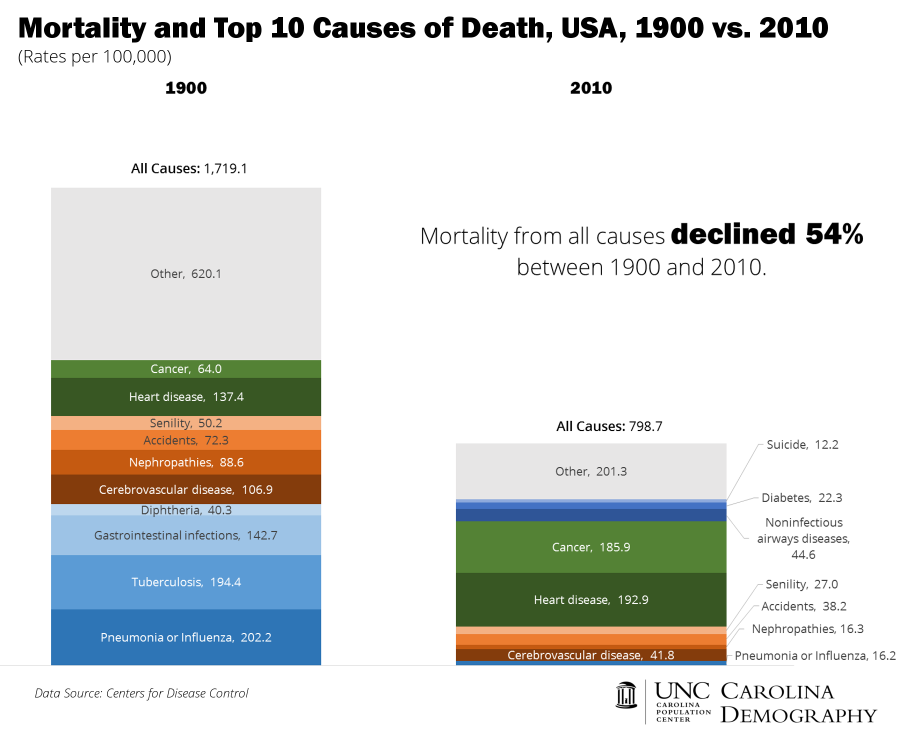
The shift from infectious diseases being the primary killers, to the vast majority of people dying from the degenerative diseases of “old age”, is precisely what happened during the latter half of the twentieth century, throughout the world. The top killers in the early 20th century were infectious diseases that have been virtually wiped out today, as this chart from the Carolina Population Center shows. (For more details, see “Mortality and Cause of Death, 1900 v. 2010” by Rebeca Tippett.) Additional major progress is evident in the 54% absolute decline in mortality from all causes during the time period between 1900 and 2010.

                Blish was foresighted enough to attempt a conceptual decoupling of chronological and biological age. Anne Abbott explains to Paige that “Old age is just the age; it’s not a thing in itself, it’s just the time of life when most degenerative diseases strike” (21). She recounts that “When the actuaries first began to notice that the degenerative diseases were on the rise, they thought that it was just a sort of side-effect of the decline of the infectious diseases. They thought that cancer was increasing because more people were living long enough to come down with it” (21). Anne then proceeds to discuss findings that some cancers are caused by viruses – which is actually the case for a minority of cancers (approximately 17.8% of cancers in 2002, as estimated by the World Health Organization). In the world portrayed by Blish, a rising incidence of degenerative diseases caused by viral infections led the National Health Service to fund research efforts by companies like Pfitzner, in an effort to address the threat.

                Incidentally, Blish also foresaw the rise in major government expenditures on medical research. Anne explains that “the result of [the first world congress on degenerative diseases] was that the United States Department of Health, Welfare and Security somehow got a billion-dollar appropriation for a real mass attack on the degenerative diseases” (22). Of course, in our world, major scientific conventions on degenerative diseases – both governmental and private – are far more routine. Indeed, a small but dynamic private organization – the SENS Research Foundation – has itself hosted six world-class conferences on rejuvenation biotechnology to date. In the United States, billions of dollars each year are indeed spent on research into degenerative diseases. The budget of the National Institute on Aging exceeds $1 billion annually (it amounts to $1,170,880,000 for Fiscal Year 2015). Unfortunately, in practice, even this level of funding – from both private and governmental sources – has thus far proven wholly insufficient to comprehensively reverse biological senescence and defeat all degenerative diseases.

                In Blish’s imagined future, the battle against senescence could be won far more easily than in our present. Pfitzner’s key project is a sweeping solution to all lifespan-limiting ailments – a broad-range “antitoxin against the aging toxin of humans” (36). In this world, Paige, who later becomes trained in Pfitzner’s research techniques, can pronounce that “We know that the aging toxin exists in all animals; we know it’s a single, specific substance, quite distinct from the ones that cause the degenerative diseases, and that it can be neutralized. […] So what you’re looking for now is not an antibiotic – an anti-life drug – but an anti-agathic, an anti-death drug” (36). If only it were that simple! Today, even the most ambitious engineering-based approach toward defeating senescence, Dr. Aubrey de Grey’s SENS program, recognizes not one but seven distinct types of aging-related damage that accumulate in the organism. Dr. de Grey’s strategy of periodically reversing the damage is more straightforward than the alternative approach of re-engineering the tremendously complex metabolic processes of the body that malfunction over time, and which are still quite incompletely understood. In Blish’s world, a single company, working covertly, with relatively modest funding (compared to the funds available to research organizations in our world), can develop an “anti-agathic” drug that does for senescence what antibiotics did for deadly infectious disease.

                Without spoiling the ending, I will only mention that it is friendly to the prospects of radical life extension and portrays it in a positive light – one additional reason for recommending that “At Death’s End” be included within the canon of proto-transhumanist and life-extensionist literary works. Furthermore, the viability of indefinite life extension in Blish’s vision is closely intertwined with humanity’s future as a spacefaring species – another progress-friendly position. Blish comes across as a thoughtful, scientifically literate (for his era) writer, who extrapolated the world-changing trends of his time to arrive at a tense, conflict-ridden, but still eminently hopeful vision for the future, where the best of human intellect and aspiration are able to overcome the perils of militarism, fundamentalism, decay, and death.

              The author of “At Death’s End” himself succumbed to death at the age of 54, on July 30, 1975. He did not live to see the world of 2000 and compare it to his prognosis. Unfortunately, Blish seems to have disregarded the tremendous harms of tobacco smoke and was even employed by the Tobacco Institute from 1962 to 1968. A genealogical profile lists Blish’s cause of death as “Recurrent cancer per smoking, metastasized.” This brilliant, forward-thinking mind unfortunately could not escape one of the most common collective delusions of his time – the fascination with and normalization of one of the least healthy habits imaginable, one that is the most statistically likely to lower life expectancy (by about 10 years). This is quite sad, as it would have been fascinating to learn how Blish’s projections for the future would have been affected by additional decades of his experience of societal and technological changes. One of the major trends in longevity improvement over the past several decades has been a major decline in the smoking rate, which decreased to an all-time low in the United States in 2013 (the latest year for which statistics are currently available). Surely, to come closer to death’s end, as many humans as possible should abandon what are now known to be obviously life-shortening habits.

              While an anti-agathic drug is not in our future, James Blish’s vision of the defeat of senescence can still serve to inspire those who endeavor to solve this colossal problem in our world, during our lifetimes. Let us hope that, through the efforts of longevity researchers and through increases in funding and public attitudinal support for their projects, we will arrive at death’s end before death ends us.

Decentralization: Why Dumb Networks Are Better – Article by Andreas Antonopoulos

Decentralization: Why Dumb Networks Are Better – Article by Andreas Antonopoulos

The New Renaissance Hat
Andreas Antonopoulos
March 8, 2015
******************************

“Every device employed to bolster individual freedom must have as its chief purpose the impairment of the absoluteness of power.” — Eric Hoffer

In computer and communications networks, decentralization leads to faster innovation, greater openness, and lower cost. Decentralization creates the conditions for competition and diversity in the services the network provides.

But how can you tell if a network is decentralized, and what makes it more likely to be decentralized? Network “intelligence” is the characteristic that differentiates centralized from decentralized networks — but in a way that is surprising and counterintuitive.

Some networks are “smart.” They offer sophisticated services that can be delivered to very simple end-user devices on the “edge” of the network. Other networks are “dumb” — they offer only a very basic service and require that the end-user devices are intelligent. What’s smart about dumb networks is that they push innovation to the edge, giving end-users control over the pace and direction of innovation. Simplicity at the center allows for complexity at the edge, which fosters the vast decentralization of services.

Surprisingly, then, “dumb” networks are the smart choice for innovation and freedom.

The telephone network used to be a smart network supporting dumb devices (telephones). All the intelligence in the telephone network and all the services were contained in the phone company’s switching buildings. The telephone on the consumer’s kitchen table was little more than a speaker and a microphone. Even the most advanced touch-tone telephones were still pretty simple devices, depending entirely on the network services they could “request” through beeping the right tones.

In a smart network like that, there is no room for innovation at the edge. Sure, you can make a phone look like a cheeseburger or a banana, but you can’t change the services it offers. The services depend entirely on the central switches owned by the phone company. Centralized innovation means slow innovation. It also means innovation directed by the goals of a single company. As a result, anything that doesn’t seem to fit the vision of the company that owns the network is rejected or even actively fought.

In fact, until 1968, AT&T restricted the devices allowed on the network to a handful of approved devices. In 1968, in a landmark decision, the FCC ruled in favor of the Carterfone, an acoustic coupler device for connecting two-way radios to telephones, opening the door for any consumer device that didn’t “cause harm to the system.”

That ruling paved the way for the answering machine, the fax machine, and the modem. But even with the ability to connect smarter devices to the edge, it wasn’t until the modem that innovation really accelerated. The modem represented a complete inversion of the architecture: all the intelligence was moved to the edge, and the phone network was used only as an underlying “dumb” network to carry the data.

Did the telecommunications companies welcome this development? Of course not! They fought it for nearly a decade, using regulation, lobbying, and legal threats against the new competition. In some countries, modem calls across international lines were automatically disconnected to prevent competition in the lucrative long-distance market. In the end, the Internet won. Now, almost the entire phone network runs as an app on top of the Internet.

The Internet is a dumb network, which is its defining and most valuable feature. The Internet’s protocol (transmission control protocol/Internet protocol, or TCP/IP) doesn’t offer “services.” It doesn’t make decisions about content. It doesn’t distinguish between photos and text, video and audio. It doesn’t have a list of approved applications. It doesn’t even distinguish between client and server, user and host, or individual versus corporation. Every IP address is an equal peer.

TCP/IP acts as an efficient pipeline, moving data from one point to another. Over time, it has had some minor adjustments to offer some differentiated “quality of service” capabilities, but other than that, it remains, for the most part, a dumb data pipeline. Almost all the intelligence is on the edge — all the services, all the applications are created on the edge-devices. Creating a new application does not involve changing the network. The Web, voice, video, and social media were all created as applications on the edge without any need to modify the Internet protocol.

So the dumb network becomes a platform for independent innovation, without permission, at the edge. The result is an incredible range of innovations, carried out at an even more incredible pace. People interested in even the tiniest of niche applications can create them on the edge. Applications that only have two participants only need two devices to support them, and they can run on the Internet. Contrast that to the telephone network where a new “service,” like caller ID, had to be built and deployed on every company switch, incurring maintenance cost for every subscriber. So only the most popular, profitable, and widely used services got deployed.

The financial services industry is built on top of many highly specialized and service-specific networks. Most of these are layered atop the Internet, but they are architected as closed, centralized, and “smart” networks with limited intelligence on the edge.

Take, for example, the Society for Worldwide Interbank Financial Telecommunication (SWIFT), the international wire transfer network. The consortium behind SWIFT has built a closed network of member banks that offers specific services: secure messages, mostly payment orders. Only banks can be members, and the network services are highly centralized.

The SWIFT network is just one of dozens of single-purpose, tightly controlled, and closed networks offered to financial services companies such as banks, brokerage firms, and exchanges. All these networks mediate the services by interposing the service provider between the “users,” and they allow minimal innovation or differentiation at the edge — that is, they are smart networks serving mostly dumb devices.

Bitcoin is the Internet of money. It offers a basic dumb network that connects peers from anywhere in the world. The bitcoin network itself does not define any financial services or applications. It doesn’t require membership registration or identification. It doesn’t control the types of devices or applications that can live on its edge. Bitcoin offers one service: securely time-stamped scripted transactions. Everything else is built on the edge-devices as an application. Bitcoin allows any application to be developed independently, without permission, on the edge of the network. A developer can create a new application using the transactional service as a platform and deploy it on any device. Even niche applications with few users — applications never envisioned by the bitcoin protocol creator — can be built and deployed.

Almost any network architecture can be inverted. You can build a closed network on top of an open network or vice versa, although it is easier to centralize than to decentralize. The modem inverted the phone network, giving us the Internet. The banks have built closed network systems on top of the decentralized Internet. Now bitcoin provides an open network platform for financial services on top of the open and decentralized Internet. The financial services built on top of bitcoin are themselves open because they are not “services” delivered by the network; they are “apps” running on top of the network. This arrangement opens a market for applications, putting the end user in a position of power to choose the right application without restrictions.

What happens when an industry transitions from using one or more “smart” and centralized networks to using a common, decentralized, open, and dumb network? A tsunami of innovation that was pent up for decades is suddenly released. All the applications that could never get permission in the closed network can now be developed and deployed without permission. At first, this change involves reinventing the previously centralized services with new and open decentralized alternatives. We saw that with the Internet, as traditional telecommunications services were reinvented with email, instant messaging, and video calls.

This first wave is also characterized by disintermediation — the removal of entire layers of intermediaries who are no longer necessary. With the Internet, this meant replacing brokers, classified ads publishers, real estate agents, car salespeople, and many others with search engines and online direct markets. In the financial industry, bitcoin will create a similar wave of disintermediation by making clearinghouses, exchanges, and wire transfer services obsolete. The big difference is that some of these disintermediated layers are multibillion dollar industries that are no longer needed.

Beyond the first wave of innovation, which simply replaces existing services, is another wave that begins to build the applications that were impossible with the previous centralized network. The second wave doesn’t just create applications that compare to existing services; it spawns new industries on the basis of applications that were previously too expensive or too difficult to scale. By eliminating friction in payments, bitcoin doesn’t just make better payments; it introduces market mechanisms and price discovery to economic activities that were too small or inefficient under the previous cost structure.

We used to think “smart” networks would deliver the most value, but making the network “dumb” enabled a massive wave of innovation. Intelligence at the edge brings choice, freedom, and experimentation without permission. In networks, “dumb” is better.

Andreas M. Antonopoulos is a technologist and serial entrepreneur who advises companies on the use of technology and decentralized digital currencies such as bitcoin.

This article was originally published by The Foundation for Economic Education.