Mr. Stolyarov provides a quick overview of ideas that anyone can implement to accelerate the pace of technological progress and bring about indefinite life extension for many who are alive today.
Mr. Stolyarov provides an update regarding the effort to distribute over 1,000 free, paperback copies of Death is Wrong to children.
As of May 28, 2014, 644 books have been sent out, and 385 remain to be distributed, out of an eventual goal of 1,029 books provided to children, free of cost to them.
Instructions for Longevity Activists to Request Copies of “Death is Wrong”
– Provide (i) your name, (ii) your mailing address, (iii) a statement of your support for indefinite life extension, and (iv) a brief description of your plan to spread the book to children in your local area. Remember that all copies received pursuant to this initiative would need to be offered to children free of charge (as gifts or reading opportunities) and may not be resold.
– Provide the number of copies of Death is Wrong that you are requesting.
– Preferably, provide an indication that you would be willing to send photographs of the books that have been delivered to you as well as events where you will be distributing the books.
Most people want to die of in their sleep, in peace, of old age, without pain and surrounded by their family and loved ones after achieving success and after having done something worthwhile.But the facts suggest, that such a peaceful end is granted to very few people, while most people have to endure different disabilities and diseases associated with aging and terrible pain and decreased function, performance, and the lack of joy coming with it.The Global Burden of Disease (GBD) project originated in 1990 in a collaboration between the World Health Organization, Harvard School of Public Health, the Institute for Health Metrics and Evaluation (IHME), and the World Bank.
The focus of the Global Burden of Disease Study is to provide a detailed statistical analysis of the impact of diseases leading to death and disability across various regions around the world. The purpose of the study is to reveal gaps between current and ideal health circumstances and develop strategies to reduce this gap.
The 2010 Global Burden of Disease study reveals a significant shift in the nature of disease worldwide. There has been a significant increase in chronic disease worldwide. This is due to demographics of aging, and the subsequent increase of age-related disease.
Worldwide, the contribution of different risk factors to disease burden has changed substantially, with a shift away from risks for communicable diseases in children towards those for non-communicable diseases in adults.
As life expectancy has increased, the number of healthy years lost to disability has also increased in most countries, consistent with the expansion of morbidity hypothesis, which has implications for health planning and health-care expenditure.One of the key findings reveals that we are living longer, but under an increased burden of chronic disease that impairs our quality of life.These results are distressing: men can expect to spend an average of 9.2 years and women 11.5 years with some form of a chronic disability. In other words, during the last decade of lives, on average, our quality of life might become significantly impaired by the presence of a chronic disease.
The paradox, then – the fact that people want to be actively saved if they are near or at the moment of death, but also want to die peacefully – seems to be rooted in a pretty profound medical illiteracy.
Healthy people don’t die in their sleep, “peacefully” or otherwise. You don’t hear about too many 25-year-olds dying suddenly of heart attacks or strokes during their nightly slumber.
When people in their twenties die, it’s usually considered tragic. When babies are found dead in their cribs, it’s referred to by a name (“Sudden Infant Death Syndrome”). But when elderly people die, in bed or otherwise, there tends to be a curious tone of, “Well, at least they went peacefully.”
The increase in life expectancy and the resulting growth of the elderly population are also thought to be driving up the number of elderly people with disabilities.
Typically in the case of dying in your sleep due to old age, an autopsy can determine exactly what went wrong, or what stopped working. For example, your heart could simply get tired and stop beating, because it’s been working hard for the past eighty or ninety years.
The phrase “natural causes” or dying “of old age” is a very strange one really. Ultimately what it means is that someone who dies of natural causes, dies of aging in a way that has not been given an additional name; so really it’s just a matter of terminology. The difference is between dying of “natural causes” and dying of some other specifically named thing that doesn’t really often affect young adults.
Searching for a cure for age-related ill health, a problem that kills more people than all other causes combined, is a moral imperative. The Advocate for Negligible Senescence publishes articles that discuss and educate the public about research to combat senescence. See the Advocate’s Facebook page.
The Slowly Spreading Realization That Aging Can Be Defeated – Article by Reason
At some point in the next ten to twenty years the public at large, consisting of people who pay little attention to the ins and outs of progress in medicine, will start to wake up to realize that much longer healthy lives have become a possibility for the near future. The preliminaries to this grand awakening have been underway for a while, gradually, and will continue that way for a while longer. A few people every day in ordinary walks of life notice that, hey, a lot of scientists are talking about greatly extending human life spans these days, and, oh look, large sums of money are floating around to back this aim. There will be a slow dawning of realization, one floating light bulb at a time, as the concept of radical life extension is shifted in another brain from the “science fiction” bucket to the “science fact” bucket.
Some folk will then go back to what they were doing. Others will catch the fever and become advocates. A tiny few will donate funds in support of research or pressure politicians to do the same. Since we live in an age of pervasive communication, we see this process as it occurs. Many people are all to happy to share their realizations on a regular basis, and in this brave new world everyone can be a publisher in their own right.
Here is an example that I stumbled over today; a fellow with a day-to-day focus in a completely unrelated industry took notice and thought enough of what is going on in aging research to talk about it. He is still skeptical, but not to the point of dismissing the current state and prospects for longevity science out of hand: he can see that this is actionable, important knowledge.
I think these guys – and the whole movement to conquer aging – is fascinating. I am highly skeptical of the claims, however. Optimism is all well and good, and I have no off-hand holes to poke in their (very) well-articulated arguments. But at the same time, biology is fiendishly complex, the expectations beyond fantastical.
Still though, I have to wonder: What if guys like de Grey and Kurzweil are half right, or even just partially right? What if, 30 years from now, it becomes physically impossible to tell a 30-year-old from a 70-year-old by physical appearance alone? It sounds nutty. But it’s a lot less nuttier, and a lot closer to the realm of possibility, than living to 1,000 – which, again, some very smart people have taken into their heads as an achievable thing.
People who don’t take care of themselves are insane. Ok, not actually “insane.” But seriously, given the potential rewards AND the risks, not taking care of your body and mind – not treating both with the utmost respect and care – seems absolutely nuts. At the poker table I see these young kids whose bodies are already turning to mush, and a part of me just wants to grab them by the shirt collar and say “Dudes! What the hell is WRONG with you!!!”
If it is possible – just realistically possible, mind you – that I could still be kicking ass and taking names at 125 years old, then I want to be working as hard as I can to preserve and maintain my equipment here and now. No matter what miracles medical science will achieve in future, working from the strongest, healthiest base possible will always improve the potential results, perhaps by an order of magnitude. Individuals who go into old age with fit, healthy bodies and sound minds, and longstanding habits to maintain both, may find potential for extended performance at truly high quality of life that was never before imaginable.
As the foundations of rejuvenation biotechnology are assembled and institutions like the SENS Research Foundation continue to win allies in the research community and beyond, the number of people experiencing this sort of epiphany will grow. The more the better and the sooner the better, as widespread support for the cause of defeating aging through medical science is necessary for more rapid progress: large scale funding always arrives late to the game, attracted by popular sentiment. The faster we get to that point, the greater our chances of living to benefit from the first working rejuvenation treatments.
Reason is the founder of The Longevity Meme (now Fight Aging!). He saw the need for The Longevity Meme in late 2000, after spending a number of years searching for the most useful contribution he could make to the future of healthy life extension. When not advancing the Longevity Meme or Fight Aging!, Reason works as a technologist in a variety of industries.
***
This work is reproduced here in accord with a Creative Commons Attribution license. It was originally published on FightAging.org.
Motivated Time Prospectors – Article by Eric Schulke
Think of all the people’s lots in life that you don’t have. You will regret not having more chances to stand here as you are now. It is said that if everybody put their worries into a pile and then took an equal share from the pile, then most people would be content to take back their own share of them. I was reading an article that said,
“To be sick and dying in Vegas has its own existential horror. Not only do you realize that you are going to die and that you don’t matter to the world, but you also realize that much of the world is awful and yet you still would do anything to live.”
Struggling to survive on this planet can be miserable, and yet we continue to stick with it. Why? Because we know that with life there is a chance to engage in more experience. It seems that a person can live, in part, on the desire for continued experience. That chance drives us to keep reaching for achievement and progress.
What does one want to experience in life? What does that honest-to-life list look like? If you had to draw up a complete list, could you do it, or describe the nature of it? The active wanting of experience, it seems, is a major cure to indifference toward death. It seems that it might be a life-or-death question.
We have become really good at being indifferent to the most widespread forms of death, in order to spare ourselves from stressing out on futilely trying to do something about it. Now that we have the tools and techniques, and the times have changed, we have to change that way of thinking from indifference back toward letting that horror affect us. Horror benefits us in that it is our cue to be driven to action to make sure that the horror can’t happen again. If a poltergeist starts ravaging your house, that’s your signal to get out of there, in the same way that the horror that general death, aging, and other diseases are your signal to get death, aging, and other diseases away from you and out of your cells.
Carl Sagan’s daughter once related his words that “there was nothing he would like more in the world than to see his mother and father again.” I was thinking about what an insult added to injury he must have felt in his final days, to have the paralyzing misery of impending death heaped on top of crushing pain. Let that kind of pain course through your mind, face it, bring it to a steaming rage, and let the energy power you to help execute any of the various assaults on aging and disease that are underway in laboratories in various places around the world.
In another article, I was reading about a guy whose daughter went missing in 1971, and was never found. He lived to be 102 and died in the fall of 2013. He had stated that one of the hardest burdens for him was never knowing what happened to his daughter. What misery, for all those years… Think of that… Then five days after he died, his daughter’s car was found upside down in a river; she was the apparent victim of a decades-old car crash.
I can’t fathom that life could inflict such a bitter spite upon somebody. That story stirs up the kind of despair and anguish that each death seems to deserve. It’s the kind of anguish you need to figure out how to allow in, in order to have the right kinds of drive to help pull the Movement for Indefinite Life Extension forward with us.
So once we get there, back to that place where we stand amidst realization of the horror of death, how do we face it? One good basic and natural way to do so, it seems, is to purposefully enjoy the good parts of life, and strategize and take action in helping to fix the worst of the broken things. It’s fun and fulfilling. Life isn’t bad, it’s an adventure. A tough challenge is like a choppy sea, like two armies clashing, or mountain climbers fighting the elements. The implementation of the solution of each challenge is like a Renaissance of scale, some miniature, some very large, like Caesar vs. Vercingetorix, or Charlemagne vs. the Vikings. It’s like the writings of Caesar, the writing-resurgence work of the Carolingians, Vercingetorix and the fate of an entire Celtic confederation, or the first times the Vikings set sail out beyond Greenland.
A few days ago I was thinking about a typical farm hand of Medieval times, walking outside to smell the heavy wet grass and earth of a cold wet spring day. How did they remember the great Lombard migrations, or Scandinavian raiders docking at Pisa? Who was Charlemagne to people before negationists took hold? What did they think might become of the future? Many of them must have felt lost at that kind of thought.
Focus on your heartbeat, feel it pulsing. Theirs pulsed like that. They thought of their hearts stopping and of how it couldn’t possibly be lost to the dust of history anytime soon. You think that, too. Their hearts are lost to the dust of history. Yours is next.
What does every year, and every moment mean to the history of everything? I read recently that if you throw a pebble, it could be offsetting the center of gravity of the universe. Every moment means everything, every moment is everything. Every moment is a world in itself, a great painting, a great work of art, a great burning torch, a water well built in inhospitable lands. Think of how many heartbeats have come to a stop, how many paintings have been burned… So many tangled groves in forests have had the wind blowing through them for all of these years, without one person, without one spoken word, in a place near a stream, where there was once a mighty, crackling stone fireplace that warmed multiple generations of families across the 6th through 8th centuries. It was a place that hosted countless memories which later tormented the souls of dying, now long-dead grandfathers.
They don’t deserve to be dead. They deserve what they earned: the world that is paying exponentially exciting, satiating, and fullfillingly valuable dividends today. This is an incredibly motivating and driving factor in what pushes me to pursue indefinite life extension. People take on a variety of diverse augmentations over time, becoming unique collections of intriguing insight – dynamic power tools for slicing and dicing the elements. We can’t afford for these wealths of rare and powerful abilities and resources to be pillaged and killed off. Sometimes it seems as if life-extensionists like me have to explain to people why it’s bad to let people be killed before we can get down to business in a worldwide effort to reach the goals that can get this done.
We are like the union for the people that make a profession out of being human. We are creating better and better pay, and we demand longer hours. I want every feasible remedy that can restore and maintain life to be a permanent fixture in this reality, for it to be harvested like air. There is no reason a heart has to give out. There is no reason we cannot prevent tangles from forming in the brain. Our organs and cells don’t have to degrade. We have tools, techniques, and brains. We will make it through these obstacles.
How long will it be before our times are old, before 2015 cars look like old classics, and thoughts of our times are most often associated with the smell of the pages of books that have been moved from their years of service on shelves, to boxes of outdated material in back rooms? Many experiences and voyages that could have happened, and could have been chronicled in those boxes, can never exist.
That’s the problem, it seems: There are experiences that could have existed, but that now never can. Thoughtful experience – there is no reason to forgo it or allow it to be lost – hence the basic, inherent reasoning for supporting indefinite life extension, it seems.
Every moment is the gold, the thing to be mined, the thing to be in awe of, to seek, pursue, and strategize toward, to work for, to feel victorious for possessing. Let’s mine more time: support the Movement for Indefinite Life Extension. Don’t be distracted by fool’s gold while the most valuable gold, time, slips through your fingers.
One of these days, we will put funeral homes across the world out of business, and it will be a great victory. We will celebrate, and the festivities will be grand. But we must get a move on now, because our chances are turning into sand.
There are numerous examples of studies that use mice genetically engineered to suffer forms of shortened life span with the appearance of accelerated aging. One has to be very cautious in reading anything into this sort of work, however: it is rarely of any great relevance to normal aging, as it creates and then attempts to ameliorate an entirely artificial situation. The appearance of accelerated aging is not in fact accelerated aging, but is rather often caused by mechanisms that are of little importance in normal aging. Even when the mechanisms are relevant, the overall metabolic circumstances can render it impossible to determine whether or not a partial treatment will be of any use in normal aging. The gold standard for relevance when evaluating new methods is the extension of life in unmodified mice, but unfortunately this is expensive and slow.
The publicity materials quoted below are a good example of research in animals exhibiting shortened life spans. Here scientists are investigating a protein involved in the induction of cellular senescence. As is often the case, however, from the structure of the work it is impossible to tell whether or not their drug candidate will be of any use as a treatment to lower levels of cellular senescence in normal aging and thus produce benefits such as extended health and life span. Those tests will still have occur:
Quote:
When cells or tissue age – called senescence – they lose the ability to regenerate and secrete certain proteins, like a distinctive fingerprint. One of those proteins, PAI-1 (plasminogen activator inhibitor) has been [a focus of] research, originally as it relates to cardiovascular disease. “We made the intellectual leap between a marker of senescence and physiological aging. We asked is this marker for cell aging one of the drivers or mechanisms of rapid physiological aging?”
For the study, [researchers] used mice bred to be deficient in a gene (Klotho) that suppresses aging. These mice exhibit accelerated aging in the form of arteriosclerosis, neurodegeneration, osteoporosis and emphysema and have much shorter life spans than regular mice. [These] rapidly aging mice produce increased levels of PAI-1 in their blood and tissue.
Then scientists fed the rapidly aging mice TM5441 – the experimental drug – in their food every day. The result was a decrease in PAI-1 activity, which quadrupled the mice’s life span and kept their organs healthy and functioning. “This is a completely different target and different drug than anything else being investigated for potential effects in prolonging life. It makes sense that this might be one component of a cocktail of drugs or supplements that a person might take in the future to extend their healthy life.”
Reason is the founder of The Longevity Meme (now Fight Aging!). He saw the need for The Longevity Meme in late 2000, after spending a number of years searching for the most useful contribution he could make to the future of healthy life extension. When not advancing the Longevity Meme or Fight Aging!, Reason works as a technologist in a variety of industries.
***
This work is reproduced here in accord with a Creative Commons Attribution license. It was originally published on FightAging.org.
The Methuselah Mouse Prize: Changing the Conversation about Aging – Article by Advocate of Negligible Senescence
Methuselah Foundation created a stir in the research community by introducing the Methuselah Mouse Prize in 2003. The Mouse Prize was designed to directly accelerate the development of revolutionary new life extension therapies by awarding two cash prizes: one to the research team that broke the world record for the oldest-ever mouse; and one to the team that developed the most successful late-onset rejuvenation strategy.Unlike other engineering prizes (for example, the X Prize for lunar exploration), an award of the Methuselah Mouse Prize is not the end of the matter. The winner establishes a record that others have to break.
***
Why mice? Mice are genetically similar to humans. They are small and inexpensive to maintain so studying large quantities is feasible. Their short lifespan, about three years, makes it possible to see if interventions result in longer, healthier lives—all in time to be of benefit to our own lives.
The Mouse Prize for longevity was first won by a team led by Dr. Andrzej Bartke of Southern Illinois University. The prize for rejuvenation first went to Dr. Stephen Spindler of the University of California.
Additionally, in 2009, the first Special Mprize Lifespan Achievement Award went to Dr. Z. Dave Sharp for the successful healthy life extension of already aged mice using a pharmaceutical, rapamycin.
***
Through programs like the Methuselah Mouse Prize, Methuselah Foundation has helped change the conversation on aging and longevity, lending credibility and prestige to areas of research that once were openly frowned upon.
***
Previous winners have already proven that healthy life can be extended; more wins are possible by researchers who can best previous winners’ performances, and each new winner pushes the outer limits of healthy life back even further.
How translatable the lesson of a Methuselah mouse will be to people is a matter of debate. The logic of disposable-soma theory applies to both species.
Private donations made since 2003 have bumped the prize value up to nearly $3.5 million, according to the latest update on the Methuselah Foundation website.
Don’t be misled by the size of the fund into thinking that a small donation will make no difference, because this is fundamentally a popular enterprise, a people’s prize, so the number of individual donors is really just as important as the total.
Searching for a cure for age-related ill health, a problem that kills more people than all other causes combined, is a moral imperative. The Advocate for Negligible Senescence publishes articles that discuss and educate the public about research to combat senescence. See the Advocate’s Facebook page.
Eternal Life Fan Club Review of “Death is Wrong” – Article and Graphic by Roen Horn
This review was originally posted on the Facebook page of the Eternal Life Fan Club, a community created by Roen Horn to share philosophy, research, and strategies to help humans increase their chances of living forever.
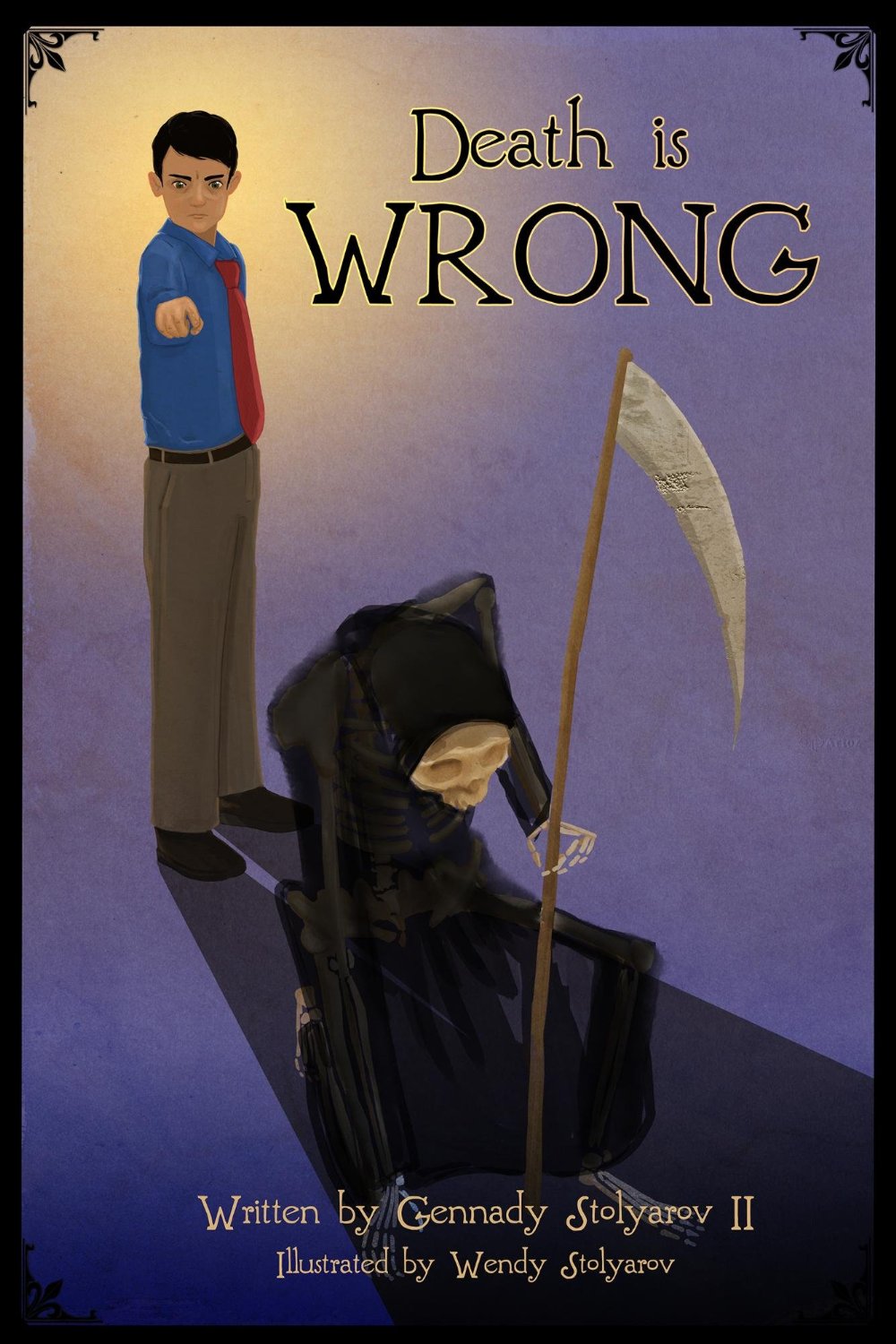
I finally got around to reading the new transhumanist children’s book Death is Wrong. I was impressed with the simplicity and clarity of the message, and my impression was that children could easily digest the information. It’s about time there was a children’s book promoting the message of indefinite life-extension. This book should be mandatory reading in elementary schools. I was pleased to see that the book gave mention to Aubrey de Grey and SENS Research Foundation. Besides explaining the logical reasons for why death is wrong, I was delighted that the book spoke about the frailness of life and the overwhelming sadness of death. The book also specified the importance of vigilantly avoiding dangerous behaviors which would endanger one’s life, and the importance of taking care of one’s health. I think that message is especially important for young children to hear. The book leaves the reader with the optimistic outlook that death does not have to be inevitable. If we know that death is wrong, then we must wage war on death and never give up until we have won this fight. You can find the book on Amazon here.
Wendy Stolyarov, Illustrator of Death is Wrong, at the Transhuman Visions 2.0 Conference – March 1, 2014
“Death is Wrong” Fundraiser: Another Ship Returns to Harbor after Braving the Seas for the Cause – Article by Eric Schulke
On December 2nd of 2013, the Movement for Indefinite Life Extension began a contest for people to send in their ideas on how to spend money on outreach for the cause. The following question was asked:
If you were to receive a check in the mail with $5,000 to inform as many people as possible about the desirability and the prospects for indefinite life extension, to get them interested in the people, projects and organizations working directly or indirectly toward indefinite life extension, then how might you spend it?
It is a great success on multiple levels for the Death is Wrong book and vision in itself, which supports indefinite-life-extension research and philosophy in general, and which is written by one of the many Movement for Indefinite Life Extension leaders, Gennady Stolyarov.
It is also a great success for the Movement for Indefinite Life Extension in general on many levels. It is one of the first major projects the MILE has executed in its upcoming series of projects to work to reach 80,000 “likes” at MILE Facebook page for the Year 3 goal, which begins on July 17th 2014, and tasks us with collectively helping to achieve the group victory of moving from 8,000 likes, to 80,000 likes by the July 17th of the following year, 2015.
Rodney Ashby and Jason Shields helped us get the momentum rolling and did fundraising throughout, and Tonya Scholz gave the project a big hand. Gennady Stolyarov made an amazing media tour for the project, finding himself talking about it in interviews and getting mentions and reports from a variety of sources. Most of them are of his own arranging, some of these outlets picked the story up on their own, and there are some opportunities that I arranged. They include, but are not limited to, the following:
This new fundraiser, started today, to distribute copies of the important book Death is Wrong, is a project that can go a long way. A thousand books might not seem like a lot in the grand scheme of things, but it can make a big difference.
Stolyarov is hoping to kindle a small spark of hope into an eternal flame. “What I think is necessary right now is a determined push to dramatically accelerate the pace of technological progress,” he says. “We have a fighting chance right now, but in order to make it happen we have to be the agents of change.”
I like to see advocates setting forth to create small scale initiatives like the children’s book Death is Wrong and the associated fundraiser to distribute copies. At the large scale a broad advocacy movement for a cause in medical research isn’t a monolithic thing; it is made up thousands of such efforts, a tapestry of individual who each thought enough of the cause to stand up and do something about it. More of this is always a good thing, and working towards a cure for degenerative aging is the most worthy of causes that I know of.
Parents who share his philosophy would therefore be wise to inoculate their children against “death acceptance” early, Stolyarov says. “Ideally, they would walk away with a motivation to do something about this dragon tyrant in the room, this problem of death. I don’t want these vestigial forms of thinking to essentially cause mass suffering and death. We need to push for these [life-extending] technologies to be invented as early as possible, as effectively as possible.”
There were 92 contributions from over 80 individuals and one group, including, but not limited to:
There were also at least 13 anonymous donations. I did a count of all of the donors that I brought in. A close, conservative estimate is that I brought in around 70% of them.
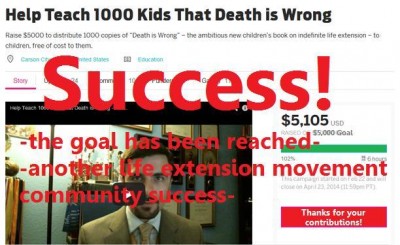
We ended up raising $5,141, compounding on the success by $141. That means that we raised enough to distribute 29 more books than projected. Those of us that worked with this didn’t take a single dime as a cut of this. I put a hundred dollars or so in ads into it, and Wendy and Gennady have given countless hours of their time to rewarding donors. Countless others, like general activists and reporters, have put their time and resources into this. The Life Extension Foundation made an inspiring and generous $1,255 dollar donation to close the deal.
Gennady and I have already secured the distribution of 140 copies, and there are now over 1,000 total available for distribution. An order even went out to Aubrey de Grey, whose work is one of the many topics that is talked about in the book. Gennady Stolyarov writes in the Indiegogo update page that,
Update of April 16, 2014: I am delighted to announce that a shipment of 10 Death is Wrong books was made yesterday to Dr. Aubrey de Grey himself at the SENS Research Foundation. Since Dr. de Grey’s work is a crucial inspiration for Death is Wrong and my longevity activism more generally, I am immensely pleased that he has agreed to receive this shipment and make the books available for distribution.
We encourage the distribution of Death is Wrong books to places like schools, libraries, and directly to parents and children. We ask people to order as many copies as they think they may be able to give away to kids and people with kids, at Transhuman and health events, rallies, and similar events. Gennady has instructions on how to order them free of charge:
Instructions for Longevity Activists to Request Copies of Death is Wrong
– Provide your name, your mailing address, a statement of your support for indefinite life extension, and a brief description of your plan to spread the book to children in your local area. Remember that all copies received pursuant to this initiative would need to be offered to children free of charge (as gifts or reading opportunities) and may not be resold.
– Provide the number of copies of Death is Wrong that you are requesting.
– Preferably, provide an indication that you would be willing to send photographs of the books that have been delivered to you as well as events where you will be distributing the books.
The project has been a great community effort. The Movement for Indefinite Life extension is our collective spirit, not an organization. Together we collect supporters for all of the constructive projects and organizations. There must have been over 150 people involved. More activists flexed their life-extension muscles, and we helped more people that want to get involved to take the first step. If you’ve ever saved money, then you know how incremental change adds up. You cannot achieve the saving of $8,000 unless you first get to $2,000, and $6,000, and so forth.
It’s an example of elements coming together for a movement, like this article says:
A movement occurs when, one, a large number of people have a need that, two, lines up with the necessary ingredients to make it happen, and those two things are sparked by, three, a catalyst.
The need to survive has always been here. The ingredients have been getting added to the mix since the dawn of the Scientific Revolution. The element of the love for life is in the air, thick with explosive properties, fueled by indefinite-life-extension research and outreach from around the world and across time. People are busy working on rallies, conferences, events, interviews, getting the message out, and all the rest. The tools and the ability to make this happen are ripe, and growing more and better yields of produce by the month. Every time you put a match to it, it erupts in indefinite-life-extension activism. Be that spark today and get in on this movement.
We have more projects like this ahead, and there are plenty of others to choose from in the communities, pages, groups, organizations, sites, and other venues, around the world, growing here toward that tipping point where we can have the opportunity to spill across the ticker tapes of screens and the minds of the young and old alike, lighting hearts and minds on fire with desire to chip in together to make this happen. This is an incredible opportunity, this time here, fertile with tools and insights, unleashed capabilities beyond our wildest dreams. People are already capable of tons of incredible things that you don’t even know about yet.
Columbus went on a fantastic voyage. When you think of those times, and how fulfilling and enthralling it must have been for them to be able to be part of that, realize that indefinite life extension, all this Transhumanism, is an even greater frontier, and you are in an even more incredible and glorious position than people like Columbus and his crew. It’s a position here where anybody, where you, can help sail out into these incredible frontiers that are opened up through the ever-expanding fields of science and technology.
A compounded victory! We have raised enough funds through Indiegogo to provide at least 1029 free paperback copies of Death is Wrong to children throughout the world.
Please watch my video announcement of the fundraiser’s success! (The number of available books has increased since I mentioned being able to provide 1024 books in the video.)
140 copies have been distributed; 159 are immediately ready to go upon request. Within 15 days, we will have the funds to distribute all of the remaining books to activists who ask for them.
Extensive thanks go to Bill Faloon of the Life Extension Foundation and Tonya Scholz, who persuaded Mr. Faloon to provide the Life Extension Foundation’s support. They have my eternal gratitude for their generous willingness to step in and get us the rest of the way to our goal. Thank you, also, to every single one of our 92 funders and hundreds of supporters throughout the world!
Earlier today I was interviewed by Tonya Scholz and Sandra Lopez on their Social Chats livestreamed radio program. We had a delightful conversation about Death is Wrong and the amazing reach it has had thus far. You can listen to the recording of the interview here.
Also, I am happy to announce that the five-day window for free downloads of the Kindle version has resulted in 318 downloads – an additional way in which the book has spread significantly!
Instructions for Longevity Activists to Request Copies of Death is Wrong
– Provide your name, your mailing address, a statement of your support for indefinite life extension, and a brief description of your plan to spread the book to children in your local area. Remember that all copies received pursuant to this initiative would need to be offered to children free of charge (as gifts or reading opportunities) and may not be resold.
– Provide the number of copies of Death is Wrong that you are requesting.
– Preferably, provide an indication that you would be willing to send photographs of the books that have been delivered to you as well as events where you will be distributing the books.