Browsed by
Tag: Donald Trump

Playing Politics Can Be Fun until It Unleashes Hell – Article by Joey Clark

Playing Politics Can Be Fun until It Unleashes Hell – Article by Joey Clark

The New Renaissance HatJoey Clark
******************************

Most politicians and their followers are not cynical enough about politics. They hate the players but not the game. Unlike me, they are cynical sentimentalists, i.e. they idealize politics yet are cynical towards any suggestion human beings should be set free from political control.

Though it may smack of paradox, I consider myself a hopeful cynic – hopeful in man’s spirit but not his politics. Accordingly, my political cynicism flows from my disappointed sentimentality.

Most politicians are not cynical enough about politics. They hate the players but not the game. As Oscar Wilde wrote in Lady Windermere’s Fan, a cynic is “a man who knows the price of everything, and the value of nothing” and a sentimentalist “is a man who sees an absurd value in everything and doesn’t know the market price of any single thing.” Together the two bring harmony.

Torn apart, they are blind in their own unique way, and in this way, the 2016 political season has rendered much of the American populace sightless. Some wish to present this presidential election as a clear-cut contest between cynical pachyderms and sentimental jackasses, but the truth, to steal another line from Wilde, is rarely so pure and never so simple.

As much as they will deny it, political factions are motivated by a mix of cynicism and sentimentality, sometimes within the very same individuals.

Even the most sentimental nincompoops – those who shed tears or fall into fits of hosannas upon hearing the most platitudinous political speech – turn cynical and stone-faced when confronted by their political opponents.

Even the most cynical demagogues – those who spit piss and vinegar in response to the most innocuous statements from their enemies – turn sentimental and misty-eyed in the presence of a president they love.

It seems one politico’s hopes are another politico’s fears. They appraise their enemy’s price as too high yet see absurd value in their champions.

The Donald’s Sentimentality

For example, even Donald Trump is not cynical enough about politics. Trump may very well be cynical and downright churlish towards, well, almost anyone (even babies) on any given day, but he is certainly a believer in the need for strong government leadership. Trump has, indeed, boosted his popularity by stoking the flames of resentment, but the essence of this resentment is the betrayed sentimentality of “the people.”

Trump and his supporters idealize America just as much as the next group. Holding true to a golden age image of the country, they are disappointed by an ever-changing world that continually shatters their “perfect” picture of the nation. They are cynical of what they see as “un-American,” and they have hitched their hopes to Trump’s politics to save their culture as they see it.

Thus, Trump’s slogan may not be “Burn America Down” as Democrats would have you believe, but he is certainly a flaming nationalist. His program may not be great for many people living in America, but “America” is, indeed, the ultimate standard of good and evil on the Trump train. One cannot be cynical about politics qua politics and a nationalist at the same time. No, nationalism is for the teary-eyed evangelicals and patriotic bomb throwers, Trump being the latter. But how about the former?

Enter Hillary Clinton.

Hillary’s Cynicism

Hillary Clinton, like most progressives, prides herself on her forward-looking and optimistic approach. She and her ilk apparently claim to loathe cynicism. As Senator Cory Booker said at the Democratic National Convention surrounded by a friendly mob of fellow sentimentalists, “Cynicism is a refuge for cowards.” Of course, by “cynicism” Cory, Hillary, and their do-gooder cronies mean anyone who does not wish to consent to their progressive plans to save the world. To hear them speak about peace, love, and community one would think such things were impossible without the imposition of the state.

What makes progressives so sentimental about people using state power yet cynical towards people acting voluntarily, I will never truly know.What makes progressives so sentimental about people using state power yet cynical towards people acting voluntarily, I will never truly know, but I suspect they do not trust the motives of many of their fellow men, especially not Donald Trump. Their assessment of Trump may be correct, but their appraisal of their own sentiments is utterly lacking. Their worship at the altar of state power seems to have turned them blind to the ironies of the “progressive” history and project.

For instance, of all the ways Hillary could take down Trump’s fear-mongering, she chose to say this in her acceptance speech at the Democratic Convention:“Well, a great Democratic President, Franklin Delano Roosevelt, came up with the perfect rebuke to Trump more than eighty years ago, during a much more perilous time. ’The only thing we have to fear is fear itself.’”

Yes, Hillary, how wise of you to quote a man who brought us Japanese internment camps, turned away Jewish refugees fleeing Nazi Germany, and set the price of gold based on “lucky numbers.” But, I suppose, since FDR is a demigod in the progressive civic religion, his cynicism and quackery can be overlooked, as can the ugly, cynical history of progressive policies such as the minimum wage.

Again, if only Hillary, Donald and their respective acolytes were more cynical about politics qua politics, we would all be better off. But what about the most cynical bunch in American politics today, the alt-right meme team?  How could a group of folks who “pretend” to be Nazis ever be helped by more political cynicism?

And why would one ever want to pretend to be a Nazi anyway?

Pretend Nazis Need Cynicism Too

Enter Charles Bukowski:

“At L.A. City College just before World War II, I posed as a Nazi. I hardly knew Hitler from Hercules and cared less. It was just that sitting in class and hearing all the patriots preach how we should go over and do the beast in, I grew bored. I decided to become the opposition. I didn’t even bother to read up on Adolf, I simply spouted anything that I felt was evil or maniacal.

However, I really didn’t have any political beliefs. It was a way of floating free.”

This is how Bukowski’s short story, “Politics”, begins, and his reasons for his posing as a Nazi – ”boredom” and “floating free” – sound quite similar to those prescribed to the alt-right “meme team” by that frivolous troll, Milo Yiannopoulos, and his colleague, Allum Bokhari, in their crash course on the alt-right:

These young rebels, a subset of the alt-right, aren’t drawn to it because of an intellectual awakening, or because they’re instinctively conservative. Ironically, they’re drawn to the alt-right for the same reason that young Baby Boomers were drawn to the New Left in the 1960s: because it promises fun, transgression, and a challenge to social norms they just don’t understand.

If this parallel continues into the future, things will probably not end well, at least not with mere lulz.

As Bukowski later relays in the story, his Nazi antics earned him disciples, but his acolytes took the whole charade much more seriously than he. After stumbling upon a Communist speaker outside of campus, one of his followers approached him with a bag of rotten tomatoes. Upon being told to put the tomatoes away, his follower said, “I wish they were hand grenades.”

“It occurred to me suddenly that my disciples hadn’t been listening to the speaker, or even if they had been, nothing he had said would matter,” writes Bukowski, “Their minds were made up. Most of the world was like that… I lost control of my disciples that day, and walked away as they started hurling their rotten tomatoes.”

The alt-right don’t want to get rid of the establishment; they want to replace it.I must hand it to the alt-right trolls – they are quite creative and prolific and, at times, hilarious in their cynical pose – but there is a difference between political cynicism and a general cynicism about the culture at large. One must be careful not to let those rotten tomatoes turn into hand grenades. Sadly, the alt-right purveyors of “ironic bigotry” may think they are simply having a little cynical fun, but their actions seem directed only towards the political establishment without rejecting the whole paradigm of political action.

They don’t want to get rid of the establishment; they want to replace it. In particular, if one is to fight, say, the excesses of political correctness for the sake of liberty (a worthy endeavor in my opinion,) the focus should be on neutering the “political” aspects of that equation rather than letting basic human decency fall into the abyss of reactionary nonsense or a babyish nihilism, all the while serving the ends of just another political faction.

Politics Pollutes Culture

Yes, politics may often be downstream from culture as Andrew Breitbart said, but it can also pollute the river of culture if allowed to become too permeating. Once politics comes to define a people, all that is left is an impending battle over whose culture will be imposed through the power of the state. In the face of such a looming war, it is understandable that people often despair only to hurl invective and material threats towards “the others” seen as the source of their angst. In such a world dominated by political power, it is understandable that politicos see anyone who is cynical about their projects as a threat to human solidarity.

But the true root of the problem is not the other nor political cynicism; it is the lust to dominate and control others within each of us. The tyrant in you is the tyrant in me, and if we are not careful, even our so-called reactions against tyranny can mutate into movements to destroy something beautiful for destruction’s sake.

What if we all become hopeful cynics – cynical of man’s lust to dominate his fellows, yet lovers of man all the same? That said, we should recognize even our enemies’ capacity for creative action and fellowship in their darkest hours. If such qualities can provide solace, even in sardonic and sadistic forms, to a select few in their most despairing moments, what can creative action and fellowship provide when we direct our cynical pose toward politics in general instead of just our opponents? What if we all become hopeful cynics – cynical of man’s lust to dominate his fellows, yet lovers of man all the same?

If I am being honest, I do not know what this pose would bring about, but this is exactly why hope is a virtue. Bukowski might disagree; he wrote in his short story, “I promise you, this will hardly be the last war. As soon as one enemy is eliminated somehow another is found. It’s endless and meaningless. There’s no such thing as a good war or a bad war.” Maybe he’s right, and the war of all against all is inevitable, but I hope not. Nor do I wish to save the world. That is much too idealistic. As our dirty old man poet says elsewhere in his novel Women, “You begin saving the world by saving one man at a time; all else is grandiose romanticism or politics.”

Maybe, just maybe, each of us can first save ourselves and then others, one by one, with a hope in the uncertain beyond for man’s society if not his politics.

Joey ClarkJoey Clark

Joey Clark is a budding wordsmith and liberty lover. He blogs under the heading “The Libertarian Fool” at joeyclark.liberty.me. Follow him on Facebook.

This article was originally published on FEE.org. Read the original article.
How Not To Waste Your Vote: A Mathematical Analysis – Article by Stephen Weese

How Not To Waste Your Vote: A Mathematical Analysis – Article by Stephen Weese

The New Renaissance HatStephen Weese
******************************

During this especially contested election, a lot of people are talking about people “wasting” or “throwing away” votes. However, many people who say this do not have a complete grasp of the full mathematical picture – or worse, they are only mentioning the part that supports their position. First let’s define what a “wasted” vote is.

Mathematical Definition of Wasted Votes

A wasted vote is a vote that provides no determination or effect on the final outcome of the election. According to Wikipedia: “Wasted votes are votes cast for losing candidates or votes cast for winning candidates in excess of the number required for victory. For example, in the UK general election of 2005, 52% of votes were cast for losing candidates and 18% were excess votes – a total of 70% wasted votes.”

There are two kinds of wasted votes that mathematically have no effect on the final election:

  1. Votes cast for candidates who did not win
  2. Excess votes cast for winning candidates

Clearly, neither of these kinds of votes statistically affect the election. However, many arguments only mention the first type without mentioning the second. Mathematically and logically, both categories are ineffectual votes.

First Past the Post

The value of your vote is what you give it. Should you spend it on a candidate you don’t believe in?The United States, along with several other nations, uses the First Past the Post (FPTP) or “winner take all” election. This method is defined as “the candidate who receives more votes than any other candidate wins.”

This is one of the reasons that many people mention wasted votes – our system creates that result. Sociologically speaking, the FPTP system tends to favor a two-party system. The French sociologist Maurice Duverger created “Duverger’s Law” which says just that.

The Electoral College

For U.S. Presidential elections, a state-by-state system is used called the Electoral College. Each state gets a proportional amount of electoral votes which are then used to find a majority for president. Interestingly, what happens in each separate state is a smaller FPTP election, followed by a counting of electoral votes.

The Electoral College is slightly different from a pure FPTP system because it requires an actual number threshold (currently 270 electoral votes) for a candidate to win instead of a simple majority of the votes.

We can sum things up as follows:

  1. States hold “winner take all” FPTP elections for electoral votes
  2. Electoral votes are counted
  3. The winner must have 270 electoral votes
  4. If there is no candidate that reaches it, the House of Representatives chooses the president

These distinctions are important, because they can change the math and the concept of the “wasted” vote phenomenon.

Wasted Votes in Presidential Elections

The general concept that is proposed by many is that you must always vote for a Republican or a Democrat because you must stop the worst candidate from winning. In a sense, you are voting a negative vote – against someone – rather than for a candidate of your choice. However, this actually depends on the scenario of the vote. Let’s look at some examples.

Bush vs. Gore: 2000

People voting out of fear of the worst candidate is a self-perpetuating cycle. Let’s examine a common example used in this discussion.

Following the extremely close 2000 U.S. presidential election, some supporters of Democratic candidate Al Gore believe that one reason he lost the election to Republican George W. Bush is because a portion of the electorate (2.7%) voted for Ralph Nader of the Green Party, and exit polls indicated that more of these voters would have preferred Gore (45%) to Bush (27%), with the rest not voting in Nader’s absence.

The argument for this case is even more pronounced because the election was ultimately decided on the basis of the election results in Florida where Bush prevailed over Gore by a margin of only 537 votes (0.009%), which was far exceeded by the number of votes, 97,488 (0.293%), that Nader received. (Wikipedia)

At first, this may look like a clear example of the need to vote for a major party. However, let’s break this situation down mathematically. In every single state election, Bush or Gore won. There were millions of mathematically wasted votes in this election of both types.

In California, Gore won by 1,293,774 votes. Mathematically speaking, there were over one million wasted votes for Gore in this state alone. None of these excess votes could have helped Gore, since he had already mathematically won the state. The California votes didn’t matter in Florida. In fact, the votes in Florida have much more relevance than any other state.

Conclusions: Sometimes a vote for a major party winner is wasted anyway. Sometimes everything will come down to one state. However, there is no way to predict in advance which votes will be this important. If the parties knew that Florida would have been the deal breaker, then they would have acted differently. However, we simply don’t know the future well enough to predict that.

We do know that battleground states are generally more important than “safe” states for each candidate, but it is hard to know exactly which state might matter. (There are plenty of scenarios you can research online about possibly electoral outcomes, I encourage you to do so.) This leads us into our next example.

Clinton vs. Trump 2016

Let’s do some math about the state of California and our current presidential election. The average RCP poll has Hillary Clinton ahead by 22.2 percent. The registered voters in California add up to 17.7 million. Not all of them will vote, but we can use the 2012 presidential election as a predictor, where 13.2 million people voted.

Out of those 13.2 million, according to current predictions, 52.6% will vote for Clinton. However, Clinton only needs about 31% to beat Trump. The other 21% of excess votes for Clinton will be wasted. This means that approximately 3 million votes for Clinton in California will be wasted. Now, this is only a mathematical model, but we have several reasons to believe in it.

  1. California has a history of being a heavily Democratic state
  2. Polls usually swing within a single digit margin of error
  3. 21% is quite a large margin of leeway

Even if the polling changes significantly, we are still looking at millions of wasted Clinton votes in California.

Now let’s throw Jill Stein into the math. As part of the Green Party, she is to the left politically of Hillary, so we will assume that votes for her will be taken from Clinton’s pool. (Though this isn’t always a true assumption, as we will see later.) Right now she is polling at around 4%, but we could even give her 5%. If you take away 5% from Hillary’s margin of 22.2%, that leaves a huge margin of 17.2%: still millions of votes. The takeaway from this: you can safely vote for Jill Stein in California without fear of changing the state election results. Therefore, it will not affect the national vote either.

Since we have the Electoral College, your votes will have no influence beyond the state to change other vote counts. Those who prefer Jill Stein can with a clear conscience vote for her, since it will make no difference mathematically. Later we will look at the ethics of voting as it relates to this math.

Mathematical Importance of a Single Vote

There are a few theories on voting power calculations; we will look at two of them here. John F. Banzhaf III created a probabilistic system for determining individual voting power in a block voting system, such as the Electoral College. According to his calculations, because of differences in each state, it gives different voters different amounts of “voting power.”

A computer science researcher at UNC ran the Banzhaf power numbers for the 1990 U.S. Presidential election and determined that the state of California had the voters with the highest power index: 3.3. This index is measured as a multiple of the weakest voting state, which was Montana (1.0 voting power).

A newer method of measuring voting power was created by a research team from Columbia University using a more empirical (based on existing data) and less randomized model. They concluded that the smaller states had more mathematical voting power due to the fact that they received 2 votes minimum as a starting point. This model tends to generate smaller multipliers for voting power but more accurately matches empirical data from past elections.

Using these power ratings as a guide, we can estimate an estimated maximum voting power for each vote. We will be making some assumptions for this calculation.

  1. The minimum voting power multiplier is 1
  2. The highest multiplier from both models will be used as a maximum

Starting numbers

In the United States there are currently 218,959,000 eligible voters with 146,311,000 actual registered voters. In the 2012 Presidential election, 126,144,000 people actually voted. This is our voting pool.

Each vote, legally speaking, has the same weight. So if we start from that assumption, taking into account a probable amount of voters (126 million), the power of your vote is:

1
_____

126 million

This is: 0.0000000079 or 0.00000079%. That is the weight of your vote mathematically. Now we can multiply it by the highest power index to show the highest potential of your vote. Our California historical data from 1990 shows a 3.3 index, but to be conservative we will raise it to 4. So now the power is: 0.00000317%

Using probabilistic equations and analysis, this is the result. This is how powerful your vote is in the U.S. Presidential election is if you end up in the most heavily weighted state.

Addressing Weighted Vote Fallacies

As we have seen, many people argue that we should not “waste” votes, yet many millions of votes for the winner are wasted every year. It is difficult to predict whether a vote will end up in either wasted category. We’ve also seen past and possible scenarios where voting third party or major party can have no influence on the final election.

Fallacy 1: Treating Single Voters as One Block

A false assumption that people make about voting is treating a single vote as a block. For instance, let’s use our current election again as an example.

Someone insists that if you do not vote for Hillary, then you are helping Trump to be elected. (The reverse of this can also apply here.) You claim that you wish to vote for Gary Johnson, the Libertarian candidate. You’re then told that the current national poll with all parties shows that Johnson is polling at 7%, which is less than the difference between Clinton (39%) and Trump (40%). Therefore, you must vote for Clinton to make up that difference.

There are several problems with this proposal. It does not take each state into consideration. It assumes all Gary Johnson supporters have Clinton as their second choice. And it treats your single vote as the entire 7%.

As we have seen, the current picture in California shows that Clinton has a huge margin. If this voter lived in California, a vote for Gary Johnson would not help Trump and also would not hurt Hillary, even if the entire 7% voted for Johnson. Anyone who says it is your duty to vote negative in this scenario does not know the math of this state.

This also assumes that all Johnson votes would choose Hillary as the second choice, but given that Libertarians take some platform elements from both the Left and the Right, this assumption would be highly unlikely. The same would go for Trump.

When people look at the 7% and tell you that you must vote a certain way, it is assuming you will somehow influence the entire 7%. However, we have seen that you are just one voter, and that your voting power is a very tiny number by itself. You cannot be entirely responsible for a candidate winning or losing with your single vote. In theory, it’s mathematically possible for one vote to decide an election, but given there are an exponential number of possible scenarios with millions of voters (imagine raising a few million to an exponent), it’s astronomically unlikely, especially if you live in a non-battleground state.

It’s also astronomically unlikely that all 7% (8,820,000 people) would vote for who they polled for. Even if you gave each voter a 99% chance of voting for who they polled for, the chance that all of them would vote the way they polled is (0.99) to the power of 8,820,000, which is less than 0.000000000000000000000000000000000000000000000000001%

Individuals are not entire blocks of voters, and it’s problematic to treat them as such.

Fallacy 2: Third Party Votes Have No Value

If enough people vote their conscience and vote for what they believe in, things can change.On the surface, this might appear to be true. A third party candidate for President has never won an election. We also have Duverger’s law that states our FPTP favors two party systems. However, it is mathematically possible for a third party to win, and there are also other measurable gains for voting for a third party.

Part of this fallacy is the “winner take all” perspective. In other words, if you don’t win the presidency, you’ve wasted your time.

However, there are many benefits of voting third party, even for president. It makes a political statement to the majority parties. It helps local politicians of that party in elections. It can help change platforms to include third-party elements. And it provides recognition for the party among voters as a viable alternative.

Third party candidates can and have won local and state elections in the past. This is a fact.

In 1968, George Wallace ran as a third party option for President. He received nine million votes and 45 electoral votes. Though he did not expect to win the popular vote, one of his aims was to force the House of Representatives to choose the President by denying either candidate the 270 electoral votes needed to win – and he nearly succeeded. Since our system is not a true First Past the Post, but a hybrid, this kind of situation is possible. In fact, calculations have been done showing that Gary Johnson could in fact force that situation this year. It is very unlikely, but it is possible.

Regardless of his loss, the impact of the Wallace campaign was substantial. He was able to affect the dialogue and events of that election significantly. (This is meant in no way as an endorsement of George Wallace’s political positions.) If his supporters had mostly voted for a majority party, his impact would have been less significant.

In most scenarios given by the “wasted” vote crowd, all of the votes that are considered are ones from the current voting electorate. Yet we have seen from figures previously mentioned that over 50 million eligible voters are not registered. Even among registered voters, almost 20 million didn’t vote in the last election. These potential votes are never placed into the scenario.

The simple truth is, there are millions of uninterested voters out there, yet candidates are not inspiring them to vote. If candidate X or Y were truly worthy of votes, would not some of these voters decide to register? And another question, would it be easier to get a third party voter to choose a majority candidate, or a non-voter? These are not mathematical questions, but they are logical. The fact is, with this many votes at stake, if these non-voters could be encouraged to register, they would undoubtedly change the election as they make up one-third of total eligible voters.

Ethics and Math

It has been demonstrated that the potential individual power of a vote is mathematically very small. It also has been shown that wasted votes can be cast for the winner of an election as well as the losers, as well as demonstrating that it is sometimes hard to predict exactly which vote will be wasted. Given this information, where do we derive the value of a vote?

It’s hard to get it purely from the math or practicality. In fact, it would seem our single vote is of very little import at all. Therefore, we must find meaning and value for our votes outside of the math.

Certainly, the Founders never envisioned an endless cycle of US citizens voting for the “lesser of two evils.”Certainly, the Founders never envisioned an endless cycle of United States citizens voting for the “lesser of two evils,” as the argument is often presented. The idea was for free and open elections where the people’s voice would be heard. It was simple: the candidate who best represented your interests earned your vote.

Your vote is, therefore, an expression of yourself and your beliefs. Your vote has power as a statement. People voting out of fear of the worst candidate is a self-perpetuating cycle. If no one ever has the courage to vote outside of the two main parties, it will never be broken. However, if enough people vote and it shows in the total election count, it will give cause for us to reconsider and embolden even more to vote outside of the two parties.

Yes, our current electoral system has some serious mathematical flaws. It simply does not encourage people to vote for their conscience – but we have seen that things are not as bad as we would be led to believe by some. The true value of a vote is in the people.

The Value of Your Vote

The value of your vote is what you give it. Should you spend it on a candidate you don’t believe in? Should it be an exercise in fear? It’s up to you. It is my hope that these mathematical calculations will bring you freedom from the idea that only majority party votes matter. A vote is a statement, a vote is personal, a vote is an expression of your citizenship in this country. If enough people vote their conscience and vote for what they believe in, things can change.

If you are already a staunch supporter of a major party, then you should vote that way. This paper is not against the major parties at all – but rather against the concept that votes somehow “belong” to only Democrats or Republicans. Votes belong to the voter. There has never been a more important time to vote your conscience.

Stephen_WeeseStephen Weese

Stephen Weese has an undergraduate degree in Computer Science from George Mason University, and a Masters in Computer Information Technology from Regis University. Stephen teaches college Math and Computer courses. He is also a speaker, a film and voice actor, and a nutrition coach.

This article was originally published on FEE.org. Read the original article.

Americans Are Going to be Disappointed in Election Outcome – Article by Ron Paul

Americans Are Going to be Disappointed in Election Outcome – Article by Ron Paul

The New Renaissance HatRon Paul
******************************
It is a sad commentary on the state of political life in the United States that our political conventions have become more like rock music festivals than competitions of ideas. There has been a great deal of bombast, of insults, of name-calling, and of chest-beating at both party conventions, but what is disturbingly absent is any mention of how we got to this crisis and how we can get out. From the current foreign-policy mess to the looming economic collapse, all we hear is both party candidates saying they will fix it, no problem.

In her convention speech Hillary Clinton promised that she would “fight terrorism” and defeat ISIS by doing more of what we have been doing all along: bombing. In fact we have dropped more than 50,000 bombs on ISIS in Iraq and Syria over the past two years and all she can say is that she will drop more. How many more bombs will defeat ISIS? How many more years will she keep us in our longest war, Afghanistan? She doesn’t say.

In fact, the New York Times – certainly not hostile to the Clintons – wrote that it was almost impossible to fact-check Hillary’s speech because, “she delivered a speech that was remarkably without hard facts.”

Clinton’s top foreign policy advisor said just a day after her convention speech that her big plan for Syria was to go back to square one and concentrate on overthrowing its secular president. How many more thousands more will die if she gets her way? And won’t she eventually be forced to launch a massive US ground invasion that will also kill more Americans?

Clinton does not understand that a policy of endless interventionism has brought us to our knees and made us far weaker. Does she really expect us to be the policemen of the world with $20 trillion in debt?

Likewise, Republican candidate Donald Trump misses the point. He promises to bring back jobs to America without any understanding of the policies that led to their departure in the first place. Yes, he is correct that the middle class is in worse shape than when Obama took office, but not once did he mention how it happened: the destructive policies of the Federal Reserve; the financing of our warfare/welfare state through the printing of phony money; distorted interest rates that encourage consumption and discourage saving and investment.

Trump tweeted this week that home ownership is at its lowest rate in 51 years. He promised that if elected he will bring back “the American dream.” He seems to have no idea that home ownership is so low because the Fed-created housing bubble exploded in 2007-2008, forcing millions of Americans who did not have the means to actually purchase a home to lose their homes. Not a word about the Fed from Trump.

How are these candidates going to fix the problems we face in America if they have absolutely no idea what caused the problems? No matter who is elected, Americans are going to be very disappointed in the outcome. The warfare/welfare state is going to proceed until we are bankrupt. There is hope, however. It is up to us to focus on the issues, to focus on educating ourselves and others, and to demand that politicians listen.

Ron Paul, MD, is a former three-time Republican candidate for U. S. President and Congressman from Texas.

This article is reprinted with permission from the Ron Paul Institute for Peace and Prosperity.

Protectionism Will Not Make America Great – Article by Pierre-Guy Veer

Protectionism Will Not Make America Great – Article by Pierre-Guy Veer

The New Renaissance HatPierre-Guy Veer
******************************

At the end of June, presumptive Republican nominee Donald Trump made a fiery speech about trade in Pittsburgh. Using many of Bernie Sanders’ talking points on the subject, Trump said, among others, that he would hold China accountable for the manipulation of its currency and unfair trade practices, withdraw from the Trans-Pacific Partnership, and renegotiate the North American Free Trade Agreement with Mexico and Canada.

Trade vs. Trade Treaties

There is some wisdom on Trump’s part about NAFTA. This agreement would deserve the label “bureaucratic agreement on trade” rather than “free trade agreement.”

For example, Annex 313 states that Bourbon and Tennessee Whiskey can only be called as such (and be sold) if they are produced in Tennessee “in accordance with the laws and regulations of the United States governing the manufacture of Bourbon Whiskey and Tennessee Whiskey.”

The same rule applies to Canadian Whisky in Canada and Tequila and Mezcal in Mexico. Annex 703.2.A.4, on its side, contains a truckload of products which are exempted from free trade, including Canada’s milk supply management which may cost the average family $267 a year.

Trump is also right about being hesitant to support the TPP. What has leaked out of it shows that the agreement has more to do about protecting intellectual property rather than genuine trade liberalization. Such protection would stifle innovation and slow economic growth – just imagine if there had been a patent on the wheel or iron casting when it was first invented.

Fairness is Buying What You Want from Wherever

However, Donald Trump is wrong to advocate for “fair” trade. In his platform he calls for a level playing field in order to have a “fairer” trading relationship with China, known for its heavy top-down approach on foreign businesses.

This amounts to protectionism that could set off a very costly trade war. American consumers will pay the price – a form of tax. It could set off a deep recession. When you consider the stakes here, you see that all of Trump’s valid complaints about trade treaties are designed to bring about something that is even worse.

If, however, Trump’s goal is really to “make America great again,” then he should not be caring about China’s trade practices, but embracing unilateral free trade.

Of course there would be unavoidable, short-term pain with job losses in industries that cannot compete with China and other industries. The steel industry, for example, would not be protected by the recently enabled 266-percent tariff imposed on Chinese steel and would shed many jobs.

However, people using steel (for construction, manufacturing, etc.) would save so much money by being able to import cheaper steel. This surplus money will not evaporate; it will return in the economy in the form of savings, job creation, and economic growth.

This is not trade theory: unilateral free trade has successfully happened. Famous French liberal Frédéric Bastiat has abundantly talked about England turning to unilateral free trade and how it helped the country become even richer.  It even “gave them bread” during a bad harvest 1847 thanks to wheat imports.

By walking down this “bold path,” to quote minister Peel who enacted free trade, America would truly be great. Government would stop subsidizing agriculture in every single form, thereby not only improving the quality of the water supply, but also reversing the contentious debate about undocumented Mexicans whose livelihood was destroyed by U.S. corn subsidies. Capital resources would be allocated in a more efficient way according to supply and demand – it might still be farming, but it could become manufacturing, mining, or even services – and save an average of $6.1 billion per year until 2019.

Trade liberalization, combined with Trump’s promises to lower business income tax to 15 percent and tackle the deficit and debt, would truly “make America great again.” Because after the unavoidable short-term pain of adjusting to new incentives, Americans will get back to work and better supply the world’s demand on their own.

Pierre-Guy Veer


Pierre-Guy Veer

Pierre-Guy Veer is a Linguistic Reviewer at Lionbridge

This article was originally published on FEE.org. Read the original article.
Taking the Low Road on Free Trade – Article by Chris Baecker

Taking the Low Road on Free Trade – Article by Chris Baecker

The New Renaissance HatChris Baecker
******************************

During the holidays, I took my daughters to my aunt and uncle’s house in Rogers, TX. Over the last few years, when not working their day jobs at Scott and White hospital in Temple, they have grown a large garden of marketable produce, devoting more than 4 acres to the operation. I sent some photos to a friend of mine who has his own backyard garden. His enthusiasm was palpable. This is a guy who once told me, “everyone should have a garden.”

Fast forward to this spring. I finally got around to buying a bookshelf. As I set about putting it together, I started thinking, “I could put together a nicer, sturdier one than this. All I’d need is some wood, sandpaper, stain/paint, braces … never mind. This one will do for now.”

I don’t have all the tools at my disposal to carry out that sort of a project, any more than I do for gardening. My interests lie elsewhere. In a free society like ours, each person is allowed to pursue their own preferred interests. Eventually, however, we do require other goods for sustenance, and leisure, so we trade with each other.

In what has been the most unpredictable and surprising election season of my lifetime, one issue that has come under unusually widespread attack is free trade.

The Opposition

Resistance to free trade has typically been found in the Democratic Party. Its union supporters fret about their jobs being “shipped overseas,” and environmentalists express concerns about trading with countries that lack “adequate” protections thereof. A few decades ago, that bloc was countered by the relatively more market-friendly Democratic Leadership Council, whose influence peaked with the election of Bill Clinton as president.

Remaining democratic opposition was joined by a couple of protesters from the center-right, H. Ross Perot and Patrick Buchanan. Mr. Perot famously claimed during a 1992 presidential debate that we would hear “a giant sucking sound” of manufacturing going south to Mexico. Four years later, while seeking the Republican Party nomination for President, Mr. Buchanan campaigned on a fear of losing nationality as goods and labor move more seamlessly across borders.

Nowadays, the DLC is defunct (2011) while the spirit of Messrs. Perot and Buchanan has morphed into this election season’s wild card, Donald Trump. The similarities amongst the three are many: businessmen (Perot and Trump), populist streaks, insurgent outsiders, meticulously crafted coifs, etc. They also share a skepticism of free trade.

A few Trump talking points have jumped out at me: “we don’t make things anymore,” we’re in “imbalance (deficit) with” other countries and threatening a 45% tariff on Chinese goods.

Trade protectionism has been around for ages. Our Founding Fathers supported tariffs, which used to be a prominent source of government revenue. Alexander Hamilton even coined the “infant industry” argument, whereby the government shields from international competition new and developing industries deemed important to self-sufficiency and independence.

Trade and Trump

In trade debates of modern times, Republicans have typically argued for “free” trade, whereas “fair trade” was sought by Democrats. Mr. Trump has picked up the mantle of the latter, saying the 45% tariff is merely a threat to achieve such fairness.

I’m reminded of the interrogation scene in the movie “Starsky and Hutch” where
Ben Stiller tries to coerce some information out of a suspect … by pointing the gun at his own head. Why threaten the American consumer with price hikes? Why not, for example, allow domestic steel-input consumers to benefit from rock-bottom prices that result from Chinese overproduction? How does it make sense to protect the American steel industry with a tariff of more than 500% if employment in, and value produced by, those input consumers is greater?

The answer also happens to explain why we’re lagging behind the rest of the world in the sugar trade: concentrated benefits (domestic industry) vs. dispersed costs (artificially inflated prices for consumers). Such beneficiaries typically have more clout with policymakers than consumers do. It’s this kind of rent-seeking that prevents us from being able to take advantage of the shortcomings of a centrally-planned (though certainly less so than a couple generations ago) economy like China’s, or the fact that some countries just flat out produce something more efficiently than we do.

Ironically enough, if Mr. Trump is so concerned with illegal immigration from our south, perhaps he should first take a look at the agricultural and dairy subsidies Uncle Sam doles out that put Mexican farmers out of business and drive them north to get a piece of our artificially- inflated industry.

Moreover, when he asks “(w)ho the hell cares if there’s a trade war?” someone should remind him of the Smoot-Hawley Tariff Act of June 1930. In an effort to protect domestic agricultural and industrial interests, President Herbert Hoover signed it into law over a petition signed by a thousand economists. Other nations retaliated and the world headed toward depression. And that was when trade was a smaller part of the global economy.

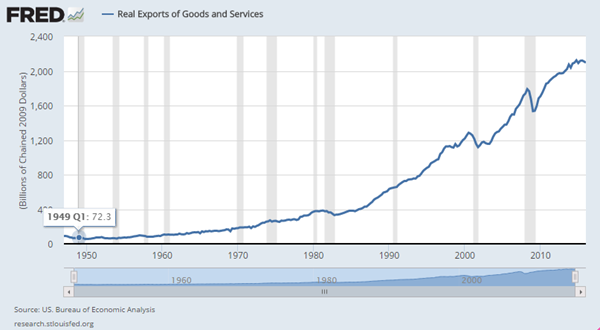
Lesson learned, after the war, the world moved toward freer trade. In that time, our real exports of goods and services rose steadily, accelerating in the mid-1980s, belying the claim that “we don’t make” stuff.

fred_graph1

As Harvard professor and former Chairman of the President’s Council of Economic Advisers Greg Mankiw recently pointed out in The New York Times, manufacturing is currently at an all-time high. The problem, as it were, is that we’re doing it with less manpower.

The Effectiveness of Efficiency

That very transformation is currently underway in the energy industry. Even after the price of oil started tanking, and rigs were idled, and jobs were being eliminated, production still increased. We became more efficient. It won’t take the same quantity of capital and labor to respond to $50 oil the next time it rises to that level. The displaced resources can be redeployed to other areas of the economy.

There are undoubtedly industry shakeups in freer markets. Labor, capital, and entrepreneurs are reshuffled. But our society encourages innovation by safeguarding intellectual and property rights. That allows us to find new and better ways of doing things.

This is just the latest example of our capacity to achieve the self-sufficiency that was the goal of our first Treasury Secretary (Mr. Hamilton) when he submitted to the second Congress suggestions of “encouragement” and “protection of government” in his “Reports on Manufactures.” All the “protection” we need for the aforementioned “encouragement” is between our ears. The human capital that we’ve built up over the years doesn’t go away, but rather accumulates.

Without free trade, there might be an erosion of two of its most important exports: peace and freedom. The world has to cooperate and get along if we all want to prosper. And the freer the people, the greater the likelihood of greater prosperity. Besides, should that peace unfortunately break down again someday, the Second Amendment and our bread basket give us time to dust off and tap that know-how to rev up the necessary industries.

Counterbalancing Deficits

Nevertheless, more trade liberalization is afoot. My industry has a new market: the rest of the world, thanks to the repeal of the oil export ban last December. That’ll surely alleviate something else nearly all our leaders are prone to complain about: our trade deficit.
fred_graph2

It’s a curious thing that you rarely hear that it’s actually only half of an equation, but it is.

The balance of payments (BoP) is basically an accounting of our international transactions. The current account (trade) is the one we always hear about when it’s in deficit. Interestingly enough, it tends to trend back toward break-even only when we’re heading toward recession. It makes sense that imports rise in good times. “We’re Americans,” I tell my students, “we like to buy stuff. We like to buy stuff so much, we rent storage facilities in which to put all our extra stuff!” Regardless, there’s nothing inherently wrong with a trade deficit.

The counterbalance is the capital account. We have a big example of that in our backyard: the Toyota plant in south San Antonio. This is foreign direct investment. That plant is in the heart of truck country. It gives Toyota direct access to that market here. And, they employ highly-skilled Texans. That seems like a win-win, a sign of strength perhaps, when a foreign company wants to locate operations here.
fred_graph3

You actually contribute to the capital account when you crack open a Bud Light after feeding Purina to Scooby, who was hungry because you forgot to feed him while you were eating a Smithfield ham steak (that had been stored in a GE freezer) for dinner before going to see “X-Men: Apocalypse” at the AMC Rivercenter 11. All those companies are foreign-owned. The profit portion of the prices paid for those goods is exported to another country. Foreign entities saw value in the brand recognition of items Americans know and love. And they were able to buy those companies in part because they do more of something that we don’t: save.

When the consumer expenditure portion of the Gross Domestic Product [GDP] started climbing in the 1980s from 60% to almost 70% today, it was arguably fueled by the concurrent proliferation of the all-purpose credit card. Perhaps it goes without saying, but when you’re spending, you’re not saving. And when you’re borrowing, you are dissaving. Much of the consumer savings derived from more efficient global production of goods could go to more savings. Instead, it seems to go toward buying more stuff.
fred_graph4

When you think about it though, our incentive to save has slid right alongside available interest rates.

fred_graph5

A couple years after they were pushed way up to break the inflation of the 1970s, interest rates have been on a steady march downward: ~7-8% in 1980s, ~5% in the 1990s, half that in the 2000s, and now near 0%. Monetary policy that could be enticing us to invest in learning new skills, opening a new business, guarding against unforeseen events, etc., instead has nudged us toward $1,000,000,000,000 in both credit card and automobile debt this year. What was the current trade deficit again?

If bringing down the trade deficit is the goal, increasing domestic savings and investment is preferable to erecting trade barriers. And if curbing interest-bearing consumer indebtedness happens as well, all the better.

While former Secretary of State Hillary Clinton seems like little more than a 21st century version of the pandering, “meaningless platitude-spouting” Kevin Fogerty from a classic episode of “Cheers,” Senator Bernie Sanders and Mr. Trump have been more consistent in their views toward free trade. But the aggressive tone they sometimes take toward it and our trading partners reminds me of when my four daughters (average age, 9) bicker with one another. Only it’s more understandable that my girls have to be taught to take the high road.

As for me, one of these days I could take up woodworking, or gardening, or some other hobby/trade that produces tangible output. Right now though, my spare time is best served educating. It’s what I like to do. It’s where I feel most productive. And given this season’s crop of presidential aspirants, there seems to be a need for it.


Chris Baecker

Christopher E. Baecker manages fixed assets for Pioneer Energy Services and is an adjunct lecturer of economics at Northwest Vista College in San Antonio.  He can be reached via www.chrisbaecker.com, @chrisbaecker71 & LinkedIn.com

This article was originally published on FEE.org. Read the original article.


Yes, We Still Make Stuff, and It Wouldn’t Matter if We Didn’t – Article by Steven Horwitz

Yes, We Still Make Stuff, and It Wouldn’t Matter if We Didn’t – Article by Steven Horwitz

The New Renaissance HatSteven Horwitz
******************************

One of the perennial complaints about the US economy is that we don’t “make stuff” anymore. You hear this from candidates from both major parties, but especially from Donald Trump and Bernie Sanders. The argument seems to be that our manufacturing sector has collapsed and that all US workers do is to provide services, rather than manufacturing tangible goods.

It turns out that this perception is wrong, as the US manufacturing sector continues to grow and in 2014 manufacturing output was higher than at any point in US history. But even if the perception were correct, it does not matter. The measure of an economy’s health isn’t the quantity of physical stuff it produces, but rather the value that it produces. And value comes in a variety of forms.

Manufacturing is Up

The path to economic growth is not to freeze into place the US economy of the 1950s. Let’s deal with the myth of manufacturing decline first. The one piece of evidence in favor of that perception is that there are fewer manufacturing jobs today than in the past. Total manufacturing employment peaked at around 19 million jobs in the late 1970s. Today, there are about 12.5 million manufacturing jobs in the US.

However, manufacturing output has never been higher. The real value of US manufacturing output in 2014 was over $2 trillion. The real story of the US manufacturing sector is that we have become so much more efficient, that we can produce more and more manufactured goods with less and less labor. These efficiency gains are largely the result of computer technology and automation, especially in the last fifteen years.

The labor that we no longer need in order to produce an ever-increasing amount of stuff is now available to produce a whole variety of other things we value, from phone apps to entertainment to the expanded number and variety of grocery stores and restaurants, to the data analyses that makes all of this growth possible.

Just as the workers in those factories we are so nostalgic for were labor freed from growing food thanks to the growth in agricultural productivity, so are today’s web designers, chefs at the newest hipster café, and digital editors in Hollywood the labor that has been freed from producing “stuff” thanks to greater technological productivity.

Or, put differently: those agricultural, industrial, and computer revolutions collectively have enabled us to have more food, more stuff, and more entertainment, apps, services, and cage-free chicken salads served with kale. The list of human wants is endless, and the less labor we use to satisfy some of them, the more we have to start working on other ones.

But notice something: all of the things that we produce have something in common. Whether it’s food or footwear, or automobiles or apps, or manicures or massages, the point of production is to rearrange capital and labor in ways that better satisfy wants. In the language of economics, the point of production (and exchange) is to increase utility.

When we produce more cars that people wish to buy, it increases utility. When we open a new Asian fusion street food taco stand, it increases utility. When Uber more effectively uses the existing stock of cars, it increases utility. When we exchange dollars for manicures, it increases utility.

Adam Smith helped us to understand that the wealth of nations is not measured by how much gold a country possesses. Modern economics helps us understand that such wealth is not measured by how much physical stuff we manufacture. Increases in wealth happen because we arrange the physical world in ways that people value more.

Neither producing cars nor providing manicures changes the number of atoms in the universe. Both activities just rearrange existing matter in ways that people value more. That is what economic growth is about.

Misplaced Nostalgia

We’re richer because we have allowed markets to produce with fewer workers. When we are fooled into believing that “growth” is synonymous with “stuff,” we are likely to make two serious errors. First, we ignore the fact that the production of services is value-creating and therefore adds to wealth.

Second, we can easily believe that we need to “protect” manufacturing jobs. We don’t. And if we try to do so, we will not only stifle economic growth and thereby impoverish the citizenry, we will be engaging in precisely the sort of special-interest politics that those who buy the myth of manufacturing often rightly complain about in other sectors.

The path to economic growth is not to freeze into place the US economy of the 1950s. We are far richer today than we were back then, and that’s due to the remaining dynamism of an economy that can still shed jobs it no longer needs and create new ones to meet the ever-changing wants of the consumer.

The US still makes plenty of stuff, but we’re richer precisely because we have allowed markets to do so with fewer workers, freeing those people to provide us a whole cornucopia of new things to improve our lives in endless ways. We can only hope that the forces of misplaced nostalgia do not win out over the forces of progress.

Steven_Horwitz

Steven Horwitz

Steven Horwitz is the Charles A. Dana Professor of Economics at St. Lawrence University and the author of Hayek’s Modern Family: Classical Liberalism and the Evolution of Social Institutions.

He is a member of the FEE Faculty Network.

This article was originally published on FEE.org. Read the original article.

Nazis on Twitter? That’s What Blocking Is For – Article by Jeffrey A. Tucker

Nazis on Twitter? That’s What Blocking Is For – Article by Jeffrey A. Tucker

The New Renaissance HatJeffrey A. Tucker
******************************

I’ve followed the fascinating case of Jonathan Weisman, The New York Times’s deputy Washington editor, and his conflagration with the legions of Nazis on Twitter. After he tweeted an essay about the rise of fascism in the U.S. — an essay not unlike the one I wrote this time last year — he was dogpiled by a variety of crazy alt-right accounts, and bombarded by some deeply malicious messaging.

You wake in the morning and find 100 notifications from people calling you a tool of the Jews.It might have been new to him, but for most curious Internet users of a certain generation, this is nothing new. For Weisman, it came as a shock, and understandably. The tweets featured photoshopped images of Weisman being marched to the gas chambers, for example. They threatened him with vile anti-Semitic and hard-core racist rhetoric.

He knew that if he merely claimed that this happened, he would be met with incredulity by a mainstream audience. To make sure that people believed him, he spent the day retweeting the vile messages to his followers, as if to say: “this stuff really does exist.”

I know exactly what he means. After my first critical article on Trump last year, one in which I reported on an early campaign speech I watched, I was trolled hard too. You wake in the morning and find 100 notifications from people calling you a tool of the Jews, slamming you with racist cartoons, telling you that you have sold out the white race, and even calling for your death.

These are people who perhaps begin their trajectory with some harmless anti-PC racial banter, but it escalates to become a full-scale political ideology, one that eventually crowds out all concern for human rights and decency. What they have joined isn’t a real army with guns, but when you are targeted it is still emotionally draining and politically frightening to say the least.

It’s supposed to be. That’s why they do it. The point is to shake you up, and make you feel like you are being bombarded.

When I told people about it, they didn’t believe it, or didn’t want to believe it. I too ended up screenshotting and posting in private messages, just to make the point that these vile movements do indeed exist. Even then, people doubt, probably because the sheer aggressiveness of this crowd is rather new in public life, at least in the US.

Hatred, Left and Right

For most of my writing career, I’ve been called a corporate shill by the left, a puppet of the Kochtopus, an apologist for capitalist exploitation and frankenfood. None of the attacks from the left have matched the sheer vitriol of those from the supposed opposite side. These days, though I hold the same libertarian perspective I always have, I’m being denounced as a witting dupe of the rootless commercial class, a shill for the global banksters and usurers, a cuckservative (look it up), and probably a secret Jew myself.

Welcome to Twitter in 2016.

The world truly does seem to be dividing between authoritarians of the right and left, and the rest of us. At some point in last year, hundreds of bitter people left their 4chan caves and became Twitter mavens. It became the choice venue for the far right, which has developed its own internal signaling systems such as putting the signs ((( ))) around ostensibly “known Jews.” They use swastikas as avatars. They post Nazi-era caricatures of Jews. And the rhetoric is a revival of interwar hate that most people believe was vanquished from the earth with the defeat of the Nazis 70 years ago.

Not all the accounts are so blatant. Some prefer the dog-whistle approach in their own posting and merely retweet the more hard-core material. After a while, you can become very talented at spotting the members of this internet junta, and have it confirmed with only one or two degrees of separation from the more overt deniers and/or celebrators of the actual Holocaust (strange how deniers and celebrators hang out together).

Just as left socialism never seems to go away, no matter how many economic disasters it brings about, so it is with national socialism with a rightest tinge. In fact, it seems to be growing, both in Europe and the US, posing a serious challenge to those of us who consider ourselves classical liberals: hard opposition to the left and to the right. As I’ve written elsewhere, the world truly does seem to be dividing between authoritarians of the right and left, opposed consistently by a small but growing group of genuine liberals all over the world.

Terms of Use

Now, to be sure, Jonathan Weisman was exactly right to wonder why Twitter puts up with this stuff. As he points out, banning such accounts is not censorship; this is a private venue that can set its own rules, same as a restaurant or movie theater. And Twitter does indeed have rules against “hateful conduct” that threatens people based on religion and ethnicity, as well as a policy on harassment that prohibits targeting people and inciting others to do the same. There’s no question that these accounts are in violation.

Why doesn’t Twitter act? Well, it sometimes does. After the Weisman articles, Twitter banned some 30 or so accounts. What happened to them? It’s pretty easy: they can easily come back again with another user name. In this sense, Twitter is, by design, much easier to game than Google or Facebook, both of which have much stricter policies. Sockpuppeting is a way of life here.

How does a digital venue decide how strict to be on these matters? It is all about the value of the platform for users. Sometimes tighter is better and other times it is not. In the case of Twitter, a main contribution it makes to global culture is its openness to all. You can find and see and hear just about anything. You can curate your feed. You can include or exclude. Sure, that takes a bit of work, but it is more than worth it.

For Facebook and LinkedIn, matters are very different. Permitting hate, harassment, sex solicitation, porn, and so on, is a problem for the kind of culture they want to create for members. And so it is more carefully policed. Again, this is not censorship anymore than a restaurant that demands shoes is violating human rights. You have the human right to be a Nazi all you want on your own property, but you don’t have the right to do so on property that belongs to others.

What To Do?

As it turns out, the nasty junta of hate-spewing freaks is not an army after all.When this started happening to me, I was initially disoriented and, I admit, a bit shaken. But then it struck me that Twitter surely has permitted a way to deal with this. Sure enough, there is a little gear that allows you to select a pretty little option: block. With the block, that account can no longer contact you or post among your notifications. Quite simply, you stop hearing from them.

I spent about a month doing this to trolls. Oddly, it is very satisfying. Someone tags you in a hate-filled post. With one click, you can blast them out of your curated universe. Once I got the hang of it, it became a game. Instead of getting mad, you just get even. Well, not really. But it sort of feels like it.

You know what? It works. After blocking about 100 accounts over the course of the fall, the problem almost entirely vanished. As it turns out, the nasty junta of hate-spewing freaks is not an army after all. In the end, we might in fact be talking about a few hundred accounts. Maybe it is more. And maybe after this article, they will all be back.

It might not be possible to make them all go away, but there is a way to reduce the influx and almost eliminate the stress. That’s not to minimize the alarming rise of fascism in politics here and abroad, but only to say that we are wise to distinguish between reality and digital illusion.

Blocking Is Betting than Beatings

And this is a much better option than leaning hard on Twitter to do more enforcement of its own terms of use. As much as these people disgust me, I would actually prefer to live in a world in which even deranged Nazis have access to widely available communication channels. I won’t invoke the right of free speech here because that’s not what this is about.

I will, however, say a good word for openness to all – and I mean all – points of view, access to media by all the world’s people (this is a wonderful miracle), and, above all else, the right of individuals to exclude through blocking. This is the way the opinion market should work. This is how we curate our own intellectual lives.

What we absolutely do not need – which Europe has tried to do – are government controls on what types of opinions one is allowed to hold and what books one is allowed to read. If you want violent extremism to grow, this is a great path towards guaranteeing that it will. Shutting people up by force is not the solution. The block button is far more effective than any censor.

Jeffrey Tucker is Director of Digital Development at FEE, CLO of the startup Liberty.me, and editor at Laissez Faire Books. Author of five books, he speaks at FEE summer seminars and other events. His latest book is Bit by Bit: How P2P Is Freeing the World.  Follow on Twitter and Like on Facebook. 

This article was published by The Foundation for Economic Education and may be freely distributed, subject to a Creative Commons Attribution United States License, which requires that credit be given to the author.


59 Policies from One Year of Donald Trump – Article by David Bier

59 Policies from One Year of Donald Trump – Article by David Bier

The New Renaissance Hat
David Bier
******************************

One year ago, Donald Trump thrust his bizarre, erratic, and incomprehensible campaign on the world. Much has been said about Trump’s “rhetoric” during his campaign — the racism, sexism, incivility, and much else besides — but rhetoric is not what makes a Trump administration a unique threat to the country. It is his policy proposals that should receive our closest attention and concern.

Below is a list of 59 “policies,” if you can dignify them with such a title, that Trump has proposed during his campaign. The list drives home how truly frightening a Trump presidency would be for the country and the world. Skimming the surface of Trump’s stream of consciousness brings out some particularly disturbing aspects of his agenda: notably, the way he singles out specific businesses and individuals for targeting by the government, as well as his obsessions with China, Mexico, Muslims, and immigrants.

Perhaps worst of all, Trump’s proposals expose how broad he thinks the powers of the presidency are: virtually infinite. There is never a glimmer of understanding that the government is bound by the Constitution, that the federal government has limited scope and authority, or that president is just one of three equal branches of the federal government.

Instead, it is Trump, and Trump alone, who will transform American laws, government, and society, from the top down. Trump will bomb and invade countries, Trump will steal their oil, Trump will kill deserters, torture suspects, bypass courts, ban Muslims, break treaties, and have the military do things like mass executions with bullets dipped in pigs’ blood — all while getting Americans to say “Merry Christmas” again.

Well, all I can say is Merry Christmas, America. Here’s what the primaries brought us this year.

Bold: attack on individual or business.
Italics: attack on Mexico or China.
Underlined: attack on immigration.

June 2015

1. Make Ford Scrap Expansion Plan in Mexico

August 2015

2. Deport 11 Million Immigrants
3. Triple Number of Deportation Agents
4. Force Cities and States to Help Deport Immigrants
5. Force Mexico to Pay for Wall on US Border
6. Strip US Citizenship from Babies Born to Immigrants

September 2015

7. Use FCC to Fine His Critic, Rich Lowry
8. Place 35% Tariff on Ford Cars Made in Mexico
9. “We Will Break” North American Free Trade Agreement
10. “Government Will Pay” for Health Care for “Everyone”

October 2015

11. Deport Syrian Refugees Legally in the US
12. Soldiers Who Desert Should Be Shot
13. Spend Tens of Billions on Border Wall
14. Keep Troops in Afghanistan

November 2015

15. Kill TPP Free Trade Agreement
16. Get Americans to Say “Merry Christmas”
17. Create Special Deportation Force to Remove Immigrants
18. “Bomb the S***” Out of Syria
19. Close Mosques in the United States
20. Create Database for Muslims
21. Bypass Courts in Mass Deportation Plan

December 2015

22. Restart Warrantless Surveillance, Metadata Collection
23. Kill Family Members of Terrorists
24. Washington Post Is a “Tax Shelter” for Amazon, Jeff Bezos
25. Ban All Muslim Travel to US
26. Shut Down “Parts” of the Internet
27. Issue Executive Order Mandating the Death Penalty for Killing Police

January 2016

28. Impose 45% Tariff on Chinese Products
29. Throw Bowe Bergdhal Out of a Plane in Afghanistan

February 2016

30. Tells Supporters to Knock Out Protesters
31. Use Eminent Domain for Economic Development
32. Tax Carrier-brand Air Conditioners Made in Mexico
33. Force Apple, Tim Cook to Break into iPhone for FBI
34. Keep Obamacare’s Individual Mandate for Health Insurance
35. Praises Mass Executions of Captured Soldiers with Bullets Dipped in Pigs’ Blood
36. Threatens Donor for Giving to Opponent’s Campaign
37. Prosecute Hillary Clinton
38. Proposes “Trade War” with China
39. “Open Up Libel Laws” to Sue Critical Press

March 2016

40. Force Apple to Make iPhones in US, not China
41. Force Military to Follow Illegal Orders
42. Prosecute Ed Snowden for “Spying” for Russia
43. “Torture” Terrorism Suspects
44. Increase Military Spending
45. Steal Iraqis’ Oil
46. “Pause” Legal Immigration
47. Send 20,000 or 30,000 Troops to Middle East
48. Trump Could Envision a Nuclear First Strike
49. Appoint Supreme Court Justice to Investigate Clinton’s Email

April 2016

50. Raise Taxes on the Wealthy

May 2016

51. Threatens Pfizer, Carrier, Ford, and Nabisco With 35% Tariff
52. Increase Minimum Wage
53. “Go After” Amazon for Anti-Trust and Taxes
54. Bomb Libya
55. Threatens “Mexican” Federal Judge Trying His Case

June 2016

56. “Keep Business Out of Mexico”
57. Ban All People from Countries with “History of Terrorism”
58. Surveillance of US Mosques
59. Ban Guns for People on Secret “Watch Lists”

David Bier is an immigration policy analyst at the Niskanen Center. He is an expert on visa reform, border security, and interior enforcement. From 2013 to 2015, he drafted immigration legislation as senior policy advisor for Congressman Raúl Labrador, a member of the House Judiciary Committee’s Subcommittee on Immigration and Border Security. Previously, Mr. Bier was an immigration policy analyst at the Competitive Enterprise Institute.  

This article was published by The Foundation for Economic Education and may be freely distributed, subject to a Creative Commons Attribution 4.0 International License, which requires that credit be given to the author.

This TRA feature has been edited in accordance with TRA’s Statement of Policy.

Interest in Libertarianism Explodes – Article by Jeffrey A. Tucker

Interest in Libertarianism Explodes – Article by Jeffrey A. Tucker

The New Renaissance HatJeffrey A. Tucker
******************************
 Johnston / Weld

For forty years, the Libertarian Party has worked to survive. Then, in what seems to be a brief flash of time, it is suddenly at the center of American political life. It’s absolutely remarkable how quickly this has happened.

It’s a perfect storm that made this happen. Party A has become a plastic vessel for pillaging pressure groups, with a phony at the top of the ticket. Party B has been taken over by a cartoonish replica of an interwar strongman. Like beautiful poetry, or like the third act of a 19th-century opera, the Libertarian Party has risen to the occasion to represent a simple proposition: people should be free.

And that theme seems interestingly attractive, enough to draw more media attention to the Libertarian Party in the last week than it had received in the previous 40 years combined. Okay, that might be a slight exaggeration. But a Google News search generates 600,000 results right now, and more recent coverage than I could read between now and midnight. Meanwhile, the Johnson/Weld ticket is polling at 11% nationally, which is essentially unprecedented.

Given today’s information flood, do you know how difficult this is to accomplish? It’s unbelievably difficult to cause anything to trend in this world. That this has happened is amazing. Plus, “libertarian” is a weird word to most people. In some ways, for a party that represents a beautifully simple idea, and the most important idea in the history of the world, this is word is a handicap.

And yet it is happening anyway.

Libertarian_Interest

Friends of mine have taken issue with this or that position held by Gary Johnson and William Weld. This is not the point. Every time I speak to either them, they are immediately quick to clarify that this election is not about them as people or the particulars of their policy positions. It is about representing an idea and a body of thought — an idea that has otherwise been nearly vanquished from public life. They admit to being imperfect carriers of that message. But this humility alone contrasts with the arrogance of the other two parties.

Nor is this really about getting Johnson/Weld elected. It is about clarifying the very existence of an option to two varieties of authoritarianism that the two main parties represent.

This ticket is not an end but a beginning.

For many months, I watched in horror as the only home that tolerated something approaching the old liberal idea has been taken over at its very top by a political force that now has had nothing good to say about liberty.

I’ve looked for an upside but had a hard time finding.

Now I do see the upside. The purging of freedom-minded people from the national end of the Republican Party has created an amazing opportunity. And the Libertarian Party is stepping up to play its historical role.

What is that role? Here has been the controversy for many years. Initially, many people believed it could actually compete with the two parties. When it became obvious that this was not possible, the role became one of ideological agitation and education. Thus ensued a 30-year war over purity of ideology. After all, if the point is not to win, and rather only to enlighten, it becomes important to offer the most bracing possible message.

But that conviction alone does not actually solve the problem. Which version of libertarianism, among the dozens of main packages and hundreds if not thousands of iterations, should prevail? This becomes a prescription for limitless factionalism, arguments, personal attacks — which is pretty much a description of how people have characterized the party and libertarianism generally over the years.

It is for this reason that the Johnson/Weld run this year is so refreshing. They are sometimes called moderates. I don’t think that’s right. It is more correct to say that they are interested in the main theme of the party, and that theme is freedom. No, they are not running to implement my vision of what liberty looks like in all its particulars. But they are on message with the essentials: freedom is what matters and we need more of it.

There was a time when such a message was redundant of what was already said by the Republicans and, perhaps, even the Democrats. But with the whole messaging of the two-party cartel having become “what kind of tyranny do you want?” there is a desperate need for someone to change the subject.

All issues of ideological particulars aside, this is what we need right now. And it will make the difference. Having this ticket become a part of the debate structure can provide that needed boost to liberalism as an idea, saving it from the desire on the part of the Trump/Clinton to drive it out of public life.

These are enormously exciting times. Six months ago, I would have never imagined such opportunities. As I’ve written elsewhere, the choice is at last clear, and clearer than it has been in my lifetime.

We can do socialism, fascism, or liberalism. Which way we take forward will not be determined by who gets elected but by the values we hold as individuals. And here, at long last, national politics can make an enormous contribution to changing hearts and minds.

Jeffrey Tucker is Director of Digital Development at FEE, CLO of the startup Liberty.me, and editor at Laissez Faire Books. Author of five books, he speaks at FEE summer seminars and other events. His latest book is Bit by Bit: How P2P Is Freeing the World.  Follow on Twitter and Like on Facebook. 

This article was originally published on Liberty.me.

This TRA feature has been edited in accordance with TRA’s Statement of Policy.

Donald Trump and Obi-Wan’s Gambit – Article by Daniel Bier

Donald Trump and Obi-Wan’s Gambit – Article by Daniel Bier

The New Renaissance HatDaniel Bier

You Cannot Win By Losing

In Star Wars: A New Hope, the last Jedi Knight, Obi-Wan Kenobi, is confronted by his former pupil, Darth Vader, as he races to escape the Death Star. The two draw their lightsabers and pace warily around each other. After deflecting some heavy blows from Vader, Obi-Wan’s lightsaber flickers, and he appears tired and strained.

Vader gloats, “Your powers are weak, old man.”

The hard-put Obi-Wan replies, “You can’t win, Darth. If you strike me down, I shall become more powerful than you can possibly imagine.”

Obi-Wan backs away from Vader but finds his escape cut off by storm troopers. He is trapped. He gives a mysterious smile, raises his lightsaber, and allows Vader to cut him in half.

This is Obi-Wan’s gambit, or the “win by losing” strategy. Lately, it has emerged as a distinct genre of commentary about Donald Trump.

Take, for example, “The Article About Trump That Nobody Will Publish,” which promotes itself as having been rejected by 45 publications. That’s a credit to America’s editors, because the article is an industrial strength brew of wishful thinking, a flavor that is already becoming standard fare as a Trump presidency looms.

The authors give a boilerplate denunciation of Trump (he’s monstrous, authoritarian, unqualified, etc.), but then propose:

What would happen should Trump get elected? On the Right, President Trump would force the GOP to completely reorganize — and fast. It would compel them to abandon their devastating pitch to the extreme right. …

On the Left, the existence of the greatest impossible dread imaginable, of President Trump, would rouse sleepy mainline liberals from their dogmatic slumber. It would force them to turn sharply away from the excesses of its screeching, reality-denying, uncompromising and authoritarian fringe that provided much of Trump’s thrust in the first place.

Our daring contrarians predict, Trump “may actually represent an unpalatable but real chance at destroying these two political cancers of our time and thus remedying our insanity-inflicted democracy.”

You can’t win, Donald! Strike me down and I shall be… forced to completely reorganize and/or roused from dogmatic slumber!

The authors assert these claims as though they were self-evident, but they’re totally baffling. Why would a Trump win force the GOP to abandon the voters and rhetoric that drove it to victory? Why would it reorganize against its successful new leader? Why would a Hillary Clinton loss empower moderate liberals over the “reality-defying fringe”? Why would the left turn away from the progressives who warned against nominating her all along?

This is pure, unadulterated wishful thinking. There is no reason to believe these rosy forecasts would materialize under President Trump. That is not how partisan politics tends to work. Parties rally to their nominee, and electoral success translates into influence, influence into power, power into friends and support.

We’ve already seen one iteration of this “win by losing” fantasy come and go among the Never Trump crowd: the idea that Trump’s mere nomination would be a good thing, because (depending on your politics) it would (1) compel Democrats to nominate Bernie Sanders, (2) propel Clinton to a landslide general election victory, or (3) destroy the GOP and (a) force it to rebuild as a small-government party, (b) split it in two, or (c) bring down the two-party system.

But, of course, none of those things happened. Clinton has clinched the nomination over Sanders (his frantic protests notwithstanding). Meanwhile, Clinton’s double digit lead over Trump has evaporated, and the race has narrowed to a virtual tie. Far from “destroying the GOP,” Trump has consolidated the support of the base and racked up the endorsements of dozens of prominent Republicans who had previously blasted him, including Marco Rubio and Paul Ryan.

The GOP is not being destroyed — it is being gradually remade in Trump’s image, perhaps into his dream of a populist “workers’ party,” heavy on the protectionism, nativism, and authoritarianism. Meanwhile, knee-jerk partisanship and fear of Clinton are reconciling the center-right to Trump.

Moderates win by defeating the fringe, not by losing to it. Yet, for some reason, conservatives, liberals, and libertarians all like to fantasize that the worst case scenario would actually fulfill their fondest wishes, driving the nation into their losing arms — as though their failure would force the party or the public do what they wanted all along. This is the bad-breakup theory of politics: Once they get a taste of Trump, they’ll realize how great we were and love us again.

But the public doesn’t love losers. (Trump gets this and has based his whole campaign around his relentless self-promotion as a winner.) Trump’s inauguration would indeed be a victory for him and for his “alt-right” personality cult, and a sign of defeat for limited-government conservatives and classical liberals — not because our ideology was on the ballot, but because all our efforts did not prevent such a ballot.

Trump embodies an ideology that is anathema to classical liberalism, and if he is successful at propelling it into power, we cannot and should not see it as anything less than a failure to persuade the public on the value of liberty, tolerance, and limited government. Nobody who is worried about extreme nationalism and strong man politics should be taken in by the idea that their rapid advance somehow secretly proves their weakness and liberalism’s strength.

This does not mean that we’re all screwed, or that a Trump administration will be the end of the world — apocalyptic thinking is just another kind of dark fantasy. As horrible as Trumpism may be, it cannot succeed without help. And here’s the good news: Most Americans aren’t really enamored with Trump’s policies. The bad news is that they could still become policy.

Classical liberals who oppose Trump should realize that things aren’t going to magically get better on their own. We cannot try to Obi-Wan our way out of this. We will have to actually make progress — in education, academia, journalism, policy, activism, and, yes, even electoral politics.

If this seems like an impossible task at the moment, just remember that the long-sweep of history and many trends in recent decades show the public moving in a more libertarian direction. It can be done, and there’s fertile ground for it. We have to make the argument for tolerance and freedom against xenophobia and authoritarianism — and we have to win it. The triumph of illiberalism will not win it for us.

Daniel Bier is the site editor of FEE.org He writes on issues relating to science, civil liberties, and economic freedom.

This article was published by The Foundation for Economic Education and may be freely distributed, subject to a Creative Commons Attribution 4.0 International License, which requires that credit be given to the author.