Browsed by
Tag: Donald Trump

Trump and Hillary Don’t Know How to Fix the Economy – Article by Justin Murray

Trump and Hillary Don’t Know How to Fix the Economy – Article by Justin Murray

The New Renaissance HatJustin Murray
******************************

Recently, Hillary Clinton was taped ridiculing Donald Trump for lacking a detailed plan for the American economy. The message, so it goes, is that Trump is not suited for the presidency because he doesn’t have a plan on how to turn the American economy around.

But is it really more dangerous to elect a president who makes up economic policy on the fly than one who proclaims to have a detailed plan for us?

The answer to this is no, it is not more dangerous to elect someone who makes up economic policy by the seat of his pants — as Donald Trump is prone to do — than it is to elect someone who thinks she can have the future of the economy neatly mapped out. However, this does not imply that seat-of-the-pants method is less dangerous either. The underlying problem is we have two competing people who think they can manage the American economy.

The core of why both philosophies are equally dangerous is best summarized by F.A. Hayek and the pretense of knowledge. Hayek notes in his speech in 1974:

Unlike the position that exists in the physical sciences, in economics and other disciplines that deal with essentially complex phenomena, the aspects of the events to be accounted for about which we can get quantitative data are necessarily limited and may not include the important ones … in the study of such complex phenomena as the market, which depend on the actions of many individuals, all the circumstances which will determine the outcome of a process … will hardly ever be fully known or measurable.

We are incapable of knowing what the future will bring. No president can come up with a detailed or air tight plan or can accumulate a sufficient stable of experts to be able to guide the behavior, wants, and needs of 320 million people.

For example, if we were to have asked George Bush and his economic experts in 2002 to develop a five year plan for cell phones, we would have built up a massive production capacity and R&D structure around miniaturizing phones as that was all the rage. If someone said in 2002 that people in the future would give up physical buttons and want larger screens, they would have been looked upon as mad. People are buying smaller and smaller phones, there’s no way they could touch the screen and get anything done! But come 2007, Apple introduces the iPhone and the older-style button phone has nearly vanished from the marketplace. Had the government decided it needed to plan the economy around smaller phones, we wouldn’t be enjoying a mobility revolution.

This extends well beyond cellular phones and into all walks of our lives. We don’t need central planning on how we consume our energy, what cars we can buy, what we charge people for borrowing money, and so forth.

All behavior is risky. Even if central planners could somehow canvass all of our wants and needs, figured out when exactly we want to satisfy those needs, and determined who gets what in a world of scarcity, the planners would still fail. This is because even we have no idea what we’ll want in the future. If we were to ask someone to write down exactly what they would buy on August 14, 2017 and put it in an envelope then open it up and compare it to what was bought on that day, there is little doubt the results would be wildly different.

The planner is going to do no better. Instead of a single individual failing to predict his own habits in a fun exercise, we’ll be malinvesting untold amounts of money into unwanted industries and imposing counterproductive and dangerous rules on businesses — the effects of which are impossible to predict. Furthermore, central planning shuts down innovation and the entrepreneurial process because it assumes to know today what is wanted tomorrow. Most innovation arises when someone produces a product we had no idea we wanted and couldn’t fathom existing.

Does Hillary Clinton’s plan for the economy make her a more qualified president than Donald Trump, who will likely create plans spontaneously? No, it makes them equally dangerous as both assume they have the ability to do what countless officials over the centuries have never managed to do — predict the future.

Justin Murray received his MBA in 2014 from the University of St. Gallen in Switzerland.

This article was published on Mises.org and may be freely distributed, subject to a Creative Commons Attribution United States License, which requires that credit be given to the author.

Thomas Carlyle: The Founding Father of Fascism – Article by Jeffrey A. Tucker

Thomas Carlyle: The Founding Father of Fascism – Article by Jeffrey A. Tucker

The New Renaissance HatJeffrey A. Tucker
******************************

Thomas Carlyle fits the bill in every respect

***

Have you heard of the “great man” theory of history?

The meaning is obvious from the words. The idea is that history moves in epochal shifts under the leadership of visionary, bold, often ruthless men who marshal the energy of masses of people to push events in radical new directions. Nothing is the same after them.

In their absence, nothing happens that is notable enough to qualify as history: no heroes, no god-like figures who qualify as “great.” In this view, we need such men.  If they do not exist, we create them. They give us purpose. They define the meaning of life. They drive history forward.

Great men, in this view, do not actually have to be fabulous people in their private lives. They need not exercise personal virtue. They need not even be moral. They only need to be perceived as such by the masses, and play this role in the trajectory of history.

Such a view of history shaped much of historiography as it was penned in the late 19th century and early 20th century, until the revisionists of the last several decades saw the error and turned instead to celebrate private life and the achievements of common folk instead. Today the “great man” theory history is dead as regards academic history, and rightly so.

Carlyle the Proto-Fascist

Thomas_CarlyleThe originator of the great man theory of history is British philosopher Thomas Carlyle (1795-1881), one of the most revered thinkers of his day. He also coined the expression “dismal science” to describe the economics of his time. The economists of the day, against whom he constantly inveighed, were almost universally champions of the free market, free trade, and human rights.

His seminal work on “great men” is On Heroes,  Hero-Worship, and the Heroic in History (1840). This book was written to distill his entire worldview.

Considering Carlyle’s immense place in the history of 19th century intellectual life, this is a surprisingly nutty book. It can clearly be seen as paving the way for the monster dictators of the 20th century. Reading his description of “great men” literally, there is no sense in which Mao, Stalin, and Hitler — or any savage dictator from any country you can name — would not qualify.

Indeed, a good case can be made that Carlyle was the forefather of fascism. He made his appearance in the midst of the age of laissez faire, a time when the UK and the US had already demonstrated the merit of allowing society to take its own course, undirected from the top down. In these times, kings and despots were exercising ever less control and markets ever more. Slavery was on its way out. Women obtained rights equal to men. Class mobility was becoming the norm, as were long lives, universal opportunity, and material progress.

Carlyle would have none of it. He longed for a different age. His literary output was devoted to decrying the rise of equality as a norm and calling for the restoration of a ruling class that would exercise firm and uncontested power for its own sake. In his view, some were meant to rule and others to follow. Society must be organized hierarchically lest his ideal of greatness would never again be realized. He set himself up as the prophet of despotism and the opponent of everything that was then called liberal.

Right Authoritarianism of the 19th Century

Carlyle was not a socialist in an ideological sense. He cared nothing for the common ownership of the means of production. Creating an ideologically driven social ideal did not interest him at all. His writings appeared and circulated alongside those of Karl Marx and his contemporaries, but he was not drawn to them.

Rather than an early “leftist,” he was a consistent proponent of power and a raving opponent of classical liberalism, particularly of the legacies of Adam Smith and John Stuart Mill. If you have the slightest leanings toward liberty, or affections for the impersonal forces of markets, his writings come across as ludicrous. His interest was in power as the central organizing principle of society.

Here is his description of the “great men” of the past:

“They were the leaders of men, these great ones; the modellers, patterns, and in a wide sense creators, of whatsoever the general mass of men contrived to do or to attain; all things that we see standing accomplished in the world are properly the outer material result, the practical realization and embodiment, of Thoughts that dwelt in the Great Men sent into the world: the soul of the whole world’s history….

One comfort is, that Great Men, taken up in any way, are profitable company. We cannot look, however imperfectly, upon a great man, without gaining something by him. He is the living light-fountain, which it is good and pleasant to be near. The light which enlightens, which has enlightened the darkness of the world; and this not as a kindled lamp only, but rather as a natural luminary shining by the gift of Heaven; a flowing light-fountain, as I say, of native original insight, of manhood and heroic nobleness;—in whose radiance all souls feel that it is well with them. … Could we see them well, we should get some glimpses into the very marrow of the world’s history. How happy, could I but, in any measure, in such times as these, make manifest to you the meanings of Heroism; the divine relation (for I may well call it such) which in all times unites a Great Man to other men…

Carlyle established himself as the arch-opponent of liberalism — heaping an unrelenting and seething disdain on Smith and his disciples.And so on it goes for hundreds of pages that celebrate “great” events such as the Reign of Terror in the aftermath of the French Revolution (one of the worst holocausts then experienced). Wars, revolutions, upheavals, invasions, and mass collective action, in his view, were the essence of life itself. The merchantcraft of the industrial revolution, the devolution of power, the small lives of the bourgeoisie all struck him as noneventful and essentially irrelevant. These marginal improvements in the social sphere were made by the “silent people” who don’t make headlines and therefore don’t matter much; they are essential at some level but inconsequential in the sweep of things.

To Carlyle, nothing was sillier than Adam Smith’s pin factory: all those regular people intricately organized by impersonal forces to make something practical to improve people’s lives. Why should society’s productive capacity be devoted to making pins instead of making war? Where is the romance in that?

Carlyle established himself as the arch-opponent of liberalism — heaping an unrelenting and seething disdain on Smith and his disciples. And what should replace liberalism? What ideology? It didn’t matter, so long as it embodied Carlyle’s definition of “greatness.”

No Greatness Like the Nation-State

Of course there is no greatness to compare with that of the head of the nation-state.

“The Commander over Men; he to whose will our wills are to be subordinated, and loyally surrender themselves, and find their welfare in doing so, may be reckoned the most important of Great Men. He is practically the summary for us of all the various figures of Heroism; Priest, Teacher, whatsoever of earthly or of spiritual dignity we can fancy to reside in a man, embodies itself here, to command over us, to furnish us with constant practical teaching, to tell us for the day and hour what we are to do.”

Why the nation-state? Because within the nation-state, all that is otherwise considered immoral, illegal, unseemly, and ghastly, can become, as blessed by the law, part of policy, civic virtue, and the forward motion of history. The leader of the nation-state baptizes rampant immorality with the holy water of consensus. And thus does Napoleon come in for high praise from Carlyle, in addition to the tribal chieftains of Nordic mythology. The point is not what the “great man” does with his power so much as that he exercises it decisively, authoritatively, ruthlessly.

The exercise of such power necessarily requires the primacy of the nation-state, and hence the protectionist and nativist impulses of the fascist mindset.

Consider the times in which Carlyle wrote. Power was on the wane, and humankind was in the process of discovering something absolutely remarkable: namely, the less society is controlled from the top, the more the people thrive in their private endeavors. Society needs no management but rather contains within itself the capacity for self organization, not through the exercise of the human will as such, but by having the right institutions in place. Such was the idea of liberalism.

Liberalism was always counterintuitive. The less society is ordered, the more order emerges from the ground up. The freer people are permitted to be, the happier the people become and the more meaning they find in the course of life itself. The less power that is given to the ruling class, the more wealth is created and dispersed among everyone. The less a nation is directed by conscious design, the more it can provide a model of genuine greatness.

Such teachings emerged from the liberal revolution of the previous two centuries. But some people (mostly academics and would-be rulers) weren’t having it. On the one hand, the socialists would not tolerate what they perceived to be the seeming inequality of the emergent commercial society. On the other hand, the advocates of old-fashioned ruling-class control, such as Carlyle and his proto-fascist contemporaries, longed for a restoration of pre-modern despotism, and devoted their writings to extolling a time before the ideal of universal freedom appeared in the world.

The Dismal Science

One of the noblest achievements of the liberal revolution of the late 18th and 19th centuries — in addition to the idea of free trade — was the movement against slavery and its eventual abolition. It should not surprise anyone that Carlyle was a leading opponent of the abolitionist movement and a thoroughgoing racist. He extolled the rule of one race over another, and resented especially the economists for being champions of universal rights and therefore opponents of slavery.

As David Levy has demonstrated, the claim that economics was a “dismal science” was first stated in an essay by Carlyle in 1848, an essay in which non-whites were claimed to be non-human and worthy of killing. Blacks were, to his mind, “two-legged cattle,” worthy of servitude for all times.

Carlyle’s objection to economics as a science was very simple: it opposed slavery. Economics imagined that society could consist of people of equal freedoms, a society without masters and slaves. Supply and demand, not dictators, would rule. To him, this was a dismal prospect, a world without “greatness.”

The economists were the leading champions of human liberation from such “greatness.” They understood, through the study of market forces and the close examination of the on-the-ground reality of factories and production structures, that wealth was made by the small actions of men and women acting in their own self interest. Therefore, concluded the economists, people should be free of despotism. They should be free to accumulate wealth. They should pursue their own interests in their own way. They should be let alone.

Carlyle found the whole capitalist worldview disgusting. His loathing foreshadowed the fascism of the 20th century: particularly its opposition to liberal capitalism, universal rights, and progress.

Fascism’s Prophet

Once you get a sense of what capitalism meant to humanity – universal liberation and the turning of social resources toward the service of the common person – it is not at all surprising to find reactionary intellectuals opposing it tooth and nail. There were generally two schools of thought that stood in opposition to what it meant to the world: the socialists and the champions of raw power that later came to be known as fascists. In today’s parlance, here is the left and the right, both standing in opposition to simple freedom.

Carlyle came along at just the right time to represent that reactionary brand of power for its own sake. His opposition to emancipation and writings on race would emerge only a few decades later into a complete ideology of eugenics that would later come to heavily inform 20th-century fascist experiments. There is a direct line, traversing only a few decades, between Carlyle’s vehement anti-capitalism and the ghettos and gas chambers of the German total state.

Do today’s neo-fascists understand and appreciate their 19th century progenitor? Not likely. The continuum from Carlyle to Mussolini to Franco to Donald Trump is lost on people who do not see beyond the latest political crisis. Not one in ten thousand activists among the European and American “alt-right” who are rallying around would-be strong men who seek power today have a clue about their intellectual heritage.

Hitler turned to Goebbels, his trusted assistant, and asked for a final reading. It was Carlyle.And it should not be necessary that they do. After all, we have a more recent history of the rise of fascism in the 20th-century from which to learn (and it is to their everlasting disgrace that they have refused to learn).

But no one should underestimate the persistence of an idea and its capacity to travel time, leading to results that no one intended directly but are still baked into the fabric of the ideological structure. If you celebrate power for its own sake, herald immorality as a civic ideal, and believe that history rightly consists of nothing more than the brutality of great men with power, you end up with unconscionable results that may not have been overtly intended but which were nonetheless given license by the absence of conscience opposition.

As time went on, left and right mutated, merged, diverged, and established a revolving door between the camps, disagreeing on the ends they sought but agreeing on the essentials. They would have opposed 19th-century liberalism and its conviction that society should be left alone. Whether they were called socialist or fascists, the theme was the same. Society must be planned from the top down. A great man — brilliant, powerful, with massive resources at his disposal — must lead. At some point in the middle of the 20th century, it became difficult to tell the difference but for their cultural style and owned constituencies. Even so, left and right maintained distinctive forms. If Marx was the founding father of the socialist left, Carlyle was his foil on the fascist right.

Hitler and Carlyle

In his waning days, defeated and surrounded only by loyalists in his bunker, Hitler sought consolation from the literature he admired the most. According to many biographers, the following scene took place. Hitler turned to Goebbels, his trusted assistant, and asked for a final reading. The words he chose to hear before his death were from Thomas Carlyle’s biography of Frederick the Great. Thus did Carlyle himself provide a fitting epitaph to one of the “great” men he so celebrated during his life: alone, disgraced, and dead.

Jeffrey Tucker is Director of Digital Development at FEE, CLO of the startup Liberty.me, and editor at Laissez Faire Books. Author of five books, he speaks at FEE summer seminars and other events. His latest book is Bit by Bit: How P2P Is Freeing the World.  Follow on Twitter and Like on Facebook. 

This article was published by The Foundation for Economic Education and may be freely distributed, subject to a Creative Commons Attribution United States License, which requires that credit be given to the author.

This TRA feature has been edited in accordance with TRA’s Statement of Policy.

Three Popular Myths behind Trump’s Success – Article by Barry Brownstein

Three Popular Myths behind Trump’s Success – Article by Barry Brownstein

The New Renaissance HatBarry Brownstein

******************************
Why the Unprincipled Worst Get on Top

“Nothing sinks people faster in their careers than arrogance,” according to Stephen R. Covey, the bestselling author of The Seven Habits of Highly Effective People. But it is hard to imagine a less humble or more arrogant individual than Donald Trump, and to date, his shoot-from-the-hip, prideful, self-referencing arrogance has not sunk his career.

In his book Principle-Centered Leadership, Covey described “politics without principle” as a politics of personality focused on “the instant creation of an image that sells well in the social and economic marketplace. You see politicians spending millions of dollars to create an image, even though it’s superficial, lacking substance, in order to get votes and gain office.”

The marketplace imposes a check on empty promotion and false confidence, which is why, as Covey observes, the most successful leaders in the private sector are often also quite humble.

So why do the arrogant do so well in elections? Is there something different about the political process that allows the worst to succeed?

In his seminal book The Road to Serfdom, Nobel laureate F.A. Hayek offers part of the answer. He lists three widely held beliefs that allow arrogant politicians to emerge.

Belief 1: We should be able to get out of our economic difficulties without pain.

As Hayek saw it, some people blame “the system” for their troubles and “wish to be relieved of the bitter choice which hard facts often impose upon them.” They “are only too ready to believe that the choice is not really necessary, that it is imposed upon them merely by the particular economic system under which we live.”

Let the implication of Hayek’s words sink in. The successful politicians may be those who increasingly blame the “system.”

With a majority of Americans feeling economically insecure, there is plenty of fear for Trump to exploit and a ready audience for promises that he can ease the economic pain of ordinary Americans.

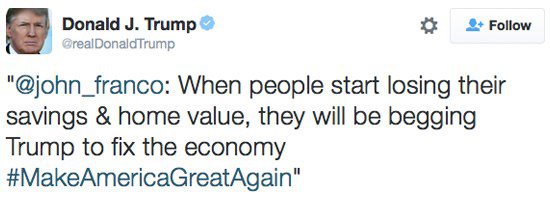
Trump postures as a great fixer. Consider this retweet on Trump’s official Twitter page:

trumptweet20150824

He promises that things are going to be “great again,” once he gets us a better deal with China. Trump tells us he gets what he wants. To purchase a hotel in Miami, he brags, “I went in and punched and punched and beat the hell out of people, and I ended up getting it.”

Of course, Trump is not alone. In their arrogance, politicians will claim to fix social pain points — while they create many, many more.

Belief 2: Government should command or partially command significant portions of the economy.

Hayek observes that many well-meaning people ask, “Why should it not be possible that the same sort of system, if it be necessary to achieve important ends, be run by decent people for the good of the community as a whole?”

Those who believe in command economies think that when things go wrong, it must be because the wrong people are in charge. They don’t question their core belief that controls are needed.

History, economics, and the contemporary world teach lessons of command-and-control societies that have experienced economic failure. Yet, the wrong-person-in-charge belief is sadly all too common.

In her book The Art of Choosing, social psychologist and business professor Sheena Iyengar reports on 2007 research about societal attitudes in East Germany. She observes that among former East Germans, “more than 90% believed socialism was a good idea in principle, one that had just been poorly implemented in the past.”

Look around at your friends and neighbors who are supporting a candidate who advocates top-down solutions to social and economic problems. With few exceptions, they want the same things that you want: prosperity and peace for their family and the world. It is not that they want different outcomes than you do. They simply don’t understand that command economies are inherently, fatally flawed and cannot accomplish those goals.

Without examining their core beliefs, decent people tell themselves they’re choosing the “right” person to put in charge. Arrogant politicians are standing by, posturing as the “right” people.

Belief 3: There is a “good of the community as a whole” that our current economy is not meeting.

It is essential to understand why there can be no such thing as the “good of the community as a whole.” Hayek explains,

The “social goal” or “common purpose” for which society is to be organized is usually vaguely described as the “common good,” the “general welfare,” or the “general interest.” It does not need much reflection to see that these terms have no sufficiently definite meaning to determine a particular course of action.

All top-down solutions will be win-lose, benefiting some and harming others, for as Hayek explains,

The welfare and happiness of millions cannot be measured on a single scale of less or more. The welfare of the people, like the happiness of a man, depends up on a great many things that can be provided in an infinite variety of combinations.

Some see health care as a common good and a human right that the market system has failed to provide. In my FEE essay, “Castro and Obama Are Wrong about ‘Human Rights’” (FEE.org, March 25, 2016), I explain why real rights are win-win, not win-lose. “Rights” such as health care are win-lose and not real rights at all.

The arrogant believe they know what is best for you and best for the community. To them the course of action is clear. However, Hayek warns that in collectivist ethics, the ends justify the means and thus lead to amoral totalitarianism:

There is literally nothing which the consistent collectivist must not be prepared to do if it serves “the good of the whole” because “the good of the whole” is to him the only criterion of what ought to be done.

The Consequences of Our False Beliefs

Since there is no majority to agree on a specific plan of action to promote a nonexistent “common good,” the worst get on top in a centrally planned economy.

The “worst” will take advantage of the fact that agreement can be more readily forged by focusing on a “negative program.” Hayek writes,

It seems to be almost a law of human nature that it is easier for people to agree on a negative program — on the hatred of an enemy, on the envy of those better off — than on any positive task. The contrast between the “we” and the “they,” the common fight against those outside the group, seems to be an essential ingredient in any creed which will solidly knit together a group for common action. It is consequently always employed by those who seek, not merely support of a policy, but the unreserved allegiance of huge masses.

The “mass” that the “worst” seek to mobilize will include those who themselves are not grounded on principles. Hayek cautions that those having “imperfectly formed ideas are easily swayed”; their “passions and emotions are readily aroused.”

Hayek helps us to understand why the careers of arrogant politicians do not sink fast. The careers of arrogant politicians rise as long as we believe in a common good, seek the “right” politicians to be in charge, and support those who promise to shelter us from the work of examining our beliefs and the pain of making a different choice.

We shouldn’t be surprised when the outcome is not what we expect. As Freeman editor B.K. Marcus observes, “The more decisions we cede to the political process, the less we should expect anyone to protect our interests” (“Why Do We Believe These Pathological Liars?” FEE.org, April 27, 2016).

As individuals, we can question our core beliefs. We can humbly “try to live in harmony with natural laws and universal principles.” And we can demand the same of our politicians.

Barry Brownstein is professor emeritus of economics and leadership at the University of Baltimore. He is the author of The Inner-Work of Leadership. He blogs at BarryBrownstein.com, Giving up Control, and America’s Highest Purpose.

This article was published by The Foundation for Economic Education and may be freely distributed, subject to a Creative Commons Attribution 4.0 International License, which requires that credit be given to the author.

You Are Not Obligated to Support Trump – Video by G. Stolyarov II

You Are Not Obligated to Support Trump – Video by G. Stolyarov II

The New Renaissance Hat
G. Stolyarov II
******************************

It does not matter that Donald Trump will win the Republican Presidential nomination. In his new video, Mr. Stolyarov emphasizes that you should vote your conscience and support the candidate closest to your personal ideals, not the candidate who has an “R” next to his name.

Don’t Turn Foreign Tragedies into Domestic Tragedies – Article by Doug Bandow

Don’t Turn Foreign Tragedies into Domestic Tragedies – Article by Doug Bandow

The New Renaissance HatDoug Bandow
******************************
Americans Enjoy Prosperity and Peace in a Dangerous World
 ***

The Islamic State’s March attacks in Belgium reinforce Americans’ belief that we live in a dangerous world, perhaps the most dangerous ever. Thankfully, most of the horror bypasses the United States, which remains a global oasis.

Americans can help alleviate the ugliness elsewhere. But rarely can they remake other nations, at least not at a reasonable cost in lives and resources. Americans’ priority must remain safeguarding and uplifting the United States.

I recently visited the city of Erbil, Iraq. Briefly threatened by the Islamic State two summers ago, Erbil is the capital of largely autonomous Kurdistan. Today, the city operates without evident fear, though security remains heavy. The Kurdish people are spread throughout Iraq, Syria, Turkey, and Iran, and are the largest ethnic group without their own nation. They have suffered oppression and violence at the hands of all four states.

In Erbil, one government official spoke of fleeing his home with his family years ago as Saddam Hussein’s air force attacked from above. Hussein employed mustard gas against Kurdish civilians who opposed his brutal rule. The official’s father explained that they could count on no one else and should be prepared to die fighting. Many did.

Kurdistan remains largely separate from the Baghdad government and has become a sanctuary for others, especially religious minorities. I attended a training seminar on religious liberty organized by the group HardWired, headed by Tina Ramirez, who previously worked on Capitol Hill handling foreign policy and religious persecution. The meeting brought together people of all faiths to deepen their commitment to protecting the religious liberty of all.

Every group had suffered. Christians fled the Islamic State’s takeover of the Nineveh Plain. A Baha’i who lived close to Baghdad went to Turkey with her son. A Sunni judge got out of Mosul three days before the brutal ISIS takeover. Many in his family were not so lucky: the Islamic State detained his youngest brother for more than a year before beheading the 17-year-old. A Yazidi abandoned her home when her city was overrun by ISIS forces. Many people lost contact with friends or relatives left under Islamic State rule.

Even those who escape suffer. A church turned its grounds across the street from my hotel into a mini-refugee camp for 94 families. Homes went from tents to metal containers, but kitchens and bathrooms remain communal. People play soccer and volleyball in the common area, marking time while hoping to return home or find refuge abroad.

Even more people have been displaced by the Syrian conflict. The European migrant crisis is a result of millions fleeing their war-ravaged nation. Many have crossed into neighboring Turkey. Refugees make up an astonishing one-third of Lebanon’s population. Last summer, I visited Jordan’s Zaartari camp, home to some 80,000 people. Many residents have been there for years. Some, in a mix of frustration and desperation, return to Syria aflame.

Only today, decades into a widespread insurgency in eastern Burma, is there hope for the 50,000 residents of Mae La refugee camp, across the border in Thailand. For years, when I visited, children would tell stories of murdered parents, wrecked homes, and desperate flight across the Moei River. Few people could leave the camps and none could work legally.

Today, an uneasy peace has descended upon most of the land also known as Myanmar. In fact, it now may be freer politically than Thailand, which suffered a coup two years ago. Although the Burmese military retains much influence, it is yielding ground. In contrast, the Thai junta seems determined to hold on to power and to construct a faux democracy in which the generals will rule however the people vote.

In many other nations, the threat similarly is repression and persecution rather than conflict and war. Turkish journalists risk jail and ruin for criticizing the new sultan-wannabe, President Recep Tayyip Erdogan. A Christian minister’s wife lost a leg in a church bombing in Indonesia. Russians are arrested for demonstrating against the Putin government. Palestinian Christians are unable to worship in Jerusalem or to farm ancestral lands due to the Israeli occupation. Chinese students are angry over censorship and curious about the Tiananmen Square massacre.

Pervasive repression is evident in totalitarian systems, in which the state claims authority over almost every aspect of human life, including religious faith. North Korea, Eritrea — known as Africa’s North Korea — and Saudi Arabia come to mind. An accident of birth separates those with a future of freedom and opportunity from those who endure a modern form of serfdom.

Americans face many challenges, too, especially this political season. What believer in liberty could savor a presidential match-up between Hillary Clinton and Donald Trump? Or Bernie Sanders and Ted Cruz? It’s enough for many of us to consider committing ritual seppuku.

Nevertheless, the United States remains largely invulnerable to foreign attack. Only a couple of nations could launch a nuclear assault, and they would be annihilated in return. None can challenge America conventionally: indeed, Washington spends so much on the military to enable it to attack others, not to protect the homeland. Yet, America’s prosperous and populous allies, like the Europeans, prefer to fund generous welfare states rather than potent defenses.

Horrific conflicts elsewhere appropriately tug at Americans’ heartstrings, but that is no reason to turn foreign tragedies into domestic tragedies. Terrorism remains America’s most serious security concern, but it does not threaten the nation’s existence, as did conflict during the Cold War. Less promiscuous intervention abroad is the surest means to limit such attacks at home.

America’s economic dream of a constantly improving future has lagged, but the United States is not alone in that regard. And the wounds are largely self-inflicted: foolish regulatory, spending, and tax policies that weaken Americans’ ability to compete in the world. It’s a lesson that even Europe has had painfully to learn.

No one should wish America’s political system on anyone else, yet a similar populist uprising is occurring in many European nations. It’s a problem born of frustration with bipartisan elites who rig the game for their own benefit. Who can blame people for believing that it really doesn’t matter who they vote for? There is a permanent national government that works most assiduously to ensure its permanence, irrespective of the wishes of those it governs.

The ongoing populist response is fraught with danger. Nevertheless, American supporters of liberty remain alert, constitutional protections persist, checks and balances abound, and for at least two decades, Washington pols have perfected their ability to block and frustrate their opponents. Despite fevered claims this political season, America remains far from a fascist dictatorship.

There is much in America about which to be concerned and even anguished. Yet, traveling the world reminds one just how special Americans remain. Rather than give up in despair, we should remember our blessings and redouble our efforts to reclaim the Founders’ revolutionary legacy. We don’t need to try to remake the world, as so many people seem to desire. Rather, we should concentrate on reviving America.

Doug Bandow is a senior fellow at the Cato Institute and the author of a number of books on economics and politics. He writes regularly on military non-interventionism.

This article was originally published by The Foundation for Economic Education and may be freely distributed, subject to a Creative Commons Attribution 4.0 International License, which requires that credit be given to the author.

Is Trump a Howard Roark? – Article by Edward Hudgins

Is Trump a Howard Roark? – Article by Edward Hudgins

The New Renaissance HatEdward Hudgins
******************************
Roark vs. TrumpDonald Trump recently said he’s a fan of Ayn Rand’s novel The Fountainhead. Even if you haven’t read it, a reflection on the key characters in that excellent work will help you understand much of what’s wrong with The Donald. Not wishing to write a book-length treatment on the subject, I’ll focus on just one thing that’s relevant to the presidential election: how one treats others.

In an interview with Kristen Powers, Trump said of The Fountainhead, “It relates to business … beauty … life and inner emotions. That book relates to … everything.” (Here he’s right!) He identified with Howard Roark, the novel’s architect hero, loosely based on Frank Lloyd Wright. Trump builds buildings too, so no doubt a novel on the subject would interest him. But much of the resemblance between Roark and Trump ends there.

Roark treats people with respect
Howard Roark loves the creative work of designing buildings for the purpose of seeing them built just the way he designs them. His work is his source of pride. He doesn’t work for the approval of others.

Roark must struggle because in his world established architects simply want to imitate the styles of the past, mainly to impress other people who, for the most part, aren’t particularly impressed in any case.

Roark must find individuals and enterprises that want his buildings. But he is quite clear that “I don’t build in order to have clients. I have clients in order to build.” He does not bastardize his buildings—sticking columns or balconies on them just to make sales. He has his standards. He is honest with his prospective clients and tries to educate them. He respects them enough to treat them like intelligent individuals. If they can’t accept his style, that is unfortunate, but Roark will not pander. Roark has integrity.

Wynand panders to the lowest
Another major character in the novel is Gail Wynand, who rose from nothing to build a chain of “Banner” newspapers. Wynand is good at what he does but what he does is not good. He builds his empire by appealing to the lowest common denominator among his readers. He is a yellow journalist who feeds them scandal, sensation, and schlock. He sees his readers as basically stupid and irrational, and his idea of success is not to appeal to the best within them but, rather, the worst, assuming they deserve nothing better.

And that is how Trump approaches prospective voters in his political campaign. It’s all a sensationalist, headline-grabbing show. It’s saying the most outrageous things to appeal to emotions on the assumption that his audience can’t or doesn’t want to actually think.

Which works?
But there is a major difference between Wynand and Trump. Wynand wants power over others but his sense of self-worth is not dependent on the adulation of the mob he wants to rule. Trump, on the other hand, seems to drink up the applause of his audience, and if someone challenges him, it’s personal and rates the response of the most insecure playground bully.

By contrast, in The Fountainhead, when the novel’s most malicious villain who has tried to block Roark’s career approaches him and asks “What do you think of me?” Roark responds, “But I don’t think of you.” That’s true self-esteem!

Which approach works better: Roark’s career built on dealing with people based on reason, or Wynand’s career built on treating people like idiots? Read The Fountainhead to discover the intriguing answer you probably already suspect. In terms of Trump’s political career, it will depend on how many voters prefer to be treated like idiots rather than with respect.

Dr. Edward Hudgins directs advocacy and is a senior scholar for The Atlas Society, the center for Objectivism in Washington, D.C.

Copyright The Atlas Society. For more information, please visit www.atlassociety.org.

Donald Trump Is the Nightmare Version of a Political Outsider – Article by Lucy Steigerwald

Donald Trump Is the Nightmare Version of a Political Outsider – Article by Lucy Steigerwald

The New Renaissance HatLucy Steigerwald
******************************

Trump Is Not an Alternative to Politics as Usual: He Is Its Purest Form

At a CNN-hosted town hall debate, Donald Trump said that the US government’s core focus should be on security (times three!), health care, and education. In spite of this vague, rambling answer, and much other blathering in support of big government, the real estate mogul has a large, intense following, which includes people on the right, the left, and even some paleoconservatives and libertarians.

In some ways, it’s understandable: if the normal process of politics revolts you in any way, the dream of anti-candidate Trump is sweet. The approval rating for the presidency in general is around 30 percent, according to Gallup. For Congress, it’s a stingy eight percent. People — or at least the people Gallup calls — do not seem terribly impressed by their elected officials.

Nor should they be. Powerful men and women spy, meddle, steal, and go to war, whether the people want them to or not, and then pat them on the head and coo euphemisms when people get upset with the results.

Into this travesty strolls Donald Trump, with a terrible, shallow campaign, brilliant in its bombastic vagueness. Populism, it’s been a while. You’re looking tanned, rested, but disturbingly familiar.

When Trump boasts about being against the Iraq war, or disses Dick Cheney, or says that being called a politician is insulting, it’s all too easy to like him. It would be so nice to believe he is not one of them, but one of us. Sure, he’s a billionaire on his third wife, with numerous failed business ventures, a love of eminent domain, and his own brand of “luxury” steaks, but he feels our loathing of the political class.

Yet it is infuriating that this is the year, and this is the man who has stolen the heart of the people fed up with DC. Not someone with principles (such as one against, oh, gleefully saying literally anything to be elected), not someone notably different from the elites he professes to loathe — merely a man who knows how to blab with the purest, most bald-faced confidence ever seen on a national stage.

In one way, Trump’s presidential run is about an outsider group revolting against the status quo, the way that fringey, quixotic campaigns like Pat Buchanan, Dennis Kucinich, or Ron Paul’s were. And some libertarians and paleocons have jumped on the Trump float, but it is clearly not their parade. The cause of Trump is not small government or social democracy or even Catholic populism.

It is Charlie Sheen-esque nationalism. It is strident whining confused for truth-telling. It is nonsense mercantilist ideas, bullying as public policy, and the worst anti-immigrant scapegoating in decades. However, there are no ideas here: it’s merely a billionaire playing that he’s angry about Mexicans and rallying swarms to his meaningless sort of “patriotism.”

Whether Trump was inevitable, or whether he simply speaks to the truly mediocre 2016 candidates is uncertain. But boy is it frustrating that the man who wants to raze DC is the one who wants to erect a statue of himself in its place. He tells it like it is, he knows politicians don’t work for the people! But he’s going to wave his hands and make a Mexico wall and 18th-century trade policy appear by incantation.

Back in September, the New Yorker wrote that “Trump … is playing the game of anti-politics.” We should be so lucky. Trump is merely politics distilled down to the size of one angry rich guy. On the campaign trail, would-be officials swear they can do anything and everything (and in the first 100 days, no less). Trump is bolder, brasher, and even more divorced from reality. But he’s still essentially that. The waking reality of the presumptive GOP nominee — who disses Dick Cheney, Hillary Clinton, and both party establishments — is that he is, heart and soul, a consummate politician.

His critique of the political class is not that they meddle too heavily in the lives of individuals, but that they haven’t done enough. If they had, wouldn’t we have a 50-foot wall on the southern border? Wouldn’t all those manufacturing jobs come back from China? For Trump and his supporters, the problem with Washington is not the inherent disaster of a massive bureaucracy with no consequences for failure and a surplus of corrupting power. No, it’s lack of strident, Trump-like spirit: a lack of will.

In spite of his twitches towards a less militaristic foreign policy — in between suggesting the United States rip up the Geneva Conventions, bomb the hell out of Syria, and seize Iraq’s oil — there is nothing really consistent about Trump. He may or may not be worse in practice than the status quo, but there is no reason to suspect that he is the savior of anything except his own ego. Indeed, his view that the government is incompetent due to bad managers sounds more like progressive technocracy than anything conservative. But somehow his screaming fans have gotten their signals crossed or, more grimly, they are as disinterested in small government as he is.

Hating DC is fun, but it doesn’t magically translate to supporting liberty. And populism is a not principle — it has no policies, feasible or otherwise. It is raw emotion. It is preaching. It is the flimflam, finger-pointing, and impossible promises of traditional assembly-line politics, just stripped down to bare parts. Trump is the schoolyard version of everything Marco Rubio or Bill Kristol advocates. He isn’t flattering anyone’s intelligence with his policy acumen. He doesn’t think we’re terribly smart, but he also thinks those fancy pants DC elites are not as smart as they pretend. He’s right about all of that. It’s not as if politics is noble or deserves better than Trump. It is Trump.

The Donald is not some demon summoned from another dimension to destroy America. He probably isn’t a new Hitler or Mussolini. He is a part of us, a glitzy, gilded reflection of the dark soul of politics: the lies, the self-promotion, and the delusion. Take a good, long look.

Lucy Steigerwald is a contributing editor to Antiwar.com and a contributor to Playboy; she previously worked as an Associate Editor for Reason magazine. Her articles have appeared at Playboy, Vice, Antiwar, Reason, Pittsburgh City Paper, the Pittsburgh Tribune-Review, and various libertarian blogs.

This article was originally published by The Foundation for Economic Education and may be freely distributed, subject to a Creative Commons Attribution 4.0 International License, which requires that credit be given to the author.

The US Two-Party System Made Donald Trump’s Fascist Campaign Possible – Video by G. Stolyarov II

The US Two-Party System Made Donald Trump’s Fascist Campaign Possible – Video by G. Stolyarov II

The New Renaissance Hat
G. Stolyarov II
******************************

Were it not for the deeply fallacious and self-defeating mindset of voting for the “lesser evil”, the rise of a demagogue such as Trump would have been impossible in the United States.

Though it may be alleged that economic fascism has characterized America’s “mixed economy” since at least the New Deal of the 1930s, the resurgence of cultural fascism would have been unthinkable even during the 2012 Presidential Election. Yet it is here in the form of Donald Trump’s campaign. Mr. Stolyarov considers what made possible this frightening resurgence of the worst tendencies in American politics. He concludes that the biggest underlying facilitator of Trump’s frightening rise is the very two-party political system in the United States and the “lesser evil” trap it engenders in the minds of many voters.

References

– “The US Two-Party System Made Donald Trump’s Fascist Campaign Possible” – Article by G. Stolyarov II
– “Why Republicans Deserved a Crushing Defeat in the 2012 Presidential Election” – Article by G. Stolyarov II –
– “Black students ‘outraged’ after being escorted from Trump rally” – Article by Lindsey Bever – The Washington Post and Chicago Tribune
– “Technically, it is illegal to protest inside of Trump rallies” – Article by Colin Daileda – Mashable –
– “Rejecting the Purveyors of Pull: The Lessons of Atlas Shrugged: Part II” – Article by G. Stolyarov II
– “Trump is Phony, a Fraud” – Speech by Mitt Romney – PBS NewsHour
– “Hating the Establishment Is Not the Same as Supporting Liberty” – Article by Jeffrey Tucker
– “On Moral Responsibility in General and in the Context of Voting” – Article by G. Stolyarov II
– “The Importance of Zoltan Istvan’s Transhumanist Presidential Campaign” – Article by G. Stolyarov II

Demagoguery vs. Data on Employment in America – Article by Tyler Watts

Demagoguery vs. Data on Employment in America – Article by Tyler Watts

The New Renaissance Hat
Tyler Watts
******************************

Demagogue politicians love to play on popular fears that low-wage foreigners are “stealing” good-paying American jobs by way of outsourcing and globalization. The claim is made by nativists and protectionists of all political stripes, whether leftists complaining of a “rigged economy” or rightists speaking of other countries “beating us” economically.

A sound economic analysis of the claim about job losses due to international trade should address two questions: First, is it true that the US has lost jobs due to trade (or other factors)? Second, is this phenomenon good or bad overall for the US and world economies?

On the first point, it can appear as though the US has lost jobs. For example, as Figure 1 shows, manufacturing employment in the US has declined by about 2 million from pre-Great Recession levels, and is down by over 7 million, or 37 percent, from the all-time high reached in 1979.

Figure 1: Total Manufacturing Employment, 1940–2016

watts1

The problem, though, is that by looking at manufacturing in terms of jobs, we’re missing the full picture of industrial production.

Nevertheless, the demagogues still argue that, even though high-paying service sector jobs have more than replaced lost factory jobs, “we don’t make things here anymore” and we should lament this. This oft-heard refrain is patently false. We don’t make certain things, such as garments, toys or electronics, because global free trade and technological advances tend to shift America’s output into those industries in which our comparative advantage is greatest. But Americans do indeed make things — quite valuable things.

This can be seen in Figure 2, which shows the US Industrial Production Index for the “de-industrialization” period. After the expected steep decline following the Great Recession of 2008–2009, US manufacturing has slowly bounced back and is now producing more products, in value-added terms, than ever before. Indeed, this index, which consists mainly of manufacturing, has grown by over 100 percent since the 1979 peak in manufacturing employment.

Figure 2: Industrial Production Index for the United States, 1979–2016

watts2

In other words, thanks to productivity gains, we need fewer workers to make more stuff.

From an economic perspective, nothing could be better news. US manufacturing creates 100 percent more value with 37 percent fewer workers. Creating more value with fewer workers means we’re more efficient than ever, or put another way, more productive than ever. These awesome productivity gains have many sources, especially in the form of technological advances in areas like software, robotics, and communications. Globalization and outsourcing have also played a role, as they allow American workers a greater degree of specialization in those sectors where our productivity edge is largest.

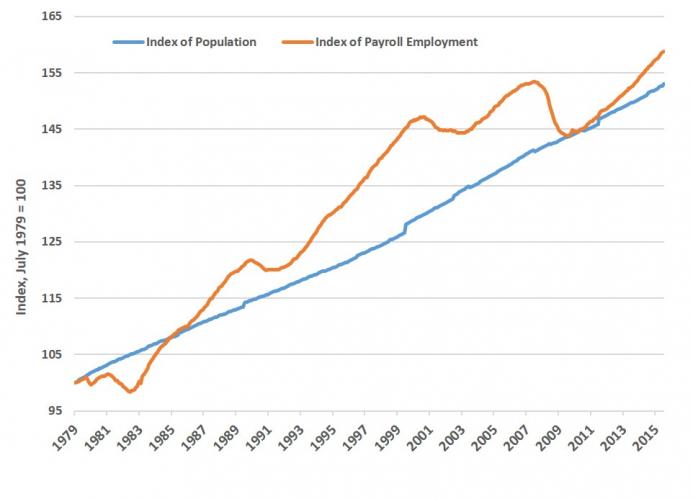
The good news gets better, though: not only have we gained jobs on net, but jobs have grown faster than the population over time. Since the 1979 peak in manufacturing employment, the US adult population grew by 53 percent, whereas employment grew by 59 percent, as shown in Figure 3.

Figure 3: Population Growth vs. Employment Growth Since 1979

watts3Source: Federal Reserve Economic Data

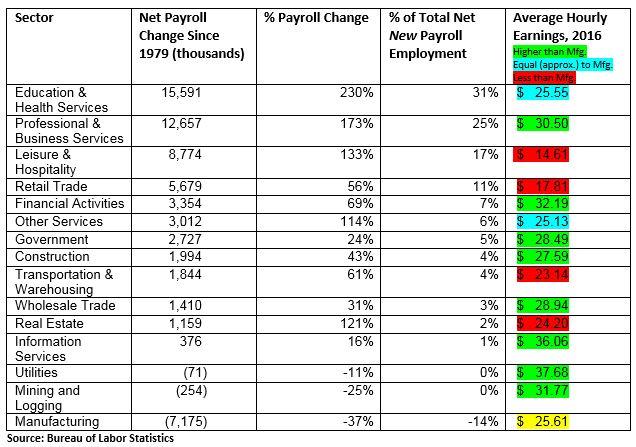
Despite these generally positive facts, some still contend that we’ve replaced “good” manufacturing jobs with lousy service sector jobs. Well, of course it must be true that, if we’ve lost manufacturing jobs, but gained jobs overall, then all of the job gains must have come from non-manufacturing sectors. And indeed the service sector, broadly defined, has seen employment growth of 90 percent since our 1979 benchmark. But beware of making hasty earnings assumptions about a sector that employs nearly 124 million people. To see whether the newly-created “service sector” jobs really don’t pay as well as the vaunted manufacturing jobs, we need to drill down into the employment and earnings data. What we’ll find is that a large majority of the new service sector jobs pay just as well or much better than manufacturing jobs.

Table 1 presents Bureau of Labor Statistics data on the 15 largest sectors and sub-sectors of the US economy, which together represent over 96 percent of the total net increase in payroll employment for the post-peak manufacturing jobs era (1979 to 2016). This might come as a surprise to the anti-globalization crowd: despite the loss of 7 million manufacturing jobs (and some mining, logging, and utilities sector jobs), we’ve seen a net increase of nearly 53 million total jobs. Of these net new jobs, fully 62 percent of them feature, as of January 2016, average hourly earnings equal to or greater than current average hourly manufacturing earnings. In other words, most of the 53 million new jobs pay the same or better wages than the demagogues’ benchmark “good” manufacturing jobs. So we lost 7 million good jobs, only to gain about 32 million equal or better-paying jobs, along with about 19 million lower-paying jobs (about 38 percent of net new jobs pay less than manufacturing).

Table 1: Employment Changes and Current Earnings by Sector

watts4Source: Bureau of Labor Statistics

We’ve established that, despite a major decrease in employment in the manufacturing sector, we’ve gained many more jobs than we’ve lost in the past 35 years or so, and that most of these new jobs pay better to boot. Economic changes, while painful in the short run, have brought gains in output and employment not only for the US, but for the rest of the world as well. Overall, this is good news for the US and world economies.

So, as the campaign season heats up, let’s not be misled by baseless arguments about America “losing jobs” or other countries “beating us” at trade. Trade is a positive sum game, and the benefits for both the US and world economies are, shall we say, “yuge.”

Tyler Watts earned his PhD in economics at George Mason University in 2010. He currently teaches economics at East Texas Baptist University and runs the Institute for Economic Education (see YouTube channel here), a public outreach focused on integrating economics with a Biblical worldview and providing unique teaching tools for high school and college economics students.

This article was published on Mises.org and may be freely distributed, subject to a Creative Commons Attribution United States License, which requires that credit be given to the author.

The US Two-Party System Made Donald Trump’s Fascist Campaign Possible – Article by G. Stolyarov II

The US Two-Party System Made Donald Trump’s Fascist Campaign Possible – Article by G. Stolyarov II

The New Renaissance Hat
G. Stolyarov II
******************************

                It is disconcerting to watch as the front-runner for the 2016 Republican Presidential nomination in the United States espouses a genuinely fascistic agenda – not just in terms of protectionism, economic nationalism, militarism, and the desire to centrally plan economic greatness – but also in terms of the overtly uglier sides of historical fascism: the xenophobia, racism, advocacy of torture and blood guilt, desire to silence political opponents, and incitements to violence against protesters and dissenters. Yet this is precisely what Donald Trump has done, unleashing the long-dormant worst tendencies of American politics. He has emboldened the crudest, least enlightened, most hide-bound enemies of tolerance, cosmopolitanism, and liberty to emerge from well-deserved disgrace to fuel the campaign of a cynical, unprincipled opportunist who thrives by pandering to their lowest impulses. Trump is vulgar, volatile, and unhinged. He has already turned his rallies into miniature versions of the police state he would create if elected – evicting even protesters who simply stand there with signs or clothing that express disagreement with Trump, or even individuals who attract the ire of the frenzied Trumpists for having the “wrong” color of skin or the “wrong” incidental expressions. Because of a bizarre law (H. R. 347, enacted in 2012), it is illegal to protest inside Trump rallies (or rallies of any candidate that receives Secret Service protection), so Trump is already utilizing coercive police powers to suppress dissent.

                Though it may be alleged that economic fascism has characterized America’s “mixed economy” since at least the New Deal of the 1930s, the resurgence of cultural fascism would have been unthinkable even during the 2012 Presidential Election. Mitt Romney, who seemed to me at the time to represent a paradigm of crony capitalism that inched toward overarching totalitarianism, now appears to be a gentleman and an intellectual – a voice of reason, class, and prudence in his eloquent denunciation of Donald Trump. Romney, as President, would have been unlikely to avert an incremental descent into fascism (although, in retrospect, he seems to be a decent human being), and his own candidacy was marred by manipulations at various State Republican Conventions, but, compared to Trump, Romney is a model of civility and good sense. Romney, if elected, would primarily have been the next status-quo President, overseeing a deeply flawed and deteriorating but endurable economic, political, and civil-liberties situation. Trump, however, would plunge the United States into an abyss where the remnants of personal liberty will suffocate.

                And yet the manipulations that occurred in 2012 to aid Romney paved the way for a Trump candidacy and its widely perceived “unstoppable” momentum. (Let us hope that this perception is premature!) I was a delegate to the Nevada State Republican Convention in 2012, where I helped elect a pro-Ron Paul delegation to the Republican National Convention. However, upon learning of the events at the National Convention, I became forever disillusioned with the ability of the Republican Party to become receptive to the advocacy of individual freedom. I wrote after Romney’s electoral defeat that

the rule change enacted by the party establishment at the National Convention, over the vociferous objections of the majority of delegates there, has permanently turned the Republican Party into an oligarchy where the delegates and decision-makers will henceforth be picked by the ‘front-runner’ in any future Presidential contest. Gone are the days when people like me could, through grass-roots activism and participation at successive levels of the party conventions, become delegates to a state convention and exert some modicum of influence over how the party is governed and intellectually inclined.

                The Republican Party establishment intended its rule change to prevent the ability of motivated grass-roots activists to elect delegates at State Conventions who would vote against the “presumptive nominee” and in favor of an upstart – presumably more libertarian – contender such as Ron Paul. Little did the establishment expect that this rule change would prevent its own favored candidates from effectively contesting Donald Trump’s nomination if Trump continues to win popular votes, especially in “winner-take-all” primaries, and approaches a majority of the total delegates. The most that the Republican Party elites can hope for now is that a candidate such as Ted Cruz eventually overtakes Trump, or that the remaining candidates – Cruz, Marco Rubio, and John Kasich – split enough of the delegates to deny Trump the majority and lead to a brokered convention. But as the narrative of inevitability continues to be spun in Trump’s favor and he amasses prominent endorsements and even promises from the other candidates that they would support him if he were the nominee, these damage-control plans seem quite vulnerable. Blind party loyalty, combined with a bandwagon mentality, appears to be driving the Republican establishment to a reluctant capitulation to Trump – which would be political suicide, but they are apt to do it anyway.

                If Trump trumps the old Republican Party establishment, however, this would be nothing to cheer. It would be a replacement of a defunct, cronyist, and backroom-dealing oligarchy – but one considerably tempered by satiation from its own decades of comfortable dominance and the remaining checks and balances of the political system – with a vicious, crass, completely unrestrained new oligarchy headed by Trump himself, and fueled by populistic pandering to masses about whom Trump personally could not care less. Trump asserts that he is incorruptible because he is funding his own campaign. However, the truth is that he does not need to pay anyone off for special political privileges, because he is the special interest that would be garnering the favors during “normal times”. If elected, he will simply do so without the intermediaries of the traditional political class. As Jeffrey Tucker eloquently explains,

many have fallen for Donald Trump’s claim that he deserves support solely because he owes nothing to anyone. Therefore, he is not part of the establishment. Why is that good for liberty? He has said nothing about dismantling power. […] He wants surveillance, controls on the internet, religious tests for migration, war-like tariffs, industrial planning, and autocratic foreign-policy power. He’s praised police power and toyed with ideas such as internment and killings of political enemies. His entire governing philosophy boils down to arbitrary, free-wheeling authoritarianism.

                Yet the biggest underlying facilitator of Trump’s frightening rise is the very two-party political system in the United States. Had the ballot-access laws not been rigged against “third” political parties and independent candidates, and had representation been determined on a proportional rather than a “winner-take-all” basis, there would have been genuine alternatives for voters to choose from. At present, however, every recent election season has degenerated into a spectacle of demonizing “the other side” – even if that side is just a different wing of the same political establishment. Far too many people vote for “the lesser evil” in their view, rather than the candidate with whom they agree most (who will most likely be a minor-party or independent candidate, since both the Republican and Democratic Parties are widely perceived as ineffectual and misguided once actually in power). Instead of evaluating specific candidates based on their stances on the issues as well as their personal record of integrity (or lack thereof), too many voters have learned to viscerally hate “the other” party’s brand and exhibit unconditional loyalty to their own. During the primary process, even voters who prefer the candidates who did not become the nominee will often capitulate and embrace a deeply flawed frontrunner. If too many Republican voters come to believe that Hillary Clinton or Bernie Sanders would be intolerable choices for President, then they may come to rally behind Trump even if they personally would have preferred Rubio, Cruz, or Kasich – and that is how a fascistic campaign could elicit the support of even the many non-fascists who simply cannot distance themselves from the “R” next to a candidate’s name.

                The only way in the long term to defeat Trump and those like him (because, in the wake of Trump’s bewildering popularity, others will emerge to imitate his tactics) is to renounce the two-party political system and judge each candidate solely on his or her policies, record, and personal merits or demerits. As I pointed out in 2012 in “On Moral Responsibility in General and in the Context of Voting”,

The most reliable way to avoid adverse moral responsibility in voting is to vote for a candidate whom one considers to be an improvement over the status quo in absolute, not relative, terms – and without regard for how others might vote. Morality is not based on consensus, but on objective truth. One’s own understanding of objective truth, and the continual pursuit of improving that understanding, is the best path to moral action and the habits of thought that facilitate it.

More recently, in 2015, I explained that

voters who are caught in the expectations trap will tend to vote for the “lesser evil” (in their view) from one party, because they tend to think that the consequences of the election of the candidate from the other party will be dire indeed, and they do not want to “take their vote away” from the slightly less objectionable candidate. This thinking rests on the false assumption that a single individual’s vote, especially in a national election, can actually sway the outcome. Given that the probabilities of this occurring are negligible, the better choice – the choice consistent with individual autonomy and the pursuit of principle – is to vote solely based on one’s preference, without any regard for how others will vote or how the election will turn out.

             Had Trump been one candidate among tens of independent contenders, he would have been rightly recognized as a demagogue whose base of support is a xenophobic, poorly educated fringe. Had numerous political parties been able to compete without major barriers to entry, today’s “moderate” establishment Republicans and movement conservatives would have had no need to fight with Trump over a particular party’s nomination, since they – having little in common – would have likely fielded multiple candidates of their own from multiple parties. As it stands now, however, the two-party system has destroyed the checks that would exist in a truly politically competitive system to prevent a fascistic demagogue’s meteoric rise. Only the consciences of voters stand between Trump and the Republican nomination, as well as the Presidency. Now, more than ever, it is imperative to vote solely on principle and escape the “lesser evil” trap, lest the greater evil of untrammeled illiberalism trap us forever.

This essay may be freely reproduced using the Creative Commons Attribution Share-Alike International 4.0 License, which requires that credit be given to the author, G. Stolyarov II. Find out about Mr. Stolyarov here.