Browsed by
Tag: Donald Trump

Trump’s Promised ‘New Foreign Policy’ Must Abandon Regime Change for Iran – Article by Ron Paul

Trump’s Promised ‘New Foreign Policy’ Must Abandon Regime Change for Iran – Article by Ron Paul

The New Renaissance HatRon Paul
******************************

President-elect Donald Trump told a Cincinnati audience in early December 2016 that he intends to make some big changes in US foreign policy. During his “thank you” tour in the midwest, Trump had this to say:

We will pursue a new foreign policy that finally learns from the mistakes of the past. We will stop looking to topple regimes and overthrow governments. …In our dealings with other countries we will seek shared interests wherever possible…”

If this is really to be President Trump’s foreign policy, it would be a welcome change from the destructive path pursued by the two previous administrations. Such a foreign policy would go a long way toward making us safer and more prosperous, as we would greatly reduce the possibility of a “blowback” attack from abroad, and we would save untold billions with a foreign policy of restraint.

However as we know with politicians, there is often a huge gap between pronouncements before entering office and actions once in office. Who can forget President George W. Bush’s foreign-policy promises as a candidate 16 years ago? As a candidate he said:

I am not so sure the role of the United States is to go around the world saying ‘this is the way it’s got to be.’ … If we’re an arrogant nation they will resent us, if we’re a humble nation but strong they’ll welcome us.

Unfortunately as soon as he took office, George W. Bush pursued a completely different foreign policy, attacking countries like Iraq at the urging of the neocons he placed in positions of power in his White House and State Department.

Some people say that “personnel is policy,” and that much can be predicted about Trump’s foreign policy by the people he has appointed to serve his Administration. That is where we might have reason to be worried. Take Iran, for example. While Trump says he wants the US to stop overthrowing governments, on the issue of Iran both the candidate and his recent appointees have taken a very different view.

Trump’s pick for National Security Advisor, Michael Flynn, has said the following about Iran: “I believe that Iran represents a clear and present danger to the region, and eventually to the world…” and, “…regime change in Tehran is the best way to stop the Iranian nuclear weapons program.”

Trump’s CIA choice, Mike Pompeo, has said of President Obama’s Iran deal, “The Iranian regime is intent on the destruction of our country. Why the President does not understand is unfathomable.”

And Trump’s selection for Defense Secretary, General James Mattis, was even more aggressive, saying, “The Iranian regime in my mind is the single most enduring threat to stability and peace in the Middle East. …Iran is not an enemy of ISIS. They have a lot to gain from the turmoil in the region that ISIS creates.”

Donald Trump’s words in Cincinnati don’t seem to match up with the views of the people that he’s assigning to high places. At least when it comes to Iran.

While I hope we can take President Trump at his word when it comes to foreign policy, I also think we should hold him to his word – especially his encouraging words in early December. Will the incoming president have the ability to rein in his more bellicose cabinet members and their underlings? We can be sure about one thing: if Trump allows the neocons to capture the State Department, keeping his foreign-policy promises is going to be a lot more difficult.

Ron Paul, MD, is a former three-time Republican candidate for U. S. President and Congressman from Texas.

This article is reprinted with permission from the Ron Paul Institute for Peace and Prosperity.

To Really ‘Make America Great Again,’ End the Fed! – Article by Ron Paul

To Really ‘Make America Great Again,’ End the Fed! – Article by Ron Paul

The New Renaissance HatRon Paul
******************************

Former Dallas Federal Reserve Bank President Richard Fisher recently gave a speech identifying the Federal Reserve’s easy-money/low-interest-rate policies as a source of the public anger that propelled Donald Trump into the White House. Mr. Fisher is certainly correct that the Fed’s policies have “skewered” the middle class. However, the problem is not specific Fed policies, but the very system of fiat currency managed by a secretive central bank.

Federal Reserve-generated increases in money supply cause economic inequality. This is because, when the Fed acts to increase the money supply, well-to-do investors and other crony capitalists are the first recipients of the new money. These economic elites enjoy an increase in purchasing power before the Fed’s inflationary policies lead to mass price increases. This gives them a boost in their standard of living.

By the time the increased money supply trickles down to middle- and working-class Americans, the economy is already beset by inflation. So most average Americans see their standard of living decline as a result of Fed-engendered money supply increases.

Some Fed defenders claim that inflation doesn’t negatively affect anyone’s standard of living because price increases are matched by wage increases. This claim ignores the fact that the effects of the Fed’s actions depend on how individuals react to the Fed’s actions.

Historically, an increase in money supply does not just cause a general rise in prices. It also causes money to flow into specific sectors, creating a bubble that provides investors and workers in those areas a (temporary) increase in their incomes. Meanwhile, workers and investors in sectors not affected by the Fed-generated boom will still see a decline in their purchasing power and thus their standard of living.

Adoption of a “rules-based” monetary policy will not eliminate the problem of Fed-created bubbles, booms, and busts, since Congress cannot set a rule dictating how individuals react to Fed policies. The only way to eliminate the boom-and-bust cycle is to remove the Fed’s power to increase the money supply and manipulate interest rates.

Because the Fed’s actions distort the view of economic conditions among investors, businesses, and workers, the booms created by the Fed are unsustainable. Eventually reality sets in, the bubble bursts, and the economy falls into recession.

When the crash occurs the best thing for Congress and the Fed to do is allow the recession to run its course. Recessions are the economy’s way of cleaning out the Fed-created distortions. Of course, Congress and the Fed refuse to do that. Instead, they begin the whole business cycle over again with another round of money creation, increased stimulus spending, and corporate bailouts.

Some progressive economists acknowledge how the Fed causes economic inequality and harms average Americans. These progressives support perpetual low interest rates and money creation. These so-called working class champions ignore how the very act of money creation causes economic inequality. Longer periods of easy money also mean longer, and more painful, recessions.

President-elect Donald Trump has acknowledged that, while his business benefits from lower interest rates, the Fed’s policies hurt most Americans. During the campaign, Mr. Trump also promised to make Audit the Fed part of his first 100 days agenda. Unfortunately, since the election, President-elect Trump has not made any statements regarding monetary policy or the Audit the Fed legislation. Those of us who understand that changing monetary policy is the key to making America great again must redouble our efforts to convince Congress and the new president to audit, then end, the Federal Reserve.

Ron Paul, MD, is a former three-time Republican candidate for U. S. President and Congressman from Texas.

This article is reprinted with permission from the Ron Paul Institute for Peace and Prosperity.

Secede and Decentralize: An Open Letter to Clinton Supporters – Article by Justin Murray

Secede and Decentralize: An Open Letter to Clinton Supporters – Article by Justin Murray

The New Renaissance HatJustin Murray
******************************

Dear Clinton Voters:

I know this election has been painful for you. Many feel betrayed and even believe yourselves no longer living in the country you thought you were. Reflect on that pain and frustration for a moment. Now recognize how you feel now is how an equally large, possibly larger, number felt for the past eight years. Those who are of a liberty bent feel it all the time, no matter who ends up in office. Reflect on it, feel it, understand it, own it.

Before you get the wrong idea, this is not my attempt at rubbing in your face the loss of your candidate or an endorsement of President-elect Donald Trump. If anything, I share your pain and frustration, just for an entirely different reason. What you’re feeling, this hopelessness, this feeling that you’re no longer represented, this feeling that people other than you are now able to dictate your way of life, this is all a result of the massive expansion of the Federal government. Elections have long ceased being voting for someone you think represents the lifestyle you want to live and are, in practice, an exercise on determining whether or not you get to impose your preferred lifestyle on someone else.

This is the nature of elections, especially the “first past the post” method utilized in the United States. This system is, by its nature, one where one group of people enjoys the ability to effectively dictate to those who did not win how they will be living their lives over the next term period. The effect of this on voter frustration, which manifests as cultural divisiveness, only gets magnified the more powerful that government becomes. A weak federal government would produce little divisiveness because there is little to be divided over. A strong Federal government would produce significant divisiveness since there is much to be divided over. It also goes to say that an absolute government would create absolute division while the absence of government would not produce a division because there isn’t any risk of having your life dictated by distant populations. When we add in factors of geographic distance and cultural diversity, we end up with a horrible mud-slinging process where people actively dislike both candidates and the electorate openly attacks one another over the political process, completing the division process. These issues won’t go away with vague calls of being civil, coming together or getting along. One group or another will always feel put out and ignored since those in office only truly represent those that got them elected.

However, you need not despair. The liberty movement has the answers you seek to not only distance yourself from future risk of being dictated to by distant populations and political heartache but also be able to more quickly and nimbly get policies and lifestyles you prefer without having to fight someone else for it.

Option 1: Demand Your Representatives Shut Down DC

Nothing Obama signed into law or created through regulatory diktat had to be done at the national level. Not the Affordable Care Act. Not raising minimum wages. Not identifying tax rates. Not regulatory agencies. Not even food stamps and various other welfare programs. None of it has to be done in Washington DC. All of it can be done at your State level and even locally. To prove a point, Colorado had an opportunity to form the nation’s first European-style single-payer health care system. Had that referendum passed, residents of Colorado could have been able to copy the Canadian model of medical care delivery. And it would have been entirely legal and done so without having to collect the opinions of 320 million people or impose it on residents of other States that would not have wanted it.

However, as noted in the linked article, the referendum was opposed on grounds that it could not be sufficiently paid for. This is not because of the common argument that the entire nation needs to be tapped to afford it. Colorado is wealthier than the national average, so Colorado would realistically end up having to pay residents of other States if such a scheme went national. So why is this law fiscally impossible in today’s environment? It is mainly because the Federal government is already taking all those resources for itself.

On average, the Federal government consumes 50 percent of all the taxes paid in this country. This means that, if the average holds for Colorado, and the State is likely further disadvantaged because of the higher income bracket, residents are sending $1 in taxes to the federal government for every $1 in taxes that are collected from them that go to the State or Local governments. In other words, Colorado residents have no say in how half their tax resources are used. Worse, Colorado residents would likely do a better job administering the exact same programs and do so for less because most Federal programs do little more than return the money back to equivalent State agencies. This means your State is having to cover the overhead of 2.7 million Federal employees whose sole purpose is to take money from your State then give it back again with orders on how to spend it.

By eliminating these programs wholesale on a national level and utilizing your existing State systems, you can avoid any disruptions in the programs and also enjoy a less expensive process. Instead of the Federal government collecting its pound of flesh, you will send it to your State capital. This not only allows you to continue the policies and even amend and adjust them more readily without having to convince up to 59 other Senators, hundreds of House representatives and a sitting president, along with an unknown and distant bureaucracy. All you need to do is ask your State representative, who is probably far more available to talk to than the senator you send to DC. With an added bonus, the people living the next State over aren’t going to feel threatened by your political philosophy because they are safe knowing that whatever system you decide to live under does not apply to them if they so choose not to.

Option 2: Secession

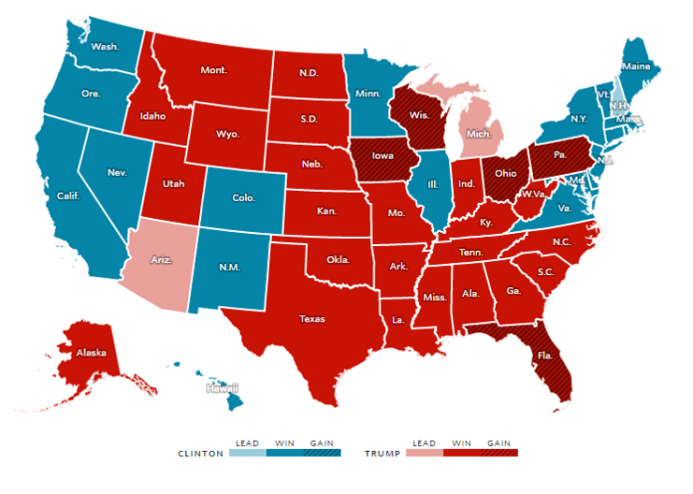
This is a more extreme process, but it is also just as valid and allows for more culturally compatible people to have a stronger option at self-determination. This strategy further removes the chances of having a central power structure usurping the wishes and desires of your more culturally compatible group by incompatible groups elsewhere. If one looks at the 2016 election map:

us_2016_election_map

We can find that, at minimum, save for a couple of orphans in the form of New Mexico, Denver, Minneapolis, and Chicago, the United States as it stands is perfectly set up for a secession movement to split the nation into at least three separate entities.

This would allow a greater level of freedom for residents of these three newly formed entities. Further, this split is more than possible from economic size. For the purposes of this exercise, I’ll name the three new nations Cascadia (Washington, Oregon, California, Nevada and let’s throw Hawaii in there), New England (all the blue colored States from Virginia through Maine), and the United States (everyone else). If the USA split into these three entities, here is how the top 20 nations by GDP would look:

us_3_countries

These new nations would rank second, fourth and sixth in world GDP and two of them, USA and Cascadia, are one decent year of growth away from jumping up a rank.

An additional benefit of secession is the ability to further harmonize the new nation with more desirable trade practices, immigration policy, foreign policy, military spending, court systems, and monetary policy. These decentralized entities even have the option of altering how the government itself works, such as dispensing with individual State identities, removing the Electoral College and applying a direct vote system or even converting into a European-style Parliamentary system. Secession allows for even greater self-determination missing in today’s system.

Or you could continue operating as-is and hope enough swing voters decide they want to go back to your philosophy so you can take your turn again imposing your lifestyle on someone else and taking the risk of playing backseat where you truly have no representation or real say in how you live.

In any case, the liberty movement can be a strong ally to allow you to avoid having to live through another Donald Trump term and forge your own destiny without all the strife and divisiveness that goes with a modern American election cycle.

Justin Murray received his MBA in 2014 from the University of St. Gallen in Switzerland.

This article was published on Mises.org and may be freely distributed, subject to a Creative Commons Attribution United States License, which requires that credit be given to the author.

Memo to the Next Administration: Defense Spending Must Be For Actual Defense – Article by Ron Paul

Memo to the Next Administration: Defense Spending Must Be For Actual Defense – Article by Ron Paul

The New Renaissance HatRon Paul
******************************
In a disturbing indication of how difficult it would be to bring military spending in line with actual threats overseas, House Armed Services Chairman Rep. Mac Thornberry (R – TX) told President Obama last week that his war funding request of $11.6 billion for the rest of the year was far too low. That figure for the last two months of 2016 is larger than Spain’s budget for the entire year! And this is just a “war-fighting” supplemental, not actual “defense” spending! More US troops are being sent to Iraq, Syria, Afghanistan, and elsewhere and the supplemental request is a way to pay for them without falling afoul of the “sequestration” limits.

The question is whether this increase in US military activity and spending overseas actually keeps us safer, or whether it simply keeps the deep state and the military-industrial complex alive and well-funded.

Unfortunately many Americans confuse defense spending with military spending. The two terms are used almost interchangeably. But there is a huge difference. I have always said that I wouldn’t cut anything from the defense budget. We need a robust defense of the United States and it would be foolish to believe that we have no enemies or potential enemies.

The military budget is something very different from the defense budget. The military budget is the money spent each year not to defend the United States, but to enrich the military-industrial complex, benefit special interests, regime-change countries overseas, maintain a global US military empire, and provide defense to favored allies. The military budget for the United States is larger than the combined military spending budget of the next seven or so countries down the line.

To get the military budget in line with our real defense needs would require a focus on our actual interests and a dramatic decrease in spending. The spending follows the policy, and the policy right now reflects the neocon and media propaganda that we must run the rest of the world or there will be total chaos. This is sometimes called “American exceptionalism,” but it is far from a “pro-American” approach.

Do we really need to continue spending hundreds of billions of dollars manipulating elections overseas? Destabilizing governments that do not do as Washington tells them? Rewarding those who follow Washington’s orders with massive aid and weapons sales? Do we need to continue the endless war in Afghanistan even as we discover that Saudi Arabia had far more to do with 9/11 than the Taliban we have been fighting for a decade and a half? Do we really need 800 US military bases in more than 70 countries overseas? Do we need to continue to serve as the military protection force for our wealthy NATO partners even though they are more than capable of defending themselves? Do we need our CIA to continue to provoke revolutions like in Ukraine or armed insurgencies like in Syria?

If the answer to these questions is “yes,” then I am afraid we should prepare for economic collapse in very short order. Then, with our economy in ruins, we will face the wrath of those countries overseas which have been in the crosshairs of our interventionist foreign policy. If the answer is no, then we must work to convince our countrymen to reject the idea of Empire and embrace the United States as a constitutional republic that no longer goes abroad seeking monsters to slay. The choice is ours.


Ron Paul, MD, is a former three-time Republican candidate for U. S. President and Congressman from Texas.

This article is reprinted with permission from the Ron Paul Institute for Peace and Prosperity.

The Constitution in the Donald Trump Era – Press Release by Tenth Amendment Center

The Constitution in the Donald Trump Era – Press Release by Tenth Amendment Center

The New Renaissance HatTenth Amendment Center
November 11, 2016
******************************
Contact: Mike Maharrey
Communications Director
O: 213.935.0553
media@tenthamendmentcenter.com
www.tenthamendmentcenter.com
***

The election of Donald Trump has changed the political dynamics in Washington D.C., but it will not fundamentally change our work at the Tenth Amendment Center. We will continue to aggressively fight unconstitutional federal actions with the same vigor we have over the last eight years.

The Tenth Amendment Center was founded in 2006 in opposition to Bush war and surveillance policies. The organization has also worked to support states nullifying federal programs like marijuana prohibition and the Bush-era real ID act.

“Constitutionalists should retch at the mere thought of John Bolton being anywhere near 1600 Pennsylvania Avenue,” Tenth Amendment Center founder and executive director Michael Boldin said in response to hearing Trump is considering the Bush-policy architect for Secretary of State.

Tenth Amendment Center Executive Director Michael Boldin and Communications Director Mike Maharrey are always available to provide quotes from a constitutional perspective on Trump policy.

Give us a call.

###

The Tenth Amendment Center, based in Los Angeles, seeks to limit federal power through action in the states and education.

Regardless of How America Votes, Americans Want a Different Foreign Policy – Article by Ron Paul

Regardless of How America Votes, Americans Want a Different Foreign Policy – Article by Ron Paul

The New Renaissance HatRon Paul
******************************

I have said throughout this presidential campaign that it doesn’t matter much which candidate wins. Both Donald Trump and Hillary Clinton are authoritarians, and neither can be expected to roll back the leviathan federal government that destroys our civil liberties at home while destroying our economy and security with endless wars overseas. Candidates do not matter all that much, despite what the media would have us believe. Ideas do matter, however. And regardless of which of these candidates is elected, the battle of ideas now becomes critical.

The day after the election is our time to really focus our efforts on making the case for a peaceful foreign policy and the prosperity it will bring. While we may not have much to cheer in Tuesday’s successful candidate, we have learned a good deal about the state of the nation from the campaigns. From the surprising success of the insurgent Bernie Sanders to a Donald Trump campaign that broke all the mainstream Republican Party rules – and may have broken the Republican Party itself – what we now understand more clearly than ever is that the American people are fed up with politics as usual. And more importantly they are fed up with the same tired old policies.

Last month a fascinating poll was conducted by the Center for the National Interest and the Charles Koch Institute. A broad ranging 1,000 Americans were asked a series of questions about US foreign policy and the 15 year “war on terror.” You might think that after a decade and a half, trillions of dollars, and thousands of lives lost, Americans might take a more positive view of this massive effort to “rid the world of evil-doers,” as then-president George W. Bush promised. But the poll found that only 14 percent of Americans believe US foreign policy has made them more safe! More than 50 percent of those polled said the next US president should use less force overseas, and 80 percent said the president must get authorization from Congress before taking the country to war.

These results should make us very optimistic about our movement, as it shows that we are rapidly approaching the “critical mass” where new ideas will triumph over the armies of the status quo.

We know those in Washington with a vested interest in maintaining a US empire overseas will fight to the end to keep the financial gravy train flowing. The neocons and the liberal interventionists will continue to preach that we must run the world or everything will fall to ruin. But this election and many recent polls demonstrate that their time has passed. They may not know it yet, but their failures are too obvious and Americans are sick of paying for them.

What is to be done? We must continue to educate ourselves and others. We must resist those who are preaching “interventionism-lite” and calling it a real alternative. Claiming we must protect our “interests” overseas really means using the US military to benefit special interests. That is not what the military is for. We must stick to our non-interventionist guns. No more regime change. No more covert destabilization programs overseas. A solid defense budget, not an imperial military budget. US troops home now. End US military action in Syria, Iraq, Afghanistan, Somalia, and so on. Just come home.

Americans want change, no matter who wins. We need to be ready to provide that alternative.

Ron Paul, MD, is a former three-time Republican candidate for U. S. President and Congressman from Texas.

This article is reprinted with permission from the Ron Paul Institute for Peace and Prosperity.


Trump: The Moral Monster Beyond Hope – Post by G. Stolyarov II

Trump: The Moral Monster Beyond Hope – Post by G. Stolyarov II

The New Renaissance Hat
G. Stolyarov II
******************************

Two excellent recent editorials highlight the unprecedented danger that Donald Trump poses to liberty and basic human decency in America.

Nina Khrushcheva, great-granddaughter of Nikita Khrushchev, writes of how Donald Trump has brought Soviet-Style politics, particularly the sweeping use of the Big Lie, to the United States. (“Trump Through Russian Eyes”. Project Syndicate. September 27, 2016)

Khrushcheva observes,

Indeed, from my perspective, many of the nastiest and most perverse features of Russian politics now seem present in the United States as well. The Big Lie – invented in Nazi Germany, perfected in the Soviet Union, and wielded expertly by Russian President Vladimir Putin – is today a core component of Donald Trump’s presidential campaign.

***

So far, Trump has been allowed to get away with his lies. The news media have largely been what Lenin called ‘useful idiots,’ so eager to use Trump to boost their own ratings that they did not notice or care that they were also boosting his. No surprise, then, that an emboldened Trump now delivers lies of ever more breathtaking audacity.

Harvard political theorist Danielle Allen likens Donald Trump to Gilgamesh – and not in a flattering manner. (“Donald Trump is a walking, talking example of the tyrannical soul”. The Washington Post. October 8, 2016.) In the early “Epic of Gilgamesh”, the king Gilgamesh (before he journeys on his quest to obtain eternal life) is an arbitrary, capricious tyrant with no regard for any other individuals’ rights or for basic human dignity and decency. Only when Gilgamesh realizes that death is a fundamental problem affecting everyone (him, too), is he impelled away from tyranny and toward wisdom.

But it is too much to hope that Trump would all of a sudden turn from a populist demagogue and would-be tyrant into a life-extension supporter. Instead, Trump should be recognized as completely devoid of moral character, and a completely lost cause for anyone who thought that he might somehow magically transform himself into a reasonable person.

It is time to break free from the spell of the Big Lie and universally denounce Trump for the moral monster he is. All people of good moral character must stand against Trump. Support anyone else you wish (Libertarian, Democrat, Green, Transhumanist, McMullin, none of the above) – but express the conviction that a decent, humane society should not allow such an unseemly, tyrannical brute as Trump to have any degree of power.

This post may be freely reproduced using the Creative Commons Attribution Share-Alike International 4.0 License, which requires that credit be given to the author, G. Stolyarov II. Find out about Mr. Stolyarov here.

Trump’s Economic Plan Faces Well-Deserved Ridicule – Article by K. William Watson

Trump’s Economic Plan Faces Well-Deserved Ridicule – Article by K. William Watson

The New Renaissance HatK. William Watson
******************************

Earlier this week, the Trump campaign released a white paper written by senior policy adviser Peter Navarro to elaborate and quantify the candidate’s economic plan.  The goal of the paper is to explain how Donald Trump’s promises to renegotiate trade agreements and raise tariffs will promote economic growth and raise revenue for the government.

The plan betrays embarrassing ignorance of how trade negotiations work and a farcically simplistic and erroneous understanding of economics.  In essence, the plan justifies Trump’s policies by reimagining how the world works.

Trump’s entire view of trade and its impact on the U.S. economy is wrong.  He believes that trade is good for the United States only if we export more than we import and that trade relations are a contest between countries, which we are losing because they sell more stuff to us than we sell to them.  He claims to be the tough-guy who will the save the American economy from shrewd foreign cheaters and the inept government officials who let them beat us.

Since that’s not how things work in the real world, he has to rely on falsehoods and bad economics to justify disastrous policies.  This new white paper is just a continuation of that tactic.

But you don’t have to take my word for it.  If you think I’m being too harsh or would like to learn more about the “Trump Trade Doctrine” and what’s wrong with it, I recommend you read lengthier condemnations from experts who have called the plan’s analysis “truly disappointing,” “not only wrong, but foolish,” “magical thinking,” “a complete mess,” and the sort of thing “that would get you flunked out of an AP economics class.”

Bill Watson is a trade policy analyst with Cato’s Herbert A Stiefel Center for Trade Policy Studies. His research focuses on U.S. trade remedy policies, disguised protectionism, and the institutional aspects of global trade liberalization. He manages Free Trade, Free Markets: Rating the Congress, Cato’s online database that tracks votes by Congress and its individual members on bills and amendments affecting the freedom of Americans to trade and invest in the global economy. Watson received a BA in political science from Texas Christian University, a JD from Tulane University Law School, and an LLM in international and comparative law from the George Washington University Law School.

This work by Cato Institute is licensed under a Creative Commons Attribution-NonCommercial-ShareAlike 3.0 Unported License.

Our Media-Driven Epistemological Breakdown – Article by Bill Frezza

Our Media-Driven Epistemological Breakdown – Article by Bill Frezza

The New Renaissance HatBill Frezza
******************************

How do we know what we know? Philosophers have pondered this question from time immemorial. Julian Jaynes, in his classic book, The Origin of Consciousness in the Breakdown of the Bicameral Mind, speculates that before the development of modern human consciousness, people believed they were informed by voices in their heads. Today, an alarming number of people are responding to voices on the Internet in similarly uncritical fashion.

As Jesuit scholar John Culkin pointed out in his seminal 1967 Saturday Review article, “A Schoolman’s Guide to Marshall McLuhan,” “We shape our tools and, thereafter, they shape us.” Examining history through this lens, one can identify seven great epochs in mankind’s intellectual and social evolution.  Each is characterized by the way a new technology changed not only how we think about the world, but our actual thought processes. These are:

1) Spoken language, which first led to the primacy of mythology;

2) Written language, which bequeathed to us holy books and the world’s great religions;

3) The printing press, which spread literacy to the elites who went on to birth the nation state, the Reformation, the Enlightenment, and the U.S. Constitution;

4) The telegraph, which transformed pamphlets and broadsheets into modern newspapers, whose agenda-setting influence goaded America to “Remember the Maine” and become an imperialist power;

5) Radio, which placed broadcast propaganda at the service of central planners, progressives, and tyrants;

6) Television, which propelled the rising tide of the counterculture, environmentalism, and globalism; and

7) The Internet, a nascent global memory machine that puts the Library of Alexandria to shame, yet fits in everyone’s pocket.

Reason’s primacy is a fragile thing.

At each transition, the older environment and way of thinking does not disappear. Rather, it adopts an extreme defensive crouch as it attempts to retain power over men’s minds. It is the transition from the Age of Television to the Age of the Internet that concerns us here, as it serves up an often-toxic brew of advocacy and click-bait journalism competing to feed the masses an avalanche of unverifiable information, often immune to factual or logical refutation.

Rational epistemology holds that reason is the chief test and source of knowledge, and that each of us is not just capable of practicing it, but is responsible for doing so. Reason flowered when the Enlightenment overturned the ancient wisdom of holy books, undermining the authority of clerics and the divine right of kings. Wherever reason is widely practiced and healthy skepticism is socially accepted, error becomes self-correcting (rather than self-amplifying, as under a system based on superstition), as new propositions are tested, while old propositions get reexamined as new facts come to light.

So now that the voices have returned to our heads, we are inadequately prepared to defend against them.

Yet, reason’s primacy is a fragile thing. As increasingly potent electronic media confer influence on new voices, formerly-dominant media and governing elites fight a rearguard action to regain their status as ultimate arbiters of knowledge and what matters. Goebbels proved that a lie repeated loudly and frequently in a culture that punished skepticism became accepted as truth. We all know how that turned out.

Revulsion at the carnage of the Second World War crested with the counterculture revolution driven by the first TV generation. By the time the dust settled, its thought leaders had grabbed control of the academy, reshaping it along postmodern lines that included an assault on language that critics dubbed political correctness. This was intentionally designed to constrain what people can think by restraining what they can say. The intention may have been to avert a repeat of the horrors of the 20th century, but the result was to strip much of the educated populace of the mental tools needed to ferret out error.

So now that the voices have returned to our heads, we are inadequately prepared to defend against them. Digitally streamed into every nook and cranny of our ubiquitously connected lives, these voices are filtered by our own self-reinforcing preferences and prejudices, becoming our own in the process. The result is an ongoing series of meme-driven culture wars where the shouting only gets louder on all sides.

So we come back to the question: How do we know what we know?

What causes crime? Is autism linked to vaccines? Should GMOs be banned? Is global warming “settled science”? These are more than factual questions. Responses to them signal identification with an array of ever more finely differentiated identity groups set at each other’s throats. For those who wish to divide and rule, that’s the whole point.

In a cruel irony, this global outbreak of media-induced public schizophrenia has even empowered jihadists bent on taking the world back to the 10th century using the idea-spreading tools of the Internet to challenge a Western Civilization rapidly losing its mojo.

So we come back to the question: How do we know what we know? At the present time, we don’t. And therein lies the problem.

Bill Frezza

Bill Frezza is a fellow at the Competitive Enterprise Institute and the host of RealClear Radio Hour.

This article was originally published on FEE.org. Read the original article.

The Two-Party Crackup Could Be Upon Us – Article by Stephen Weese

The Two-Party Crackup Could Be Upon Us – Article by Stephen Weese

The New Renaissance HatStephen Weese
******************************

Imagine living in a world where there are only two choices. Chocolate or vanilla. Hot or cold. Light or darkness. There are no in-betweens. No “shades of gray.” You must explain everything as a “yes or no” dichotomy. On or off. False or true. This binary reality leaves little room for human diversity or creativity – yet it is in this exact reality we find ourselves trapped with the US political system.

Prelude to Deception

The parties are divided and their candidates are weak.It all starts with a sociological phenomenon created due to our political election process. First Past the Post means that in our elections, winner takes all and the loser gets nothing. We are told that if we do not vote for one of the two major parties, our vote is wasted. (I mathematically analyzed this myth in a previous article.)

The concept that underlies the two party phenomenon is not only mathematical in principle, it is sociological. Duverger’s law assumes that people faced with more than two choices in a First Past the Post election will vote against the most radical or undesired opponent, instead of for the candidate they most desire. This demonstrates what is called a “negative” vote – it could be more precisely described as a vote made out of fear of the worst candidate.

Another principle of Duverger’s law is that it filters out “weaker” parties in that people will not vote for a party that has no chance of winning. This weakness is only psychologically defined; a party could appear weaker simply due to less publicity. Certainly a third party could have better ideas than the main two – but if the ideas are not heard, then no one can know about them. The purely cognitive illusion that there are only two “worthy” parties is perpetuated by lack of media coverage and the false appeal to common practice that it’s the “way things always have been done.”

The simple truth is, Duverger’s law depends on the psychological basis of fear and ignorance. Without these factors in society, the mathematical differences would disappear.

The Two Major Parties are Weak

People only think of politics as “right” or “left” because this is all they have ever known.At this point, the two major candidates for election, Donald Trump and Hillary Clinton, have historically high negative numbers. In fact, the two frontrunners have the highest unfavorable ratings since those numbers have been tracked: Trump is net negative 33, and Clinton negative 21.

More voters see these candidates in an unfavorable light than a favorable one. This would be a perfect time for the rise of a third party, even according to Duverger’s law. It only takes a cursory look at the news to see the large anti-Trump movement among major Republicans as well as the staunch Sanders wing of the Democratic party. The parties are divided and their candidates are weak, as shown by the polls above.

The Electorate Is Polarized

If you have the feeling that in the last decade partisan politics has become more extreme and vitriolic you’d be correct – Pew research has been tracking this phenomenon. Both the extremity of Democratic and Republican views have increased, as well as dislike and intolerance for the “other” party. At this point, 92% of Republicans are to the right of the median Democrat, and 94% of Democrats are to the left of the median Republican.

There are double the amount of pure liberals and conservatives than a decade ago, and the fear of the opposing party has doubled as well. Twice as many people think that the alternate party threatens the “nation’s well-being.”

If people could overcome the fear of the “worst” candidate and voted for what they believed in, the facade would begin to crumble. This polarization affects people’s choices of where to live, shop, and travel, and even goes to the extent of opposition to a family member marrying someone of the opposing party. The Pew study also shows that those on the extreme ends of the spectrum are the most politically active – writing letters, posting on social media, travelling to political events (though this is hardly surprising.) The effect of this of course is that these parties are represented more by their extreme elements.

This polarization also results in one-dimensional thinking. People only think of politics as “right” or “left” because this is all they have ever known. As humans, are we only one-dimensional? Aren’t there more ways to look at solving the problems of a nation than just left and right?

Most of us are trapped in this one-dimensional illusory world, like a train stuck on a single track. The mere idea that we could travel in a completely different direction is a foreign concept. Even a middle-school student can tell you that we live in a world with three dimensions, that we can travel in an infinite variety of paths. Yet we find ourselves confined to this oversimplified model of reality that goes counter to our interests and only allows us choices that leave most dissatisfied.

Majority in the Middle

Another effect of this polarization is that moderate Americans find themselves in the middle of this extremism. Most voters do not view the other party as a threat to the nation and are not 100% liberal or conservative in their views. There are actually more people in the middle, yet they find themselves forced to choose to side with one extreme or the other. In 2014, the “mixed” electorate (holding views from both sides) was 39%.

There are less of them now, due to extremism, yet this 39% in the middle is enough to completely take over an election, if they only had a different option to choose from. Unfortunately, the Pew data also shows that the people in the middle are less likely to vote and participate in the election process. Duverger’s law is working here because these moderates do not know that they are a huge bloc that could elect a moderate candidate with ease.

Overcoming Ignorance and Fear

We live in the age of new media – a social movement can begin online without the backing of a major television or news network. As we have seen, voting tendencies in our system are predicated on fear of a radical candidate as well as ignorance of third-party platforms or even their existence. This is the one-dimensional illusion we live in. If we continue to be more polarized, more and more of the electorate will hate the other half.

If nothing stops this progress, those in the middle will be forced to choose a side as the tolerance for opposing views decreases. Others could stand up and speak and become a driving force pulling opinions back toward some sense of centrism – or even better, they could propose ideas outside of the traditional “left vs. right” paradigm.

The truth is, if people could overcome the fear of the “worst” candidate and voted for what they believed in, the facade would begin to crumble. If the media and others covered third parties more, unaligned voters – for example, people who believe in peace and freedom – would have a new incentive to participate and give a positive vote.

Fortunately, we now live in the age of new media – a social movement can begin online without the backing of a major television or news network. This election is the most opportune time for this to happen given the record negative views of both candidates. Thus it behooves the unaligned voter to find her or his voice in this election. If these voters together decided that “enough is enough” and realized that they are actually the most powerful voting bloc, they could simply say “no” to the two major parties – and nothing could stop them.
Stephen_WeeseStephen Weese

Stephen Weese has an undergraduate degree in Computer Science from George Mason University, and a Masters in Computer Information Technology from Regis University. Stephen teaches college Math and Computer courses. He is also a speaker, a film and voice actor, and a nutrition coach.

This article was originally published on FEE.org. Read the original article.