Browsed by
Tag: FEE

Safe Spaces Can’t Be Diverse – And Vice Versa – Article by Kevin Currie-Knight

Safe Spaces Can’t Be Diverse – And Vice Versa – Article by Kevin Currie-Knight

The New Renaissance Hat
Kevin Currie-Knight
******************************

I’m a fan of the LGBT center on the campus where I teach. It offers a space where gay, lesbian, bisexual, and transgender students can be among students, faculty, and staff without fear of harassment, bullying, or negative judgment. There, they do not have to worry about passing (pretending to be straight) or covering (having to signal to others that they are still “normal” despite who they are).

But do you know what spaces like this are not? Diverse.

Or rather, they are not diverse in the types of attitudes permitted to exist there. One cannot, say, believe that homosexuality is a sin and feel welcome at an LGBT center. One cannot believe that transgender people are mentally ill and find LGBT centers to be congenial.

This lack of diversity is not wrong; it is by design and has a good purpose. A safe space is one where people with certain identities that don’t fit in elsewhere can find safety through homogeneity and solidarity.

We don’t need to dismiss either ideal to recognize that a space’s safety and its diversity will be inversely related. The more you have of one, the less you must have of the other.

But you can have spaces and contexts that allow for either ideal, or varying degrees of compromise between them — unless activists succeed in their current quest to convert entire universities into safe spaces.

The Yale case is well known by now. Erika Christakis, a lecturer in early child development, voiced concern in an email to Yale students and residence-life folks urging them to rethink the university’s heavy-handed approach to advising students on which Halloween costumes to avoid. Her note ignited controversy and protest on campus — with some even calling for Christakis’s resignation — because the possibility of students wearing offensive Halloween costumes makes the campus a potentially unsafe space.

In another recent example, the University of Missouri has been experiencing protests regarding alleged racist speech and treatment of minority students. During one of these protests, a journalist trying to cover the event was evidently shouted down and intimidated because his (journalistic) presence at the protest allegedly threatened the protesters’ safe space. (Think about how odd it is to describe the site of a vigorous protest as a safe space).

One journalist described a video of the events as follows:

In the video of Tim Tai trying to carry out his ESPN assignment, I see the most vivid example yet of activists twisting the concept of “safe space” in a most confounding way. They have one lone student surrounded. They’re forcibly preventing him from exercising a civil right. At various points, they intimidate him. Ultimately, they physically push him. But all the while, they are operating on the premise, or carrying on the pretense, that he is making them unsafe.

If people who regularly find their campuses (or other places) to be inhospitable, it may do them good to have social spaces where they are assured some level of relief, probably with people they are comfortable with. But think about what that means for diversity.

Increasing diversity is another aspiration at universities and other organizations, but safe spaces demand that the people in the space have a certain degree of homogeneity. For Yale to be a safe space, the university must disallow a diversity of Halloween costumes.

Why did the Missouri protesters suggest that Tai’s presence threatened to turn their protest into an unsafe space? Because there was a possibility that the narrative this journalist would construct might not be one the homogeneous protesters would approve of. Tai threatened the homogeneity and solidarity of the protest.

Let’s go back to the example of LGBT centers. That these students have somewhere they can go where they do not feel pressures to hide or “tone down” their identities is important, and any society that promotes freedom of association will have many such centers, whether official or not. But the only way for an entire university to become a safe space for LGBT students is to sacrifice diversity by, for example, demanding that religious students not believe (at least openly) that homosexuality is sinful. The converse is also true: LGBT centers could no longer function as safe spaces for LGBT students if they became sites of more diversity, where those religious students could regularly voice their beliefs.

Diversity cannot thrive in a world that is one big safe space.

Why? Because diversity means difference. Difference means that people will invariably see things in different ways, and we will sometimes anger each other. It’s not a bug, but a feature. To eliminate the possibility that some of us could deeply offend others of us would be to require everyone to live only in ways acceptable to all.

Diversity means a world where black-power advocates can live openly and in ways that anger white people — and where white-power advocates can live openly and thus anger black people. A world of diversity is one where people with different tastes, comfort levels, and senses of humor can wear Halloween costumes that may offend others.

The best resolution is to allow people on college campuses and elsewhere to create safe spaces. If we believe others’ Halloween costumes may deeply offend us, or that people may say derogatory and racist things to us, we can go to one of those spaces. But leave the university as a diverse space — don’t force it to become a safe space.

Diversity and emotional safety are values at odds with each other. They can coexist in tension, but the expansion of one can only come at the expense of the other.

Kevin Currie-Knight teaches in East Carolina University’s Department of Special Education, Foundations, and Research. He is a member of the FEE Faculty Network.

This article was originally published by The Foundation for Economic Education and may be freely distributed, subject to a Creative Commons Attribution 4.0 International License, which requires that credit be given to the author.

Does DC’s Curfew Prevent Crime – Or Increase It? – Article by Alex Tabarrok

Does DC’s Curfew Prevent Crime – Or Increase It? – Article by Alex Tabarrok

The New Renaissance HatAlex Tabarrok
******************************

Another for the “unintended consequences” file

Washington, DC, has a juvenile curfew law. Anyone “under the age of 17 cannot remain in or on a street, park or other outdoor public place, in a vehicle or on the premises of any establishment within the District of Columbia during curfew hours.” There are exemptions for juveniles accompanied by a parent and for travel for jobs (no detours allowed.)

Curfew laws keep some juveniles off the streets during curfew hours, but which ones? The criminals seem the least likely to be deterred, and with fewer people on the street, perhaps the criminals are emboldened.

The DC curfew switches from midnight to 11 pm on Sept 1 of every year. In a working paper, Jennifer L. Doleac and Jillian Carr test the effect of DCs juvenile curfew on gun violence by looking at the number of gunshots heard in the 11pm to midnight “switching hour” just before and just after Sept 1. From a summary:

The September 1 change provides a clean natural experiment. If curfews reduce gun violence, then when the curfew shifts to 11:00 p.m. rather than midnight, gunfire between 11:00 p.m. and midnight should go down. Does it?

Just the opposite. Using data on gunfire incidents from ShotSpotter (acoustic gunshot sensors that cover the most violent neighborhoods in D.C.), we find that after the curfew switches from midnight to 11:00 p.m., the number of gunshot incidents increases by 150 percent during the 11:00 p.m. hour.

This amounts to 7 additional gunfire incidents city-wide per week, during that hour alone. Jane Jacobs was right: the deterrent effect of having lots of people out on the streets is powerful. This makes juvenile curfew policies counter-productive.

The use of ShotSpotter data is innovative and avoids some problems with issues of police enforcement. Calls to 911, however, don’t show the same pattern as the ShotSpotter data, which is worrying.

I’d also like to see more information on the proposed mechanism. Is it really the case that significantly fewer people are out on the streets at say 11:30 pm after the curfew has been lowered to 11 pm than when the curfew was set at midnight? The curfew only directly affects people under 17 and, as noted above, there are quite a few exemptions. Also what are the ages of those typically arrested on the basis of ShotSpotter alerts?

By the way, on a typical day in DC there are almost 15 gunfire incidents heard by ShotSpotter (data here, the authors report 8 but that may be from a restricted sample). A lot of gunfire is heard around a handful of schools. The ShotSpotter system is quite accurate. Although it misses some shots it distinguishes shots from car backfires better than people do. I also found this note from the Washington Post amusing, in a frightening way:

About a third of detected gunshot incidents in the city happen on New Year’s Eve or around July 4. Officials explain the high rate as celebratory gunfire.

This post first appeared at Marginal Revolution.

Alex Tabarrok is a professor of economics at George Mason University. He blogs at Marginal Revolution with Tyler Cowen.

Comparative Advantage: An Idea Whose Time Has Passed – Article by Michael Munger

Comparative Advantage: An Idea Whose Time Has Passed – Article by Michael Munger

The New Renaissance HatMichael Munger
******************************

The Division of Labor Is the Engine That Drives Prosperity

Many economists will tell you that the most important principle in economics is comparative advantage — the idea that it is expensive to grow oranges in Alaska or to flood rice paddies in Saudi Arabia, so Alaska and Saudi Arabia should import oranges and rice, respectively, and base local production on the advantages of local conditions. We got this idea from classical economist David Ricardo, who famously observed in 1821 that England and Portugal would both be wealthier if Portugal exported its wine and imported England’s textiles, and vice versa.

Ricardo’s principle even demonstrated the advantages of trading with those who are less productive at everything. For example, my wife is an attorney. She is also a fast and accurate typist. Yet she hires a secretary who is considerably slower at typing. Secretaries get paid less than attorneys, so if my wife specializes in law and the secretary specializes in typing, my wife can earn more for her firm and a secretary gets a job. Both end up better off. That’s true even though my wife is better at both jobs: comparative advantage means trade helps everyone.

Division of Labor Trumps Comparative Advantage

The problem is that fixed comparative advantage — derived from weather, culture, and location — is vanishing in the modern world. Ricardo’s classical formulation leaves no space for human creativity, no role for division of labor, and no room for innovation to affect the dynamics of cost.

So economists have it wrong, as my friend Russ Roberts argued in 2010. The most important principle in economics is opportunity cost. Here’s proof: you can define opportunity cost without resorting to comparative advantage. But you can’t possibly define comparative advantage without invoking opportunity cost.

The notion of comparative advantage is empirically misleading, because it sounds deterministic. There are few situations where fixed factors make the relative opportunity costs of different actions immutable. Instead, cost and productivity differences are endogenous, the consequence of human ingenuity and the division of labor. Today’s cost advantage for one country may disappear if another country finds a better, cheaper way to produce the product. And the way to specialize is to exploit the division of labor.

Sock City

What nation lost the most manufacturing jobs from 1990 to 2000? China. That may seem surprising, given the media stereotype of how we “ship US jobs overseas,” but it’s true (PDF). In 1990, Chinese manufacturing meant large sheds filled with hundreds of people working with sewing machines and other small tools. The scale was huge, with at least 100 million manufacturing workers. But productivity was terrible.

In the late 1990s, China began to automate, taking advantage of division of labor. A thousand women with sewing machines in a barn turned into 25 women running enormous machines in a factory, with a gigantic increase in productivity. A fraction of the workers produced 10 times as much output, increasing productivity a hundredfold and forcing 97.5 percent of the workers out. But those workers found new jobs, as China used the division of labor more and more effectively. The country’s advantage was not climate, not soil quality, but human action consciously designing production processes that were cheaper and faster.

Nowhere did productivity rise faster than in the city of Datang in Guangdong Province. Part of Datang is actually called “Sock City,” because more than a third of all socks sold in the entire world (yes, the world) are manufactured there. Datang boasts more than 8,000 hosiery makers ringing the city center, and they produced more than 11 billion pairs of socks in 2012. The socks you’ll find at Walmart — or even at Neiman Marcus or another more upscale store — were likely made in or around Datang.

The concentration of manufacturing at Sock City means this: there is a well-developed labor market for exotic sock-making specialties. The occupations that are well known in Datang don’t exist elsewhere, because no other location has been able to take such full advantage of the division of labor. What limits the division of labor in Datang? Only the extent of the market, just as Adam Smith said in The Wealth of Nations. And remember that Datang is producing at a rate of nearly two pairs of socks per year, for every human on the planet. Datang’s market is Earth.

It wasn’t always that way. Datang does not have any comparative advantage, at least not in the way Ricardo meant. The climate is not especially favorable, the city is not near an essential natural-resource base, and sock making is not part of traditional culture. Datang’s dominance is new and is overtaking historical frontrunners like Fort Payne, Alabama, the self-proclaimed Sock Capital of the World.

Fort Payne “began making stockings in 1907 and once boasted of producing 1 of every 8 pairs worn on the planet,” writes Don Lee in “The New Foreign Aid,” published April 10, 2005, in the Los Angeles Times. However, he explains,

China’s advantages in the global marketplace are moving well beyond cheap equipment, material and labor. The country also exploits something called clustering in a way that the United States just can’t match.… Industrial clusters are like one-stop production centers, achieving economies of scale and driving innovation by geographically bunching suppliers, manufacturers and contractors.…

Meanwhile, American producers, pummeled by imports from China and elsewhere, saw their share of the US hosiery market fall from 69% in 2000 to 44% in 2003, according to the latest industry data.

Comparative advantage is fixed and exogenous. Opportunity cost is mutable, the product of innovation. Datang’s Sock City itself may soon lose its dominance.

Who “should” produce socks? Comparative advantage here is no guide; the situation is more like comparing two street porters who appear to be quite similar. One of the street porters figures out ways to make socks much more cheaply. Over time, the advantage in opportunity cost grows because of the improvements in dexterity, tool use, and design of new production processes. Human ingenuity created an opportunity for nations to specialize in activities where their opportunity costs were lower. Specialization and trade are what produce prosperity, and opportunity costs guide the choice of what each country should specialize in. My comparative advantage today may be your comparative advantage next year. But all the street porters started out the same.

Focus on Opportunity Cost

Economists routinely act as if three related key concepts — division of labor, comparative advantage, and opportunity cost — are distinct.

They are not. Comparative advantage is not a separate concept at all. It is simply an explanation of the implications of the division of labor (the engine that drives prosperity) and opportunity cost (the concept that guides the choice of which activities a person, or a nation, should specialize in).

Admittedly, it was a significant intellectual achievement to show that the weaker trading partner benefits from trade, even if the stronger partner is better at everything. But those fixed differences have largely disappeared in many markets. The question of what should be produced, and where, is now answered by dynamic processes of market signals and price movements, driven by human ingenuity and creativity. The cost savings resulting from successfully dividing labor and automating production processes dwarf the considerations that made comparative advantage a useful concept in economics.

Let’s downgrade comparative advantage from our list of key concepts in economics, and recognize that the human mind is the mainspring of a market economy.

Michael Munger is the director of the philosophy, politics, and economics program at Duke University. He is a past president of the Public Choice Society.

This article was published by The Foundation for Economic Education and may be freely distributed, subject to a Creative Commons Attribution 4.0 International License, which requires that credit be given to the author.
Why Is the Middle Class Shrinking? – Article by Steven Horwitz

Why Is the Middle Class Shrinking? – Article by Steven Horwitz

The New Renaissance HatSteven Horwitz
******************************

Two Arguments in Favor of Economic Inequality

Economic inequality continues to be a major political issue even as the headlines scream about terrorism and climate change. Bernie Sanders has made it a centerpiece of his presidential campaign, and other candidates have addressed it along the way. And a recent study by the Pew Research Center has added new, though misplaced, fuel to the fire of those concerned about inequality.

The Pew study has been discussed in the media, and one key point has been grossly misunderstood. Among other things, the study found that the American middle class is shrinking and is now just under half of the population. Commentators quickly began to refer to the “hollowing out” of the middle class and to tie this study to the concerns about growing inequality.

However, a close look at the data shows that the middle class has shrunk since 1971 because more members of the middle class have moved up the income ladder than down it.

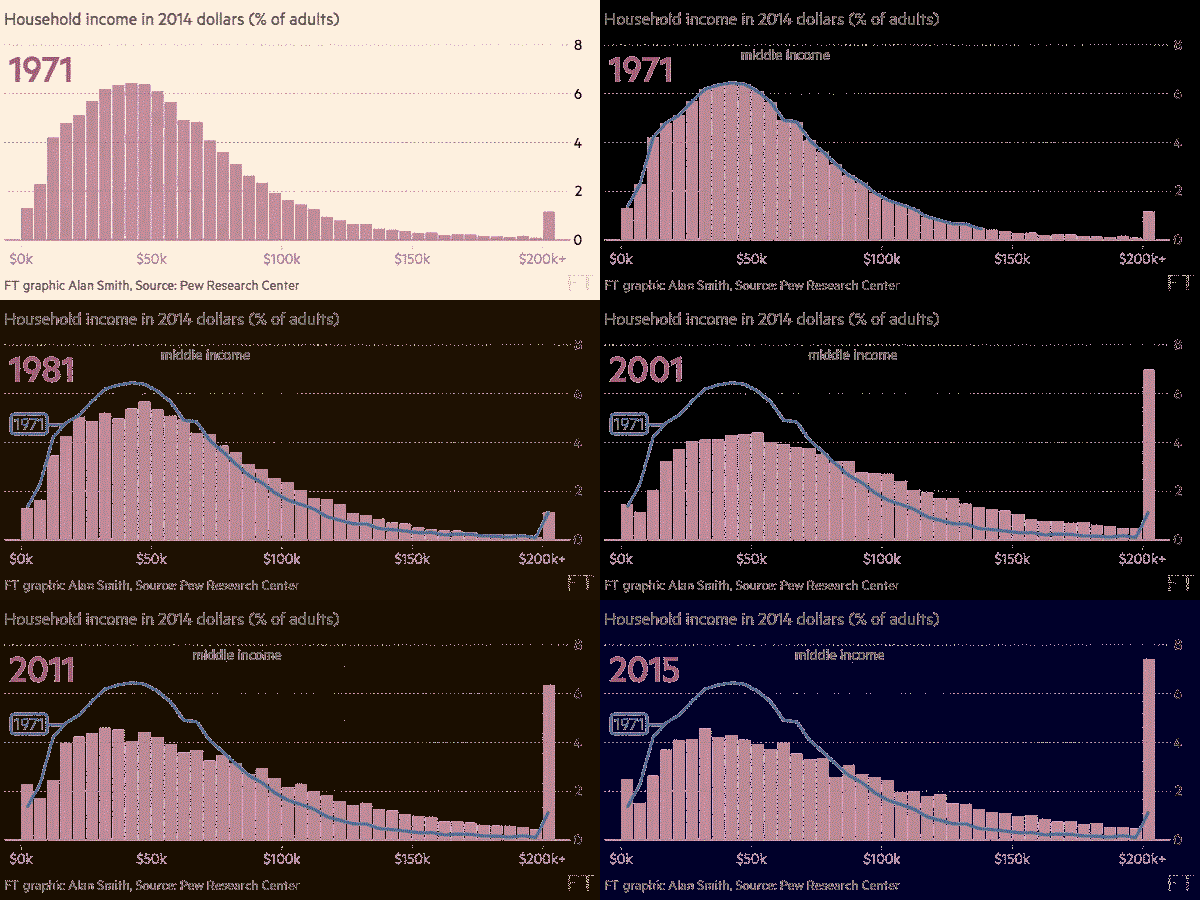
Don’t believe me? Look for yourself at the terrific graphic that the Financial Times created to illustrate the data:

ft2015inequalitygraphYou can watch as the folks on the left slowly slide to the right over 44 years. When you compare the 1971 distribution with the 2015 one, what do you see? A growth in households earning around $80,000 or above, adjusted for inflation, since 1971 and a significant decline in those making less than that amount (with the exception of the folks right around $0). It’s true that there’s not a fat middle class anymore, but why should that trouble us if there are more high-income households and fewer low-income households overall?

The funny part of this is that if you read the story in the Financial Times that accompanies this graphic, it’s as if they never actually looked at the graphic they produced. Their narrative is at odds with it, as the narrative proclaims the doom-and-gloom story that the graphic actually refutes. As they say, never let the facts get in the way of a good story.

This growth in household income may, to some extent, be a by-product of the same economic processes that have produced the concerns about inequality, illustrated in this graphic by the significant growth of the ultra-rich.

There are far more very rich people today than there were 44 years ago, but the growth of the upper class has gone hand in hand with the enrichment of a large number of less-well-off households. Are there ways in which economic inequality is good, then? I think the answer to that question is yes. If so, then, what are they? Here are two defenses of economic inequality that proponents of the free market could make.

First is the more obvious one: growing inequality is good because it might be a consequence of economic institutions that produce all kinds of results that we think are desirable. For example, if competitive markets lead to peace and rising prosperity for all but also create inequality along the way by allowing some folks to get very rich, then we should at least tolerate that inequality because the things that produce it also produce other things we like.

This is the usual defense libertarians invoke, and it’s a good argument. The critic, however, might say that even if the defense is true, it doesn’t prove that inequality is necessary for that result. There’s a difference between saying, “Good economic institutions will produce inequality while creating good economic outcomes for all,” and saying, “Good economic outcomes for all can’t be produced without inequality.” The critic would likely ask how reducing the inequality that markets produce will harm their ability to produce those good results.

And here is where we come back to the Pew study and get a second defense of inequality. One way the middle class (and all of us) has become richer in the last generation is that the cost of so many goods and services has dropped in terms of the number of hours we have to work at the average wage in order to purchase them. The lower price of basic goods has enabled more and more people to afford things like large TVs, smartphones, and new, cheaper medications.

One thing that has made this process happen is inequality. In The Constitution of Liberty, F.A. Hayek argued,

A large part of the expenditure of the rich, though not intended for that end, thus serves to defray the cost of the experimentation with the new things that, as a result, can later be made available to the poor.… Even the poorest today owe their relative material well-being to the results of past inequality.

Having a group of very rich people is what enables yesterday’s luxuries to become today’s basics.

There are two parts to this process: cost bearing and discovery. The very rich are able to afford the high prices of new technologies, thereby providing an incentive for firms to market new and expensive products. Once the rich pay the high initial price and cover the fixed costs of research and development, sellers can begin to price closer to the much lower marginal cost of producing additional units, making the good much more affordable to more people.

But the rich are also an economic canary in the coal mine that informs producers whether they are getting it right.

For example, a critic of inequality might complain that no one “really needs” a $100,000 luxury car with all kinds of new high-tech gadgets on it. But the fact that some can afford it and want to buy it helps the car companies figure out which new features might be popular. Rear-view cameras were once only available on top-end cars, but they have slowly become a standard feature. The same may soon be true of collision warning systems now available on high-end models of some cars.

In fact, everything we think of as basics today was once the province of only the well-off. The first microwaves were expensive and bought mostly by the rich. I can remember my parents paying about $900 for a VCR in the late 1970s. VCRs, of course, fetch a price close to zero these days. The rich who bought the early LCD TVs helped manufacturers defray the fixed production costs and figure out what people wanted, and now these TVs are in the vast majority of houses at a more affordable price.

The inequality at any point in time is a key part of the process that creates wealth for the rest of society over the years to follow. The very rich enable producers to experiment and cover their costs, and that makes more goods more affordable for the rest of us, from fun toys to life-saving necessities.

The inequality produced by the market is a key part of how the market moves forward, enriching all of us in the process. And that’s why the middle class is shrinking: the rich, through the competitive market, have helped make the middle class richer.

Steven Horwitz is the Charles A. Dana Professor of Economics at St. Lawrence University and the author of Hayek’s Modern Family: Classical Liberalism and the Evolution of Social Institutions. He is a member of the FEE Faculty Network.

This article was published by The Foundation for Economic Education and may be freely distributed, subject to a Creative Commons Attribution 4.0 International License, which requires that credit be given to the author.

America’s Concentration Camps Are a Warning, Not a Model – Article by Gary McGath

America’s Concentration Camps Are a Warning, Not a Model – Article by Gary McGath

The New Renaissance HatGary McGath
******************************

But some politicians are trying to revive their legacy

Woodrow Wilson’s reputation has recently taken a well-deserved beating because of his racial policies. He restored segregation in the federal civil service, and the infamous movie Birth of a Nation highlights his support for the Ku Klux Klan. Those policies are dead today, with very few advocates.

However, a more recent president implemented an even worse race-based policy against Americans, and some politicians say we should emulate it today. Franklin D. Roosevelt’s executive order forcibly removed about 120,000 Japanese-Americans, mostly US citizens, from their homes.

After the bombing of Pearl Harbor, people feared a Japanese attack on the West Coast, and many regarded the Japanese American population in California as disloyal. On February 19, 1942, Roosevelt issued Executive Order 9066, which authorized the military to remove people from designated military areas.

As explained in Greg Robinson’s By Order of the President, Roosevelt’s language was broad, but everyone understood “any and all persons” to mean Japanese-Americans and “military areas” to mean the West Coast. The removals included “Issei” — resident immigrants — as well as “Nisei” — native-born Americans with Japanese parents. Immigration from Japan had been banned since 1924, and all Japanese immigrants were ineligible for citizenship, although all had been living in America for at least eighteen years.

They were forcibly removed to ten concentration camps. The government officially called them “relocation centers,” but Roosevelt himself used the words “concentration camp” in a recommendation as early as 1936, as did a military proposal in 1942. The occupants were kept behind barbed wire, and armed guards kept them from leaving.

The mass displacement of Japanese-Americans, but not people of German or Italian extraction, was the result of racial rather than security considerations. Roosevelt showed a lifelong hostility toward the Japanese. Robinson states:

FDR had a long and unvaried history of viewing Japanese-Americans in racialized terms, that is, as essentially Japanese in their identity and emotional allegiance, and of expressing hostility toward them on that basis.

In the years before World War I, Roosevelt considered immigration part of the Japanese threat to the West Coast. During the 1920s, when Roosevelt urged better relations with Japan, he supported immigration restriction and legal discrimination in order to deter Japanese-American settlement.

A report commissioned by Congress concluded that

Executive Order 9066 was not justified by military necessity, and the decisions that followed from it — exclusion, detention, the ending of detention and the ending of exclusion — were not founded upon military considerations. The broad historical causes that shaped these decisions were race prejudice, war hysteria and a failure of political leadership.

As documented by Thomas Fleming in The New Dealers’ War, Roosevelt proposed removing an even larger number of Japanese and Japanese-Americans in Hawaii. The military objected because so many of them were skilled workers who were necessary to the war effort.

The order banning Japanese-Americans from the West Coast was lifted in January of 1945, and the camps were shut down soon afterward. Many returned to find they couldn’t reclaim their property or return to their homes.

These events should be a shameful chapter in America’s past, but even today people cite them as an example to follow. David Bowers, mayor of Roanoke, Virginia, ordered the city government to stop helping Syrian refugees, citing Roosevelt’s internment order as justification.

Al Baldasaro, a New Hampshire state representative and co-chair of Donald Trump’s state veterans’ coalition, has defended Trump’s proposal to ban Muslim immigration by citing World War II internment: “What he’s saying is no different than the situation during World War II, when we put the Japanese in camps.”

Trump has made the connection between his call for banning Muslim immigrants and creating a national registry and FDR’s policies explicit:

What I’m doing is no different than FDR’s solution for German, Italian, Japanese, you know… They stripped them of their naturalization proceedings. They went through a whole list of things; they couldn’t go five miles from their homes. They weren’t allowed to use radios, flashlights. I mean, you know, take a look at what FDR did many years ago and he’s one of the most highly respected presidents.

Trump evaded the question of whether he would have supported Japanese internment, saying, “I would have had to be there at the time to give you a proper answer.” He wasn’t there, but there are still living Americans who were. One was George Takei, who played Lt. Sulu on Star Trek and was sent off at the age of five. He recalls how it happened:

Without charges, without trial, without due process — the fundamental pillar of our justice system — we were summarily rounded up, all Japanese-Americans on the West Coast, where we were primarily resident, and sent off to 10 barb wire internment camps — prison camps, really, with sentry towers, machine guns pointed at us — in some of the most desolate places in this country.

For the sake of a false sense of security, the US government ruined countless lives, imprisoned tens of thousands without charges, without even accusation, with only the mere fact of their skin color and ancestry. The internment stoked hatred against a minority group, squandered potential assets in the war, and fueled the Axis’s anti-American propaganda.

The lesson that America’s concentration camps should have burned into our national consciousness that we must never do that again — not to a racial, national, or a religious minority, nor anyone else — no matter how afraid we are. They are a warning, not a model.

Gary McGath is a freelance software engineer living in Nashua, New Hampshire.

This article was published by The Foundation for Economic Education and may be freely distributed, subject to a Creative Commons Attribution 4.0 International License, which requires that credit be given to the author.

The Hoverboard’s Patent Problem – Article by Jeffrey A. Tucker

The Hoverboard’s Patent Problem – Article by Jeffrey A. Tucker

The New Renaissance HatJeffrey A. Tucker
******************************

Who has the right to make a “hoverboard”?

Shane Chen of Portland, Oregon, owns the patent to one of the hottest holiday gifts this season. It is a kind of hoverboard, a small item that keeps its user upright using infrared sensors, gyroscopes, and motors. You have probably seen them all over your city. You might even have been approached by a street seller.

The authorized version — licensed by Chen himself — is being made and distributed by Razor USA. Prices started at $1,000 and up, but competition from cheap knockoffs, selling for as low as $200, has brought the price for the authorized version to $600. Still, there are places online where you can get them for $200. If experience in new products in a guide to the future, in a year, they will be available for less than $100.

And truly, these knockoffs are everywhere. Small entrepreneurs are importing them from small manufacturers by the thousands and selling them on the streets. They are making and selling so fast that quality control has been… lax. There are anecdotal reports of explosions and sudden acceleration (parodies on this Saturday night live skit). Amazon has refused to sell many brands.

The patent has proven difficult to enforce. Razor is spending up to $1 million per week to sue unauthorized manufactures. It’s a reminder: it’s never enough just own the government-granted monopoly rights to produce something. It always costs money to enforce it. You have to investigate. You have to litigate. You have to win. And by the time that day comes, you might have lost vast market share.

If the product is popular enough, the task is essentially hopeless. The resources and time expended on patent enforcement might instead of gone to innovation and marketing toward actually making profits. Enforcing a monopoly isn’t necessarily the same as making money. Indeed, it is the opposite.

The Case of Eli Whitney
The hoverboard saga brings to mind the history of one of the 19th-century’s most famous inventions: the cotton gin. The holder of the patent was Eli Whitney. A year after his graduation from Yale, he designed and constructed an improvement in the cotton gin — a technology that had existed since the ancient world. He obtained the patent on a single feature, a brush-like extension that improved the way the seeds were extracted from the cotton.

According to Boldrin and Levine, Eli and his partner Phineas Miller has dreams of getting rich with a monopoly pricing scheme. They would install their machines throughout the South and ask a royalty of two fifths, payable in ginned cotton. This prospect seriously annoyed farmers throughout the region, understandably.

So it became a common practice for farmers to reverse engineer the innovation — not a difficult thing to do. Rather than lease the Whitney machine, they would just make their own. Does this violate anyone’s rights? Of course not. A design of a contraption is made scarce and “owned” only by legislation. To forcibly prevent farmers from making their own machines is actually an invasion of their rights.

Still, with the prospect of riches dancing in his head, Eli and Phineas set out to sue every farmer who reverse engineered their design. “Whitney and Miller spent a lot of time and money trying to enforce their patent on the cotton gin, but with little success,” write Boldrin and Levine. “Between 1794 and 1807 they went around the South bringing to court everyone in sight, yet received little compensation for their strenuous efforts.”

Meanwhile, the gin led to vast increases in productivity. The cotton industry boomed. But the holders of the patent became ever poorer.

Fortunately, the story ends well. Whitney learned that suing people is less profitable than actually marketing products. His next project was to invent a machine that created interchangeable parts for muskets. Having learned his lesson, he did not seek a patent for his innovation. He just got busy right away and began selling. (His main customer, as it turns out, became the US Army.)

He finally did strike it big. As Boldrin and Levine summarize the lesson: “It was not as a monopolist of the cotton gin, but rather as the competitive manufacturer of muskets that Whitney finally became rich.”

Will Shane Chen Learn the Lesson?
The hoverboard, like the cotton gin, is in enormous demand. All the government power is the world will not prevent hundreds of manufacturers from making them, driving the price down and down until everyone can afford one. That one million per week that Razor is spending on trying to stop copycats is probably better spent on marketing and innovation — actually selling stuff rather than trying to prevent others from selling stuff.

Absent the government regulation, how can innovators make money? They have the first-mover advantage. This is what provides a period of high profitability before others get in on the act. This is the competitive market at work, inspiring everyone to serve the customer ever more faithfully through lower prices and better products.

Another factor that gives advantage to the innovators is trust. Even now, you can go to the drug store and see name-brand products living alongside store-branded products. Both make money. Both appeal to certain market segments. One producer’s gain does not necessarily come at the expense of other producers, unless the government intervenes.

It is common wisdom to say that the patent system is broken. But what is broken about it? It’s not that the system is abused. It is that it is used at all. Industrial monopolies achieved through government grants of special privileges create waste — and the ongoing lawsuits concerning the hoverboard are a case in point.

Whether it is ginning cotton or zipping around on city sidewalks, a true innovative society encourages as much production and innovation as possible, in service of the masses who love the newest and coolest thing.

Jeffrey Tucker is Director of Digital Development at FEE, CLO of the startup Liberty.me, and editor at Laissez Faire Books. Author of five books, he speaks at FEE summer seminars and other events. His latest book is Bit by Bit: How P2P Is Freeing the World.  Follow on Twitter and Like on Facebook. 

This article was published by The Foundation for Economic Education and may be freely distributed, subject to a Creative Commons Attribution United States License, which requires that credit be given to the author.

Science Fiction and Communist Reality – Article by Lawrence W. Reed

Science Fiction and Communist Reality – Article by Lawrence W. Reed

The New Renaissance HatLawrence W. Reed
******************************

Real Heroes: Stanislaw Lem

Each week, Mr. Reed will relate the stories of people whose choices and actions make them heroes. See the table of contents for previous installments.


Polish science fiction writer Stanislaw Lem (1921–2006) “skillfully dissected the 20th century’s foolhardy efforts to create utopias by stifling individuality and economic freedoms.” So said cultural critic Bruce Edward Walker. Lem was best known internationally as author of the classic Solaris — twice adapted for the silver screen — but the majority of his fiction featured damning allegories against the suppression of the human spirit.

Lem ranks high in the Polish pantheon of independent thinkers and dissidents, any list of which would be long and distinguished. Poland’s role in the historic unraveling of the Soviet empire was pivotal by any measure. And while world leaders from Pope John Paul II to Ronald Reagan to Margaret Thatcher played a part, the audacity of the homegrown resistance is a story that is still underemphasized to this day.

In November 1986, I spent nearly two weeks in Poland with the anticommunist underground. This was five years after the Warsaw government declared martial law and threw many pro-freedom activists in jail. It was still many months before the big changes of 1989 that would liberate Eastern Europe from the communist yoke. One night during my visit, I met in a private home with a half-dozen underground printers. They were eager to impress me with examples of many great pro-freedom books they had illegally translated, printed, and distributed throughout the country.

I asked, “Where did you get the paper to publish all this stuff?”

“From two places,” replied a young man named Pavel. “One, we smuggle it in from the West. Two, we steal it from communists.”

When I asked him to explain the second source, he revealed that many of the workers in the communist government’s publishing houses were sympathetic to the resistance. When those workers saw the opportunity, they smuggled the paper out or even printed resistance literature on the government’s own printing presses.

The impressive stack of illegally printed books those printers showed me included works by great scholars of liberty from the West — Freeman writers F.A. Hayek, Ludwig von Mises, and Murray N. Rothbard, to name just three. I later raised $5,000 for the underground to translate, publish, and distribute Milton Friedman’s classic Free to Choose, a copy of which I proudly display today in a glass case in my study. But there were books, essays, and ideas by native Poles that the underground took risks to disseminate as well. Stanislaw Lem was one of them.

Born in 1921, Lem survived both Nazi occupation and Soviet rule in the town of his birth, which was known alternately as Lwów in free Poland, Lvov in the Soviet Union, and Lviv in modern Ukraine. His father was a doctor, and Lem was poised to follow in his footsteps until Hitler’s invasion in 1939. He was forced to work as a mechanic but became a crack saboteur: “I learnt to damage German vehicles in such a way that it wouldn’t be discovered,” he said.

Lem resumed his medical studies following the war, eventually finishing his degree in Cracow in 1946. He intended to pursue a career in theoretical biology, but abandoned his plans rather than adhere to the since-discredited practices of Soviet geneticist Trofim Lysenko. He turned to writing, only to have his first novel, The Hospital of the Transfiguration, banned by communist censors for nearly a decade.

By 1951, Lem realized that his only hope of publishing was to mask his views as allegorical works of science fiction. State apparatchiks in charge of expunging subversive works from the public square were too stupid to appreciate his subtlety, but Polish intellectuals and many ordinary readers knew full well what the underlying message was. What Lem did with a wrench to German vehicles, he later did with pen and ink to the communist state.

Lem used his considerable intellect (he reportedly had an IQ of 180) and writing skills to parody Soviet and Polish leaders and subtly convey the torments of communist life. He is seen as in the same mold as satirical fantasists Jonathan Swift, George Orwell, and Franz Kafka. In the estimation of many who took great risks to criticize the Soviet and allied Eastern European regimes, his work sits comfortably alongside such anti-totalitarian classics as Arthur Koestler’s Darkness at Noon and Alexander Solzhenitsyn’s The Gulag Archipelago.

Lem’s writings have been translated into at least 40 languages, have sold nearly 30 million copies, and span a wide range from screenplays, short stories, and mystery novels to more serious matters of philosophy, cybernetics, and the nature of intelligence itself.

The Astronauts, published in 1951, was followed by Time Not Lost, a fictionalized account of Nazi occupation of Poland. Return from the Stars, published in 1961, presented a world devoid of “the hell of passion, and then it turned out that in the same sweep, heaven, too, had ceased to be. Everything now is lukewarm.” This bland reality, noted reviewer Marilyn Jurich, “reduces the possibility of individuals accepting personal risks,” resulting in “a monotone, denatured safe world at the cost of direct experience in a nature that is open, unknown, risky; a world where wild animals have disappeared along with human emotion and initiative. Individuals have few means left to test physical capacity or mental endurance.”

Nightmarish Conformity

The short story “The Thirteenth Voyage,” in the collection The Star Diaries, depicts the totalitarian urge at its most invasive. In that story, the Angelicans, a group of social engineers, determine that all human foibles can be solved by collectivization, producing a nightmarish, stagnant conformity. Having lived through collectivism of both the national socialist and communist varieties, Lem knew his subject well.

Lem published his last collection of fiction in 1988, before the collapse of the Berlin Wall and the subsequent implosion of the Soviet Union. He told interviewer Istvan Csicsery-Ronay Jr. in 1985,

The literature of the 20th century has lost its battle, or at least finds itself in retreat.… The tales of refugees from totalitarian countries reduce themselves to an exhaustive catalogue of social and psychological suffering that such systems treat their citizens to. These books cannot pick their readers up, and the lessons they teach are not pleasant. One could say that the job of literature is not primarily to entertain, move, and cheer us up, but as [Joseph] Conrad said, to ‘bring the visible world to justice.’ Well, in order to bring this world to justice, it is first necessary to understand it with one’s intellect, to appreciate the wealth of its diversity.

Another Polish dissident, Stefan Kisielewski, was once jailed for an eloquent three-word sentence: “Socialism is stupidism.”

As a rule, dictators understand the power of ideas better than most people, which is why they often make it illegal to simply harbor a certain thought or give that thought expression in ink on paper.

Thankfully, courageous men and women like Stanislaw Lem found creative ways around evil regimes — a key reason those very regimes now exist, with a few exceptions, only in the history books.

For further information, see:

Lawrence W. (“Larry”) Reed became president of FEE in 2008 after serving as chairman of its board of trustees in the 1990s and both writing and speaking for FEE since the late 1970s. Follow on Twitter and Like on Facebook.

This article was published by The Foundation for Economic Education and may be freely distributed, subject to a Creative Commons Attribution 4.0 International License, which requires that credit be given to the author.

Thanks to “Wiretapping” Laws, Your Cell Phone Is a Felony Machine – Article by Gary McGath

Thanks to “Wiretapping” Laws, Your Cell Phone Is a Felony Machine – Article by Gary McGath

The New Renaissance HatGary McGath
******************************

The prosecutions are clearly meant to chill free speech

In 2006, police in Nashua, New Hampshire, filed charges against Michael Gannon for using a security system in his home. When he brought a security recording to the police to back up a complaint about how he was treated, they arrested him and charged him with “felony wiretapping” — recording what happened in his own house. They were later forced to drop the charges under intense publicity.

The relevant New Hampshire law is titled “Wiretapping and Eavesdropping,” but it isn’t restricted to electronic communications.

It’s a felony if someone “willfully intercepts, endeavors to intercept, or procures any other person to intercept or endeavor to intercept, any telecommunication or oral communication.”

Intercepting means “the aural or other acquisition of, or the recording of, the contents of any telecommunication or oral communication through the use of any electronic, mechanical, or other device.” Oral communication means “any verbal communication uttered by a person who has a reasonable expectation that the communication is not subject to interception, under circumstances justifying such expectation,” but the law doesn’t define “reasonable expectation.”

Recording what someone else says can be a felony unless it falls under the reasonable-expectation exception. Burglars don’t expect to be recorded. I live in the same city as Gannon; if thieves broke into my home and I recorded their activity, would I dare bring the evidence to the police?

The New Hampshire law is a “two-party consent” law; you can’t even record your own conversation with someone else without letting him or her know. Nine to twelve states, depending on interpretation, have two-party consent requirements.

In recent years activists have successfully pushed back against using those laws to prevent or punish recording police activity. Courts have held that when they’re on duty, cops don’t have a reasonable expectation of privacy. Governments can still use the law against people who record other public speech, though.

In 2015, in Portsmouth, New Hampshire, Christopher David was charged with felony wiretapping for recording a conversation on a public street. He recorded a private citizen telling him he could be prosecuted for running an Uber vehicle, which the city has banned. It’s easy to suspect the city is going after him for competing with the city’s taxis, but officially, his “crime” is recording words directed at him in public.

Illinois had a similarly draconian law often used to punish recording the police, which the state’s Supreme Court struck down. The court held:

The recording provision of the eavesdropping statute … burdens substantially more speech than is necessary to serve a legitimate state interest in protecting conversational privacy. Thus, it does not survive intermediate scrutiny. We hold that the recording provision is unconstitutional on its face because a substantial number of its applications violate the First Amendment.

Any legal prohibition ought to satisfy the question, “What harm to someone does it deter?” Recording a person who comes up to you in public and tells you something doesn’t injure him in any way. If he’s giving away information he doesn’t want known, that’s on his own head.

Eugene Volokh notes that without a clear definition of privacy, prohibitions ostensibly designed to protect it can seriously infringe on free speech. “Once restrictions on people’s speech are accepted in the name of ‘privacy,’ people will likely use them to argue for other restrictions on ‘privacy’ grounds, even when the matter involves a very different sort of ‘privacy.’” This is a serious matter, because “the right to information privacy — my right to control your communication of personally identifiable information about me — is a right to have the government stop you from speaking about me.”

Modern technology allows anyone to make video recordings in public, and if anyone’s voice is picked up without consent, the recording could be a crime punishable by years in jail. David Rittgers, an attorney and legal policy analyst at the Cato Institute, argues, “I think in this modern age where everyone has a ‘felony machine’ in their pocket — a cell phone — the [all-party] consent law is outdated.”

When the government surreptitiously captures records of our private communications, it tells us we shouldn’t worry if we have nothing to hide. When we record people speaking openly in public, quite a different standard applies.

Most of the debate about abusive wiretapping and eavesdropping laws has focused on their use to protect police officers caught misbehaving. The problem doesn’t stop there, though. When “reasonable expectation of privacy” isn’t clearly delimited, any recording of what people say in public can become an excuse to throw people in jail.

Gary McGath is a freelance software engineer living in Nashua, New Hampshire.

This article was published by The Foundation for Economic Education and may be freely distributed, subject to a Creative Commons Attribution 4.0 International License, which requires that credit be given to the author.

Fast-Tracking Safe Drugs without Sacrificing Scientific Rigor – Article by Alex Tabarrok

Fast-Tracking Safe Drugs without Sacrificing Scientific Rigor – Article by Alex Tabarrok

The New Renaissance HatAlex Tabarrok
******************************

Here’s how to do it

In a post earlier this year, I noted that Japan has significantly liberalized its approval process for regenerative medicine. Writing in Forbes, Bart Madden and Nobelist Vernon Smith outline a similar proposal for the United States.

Recently, Japanese legislation has implemented the core Free To Choose Medicine (FTCM) principles of allowing not-yet-approved drugs to be sold after safety and early efficacy has been demonstrated; in addition, observational data gathered for up to seven years from initial launch will be used to determine if formal drug approval is granted. …

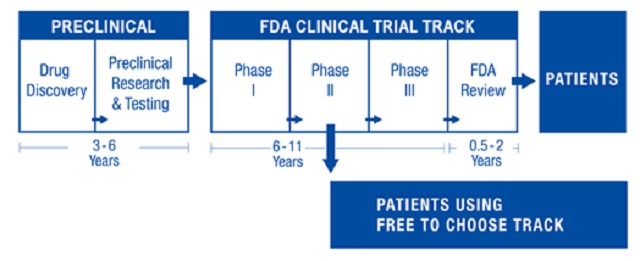
FTCM legislation in the U.S. would create a dual track system (see figure below) that preserves the existing FDA clinical trial process while offering patients an alternative. Patients, advised by their doctors, would be able to contract with a drug developer to use not-yet-approved drugs after Phase I safety trials are successfully completed and one or more Phase II trials have demonstrated continued safety and initial efficacy.

The resulting early access could make FTCM drugs available up to seven years before conventional FDA approval, which entails Phase III randomized control trials and a lengthy FDA review before the FDA makes an approval decision. …

bartgraph

The heart of the dual track system is the Tradeoff Evaluation Drug Database (TEDD) which would be available to the public through a government-supervised web portal. TEDD would contain all treatment results of FTCM drugs including patients’ health characteristics and relevant biomarkers, but no personal identification.

This open access database would be a treasure-trove of information to aid drug developers in making better R&D decisions consistent with fast-paced learning and innovation. …

Today’s world of accelerating medical advancements is ushering in an age of personalized medicine in which patients’ unique genetic makeup and biomarkers will increasingly lead to customized therapies in which samples are inherently small. This calls for a fast-learning, adaptable FTCM environment for generating new data.

In sharp contrast, the status quo FDA environment provides a yes/no approval decision based on statistical tests for an average patient, i.e., a one-size-fits-all drug approval process.

I hold the Bartley J. Madden Chair in Economics at the Mercatus Center, so I am biased, but this is an important proposal. Japan is leading the way and similar ideas are being discussed in Great Britain, but as the most important pharmaceutical market in the world, the United States has an outsize influence on world drug development. We need to lower costs and speed new drugs to market.

This post first appeared at Marginal Revolution.

Alex Tabarrok is a professor of economics at George Mason University. He blogs at Marginal Revolution with Tyler Cowen.

Where Is Speech Most Restricted in America? – Article by George C. Leef

Where Is Speech Most Restricted in America? – Article by George C. Leef

The New Renaissance HatGeorge C. Leef
******************************

Tolerance of speech and thought is being throttled here first

A good argument can be made that free speech is least safe on private college campuses.

At public universities, the First Amendment applies, thus giving students, faculty members, and everyone else protection against official censorship or punishment for saying things that some people don’t want said.

A splendid example of that was brought to a conclusion earlier this year at Valdosta State University, where the school’s president went on a vendetta against a student who criticized his plans for a new parking structure — and was clobbered in court. (I discussed that case here.)

But the First Amendment does not apply to private colleges and universities because they don’t involve governmental action. Oddly, while all colleges that accept federal student aid money must abide by a vast host of regulations, the Supreme Court ruled in Rendell-Baker v. Kohn that acceptance of such money does not bring them under the umbrella of the First Amendment.

At private colleges, the protection for freedom of speech has to be found (at least, in most states) in the implicit contract the school enters into with each incoming student. Ordinarily, the school holds itself out as guaranteeing certain things about itself and life on campus in its handbook and other materials. If school officials act in ways that depart significantly from the reasonable expectations it created, then the college can be held liable.

As the Foundation for Individual Rights in Education (FIRE) puts it, “There is a limit to ‘bait-and-switch’ techniques that promise academic freedom and legal equality but deliver authoritarianism and selective censorship.”

With that legal background in mind, consider a recent case at Colorado College. If Franz Kafka or George Orwell had toyed with a similar plot, they’d probably have rejected it as too far-fetched.

Back in November, a student, Thaddeus Pryor, wrote the following reply to a comment (#blackwomenmatter) on the social media site Yik Yak: “They matter, they’re just not hot.” Another student, offended that someone was not taking things seriously, complained to college officials. After ascertaining that the comment had been written by Pryor, the Dean of Students summoned him to a meeting.

Pryor said that he was just joking. What he did not realize is that there are now many things that must not be joked about on college campuses. Some well-known American comedians have stopped playing on our campuses for exactly that reason, as Clark Conner noted in this Pope Center article.

In a subsequent letter, Pryor was informed by the Senior Associate Dean of Students that his anonymous six word comment violated the school’s policy against Abusive Behavior and Disruption of College Activities.

Did that comment actually abuse anyone? Did it in any way disrupt a college activity?

A reasonable person would say “of course not,” but many college administrators these days are not reasonable. They are social justice apparatchiks, eager to use their power to punish perceived enemies of progress like Thaddeus Pryor.

For having joked in a way that offended the wrong people, Pryor was told that he was suspended from Colorado College until June, 2017. Moreover, he is banned from setting foot on campus during that time. And in the final “pound of flesh” retribution, the school intends to prohibit him from taking any college credits elsewhere.

With FIRE’s able assistance, Pryor is appealing his punishment. Perhaps the college’s attorney will advise the president to back off since its own “Freedom of Expression” policy hardly suggests to students that they will be subject to severe punishment for merely making offensive jokes on a social media site. If the case were to go to trial, there is a strong likelihood that a jury would find Colorado College in breach of contract.

Even if the school retreats from its astounding overreaction to Pryor’s comment, the administration should worry that alums who aren’t happy that their school has fallen under the spell of thought control will stop supporting it.

This incident is emblematic of a widespread problem in American higher education today: administrators think it’s their job to police what is said on campus, even comments on a social media app. Many colleges and universities have vague speech codes and “harassment” policies that invite abuse; those positions tend to attract mandarins who are not scholars and do not value free speech and unfettered debate. They are committed to “progressive” causes and will gladly use their power to silence or punish anyone who doesn’t go along.

American colleges have been suffering through a spate of ugly protests this fall. Among the demands the protesters usually make is that the school mandate “diversity training” for faculty and staff. Instead of that, what most schools really need is tolerance training, with a special emphasis on the importance of free speech. Those who don’t “get it” should be advised to find other employment.

George Leef is the former book review editor of The Freeman. He is director of research at the John W. Pope Center for Higher Education Policy.

This article was published by The Foundation for Economic Education and may be freely distributed, subject to a Creative Commons Attribution 4.0 International License, which requires that credit be given to the author.