Browsed by
Tag: life extension

“Death is Wrong” Reviewed by Zoltan Istvan in “Psychology Today” – Post by G. Stolyarov II

“Death is Wrong” Reviewed by Zoltan Istvan in “Psychology Today” – Post by G. Stolyarov II

The New Renaissance Hat
G. Stolyarov II
December 17, 2013
******************************

I am pleased to announce some excellent news regarding a development that will hopefully accelerate the spread of life-extension ideas to children and to the general public. Zoltan Istvan’s article on my new children’s book Death is Wrong and his interview with me and my wife Wendy Stolyarov was just published on Psychology Today. You can read it here. Psychology Today is a high-traffic site with a high potential for influencing public outlooks on life, death, and life extension.  I welcome your comments both at the bottom of this post and on the Psychology Today page.

Short Review of New Children’s Book, “Death is Wrong” – Article by B. J. Murphy

Short Review of New Children’s Book, “Death is Wrong” – Article by B. J. Murphy

The New Renaissance Hat
B. J. Murphy
December 14, 2013
******************************

The qualm of death is a very uneasy burden we all suffer from. We dedicate hours of our time, spent in colloquy, discussing the myriad risks of life, though subsequently the tender rage to resist to ensure that life lives on. But then, when do we spend our time in preparing our children – the next generation – for what is to come, what is to discuss, and what is to fight for?

I believe this wonderful children’s book, provided by the Stolyarovs, is a very grand step forward in achieving this. Not too grammatically complex, and not too excruciatingly simplistic, Death is Wrong is a blunt dose of reality, quick to the punch and holding nothing back. This is the book I wish I’d have read as a young child.

As science matures and technology continues growing at an exponential pace, especially in the medical sector, the words written here in this book will not only live on forever via the vast archives of historical literature, they will live on forever through the lives of the indefinitely extended – the cyborgs, the transhumans, the posthumans, etc.

While certainly not religious myself, I believe this loosely correlated – albeit relevant – quote from the Judeo-Christian bible will suffice as final remarks in tribute of this book’s noble message to you, the reader:

“The last enemy that shall be destroyed is death.” – 1 Corinthians 15:26

B. J. Murphy publishes The Proactionary Transhumanist blog, where this review originally appeared. 

Death is Wrong - by Gennady Stolyarov II, Illustrated by Wendy Stolyarov

Death is Wrong – by Gennady Stolyarov II, Illustrated by Wendy Stolyarov

Purchase

Kindle Format | Paperback Format (Amazon, CreateSpace)

MILE Activist Contest Entry: Distribution of “Death is Wrong” – by G. Stolyarov II

MILE Activist Contest Entry: Distribution of “Death is Wrong” – by G. Stolyarov II

The New Renaissance Hat
G. Stolyarov II
December 7, 2013
******************************

This is my entry into the Movement for Indefinite Life Extension (MILE) Activist Contest, regarding how one would spend a hypothetical $5,000 to “inform as many people as possible about the desirability and the prospects for indefinite life extension”.

Death is Wrong (currently available on Amazon and Createspace) is my ambitious new book for children and for life-extension advocates of all ages, concisely introducing the major reasons for the feasibility and desirability of indefinite life extension.

Death is Wrong - by Gennady Stolyarov II, Illustrated by Wendy Stolyarov

Death is Wrong – by Gennady Stolyarov II, Illustrated by Wendy Stolyarov

My proposal for the MILE Activist Contest entails spending $5,000 to distribute Death is Wrong to as broad an audience as possible.

As the author, I am able to obtain paperback copies of Death is Wrong at a highly discounted price of $3.79 per copy. 1,000 copies could be obtained at a cost of $3,790. The remaining $1,210 would be set aside to pay shipping costs as needed. The plan for distribution would involve coordinating with other life-extension activists in the United States to bring Death is Wrong to their local areas. For instance, if a life-extension activist desires 25 copies of Death is Wrong to distribute to schools, libraries, or local gatherings, I could ship these copies to the activist, who would be able to identify the most effective local distribution channels and the most receptive audiences. Activists could use the donated copies to conduct public readings, including events that draw an audience of children.

As part of this distribution plan, I would be able to provide a similar arrangement for schools, libraries, and other organizations, particularly those which interact significantly with children. Death is Wrong is written at a level readily comprehensible for children ages 8 and older, though ambitious children of younger ages would be an ideal audience as well. In facilitating the distribution of Death is Wrong, I would encourage life-extension activists to invest in quality. Even a single bright child who shows ample curiosity, interest in, and support for dramatic enhancements in human longevity could become a leading contributor to the Movement for Indefinite Life Extension. Cultivating such a passion extremely early in life could provide the MILE with just the kind of support it needs – a set of energetic, intelligent, talented, and idealistic young people who are equipped and eager to transform the world for the better.

Success would be tracked through steady correspondence with activists and other recipients of donated books, to receive updates as to how many books were distributed and through which venues. The greatest mark of success, though, would be observing new people – both children and adults – entering the life-extension movement as a result of Death is Wrong. Through Amazon book reviews, online searches, and monitoring of life-extension social-networking groups and publications, as well as correspondence addressed to me and other longevity activists, it would be possible to gain an appreciation for how many hearts and minds have been won by this effort.

Death is Wrong – Children’s Book on Life Extension – Written by G. Stolyarov II, Illustrated by Wendy Stolyarov

Death is Wrong – Children’s Book on Life Extension – Written by G. Stolyarov II, Illustrated by Wendy Stolyarov

Death is Wrong - by Gennady Stolyarov II, Illustrated by Wendy Stolyarov

Death is Wrong – by Gennady Stolyarov II, Illustrated by Wendy Stolyarov

Click on the cover for a high-resolution image that you can download, save, and distribute.

If you have ever asked, “Why do people have to die?” then this book is for you. The answer is that no, death is not necessary, inevitable, or good. In fact, death is wrong. Death is the enemy of us all, to be fought with medicine, science, and technology. This book introduces you to the greatest, most challenging, most revolutionary movement to radically extend human lifespans so that you might not have to die at all.

You will learn about some amazingly long-lived plants and animals, recent scientific discoveries that point the way toward lengthening lifespans in humans, and simple, powerful arguments that can overcome the common excuses for death. If you have ever thought that death is unjust and should be defeated, you are not alone. Read this book, and become part of the most important quest in human history.

This book was written by the philosopher and futurist Gennady Stolyarov II and illustrated by the artist Wendy Stolyarov. It is here to show you that, no matter who you are and what you can do, there is always a way for you to help in humanity’s struggle against death.

Death is Wrong is the ambitious new book for children and for life-extension advocates of all ages.

You can purchase Death is Wrong in the following formats and locations:

Paperback Edition: Amazon – $9.48

Paperback Edition: Createspace – $9.48

Kindle Edition: Amazon – $0.99

The First Edition of Death is Wrong was published by the Rational Argumentator Press in conjunction with Ria University Press.

The Rational Argumentator welcomes your reviews of Death is Wrong. You can submit them to TRA by sending them to gennadystolyarovii@yahoo.com. You are also encouraged to review the book on Amazon and spread the word by reprinting the information on this page or your own comments concerning the book on other media outlets.

Non-commercial distribution of Death is Wrong is welcomed – including lending, public readings, and dissemination to libraries and schools. For commercial distribution options, please contact Mr. Stolyarov at gennadystolyarovii@yahoo.com. Because of Mr. Stolyarov’s desire to maximize the spread of this book, non-exclusivity is a key criterion for any commercial distribution rights.

Life Expectancy is Growing at the Upper End, Too – Video by G. Stolyarov II

Life Expectancy is Growing at the Upper End, Too – Video by G. Stolyarov II

Mr. Stolyarov provides evidence that increasing life expectancy is occurring for the oldest individuals, and that rises in average longevity are not just due to reductions in mortality among infants and young adults.

References
– “Life Expectancy is Growing at the Upper End, Too” – Post by G. Stolyarov II
– “Centenarians are the fastest-growing age segment: Number of 100-year-olds to hit 6 million by 2050” – New York Daily News and The Associated Press – July 21, 2009
– “Living to 100: 80% are women, report shows” – USA Today – December 10, 2012
– “Number of centenarians hits new high in Japan” – Medical Xpress – September 13, 2011
– “Jeanne Calment” – Wikipedia
– “Jiroemon Kimura” – Wikipedia

SENS or Cryonics?: My Answer to a Hypothetical Choice – Video by G. Stolyarov II

SENS or Cryonics?: My Answer to a Hypothetical Choice – Video by G. Stolyarov II

If Mr. Stolyarov had $1 billion to donate to life extension, would he donate it to SENS (Strategies for Engineered Negligible Senescence) or cryonics? Find out his answer.

References:
– “How Can I Live Forever?: What Does and Does Not Preserve the Self” – Essay by G. Stolyarov II
– “How Can I Live Forever?: What Does and Does Not Preserve the Self” – Video by G. Stolyarov II
– SENS Research Foundation Website
– “Kim Suozzi Cryogenically Preserved After Battle With Brain Cancer” – Huffington Post – January 22, 2013

The Boon to Longevity Progress Will Be Increased Activism, Advocacy, and Lobbying – Article by Franco Cortese

The Boon to Longevity Progress Will Be Increased Activism, Advocacy, and Lobbying – Article by Franco Cortese

The New Renaissance Hat
Franco Cortese
November 17, 2013
******************************
When asked what the biggest bottleneck for progress in life extension is, most thinkers and researchers say funding. Others say the biggest bottleneck is breakthroughs, while still others say it’s our way of approaching the problem (i.e., seeking healthy life extension, a.k.a. “aging gracefully”, instead of more comprehensive methods of radical life extension). But the majority seem to feel that the largest determining factor impacting how long it takes to achieve indefinite lifespans is adequate funding to plug away at developing and experimentally verifying the various alternative technologies and methodologies that have already been proposed (e.g. Robert Freitas’s Nanomedicine [1], Aubrey de Grey’s Strategies for Engineered Negligible Senescence [2, 3, 4], Michael R. Rose’s Evolutionary Longevity [5, 6]). I claim that Radical Longevity’s biggest bottleneck is not funding, but advocacy, activism and lobbying.
***

This is because the final objective of increased funding for Radical Longevity and Life Extension research can be more effectively and efficiently achieved through public advocacy for Radical Life Extension than it can by direct funding or direct research, per unit of time or effort. Research and development obviously still need to be done, but an increase in researchers needs an increase in funding, and an increase in funding needs an increase in the public perception of indefinite longevity’s feasibility and desirability.

There is no definitive timespan that it will take to achieve radically extended life. How long it takes to achieve Radical Longevity is determined by how hard we work at it and how much effort we put into it. More effort means that it will be achieved sooner. And by and large, an increase in effort can be best achieved by an increase in funding, and an increase in funding can be best achieved by an increase in public advocacy. You will likely accelerate the development of Radically Extended Life, per unit of time or effort, by advocating the desirability, ethicality, and technical feasibility of longer life than you will by doing direct research, or by working towards the objective of directly contributing funds to life-extension projects and research initiatives.

In order to get funding we need to demonstrate with explicit clarity just how much we want it, and that we can do so while minimizing potentially negative societal repercussions like overpopulation. We must do our best to vehemently invalidate the clichés that promulgate the sentiment that life extension is dangerous or unethical. It needn’t be either, and nor is it necessarily likely to be either.

Some think that spending one’s time deliberating the potential issues that could result from greatly increased lifespans and the ways in which we could mitigate or negate them won’t make a difference until greatly increased lifespans are actually achieved. I disagree. While any potentially negative repercussions of life extension (like overpopulation) aren’t going to happen until life extension is achieved, offering solution paradigms and ways in which we could negate or mitigate such negative repercussions decreases the time we have to wait for it by increasing the degree with which the wider public feels it to be desirable, and that it can very well be done safely and ethically. Those who are against radical life extension are against it either because they think it is infeasible (in which case being “against” it may be too strong a descriptor) or because they have qualms relating to its ethicality or its safety. More people openly advocating against it means a higher public perception of its undesirability. Whether indefinite longevity is eventually achieved via private industry or via government-subsidized research initiatives, we need to create the public perception that it is widely desired before either government or industry will take notice.

The sentiment that the best thing we can do is simply live healthily and wait until progress is made seems to be fairly common as well. People have the feeling that researchers are working on it, that it will happen if it can happen, and that waiting until progress is made is the best course to take. Such lethargy will not help Radical Longevity in any way. How long we have to wait for indefinite lifespans is a function of how much effort we put into it. And in this article I argue that how much funding and attention life extension receives is by and large a function of how widespread the public perception of its feasibility and desirability is.

This isn’t simply about our individual desires to live longer. It might be easier to hold the sentiment that we should just wait it out until it happens if we only consider its impact on the scale of our own individual lives. Such a sentiment may also be aided by the view that greatly longer lives would be a mere advantage, nice but unnecessary. I don’t think this is the case. I argue that the technological eradication of involuntary death is a moral imperative if there ever was one. If how long we have to wait until radical longevity is achieved depends on how vehemently we demand it and on how hard we work to create the public perception that longer life is widely longed-for, then to what extent are  100,000 lives lost potentially needlessly every day while we wait on our hands? One million people will die wasteful and involuntary deaths in the next 10 days. 36.5 million people will die this year from age-correlated causes of functional decline. This puts the charges of inethicality in a ghostly new light. If advocating the desirability, feasibility, and blatant ethicality of life extension can hasten its implementation by even a mere 10 days, then one million lives that would have otherwise been lost will have been saved by the efforts of life-extension advocates, researchers, and fiscal supporters. Seen in this way, working toward radical longevity may very well be the most ethical and selfless way you could spend your time, in terms of the number of lives saved and/or the amount of suffering prevented.

One of the most common and easy-to-raise concerns I come across in response to any effort to minimize the suffering of future beings is that there are enough problems to worry about right now. “Shouldn’t we be worrying about lessening starvation in underdeveloped countries first? They’re starving right now. Shouldn’t we be focusing on the problems of today, on things that we can have a direct impact on?” Indeed. 100,000 people will die, potentially needlessly, tomorrow. The massive number of people that suffer involuntary death is a problem of today! Indeed, it may very well be the most pressing problem of today! What other source of contemporary suffering claims so many lives, and occurs on such a massive scale? What other “problem of today” is responsible for the needless and irreversible involuntary death of one hundred thousand lives per day? Certainly not starvation, or war, or cancer, all of which in themselves represent smaller sources of involuntary death. Longevity advocates do what they do for the same reason that people who try to mitigate starvation, war, and cancer do what they do, namely to lessen the amount of involuntary death that occurs.

This is a contemporary problem that we can have a direct impact on. People intuitively assume that we won’t achieve radically extended life until far in the future. This makes them conflate any lives saved by radically extended lifespans with lives yet to come into existence. This makes them see involuntary death as a problem of the future, rather than a problem of today. But more people than I’ve ever known will die tomorrow, from causes that are physically possible to obviate and ameliorate – indeed, from causes that we have potential and conceptual solutions for today.

I have attempted to show in this article that advocating life-extension should be considered as “working toward it” to as great an extent as directly funding it or performing direct research on it is considered as “working toward it”. Advocacy has greater potential to increase life extension’s widespread desirability than direct work or funding does, and increasing both its desirability and the public perception if its desirability has more potential to generate increased funding and research-attention for life-extension than direct funding or research does. Advocacy thus has the potential to contribute to the arrival of life extension and hasten its implementation just as much, if not more so (as I have attempted to argue in this article), than practical research or direct funding does. This should motivate people to help create the momentous momentum we need to really get the ball rolling. To be a longevity advocate is to be a longevity worker! Involuntary death from age-associated, physically-remediable causes is the largest source of death, destruction and suffering today.  Don’t you want to help prevent the most widespread source of death and of suffering in existence today? Don’t you want to help mitigate the most pressing moral concern not only of today, but of the entirety of human history – namely physically remediable involuntary death?

Then advocate the technological eradication of involuntary death. Advocate the technical feasibility, extreme desirability, and blatant ethicality of radically extending life. Death is a cataclysm. We need not sanctify the seemingly inevitable any longer. We need not tell ourselves that death is somehow a good thing, or something we can do nothing about, in order to live with the “fact” of it any longer. Soon it won’t be a fact of life. Soon it will be an artifact of history. Life may not be ipso facto valuable according to all philosophies of value – but life is a necessary precondition for any sort of value whatsoever. Death is dumb, dummy! An incontrovertible waste convertible into nothing! A negative-sum blight! So if you want to contribute to the solution of problems of today, if you want to help your fellow man today, then stand proud and shout loud “Doom to Arbitrary Duty and Death to  Arbitrary Death!” at every crowd cowed by the seeming necessity of death.

***

Franco Cortese is a futurist, author, editor, Affiliate Scholar at the Institute for Ethics & Emerging Technologies, Ambassador at The Seasteading Institute, Affiliate Researcher at ELPIs Foundation for Indefinite Lifespans, Fellow at Brighter Brains Institute, Advisor at the Lifeboat Foundation (Futurists Board Member and Life Extension Scientific Advisory Board Member), Director of the Canadian Longevity Alliance, Activist at the International Longevity Alliance, Canadian Ambassador at Longevity Intelligence Communications, an Administrator at MILE (Movement for Indefinite Life Extension), Columnist at LongeCity, Columnist at H+ Magazine, Executive Director of the Center for Transhumanity, Contributor to the Journal of Geoethical Nanotechnology, India Future Society, Serious Wonder, Immortal Life and The Rational Argumentator. Franco edited Longevitize!: Essays on the Science, Philosophy & Politics of Longevity, a compendium of 150+ essays from over 40 contributing authors.
***
References:
***
[1]. de Grey AD, Ames BN, Andersen JK, Bartke A, Campisi J, HewardCB, McCarter RJ, Stock G (2002). “Time to Talk SENS: Critiquing the Immutability of Human Aging”. Annals of the New York Academy of Sciences 959: 452–62. PMID 11976218.
***

[2]. de Grey, Aubrey (2003). The Mitochondrial Free Radical Theory of Aging. Austin, Texas: Landes Bioscience. ISBN 1-58706-155-4.

[3]. de Grey, Aubrey and Rae, Michael (2007). Ending Aging: The Rejuvenation Breakthroughs that Could Reverse Human Aging in Our Lifetime. St. Martin’s Press.

[4]. Laurence D. Mueller, Casandra L. Rauser and Michael R. Rose (2011). Does Aging Stop? Oxford University Press.

[5]. Garland, T., Jr., and M. R. Rose, eds. (2009). Experimental Evolution: Concepts, Methods, and Applications of Selection Experiments. University of California Press.

Longevity Logistics: We Can Manage the Effects of Overpopulation – Article by Franco Cortese

Longevity Logistics: We Can Manage the Effects of Overpopulation – Article by Franco Cortese

The New Renaissance Hat
Franco Cortese
November 5, 2013
******************************

This is a more popularly-oriented version of a scholarly article in review for the Journal of Evolution and Technology.

By far the most predominant criticism made against indefinite longevity is overpopulation. It is the first “potential problem” that comes to mind. But fortunately it seems that halting the global mortality rate would not cause an immediate drastic increase in global population; in fact, if the mortality rate dropped to zero tomorrow then the doubling rate for the global population would only be increased by a factor of 1.75 [1], which is smaller than the population growth rate during the post-WWII baby-boom.

Population is significantly more determined by birth rate than by death rate, simply because many people have more than one natural child.

This means that we should not see an unsustainable rise in population following even the complete cessation of death globally for a number of generations. We will run into problems 3 or 4 generations hence – but this leaves us with time enough to plan for overpopulation before we’re forced to resort to more drastic solution-paradigms like procreation-bans and space colonization.

Moreover, there are a number of proposed, and in some cases implemented, solutions to existing, contemporary problems that can be utilized for the purpose of minimizing overpopulation’s detrimental effects on living space and non-renewable resource constraints. These contemporary concerns include climate change and dependence on non-renewable energy sources, and they are only increasing in the amount of public attention they are attracting.

While these concerns and their potential solutions were not created by overpopulation or with overpopulation in mind, the potentially negative effects of an increasing global population can be effectively combated all the same using such contemporary methods and technologies.

Thus we can take advantage of the solution-paradigms developed for such contemporary concerns as climate change and dependence on non-renewable resources, and borrow from such movements as the sustainability movement and the seasteading movement, so as to better mitigate and effectively plan for the negative repercussions of a growing global population caused by the emergence of effective longevity technologies.

In a session with The President’s Council on Bioethics (as it was composed during the Bush Administration), S. Jay Olshansky [2] reported calculations he performed indicating that complete cessation of the global morality rate today would lead to less population growth than resulted from the post-WWII “Baby Boom”:

This is an estimate of the birth rate and the death rate in the year 1000, birth rate roughly 70, death rate about 69.5. Remember when there’s a growth rate of 1 percent, very much like your money, a growth rate of 1 percent leads to a doubling time at about 69 to 70 years. It’s the same thing with humans. With a 1 percent growth rate, the population doubles in about 69 years. If you have the growth rate — if you double the growth rate, you have the time it takes for the population to double, so it’s nothing more than the difference between the birth rate and the death rate to generate the growth rate. And here you can see in 1900, the growth rate was about 2 percent, which meant the doubling time was about five years. During the 1950s at the height of the baby boom, the growth rate was about 3 percent, which means the doubling time was about 26 years. In the year 2000, we have birth rates of about 15 per thousand, deaths of about 10 per thousand, low mortality populations, which means the growth rate is about one half of 1 percent, which means it would take about 140 years for the population to double.

Well, if we achieved immortality today, in other words, if the death rate went down to zero, then the growth rate would be defined by the birth rate. The birth rate would be about 15 per thousand, which means the doubling time would be 53 years, and more realistically, if we achieved immortality, we might anticipate a reduction in the birth rate to roughly ten per thousand, in which case the doubling time would be about 80 years. The bottom line is, is that if we achieved immortality today, the growth rate of the population would be less than what we observed during the post-World War II baby boom.

We would eventually run into problems, of course, a century down the road, but just so you know the growth rates would not be nearly what they were in the post-World War II era, even with immortality today.

In other words we will only have increased the doubling-time of the global population by a factor of 1.75 if we achieved indefinite longevity today (e.g., a doubling time of 140 years in 2000 compared to a doubling time of 80 years). This means that we will have two to four generations worth of time to consider possible solutions to growing population before we are faced with the “hard choice” of (1) finding new space and resources or else (2) limiting or regulating the global birthrate.

An alternate study on the demographic consequences of life extension concluded that “population changes are surprisingly slow in their response to a dramatic life extension”. The study applied “the cohort-component method of population projections to 2005 Swedish population for several scenarios of life extension and a fertility schedule observed in 2005,” concluding that “even for a very long 100-year projection horizon, with the most radical life extension scenario (assuming no aging at all after age 60), the total population increases by 22% only (from 9.1 to 11.0 million)” and that “even in the case of the most radical life extension scenario, population growth could be relatively slow and may not necessarily lead to overpopulation.” [2]. The total population increase due to the complete negation of mortality given by this study is significantly lower than the figure calculated by Olshansky.

Finding innovative solutions to new and old problems is what humanity does. We have a variety of possible viable options to increase the resources and living space available to humanity already. Moreover, there are several other contemporary concerns that are invoking the development of technological and methodological solutions that can be applied to our own concerns regarding the effects of overpopulation. Surely we can conceive of optimal solutions to these problems (and the more pressing a given problem is, the more funding it receives and the faster the solution to it is accomplished) – and take advantage of the growing methodological and technical infrastructure being developed for related and convergent problems – within the time it will take to feel overpopulation’s effect on living space and resources.

We could, for instance, colonize the oceans [3, 4, 5], drawing from the engineering, construction techniques used to build, maintain, and safely inhabit contemporary VLFSs (Very Large Floating Structures). 75% of the Earth’s surface area is, after all, water. This would increase our potential living space 3-fold – and I say “potential” because we surely don’t currently maximize living space on the 25% of the Earth’s surface occupied by land. Furthermore, humanity has as yet barely ventured beyond the surface of the earth – which is a sphere after all. There is nothing to prevent society building higher and building deeper. Indeed, with contemporary and projected advances in materials science and structural engineering, there is no theoretical limit to the height of structures we can safely build – the space elevator being a case in point. And while there will indeed be a maximum size wherein building higher becomes economically prohibitive (a limit determined to a large extent by the materials used), contemporary megastructures [6] indicate that very large structures can be built safety and cost-effectively. Underground living [7, 8, 9, 10] is another potential solution-paradigm as well; underground structures require less energy, are protected from weathering effects and changing temperatures to a much greater extent than structures exposed to the elements, and are less susceptible to damage from natural disasters. Furthermore, there are a number of underground cities in existence today [11], with existing techniques and technologies used to better facilitate contemporary underground living, which we can take advantage of.

In fact, the problem of limited living space is a contemporary problem for certain nations like Japan, and active projects to combat this growing problem have already been undertaken in many cases. This means that there will be an existing host of solutions, with their own technological and methodological infrastructures, which we can benefit from and take advantage of when the problematizing effects of growing global population become immediate. Not only can we take advantage of the existing engineering methodologies developed for use in the construction of VLFSs, but we can also take advantage of the growing body of knowledge pertaining to megastructural engineering and even existing proposals for floating cities [12, 13, 14, 15, 17, 18]. Another possible solution is artificial islands [19].

Furthermore, in recent years the topic of Very Large Floating Structures [21, 22] has experienced a surge of renewed interest occurring in tandem with the increasing interest in seasteading [23, 24], – that is, the creation of very-large-floating-structures for reasons of political sovereignty as well as to allow corporations to get around the laws of a given nation by occupying an area outside of exclusive economic zones. This renewed interest can only increase the amount of attention and funding these concepts receive, in turn increasing the viability of VLFS designs and their underlying structural-engineering and energy-production concerns.

Another contemporary movement that will prove advantageous for our own concerns with the effects of overpopulation on living space, working space, and resource space is the growing green movement and sustainability movement. The problem of resource scarcity is already upon us in many areas, and there exists contemporary motivation for finding more resource-efficient ways of making energy and producing goods, and for lessening our dependency on non-renewable energy sources. Climate change has only become an increasingly predominant concern in international politics, and many incentives exist to lessen our dependence on non-renewable energy sources as well as to lessen the environmental impact of contemporary civilization, which is itself another oft-touted problematic concern possibly resulting from overpopulation. Developments in these areas are only set to continue, for reasons wholly unrelated to the effects of overpopulation, and when those effects come to the fore we will have a collection of existing methodologies that can then be harnessed to lessen the impact of overpopulation on living space and resource scarcity.

The predominance of these problems, as well as the amount of attention and funding they are expected to receive (and thus the viability of their potential solutions), will only increase as we move forward into the future. The solutions we have to the potential problems of overpopulation – namely resource scarcity and lack of living space – will not only increase as the effects of overpopulation get closer, but the technological and methodological infrastructures underlying those solutions will also become more tried, tested, and robust, fueled by contemporary concerns over decreasing living space, climate-change and resource scarcity.

While space colonization is the most frequently proffered technological solution to the possibility of future overpopulation, I think we will turn to various Earth-bound solutions to increasing humanity’s available living space, as well as the space available for agricultural labs, that is the manufacture of food-stuffs, or indoor farming systems [25, 26, 28], before colonizing the cosmos becomes an economically optimal option. I think these sorts of solutions will be employed long before humanity is forced to either regulate the birthrate or move into the cosmos.

Moreover, people who wish to have children will have incentive to support politicians running on policies promoting new solutions to decreasing living space. Consider the number of U.S. taxpayer dollars spent during the Space Race, with no immediate material or scientific benefit (other than to prove it could be done, as well as to maintain rough militaristic equality with the USSR to some extent, as the state of rocket technology was indicative of the state of ballistic technologies like missiles). If humanity is forced to choose between having children and receiving the medical treatments that will keep them from dying, surely people will be motivated to fund initiatives and projects aimed at solving the problems of decreasing living space and increasing resource constraints due to a growing global population.

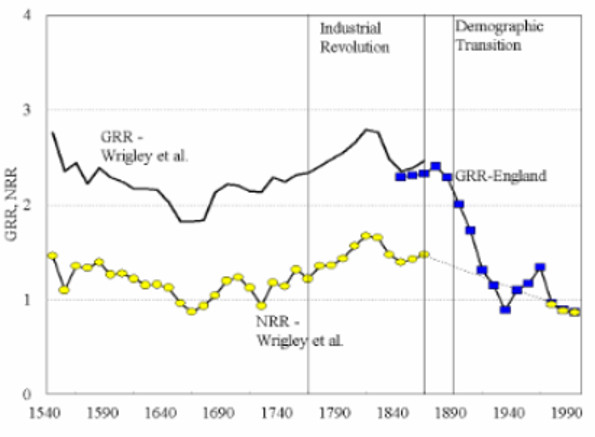
It is important to remember that the largest increase in life expectancy we have experienced historically was followed by a drastic decrease in birthrate over the next few generations thereafter. Before the Industrial Revolution, English women had on average 6 children. In 2000 the average was less than 2.

Figure 1: Fertility Rates in England, 1540-2000

Note: GRR = Gross Reproduction Rate, NRR = Net Reproduction Rate
Source: Wrigley et al. (1997) p. 614. Office of National Statistics, United Kingdom.

The drop in birthrate following the industrial revolution has several causes. Chief among them is the fact that children were considered to some extent as assets, helping with maintaining the family livelihood, often by doing agricultural work on a family farm or helping with household chores (which were much more extensive then). Another large determining factor is a high rate of child mortality; thus families would have multiple children in anticipation of losing some to death. But with a rise in living conditions, the child mortality rate dropped drastically – and as a result we stopped having more kids in anticipation of some of them dying. Moreover, we started treating children less as assets and more as people to nurture and raise for their own sake. Longer lives, and less susceptibility to death in general, appears to have made us better parents.

Thus it is not only possible but probable that we will see a similar drop in the birthrate as a consequence of a significant future increase in average lifespan, with people having children much later in life, when they are more financially stable and when they have done all the commitment-free things they’ve always wanted to do. Without a looming limit on one’s available reproductive lifespan, there will be no pressing motivation to have children “before it’s too late” – and this alone could very well facilitate an unprecedented decrease in the Total Fertility Rate (TFR) of the global population.

Evidence indicates that the drop in birth rate was neither limited to England, nor an isolated result of the Industrial Revolution. A net drop in the TFR seems to be a longer-term trend concurrent across the globe. It is likely that the drop in the TFR is due to the same factors as the drop in birth rate following the Industrial Revolution – increasing life expectancy and continually improving living conditions allow people to have children without expecting a portion of them to be lost to death, to have them for the sake of having children rather than as assets to aid in maintaining the family livelihood, and to have children later in life due to the increase in one’s reproductive lifespan that comes with increasing life expectancy. The fact that the drop in TFR is not an isolated historical event is advantageous because the global population is affected by birth rate much more than by the mortality rate. Hence we may see a continuing decrease in the TFR occur in tandem with increasing life expectancy, leveling out the imbalance created by a mortality rate of zero by a larger than has been heretofore anticipated. (Source: U.S. Central Intelligence Agency, World Factbook.)

Let us suppose, for a moment, the worst: that indefinite longevity is achieved and we completely ignore (i.e., fail to plan for) overpopulation until its effects start becoming readily apparent. Even in this seeming worst-case scenario, overpopulation is not likely to result in any great tragedies. In such a case we would be forced to limit the global birthrate until we are able to implement the solutions that would allow us to sustainably procreate again. If people have a strong enough desire to continue having children, then they will express their demand and politicians will consequently base their policies upon deliberative initiatives to increase available living and agricultural space – and get elected if the desire to freely procreate is strong and widespread enough. Failing to plan for overpopulation will simply be a wake-up call, letting us know that we should have been planning for its effects from the beginning, and that we had better start planning for them now if we want to continue to freely procreate.

Thus while overpopulation is the most prominent and most credible criticism against continually increasing lifespans, and the one that needs to be planned for the most (because it will eventually happen, but it will lead to sustainability, resource, and living-space problems only if we do nothing about it), it is in no way insoluble, nor particularly pressing in terms of the time available to plan and implement solutions to shrinking living space and resource space (i.e., the space occupied by resources such as food, energy production, workplaces, etc.). We have a host of potential solutions today, ones we can use to increase available living space without regulating the global birthrate, and decades following the achievement of indefinite lifespans to consider the advantages and disadvantages of the various possible solutions, to develop them and to implement them.

So then: where to from here? Overpopulation is still the most prominent criticism raised against indefinite longevity, and if combated, the result could be an increase in public support for the Longevity movement. You might think that the widespread concern with overpopulation due to increasing longevity won’t really matter, if they turn out to be wrong, and overpopulation isn’t so insoluble a problem as one is inclined to first presume. But this misses a crucial point: that the time it takes to achieve longevity is determined by and large by how strongly and in how widespread a manner society and the members constituting it desire and demand it. If we can convince people today that overpopulation isn’t an insoluble problem, then continually increasing longevity might happen much sooner than otherwise. At the cost of 100,000 deaths due to age-correlated causes per day, I think hastening the arrival of indefinite longevity therapies by even a modest amount is somewhat imperative. Hastening its arrival by one month will save 3 million lives, and achieving it one year sooner than otherwise will save an astounding 36.5 Million real, human lives.

Thus, we should work toward putting more concrete numbers to these estimates. How much more living space can be feasibly created by colonizing the oceans? How deep can we really dig, build and live? How high can we safely build? Is there a threshold height or depth where building higher or deeper becomes too economically prohibitive to be worth the added living, working or resource space? What are the parameters (e.g., material strength/cost ratio, specific structural design) determining such a threshold?

First, we need to collect and analyze the feasibility studies that have already been undertaken on floating cities, artificial islands, VLFSs and the new solution-paradigms that are emerging to combat the contemporary concerns of sustainability and resource scarcity. In short, we need to compile data from the feasibility studies that have already been done, and the projects already implemented. Then we need to plan and commission further feasibility studies, undertaken by engineers and geologists, to build upon the work already accomplished in feasibility studies pertaining to existing designs for floating cities and other Very Large Floating Structures. We need to put some numbers to the cost the additional space for food, resources, work and living necessitated by widely available life-extension therapies. We need to do some hard calculations to show that the effects of overpopulation are problems that can be solved using existing megascale engineering and construction techniques and materials, safely and economically. We need to show the world that it has more space than it ever thought it had, and that such solution-paradigms as cosmic colonization and procreative regulation are neither the only ones, nor necessarily the most optimal ones. We need, in short, to show them that, in this case, where there’s a will there’s a way, and that the weight of waiting is too high a price to pay.

Franco Cortese is a futurist, author, editor, Affiliate Scholar at the Institute for Ethics & Emerging Technologies, Ambassador at The Seasteading Institute, Affiliate Researcher at ELPIs Foundation for Indefinite Lifespans, Fellow at Brighter Brains Institute, Advisor at the Lifeboat Foundation (Futurists Board Member and Life Extension Scientific Advisory Board Member), Director of the Canadian Longevity Alliance, Activist at the International Longevity Alliance, Canadian Ambassador at Longevity Intelligence Communications, an Administrator at MILE (Movement for Indefinite Life Extension), Columnist at LongeCity, Columnist at H+ Magazine, Executive Director of the Center for Transhumanity, Contributor to the Journal of Geoethical Nanotechnology, India Future Society, Serious Wonder, Immortal Life and The Rational Argumentator. Franco edited Longevitize!: Essays on the Science, Philosophy & Politics of Longevity, a compendium of 150+ essays from over 40 contributing authors.

References:

  1. Presidents Council for Bioethics: Transcripts (December 12, 2002): Session 2: Duration of Life: Is There a Biological Warranty Period? 01.
  2. L. A. Gavrilov and N.S. Gavrilova. “Demographic Consequences of Defeating Aging”. Rejuvenation Research. 2010 April; 13(2-3): 329–334.
  3. Ibid.
  4. McCullagh, Declan. “Seasteaders” Take First Step Toward Colonizing The Oceans.” CBS News, October 9, 2009. 02
  5. Pasternack, Alex. “Bioengineer aspires to colonize the sea.” CNN, January 12, 2011. 03
  6. Banham, Reyner. Megastructure: urban futures of the recent past. London: Thames and Hudson, 1976.
  7. Tsuchiyama, Ray. “Ocean Colonies as Next Frontier.” Forbes, April 24, 2011. Accessed August 1, 2013. 04
  8. “Inside Underground Cities.” Before Its News. 2013 March. 05
  9. South, D. B., and Freda Parker. “Underground Homes – Good or Bad?” Monolithic, January 22, 2009. 06.
  10. Good Earth Plants & Greenscaped Buildings. “Underground Living.” Last modified May 6, 2013. 07.
  11. Kelly, J. “10 Amazing Underground Cities”. Listverse.com. January 22, 2013. Accessed August 1, 2013. 08
  12. Gammon, Katharine. “Building Artificial Islands That Rise With Sea.” PopSci, June 8, 2012. 09
  13. Cottrell, Claire. “A Survey of Futuristic Floating Cities.” FlavorWire, November 2, 2012. 10
  14. “Cities on the Ocean.” Technology Quarterly – The Economist. Q4 2011.
  15. Bonsor, Kevin. “How the Floating Cities Will Work.” HowStuffWorks. n.d. 11.
  16. DigInfo TV. “GREEN FLOAT – a Floating City in the Sky.” Accessed August 6, 2013. 12.
  17. National Geographic. “Pictures: Floating Cities of the Future.” Accessed August 6, 2013. 13.
  18. Emerging Technology News. “Self-Sufficient Floating Cities Planned for 2025: Japan.” Accessed August 6, 2013. 14.
  19. “An artificial island in Hambantota.” News.LK, August 2, 2013. 15
  20. Goodier, Rob. “The World’s 18 Strangest Man Made Islands.” Popular Mechanics, n.d. 16
  21. E. Watanabe, C.M. Wang, T. Utsunomiya and T. Moan. “Very Large Floating Structures: Applications, Analysis and Design”. CORE Report No. 2004-02. Centre for Offshore Research and Engineering National University of Singapore. 17
  22. C.M. Wang, and Z. Tay. Very Large Floating Structures: Applications, Research and Development. In The Proceedings of the Twelfth East Asia-Pacific Conference on Structural Engineering and Construction — EASEC12. Edited by LAM Heung Fai. Singapore: Department of Civil Engineering, National University of Singapore Kent Ridge, 2011. 18
  23. World Architecture News. “Seasteading, United States.” Accessed August 6, 2013. 19
  24. The Seasteading Institute. The Seasteading Institute Annual Report 2008. Rep. n.p., n.d.
  25. Nagy, Attila. “14 High-Tech Farms Where Veggies Grow Indoors.” Gizmodo, June 17. 20.
  26. Meinhold, Bridgette. “Indoor Vertical Farm ‘Pinkhouses’ Grow Plants Faster With Less Energy.” Inhabitat. Last modified May 23, 2013. 21.
  27. TerraSphere. “Urban farming 2.0: No soil, no sun.” Accessed August 1, 2013. 22.
  28. The Vertical Farm Project – Agriculture for the 21st Century and Beyond. “Vertical Farm Designs.” Accessed August 6, 2013. 23


Three Specters of Immortality: A Talk from the Radical Life-Extension Conference in Washington D.C. – Article by Franco Cortese

Three Specters of Immortality: A Talk from the Radical Life-Extension Conference in Washington D.C. – Article by Franco Cortese

The New Renaissance Hat
Franco Cortese
October 20, 2013
******************************

Author’s Note: The following is a transcript of a talk given at the recent Radical Life Extension Conference held in the U.S. Capitol on September 22,2013. Talks were also given by Antonei B. Csoka, Gabriel Rothblatt, Tom Mooney, Mark Waser, Gray Scott, Josh Mitteldorf, Maitreya One, Jennifer ‘Dotora’ Huse and Apneet Jolly. A special thanks to David Pizer for making this article available for distribution at the upcoming Society for Venturism 2013 Cryonics Conference in Laughlin, Nevada, on October 25-27th.

Introduction

I would like to address what I consider to be three common criticisms against the desirability and ethicality of life-extension I come across all too often – three specters of immortality, if you will. These will be (1) overpopulation (the criticism that widely available life-extension therapies will cause unmanageable overpopulation), (2) naturality (the criticism that life extension is wrong because it is unnatural), and (3) selfishness (the criticism that life-extension researchers, activists, and supporters are motivated by a desire to increase their own, personal lifespans rather than by a desire to decrease involuntary suffering in the world at large).

But first I would like to comment on why this would be important. I would consider two of the three critiques – namely the naturality critique and the selfishness critique – to be largely unfounded and vacuous; I don’t think they will be real worries when comprehensive life-extension therapies arrive. I think that the overpopulation critique does have some weight to it; we do in fact need to plan for and manage the effects of a growing population. However, the overpopulation critique is wrong in assuming that such affects will be unmanageable.

So if at least 2 of these 3 critiques are largely unfounded, then what’s the worry? Won’t they simply disappear when life extension is achieved, if they are really so baseless? Well, yes, but the possibility of their turning out to be right at the end of the day is not what makes them worrying.

What makes them worrying is the fact that they deter widespread support of life extension from the general public, because they stop many people from seeing the advantage and desirability of life extension today. A somewhat common, though thankfully not predominant, attitude I find from some longevity supporters is that work is being done, progress is being made, and that the best course of action for those who want to be around to benefit from the advances in medicine already on the developmental horizon is simply to live as healthily as we can today while waiting for tomorrow’s promise. I don’t think this attitude necessarily deters progress in the life-extension field, but I certainly don’t think it helps it very much either. I think such people are under the pretense that it will take as long as it needs to, and that there is nothing the average person can really do to speed things up and hasten progress in the field. Quite to the contrary, I think every man and woman in this room can play as central a role in hastening progress in the field of life extension as researchers and scientists can.

This is largely due to the fact that just what is considered worthy of scientific study is to a very large extent out of the hands of the average scientist. The large majority of working-day scientists don’t have as much creative license and choice over what they research as we would like to think they do. Scientists have to make their studies conform to the kinds of research that are getting funded. In order to get funding, more often than not they have to do research on what the scientific community considers important or interesting, rather than on what they personally might find the most important or interesting. And what the scientific community considers important and worthy of research is, by and large, determined by what the wider public considers important.

Thus if we want to increase the funding available to academic projects pertaining to life extension, we should be increasing public support for it first and foremost. We should be catalyzing popular interest in and knowledge of life extension. Strangely enough, the objective of increased funding can be more successfully and efficiently achieved, per unit of time or effort, by increasing public support and demand via activism, advocacy, and lobbying, rather than by, say, direct funding, period.

Thus, even if most of these three criticisms, these specters of immortality, are to some extent baseless, refuting them is still important insofar as it increases public support for life extension, thereby hastening progress in the field. We need massive amounts of people to wake up and very explicitly communicate their desire for increased funding in biomedical gerontology, a.k.a. life extension. I think that this is what will catalyze progress in the field – very clear widespread demand for increased funding and attention for life extension.

This is something I think each and every man and woman here today can do – that is, become a life-extension activist and advocate. It is not only one of the easiest ways in which you can contribute to the movement – it may very well be the most important and effective ways that you can contribute to the movement as well. Send an email to the International Longevity Alliance (info@longevityalliance.org), an organization dedicated to social advocacy of life extension, which is compiling a list of life-extension advocates and networking them together. Arrange and organize your own local life-extension rally or demonstration, like the one held last year in Brussels. This could be as easy as holding up signs supporting scientific research into aging in the most traffic-dense location in your local area, recording it, and posting it on YouTube.

And so, without further ado, I’d like to move on to the three specters of immortality.

1. The Unmanageable-Overpopulation Critique

Firstly, I’d like to turn a critique of the possible undesirable societal and demographic repercussions of life extension. The most prominent among these kinds of critiques is that of overpopulation – namely that the widespread availability of life-extension therapies will cause unmanageable overpopulation and a rapid depletion of our scarce resources.

I think this critique, out of those three critiques addressed here, is really the only one that is a real worry. That is because potential negative societal repercussions of life extension are a real possibility, and must be appropriately addressed if they are to be avoided or mitigated. And don’t get me wrong – they are manageable problems that can be handled if we make sure to plan for them sufficiently, and allocate enough attention to them before their effects are upon us.

According to some studies, such as one performed by S. Jay Olshanksy, a member of the board of directors for the American Federation of Aging Research (and the foremost advocate and promulgator of the Longevity Dividend), if the mortality rate dropped to zero tomorrow – that is, if everyone in the world received life-extension therapies comprehensive enough to extend their lives indefinitely – we would experience a rise in population less than the growth in population we experienced following the Post-World-War-II baby-boom. Global society has experienced dramatic increases in population growth before – and when that happened we extended and added to our infrastructure accordingly in order to accommodate them. When significant increases in life extension begin to happen, I expect that we will do the same. But we must make sure to plan ahead. Overpopulation will be an insoluble problem only if we ignore it until its perceptible effects are upon us.

Luckily, there are a number of existing solution-paradigms to other, somewhat related problems and concerns that can be leveraged to help mitigate the scarcitizing effects of overpopulation on resources and living-space.

Contemporary concerns over the depletion of non-renewable resources, such as but not limited to climate change, can be leveraged to help lessen the detrimental effect overpopulation might have on non-renewable resources.

Another contemporary solution paradigm we can leverage to help mitigate the detrimental effects of overpopulation on living space is seasteading. This is the notion of creating permanent dwellings and structures at sea, essentially floating cities, outside of the territory of governments – more often than not to get around legal complications relating to whatever the prospective seasteaders wish to do. This movement is already bringing about designs and feasibility studies relating to the safe construction of very large floating cities.

The most common solution-paradigms proposed to combat the problems of resources and living space are space colonization and regulating how many children people can have. I think that long before we turn to these options, we will begin to better maximize the existing living space we have. 75% of the earth’s surface area is water. I think that we will colonize the oceans long before space colonization becomes a more economically optimal option. Further, we currently don’t use the living space we have very well. We live on the surface of a sphere, after all. There is nothing in principle preventing us from building taller and building deeper. We can take from existing proposals and feasibility studies pertaining to megastructures – that is, very large man-made structures – to build much bigger than we currently do.

Another existing field that can help lessen the potential resource-depleting effects of a growing global population is agricultural labs, indoor farming systems, and vertical farms. Such systems are in use today for large-scale food production. This would allow us to take all the space we currently have devoted to agriculture (roughly 40% of earth’s total land-area according to some estimates – see here and here) and move it underground or indoors.

Thus overpopulation is a real worry, but we have the potential solutions to its problematic effects today. We can leverage several existing solution-paradigms proposed to combat several contemporary problems and concerns in order to manage the scarcitizing effects of overpopulation on resources and living space.

2. The Naturality Critique

I’d like to turn to the Naturality criticism now – the criticism that life-extension is unnatural, dehumanizing and an affront to our human dignity.  – This could not be farther from the truth. The stanch revulsion we have of death is right; appropriate; a perfectly natural response.

Besides which, “naturality,” insofar as it pertains to humans, is an illegitimate notion to begin with. For us human beings, naturality is unnatural. It is we who have cast off animality in the name of mind, we who have ripped dead matter asunder to infuse it with the works of our mind – we who have crafted clothes, codes, cities, symbols, and culture. Since the very inception of human civilization, we have very thoroughly ceased to be natural, and to such an extent that unnaturality has become our first nature.

Firstly, one thing that I think undercuts the critique of naturality rather well is the known existence of biologically immortal organisms. There are in fact known organisms where the statistical probability of mortality does not increase with age. Meaning that if one kept these organisms healthily fed and in a good environment for them, then they simply shouldn’t die. Not only are there proofs of concept for biological immortality – but it can be found in nature unmodified by man.

Hydras, small freshwater organisms, do not undergo cellular senescence and are able to maintain their telomere lengths throughout continued cell division. The jellyfish Turritopsis Nutricula can, through a process called cellular transdifferentiation, revert back to the polyp stage (an earlier stage in its developmental cycle) a potentially indefinite number of times. Planarian Flatworms also appear to be biologically immortal, and can maintain their telomere lengths through a large population of highly proliferative adult stem cells. And if you can believe it, an organism as commonplace as the lobster also appears to be biologically immortal. Older lobsters are more fertile than young lobsters, and they don’t appear to weaken or slow down with age.

There is then such a thing as biological immortality. In biology it’s defined as a stable or decreasing rate or mortality from cellular senescence as a function of chronological age. Meaning that barring such accidents as being eaten by prey, such organisms should continue to live indefinitely.

I also think that this is great proof of concept for people who automatically associate the magnitude of the endeavor with its complexity or difficulty, and assume that achieving biological immortality is technically infeasible simply due to the sheer profundity of the objective. But in regards to naturality, I think the existence of such biologically immortal organisms goes to show that there is nothing necessarily unnatural about biological immortality – because it has already been achieved by blind evolution in various naturally-occurring biological organisms.

Secondly, I think that the long history of seminal thinkers who have contemplated the notion of human biological immortality, the historical antecedents of the contemporary life-extension movement, help to combat the naturality criticism as well. Believe it or not, people have been speculating about the scientific abolition of involuntary death for hundreds of years at least.

As early as 1795, nearly 220 years ago, Marquis de Condorcet wrote

“Would it be absurd now to suppose that the improvement of the human race should be regarded as capable of unlimited progress? That a time will come when death would result only from extraordinary accidents or the more and more gradual wearing out of vitality, and that, finally, the duration of the average interval between birth and wearing out has itself no specific limit whatsoever? No doubt man will not become immortal, but cannot the span constantly increase between the moment he begins to live and the time when naturally, without illness or accident, he finds life a burden?”

Here we see one of the fathers of the enlightenment tradition speculating on whether it is really that absurd to contemplate the notion of a continually-increasing human lifespan.

In 1773, 240 years ago, Benjamin Franklin wrote in a letter to Jacques Duborg, first praising the sagacity and humanity demonstrated by his attempt to bring animals back from the dead, and then describing what can only be a harkening of cryonics and suspended animation, where he wishes that there were a way for him to be revived a century hence, and witness the progress in science that had been made since the time of his death.

“Your observations on the causes of death, and the experiments which you propose for recalling to life those who appear to be killed by lightning, demonstrate equally your sagacity and your humanity. It appears that the doctrine of life and death in general is yet but little understood…

I wish it were possible… to invent a method of embalming drowned persons, in such a manner that they might be recalled to life at any period, however distant; for having a very ardent desire to see and observe the state of America a hundred years hence, I should prefer to an ordinary death, being immersed with a few friends in a cask of Madeira, until that time, then to be recalled to life by the solar warmth of my dear country! But… in all probability, we live in a century too little advanced, and too near the infancy of science, to see such an art brought in our time to its perfection…”

Thus the notion of human biological immortality through science and medicine is not as new as most of us are probably quick to presume. Men of stature and intellect, respected and admired historical figures, have been contemplating the prospect for hundreds of years at least.

Thirdly, I think that religion itself exemplifies our desire for indefinite lifespans. This may seem counter-intuitive considering that many criticisms of life extension come from underlying religious arguments and worldviews – for instance that we shouldn’t be playing god, or messing with the way god created us. But the fact is that most religions have a conception of the afterlife – i.e., of eternal life following the physical death of the body. The fact that belief in an afterlife is a feature shared by almost all historical religions, that belief in an afterlife was conceived in a whole host of cultures independent of one another, shows that indefinite lifespans is one of humanity’s most deep-rooted and common longings and desires – indeed, one so deep-rooted that it transcends cultural distance and deep historical time.

3. The Selfishness Critique

Now I’d like to turn to the third specter of immortality – the criticism of selfishness. Whereas the first specter of immortality was a critique of the ethicality of life extension, this second specter is more a moralistic critique of the worthiness of actually spending one’s time trying to further progress in the field today.

The view that life-extension researchers, activists and supporters are arrogant for thinking that we somehow deserve to live longer than those that came before us – as though we were trying to increase public support for and interest in life extension merely for the sake of continuing our own lives. This, too, is, I think, a rather baseless criticism. Every life-extension researcher, activist, scholar and supporter I know does it not solely for the sake of their own lives but for the sake of the 100,000 people that die every day due to age-correlated causes. That’s right, ladies and gentlemen, 100,000 people will die from aging today, lost forever to causes that are in principle preventable and ultimately unnecessary. There are roughly 86,000 seconds in a day. That works out to a little more than one death per second. That’s about equal to the entire population of Washington, DC, dying every week, 3 million preventable deaths per month, and 36.5 million deaths per year. A group larger than the entire population of Canada will die from aging this year – and the fact that it sickens so few of us is incredibly sickening to me. This is an untenable situation for a civilization as capable as ours – we who have reshaped the world over, we who have gone to the moon, we who have manipulated atoms despite out fat monkey fingers. Humanity is an incredibly powerful and unprecedented phenomenon, and to say that we simply cannot do anything about death is to laugh in the face of history to some extent. Recall that very learned and esteemed men once said that heavier-than-air flying machines – and a great many other things we take for granted today – are impossible.

We cringe and cry when we hear of acts of genocide or horrible accidents killing thousands. But this occurs every day, on the toll of 100,000 deaths per day, right under our noses.

Doing something about this daily cataclysm is what drives my own work, and the work of most every life-extension supporter I know. The life-extension movement is about decreasing the amount of involuntary suffering in the world, and only lastly about our own, personal longevity, if at all. The eradication of involuntary death via science and medicine is nothing less than the humanitarian imperative of our times!

And again, this is something that I think each and every one of you can take part in. Become a life-extension supporter, advocate and activist. It may be not only the easiest way that you can contribute to hastening progress in the field of life extension, but the most effective way as well. Thank you.

###

Franco Cortese is a futurist, author, editor, Affiliate Scholar at the Institute for Ethics & Emerging Technologies, Ambassador at The Seasteading Institute, Affiliate Researcher at ELPIs Foundation for Indefinite Lifespans, Fellow at Brighter Brains Institute, Advisor at the Lifeboat Foundation (Futurists Board Member and Life Extension Scientific Advisory Board Member), Director of the Canadian Longevity Alliance, Activist at the International Longevity Alliance, Canadian Ambassador at Longevity Intelligence Communications, an Administrator at MILE (Movement for Indefinite Life Extension), Columnist at LongeCity, Columnist at H+ Magazine, Executive Director of the Center for Transhumanity, Contributor to the Journal of Geoethical Nanotechnology, India Future Society, Serious Wonder, Immortal Life and The Rational Argumentator. Franco edited Longevitize!: Essays on the Science, Philosophy & Politics of Longevity, a compendium of 150+ essays from over 40 contributing authors.
Transhumanism as the Logical Extrapolation of Humanism – Video by G. Stolyarov II

Transhumanism as the Logical Extrapolation of Humanism – Video by G. Stolyarov II

Mr. Stolyarov explains why transhumanism is humanism taken to its full logical extent by recognizing the possibilities unleashed by technology for improving human potential.

References
– “Transhumanism as the Logical Extrapolation of Humanism” – Post by G. Stolyarov II
– “Human Nature is Tautological” – Video by G. Stolyarov II
– “Human Nature is Tautological” – Essay by G. Stolyarov II
– “Humanism” – Wikipedia