Browsed by
Tag: longevity

Google, Entrepreneurs, and Living 500 Years – Article by Edward Hudgins

Google, Entrepreneurs, and Living 500 Years – Article by Edward Hudgins

The New Renaissance Hat
Edward Hudgins
March 29, 2015
******************************

“Is it possible to live to be 500?”

“Yes,” answers Bill Maris of Google, without qualifications.

A Bloomberg Markets piece on “Google Ventures and the Search for Immortality” documents how the billions of dollars Maris invests each year is transforming life itself. But the piece also makes clear that the most valuable asset he possesses —and that, in others, makes those billions work—is entrepreneurship.

Google’s Bio-Frontiers

Maris, who heads a venture capital fund set up by Google, studied neuroscience in college. So perhaps it is no surprise that he has invested over one-third of the fund’s billions in health and life sciences. Maris has been influenced by futurist and serial inventor Ray Kurzweil who predicts that by 2045 humans and machines will merge, radically transforming and extending human life, perhaps indefinitely. Google has hired Kurzweil to carry on his work towards what he calls this “singularity.”

Maris was instrumental in creating Calico, a Google company that seeks nothing less than to cure aging, that is, to defeat death itself.  This and other companies in which Maris directs funds have specific projects to bring about this goal, from genetic research to analyzing cancer data.

Maris observes that “There are a lot of billionaires in Silicon Valley, but in the end, we are all heading for the same place. If given the choice between making a lot of money or finding a way to live longer, what do you choose?”

Google Ventures does not restrict its investments to life sciences. For example, it helped with the Uber car service and has put money into data management and home automation tech companies.

“Entrepreneuring” tomorrow

Perhaps the most important take-away from the Bloomberg article is the “why” behind Maris’s efforts. The piece states that “A company with $66 billion in annual revenue isn’t doing this for the money. What Google needs is entrepreneurs.” And that is what Maris and Google Ventures are looking for.

They seek innovators with new, transformative and, ultimately, profitable ideas and visions. Most important, they seek those who have the strategies and the individual qualities that will allow them to build their companies and make real their visions.

Entrepreneurial life

But entrepreneurship is not just a formula for successful start-ups. It is a concept that is crucial for the kind of future that Google and Maris want to bring about, beyond the crucial projects of any given entrepreneur.

Entrepreneurs love their work. They aim at productive achievement. They are individualists who act on the judgments of their own minds. And they take full responsibility for all aspects of their enterprises.

On this model, all individuals should treat their own lives as their own entrepreneurial opportunities. They should love their lives. They should aim at happiness and flourishing—their big profit!—through productive achievement. They should act on the judgments of their own minds. And they should take full responsibility for every aspect of their lives.

And this entrepreneurial morality must define the culture of America and the world if the future is to be the bright one at which Google and Maris aim. An enterprise worthy of a Google investment would seek to promote this morality throughout the culture. It would seek strategies to replace cynicism and a sense of personal impotence and social decline with optimism and a recognition of personal efficacy and the possibility of social progress.

So let’s be inspired by Google’s efforts to change the world, and let’s help promote the entrepreneurial morality that is necessary for bringing it about.

Dr. Edward Hudgins directs advocacy and is a senior scholar for The Atlas Society, the center for Objectivism in Washington, D.C.

Copyright, The Atlas Society. For more information, please visit www.atlassociety.org.

Movement for Indefinite Life Extension (MILE) Demonstration – March 21, 2015

Movement for Indefinite Life Extension (MILE) Demonstration – March 21, 2015

Segment 1

On Saturday, March 21, 2015, Gennady Stolyarov II and Wendy Stolyarov co-hosted the first segment of the Movement for Indefinite Life Extension (MILE) Demonstration between 7:00 a.m. and 10:00 a.m. Pacific Time.

Segment 2

The second MILE Demonstration segment, hosted by Roen Horn and Desiree Duffy, is available here.

Description: “We are for awareness that bio-sciences and technologies have opened up the option of expediting a world effort to make gains toward eradicating the roots and diseases of aging, and other forms of involuntary death. Our lives are in our hands, and we must act with urgency.”

Find out more on the MILE Demonstration Facebook page.

Resources
– “Paul Sandford McGlothin” – Wikipedia
Living the CR Way – Website
Death is Wrong – Illustrated children’s book on indefinite life extension by Gennady Stolyarov II and Wendy Stolyarov –
– “The Aristotelian Golden Mean as Conducive to Good Health in the Pursuit of Life Extension” – Article by Gennady Stolyarov II
A History of Life-Extensionism in the Twentieth Century by Ilia Stambler
“Ending Aging” Song by Paul Steven Thompson – Noelternative
Art by Elitanna (Valentinia Korshunakova)
Roy Carl Stanley – US House Candidate – Green Party of Texas
Roy Carl Stanley on Twitter

James Blish’s “At Death’s End”: An Early View of the Prospects for Indefinite Life Extension – Article by G. Stolyarov II

James Blish’s “At Death’s End”: An Early View of the Prospects for Indefinite Life Extension – Article by G. Stolyarov II

The New Renaissance Hat
G. Stolyarov II
March 14, 2015
******************************
At-Deaths-End-ASF-May-1954-900

                “At Death’s End”, written by James Blish (1921-1975), was published in the May 1954 issue of Astounding Science Fiction magazine. Surprisingly, this short story is still only accessible in hard copy, within the original Astounding Science Fiction edition. Apart from a brief review by Robert W. Franson, who introduced me to this work, there is today surprisingly little literary analysis devoted to “At Death’s End” – even though it offers a fascinating glimpse into how a science-fiction writer from an earlier era perceived the prospects for indefinite human longevity, from the vantage point of the scientific knowledge available at the time. The world portrayed by Blish is, in some respects, surprisingly like our own. In others, however, it overlooks the complexity of the treatments that would be necessary to achieve actual radical life extension.

                The future (shortly after 2000) that Blish depicts is one where national governments are obsessed with “security” and “defense” – much like the United States today. It appears that the Cold War is still underway in this world (and it could be said that it has been resurrected in ours as well); however, space travel and space colonies are also prominent. The protagonist, Colonel Paige Russell, is himself a spacefarer who begins the story by journeying to the headquarters of pharmaceutical firm Jno. Pfitzner & Sons, Inc., to bring back soil samples from Ganymede and Callisto. In the midst of a society where an entrenched military-industrial complex has taken hold (even to the point of top positions – such as head of the FBI – becoming hereditary), a fundamentalist religious revival has also emerged, though the religionists often use machines to preach in their stead. This development, too, bears striking similarities to the rise of televangelism and the fundamentalist “religious right” in the United States during the late 1970s and 1980s. The overall society depicted by Blish is more permeated with religion than our own, as the alternative to the preachy fundamentalist religiosity of the Believers is portrayed as being a more subdued but still inextricable personal faith. Paige claims,

I’ve no religion of my own, but I think that when the experts talk about ‘faith’ they mean something different than the shouting kind, the kind the Believers have. […] Real faith is so much a part of the world you live in that you seldom notice it, and it isn’t always religious in the formal sense. Mathematics is based on faith, for instance, for those who know it. (17-18)

Even many religious individuals today would disagree with the notion that mathematics is based on faith – and certainly the many atheists and agnostics who are fond of mathematics and of the scientific method would rightly recognize that these logic-based and evidence-based approaches are as far from faith as one can get. And yet Blish intends Paige’s position to be the level-headed, sensible, rational one, compared to the alternative – showing that Blish did not foresee the extent to which skepticism of religious faith would become a widespread, though still a minority, position.

                Blish’s extrapolation of medical progress is remarkably prescient in certain respects. Paige learns of the history of medicine from Anne Abbott, the daughter of Pfitzner’s leading researcher:

In between 1940 and 1960, a big change came in in Western medicine. Before 1940 – in the early part of the century – the infectious diseases were major killers. By 1960 they were all but knocked out of the running. […] In the 1950s, for instance, malaria was the world’s greatest killer. Now it’s as rare as diphtheria. We still have both diseases with us – but how long has it been since you heard of a case of either? […] Life insurance companies, and other people who kept records, began to be alarmed at the way the degenerative diseases were coming to the fore. Those are such ailments as hardening of the arteries, coronary heart disease, the rheumatic diseases, and almost all the many forms of cancer – diseases where one or another body mechanism suddenly goes haywire, without any visible cause. (20-21)

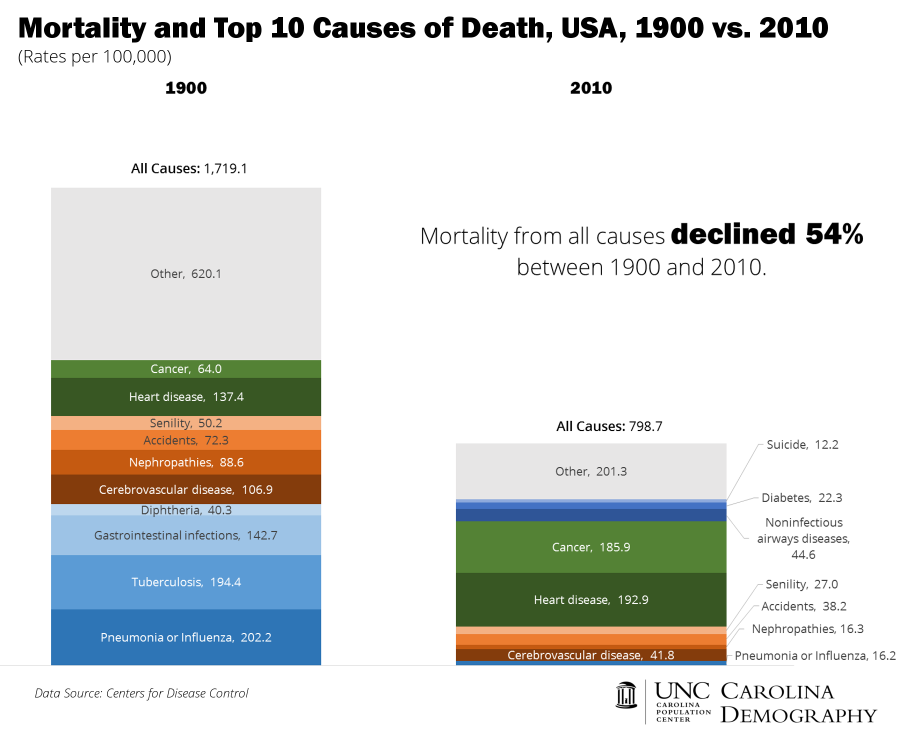
The shift from infectious diseases being the primary killers, to the vast majority of people dying from the degenerative diseases of “old age”, is precisely what happened during the latter half of the twentieth century, throughout the world. The top killers in the early 20th century were infectious diseases that have been virtually wiped out today, as this chart from the Carolina Population Center shows. (For more details, see “Mortality and Cause of Death, 1900 v. 2010” by Rebeca Tippett.) Additional major progress is evident in the 54% absolute decline in mortality from all causes during the time period between 1900 and 2010.

                Blish was foresighted enough to attempt a conceptual decoupling of chronological and biological age. Anne Abbott explains to Paige that “Old age is just the age; it’s not a thing in itself, it’s just the time of life when most degenerative diseases strike” (21). She recounts that “When the actuaries first began to notice that the degenerative diseases were on the rise, they thought that it was just a sort of side-effect of the decline of the infectious diseases. They thought that cancer was increasing because more people were living long enough to come down with it” (21). Anne then proceeds to discuss findings that some cancers are caused by viruses – which is actually the case for a minority of cancers (approximately 17.8% of cancers in 2002, as estimated by the World Health Organization). In the world portrayed by Blish, a rising incidence of degenerative diseases caused by viral infections led the National Health Service to fund research efforts by companies like Pfitzner, in an effort to address the threat.

                Incidentally, Blish also foresaw the rise in major government expenditures on medical research. Anne explains that “the result of [the first world congress on degenerative diseases] was that the United States Department of Health, Welfare and Security somehow got a billion-dollar appropriation for a real mass attack on the degenerative diseases” (22). Of course, in our world, major scientific conventions on degenerative diseases – both governmental and private – are far more routine. Indeed, a small but dynamic private organization – the SENS Research Foundation – has itself hosted six world-class conferences on rejuvenation biotechnology to date. In the United States, billions of dollars each year are indeed spent on research into degenerative diseases. The budget of the National Institute on Aging exceeds $1 billion annually (it amounts to $1,170,880,000 for Fiscal Year 2015). Unfortunately, in practice, even this level of funding – from both private and governmental sources – has thus far proven wholly insufficient to comprehensively reverse biological senescence and defeat all degenerative diseases.

                In Blish’s imagined future, the battle against senescence could be won far more easily than in our present. Pfitzner’s key project is a sweeping solution to all lifespan-limiting ailments – a broad-range “antitoxin against the aging toxin of humans” (36). In this world, Paige, who later becomes trained in Pfitzner’s research techniques, can pronounce that “We know that the aging toxin exists in all animals; we know it’s a single, specific substance, quite distinct from the ones that cause the degenerative diseases, and that it can be neutralized. […] So what you’re looking for now is not an antibiotic – an anti-life drug – but an anti-agathic, an anti-death drug” (36). If only it were that simple! Today, even the most ambitious engineering-based approach toward defeating senescence, Dr. Aubrey de Grey’s SENS program, recognizes not one but seven distinct types of aging-related damage that accumulate in the organism. Dr. de Grey’s strategy of periodically reversing the damage is more straightforward than the alternative approach of re-engineering the tremendously complex metabolic processes of the body that malfunction over time, and which are still quite incompletely understood. In Blish’s world, a single company, working covertly, with relatively modest funding (compared to the funds available to research organizations in our world), can develop an “anti-agathic” drug that does for senescence what antibiotics did for deadly infectious disease.

                Without spoiling the ending, I will only mention that it is friendly to the prospects of radical life extension and portrays it in a positive light – one additional reason for recommending that “At Death’s End” be included within the canon of proto-transhumanist and life-extensionist literary works. Furthermore, the viability of indefinite life extension in Blish’s vision is closely intertwined with humanity’s future as a spacefaring species – another progress-friendly position. Blish comes across as a thoughtful, scientifically literate (for his era) writer, who extrapolated the world-changing trends of his time to arrive at a tense, conflict-ridden, but still eminently hopeful vision for the future, where the best of human intellect and aspiration are able to overcome the perils of militarism, fundamentalism, decay, and death.

              The author of “At Death’s End” himself succumbed to death at the age of 54, on July 30, 1975. He did not live to see the world of 2000 and compare it to his prognosis. Unfortunately, Blish seems to have disregarded the tremendous harms of tobacco smoke and was even employed by the Tobacco Institute from 1962 to 1968. A genealogical profile lists Blish’s cause of death as “Recurrent cancer per smoking, metastasized.” This brilliant, forward-thinking mind unfortunately could not escape one of the most common collective delusions of his time – the fascination with and normalization of one of the least healthy habits imaginable, one that is the most statistically likely to lower life expectancy (by about 10 years). This is quite sad, as it would have been fascinating to learn how Blish’s projections for the future would have been affected by additional decades of his experience of societal and technological changes. One of the major trends in longevity improvement over the past several decades has been a major decline in the smoking rate, which decreased to an all-time low in the United States in 2013 (the latest year for which statistics are currently available). Surely, to come closer to death’s end, as many humans as possible should abandon what are now known to be obviously life-shortening habits.

              While an anti-agathic drug is not in our future, James Blish’s vision of the defeat of senescence can still serve to inspire those who endeavor to solve this colossal problem in our world, during our lifetimes. Let us hope that, through the efforts of longevity researchers and through increases in funding and public attitudinal support for their projects, we will arrive at death’s end before death ends us.

G. Stolyarov II and Franco Cortese Discuss Humankind’s Future

G. Stolyarov II and Franco Cortese Discuss Humankind’s Future

The New Renaissance Hat
G. Stolyarov II and Franco Cortese
March 6, 2015
******************************

Mr. Stolyarov invites life-extension advocate and wide-ranging future-oriented thinker Franco Cortese to discuss a broad array of ideas and possibilities regarding the future of humankind.

Apologies for the technical difficulties at the end. The conclusion of our discussion can be found here. The last several minutes of the conversation focus on how emerging technologies could help overcome current existential risks and help lead to the elimination of brutality and barbarism.

Questions addressed in the discussion include the following:

(1) What do you consider to be humankind’s best opportunities for achieving a bright future within the next several decades?
(2) What do you consider to be the greatest obstacles to the realization of such a bright future?
(3) How could such obstacles be overcome?
(4) What actions can most people take to assist in the acceleration of technological progress so as to solve, within the lifetimes of those alive today, many of the major problems currently associated with the human condition?
(5) How can virtual worlds help to improve the physical world?

Franco Cortese is Affiliate Scholar of the Institute for Ethics & Emerging Technologies, Research Scientist at ELPIs Foundation for Indefinite Lifespans, Assistant Editor of Ria University Press, Fellow of the Brighter Brains Institute, Ambassador for The Seasteading Institute, and Chief Operating Officer of the Center for Interdisciplinary Philosophic Studies.

Stolyarov_Cortese_Discussion

Adam Alonzi Interviews G. Stolyarov II on Indefinite Life Extension and “Death is Wrong”

Adam Alonzi Interviews G. Stolyarov II on Indefinite Life Extension and “Death is Wrong”

The New Renaissance Hat
G. Stolyarov II and Adam Alonzi
February 22, 2015
******************************

Today I had a pleasant and erudite discussion with Adam Alonzi regarding the feasibility and desirability of attaining indefinite longevity in our lifetimes, as well as Death is Wrong and its impact.

References

Adam Alonzi’s YouTube Channel
Adam Alonzi Reads Death is Wrong

“Death is Wrong” Rap and Book Giveaway #3 – Videos by Roen Horn

“Death is Wrong” Rap and Book Giveaway #3 – Videos by Roen Horn

This week I was delighted to find out that Death is Wrong is charting new territory once again.

This is the first rap inspired by a children’s book on indefinite life extension. Thank you to Roen Horn of the Eternal Life Fan Club!

LYRICS by Roen Horn:

I know a book that every kid should read.
Death is Wrong has the wisdom they need.

There is nothing worse than not being alive.
And if we find the cure aging then we CAN SURVIVE.

Death is wrong because life is right.
If we want to live forever , well, then we need to fight.

Death is our enemy and aging is our foe!
This book has truth that every child should know.

There is real hero named Aubrey de Grey.
If you wanna save lives, then he has the way.

Aging kills more people than any other cause,
but lucky for us we have our wizard of Oz.

Evolution doesn’t care if we live or die.
Once you get old, you’re just pushed aside.

Nothing’s gonna change unless we get mad.
If you wanna save yourself, your mom and your dad,

Here’s a little wisdom you won’t hear in church.
If you want eternal life, then we need aging research.

I think death is a FAILURE, and I don’t want to lose.
We should be able to live for as long as we choose!

The world should admit that aging really sucks.
Until we cure aging, we’re all like sitting ducks.

We have no time to waste, so let’s get busy like the bees.
We gotta make haste to avoid disease.

The cure is gonna come, but will it come in time for us?
Our eternal life is way too important to miss this bus.

Eternal life fans know that we have to persist.
Because our life is meaningless if we CEASE TO EXIST.

***

Roen has also done magnificent work giving away copies of Death is Wrong to children and filming the occasions.

Watch this skillfully produced video by Roen – the third in his series.

What Did Not Have to Be – Short Story by G. Stolyarov II

What Did Not Have to Be – Short Story by G. Stolyarov II

The New Renaissance Hat
G. Stolyarov II
February 11, 2015
******************************

This short story was the winning entry in Transhumanity.net’s 2033 Immortality Fiction Contest in January 2013.

I visited the Neo-Luddite village on January 13, 2033, to deliver the weekly shipment of microchips. The Neo-Luddites are particular. They refuse any chip made after 2005, so obtaining components fitting their specifications becomes harder every year.

My parents tell me that, when they were my age, everyone lived like the Neo-Luddites do today. I downloaded plenty of history about this period, but I could not comprehend how anyone could live that way. I wanted to see it myself. This interested me in the work-study program at my ecollege. The ecollege AI maintains a sophisticated registry of supply and demand, connecting goods to customers. Even the Neo-Luddites participate: their Head Elder emails the AI a list of desired goods. The AI obliges them by locating items meeting their restrictions.

I pick up the goods discovered by the AI and fly them to the Neo-Luddites. Then I spend a few hours in the Neo-Luddite village, setting up their computers in their “traditional” schools and hospitals: quaint rooms with row after row of austere chair-desks and bunk beds.

I landed my hovercar in the parking lot outside the Neo-Luddite territory and waited for Joshua’s ground-car to arrive. The Neo-Luddites shun flying or self-driving vehicles. Within their boundaries, all transportation must be manually operated.

Joshua is my age. He is nearing his eighteenth birthday, when Neo-Luddite adulthood begins. Every Neo-Luddite, upon reaching that age, may choose to remain in the Neo-Luddite community or join the broader technological world.  During my past several visits, I have sensed both increasing nervousness and curiosity from him.

“So, Prometheus,” said Joshua once I was seated, “you wanted to see more of Neo-Luddite life. There’s one place I want to show you. I usually don’t go there, but it needs cleaning. Head Elder Timothy asked me to wash the gravestones. You can help, if you like. The cemetery is on the way.”

I agreed, and Joshua turned onto a side road. The cemetery soon stretched before us, triangular, with the point closest to us. Joshua parked the ground-car, then handed me some rags and old-fashioned cleaning supplies. The rows of graves widened as we proceeded. I realized that the Neo-Luddites arranged their graves in reverse-chronological order. The gravestones really did need cleaning – particularly the back rows.

“There aren’t many of us anymore to maintain the cemetery,” Joshua explained. “Most of the original community founders have died. Timothy is the only founding elder alive today. My grandfather used to be Head Elder, but he died last year. Brain cancer.”

“Brain cancer was cured back in 2025!” I exclaimed. “His death was preventable!” But then, all death is preventable now. It is harder to treat the already-senesced – and the Neo-Luddites oppose rejuvenation – but even Joshua’s grandfather could have been saved.

“He was 93,” Joshua said. “Our doctors tried their best, but he lived a long and fruitful life. There were other patients of higher priority to treat.” I know 93-year-olds who would disagree – who are still in ecollege studying one discipline or another, and who outran me at our weekly ultramarathons.

I was curious: “Aren’t large families a major goal in your community? You compensate for your individual mortality by having lots of children to perpetuate your genetic heritage and community traditions.”

“True,” replied Joshua. “But your world’s enticements are strong. Many leave upon turning eighteen. Even some older members have left. My great-uncle Robert looked my age when he visited my grandfather on his deathbed. They were alone for a while; then Robert came out shaking his head. ‘He wouldn’t let me save him,’ was all I heard before he left.”

“Are you considering leaving?” I asked.

“I’ve thought about it,” replied Joshua. “But our community teachings all oppose it. Eternal boredom, overpopulation, loss of essential humanity – we Neo-Luddites resist this.”

“But none of these have occurred!” I was surprised to hear him seriously articulate such old anti-longevity superstitions. “Do I look any less human to you?”

“Well, not superficially, but you have nanobots in your bloodstream, and your bones are unlike our bones.”

“But does that make me less human, or does it amplify my humanity? We are, after all, communicating as two intelligent beings, two friends – perhaps.”

He paused to think. “You’re unusual for your kind. You willingly try to understand us. But I know you live differently in your world. You download information instead of reading it; you have computer memory in your head. You believe you can learn anything and do anything. We have time for only a single vocation, which defines our identities.”

Before I could respond, we noticed a hooded figure, crouching at a gravestone several rows ahead. I magnified my vision to catch the inscription: “Anna Blomgren: 1955-2015”. This person died the year I was born, and she was only sixty!

The figure noticed us and turned around. I saw the deeply wrinkled face of a senesced man in his eighties. His eyes shimmered, not just with life and intelligence, but with tears. He spoke: “Joshua, come closer. See what grief looks life. Anna died because our era’s medicine could not save her. In my despair, I had to find meaning in her death. I told myself that death was natural and good, part of the life cycle. How else could such a wonderful, loving person be taken so early?”

“Head Elder, I had no idea…” Joshua began.

The elder’s piercing stare encompassed us both. “Look at me, Joshua, and see your future – if you stay. You, too, will know grief and loss. I asked you to come here for a reason. This is a test: do you accept our way of life, with all its concomitant suffering? If you stay and raise a Neo-Luddite family, then one day, you, too, will be here, weeping over a grave. If you do not want this, go back with him.”

“But don’t you want me to stay?” Joshua asked, incredulous.

You must decide,” Timothy replied. “My time is almost done; humanity’s time will be forever. I had my reasons; I resisted the future – but soon I will be no more, and the future is already here.”

I was puzzled. “You just need to visit any clinic for rejuvenation therapy. You can be young again, and have indefinite life. Why not, if you are dissatisfied now?”

“It is hardest to face what did not have to be. I lost Anna because I couldn’t save her, but in my grief I convinced others to die unnecessarily. I cannot undermine their sacrifice by avoiding myself the end I led them to. But you can escape. You have your whole life ahead of you. Go!”

We left Timothy to grieve in the graveyard. Joshua flew to the city with me. I messaged a nearby clinic that a senesced man might request assistance soon. He needed only to express the desire in earnest, and a hovercraft would transport him there in minutes. Two weeks later, the clinic still has received no request.

How Can We Accelerate Technological Progress? – Panel Discussion with G. Stolyarov II, Demian Zivkovic, and Arash Amini

How Can We Accelerate Technological Progress? – Panel Discussion with G. Stolyarov II, Demian Zivkovic, and Arash Amini

The New Renaissance Hat
G. Stolyarov II, Demian Zivkovic, and Arash Amini
January 24, 2015
******************************

Mr. Stolyarov invites panelists to offer their thoughts on the following question:

What actions can most people take to assist in the acceleration of technological progress so as to solve, within the lifetimes of those alive today, many of the major problems currently associated with the human condition?

Panelists

Demian Zivkovic, 23 years old, is a student of artificial intelligence and philosophy, and founder and president of the Arma’thwynn Society – an international transhumanist think tank comprised of a group of transhumanism-oriented professionals, students, and entrepreneurs interested in the interdisciplinary approach to advancing transhumanist technologies.

Demian has been involved in several endeavors, including interviewing Professor Aubrey de Grey, organizing a transhumanism lecture in The Netherlands now, and spreading “Death is Wrong” – Mr. Stolyarov’s illustrated children’s book on indefinite life extension – in The Netherlands.

***

Arash Amini earned a BS Physics degree from UIC. Since his time at college, Arash was focused on scaling cleantech innovations as far and wide as he could manage.

Thus his affection for the private venture- the vehicle he believes moves information and goods faster than any other available.

While in his last semester at college, Amini started a 312 Aquaponics and went to research and develop industrial scale vertical farming. His latest venture, FarmTower Co is personalizing farming- bringing the site of production to the site of consumption.

He is the author of “DIY Aquaponics: The Definitive How To Guide” and curator of www.diyaquaponicsdesign.info.

In addition, Amini helps startups market their ideas, and grow their revenues without the need of investors. He spends his time ideating solutions to the world’s largest problems.

References

SENS Research Foundation
– “Metformin” – Wikipedia
– “Spontaneous order” – Wikipedia

Review of Robert Wilfred Franson’s “The Shadow of the Ship” – Article by G. Stolyarov II

Review of Robert Wilfred Franson’s “The Shadow of the Ship” – Article by G. Stolyarov II

The New Renaissance Hat
G. Stolyarov II
January 17, 2015
******************************
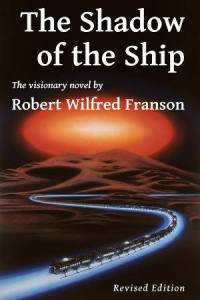
Shadow_of_the_Ship_Cover

               The Shadow of the Ship by Robert Wilfred Franson is a science-fiction novel set in a universe with a unique premise for methods of interstellar travel. A novel with strong individualist and life-extensionist themes, this book has much to recommend itself to libertarians and transhumanists alike. The Second Edition of The Shadow of the Ship was released in Kindle format in December 2014, after Franson regained the rights to the work from the publisher of the 1983 First Edition. The Second Edition contains major enhancements, including more extensive character development, explanation of key aspects of the world within which the novel takes place, and an ending that clearly sets the stage for additional books in what is to be Franson’s Overflight series.

                Space travel in The Shadow of the Ship is accessible to a society that is otherwise technologically far behind our own. The Trails Culture is dispersed among tens of worlds but lacks access even to most twentieth-century technology, such as powered flight or electricity. A series of trails across the “meadow” of subspace connects planets and can be traversed by caravans conveyed by waybeasts (squeakers) who are uniquely suited to crossing them. The book’s protagonist, Hendrikal Eiverdein Rheinallt, is originally from Earth and has been stranded within the region inhabited by the Trails Culture ever since his spaceship crashed on a nearby world. He and his friend Arahant, an intelligent aircat with the ability to speak and compose operas, are “bloodswayers” – practitioners of a rare and challenging discipline that allows the channeling of the body’s energies toward repair and rejuvenation. Rheinallt and Arahant are therefore indefinitely lived and more resilient than ordinary humans, though not indestructible. Rheinallt is approximately six centuries old and endeavors to use his vast scientific knowledge to eventually find his way back to Earth. In the meantime, he carefully advances the scientific and technical knowledge of the inhabitants of the Blue Free Nation, the most tolerant and least regimented of the societies within the Trails Culture.

                The book’s events take place aboard a caravan headed by Rheinallt with the purpose of investigating rumors of a crashed starship along the Blue Trail. The starship would be a paradigm-changing find for the people of the Trails Culture, as it would permit space travel without the limitations that the Trails pose; it could also be Rheinallt’s means to return home. The caravan includes many travelers who join out of scientific curiosity or a desire for fame, while others have more personal motives. Accompanying Rheinallt is his wife and beast-master Whitnadys, as well as a small contingent of crew to defend the caravan and provide essential logistical support. Although Rheinallt is the captain of the caravan, interactions aboard are largely guided by a spontaneous order without explicit laws and with virtually no authority for the captain to impose preemptive restrictions or discipline. Rheinallt, apart from making sure that the caravan is properly organized and maintained, only has the same prerogatives as ordinary passengers – such as the right of self-defense and the ability to protect the caravan against threats that have already manifested themselves. He considers the circumstances carefully and is reluctant to resort to force unless the existence of a physical threat is incontrovertible, as he does not wish for the passengers to lose trust in his leadership or the legitimacy of his decisions.

                Apart from the mostly anarchistic order aboard the caravan – a reflection of the broader lack of centralized authority within the Blue Free Nation – there are competing visions presented in the book, including an attempt by the Federated Trailmen, the area’s guild of caravaneers, to bring subspace travel within their sphere of control, as well as the efforts by the government of Fleurage – a world on the Yellow Trail – to clamp down on political dissent and quash “subversive” innovators who threaten an establishment rapidly spiraling toward totalitarianism. Various passengers on the caravan represent these conflicting visions, which come to challenge Rheinallt’s ability to peacefully coordinate the expedition.

                As much of the novel centers around the mystery of the ship and the stories of the passengers aboard, I will not delve into too much detail regarding events that are crucial to the story’s suspense and surprise. I note, however, that the Second Edition contains significant additions, including thorough expositions of the main characters’ backgrounds and key aspects of Franson’s universe – such as subspace travel, the bloodswayer discipline, and the cultural and technological environment of the Trails Culture. The newly added content allows for foreshadowing of important discoveries and a more definitive elaboration on the threads of the story that would be continued in subsequent novels of the series. Furthermore, the revised ending is quite moving and immerses the reader more deeply into the novel’s characters.

                Indeed, the characters of Rheinallt and Arahant should be of interest to all supporters of indefinite life extension, as here we have fine examples of literary protagonists who do not senesce and are not condemned to an inevitable demise – and who are also intelligent, rational, benevolent, witty, creative, and resourceful. Their range of abilities and vulnerabilities is much closer to what actual indefinitely lived organisms would experience: they can still suffer from accidents and external physical harm, but they lack a built-in expiration. Therefore, their interactions in the environment of subspace are still fraught with peril, but they have sufficient abilities and strengths to give them a fighting chance – much like the fighting chance we humans will need when faced with the many phenomena in the universe that are far bigger than ourselves. The more positive examples of protagonists with unlimited lifespans arise in fiction, the greater will be the cultural acceptance of the idea’s eventual application to our world. For this reason and many others, readers should eagerly anticipate the continuation of Franson’s Overflight series, which will finally bring the universe and ideas of The Shadow of the Ship into renewed prominence after more than three decades.

“Death is Wrong” Reviewed by Robert W. Franson of Troynovant

“Death is Wrong” Reviewed by Robert W. Franson of Troynovant

Read the excellent new review by science-fiction author and literary essayist Robert W. Franson of Death is Wrong. The review is published on Mr. Franson’s website Troynovant, which offers extensive literary and philosophical analysis.

Here is an excerpt: “Death is Wrong is a short book, clearly written and easy to read. I like the personal approach: it doesn’t talk down and is quite accessible. A striking concept presented quite reasonably and supported matter-of-factly. There are apt quotations from a variety of thinkers, including several of my personal heroes of modern times: Francis Bacon, Benjamin Franklin, Friedrich Nietzsche. These people and some scenes from nature are nicely illustrated by Wendy Stolyarov. For readers who want a little more about the background concepts, there is a brief Appendix discussing the seven basic causes of senescence, such as cell loss and atrophy. There are some links for further learning. It’s a good book, entertaining and thoughtful, and certainly gives us a challenge to think about.